




NCERT Class 8 Science Chapter 4 Electricity Magnetic and Heating Effects Notes help students revise magnetic effect of current, electromagnets, heating effect, dry cells, rechargeable batteries and safe battery disposal for the 2026-27 NCERT Curiosity textbook.
- Best for quick revision: covers compass deflection, electromagnets, nichrome heating, Voltaic cells, dry cells and rechargeable batteries.
- Useful for classwork: includes comparison tables, cause-effect chains, safety notes and answer-writing frames.
- Free PDF: download the full chapter notes with diagrams, tables, memory boxes and one-page revision summaries.
Chapter4Electricity:MagneticandHeatingEffectsNotes.pdf?page=1&dpi=150)
Chapter4Electricity:MagneticandHeatingEffectsNotes.pdf?page=2&dpi=150)
Chapter4Electricity:MagneticandHeatingEffectsNotes.pdf?page=3&dpi=150)
Chapter4Electricity:MagneticandHeatingEffectsNotes.pdf?page=4&dpi=150)
Chapter4Electricity:MagneticandHeatingEffectsNotes.pdf?page=5&dpi=150)
Chapter4Electricity:MagneticandHeatingEffectsNotes.pdf?page=6&dpi=150)
Chapter4Electricity:MagneticandHeatingEffectsNotes.pdf?page=7&dpi=150)
Chapter4Electricity:MagneticandHeatingEffectsNotes.pdf?page=8&dpi=150)
Chapter4Electricity:MagneticandHeatingEffectsNotes.pdf?page=9&dpi=150)
Chapter4Electricity:MagneticandHeatingEffectsNotes.pdf?page=10&dpi=150)
Chapter4Electricity:MagneticandHeatingEffectsNotes.pdf?page=11&dpi=150)
Chapter4Electricity:MagneticandHeatingEffectsNotes.pdf?page=12&dpi=150)
Chapter4Electricity:MagneticandHeatingEffectsNotes.pdf?page=13&dpi=150)
Chapter4Electricity:MagneticandHeatingEffectsNotes.pdf?page=14&dpi=150)
Chapter4Electricity:MagneticandHeatingEffectsNotes.pdf?page=15&dpi=150)
Chapter4Electricity:MagneticandHeatingEffectsNotes.pdf?page=16&dpi=150)
Chapter4Electricity:MagneticandHeatingEffectsNotes.pdf?page=17&dpi=150)
Chapter4Electricity:MagneticandHeatingEffectsNotes.pdf?page=18&dpi=150)
Chapter4Electricity:MagneticandHeatingEffectsNotes.pdf?page=19&dpi=150)
Chapter4Electricity:MagneticandHeatingEffectsNotes.pdf?page=20&dpi=150)
Chapter4Electricity:MagneticandHeatingEffectsNotes_flat_MobileCard.pdf?page=1&dpi=150)
Chapter4Electricity:MagneticandHeatingEffectsNotes_flat_MobileCard.pdf?page=2&dpi=150)
Chapter4Electricity:MagneticandHeatingEffectsNotes_flat_MobileCard.pdf?page=3&dpi=150)
Chapter4Electricity:MagneticandHeatingEffectsNotes_flat_MobileCard.pdf?page=4&dpi=150)
Chapter4Electricity:MagneticandHeatingEffectsNotes_flat_MobileCard.pdf?page=5&dpi=150)
Chapter4Electricity:MagneticandHeatingEffectsNotes_flat_MobileCard.pdf?page=6&dpi=150)
Chapter4Electricity:MagneticandHeatingEffectsNotes_flat_MobileCard.pdf?page=7&dpi=150)
Chapter4Electricity:MagneticandHeatingEffectsNotes_flat_MobileCard.pdf?page=8&dpi=150)
Chapter4Electricity:MagneticandHeatingEffectsNotes_flat_MobileCard.pdf?page=9&dpi=150)
Chapter4Electricity:MagneticandHeatingEffectsNotes_flat_MobileCard.pdf?page=10&dpi=150)
Chapter4Electricity:MagneticandHeatingEffectsNotes_flat_MobileCard.pdf?page=11&dpi=150)
Chapter4Electricity:MagneticandHeatingEffectsNotes_flat_MobileCard.pdf?page=12&dpi=150)
Chapter4Electricity:MagneticandHeatingEffectsNotes_flat_MobileCard.pdf?page=13&dpi=150)
Chapter4Electricity:MagneticandHeatingEffectsNotes_flat_MobileCard.pdf?page=14&dpi=150)
Chapter4Electricity:MagneticandHeatingEffectsNotes_flat_MobileCard.pdf?page=15&dpi=150)
Chapter4Electricity:MagneticandHeatingEffectsNotes_flat_MobileCard.pdf?page=16&dpi=150)
Chapter4Electricity:MagneticandHeatingEffectsNotes_flat_MobileCard.pdf?page=17&dpi=150)
Chapter4Electricity:MagneticandHeatingEffectsNotes_flat_MobileCard.pdf?page=18&dpi=150)
Chapter4Electricity:MagneticandHeatingEffectsNotes_flat_MobileCard.pdf?page=19&dpi=150)
Chapter4Electricity:MagneticandHeatingEffectsNotes_flat_MobileCard.pdf?page=20&dpi=150)
Chapter4Electricity:MagneticandHeatingEffectsNotes_flat_MobileCard.pdf?page=21&dpi=150)
Chapter4Electricity:MagneticandHeatingEffectsNotes_flat_MobileCard.pdf?page=22&dpi=150)
Chapter4Electricity:MagneticandHeatingEffectsNotes_flat_MobileCard.pdf?page=23&dpi=150)
Chapter4Electricity:MagneticandHeatingEffectsNotes_flat_MobileCard.pdf?page=24&dpi=150)
Chapter4Electricity:MagneticandHeatingEffectsNotes_flat_MobileCard.pdf?page=25&dpi=150)
Chapter4Electricity:MagneticandHeatingEffectsNotes_flat_MobileCard.pdf?page=26&dpi=150)
Chapter4Electricity:MagneticandHeatingEffectsNotes_flat_MobileCard.pdf?page=27&dpi=150)
Chapter4Electricity:MagneticandHeatingEffectsNotes_flat_MobileCard.pdf?page=28&dpi=150)
Chapter4Electricity:MagneticandHeatingEffectsNotes_flat_MobileCard.pdf?page=29&dpi=150)
Chapter4Electricity:MagneticandHeatingEffectsNotes_flat_MobileCard.pdf?page=30&dpi=150)
Chapter4Electricity:MagneticandHeatingEffectsNotes_flat_MobileCard.pdf?page=31&dpi=150)
Chapter4Electricity:MagneticandHeatingEffectsNotes_flat_MobileCard.pdf?page=32&dpi=150)
Student Feedback: In a Collegedunia poll of 12,400 Class 8 students, most students found this chapter easier after separating it into magnetic effect, heating effect and battery chemistry blocks.
|
Table of Contents |
Electricity Magnetic and Heating Effects Notes Overview
Electricity Magnetic and Heating Effects explains three linked ideas. Electric current can produce a magnetic field, current can heat a conductor, and chemical reactions inside a cell can generate current. The notes PDF follows the NCERT order, so students can move from classroom activities to short exam answers without missing the textbook sequence.
These Class 8 Science Chapter 4 notes are curated according to the 2026-27 NCERT Curiosity textbook and focus on the exact definitions, activities and reasoning questions students need for school exams.
Electricity Magnetic and Heating Effects Video Lesson
Source: Magnet Brains on YouTube
Magnetic Effect of Electric Current in Class 8 Science Chapter 4
The magnetic effect begins with a simple compass activity. When current flows through a nearby wire, the compass needle deflects. When current stops, the needle returns. This proves that current in a conductor produces a magnetic field around it.
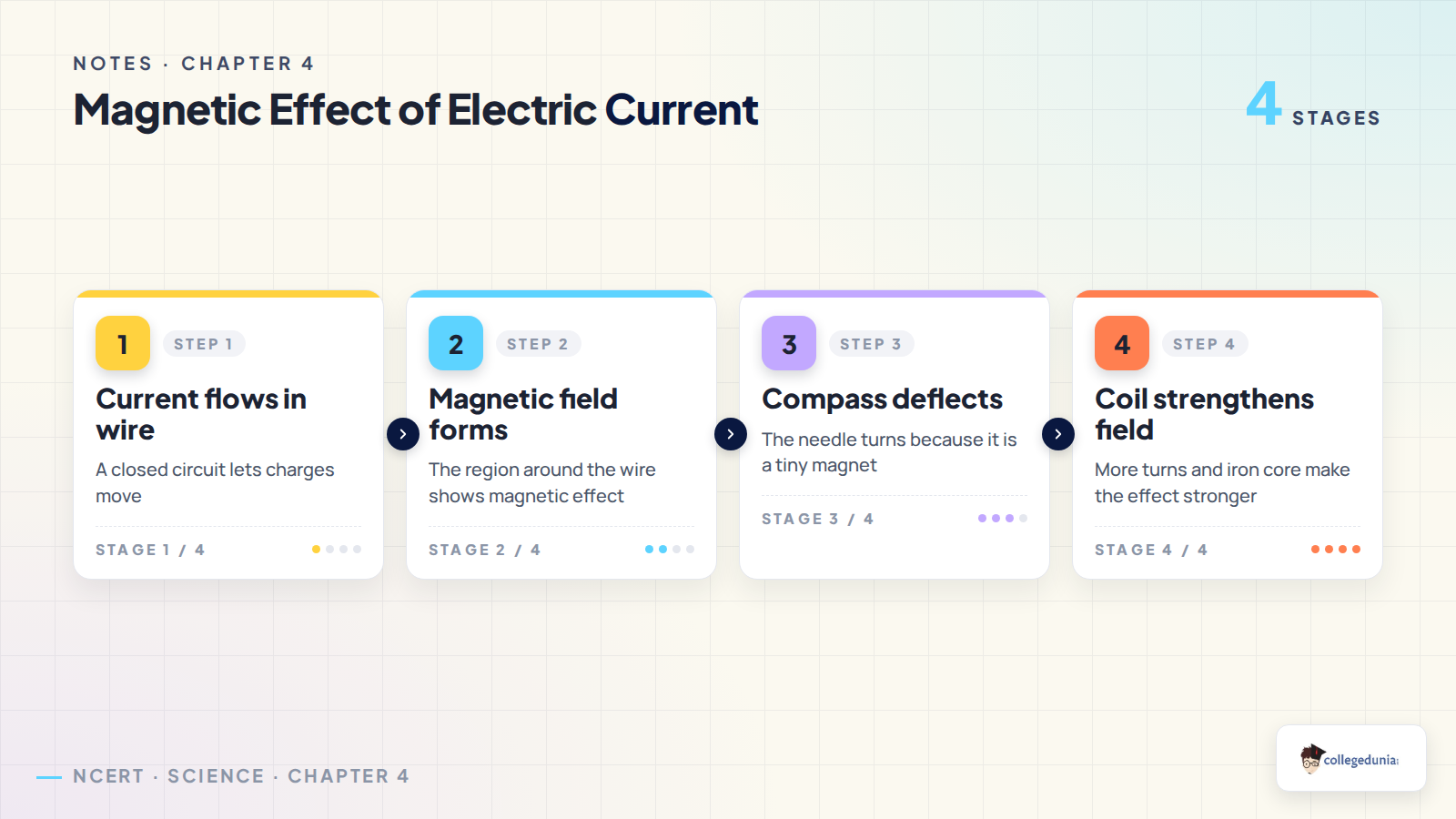
- Current ON: the wire produces a magnetic field.
- Current OFF: the magnetic effect disappears.
- Compass needle: it works as a small magnet and detects the field.
Electromagnets and Lifting Cranes in Electricity Magnetic and Heating Effects
An electromagnet is a current carrying coil that behaves like a magnet. The coil becomes stronger when it has more turns, more current or an iron core. Its poles can also reverse when the direction of current is reversed.
| Change made | Effect on electromagnet | Revision clue |
|---|---|---|
| More cells used safely | More current can flow | Stronger compass deflection |
| More turns in coil | Magnetic field becomes stronger | More clips may be lifted |
| Iron nail inserted | Core strengthens the coil's field | Practical electromagnet |
| Battery terminals reversed | Poles reverse | Compass deflects the other way |
Heating Effect of Electric Current in Class 8 Science Notes
The heating effect happens because a conductor offers resistance to current. Some electrical energy changes into heat energy. Nichrome is used in heating elements because it has high resistance and can become hot without burning easily.
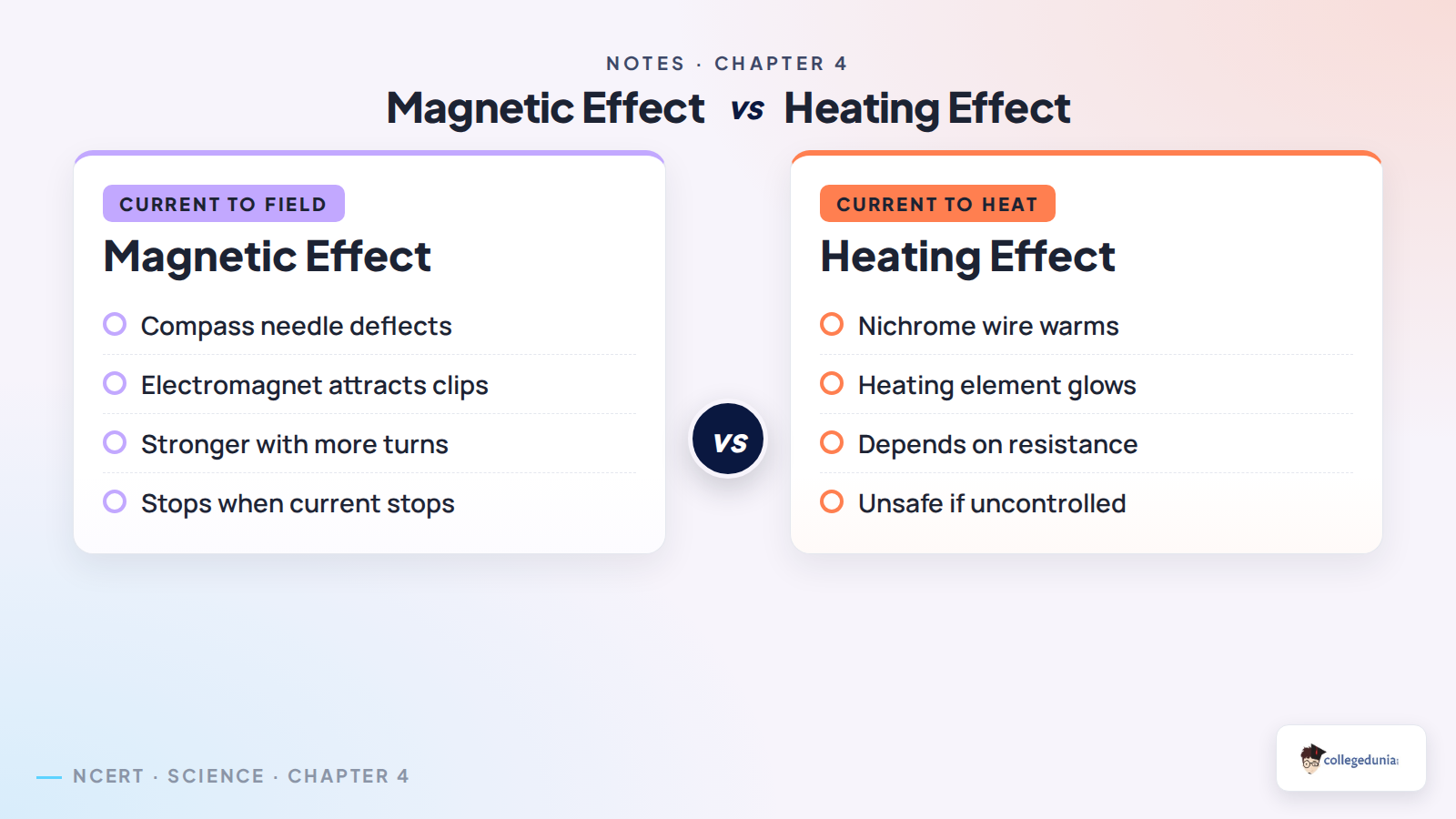
Nichrome wire, not copper wire, is the usual heater-wire answer because copper is better suited for connections, while nichrome is better suited for producing heat.
Cells Batteries and Chemical Electricity in Chapter 4
A Voltaic cell has two different electrodes dipped in an electrolyte. The chemical reaction between electrodes and electrolyte produces electricity. In a lemon cell, copper and iron act as electrodes, while lemon juice acts as the electrolyte.
| Cell or battery | Key feature | Example clue |
|---|---|---|
| Voltaic cell | Two electrodes in liquid electrolyte | Lemon cell activity |
| Dry cell | Moist paste electrolyte | Torch cell or remote cell |
| Rechargeable battery | Can be charged and reused many times | Phone, laptop, inverter or electric vehicle |
Electricity Magnetic and Heating Effects Important Comparisons
| Point | Magnetic effect | Heating effect |
|---|---|---|
| What current does | Produces a magnetic field | Produces heat in a conductor |
| Best observation | Compass deflection or iron clip attraction | Warm nichrome wire or glowing element |
| Common device | Electromagnet, crane, electric bell | Heater, kettle, iron, hair dryer |
| Safety point | Do not keep coil connected too long | Do not touch heated wire for long |
Class 8 Science Chapter 4 Safety and Environment Notes
Safety questions from this chapter often ask students to connect science with daily life. Wires can overheat if the circuit is left ON for too long. Used batteries may still contain acids and metals, so they should go to proper e-waste or battery collection points.
- Heating circuit: use it only under teacher supervision.
- Household wiring: use suitable wires, plugs and sockets for the expected current.
- Battery disposal: recycle used batteries instead of throwing them into regular waste.
Electricity Magnetic and Heating Effects Related Resources
| Resource | Link |
|---|---|
| NCERT Book PDF | Class 8 Science Chapter 4 NCERT Book PDF |
| Class 8 Science Hub | Class 8 Science Curiosity All Chapters |
Class 8 Science Curiosity Notes for All Chapters
| Chapter | Notes |
|---|---|
| Chapter 1 | Exploring the Investigative World of Science Notes |
| Chapter 2 | The Invisible Living World Beyond Our Naked Eye Notes |
| Chapter 3 | Health The Ultimate Treasure Notes |
| Chapter 4 | Electricity Magnetic and Heating Effects Notes |
Student Doubts on Class 8 Science Chapter 4
Electricity Magnetic and Heating Effects Class 8 Notes FAQs
Ques. What is the magnetic effect of electric current?
Ans. When current flows through a conductor, it produces a magnetic field around it. A compass needle can detect this field by deflecting.
Ques. What is an electromagnet in Class 8 Science Chapter 4?
Ans. An electromagnet is a current carrying coil that behaves like a magnet. It becomes stronger with more turns, more current and an iron core.
Ques. Why is nichrome used in electrical heating devices?
Ans. Nichrome has high resistance and can become hot without burning easily, so it is used in heater coils, irons and other heating elements.
Ques. Where can I download Class 8 Science Chapter 4 notes PDF?
Ans. Students can download the free PDF from this page using the PDF card above the article body.



Comments