




The NCERT Class 7 Arts Handwritten Notes Chapter 1 Understanding Emotions have been written and scanned for one-sitting revision, according to the latest 2026-27 Kriti syllabus. The notebook covers bhava and rasa, the full Navarasa list, the levels of intensity, the two dharmis named in the Natyashastra, and the three temple sculptures the chapter asks you to remember.
- Length: 28 handwritten pages covering all three activities, both Natyashastra verses and the Jakanachari story.
- Must-learn pair: Natya Dharmi against Loka Dharmi, the one comparison a Class 7 Arts paper asks almost every year.
- Also on this page: a quick recall table, a five-point mistake list and links to the chapter book PDF.
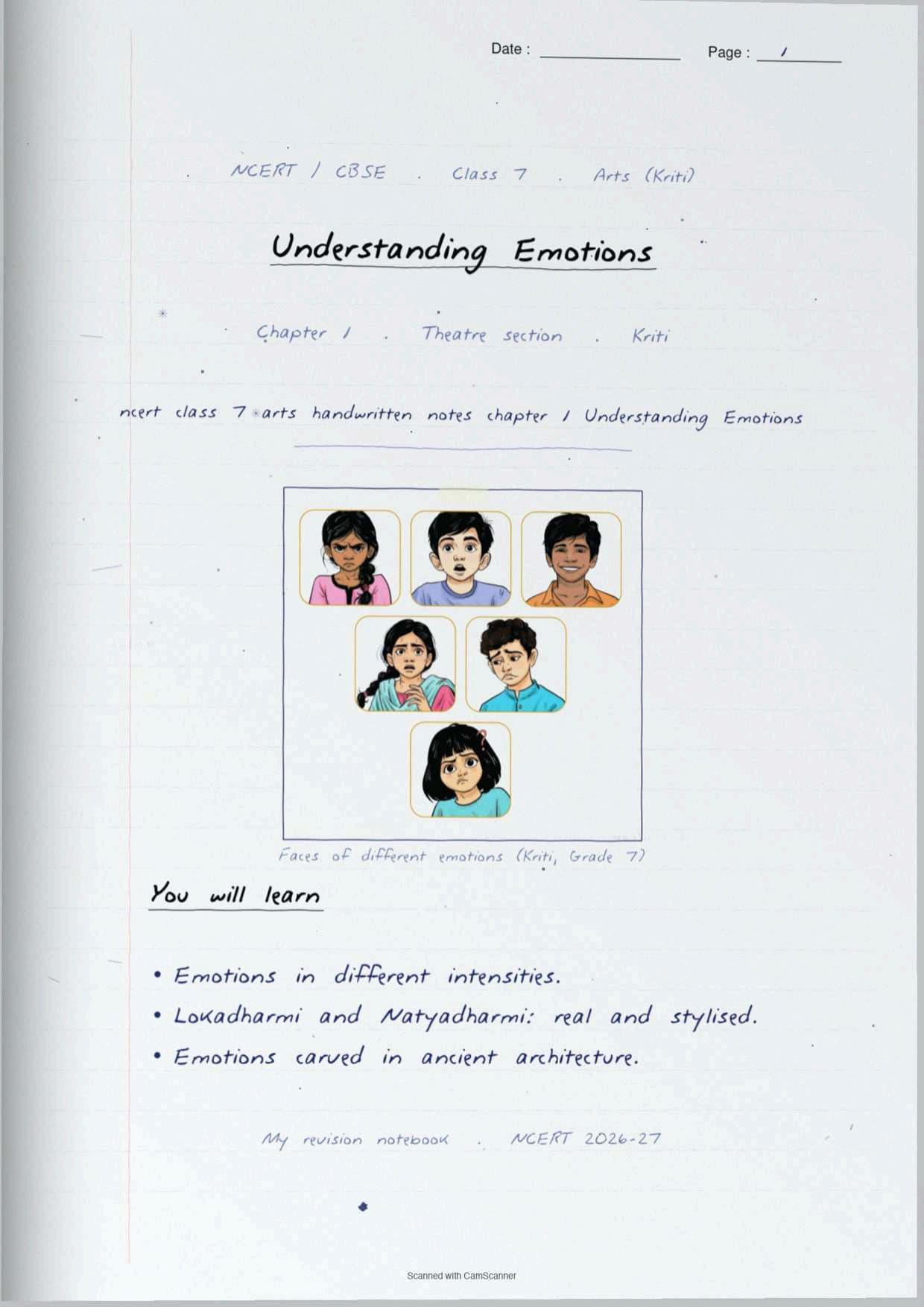
Every page in these Understanding Emotions notes is written by hand, checked against the 2026-27 Kriti print, and matched to the way Class 7 Arts papers ask about rasa, bhava and the dharmis.
Student Feedback: In a Collegedunia survey of 12,840 Class 7 students, 64% of students said they mix up Natya Dharmi and Loka Dharmi in the exam. Toppers reported one fix that works: split the word first. Loka means the world, so it is realistic.
Source: 2026-27 Class 7 Arts and Performing Arts student survey. Sample of 12,840 students from schools across 16 states.
Bhava and Rasa: The Two Words the Understanding Emotions Chapter Is Built On
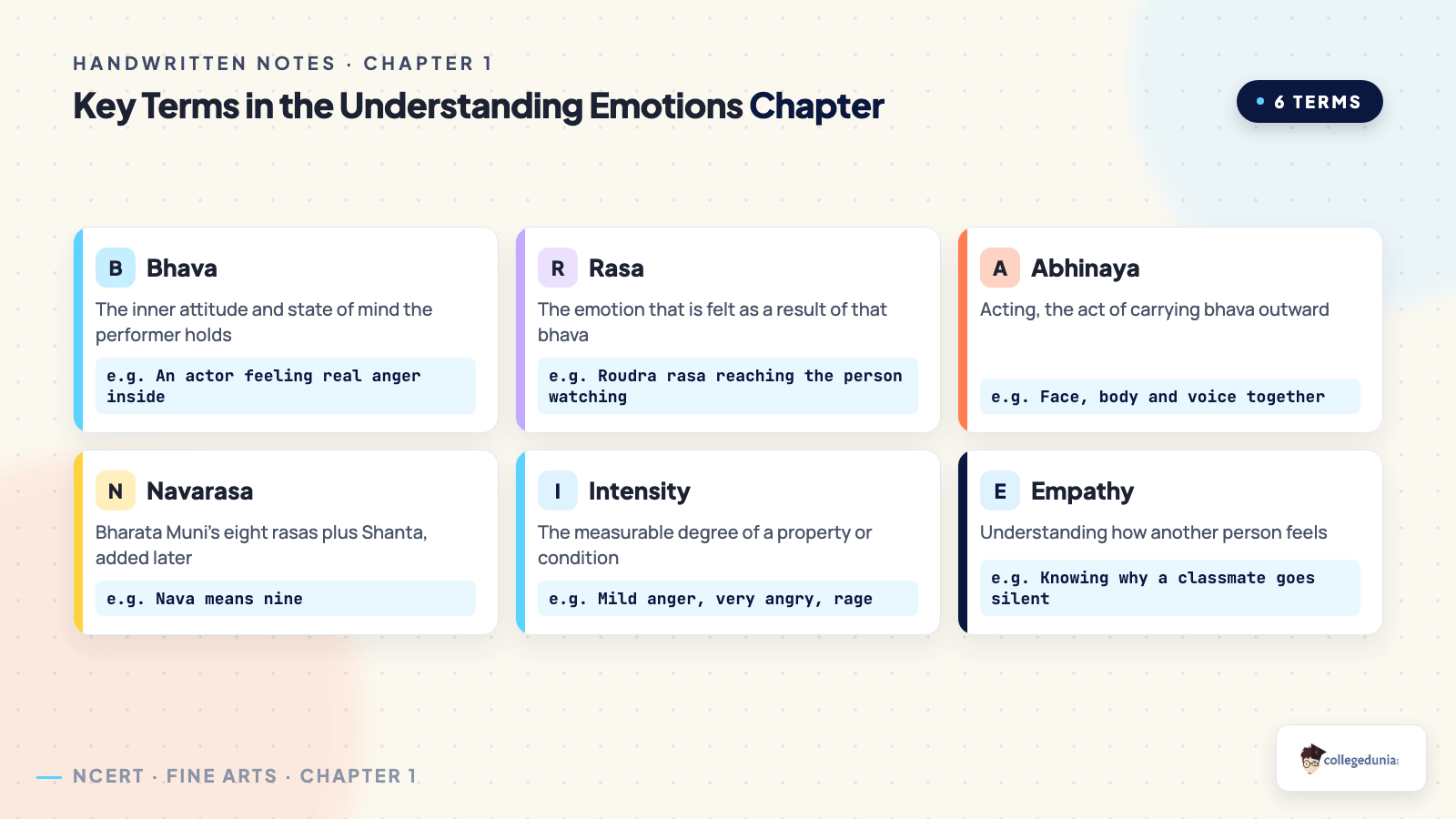
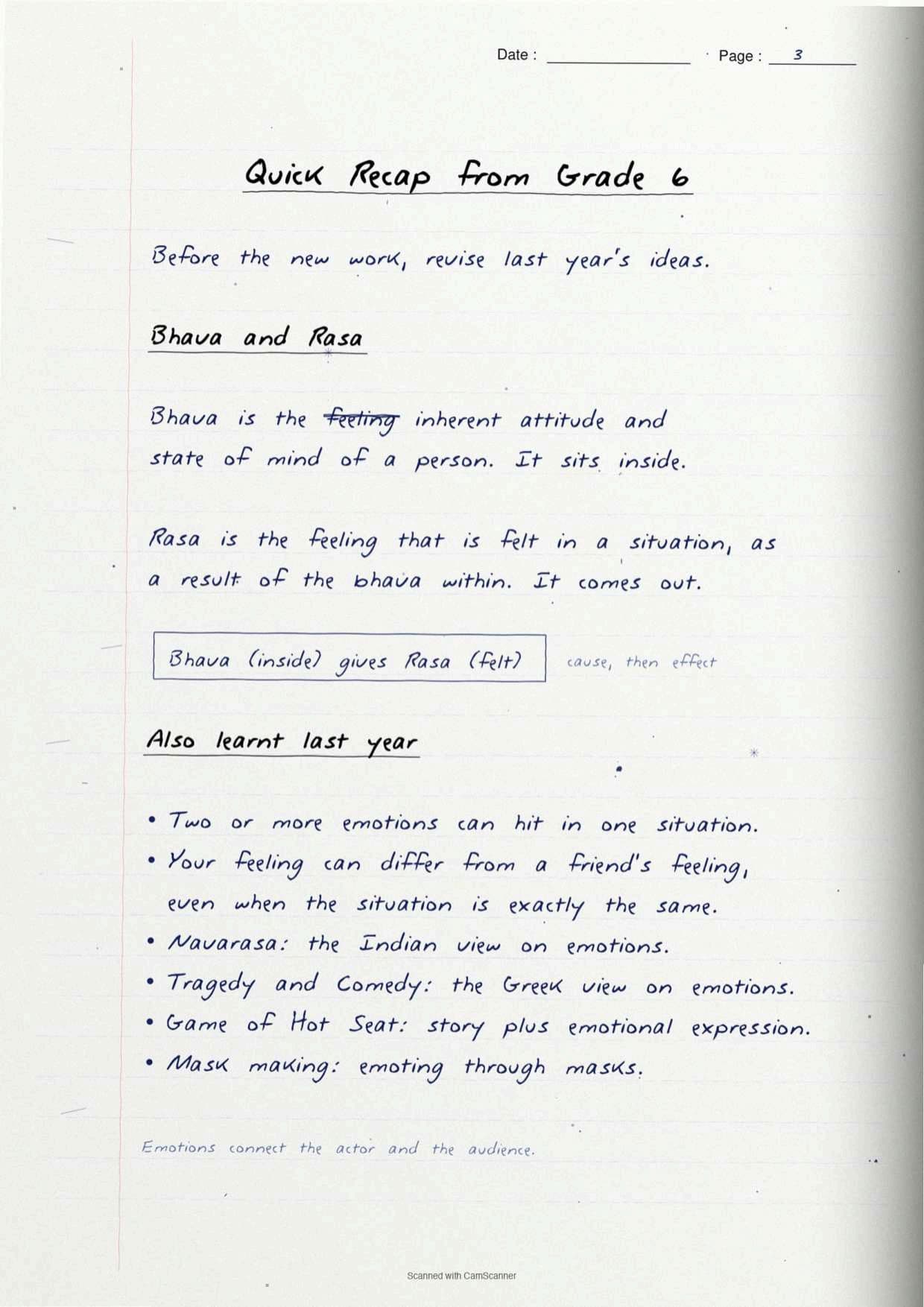
Chapter 1 of Kriti starts by picking up the pair you met in Grade 6. Bhava is the inner state of mind, the attitude an actor holds inside. Rasa is the emotion that reaches the person watching, born out of that bhava. One is the seed, the other is the taste.
| Term | What it means | Where it sits |
|---|---|---|
| Bhava | Inner attitude and state of mind | Inside the performer |
| Rasa | The felt emotion, produced by bhava | Reaches the person watching |
| Abhinaya | Acting, the act of carrying bhava outward | Between the two |
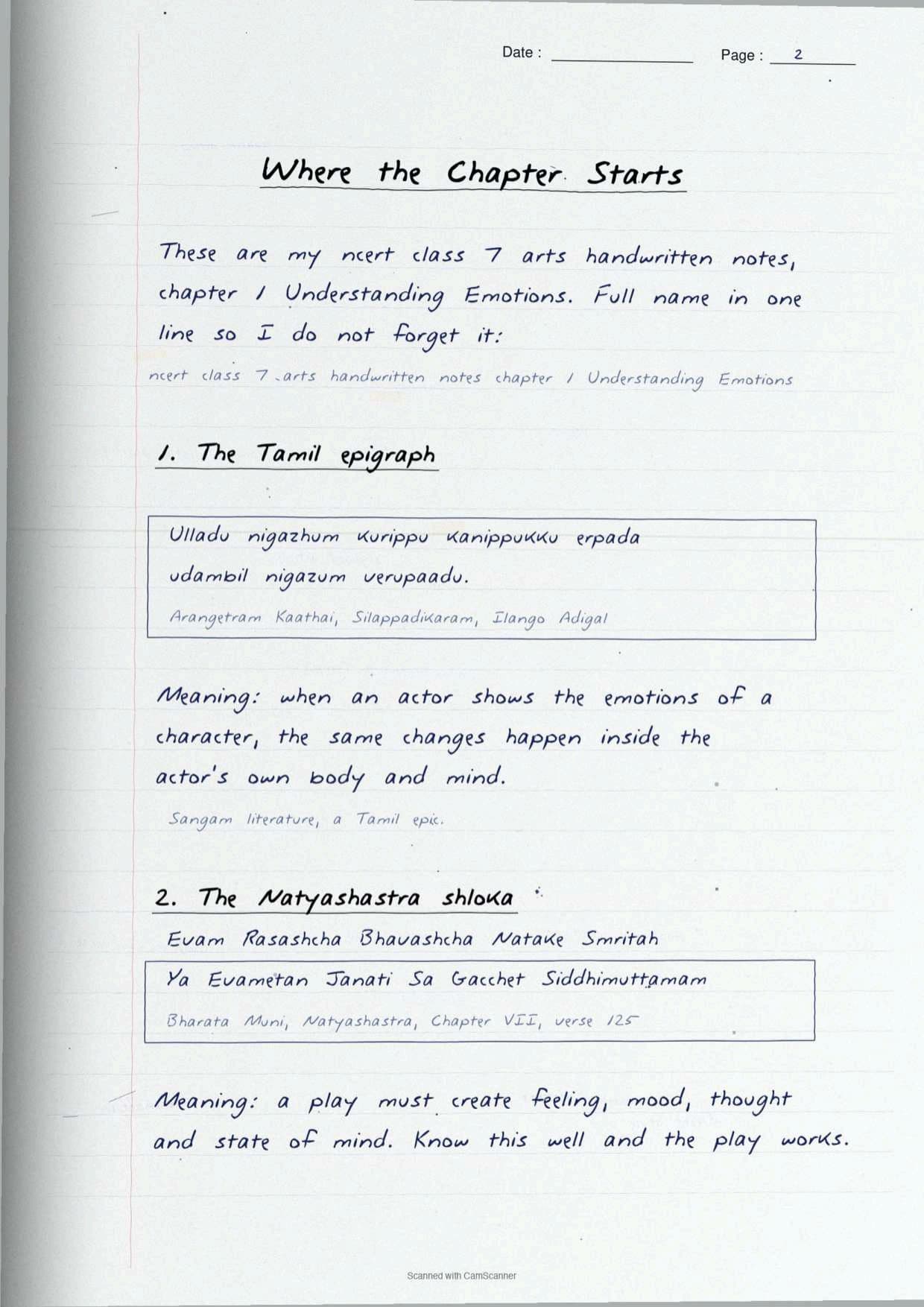
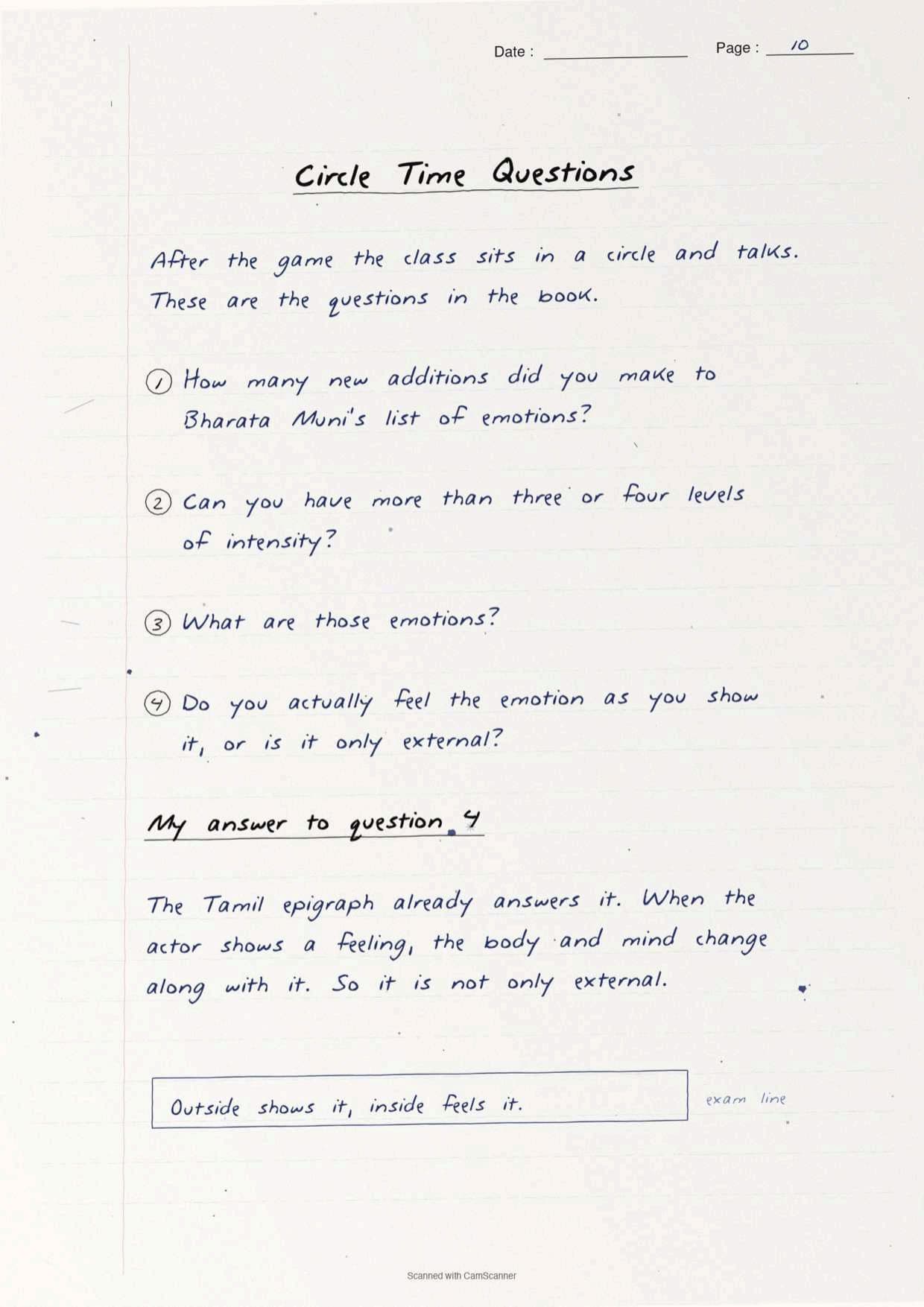
The chapter opens with two quotations, a Tamil epigraph and a shloka from the Natyashastra. Both say the same thing in different languages: feeling comes first, technique comes after. If you can define bhava and rasa in one line each, you have already covered the most repeated one-mark question from this chapter.
The Navarasa: Nine Emotions Listed by Bharata Muni and What Each One Carries
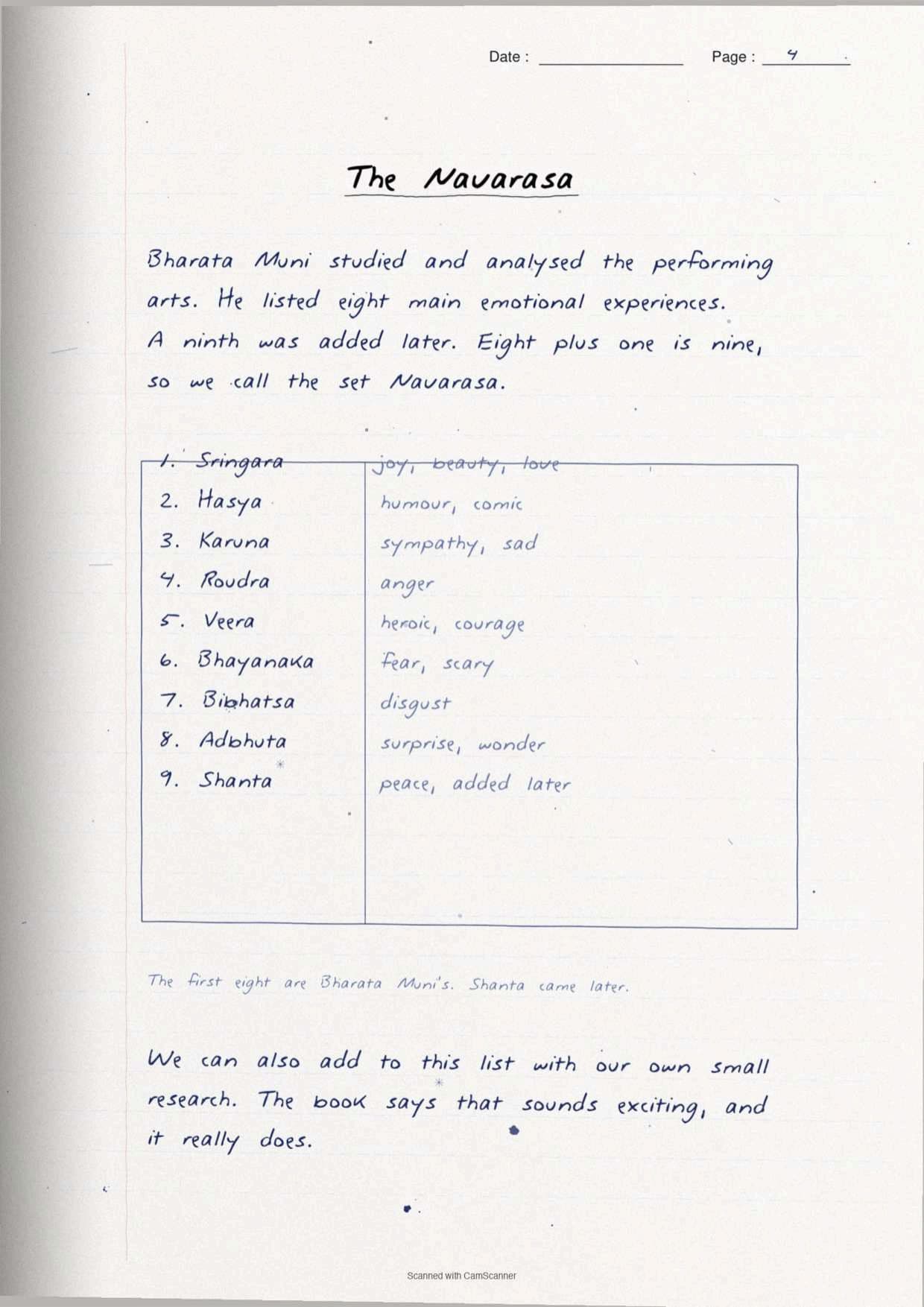
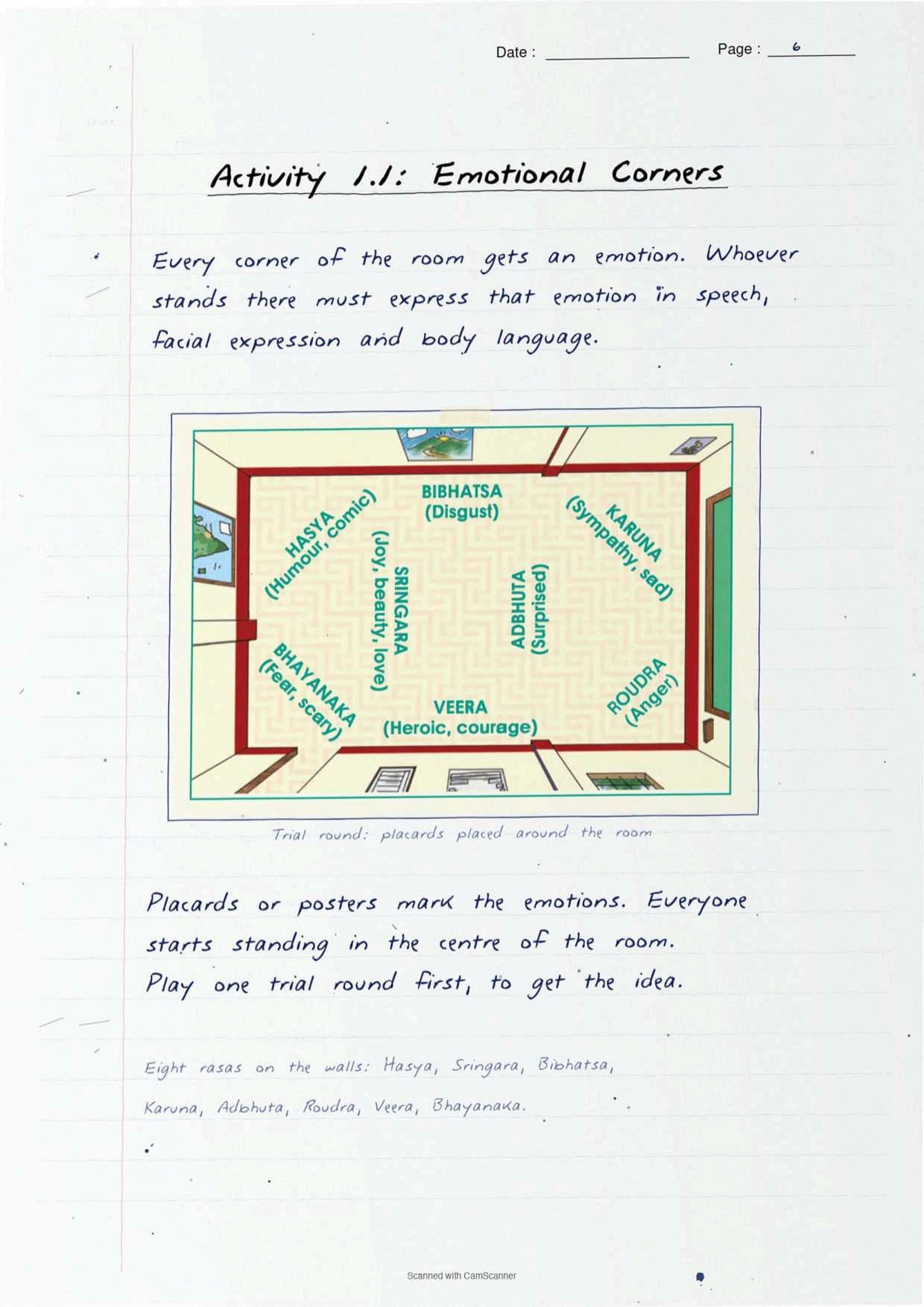
Bharata Muni studied the performing arts and listed eight main emotional experiences. A ninth, Shanta, was added much later. Eight plus one is nine, and nava means nine, which is why the set is called the Navarasa. Learn the eight in order first, then attach the ninth.
| # | Rasa | Emotion it carries |
|---|---|---|
| 1 | Sringara | Joy, beauty, love |
| 2 | Hasya | Humour, the comic |
| 3 | Karuna | Sympathy, sadness |
| 4 | Roudra | Anger |
| 5 | Veera | Heroism, courage |
| 6 | Bhayanaka | Fear |
| 7 | Bibhatsa | Disgust |
| 8 | Adbhuta | Surprise, wonder |
| 9 | Shanta | Peace, added later |
Tip: if a question says "name the rasas listed by Bharata Muni", the answer is the first eight only. Shanta belongs to the Navarasa, not to Bharata Muni's original list.
Levels of Intensity: Why One Rasa Can Be Played at Three Different Volumes
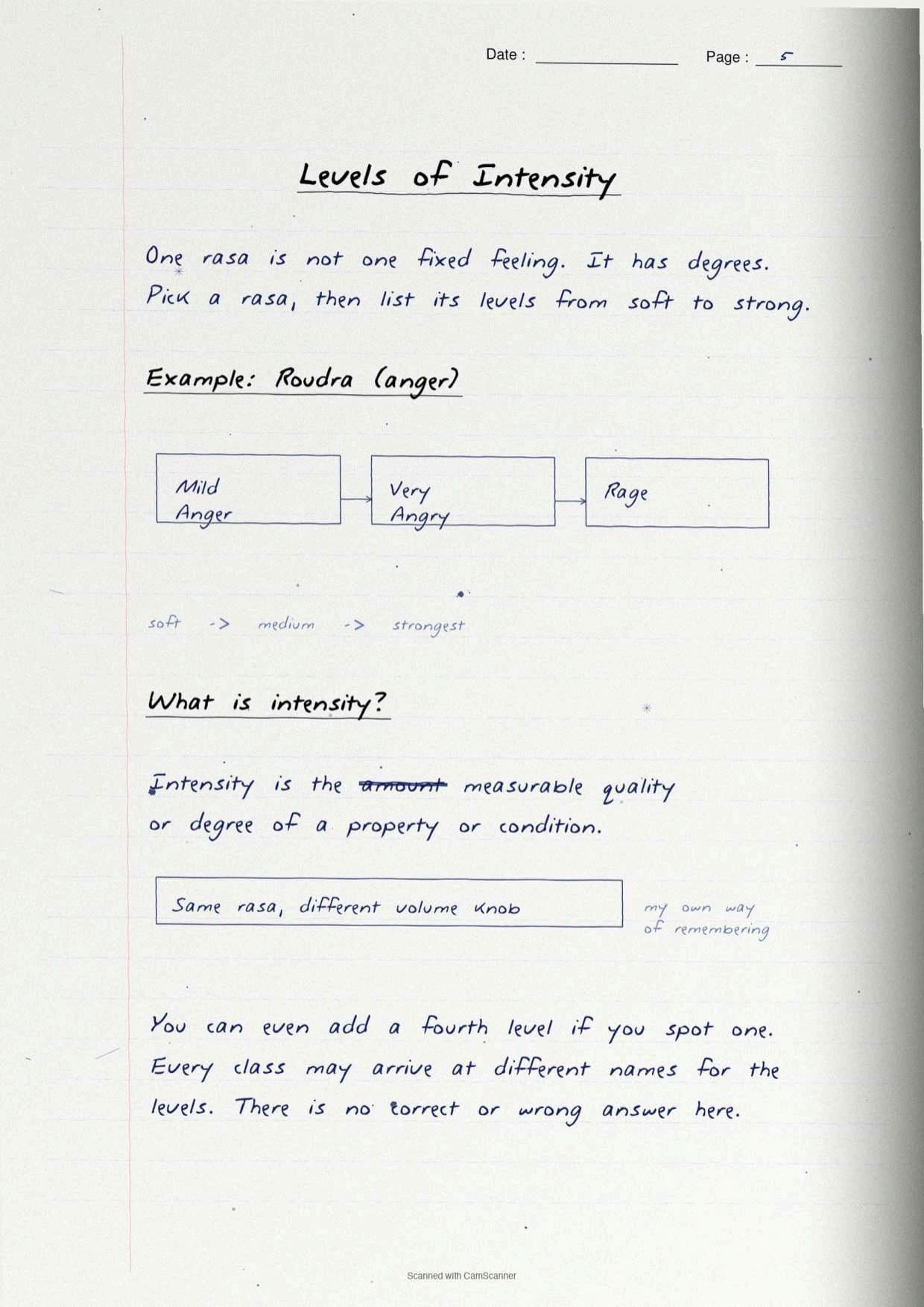
A rasa is not one fixed feeling. It has degrees. The notebook uses Roudra as the worked example and stacks it from soft to strongest, which is exactly how the book wants students to think.
- Level 1, mild anger. A tight jaw, a short reply, nothing loud yet.
- Level 2, very angry. Raised voice, sharper gestures, the body leans forward.
- Level 3, rage. Full body, full voice, the strongest version of the same rasa.
Intensity is the measurable degree of a property or condition. The easy way to hold it in your head is a volume knob: same rasa, different volume. You may add a fourth level if you spot one, and two classes may name the levels differently. There is no single correct set of level names, and the book says so directly.
Emotional Corners Activity 1.1 and the Four Levels of Happiness
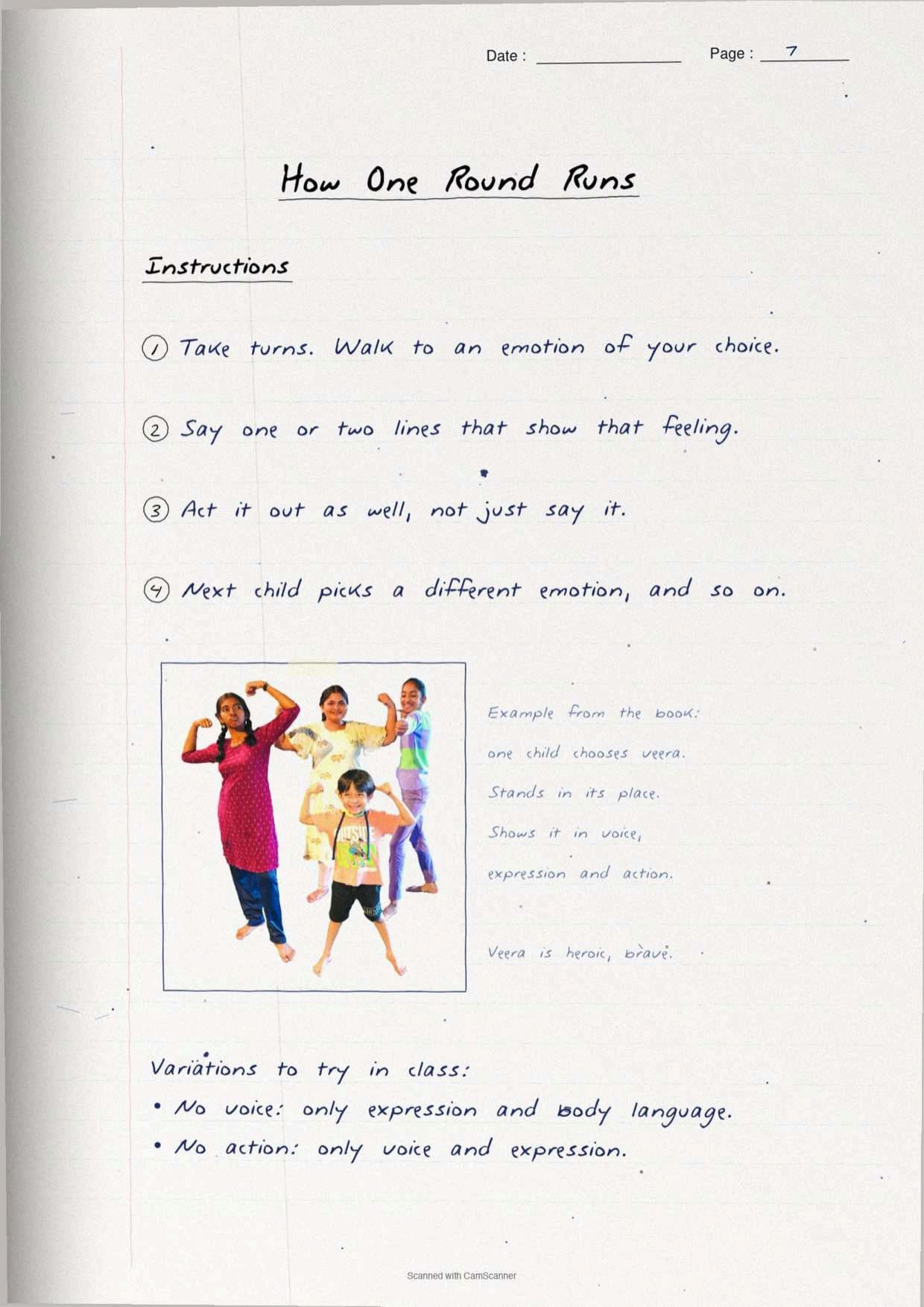
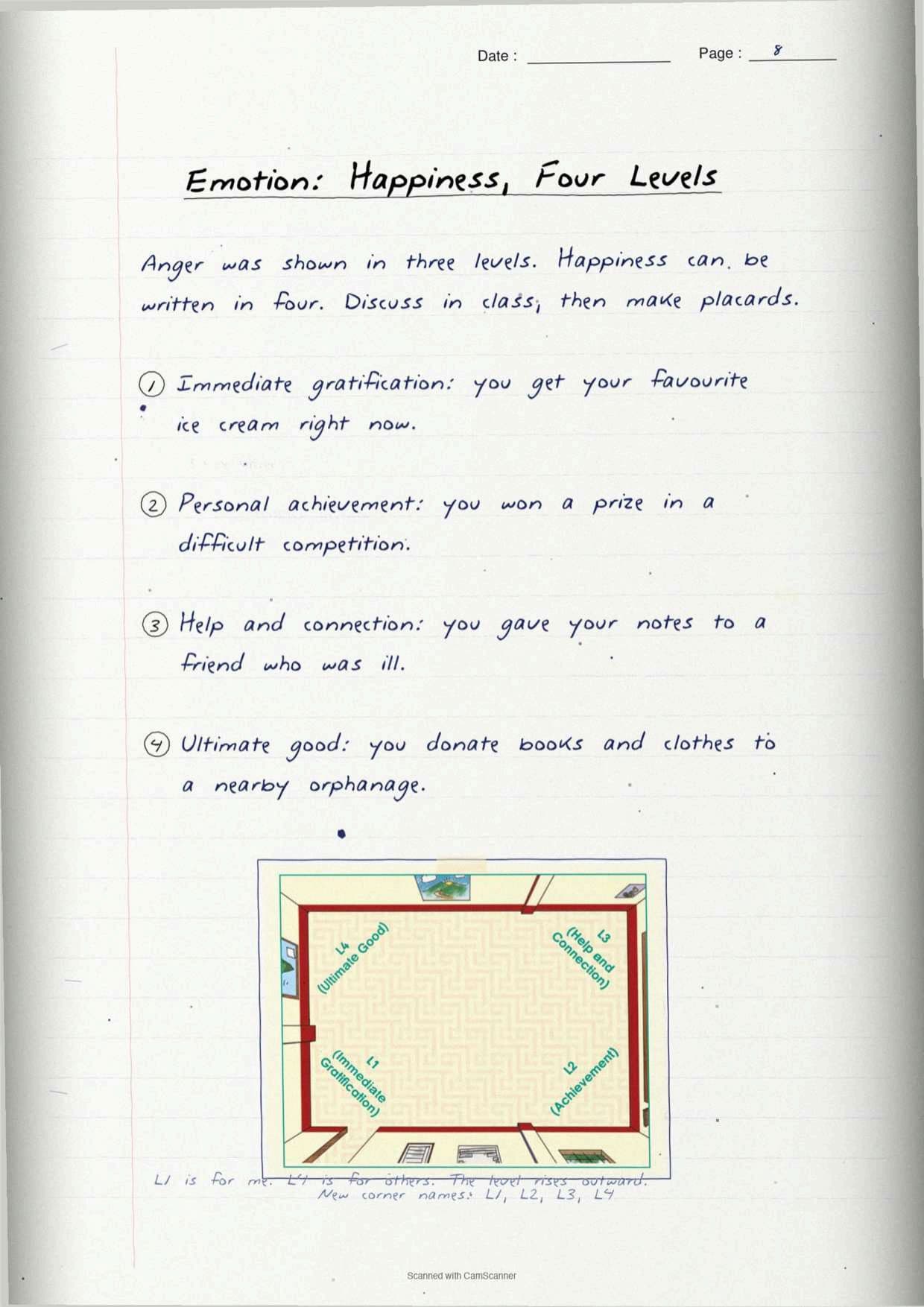
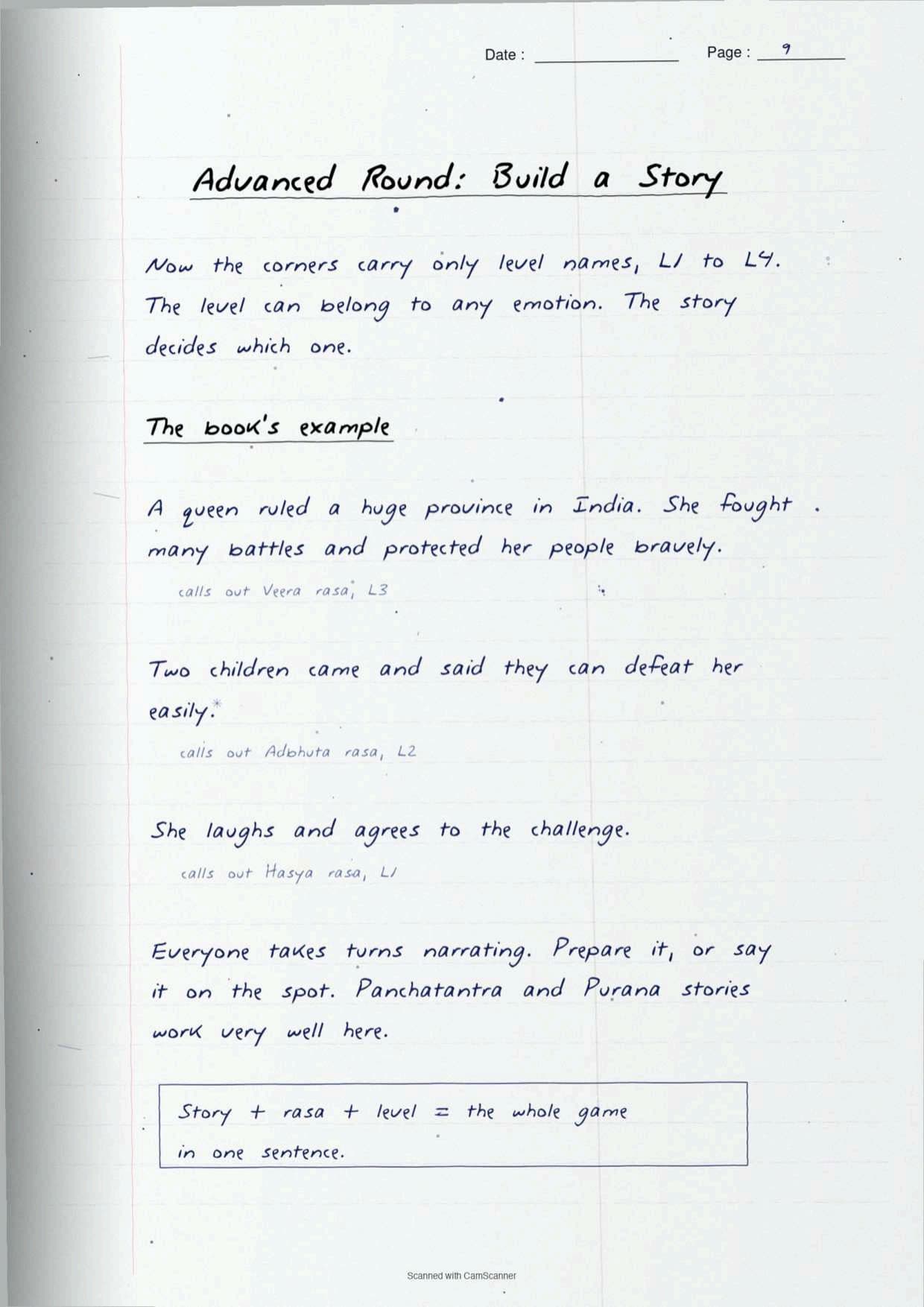
Activity 1.1 turns the intensity idea into a classroom game. Corners of the room are marked with levels of one emotion, and each student walks to a corner and shows that level through action, expression and voice. The chapter then builds a second round where the levels are joined into a short story.
- Level 1, gratification. A small want is met, such as a snack you asked for.
- Level 2, achievement. You worked for something and you got it.
- Level 3, helping someone. The happiness that comes from another person's relief.
- Level 4, the ultimate good. Happiness that is no longer about you at all.
The advanced round asks students to link the four levels into one narrated story. That is where the chapter quietly teaches empathy, because you cannot narrate level 3 without imagining how somebody else feels.
Why Two Students Show the Same Emotion in Completely Different Ways
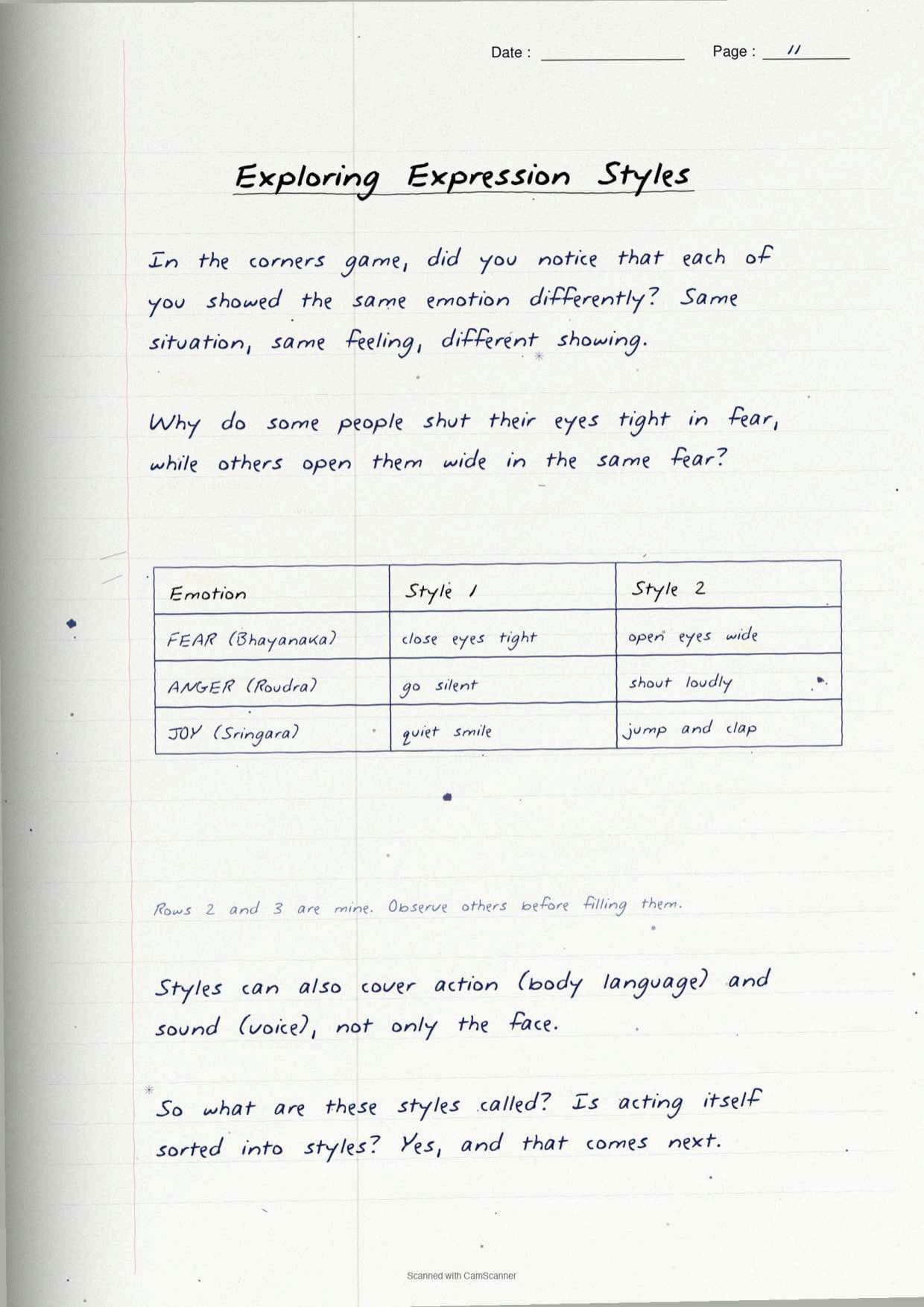
The corners game always ends with the same discovery: the same emotion looks different on different people. Some shut their eyes tight in fear, others open them wide. Style covers action and voice, not only the face.
| Emotion | Style 1 | Style 2 |
|---|---|---|
| Fear (Bhayanaka) | Eyes shut tight, body pulls back | Eyes wide open, body frozen |
| Anger (Roudra) | Goes completely silent | Shouts loudly |
| Joy (Sringara) | A quiet smile | Jumps and claps |
This table is worth copying into your own notebook with two rows left blank, then filling them after watching your classmates. The chapter treats observation as part of the work, not as an extra.
Natya Dharmi and Loka Dharmi: The Two Acting Styles of the Natyashastra
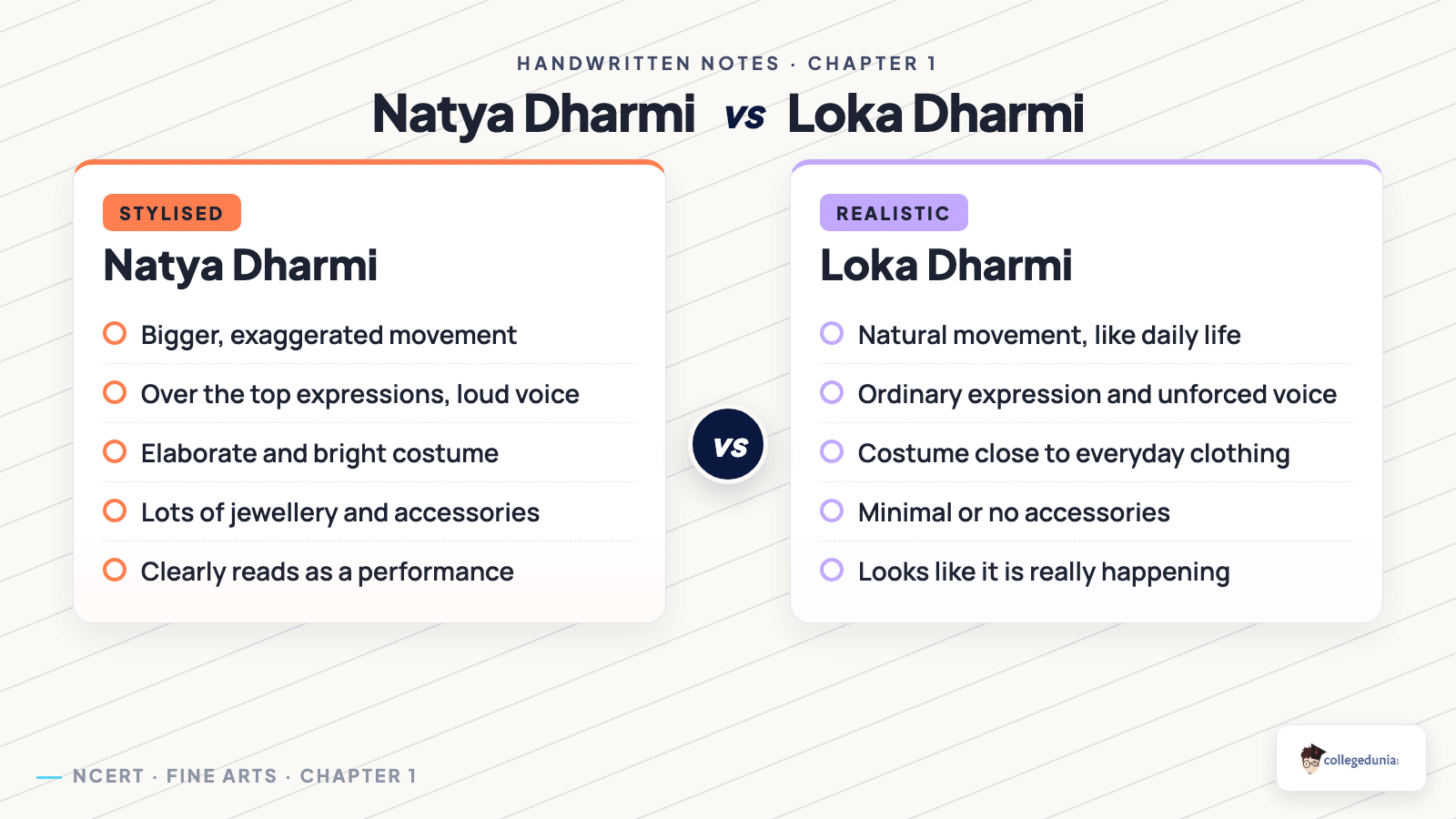
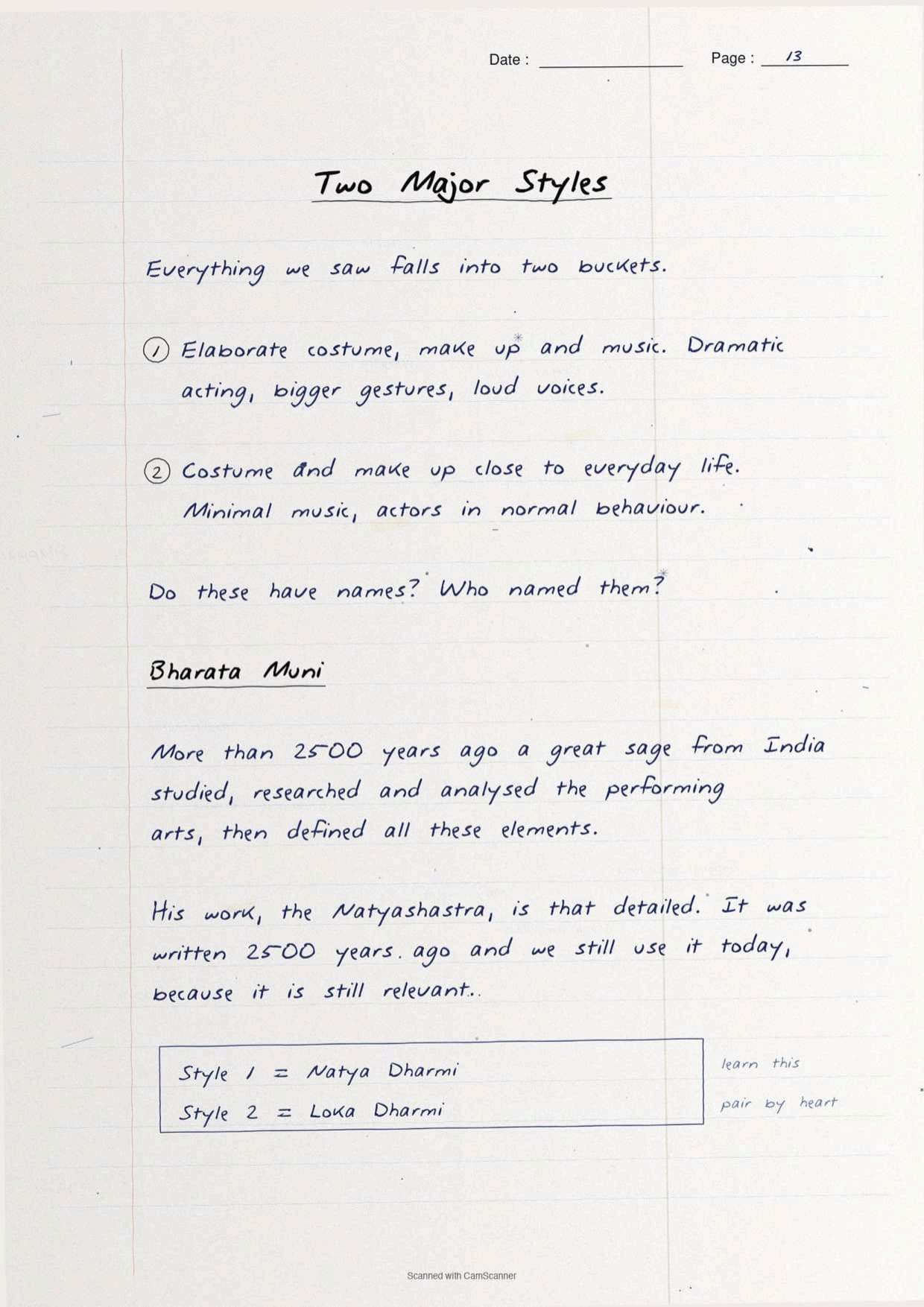
Everything in the chapter finally sorts into two buckets, and Bharata Muni named both more than 2500 years ago in the Natyashastra. This pair is the single most examined idea in Understanding Emotions.
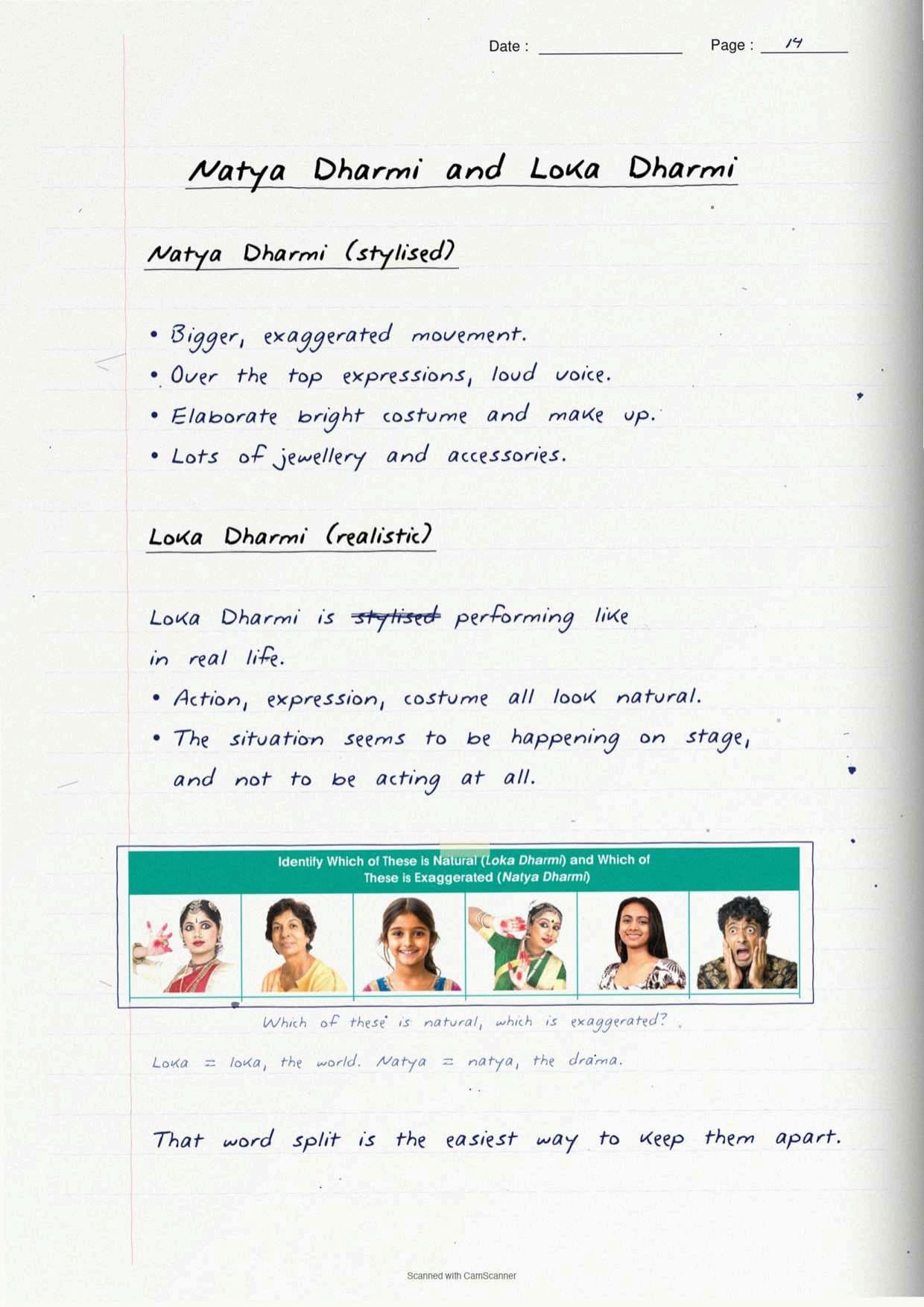
| Point of difference | Natya Dharmi (stylised) | Loka Dharmi (realistic) |
|---|---|---|
| Movement | Bigger, exaggerated | Natural, like daily life |
| Expression and voice | Over the top, loud | Ordinary, unforced |
| Costume and make-up | Elaborate and bright | Close to everyday clothing |
| Accessories | Heavy jewellery | Minimal or none |
| Effect on stage | Clearly a performance | Looks like it is really happening |
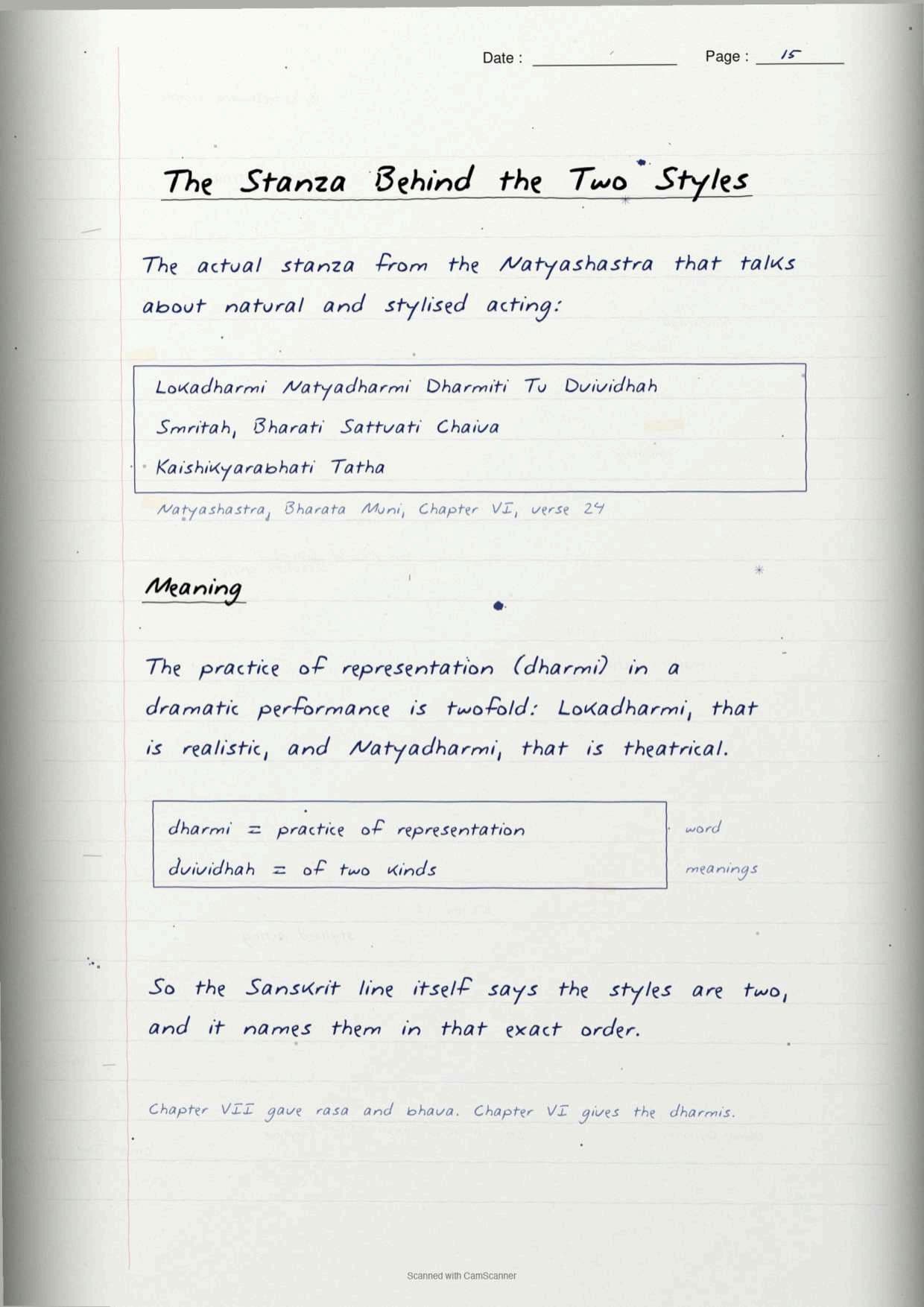
The verse itself sits in Chapter VI, verse 24 of the Natyashastra: Lokadharmi Natyadharmi Dharmiti Tu Dvividhah Smritah, Bharati Sattvati Chaiva Kaishikyarabhati Tatha. In plain words, the practice of representation in a performance is of two kinds, one realistic and one theatrical. Here dharmi means the practice of representation and dvividhah means of two kinds.
Tip: split the words to keep them apart. Loka is the world, so Loka Dharmi is life-like. Natya is drama, so Natya Dharmi is theatrical. Also remember that the rasa and bhava verse is from Chapter VII, while the dharmi verse is from Chapter VI.
Acting Styles Across the World: Japan, India, Brecht and Method Acting
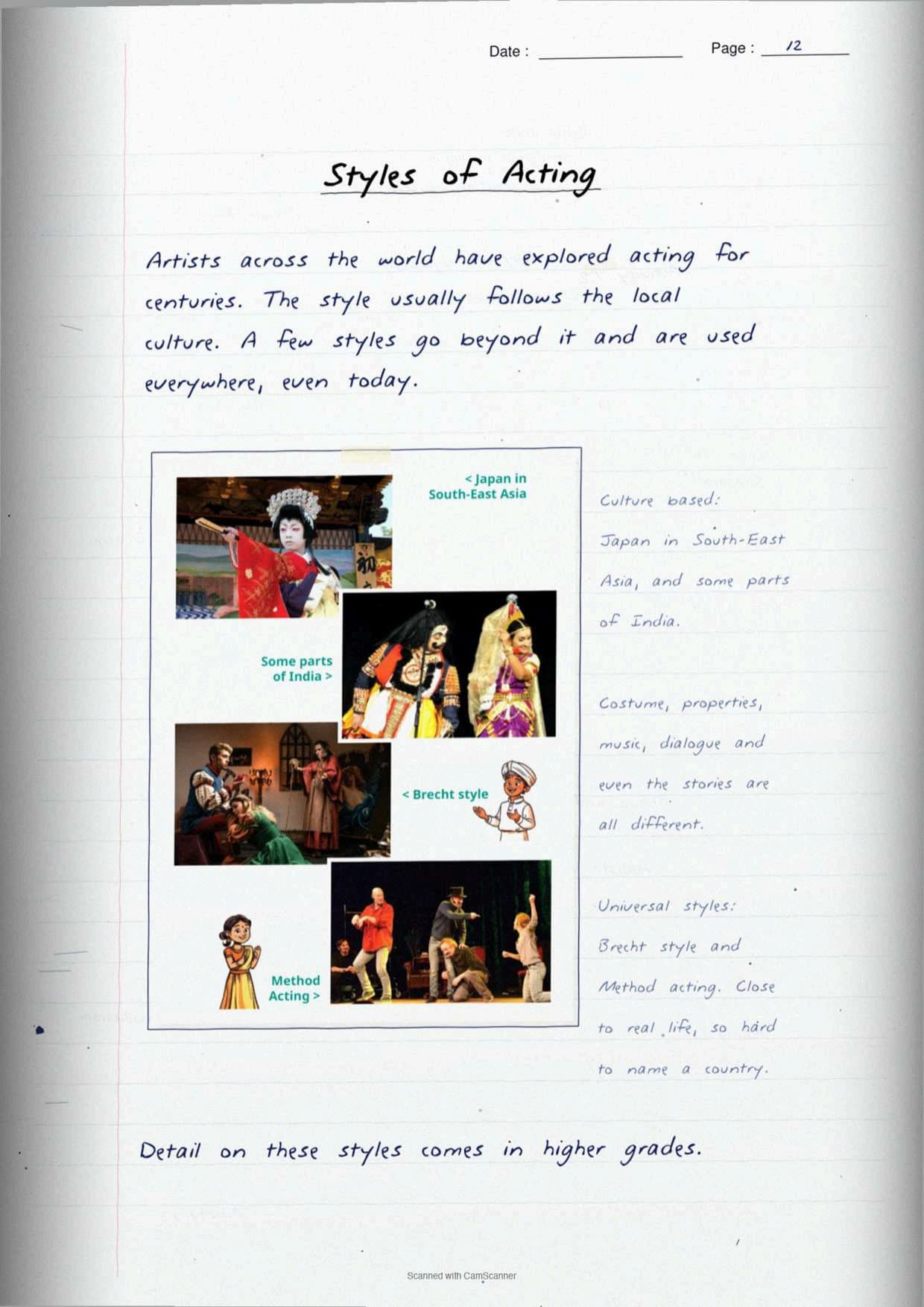
Artists everywhere have explored acting for centuries, and the style usually follows the local culture. The notebook splits the world's styles into two groups, which is enough for Class 7 while the detail waits for higher grades.
| Group | Examples | What marks it out |
|---|---|---|
| Culture-based styles | Japan and parts of South-East Asia, several traditions in India | Costume, properties, music, dialogue and even the stories differ from place to place |
| Universal styles | Brecht style and Method acting | Close to real life, so hard to tie to any one country |
Notice how this maps back onto the dharmis. The culture-based traditions lean towards Natya Dharmi, while Brecht and Method acting sit much closer to Loka Dharmi. Making that link in an answer earns more than listing the names alone.
Understanding Emotions Explained in Simple Language for Class 7
Source: NCERT Hindi Tutor on YouTube
Emotions Carved in Stone at Belur, Tanjavur and Elephanta
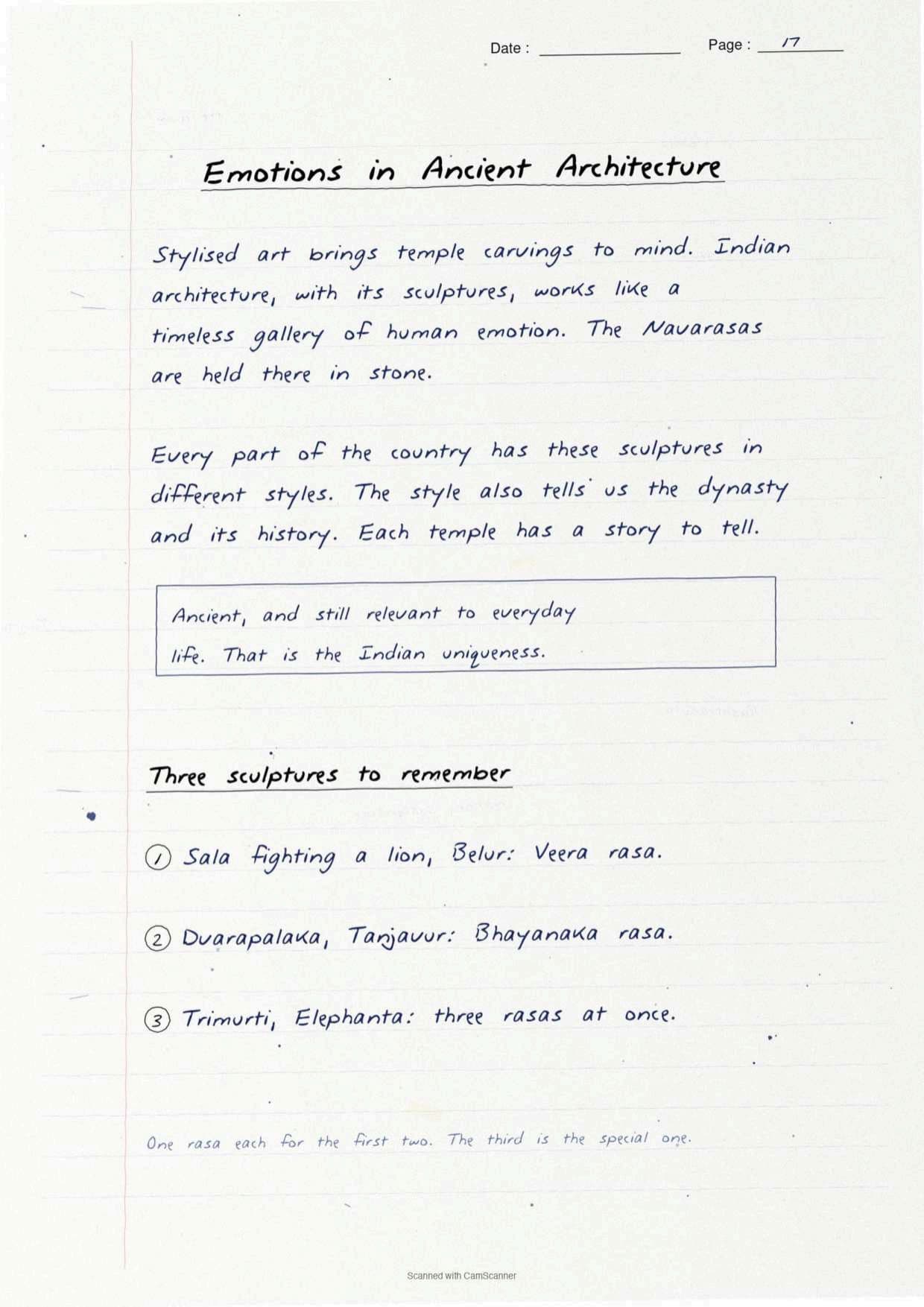
Stylised art brings temple carving to mind, and Indian sculpture works like a gallery of human emotion that never closes. The style of a carving also tells you the dynasty behind it. The chapter fixes on three sculptures, and all three are exam favourites.
| Sculpture | Place | Rasa | Dynasty |
|---|---|---|---|
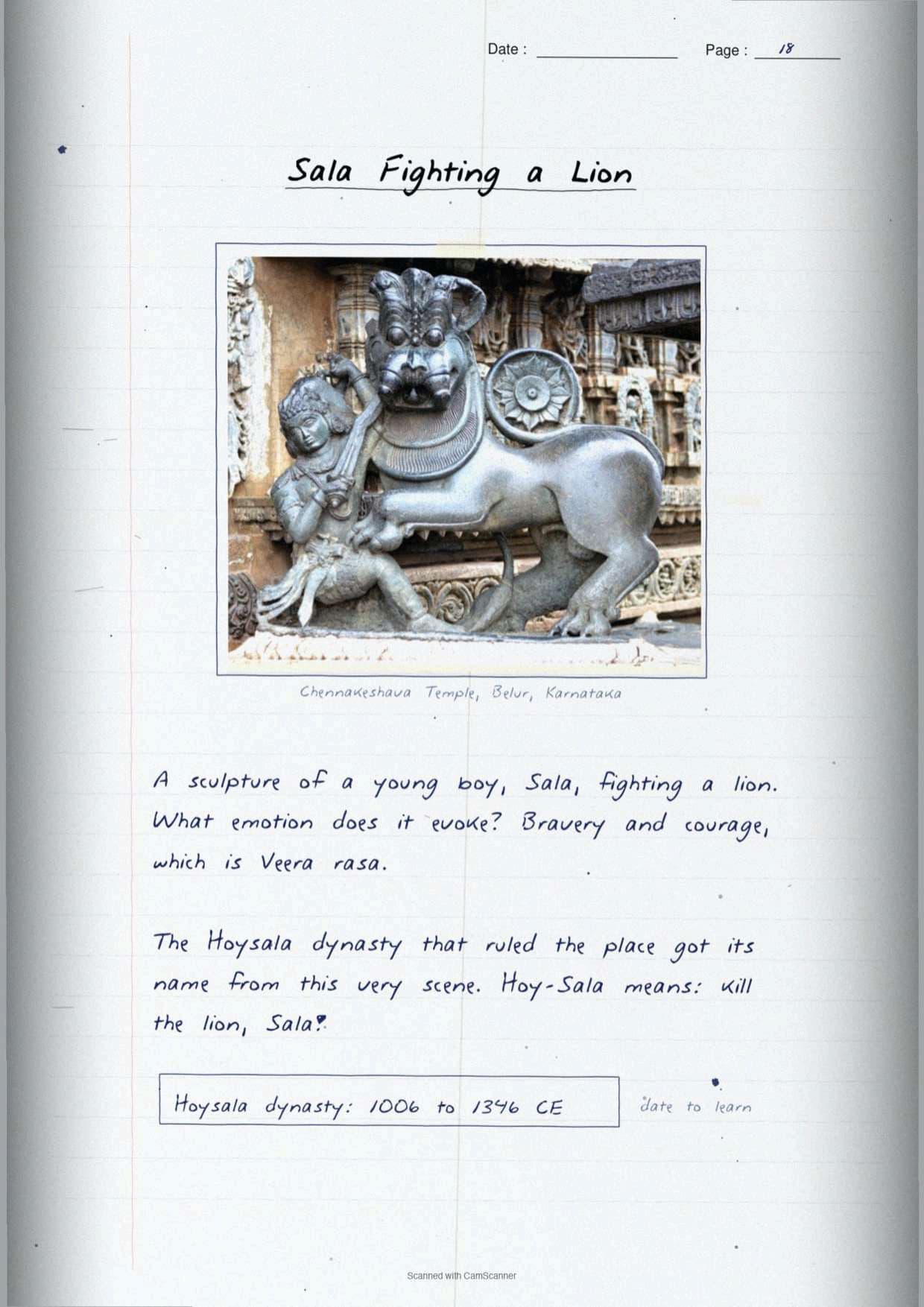
| Sala fighting a lion | Chennakeshava Temple, Belur, Karnataka | Veera, bravery and courage | Hoysala, 1006 to 1346 CE |
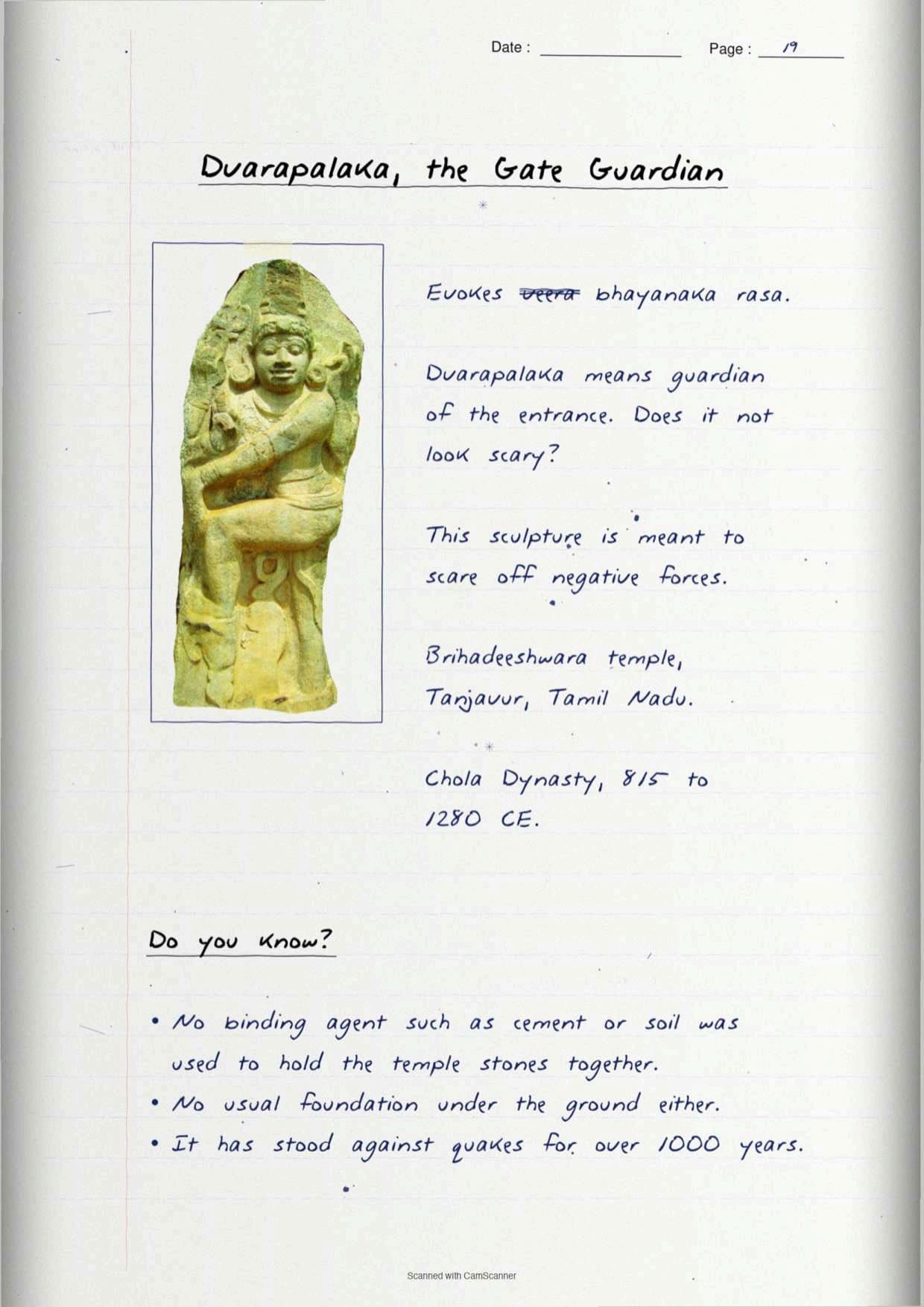
| Dvarapalaka, the gate guardian | Brihadeeshwara Temple, Tanjavur, Tamil Nadu | Bhayanaka, fear | Chola, 815 to 1280 CE |
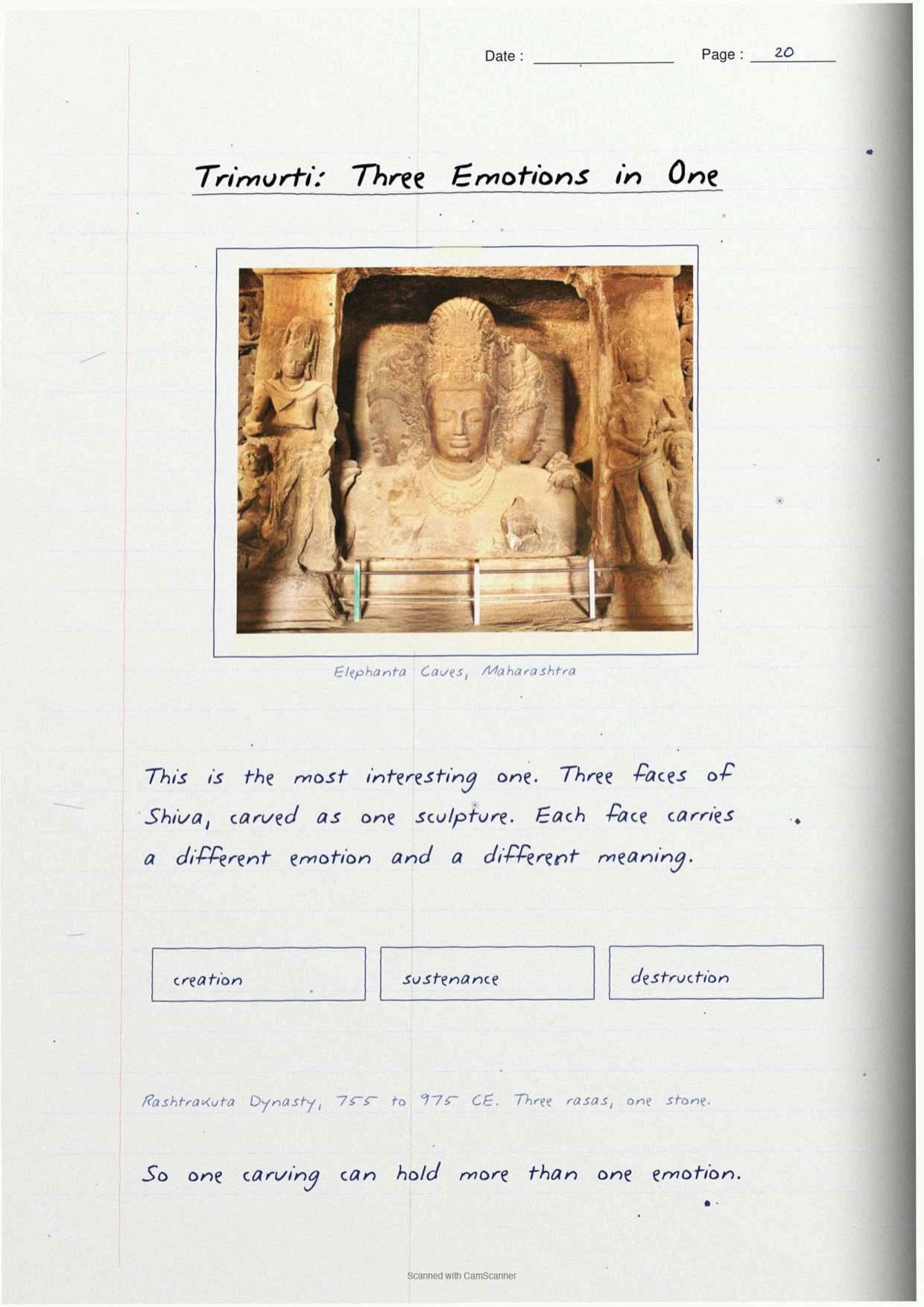
| Trimurti, three faces of Shiva | Elephanta Caves, Maharashtra | Three rasas at once | Rashtrakuta, 755 to 975 CE |
The Belur carving gave the Hoysala dynasty its name, since Hoy Sala means "strike, Sala". The Dvarapalaka was carved to look frightening on purpose, because its job is to scare negative forces away from the gate. The Brihadeeshwara temple stones were set without cement or any binding agent, and the structure has stood through earthquakes for over 1000 years.
The Trimurti is the one to spend extra time on. Three faces of Shiva are carved as a single sculpture, and each face carries a different emotion tied to creation, sustenance and destruction. It is the chapter's proof that one carving can hold more than one rasa.
The Story of Jakanachari and What It Teaches About Dedication
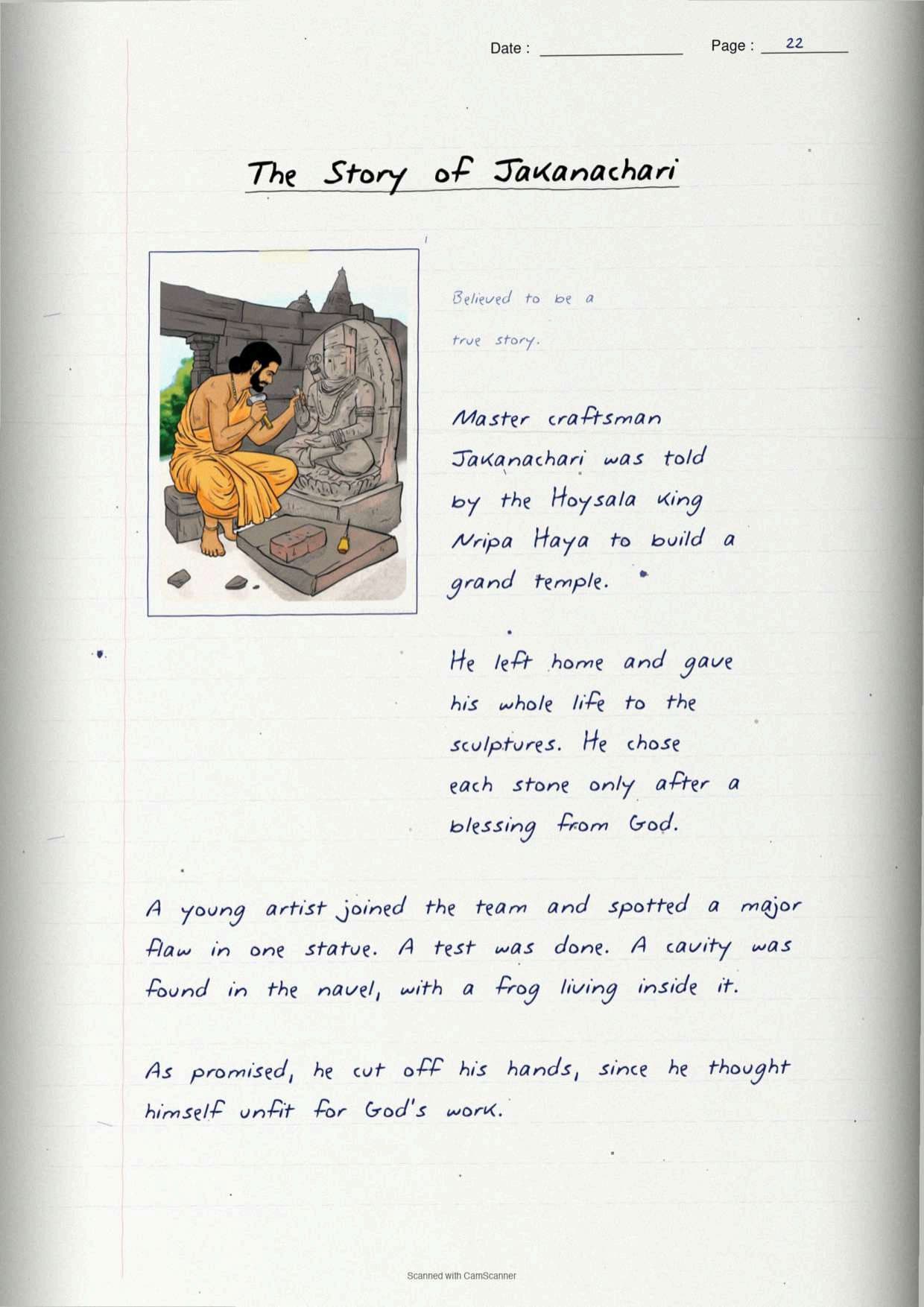
The chapter closes its sculpture section with a story believed to be true. Master craftsman Jakanachari was asked by the Hoysala king Nripa Haya to build a grand temple. He left home, gave his whole life to the carvings, and picked each stone only after a blessing.
- A young artist joined the team and pointed out a serious flaw in one statue.
- A test was carried out, and a cavity was found in the navel with a frog living inside.
- Jakanachari cut off his hands, as he had promised, believing himself unfit for the work.
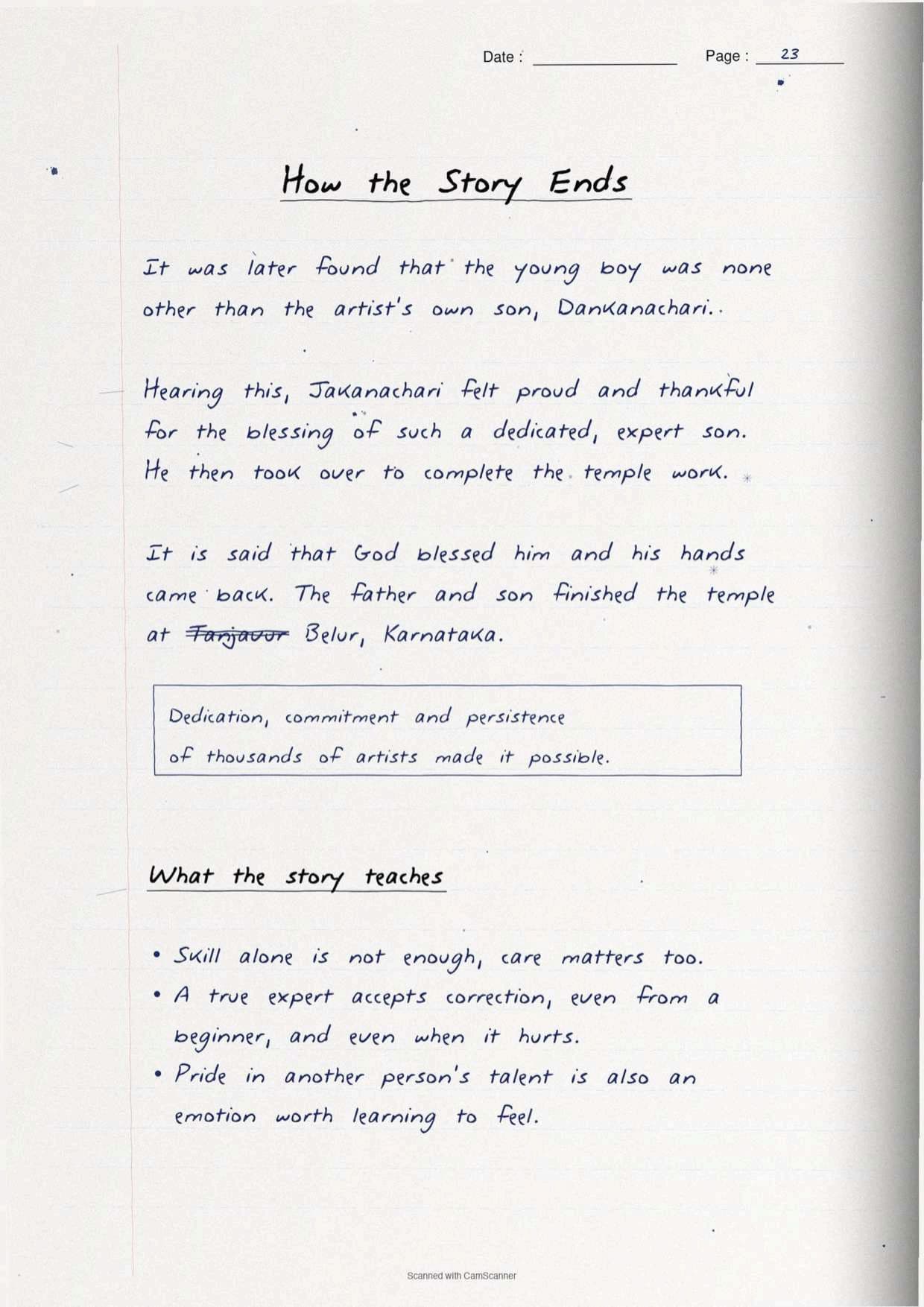
- The young artist turned out to be his own son, Dankanachari.
- The story ends with his hands restored and father and son finishing the temple at Belur.
Three lessons come out of it, and all three can be asked as a short answer. Skill alone is not enough, since care matters just as much. A true expert accepts correction even from a beginner. Feeling proud of another person's talent is itself an emotion worth learning.
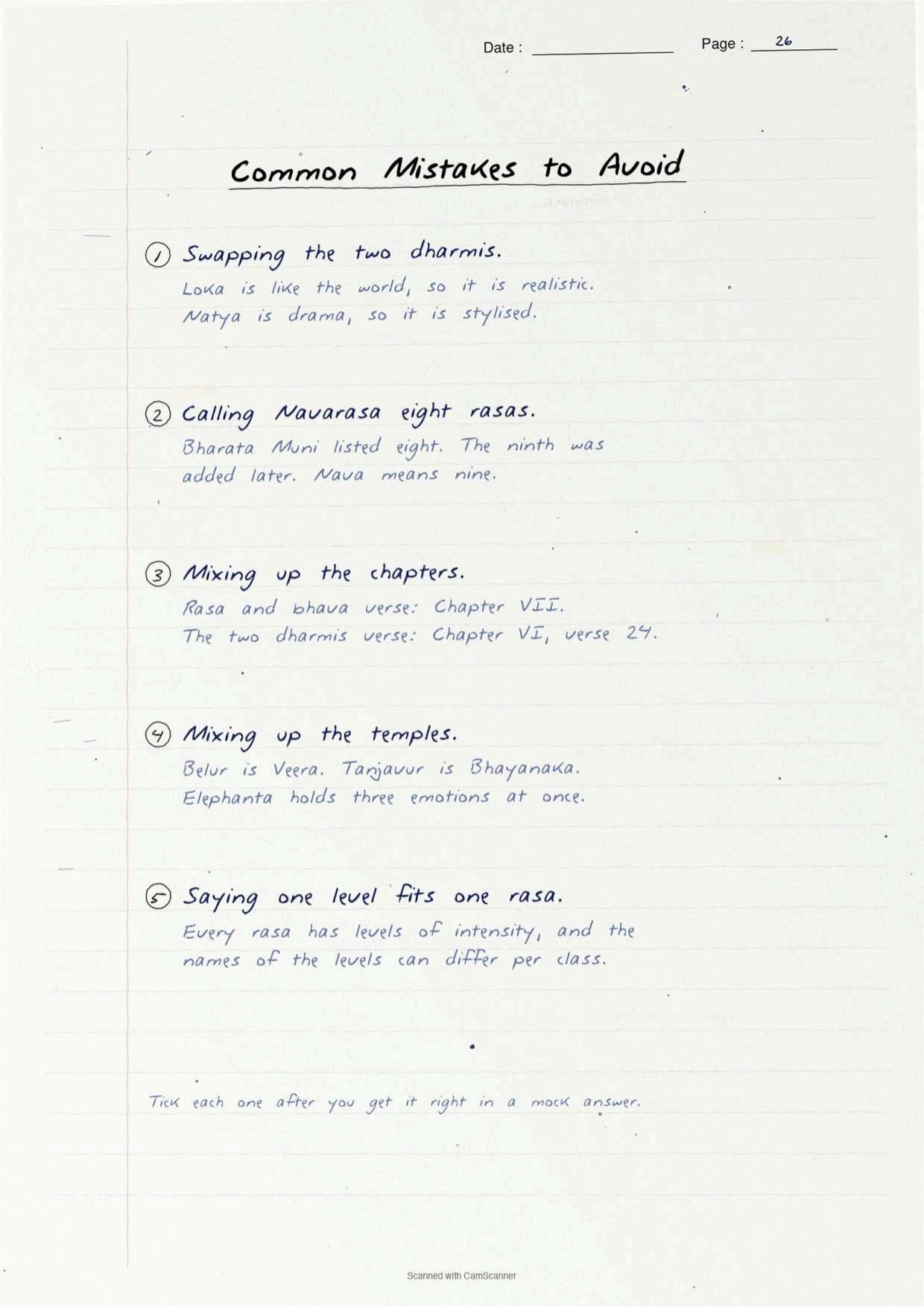
Common Mistakes Students Make in the Understanding Emotions Chapter
Five traps that cost easy marks in the Class 7 Arts paper:
- Swapping the two dharmis. Loka is the world, so it is realistic. Natya is drama, so it is stylised.
- Calling the Navarasa eight rasas. Bharata Muni listed eight, Shanta was added later, and nava means nine.
- Mixing up the chapters. Rasa and bhava come from Chapter VII, the two dharmis from Chapter VI, verse 24.
- Mixing up the temples. Belur is Veera, Tanjavur is Bhayanaka, and Elephanta holds three emotions at once.
- Saying one level fits one rasa. Every rasa carries levels of intensity, and the level names can differ per class.
Tick each trap off only after you have answered it correctly once in a mock answer. Students who did this reported the dharmi question stopped costing them marks within two attempts.
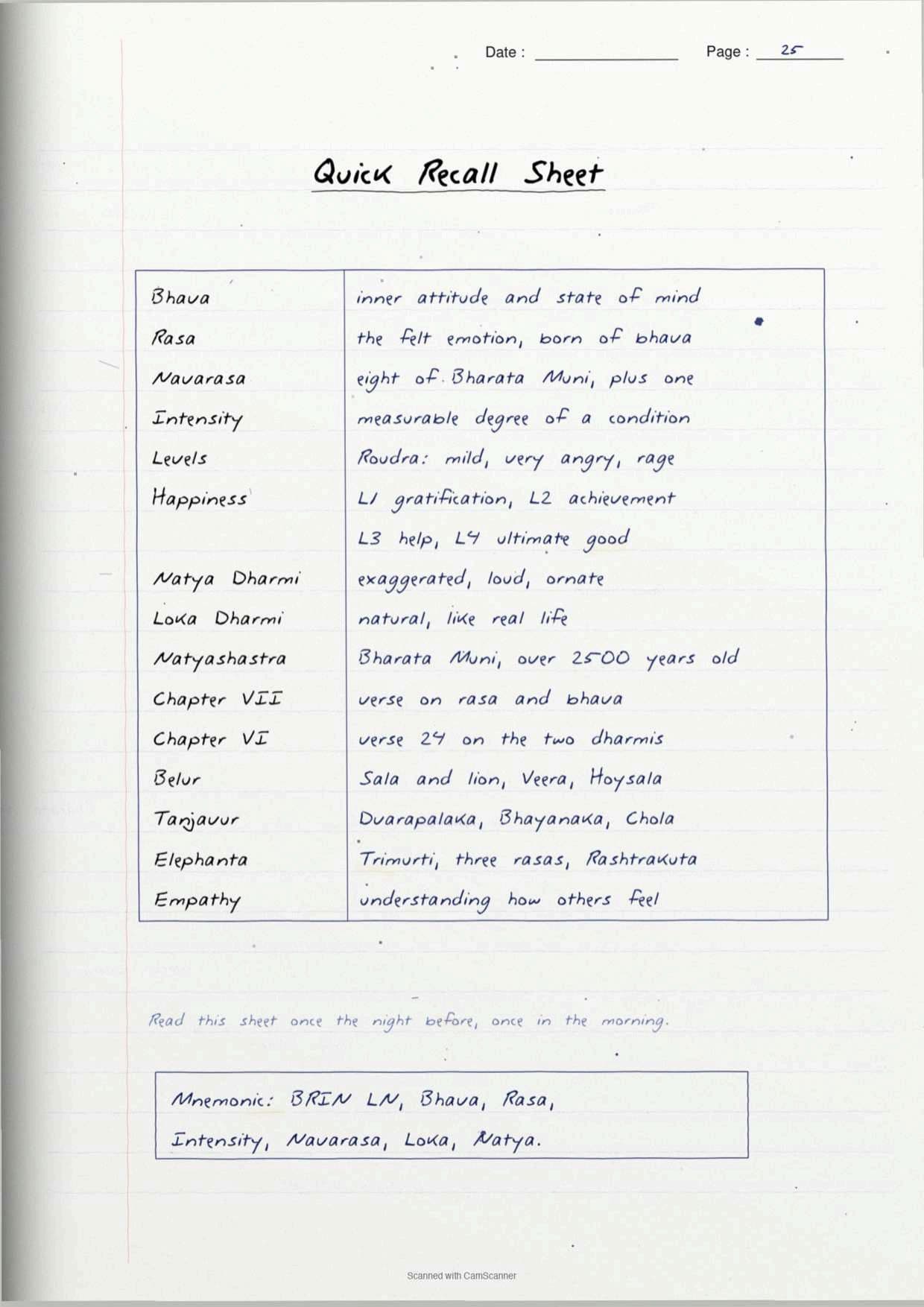
Quick Recall Sheet: Every Term from Understanding Emotions in One Table
This is the page to read the night before and once again in the morning. Everything the chapter can ask sits in one place.
| Term | One-line meaning |
|---|---|
| Bhava | Inner attitude and state of mind |
| Rasa | The felt emotion, born of bhava |
| Navarasa | Eight rasas of Bharata Muni, plus Shanta |
| Intensity | Measurable degree of a property or condition |
| Levels of Roudra | Mild anger, very angry, rage |
| Levels of happiness | Gratification, achievement, helping, ultimate good |
| Natya Dharmi | Exaggerated, loud, ornate |
| Loka Dharmi | Natural, exactly like real life |
| Natyashastra | Bharata Muni's work, over 2500 years old |
| Chapter VII | The verse on rasa and bhava |
| Chapter VI, verse 24 | The verse on the two dharmis |
| Belur | Sala and the lion, Veera, Hoysala |
| Tanjavur | Dvarapalaka, Bhayanaka, Chola |
| Elephanta | Trimurti, three rasas, Rashtrakuta |
| Empathy | Understanding how another person feels |
The notebook also carries a mnemonic for the running order of the chapter: BRIN LN, standing for Bhava, Rasa, Intensity, Navarasa, Loka, Natya.
What the Understanding Emotions Class 7 Handwritten Notes PDF Contains
The file is a scanned notebook, written on ruled paper with the source figures pasted in where the textbook uses them. Nothing is typed, so it reads the way a classmate's notes read.
- Pages 1 to 5: cover, the two opening verses, the Grade 6 recap, the Navarasa list and the intensity ladder.
- Pages 6 to 10: Activity 1.1 with the room diagram, the four levels of happiness and the circle-time questions.
- Pages 11 to 16: expression styles, acting styles around the world, both dharmis and the Chapter VI verse.
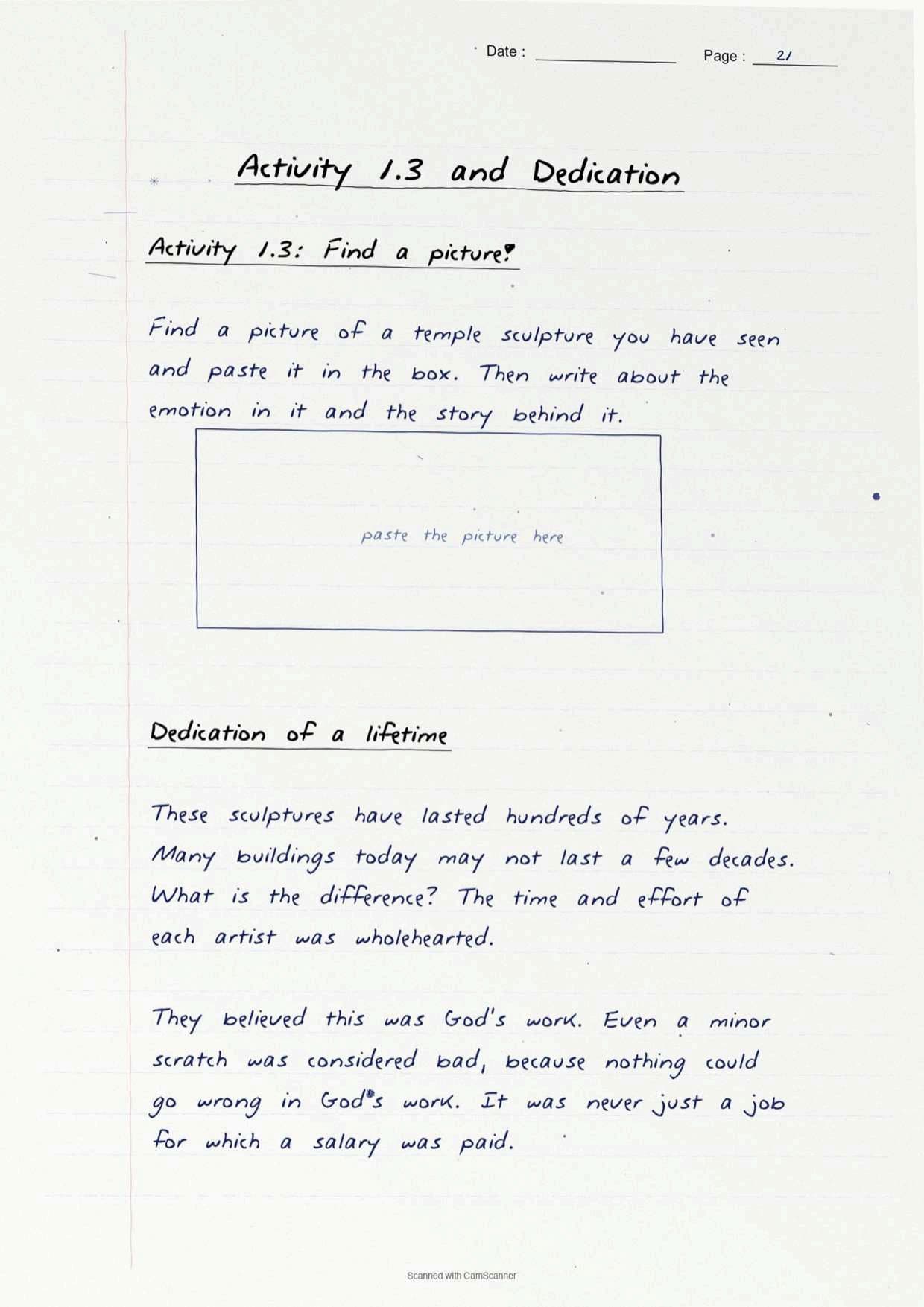
- Pages 17 to 23: the three temple sculptures with book figures, Activity 1.3 and the Jakanachari story.
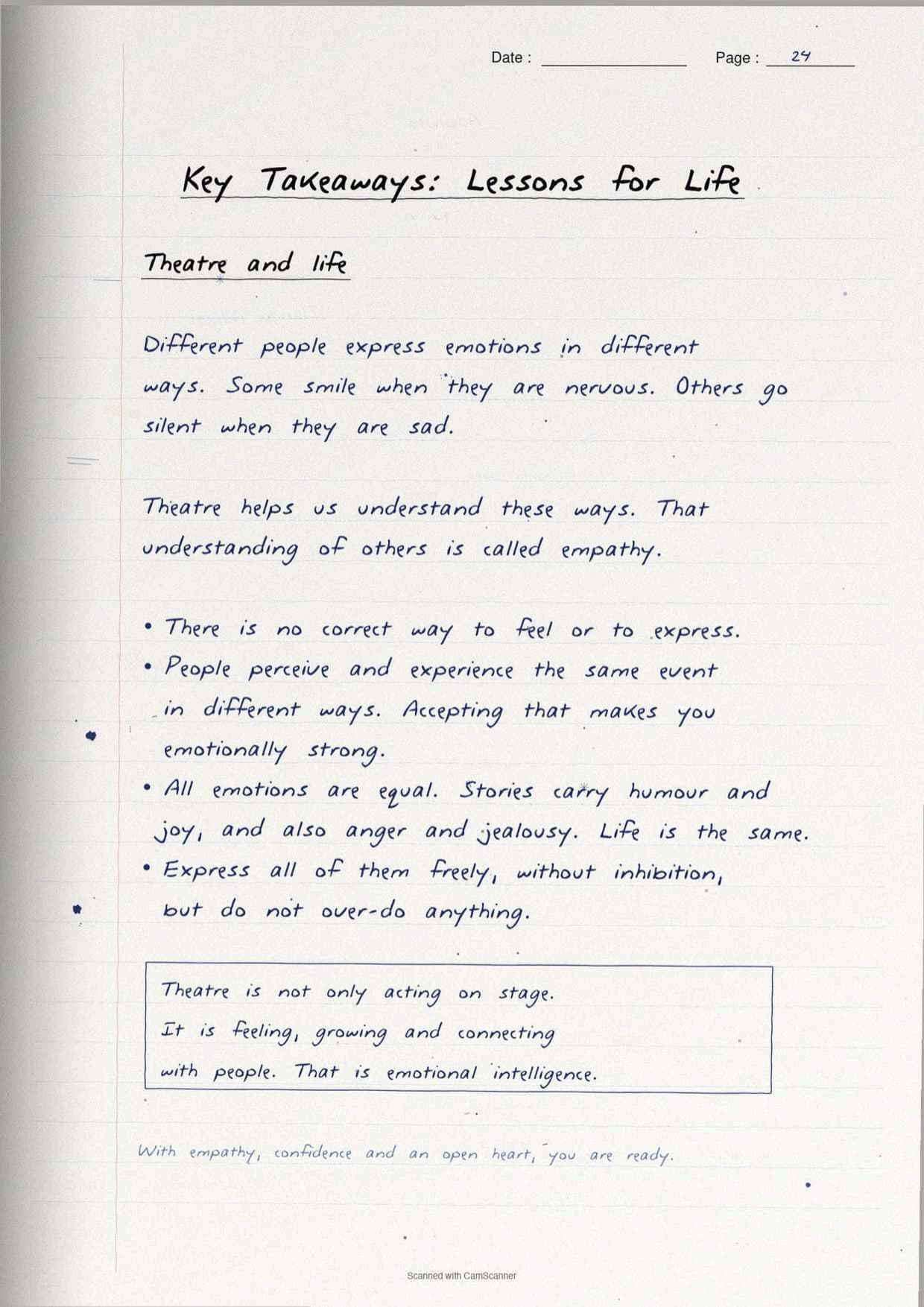
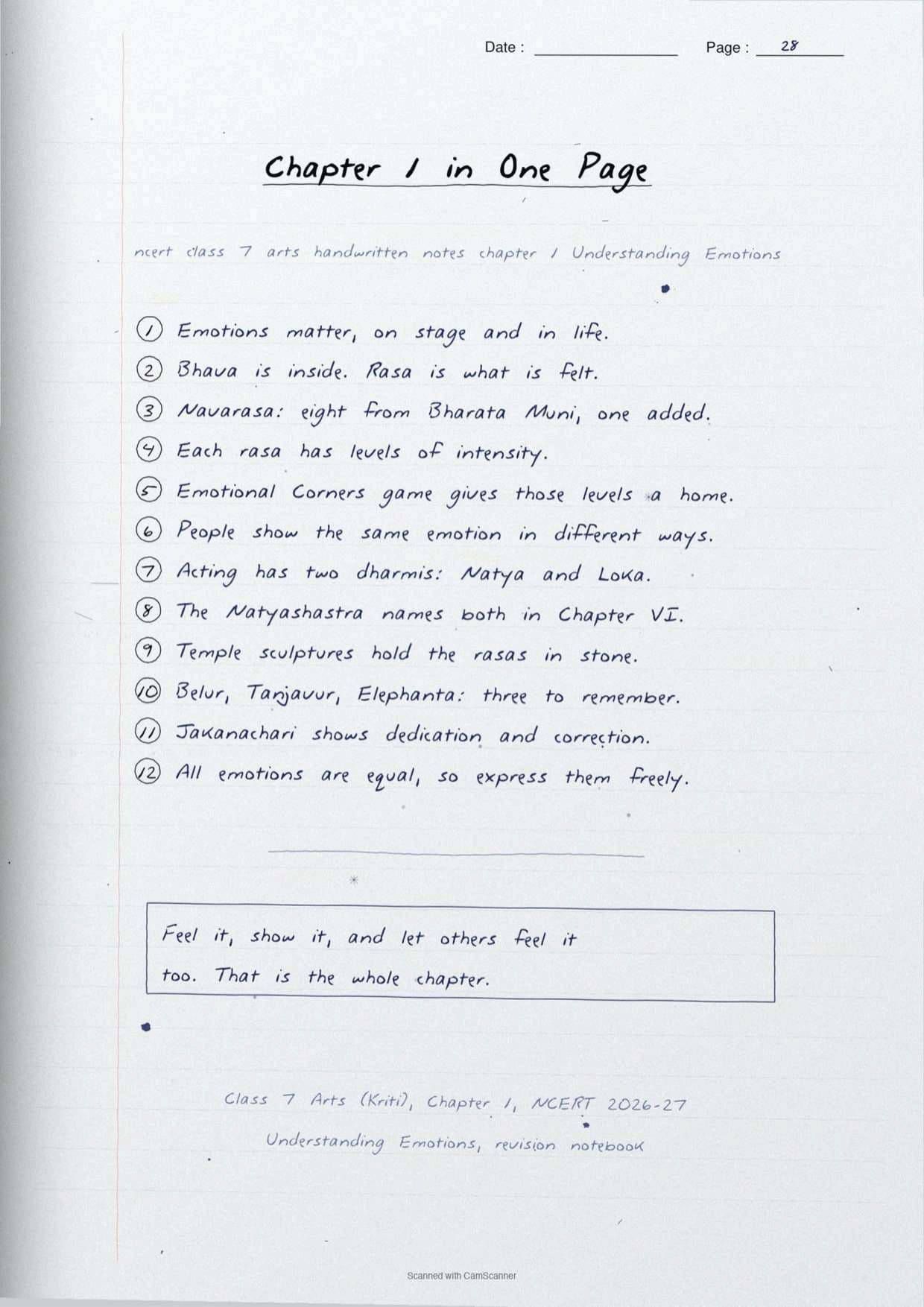
- Pages 24 to 28: lessons for life, the quick recall sheet, the mistake list, practice questions and a one-page summary.
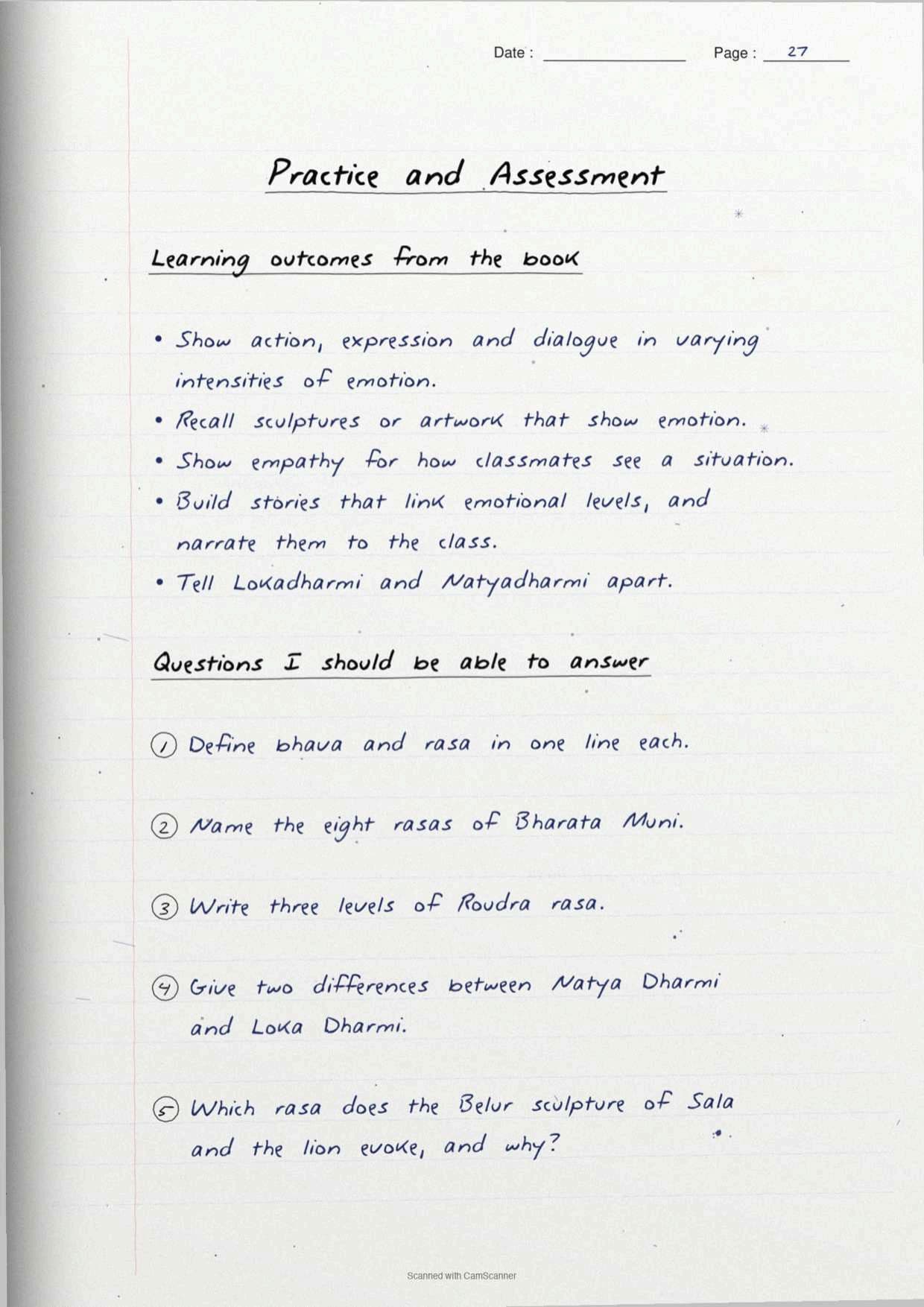
Practice Questions and Learning Outcomes from the Understanding Emotions Chapter
The Kriti textbook lists what a Class 7 student should be able to do after this chapter. The notebook turns each outcome into a question you can actually attempt.
| Learning outcome | Question to practise |
|---|---|
| Show emotion at varying intensities | Write the three levels of Roudra rasa |
| Recall artwork that shows emotion | Which rasa does the Belur sculpture of Sala evoke, and why? |
| Tell the two dharmis apart | Give two differences between Natya Dharmi and Loka Dharmi |
| Use the vocabulary correctly | Define bhava and rasa in one line each |
| Recall the classification | Name the eight rasas listed by Bharata Muni |
How to Use the Understanding Emotions Handwritten Notes Most Effectively
This chapter is short but term-heavy, so spacing beats cramming. Students who split it into three blocks reported finishing it in about two and a half hours.
- Block 1, 40 minutes. Read bhava, rasa and the Navarasa table, then write the nine rasas from memory.
- Block 2, 45 minutes. Work through intensity, the corners activity and the two dharmis, saying each definition aloud.
- Block 3, 40 minutes. Learn the three sculptures with their dynasties, then read the Jakanachari story once.
- Night before, 15 minutes. Quick recall table and the five common mistakes, nothing else.
How These Handwritten Notes Pair with the Chapter Notes and the Kriti Book PDF
Also Check: the same chapter is available in other formats on Collegedunia. Read the book chapter first, keep the typed notes for detail, and use the handwritten pages for the last revision round.
| Resource | Best used for | Open it |
|---|---|---|
| NCERT Book PDF | The official Kriti chapter text with all original figures | Understanding Emotions Class 7 Book PDF |
| Chapter Notes | Typed revision notes with every term explained in full | Understanding Emotions Class 7 Notes (coming soon) |
| Related chapter | The mime chapter that builds on expression without speech | Say More without Speech Class 7 Handwritten Notes (coming soon) |
NCERT Handwritten Notes for Class 7 Arts Kriti: All Chapters
Related Links: handwritten revision notes for every chapter of the Class 7 Kriti textbook, written to the 2026-27 syllabus.
| Chapter | Class 7 Arts Kriti Handwritten Notes |
|---|---|
| Chapter 1 | Understanding Emotions Class 7 Handwritten Notes (this page) |
| Chapter 2 | Say More without Speech, Mime Class 7 Handwritten Notes (coming soon) |
| Chapter 3 | Let's Design, Stage Technicals 2 Class 7 Handwritten Notes (coming soon) |
| Chapter 4 | Story of India's Storytelling Tradition Class 7 Handwritten Notes (coming soon) |
| Chapter 5 | Making Music Class 7 Handwritten Notes (coming soon) |
| Chapter 6 | Music, Emotions and Creativity Class 7 Handwritten Notes (coming soon) |
| Chapter 7 | Ragas and Talas Taal Class 7 Handwritten Notes (coming soon) |
| Chapter 8 | The Music of the People Class 7 Handwritten Notes (coming soon) |
| Chapter 9 | Performance Class 7 Handwritten Notes (coming soon) |
| Chapter 10 | Dance and Sculpture Class 7 Handwritten Notes (coming soon) |
| Chapter 11 | Dance Vocabulary and Techniques Class 7 Handwritten Notes (coming soon) |
| Chapter 12 | Dance, You and Creativity Class 7 Handwritten Notes (coming soon) |
| Chapter 13 | Personalities Class 7 Handwritten Notes (coming soon) |
| Chapter 14 | Natya Class 7 Handwritten Notes (coming soon) |
| Chapter 15 | Objects in Icons and Symbols Class 7 Handwritten Notes (coming soon) |
| Chapter 16 | Nature's Palette Class 7 Handwritten Notes (coming soon) |
| Chapter 17 | How You Feel Class 7 Handwritten Notes (coming soon) |
| Chapter 18 | Textiles and Traditions Class 7 Handwritten Notes (coming soon) |
| Chapter 19 | The Art of Calligraphy Class 7 Handwritten Notes (coming soon) |
| Chapter 20 | Integration of All Art Forms, Sculptures Come Alive Class 7 Handwritten Notes (coming soon) |
Understanding Emotions Class 7 Arts Handwritten Notes FAQs
Questions Students Ask About the Understanding Emotions Notes
Ques. What is the difference between bhava and rasa in Class 7 Arts?
Ans. Bhava is the inner attitude or state of mind that the performer holds. Rasa is the emotion that is actually felt because of that bhava. Bhava is the cause and stays inside, rasa is the result and reaches the person watching the performance.
Ques. Why is the set called Navarasa when Bharata Muni listed only eight rasas?
Ans. Bharata Muni listed eight main emotional experiences: Sringara, Hasya, Karuna, Roudra, Veera, Bhayanaka, Bibhatsa and Adbhuta. A ninth rasa, Shanta, meaning peace, was added much later. Eight plus one makes nine, and nava means nine, so the complete set is called Navarasa.
Ques. What is the difference between Natya Dharmi and Loka Dharmi?
Ans. Natya Dharmi is stylised acting with exaggerated movement, loud voice, bright costume and heavy jewellery. Loka Dharmi is realistic acting where action, expression and costume all look like everyday life. The word split helps: loka means the world, natya means drama.
Ques. Which Natyashastra verse names the two dharmis?
Ans. Chapter VI, verse 24 of the Natyashastra names both styles in order: Lokadharmi Natyadharmi Dharmiti Tu Dvividhah Smritah. It means the practice of representation in a dramatic performance is of two kinds, one realistic and one theatrical. The rasa and bhava verse comes from Chapter VII instead.
Ques. Which rasa does the Sala sculpture at Belur show?
Ans. It shows Veera rasa, the emotion of bravery and courage. The carving at the Chennakeshava Temple in Belur, Karnataka shows the young boy Sala fighting a lion. The Hoysala dynasty, which ruled from 1006 to 1346 CE, took its name from the phrase Hoy Sala, meaning strike, Sala.
Ques. Why does the Trimurti at Elephanta carry three rasas?
Ans. The Trimurti is a single sculpture with three faces of Shiva, and each face carries a different emotion linked to creation, sustenance and destruction. It is the chapter's proof that one carving can hold more than one emotion. The Rashtrakuta dynasty, 755 to 975 CE, built the Elephanta Caves.
Ques. What does intensity of a rasa mean?
Ans. Intensity is the measurable degree of a property or condition. A rasa is not one fixed feeling, so it can be played softly or strongly. Roudra rasa, for example, runs from mild anger to very angry to rage. Different classes may name these levels differently, and no naming is wrong.
Ques. Where can I download the Class 7 Arts Kriti Chapter 1 handwritten notes PDF?
Ans. Use the download button at the top of this page. The file is free and printable, runs to 28 handwritten pages, and follows the 2026-27 Kriti chapter order, so it can sit beside the textbook while you revise.



Comments