



NCERT Handwritten Notes for Class 7 Arts (Kriti) Chapter 9 Performance help students revise how to plan, prepare and present a class performance according to the 2026-27 NCERT syllabus. The PDF keeps the chapter in clear handwritten revision pages for quick classroom and home study.
- Download a 23-page handwritten revision PDF for Class 7 Arts Chapter 9.
- Revise planning, song selection, rehearsal, feedback, production support and final performance.
- Use the notes before group practice, stage planning and self-assessment.
Chapter9PerformanceHandwrittenNotes.pdf?page=1&dpi=150)
Chapter9PerformanceHandwrittenNotes.pdf?page=2&dpi=150)
Chapter9PerformanceHandwrittenNotes.pdf?page=3&dpi=150)
Chapter9PerformanceHandwrittenNotes.pdf?page=4&dpi=150)
Chapter9PerformanceHandwrittenNotes.pdf?page=5&dpi=150)
Chapter9PerformanceHandwrittenNotes.pdf?page=6&dpi=150)
Chapter9PerformanceHandwrittenNotes.pdf?page=7&dpi=150)
Chapter9PerformanceHandwrittenNotes.pdf?page=8&dpi=150)
Chapter9PerformanceHandwrittenNotes.pdf?page=9&dpi=150)
Chapter9PerformanceHandwrittenNotes.pdf?page=10&dpi=150)
Chapter9PerformanceHandwrittenNotes.pdf?page=11&dpi=150)
Chapter9PerformanceHandwrittenNotes.pdf?page=12&dpi=150)
Chapter9PerformanceHandwrittenNotes.pdf?page=13&dpi=150)
Chapter9PerformanceHandwrittenNotes.pdf?page=14&dpi=150)
Chapter9PerformanceHandwrittenNotes.pdf?page=15&dpi=150)
Chapter9PerformanceHandwrittenNotes.pdf?page=16&dpi=150)
Chapter9PerformanceHandwrittenNotes.pdf?page=17&dpi=150)
Chapter9PerformanceHandwrittenNotes.pdf?page=18&dpi=150)
Chapter9PerformanceHandwrittenNotes.pdf?page=19&dpi=150)
Chapter9PerformanceHandwrittenNotes.pdf?page=20&dpi=150)
Chapter9PerformanceHandwrittenNotes.pdf?page=21&dpi=150)
Chapter9PerformanceHandwrittenNotes.pdf?page=22&dpi=150)
Chapter9PerformanceHandwrittenNotes.pdf?page=23&dpi=150)
Clear handwritten notes on planning, rehearsal, feedback and final performance.
Performance Chapter Snapshot
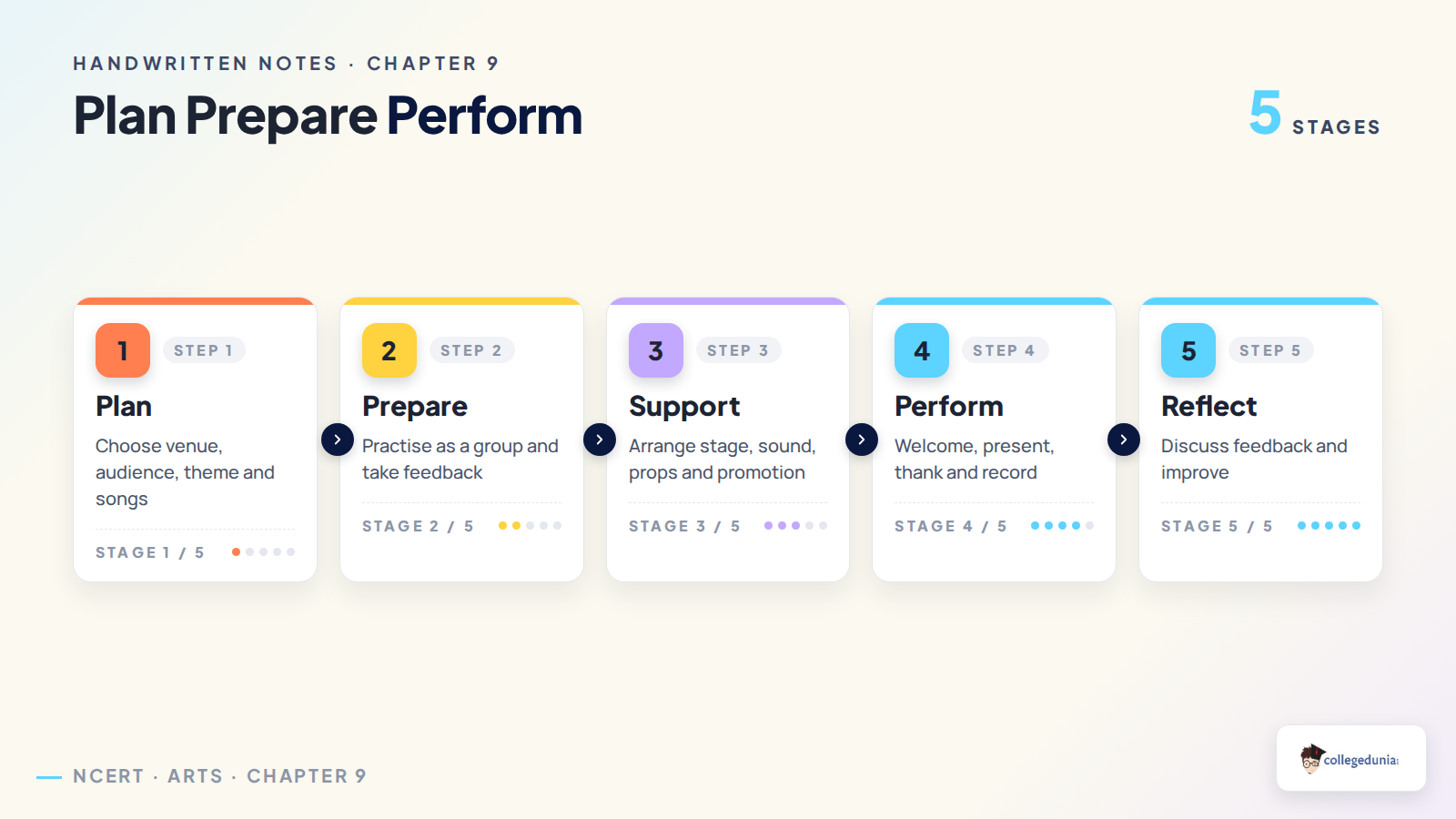
Chapter 9 explains that a successful performance needs more than singing or playing. Students can help through planning, rehearsal, stage support, promotion and feedback.
The fastest way to revise the chapter is to remember the three-part flow: Plan, Prepare and Perform. Each part has clear classroom tasks, and every student gets a useful role.
| Part | What to Remember |
|---|---|
| Plan | Choose venue, class group, theme, title, timing and songs. |
| Prepare | Practise as a group and use feedback to improve. |
| Perform | Welcome, introduce, present, thank and reflect. |
Plan the Performance
Planning is the first major stage before a performance. Activity 9.1 asks students to visualise where the performance will happen, when it will happen and how long it will be.
Students also decide viewers, theme, title, occasion and elements they liked from other performances. A clear plan helps the group imagine the final show before rehearsal begins.
- Write the venue, date, time and expected viewers.
- Choose a theme that connects every song or activity.
- Note useful ideas from other performances.
Create the Song List
Activity 9.2 asks the class to work with the teacher and make a song list. Everyone can suggest songs they know, like and can perform well.
The chapter also gives Swagatham Shubha Swagatham as an invocation or welcome song. It was composed by Pandit Ravi Shankar and sung at the 1982 Asian Games inauguration in New Delhi.
Activity 9.3 asks students to include a folk song from another tradition. The NCERT example is an Odia folk song from Koraput, Odisha, sung during Chaita Paraba.
- Collect song ideas first, then shortlist.
- Pick songs that match the theme and group comfort.
- Respect pronunciation and background when using a folk song.
Prepare with Rehearsal and Feedback
After choosing the songs, the group must practise regularly. Group performance needs timing, listening and coordination, not just individual confidence.
Students can use earlier learning such as singing in parts, canon, body percussion and synchronisation. Feedback from a teacher or friend helps the group improve before the final day.
| Performer | Preparation Cue |
|---|---|
| Vocalist | Understand lyrics, emotion and story. |
| Instrumentalist | Use dynamics and know when to lead or support. |
| Support role | Keep beat, manage space or help the group stay together. |
Production, Promotion and Support
Activity 9.5 explains that a performance also needs production support. Students think about stage design, lights, sound, space, props, anchor and seating.
Promotion is also part of the work. Posters can be made using Visual Art ideas, and simple social-media content can help people know about the event.
Backstage work matters because it shapes what viewers finally sees.
- Keep props useful, not distracting.
- Write the date, time and venue clearly on posters.
- Give every student a role, including off-stage roles.
Final Performance Steps
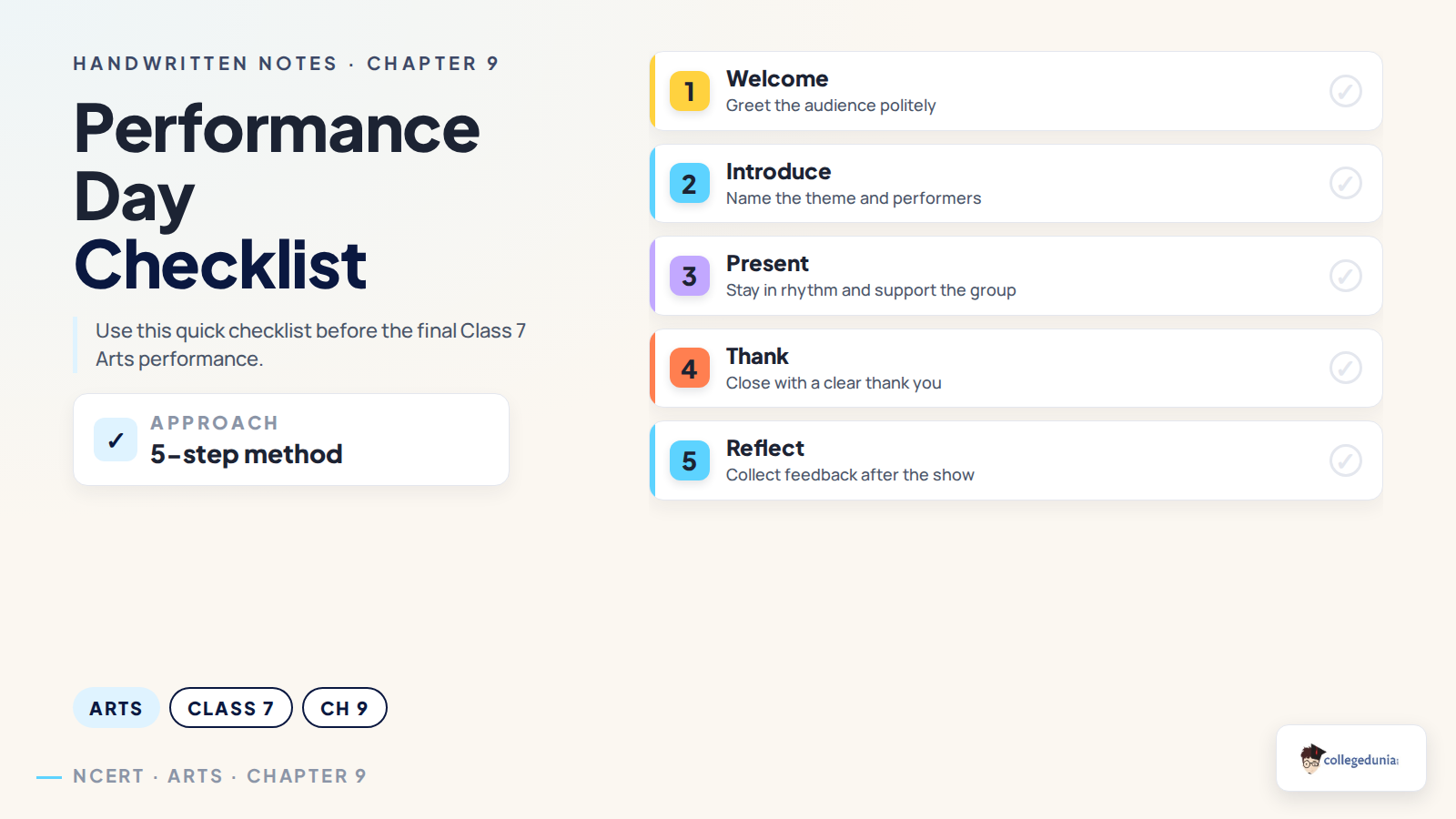
On the final day, students welcome viewers, introduce the show, present the performance and end with a thank you message. They should try to record the performance if possible.
After the performance, the group should collect constructive feedback and discuss it together. This helps students improve for the next performance.
- Welcome: greet viewers politely.
- Present: stay calm and support the group.
- Reflect: listen to feedback without arguing.
Class 7 Arts Kriti Video
Source: Prof.Analysis on YouTube
Related NCERT Class 7 Arts (Kriti) Resources
Use these related resources when you want the official book chapter or nearby handwritten notes from the same Arts (Kriti) unit.
| Resource | Link |
|---|---|
| NCERT Book PDF | Class 7 Arts Chapter 9 NCERT Book PDF |
| Previous Chapter | Class 7 Arts Chapter 8 Handwritten Notes |
| Next Chapter | Class 7 Arts Chapter 10 Handwritten Notes |
All Chapters for Class 7 Arts (Kriti) Handwritten Notes
| Chapter | Handwritten Notes |
|---|---|
| Chapter 4 Story of India's Storytelling Tradition | Download Notes |
| Chapter 5 Making Music | Download Notes |
| Chapter 6 Music, Emotions and Creativity | Download Notes |
| Chapter 7 Ragas and Talas/Taal | Download Notes |
| Chapter 8 The Music of the People | Download Notes |
FAQs on NCERT Class 7 Arts Chapter 9 Handwritten Notes
Ques. What is covered in Class 7 Arts Chapter 9 Performance?
Ans. The chapter covers planning a performance, creating a song list, including folk music, rehearsal, feedback, production support and final presentation.
Ques. What are the three main parts of the Performance chapter?
Ans. The three main parts are Plan, Prepare and Perform. They help students move from idea to rehearsal to final presentation.
Ques. Why is feedback important before the final performance?
Ans. Feedback helps students notice strengths and weaknesses. It also helps the group improve timing, coordination and confidence.
Ques. Why are these handwritten notes useful?
Ans. The notes turn the chapter into short handwritten pages with flow charts, checklists and quick points for revision.



Comments