




NCERT Handwritten Notes for Class 7 Arts (Kriti) Chapter 4 Story of India's Storytelling Tradition help students revise Kathanjali, Harikathe, Kaavad Katha, Phad paintings, Thangka and the need to protect Indian oral traditions for the 2026-27 NCERT syllabus.
Chapter4StoryofIndia’sStorytellingTraditionHandwrittenNotes.pdf?page=1&dpi=150)
Chapter4StoryofIndia’sStorytellingTraditionHandwrittenNotes.pdf?page=2&dpi=150)
Chapter4StoryofIndia’sStorytellingTraditionHandwrittenNotes.pdf?page=3&dpi=150)
Chapter4StoryofIndia’sStorytellingTraditionHandwrittenNotes.pdf?page=4&dpi=150)
Chapter4StoryofIndia’sStorytellingTraditionHandwrittenNotes.pdf?page=5&dpi=150)
Chapter4StoryofIndia’sStorytellingTraditionHandwrittenNotes.pdf?page=6&dpi=150)
Chapter4StoryofIndia’sStorytellingTraditionHandwrittenNotes.pdf?page=7&dpi=150)
Chapter4StoryofIndia’sStorytellingTraditionHandwrittenNotes.pdf?page=8&dpi=150)
Chapter4StoryofIndia’sStorytellingTraditionHandwrittenNotes.pdf?page=9&dpi=150)
Chapter4StoryofIndia’sStorytellingTraditionHandwrittenNotes.pdf?page=10&dpi=150)
Chapter4StoryofIndia’sStorytellingTraditionHandwrittenNotes.pdf?page=11&dpi=150)
Chapter4StoryofIndia’sStorytellingTraditionHandwrittenNotes.pdf?page=12&dpi=150)
Chapter4StoryofIndia’sStorytellingTraditionHandwrittenNotes.pdf?page=13&dpi=150)
Chapter4StoryofIndia’sStorytellingTraditionHandwrittenNotes.pdf?page=14&dpi=150)
Chapter4StoryofIndia’sStorytellingTraditionHandwrittenNotes.pdf?page=15&dpi=150)
Chapter4StoryofIndia’sStorytellingTraditionHandwrittenNotes.pdf?page=16&dpi=150)
Chapter4StoryofIndia’sStorytellingTraditionHandwrittenNotes.pdf?page=17&dpi=150)
Chapter4StoryofIndia’sStorytellingTraditionHandwrittenNotes.pdf?page=18&dpi=150)
Chapter4StoryofIndia’sStorytellingTraditionHandwrittenNotes.pdf?page=19&dpi=150)
Chapter4StoryofIndia’sStorytellingTraditionHandwrittenNotes.pdf?page=20&dpi=150)
Chapter4StoryofIndia’sStorytellingTraditionHandwrittenNotes.pdf?page=21&dpi=150)
Chapter4StoryofIndia’sStorytellingTraditionHandwrittenNotes.pdf?page=22&dpi=150)
Chapter4StoryofIndia’sStorytellingTraditionHandwrittenNotes.pdf?page=23&dpi=150)
Chapter4StoryofIndia’sStorytellingTraditionHandwrittenNotes.pdf?page=24&dpi=150)
- Download a 24-page handwritten revision PDF for Class 7 Arts Chapter 4.
- Revise folk storytelling forms, artist challenges and preservation ideas.
- Use these notes before class discussion, activity work or portfolio writing.
Clear colour-coded revision notes on India's storytelling traditions.
|
Table of Contents |
Story of India's Storytelling Tradition Chapter Snapshot
Chapter 4 introduces Kathanjali, a story-loving guide who has seen kings, common people and travellers. Through her, students learn how stories carry joy, memory and values.
The chapter also shows how storytelling became a performing art. Pictures, music, dance and puppets made stories easier to enjoy and remember.
| Topic | What Students Should Remember |
|---|---|
| Kathanjali | She connects old stories with modern learners. |
| Harikathe | It uses song, dance and narration linked with Lord Hari. |
| Kaavad Katha | It uses a wooden picture box from Rajasthan. |
How Indian Storytelling Travels Across Generations
Indian storytelling is an oral tradition. A story is heard, remembered, performed and passed on. This is why stories from the Ramayana and Mahabharata are known across many regions.
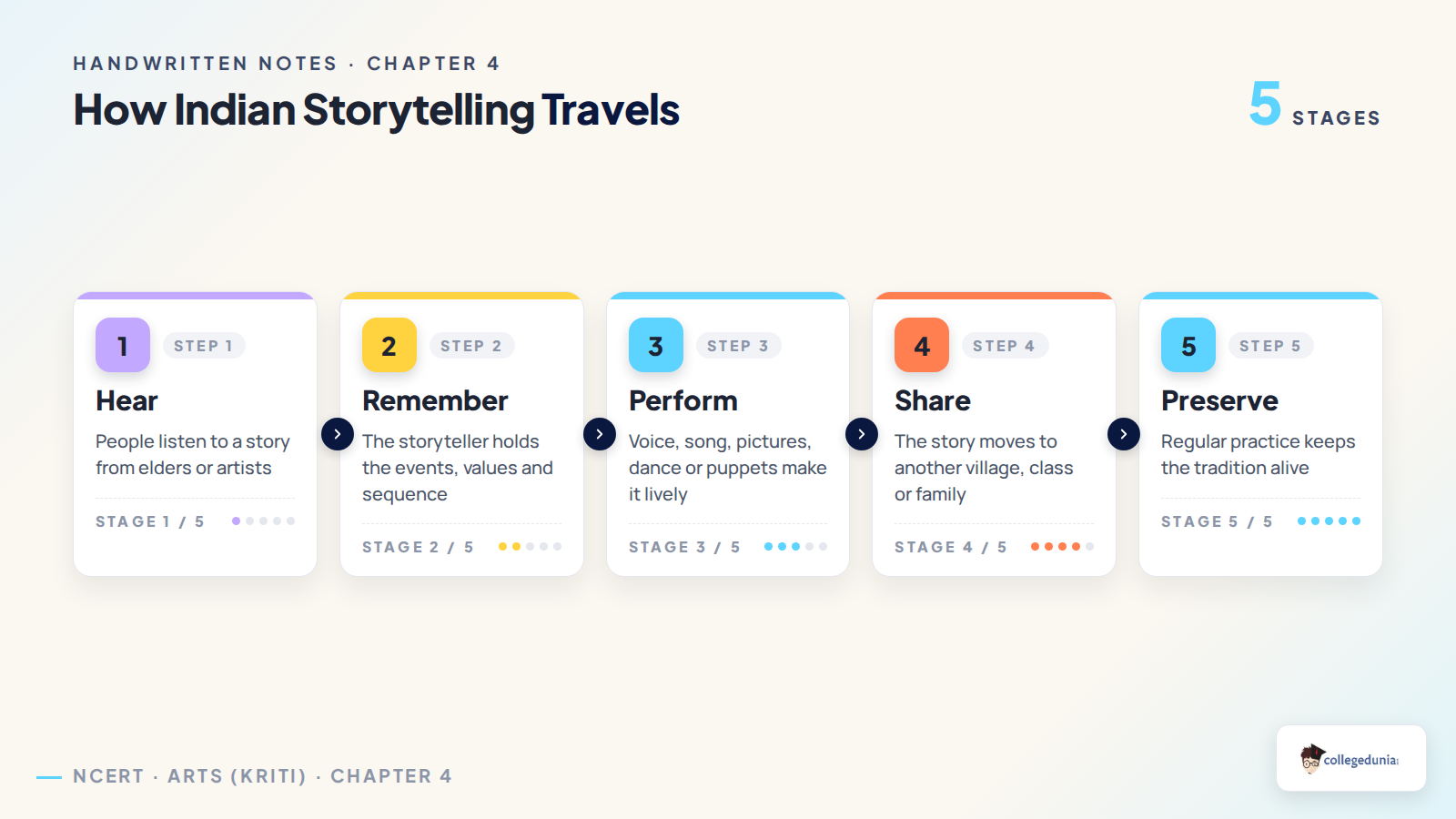
These handwritten notes explain that stories are not only entertainment. They teach values, preserve culture and bring communities together.
Harikathe and Kaavad Katha Comparison for Class 7 Arts
Harikathe and Kaavad Katha are both storytelling forms, but they use different tools. Harikathe uses music and narration. Kaavad Katha uses a painted wooden box with panels.
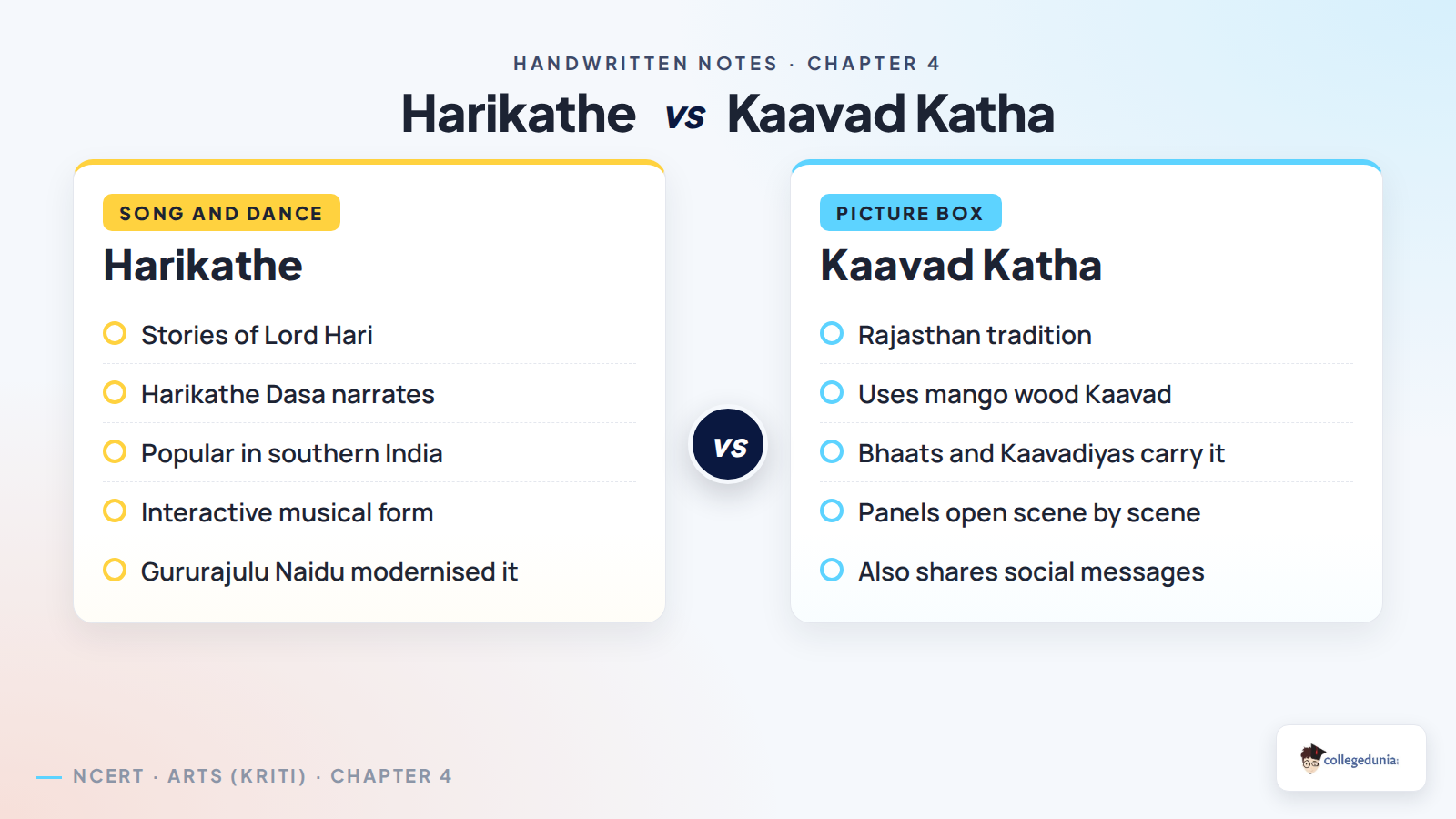
- Harikathe: Harikathe Dasa narrates stories of Lord Hari.
- Kaavad Katha: Kaavadiya opens picture panels while narrating.
- Exam tip: Always write the region and method for each form.
Storytelling Tradition Video for Class 7 Arts
Source: Edzy on YouTube
Why India's Storytelling Traditions Need Protection
Many traditional forms are becoming rare because fewer young people learn them. Television and smartphones have also reduced regular listening spaces for many artists.
If storytellers disappear, their special style of telling stories can also fade. The chapter asks students to think of practical ways to support artists.
- Invite traditional storytellers to schools and local events.
- Record performances with permission and share them with students.
- Learn one storytelling style and practise it with classmates.
How to Use These Handwritten Notes for Revision
Start with the first four pages if you need the chapter idea quickly. Then revise the separate pages on Harikathe, Kaavad Katha, Phad paintings and Thangka.
For a written answer, use this order: name the form, state the region, explain the method, then add one preservation idea.
| Question Type | Best Revision Cue |
|---|---|
| Short answer | Define the form in two lines. |
| Long answer | Add examples, artists and present-day challenges. |
| Activity work | Create a story with pictures, music or movement. |
Related NCERT Class 7 Arts (Kriti) Resources
| Resource | Link |
|---|---|
| NCERT Book PDF | Class 7 Arts Chapter 4 NCERT Book PDF |
| NCERT Notes | Class 7 Arts Chapter 4 Notes |
| Handwritten Notes | Class 7 Arts Chapter 3 Handwritten Notes |
All Chapters for Class 7 Arts (Kriti) Handwritten Notes
| Chapter | Handwritten Notes |
|---|---|
| Chapter 1 Understanding Emotions | Download Notes |
| Chapter 2 Say More without Speech Mime | Download Notes |
| Chapter 3 Let's Design Stage Technicals 2 | Download Notes |
| Chapter 4 Story of India's Storytelling Tradition | Download Notes |
FAQs on NCERT Class 7 Arts Chapter 4 Handwritten Notes
Ques. What is Story of India's Storytelling Tradition about?
Ans. It explains how Indian stories are shared through narration, music, dance, pictures and puppets. It also discusses why these traditions must be protected.
Ques. What is Harikathe in Class 7 Arts Chapter 4?
Ans. Harikathe is a storytelling form linked with stories of Lord Hari. The storyteller uses narration, songs, dance and student interaction.
Ques. What is Kaavad Katha?
Ans. Kaavad Katha is a Rajasthan storytelling tradition. The Kaavadiya opens panels of a wooden picture box and narrates the story in local language.
Ques. Why are these handwritten notes useful?
Ans. The notes turn the chapter into short handwritten pages with tables, flow points and exam cues. Students can revise the forms and key terms quickly.



Comments