



The handwritten notes on Class 8 Arts (Kriti) Chapter 15 Elements and Principles of Visual Art and Design have been prepared for quick 2026-27 revision. The PDF covers visual elements, Shadanga, design principles, NCERT activities and answer-writing cues.
- Resource focus: point, line, shape, form, colour, value, texture and space.
- Best use: revise one handwritten page, then observe the matching NCERT artwork.
- Exam link: follows the NCERT 2026-27 Arts (Kriti) Chapter 15 learning outcomes.
Chapter15ElementsandPrinciplesofVisualArtandDesignHandwrittenNotes.pdf?page=1&dpi=150)
Chapter15ElementsandPrinciplesofVisualArtandDesignHandwrittenNotes.pdf?page=2&dpi=150)
Chapter15ElementsandPrinciplesofVisualArtandDesignHandwrittenNotes.pdf?page=3&dpi=150)
Chapter15ElementsandPrinciplesofVisualArtandDesignHandwrittenNotes.pdf?page=4&dpi=150)
Chapter15ElementsandPrinciplesofVisualArtandDesignHandwrittenNotes.pdf?page=5&dpi=150)
Chapter15ElementsandPrinciplesofVisualArtandDesignHandwrittenNotes.pdf?page=6&dpi=150)
Chapter15ElementsandPrinciplesofVisualArtandDesignHandwrittenNotes.pdf?page=7&dpi=150)
Chapter15ElementsandPrinciplesofVisualArtandDesignHandwrittenNotes.pdf?page=8&dpi=150)
Chapter15ElementsandPrinciplesofVisualArtandDesignHandwrittenNotes.pdf?page=9&dpi=150)
Chapter15ElementsandPrinciplesofVisualArtandDesignHandwrittenNotes.pdf?page=10&dpi=150)
Chapter15ElementsandPrinciplesofVisualArtandDesignHandwrittenNotes.pdf?page=11&dpi=150)
Chapter15ElementsandPrinciplesofVisualArtandDesignHandwrittenNotes.pdf?page=12&dpi=150)
Chapter15ElementsandPrinciplesofVisualArtandDesignHandwrittenNotes.pdf?page=13&dpi=150)
Chapter15ElementsandPrinciplesofVisualArtandDesignHandwrittenNotes.pdf?page=14&dpi=150)
Chapter15ElementsandPrinciplesofVisualArtandDesignHandwrittenNotes.pdf?page=15&dpi=150)
Chapter15ElementsandPrinciplesofVisualArtandDesignHandwrittenNotes.pdf?page=16&dpi=150)
Chapter15ElementsandPrinciplesofVisualArtandDesignHandwrittenNotes.pdf?page=17&dpi=150)
Chapter15ElementsandPrinciplesofVisualArtandDesignHandwrittenNotes.pdf?page=18&dpi=150)
Chapter15ElementsandPrinciplesofVisualArtandDesignHandwrittenNotes.pdf?page=19&dpi=150)
Chapter15ElementsandPrinciplesofVisualArtandDesignHandwrittenNotes.pdf?page=20&dpi=150)
Chapter15ElementsandPrinciplesofVisualArtandDesignHandwrittenNotes.pdf?page=21&dpi=150)
Chapter15ElementsandPrinciplesofVisualArtandDesignHandwrittenNotes.pdf?page=22&dpi=150)
Student Feedback: In a Collegedunia revision check with 8,700 Class 8 students, 76% said element-wise handwritten notes helped them answer visual arts activities faster.
Elements and Principles of Visual Art and Design Chapter Snapshot
Elements and Principles of Visual Art and Design teaches students how an artwork is built and arranged. NCERT compares visual elements with ingredients in a recipe. A visual becomes meaningful when those ingredients are arranged with clear design principles.
- Elements are the building blocks of art.
- Principles decide how those building blocks work together.
- The handwritten PDF turns the chapter into 22 quick revision pages.
Visual Elements in Class 8 Arts Chapter 15
The chapter lists point, line, shape, form, texture, colour, value and space as core visual elements. These are the first terms students should revise before attempting the NCERT activities.
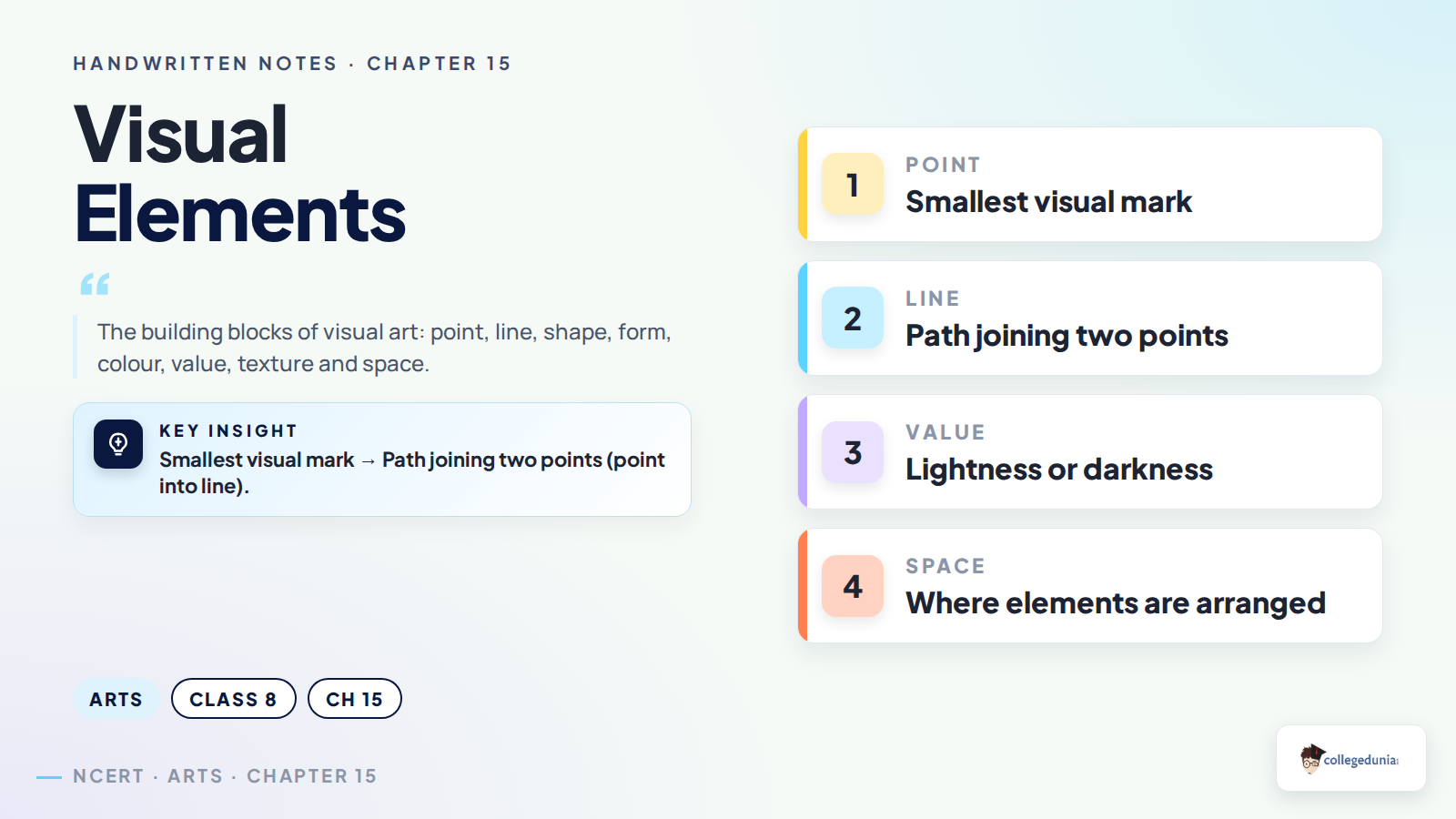
A point is the smallest visual mark. A line is the path joining two points. A shape is flat, while a form has depth. Value shows lightness or darkness, and space shows how elements are arranged.
Elements of Visual Art Explained
Students should learn each element through observation. The NCERT activity asks them to look at maandana wall art, a Thanjavur style plate and an embroidered tapestry. The answer should name the visible elements and give evidence from the object.
| Element | Meaning | What to Observe |
|---|---|---|
| Point | Smallest visual mark | Dots, bindu, small details |
| Line | Visible path joining points | Horizontal, vertical, wavy or zig-zag lines |
| Shape and Form | Flat area and three-dimensional depth | Geometric, organic and solid forms |
| Texture | Surface feel | Soft, rough, grainy, silky or prickly effects |
| Colour and Value | Reflected light and tone | Tints, shades and gradations |
| Space | Area where elements are arranged | Foreground, background, positive and negative space |
Shadanga: Six Limbs of Art
Shadanga means the six limbs of art. The idea comes from the Vishnudharmottara Purana and explains how visual elements can be combined in a tasteful way.
- Roopabhedah: difference between forms.
- Pramanani: measurement and structure.
- Bhava: expression and emotion.
- Lavanya Yojanam: graceful composition.
- Sadrishyam: likeness or resemblance.
- Varnikabhangam: use of tools and colours.
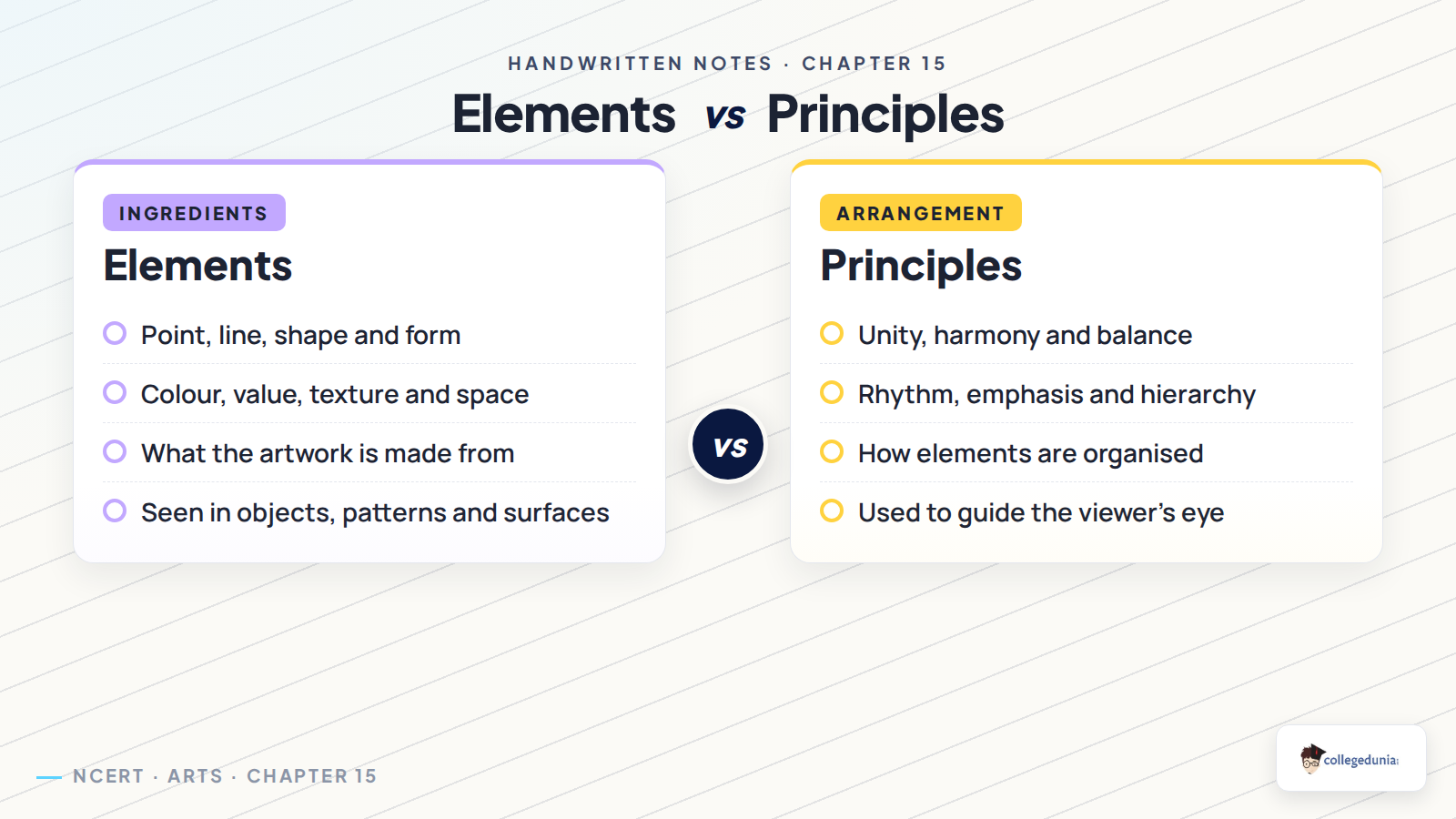
Principles of Visual Art and Design
Design principles explain how artists arrange the elements. NCERT uses Jamini Roy's Mother and Child, the Ganga sculpture and Jyoti Bhatt's Devi to show these ideas.
| Principle | Meaning | NCERT Cue |
|---|---|---|
| Unity and Harmony | Parts feel connected and pleasing | Observe colour distribution in Mother and Child. |
| Balance | Visual stability | Compare large and small areas in the artwork. |
| Rhythm and Movement | Eye moves through pattern and repetition | Look at repeated stems, folds and lines. |
| Emphasis | One part stands out | Notice the red bindi or coloured palm. |
| Proportion | Relationship between sizes | Compare baby and mother in the painting. |
| Hierarchy | Order of importance | Find the main figure, then the next details. |
Elements and Principles of Art Video Lesson
Source: YouTube
NCERT Activities and Answer Cues
Chapter 15 is activity-heavy. Students should write short observation-based answers, not memorised paragraphs. The handwritten notes give a simple answer frame for each task.
- Activity 15.1: name the artwork or object, list 3 to 4 visual elements and add evidence.
- Activity 15.2: make a visual-elements journal from objects, plants, textiles and architecture.
- Activity 15.3: write two design principles for each artwork, with evidence.
- Activity 15.4: create a simple personal motif using balance, pattern, emphasis and hierarchy.
How to Use the Handwritten Notes for Revision
First revise the element definitions. Then revise Shadanga and the six design principles. After that, open the NCERT activity pages and practise writing one evidence line for each artwork.
Quick method: spend 10 minutes on visual elements, 10 minutes on Shadanga, 15 minutes on design principles and 15 minutes on activity answers. This gives one complete revision cycle in under one hour.
More Arts Resources
| Resource | Link |
|---|---|
| NCERT Book PDF | Class 8 Arts Chapter 15 Book PDF |
| NCERT Notes | Class 8 Arts Chapter 15 Notes |
| Handwritten Notes | Class 8 Arts Chapter 15 Handwritten Notes |
Arts (Kriti) Handwritten Notes for Other Chapters
| Chapter | Handwritten Notes |
|---|---|
| Chapter 12 Dance for Well-being | Download Chapter 12 Notes |
| Chapter 13 Innovation, Inclusivity and Inspiring Change | Download Chapter 13 Notes |
| Chapter 14 A Presentation of Dance and Choreography | Download Chapter 14 Notes |
Elements and Principles of Visual Art and Design Handwritten Notes FAQs
Ques. What does Class 8 Arts Chapter 15 cover?
Ans. Class 8 Arts Chapter 15 covers visual elements, Shadanga, design principles and NCERT activities based on observation.
Ques. What are the main visual elements in this chapter?
Ans. The main elements are point, line, shape, form, colour, value, texture and space.
Ques. What is Shadanga in visual art?
Ans. Shadanga means six limbs of art: form, measurement, emotion, grace, likeness and use of tools and colours.
Ques. How should students use these handwritten notes?
Ans. Students should revise the terms first, then practise NCERT activity answers with one principle and one evidence line.



Comments