




The handwritten notes on Class 8 Arts (Kriti) Chapter 16 Still Life in Colour have been carefully prepared for quick 2026-27 revision. The PDF covers still life meaning, object selection, backdrop planning, light and shadow, contour drawing, proportion, negative space and colour techniques from the NCERT chapter.
- Resource focus: arrange, observe and draw still objects with correct proportion and light.
- Best use: revise one page, then practise the matching classroom activity.
- Exam link: follows the NCERT 2026-27 Arts (Kriti) Chapter 16 assessment cues.
Chapter16StillLifeinColourHandwrittenNotes.pdf?page=1&dpi=150)
Chapter16StillLifeinColourHandwrittenNotes.pdf?page=2&dpi=150)
Chapter16StillLifeinColourHandwrittenNotes.pdf?page=3&dpi=150)
Chapter16StillLifeinColourHandwrittenNotes.pdf?page=4&dpi=150)
Chapter16StillLifeinColourHandwrittenNotes.pdf?page=5&dpi=150)
Chapter16StillLifeinColourHandwrittenNotes.pdf?page=6&dpi=150)
Chapter16StillLifeinColourHandwrittenNotes.pdf?page=7&dpi=150)
Chapter16StillLifeinColourHandwrittenNotes.pdf?page=8&dpi=150)
Chapter16StillLifeinColourHandwrittenNotes.pdf?page=9&dpi=150)
Chapter16StillLifeinColourHandwrittenNotes.pdf?page=10&dpi=150)
Chapter16StillLifeinColourHandwrittenNotes.pdf?page=11&dpi=150)
Chapter16StillLifeinColourHandwrittenNotes.pdf?page=12&dpi=150)
Chapter16StillLifeinColourHandwrittenNotes.pdf?page=13&dpi=150)
Chapter16StillLifeinColourHandwrittenNotes.pdf?page=14&dpi=150)
Chapter16StillLifeinColourHandwrittenNotes.pdf?page=15&dpi=150)
Chapter16StillLifeinColourHandwrittenNotes.pdf?page=16&dpi=150)
Chapter16StillLifeinColourHandwrittenNotes.pdf?page=17&dpi=150)
Chapter16StillLifeinColourHandwrittenNotes.pdf?page=18&dpi=150)
Chapter16StillLifeinColourHandwrittenNotes.pdf?page=19&dpi=150)
Chapter16StillLifeinColourHandwrittenNotes.pdf?page=20&dpi=150)
Chapter16StillLifeinColourHandwrittenNotes.pdf?page=21&dpi=150)
Chapter16StillLifeinColourHandwrittenNotes.pdf?page=22&dpi=150)
Student Feedback: In a Collegedunia study check with 7,900 Class 8 students, 74% said activity-wise handwritten notes helped them finish arts revision faster.
|
Table of Contents |
Still Life in Colour Chapter Snapshot
Still Life in Colour explains how still objects become the main subject of an artwork. NCERT begins with symbolic objects in Indian art, then moves to the sixteenth-century shift where artists started arranging natural and human-made objects as a central study.
- Students revise what still life means and why objects are arranged carefully.
- The chapter treats observation as the first drawing skill.
- Activities cover choosing objects, setting a backdrop, drawing contours and colouring tones.
The handwritten PDF turns the chapter into short revision pages. Students can read one page, check the activity cue and then practise the still life task.
Still Life in Colour Audio Guide
Source: NCERT OFFICIAL on YouTube
How to Set Up a Still Life Arrangement
The first activity asks students to select three to four objects from everyday life and culture. The objects should vary in material, colour, texture, size and dimension. A basket, toy, fruit, clock, trophy or local craft object can all work if they help create an interesting composition.
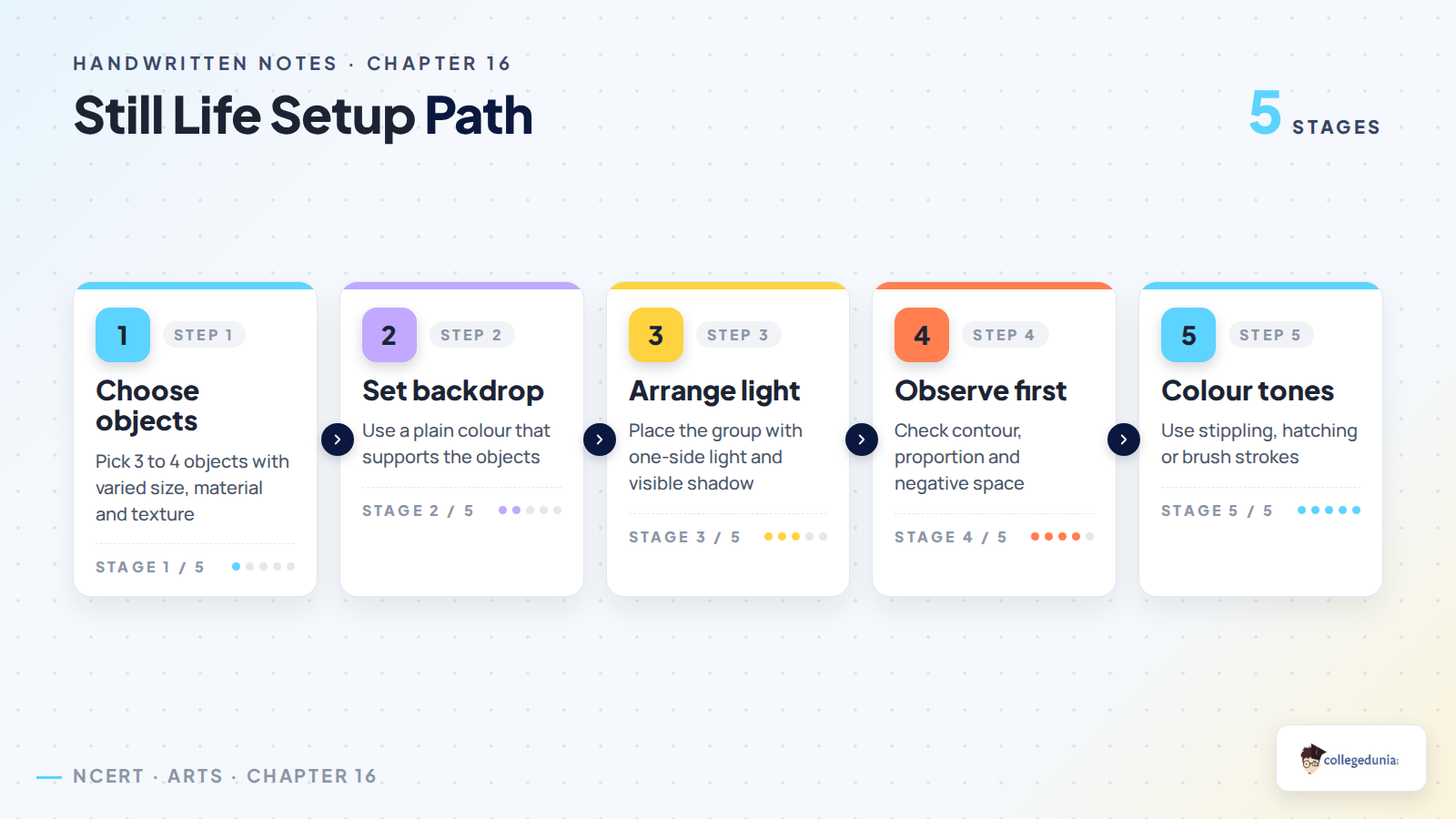
The backdrop should be plain and should complement the objects. A cloth with natural folds works well because it creates depth without distracting from the still life.
Light, Shadow and View Angle in Still Life
NCERT asks students to place the objects where light falls from one side. This creates highlights, tonal values and cast shadows. Students may partly open doors or windows, or use screens and curtains to filter classroom light.
Different students see the same arrangement from different angles. This changes the visible area of the backdrop, the overlap between objects, the mouth shape of containers and the direction of shadows.
Drawing the Still Life Step by Step
Before drawing, students should observe the arrangement for five minutes. They should decide whether the drawing fits better vertically or horizontally and then use maximum paper space.
The contour should be drawn with light lines. Students should mark edge limits first, compare object proportions with a pencil and build hidden basic shapes before adding details. Ratio is more important than actual size because the drawing must fit the paper.
Colour Techniques Used in Chapter 16
The chapter names stippling, hatching, cross-hatching and brush strokes as ways to show colour tonalities. These techniques help students avoid flat colouring and show form, light and shade.
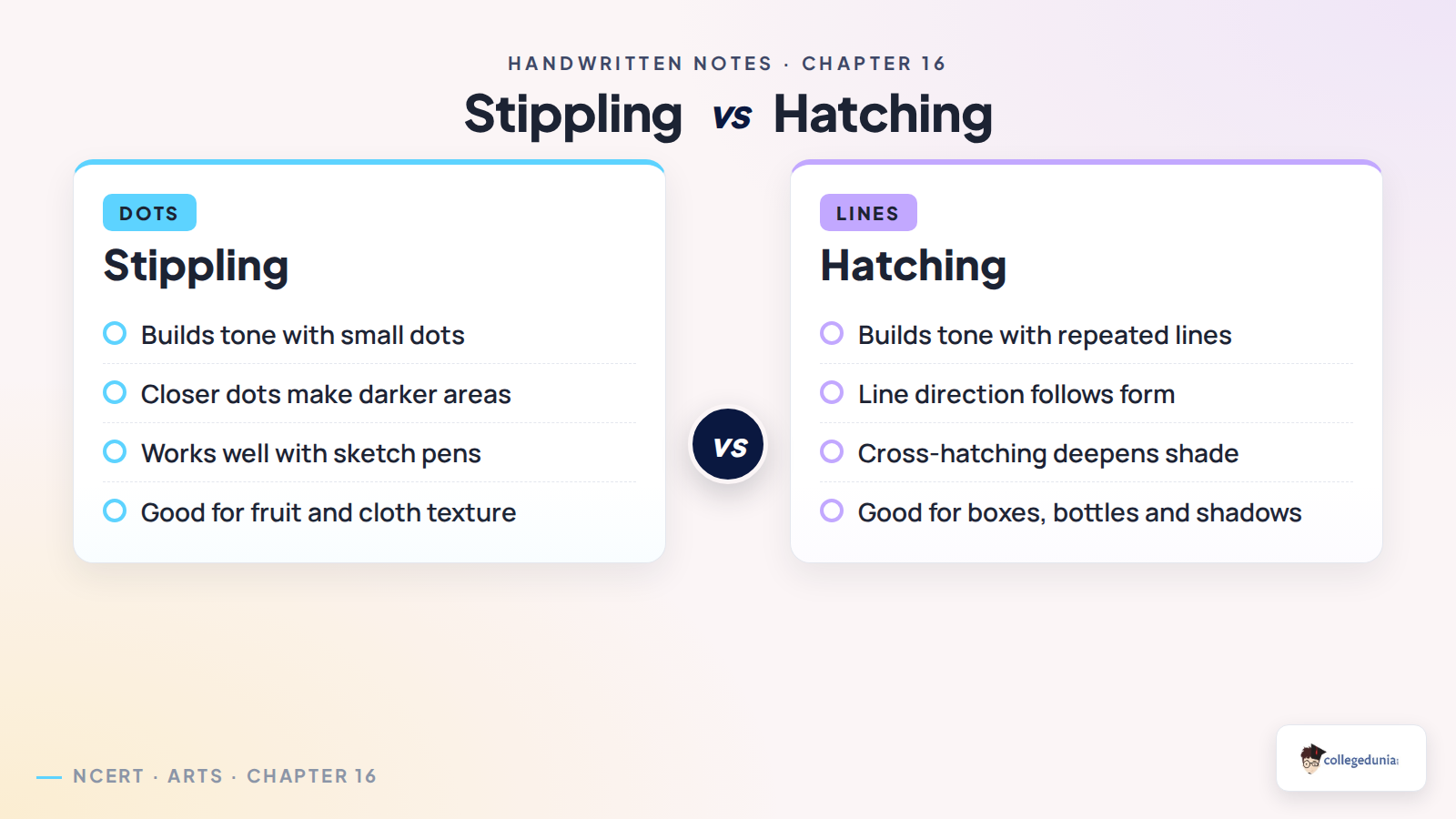
Closer dots or lines make darker areas, while wider spacing keeps the tone light. Brush direction should support the object's shape, especially on round fruits, cloth folds and containers.
Artists Mentioned in Still Life in Colour
The chapter introduces Paul Cezanne and Krishna Howlaji Ara as still life artists. Cezanne was a French artist of the nineteenth century who experimented with painting techniques. K H Ara was a twentieth-century Indian artist and a member of the Progressive Artists Group in Mumbai.
Students should compare their still life arrangements, colours and brush strokes. This trains them to look at artwork as a set of choices, not only as a finished picture.
How to Use These Handwritten Notes
Use the PDF after reading the NCERT chapter once. First revise the meaning of still life. Then move through the activity pages in order: choose objects, set backdrop, arrange light, observe, draw contour and colour with tone.
- Keep the PDF open while preparing the classroom arrangement.
- Use the final revision page before writing teacher comments or student observations.
- Practise one small object group before attempting a full still life.
More Resources for Class 8 Arts Chapter 16
| Resource | Link |
|---|---|
| NCERT Book PDF | Class 8 Arts Chapter 16 Book PDF |
| Handwritten Notes | Class 8 Arts Chapter 16 Handwritten Notes |
| Previous Chapter | Class 8 Arts Chapter 15 Handwritten Notes |
| Current Chapter | Class 8 Arts Chapter 16 Handwritten Notes |
Class 8 Arts (Kriti) Handwritten Notes for Other Chapters
| Chapter | Handwritten Notes |
|---|---|
| Chapter 13 Innovation, Inclusivity and Inspiring Change | Download Chapter 13 Handwritten Notes |
| Chapter 14 A Presentation of Dance and Choreography | Download Chapter 14 Handwritten Notes |
| Chapter 15 Elements and Principles of Visual Art and Design | Download Chapter 15 Handwritten Notes |
Still Life in Colour Class 8 Handwritten Notes FAQs
Ques. What is covered in Still Life in Colour handwritten notes?
Ans. The notes cover still life meaning, object choice, backdrop, arrangement, light and shadow, contour drawing, proportion, negative space and colour techniques.
Ques. Are these notes based on the 2026-27 NCERT chapter?
Ans. Yes. The notes follow Class 8 Arts (Kriti) Chapter 16 Still Life in Colour from the 2026-27 NCERT textbook.
Ques. Which colour techniques are included in Chapter 16?
Ans. Chapter 16 includes stippling, hatching, cross-hatching, brush strokes, tone, shade and light-shadow observation.



Comments