




Collegedunia's NCERT Notes Class 11 Accountancy Chapter 1 Introduction to Accounting bring together every definition, process step and basic term that the CBSE board paper actually tests. The notes are free to download as a 20-page PDF and follow the 2026-27 textbook order, starting from the meaning of accounting and ending with a full glossary of basic accounting terms.
- Length: 20 pages covering the whole Introduction to Accounting unit, definitions included.
- Board focus: AICPA and AAA definitions, qualitative characteristics, and the 20-term glossary that later chapters assume you already know.
- Weightage: this chapter typically carries 4 to 6 marks a year through MCQs, one-mark and short-answer questions.
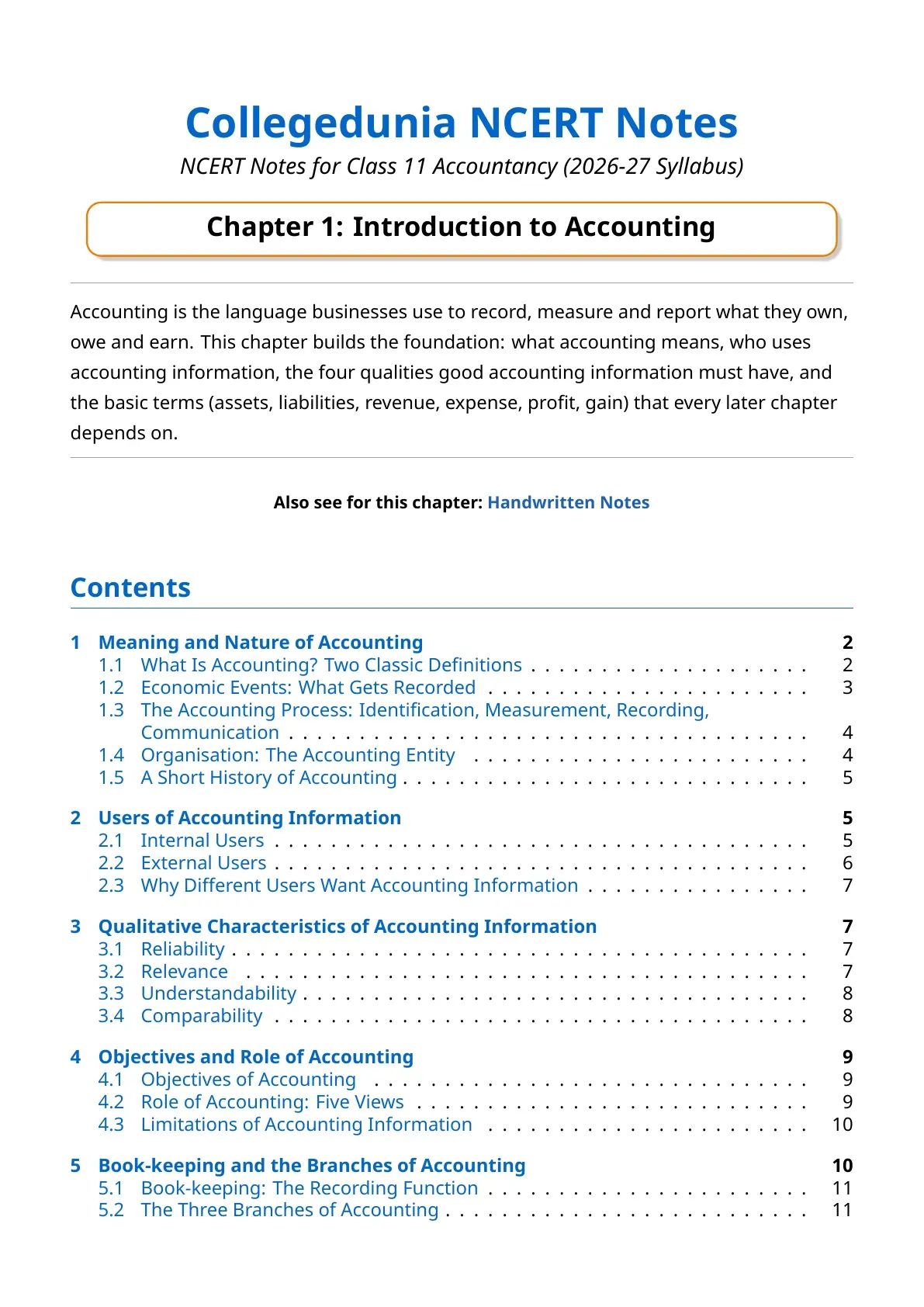
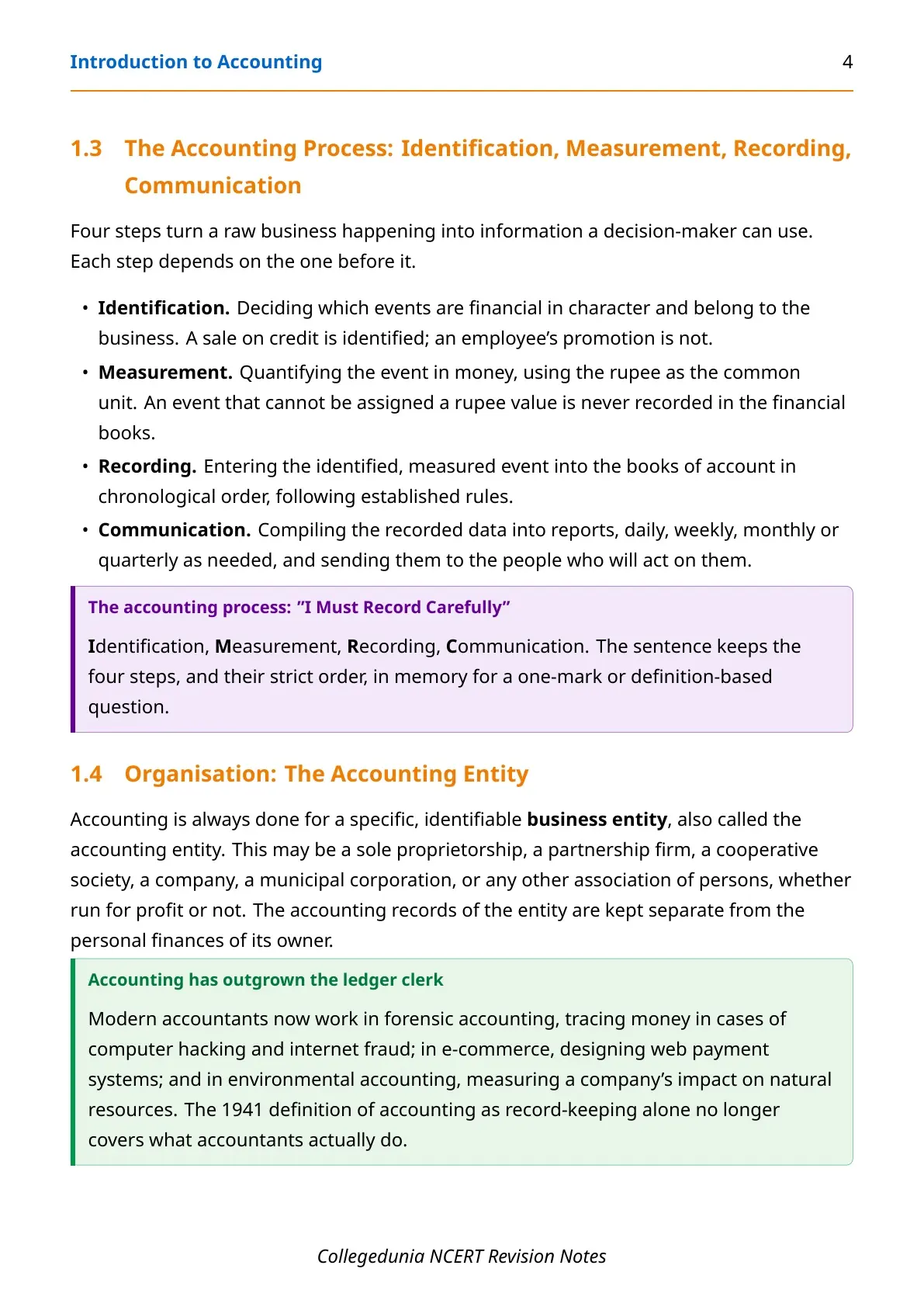
Every definition, term and example in these Introduction to Accounting notes is checked line by line against the 2026-27 Class 11 Accountancy textbook, so nothing you write in the board paper comes from a paraphrase.
Student Feedback: In a Collegedunia survey of 11,540 Class 11 Accountancy students conducted before the 2026 boards, 61% said telling profit and gain apart was the hardest one-mark question in this chapter. The same students rated the accounting process (identification, measurement, recording, communication) the easiest four marks in the paper.
Students who wrote each basic term on one side of a flashcard and its opposite pair (debtor/creditor, capital/drawings, profit/gain) on the back said the mix-ups stopped within a week.
Source: 2026-27 Class 11 Accountancy student poll. Sample of 11,540 students from CBSE schools across 17 states.
Meaning of Accounting: AICPA and AAA Definitions for Class 11
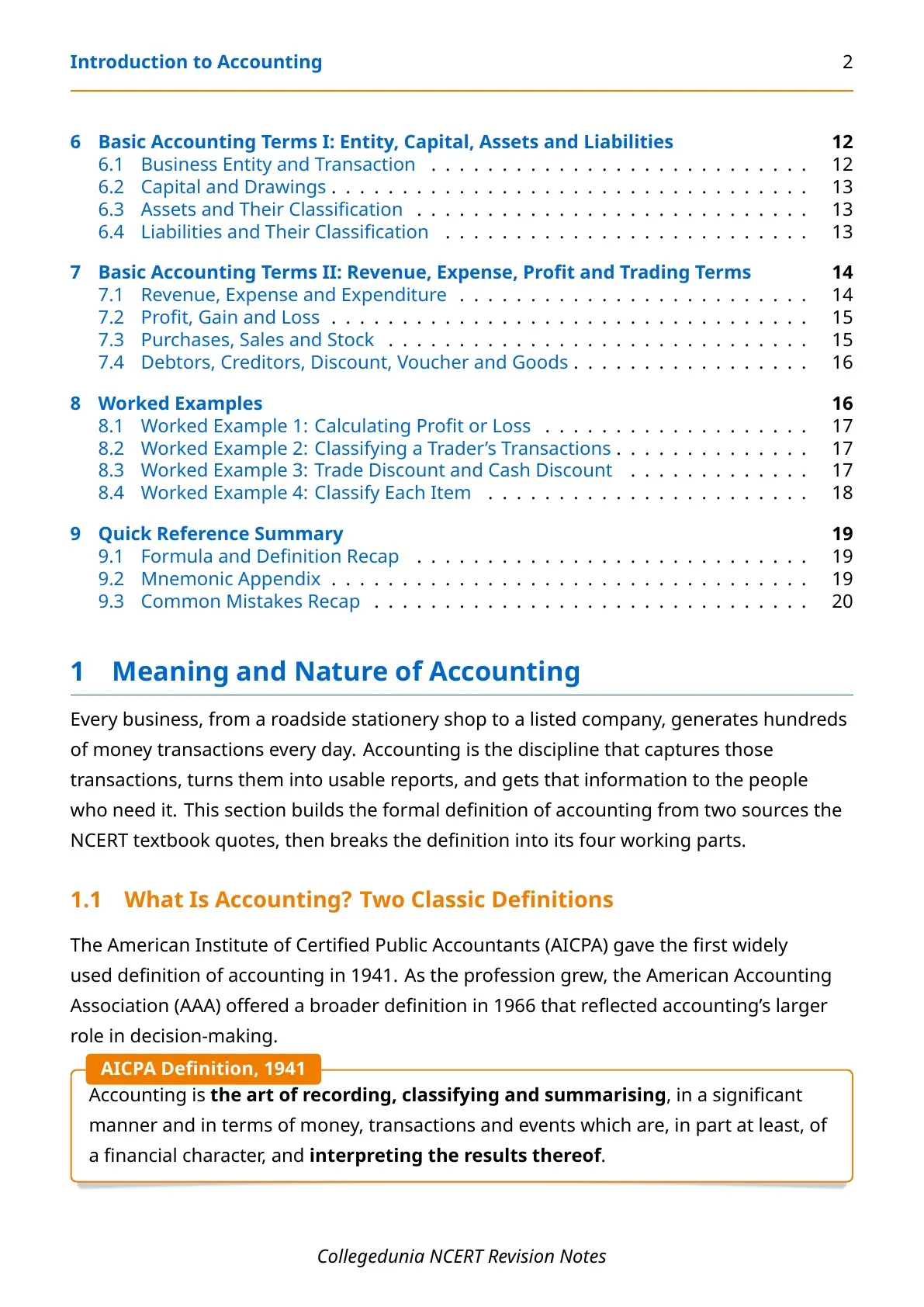
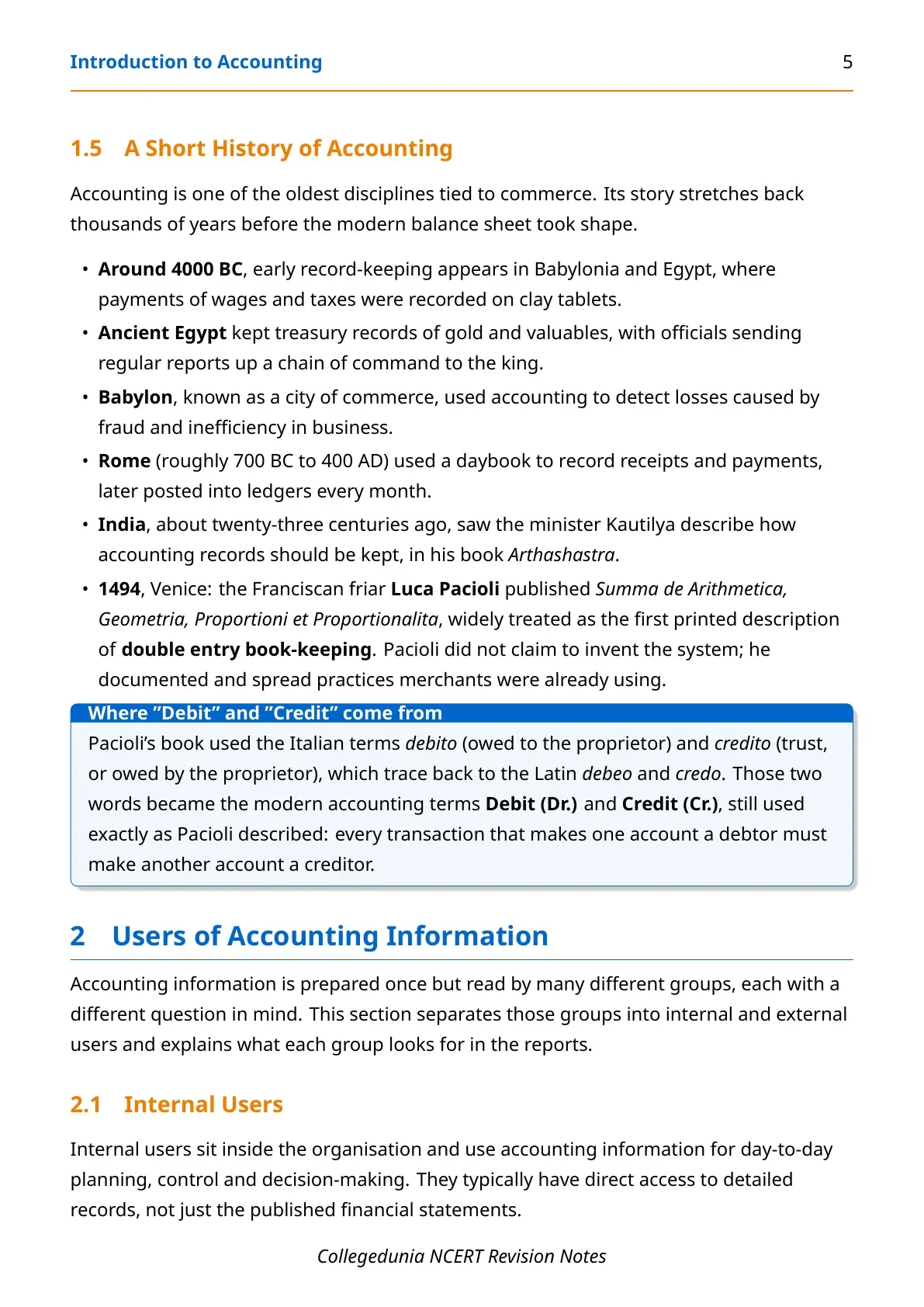
The American Institute of Certified Public Accountants (AICPA) defined accounting in 1941 as the art of recording, classifying and summarising, in terms of money, transactions of a financial character, and interpreting the results. The American Accounting Association (AAA) broadened this in 1966, defining accounting as the process of identifying, measuring and communicating economic information to permit informed decisions.
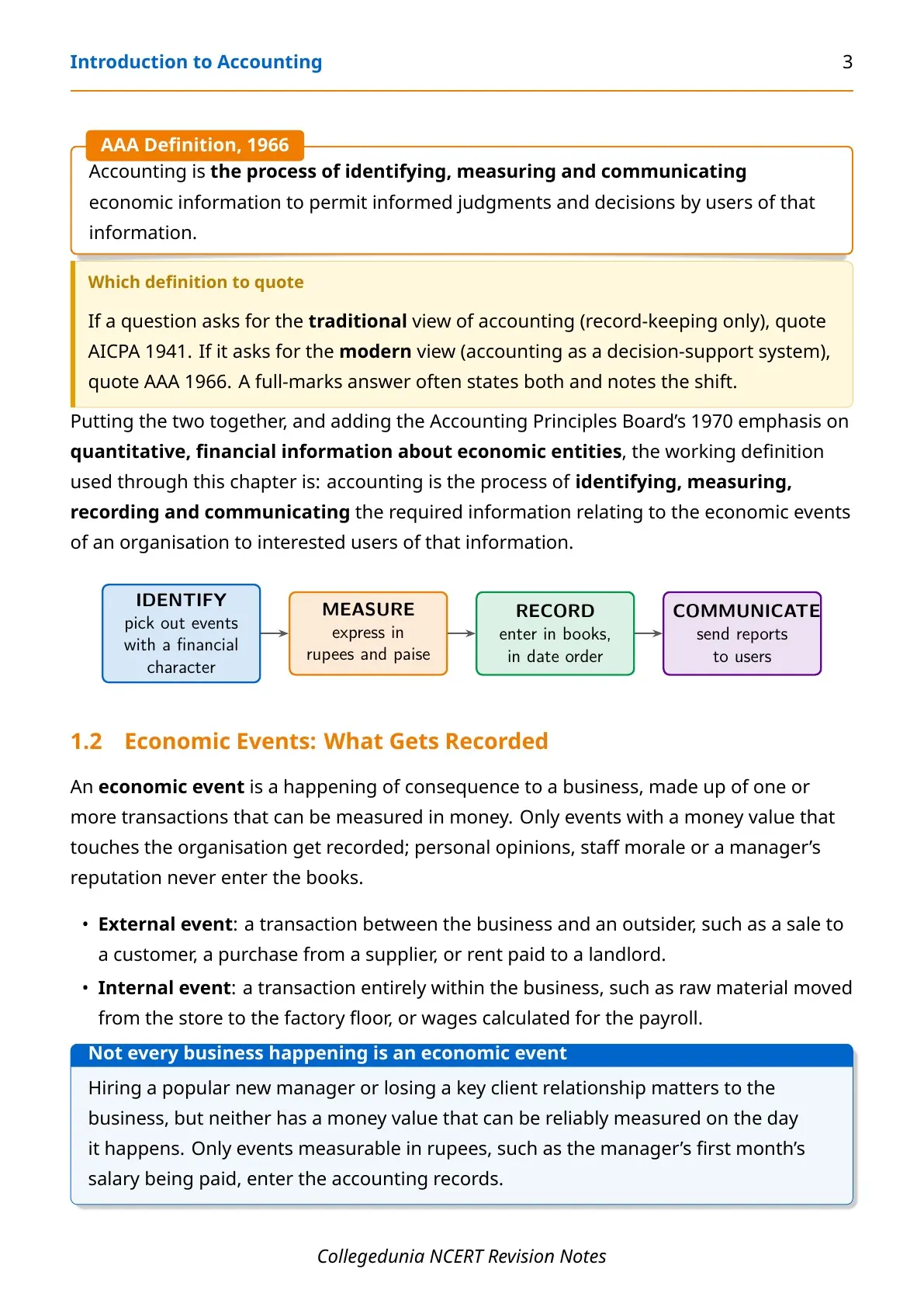
Putting both together gives the working definition NCERT uses through the chapter: accounting is the process of identifying, measuring, recording and communicating the required information relating to the economic events of a business to interested users.
| Definition | Year | What it emphasises |
|---|---|---|
| AICPA | 1941 | Traditional view: recording, classifying, summarising and interpreting |
| AAA | 1966 | Modern view: identifying, measuring and communicating for decision-making |
Tip: a one-mark question asking for "the traditional definition" wants AICPA 1941 by name. A question asking for "the modern view of accounting" wants AAA 1966.
Introduction to Accounting Video Explanation
Source: Magnet Brains on YouTube
The Accounting Process: Identification, Measurement, Recording and Communication
Every transaction moves through four steps before it becomes information a manager can use. Identification means picking out events that have a financial character and belong to the business, so a sale is identified but a manager's promotion is not.
- Measurement: the event is expressed in rupees. An event with no rupee value is never recorded.
- Recording: the measured event is entered in the books of account, in chronological order.
- Communication: the recorded data is compiled into reports and sent to internal and external users.
An economic event is a happening of consequence to the business that involves one or more transactions. An external event happens between the business and an outsider, such as a sale to a customer or rent paid to a landlord. An internal event happens entirely inside the business, such as raw material moved from the store to the factory floor.
Book-keeping vs Accounting: The Key Differences for Class 11
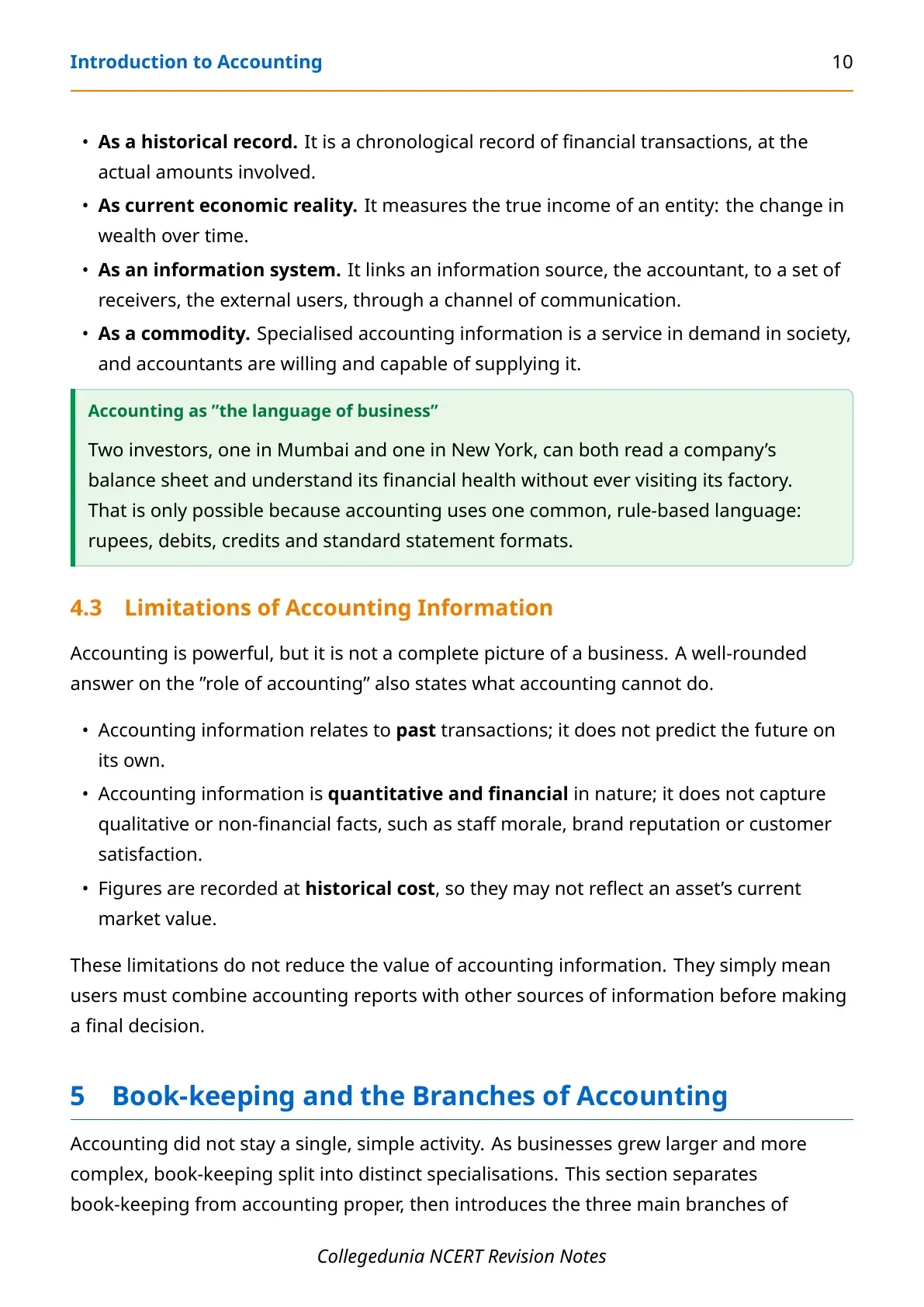
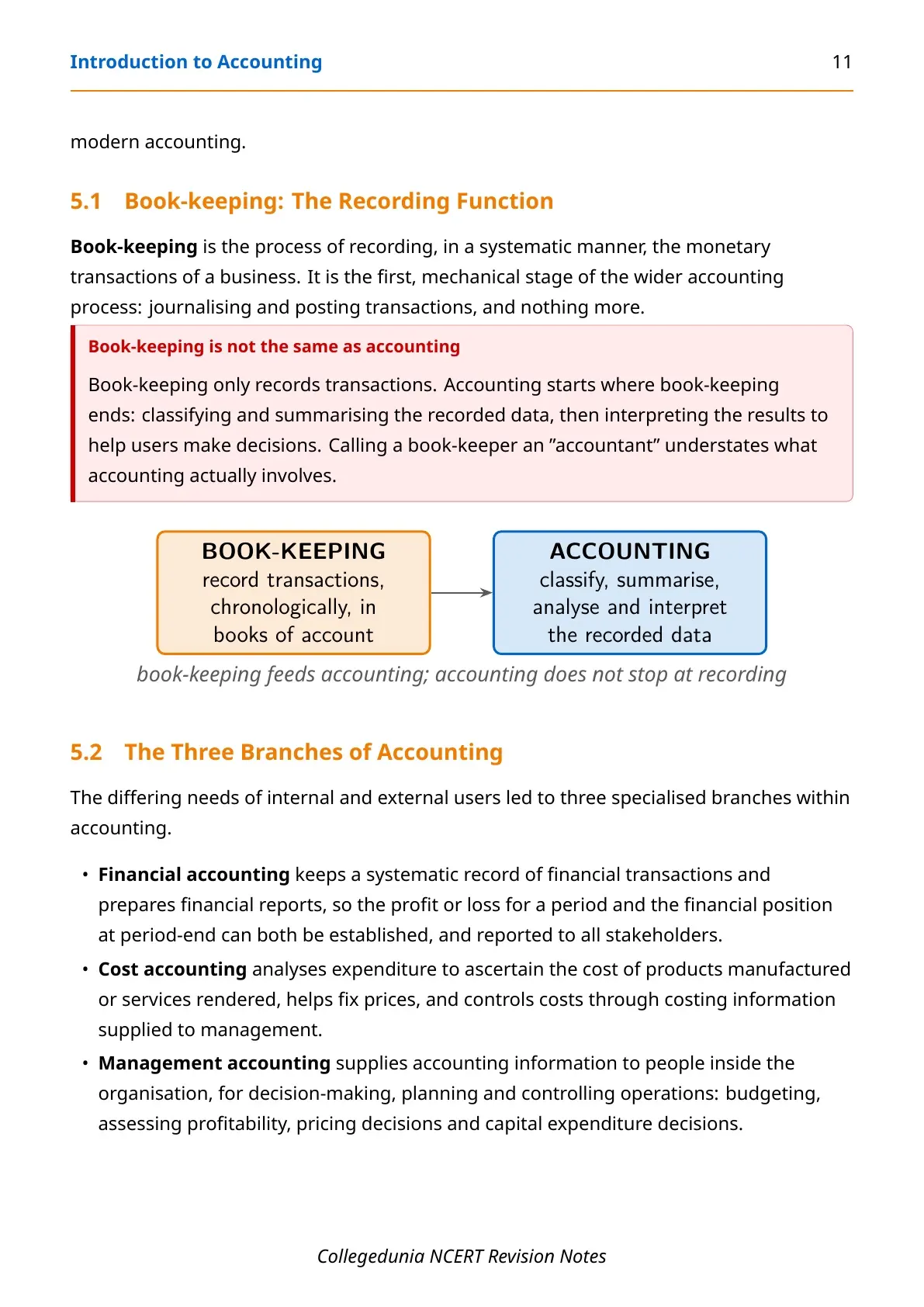
Book-keeping is the process of recording, in a systematic manner, the monetary transactions of a business. It is the first, mechanical stage of the wider accounting process. Accounting starts where book-keeping ends: classifying and summarising the recorded data, then interpreting the results for the people who use them.
| Point | Book-keeping | Accounting |
|---|---|---|
| Scope | Recording transactions only | Recording, classifying, summarising, analysing and interpreting |
| Stage | First, mechanical stage | Begins where book-keeping ends |
| Skill needed | Basic knowledge of journal and ledger entries | Analytical and interpretive skill |
| Who performs it | A book-keeper or junior clerk | An accountant, usually with more experience |
Tip: calling a book-keeper an "accountant" understates the job. Book-keeping stops at recording; accounting also classifies, summarises and interprets the same data.
Branches of Accounting: Financial, Cost and Management Accounting Compared
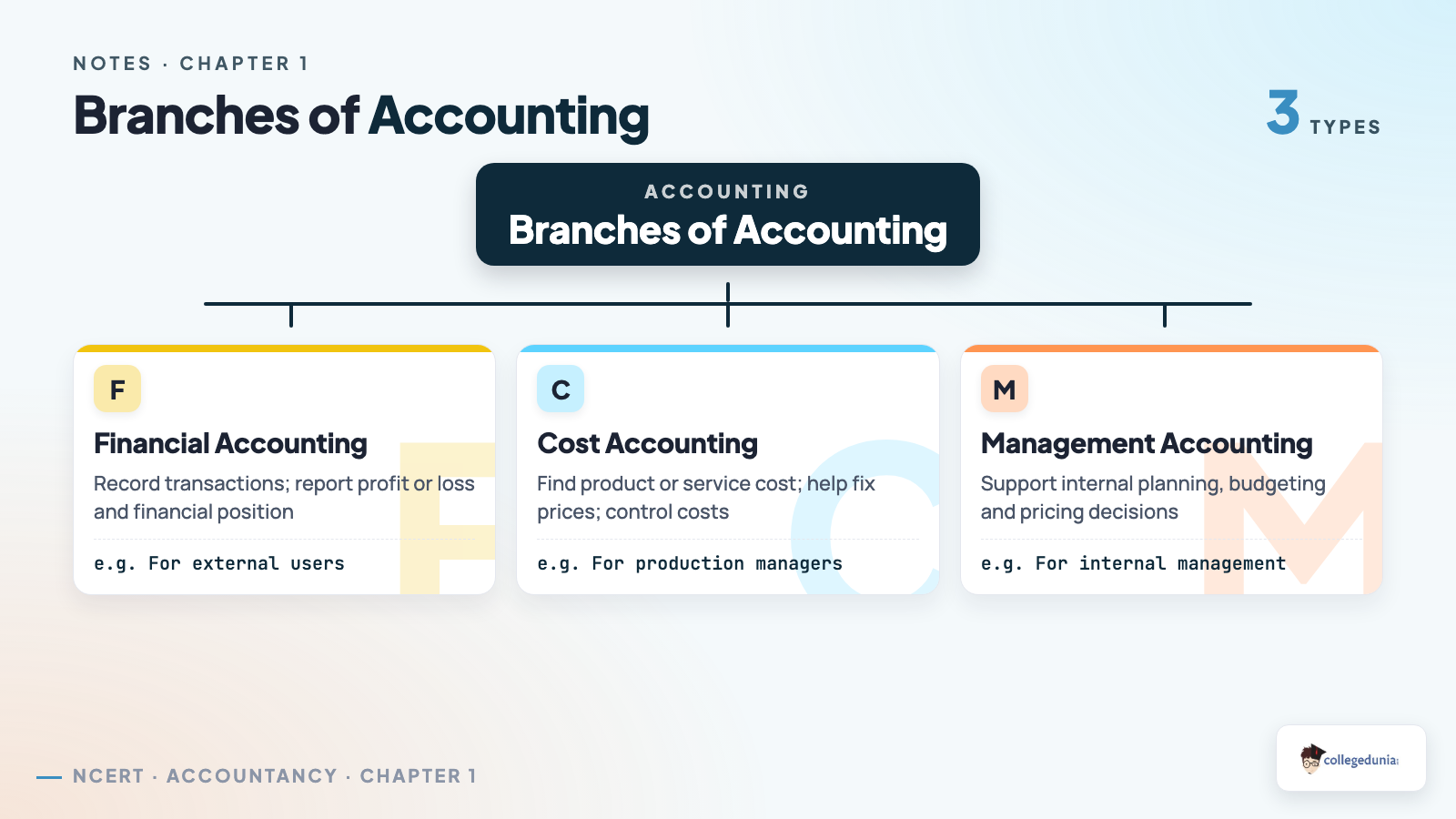
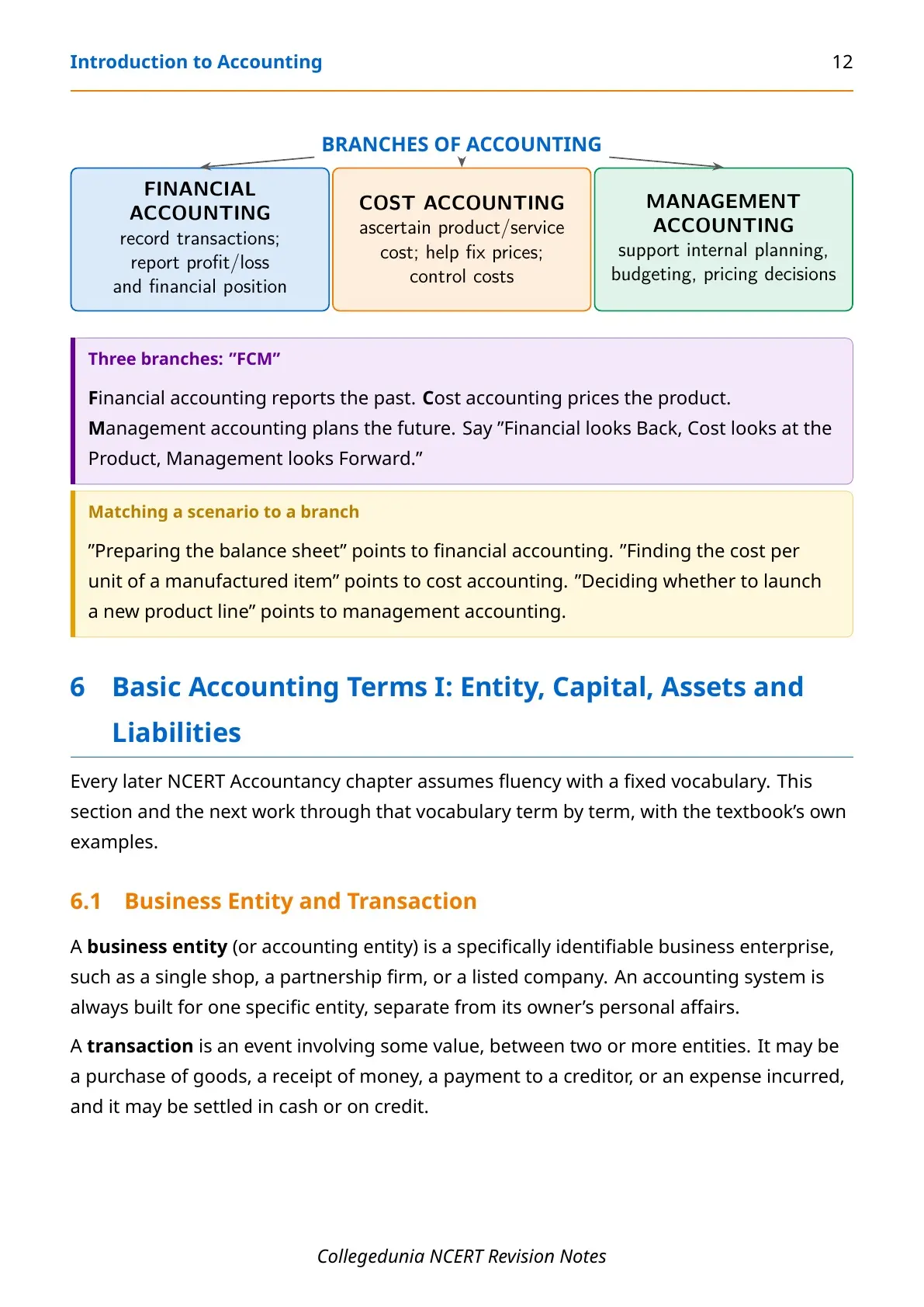
The differing needs of internal and external users split accounting into three specialised branches. Financial accounting keeps a systematic record of transactions and prepares reports so the profit or loss for a period, and the financial position at period-end, can both be worked out and reported to stakeholders.
- Cost accounting: analyses expenditure to find the cost of products manufactured or services rendered, and helps fix prices.
- Management accounting: supplies accounting information to people inside the business, for planning, budgeting and pricing decisions.
| Branch | Main purpose | Who mainly uses it |
|---|---|---|
| Financial accounting | Report profit/loss and financial position | External users: investors, creditors, tax authorities |
| Cost accounting | Find product cost, help fix prices, control costs | Production and pricing managers |
| Management accounting | Support planning, budgeting, pricing decisions | Internal management at every level |
Users of Accounting Information: Internal and External Users Explained
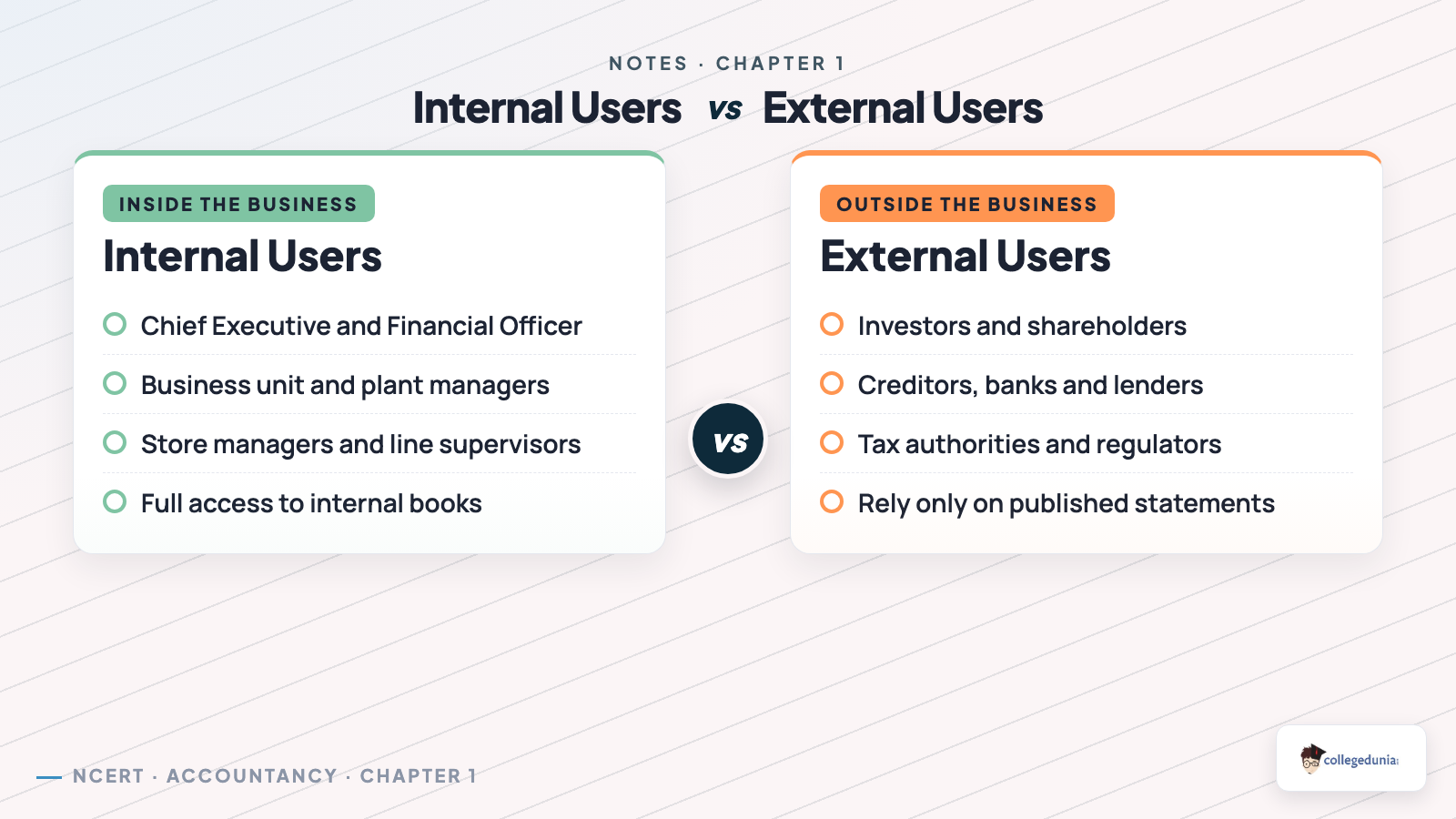
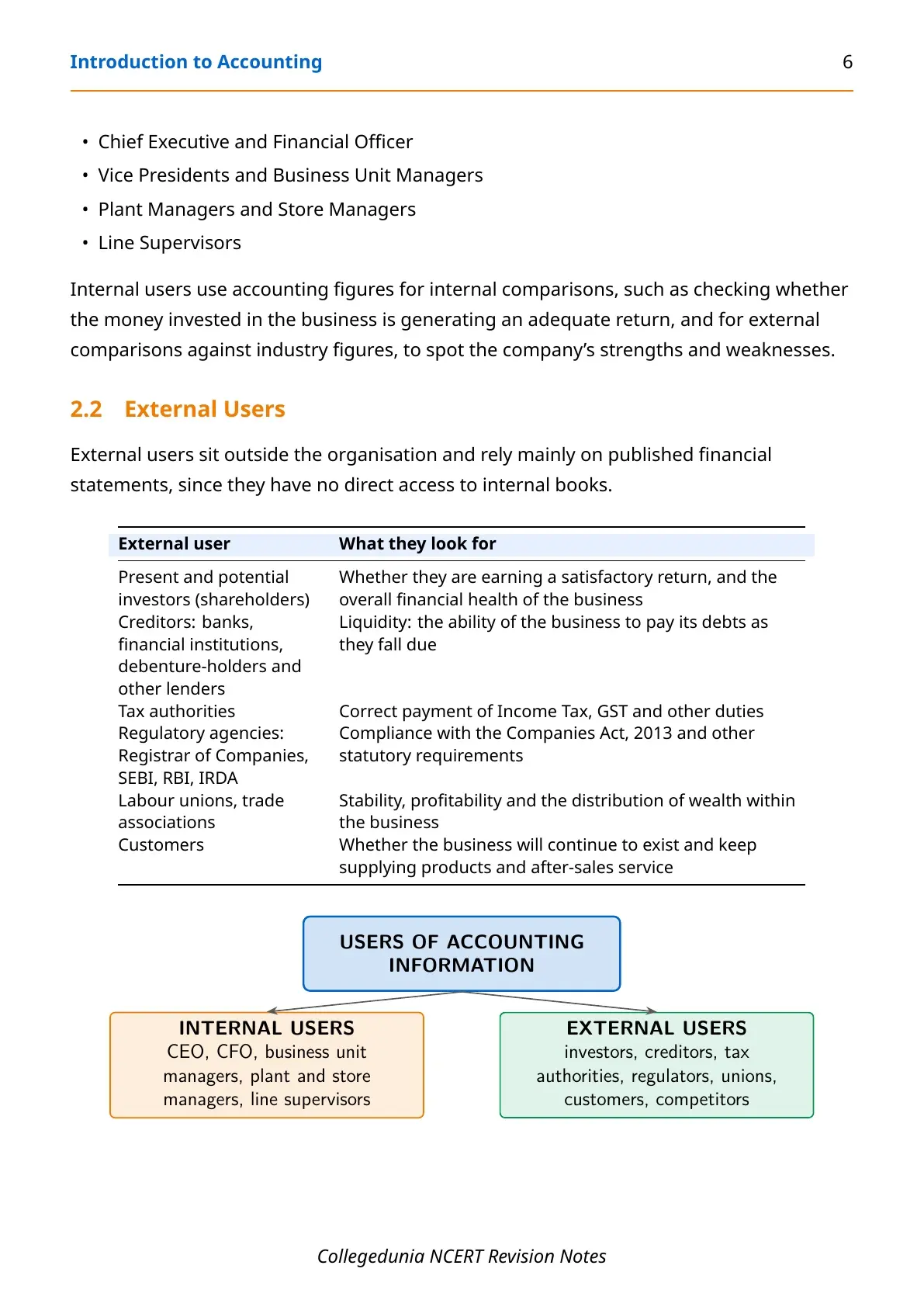
Accounting information is prepared once but read by many groups. Internal users sit inside the business: the Chief Executive, the Financial Officer, business unit managers, plant and store managers, and line supervisors. They use figures for internal comparisons and to check whether invested money is earning an adequate return.
External users sit outside the business and rely mainly on published financial statements, since they have no access to internal books.
| External user | What they look for |
|---|---|
| Investors and shareholders | Satisfactory return, overall financial health |
| Creditors and lenders | Liquidity, the ability to pay debts as they fall due |
| Tax authorities | Correct payment of Income Tax, GST and other duties |
| Regulatory agencies (SEBI, RBI, ROC) | Compliance with the Companies Act, 2013 and other rules |
| Customers and labour unions | Continued existence of the business, stability, distribution of wealth |
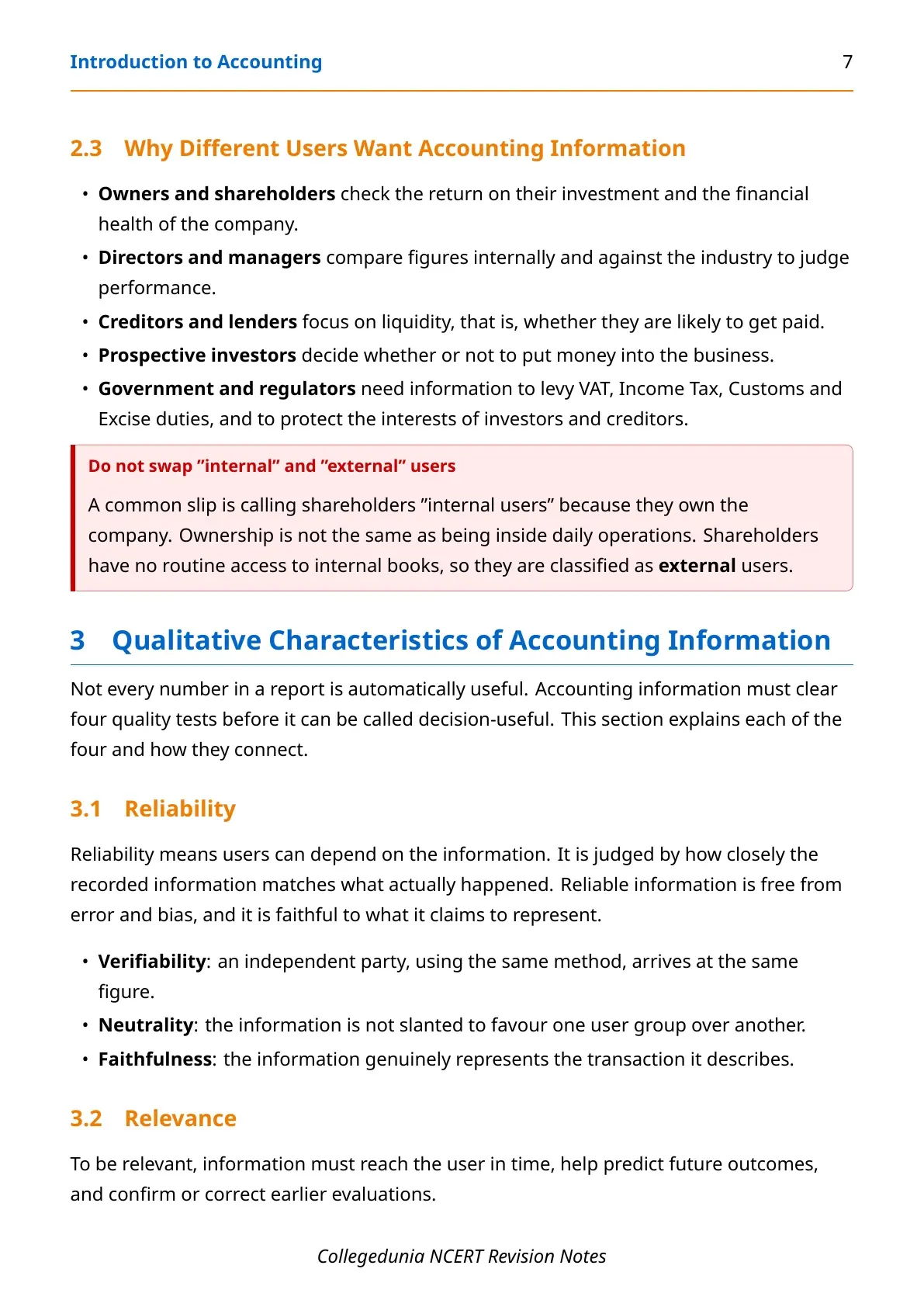
Tip: shareholders are commonly, and wrongly, called "internal" users because they own the company. Ownership is not the same as daily access to internal books, so shareholders count as external users.
Qualitative Characteristics of Accounting Information for Class 11 Accountancy
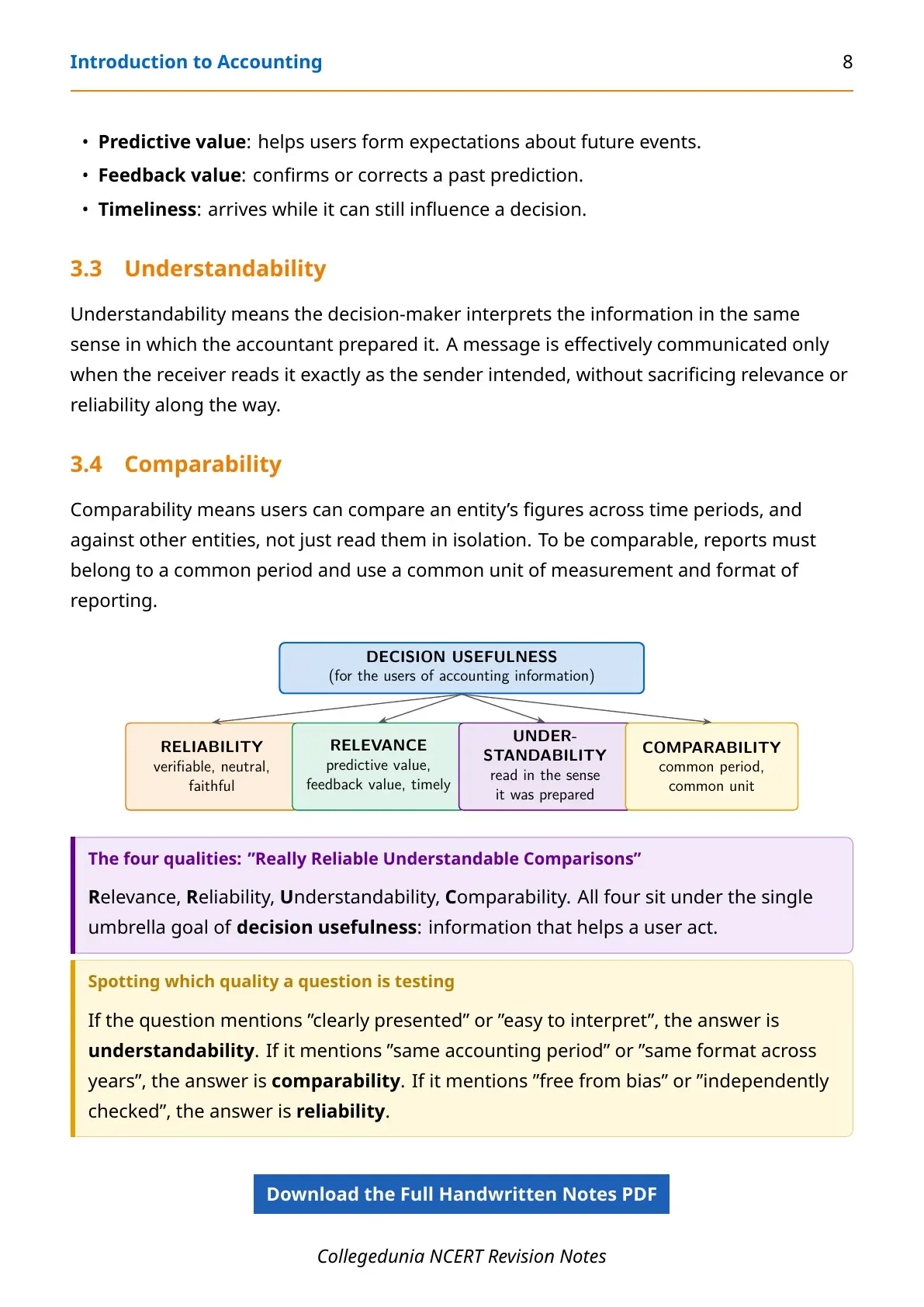
Accounting information must clear four quality tests before it counts as decision-useful. Reliability means the information is verifiable, neutral and faithfully represents what it claims to. Relevance means it has predictive value, feedback value and reaches the user in time.
- Understandability: the decision-maker reads the information the way the accountant intended it, without losing relevance or reliability.
- Comparability: reports can be compared across time periods and against other entities, using a common unit and format.
All four qualities sit under one umbrella goal: decision usefulness. A CBSE question that says "clearly presented" is testing understandability; one that says "same format across years" is testing comparability.
Objectives and Role of Accounting in Modern Business
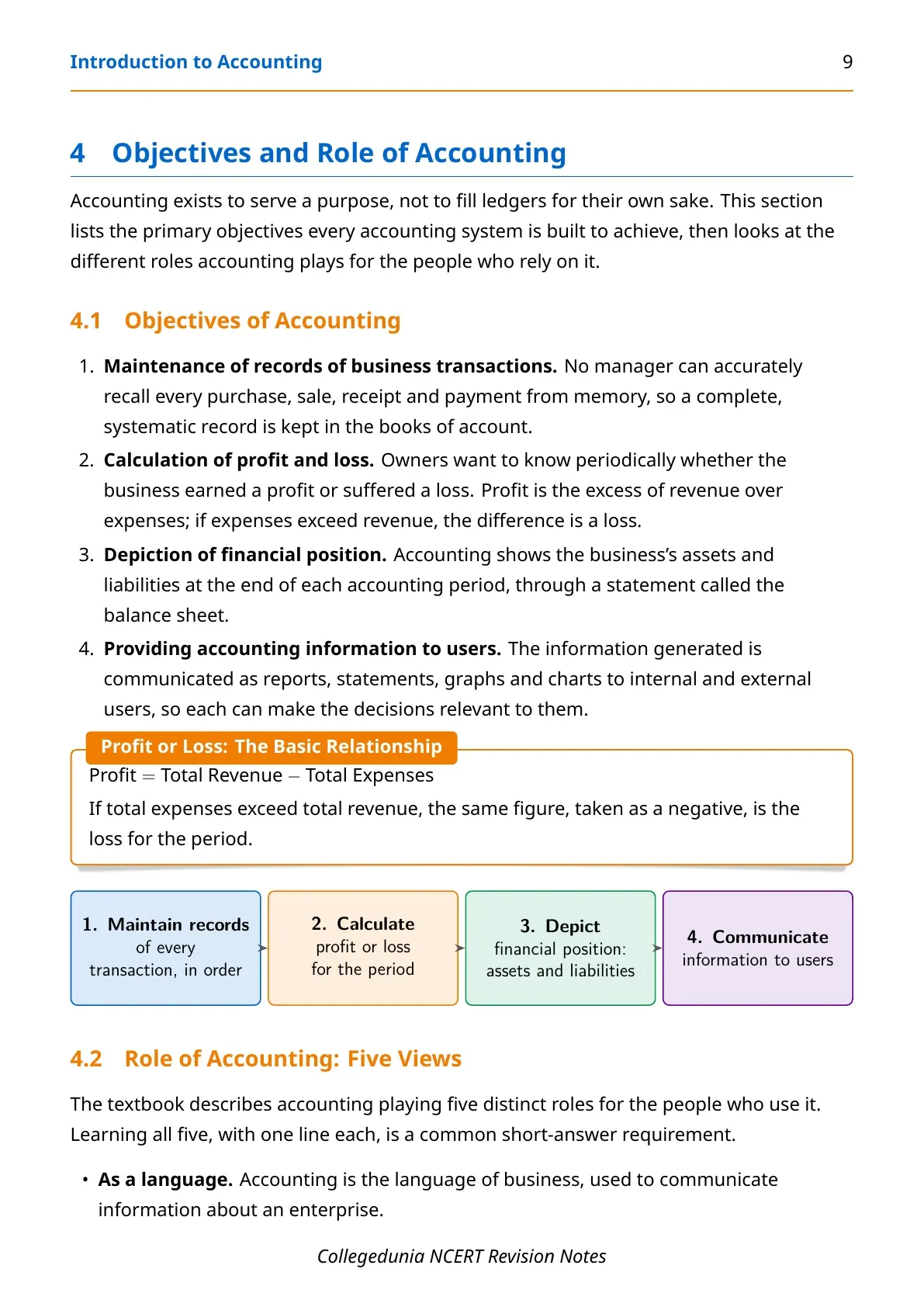
The primary objectives of accounting are to maintain a record of every transaction, calculate profit or loss for the period, depict the financial position through the balance sheet, and communicate that information to internal and external users.
- Maintenance of records: no manager can recall every purchase, sale, receipt and payment from memory.
- Calculation of profit or loss: profit equals total revenue minus total expenses.
- Depiction of financial position: assets and liabilities are shown through the balance sheet.
- Providing information to users: reports, statements, graphs and charts reach the people who act on them.
The chapter also names five roles accounting plays: it works as a language of business, a historical record, a measure of current economic reality, an information system, and a commodity or service in demand.
Basic Accounting Terms: Entity, Capital, Assets and Liabilities
A business entity is a specifically identifiable enterprise, kept separate from its owner's personal affairs. A transaction is an event involving some value between two or more entities, settled in cash or on credit.
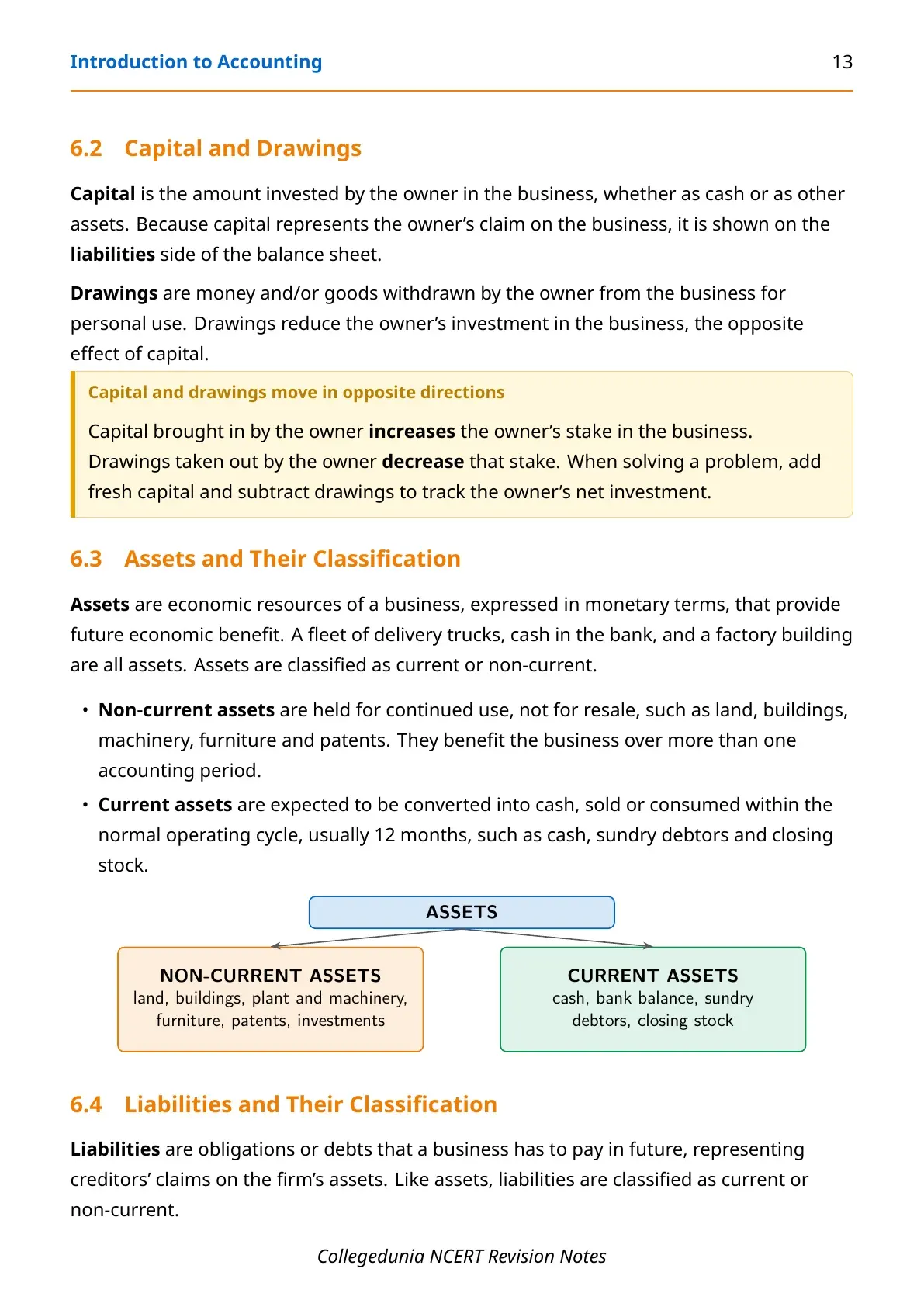
- Capital: the amount the owner invests in the business, shown on the liabilities side of the balance sheet.
- Drawings: money or goods the owner withdraws for personal use; drawings reduce capital.
- Assets: economic resources providing future benefit, split into current (cash, debtors, closing stock) and non-current (land, machinery, furniture).
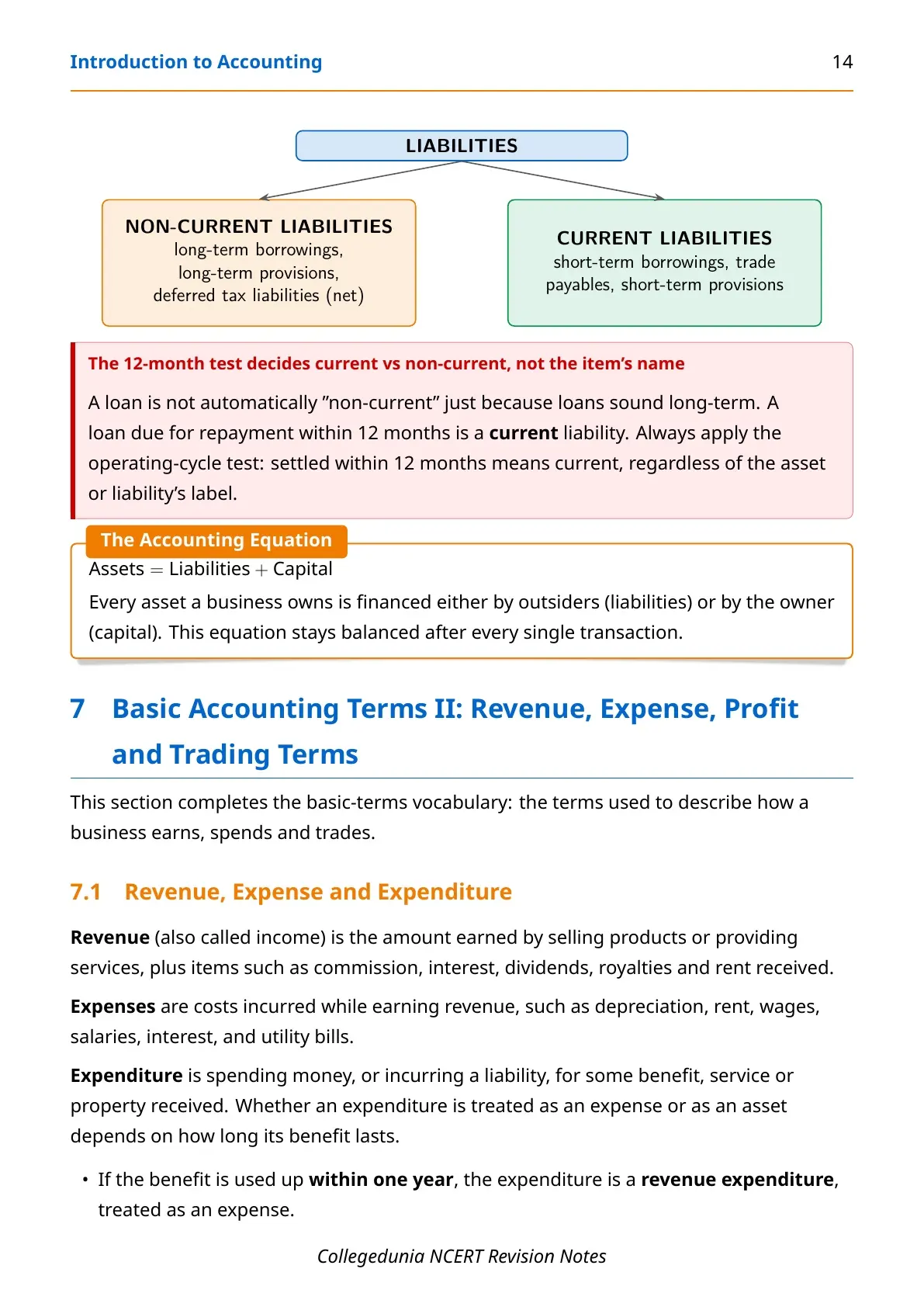
- Liabilities: obligations to outsiders, also split into current (short-term borrowings, trade payables) and non-current (long-term loans, long-term provisions).
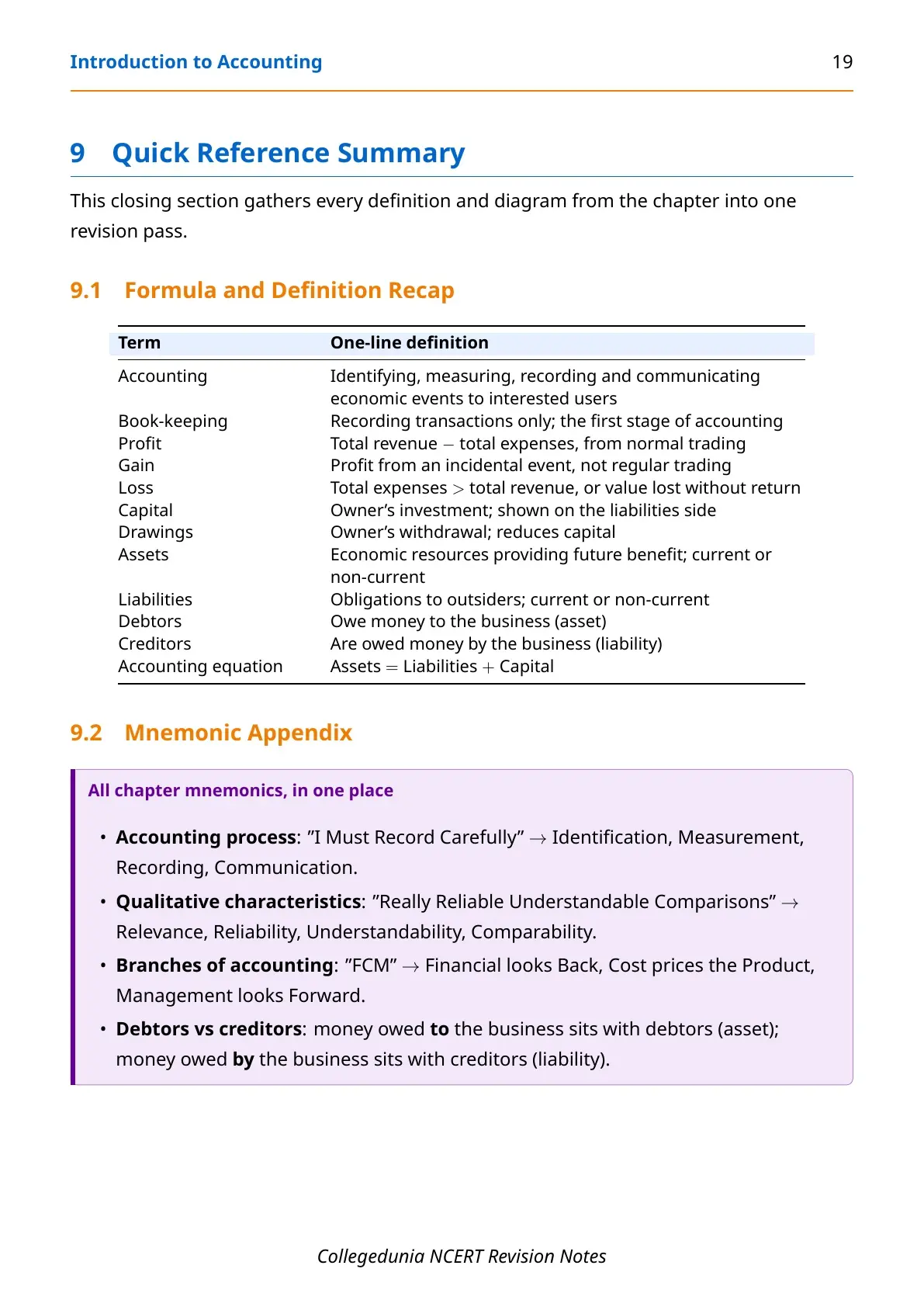
Assets = Liabilities + Capital is the accounting equation. Every asset a business owns is financed either by outsiders or by the owner, and this equation stays balanced after every transaction.
Tip: current vs non-current is decided by a 12-month test, not by the item's name. A loan repayable within 12 months is a current liability even though "loan" sounds long-term.
Basic Accounting Terms: Revenue, Expense, Profit, Gain and Trading Terms
Revenue is the amount earned by selling products or services, plus items such as commission and interest received. Expenses are costs incurred while earning revenue, such as rent, wages and depreciation.
| Term | Meaning |
|---|---|
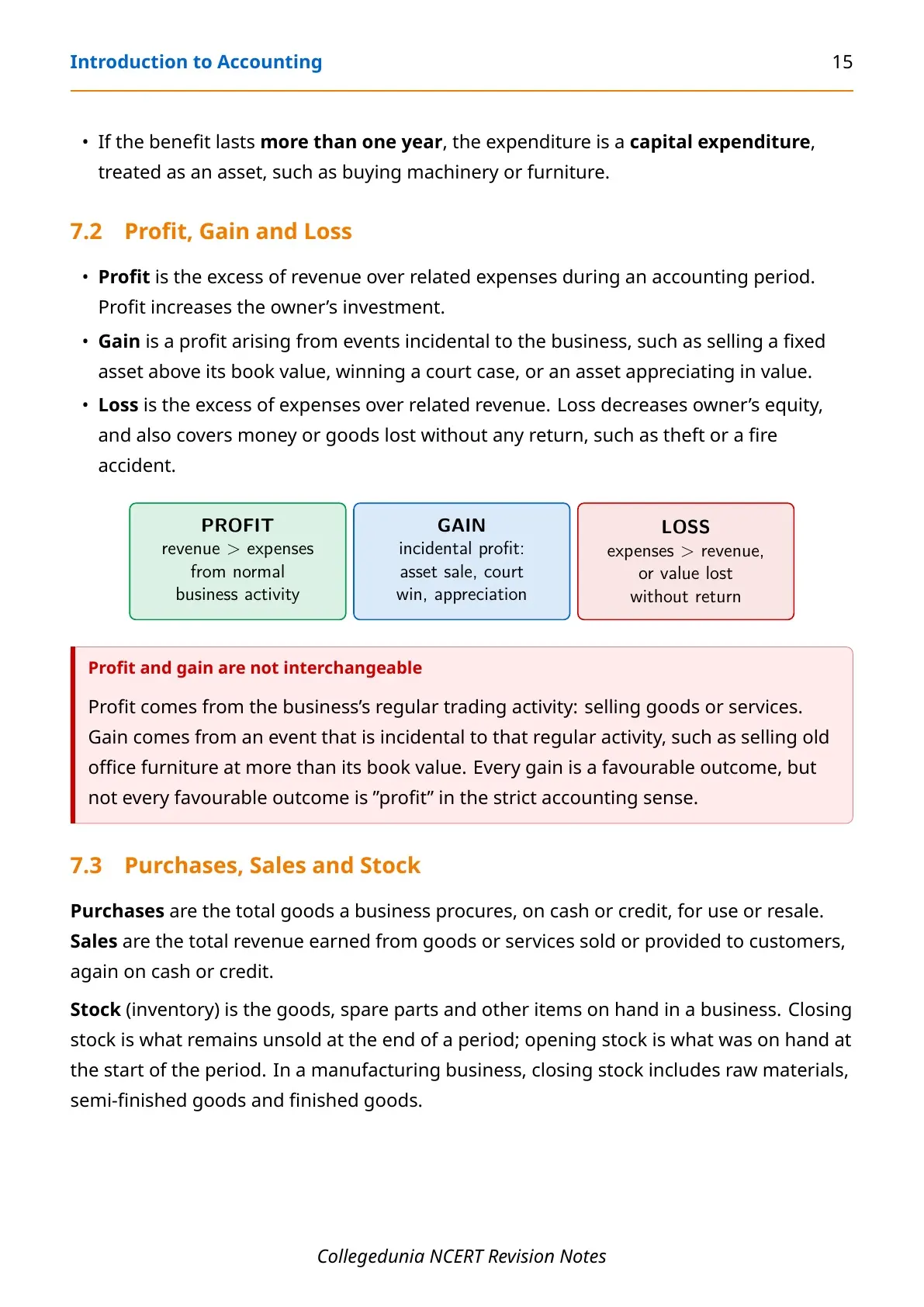
| Profit | Revenue exceeds expenses, from normal trading activity |
| Gain | Profit from an event incidental to the business, such as selling a fixed asset above cost |
| Loss | Expenses exceed revenue, or value is lost without any return |
| Purchases | Total goods procured, on cash or credit, for use or resale |
| Sales | Total revenue from goods or services sold or provided |
| Stock | Goods on hand; closing stock at period-end, opening stock at period-start |
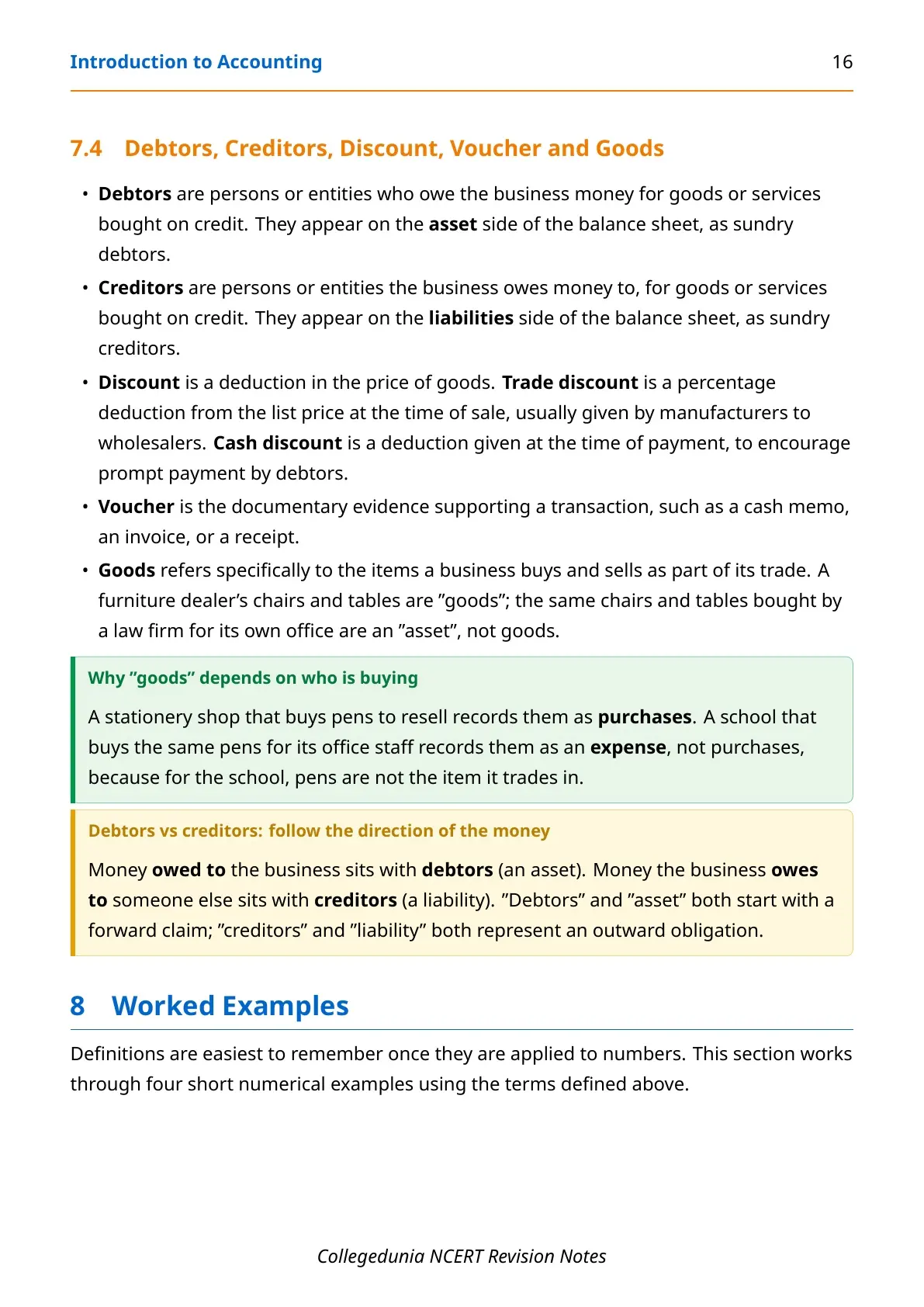
| Debtors | Owe money to the business (an asset) |
| Creditors | Are owed money by the business (a liability) |
| Discount | Deduction in price; trade discount at sale, cash discount at payment |
| Voucher | Documentary evidence of a transaction, such as a cash memo or invoice |
Tip: profit and gain are not interchangeable. Profit comes from regular trading; gain comes from an incidental event, such as selling old furniture above its book value.
Solved Examples for Introduction to Accounting Class 11
Definitions are easiest to remember once applied to numbers. Two short worked examples below use the terms from this chapter.
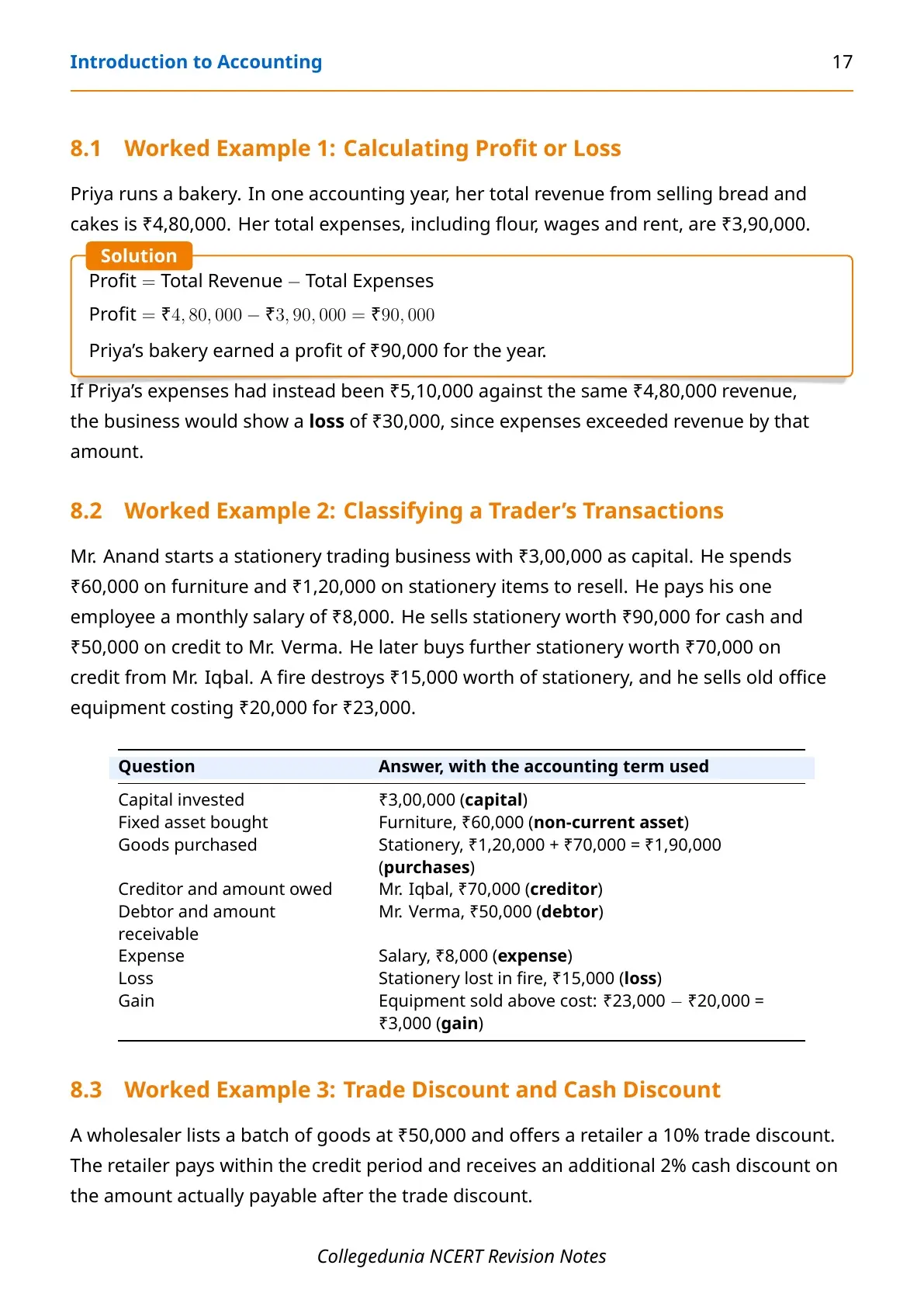
Example 1. A bakery earns total revenue of ₹4,80,000 in a year, against total expenses of ₹3,90,000. Profit = Total Revenue − Total Expenses = ₹4,80,000 − ₹3,90,000 = ₹90,000. If expenses had instead been ₹5,10,000, the business would show a loss of ₹30,000.
Example 2. A trader starts a business with ₹3,00,000 as capital, buys furniture worth ₹60,000 (a non-current asset) and stationery worth ₹1,20,000 (purchases, since it is resold). He sells goods worth ₹50,000 on credit to Mr. Verma (a debtor) and buys further goods worth ₹70,000 on credit from Mr. Iqbal (a creditor). Each figure above maps to exactly one basic accounting term from this chapter, which is exactly how CBSE frames Question 5-mark classification problems.
Common Mistakes Students Make in the Introduction to Accounting Chapter
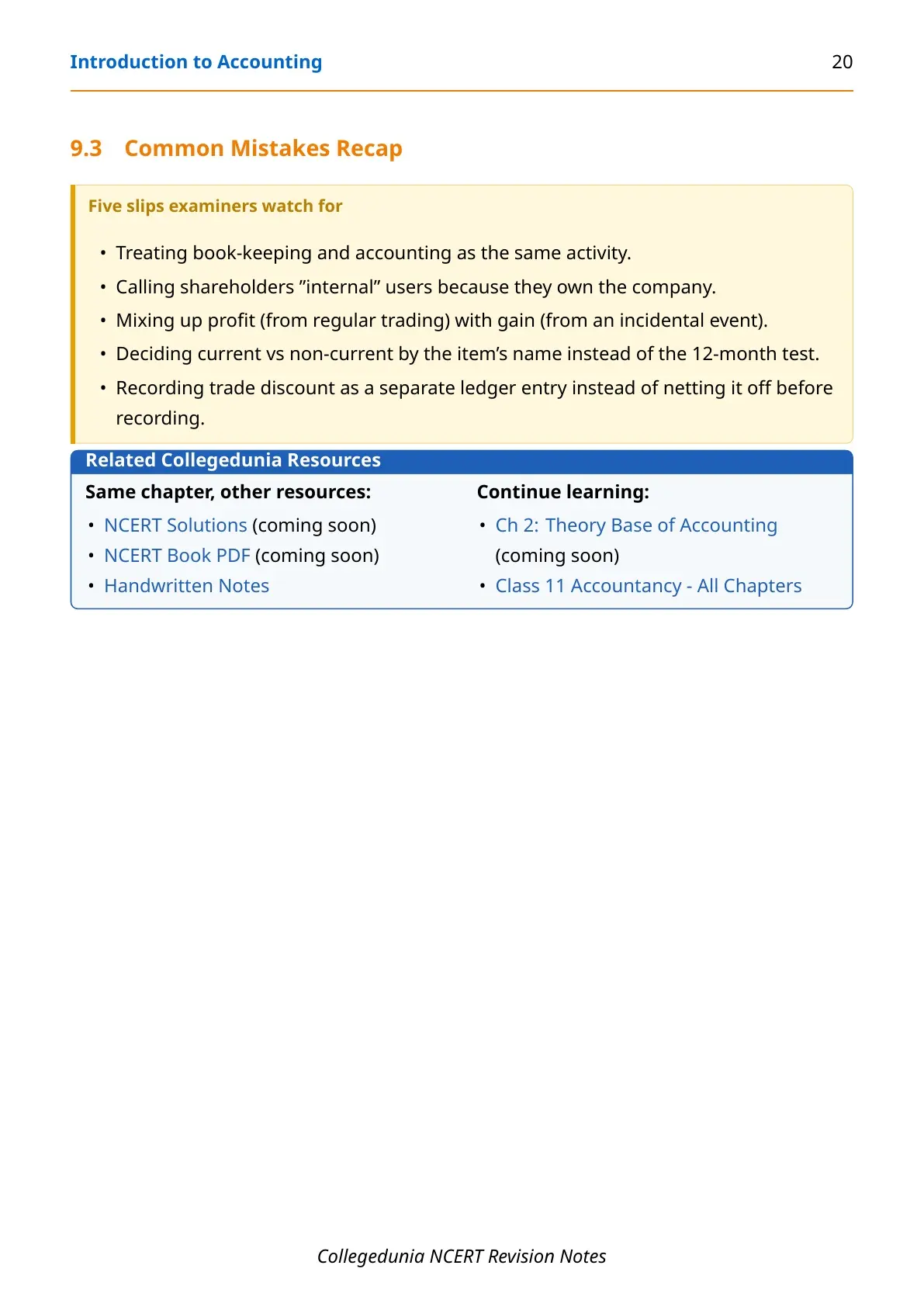
Five traps that cost easy marks in the Class 11 Accountancy paper:
- Treating book-keeping and accounting as the same thing. Book-keeping only records; accounting also classifies, summarises and interprets.
- Calling shareholders "internal" users. They own the company but have no daily access to its books, so they are external users.
- Mixing up profit and gain. Profit is from regular trading, gain is from an incidental event.
- Deciding current vs non-current by the item's name. Use the 12-month test instead.
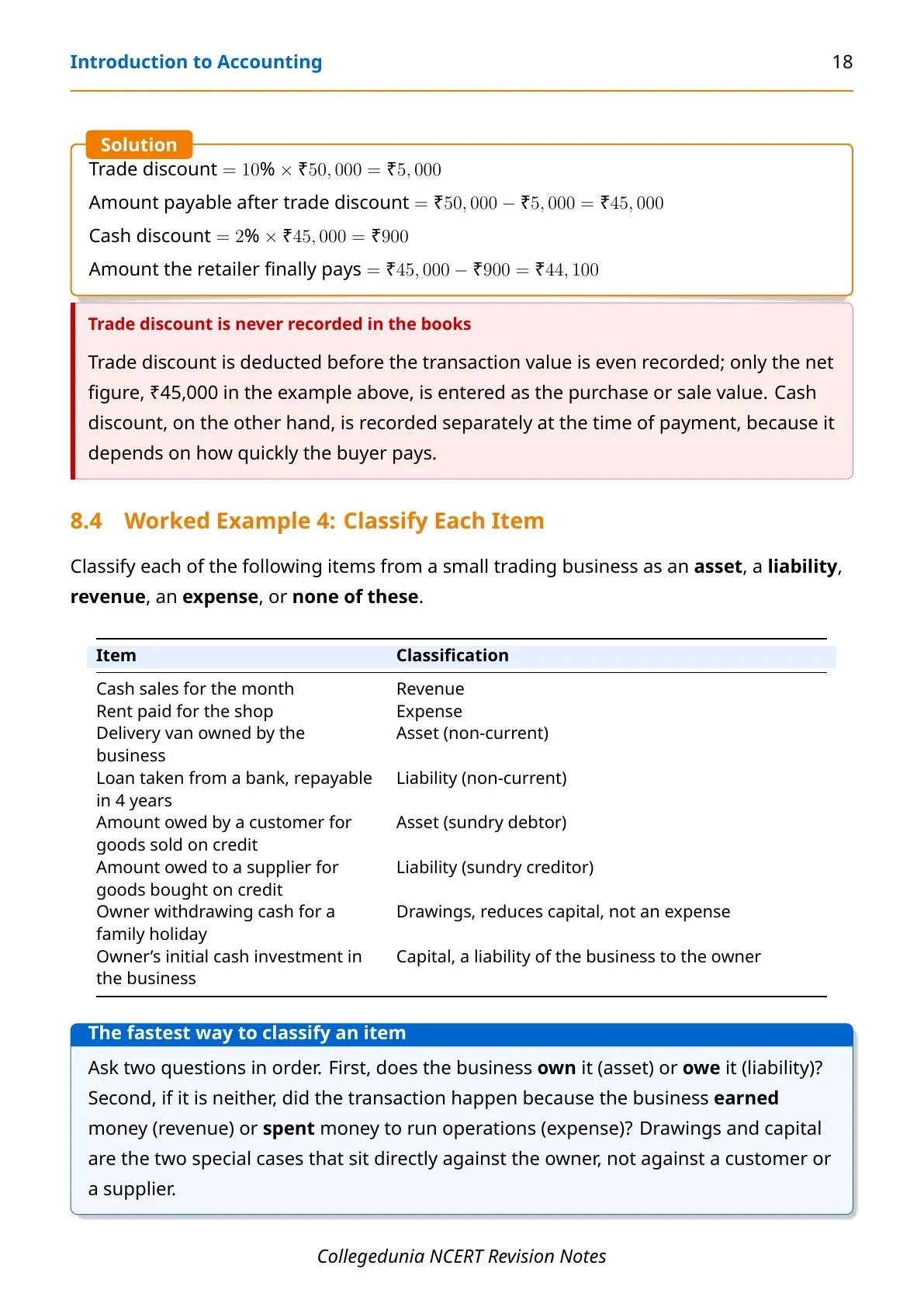
- Recording trade discount as a separate ledger entry. Trade discount is netted off before the transaction is even recorded; only cash discount gets its own entry.
What the Class 11 Accountancy Chapter 1 Notes PDF Contains
The Collegedunia NCERT Notes Class 11 Accountancy Chapter 1 Introduction to Accounting PDF follows the same order as the textbook chapter, so it can sit open beside the book while you revise.
- Pages 1 to 5: meaning of accounting, the AICPA and AAA definitions, economic events and the accounting process.
- Pages 6 to 10: users of accounting information, qualitative characteristics, and the objectives and role of accounting.
- Pages 11 to 12: book-keeping vs accounting, and the three branches of accounting.
- Pages 13 to 18: the full glossary of basic accounting terms, from entity and capital through to voucher and goods.
- Pages 19 to 20: worked examples and a one-page quick-reference summary with a mnemonic appendix.
How to Use the Introduction to Accounting Notes Page Most Effectively
The NCERT Notes Class 11 Accountancy Chapter 1 Introduction to Accounting are dense with definitions rather than long derivations, so short, spaced sessions work better than one long sitting.
- Block 1, 30 minutes: meaning of accounting, the accounting process, and economic events.
- Block 2, 30 minutes: users of accounting information and the four qualitative characteristics.
- Block 3, 30 minutes: book-keeping vs accounting, the three branches, and the objectives of accounting.
- Block 4, 40 minutes: the full glossary of basic accounting terms, in pairs (debtor/creditor, capital/drawings, profit/gain).
- Morning of the paper, 15 minutes: the quick-reference summary table and the five common mistakes, nothing else.
How the Introduction to Accounting Notes Pair with Other Class 11 Accountancy Resources
Also Check: once the NCERT Notes Class 11 Accountancy Chapter 1 Introduction to Accounting are settled, Chapter 2 builds directly on the terms defined here, so read Theory Base of Accounting next.
| Resource | Open it | Best used for |
|---|---|---|
| NCERT Solutions | Introduction to Accounting Class 11 NCERT Solutions (coming soon) | Answers to every textbook exercise question of this chapter. |
| Handwritten Notes | Introduction to Accounting Class 11 Handwritten Notes | A topper's handwritten revision notes on definitions and basic terms. |
| NCERT Book PDF | Introduction to Accounting Class 11 Accountancy Book Chapter PDF (coming soon) | The official CBSE Accountancy textbook chapter, free to download. |
NCERT Notes for Class 11 Accountancy: All Chapters
Related Links: revision notes for the Class 11 Accountancy textbook, written according to the 2026-27 CBSE syllabus.
| Chapter | Title | Class 11 Accountancy Notes |
|---|---|---|
| Chapter 1 | Introduction to Accounting | You are here |
| Chapter 2 | Theory Base of Accounting | Theory Base of Accounting Class 11 Notes (coming soon) |
| Chapter 3 | Recording of Transactions - I | Recording of Transactions - I Class 11 Notes (coming soon) |
| Chapter 4 | Recording of Transactions - II | Recording of Transactions - II Class 11 Notes (coming soon) |
| Chapter 5 | Bank Reconciliation Statement | Bank Reconciliation Statement Class 11 Notes (coming soon) |
| Chapter 6 | Trial Balance and Rectification of Errors | Trial Balance and Rectification of Errors Class 11 Notes (coming soon) |
| Chapter 7 | Depreciation, Provisions and Reserves | Depreciation, Provisions and Reserves Class 11 Notes (coming soon) |
| Chapter 8 | Financial Statements - I | Financial Statements - I Class 11 Notes (coming soon) |
| Chapter 9 | Financial Statements - II | Financial Statements - II Class 11 Notes (coming soon) |
FAQs on Introduction to Accounting Class 11 Notes
Questions Students Ask Most About the Introduction to Accounting Chapter
Ques. What is accounting according to the NCERT Class 11 textbook?
Ans. Accounting is the process of identifying, measuring, recording and communicating the required information relating to the economic events of a business to interested users. This working definition combines the 1941 AICPA definition, which emphasised recording, classifying and summarising, with the 1966 AAA definition, which emphasised identifying, measuring and communicating for decision-making.
Ques. What is the difference between book-keeping and accounting?
Ans. Book-keeping is the systematic recording of monetary transactions only, the first mechanical stage of the wider process. Accounting starts where book-keeping ends: it classifies and summarises the recorded data, then interprets the results so users can make decisions. A book-keeper records; an accountant also analyses and interprets.
Ques. What are the three branches of accounting?
Ans. Financial accounting keeps a systematic record of transactions and reports profit or loss and financial position to stakeholders. Cost accounting analyses expenditure to find the cost of products or services and helps fix prices. Management accounting supplies information to people inside the business for planning, budgeting and pricing decisions.
Ques. Who are the internal and external users of accounting information?
Ans. Internal users include the Chief Executive, Financial Officer, business unit managers, plant and store managers and line supervisors. External users include investors and shareholders, creditors and lenders, tax authorities, regulatory agencies such as SEBI and RBI, customers and labour unions. Shareholders are external users, even though they own the company, because they have no routine access to internal books.
Ques. What are the qualitative characteristics of accounting information?
Ans. The four qualitative characteristics are reliability (verifiable, neutral, faithful), relevance (predictive value, feedback value, timely), understandability (read in the sense it was prepared) and comparability (common period, common unit of measurement). All four exist to make accounting information decision-useful.
Ques. What are the objectives of accounting?
Ans. The primary objectives are to maintain a systematic record of business transactions, calculate profit or loss for the period, depict the financial position through the balance sheet, and provide accounting information to internal and external users so they can make decisions.
Ques. What is the difference between profit and gain in accounting?
Ans. Profit is the excess of revenue over expenses from a business's normal, regular trading activity. Gain is a profit that arises from an event incidental to the business, such as selling a fixed asset above its book value, winning a court case, or an asset appreciating in value. Every gain is favourable, but not every favourable outcome counts as profit.
Ques. What is the accounting equation?
Ans. The accounting equation is Assets = Liabilities + Capital. It states that every asset a business owns is financed either by outsiders, recorded as liabilities, or by the owner, recorded as capital, and it stays balanced after every single transaction.
Ques. What is the difference between capital and drawings?
Ans. Capital is the amount the owner invests in the business, shown on the liabilities side of the balance sheet, and it increases the owner's stake. Drawings are money or goods the owner withdraws from the business for personal use, and they reduce the owner's stake, the opposite effect of capital.
Ques. What is the difference between debtors and creditors?
Ans. Debtors are persons or entities who owe the business money for goods or services bought on credit, and they appear as an asset on the balance sheet. Creditors are persons or entities the business owes money to for goods or services bought on credit, and they appear as a liability on the balance sheet.
Ques. What is the difference between trade discount and cash discount?
Ans. Trade discount is a percentage deduction from the list price at the time of sale, usually given by manufacturers to wholesalers, and it is netted off before the transaction is recorded. Cash discount is a deduction given at the time of payment, to encourage prompt payment by debtors, and it is recorded separately as an expense or income.
Ques. What are current and non-current assets and liabilities?
Ans. Current assets and liabilities are expected to be realised or settled within the normal operating cycle, usually 12 months, such as cash, sundry debtors, closing stock, short-term borrowings and trade payables. Non-current assets and liabilities benefit or bind the business for more than one accounting period, such as land, buildings, machinery, long-term loans and long-term provisions.
Ques. Where can I download the Class 11 Accountancy Chapter 1 Introduction to Accounting notes PDF?
Ans. Use the download option at the top of this page. The file is free and printable, runs to 20 pages, and follows the 2026-27 chapter order, so you can keep it open beside the textbook while revising this chapter.



Comments