




The NCERT Notes Class 11 Accountancy Chapter 2 Theory Base of Accounting will help students prepare for CBSE Boards and CUET Commerce in 2026-27. These notes cover GAAP, all 12 basic accounting concepts, accounting standards, and the cash vs accrual basis, exactly as tested in the board paper.
- CBSE Weightage: 4 to 6 marks most years, usually one Short Answer plus one Long Answer question.
- Core Content: GAAP, all 12 basic accounting concepts, accounting standards, and cash vs accrual basis.
- CUET Weightage: Regularly tested in the Commerce domain paper under Accountancy fundamentals.
This NCERT Notes Class 11 Accountancy Chapter 2 Theory Base of Accounting page is curated by subject experts, based on the 2026-27 NCERT textbook, and checked against the last five years of CBSE Class 11 Accountancy question papers.
This NCERT Notes Class 11 Accountancy Chapter 2 Theory Base of Accounting page covers every accounting concept, the full GAAP structure, and a cash-vs-accrual comparison table, written in plain language with worked examples.
How Collegedunia's Notes Help You Learn Theory Base of Accounting
These notes turn a dense, definition-heavy NCERT chapter into a structure you can actually revise the night before an exam.
- 2026-27 NCERT Alignment: Every concept and example matches the current CBSE textbook, GST section included.
- Worked Examples: Each accounting concept comes with a rupee-figure example, not just a definition.
- Comparison Tables: Cash vs accrual basis and double entry vs single entry are laid out side by side.
- Quick Recall Table: A one-line summary of all 12 basic concepts for last-minute revision.
Theory Base of Accounting Explained by Magnet Brains
Source: Magnet Brains on YouTube
What Is the Theory Base of Accounting?
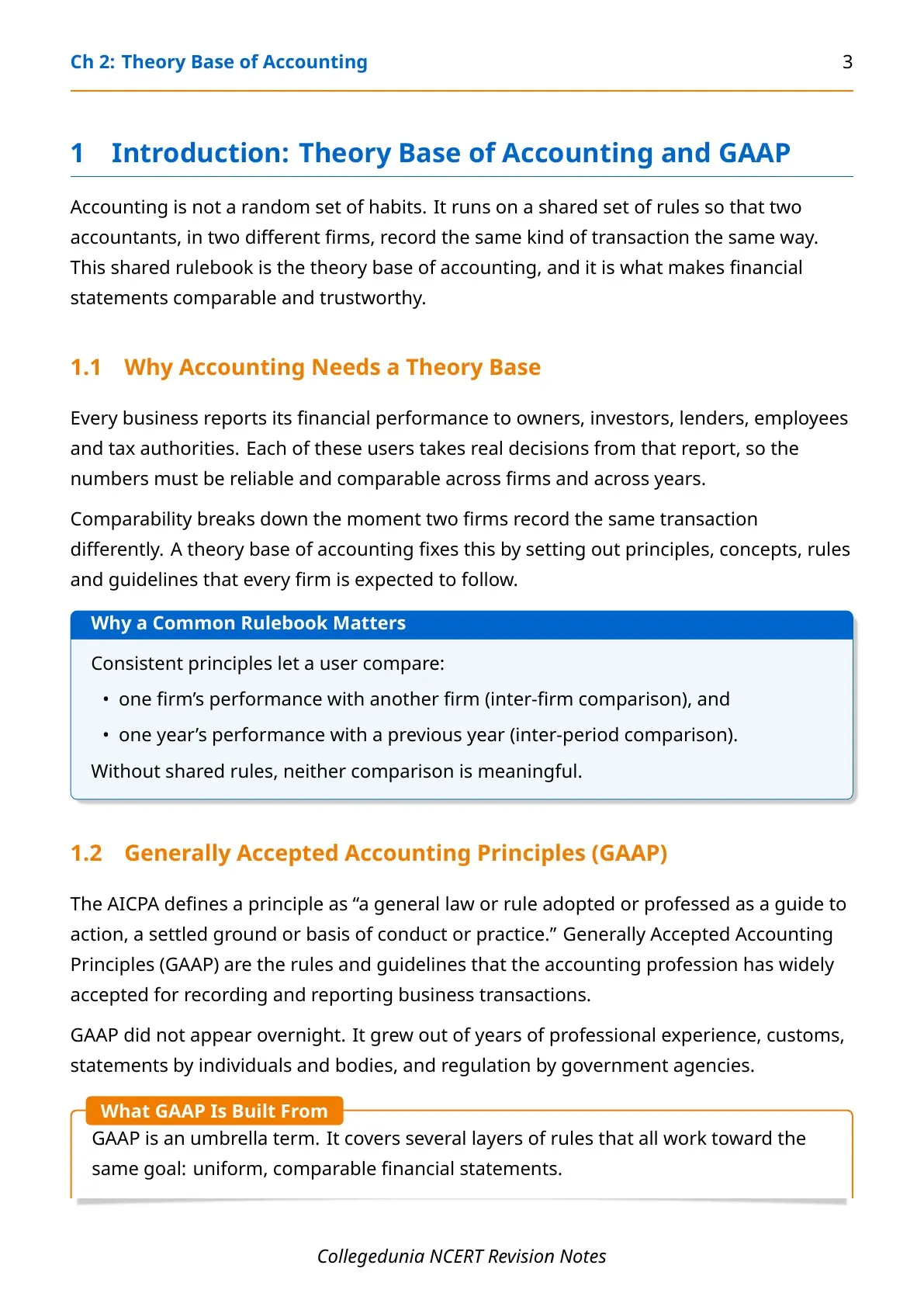
Every business reports its financial performance to owners, investors, lenders, employees and tax authorities. Each of these users takes real decisions from that report. For the numbers to mean anything, two firms must record the same kind of transaction the same way.
The theory base of accounting is this shared rulebook. It is the set of principles, concepts, rules and guidelines that accountants have built up over time to keep financial statements comparable and reliable, both across firms and across years.
Generally Accepted Accounting Principles (GAAP) Explained
Generally Accepted Accounting Principles, or GAAP, are the rules and guidelines that the accounting profession has widely accepted for recording and reporting business transactions. The AICPA defines a principle as "a general law or rule adopted or professed as a guide to action."
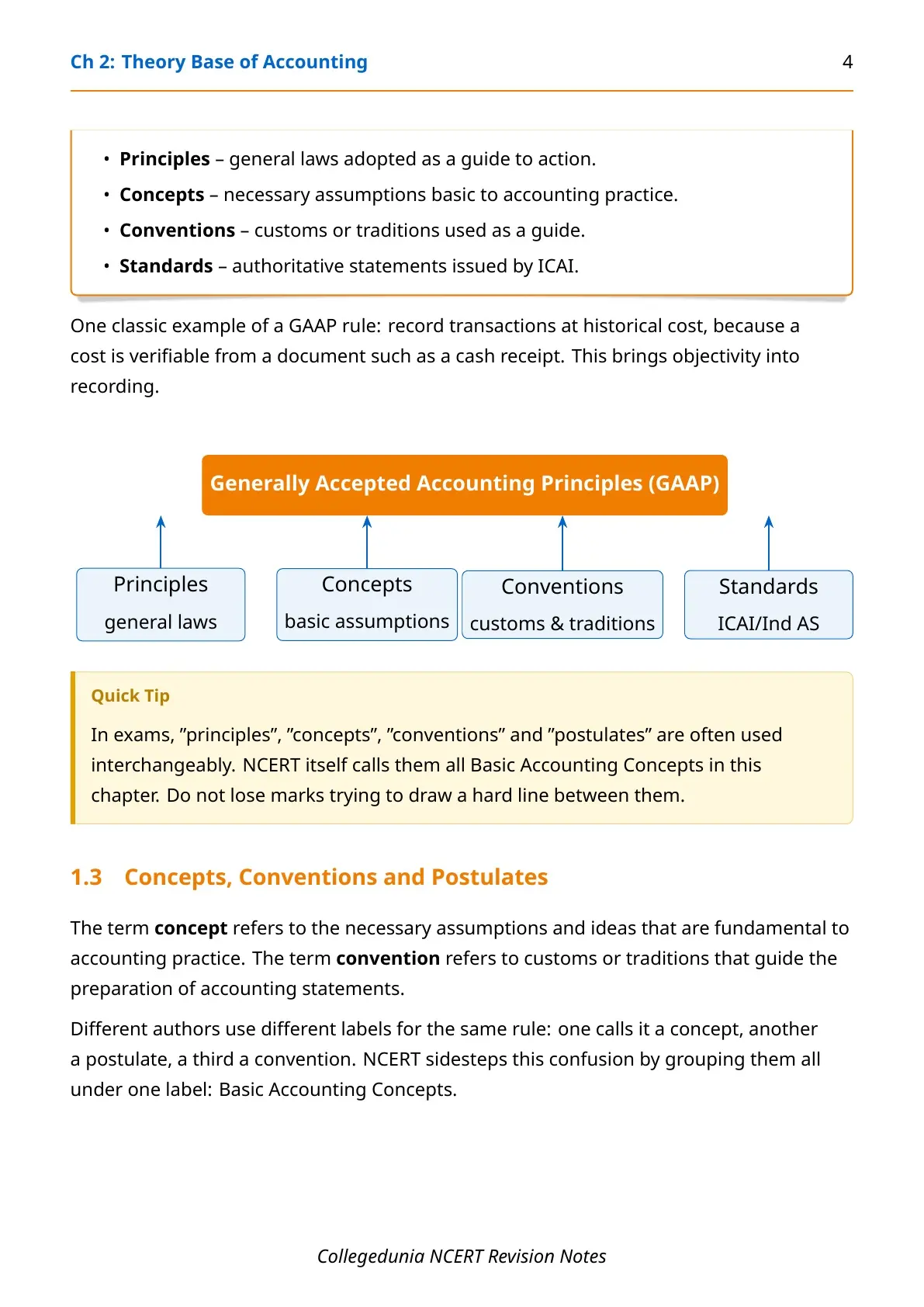
GAAP is an umbrella term. It did not appear overnight, it grew out of years of professional experience, customs, and regulation by government bodies. Under this umbrella sit four layers of rules that all work toward one goal, uniform financial statements.
- Principles - general laws adopted as a guide to action.
- Concepts - the basic assumptions fundamental to accounting practice.
- Conventions - customs or traditions used as a guide.
- Standards - authoritative statements issued by ICAI.
The 12 Basic Accounting Concepts Every Class 11 Student Must Know
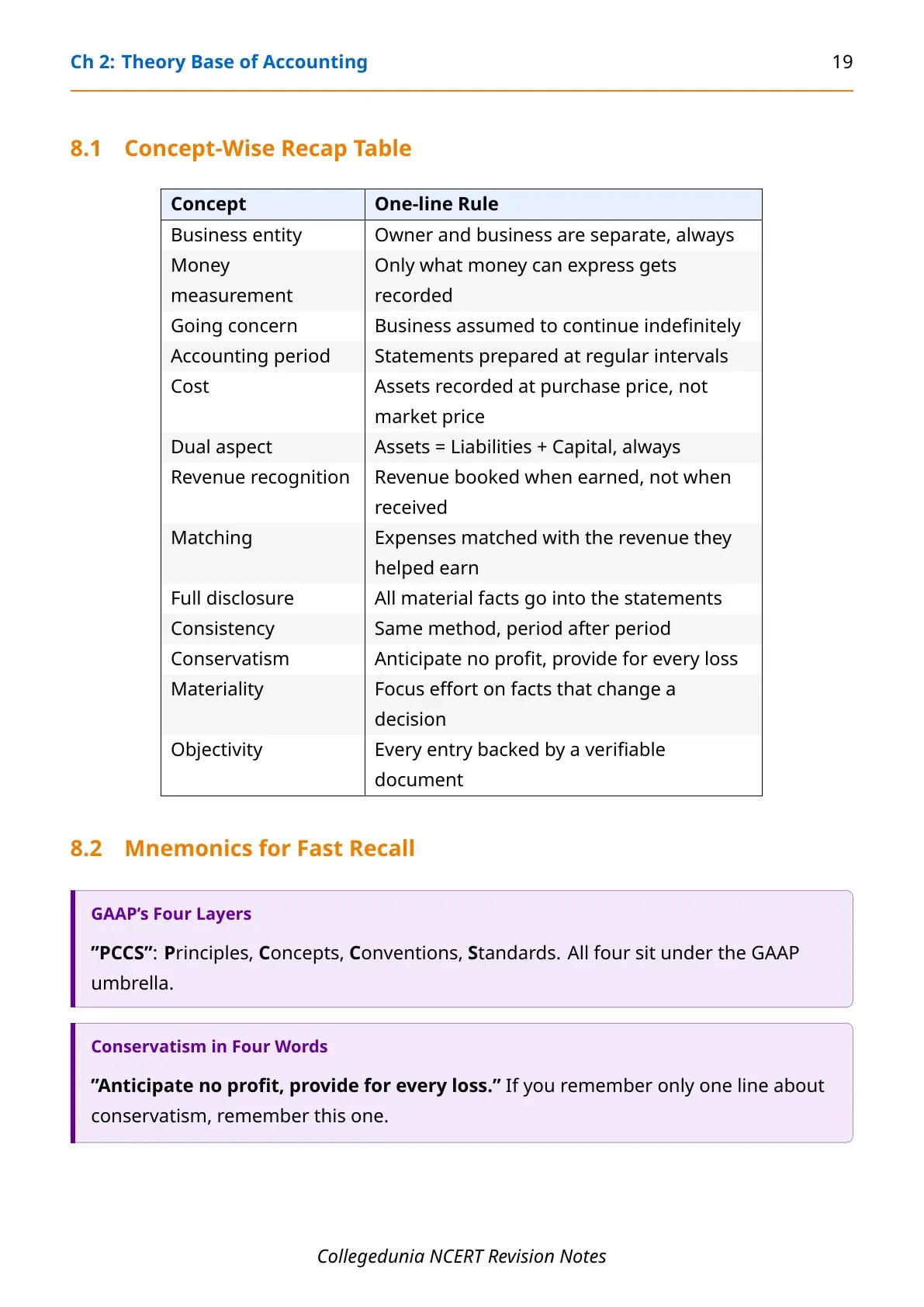
NCERT lists 12 basic accounting concepts that decide what counts as a transaction, who it belongs to, and when it gets recorded. The table below gives the one-line rule for each, useful as a quick-recall sheet before an exam.
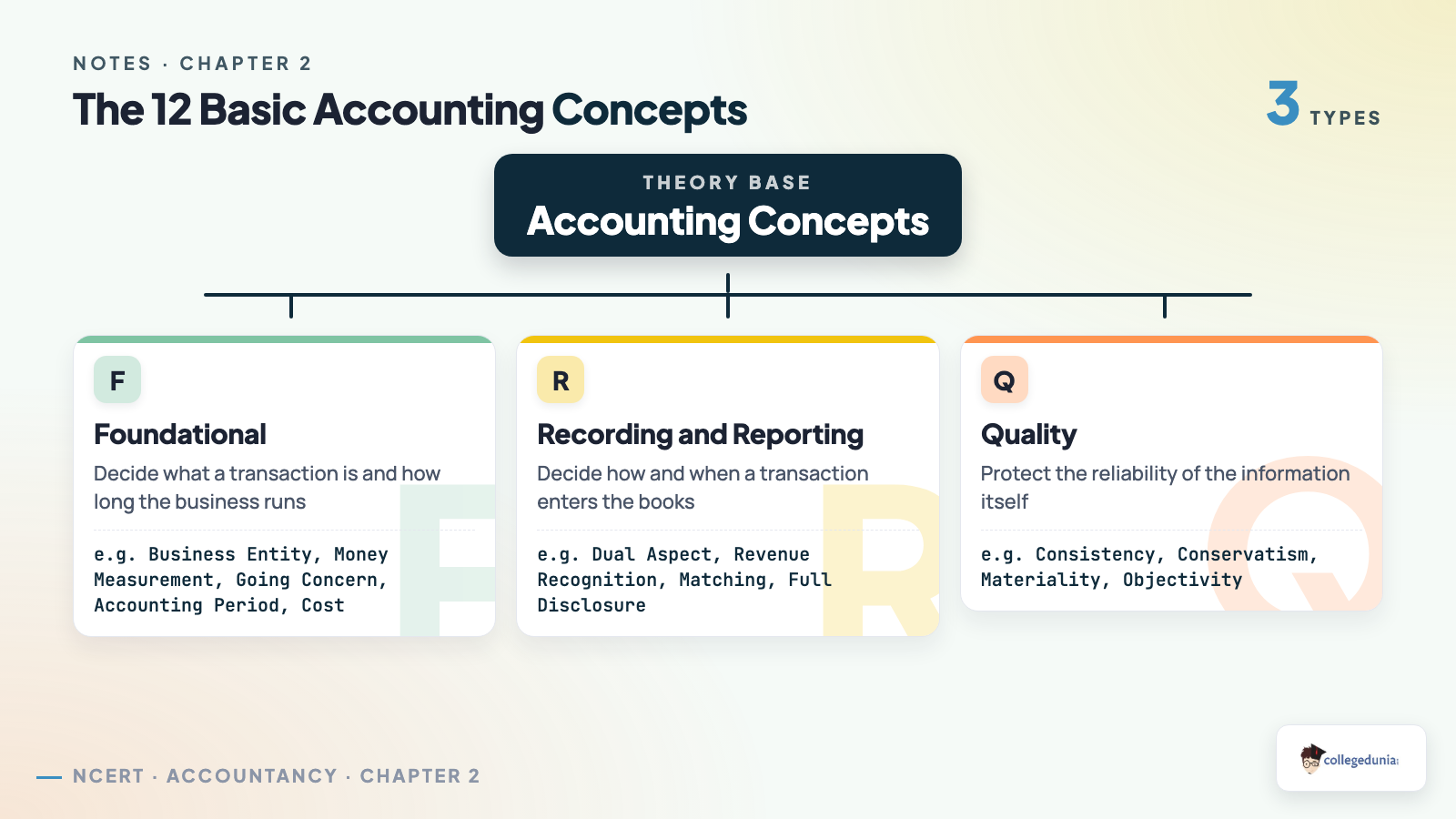
| Concept | One-line Rule |
|---|---|
| Business Entity | Owner and business are treated as two separate persons. |
| Money Measurement | Only transactions that can be expressed in money get recorded. |
| Going Concern | The business is assumed to continue operating indefinitely. |
| Accounting Period | Financial statements are prepared at regular intervals, usually a year. |
| Cost | Assets are recorded at purchase price, not market price. |
| Dual Aspect | Assets always equal Liabilities plus Capital. |
| Revenue Recognition | Revenue is booked when it is earned, not when cash is received. |
| Matching | Expenses are matched against the revenue they helped earn. |
| Full Disclosure | All material facts go into the financial statements. |
| Consistency | The same accounting method is used period after period. |
| Conservatism | Anticipate no profit, but provide for every probable loss. |
| Materiality | Accounting effort is focused on facts that can change a decision. |
| Objectivity | Every entry is backed by a verifiable document. |
Business Entity, Money Measurement, Going Concern and Accounting Period
These four concepts decide what a business transaction is, and how long the business is assumed to run for accounting purposes.
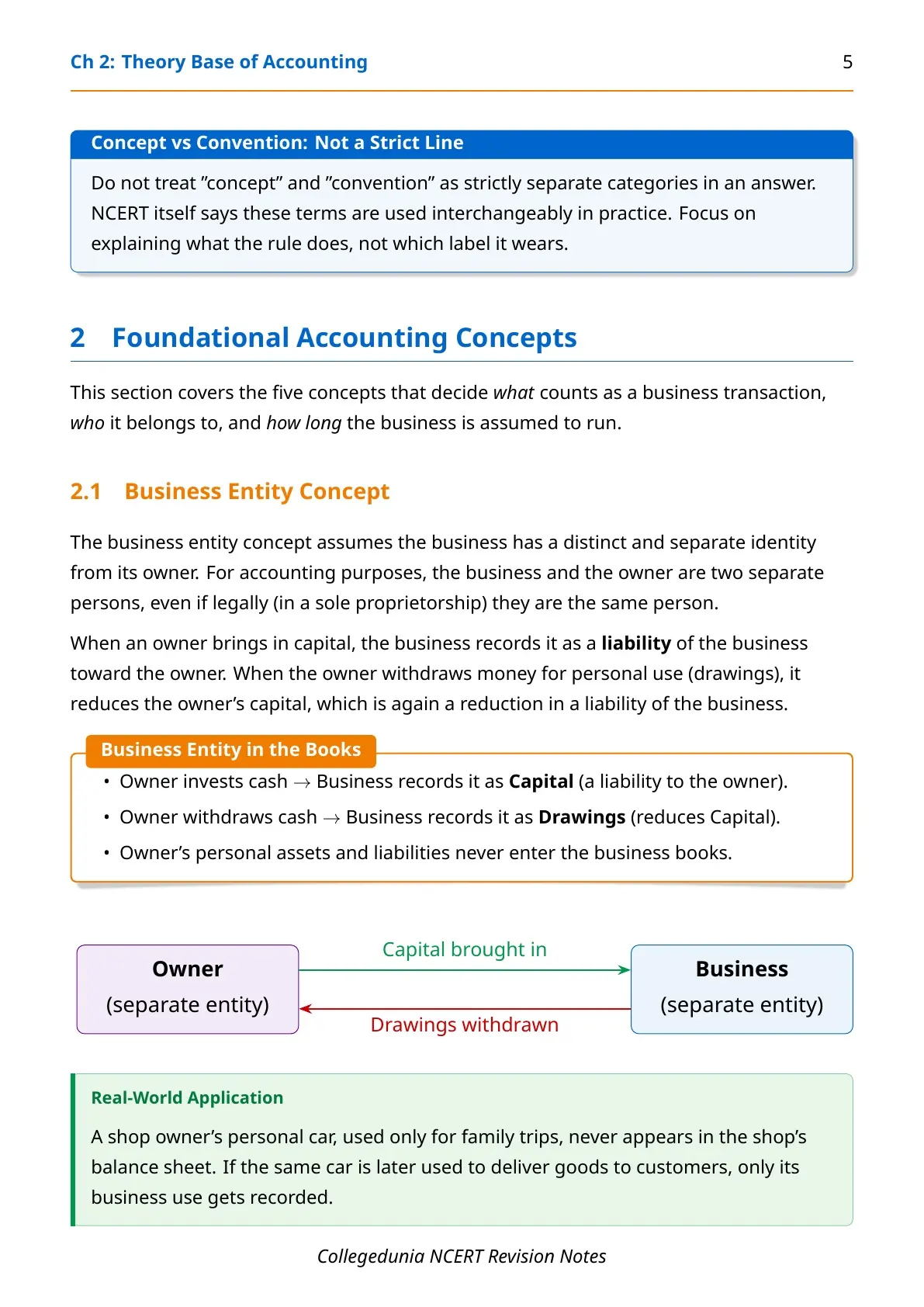
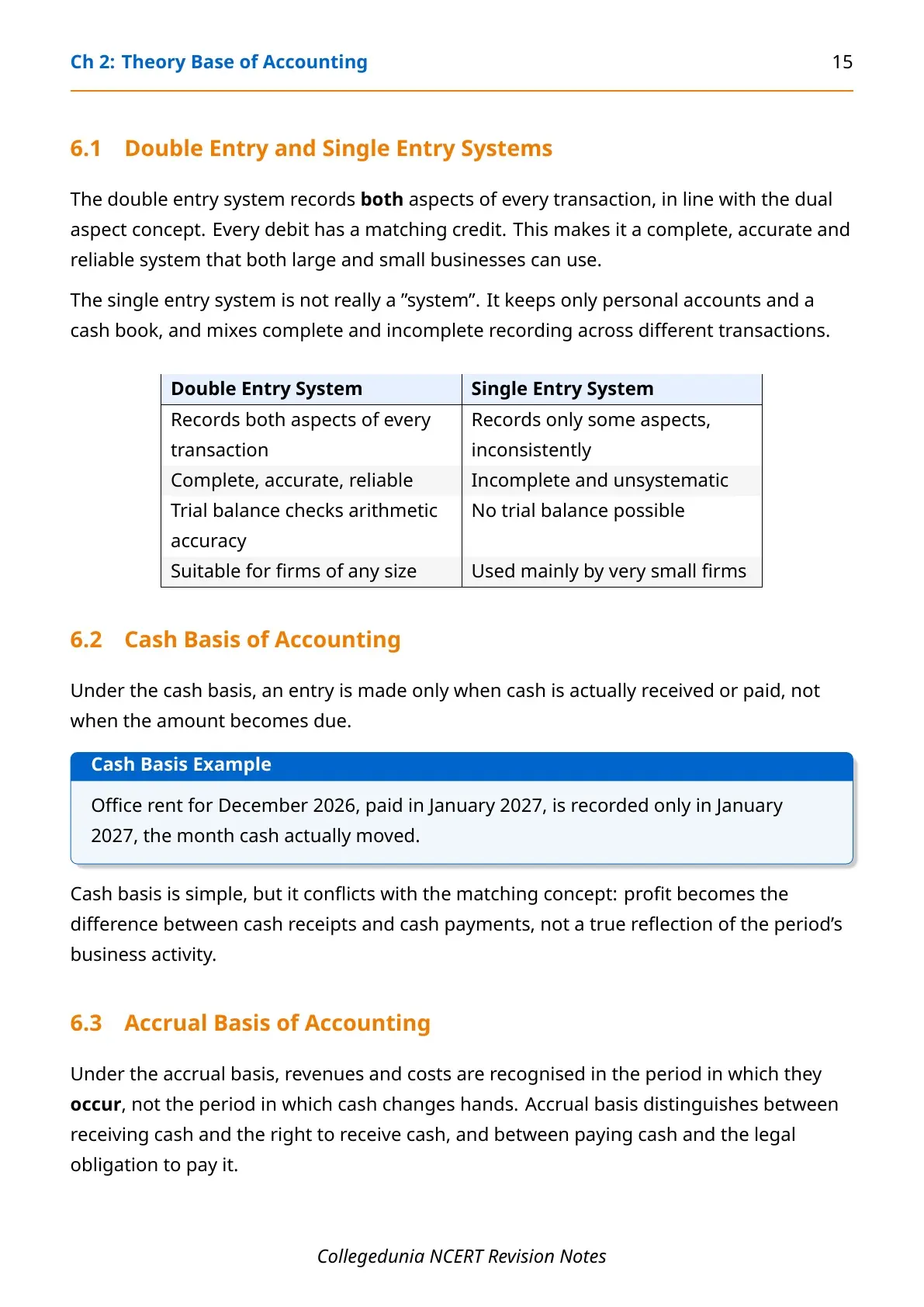
The business entity concept assumes the business has a separate identity from its owner. When an owner brings in capital, the business records it as a liability toward the owner. When the owner withdraws money (drawings), it reduces that liability.
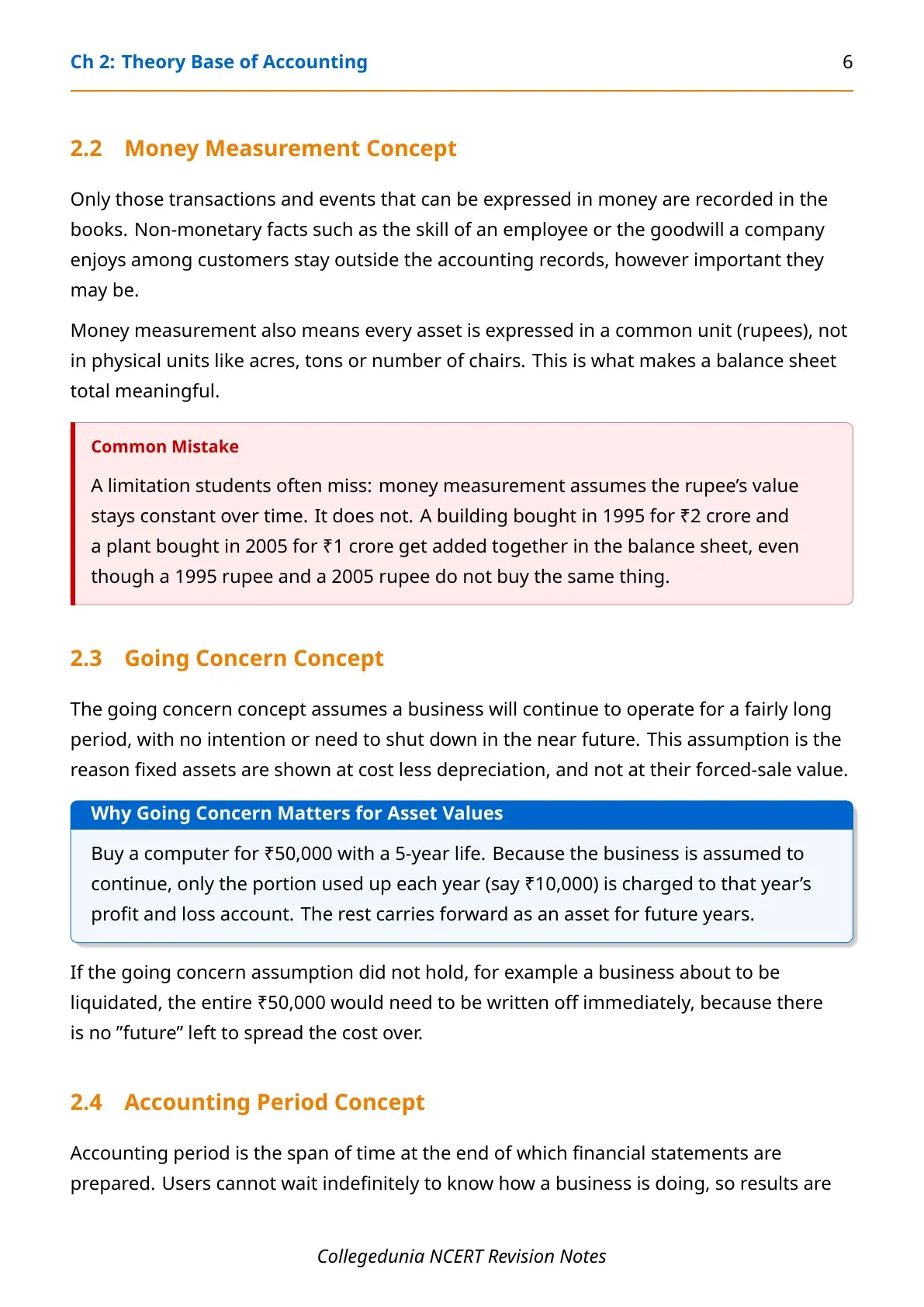
The money measurement concept means only events expressible in money get recorded. A skilled employee or strong brand image never appears in the books, however valuable it may be in reality.
The going concern concept assumes a business will run for a fairly long period. This is exactly why a computer bought for ₹50,000 with a 5-year life is not written off in one year, only the portion used each year is charged to that year's profit and loss account.
The accounting period concept fixes the reporting interval, usually one year under the Companies Act 2013, though listed companies must also publish quarterly results.
Cost, Dual Aspect, Revenue Recognition and Matching Concepts with Examples
These four concepts decide how a transaction is valued and when it enters the books.
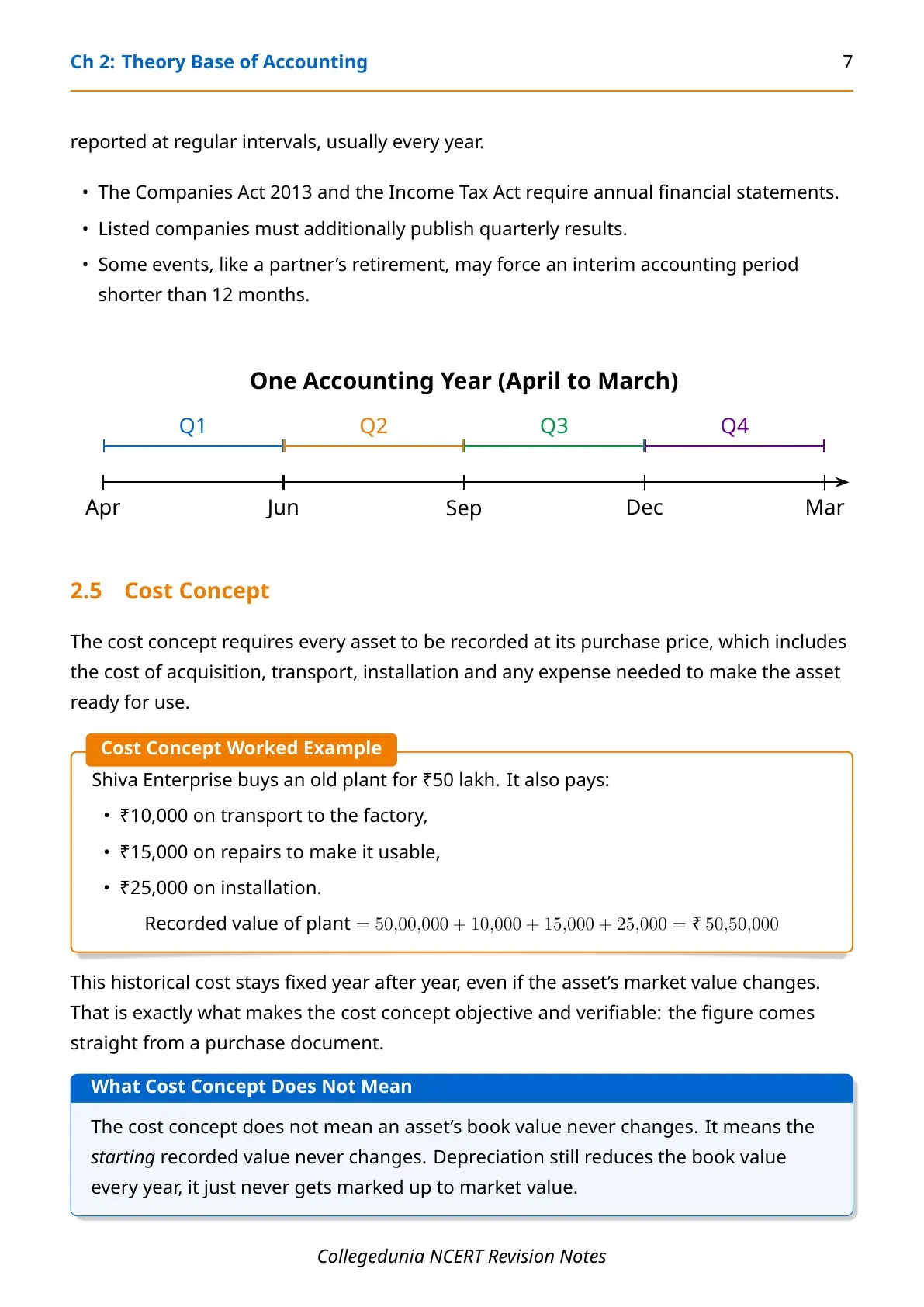
The cost concept records assets at purchase price. Shiva Enterprise buys a plant for ₹50 lakh, pays ₹10,000 on transport, ₹15,000 on repairs and ₹25,000 on installation. The recorded value is ₹50,50,000, the full cost of getting the asset ready to use.
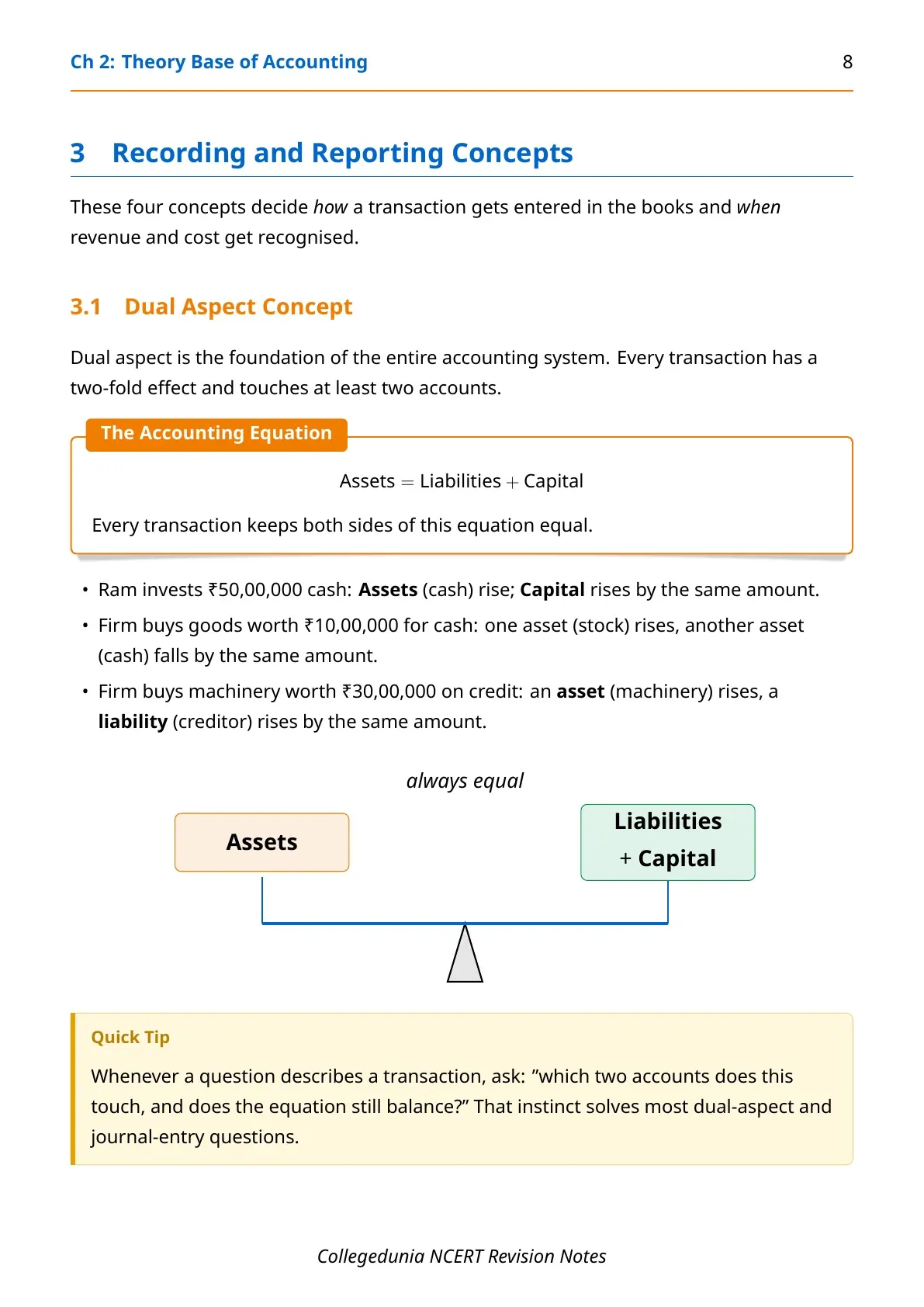
The dual aspect concept is the foundation of the entire system. Every transaction touches at least two accounts, and the accounting equation always holds.
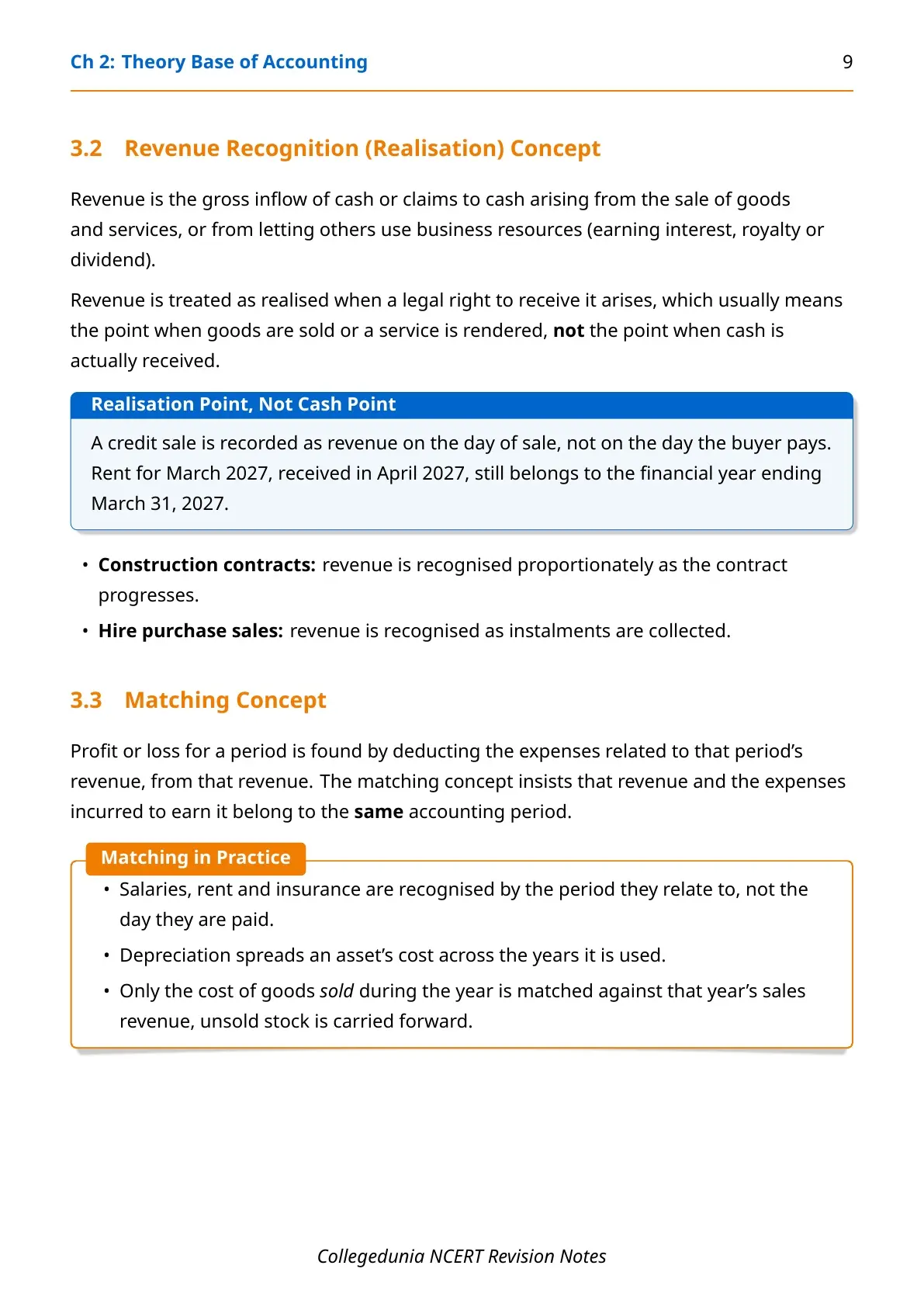
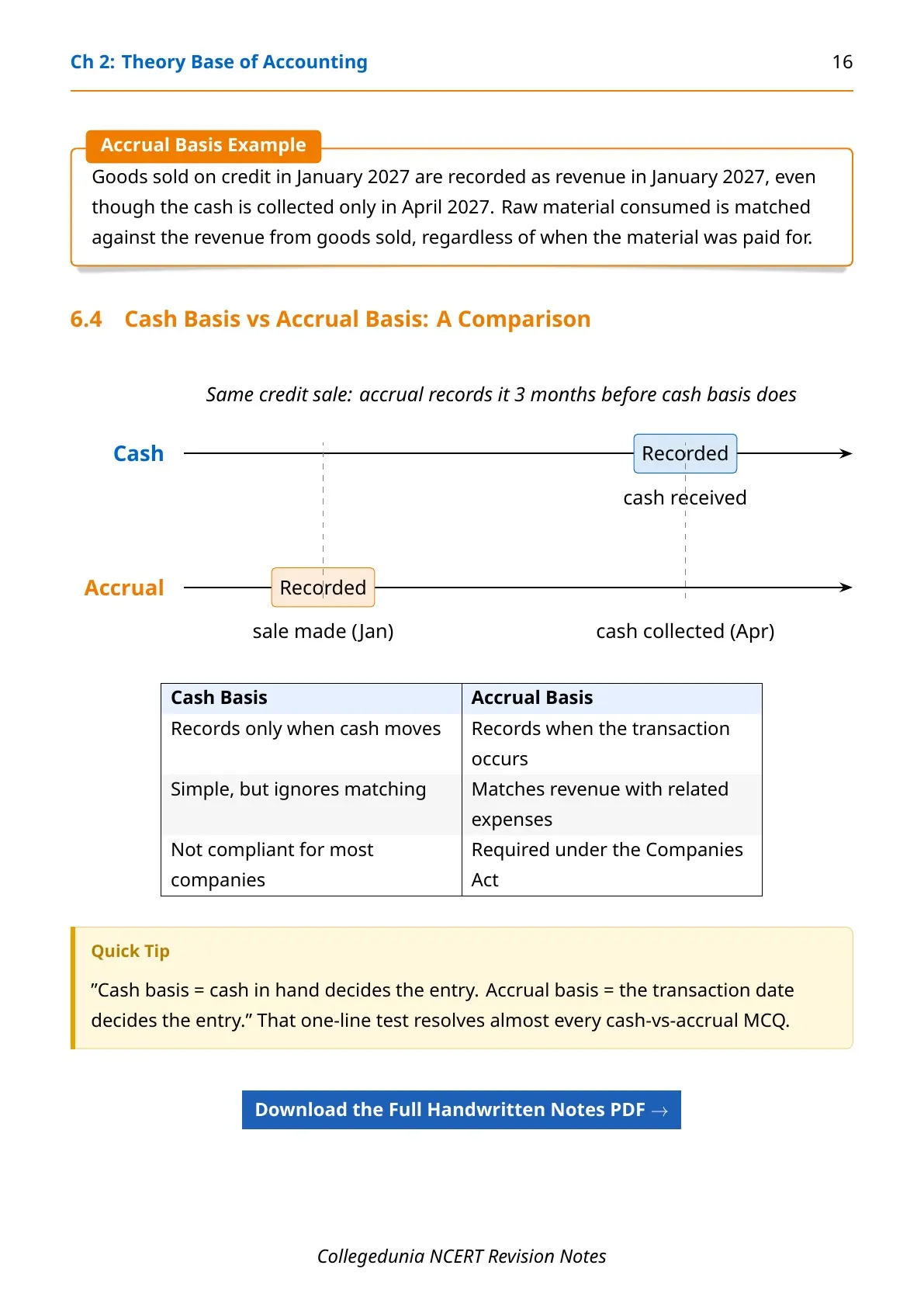
The revenue recognition concept books revenue on the day it is earned, not the day cash is received. A credit sale made in January is recorded as revenue in January, even if the buyer pays in April.
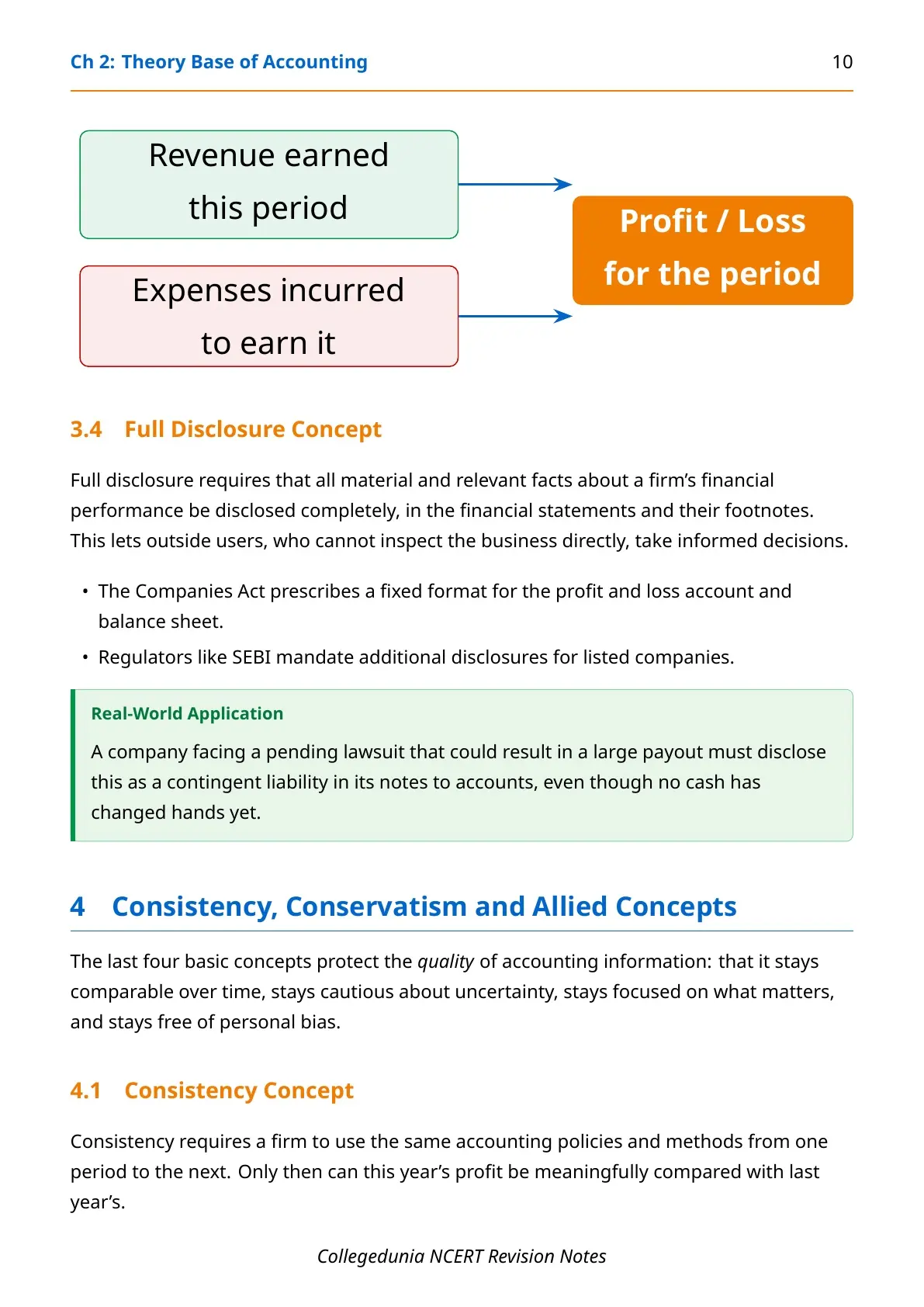
The matching concept pairs expenses with the revenue they generated in the same accounting period. Depreciation, for instance, is spread across every year the asset is used, not charged in one lump.
Full Disclosure, Consistency, Conservatism, Materiality and Objectivity
The last five concepts protect the quality of the information itself, that it stays complete, comparable, cautious, focused and unbiased.
- Full Disclosure: every material fact about the firm's performance must appear in the statements and footnotes.
- Consistency: a firm must use the same accounting policy period after period, or disclose any change.
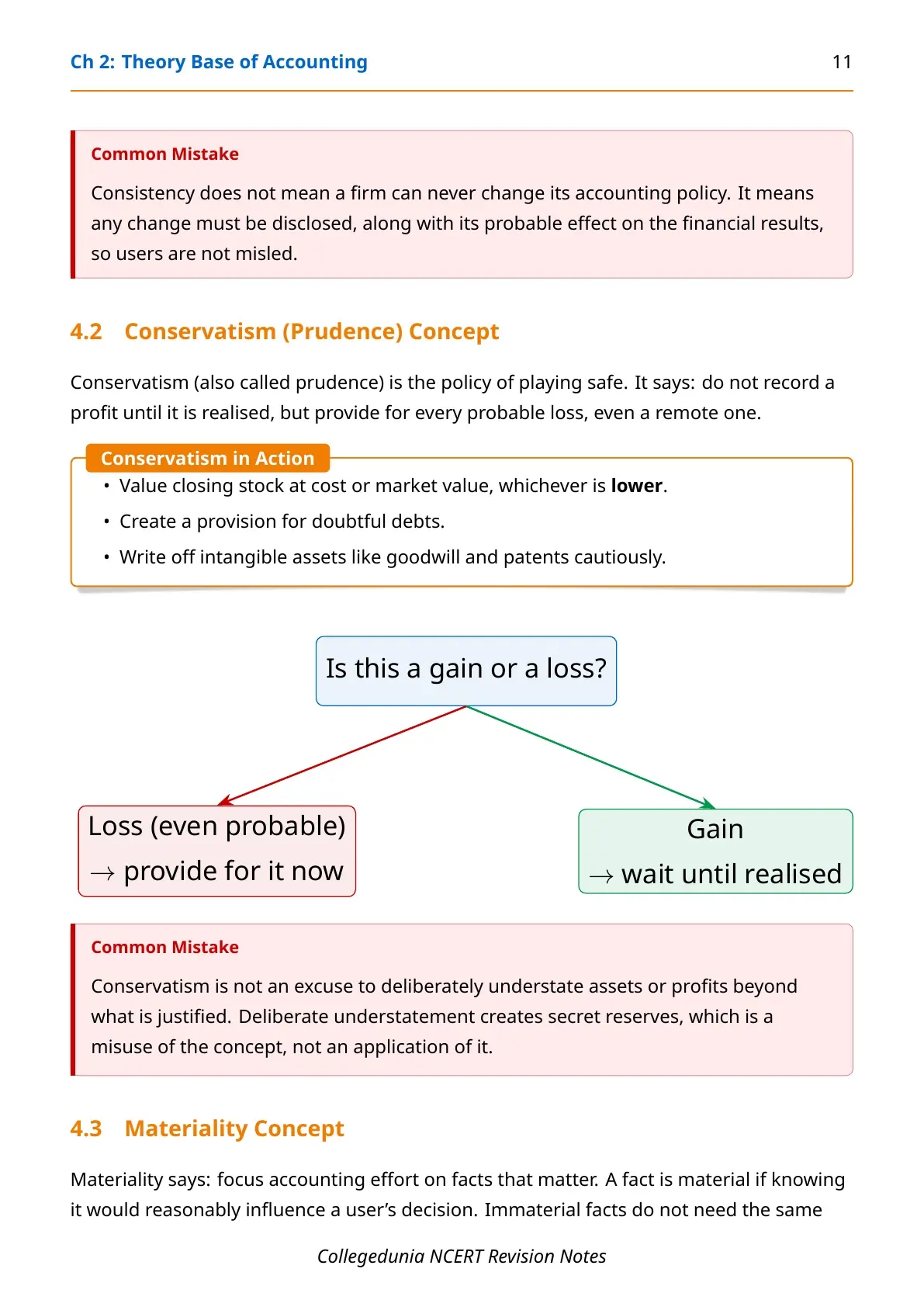
- Conservatism (Prudence): do not record a profit until it is realised, but provide for every probable loss.
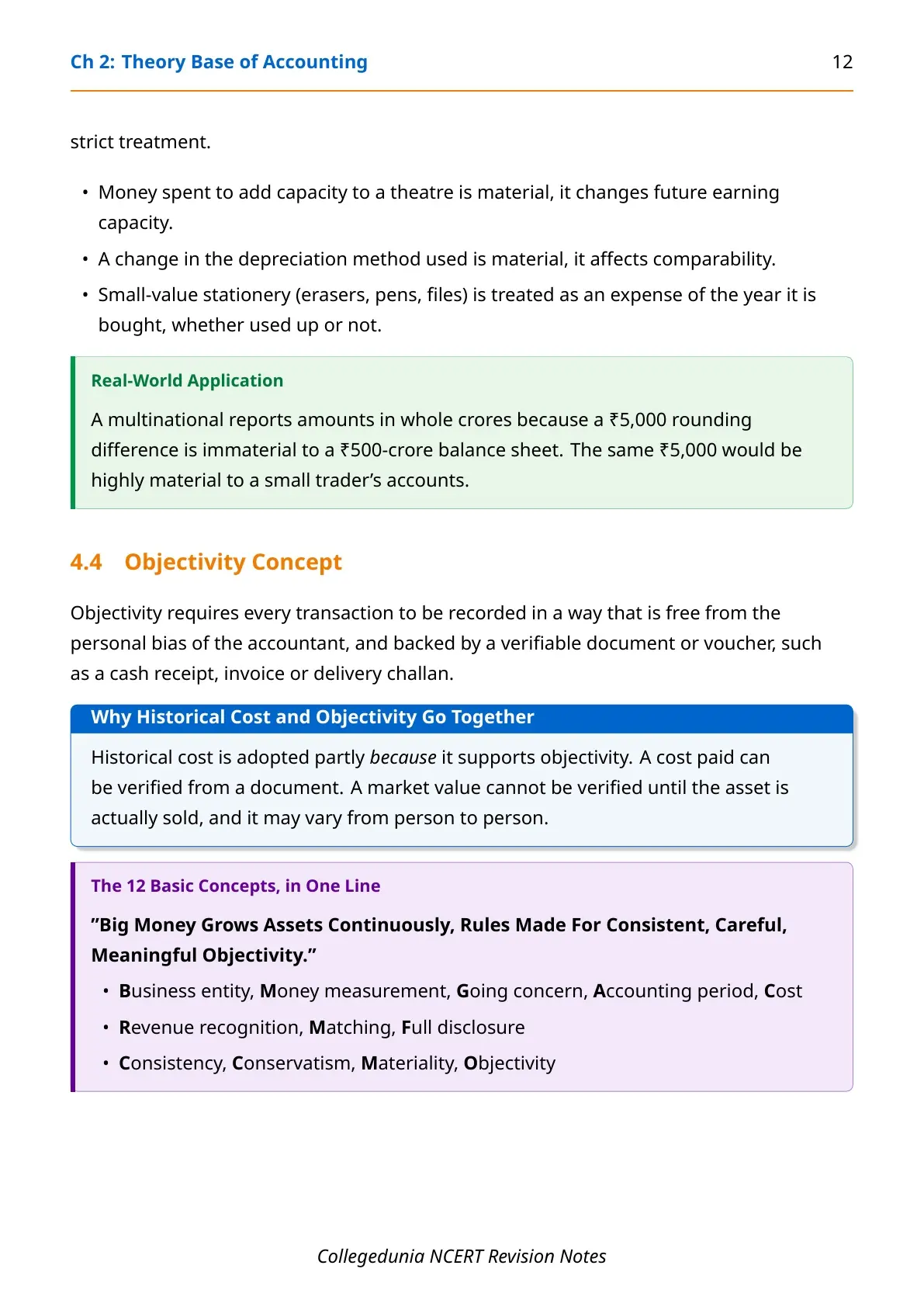
- Materiality: focus accounting effort on facts big enough to influence a user's decision.
- Objectivity: every entry needs a verifiable document, a receipt, invoice or challan.
Accounting Standards and Ind AS: How ICAI Aligns with IFRS
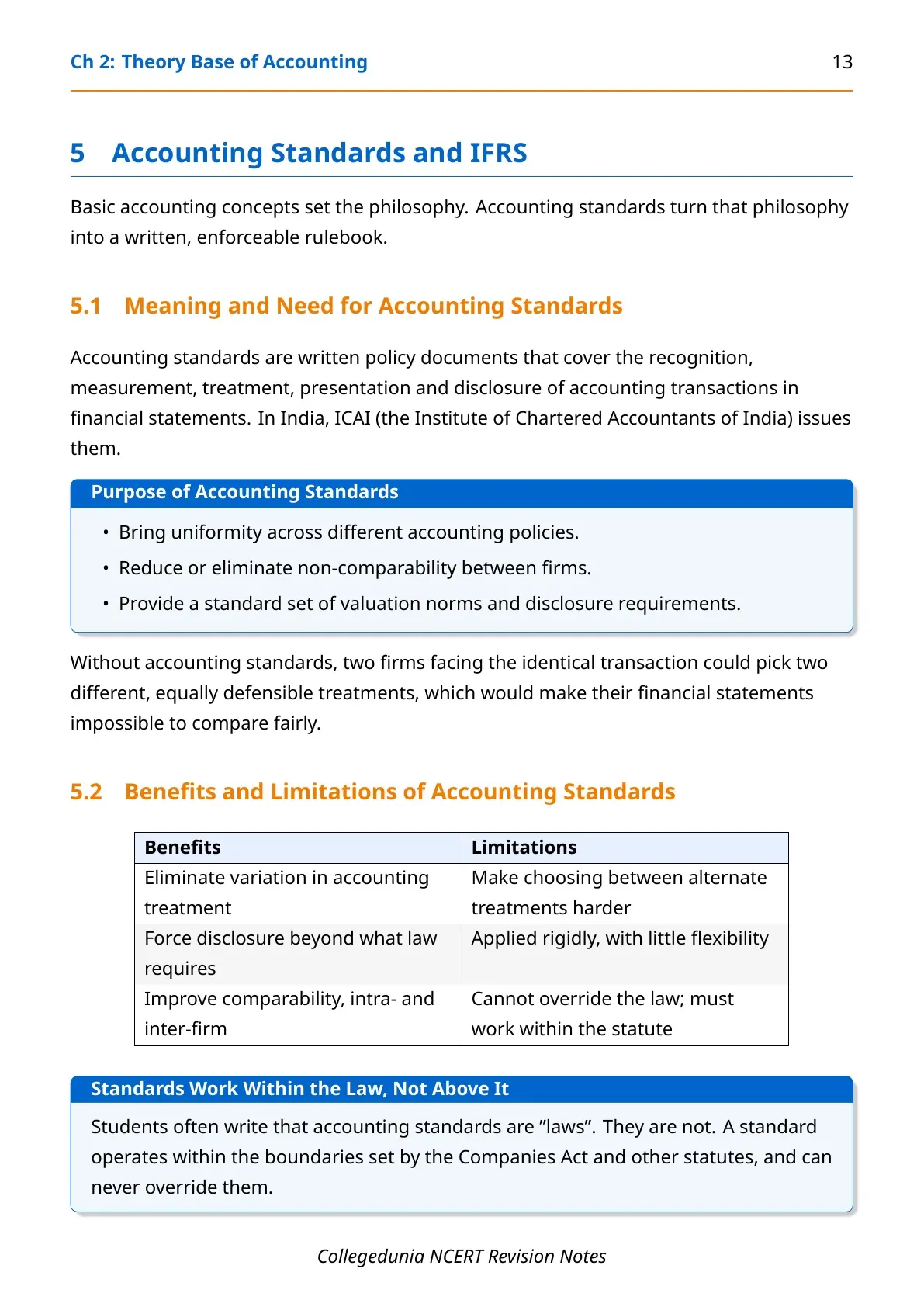
Accounting standards are written policy documents covering recognition, measurement, treatment, presentation and disclosure of transactions. In India, the Institute of Chartered Accountants of India (ICAI) issues them.
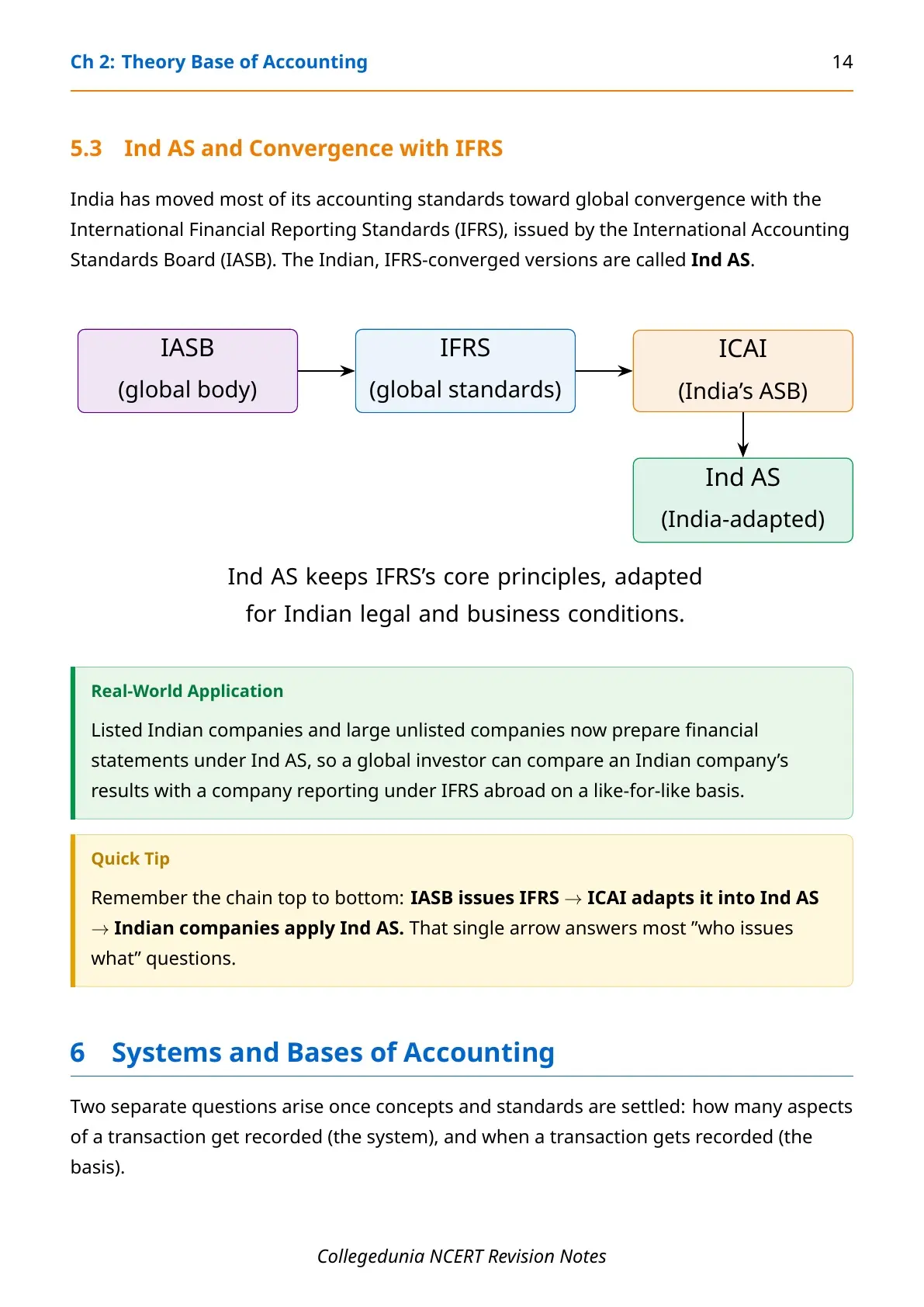
India has largely converged its standards with the International Financial Reporting Standards (IFRS), issued globally by the International Accounting Standards Board (IASB). The Indian, IFRS-aligned versions are called Ind AS.
| Benefits of Accounting Standards | Limitations of Accounting Standards |
|---|---|
| Remove variation in accounting treatment | Make choosing between alternate treatments harder |
| Force disclosure beyond what the law demands | Applied rigidly, with little flexibility |
| Improve comparability, intra- and inter-firm | Cannot override the law; must work within the statute |
Cash Basis vs Accrual Basis of Accounting: Key Differences
Accounting has two broad approaches to timing revenue and cost recognition, and NCERT expects students to be able to tell them apart with an example.
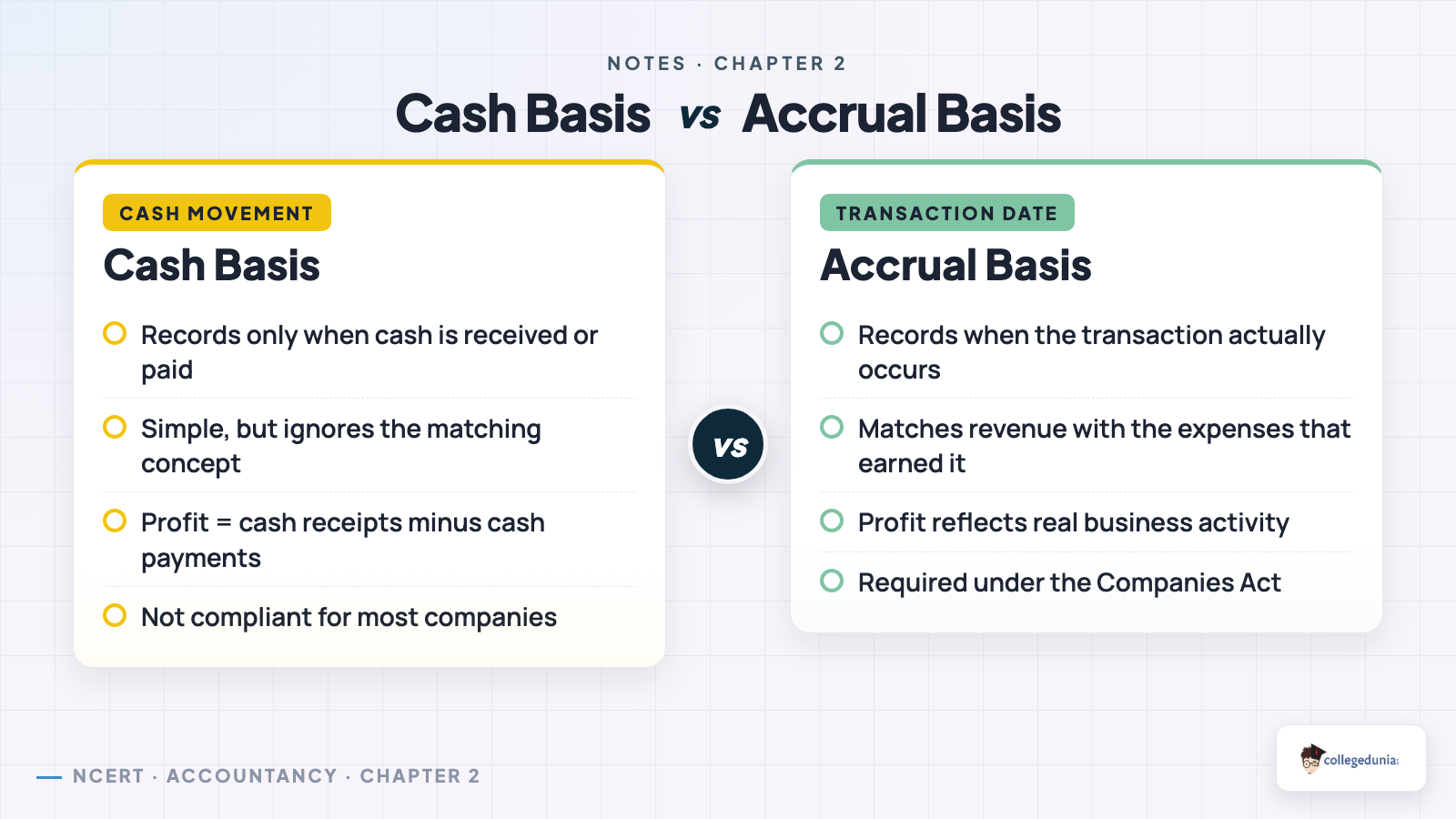
| Cash Basis | Accrual Basis |
|---|---|
| Records only when cash is received or paid | Records when the transaction actually occurs |
| Simple, but ignores the matching concept | Matches revenue with the expenses that earned it |
| Not compliant for most companies | Required under the Companies Act |
An easy test: office rent for December, paid in January, is recorded in January under cash basis, but in December under accrual basis, since that is the month the expense actually relates to.
GST Basics Every Class 11 Accountancy Student Should Know
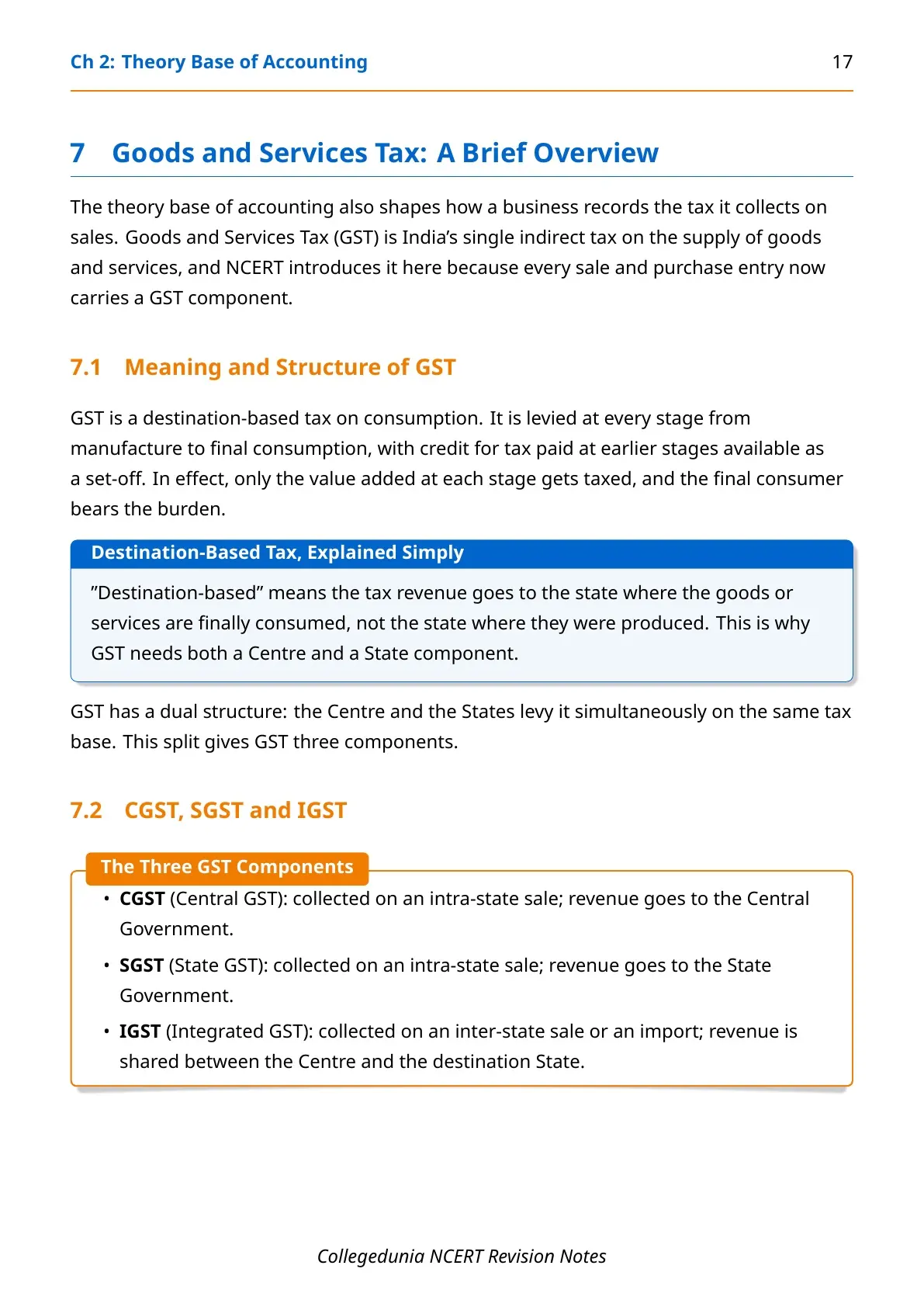
NCERT introduces Goods and Services Tax (GST) in this chapter because every sale and purchase entry now carries a GST component. GST is a destination-based tax on consumption, levied at every stage from manufacture to final consumption, with credit for tax already paid available as a set-off.
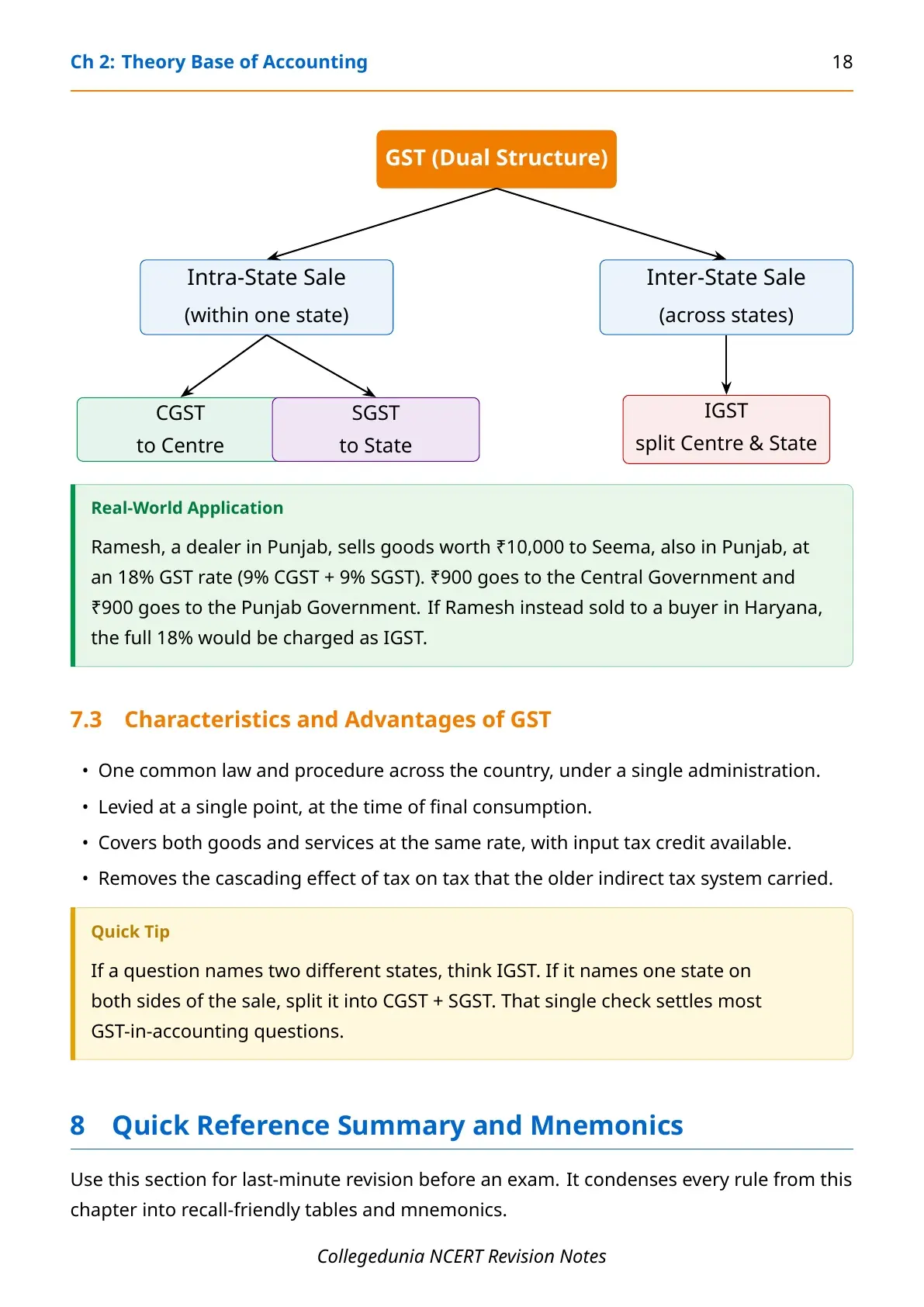
- CGST (Central GST) - collected on an intra-state sale, goes to the Centre.
- SGST (State GST) - collected on an intra-state sale, goes to the State.
- IGST (Integrated GST) - collected on an inter-state sale or import, split between Centre and destination State.
Example: Ramesh in Punjab sells goods worth ₹10,000 to Seema, also in Punjab, at 18% GST (9% CGST + 9% SGST). ₹900 goes to the Centre and ₹900 goes to Punjab. Had Seema been in Haryana, the full 18% would be charged as IGST instead.
Theory Base of Accounting Weightage for CBSE Class 11 Accountancy
Theory Base of Accounting carries 12 concepts and zero numericals, so board papers usually test it through direct definition or short-explanation questions.
| Sub-topic | Weightage | CBSE Frequency |
|---|---|---|
| Basic Accounting Concepts (12 concepts) | High | Almost every year |
| GAAP and Accounting Standards | Medium | 3 out of last 5 years |
| Cash vs Accrual Basis | Medium | 3 out of last 5 years |
| GST Basics | Low | 1 out of last 5 years |
Common Mistakes Students Make in the Theory Base of Accounting Chapter
These are the mix-ups examiners see most often when marking this chapter.
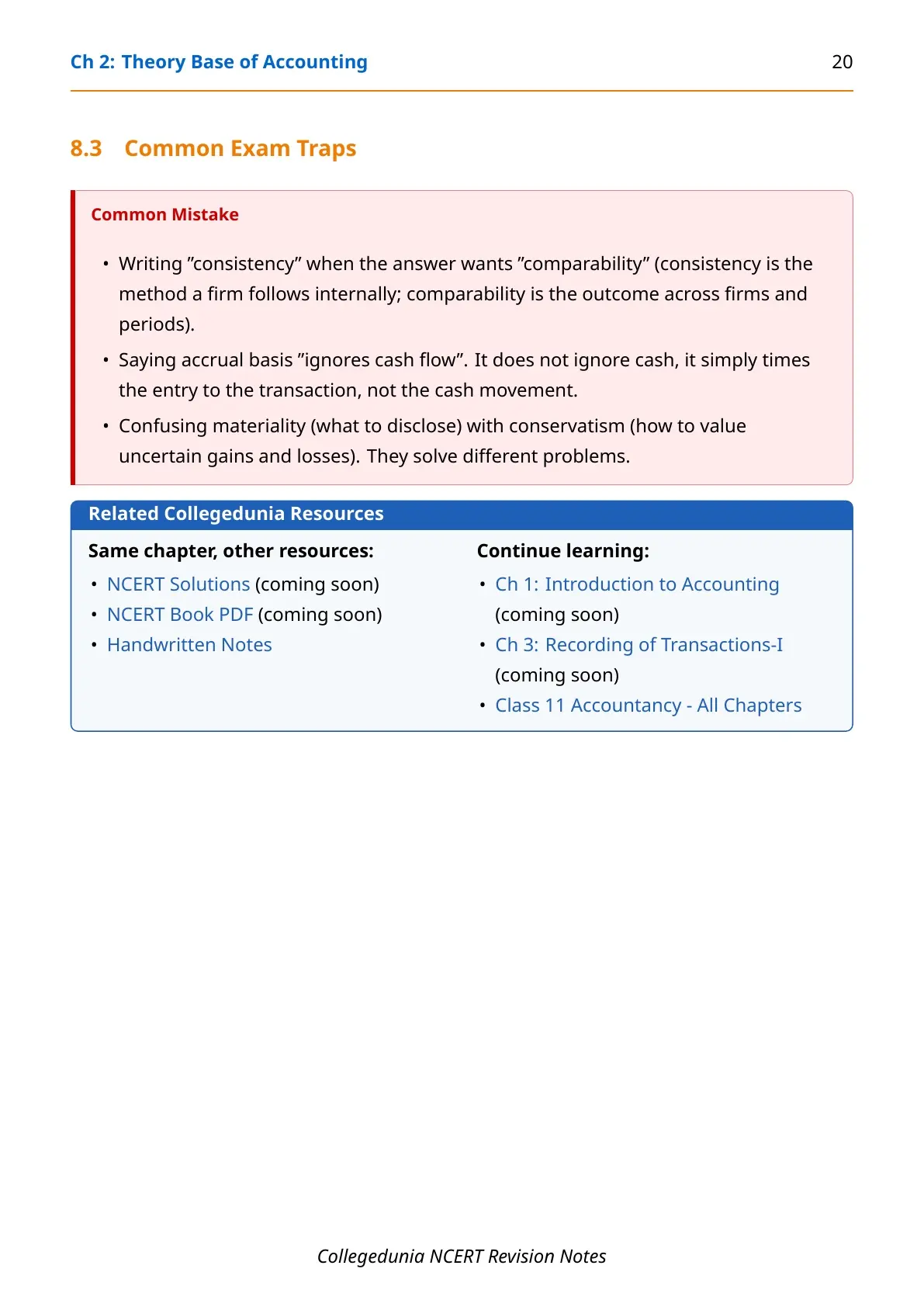
- Writing "consistency" when the answer wants "comparability" - consistency is the method a firm follows internally, comparability is the outcome across firms and periods.
- Saying accrual basis "ignores cash flow" - it does not ignore cash, it simply times the entry to the transaction, not the cash movement.
- Confusing materiality (what to disclose) with conservatism (how to value uncertain gains and losses) - they solve different problems.
- Calling accounting standards "laws" - a standard works within the Companies Act, it can never override it.
Student Feedback
In a Collegedunia poll of 11,540 Class 11 Accountancy students conducted before the 2026 boards, 68% of students named the 12 basic accounting concepts as the hardest part of this chapter to recall under exam pressure. The most-confused pair, reported by 4 out of 5 students in the same poll, was consistency versus conservatism.
Source: 2026-27 Class 11 Accountancy student poll. Sample of 11,540 students from CBSE schools across 14 states.
How to Use These Theory Base of Accounting Notes Most Effectively
A short, three-step routine gets the most out of the NCERT Notes Class 11 Accountancy Chapter 2 Theory Base of Accounting page without wasting revision time.
- First read: go through GAAP and all 12 concepts once, using the quick-recall table as a checklist.
- Practice: write the accounting equation and the cash-vs-accrual example from memory, then check against the notes.
- Final revision: re-read only the Common Mistakes and Quick Recall sections the night before the exam.
More Theory Base of Accounting Accountancy Class 11 Resources
The table below lists the other Collegedunia resources available for this chapter.
| Resource | Link |
|---|---|
| NCERT Solutions | Theory Base of Accounting Class 11 NCERT Solutions (coming soon) |
| NCERT Book PDF | Theory Base of Accounting Class 11 NCERT Book PDF (coming soon) |
| Handwritten Notes | Theory Base of Accounting Class 11 Handwritten Notes |
| Subject Hub | NCERT Class 11 Accountancy - All Chapters |
NCERT Notes for Class 11 Accountancy: All Chapters
Use the table below to move to the notes for any other chapter in the Class 11 Accountancy textbook.
| Chapter | Resource |
|---|---|
| Chapter 1 | Introduction to Accounting Notes (coming soon) |
| Chapter 2 | Theory Base of Accounting Notes |
| Chapter 3 | Recording of Transactions - I Notes (coming soon) |
| Chapter 4 | Recording of Transactions - II Notes (coming soon) |
| Chapter 5 | Bank Reconciliation Statement Notes (coming soon) |
| Chapter 6 | Trial Balance and Rectification of Errors Notes (coming soon) |
| Chapter 7 | Depreciation, Provisions and Reserves Notes (coming soon) |
Theory Base of Accounting Class 11 Accountancy Notes FAQs
Ques. Where can I download the Theory Base of Accounting Class 11 Notes PDF?
Ans. You can download the Theory Base of Accounting Class 11 Accountancy Notes PDF directly from this page, free of cost.
Ques. Is this Notes PDF based on the 2026-27 NCERT syllabus?
Ans. Yes. This page reflects the current 2026-27 NCERT syllabus for Class 11 Accountancy, including the GST section as printed in the latest textbook.
Ques. How many basic accounting concepts does NCERT list in this chapter?
Ans. NCERT lists 12 basic accounting concepts in Theory Base of Accounting: business entity, money measurement, going concern, accounting period, cost, dual aspect, revenue recognition, matching, full disclosure, consistency, conservatism, materiality and objectivity.
Ques. What is GAAP in accounting?
Ans. GAAP stands for Generally Accepted Accounting Principles. It is the set of rules and guidelines the accounting profession has widely accepted for recording and reporting business transactions, covering principles, concepts, conventions and standards.
Ques. What is the difference between cash basis and accrual basis of accounting?
Ans. Cash basis records a transaction only when cash is received or paid. Accrual basis records it in the period the transaction actually occurs, regardless of when cash moves. The Companies Act requires accrual basis for most companies.
Ques. Which body issues accounting standards in India?
Ans. The Institute of Chartered Accountants of India (ICAI) issues accounting standards in India. Many of these standards are now converged with global IFRS as Ind AS.
Ques. What is the theory base of accounting?
Ans. The theory base of accounting is the set of principles, concepts, rules and guidelines that accountants follow so that financial statements stay reliable and comparable across firms and across accounting periods.
Ques. What is the dual aspect concept in accounting?
Ans. The dual aspect concept says every transaction has a two-fold effect and touches at least two accounts, so that Assets always equal Liabilities plus Capital.
Ques. What is the difference between GAAP and accounting standards?
Ans. GAAP is the broad umbrella of principles, concepts and conventions the accounting profession has widely accepted. Accounting standards are the specific, written documents issued by ICAI that sit inside that GAAP umbrella.



Comments