



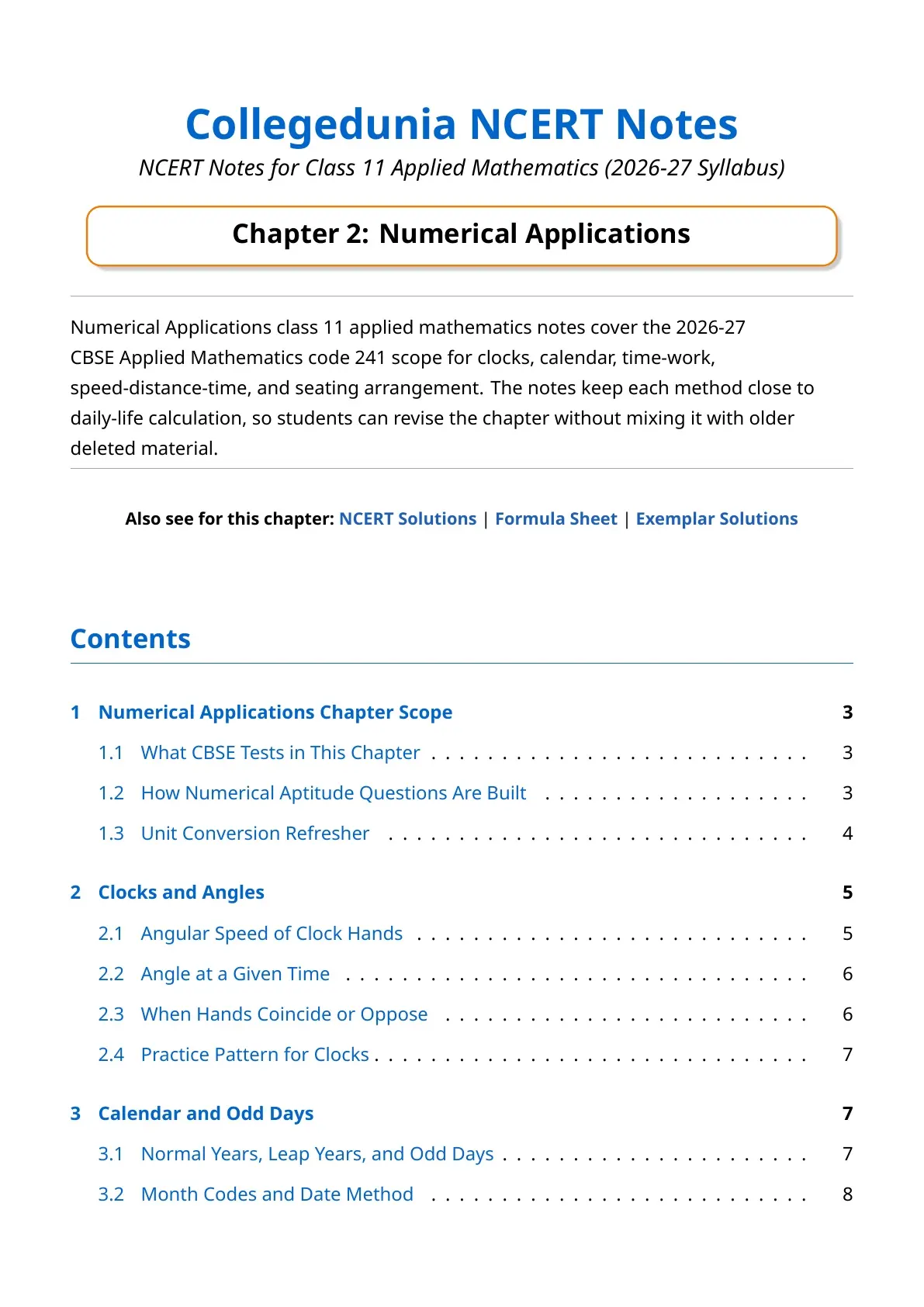
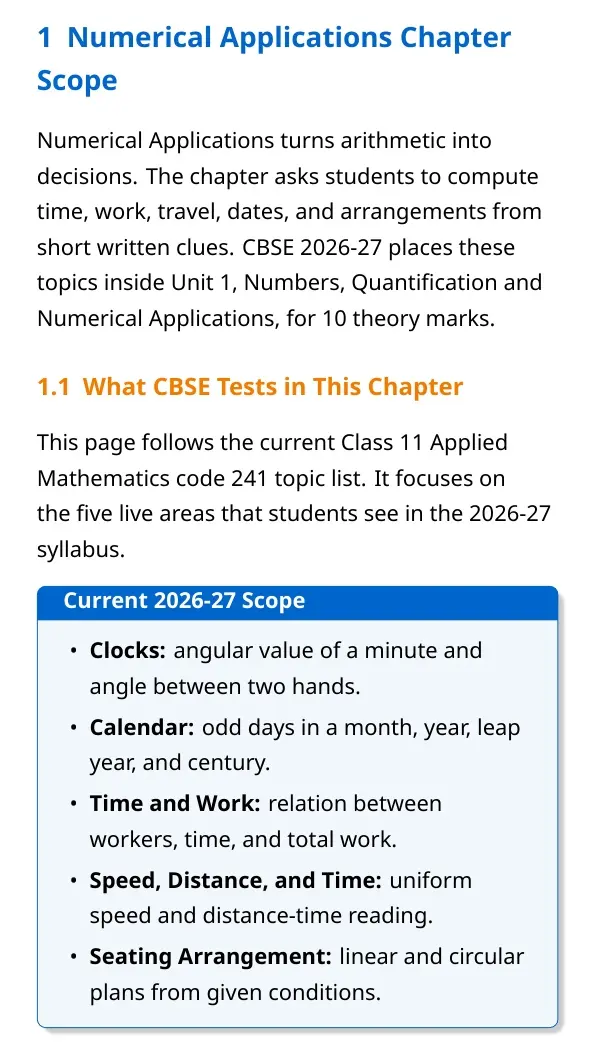
Class 11 Applied Mathematics Chapter 2 Numerical Applications notes help students revise the practical arithmetic part of Unit 1 in the 2026-27 CBSE syllabus. The chapter turns everyday settings into exam-ready calculations: clock angles, calendar odd days, shared work, speed-time questions and seating arrangements.
Student Feedback: More than 10,000 students use Collegedunia NCERT notes for short revision before class tests and pre-board practice. Students usually prefer this chapter as a formula-and-method sheet because most questions become easier after the first setup line.
- Best for quick revision: one place for the clock, calendar, work-time, speed-time and seating arrangement methods.
- Aligned to 2026-27: follows the current CBSE Applied Mathematics Unit 1 scope for Numerical Applications.
- Includes worked checks: examples show how to test the final answer instead of memorising tricks blindly.
|
Table of Contents |
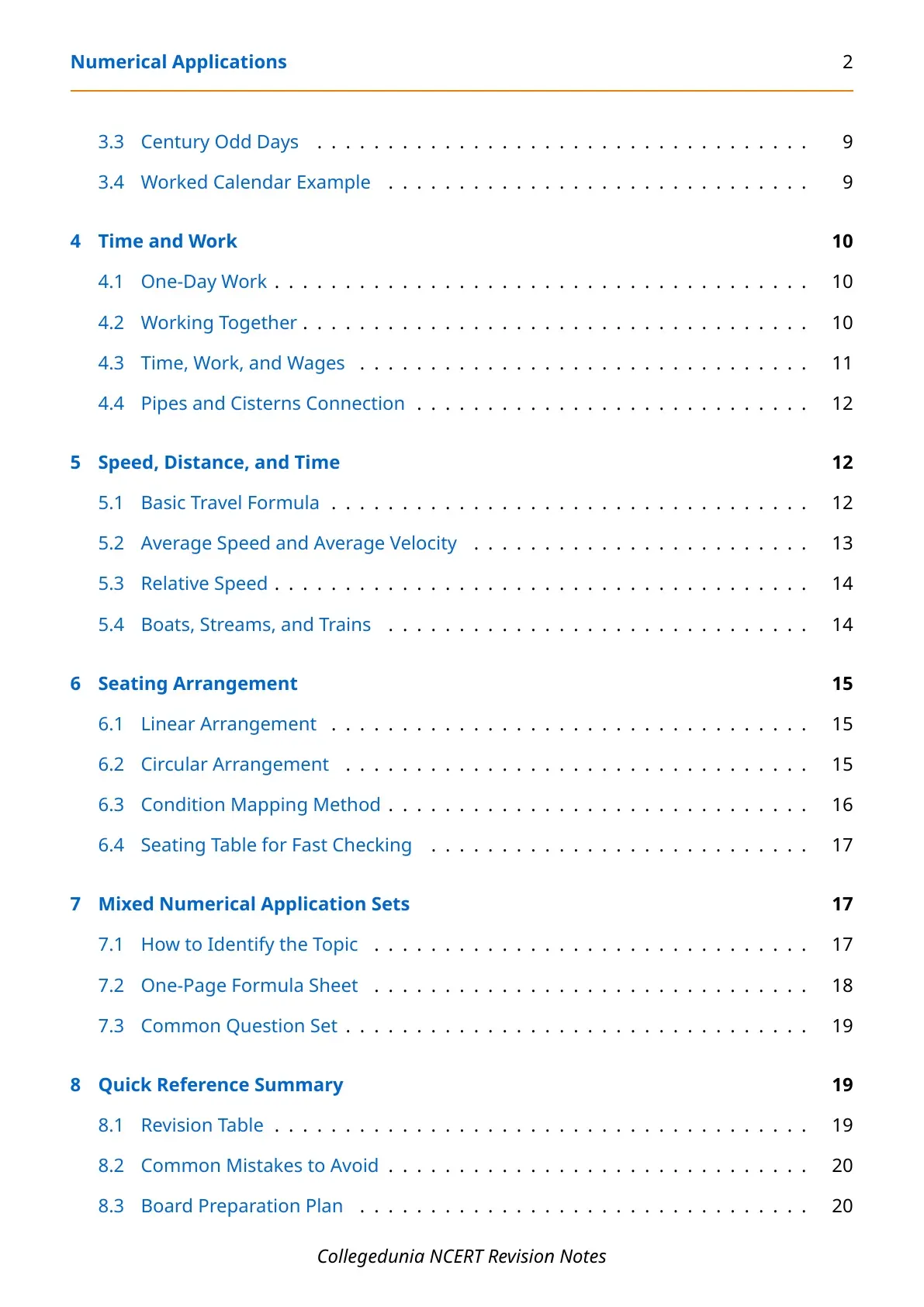
What Numerical Applications Covers in Class 11 Applied Mathematics
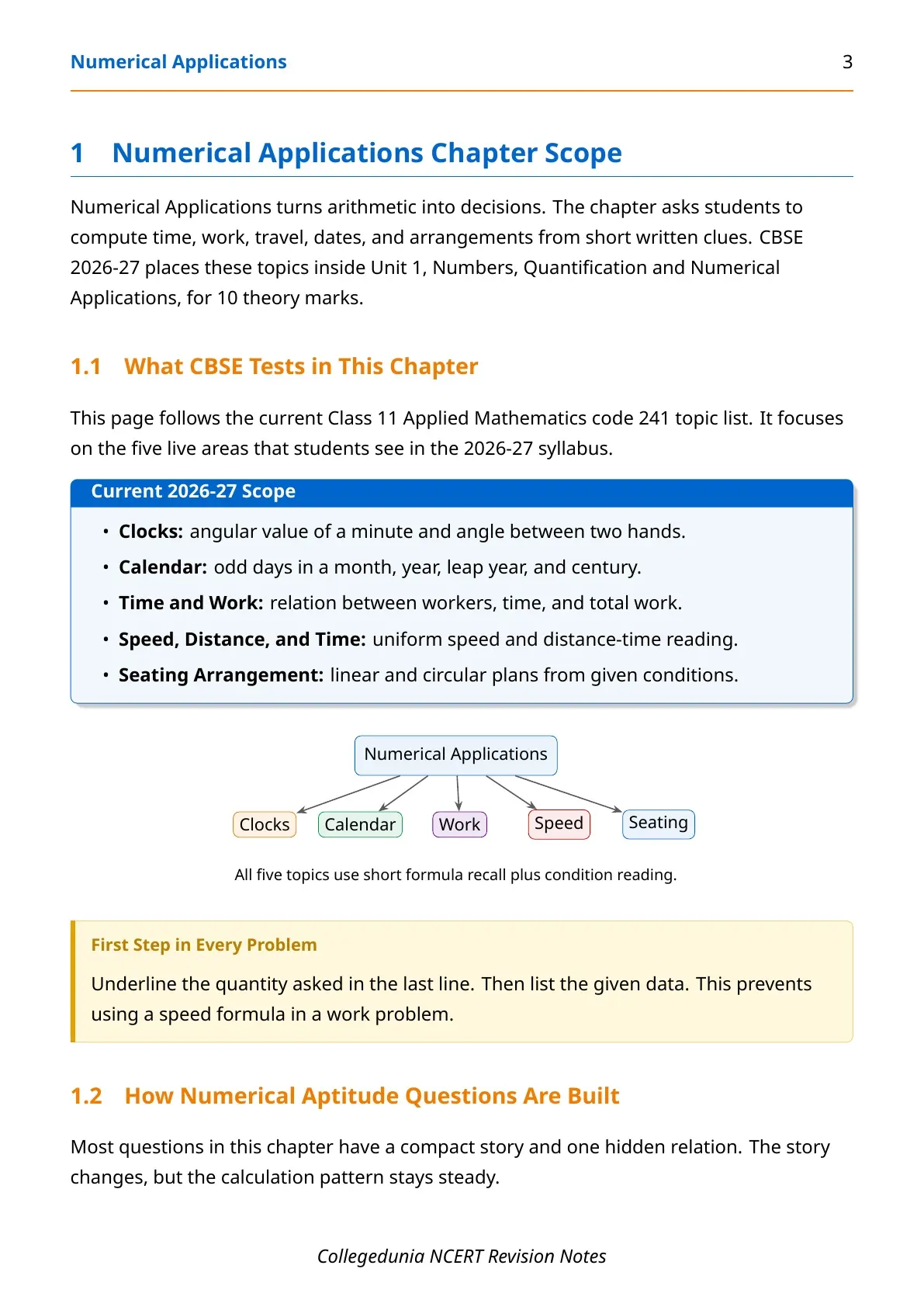
Numerical Applications is the part of Class 11 Applied Mathematics where students convert a short word problem into a compact numerical model. In the current 2026-27 scope, the important blocks are clocks, calendar, time and work, speed, distance and time, and seating arrangement. The chapter is not meant to be a theory-heavy unit. It rewards clear notation, clean unit conversion and a small number of repeatable algorithms.
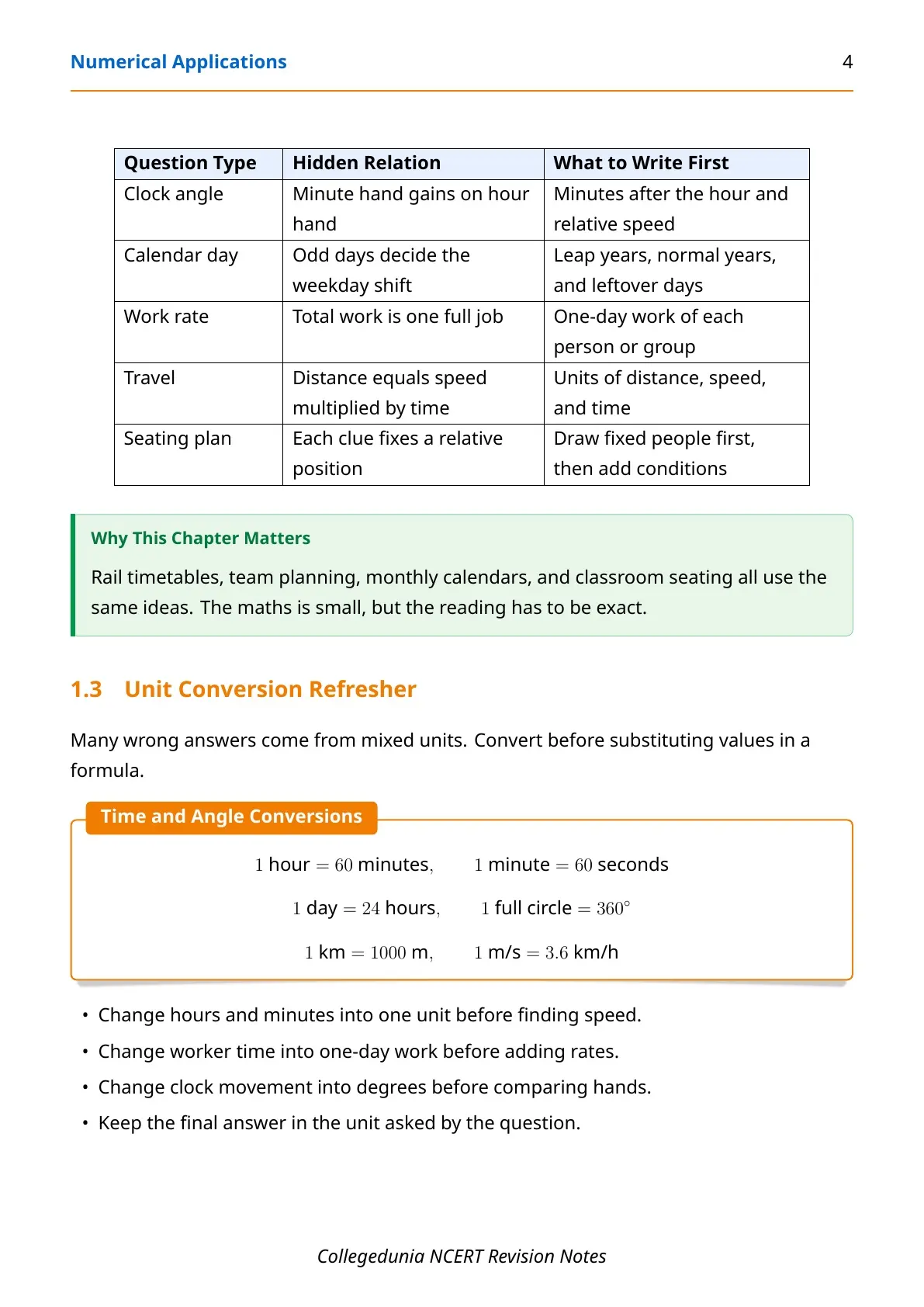
The safest revision approach is to write the known values first, choose the matching method and then check whether the answer is realistic. For example, a clock-angle answer must be between 0 and 180 degrees when the smaller angle is asked. A work-time answer should reduce when more workers join. A train-speed answer must use the same unit for distance and time. These checks catch most arithmetic slips.
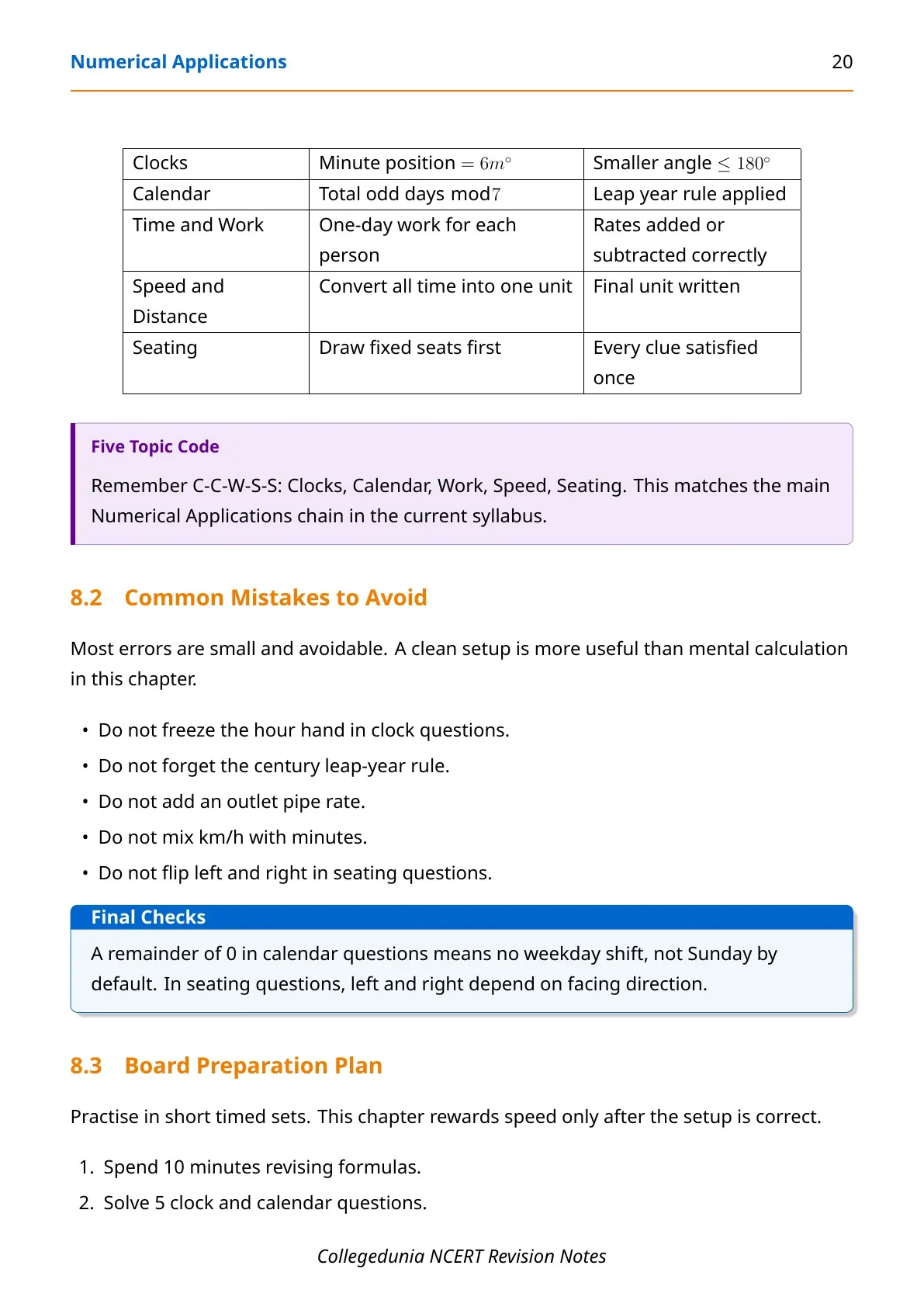
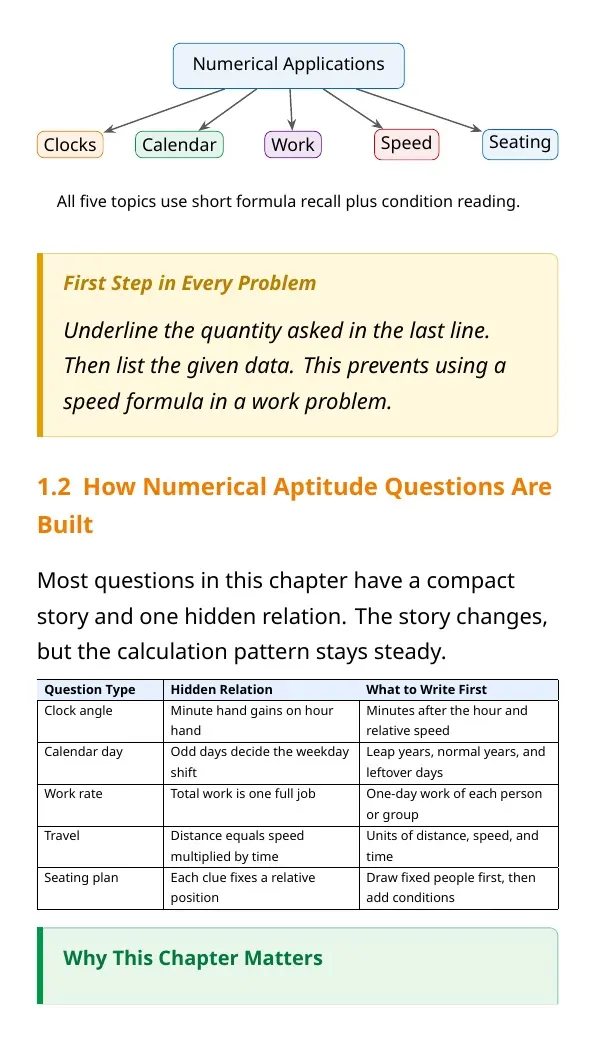
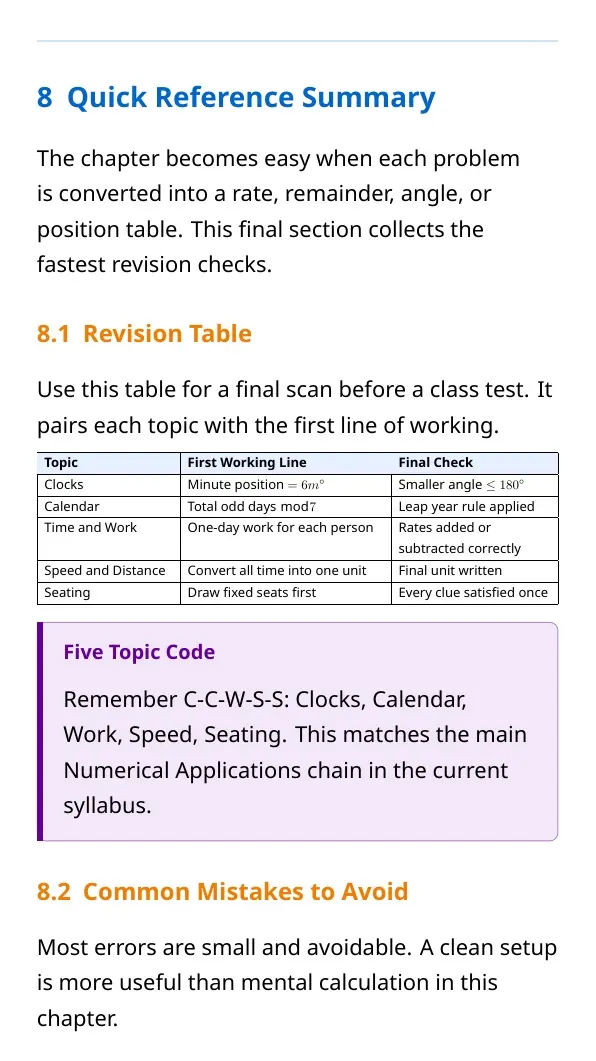
| Block | Core idea | What to check |
|---|---|---|
| Clocks | Relative motion of hour and minute hands | Use smaller angle unless the question asks otherwise |
| Calendar | Odd days after complete years, months and dates | Apply leap-year and century rules carefully |
| Time and work | Work rate per day or per hour | Total work stays constant |
| Speed-time | Distance equals speed times time | Convert km/h and m/s before calculating |
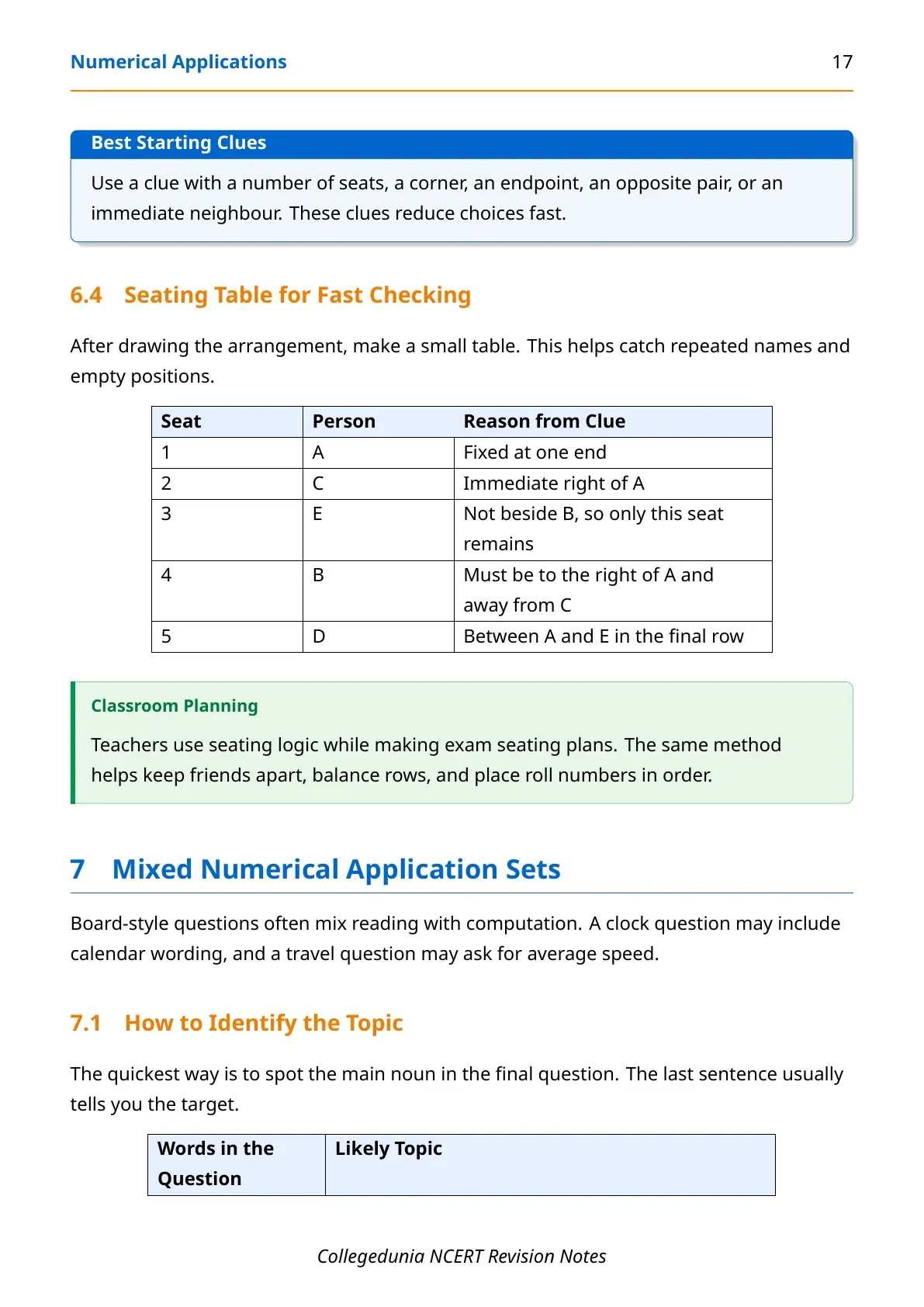
| Seating | Relative positions in a row or circle | Fix one reference point first |
Numerical Applications Quick Revision for Class 11
Source: Commerce Wallah by PW on YouTube
Clock Problems in Numerical Applications
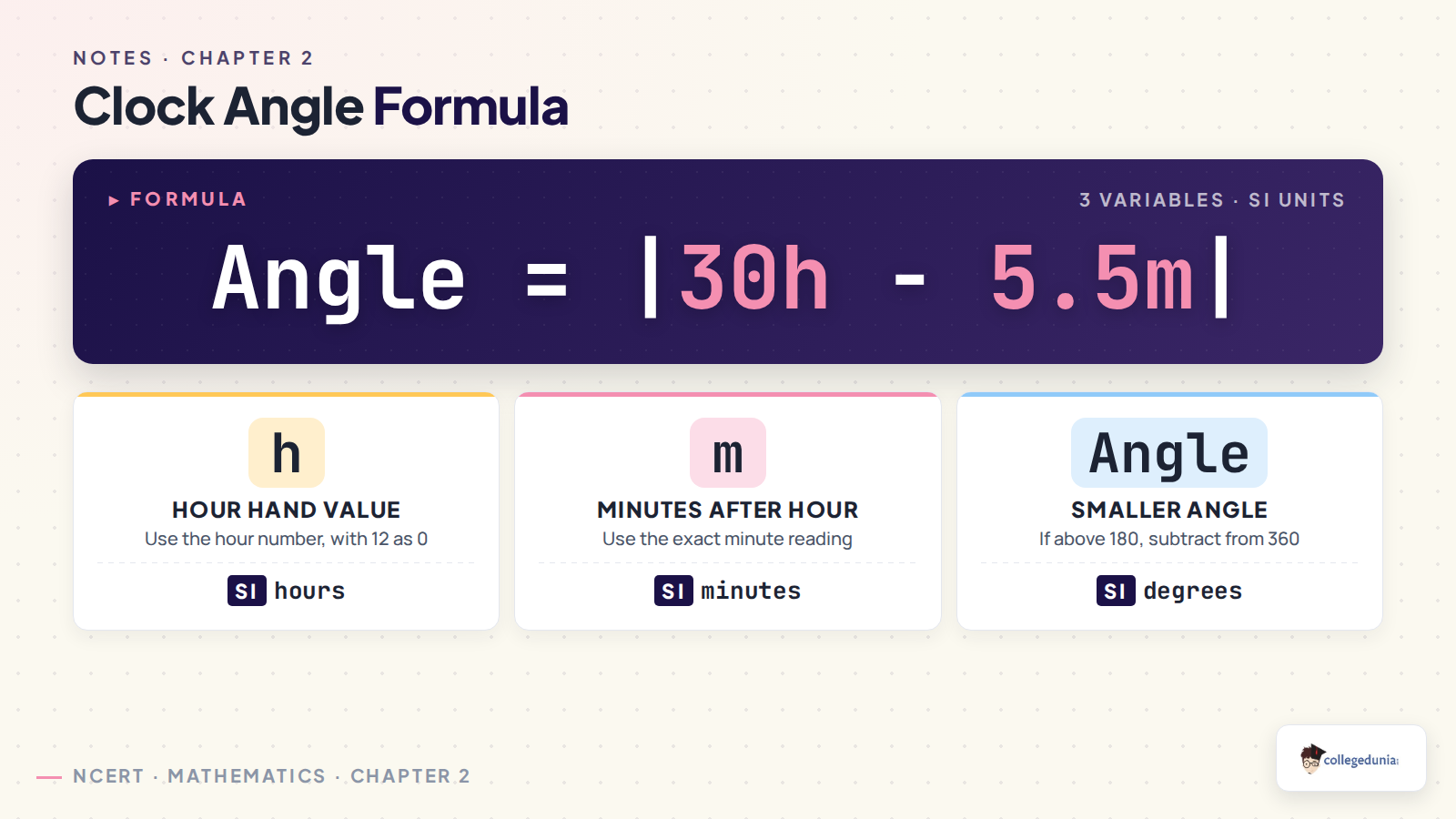
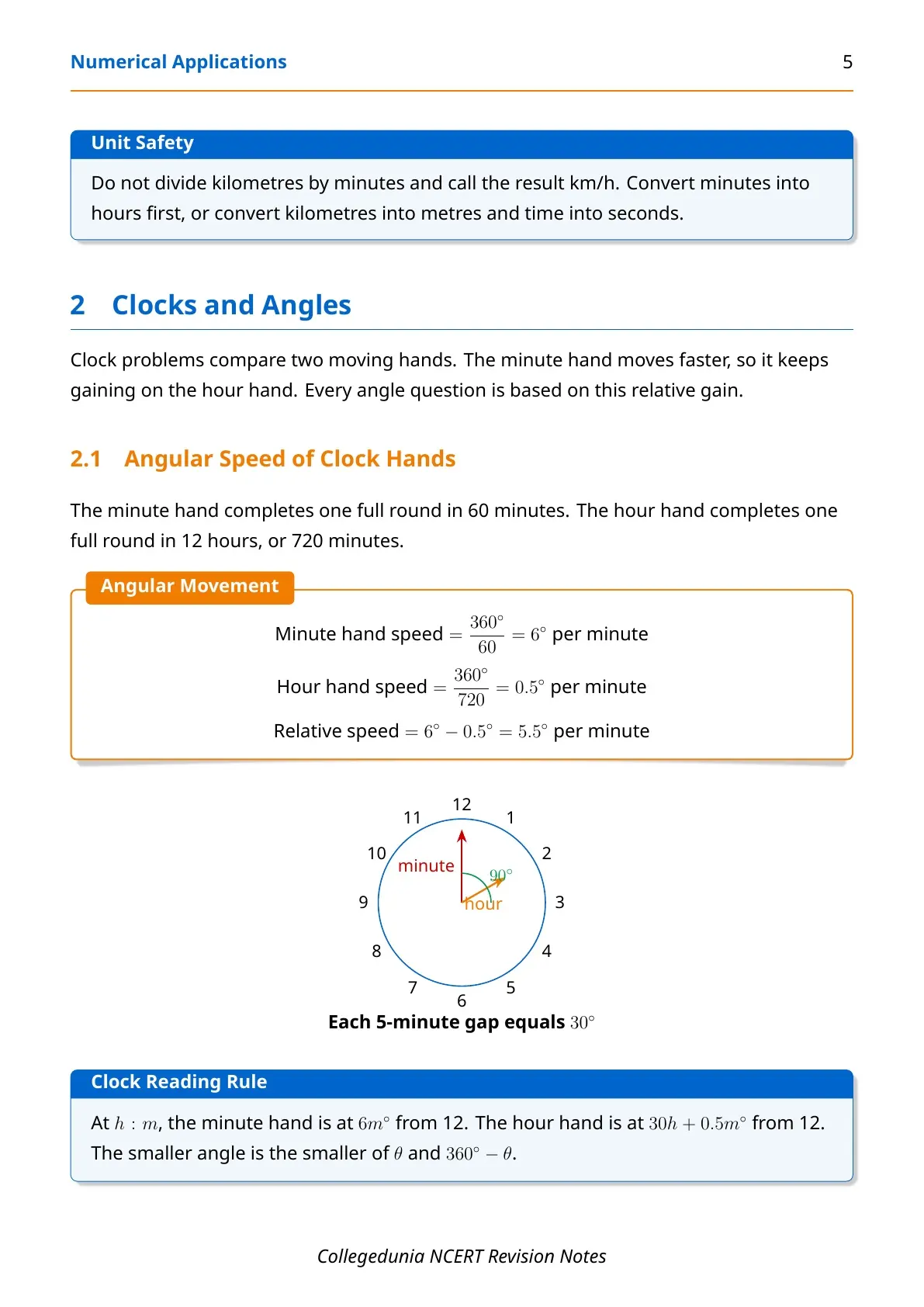
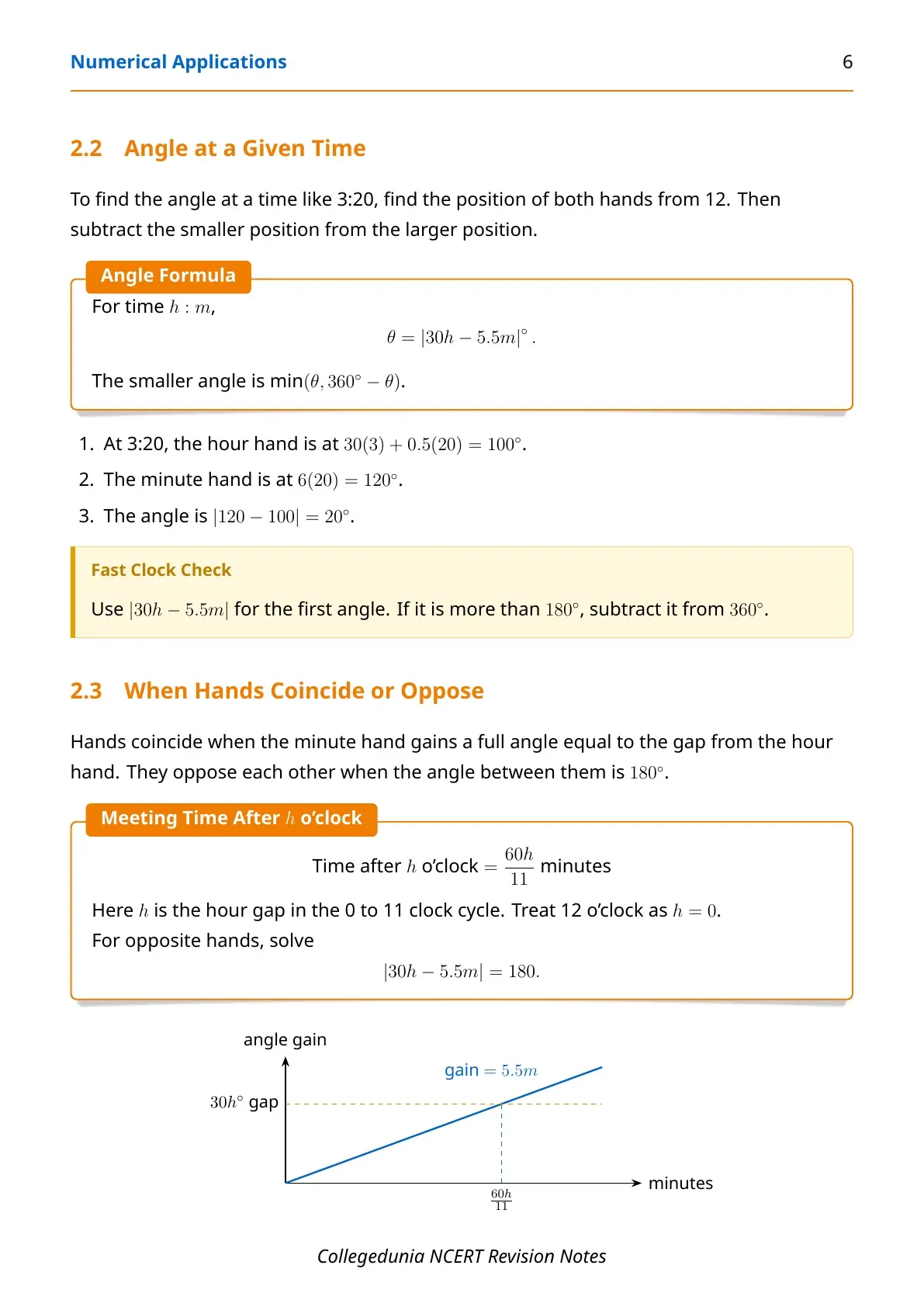
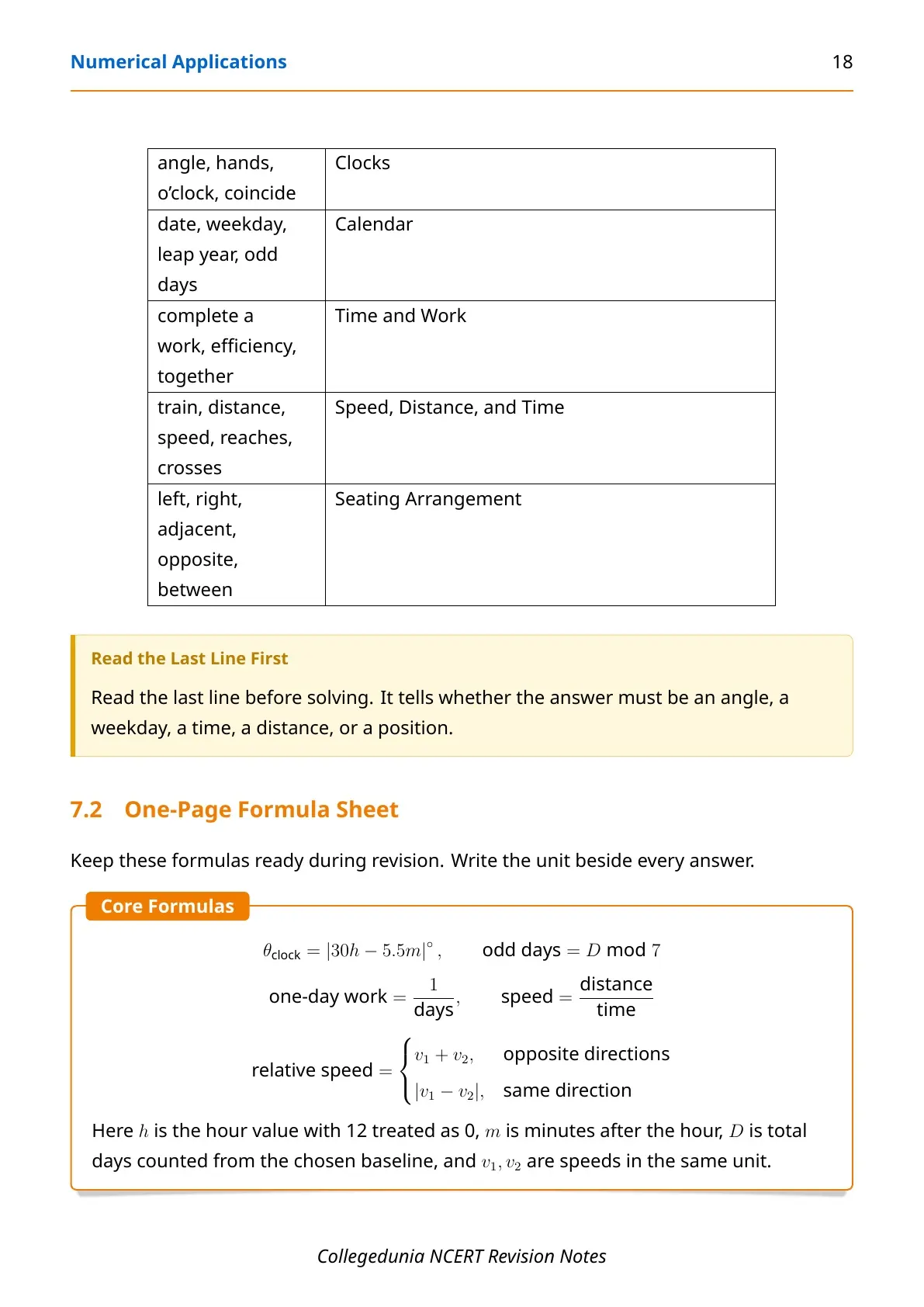
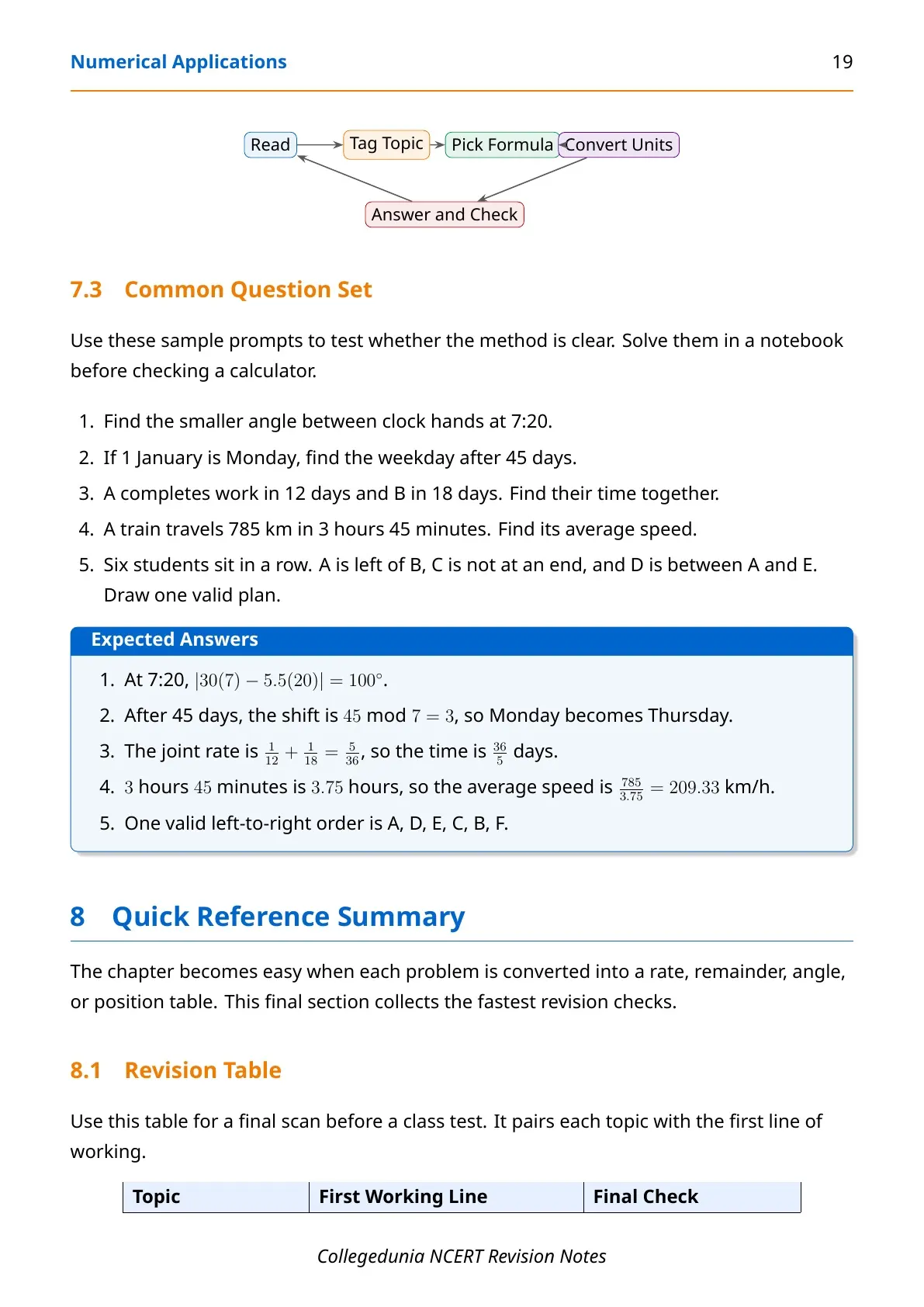
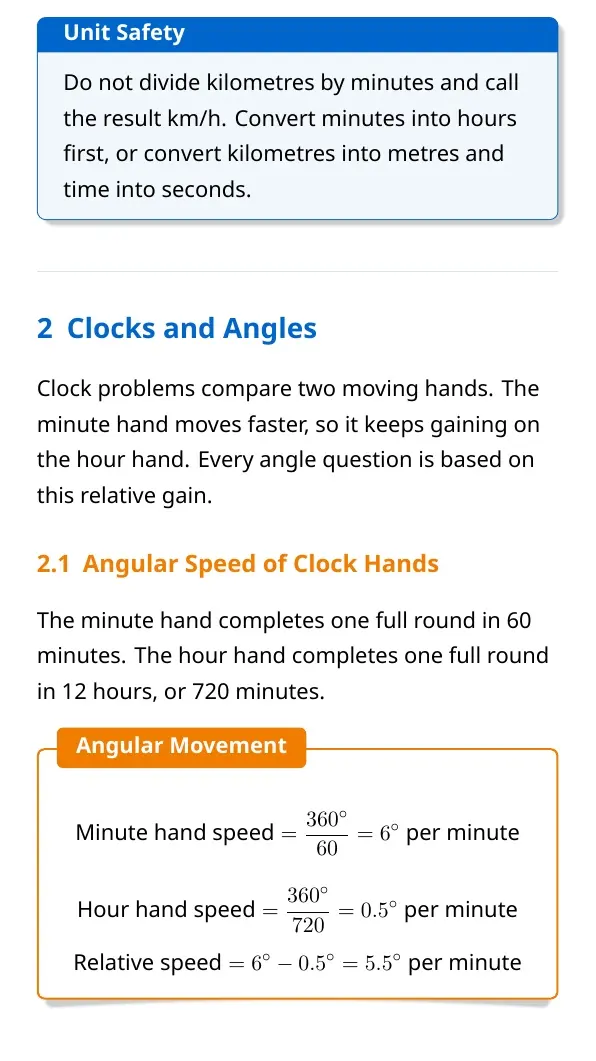
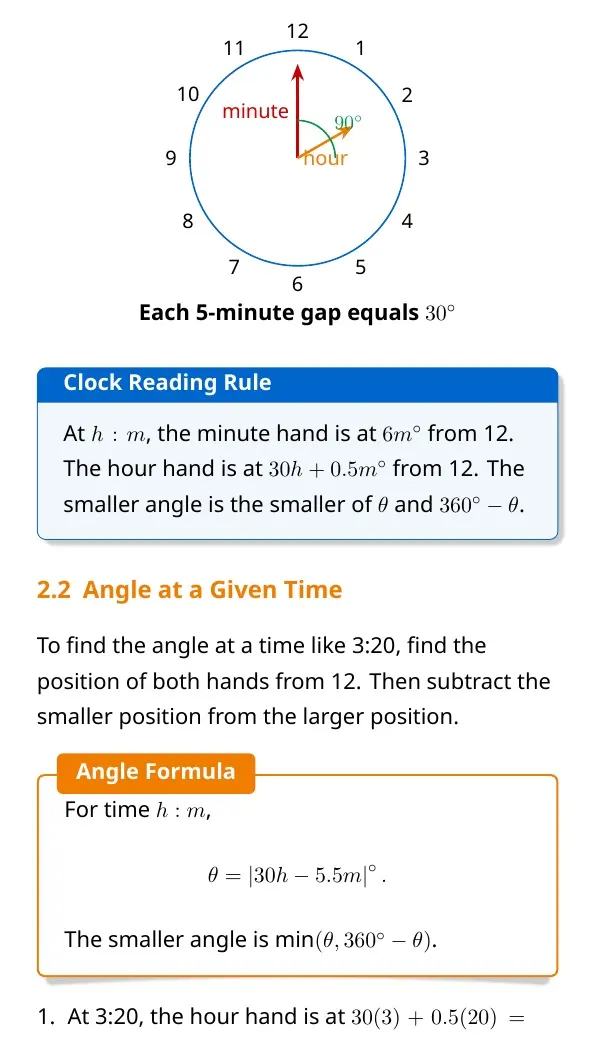
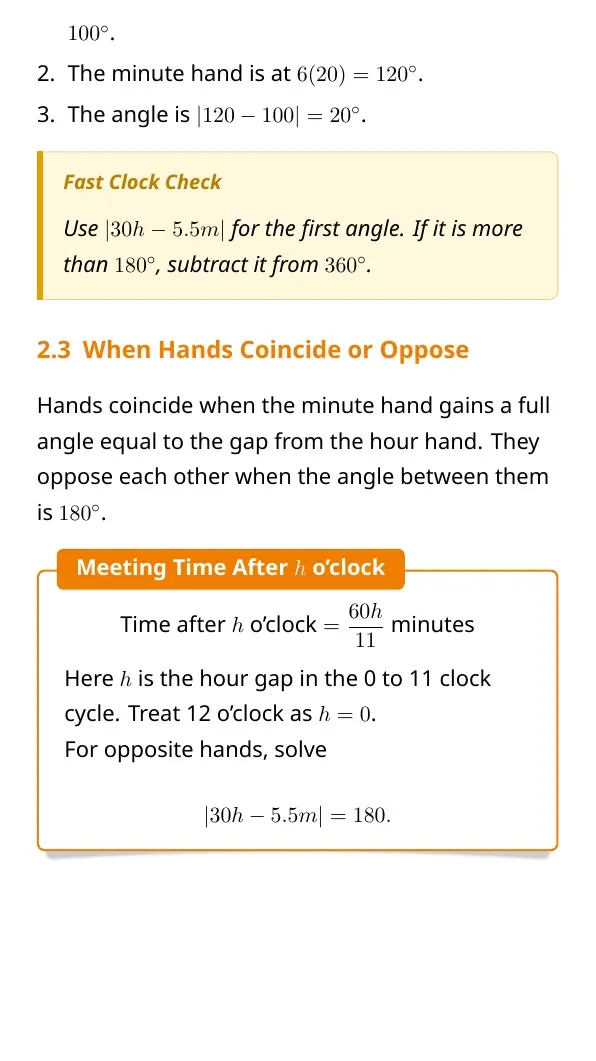
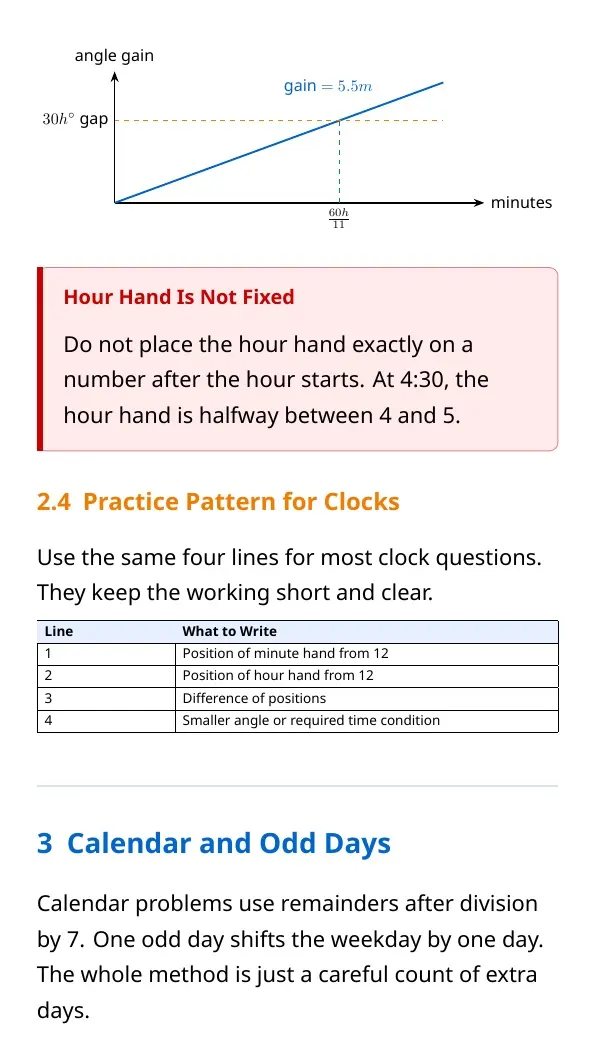
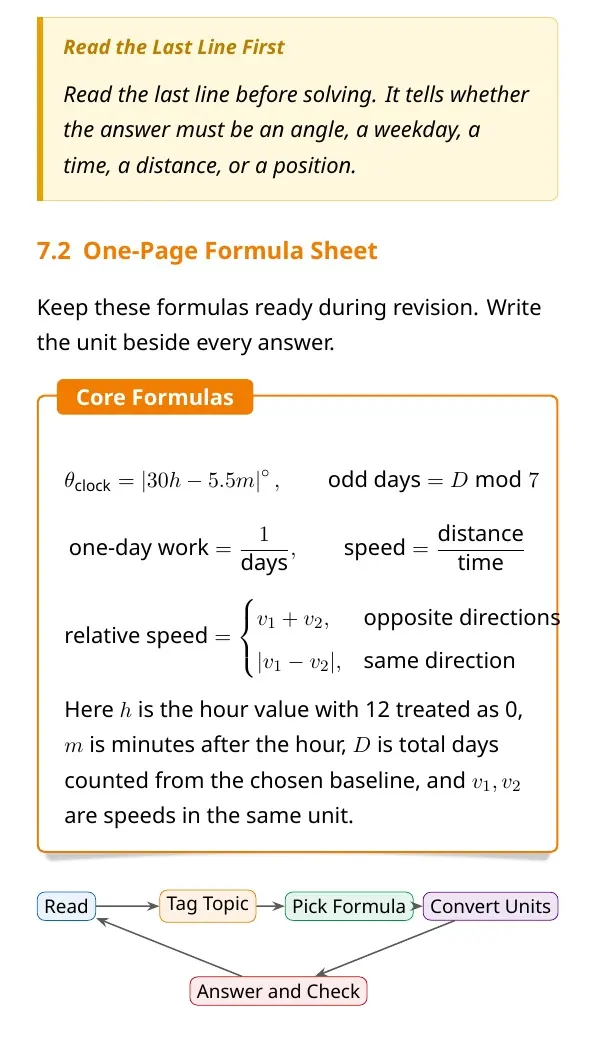
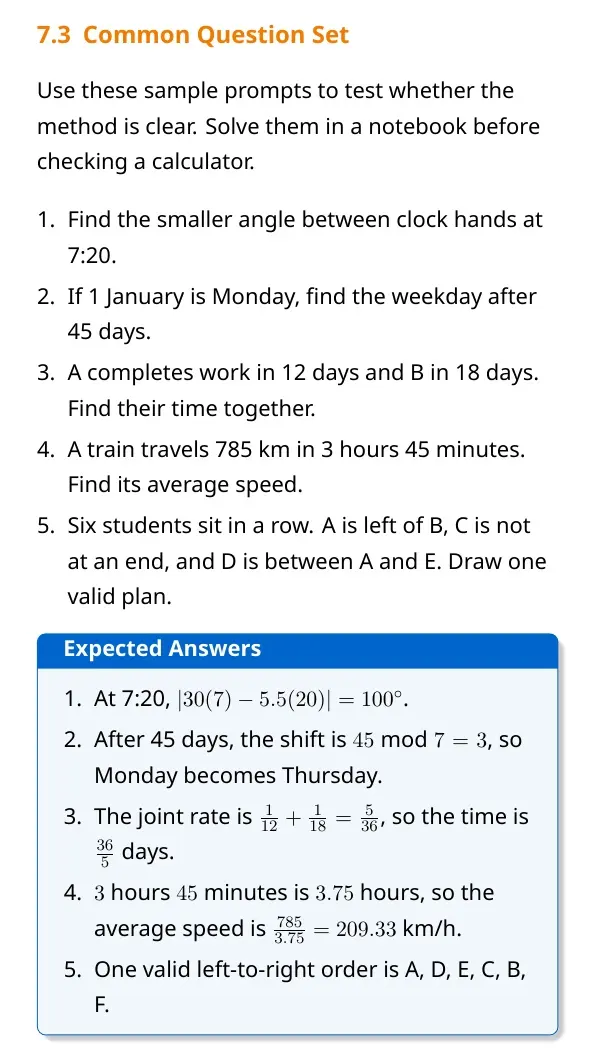
Clock questions use relative angular speed. The minute hand moves 6 degrees per minute, while the hour hand moves 0.5 degree per minute. Therefore, the minute hand gains 5.5 degrees per minute on the hour hand. For a time written as h:m, the direct angle formula is |30h - 5.5m|. If this value is more than 180 degrees, subtract it from 360 degrees to get the smaller angle.
Suppose the time is 8:20. The hour hand position is 30 x 8 + 0.5 x 20 = 250 degrees from 12. The minute hand position is 6 x 20 = 120 degrees from 12. The difference is 130 degrees, so the smaller angle is 130 degrees. The same result comes from |30 x 8 - 5.5 x 20| = |240 - 110| = 130 degrees.
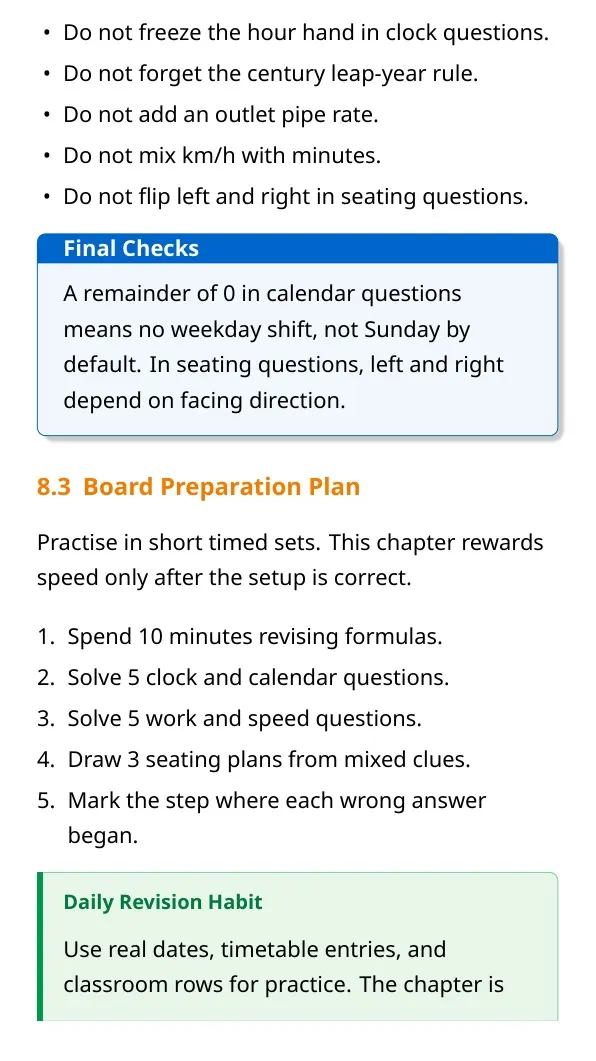
- Right angle questions: set the required difference equal to 90 degrees.
- Straight angle questions: set the required difference equal to 180 degrees.
- Overlap questions: set the relative gain to a multiple of 360 degrees.
Common check: if an answer says the hands overlap more than once inside one hour, it is wrong. The hands overlap once a little after every hour, except the 11-to-12 interval where the cycle closes at 12:00.
Calendar Odd Day Method for Dates and Weekdays
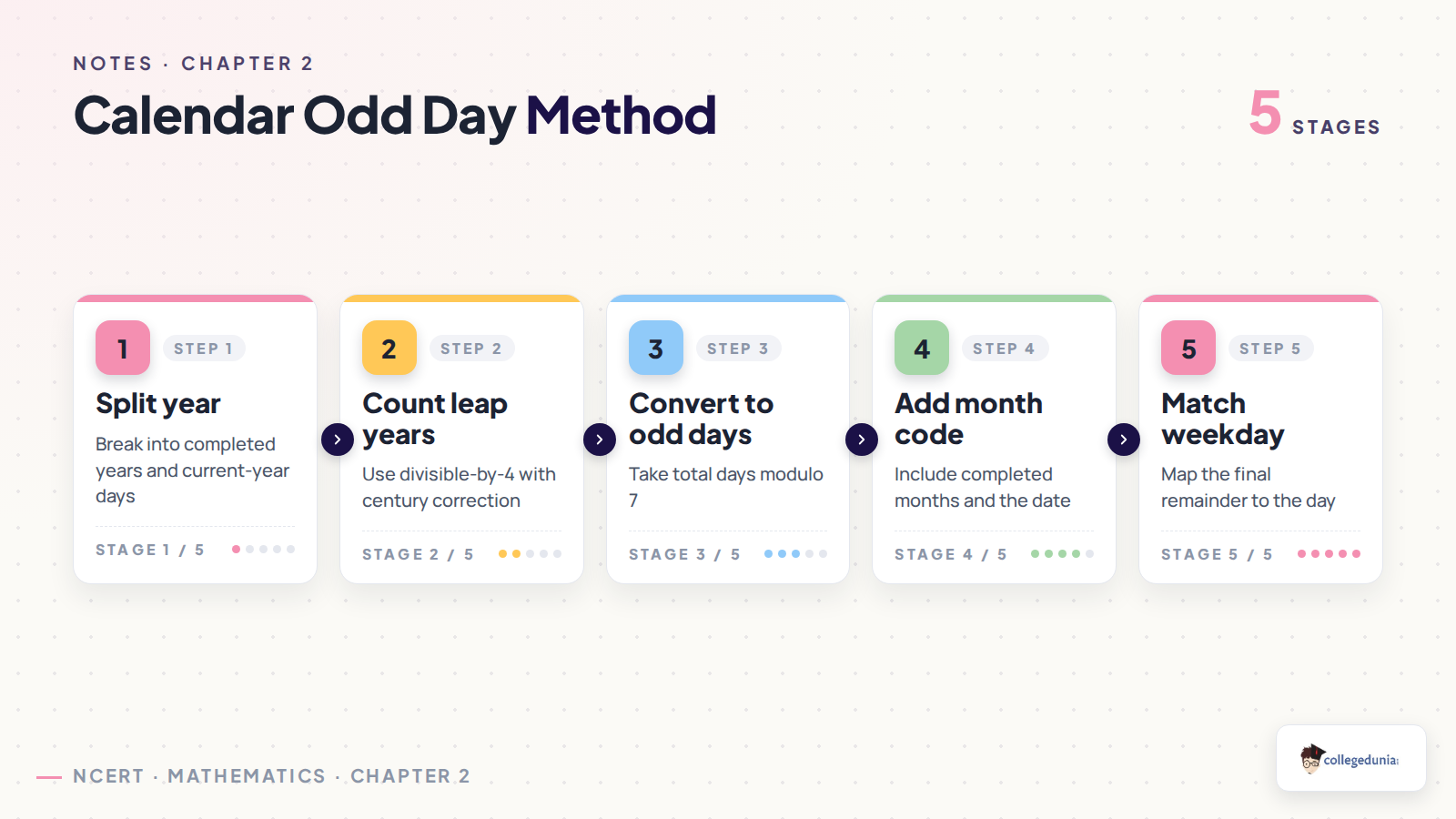
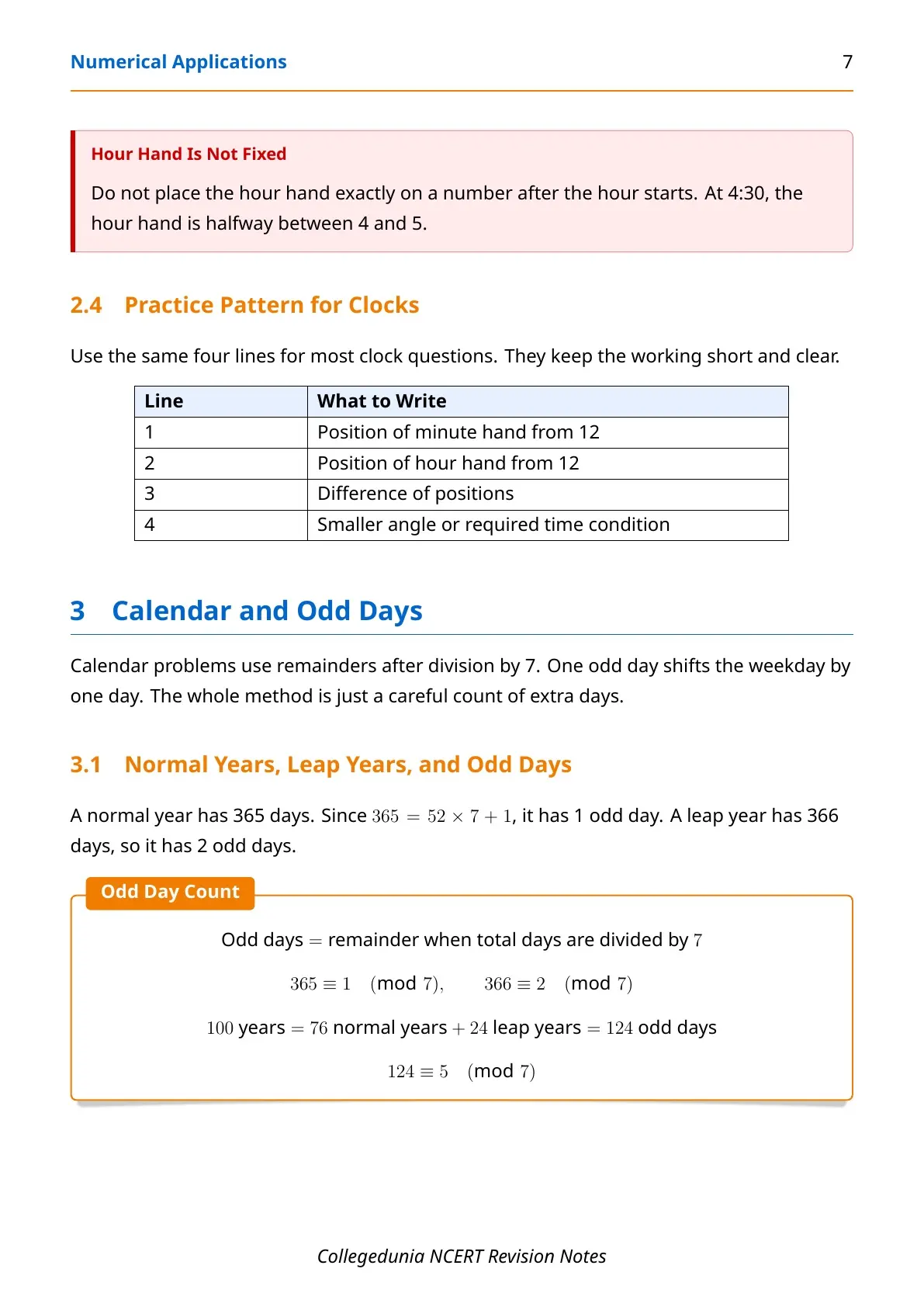
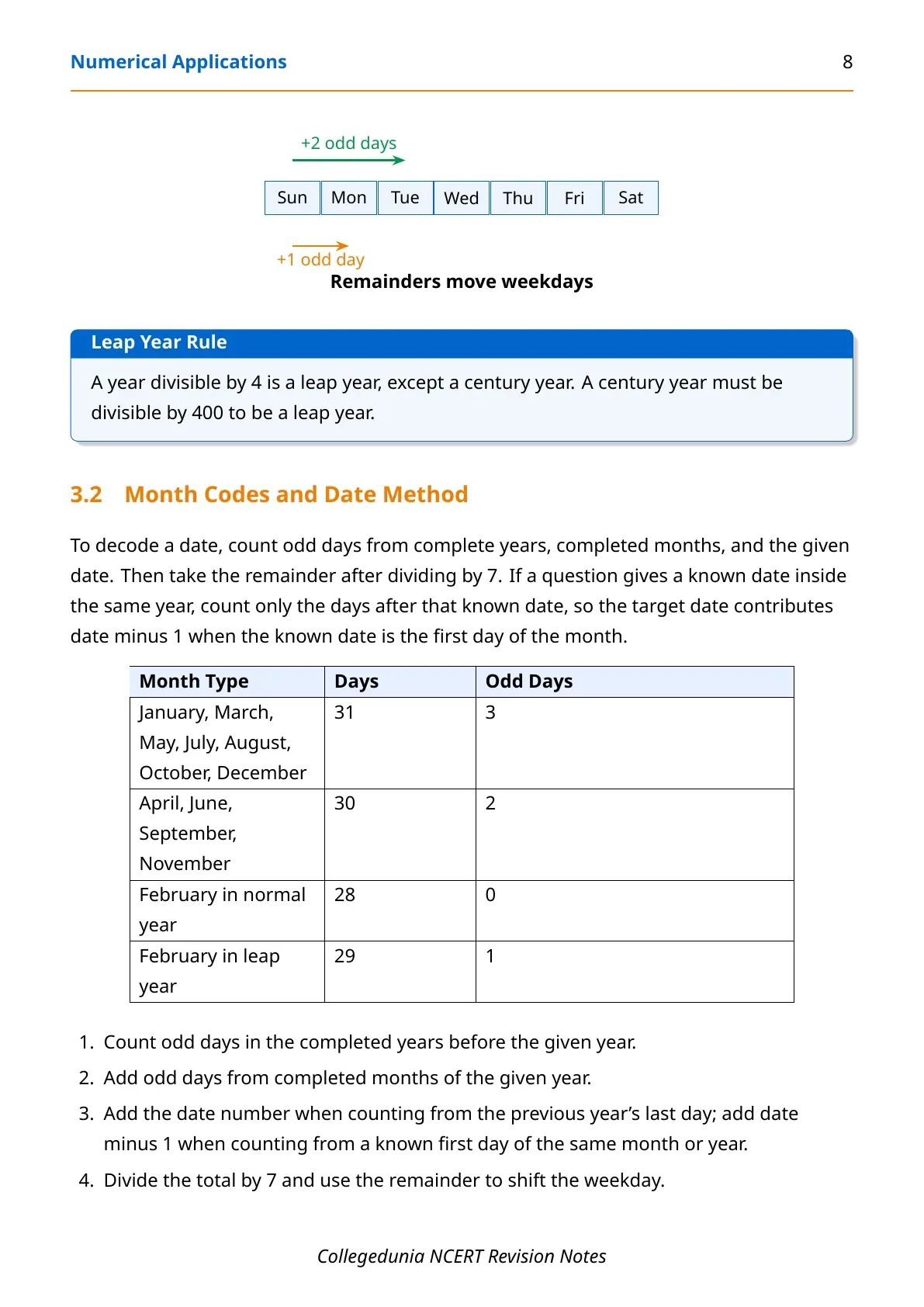
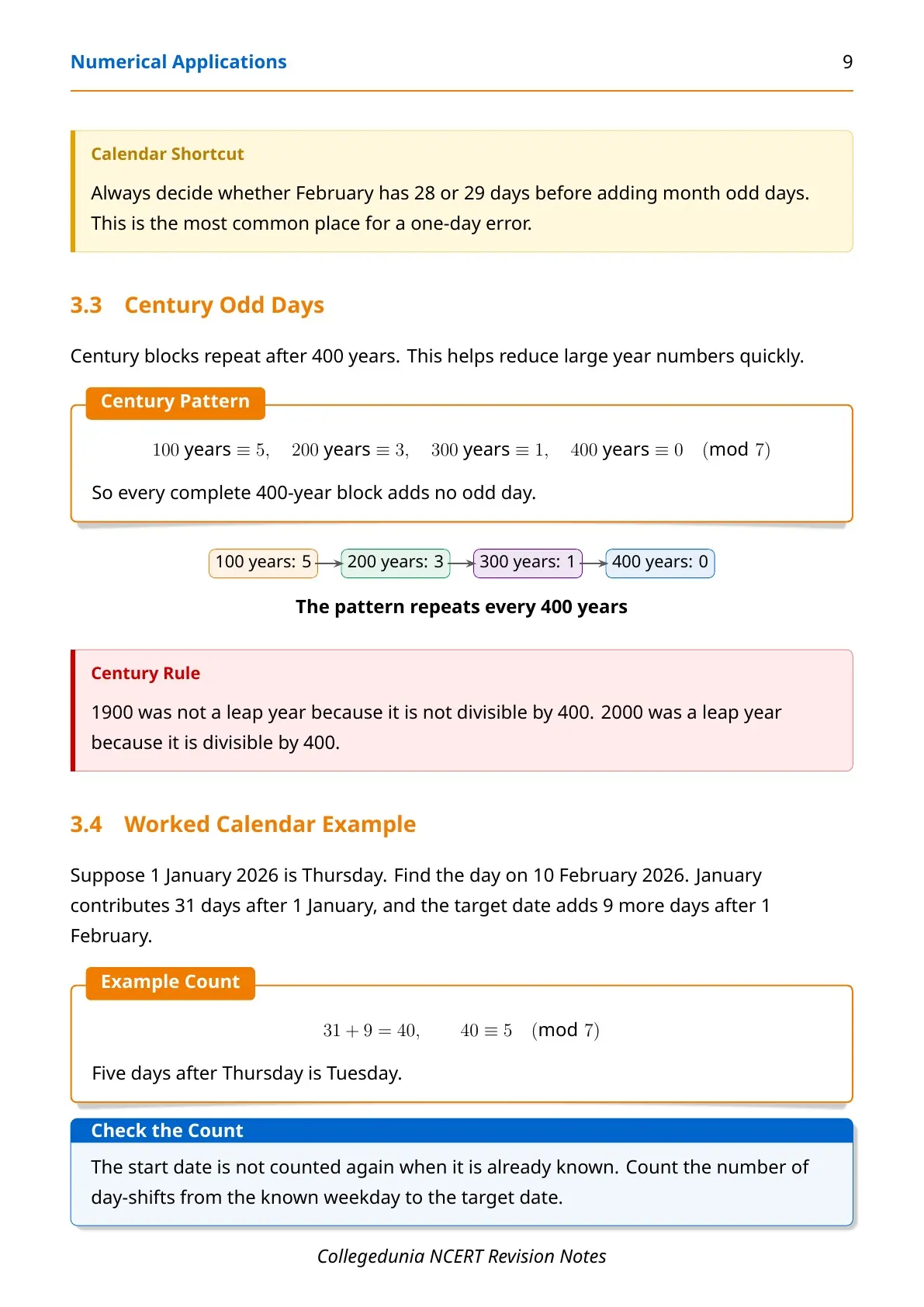
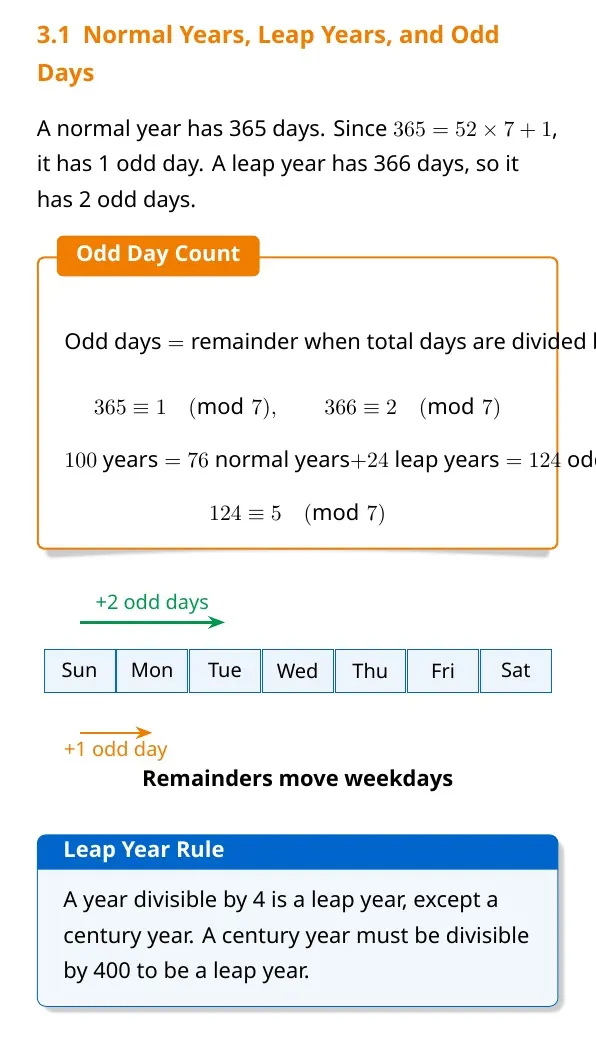
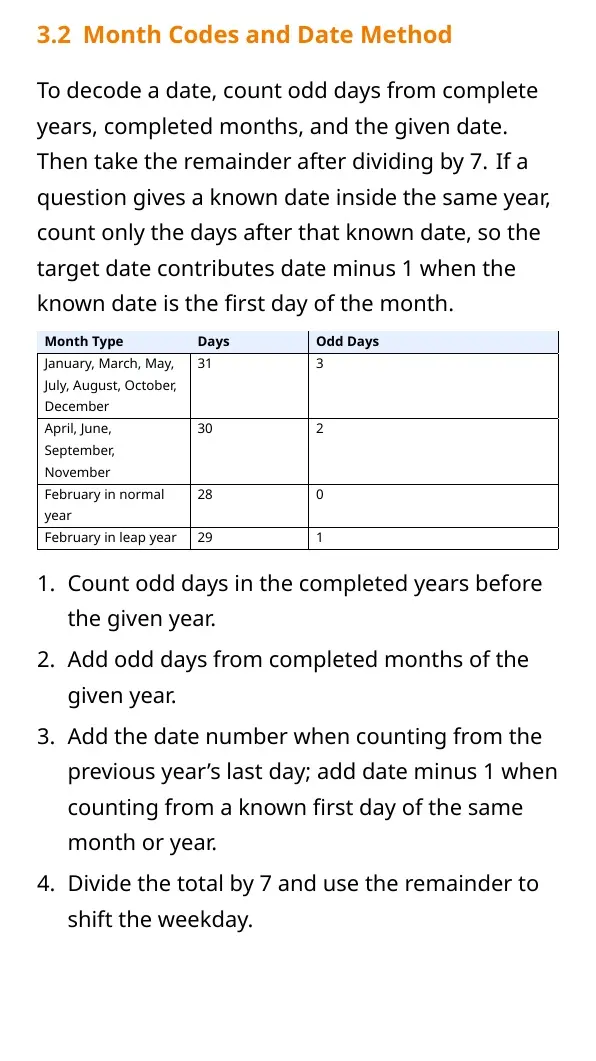
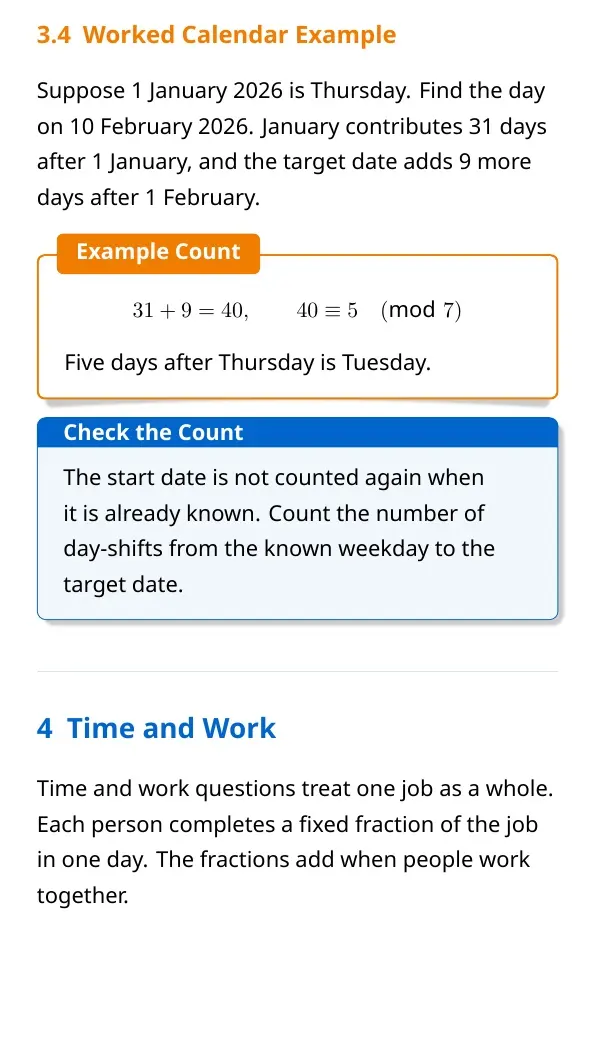
Calendar problems are built on odd days, which means the remainder left when a number of days is divided by 7. A normal year has 365 days, so it contributes 1 odd day. A leap year has 366 days, so it contributes 2 odd days. The weekday changes by the total odd-day count from a known reference date.
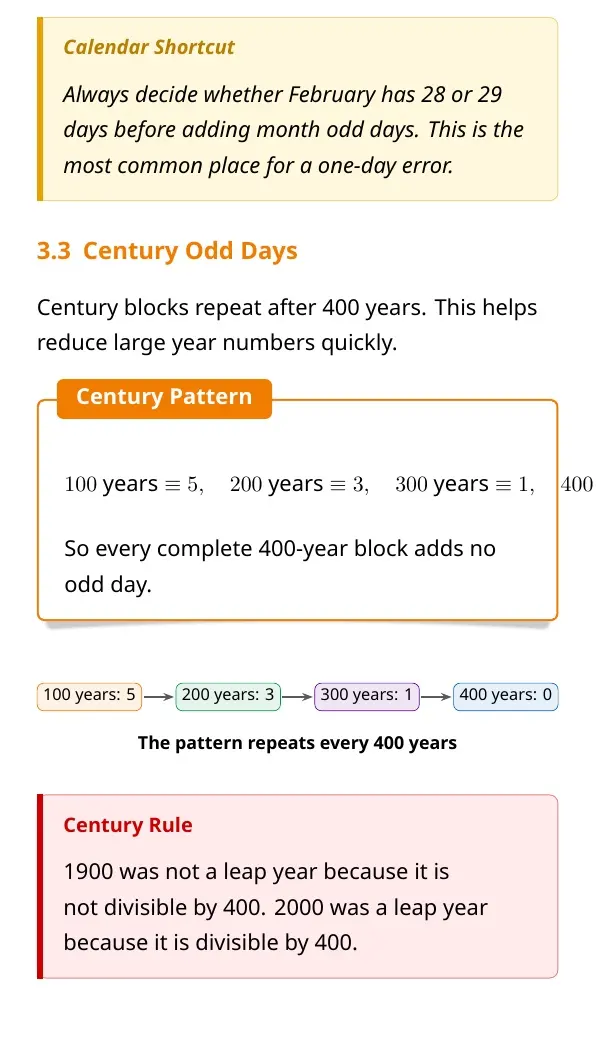
Use a fixed sequence. First count complete years. Next add leap-year adjustment. Then add days from completed months of the target year. Finally add the date and reduce the total modulo 7. The most common error is treating every year divisible by 4 as a leap year. Century years must be divisible by 400 to be leap years.
| Year type | Days | Odd days |
|---|---|---|
| Ordinary year | 365 | 1 |
| Leap year | 366 | 2 |
| 100 ordinary years | 36524 | 5 |
| 400 years | 146097 | 0 |
For fast school-level calculation, students should memorise the month-day totals up to each completed month. January contributes 31 days, February contributes 28 or 29, March contributes 31, and so on. After the total is reduced modulo 7, map the remainder to the reference weekday used in the question.
Time and Work Notes for Numerical Applications
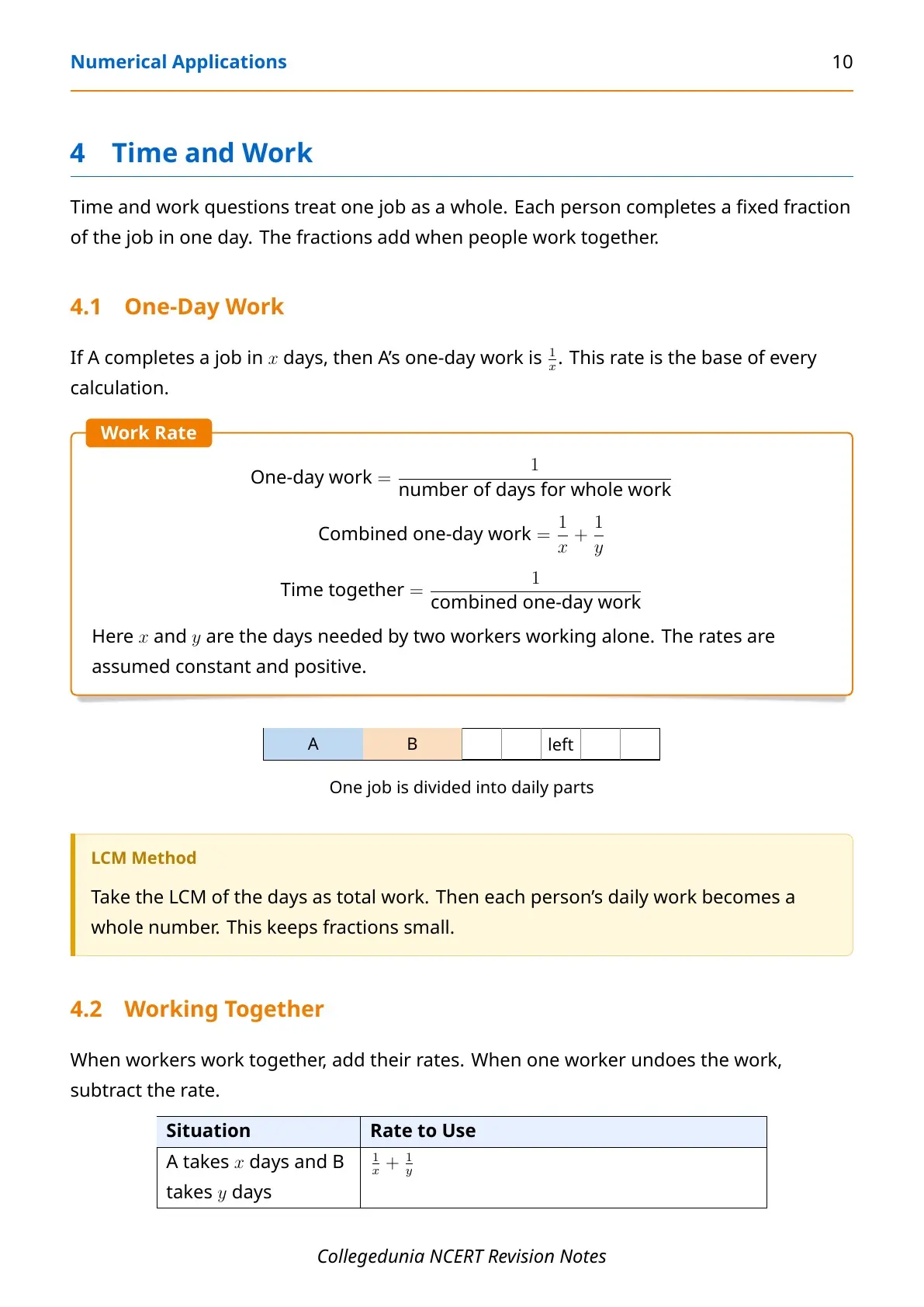
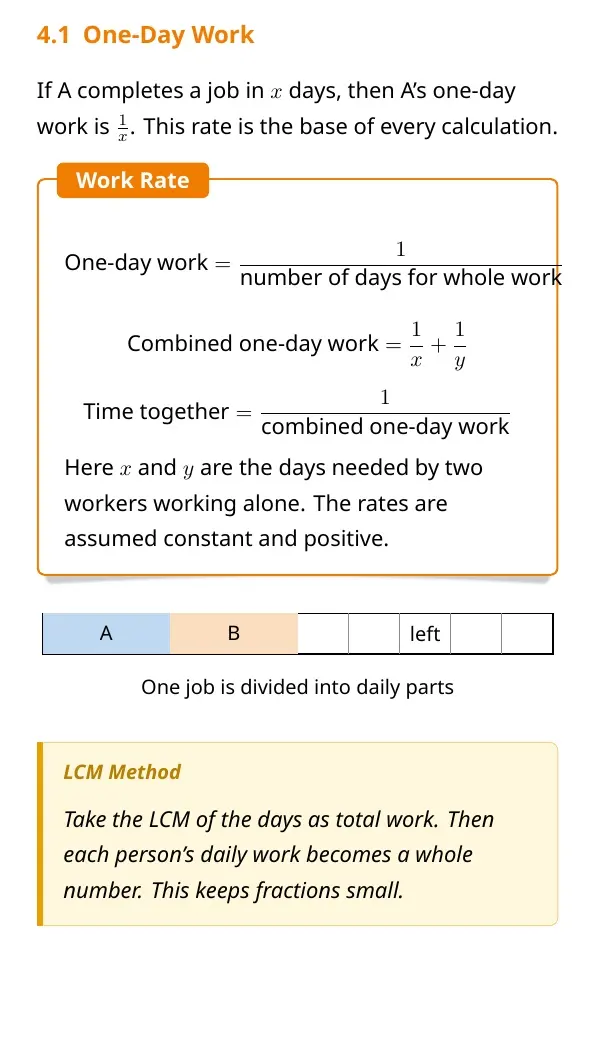
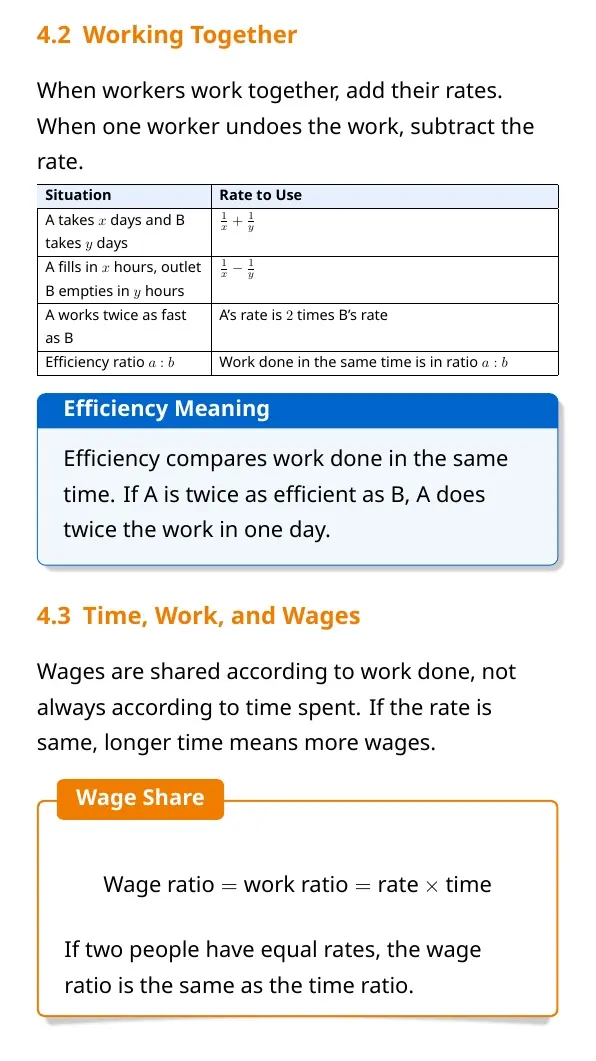
Time and work questions become simple when the job is treated as one full unit. If A completes a job in 12 days, A's rate is 1/12 job per day. If B completes it in 18 days, B's rate is 1/18 job per day. Together they complete 1/12 + 1/18 = 5/36 job per day, so the time required is 36/5 days.
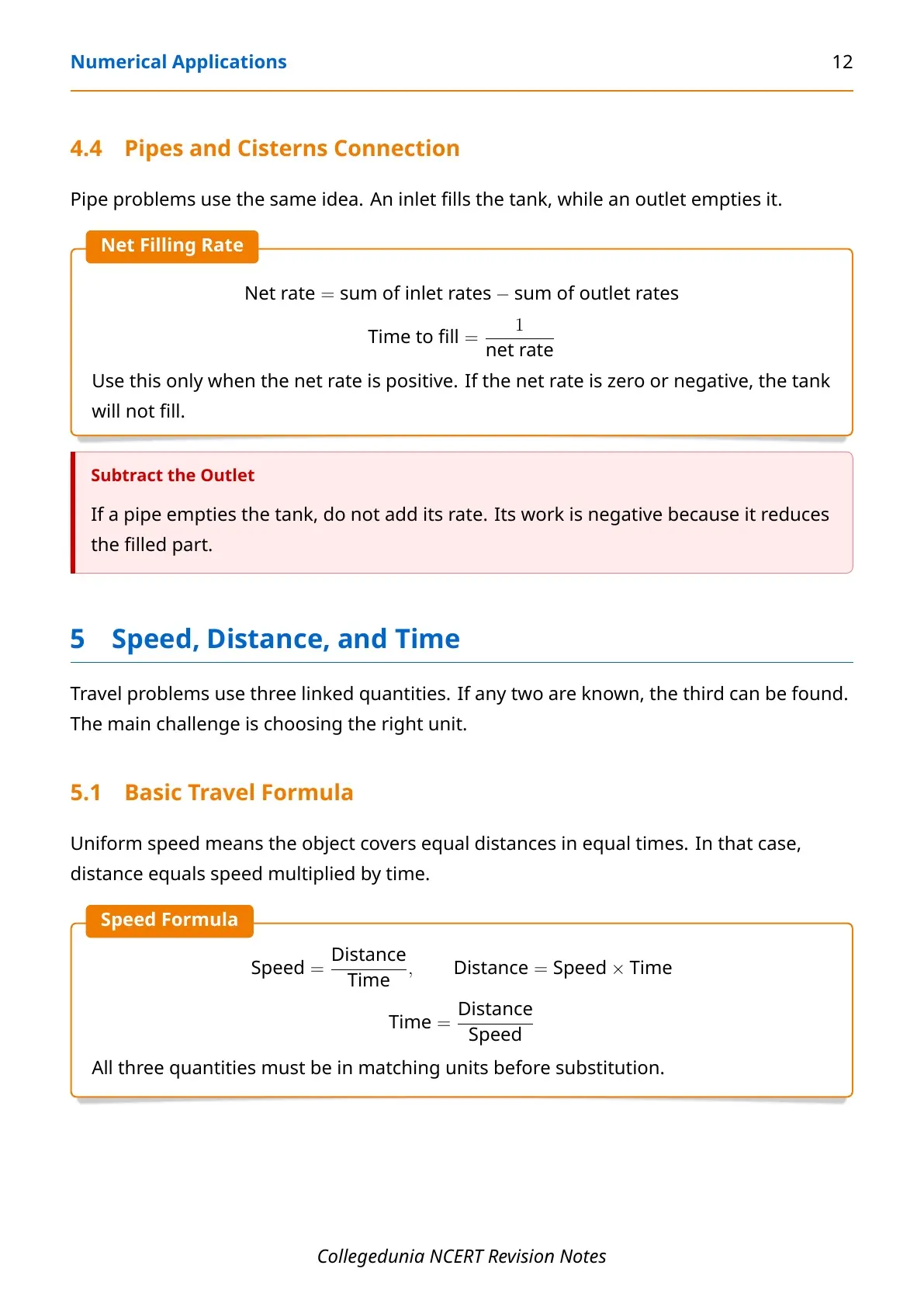
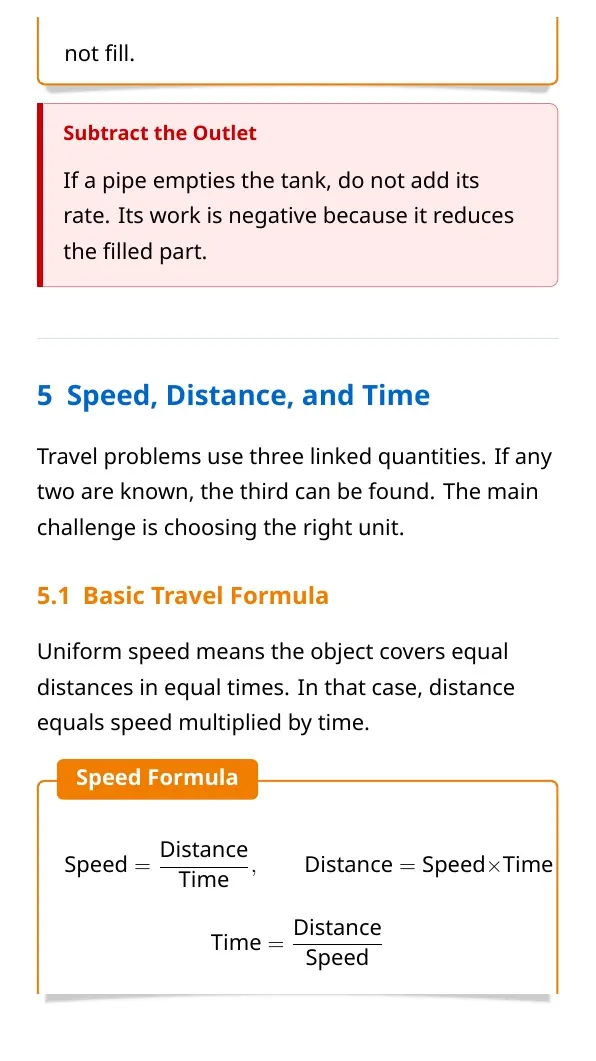
For pipe and tank questions, inlet pipes have positive rates and outlet pipes have negative rates. If a pipe fills a tank in 10 hours, its rate is 1/10 tank per hour. If another pipe empties it in 15 hours, its rate is -1/15 tank per hour. The net rate is 1/30 tank per hour, so the tank fills in 30 hours.
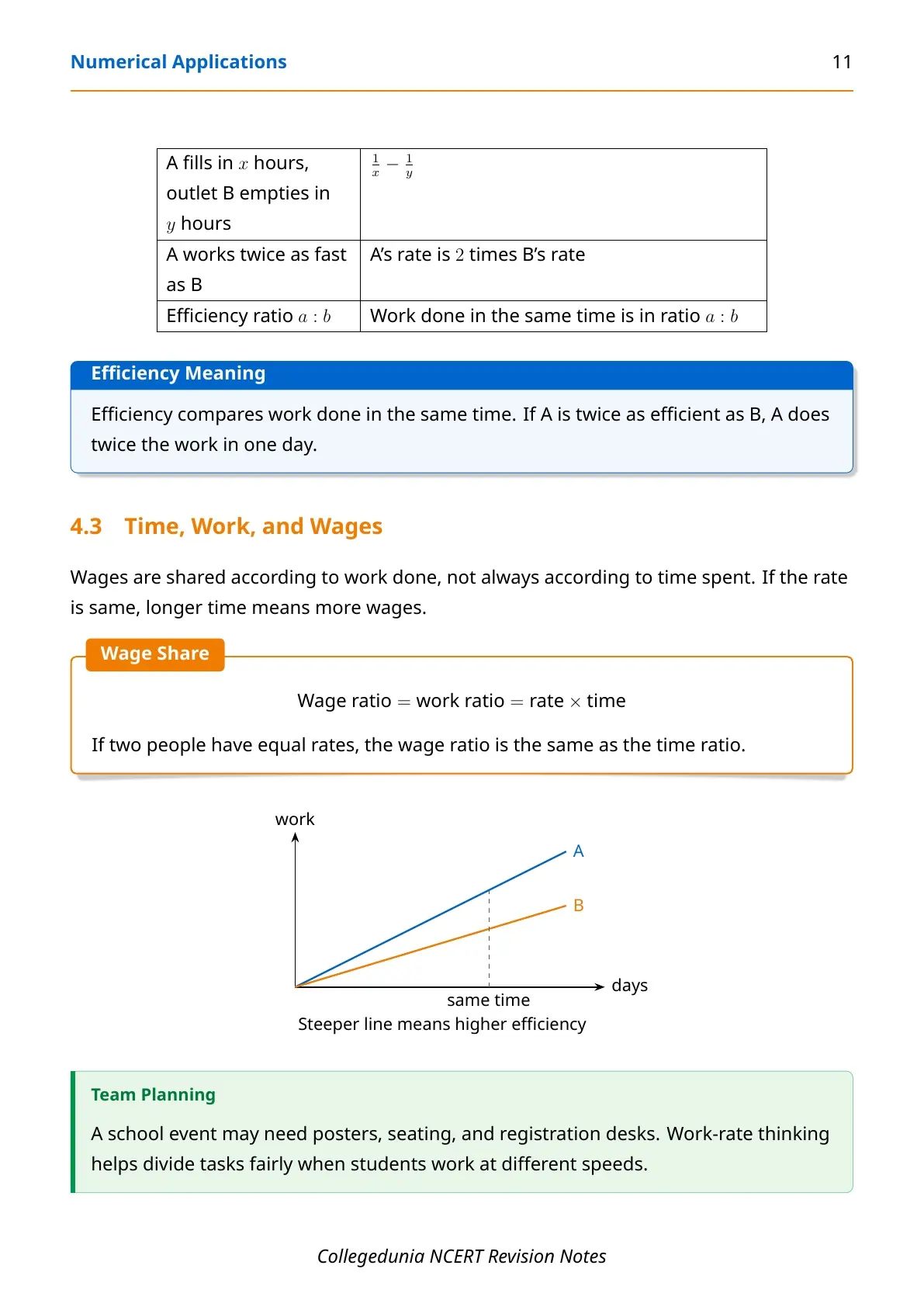
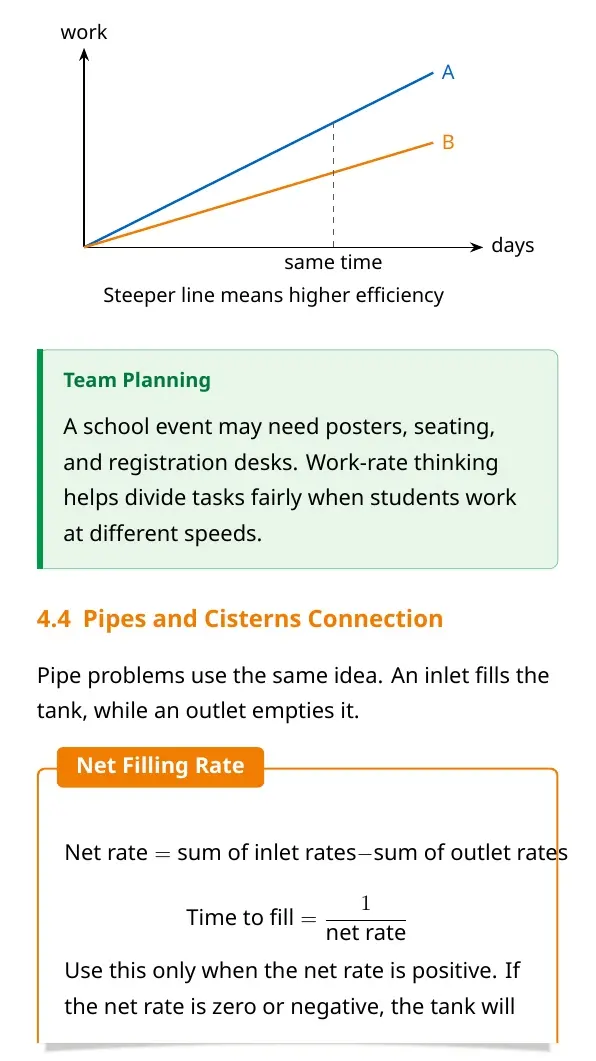
- Efficiency form: if two workers take times in the ratio 3:5, their efficiencies are in the ratio 5:3.
- LCM method: take total work as the LCM of individual times to avoid fractions.
- Partial work: multiply rate by time and subtract from the total work left.
Speed Distance and Time Applications
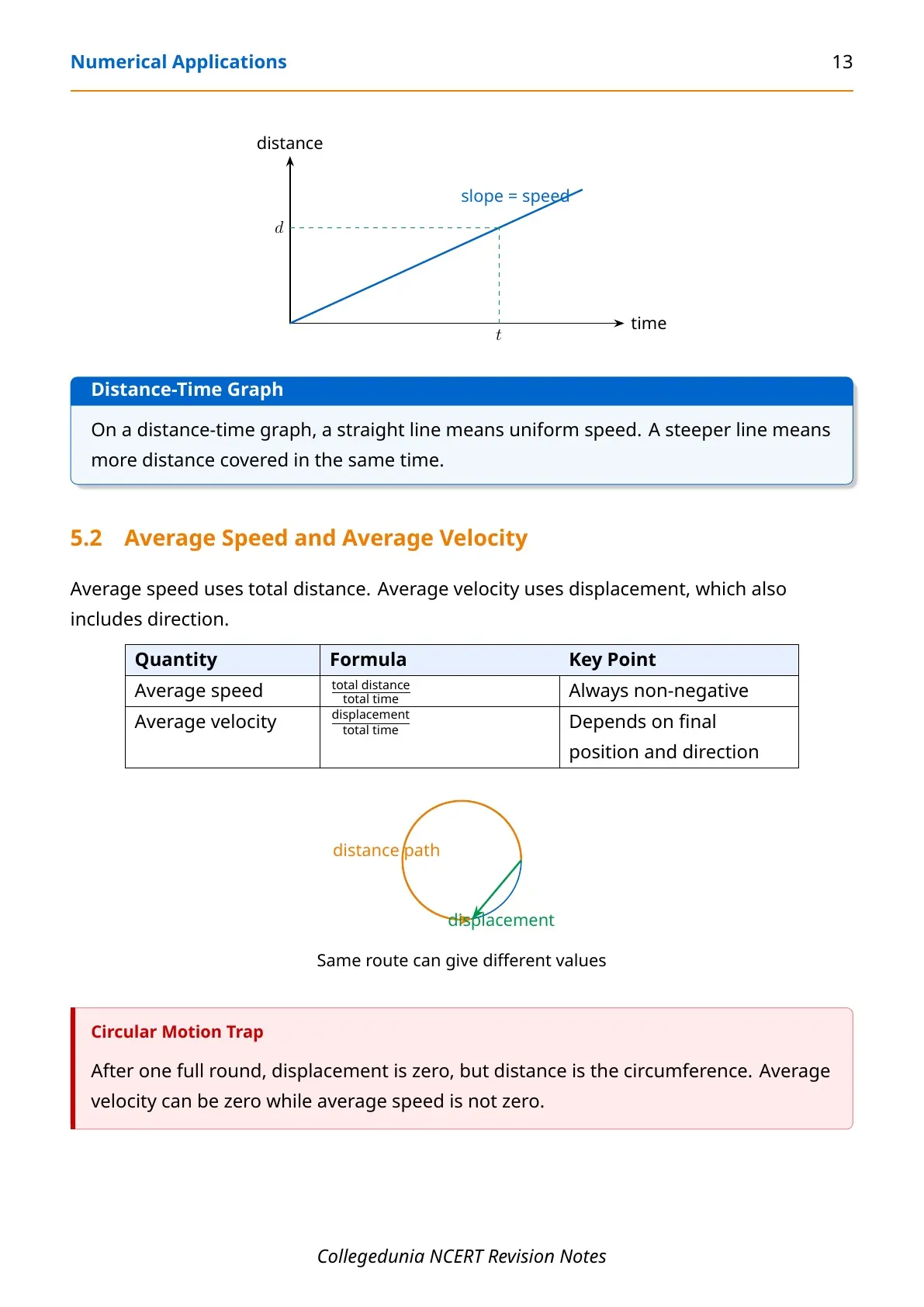
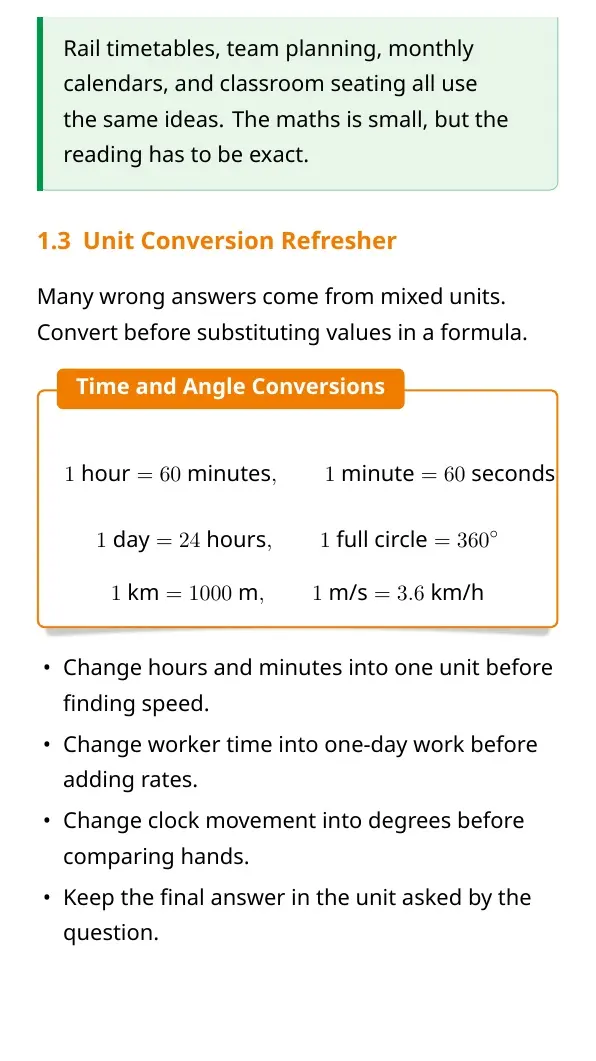
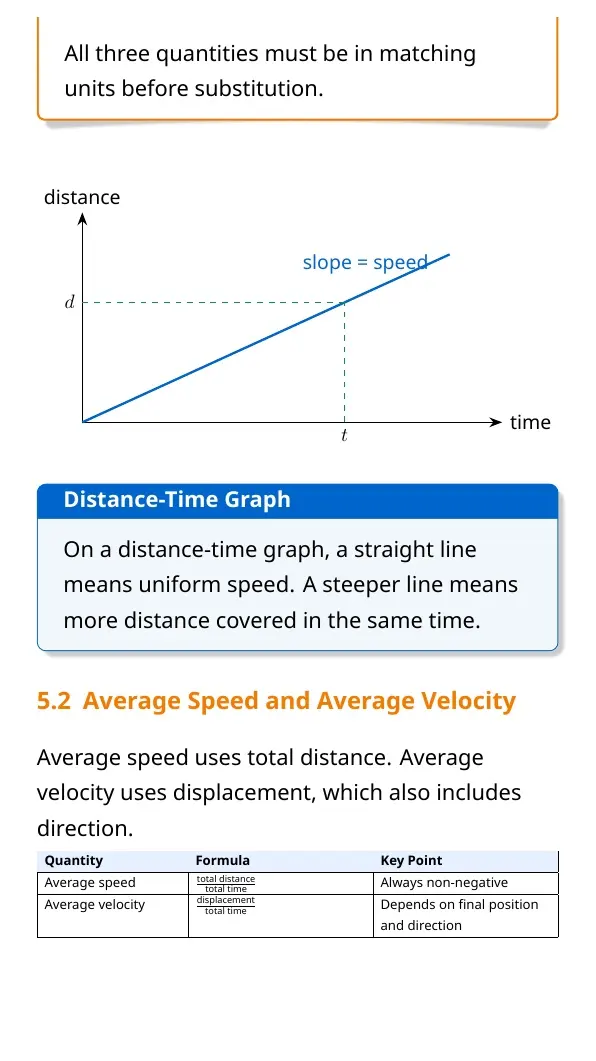
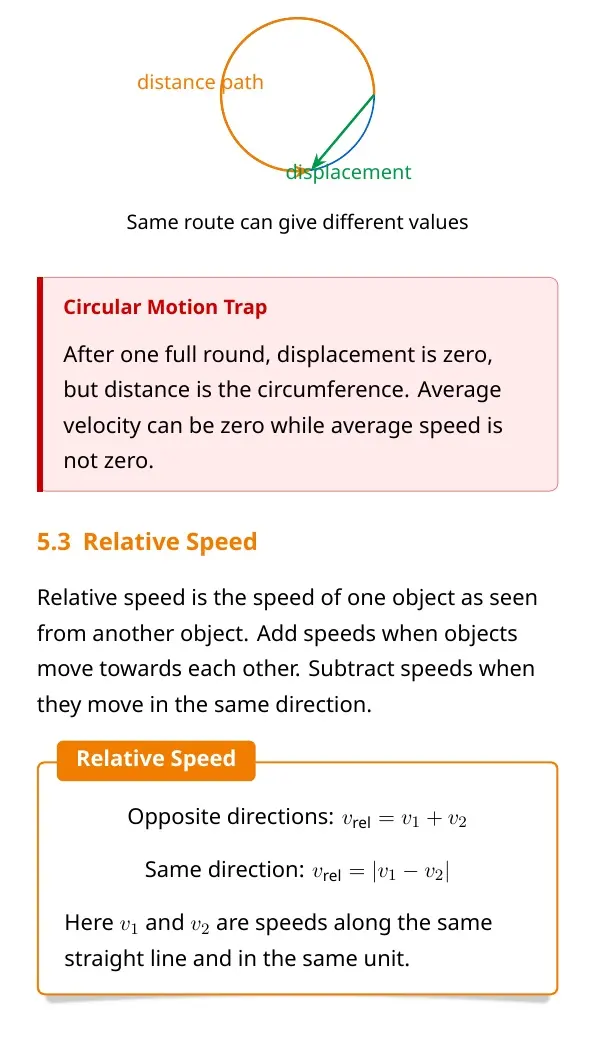
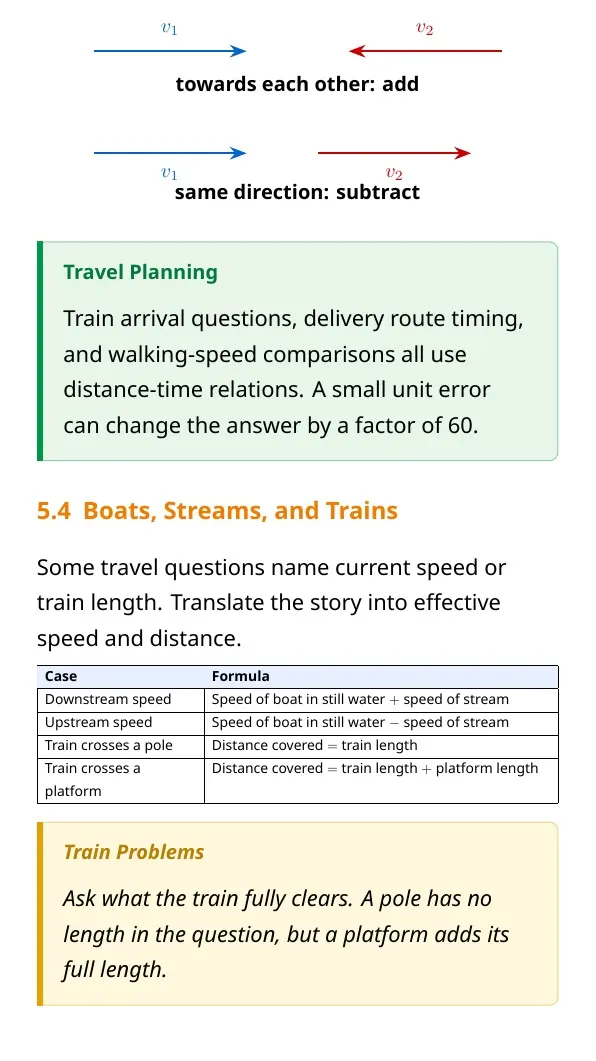
The speed-distance-time part uses the same base formula in different wrappers: distance = speed x time. Convert all units first. To convert km/h to m/s, multiply by 5/18. To convert m/s to km/h, multiply by 18/5. In train questions, the distance covered while crossing a pole is the length of the train, while the distance covered while crossing a platform is train length plus platform length.
Average speed is not always the arithmetic mean of two speeds. If the same distance is covered at speeds a and b, the average speed is 2ab/(a+b). If the same time is spent at two speeds, the average speed is the arithmetic mean. The condition decides the formula, so students should underline whether equal distance or equal time is mentioned.
| Question type | Setup | Useful check |
|---|---|---|
| Train crossing a pole | Distance = train length | Time should rise with train length |
| Train crossing platform | Distance = train + platform | Distance is longer than pole case |
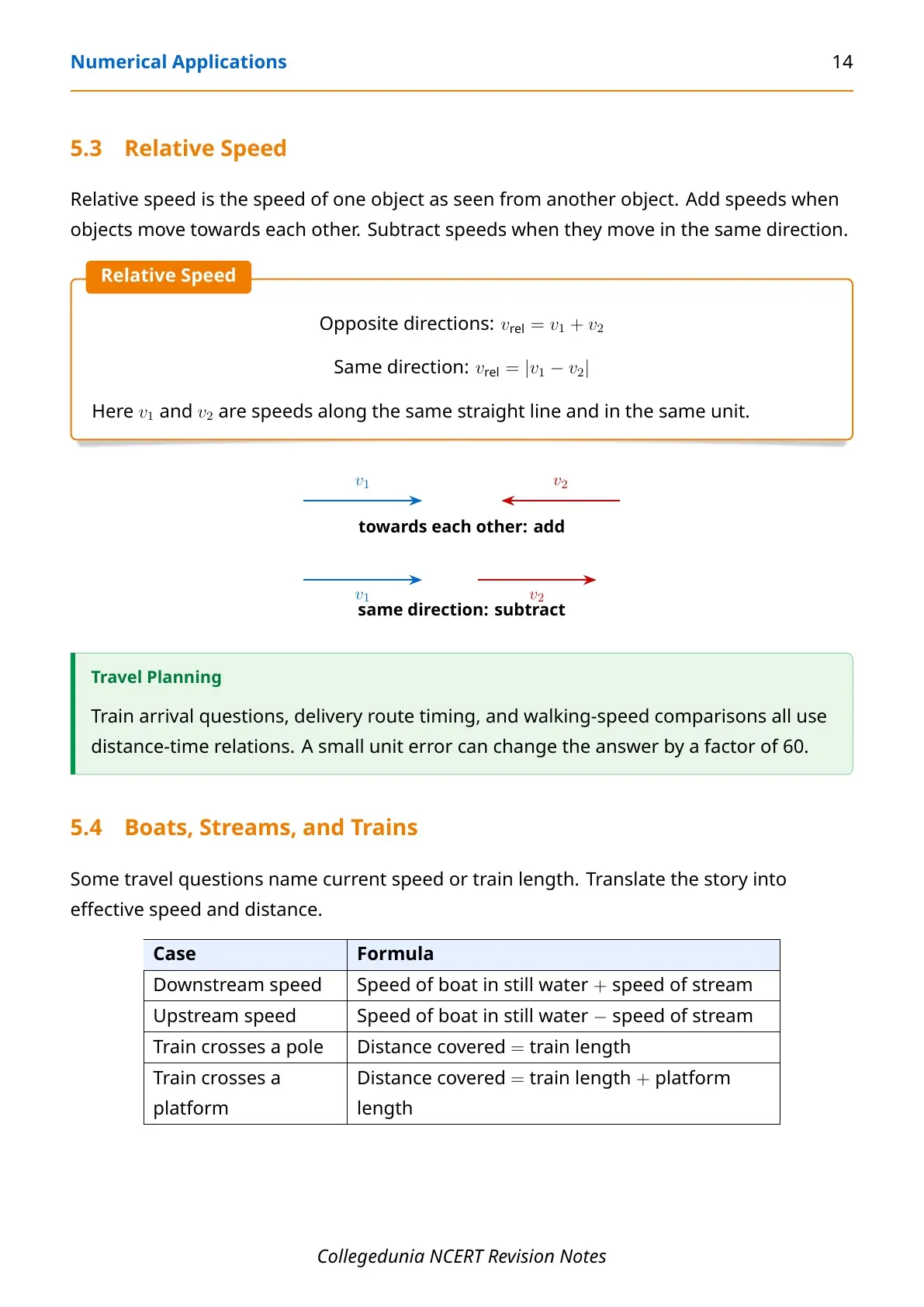
| Relative speed same direction | Subtract speeds | Overtake time is usually larger |
| Relative speed opposite direction | Add speeds | Crossing time is usually smaller |
Seating Arrangement and Position Questions
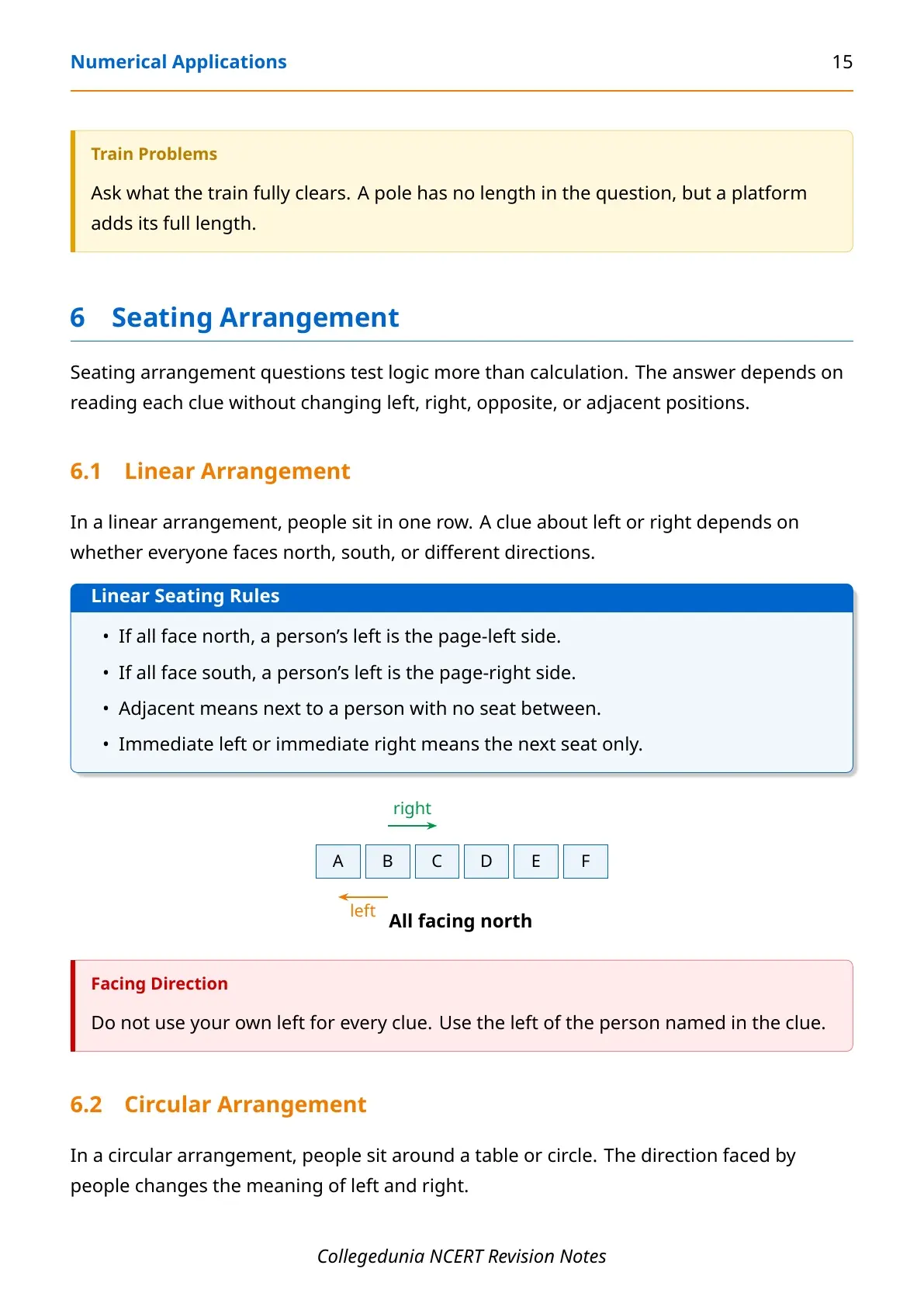
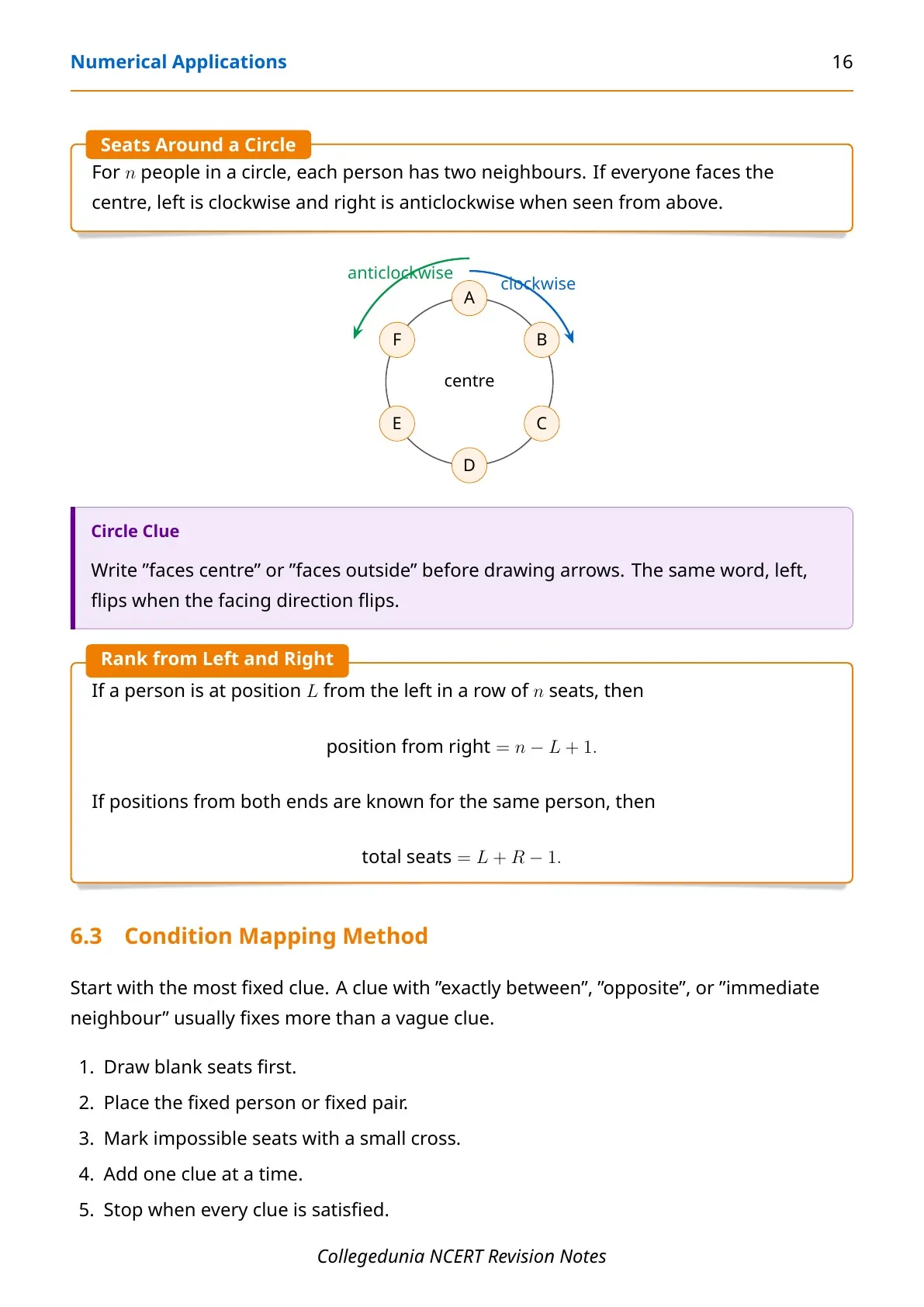
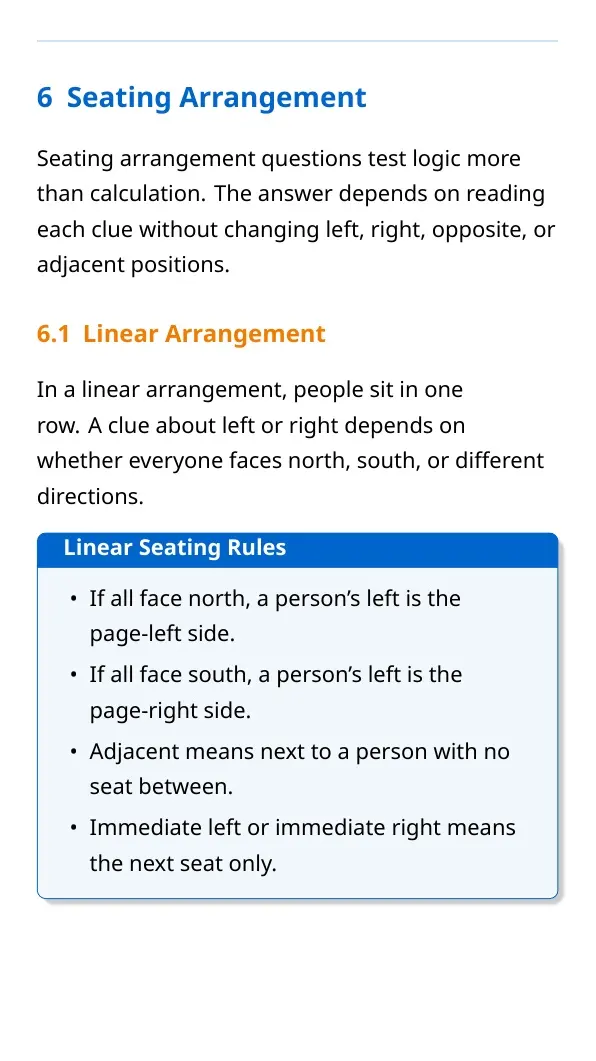
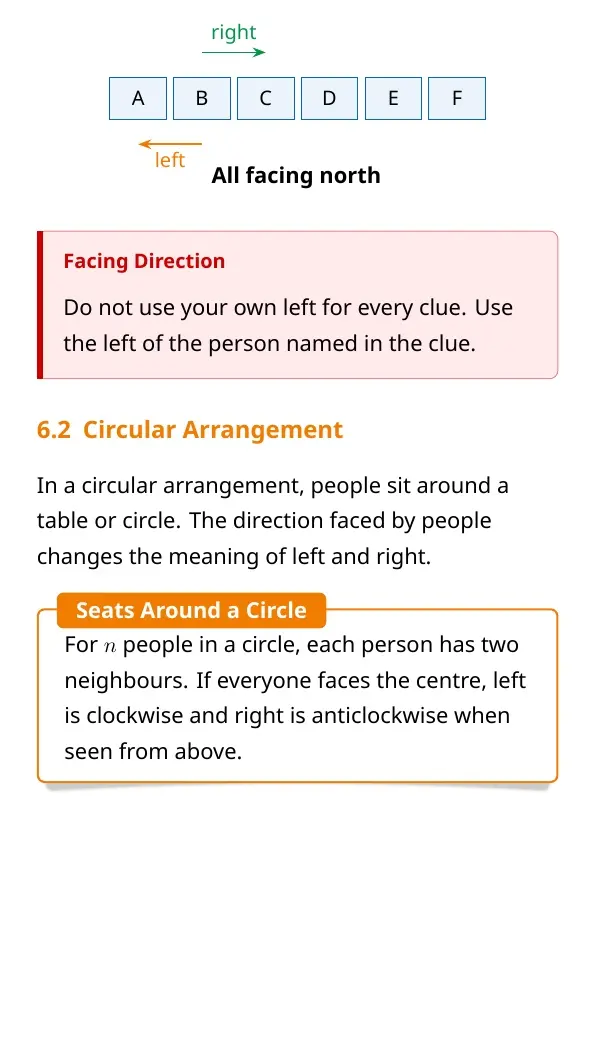
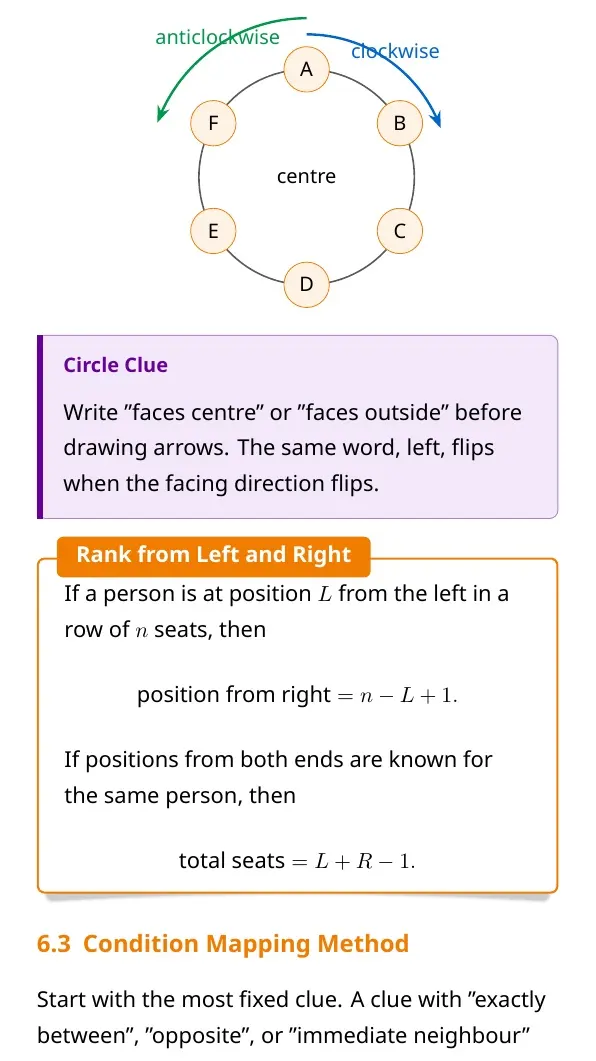
Seating arrangement problems test order, direction and relative placement. In a row, first identify whether everyone faces north, south or mixed directions. If all face north, left and right are read normally from the page. If all face south, left and right reverse. In a circular table, fix one person at the top to remove rotational ambiguity, then place the strongest condition first.
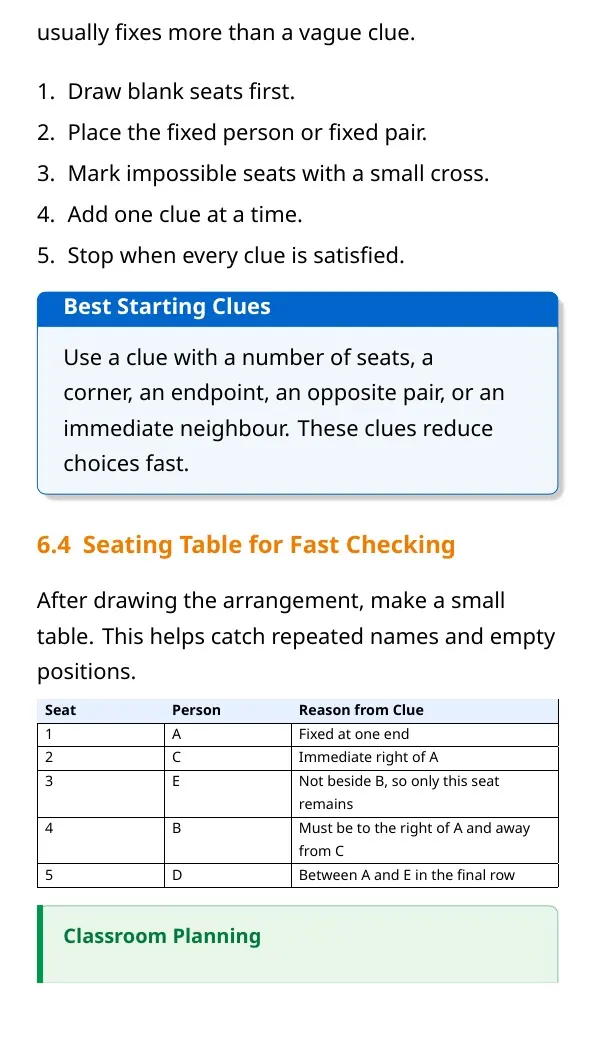
Position questions often use total-count logic. If a student's rank is r from the left and s from the right in a row, the total number of students is r + s - 1. If two positions are given with people between them, draw numbered slots and mark the gaps before calculating. This prevents double-counting the person whose position is measured from both ends.
- Linear row: draw slots from left to right and mark direction first.
- Circular row: fix one person, then move clockwise or anticlockwise consistently.
- Ranking: include the common person once, not twice.
How to Use These Class 11 Applied Mathematics Notes
Use the PDF notes as a two-pass revision tool. In the first pass, read the method boxes and copy the formula sheet on one page. In the second pass, solve the worked examples without looking at the next line. The chapter improves quickly when students practise setup decisions: angle or overlap, ordinary year or leap year, individual rate or combined rate, same distance or same time, row or circle.
Before an exam, revise this order: clock formula, odd-day rules, LCM method for work, km/h to m/s conversion, relative speed cases and seating direction rules. The order moves from formula-heavy to diagram-heavy topics, which makes recall steadier during a timed paper.
Related Resources for Numerical Applications
| Resource | Use it for | Link |
|---|---|---|
| NCERT Book PDF | Official printed examples and exercise prompts | Numerical Applications Class 11 NCERT Book PDF |
| NCERT Solutions | Step-by-step answers for chapter questions | Numerical Applications Class 11 NCERT Solutions |
| Formula Sheet | One-page formula revision for applied questions | Numerical Applications Class 11 Formula Sheet |
| Handwritten Notes | Quick visual recall before school tests | Numerical Applications Class 11 Handwritten Notes |
Class 11 Applied Mathematics Notes for All Chapters
Numerical Applications Class 11 Applied Mathematics FAQs
Ques. What is covered in Class 11 Applied Mathematics Chapter 2 Numerical Applications?
Ans. It covers practical numerical topics such as clocks, calendar odd days, time and work, speed-distance-time and seating arrangement for the 2026-27 CBSE syllabus.
Ques. What is the clock angle formula used in this chapter?
Ans. For a time h:m, use |30h - 5.5m| degrees. If the answer is more than 180 degrees, subtract it from 360 degrees to get the smaller angle.
Ques. How are odd days used in calendar questions?
Ans. Odd days are remainders after dividing total days by 7. A normal year gives 1 odd day, a leap year gives 2 odd days and 400 years give 0 odd days.
Ques. How should students revise time and work questions?
Ans. Treat the full job as one unit, write each person's rate as work per day, add or subtract rates and then take the reciprocal of the net rate to get time.



Comments