



Class 11 Applied Mathematics Chapter 3 Set notes help students revise the first Algebra chapter in the 2026-27 CBSE syllabus. The chapter builds the language needed for relations, functions, probability and data work: well-defined collections, roster form, set-builder form, subsets, intervals, Venn diagrams and counting formulas.
Student Feedback: More than 10,000 students use Collegedunia NCERT notes for short revision before class tests and school examinations. Students usually prefer Set as a compact chapter because clear notation and two or three counting rules solve most questions.
- Best for fast revision: definitions, symbols, subset rules, intervals and Venn formulas are kept in one place.
- Aligned to 2026-27: follows the CBSE Applied Mathematics Unit 2 scope for Sets in Class 11.
- Exam focused: examples show how to avoid double-counting and how to read set-builder notation correctly.
|
Table of Contents |
What Set Covers in Class 11 Applied Mathematics
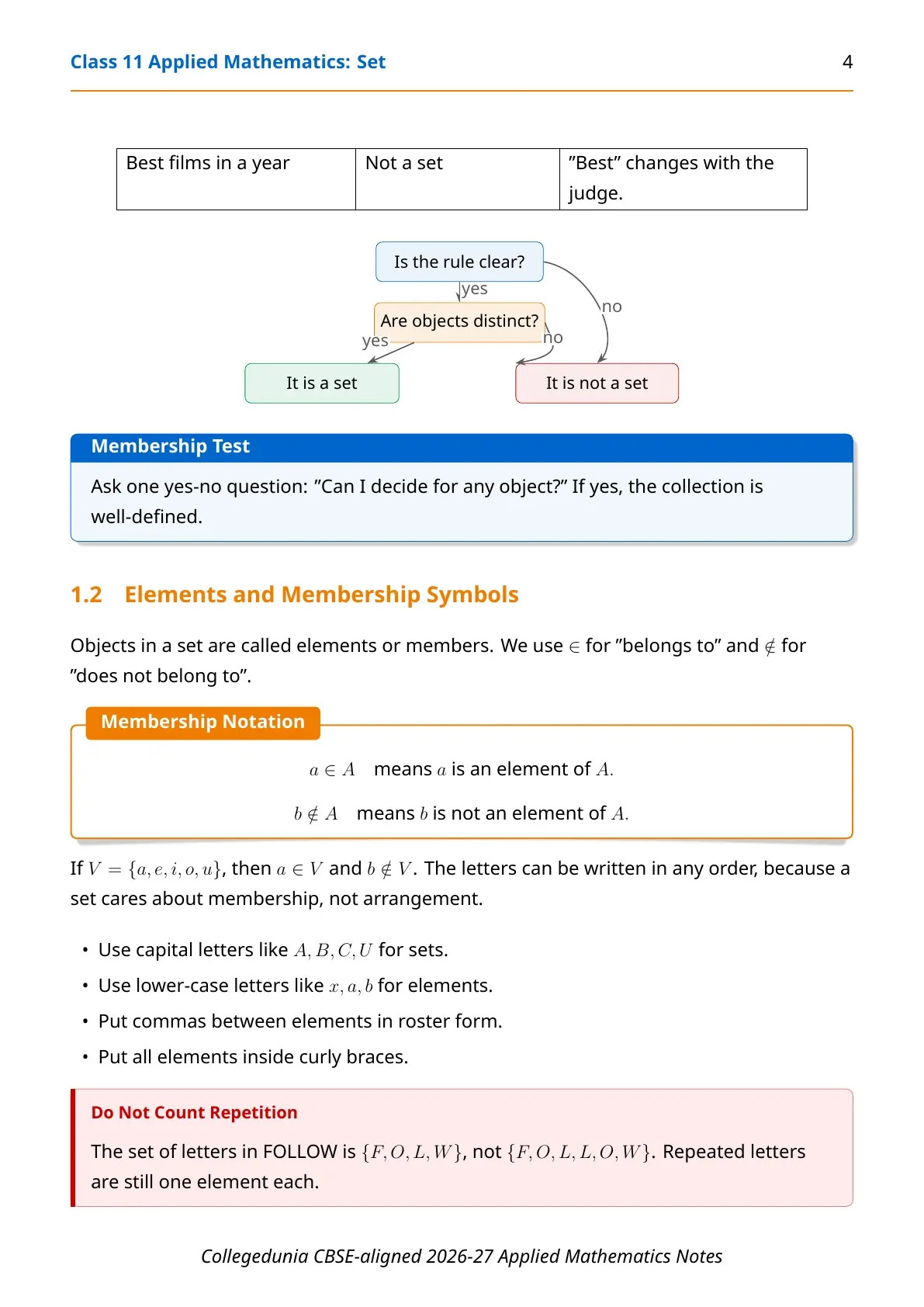
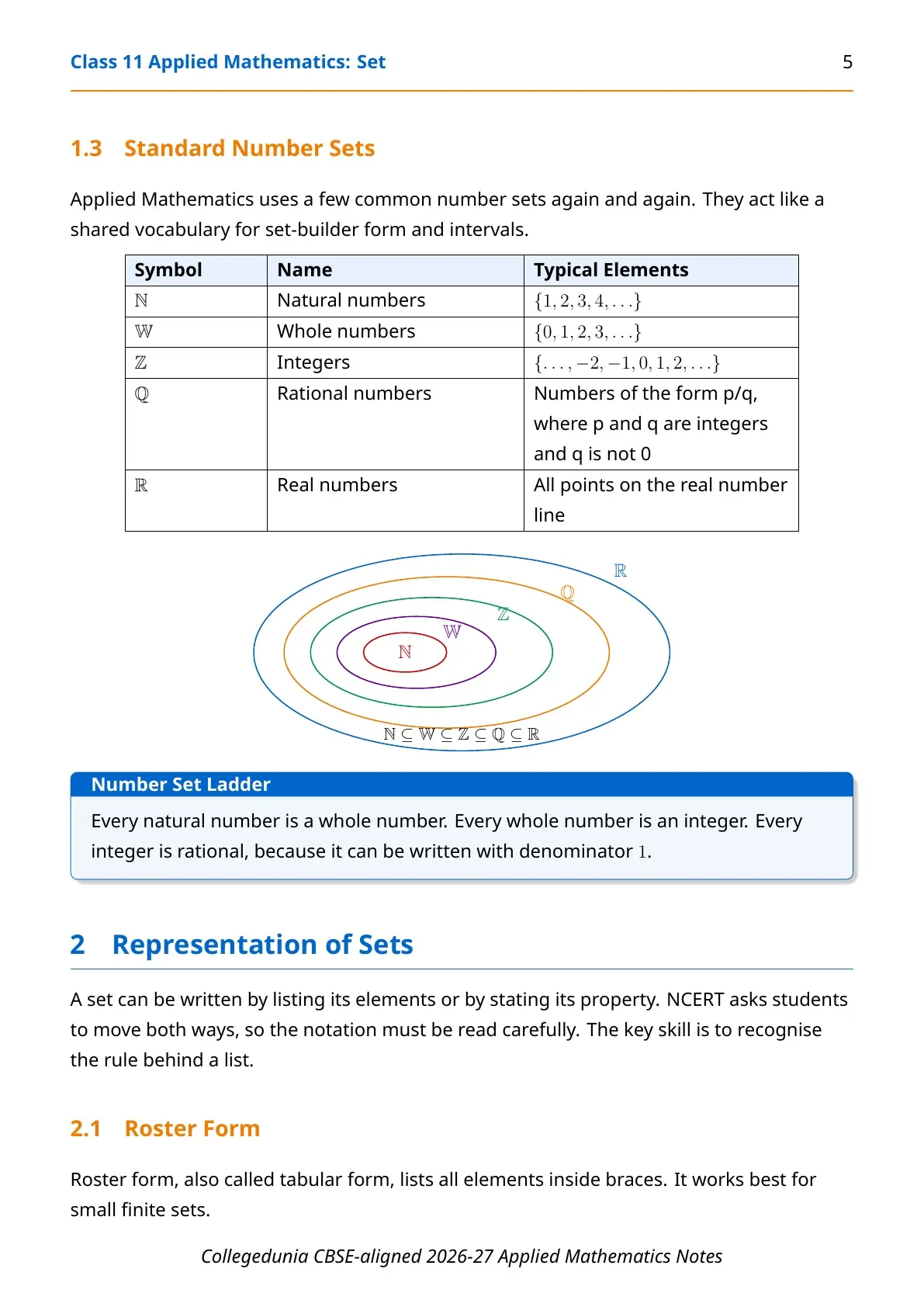
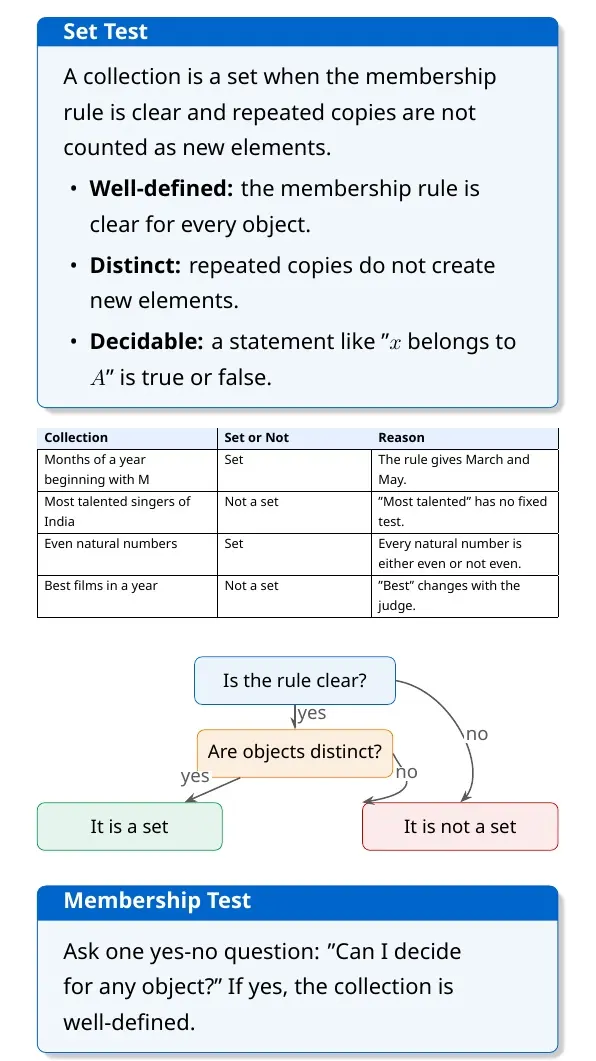
Set introduces the mathematical language used to group objects clearly. In Applied Mathematics, a set is useful because it lets students describe survey groups, number categories, intervals of real numbers and outcomes in probability. A set must be well defined, which means there is no confusion about whether an object belongs to it or not.
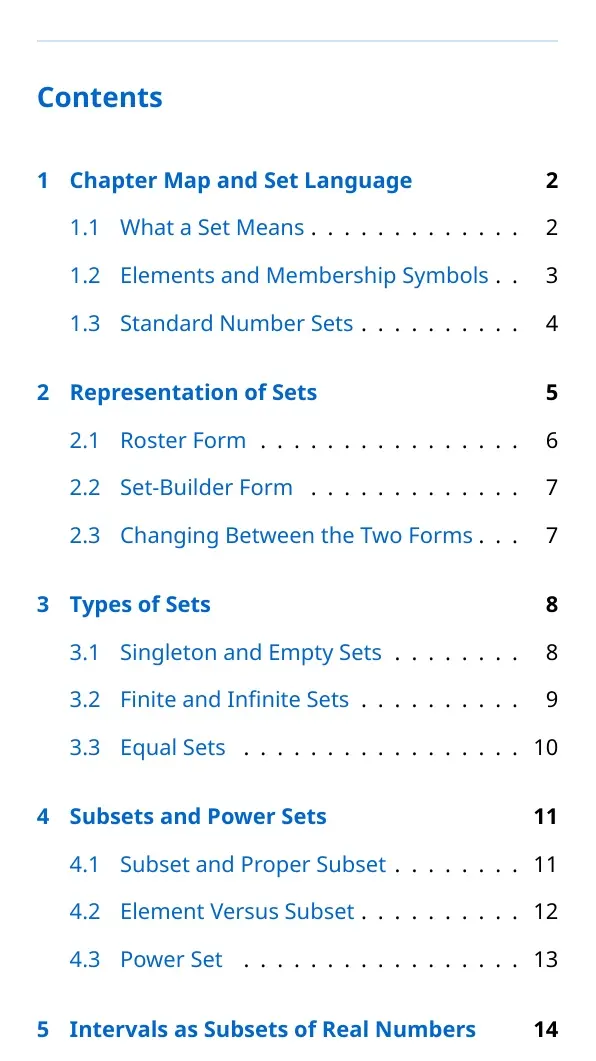
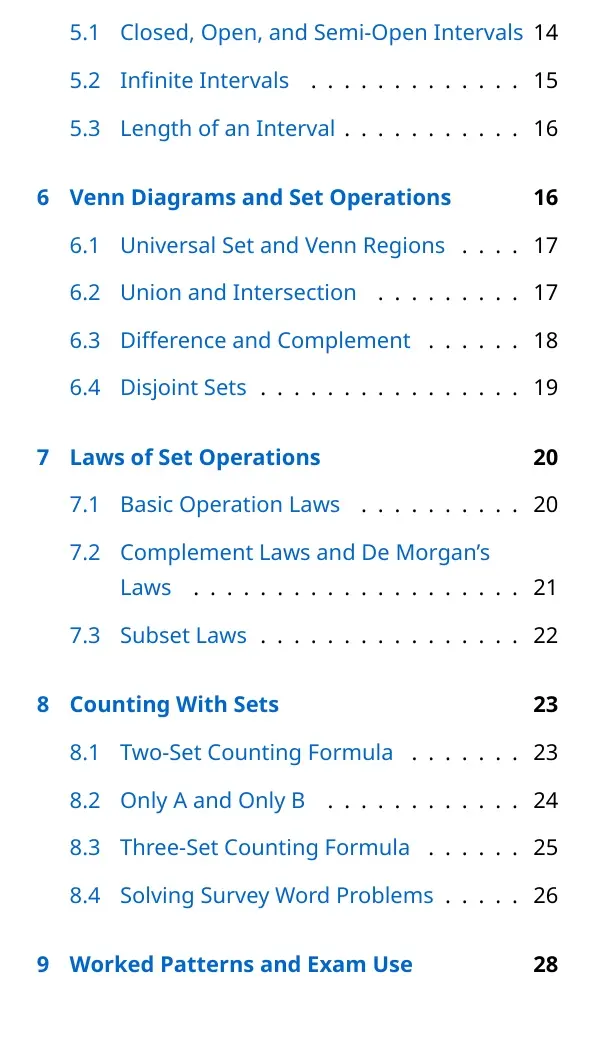
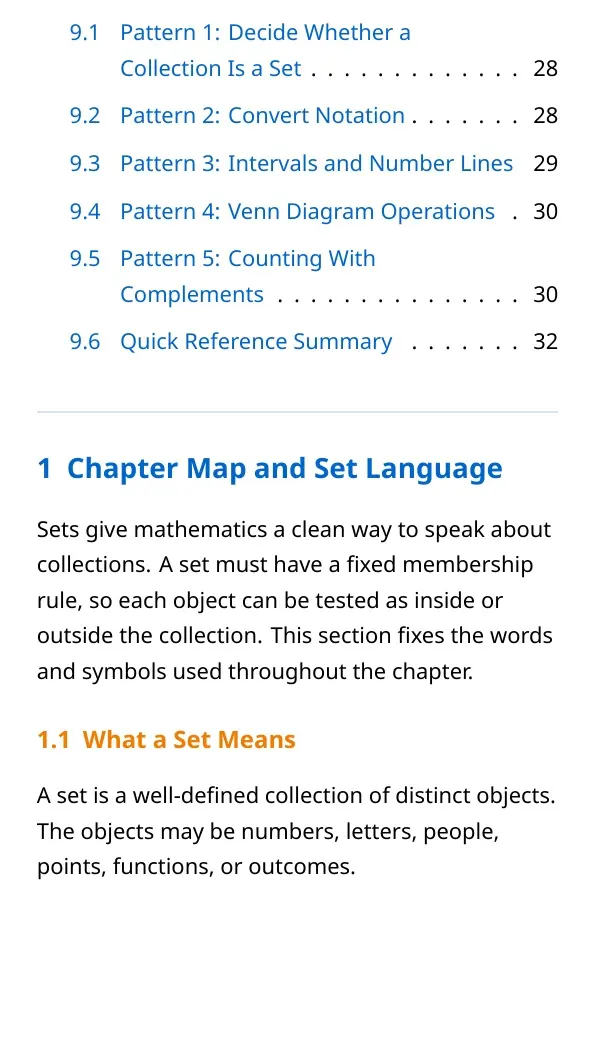
The current CBSE Applied Mathematics curriculum places Set inside Unit 2 Algebra. The official scope includes representation of a set, types of sets, equal and equivalent sets, subsets, power set, universal set, intervals, Venn diagrams and operations on sets. The chapter should therefore be revised as a notation and logic chapter, not as a long theory chapter.
| Chapter part | What students must know | Quick check |
|---|---|---|
| Representation | Roster form and set-builder form | Every member must satisfy the rule |
| Types of sets | Empty, finite, infinite, singleton, equal and equivalent sets | Count elements before naming the type |
| Subsets | Subset, proper subset and power set | A set with n elements has 2n subsets |
| Intervals | Open, closed and half-open intervals | Round bracket means endpoint excluded |
| Operations | Union, intersection, difference and complement | Check the universal set before complement |
Set Theory Video Revision for Applied Mathematics
Source: Magnet Brains on YouTube
Representation of Sets: Roster and Set-Builder Forms
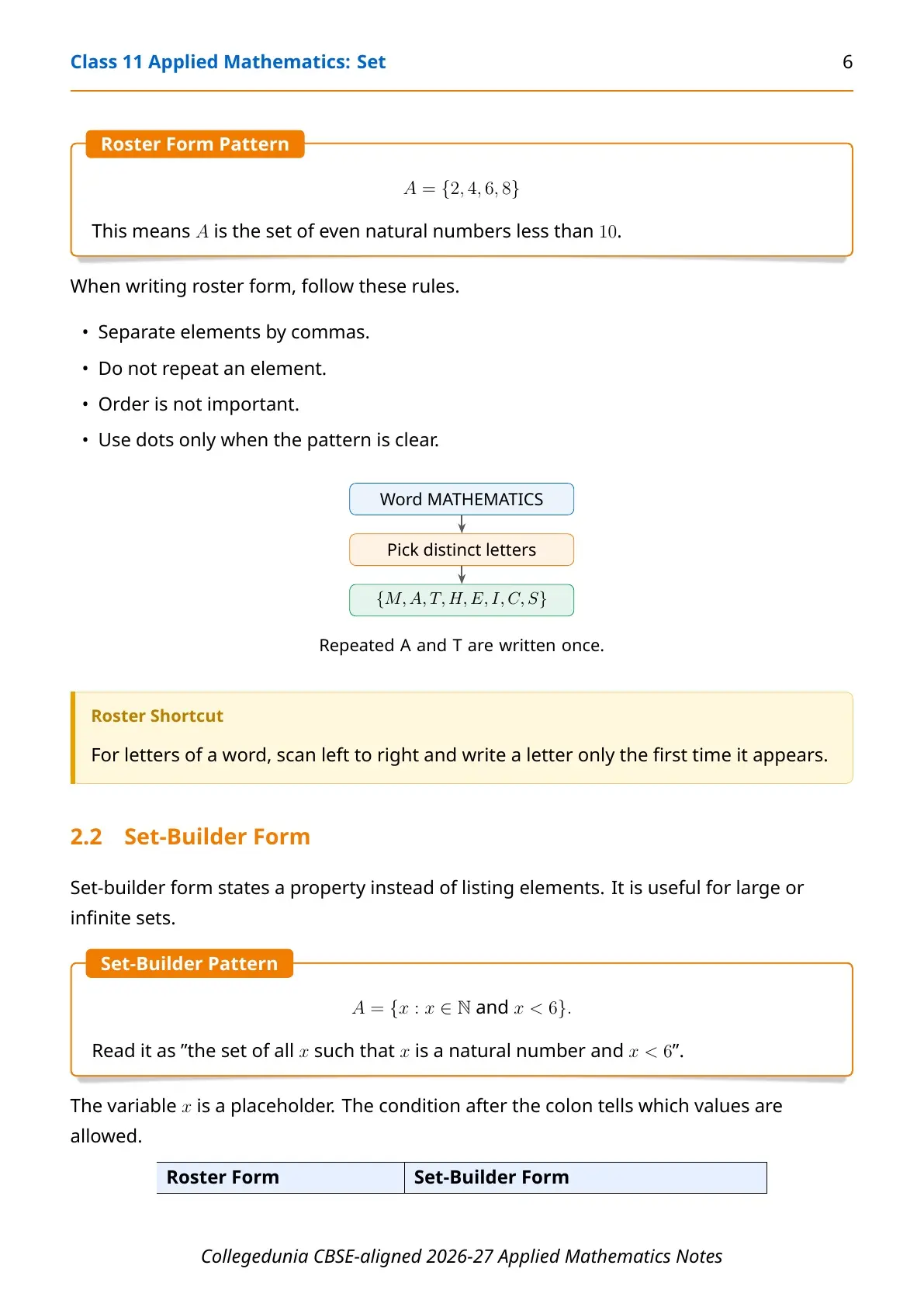
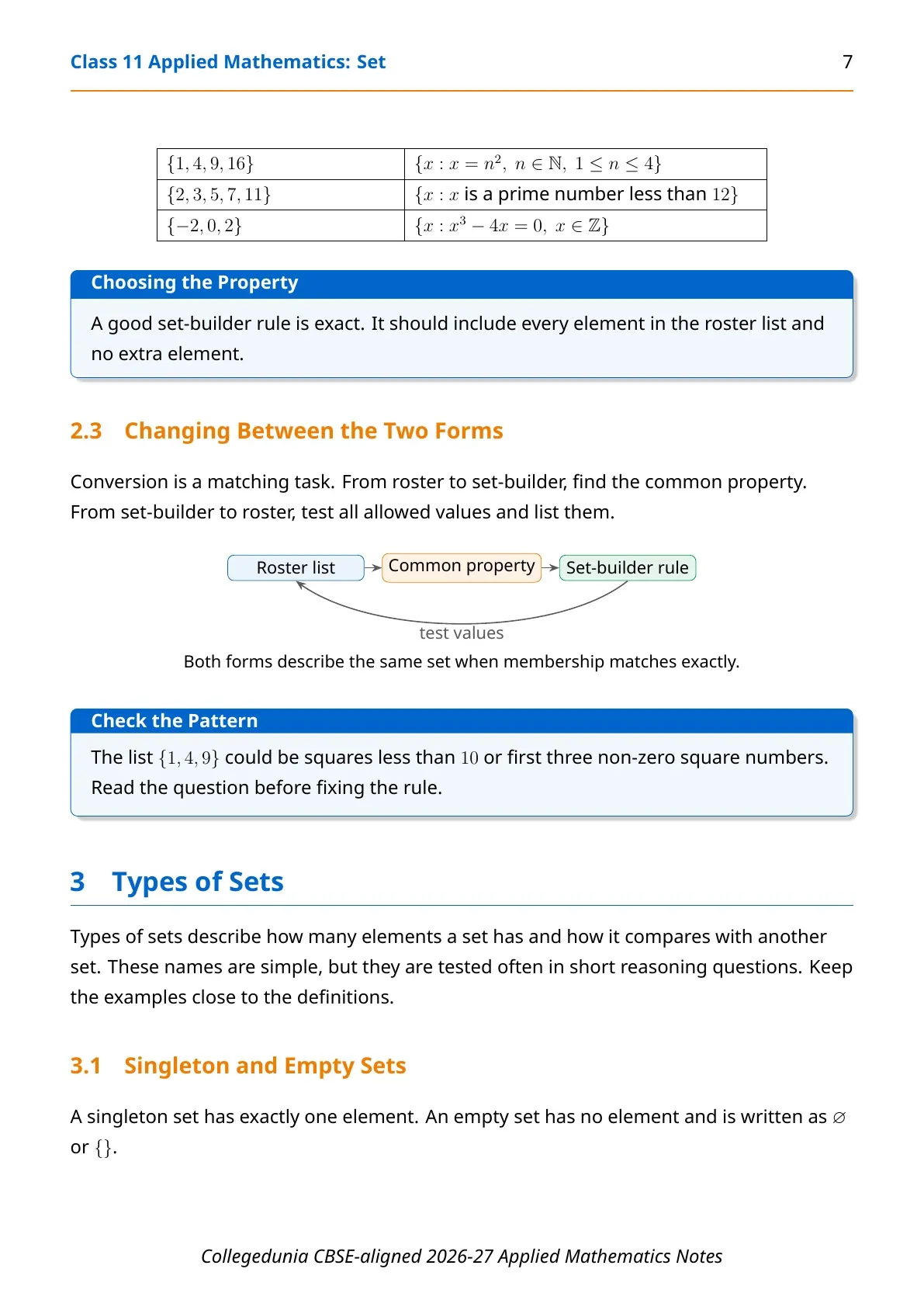
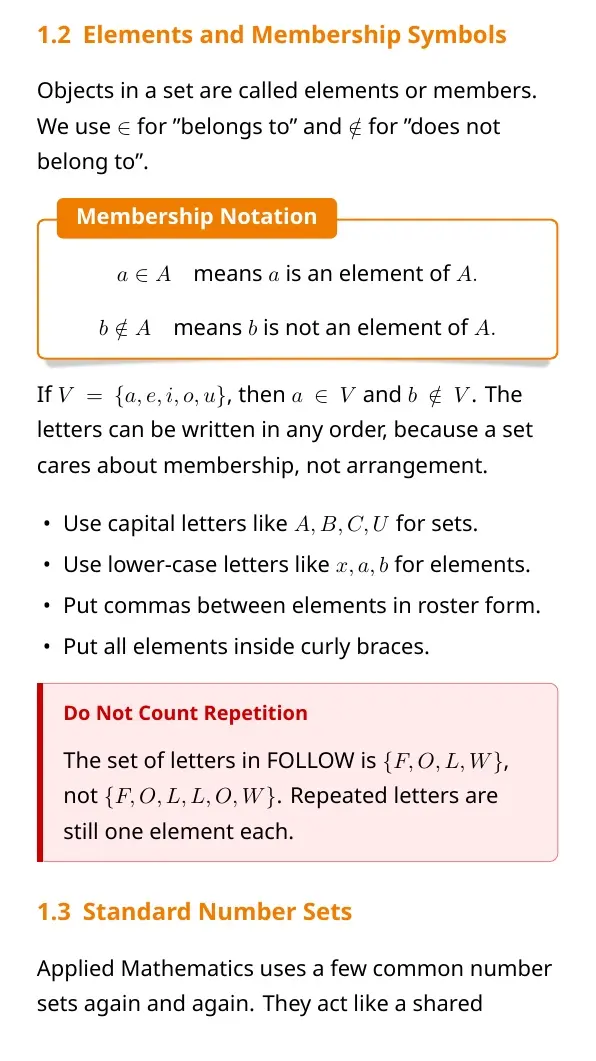
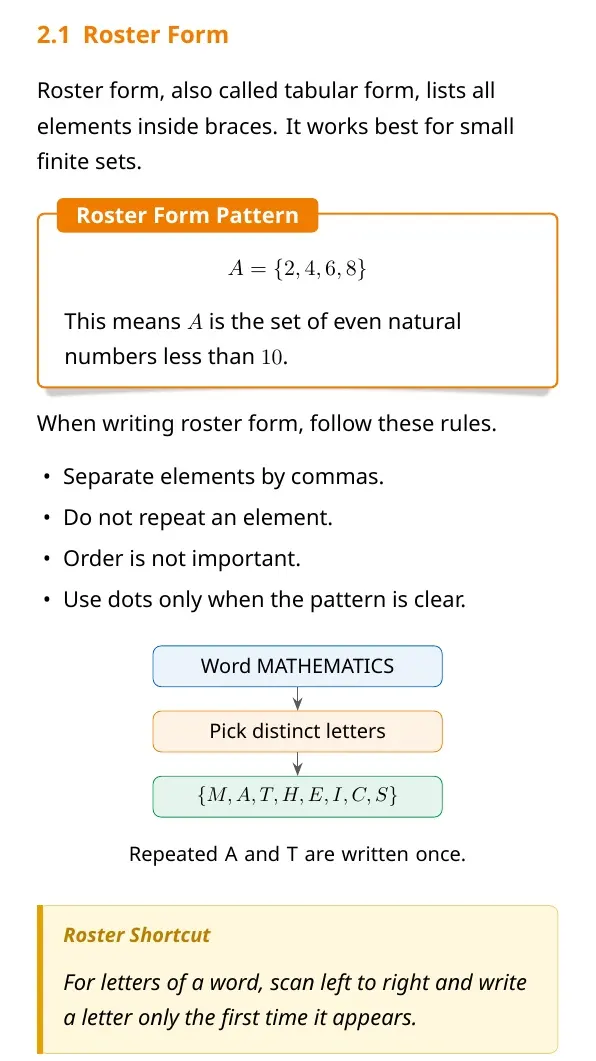
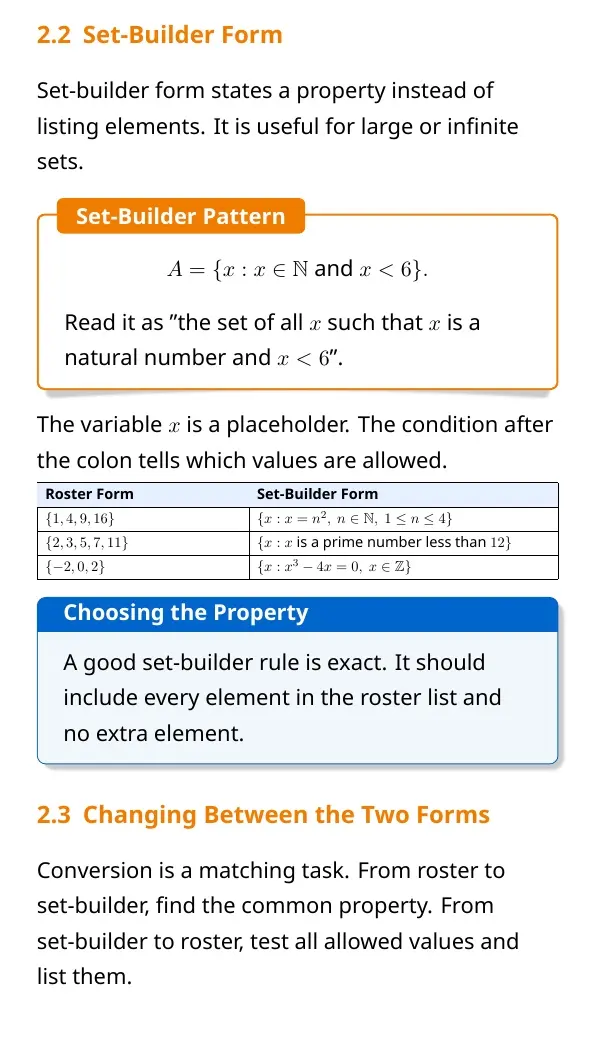
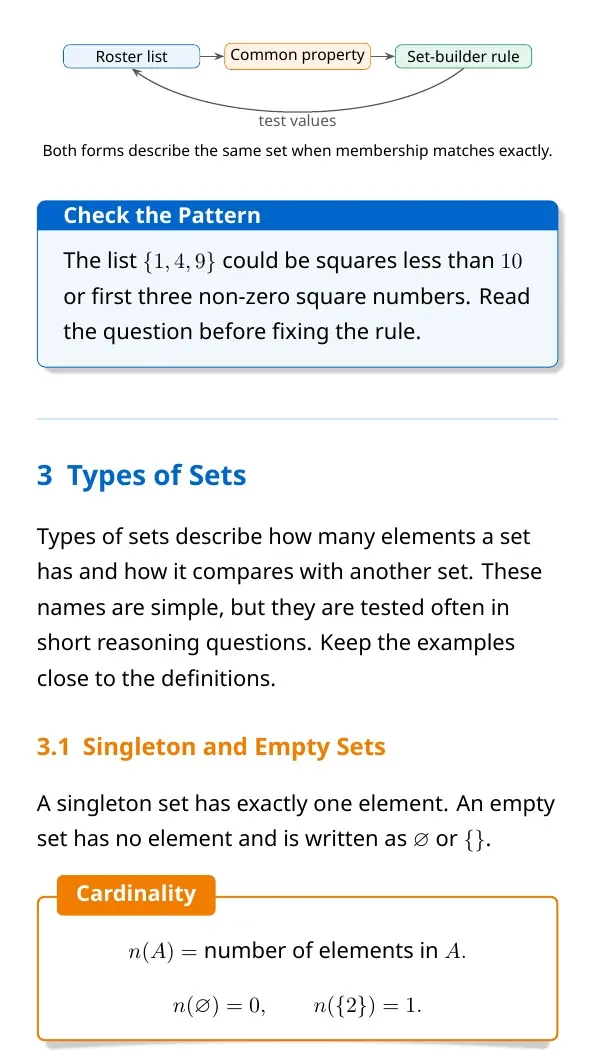
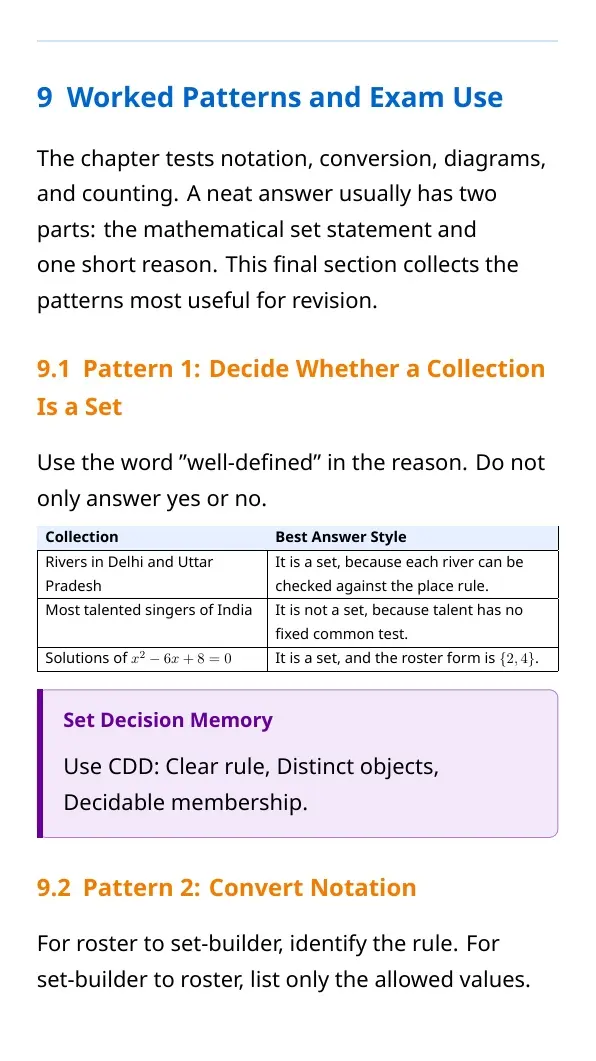
A set can be represented in roster form or set-builder form. In roster form, all members are listed inside braces. For example, the set of vowels in the English alphabet is {a, e, i, o, u}. In set-builder form, the common property is written instead of listing every object. The same set can be written as {x : x is a vowel in the English alphabet}.
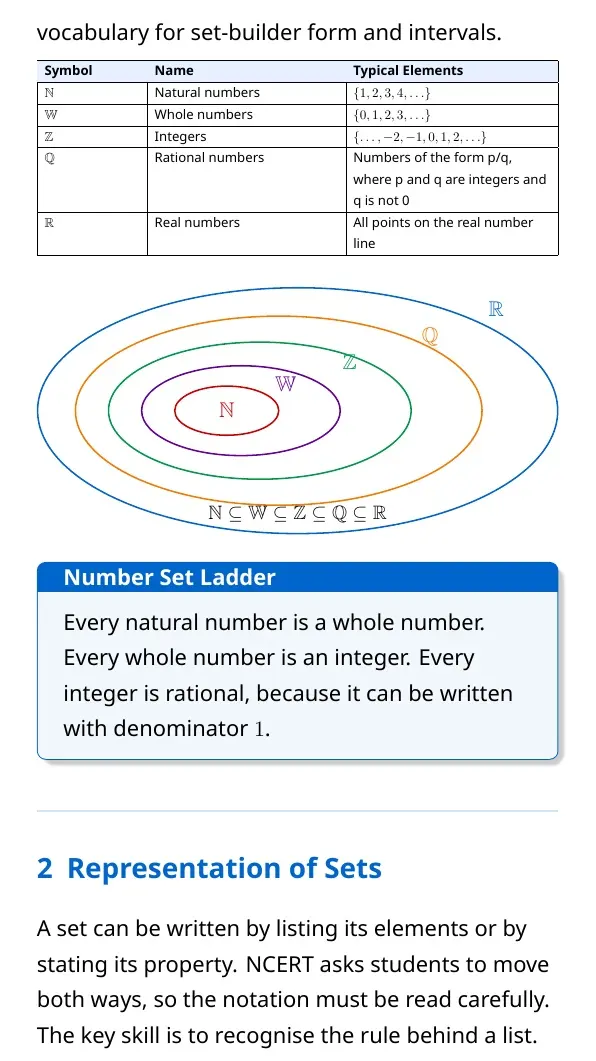
Roster form is best when the set is small and the members are easy to list. Set-builder form is better when the set is large or infinite. For example, the set of natural numbers less than 6 can be written as {1, 2, 3, 4, 5}, but the set of all natural numbers is better written as {x : x is a natural number}.
- Use braces: sets are written inside { }.
- Do not repeat elements: {1, 1, 2, 3} is the same as {1, 2, 3}.
- Order does not matter: {a, b, c} and {c, b, a} are equal sets.
Common check: a set-builder rule should be clear enough that any student can test a member and say yes or no without personal opinion.
Types of Sets and Cardinality
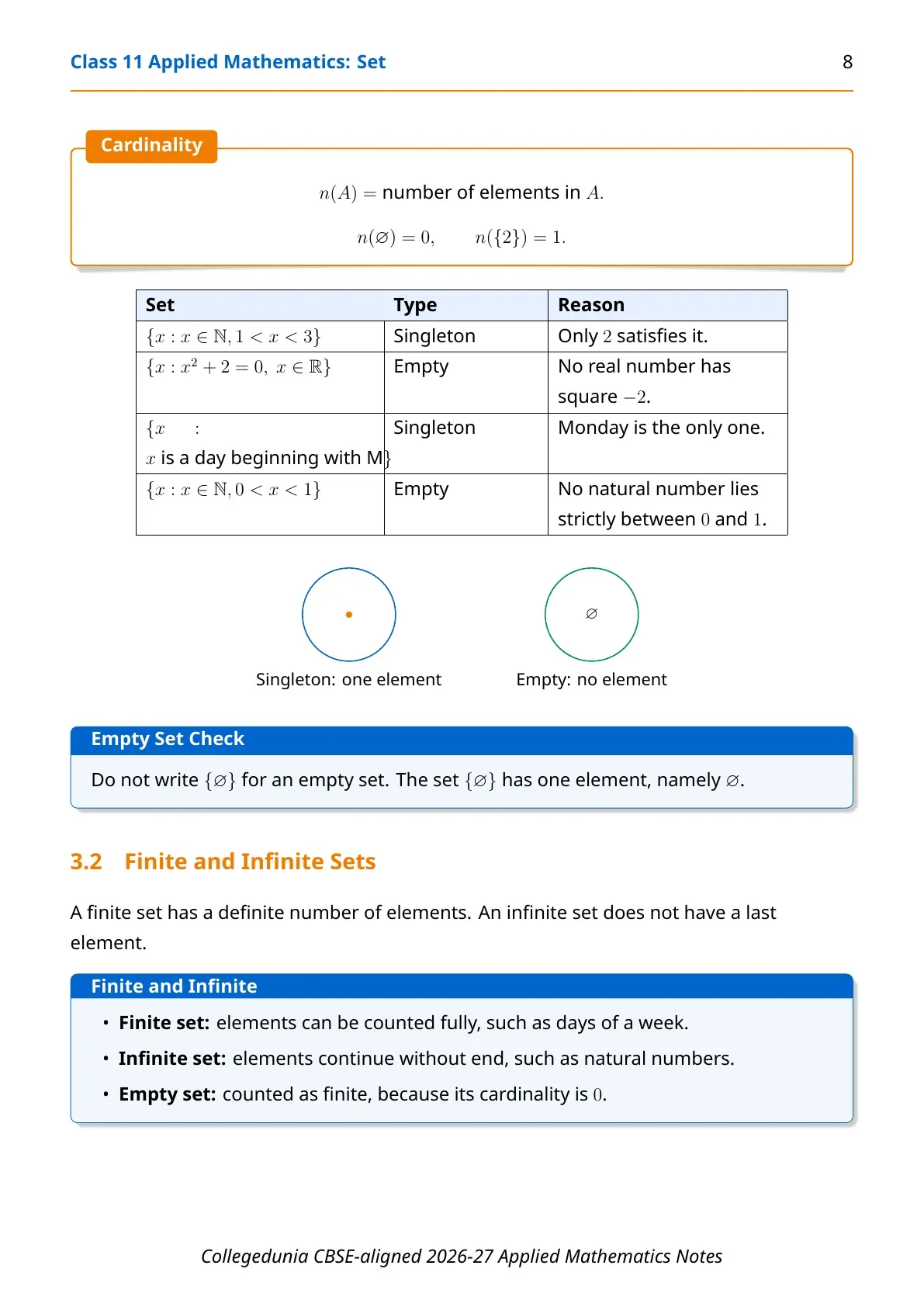
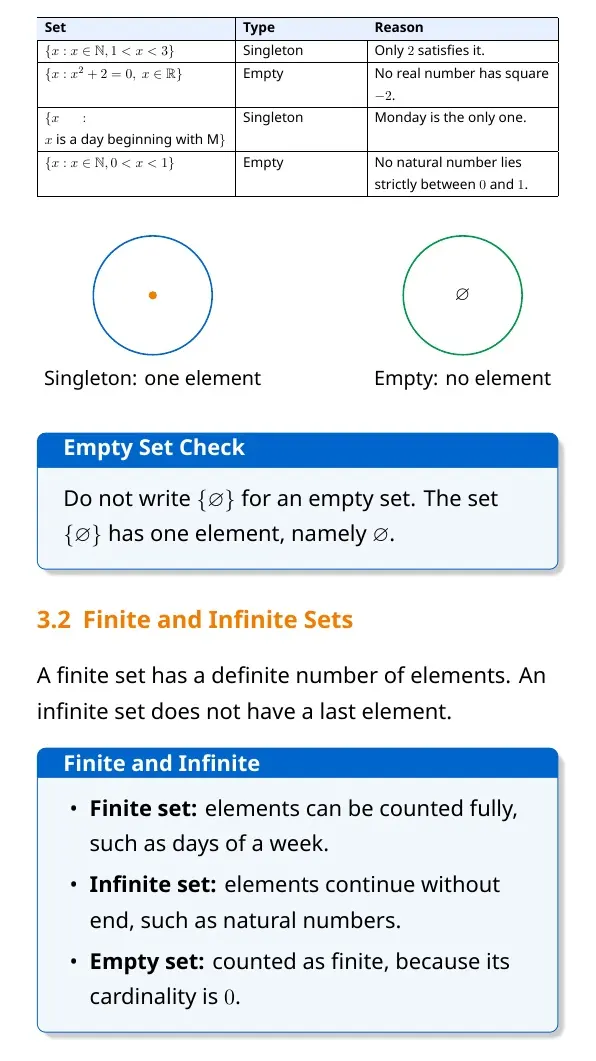
The cardinality of a finite set is the number of distinct elements in it. If A = {2, 4, 6, 8}, then n(A) = 4. Cardinality is the easiest way to decide whether two sets are equivalent. Equal sets have exactly the same elements. Equivalent sets have the same number of elements, even if the elements are different.
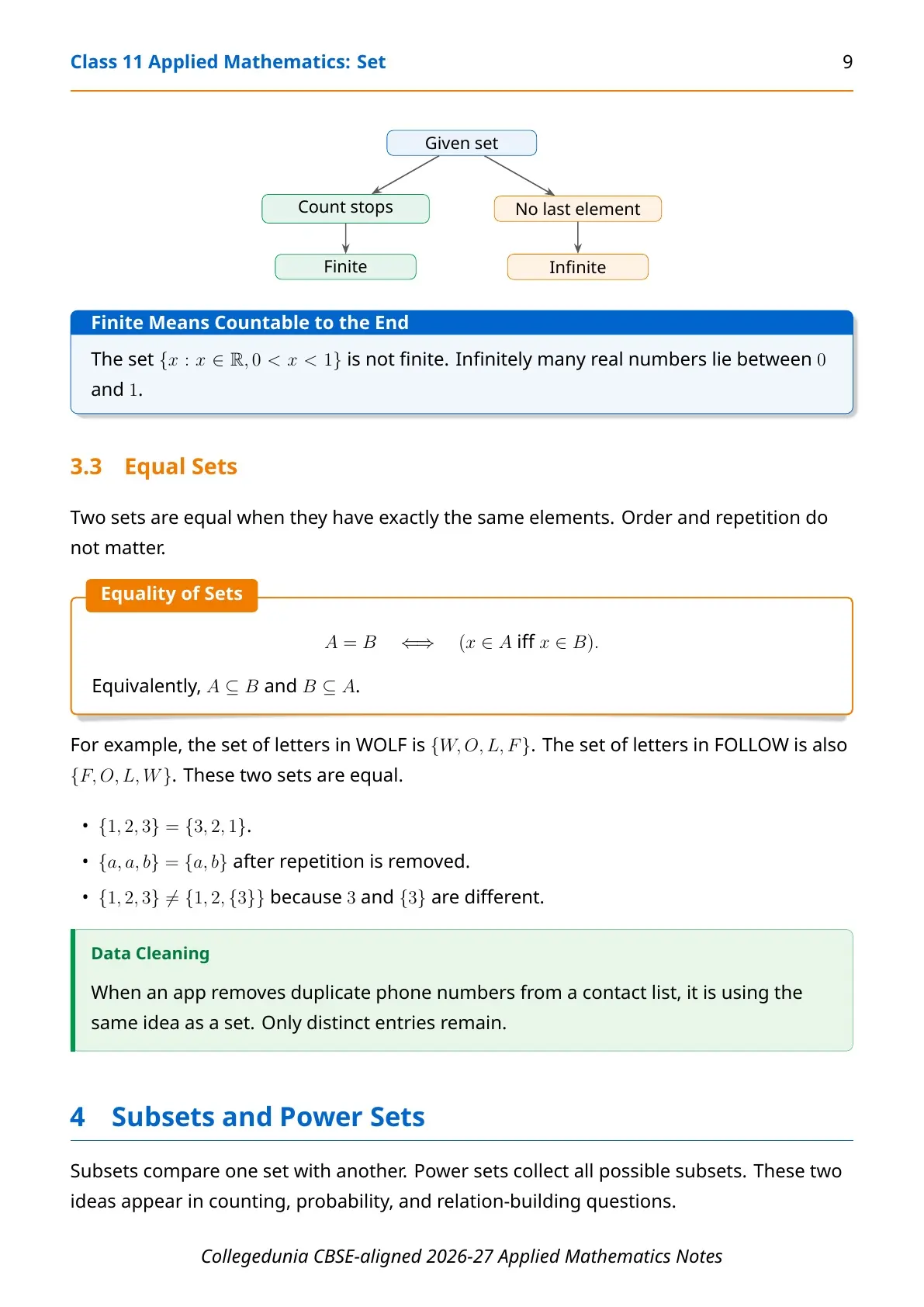
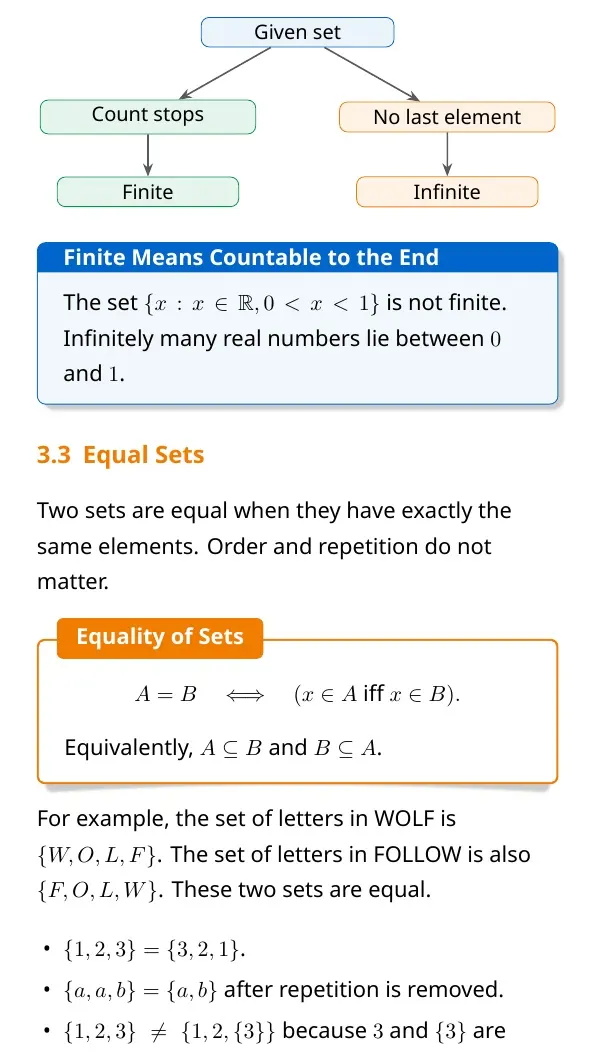
An empty set has no element and is written as { } or by the standard empty-set symbol. A singleton set has exactly one element. A finite set has countable limited elements, while an infinite set continues without an endpoint. Students should first remove repeated entries before counting cardinality.
| Type | Meaning | Example |
|---|---|---|
| Empty set | No element | Set of whole numbers between 2 and 3 |
| Singleton set | Exactly one element | {0} |
| Finite set | Limited number of elements | {1, 2, 3, 4} |
| Infinite set | Elements do not end | Set of natural numbers |
| Equal sets | Same elements | {1, 2} and {2, 1} |
| Equivalent sets | Same cardinality | {a, b, c} and {4, 5, 6} |
Subsets, Power Set and Universal Set
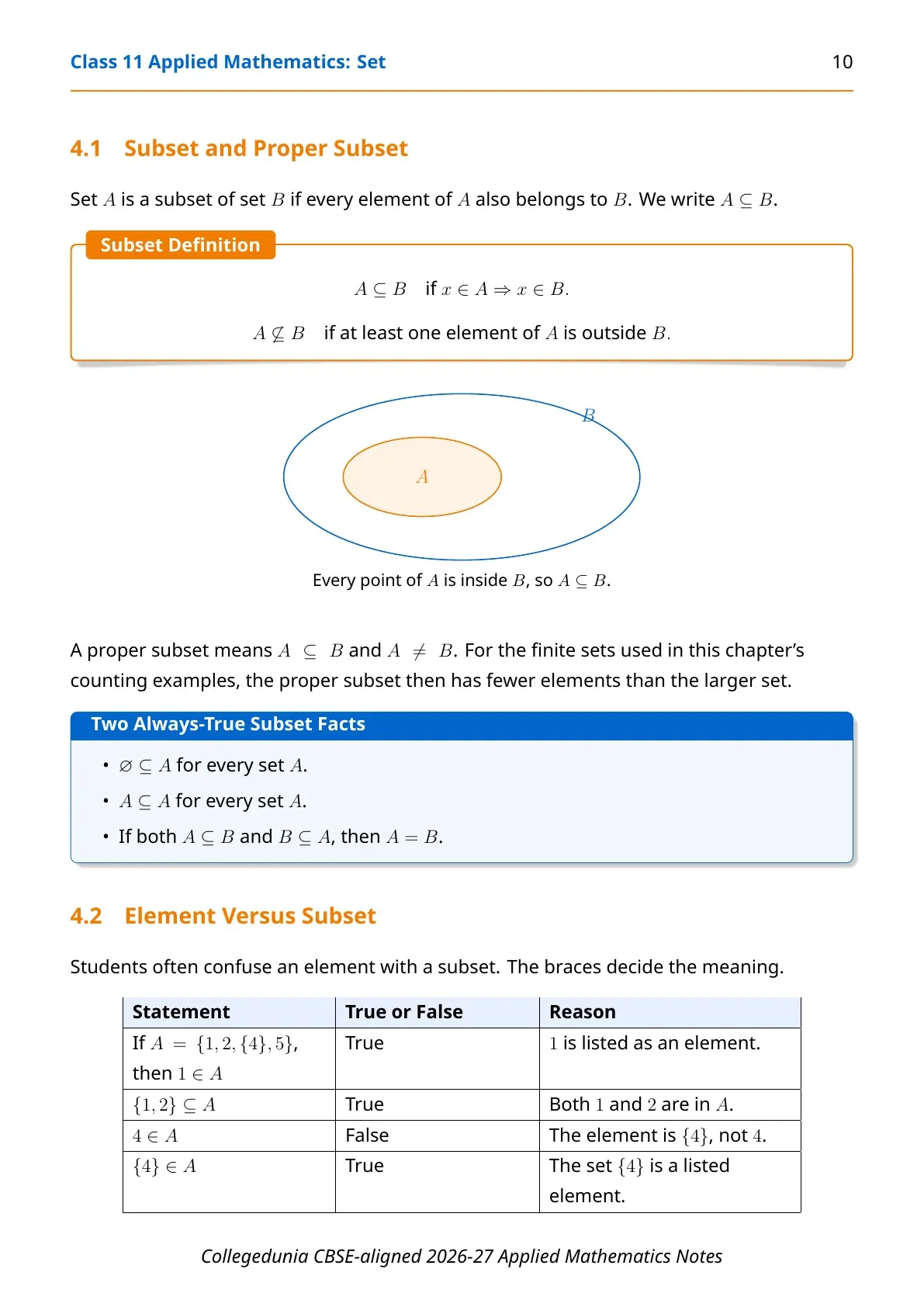
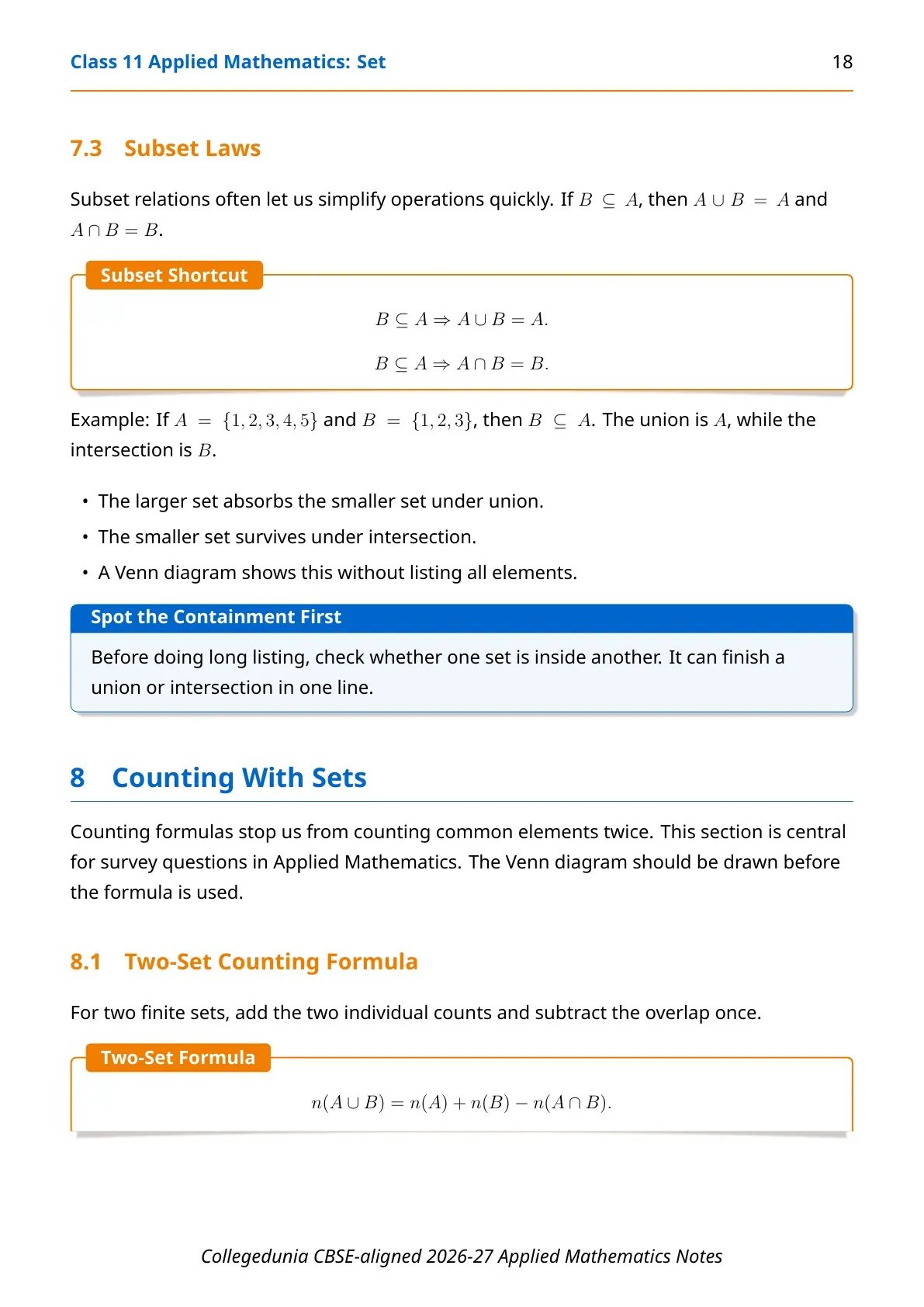
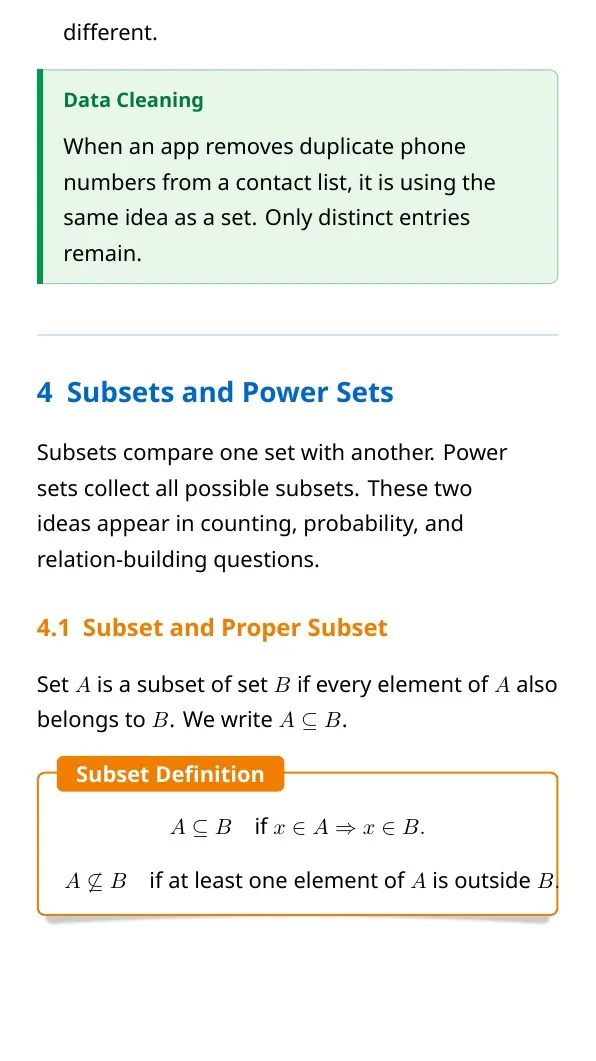
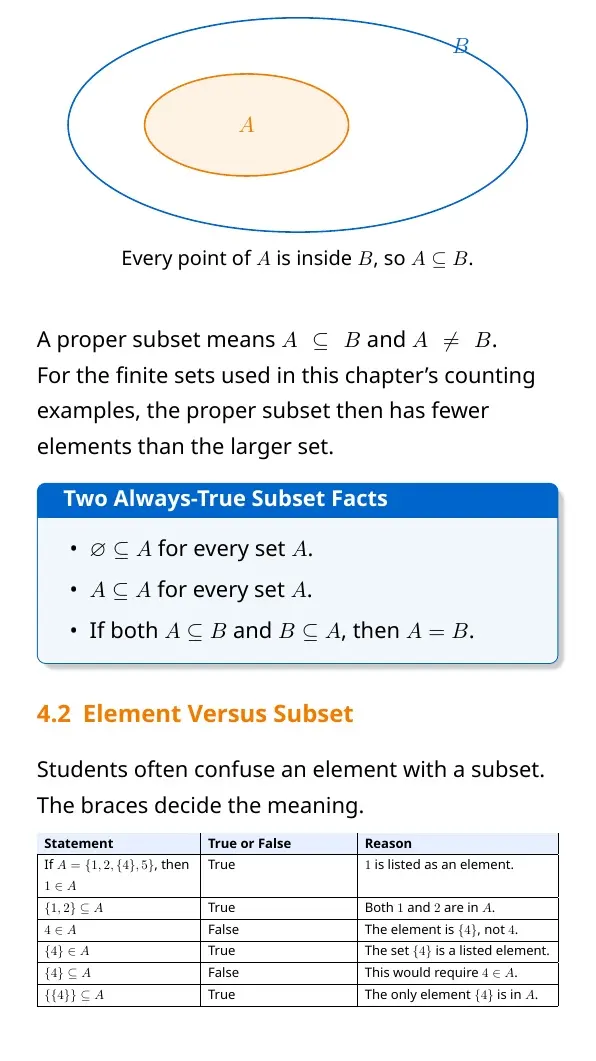
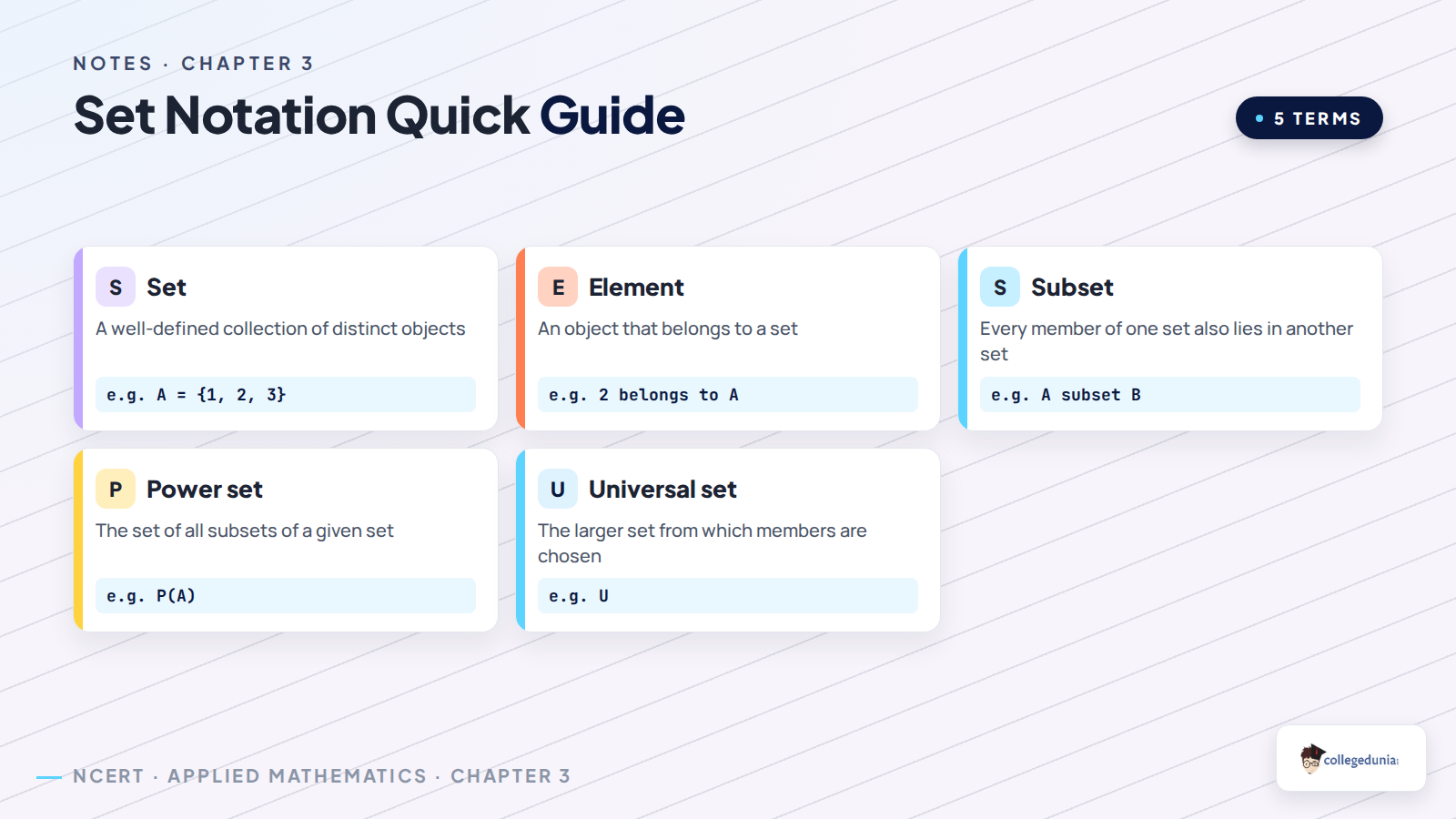
A set A is a subset of a set B when every element of A is also an element of B. The empty set is a subset of every set because there is no element in it that violates the condition. Every set is also a subset of itself. A proper subset satisfies A is inside B but A is not equal to B. In finite examples, this means the proper subset has fewer elements.
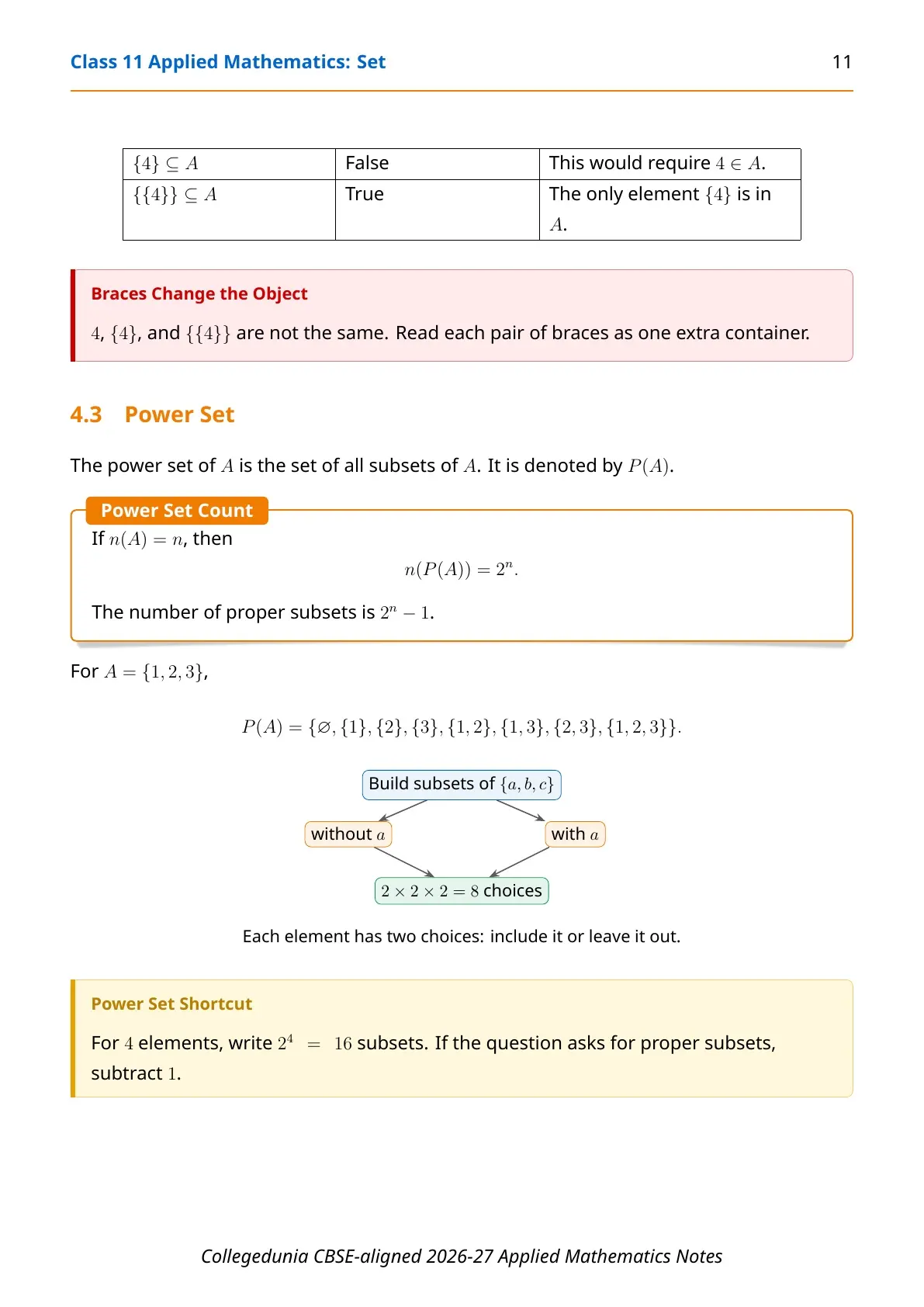
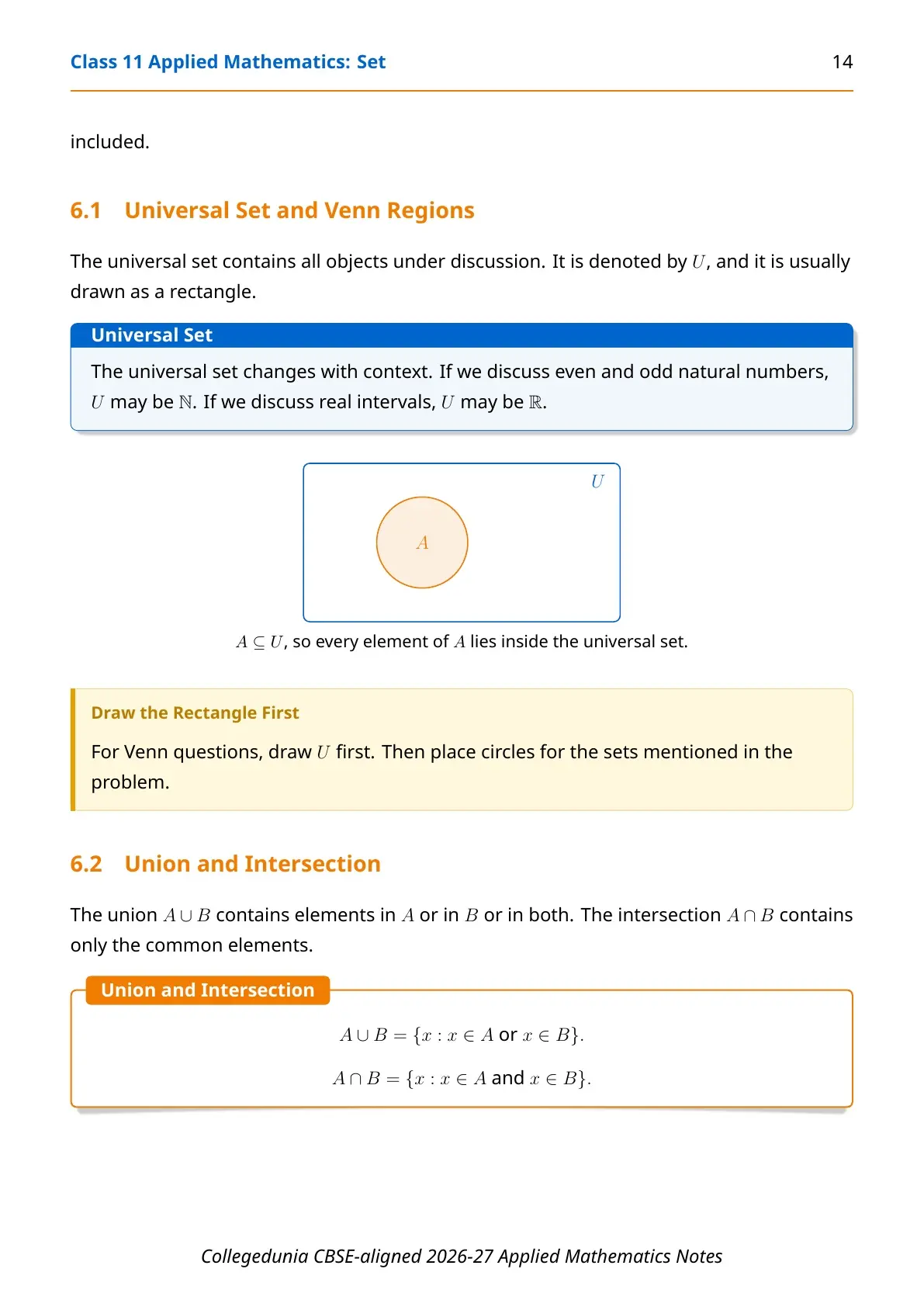
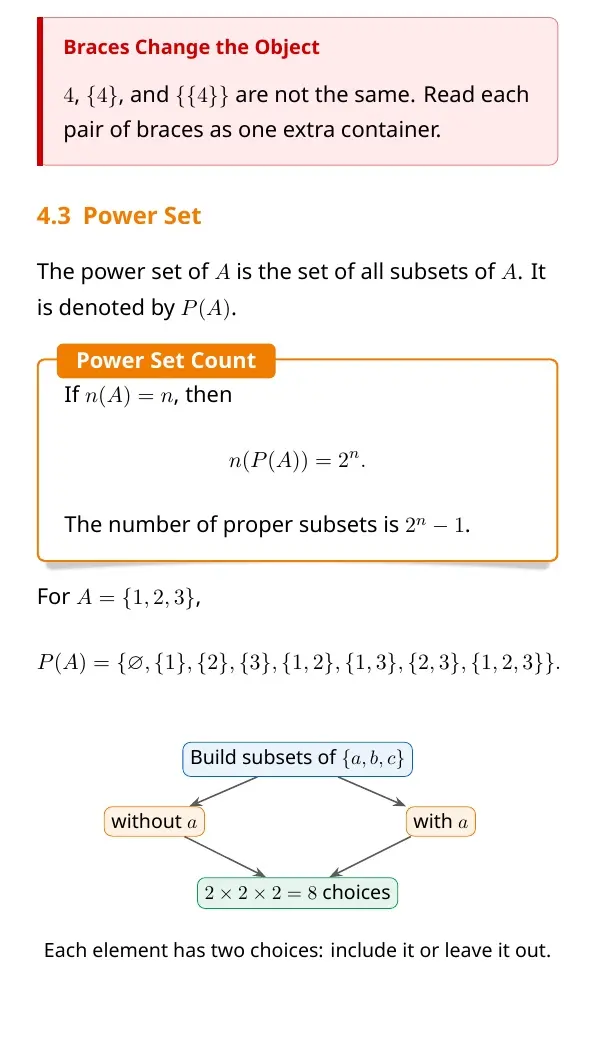
The power set of A is the set of all subsets of A. If A has n elements, then the power set has 2n elements. For A = {1, 2}, the subsets are { }, {1}, {2}, {1, 2}; therefore P(A) has 4 elements. The universal set is the larger reference set from which all sets in a question are chosen.
- Subset test: check every element of the smaller set against the larger set.
- Power set count: use 2n, where n is the number of elements in the original set.
- Universal set check: complements are impossible to define without a universal set.
Intervals as Subsets of Real Numbers
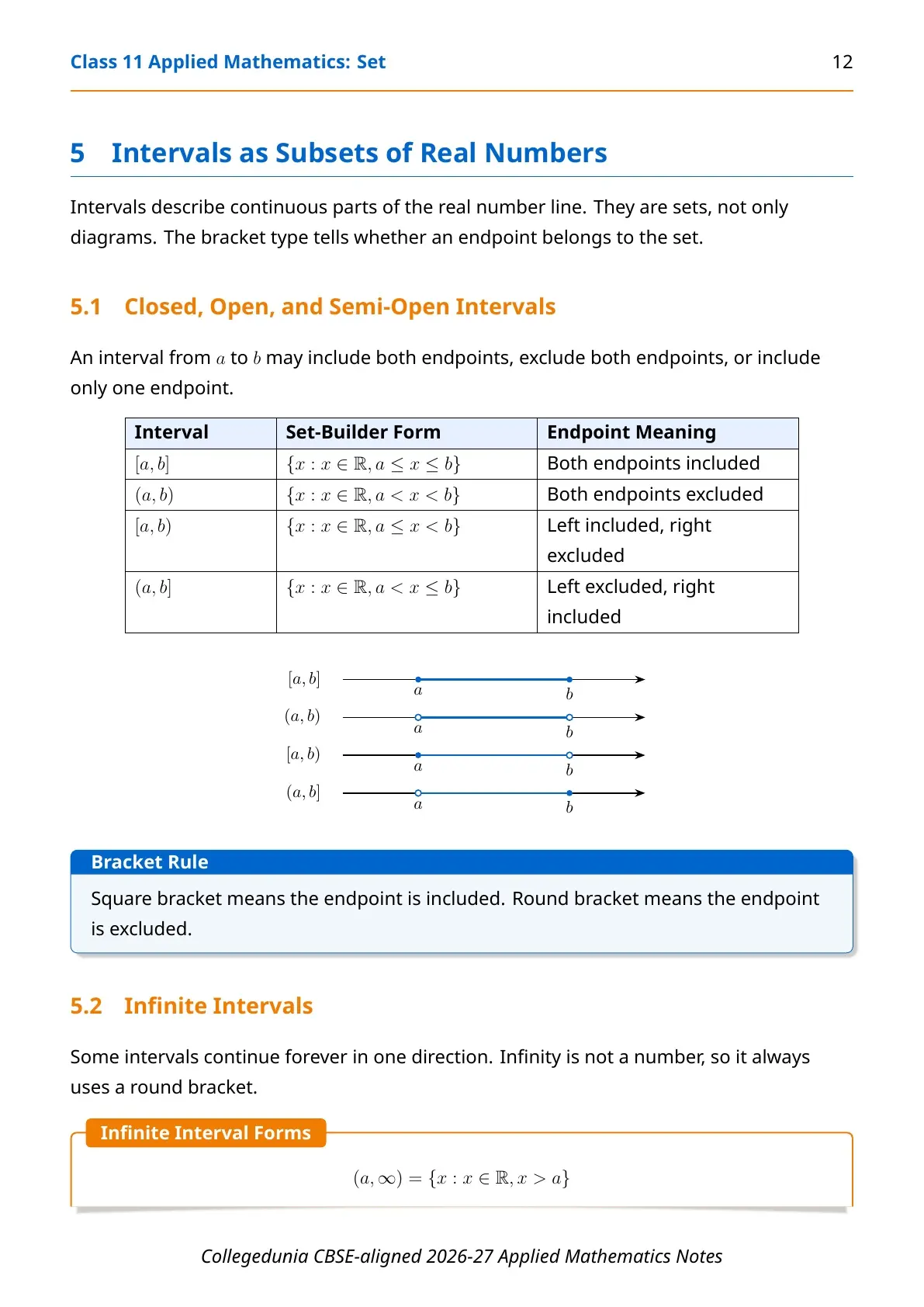
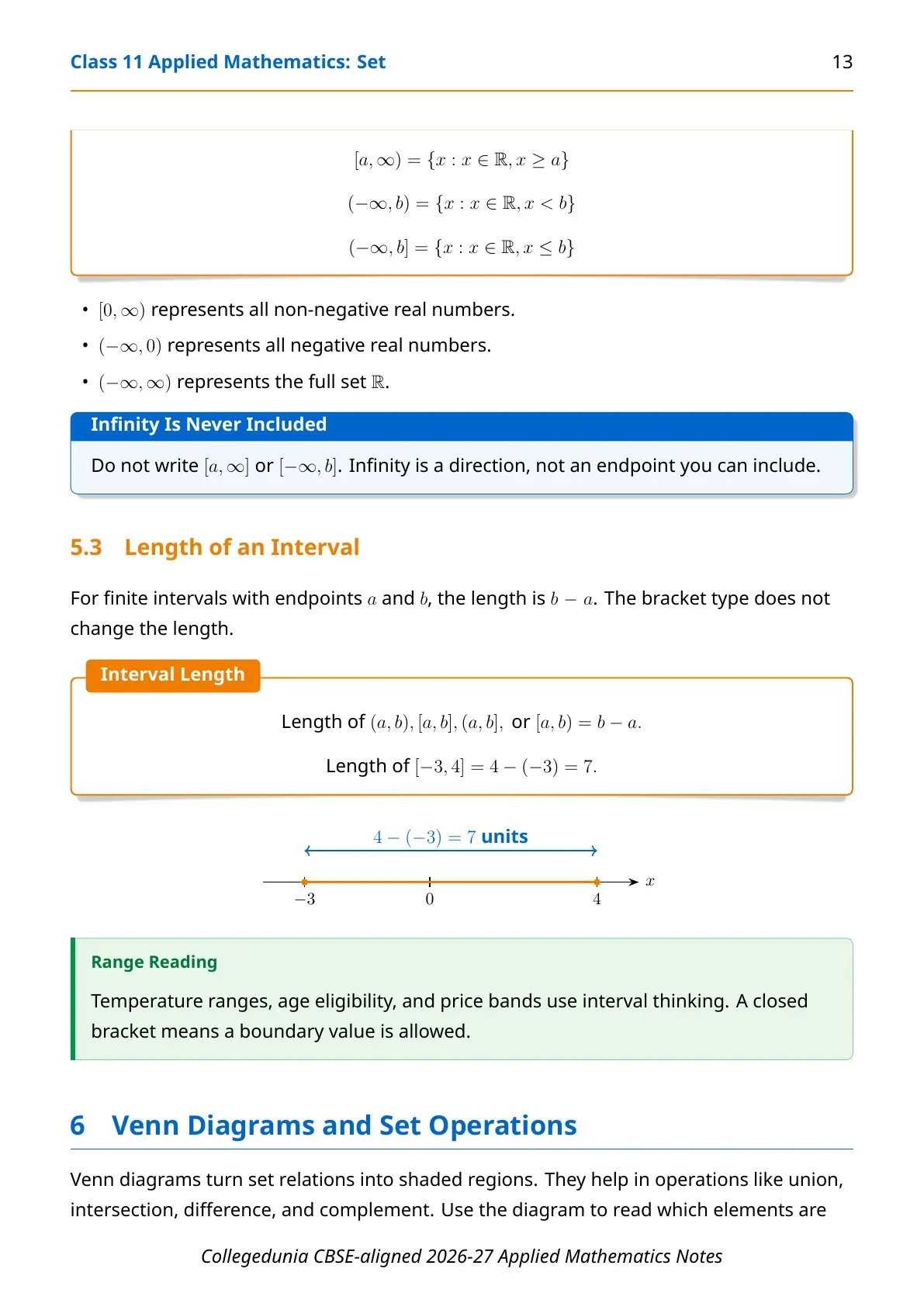
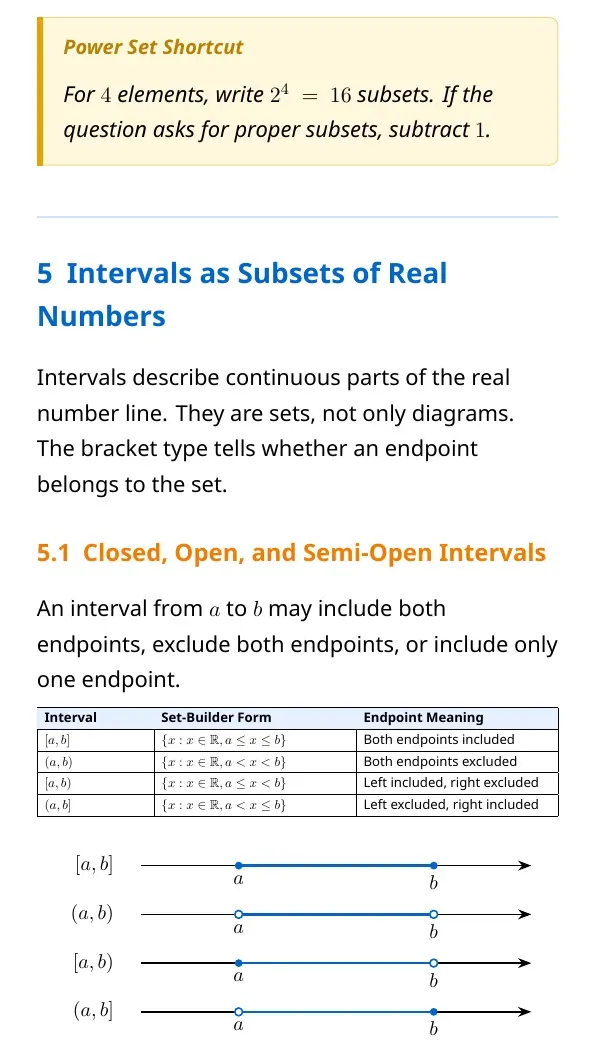
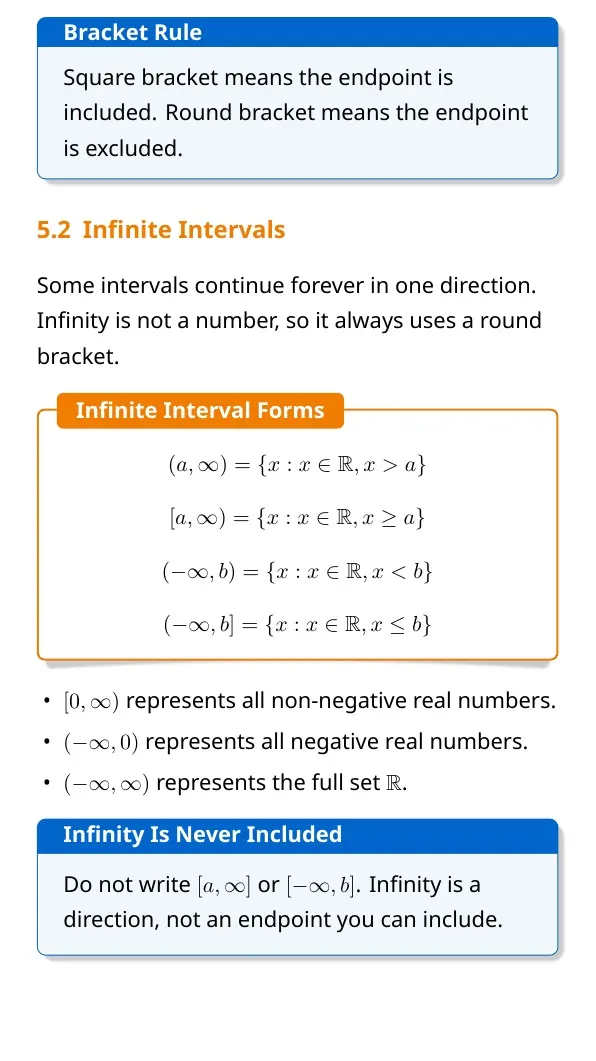
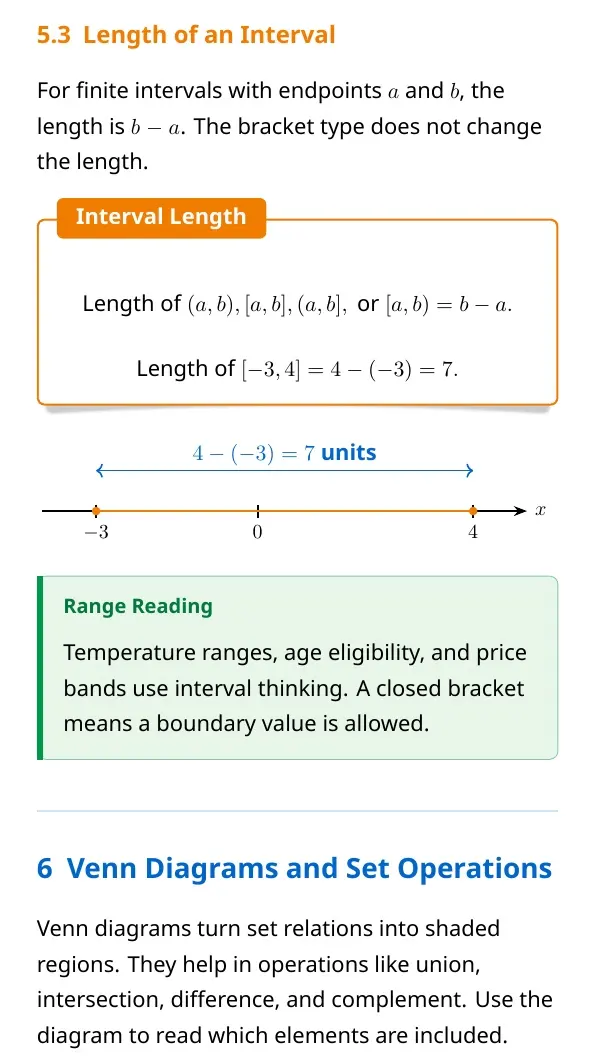
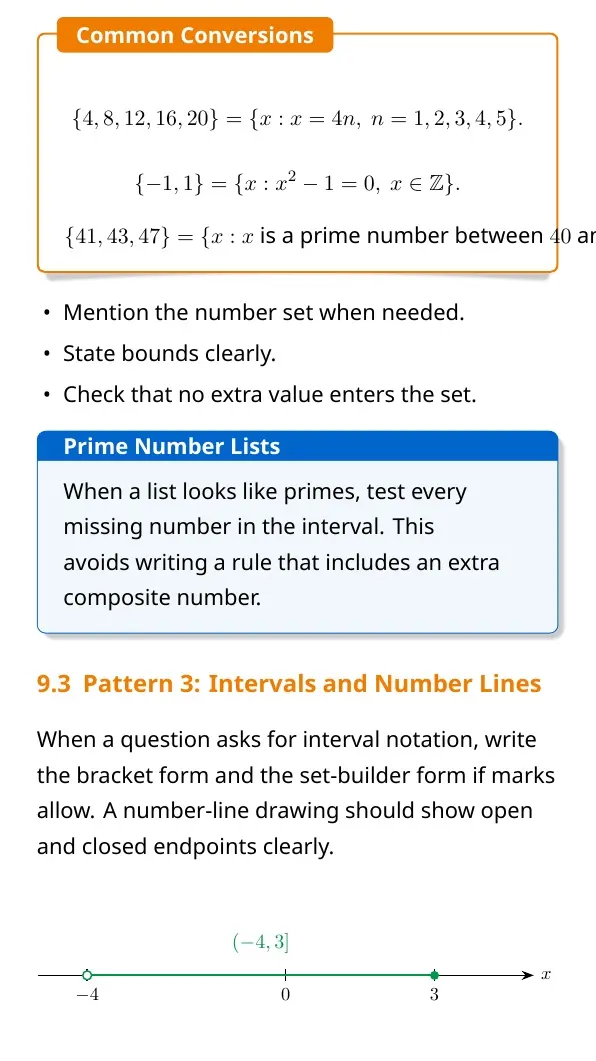
Intervals are sets of real numbers between two endpoints. A closed interval includes both endpoints, while an open interval excludes both endpoints. A half-open interval includes one endpoint and excludes the other. In Applied Mathematics, intervals are useful because they connect set notation with inequalities and graphs.
The notation [a, b] means all real numbers x such that a is less than or equal to x and x is less than or equal to b. The notation (a, b) means a is less than x and x is less than b. Students should read the bracket first before deciding whether an endpoint belongs to the set.
| Interval | Set-builder meaning | Endpoint status |
|---|---|---|
| [a, b] | {x : a <= x <= b} | a and b included |
| (a, b) | {x : a < x < b} | a and b excluded |
| [a, b) | {x : a <= x < b} | a included, b excluded |
| (a, b] | {x : a < x <= b} | a excluded, b included |
Set Operations and Venn Diagrams
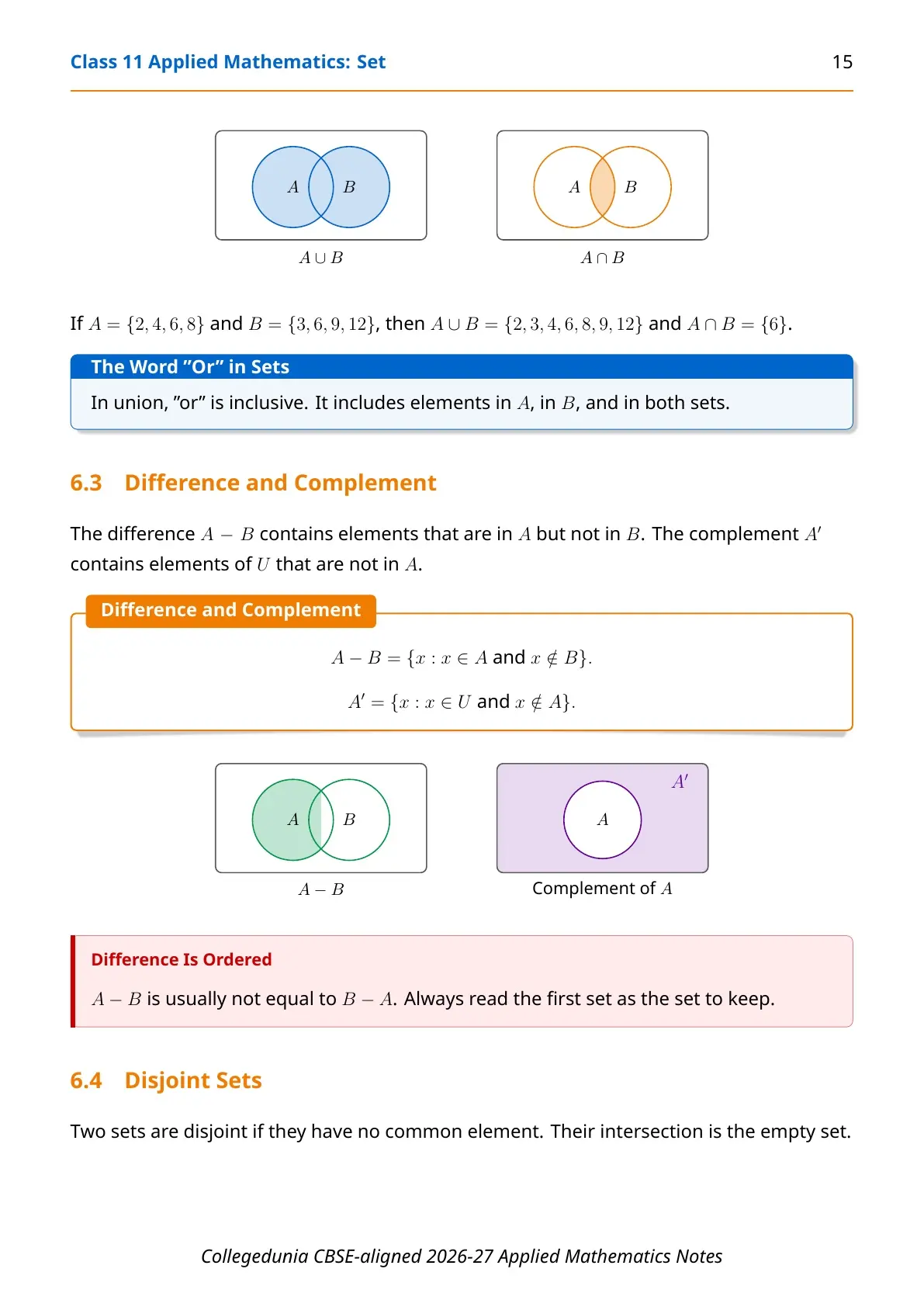
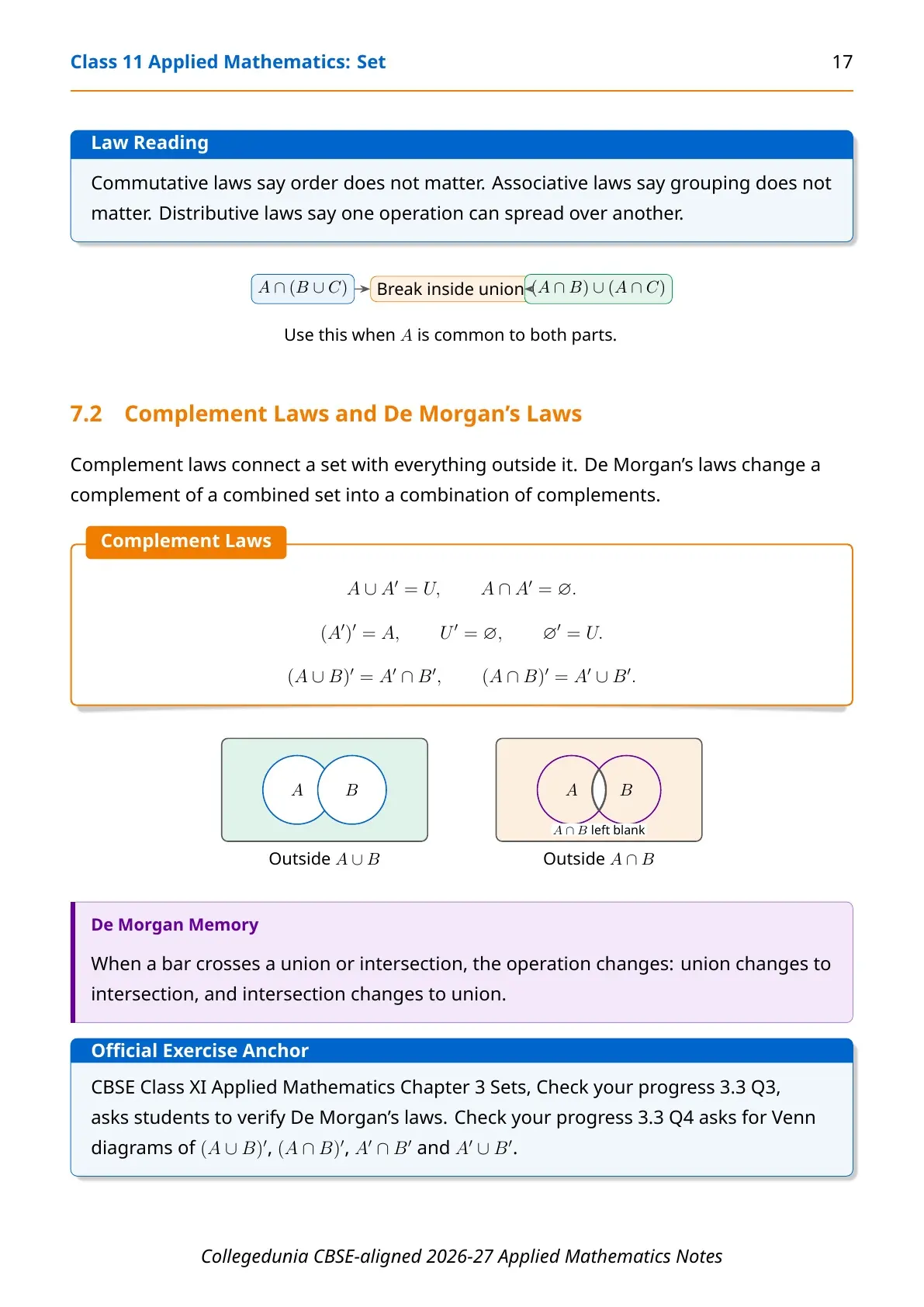
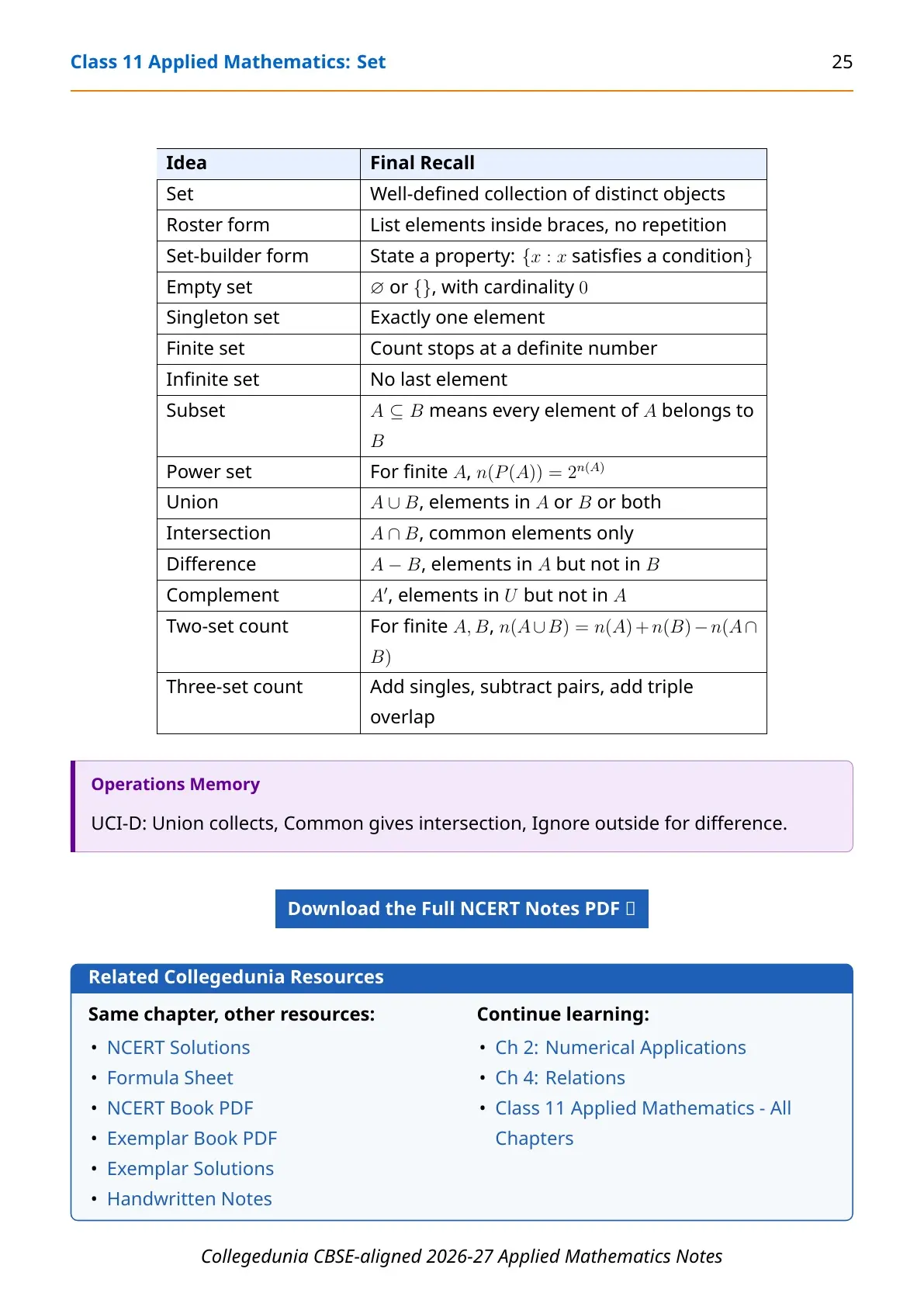
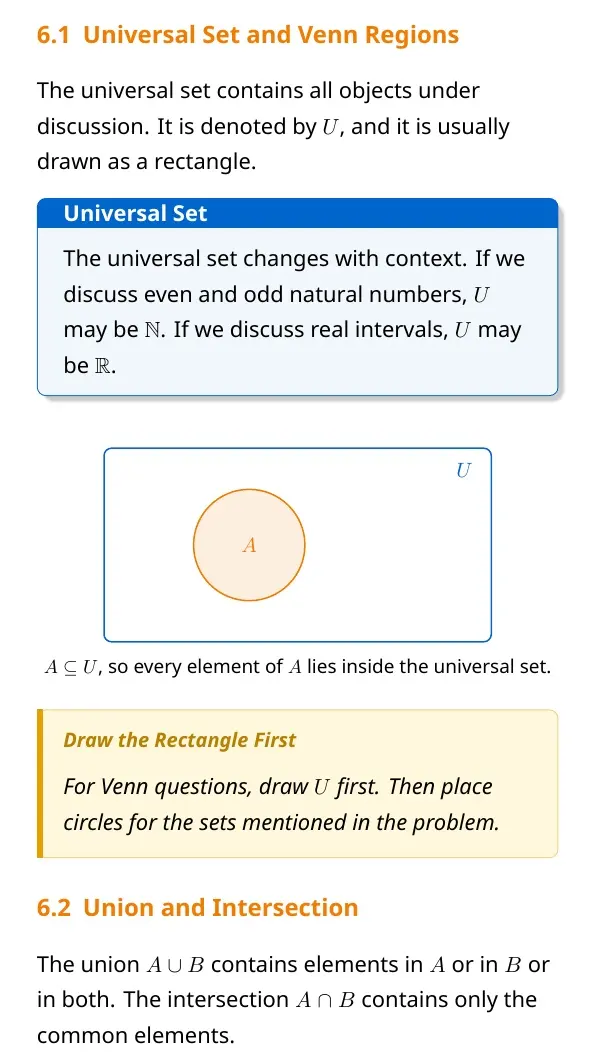
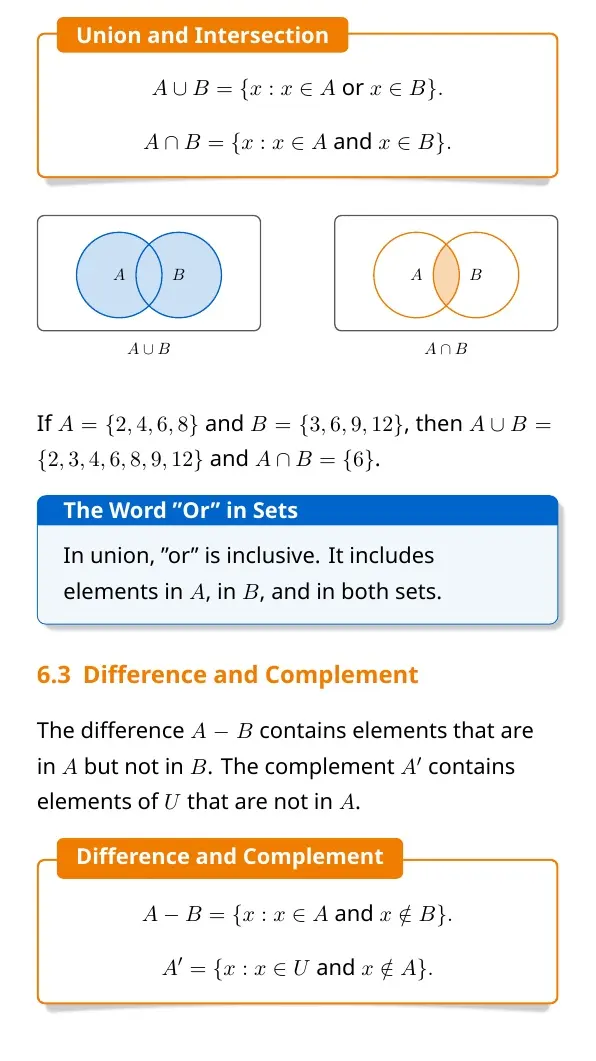
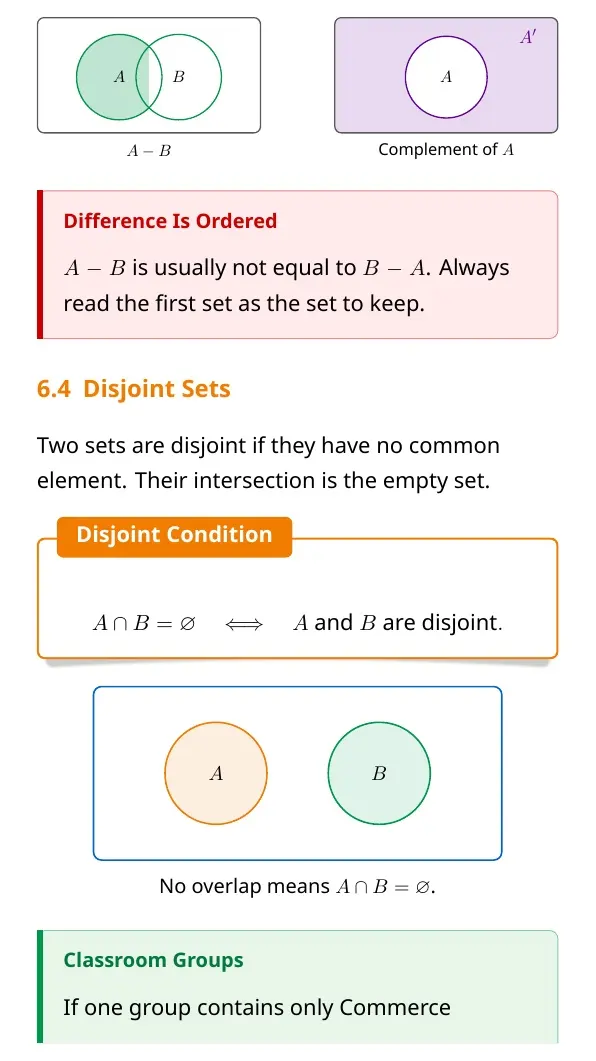
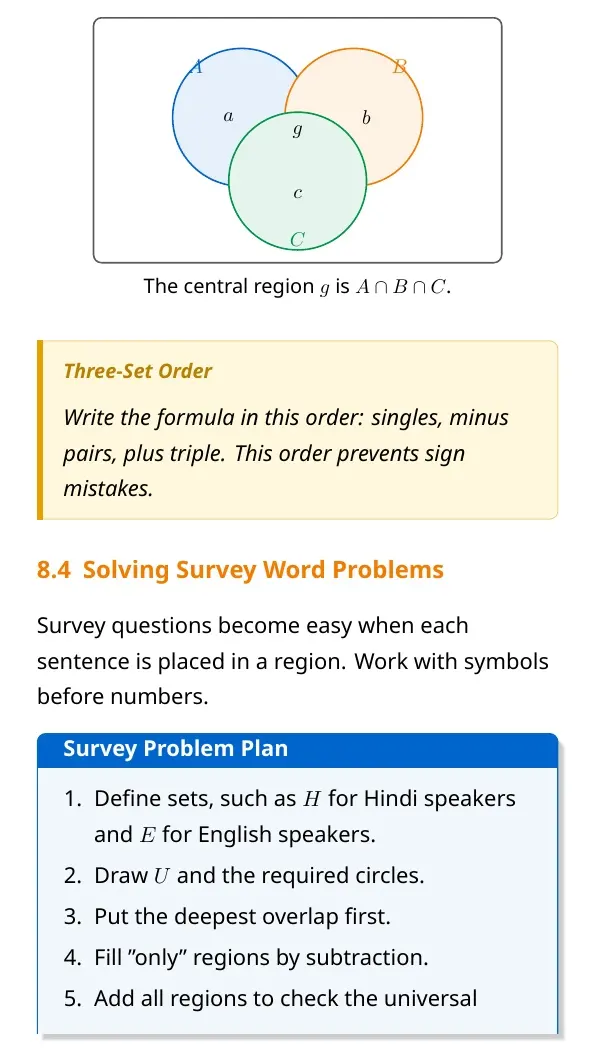
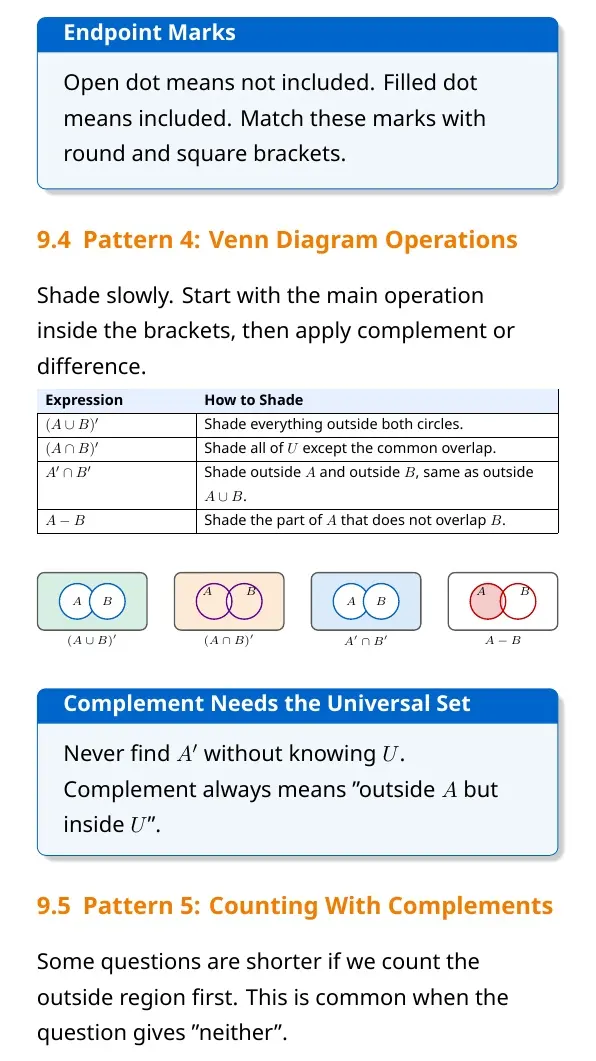
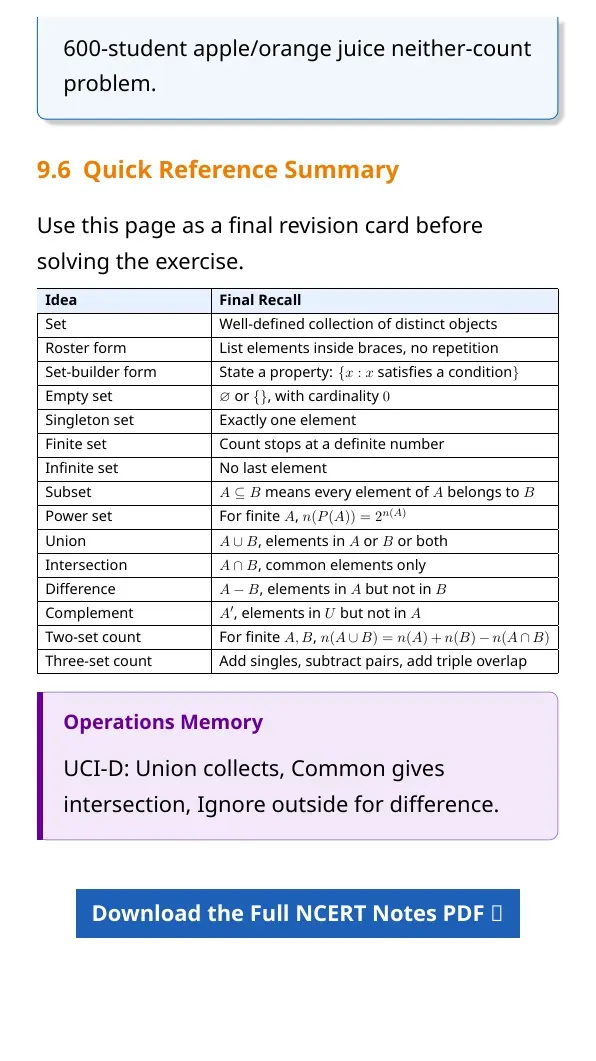
Set operations help students combine and compare groups. The union of A and B contains elements that are in A, in B, or in both. The intersection contains elements common to both A and B. The difference A - B contains elements that belong to A but not to B. The complement of A contains elements in the universal set that are not in A.
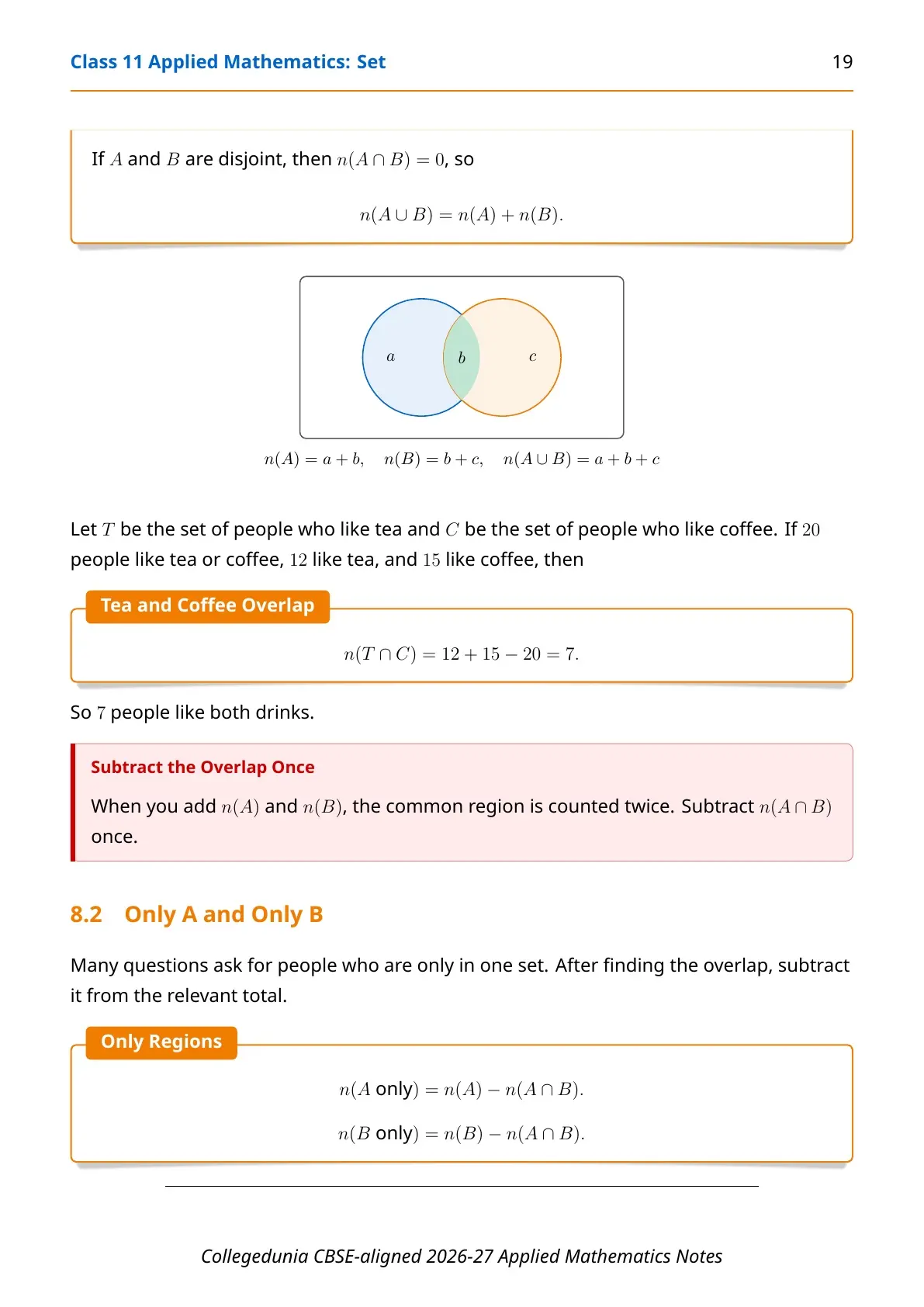
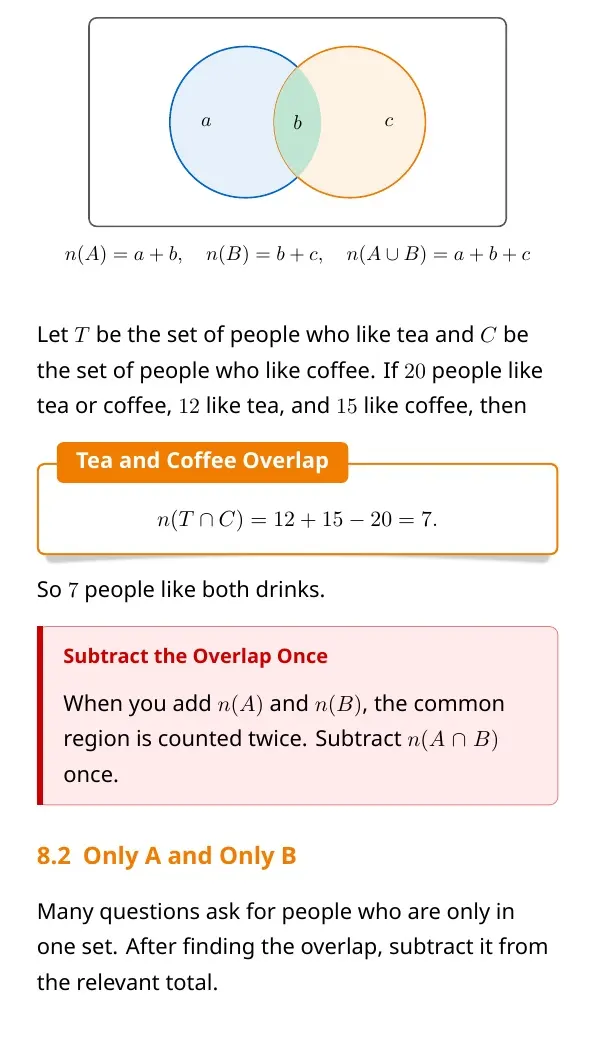
Venn diagrams make these operations visible. In two-set questions, first write the common part in the overlap. Then fill only-A and only-B regions. Finally place elements outside both sets if the universal set count is given. This order prevents double-counting.
- Union: include all regions covered by either set.
- Intersection: include only the common overlap.
- Difference: remove the second set from the first set.
- Complement: work inside the universal set and outside the named set.
Counting Formula for Two and Three Sets
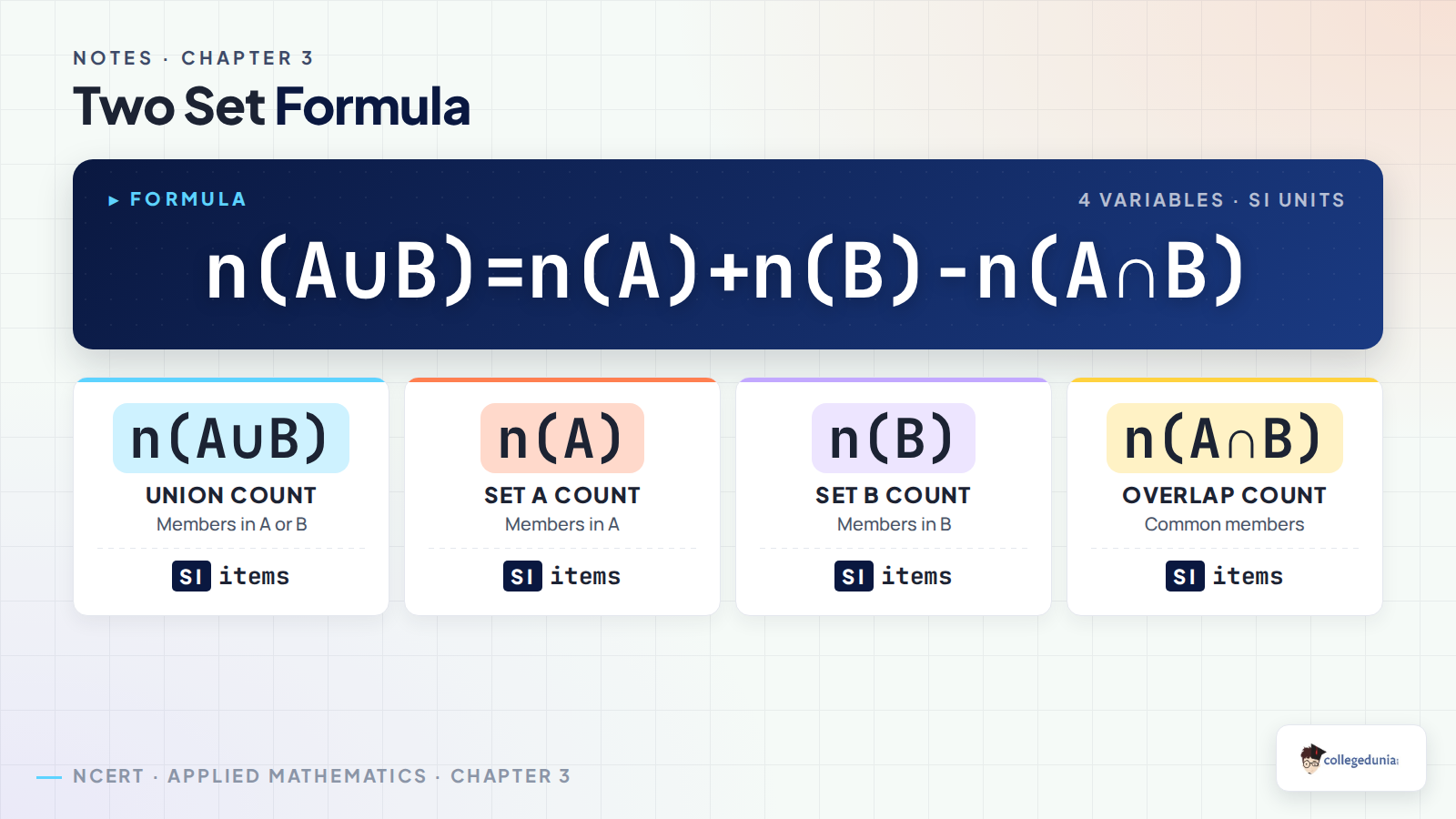
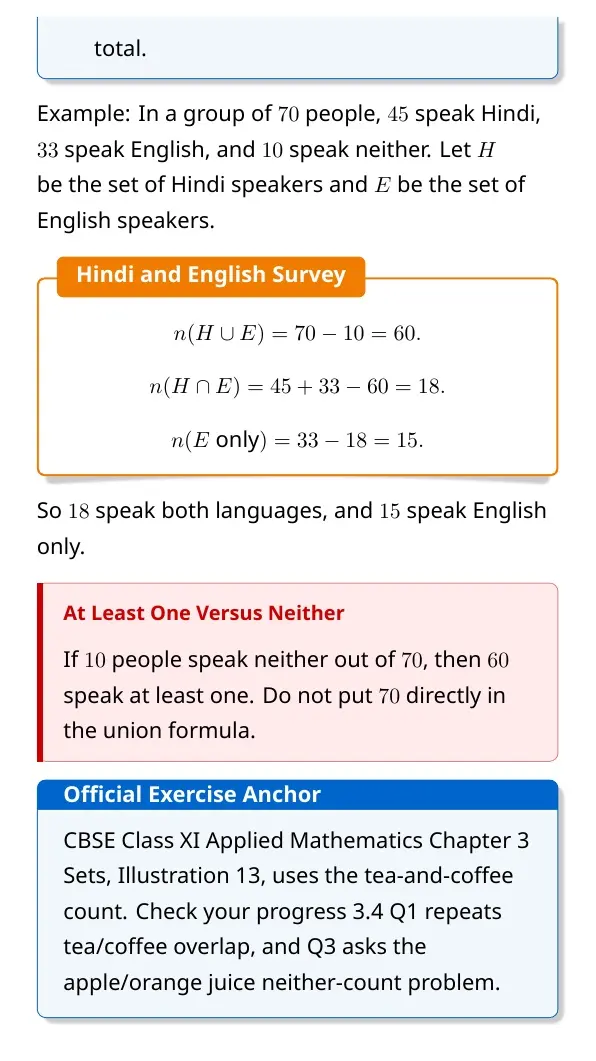
Counting formulas are used when the number of elements in different regions is known. For two finite sets, the most important formula is n(A union B) = n(A) + n(B) - n(A intersection B). The subtraction is needed because common elements are counted once in n(A) and again in n(B).
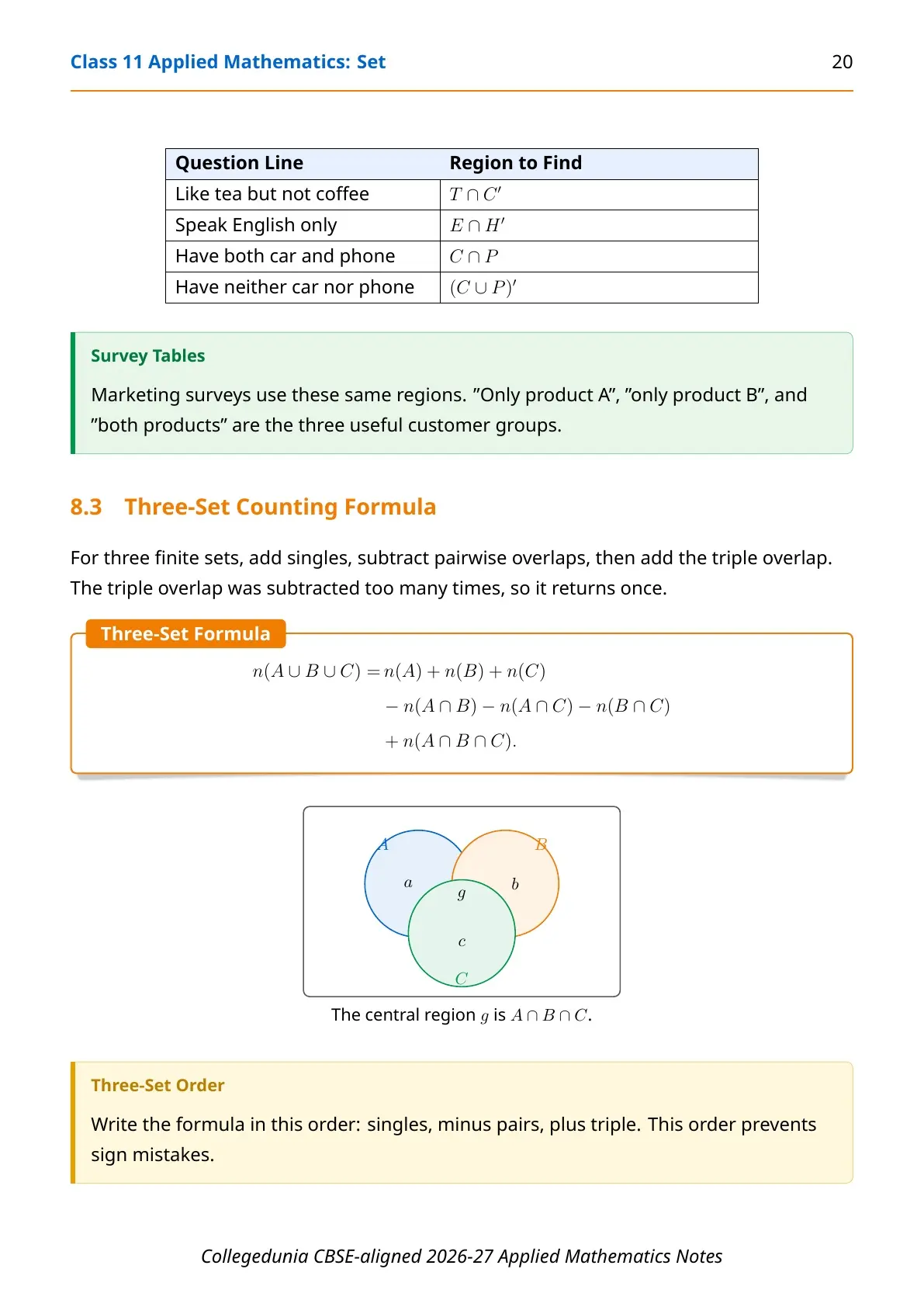
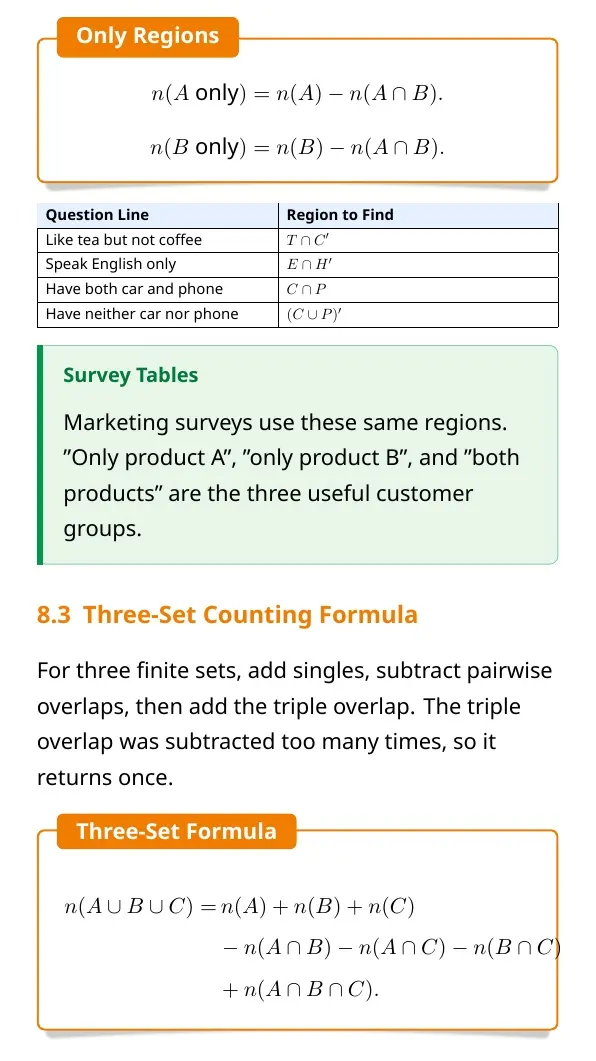
For three finite sets, the formula becomes n(A union B union C) = n(A) + n(B) + n(C) - n(A intersection B) - n(B intersection C) - n(C intersection A) + n(A intersection B intersection C). The last term is added back because it gets subtracted too many times during the pairwise-overlap correction.
| Given data | First move | Final check |
|---|---|---|
| Two sets and overlap | Use the two-set formula | Union cannot exceed universal set |
| Three sets and all overlaps | Use inclusion and exclusion | Triple overlap added at the end |
| Only-A or only-B asked | Subtract overlap from the set count | Only regions must not overlap |
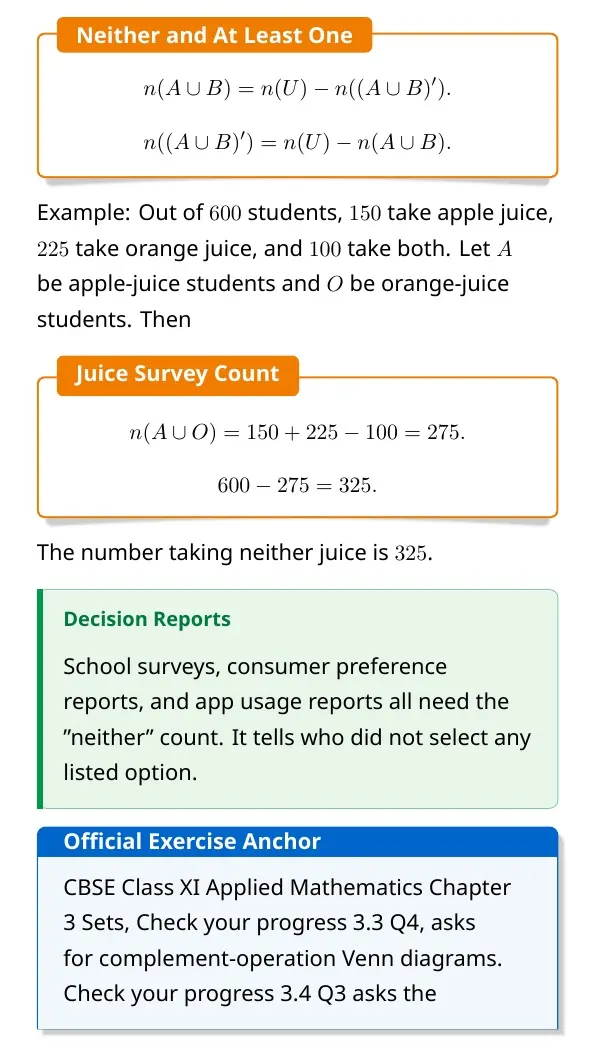
| Neither asked | Universal set minus union | Answer should be non-negative |
Common Mistakes in Set Chapter
Most mistakes in Set are notation mistakes rather than difficult calculations. Students often confuse membership with subset relation. An element belongs to a set, while a set can be a subset of another set. Another common error is treating equivalent sets as equal sets. Equal sets require the same elements, not only the same count.
Counting questions also create errors when students add n(A) and n(B) without subtracting the overlap. In complement questions, the universal set is the first thing to check. A complement taken with respect to the wrong universal set changes the answer completely.
- Do not repeat elements: repeated entries do not increase cardinality.
- Do not mix symbols: use membership for elements and subset relation for sets.
- Do not forget overlap: common members are counted twice in simple addition.
- Do not skip U: complement has meaning only inside the given universal set.
How to Revise Class 11 Applied Mathematics Set Notes
Use these notes in two passes. In the first pass, revise the vocabulary: element, subset, universal set, equal set, equivalent set and power set. In the second pass, solve one example each on roster form, set-builder form, interval notation, two-set counting and Venn diagrams. This keeps the chapter practical and exam-ready.
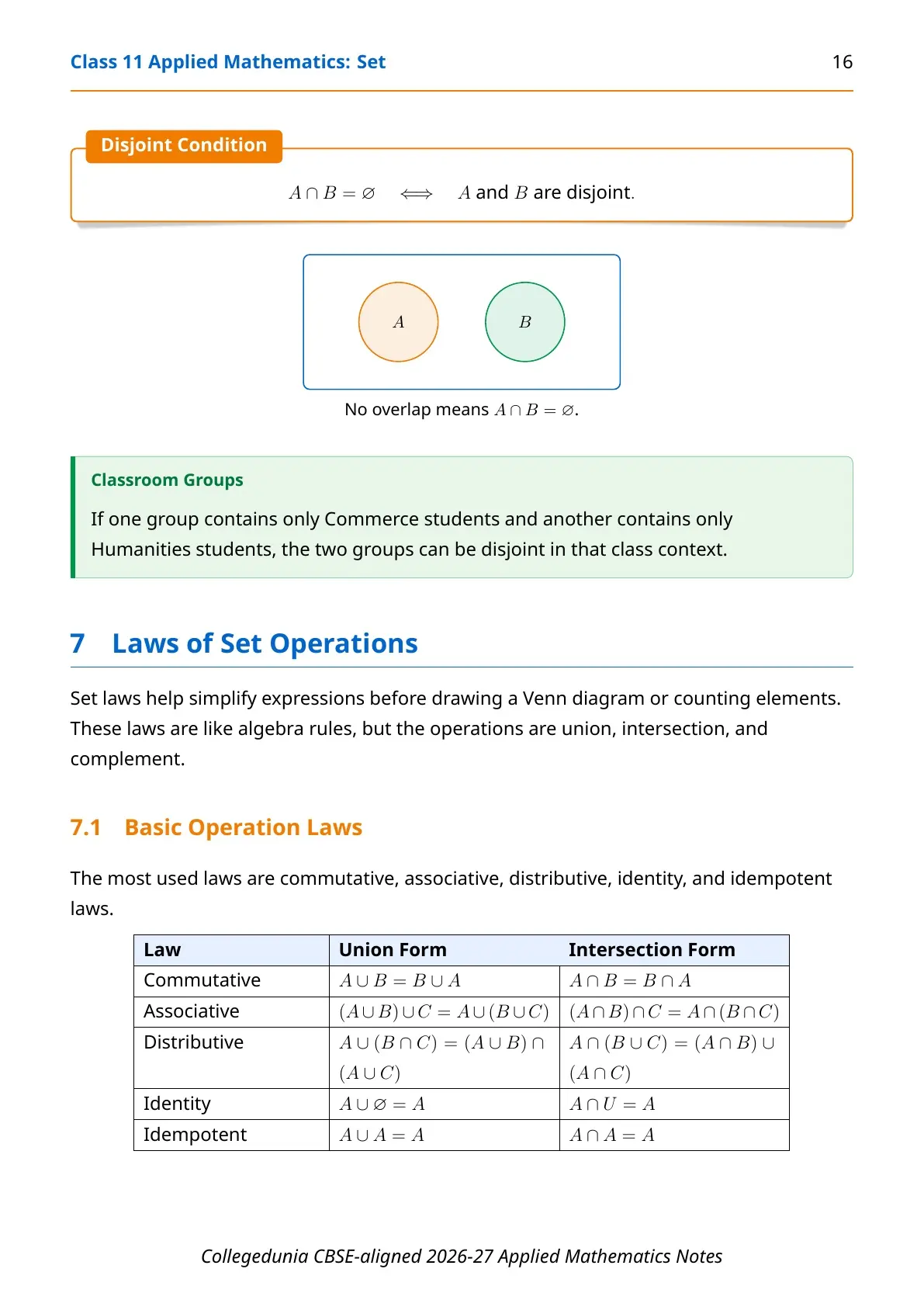
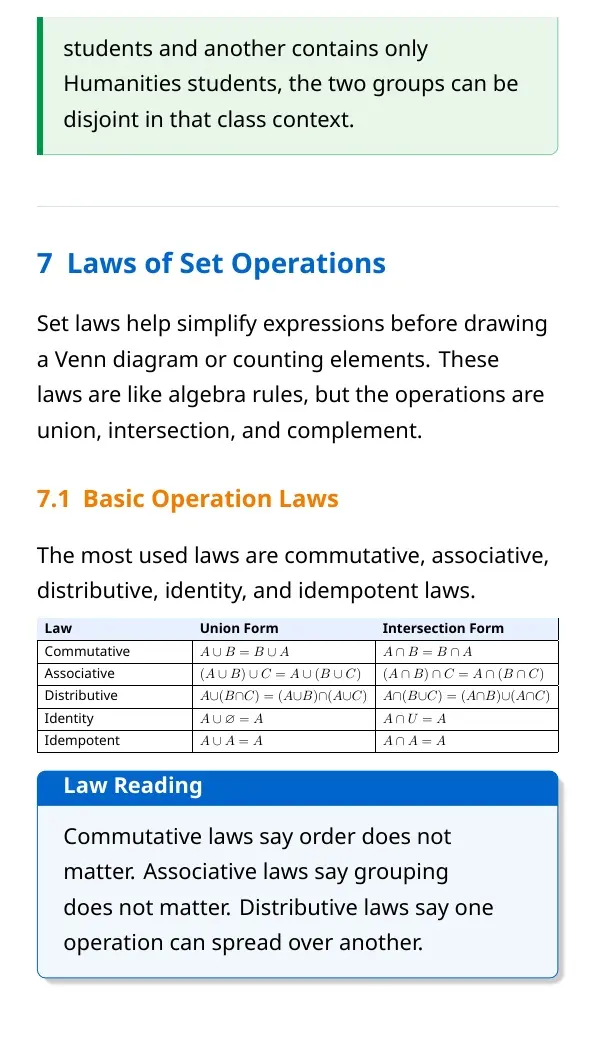
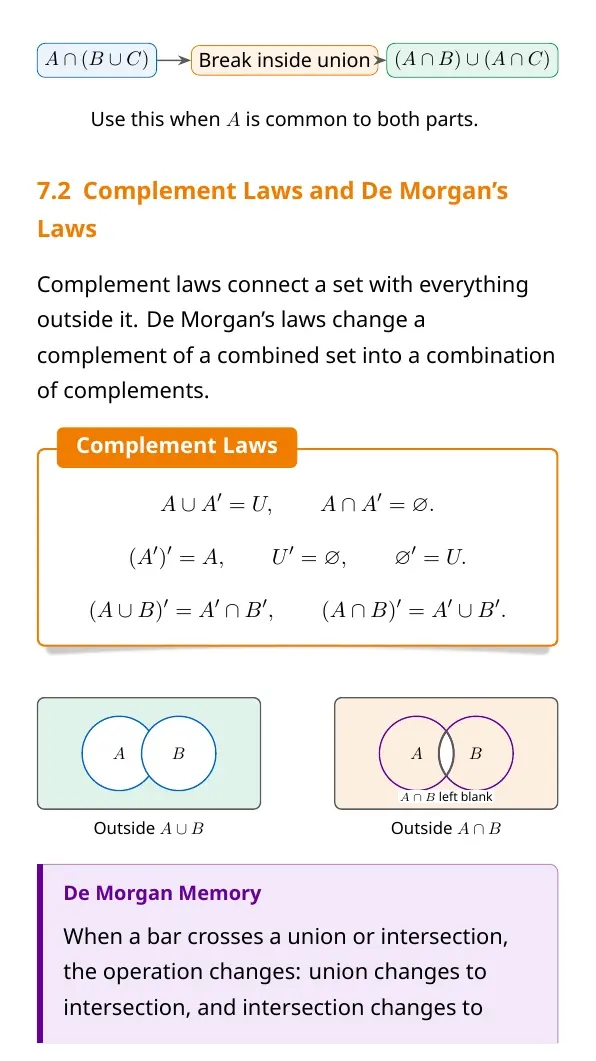
Before a test, make a single-page recall sheet with the subset count, power set count, interval brackets, union formula, three-set formula and De Morgan laws. Then take any solved example from the PDF and cover the final line. If the setup matches your recall sheet, the method is understood.
| Revision slot | What to do | Time |
|---|---|---|
| Vocabulary | Define five set terms from memory | 10 minutes |
| Notation | Convert roster form to set-builder form | 15 minutes |
| Intervals | Write four interval types with inequalities | 10 minutes |
| Venn counting | Solve one two-set and one three-set example | 25 minutes |
Related Resources for Set
| Resource | Use it for | Link |
|---|---|---|
| NCERT Book PDF | Official chapter explanation and exercise prompts | Set Class 11 NCERT Book PDF |
| NCERT Solutions | Step-by-step answers for chapter questions | Set Class 11 NCERT Solutions |
| Formula Sheet | Formula and symbol revision for operations on sets | Set Class 11 Formula Sheet |
| Handwritten Notes | Quick visual recall before class tests | Set Class 11 Handwritten Notes |
Class 11 Applied Mathematics Notes for All Chapters
Set Class 11 Applied Mathematics FAQs
Ques. What is covered in Class 11 Applied Mathematics Chapter 3 Set?
Ans. It covers set representation, types of sets, subsets, power set, universal set, intervals, Venn diagrams and set operations for the 2026-27 CBSE syllabus.
Ques. What is the difference between roster form and set-builder form?
Ans. Roster form lists the elements inside braces, while set-builder form writes a rule that all elements of the set satisfy.
Ques. How many subsets does a set with n elements have?
Ans. A set with n elements has 2n subsets. Its proper subsets are one less than this count when the full set itself is excluded.
Ques. Why is the universal set important in complement questions?
Ans. The complement of a set means all elements that are outside it but still inside the universal set, so the answer depends on the given universal set.



Comments