



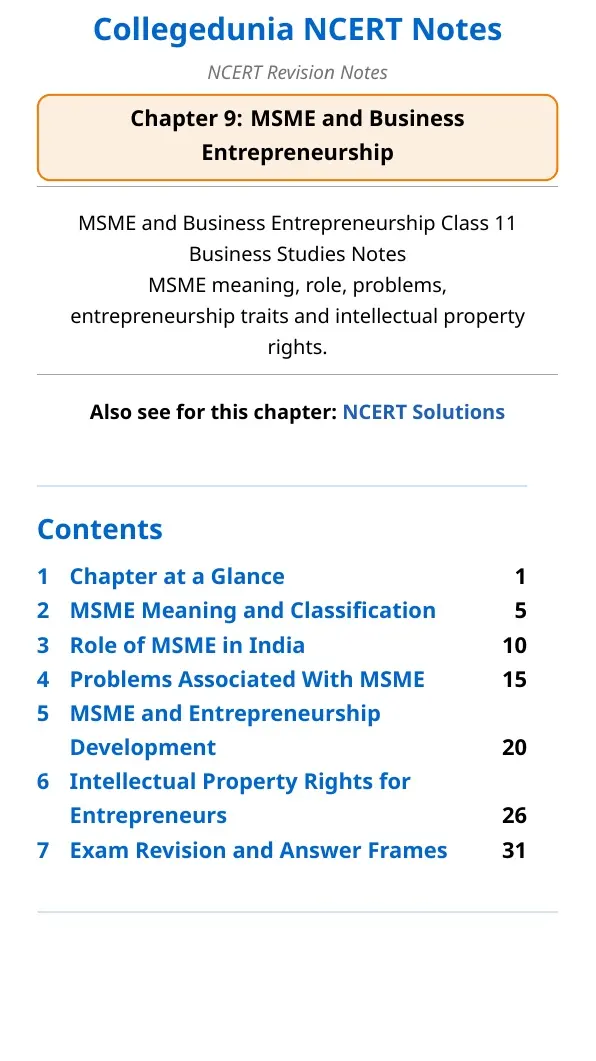
The MSME and Business Entrepreneurship Class 11 notes explain micro, small and medium enterprises, their role in India, major problems faced by MSMEs, entrepreneurship development and intellectual property rights for the 2026-27 NCERT syllabus. Use this page for quick revision, then open the PDF for tables, diagrams and answer frames.
- Download the 20-page Class 11 Business Studies Chapter 9 notes PDF for offline study.
- Revise MSME classification, role, problems, entrepreneurship traits and IPR types.
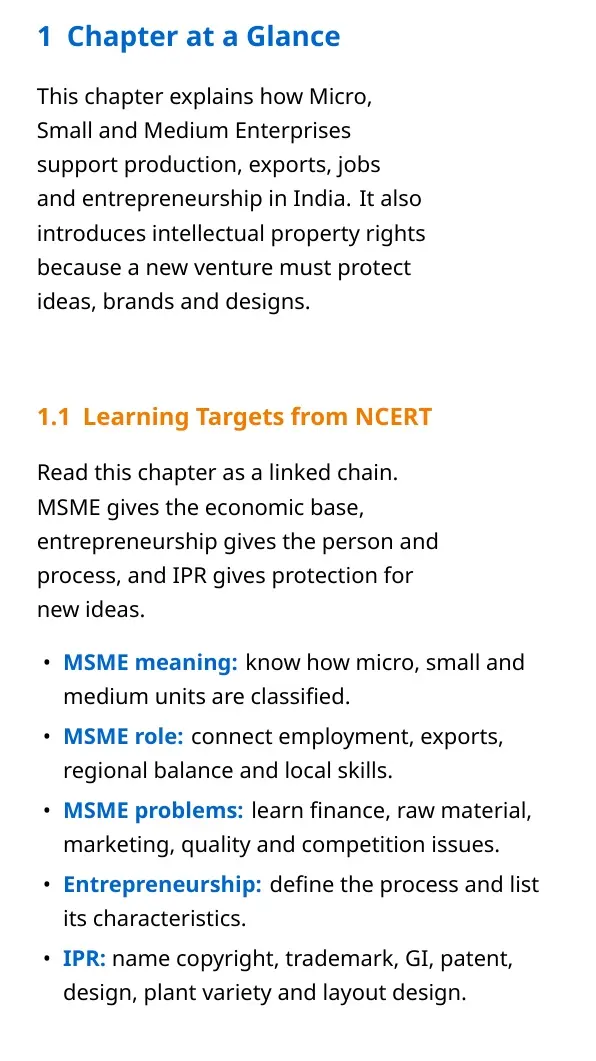
- Student focus: connect local skill, innovation and legal protection instead of learning the chapter as separate lists.
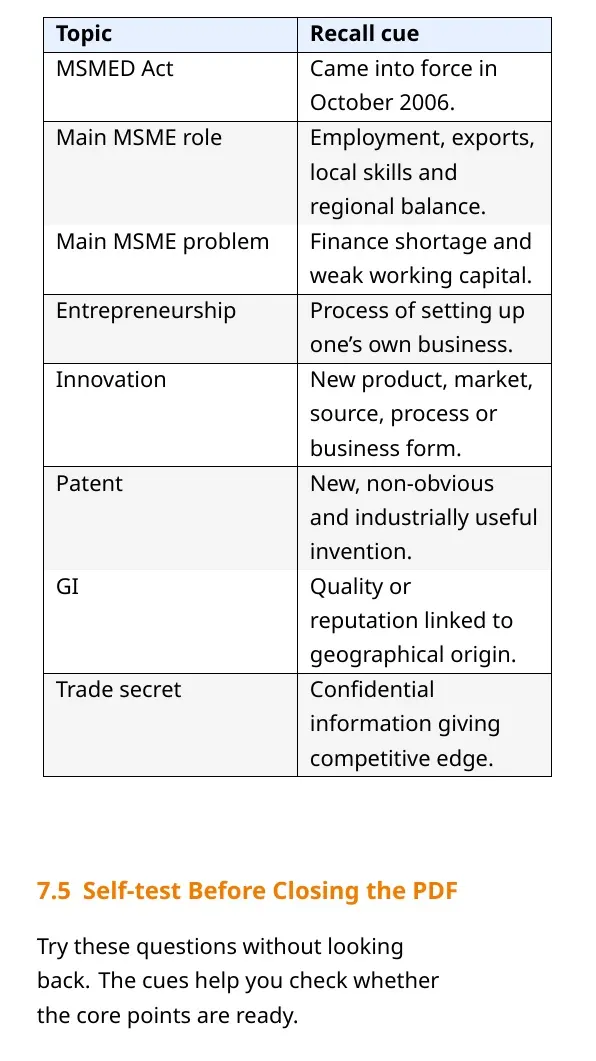
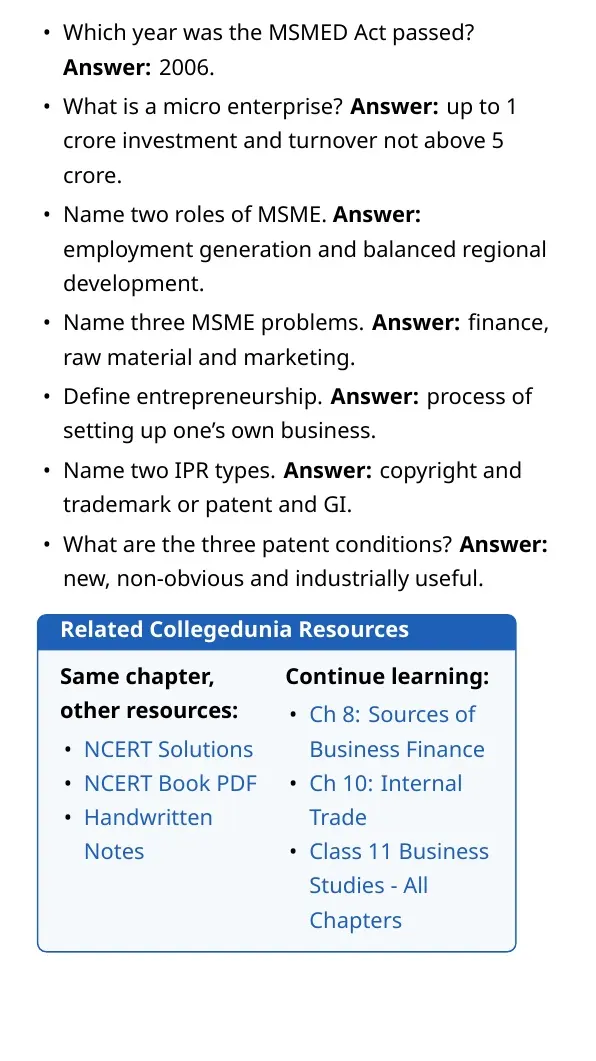
These Class 11 Business Studies notes are checked against the 2026-27 NCERT chapter and written for quick Commerce revision.
Student Feedback on MSME and Business Entrepreneurship
In a Collegedunia poll of 12,120 Class 11 Commerce students before the 2026 exams, many students said Chapter 9 became easier once MSME facts, problems and entrepreneurship points were revised through separate answer frames.
- 81% wanted one table for micro, small and medium enterprise limits.
- 69% mixed the role of MSME with the problems faced by MSME.
- 61% needed a simple comparison between MSME and entrepreneurship. The PDF includes both comparison and memory frames.
Source: 2026-27 Class 11 Commerce student poll. Sample of 12,120 students from CBSE schools across 14 states.
|
Table of Contents |
MSME and Business Entrepreneurship Class 11 Quick Map
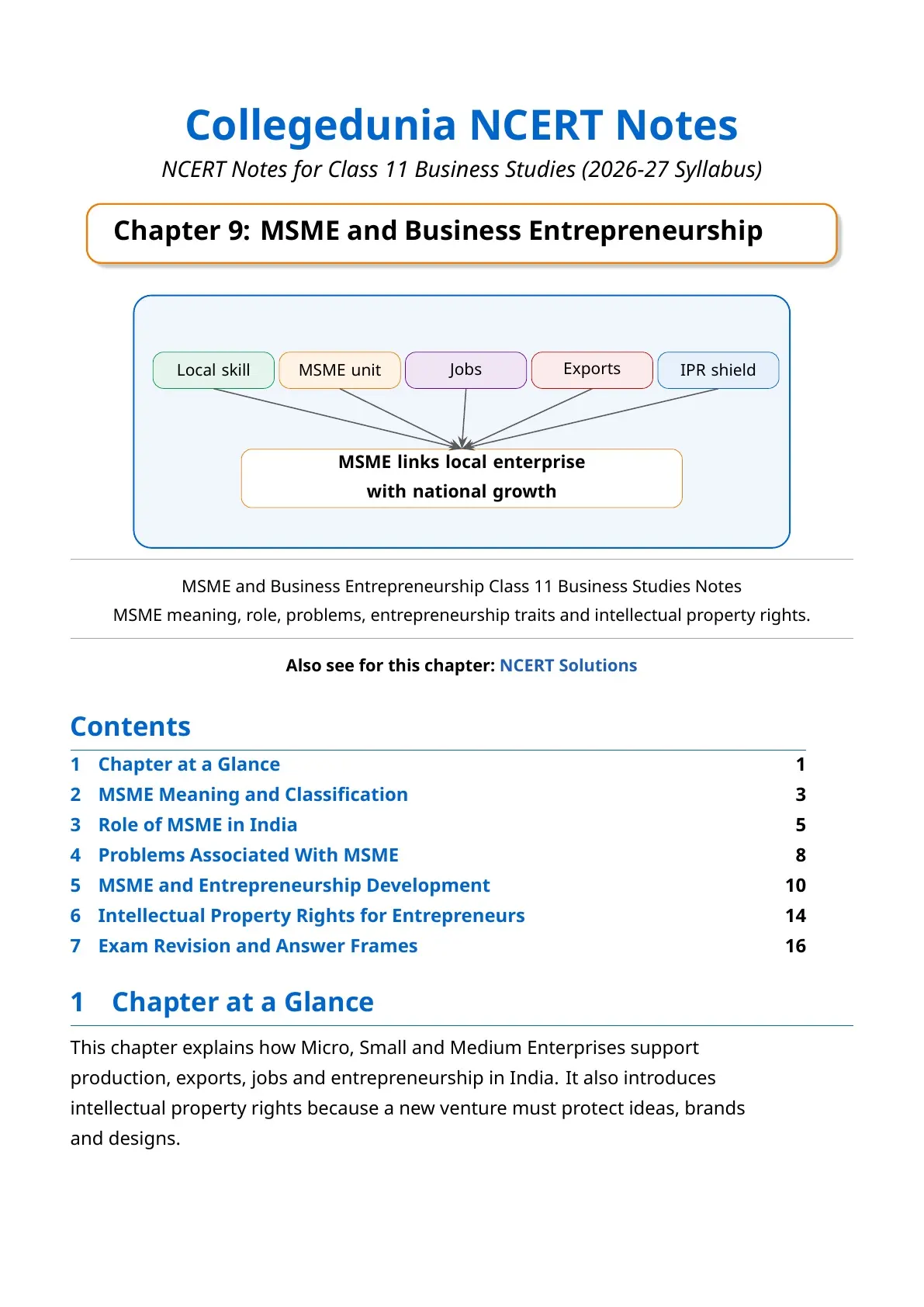
Chapter 9 shows how small business activity supports national growth. MSMEs provide production, employment, exports and local enterprise. Entrepreneurship explains the human process behind starting and growing such ventures. IPR protects the ideas, brands and designs that entrepreneurs create.
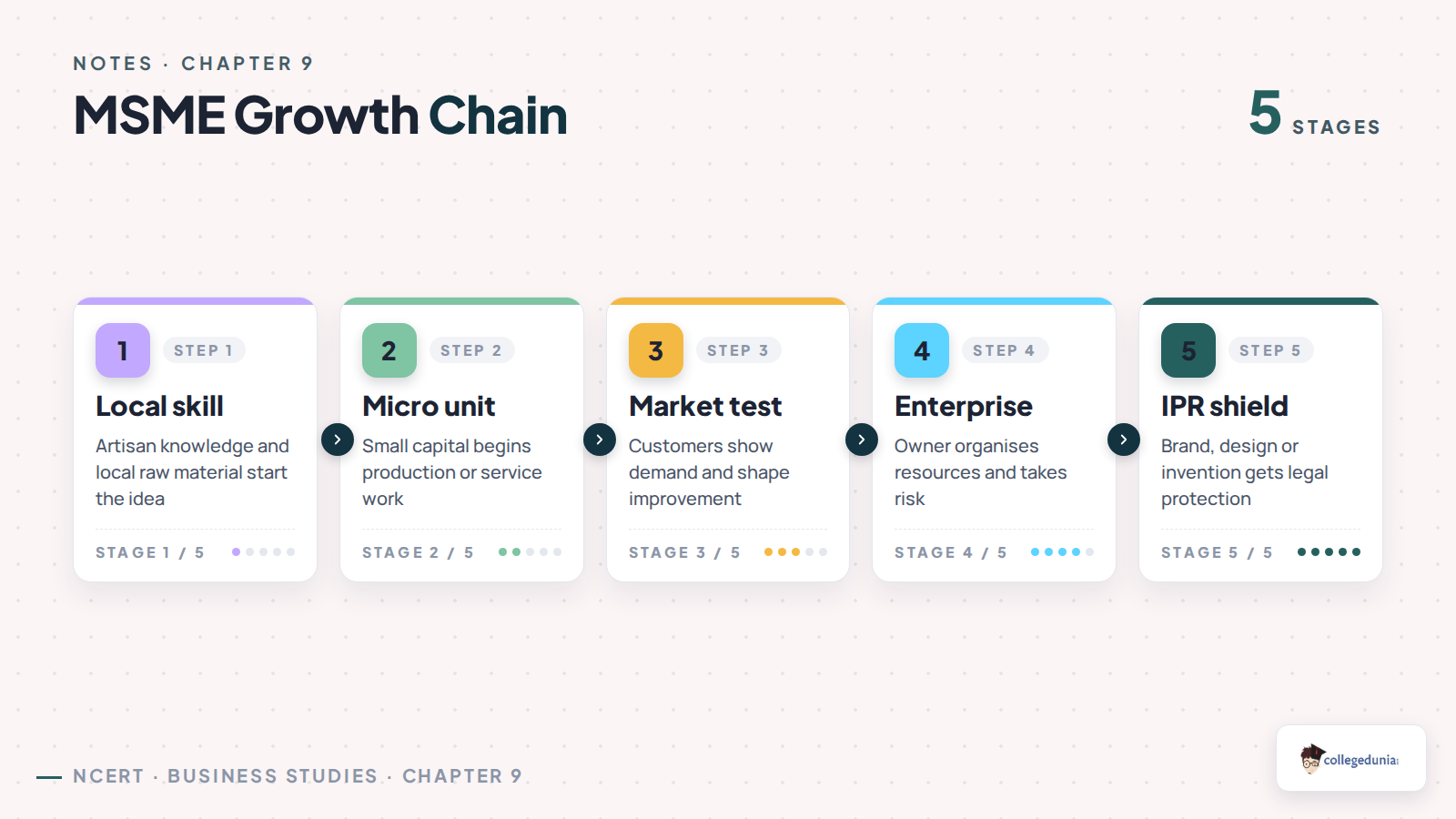
- MSME meaning: micro, small and medium enterprises are classified by investment and turnover.
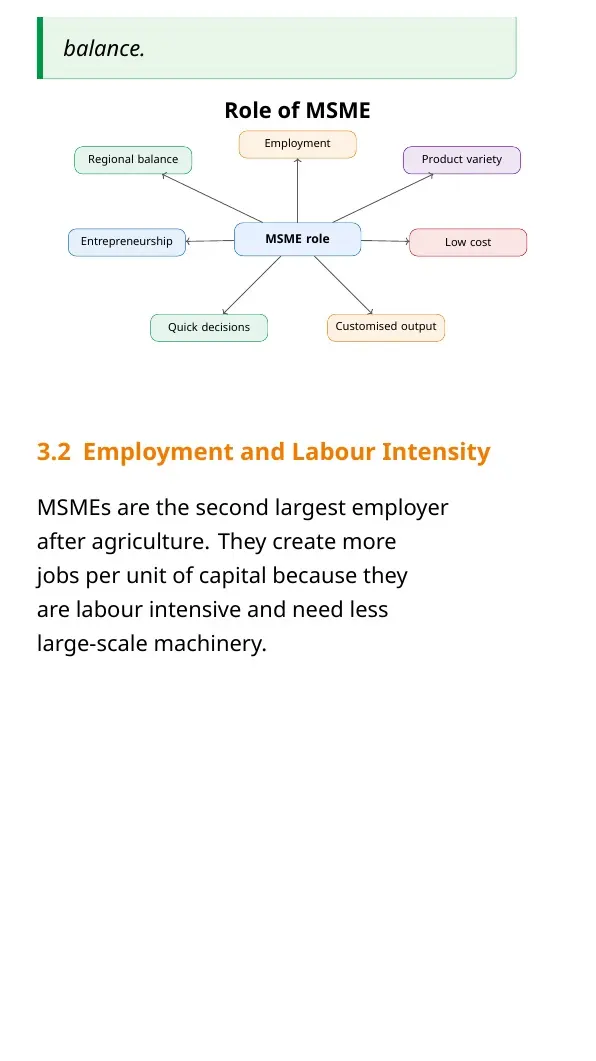
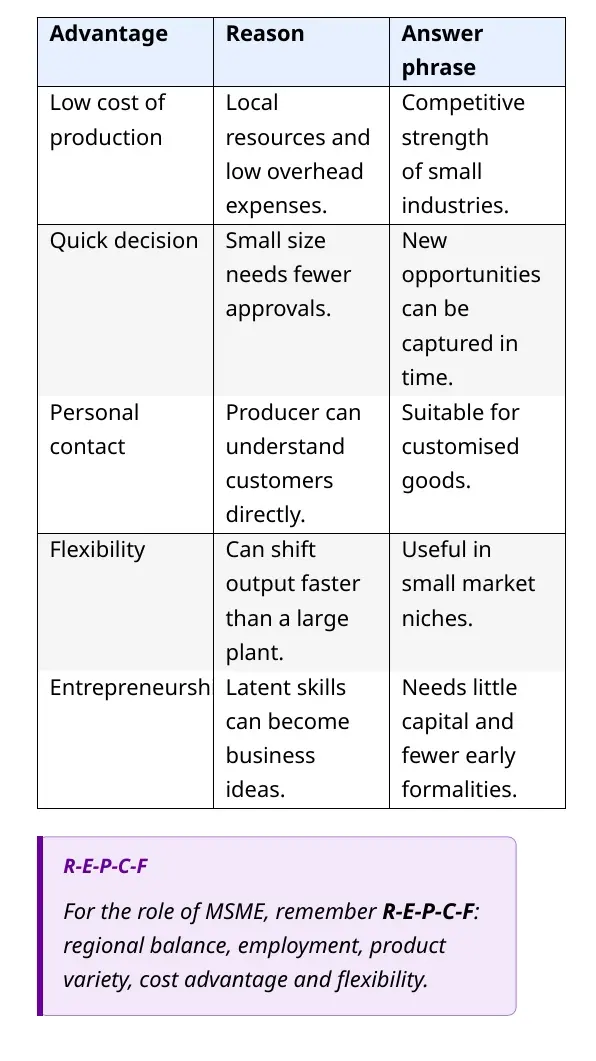
- MSME role: they support jobs, exports, regional balance, product variety and entrepreneurship.
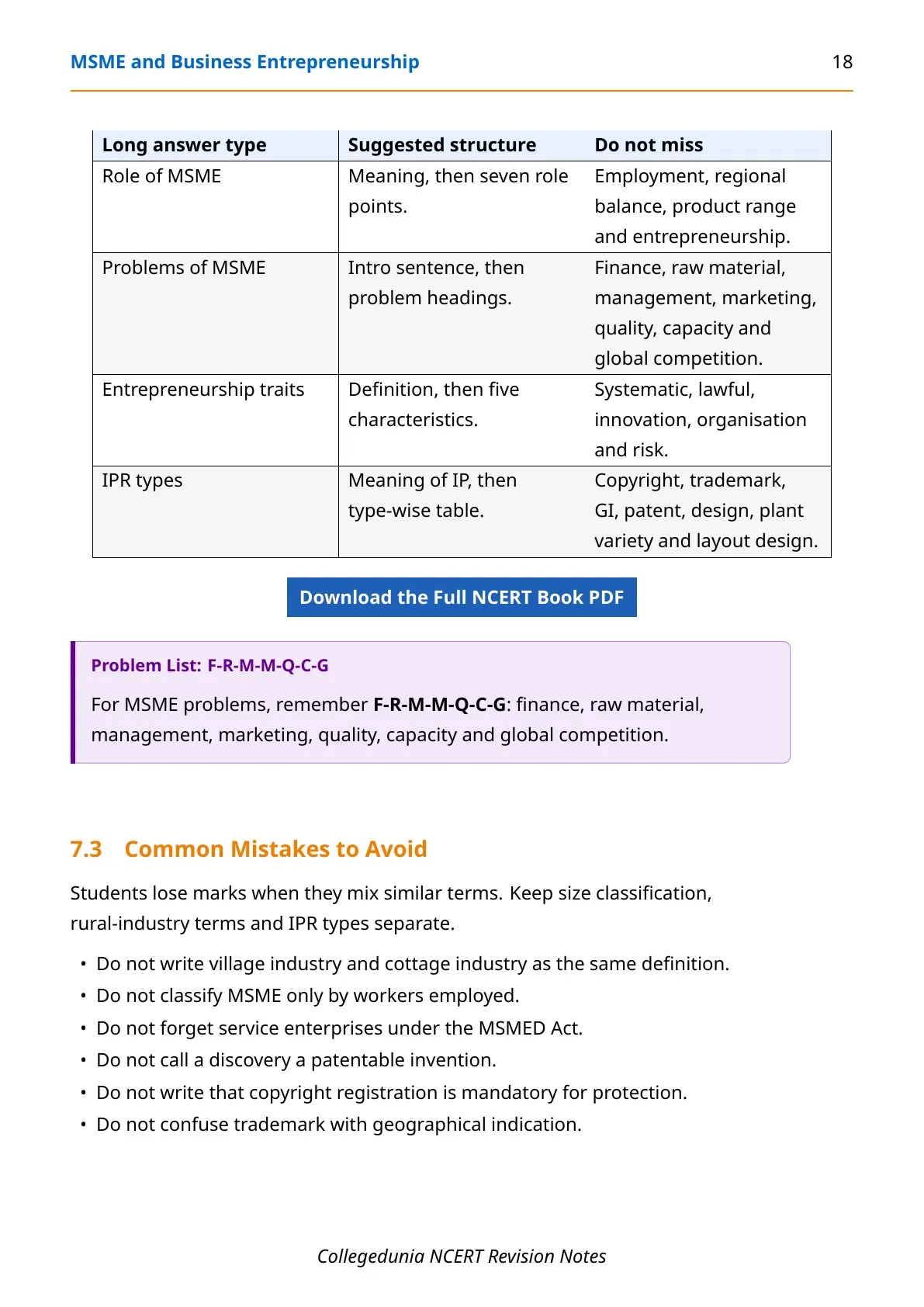
- MSME problems: finance, raw material, marketing, quality and competition issues must be revised together.
- Entrepreneurship and IPR: innovation needs both initiative and legal protection.
MSME Meaning and Classification
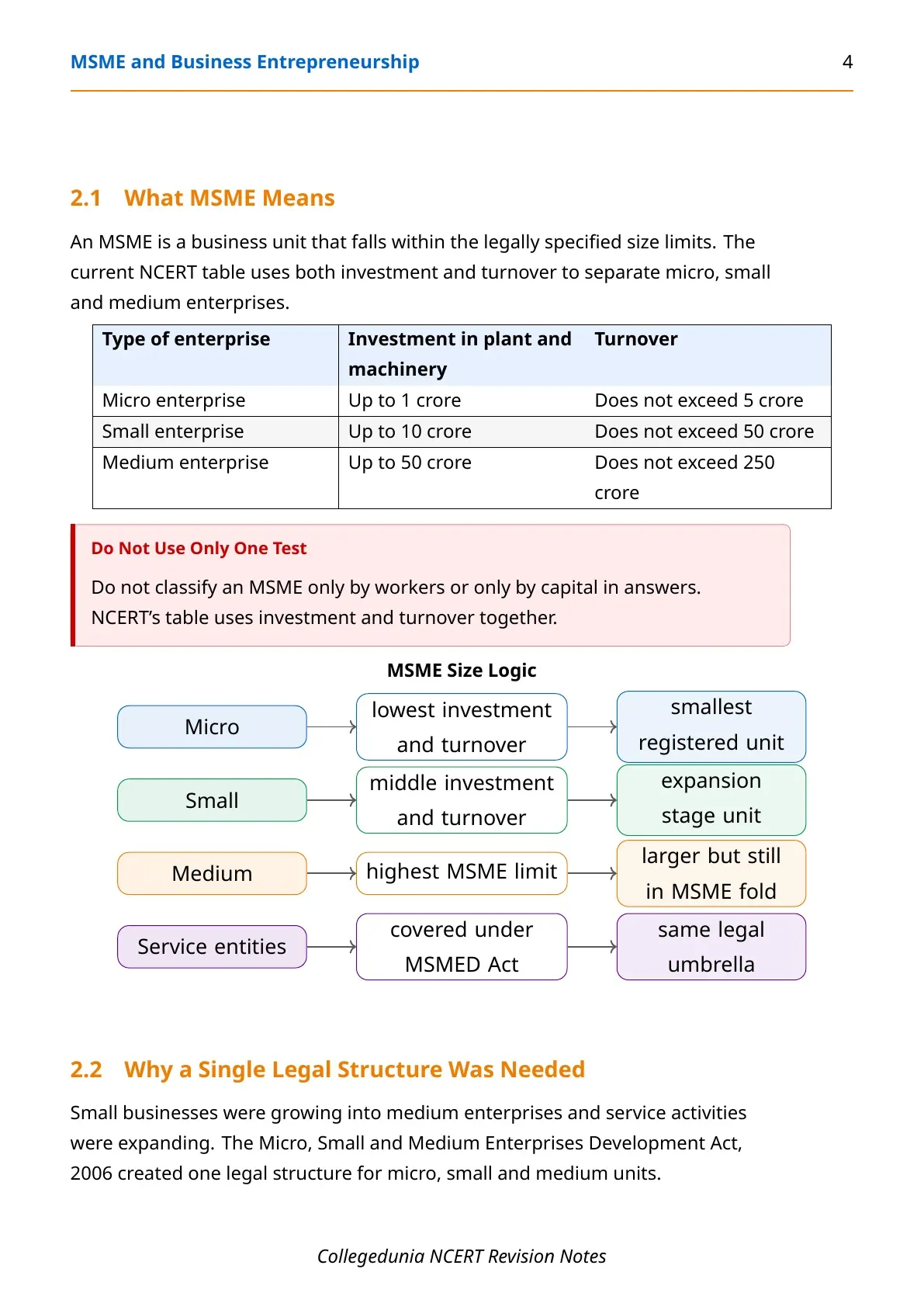
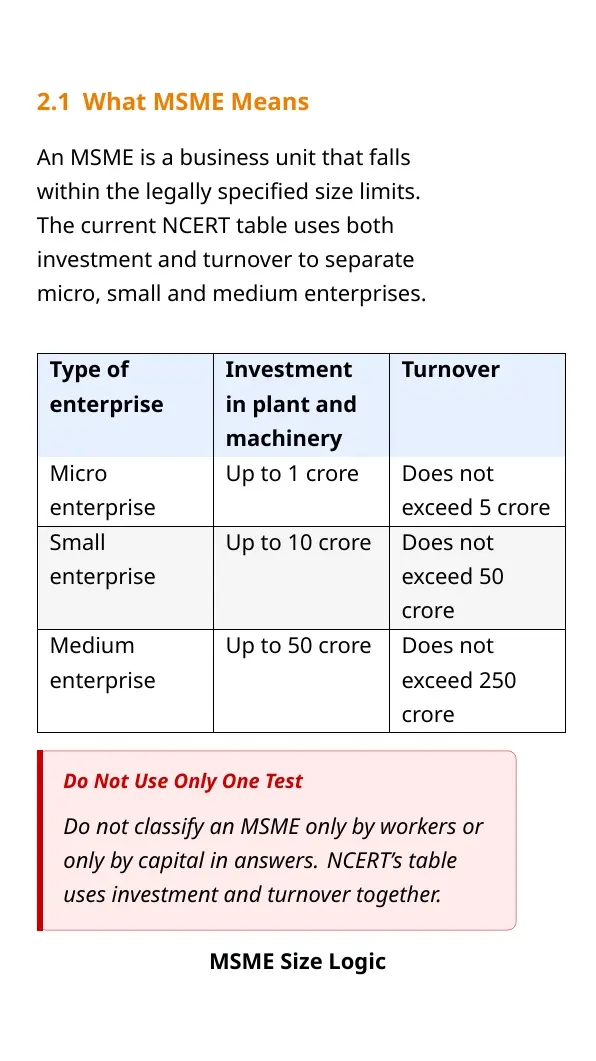
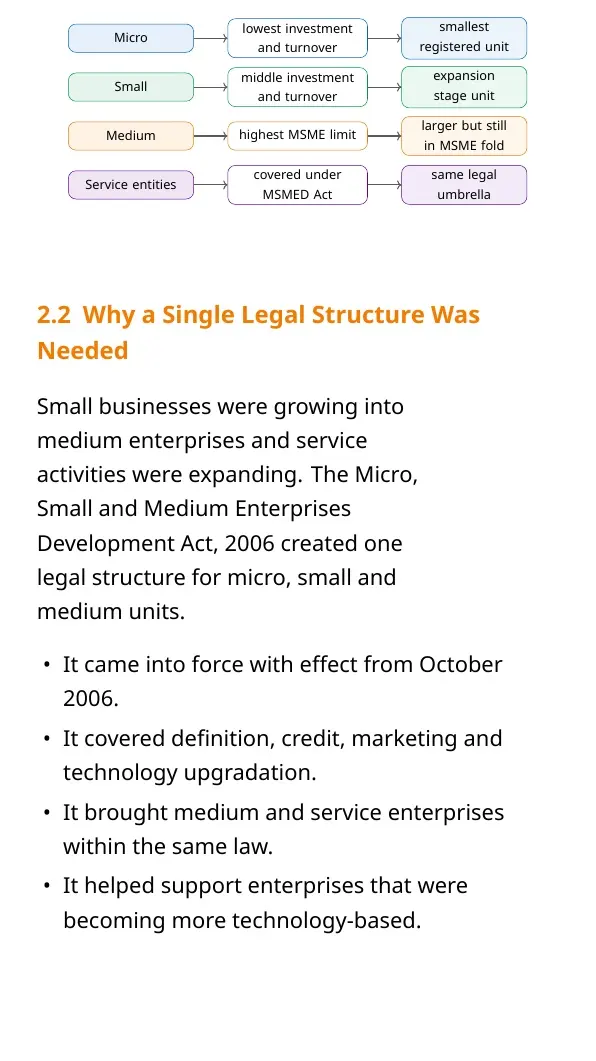
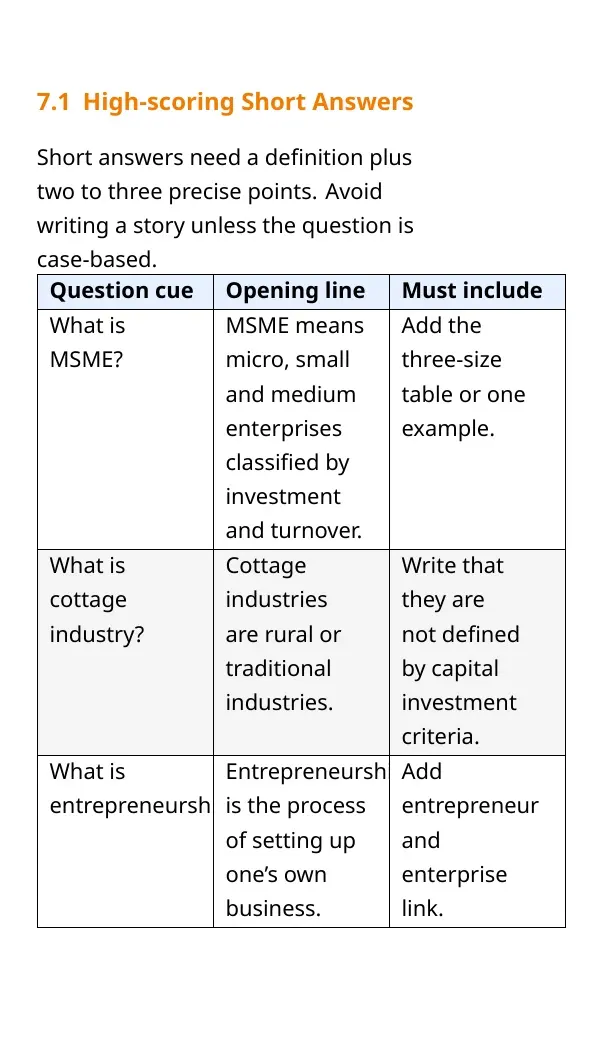
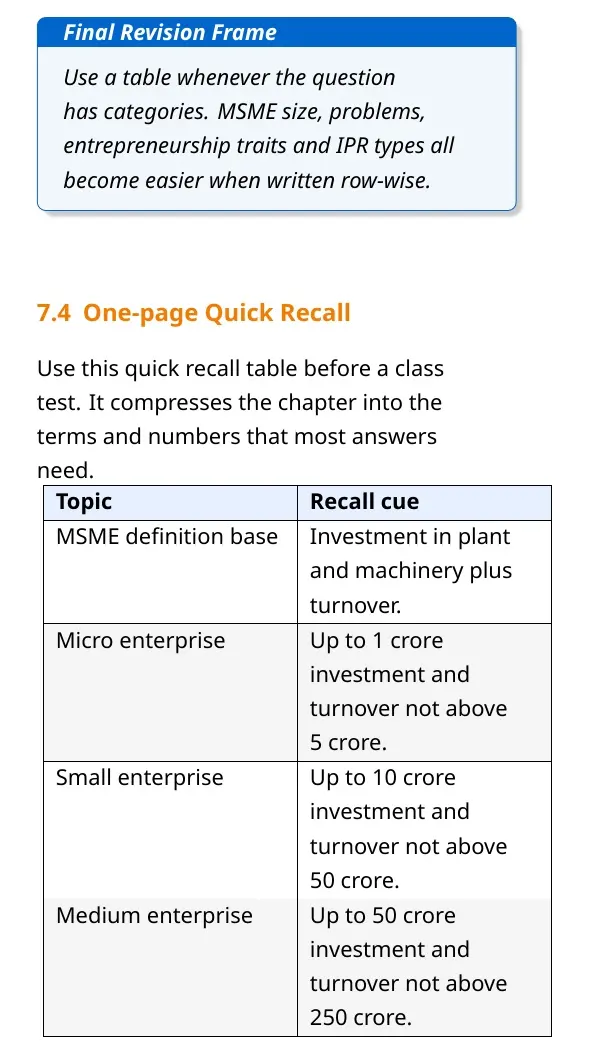
MSME stands for Micro, Small and Medium Enterprises. NCERT explains that the Government of India classifies MSMEs using investment in plant and machinery and turnover. This matters because India has scarce capital but abundant labour, so a size test must reflect the Indian business environment.
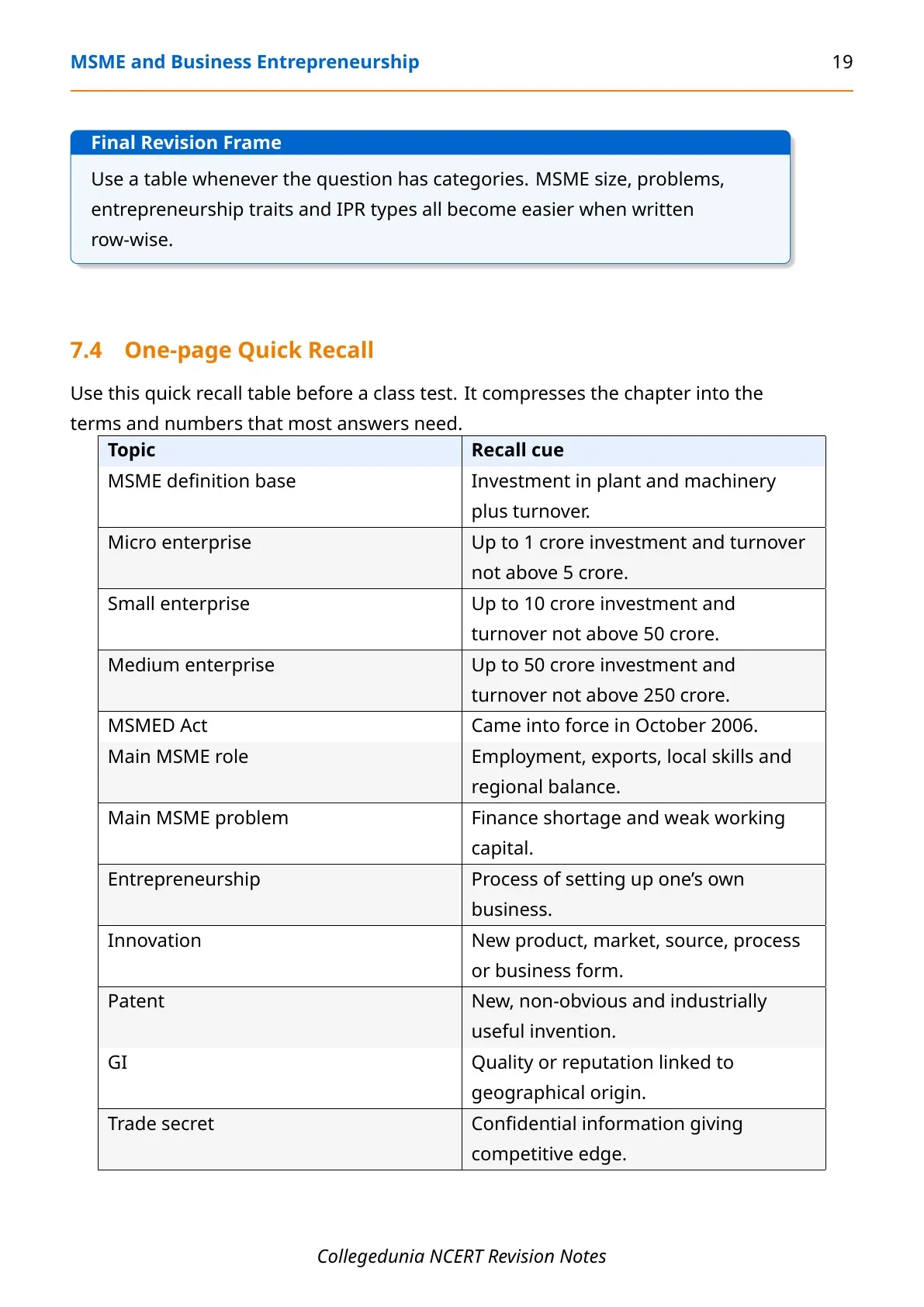
| Type of enterprise | Investment in plant and machinery | Turnover limit |
|---|---|---|
| Micro enterprise | Up to 1 crore | Does not exceed 5 crore |
| Small enterprise | Up to 10 crore | Does not exceed 50 crore |
| Medium enterprise | Up to 50 crore | Does not exceed 250 crore |
Exam tip: do not classify MSME only by workers or only by capital. The NCERT table uses both investment and turnover.
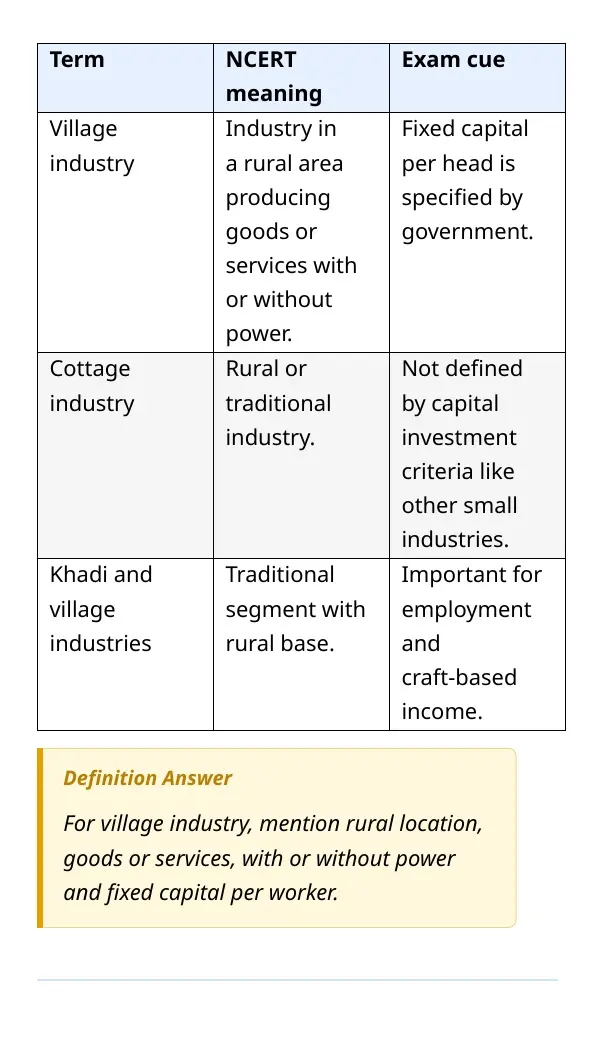
Village Industries and Cottage Industries
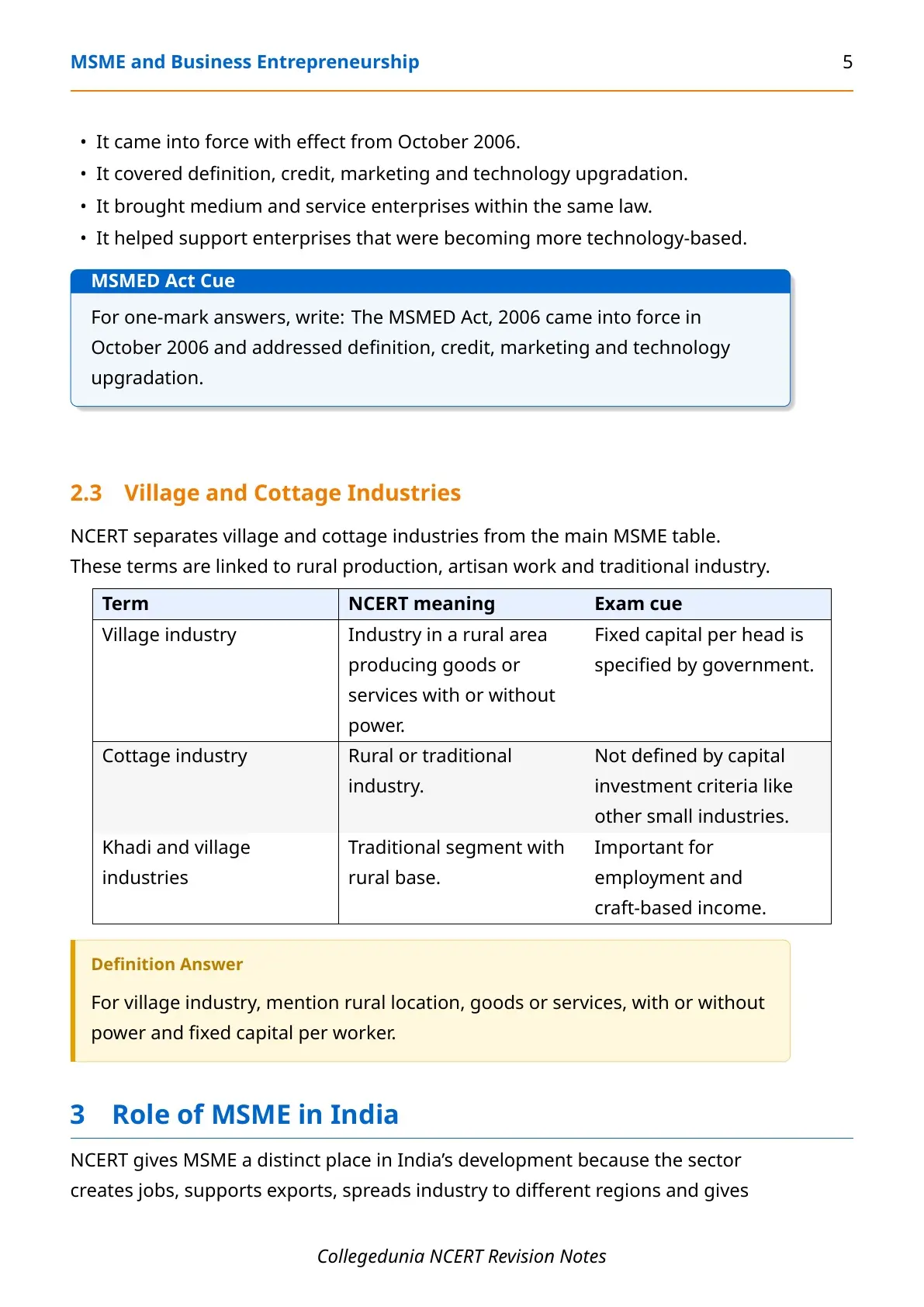
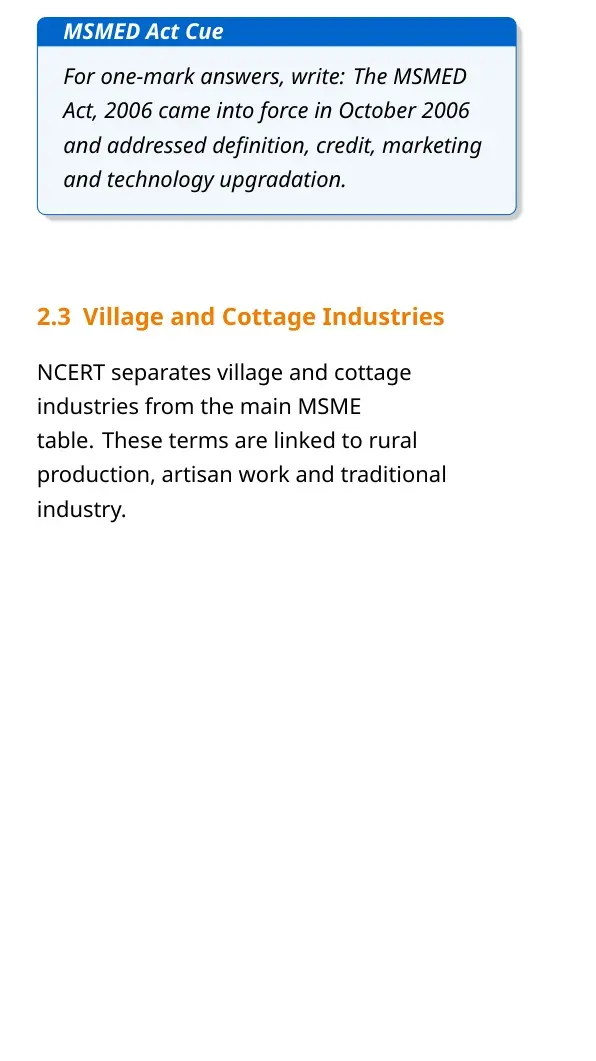
NCERT also separates village and cottage industries because they are linked with rural work, artisans and traditional skills. A village industry is located in a rural area and produces goods or services with or without power. Cottage industries are rural or traditional industries and are not defined by capital investment criteria like other small-scale industries.
| Term | Meaning | Answer cue |
|---|---|---|
| Village industry | Rural industry producing goods or services with or without power | Mention fixed capital per head or worker when required |
| Cottage industry | Rural or traditional industry | Do not use the normal capital-investment test |
| Khadi and village industries | Traditional segment with rural employment value | Useful in role and regional balance answers |
Role of MSME in India
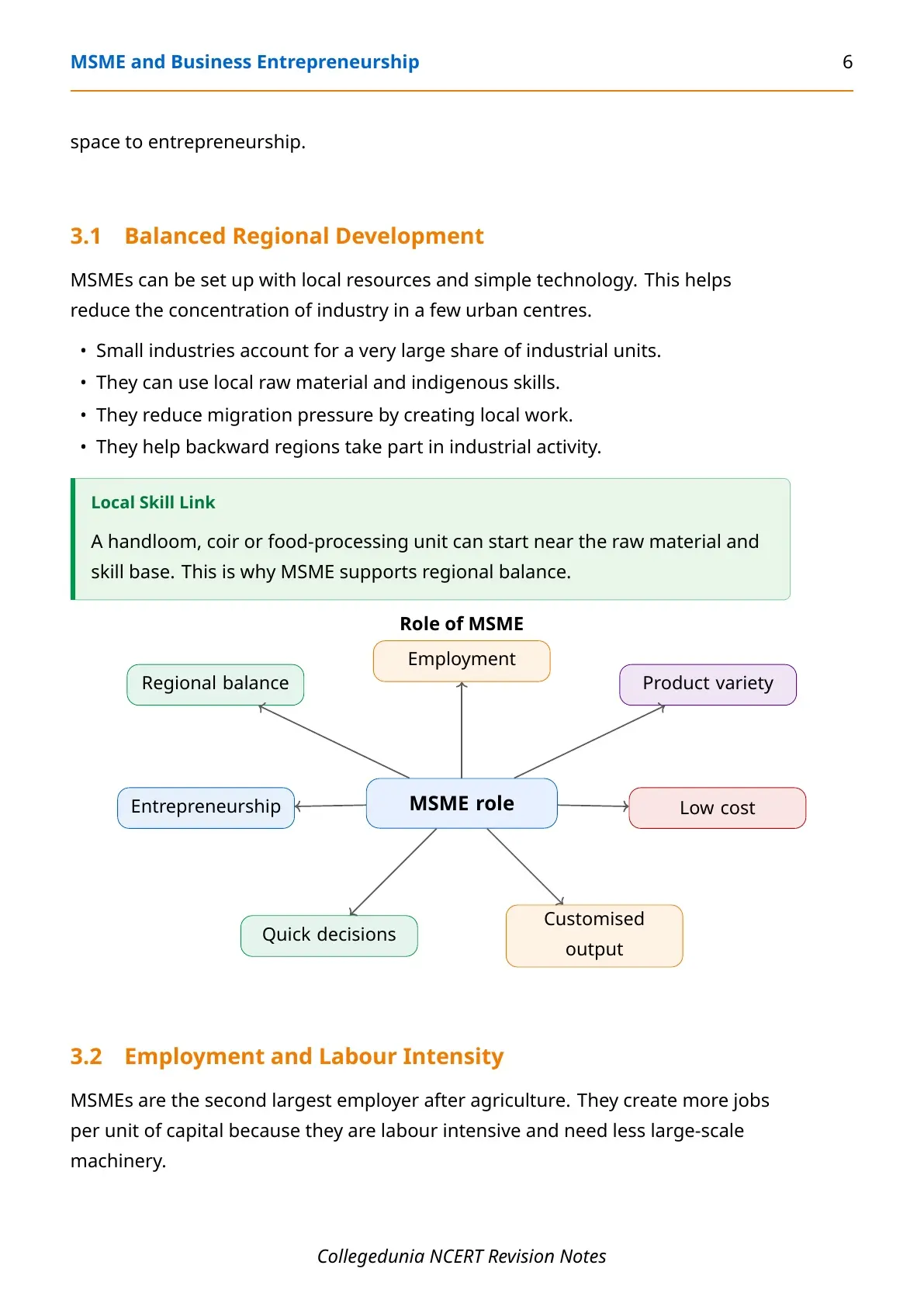
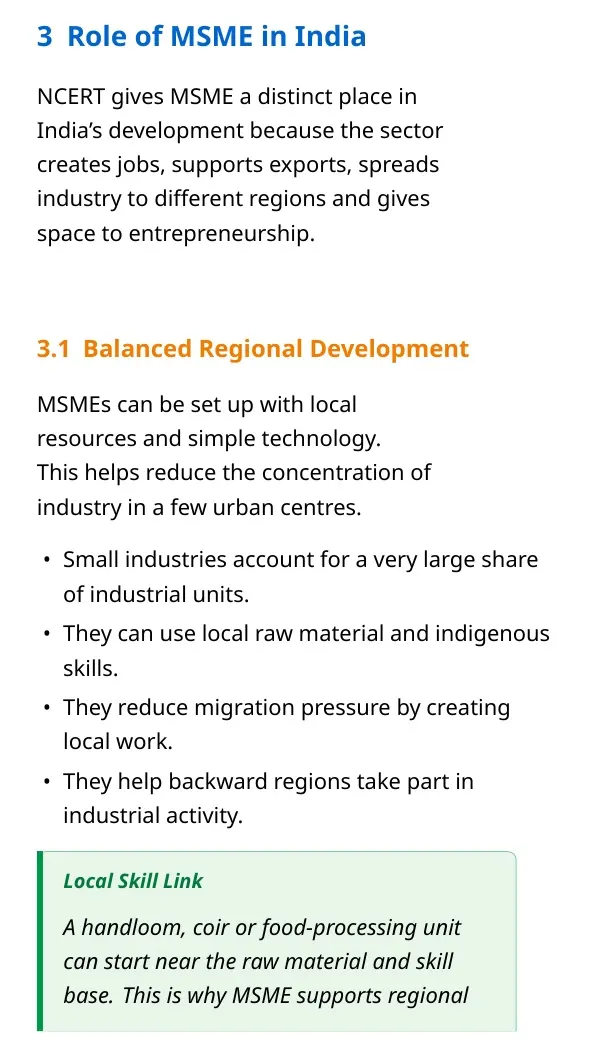
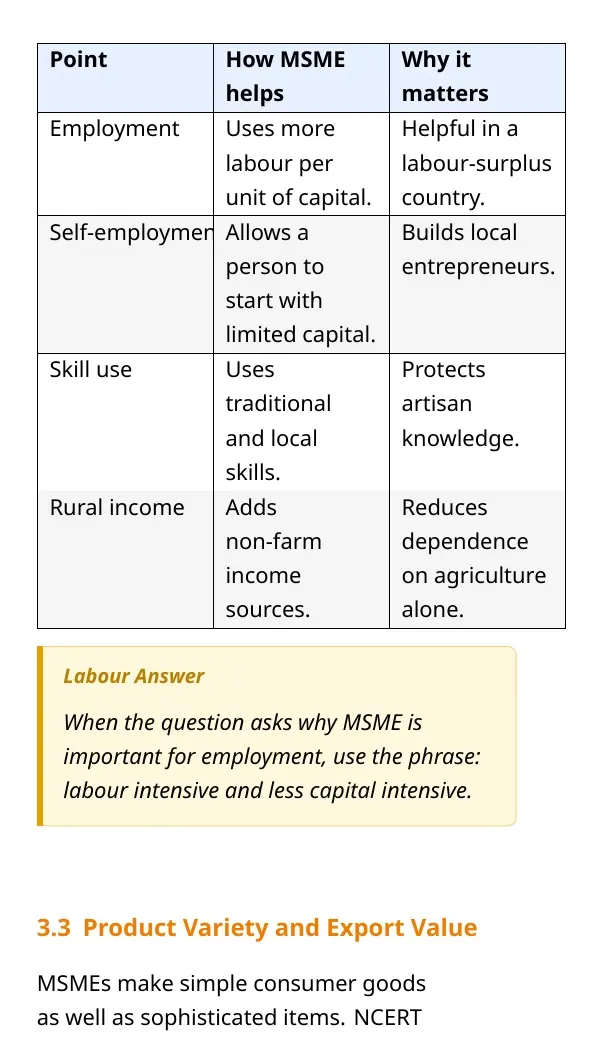
MSMEs hold a distinct place in Indian development because they create jobs, widen the entrepreneurial base and spread industry beyond large cities. NCERT highlights that MSMEs contribute to GDP, exports, employment and value-chain support for large industries.
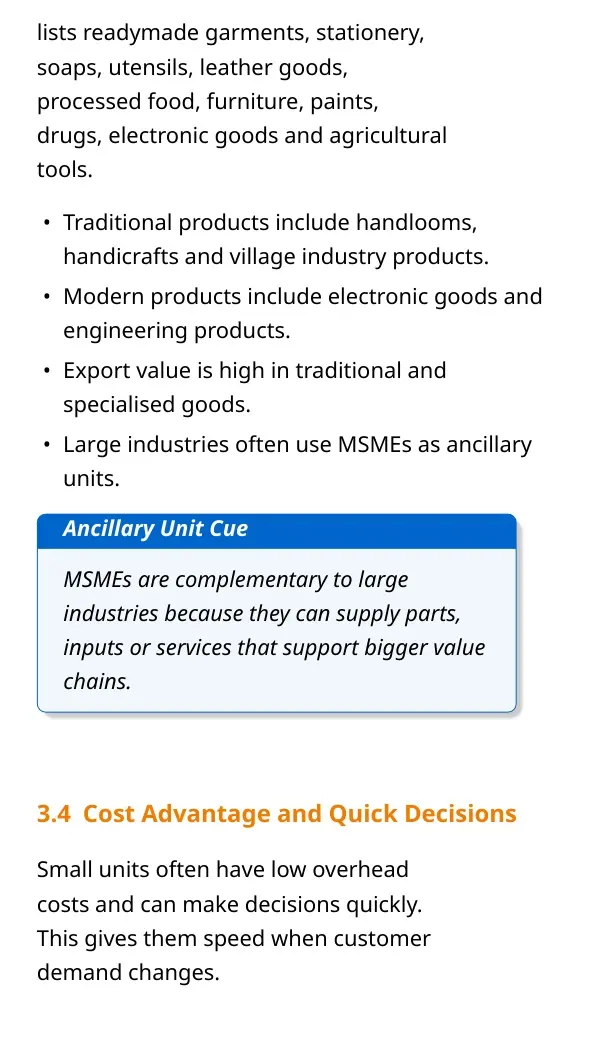
- Balanced regional development: MSMEs can use local resources and indigenous skills.
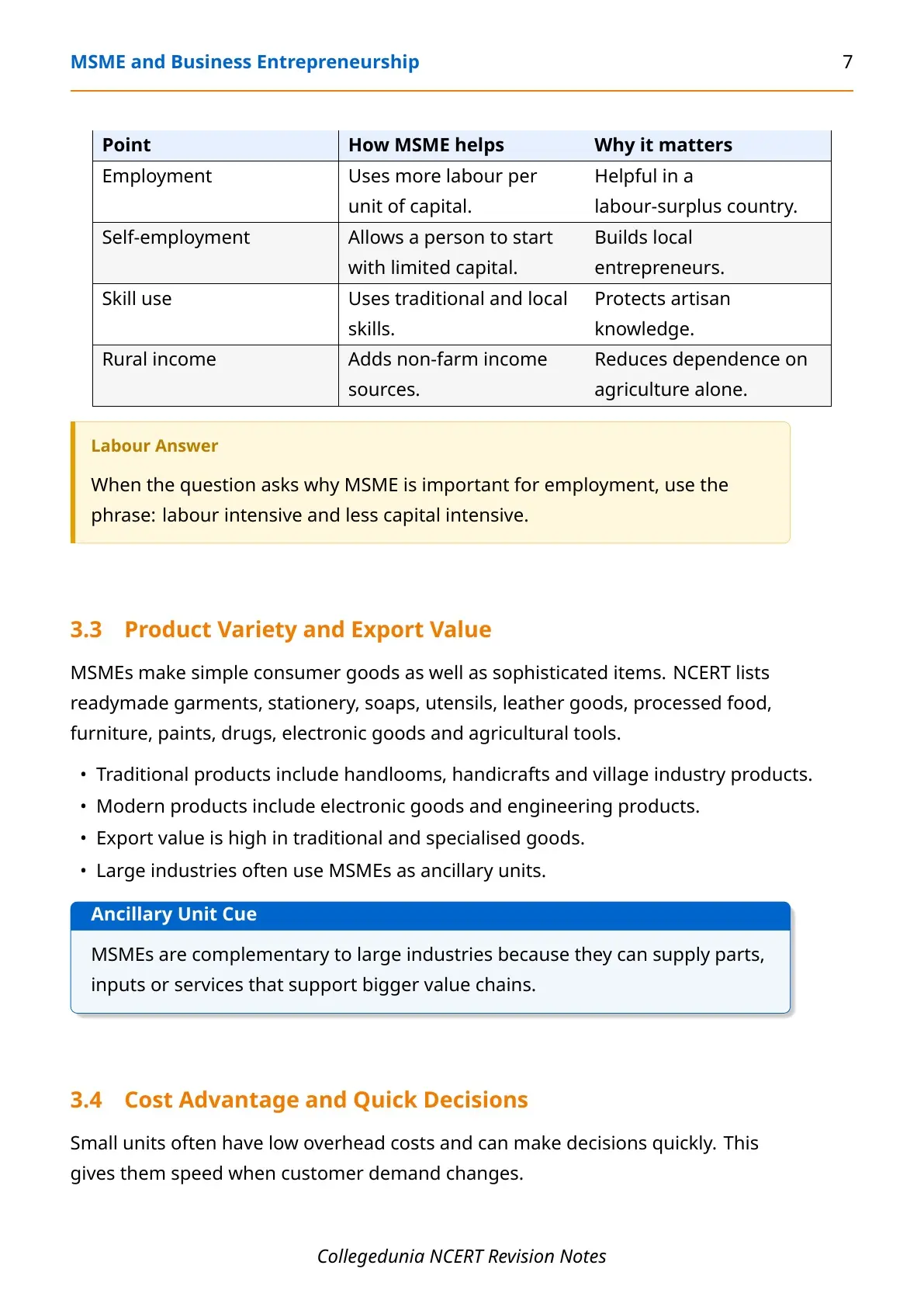
- Employment creation: labour-intensive units help a labour-surplus country like India.
- Product variety: MSMEs make consumer goods, handicrafts, engineering goods and many specialised items.
- Support to large industry: ancillary units help large firms through components and services.
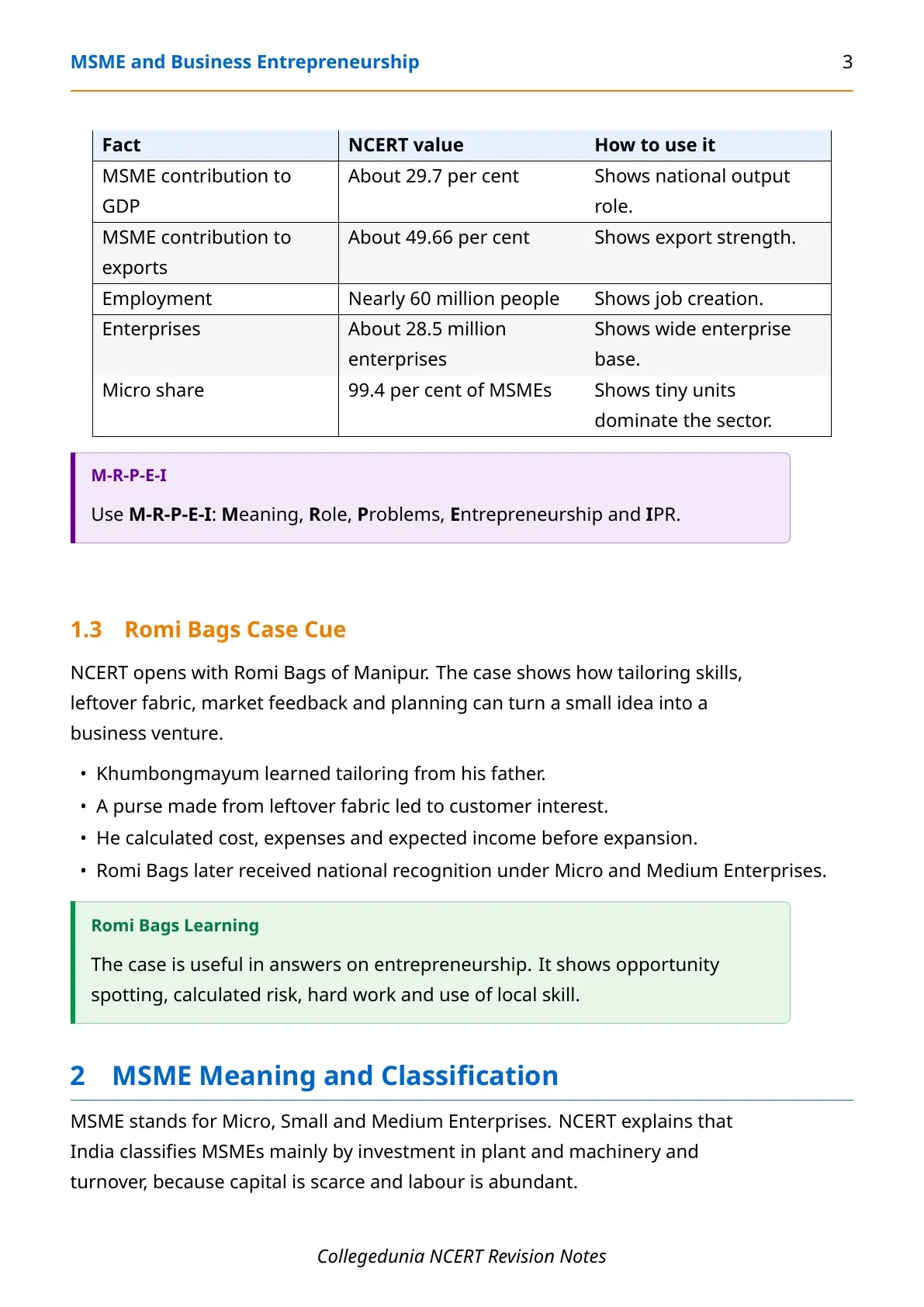
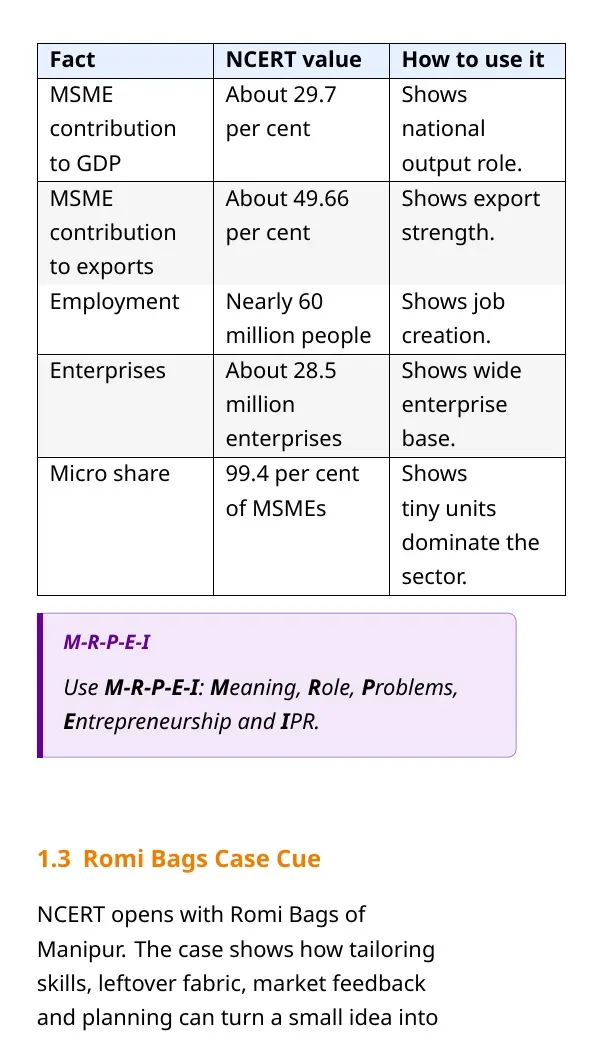
The chapter also gives important values such as about 29.7 per cent contribution to GDP, 49.66 per cent contribution to exports and employment for nearly 60 million people through about 28.5 million enterprises.
MSME and Entrepreneurship Class 11 Video Recap
Source: Magnet Brains on YouTube
Problems Faced by MSME
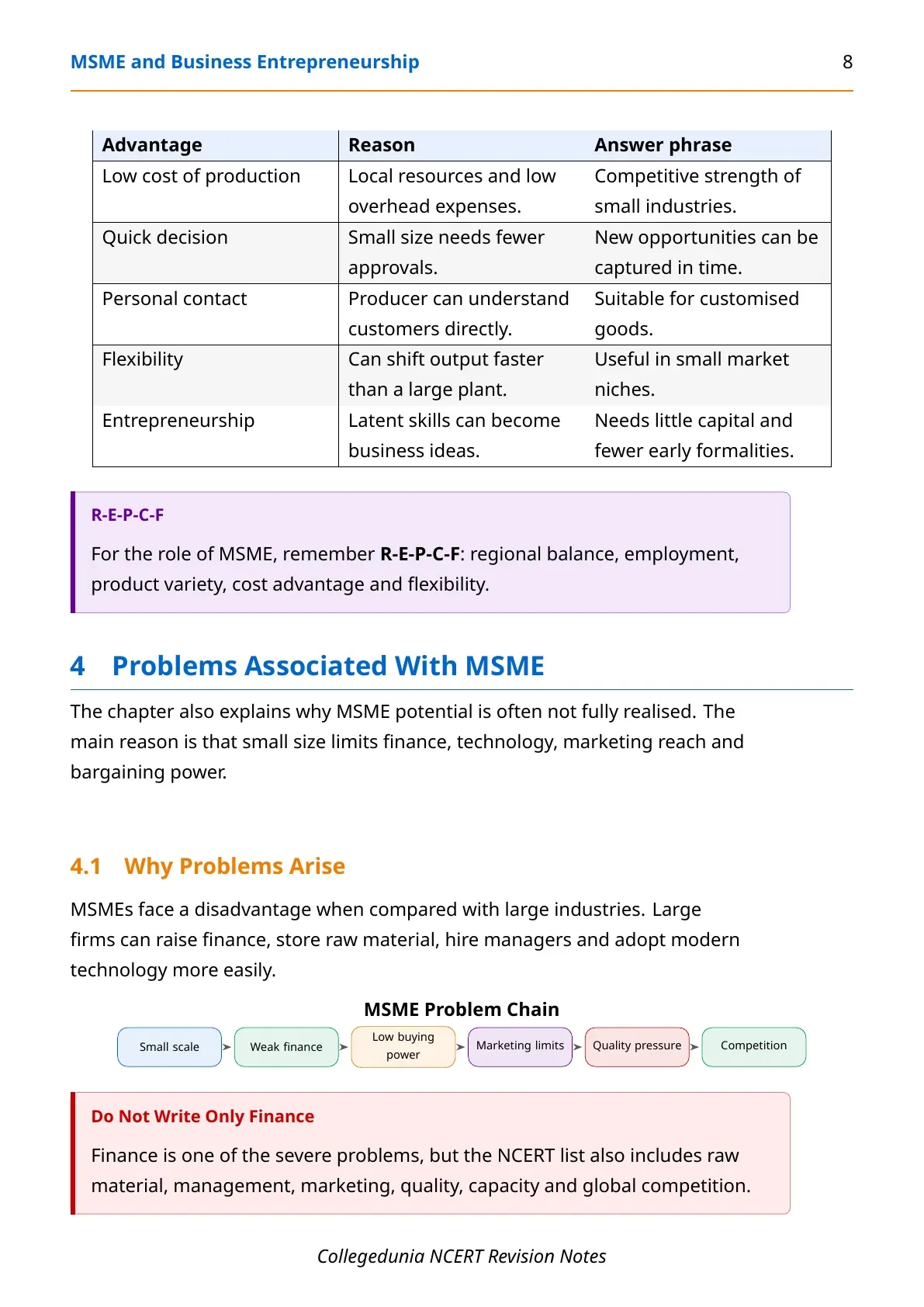
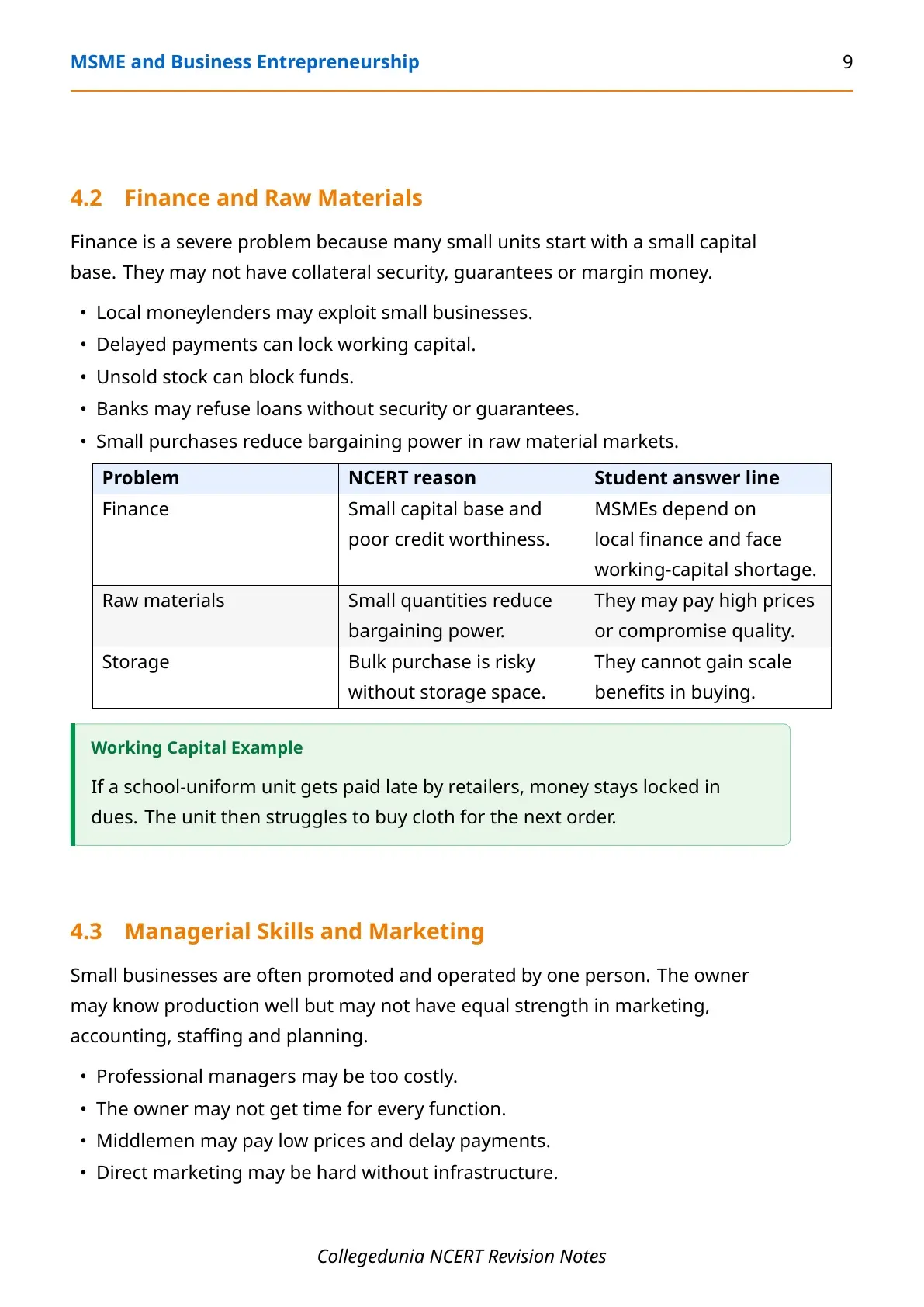
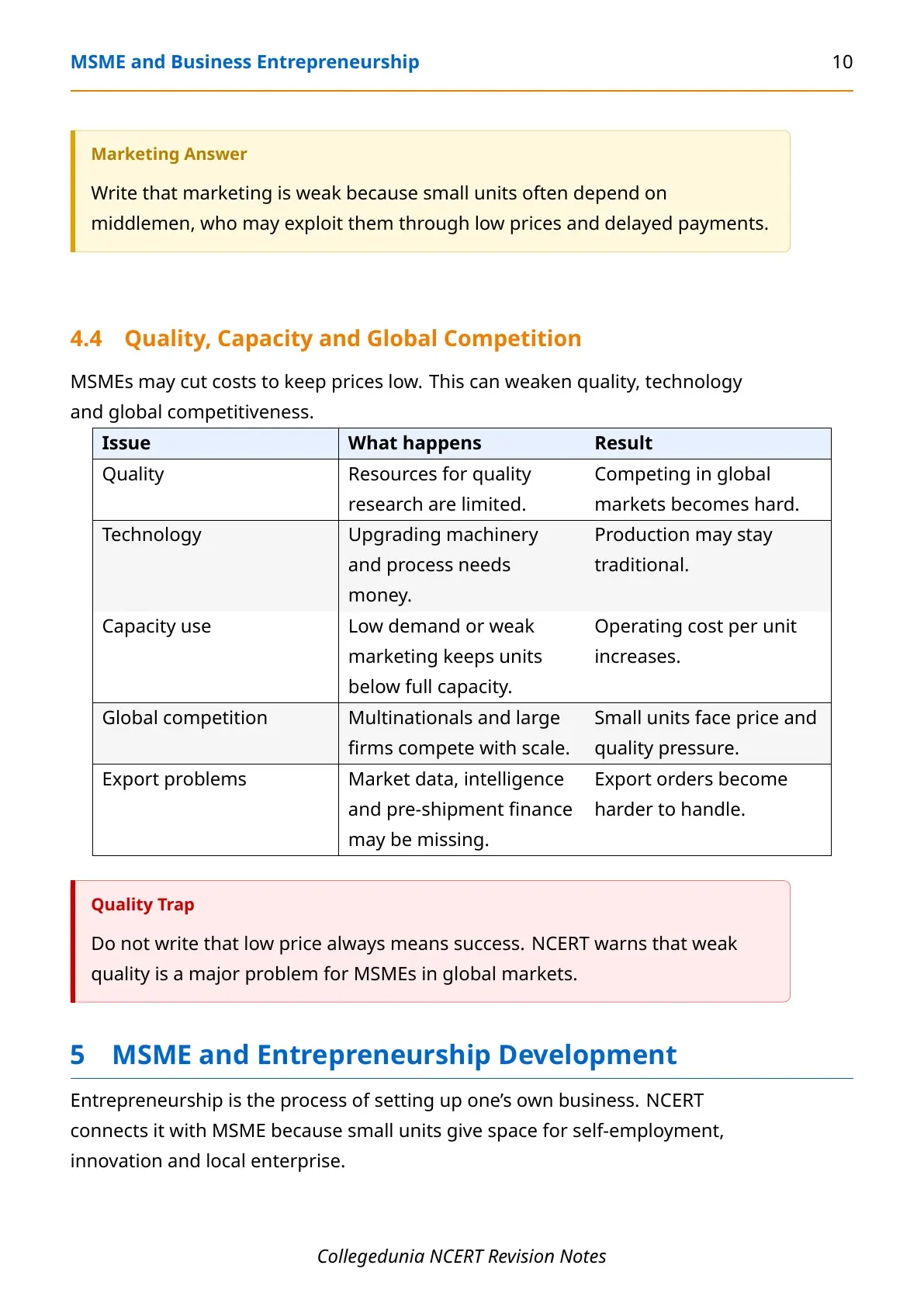
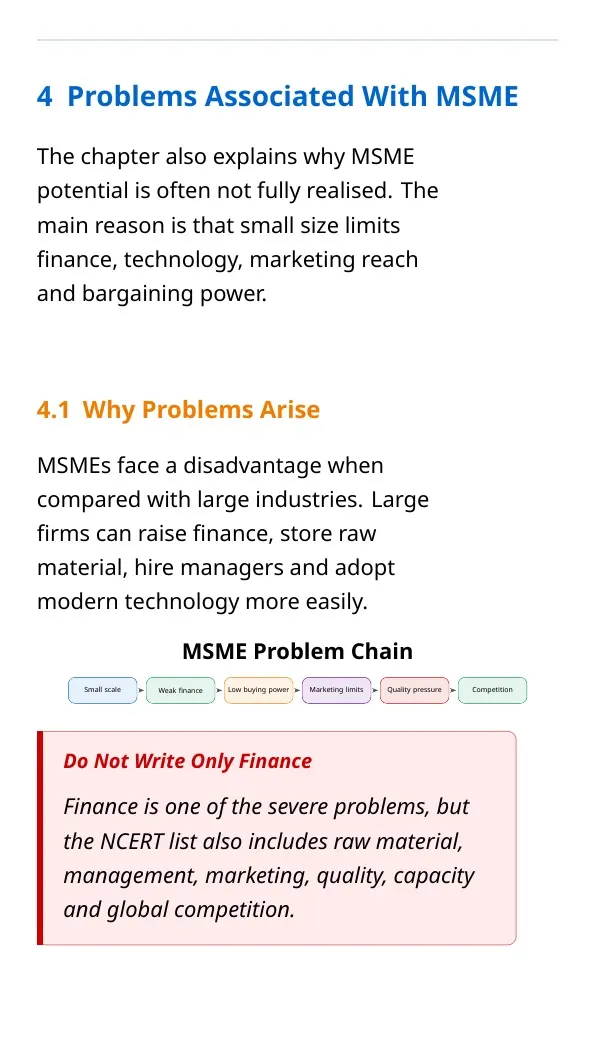
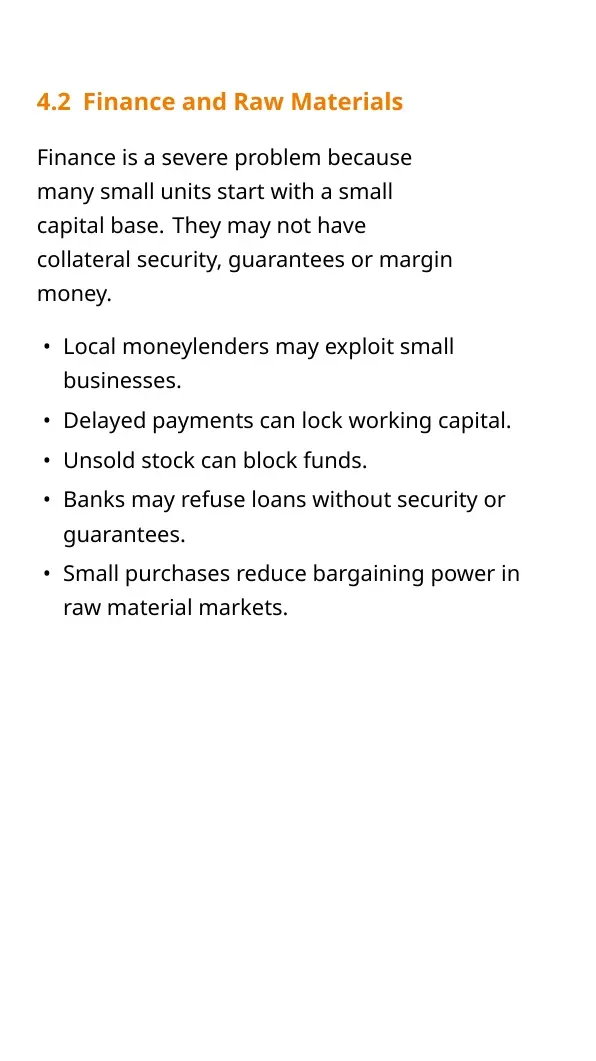
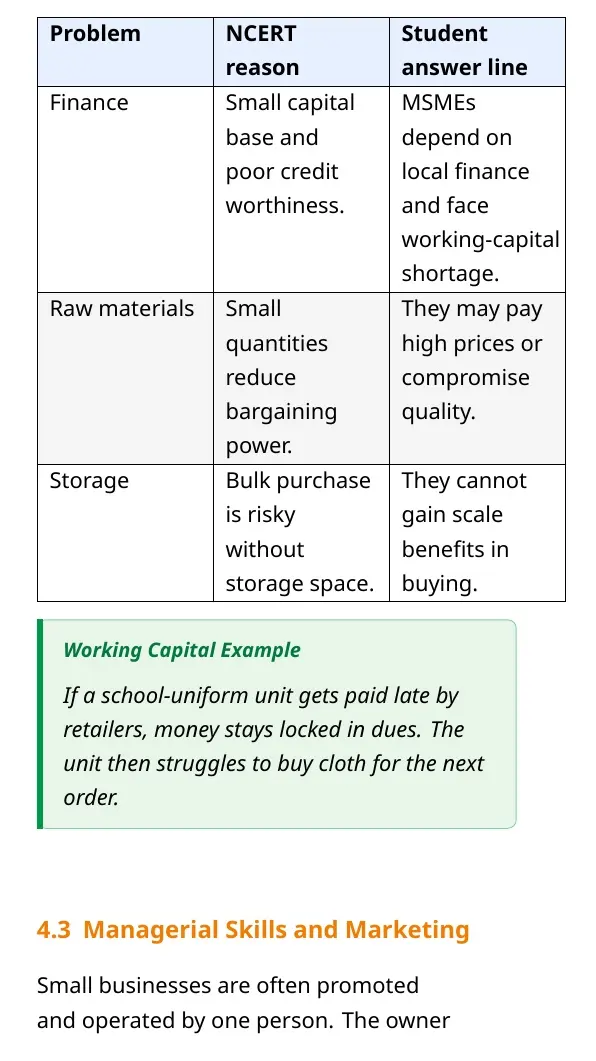
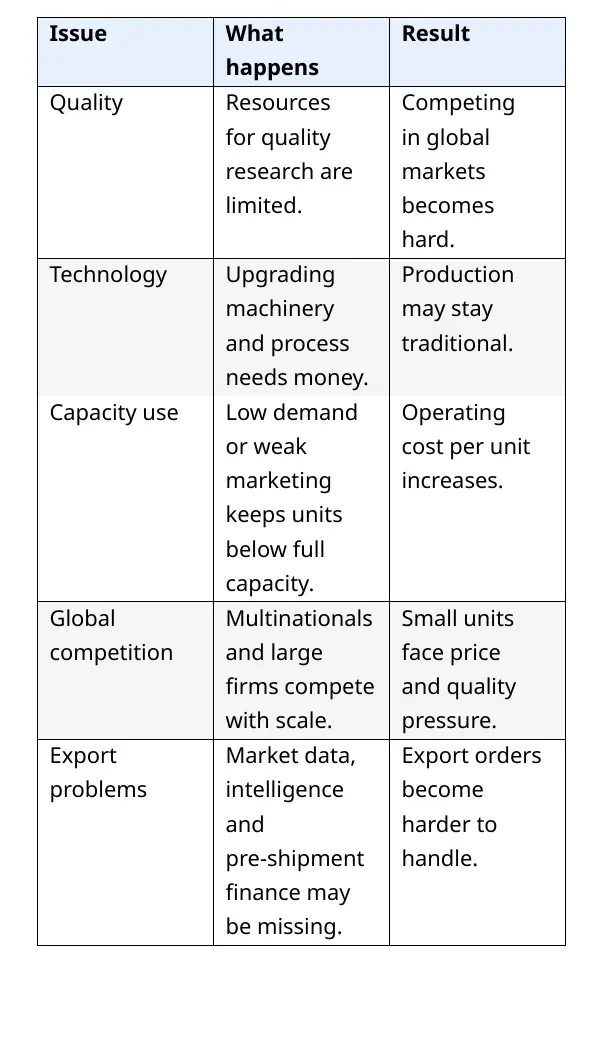
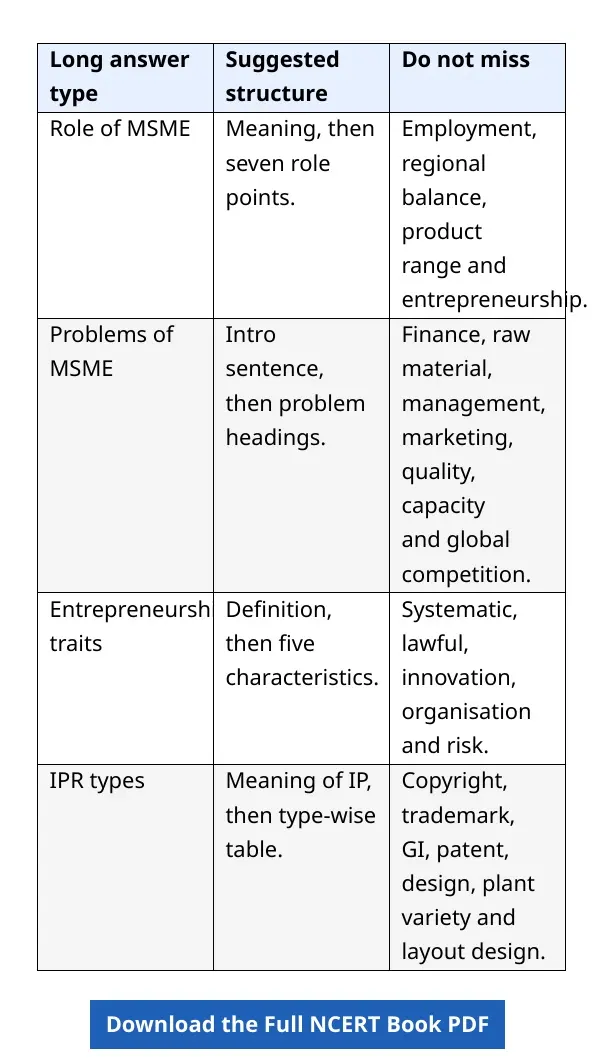
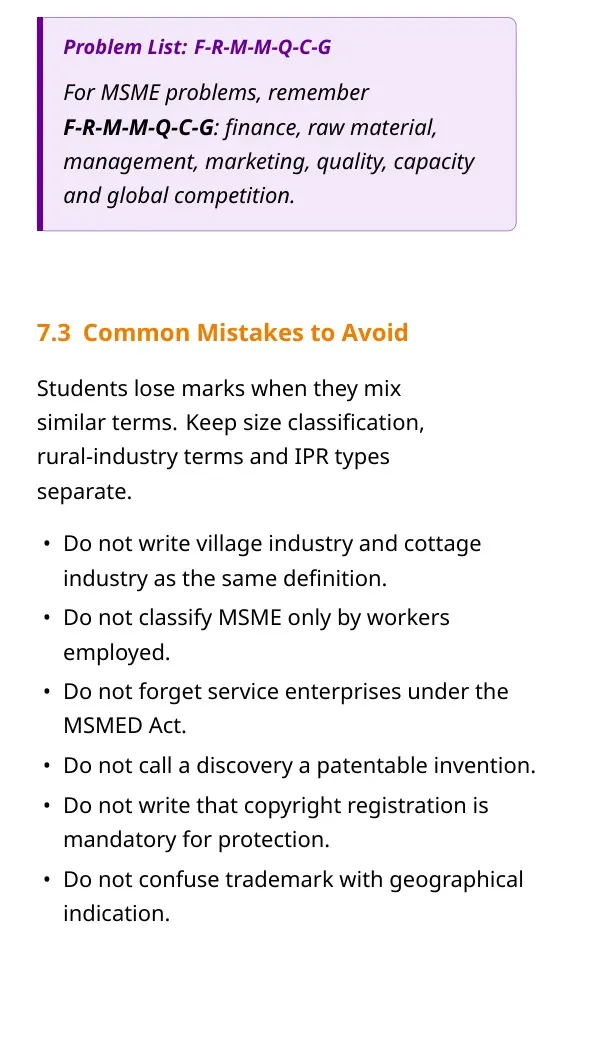
MSMEs have strong potential, but NCERT also explains why many units struggle. The common problems are shortage of finance, difficulty in obtaining raw materials, weak marketing reach, delayed payments, outdated technology and competition from large firms or imported goods.
| Problem | What it means | Exam cue |
|---|---|---|
| Finance | Small units may not get timely and adequate credit | Connect to working capital and expansion |
| Raw material | Input supply may be irregular or expensive | Raises cost and delays production |
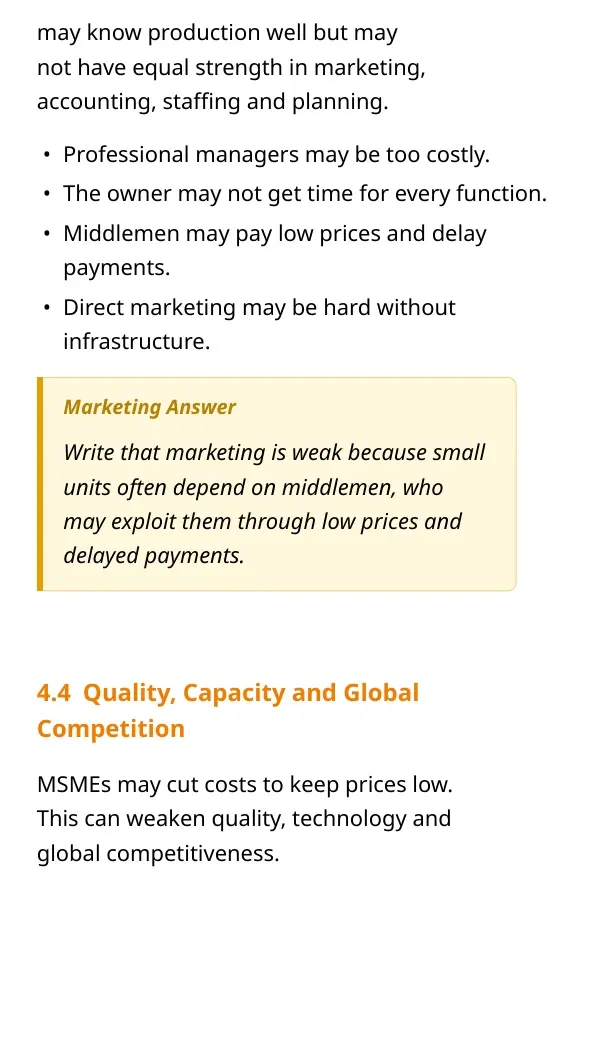
| Marketing | Limited sales network and weak brand visibility | Small units may depend on middlemen |
| Technology and quality | Modern machines and testing systems may be costly | Affects productivity and competition |
MSME and Entrepreneurship Development
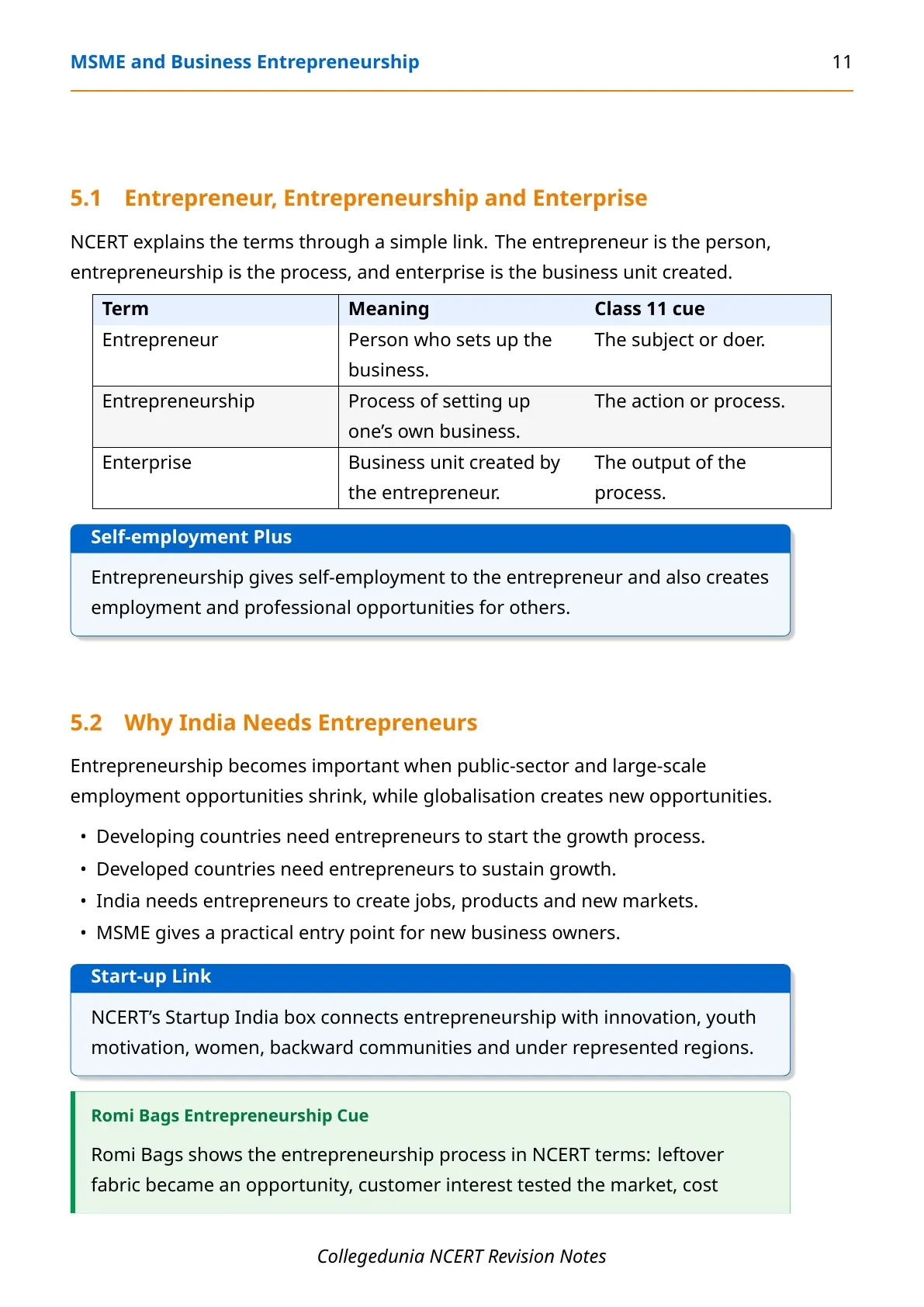
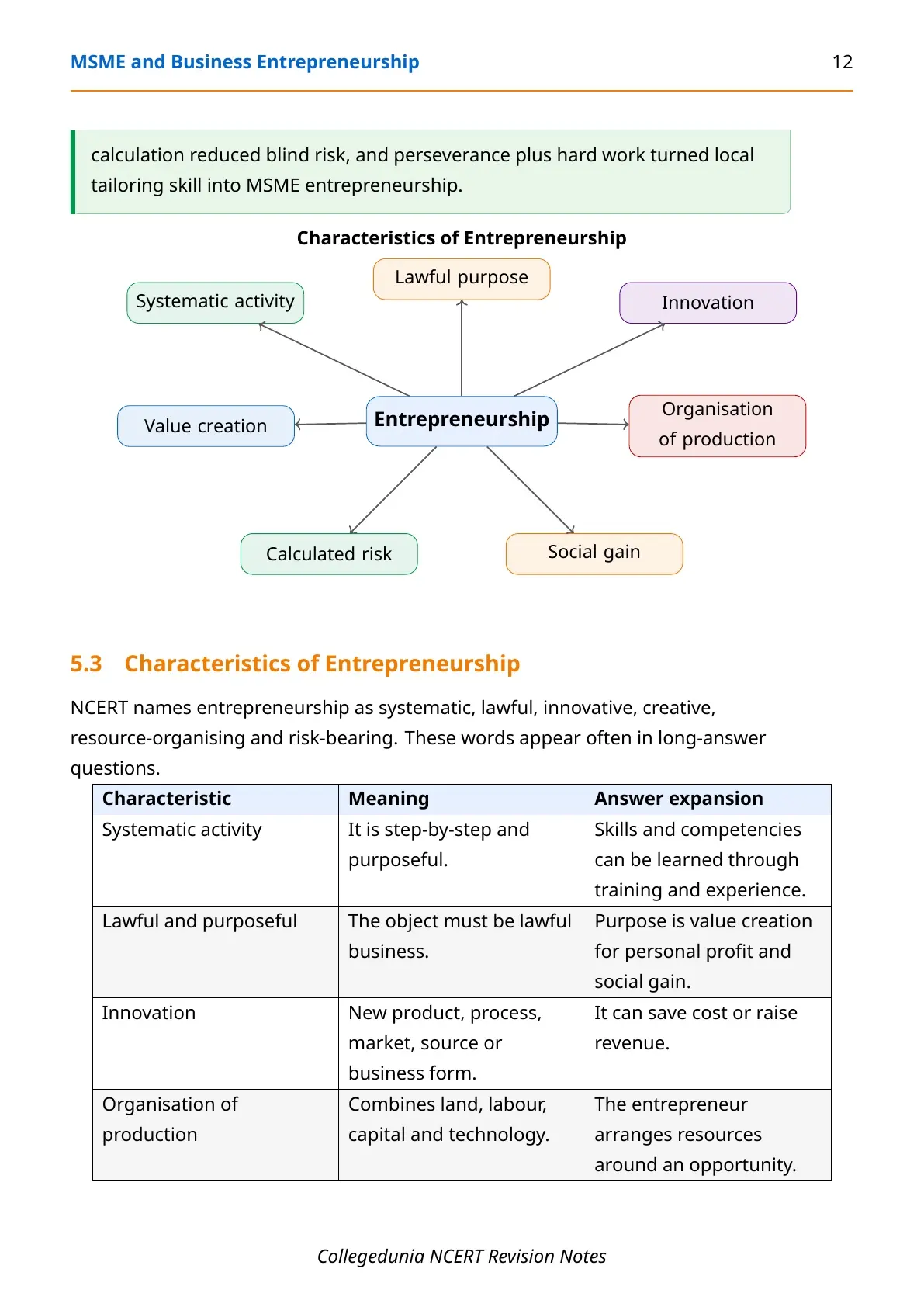
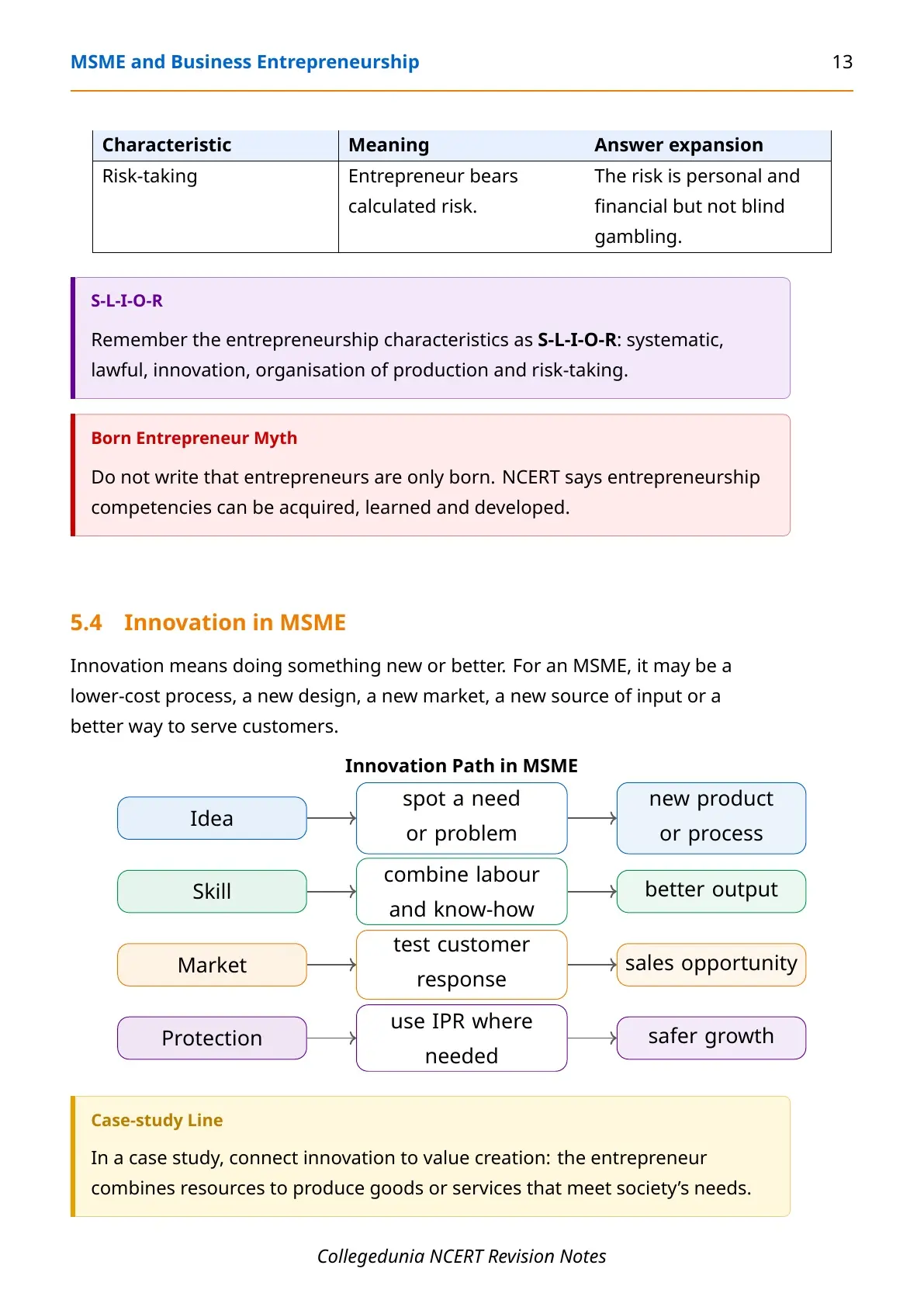
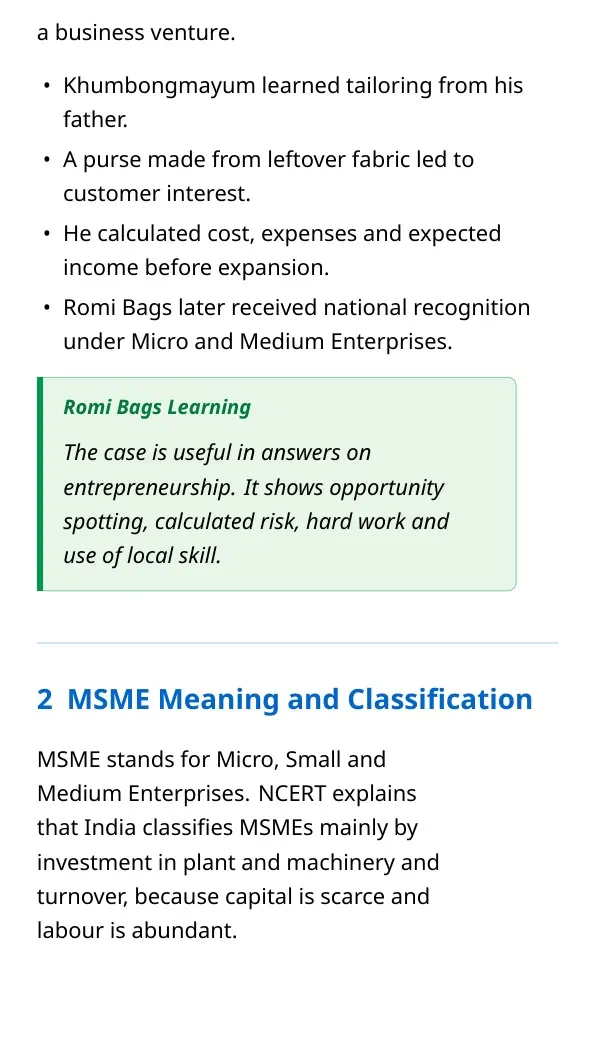
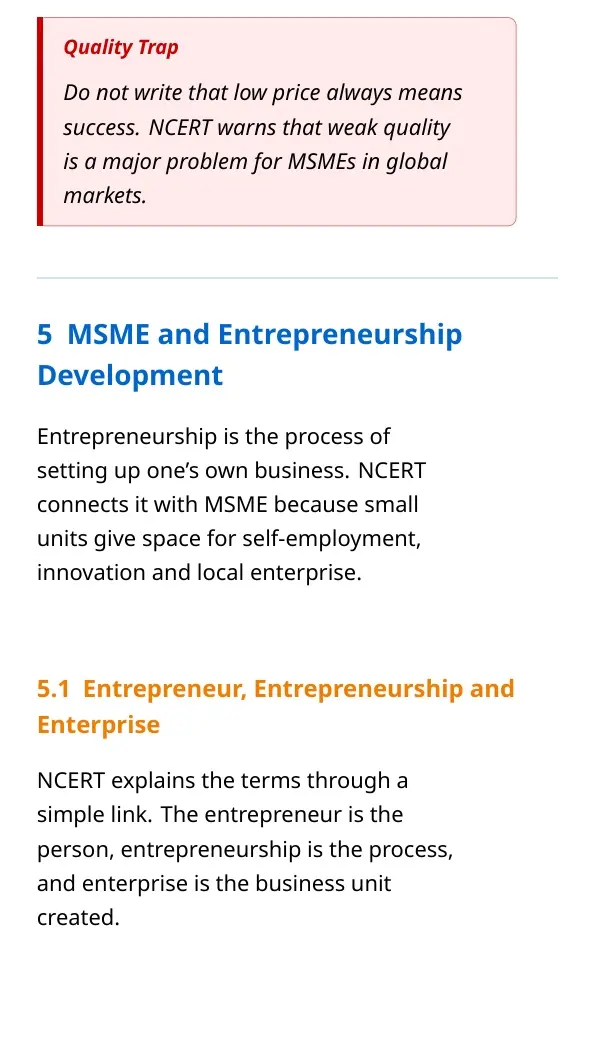
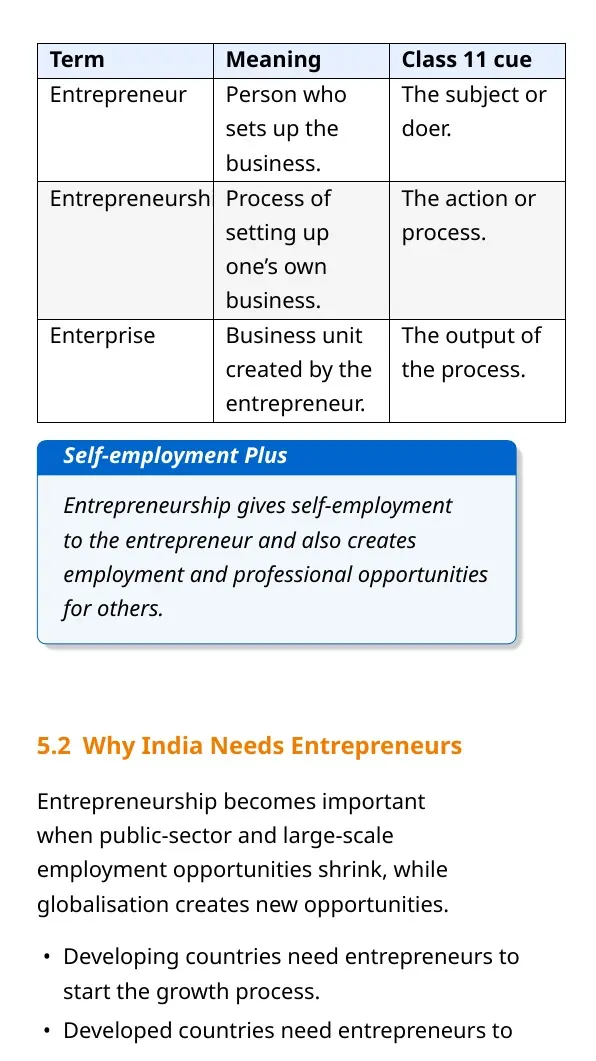
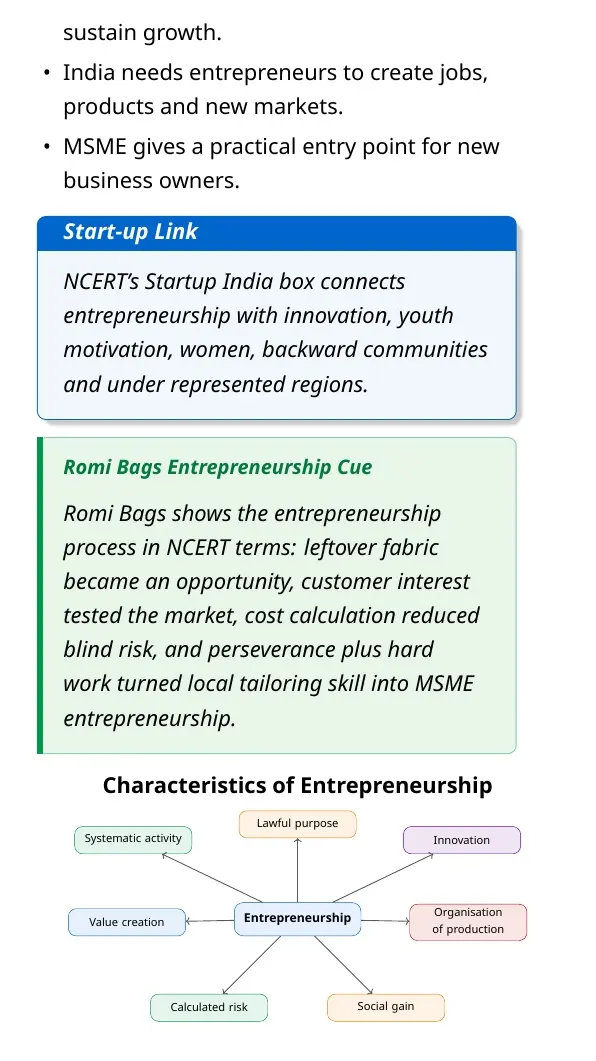
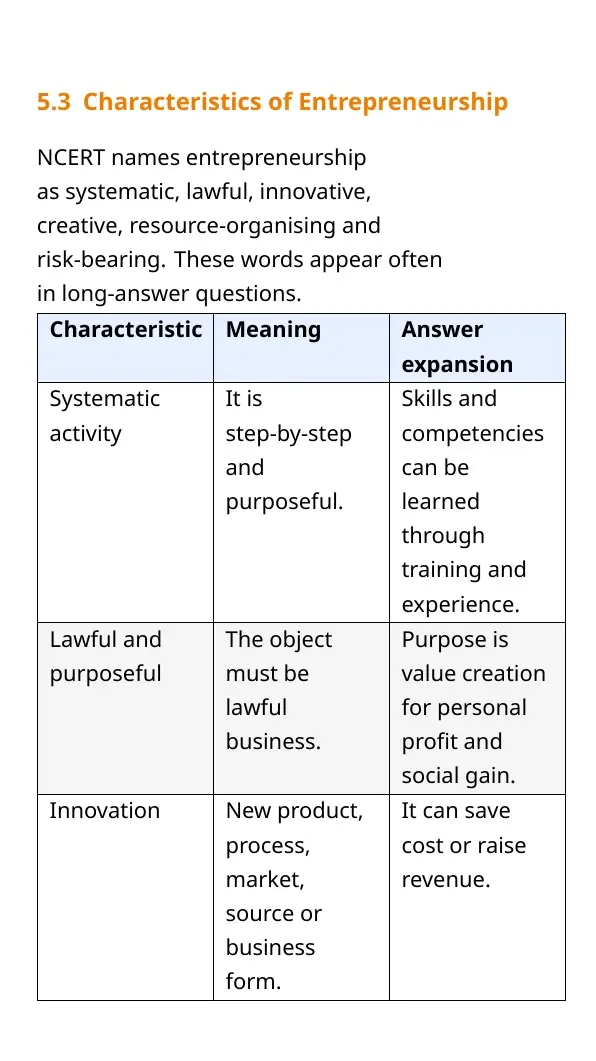
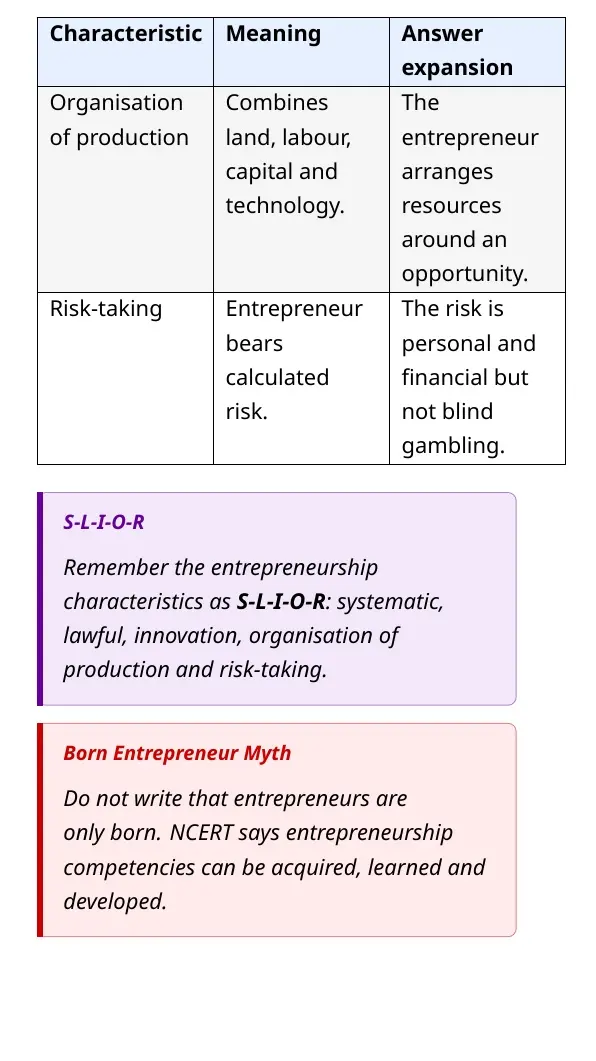
Entrepreneurship is the process of identifying an opportunity, organising resources, taking calculated risk and creating value. NCERT opens the chapter with Romi Bags of Manipur to show this process. A small idea from leftover fabric became a business venture because the entrepreneur noticed demand, calculated cost and planned expansion.
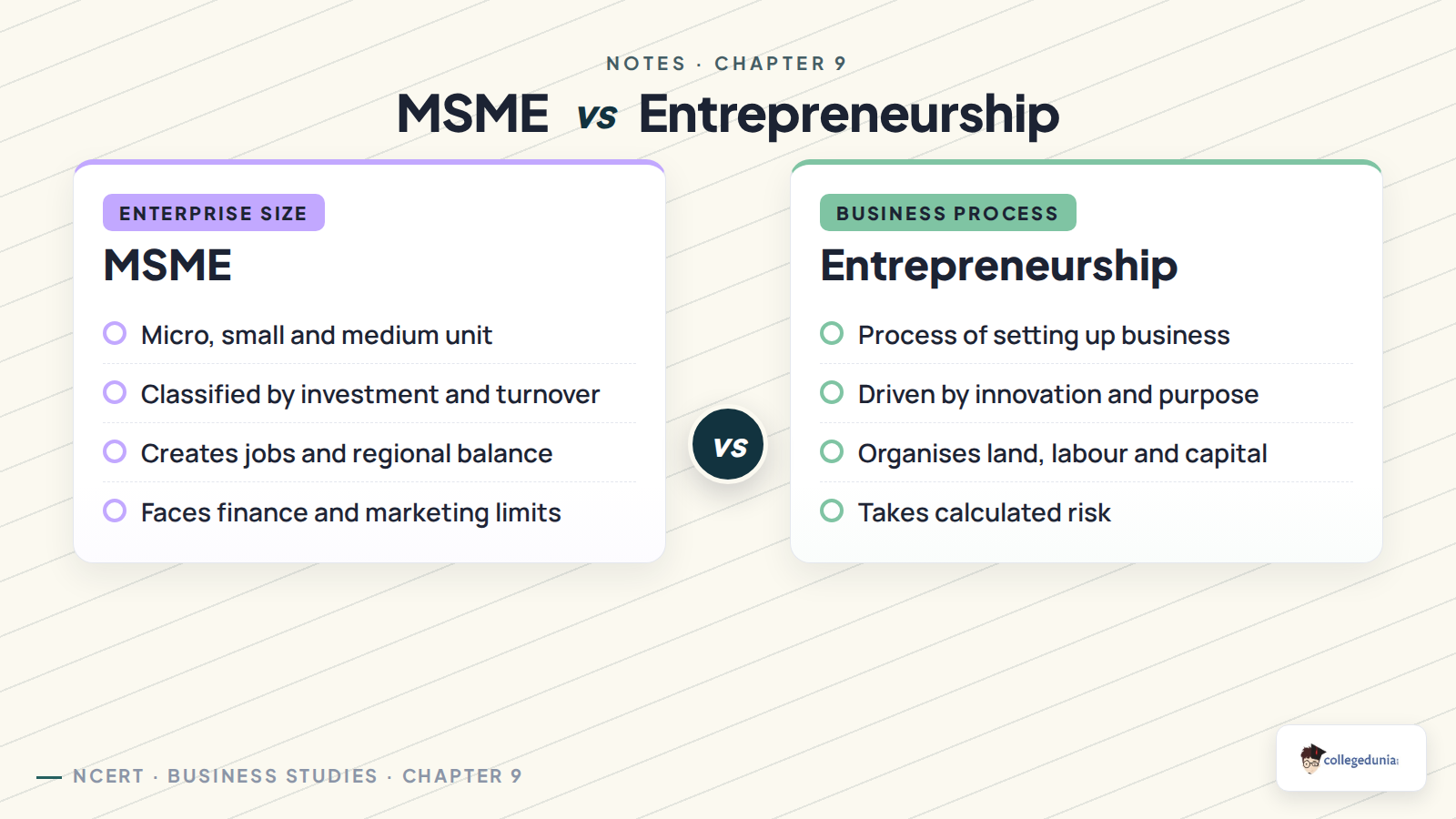
- Opportunity spotting: an entrepreneur sees a market need before others do.
- Calculated risk: cost, expected income and market demand are studied before scaling.
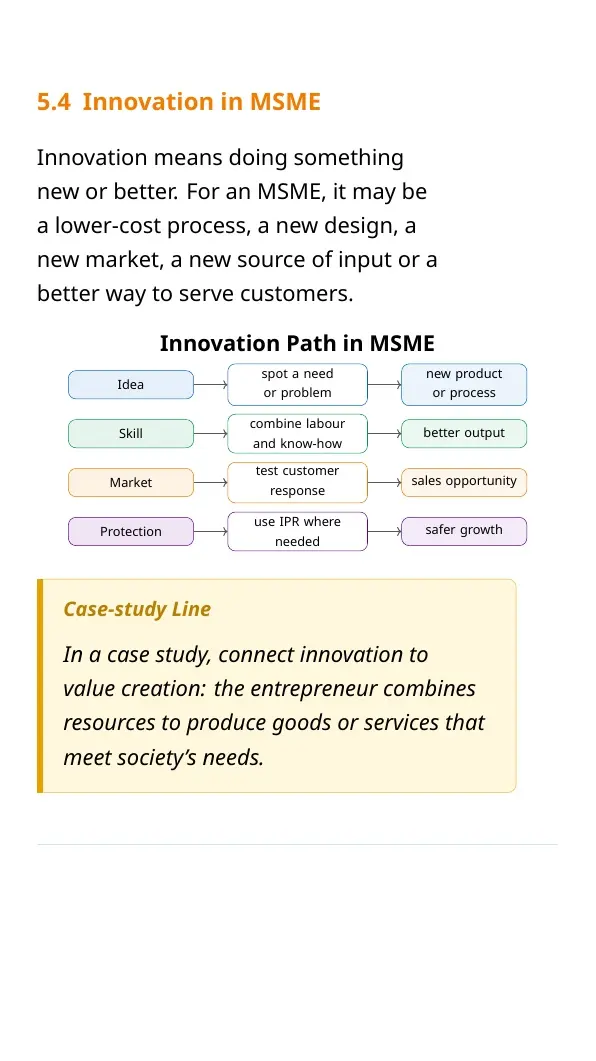
- Innovation: new designs, methods or combinations can create value.
- Perseverance: enterprise growth needs sustained effort and problem solving.
Intellectual Property Rights for Entrepreneurs
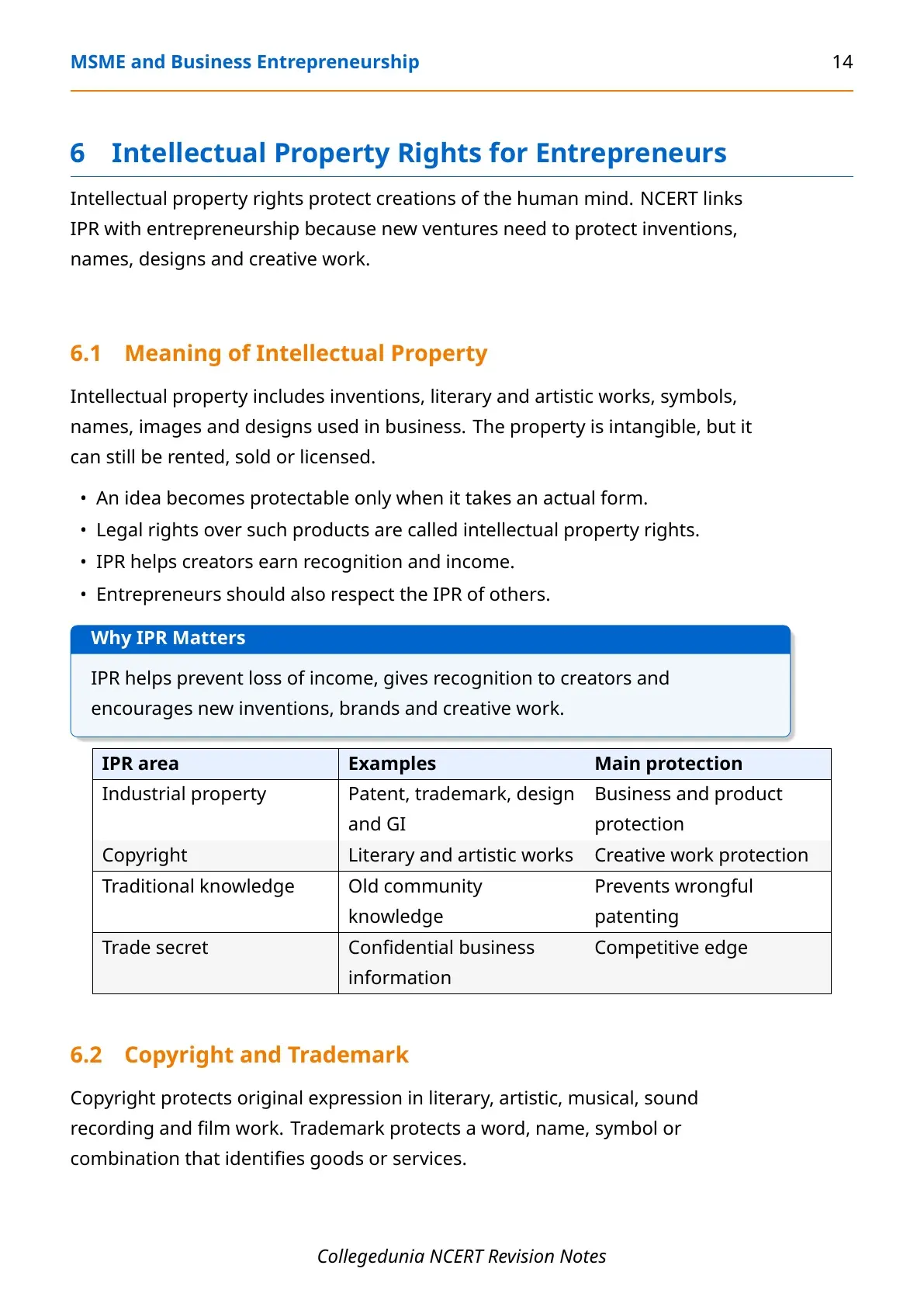
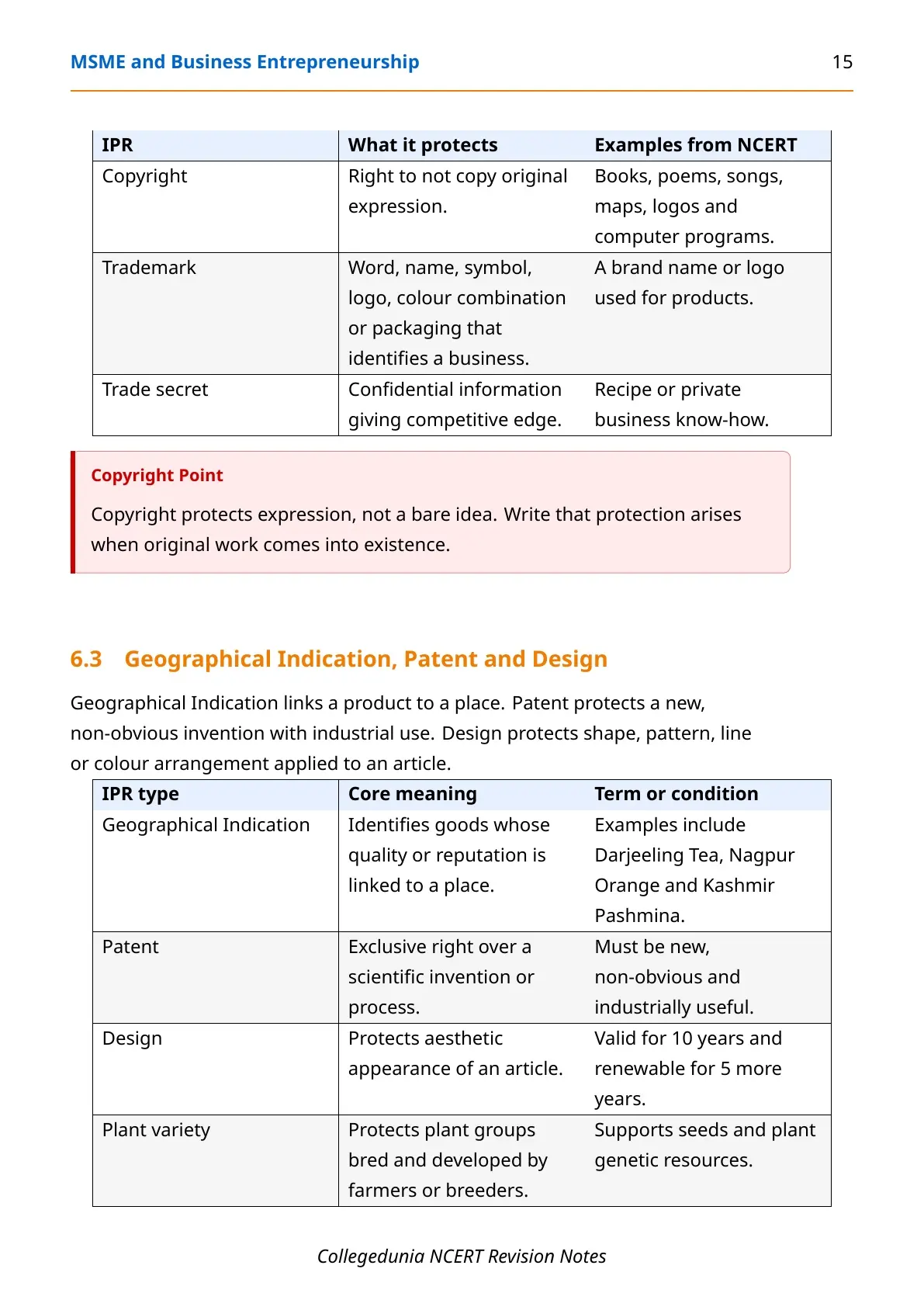
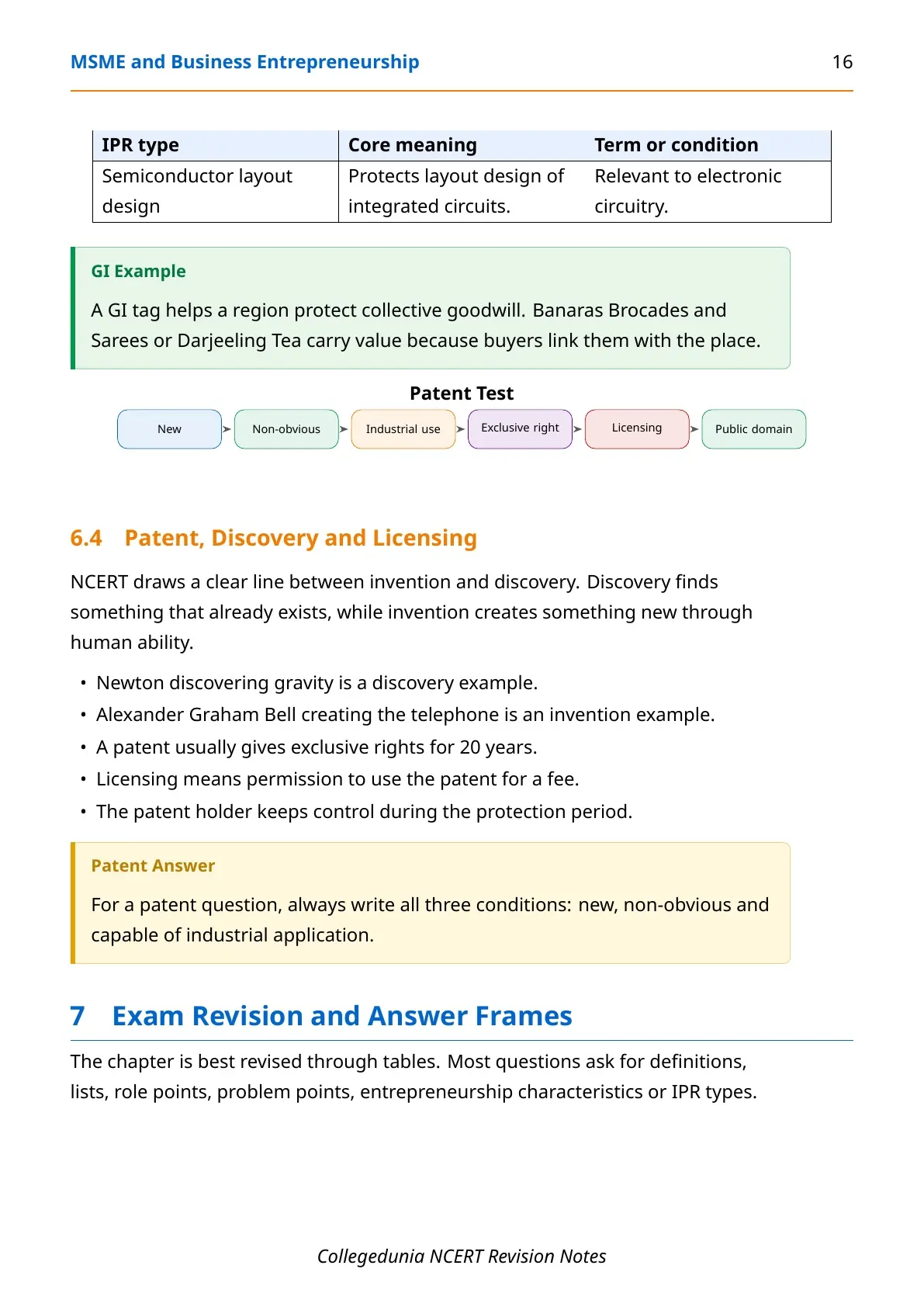
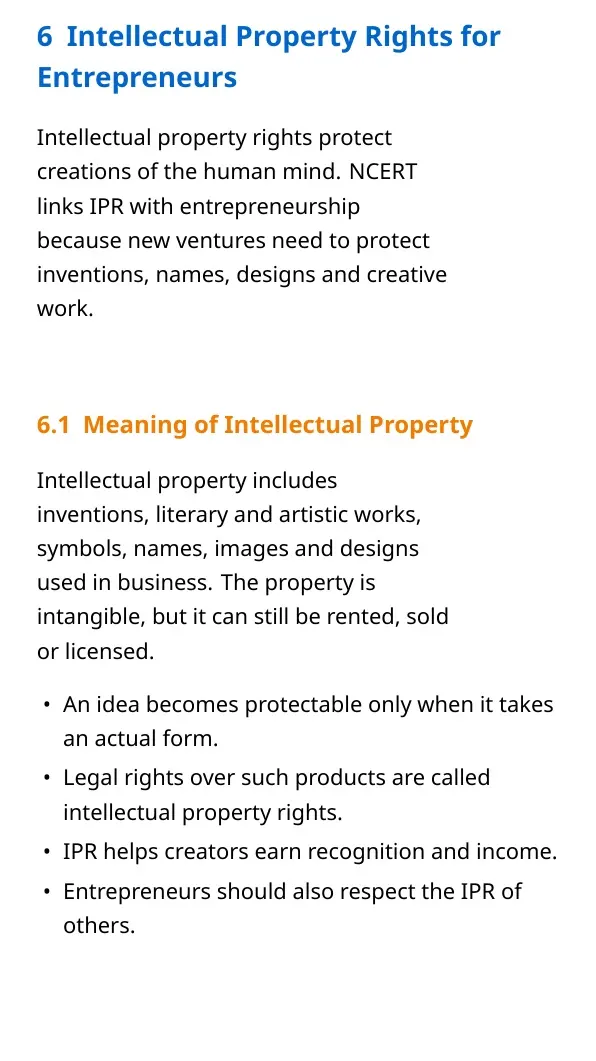
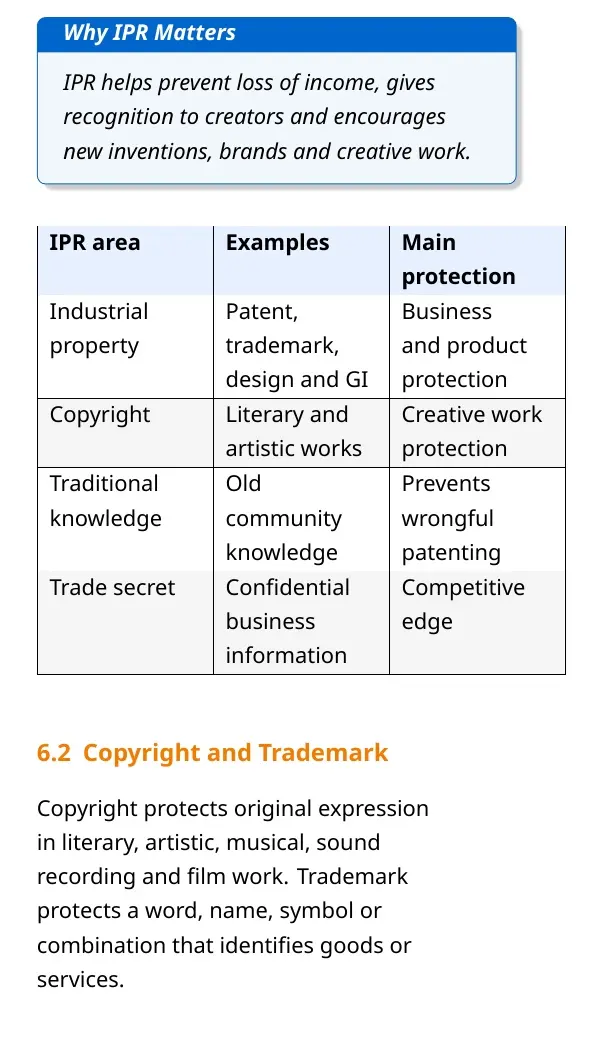
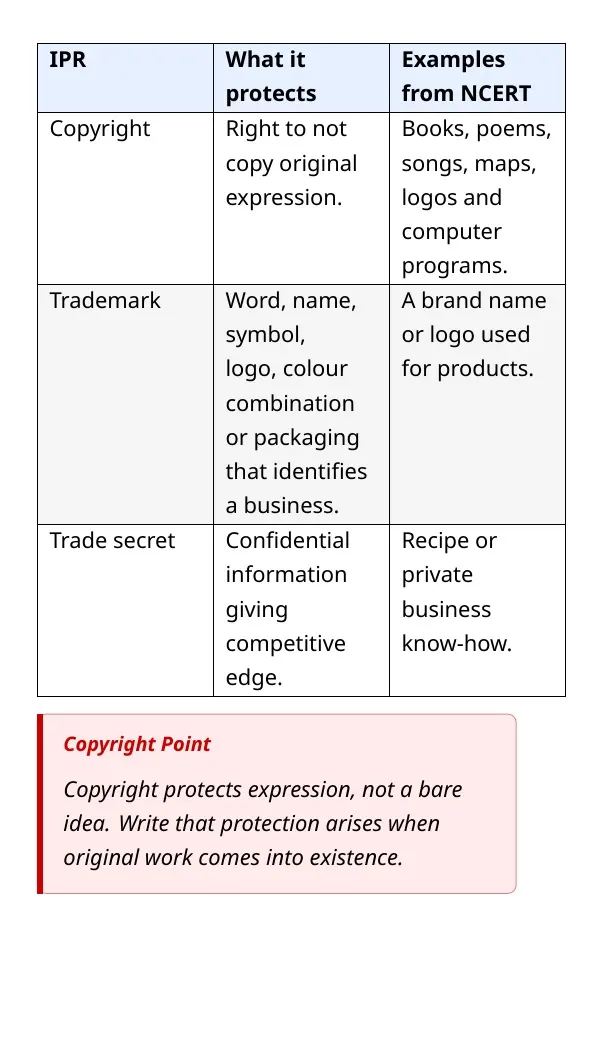
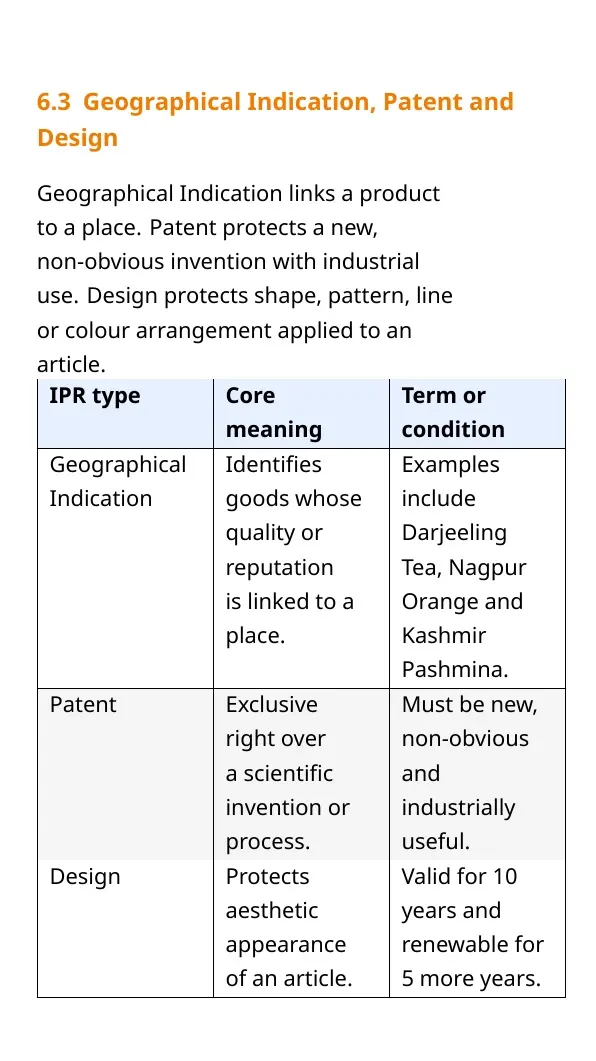
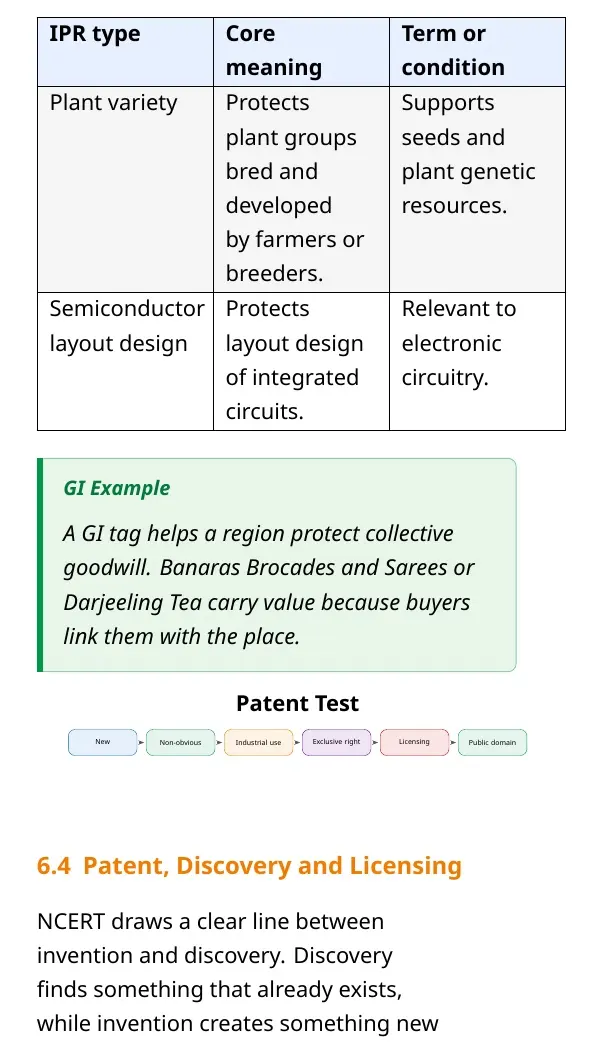
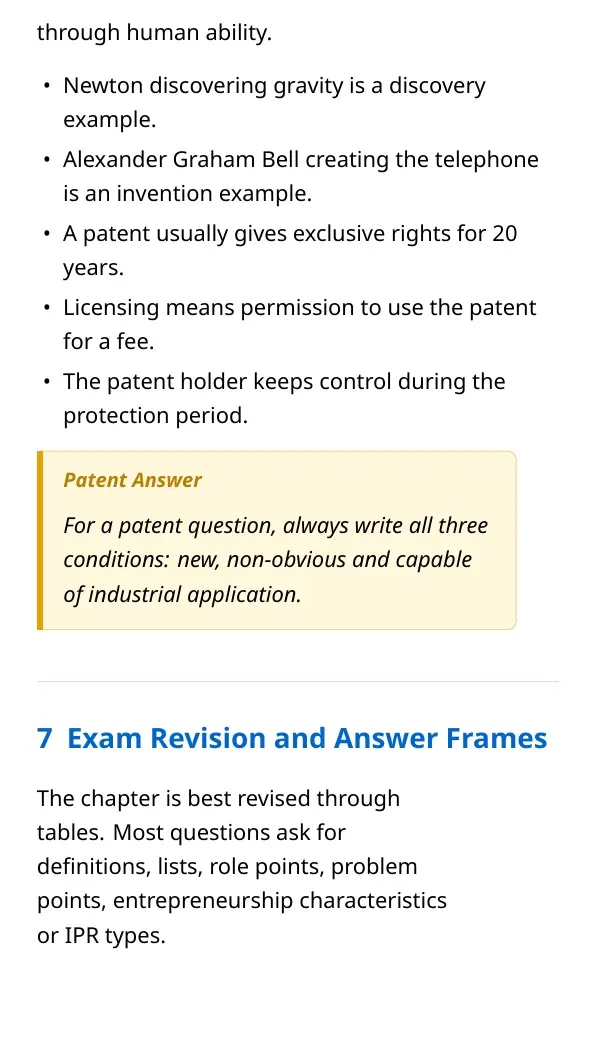
Intellectual Property Rights protect creations of the mind. They matter for entrepreneurs because a new business may create a brand name, design, invention, artistic work or unique product identity. Without protection, competitors may copy the idea or dilute the entrepreneur's market position.
| IPR type | What it protects | Simple example |
|---|---|---|
| Patent | New invention or technical solution | A new machine mechanism |
| Trademark | Brand name, symbol or logo | A distinctive product logo |
| Copyright | Literary, artistic and creative work | Booklet, software code or design content |
| Geographical indication | Product linked to a specific place | A region-linked handicraft product |
How to Write Better Answers on MSME and Entrepreneurship
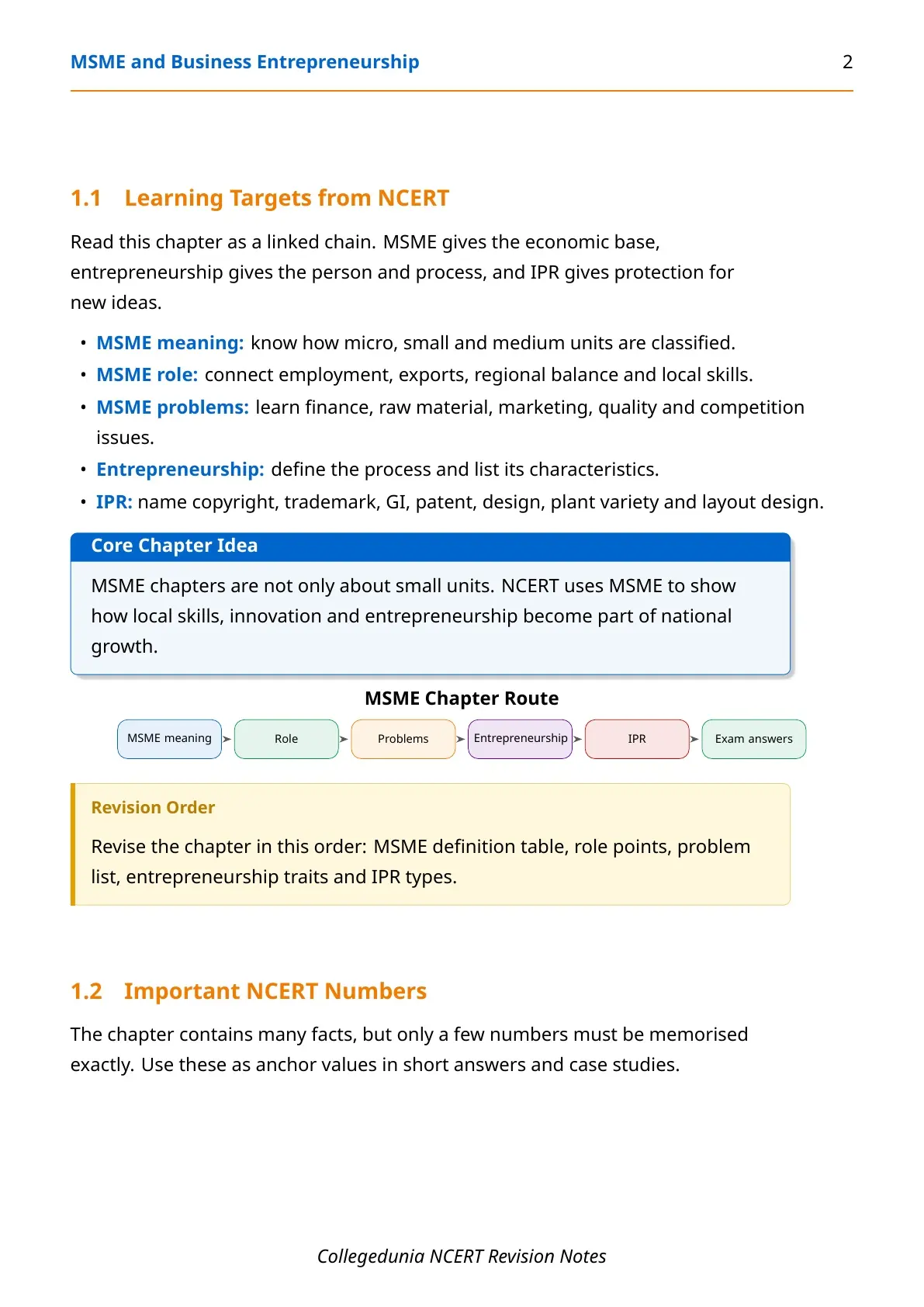
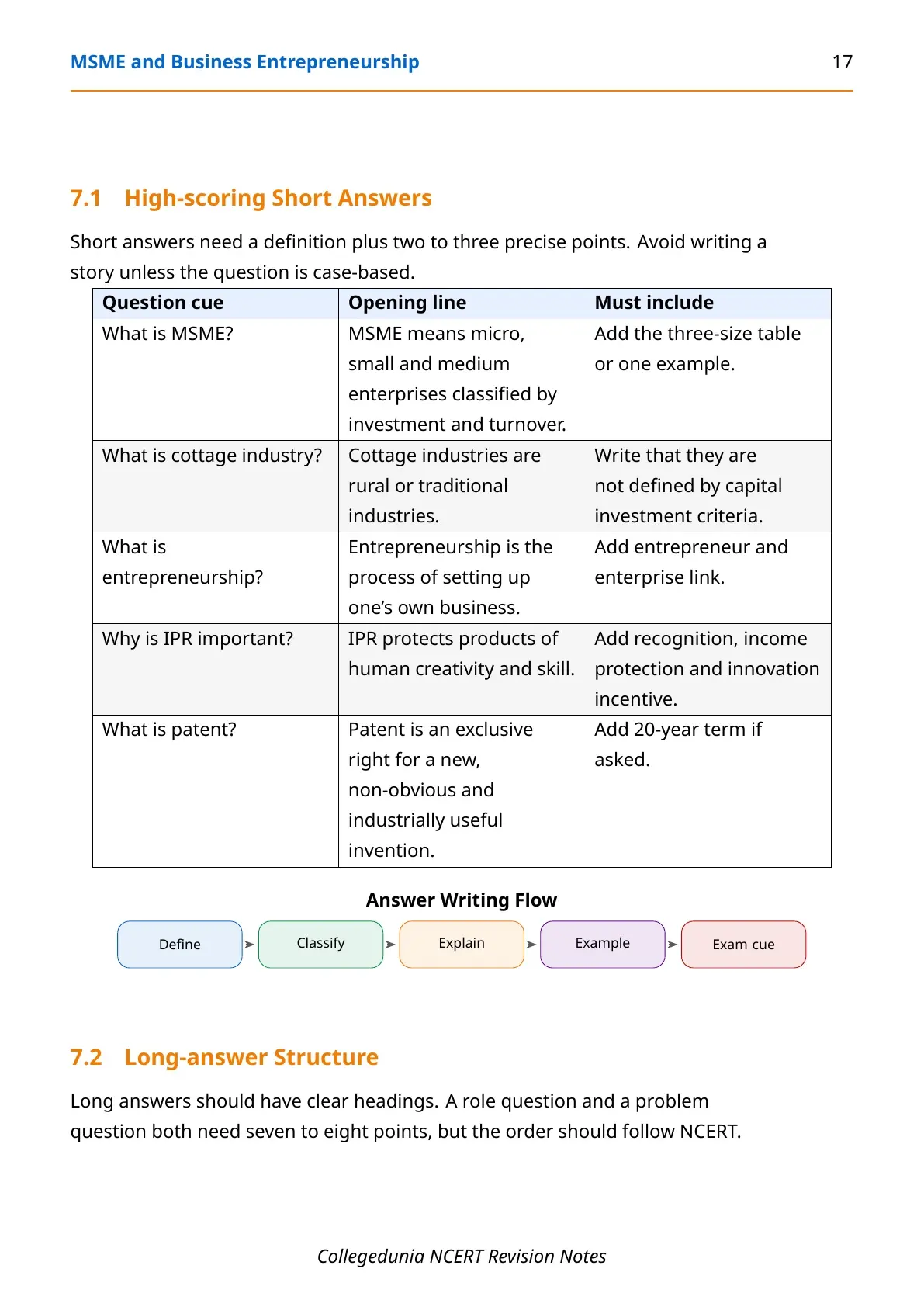
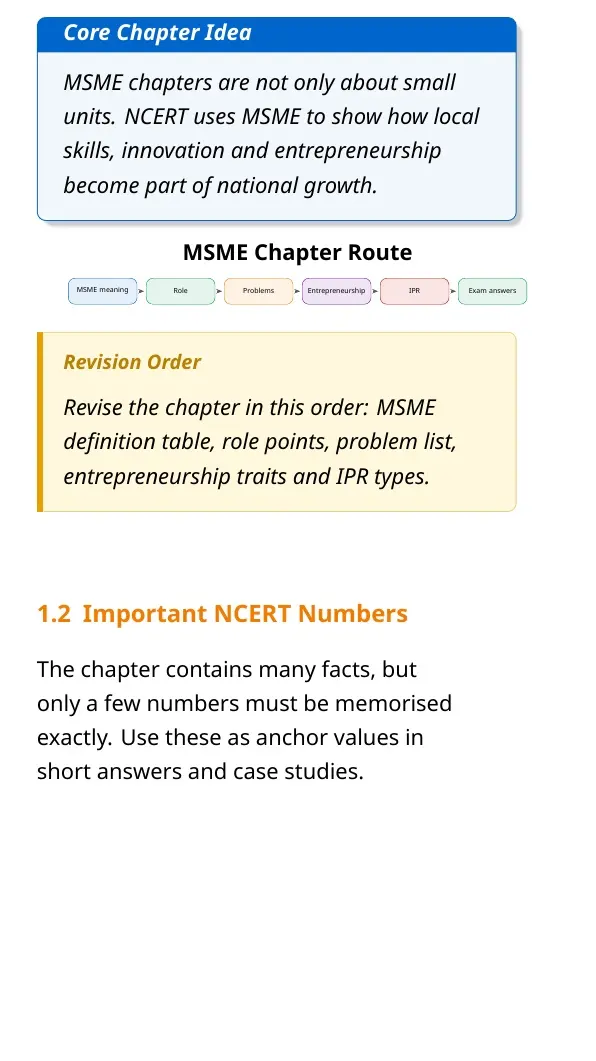
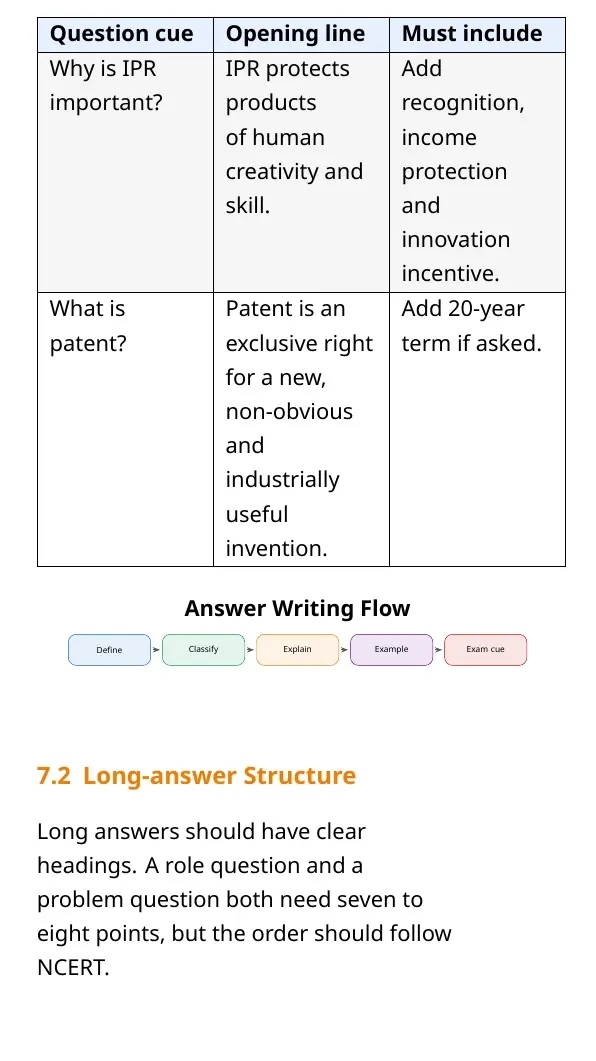
Strong Chapter 9 answers follow the NCERT order. Start with the meaning and classification, then write role points, problems, entrepreneurship traits and IPR. For case-based questions, connect the situation to opportunity, risk, local skill, innovation and legal protection.
- For classification: write both investment and turnover limits in a table.
- For role answers: include employment, exports, regional balance and local resources.
- For problem answers: separate finance, material, marketing, technology and competition.
- For entrepreneurship: use Romi Bags as an example of opportunity recognition and planning.
Related Resources for MSME and Business Entrepreneurship
| Resource | Use it for | Link |
|---|---|---|
| NCERT Solutions | Practice textbook answers for Chapter 9 | Open NCERT Solutions |
| Handwritten Notes | Revise MSME, entrepreneurship and IPR in a handwritten style | Open Handwritten Notes |
| Class 11 Business Studies Notes | Use the live notes page after publishing | Open Chapter 9 Notes |
All Class 11 Business Studies Notes Chapters
| Chapter | Title | Notes Link |
|---|---|---|
| Chapter 1 | Business, Trade and Commerce | Open Notes |
| Chapter 2 | Forms of Business Organisation | Open Notes |
| Chapter 3 | Private, Public and Global Enterprises | Open Notes |
| Chapter 4 | Business Services | Open Notes |
| Chapter 5 | Emerging Modes of Business | Open Notes |
| Chapter 6 | Social Responsibilities of Business and Business Ethics | Open Notes |
| Chapter 7 | Formation of a Company | Open Notes |
| Chapter 8 | Sources of Business Finance | Open Notes |
| Chapter 9 | MSME and Business Entrepreneurship | You are here |
MSME and Business Entrepreneurship Class 11 Notes FAQs
Ques. What does MSME and Business Entrepreneurship Class 11 Chapter 9 cover?
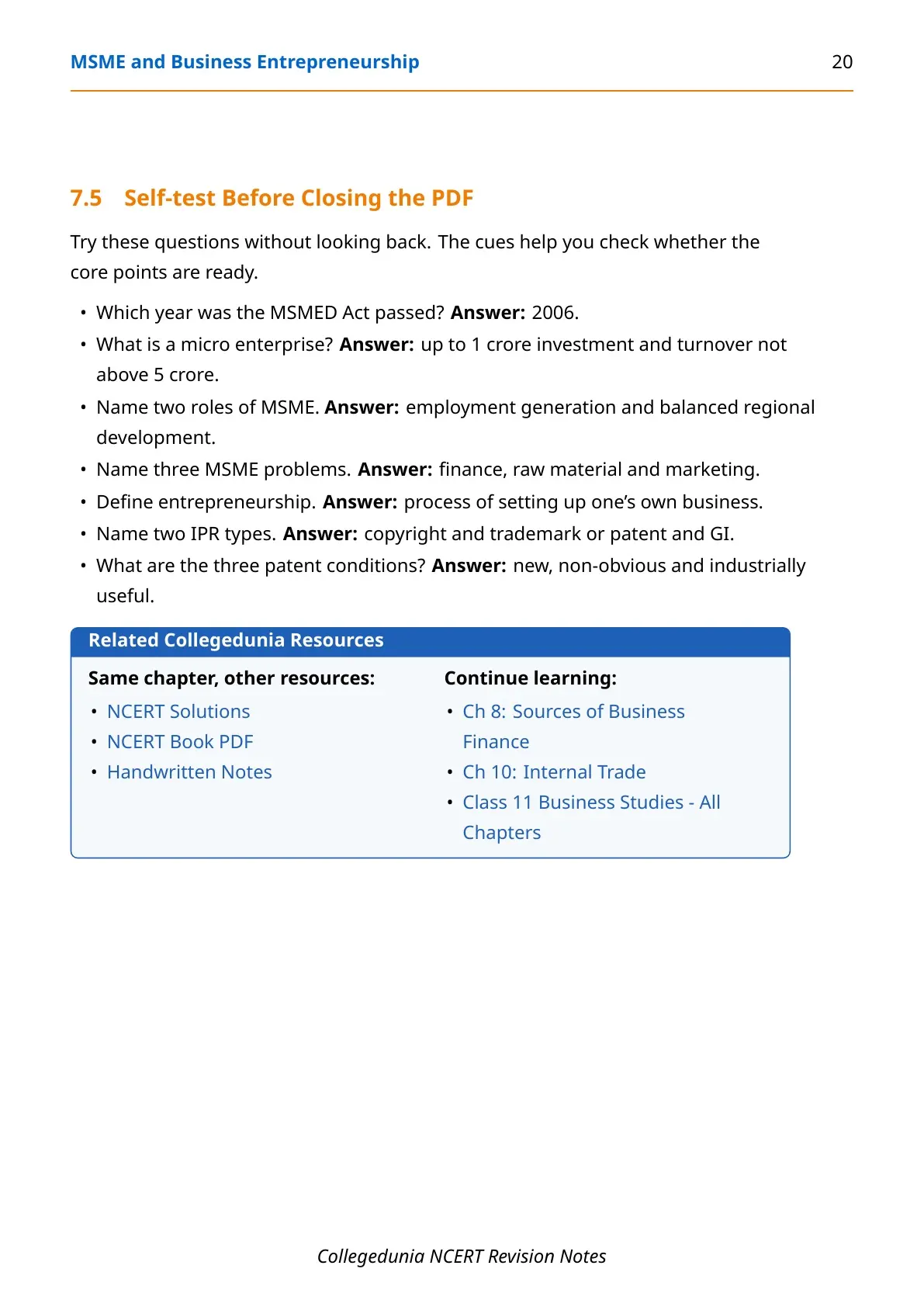
Ans. It covers MSME meaning, micro, small and medium enterprise classification, role of MSME in India, problems faced by MSMEs, entrepreneurship development and intellectual property rights.
Ques. What is the MSME classification used in the NCERT chapter?
Ans. Micro, small and medium enterprises are classified by investment in plant and machinery and turnover. Micro is up to 1 crore investment and 5 crore turnover, small is up to 10 crore investment and 50 crore turnover, and medium is up to 50 crore investment and 250 crore turnover.
Ques. Why are MSMEs important for India?
Ans. MSMEs support employment, exports, regional development, local skills, product variety and entrepreneurship. They also act as complementary units for large industries.
Ques. Which IPR types should students revise in this chapter?
Ans. Students should revise patent, trademark, copyright, geographical indication, design and other protection tools that help entrepreneurs protect ideas, brands and product identity.



Comments