



The Adventure is the one Hornbill chapter that asks a history question and then answers it with physics. Inside these notes you will find the full story of Professor Gaitonde's two days in an alternate Bombay, the Battle of Panipat that goes the other way, and plain explanations of catastrophe theory and the many worlds idea. Every line here follows the 2026-27 reprint of the NCERT Hornbill textbook.
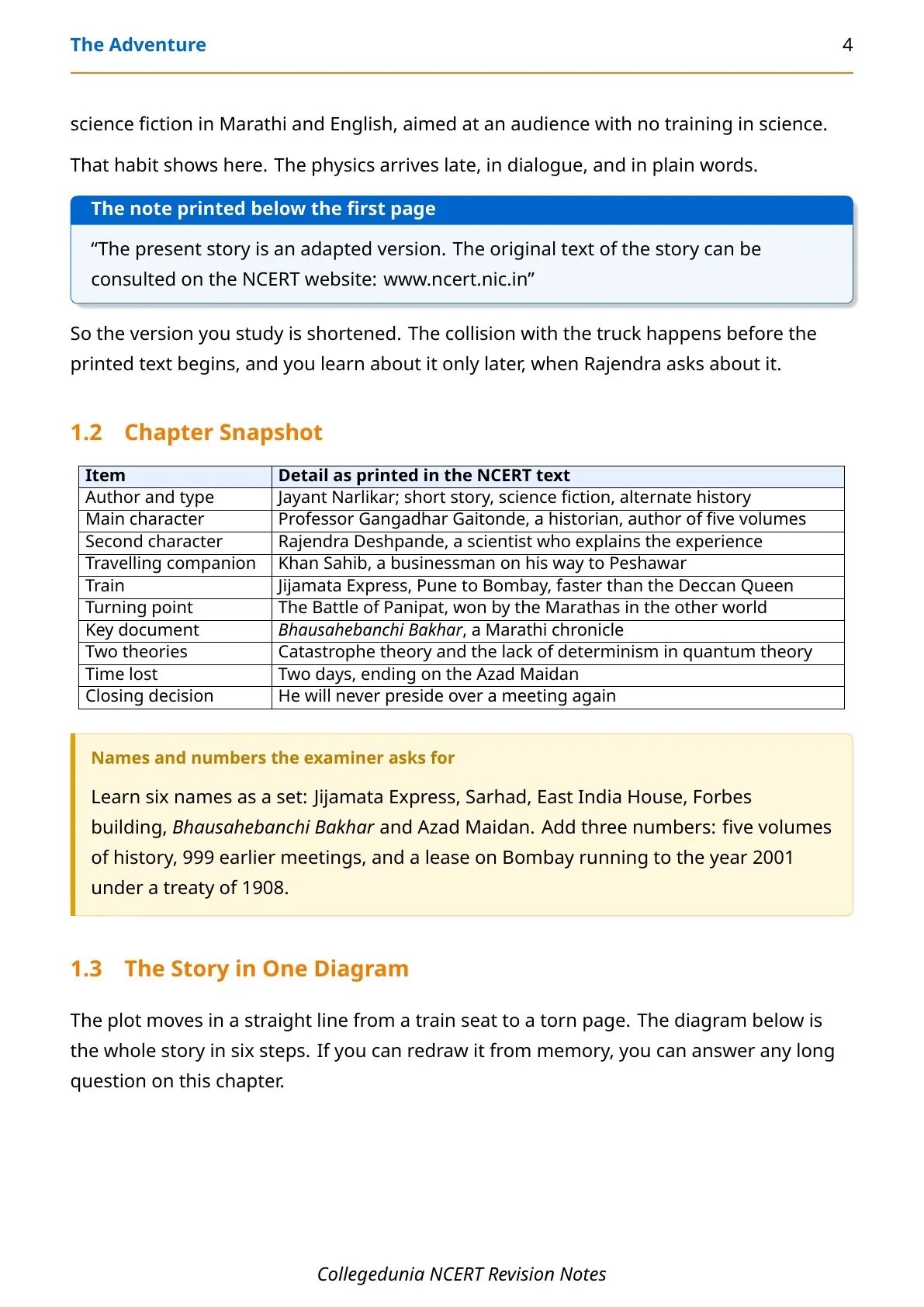
- Covers the summary, character sketches, literary devices and all eight noticing expressions.
- The chapter usually carries 6 to 8 marks in the Hornbill prose section.
- Answers every Understanding the Text, Talking about the Text and Thinking about Language task.
Every note on this page is curated by Class 11 English teachers, checked line by line against the 2026-27 Hornbill print, and refined against the last five years of school question papers.
Student Feedback: Collegedunia polled 13,640 Class 11 English students before the 2026-27 school exams. 69% said they could not tell catastrophe theory apart from the many worlds idea in a written answer. Only 31% could name Vishwasrao as the soldier the bullet misses in the torn page.
Source: 2026-27 Class 11 English Core student poll. Sample of 13,640 students from CBSE schools across 19 states.
What These The Adventure Notes Cover for Class 11 English
This page is built for the way the story is actually tested. The Adventure is short, but it holds one counterfactual battle, two scientific theories, three named characters and a long list of proper nouns that examiners love to ask about.
- Full summary in the order Narlikar tells it, from the Jijamata Express to the closing line about the Panipat seminar.
- A place by place map of the alternate Bombay, so you can quote the details that prove the world has changed.
- Simple explanations of catastrophe theory and the quantum many worlds idea, written for a Class 11 student, not for a physicist.
- Character sketches of Gangadharpant Gaitonde, Rajendra Deshpande and Khan Sahib with the exact lines that support each trait.
- Every end of unit task answered, including all eight noticing expressions and the confusing word pairs.
Jayant Narlikar and the Science Fiction Behind The Adventure
The Hornbill textbook prints a short note with the story, and that note is itself examinable. Students who skip it lose easy marks on source based questions.
- Author: Jayant Narlikar, one of India's best known astrophysicists and a writer of science fiction in English and Marathi.
- Text used in Hornbill: the textbook prints an adapted version of the story. The note says the original can be consulted on the NCERT website.
- Genre: science fiction, and more exactly alternate history. The science is real, the history is imagined.
- Central question: what would India look like today if the Marathas had won the Third Battle of Panipat?
Because Narlikar is a working scientist, the explanation at the end of the story is not hand waving. Catastrophe theory and the lack of determinism in quantum theory are both genuine ideas. That is what makes the story unusual, and it is also why questions on it mix literature with science.
The Adventure Summary in Simple Language
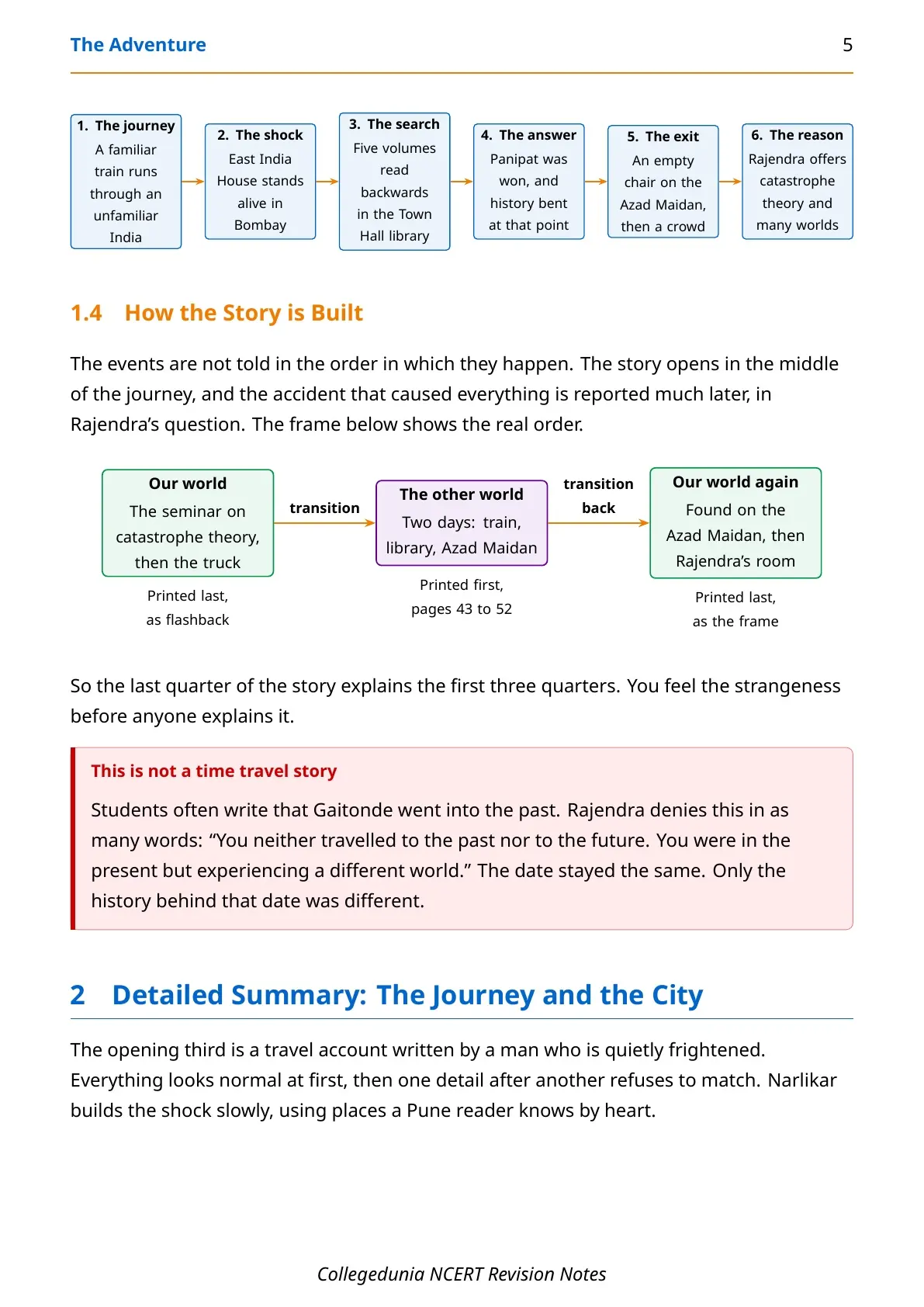
Professor Gangadharpant Gaitonde, a historian, is travelling from Pune to Bombay when his car collides with a truck. Just before the collision he is thinking about catastrophe theory and what it means for history. He then finds himself on the Jijamata Express, in a Bombay that is not the one he knows.
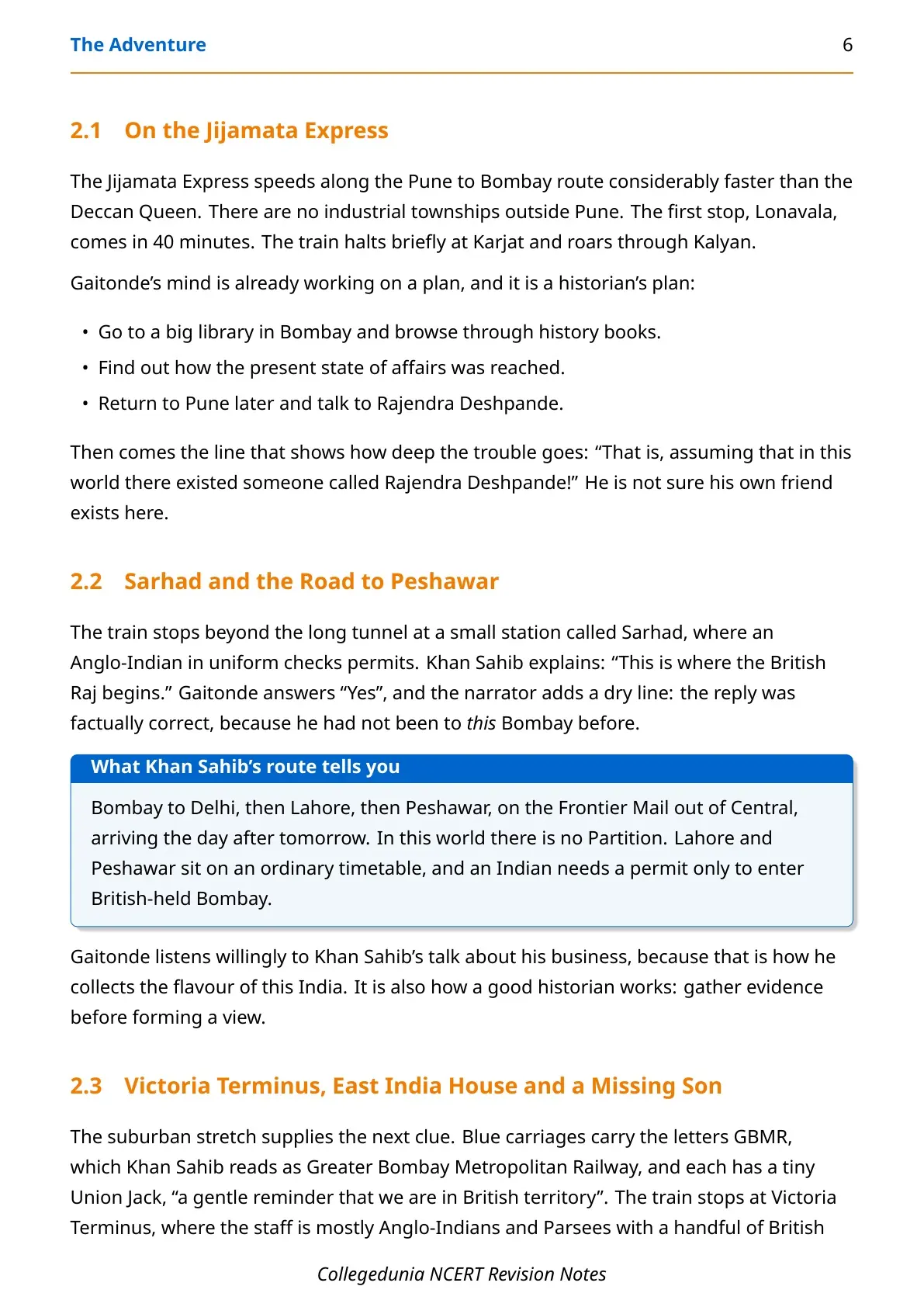
The story is told in two halves. The first half is the journey itself. The second half is Gaitonde back in Pune, telling the whole thing to his friend Rajendra Deshpande, who tries to explain it.
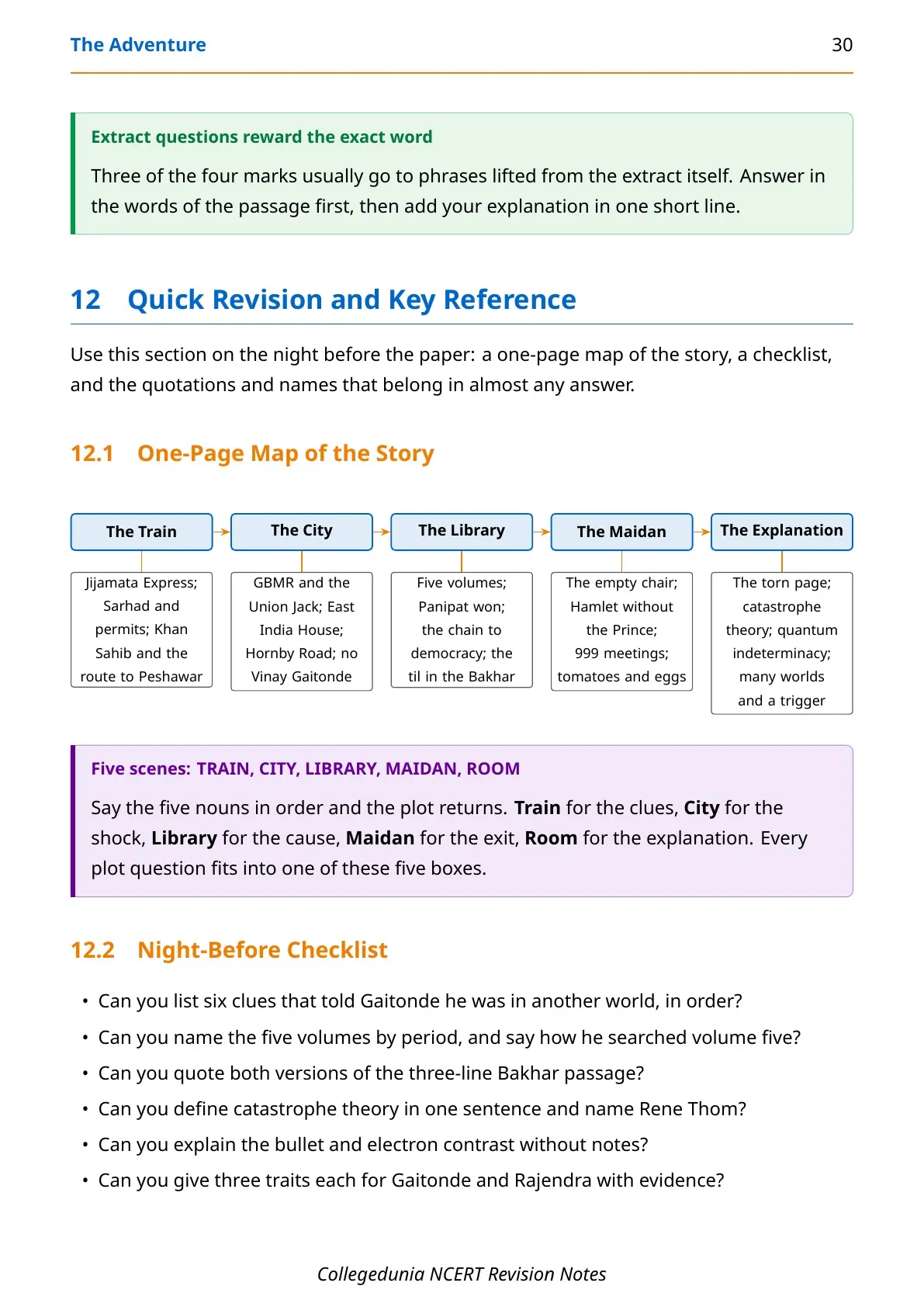
- The train. The Jijamata Express runs faster than the Deccan Queen. At a small station called Sarhad, an Anglo-Indian officer checks permits. A fellow passenger, Khan Sahib, tells him that this is where the British Raj begins.
- The city. Bombay is a small British outpost. Gaitonde sees East India House, headquarters of the East India Company, a firm that his own history books say was wound up soon after 1857.
- The search. He looks for his son Vinay at Forbes building and is told nobody of that name works there. In this world his son may never have been born.
- The library. At the Town Hall he reads his own five volumes of history and finds the exact point where history changed: the Battle of Panipat, which the Marathas win.
- The lecture. At Azad Maidan he sees a public lecture with an empty presidential chair. He tries to occupy it, the crowd turns on him, and he disappears in the scuffle.
- The explanation. He wakes in his own world. Rajendra explains the two days using catastrophe theory and the many worlds idea, and the torn page of a Bakhar proves that Gaitonde did not imagine it.
The story ends quietly. Gaitonde says his thousandth presidential address was already made, on the Azad Maidan platform, and he will never preside at a meeting again.
The Adventure Story and Themes Explained in Video
Source: Magnet Brains on YouTube
Professor Gaitonde's Journey Through the Alternate Bombay
The details of the journey are the evidence that the world has changed. Examiners ask for three or four of them at a time, so learn them as a list rather than as a story.
| Place or detail | What it tells the student |
|---|---|
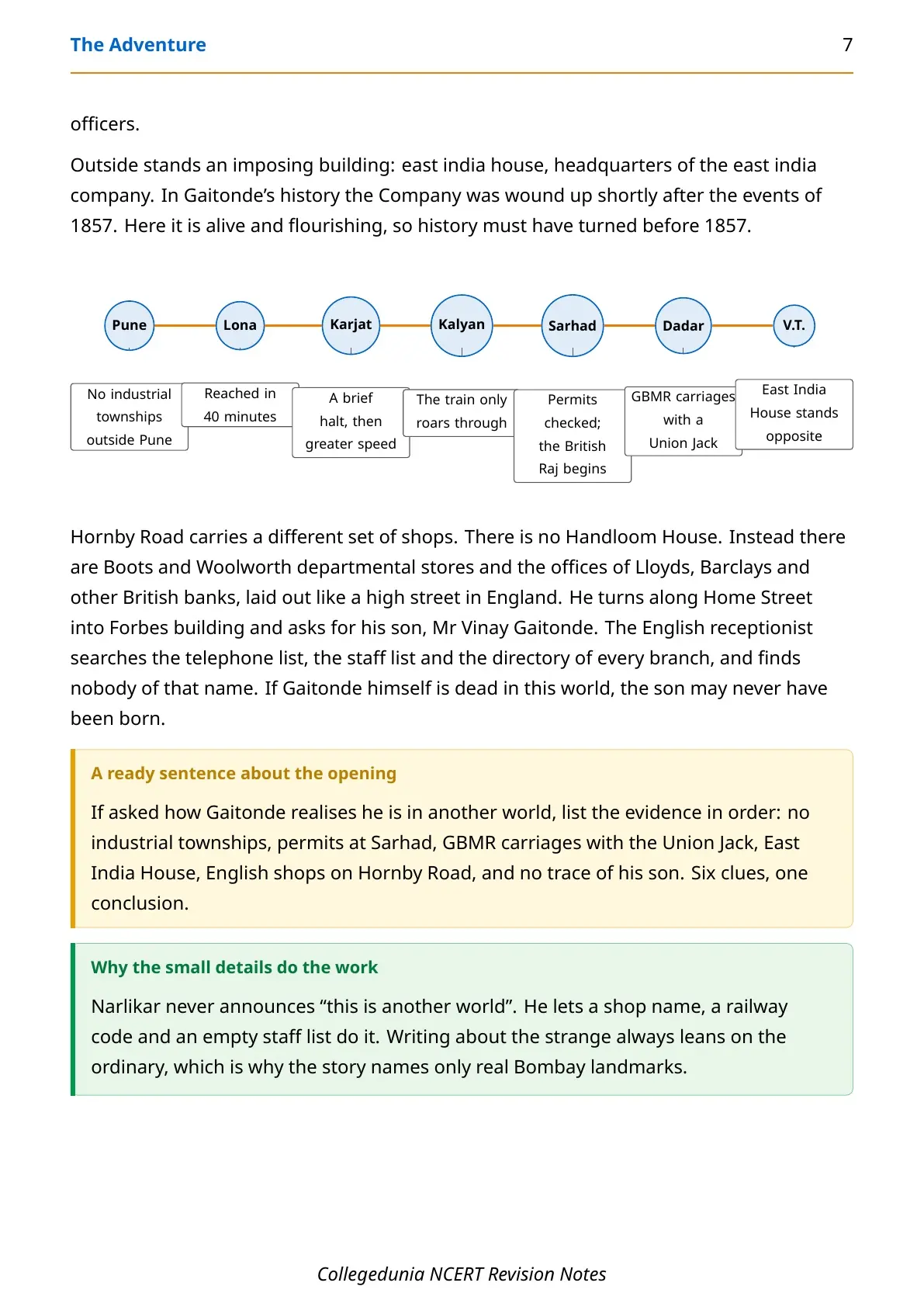
| Jijamata Express | Runs the Pune to Bombay route much faster than the Deccan Queen. No industrial townships outside Pune. |
| Lonavala, Karjat, Kalyan | The first stop comes in 40 minutes. The route is familiar, so the change is political, not geographical. |
| Sarhad | A small station beyond the long tunnel where permits are checked. Khan Sahib says, "This is where the British Raj begins." |
| Khan Sahib's route | He will take the Frontier Mail from Central: Bombay to Delhi, then Lahore, then Peshawar, arriving the day after tomorrow. |
| GBMR carriages | Blue suburban carriages of the Greater Bombay Metropolitan Railway, each with a tiny Union Jack painted on it. |
| Victoria Terminus | Remarkably neat and clean. The staff is mostly Anglo-Indians and Parsees with a handful of British officers. |
| East India House | Headquarters of the East India Company, still alive and flourishing. In real history it was wound up shortly after 1857. |
| Hornby Road | No Handloom House. Instead Boots and Woolworth stores and the offices of Lloyds and Barclays, like an English high street. |
| Forbes building | He asks for Mr Vinay Gaitonde. The English receptionist can find no such employee in any branch. |
| Town Hall | Still standing, and it still houses the library of the Asiatic Society. This is where he solves the riddle. |
Notice the shape of the sequence. The British are present but small, and India is not a colony. Bombay is the only British foothold, kept for commercial reasons on a lease that runs out in the year 2001, under a treaty of 1908.
The Battle of Panipat Counterfactual That Changes Indian History
This is the hinge of the whole story, and the single most asked question on the chapter. Gaitonde reads his own five volumes and works backwards until he finds the page where his history and this history part company.
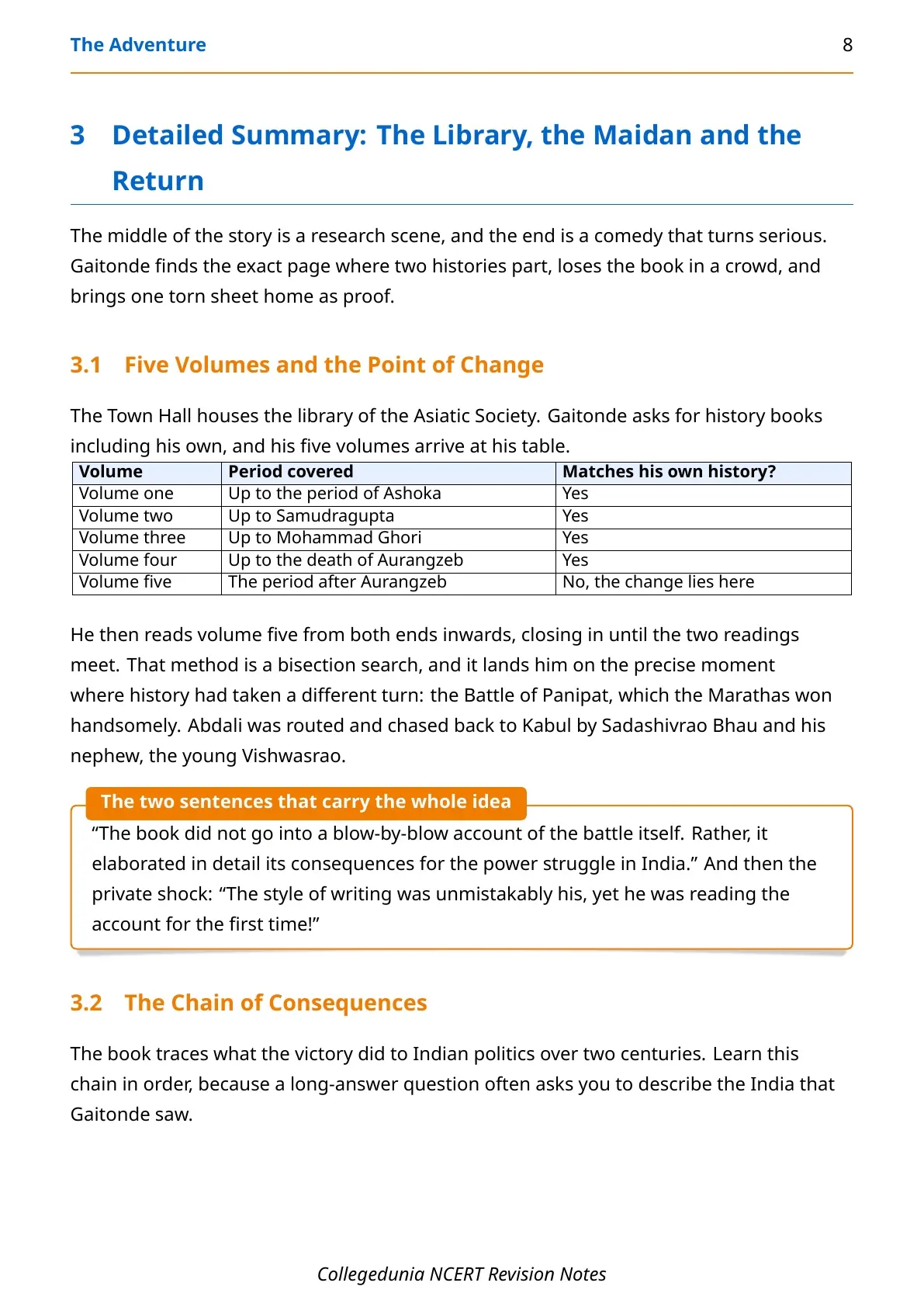
- Volume one takes the history up to the period of Ashoka.
- Volume two up to Samudragupta.
- Volume three up to Mohammad Ghori.
- Volume four up to the death of Aurangzeb. Up to here everything matches what he knows.
- Volume five is where the change sits, so he reads it from both ends inwards until he reaches the exact moment.
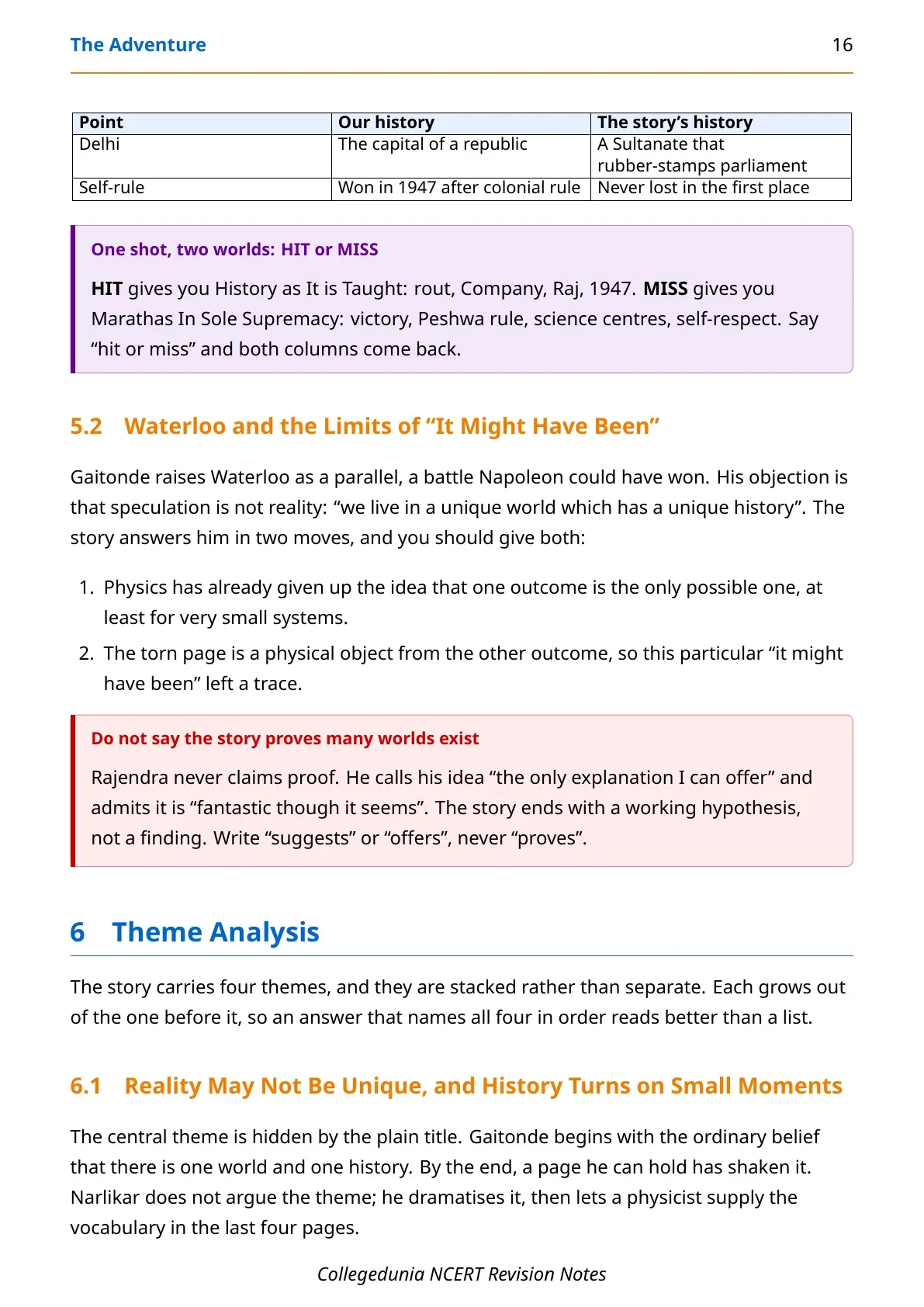
The page describes the Battle of Panipat, and it says the Marathas won it handsomely. Abdali was routed and chased back to Kabul by a Maratha army led by Sadashivrao Bhau and his nephew, the young Vishwasrao. The book does not give a blow-by-blow account of the fighting. It spends its pages on what the victory did to the balance of power in India.
One detail here is worth memorising because it is easy to score on. The account is written in a style Gaitonde recognises as unmistakably his own, yet he is reading it for the first time. In that world he wrote a book he never wrote in this one.
What Gangadharpant Read in the Library: The Alternate History Timeline
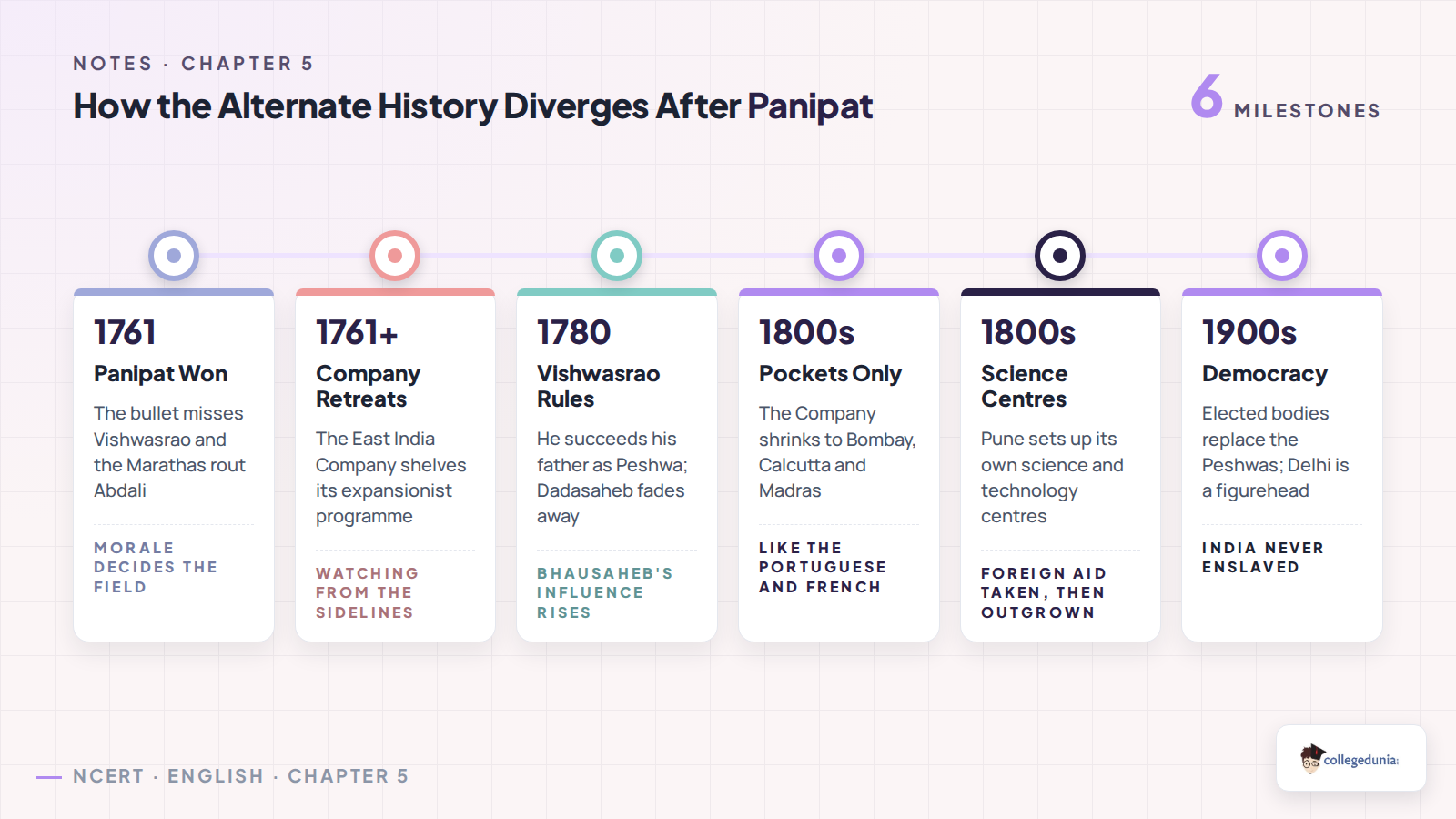
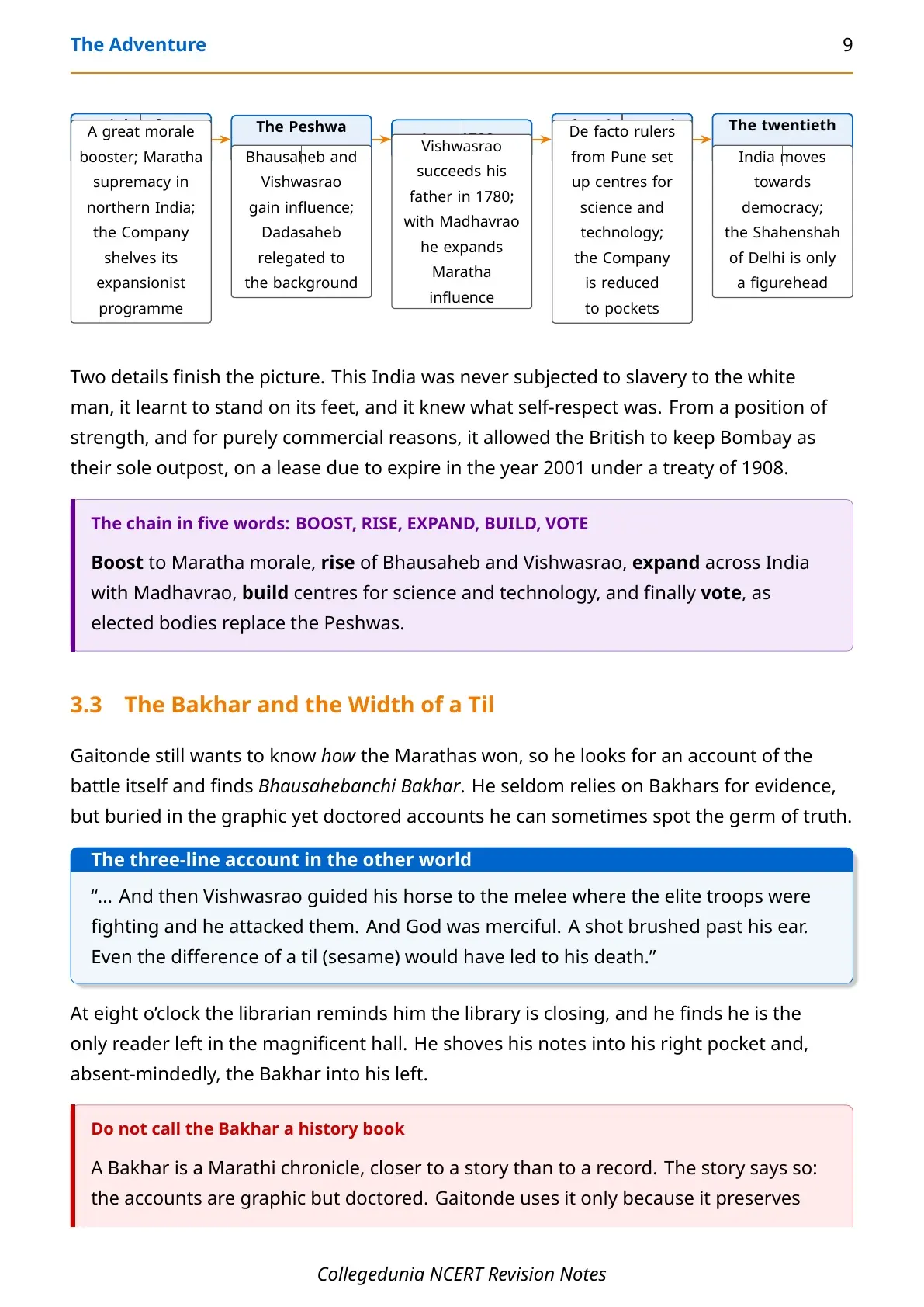
The consequences of the Maratha victory run for almost two centuries in the book, and school papers set a five mark question on them. Revise them as a chain, because each step causes the next.
| Stage | What the alternate history records |
|---|---|
| Immediately after Panipat | A great morale booster for the Marathas, and their supremacy is established in northern India. |
| The East India Company | Watching from the sidelines, it gets the message and temporarily shelves its expansionist programme. |
| Inside the Peshwa court | The influence of Bhausaheb and Vishwasrao rises. Vishwasrao succeeds his father in 1780 A.D. |
| Dadasaheb | The trouble-maker is relegated to the background and eventually retires from state politics. |
| Vishwasrao and Madhavrao | The brothers combine political acumen with valour and expand Maratha influence all over India. |
| The Company shrinks | It is reduced to pockets of influence near Bombay, Calcutta and Madras, just like the Portuguese and the French. |
| Delhi | For political reasons the Peshwas keep the puppet Mughal regime alive. |
| Nineteenth century | These de facto rulers from Pune are astute enough to see the technological age dawning in Europe and set up their own science and technology centres. |
| Company aid | It offers aid and experts, hoping to extend its influence. The offer is accepted only to make the local centres self-sufficient. |
| Twentieth century | India moves towards democracy. The Peshwas lose their enterprise and are replaced by democratically elected bodies. |
| The Sultanate | It survives the transition because it wields no real influence. The Shahenshah of Delhi is a figurehead who rubber-stamps the recommendations of the central parliament. |
| Bombay | Kept by the British as their sole outpost, allowed from a position of strength and for purely commercial reasons. |
Gaitonde's own reaction is the answer to a common short question. He begins to appreciate the India he has seen, because it is a country that was never subjected to slavery for the white man. It learnt to stand on its own feet and it knows what self-respect is.
The Azad Maidan Lecture and the Empty Presidential Chair
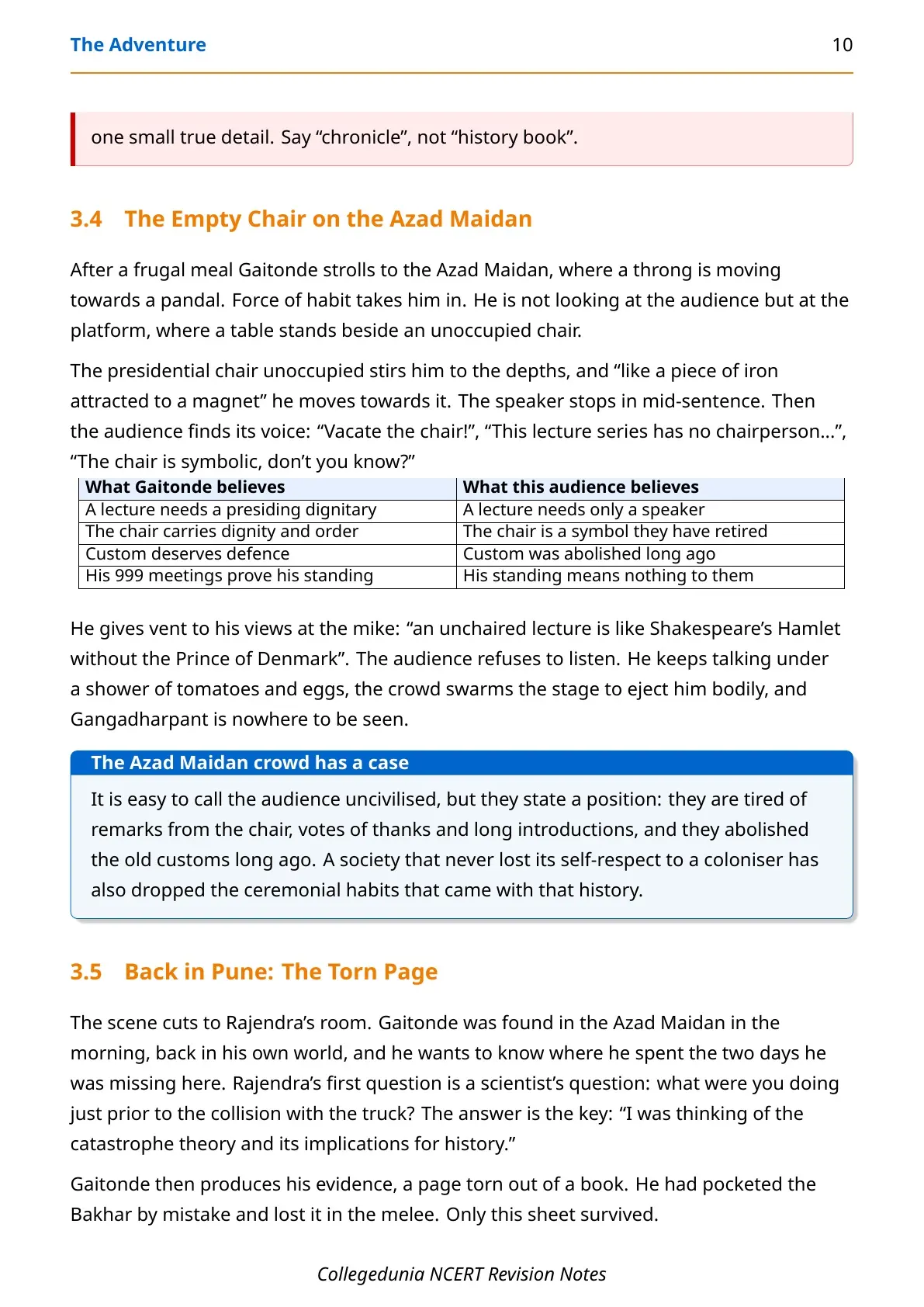
The Azad Maidan scene is the funniest part of the story and also the most symbolic. After a frugal meal at a guest house, Gaitonde strolls towards the maidan and finds a crowd moving into a pandal.
- A lecture is already in progress, and people keep coming and going.
- On the platform there is a table and a chair, and the presidential chair is unoccupied.
- The sight stirs Gaitonde to the depths. Like a piece of iron attracted to a magnet, he moves swiftly towards the chair.
- The speaker stops in mid-sentence. The people in the pandal shout at him to vacate the chair and tell him the lecture series has no chairperson.
- Someone calls out that the chair is symbolic, and that these old customs were abolished long ago.
Gaitonde goes to the microphone and gives vent to his views. His line is quotable and often set as a context question: "an unchaired lecture is like Shakespeare's Hamlet without the Prince of Denmark". Nobody wants to hear it. They say they are sick of remarks from the chair, of votes of thanks and of long introductions.
He keeps talking, because he has spoken at 999 meetings and has faced hostile crowds in Pune before. Tomatoes and eggs are thrown at him. Finally the crowd swarms the stage to throw him out bodily, and in the confusion Gangadharpant is nowhere to be seen. That is the moment he returns to his own world.
Catastrophe Theory Explained for Class 11 Students
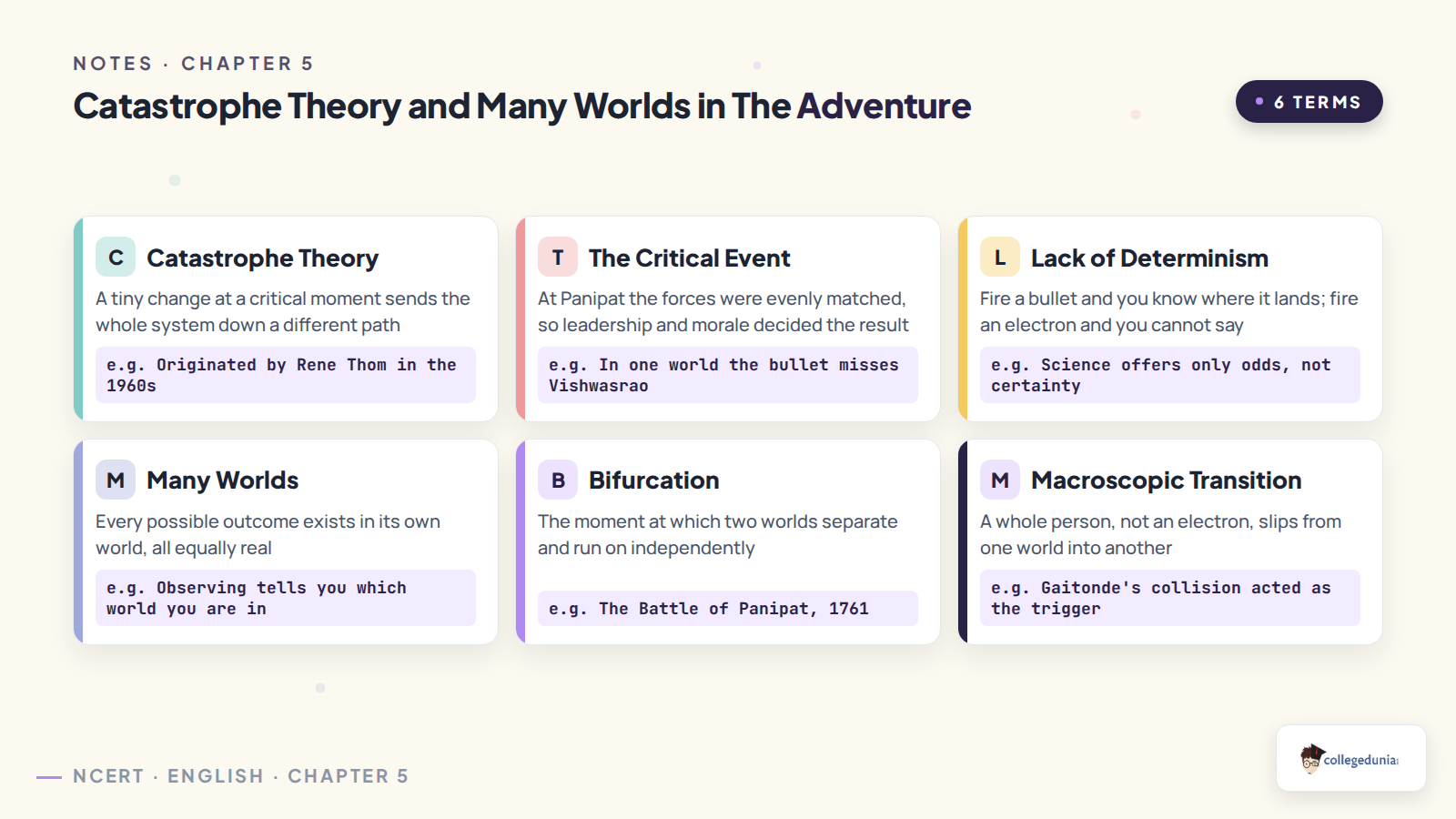
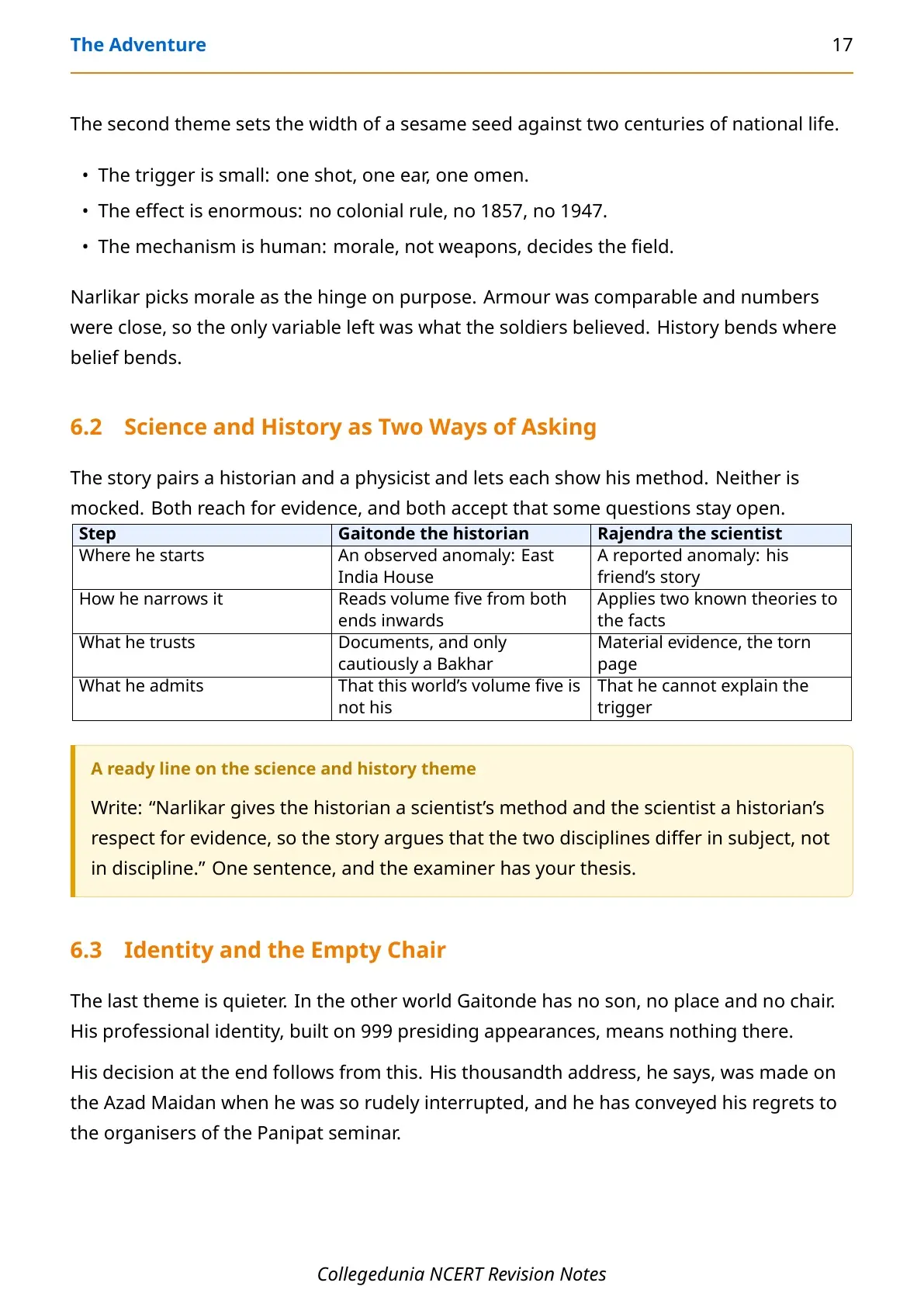
Rajendra Deshpande uses two scientific ideas to explain the two missing days. The first is catastrophe theory. Do not let the word frighten you. In this story it means one simple thing: a very small change at a critical moment can send the whole system down a completely different path.
Rajendra applies it to the Battle of Panipat step by step, and this is exactly how the answer should be written.
- The Maratha army faced Abdali's troops on an open field, so the battle was fought face to face.
- There was no great disparity between the two forces and their armour was comparable.
- So the result depended on leadership and the morale of the troops, not on numbers or weapons.
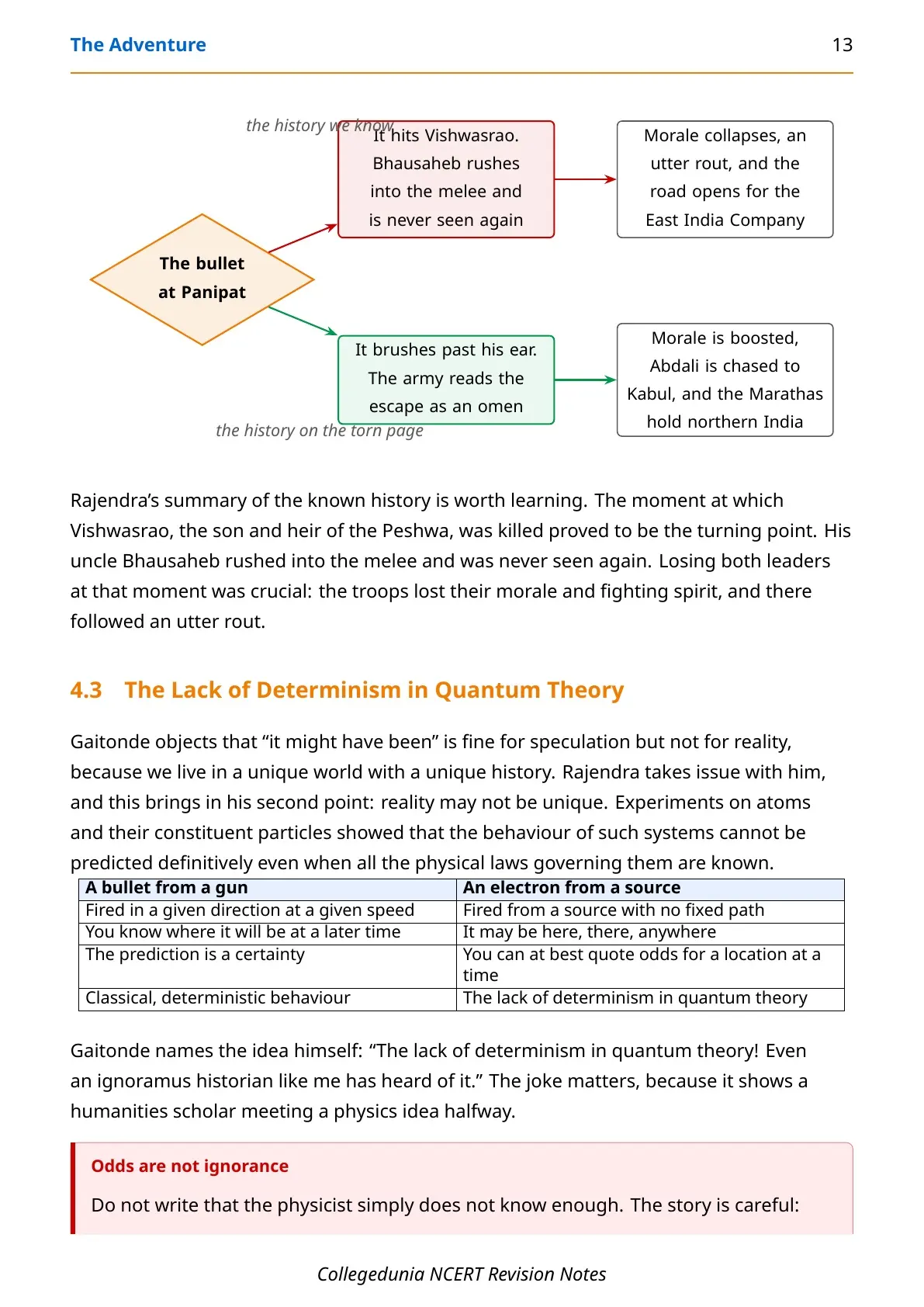
- In our history, Vishwasrao, the son and heir of the Peshwa, was killed at a critical moment. His uncle Bhausaheb rushed into the melee and was never seen again.
- Losing both leaders at once broke the morale and fighting spirit of the troops, and there followed an utter rout.
- In the other world the bullet missed. The same crucial event went the other way, the troops were lifted instead of broken, and that extra impetus won the battle.
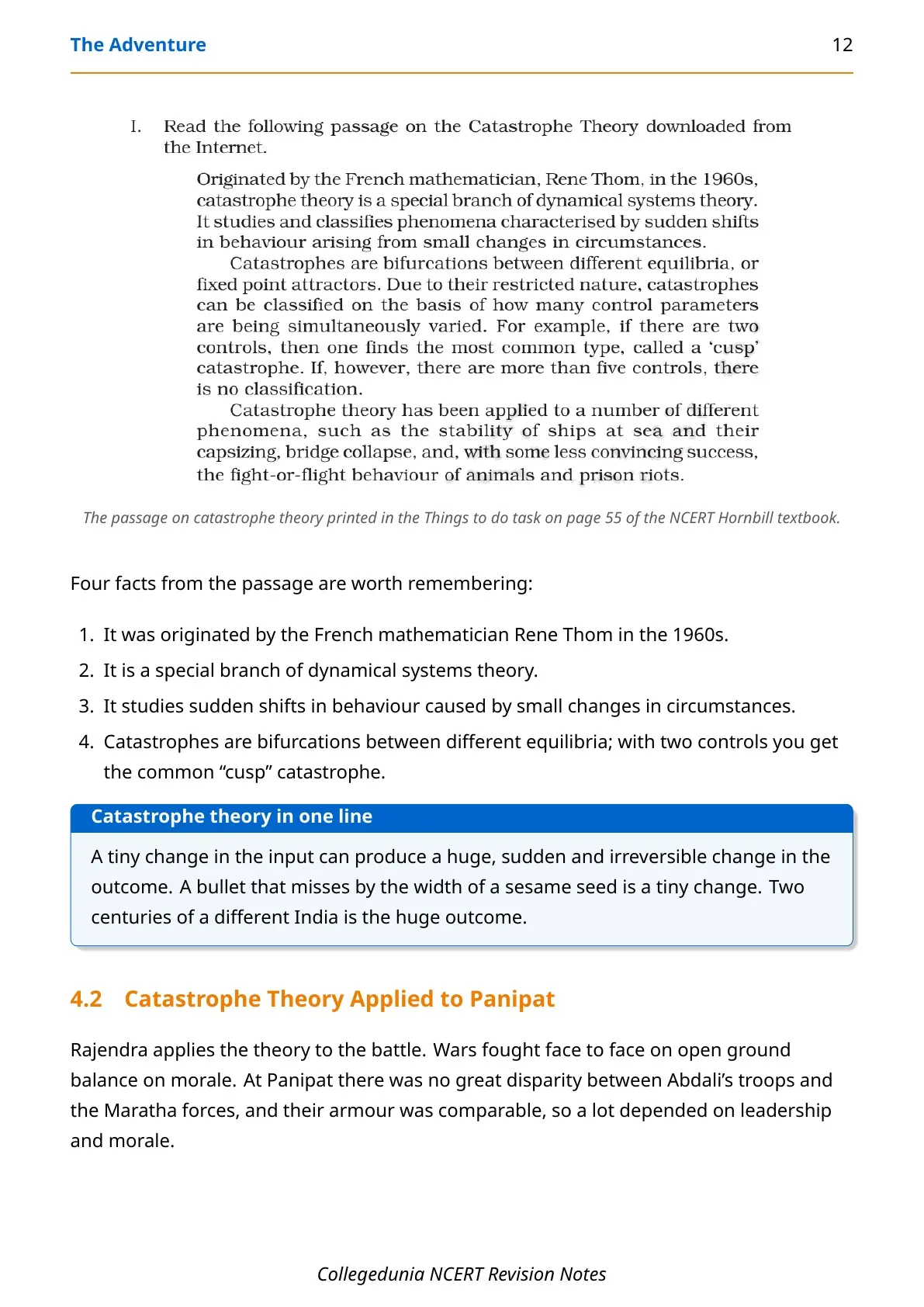
The textbook's Things To Do section adds the background. Catastrophe theory was originated by the French mathematician Rene Thom in the 1960s. It is a branch of dynamical systems theory, and it studies sudden shifts in behaviour that come from small changes in circumstances. Gaitonde's own objection is worth quoting too. He compares it to the Battle of Waterloo, which Napoleon could have won, and says that "it might have been" is fine for speculation but not for reality.
The Many Worlds Idea in Quantum Theory and How Narlikar Uses It
Rajendra's second point answers Gaitonde's objection. If reality is unique, a different Panipat is only speculation. So Rajendra argues that reality may not be unique at all, and he takes his evidence from experiments on atoms and their constituent particles.
- The problem: the behaviour of very small systems cannot be predicted definitely, even when every physical law governing them is known.
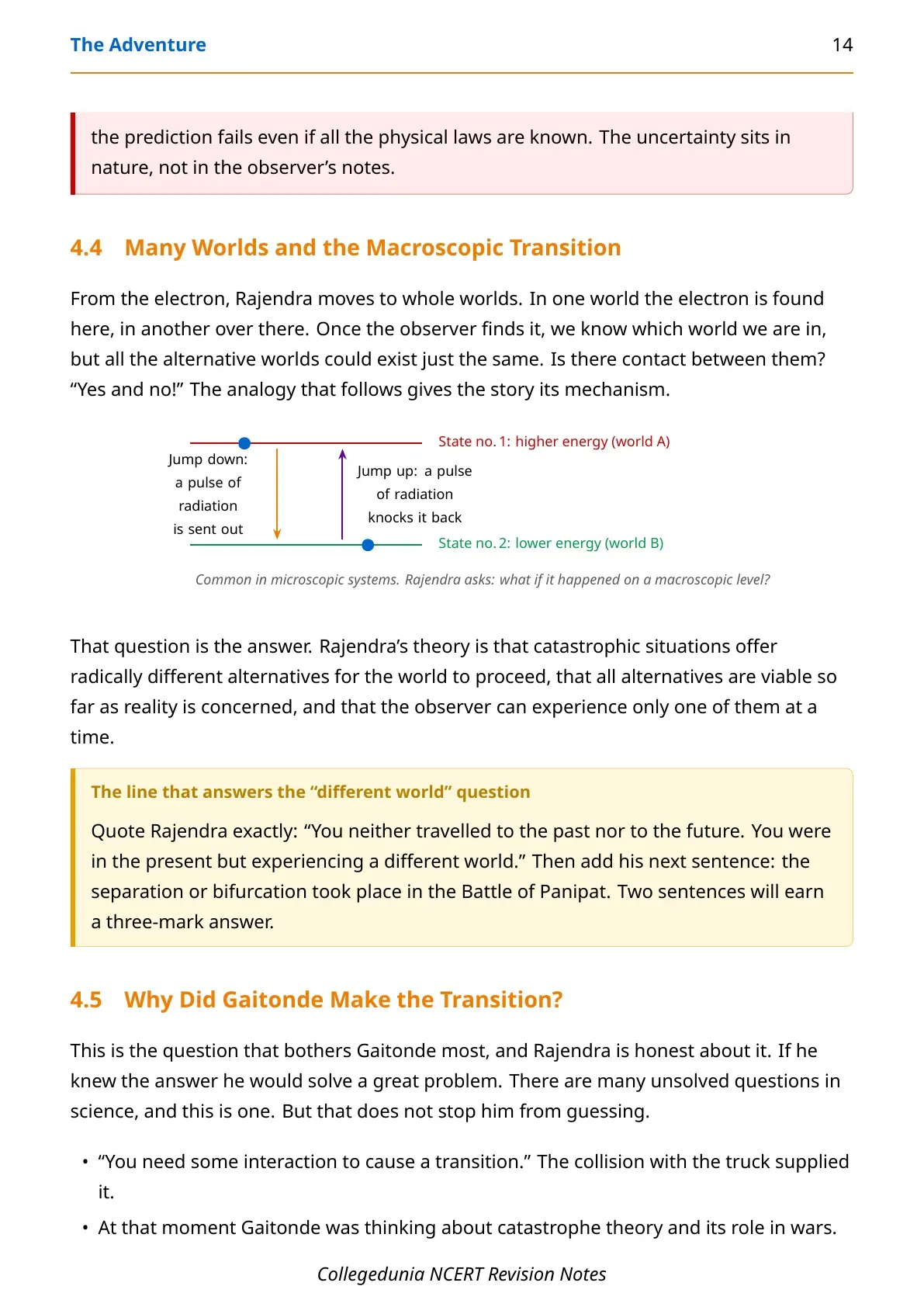
- The example: fire a bullet from a gun at a given speed and direction and you know where it will be later. Fire an electron and you cannot say. It may be here, there or anywhere.
- What science can offer: only odds, that is, the chance of finding the electron in a specified place at a specified time. Gaitonde names this himself as the lack of determinism in quantum theory.
- The many worlds picture: in one world the electron is here, in another it is there, in a third it is somewhere else. Once an observer finds it, we know which world we are in, but all the alternative worlds could exist just the same.
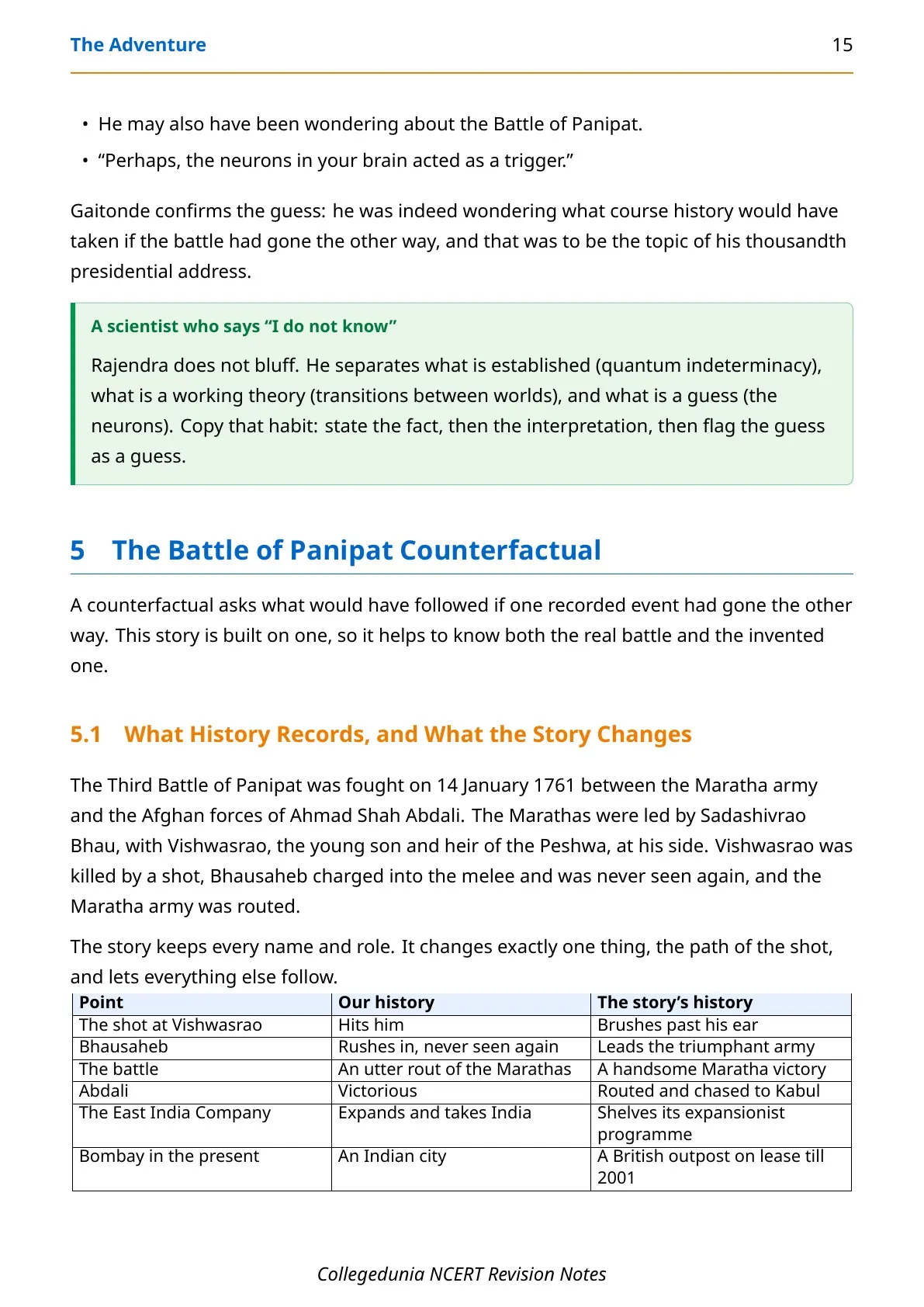
- Transitions: an electron in a higher energy state can jump to a lower one and send out a pulse of radiation, or a pulse can knock it up again. Such transitions are common in microscopic systems.
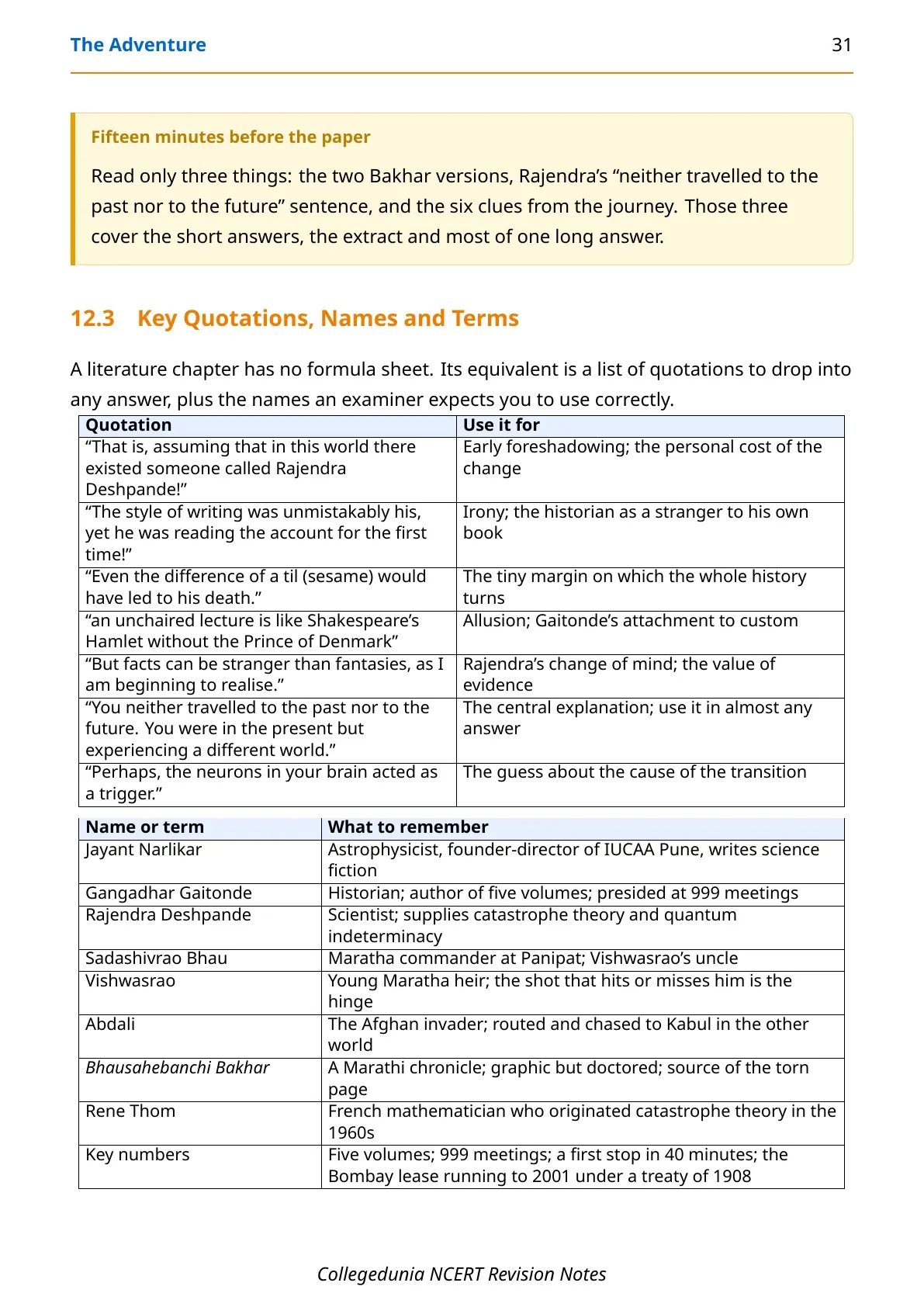
Rajendra's guess is that the same kind of transition happened on a macroscopic level, with a whole person instead of an electron. His conclusion is the sentence most often set for explanation: "You neither travelled to the past nor to the future. You were in the present but experiencing a different world." The separation, or bifurcation, of the two worlds took place at the Battle of Panipat, and by the same logic there must be many more worlds branching off at other moments.
As for why Gaitonde made the transition, Rajendra is honest. He says that if he knew the answer he would solve a great problem, and that this is one of the many unsolved questions in science. His guess is that you need some interaction to cause a transition, and that the collision, combined with Gaitonde's thoughts about catastrophe theory and Panipat, made the neurons in his brain act as a trigger.
The Torn Page from Bhausahebanchi Bakhar and the Two Versions Compared
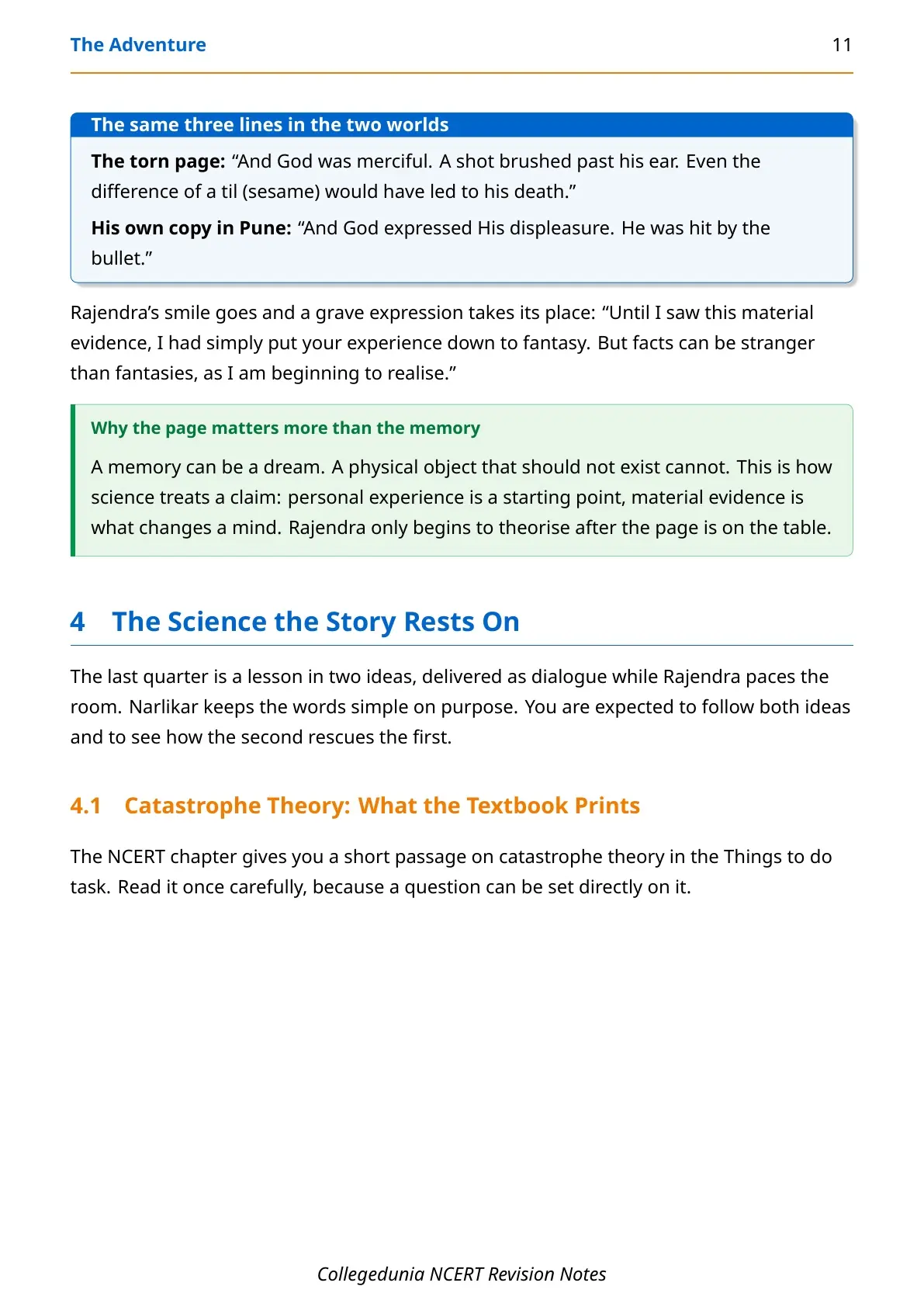
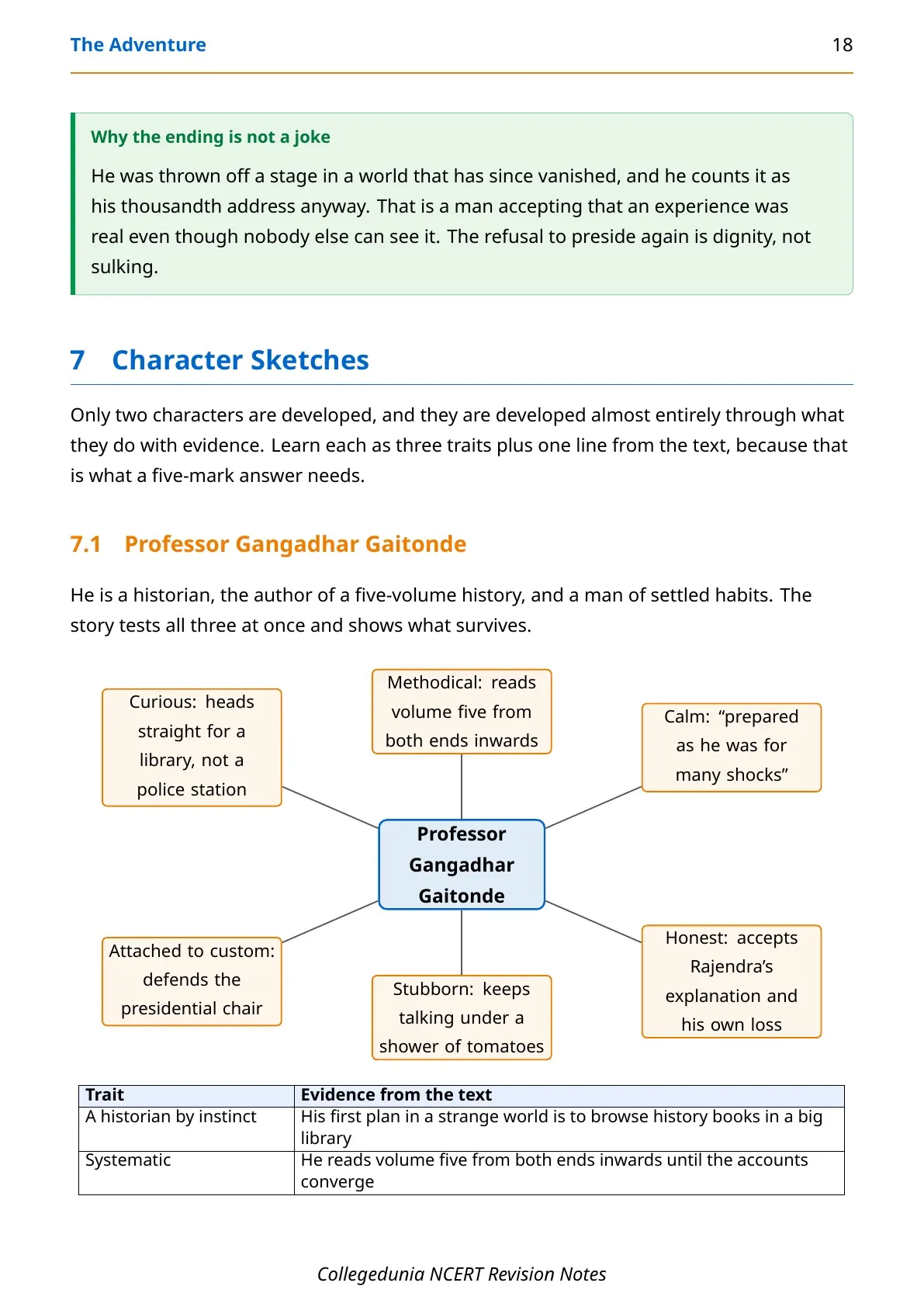
The torn page is the physical proof that turns Rajendra from a smiling sceptic into a serious listener. A Bakhar is an old Marathi chronicle. Gaitonde says he seldom relies on Bakhars as historical evidence, but he finds them entertaining, and sometimes he can spot the germ of truth buried in the graphic but doctored accounts.
| Version | What the Bakhar says | Result |
|---|---|---|
| The torn page from the other world | Vishwasrao guided his horse to the melee and attacked the elite troops. God was merciful. A shot brushed past his ear, and even the difference of a til, a sesame seed, would have led to his death. | Taken as an omen by the Maratha army, it turned the tide in their favour. |
| Gaitonde's own copy in this world | Vishwasrao guided his horse to the melee and attacked the elite troops. God expressed His displeasure. He was hit by the bullet. | The heir dies, morale collapses, and the Marathas lose the battle. |
Two small practical details are often asked about. Gaitonde had shoved his notes into his right pocket and, absent-mindedly, the Bakhar into his left, as he left the library at eight o'clock. He discovered the mistake only when he was paying for his meal, and meant to return the book the next morning. In the scuffle at Azad Maidan the book was lost and only the torn page survived.
Rajendra's response to the page is the line to quote in an answer about his change of mind: "facts can be stranger than fantasies".
Character Sketches from The Adventure with Supporting Lines
Three characters carry the story. Long answer questions ask for two or three traits each, and every trait must be backed by an action from the text.
| Character | Traits | Proof from the story |
|---|---|---|
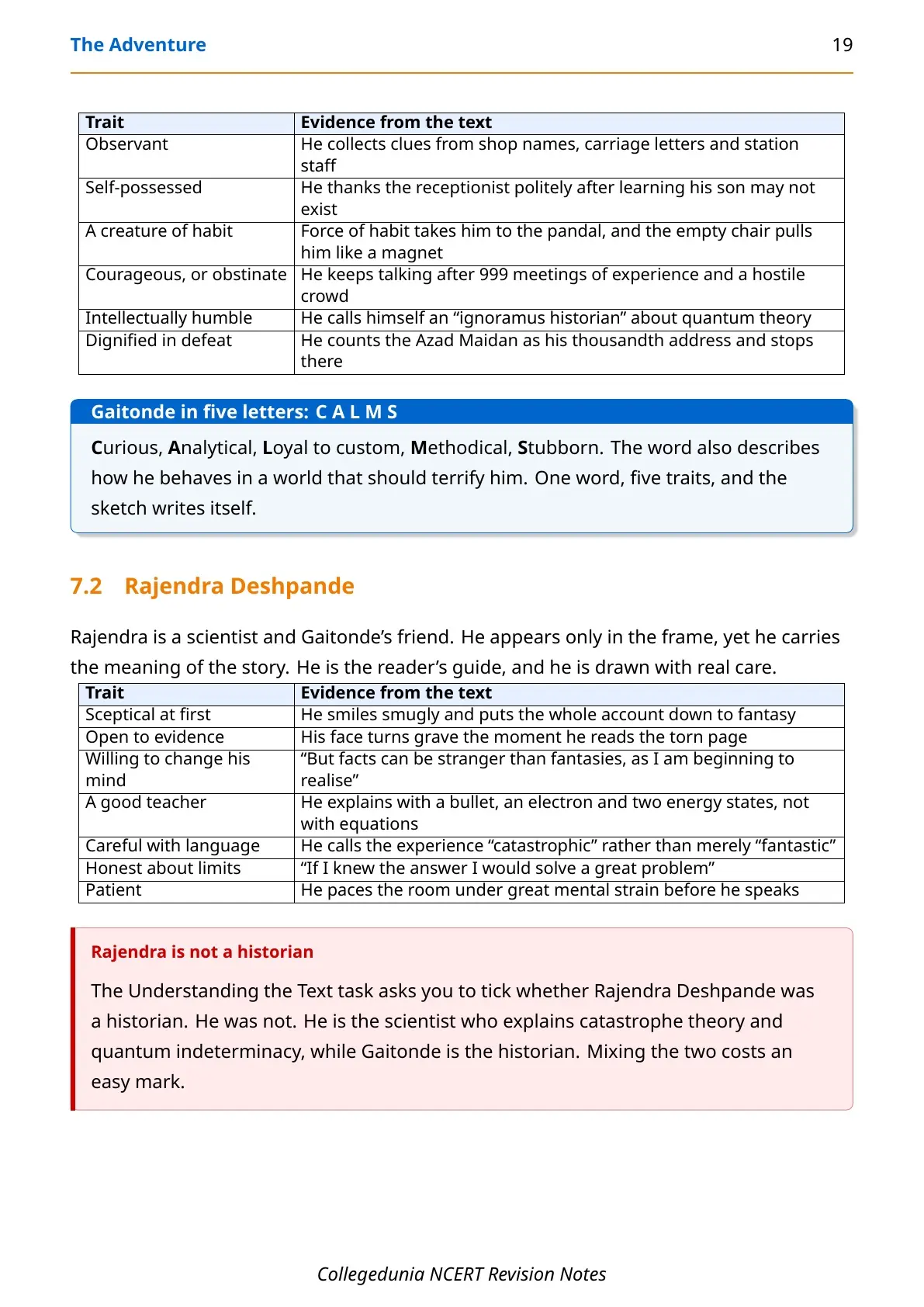
| Professor Gangadharpant Gaitonde | Historian, methodical, curious, absent-minded, courageous, traditional about custom, humble at the end | He heads straight for a library to solve the riddle, reads volume five from both ends inwards, pockets the Bakhar without noticing, faces a shower of tomatoes and eggs without stopping, and finally gives up presiding at meetings for good. |
| Rajendra Deshpande | Scientist, rational, open-minded, patient teacher, honest about what science cannot answer | He first puts the story down to fantasy, changes his mind on seeing the torn page, explains catastrophe theory and the many worlds idea in plain steps, and admits he can only guess why the transition happened. |
| Khan Sahib | Friendly, talkative, courteous, a businessman of the other world | He explains the permit check at Sarhad, points out the Union Jack on the GBMR carriages, and talks about his business all the way to Victoria Terminus, giving Gaitonde the flavour of that India. |
Two minor figures are worth a line each. The English receptionist at Forbes building searches the telephone list, the staff list and the directory of every branch before saying she cannot find Vinay Gaitonde. The librarian at the Town Hall smiles at a user and researcher after his own heart, and lets the professor reserve his books for the morning.
Themes in The Adventure Every Class 11 Student Must Know
Long answer questions are set on themes rather than on plot. Four themes cover almost everything a paper can ask, and each one can be opened with a single line from the text.
- One event can change everything. A shot that misses by the width of a sesame seed produces a different India two centuries later.
- Science and history can share a method. A historian's "what if" and a physicist's alternative world turn out to be the same question asked in two languages.
- Reality may not be unique. All alternatives are viable, but an observer can experience only one of them at a time.
- Freedom and self-respect. The India Gaitonde visits was never enslaved, and it deals with the British from a position of strength.
- Customs change and people must change with them. The empty chair he fights for has already been abolished by that society.
If a question asks which single sentence best states the theme, use Rajendra's line about being in the present while experiencing a different world. It carries both the science and the story in one breath.
Literary Devices and Narrative Technique in The Adventure
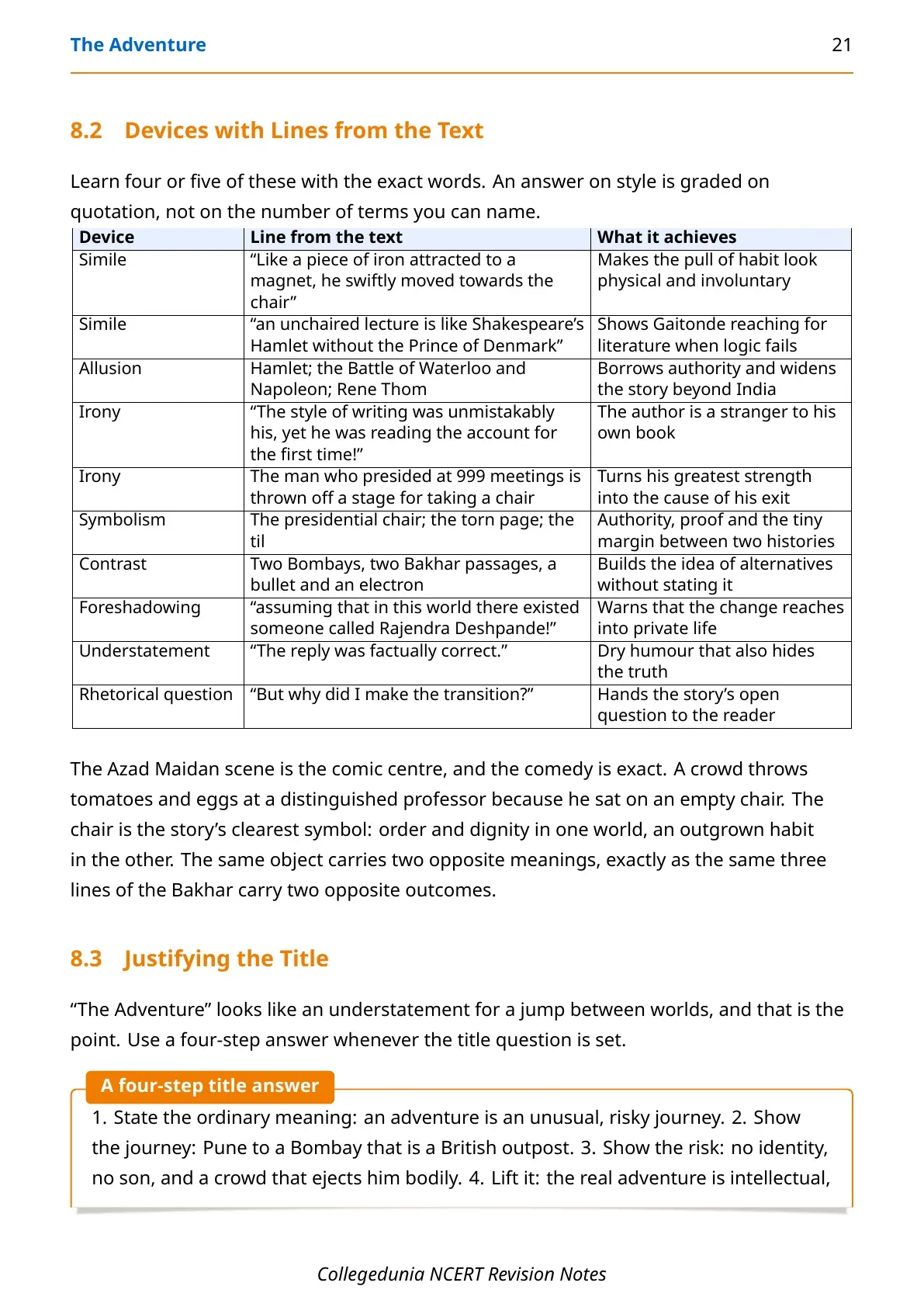
The chapter is prose fiction, so the paper can ask for figures of speech and for the way the story is built. Keep one example ready for each device.
| Device | Example from the story |
|---|---|
| Simile | "Like a piece of iron attracted to a magnet, he swiftly moved towards the chair." |
| Allusion | Shakespeare's Hamlet without the Prince of Denmark; the Battle of Waterloo and Napoleon; Rene Thom's catastrophe theory. |
| Irony | A historian reads, in his own unmistakable style, an account of a battle he never wrote about. |
| Symbolism | The presidential chair stands for old authority and ceremony. The torn page stands for hard evidence against pure speculation. |
| Contrast | The colonised India Gaitonde knows is set against the free, self-respecting India he visits. |
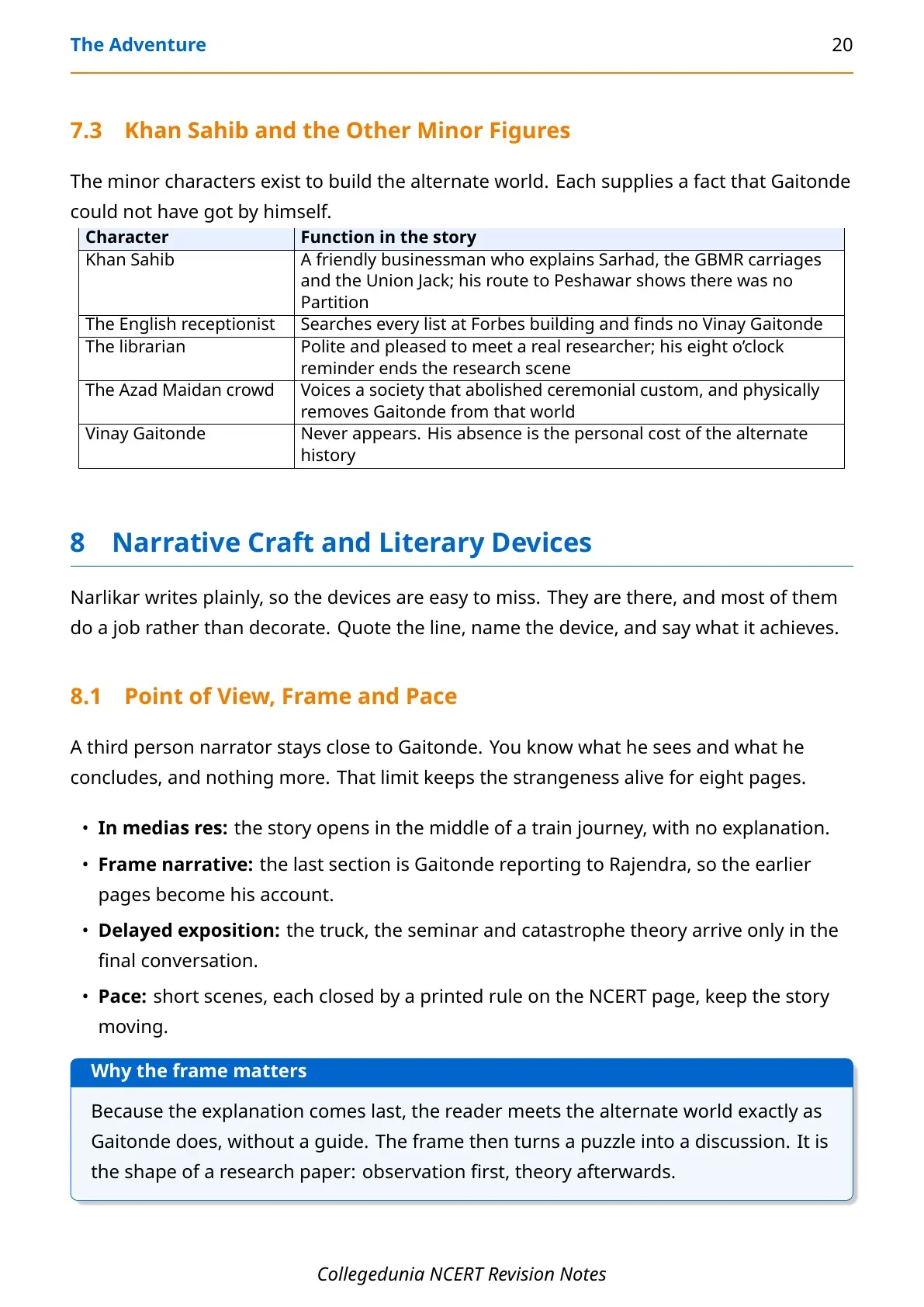
| Flashback and frame narrative | The second half of the story is Gaitonde narrating the whole experience to Rajendra in Pune. |
| Suspense | The professor vanishes in the crowd, and the explanation is held back until the conversation with Rajendra. |
| Humour and understatement | "Even an ignoramus historian like me has heard of it," says Gaitonde about quantum theory. |
On narrative technique, say three things: the story is told in the third person, it mixes a travel narrative with a scientific dialogue, and it uses real places and real historical names to make an imagined world believable.
Notice These Expressions from The Adventure with Their Meanings
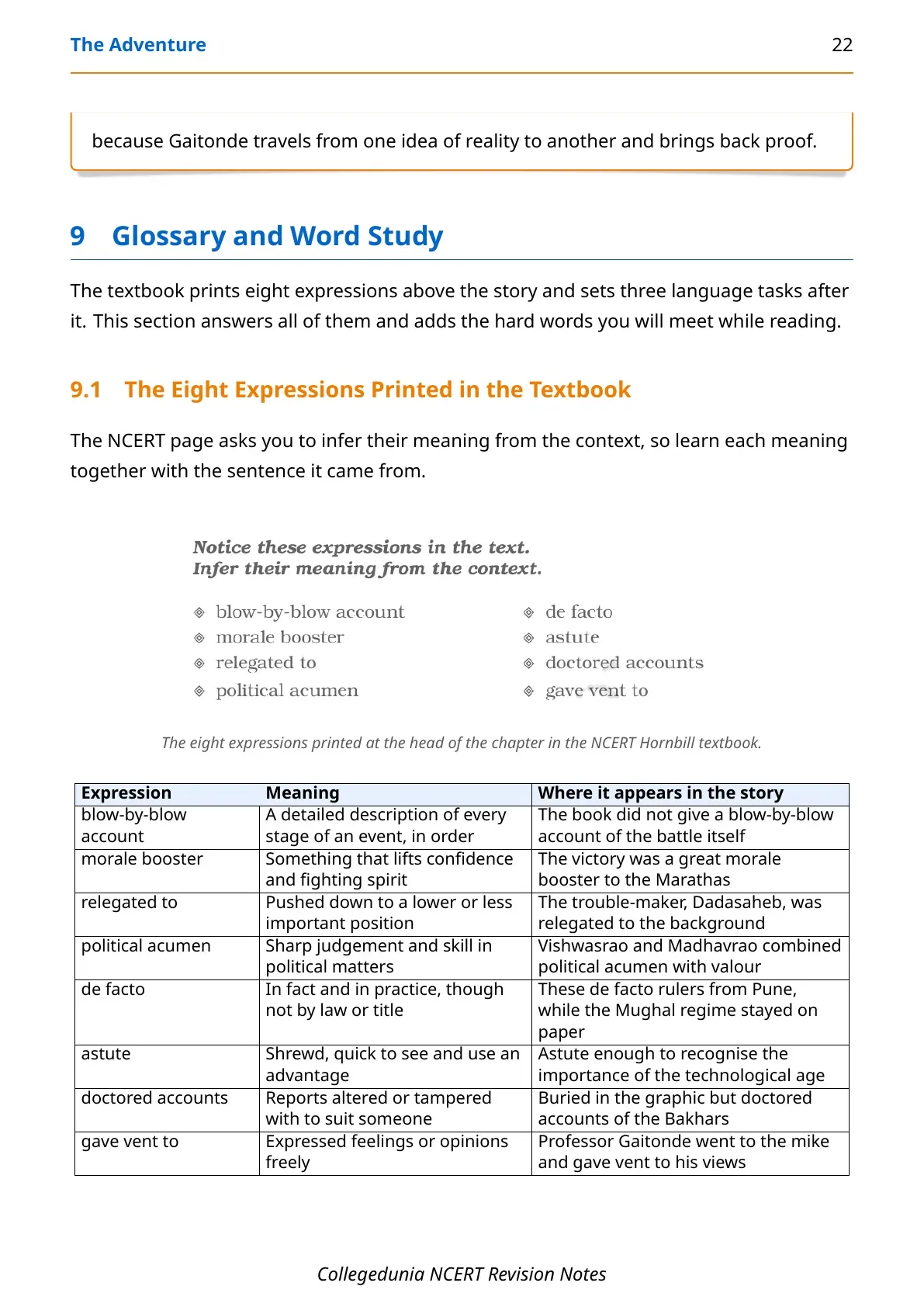
The textbook lists eight expressions above the story and asks you to infer their meaning from the context. These are direct one mark items, so learn all eight along with the sentence each one sits in.
| Expression | Meaning | Where it appears |
|---|---|---|
| Blow-by-blow account | A detailed description of every stage of an event | The book did not give a blow-by-blow account of the battle itself. |
| Morale booster | Something that lifts confidence and spirit | The victory was a great morale booster to the Marathas. |
| Relegated to | Pushed down to a lower or less important position | Dadasaheb was relegated to the background. |
| Political acumen | Sharp judgement and skill in politics | Vishwasrao and Madhavrao combined political acumen with valour. |
| De facto | In fact, in practice, whether or not it is official | The de facto rulers from Pune in the nineteenth century. |
| Astute | Shrewd, quick to see an advantage | They were astute enough to recognise the importance of the technological age. |
| Doctored accounts | Reports that have been altered or exaggerated | Buried in the graphic but doctored accounts, he could spot the germ of truth. |
| Gave vent to | Expressed strong feelings openly | Professor Gaitonde went to the mike and gave vent to his views. |
A quick memory trick: four of these expressions come from the library chapter of the alternate history, and four come from the scenes around it. Group them that way and they are easier to place in a context question.
Working with Words: Idioms and Confusing Word Pairs from The Adventure
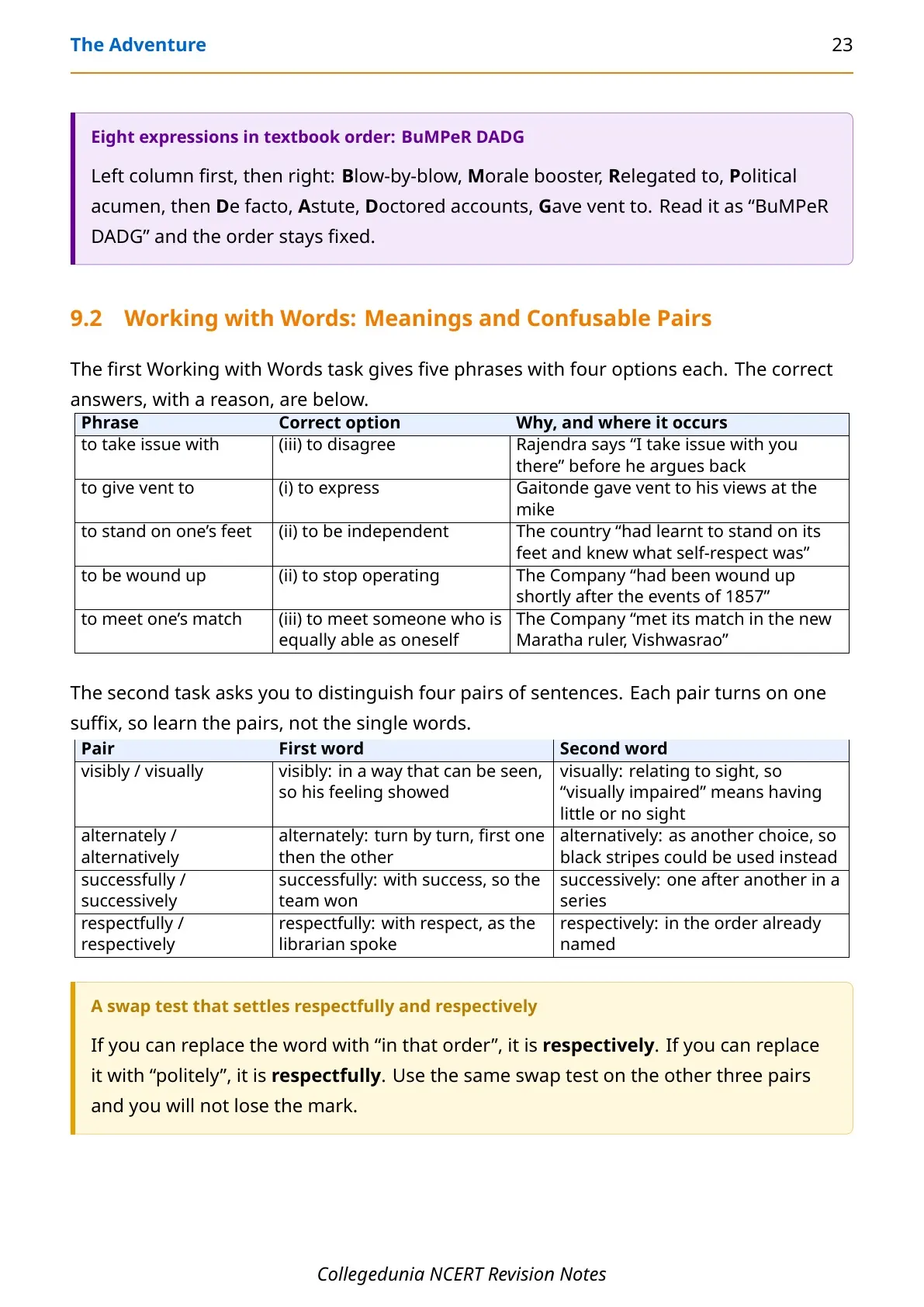
The Working with Words task has two parts. The first asks for the closest meaning of five phrases, and the second asks you to tell apart four pairs of words that look similar. Both parts appear in school papers almost every year.
| Phrase | Correct option | Used in the story as |
|---|---|---|
| To take issue with | To disagree | Rajendra says, "I take issue with you there." |
| To give vent to | To express | Gaitonde gave vent to his views at the microphone. |
| To stand on one's feet | To be independent | The country had learnt to stand on its feet. |
| To be wound up | To stop operating | The East India Company had been wound up shortly after 1857. |
| To meet one's match | To meet someone who is equally able as oneself | The Company met its match in the new Maratha ruler. |
The second part is the one that costs marks, because the two words in each pair differ by a single syllable. Learn them as opposites, not as definitions.
| Pair | First word | Second word |
|---|---|---|
| Visibly / visually | Visibly moved: his feeling showed on his face for everyone to see. | Visually impaired: having weak eyesight or no sight. |
| Alternately / alternatively | Alternately: turn by turn, first one and then the other. | Alternatively: as another choice, instead of the first option. |
| Successfully / successively | Successfully: with success, the matches were won. | Successively: one after the other, without a gap. |
| Respectfully / respectively | Respectfully: with respect and politeness. | Respectively: in the same order as the items already named. |
Understanding the Text Questions from The Adventure Answered
The task has two parts. Part one is a set of true or false statements, and part two asks you to explain five sentences taken from the story. Keep each explanation to three or four sentences and always tie it back to the plot.
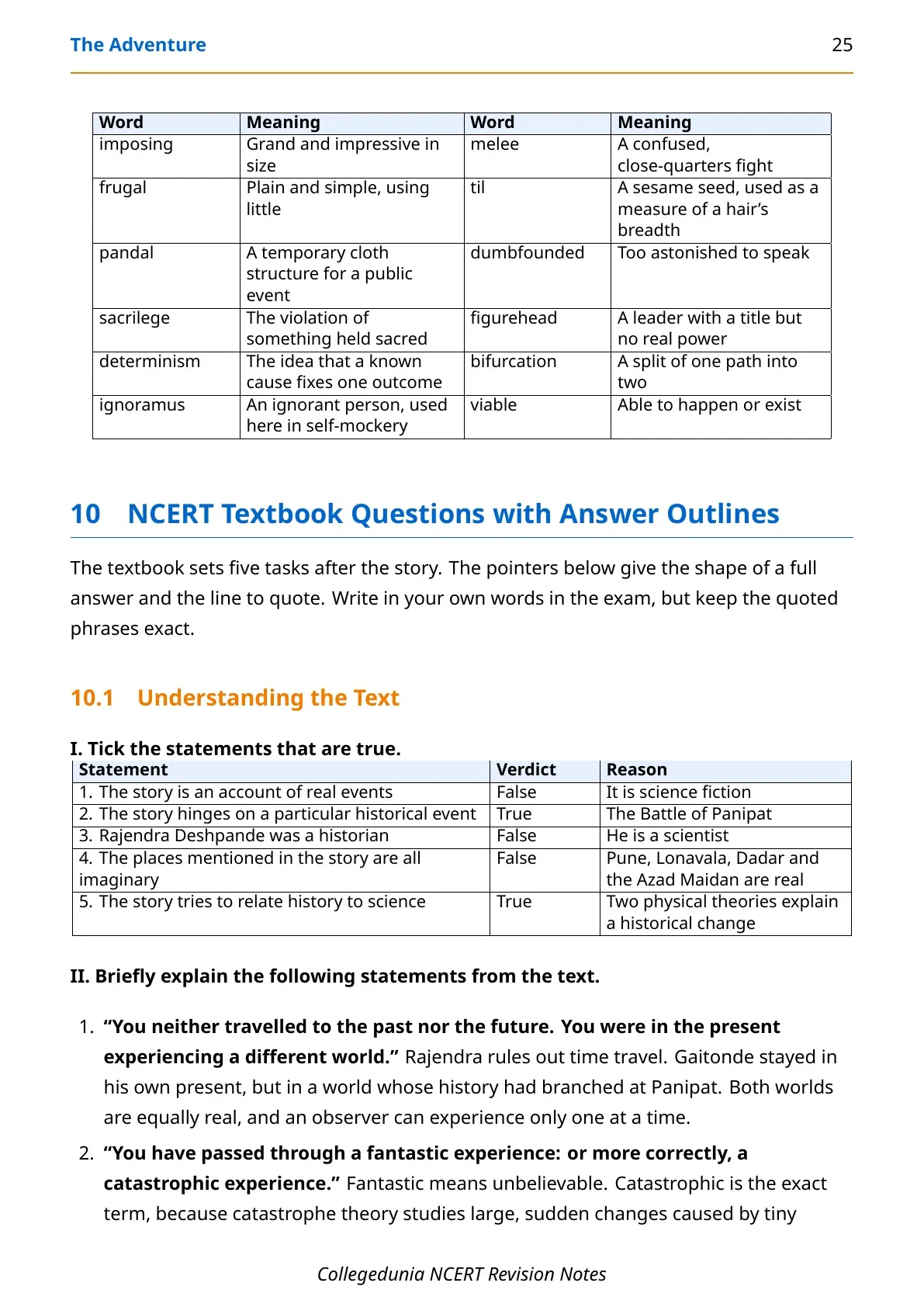
Part I. Tick the statements that are true.
| Statement | True or false | Why |
|---|---|---|
| 1. The story is an account of real events. | False | It is science fiction. The alternate India is imagined. |
| 2. The story hinges on a particular historical event. | True | Everything turns on the Battle of Panipat and who wins it. |
| 3. Rajendra Deshpande was a historian. | False | He is a scientist. Gaitonde is the historian. |
| 4. The places mentioned in the story are all imaginary. | False | Pune, Lonavala, Karjat, Bombay, Panipat and Peshawar are all real places. |
| 5. The story tries to relate history to science. | True | Catastrophe theory and quantum theory are used to explain a historical "what if". |
Part II. Briefly explain the following statements.
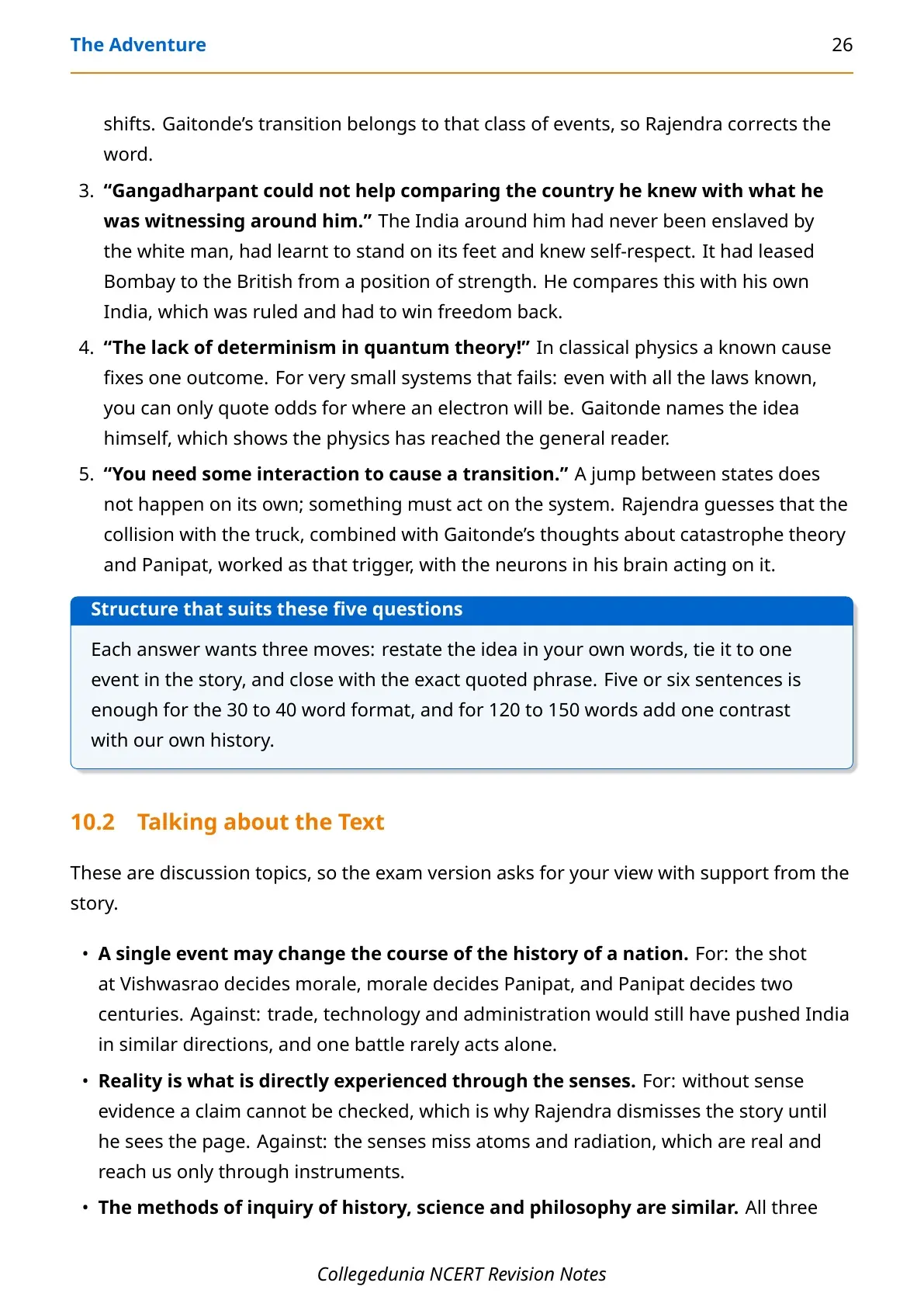
- "You neither travelled to the past nor the future. You were in the present experiencing a different world." Rajendra rejects the idea of time travel. He says the world splits into alternatives at a critical moment, and each alternative goes on existing. Gaitonde stayed in his own present, but crossed into a world where the Battle of Panipat had ended differently.
- "You have passed through a fantastic experience: or more correctly, a catastrophic experience." The word catastrophic is used in its scientific sense here, not to mean a disaster. Catastrophe theory studies sudden shifts caused by small changes, and Gaitonde's jump from one world to another is exactly such a shift.
- Gangadharpant could not help comparing the country he knew with what he was witnessing around him. The India around him had never been a colony. It had science centres of its own, elected bodies, and a Bombay leased to the British for commercial reasons. Set against the India he knew, the difference in self-respect was impossible to ignore.
- "The lack of determinism in quantum theory!" In everyday physics you can predict where a bullet will be. For an electron you cannot, even when you know every law involved. You can only state the odds of finding it at a given place and time, and that uncertainty is what allows many worlds to exist side by side.
- "You need some interaction to cause a transition." An electron changes state only when a pulse of radiation acts on it. In the same way, Rajendra guesses, Gaitonde needed a trigger. The collision with the truck, together with his thoughts about catastrophe theory and Panipat, may have made the neurons in his brain provide it.
Talking About the Text Discussion Points from The Adventure
These are group discussion tasks in the textbook, but schools regularly set them as long answers. Prepare a short stand of four or five points on each, and use examples from the story rather than general opinions.
- A single event may change the course of the history of a nation. For: a bullet missing Vishwasrao by the width of a sesame seed keeps the Marathas supreme and keeps India free. Against: long term causes such as trade, technology and administration matter more, and one lucky shot cannot decide two centuries on its own.
- Reality is what is directly experienced through the senses. For: what we cannot see or measure cannot be called real. Against: atoms, radiation and energy states are not visible, yet they are real. The story's whole argument is that reality is wider than one observer's experience.
- The methods of inquiry of history, science and philosophy are similar. All three collect evidence, test it and build an explanation. History uses documents such as the Bakhar, science uses experiments on electrons, and philosophy asks what counts as real in the first place. The difference is that a scientist can repeat an experiment while a historian cannot repeat a battle.
- Compare The Adventure with the adventure in "We're Not Afraid to Die if We Can All Be Together". The Wavewalker story is a real, physical adventure with a real storm, real injuries and a real rescue. The Adventure is an intellectual adventure inside an imagined world, and its danger is confusion rather than drowning. Both need courage, but one needs the courage of the body and the other the courage of the mind.
- Why did Professor Gaitonde decide never to preside over meetings again? His thousandth presidential address had already happened, on the Azad Maidan platform, and it ended with eggs and tomatoes. The experience showed him that the ceremony he valued had no value for others. He had also learnt humility from a world that did not need him, so he sent his regrets to the organisers of the Panipat seminar.
Thinking About Language Questions from The Adventure Answered
This task is about the languages people in the story would actually have used. Answers should mention the community and the situation together, because that is what the marker is looking for.
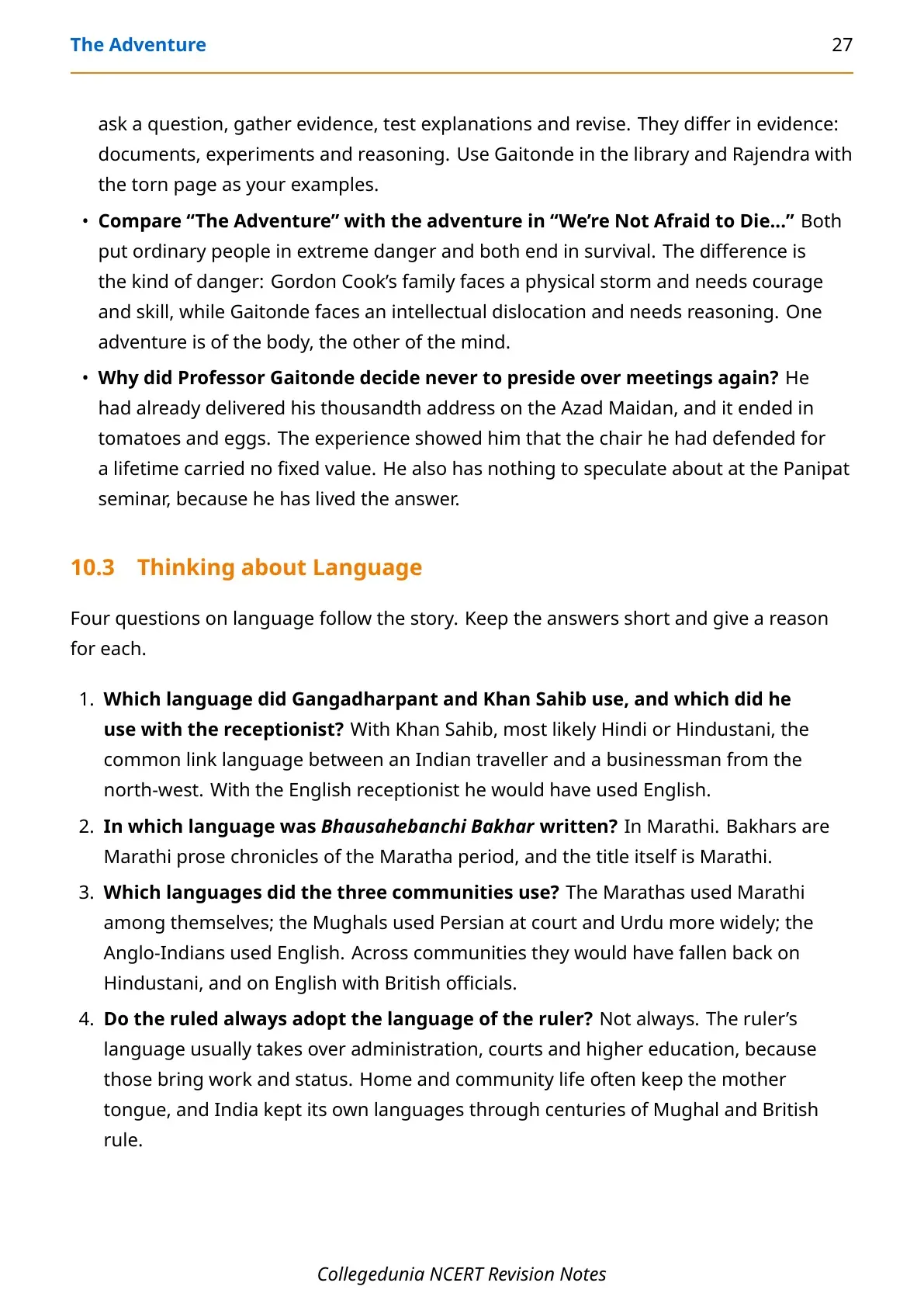
- Gangadharpant and Khan Sahib. They would have spoken Hindi or Hindustani, the common link language between two travellers from different regions. Some Marathi and Urdu words would slip in naturally.
- Gangadharpant and the English receptionist. He would have used English, since she works for a British firm in a British controlled Bombay.
- Bhausahebanchi Bakhar. It would have been written in Marathi, as the Bakhars were chronicles of the Maratha court, and the title itself is Marathi.
- The three communities. Marathas would use Marathi among themselves, the Mughals would use Urdu or Persian, and the Anglo-Indians would use English. Across communities they would fall back on Hindustani, or on English in official settings.
- Do the ruled always adopt the language of the ruler? Not always. Rulers often need the local language to govern, and many communities keep their own tongue at home while using the ruler's language at work. India kept Marathi, Tamil, Bengali and dozens of others through centuries of Mughal and British rule, so adoption is usually partial rather than complete.
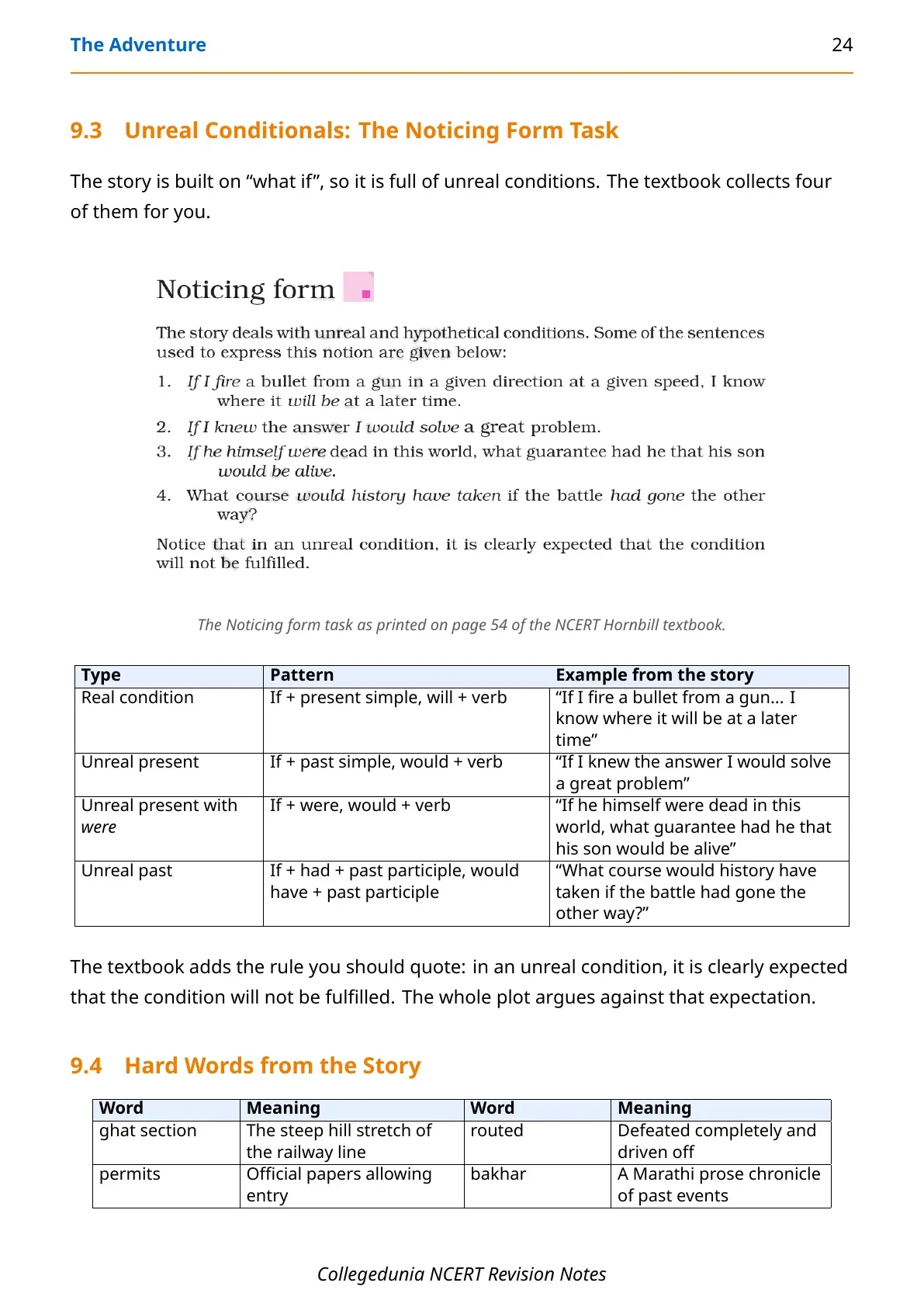
Noticing Form: Unreal Conditionals in The Adventure
The Noticing Form task points out that the story deals with unreal and hypothetical conditions. This is a grammar item, and it is easy to score on once you can see the pattern.
- "If I fire a bullet from a gun in a given direction at a given speed, I know where it will be at a later time."
- "If I knew the answer I would solve a great problem."
- "If he himself were dead in this world, what guarantee had he that his son would be alive?"
- "What course would history have taken if the battle had gone the other way?"
The point the textbook makes is short: in an unreal condition it is clearly expected that the condition will not be fulfilled. Notice the verb forms. The past tense (knew, were) is used for something imagined in the present, and the past perfect (had gone) for something imagined in the past. The main clause takes would or would have.
Common Mistakes Students Make in The Adventure Answers
Check every one of these before you submit an answer. Each of them appears in school scripts every single year.
- Calling it time travel. Rajendra says the opposite. Gaitonde stayed in the present and moved to a parallel world.
- Mixing up the two theories. Catastrophe theory explains why the battle went the other way. The many worlds idea explains how Gaitonde could visit that other world.
- Getting the Bakhar versions the wrong way round. In the torn page the shot misses Vishwasrao. In Gaitonde's own copy he is hit.
- Naming the wrong Maratha leaders. The army is led by Sadashivrao Bhau and his nephew Vishwasrao. Madhavrao is Vishwasrao's brother, not the commander at Panipat.
- Saying Rajendra is a historian. He is the scientist. Gaitonde is the historian and the author of the five volumes.
- Forgetting that the East India Company survives. East India House in the alternate Bombay is the first hard proof Gaitonde sees, so it belongs in any answer about how he realises the world has changed.
- Writing 1000 meetings instead of 999. He had spoken at 999 meetings, and the Azad Maidan speech becomes the thousandth.
- Treating catastrophic as a disaster word. In Rajendra's sentence it is a technical term from catastrophe theory.
How The Adventure Appears in the Class 11 English Paper
The story sits in the Hornbill prose section and usually contributes 6 to 8 marks across the paper. Because it is fiction built on an argument, papers mix plot questions with idea questions.
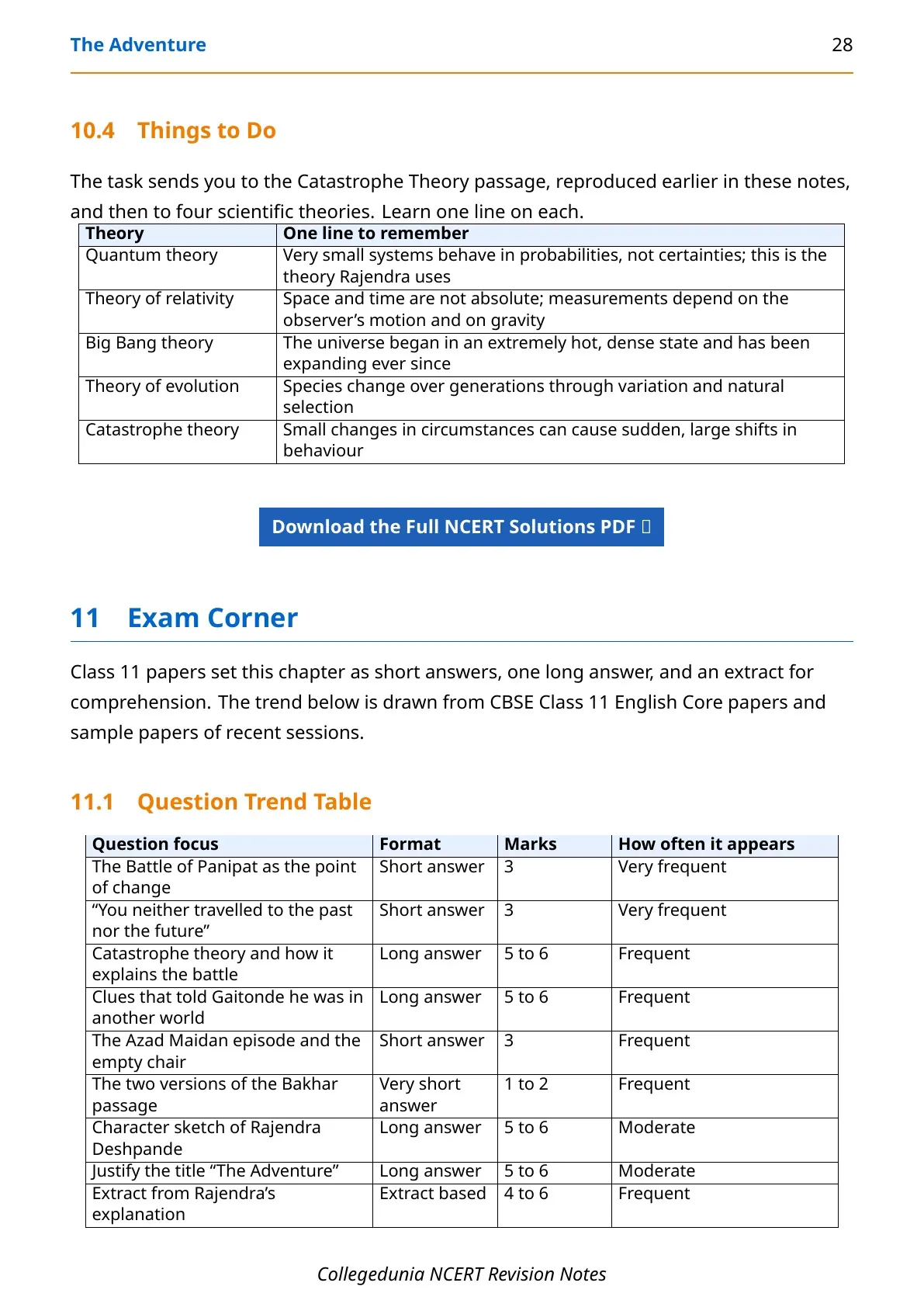
| Question type | Marks | What is usually asked |
|---|---|---|
| Short answer | 2 to 3 | The Sarhad permit check, East India House, the empty chair, the two Bakhar versions. |
| Reference to context | 3 | An extract from Rajendra's explanation or from the library section on Panipat. |
| Long answer | 5 to 6 | Explain catastrophe theory using Panipat, or sketch Gaitonde's character, or justify the title. |
| Vocabulary item | 1 | Meaning of de facto, astute, relegated to, doctored accounts or gave vent to. |
| Grammar item | 1 to 2 | Complete an unreal conditional, or tell respectfully from respectively. |
One tip that consistently adds marks: put one exact detail in every answer. A name such as Sarhad, a date such as 1780, or the phrase about the difference of a sesame seed proves to the examiner that you have read the story and not only a summary of it.
How to Revise The Adventure in One Sitting
Forty minutes is enough if you revise in the right order. Start with the two theories, because they are the part students forget first and the part that carries the long answer.
- Ten minutes on the two theories. Say catastrophe theory in five steps using Panipat, then say the many worlds idea using the electron example.
- Ten minutes on the alternate world. Cover the right column of the places table and recall what each place proves.
- Ten minutes on the characters and devices. Two traits each for Gaitonde, Rajendra and Khan Sahib, plus one example for every literary device.
- Ten minutes on words. The eight noticing expressions, the five idioms and the four confusing pairs.
Finish by writing one full length answer on how the Battle of Panipat changes the course of Indian history in the story. That single answer uses the summary, the timeline table and both theories together, which is the best test of whether the revision worked.
NCERT Notes for All Class 11 English Hornbill Chapters
Revision notes are published for the six Hornbill prose chapters. Each page follows the same shape as this one, with summary tables, a mistakes block and a downloadable PDF.
| Chapter | Title | Revision Notes |
|---|---|---|
| Chapter 1 | The Portrait of a Lady | The Portrait of a Lady Class 11 Notes |
| Chapter 2 | We're Not Afraid to Die if We Can All Be Together | We're Not Afraid to Die Class 11 Notes |
| Chapter 3 | Discovering Tut: the Saga Continues | Discovering Tut Class 11 Notes |
| Chapter 4 | The Ailing Planet: the Green Movement's Role | The Ailing Planet Class 11 Notes |
| Chapter 5 | The Adventure | You are here |
| Chapter 6 | Silk Road | Silk Road Class 11 Notes |
Class 11 English Hornbill Chapter 5 The Adventure Notes FAQs
Ques. What is the story The Adventure by Jayant Narlikar about?
Ans. It is a science fiction story about Professor Gangadharpant Gaitonde, a historian who spends two days in a parallel India where the Marathas won the Battle of Panipat. Because of that victory India was never colonised, and Bombay is only a small British outpost. His friend Rajendra Deshpande later explains the experience using catastrophe theory and the many worlds idea from quantum theory.
Ques. Why is the story called The Adventure?
Ans. Because Professor Gaitonde lives through an adventure of the mind rather than of the body. He travels through an unfamiliar Bombay, searches a library for the point at which history changed, is pelted with eggs and tomatoes at Azad Maidan, and returns with a torn page as proof. The risk is to his understanding of reality, not to his life.
Ques. What happens at the Battle of Panipat in the alternate history?
Ans. The Marathas win it handsomely. Abdali is routed and chased back to Kabul by an army led by Sadashivrao Bhau and his young nephew Vishwasrao. The victory is a great morale booster and it establishes Maratha supremacy in northern India, which makes the East India Company shelve its expansionist programme.
Ques. What is catastrophe theory in The Adventure?
Ans. It is the idea that a small change at a critical moment can push a whole system down a completely different path. Rajendra applies it to Panipat, where the two armies were evenly matched and the result depended on leadership and morale. The death of Vishwasrao broke the Maratha morale in our history, while in the other world the bullet missed and lifted it instead.
Ques. What does Rajendra mean by many worlds in the story?
Ans. He borrows the idea from quantum theory. An electron fired from a source may be found here, there or anywhere, and science can only give the odds. So one can imagine many world pictures, one for each possible result. All of them could exist together, but an observer can experience only one at a time.
Ques. What proof did Professor Gaitonde bring back from the other world?
Ans. A page torn from a copy of Bhausahebanchi Bakhar. On that page a shot brushes past Vishwasrao's ear and even the difference of a sesame seed would have killed him, and the escape is taken as an omen that turns the battle. Gaitonde's own copy of the same Bakhar says that he was hit by the bullet.
Ques. Why did Professor Gaitonde decide never to preside over a meeting again?
Ans. He counts the Azad Maidan speech as his thousandth presidential address, and it ended with the crowd throwing tomatoes and eggs and trying to remove him from the stage. The experience taught him that the ceremony he valued meant nothing to others. He therefore sent his regrets to the organisers of the Panipat seminar.
Ques. What are the eight expressions students must notice in The Adventure?
Ans. Blow-by-blow account, morale booster, relegated to, political acumen, de facto, astute, doctored accounts and gave vent to. Each one should be learnt with the sentence it appears in, since the paper often quotes the sentence and asks for the meaning of the phrase inside it.
Ques. How is the alternate Bombay different from the Bombay we know?
Ans. Permits are checked at a border station called Sarhad, suburban carriages carry the letters GBMR and a small Union Jack, and East India House still stands as the headquarters of the East India Company. Hornby Road has Boots and Woolworth stores and British banks instead of Handloom House. Bombay is a leased British outpost, and the lease expires in 2001 under a treaty of 1908.
Ques. Who was Khan Sahib and what role does he play?
Ans. Khan Sahib is a friendly businessman travelling in the same train, on his way to Peshawar by the Frontier Mail. He explains the permit check at Sarhad and points out the Union Jack on the railway carriages. Through his talk Gaitonde picks up the flavour of life in that very different India.
Ques. What does the empty presidential chair at Azad Maidan stand for?
Ans. It stands for old ceremony and old authority. In that world the custom of a presiding dignitary has been abolished, so the chair is deliberately left empty and is called symbolic. Gaitonde's fight to occupy it shows how strongly he is attached to a tradition that society has already left behind.
Ques. Did Professor Gaitonde travel in time?
Ans. No. Rajendra states it directly: he neither travelled to the past nor to the future, but was in the present while experiencing a different world. The two worlds separated at the Battle of Panipat, and Gaitonde made a transition from one to the other and back again.
Ques. Which languages would the characters in The Adventure have used?
Ans. Gaitonde and Khan Sahib would have used Hindi or Hindustani as a common link language, while Gaitonde would have spoken English to the receptionist at the British firm. Bhausahebanchi Bakhar would have been written in Marathi. Within their communities the Marathas would use Marathi, the Mughals Urdu or Persian, and the Anglo-Indians English.
Ques. Are these Class 11 English Hornbill notes according to the 2026-27 syllabus?
Ans. Yes. Every summary line, name and quotation on this page is checked against the 2026-27 reprint of the NCERT Hornbill textbook for Class 11 English Core, including the end of unit tasks for Understanding the Text, Talking about the Text, Thinking about Language, Working with Words and Noticing Form.



Comments