




The Ailing Planet: the Green Movement's Role is the one Hornbill chapter that runs almost entirely on numbers, and school papers ask for those numbers by name. These Class 11 English notes fix every figure Nani Palkhivala quotes, from 5.7 billion to 3.7 million acres, explain the eight expressions the textbook asks you to notice, and follow the 2026-27 reprint of the Hornbill textbook.
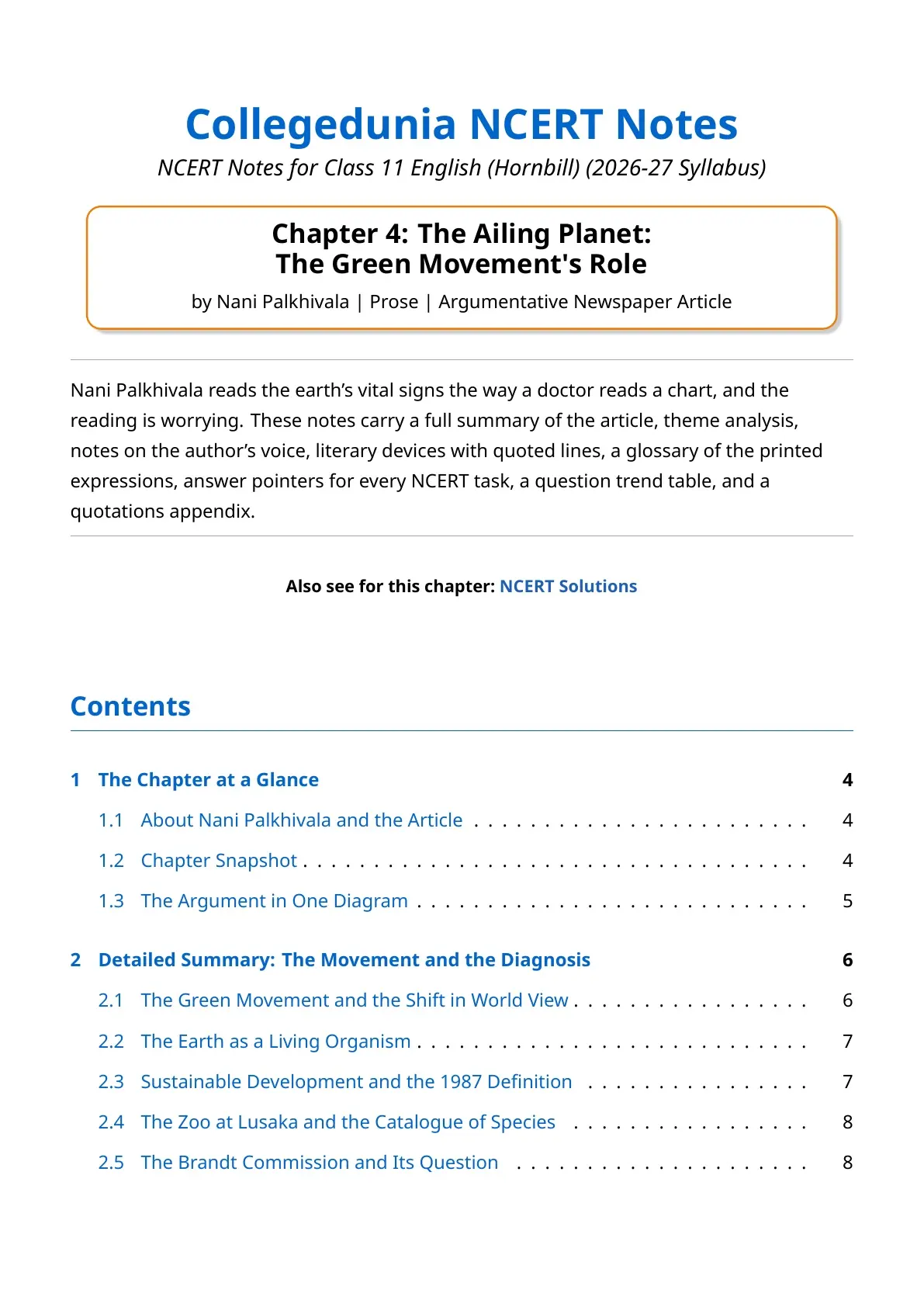
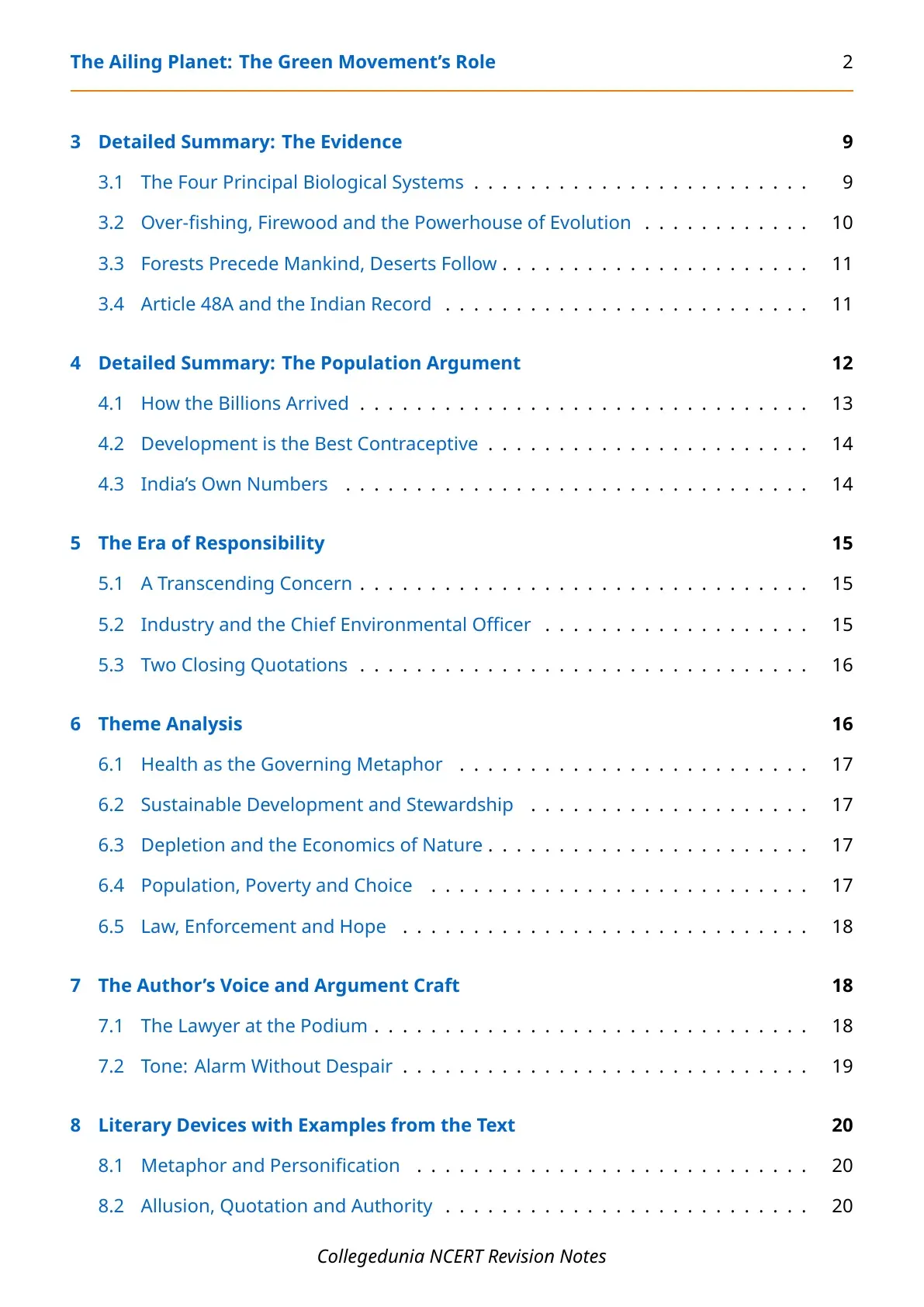
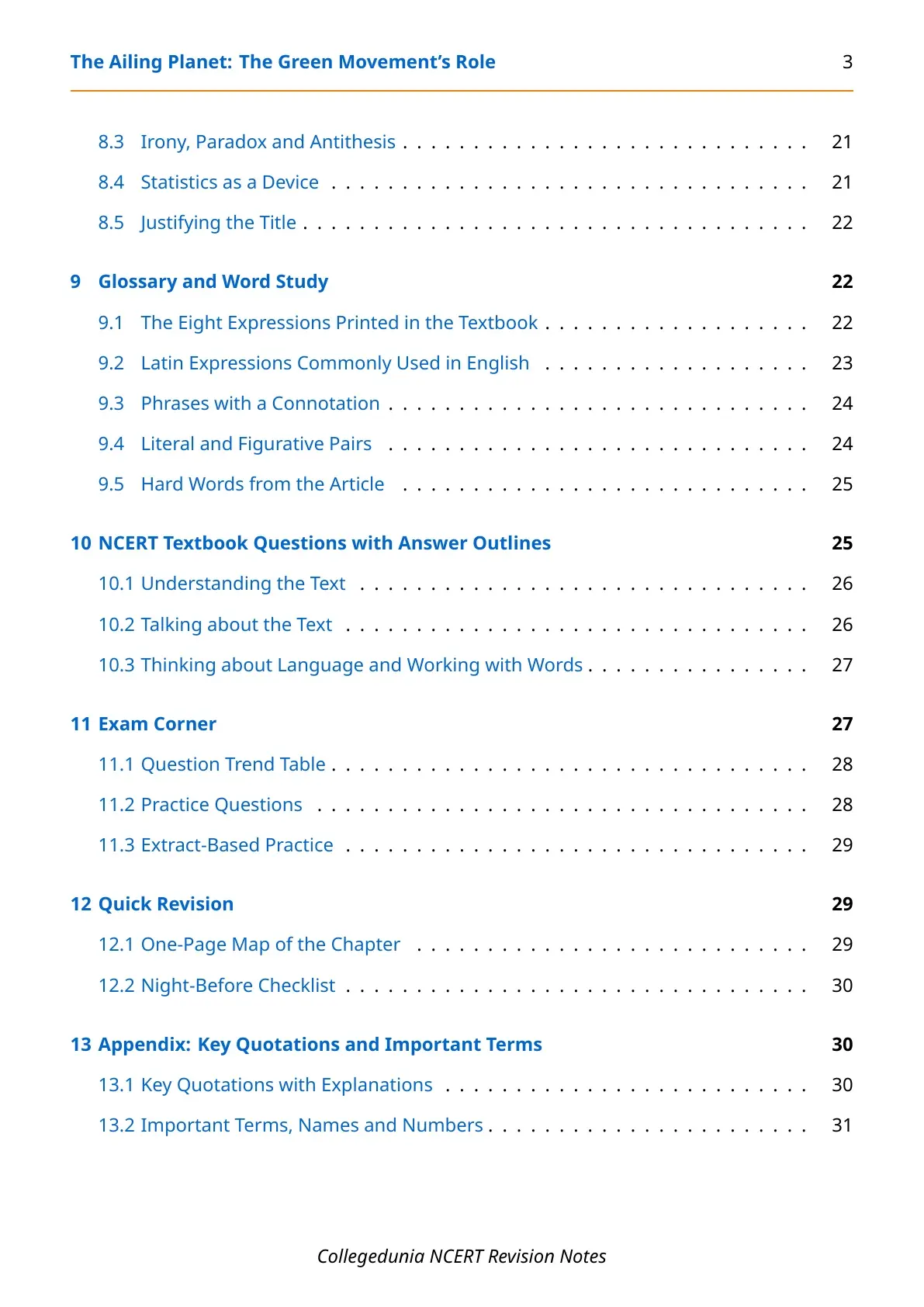
- Covers the full summary, every quoted statistic, the eight noticing expressions and all end of unit tasks.
- The chapter usually carries 6 to 8 marks in the Literature section.
- Written according to the 2026-27 NCERT Hornbill textbook for Class 11 English Core.
Every note on this page is curated by Class 11 English teachers, checked line by line against the 2026-27 Hornbill print, and refined against the last five years of school question papers.
Student Feedback: In a Collegedunia poll of 14,180 Class 11 English students taken before the 2026-27 school exams, 71% said they had written the wrong book title for Lester Brown at least once in a class test. Only 29% could quote the world population figure and the four day increase correctly in the same answer.
Source: 2026-27 Class 11 English Core student poll. Sample of 14,180 students from CBSE schools across 19 states.
What the Ailing Planet Notes Cover for Class 11 English
This page is built for the way the chapter is actually tested. Palkhivala's essay is short, but it packs in about a dozen hard figures, four named people, one Constitutional article and one famous definition. Almost every question you will face asks you to reproduce one of them.
- Full summary of the article in the order Palkhivala wrote it, from the Green Movement to the closing quotations.
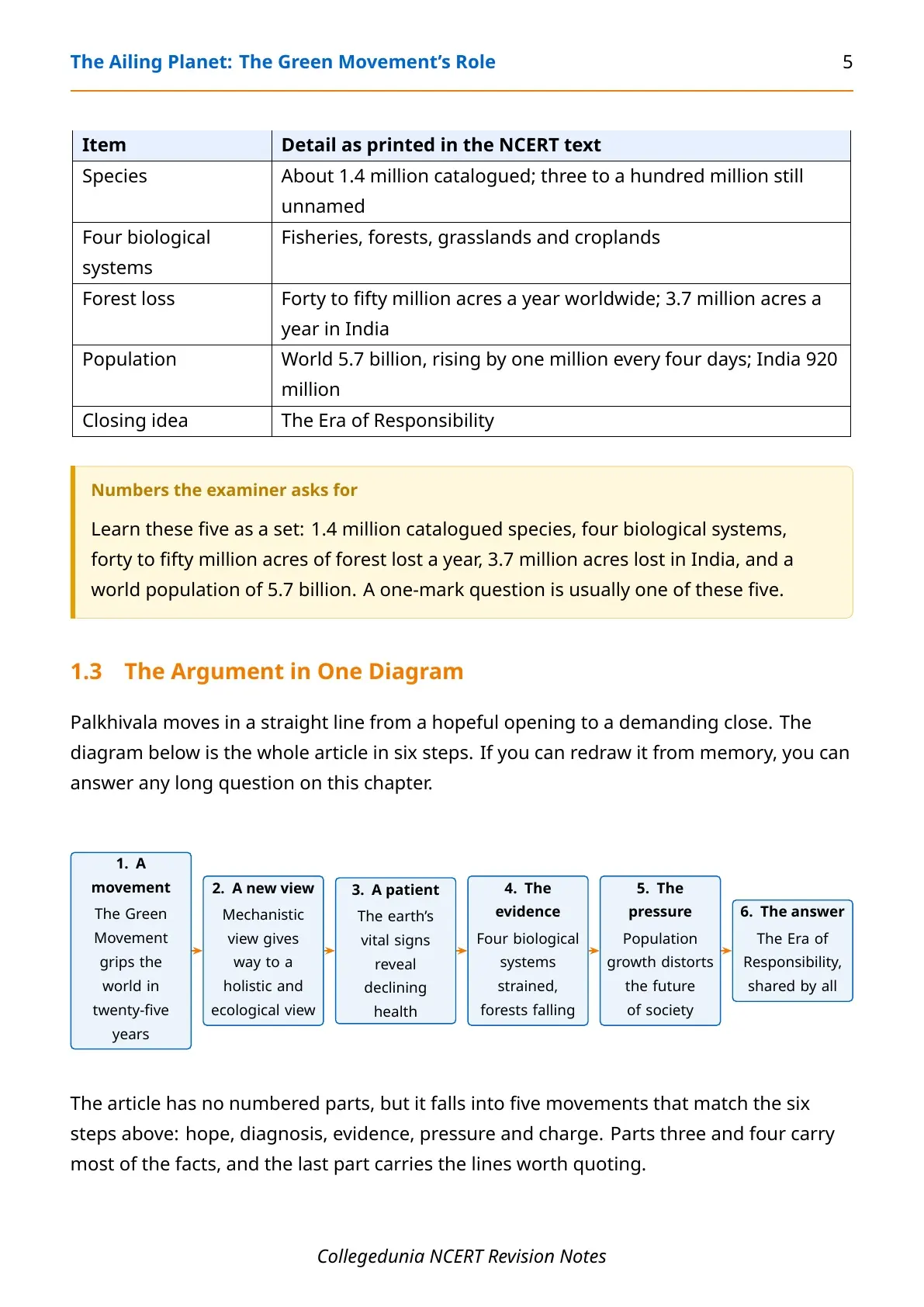
- A single figures table that holds every statistic in the chapter, so you revise them together instead of hunting through pages.
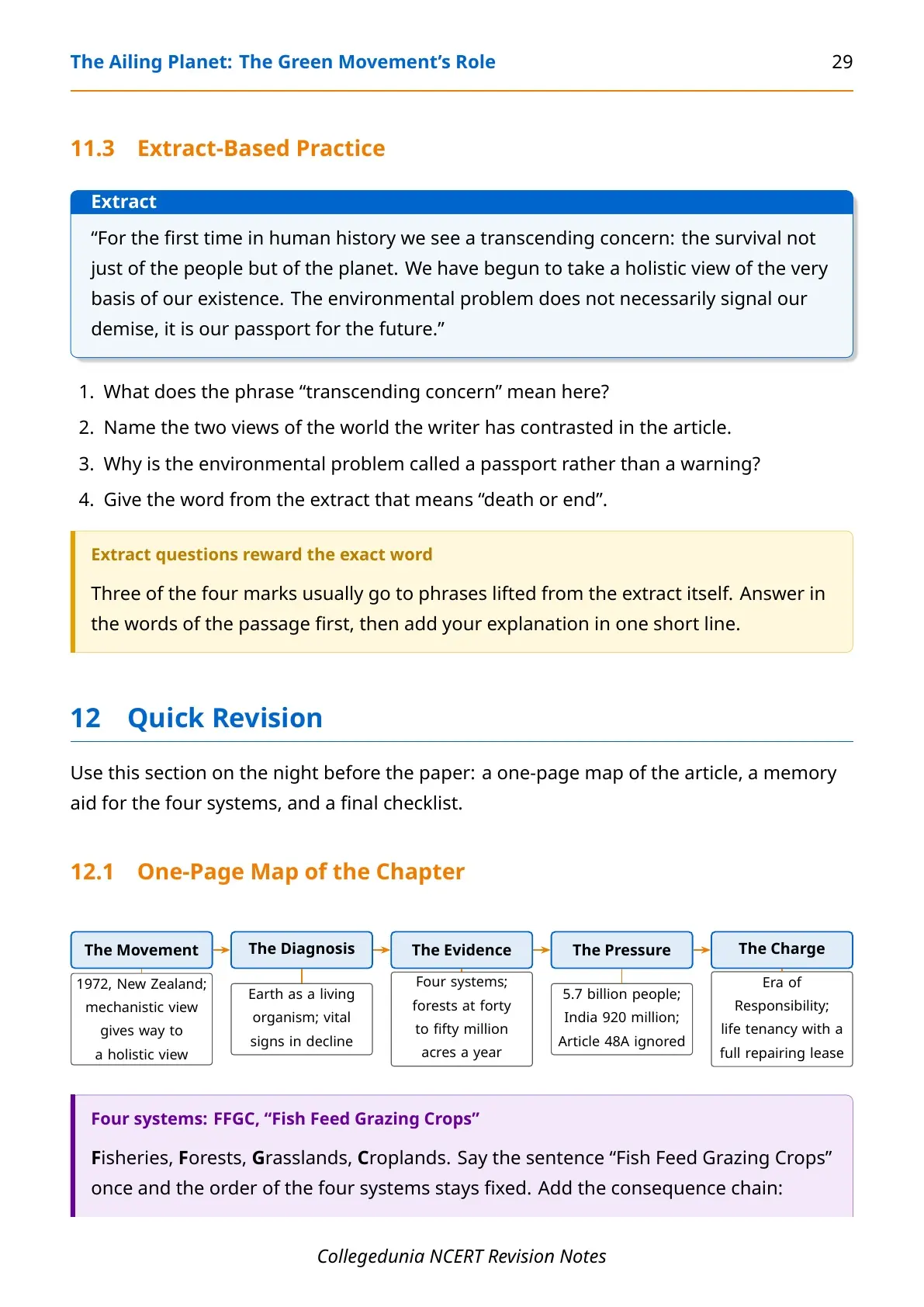
- Meanings for all eight noticing expressions and the seven Latin phrases from the Thinking About Language task.
- Short answers to the four Understanding the Text questions and the four Talking About the Text prompts.
- A mistakes block listing the exact confusions that cost students marks in this chapter every year.
Nani Palkhivala and the 1994 Indian Express Article Behind the Chapter
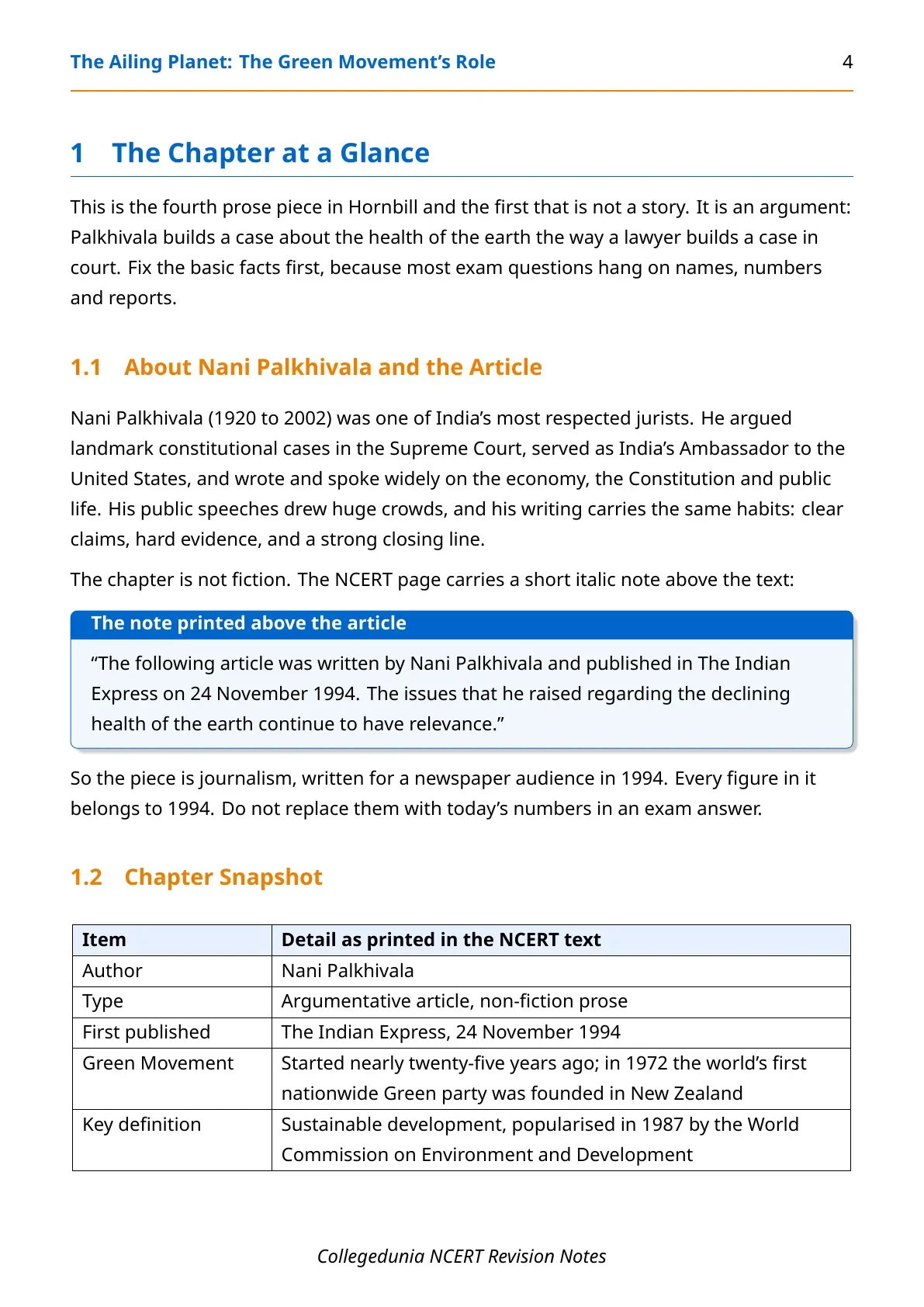
The Hornbill textbook prints a short note above the essay, and that note is itself examinable. Students who skip it lose easy marks on source based questions.
- Author: Nani Palkhivala, one of India's best known jurists and a writer on public affairs.
- First published in: The Indian Express.
- Date of publication: 24 November 1994.
- Form: a newspaper article, not a story. It argues a case, so it uses evidence, statistics and quotations rather than plot.
The textbook adds that the issues Palkhivala raised about the declining health of the earth continue to have relevance. That line is the safest way to answer any question about why a 1994 article still sits in the syllabus.
The Ailing Planet Summary in Simple Language
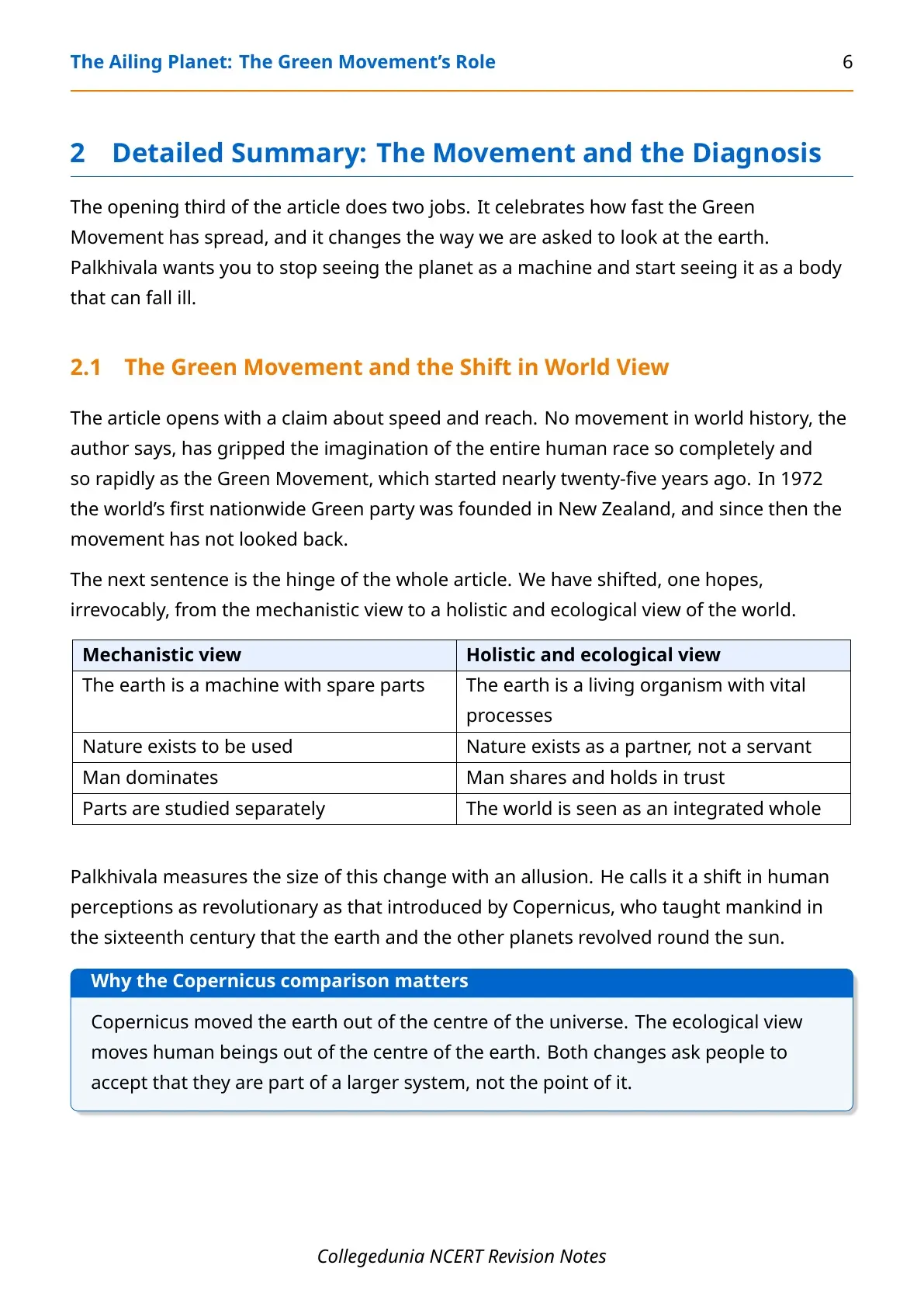
Palkhivala begins with the Green Movement. He says no movement in world history has gripped the imagination of the human race so completely and so rapidly, and that it started nearly twenty five years before he wrote. In 1972 the world's first nationwide Green party was founded in New Zealand, and the movement has not looked back since.
He then describes a change in how people see the world. Humanity has shifted from the mechanistic view to a holistic and ecological view. Palkhivala calls this shift as revolutionary as the one Copernicus caused in the sixteenth century, when he taught mankind that the earth and the other planets revolved round the sun.
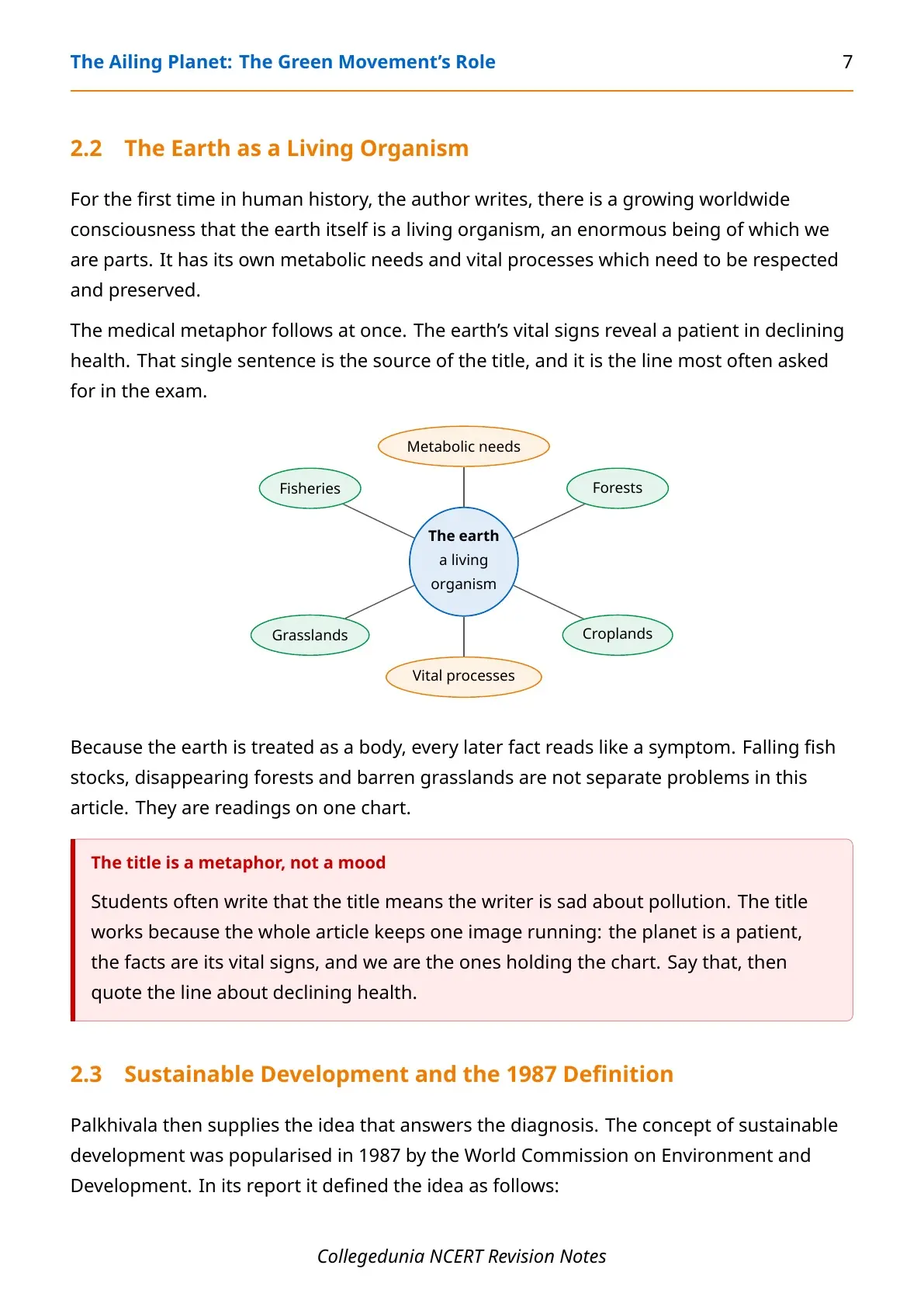
For the first time in human history there is a growing worldwide belief that the earth itself is a living organism, an enormous being of which we are parts, with its own metabolic needs and vital processes. From this comes the famous medical image of the essay: the earth's vital signs reveal a patient in declining health. People have begun to see themselves as good stewards of the planet and responsible trustees of the legacy left to future generations.
The middle of the article is the evidence. Palkhivala takes the reader through species counts, forest loss, the failure of Indian environmental law and the growth of population. He closes on a hopeful note with the Era of Responsibility, the role of industry, and two famous quotations about borrowing the earth rather than owning it.
The Ailing Planet Chapter Explanation in Video
Source: Magnet Brains on YouTube
Why Palkhivala Calls the Earth a Patient in Declining Health
The title question comes up almost every year. The lines that support the title The Ailing Planet are scattered through the essay, and a full answer needs three or four of them together.
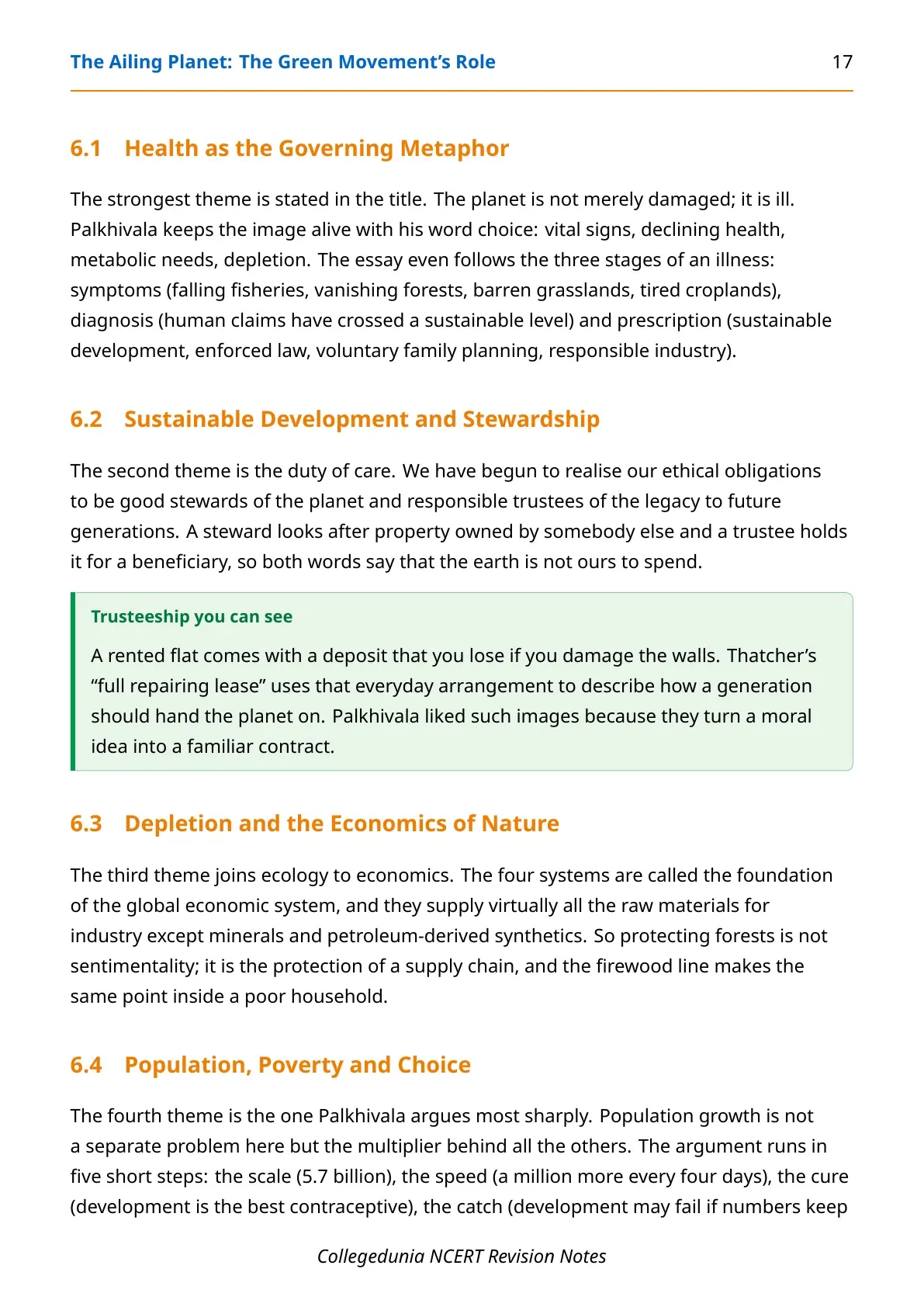
- "The earth's vital signs reveal a patient in declining health." This is the sentence the title rests on.
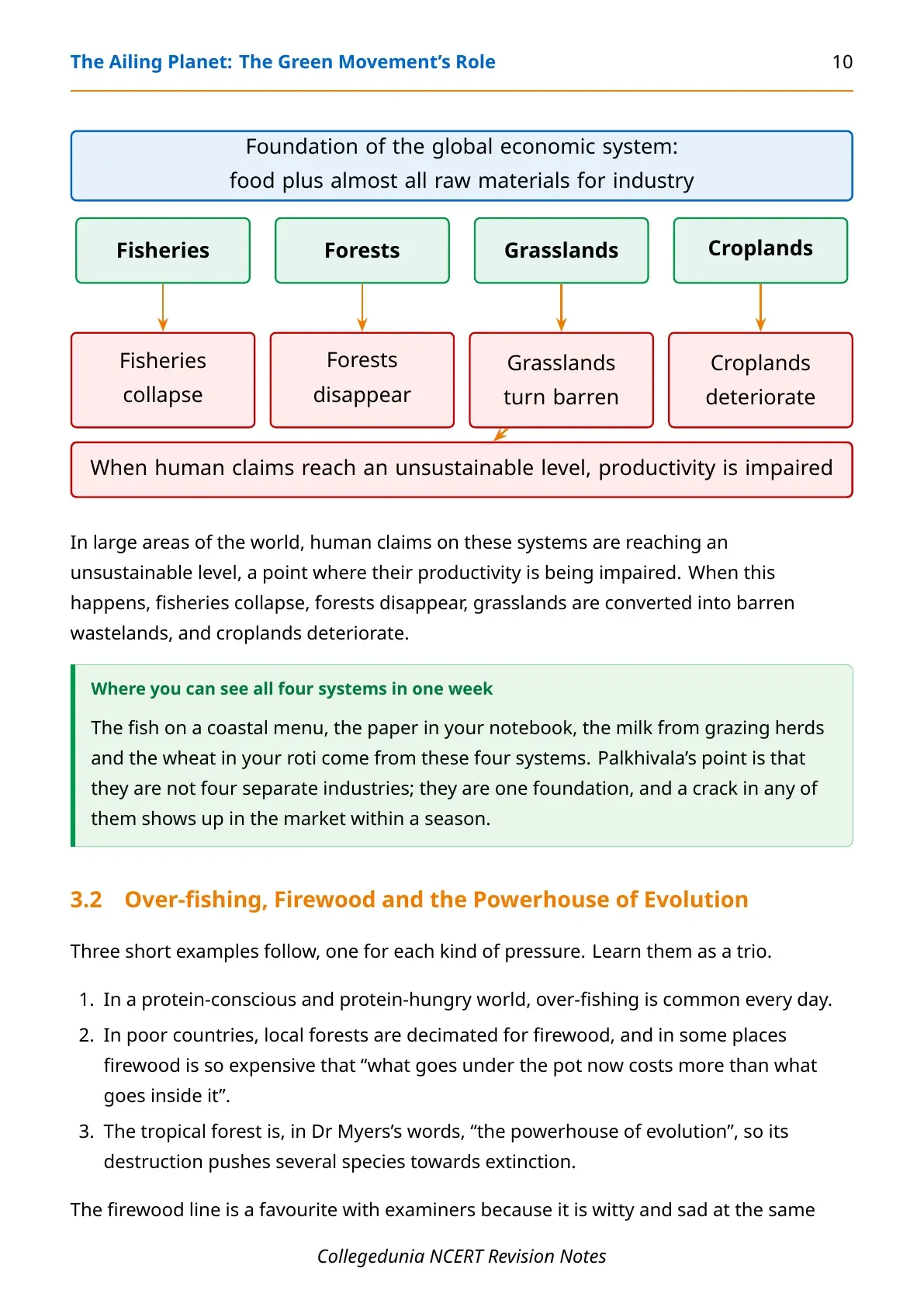
- The four principal biological systems are being pushed past the point where their productivity is impaired.
- Tropical forests are eroding at forty to fifty million acres a year, and the Estimates Committee reports near catastrophic depletion of India's forests.
- A United Nations study found the environment critical in many of the eighty-eight countries investigated.
- World population growth is called one of the strongest factors distorting the future of human society.
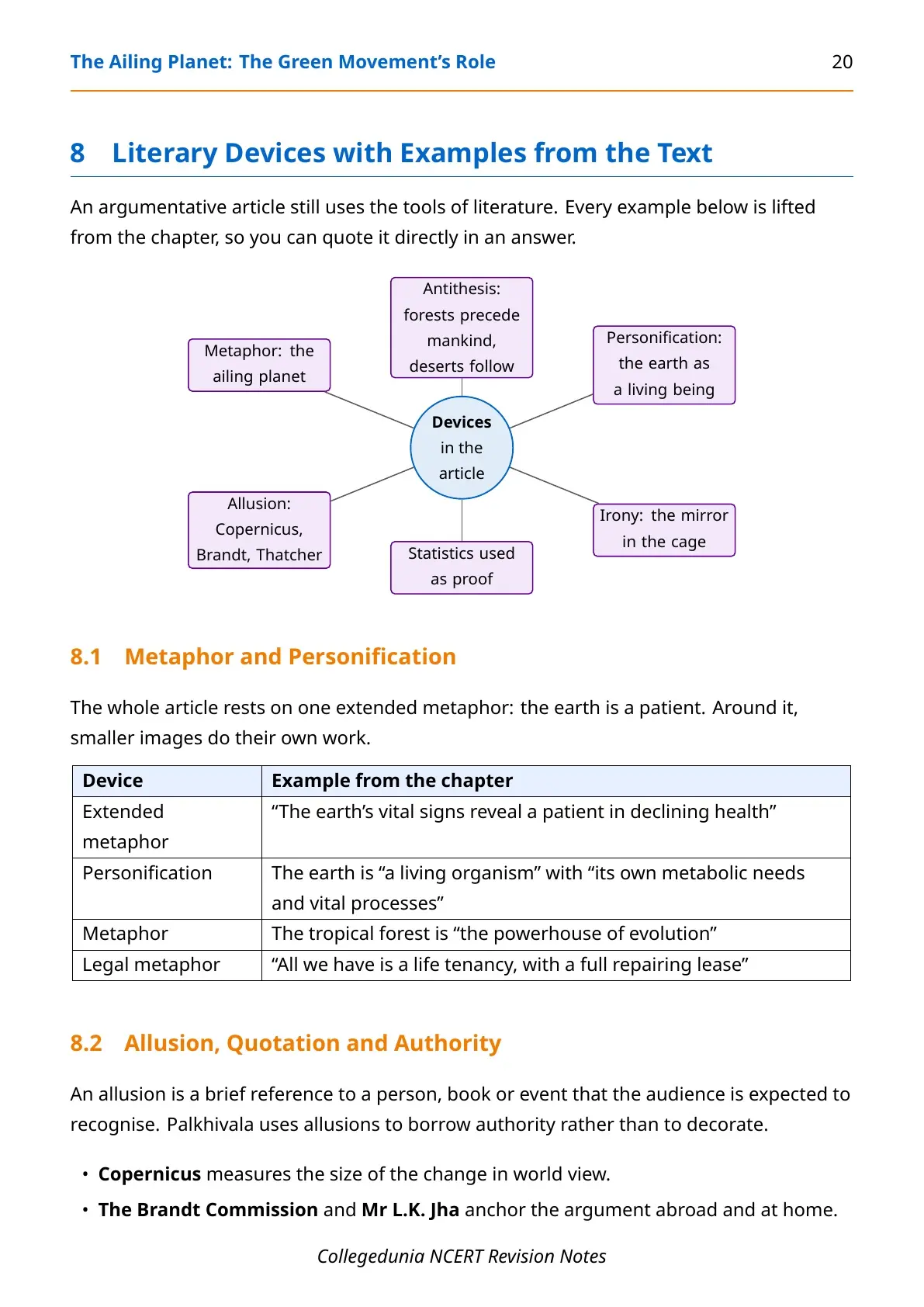
Note the metaphor Palkhivala keeps returning to. The earth is a body, its systems are organs, and the essay reads like a doctor's report. If a question asks for the figure of speech, the answer is an extended metaphor of illness.
Sustainable Development and the 1987 Brundtland Definition Explained
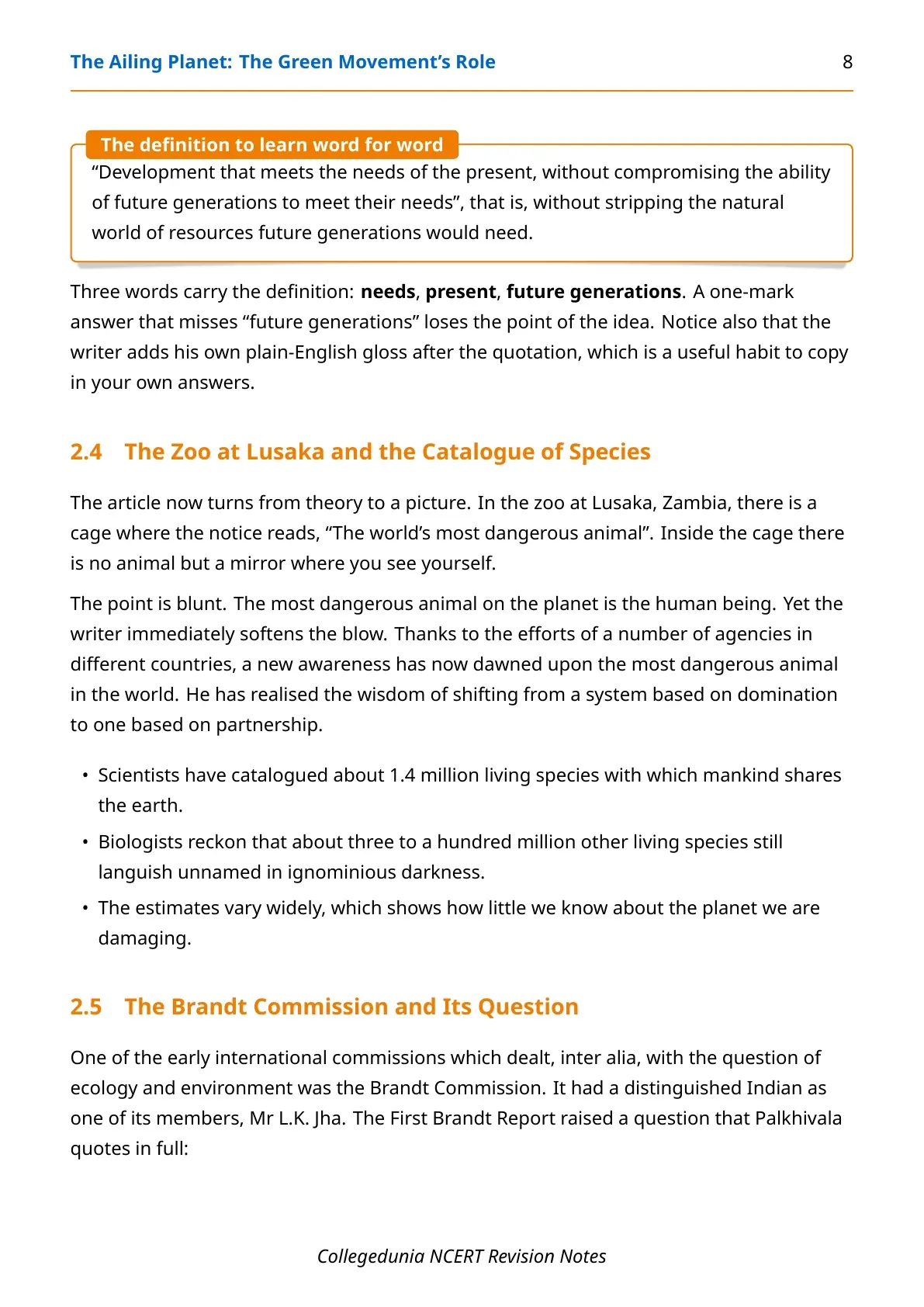
This is the single most quoted definition in the chapter, and marks are given for reproducing it word for word. Learn the sentence, not a paraphrase of it.
The concept of sustainable development was popularised in 1987 by the World Commission on Environment and Development. In its report the Commission defined the idea as "Development that meets the needs of the present, without compromising the ability of future generations to meet their needs". Palkhivala adds the plain English gloss himself: development without stripping the natural world of resources that future generations would need.
- Who: the World Commission on Environment and Development.
- When: 1987.
- Key words to keep: needs of the present, without compromising, future generations.
- Common trap: the definition is about needs, not about wants, growth or profit.
The World's Most Dangerous Animal and the Lusaka Zoo Mirror
One of the short answer favourites is the notice at the zoo. In the zoo at Lusaka, Zambia, there is a cage whose notice reads 'The world's most dangerous animal'. Inside the cage there is no animal, only a mirror, so the visitor sees himself.
The meaning is direct. Man is the most dangerous animal on earth because he alone has the power to damage every other species and the planet itself. Palkhivala does not leave it there. He says that thanks to the efforts of a number of agencies in different countries, a new awareness has now dawned on this dangerous animal, who has realised the wisdom of shifting from a system based on domination to one based on partnership.
- The mirror makes the visitor the exhibit, which is the whole point of the notice.
- Domination means treating nature as property to be used up.
- Partnership means treating nature as a system we belong to and depend on.
The Four Principal Biological Systems Lester Brown Names in the Essay
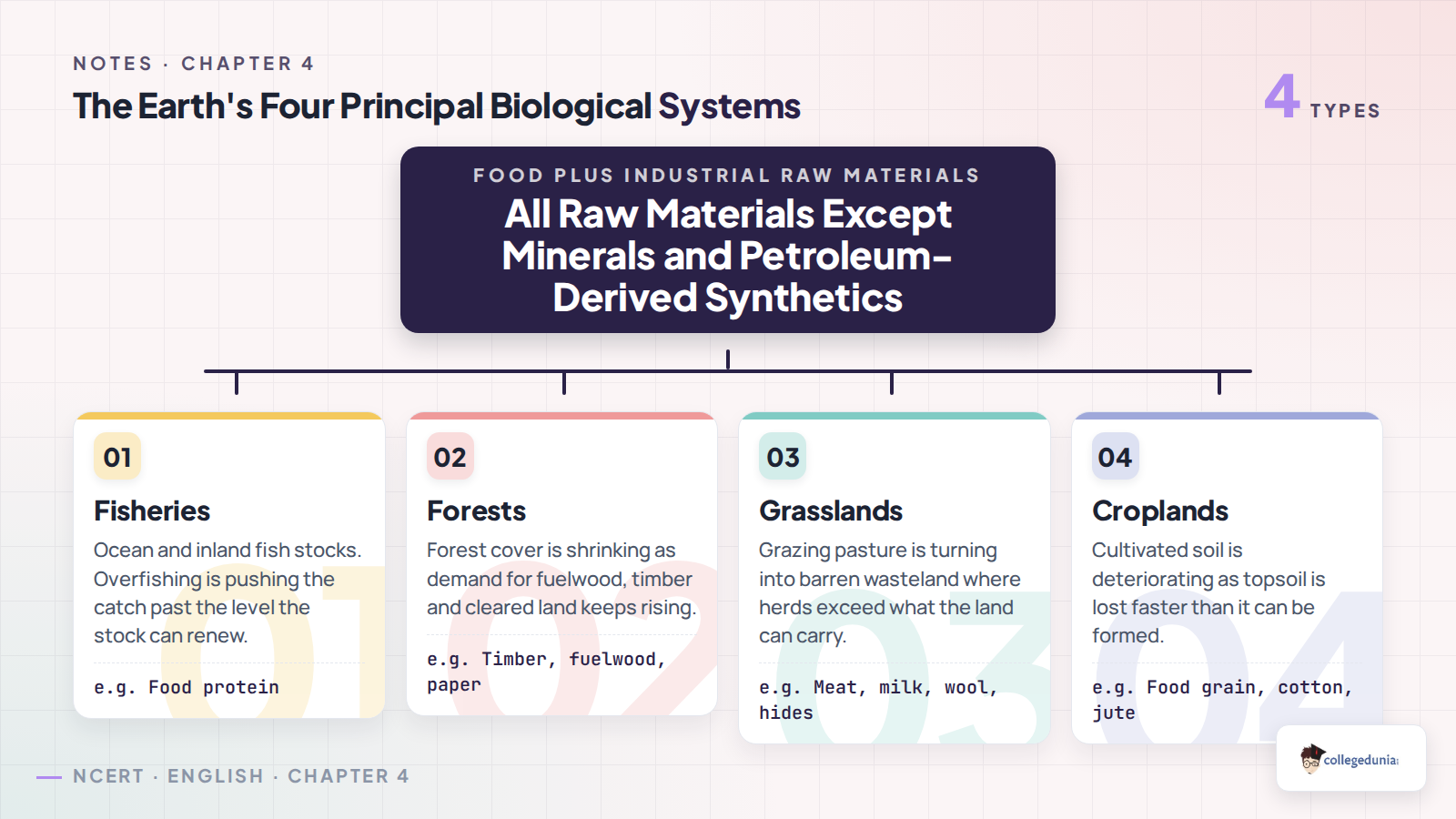
Get the book title right. Palkhivala cites Mr Lester R. Brown and his thoughtful book The Global Economic Prospect. A very common web error attaches a different Brown title to this chapter, and examiners mark it wrong.
Brown points out that the earth has four principal biological systems, and that they form the foundation of the global economic system. Besides supplying our food, these four systems provide virtually all the raw materials for industry except minerals and petroleum derived synthetics.
| Biological system | What goes wrong when human claims cross the limit |
|---|---|
| Fisheries | Fisheries collapse. In a protein conscious and protein hungry world, over fishing is common every day. |
| Forests | Forests disappear. In poor countries local forests are decimated to procure firewood for cooking. |
| Grasslands | Grasslands are converted into barren wastelands. |
| Croplands | Croplands deteriorate, and the growing use of dung for burning robs the soil of a natural fertiliser. |
Two quotations sit inside this section and both are examinable. On firewood, Palkhivala writes that in some places it has become so expensive that "what goes under the pot now costs more than what goes inside it". On tropical forests he quotes Dr Myers, who calls the tropical forest "the powerhouse of evolution", which is why several species face extinction as it is destroyed.
Forest Loss in India, Article 48A and the Estimates Committee Findings
This is the angriest part of the essay and the part that carries the most marks. Palkhivala first states the law, then shows that the law is ignored.
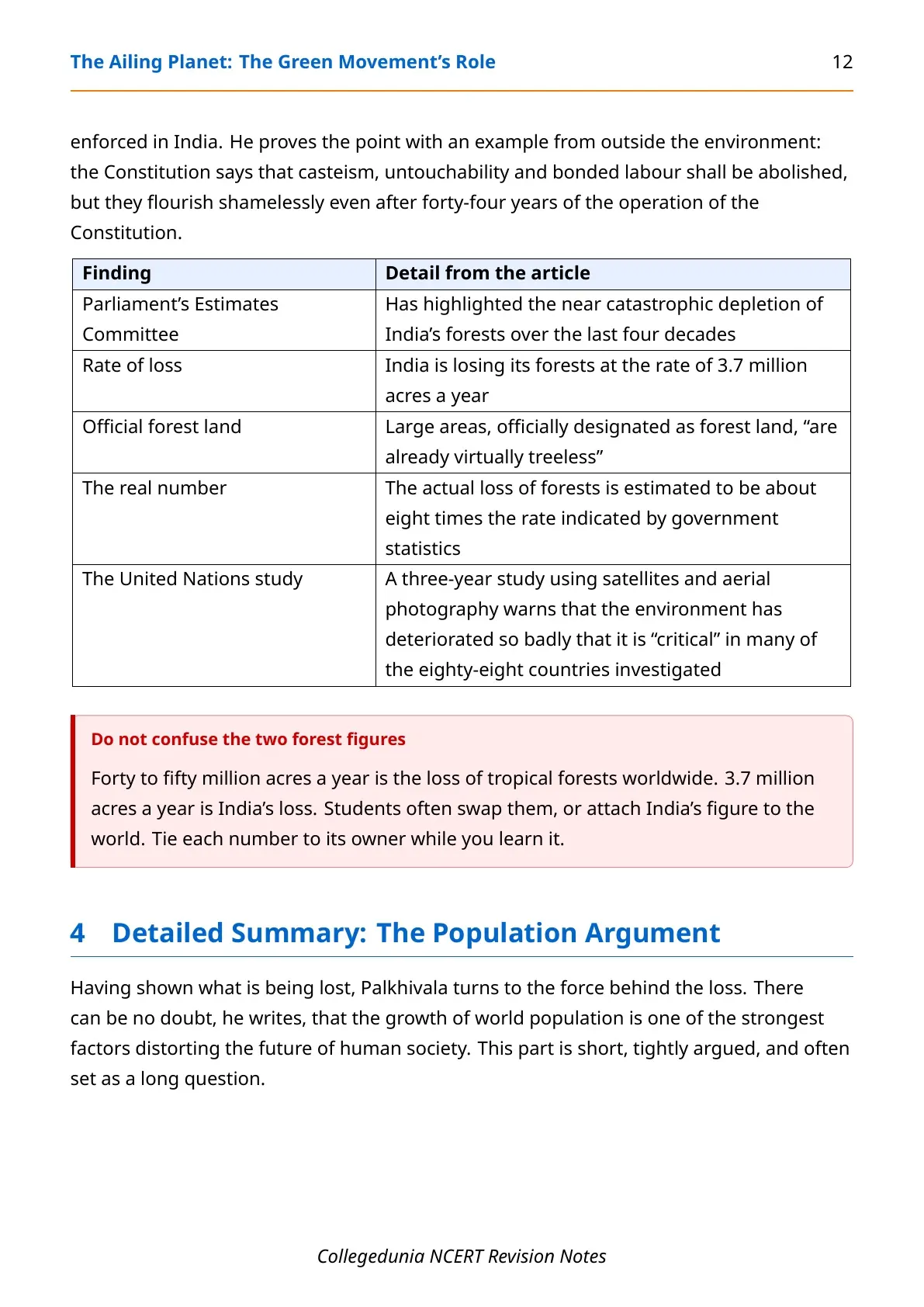
Article 48A of the Constitution of India provides that "the State shall endeavour to protect and improve the environment and to safeguard the forests and wildlife of the country". What causes Palkhivala endless anguish is that laws are never respected nor enforced in India. He gives a parallel example: the Constitution says casteism, untouchability and bonded labour shall be abolished, yet they flourish shamelessly even after forty four years of the operation of the Constitution.
- A report of our Parliament's Estimates Committee highlighted the near catastrophic depletion of India's forests over the last four decades.
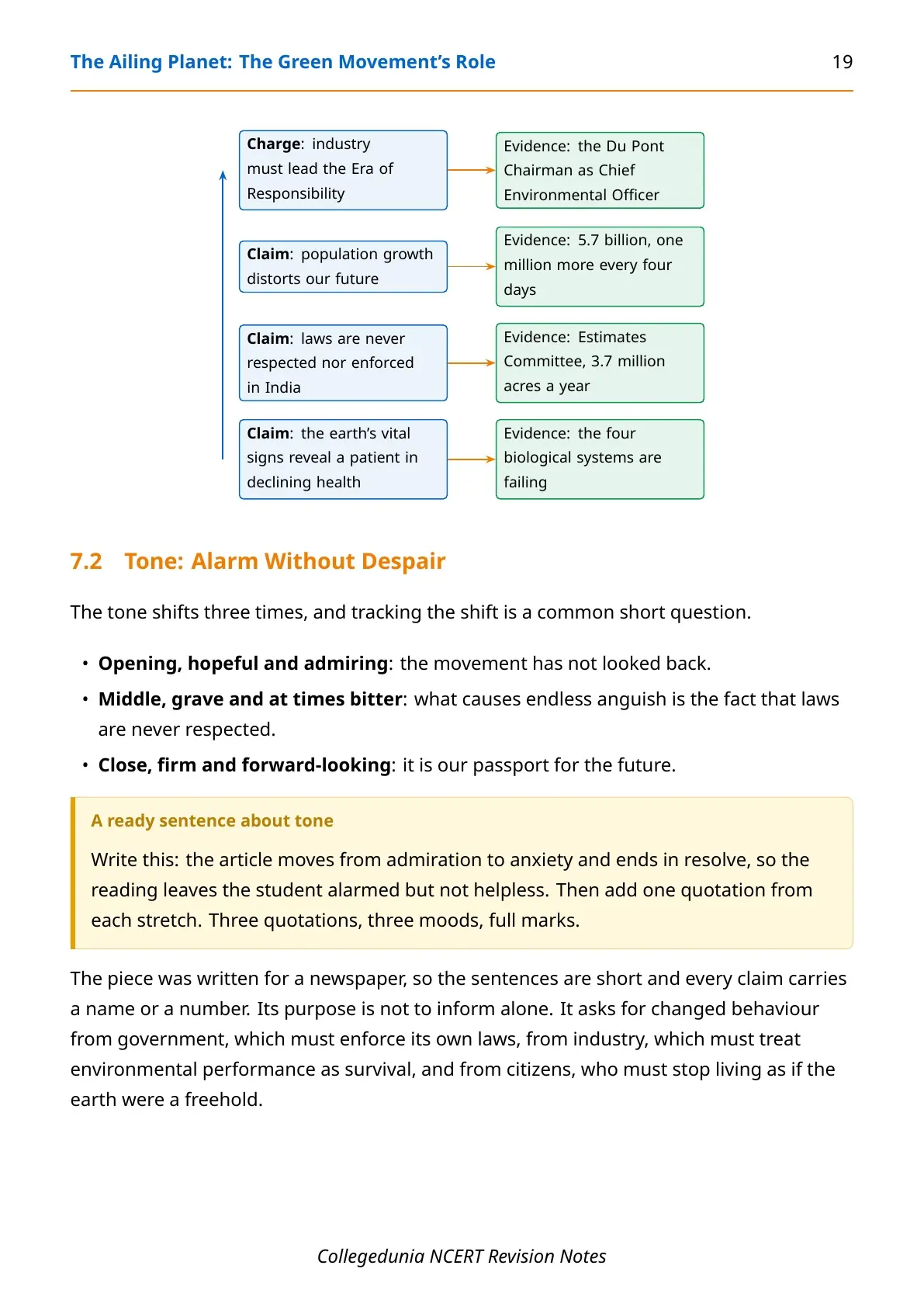
- India, according to reliable data, is losing its forests at the rate of 3.7 million acres a year.
- Large areas officially designated as forest land "are already virtually treeless".
- The actual loss of forests is estimated to be about eight times the rate indicated by government statistics.
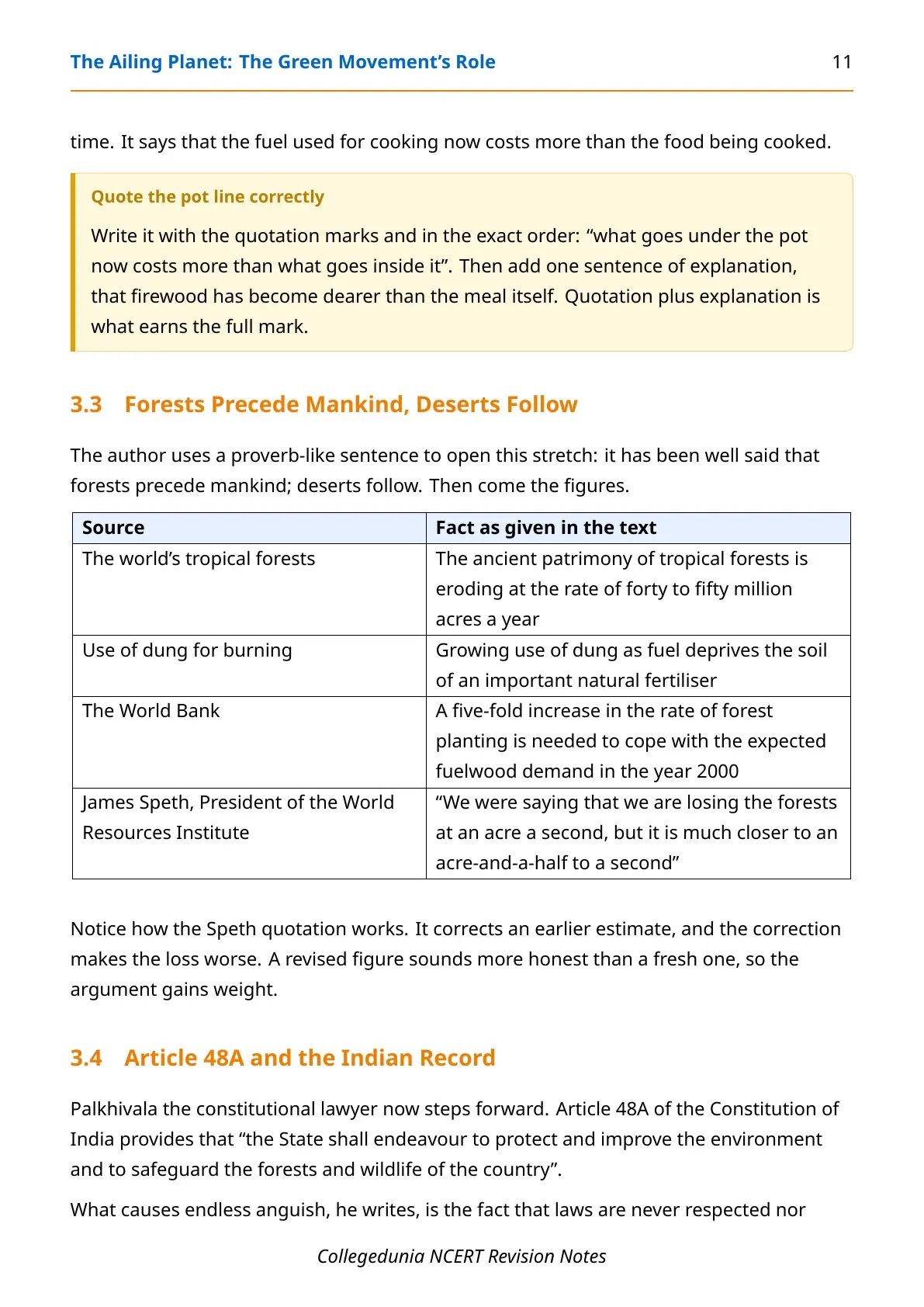
- The world's ancient patrimony of tropical forests is eroding at forty to fifty million acres a year.
- The World Bank estimates that a five-fold increase in the rate of forest planting is needed to meet the expected fuelwood demand in the year 2000.
Two more sources close the section. James Speth, President of the World Resources Institute, said that where the loss was once described as an acre a second, it is much closer to an acre and a half to a second. And a three year study using satellites and aerial photography, conducted by the United Nations, warns that the environment has deteriorated so badly that it is 'critical' in many of the eighty-eight countries investigated. The proverb Palkhivala uses to sum it up is worth memorising: forests precede mankind; deserts follow.
Population Growth and the Choice Palkhivala Puts Before India
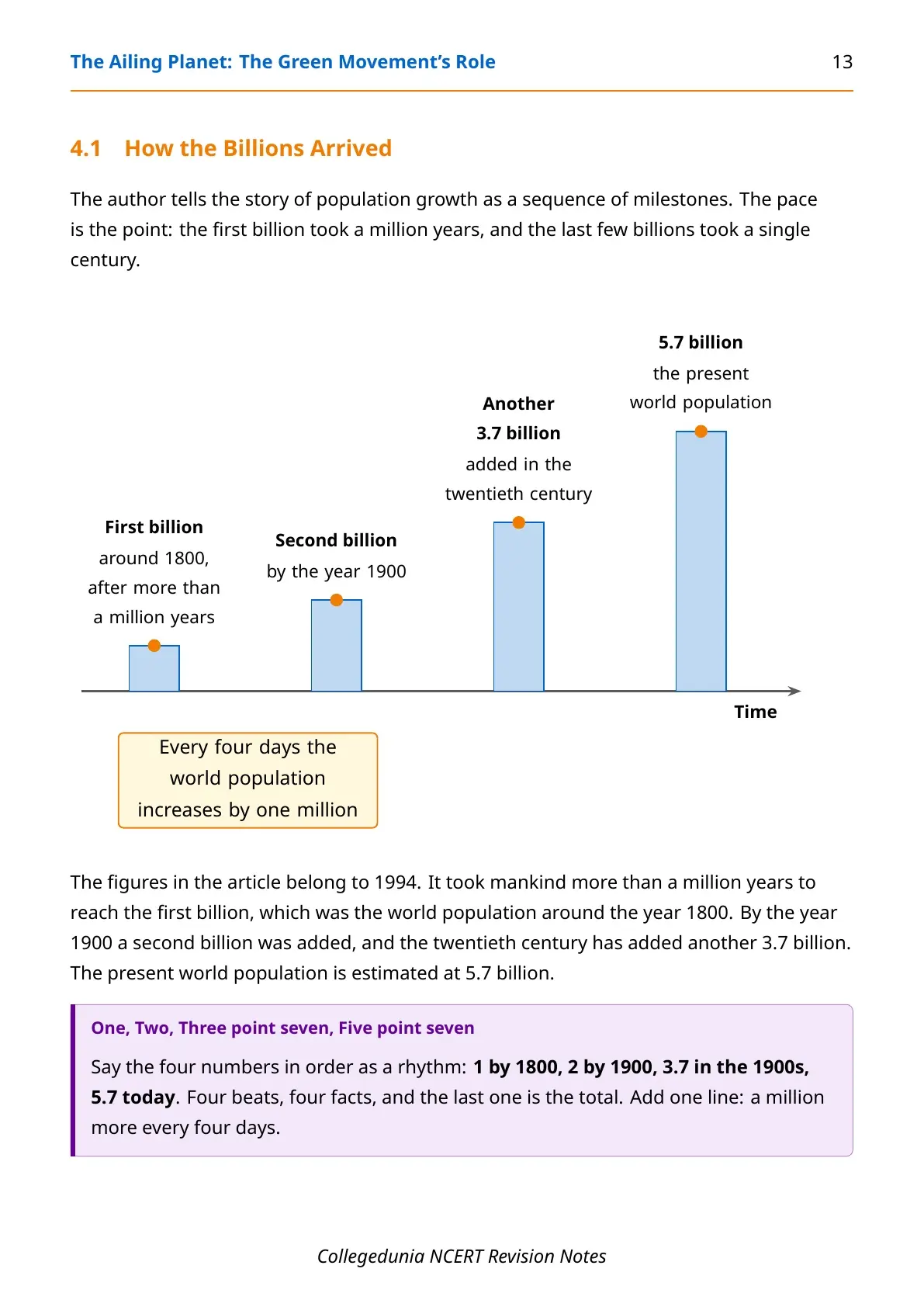
Palkhivala calls the growth of world population one of the strongest factors distorting the future of human society. He builds the case as a timeline, so revise it as one.
| Stage | What the essay states |
|---|---|
| First billion | Took mankind more than a million years, reached around the year 1800. |
| Second billion | Added by the year 1900. |
| Twentieth century | Added another 3.7 billion. |
| Present world population | Estimated at 5.7 billion. |
| Rate of increase | Every four days the world population increases by one million. |
| India | Estimated at 920 million, more than the populations of Africa and South America put together. |
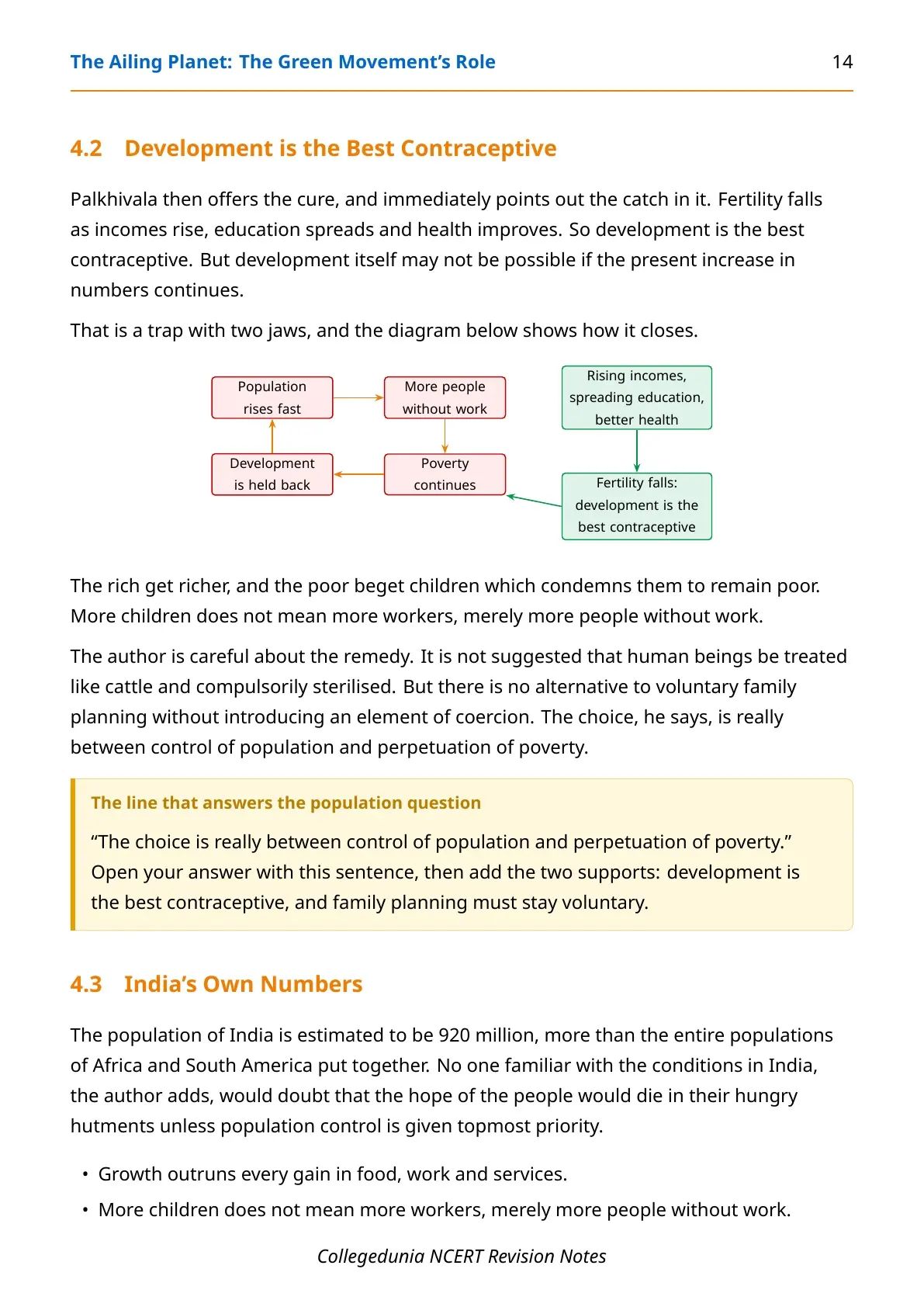
His argument about the cure is just as testable. Fertility falls as incomes rise, education spreads and health improves, so development is the best contraceptive. But development itself may not be possible if numbers keep rising at this rate.
Palkhivala is blunt about poverty. The rich get richer, and the poor beget children, which condemns them to stay poor. More children does not mean more workers, merely more people without work. He rejects coercion outright: human beings are not to be treated like cattle and compulsorily sterilised, and there is no alternative to voluntary family planning. His closing line on the subject is the one to quote: "The choice is really between control of population and perpetuation of poverty." For India he warns that the hope of the people would die in their hungry hutments unless population control is given topmost priority.
The Era of Responsibility and the Role of Industry in the Essay
The last part of the article turns hopeful, and students often miss this because they stop reading at the population figures. Palkhivala says that for the first time in human history we see a transcending concern, the survival not just of the people but of the planet.
- The environmental problem "does not necessarily signal our demise, it is our passport for the future".
- The emerging new world vision has ushered in the Era of Responsibility, a holistic and ecological view that sees the world as an integrated whole rather than a dissociated collection of parts.
- Industry has a most crucial role in this new era.
- The Chairman of Du Pont, Mr Edgar S. Woolard, declared himself the company's "Chief Environmental Officer" and said that continued existence as a leading manufacturer requires excellence in environmental performance.
The essay ends on two quotations. Margaret Thatcher said that no generation has a freehold on this earth, and that all we have is a life tenancy, with a full repairing lease. Lester Brown said, "We have not inherited this earth from our forefathers; we have borrowed it from our children." If a question asks which line best states the theme, use the Brown quotation.
Every Figure Quoted in The Ailing Planet in One Revision Table
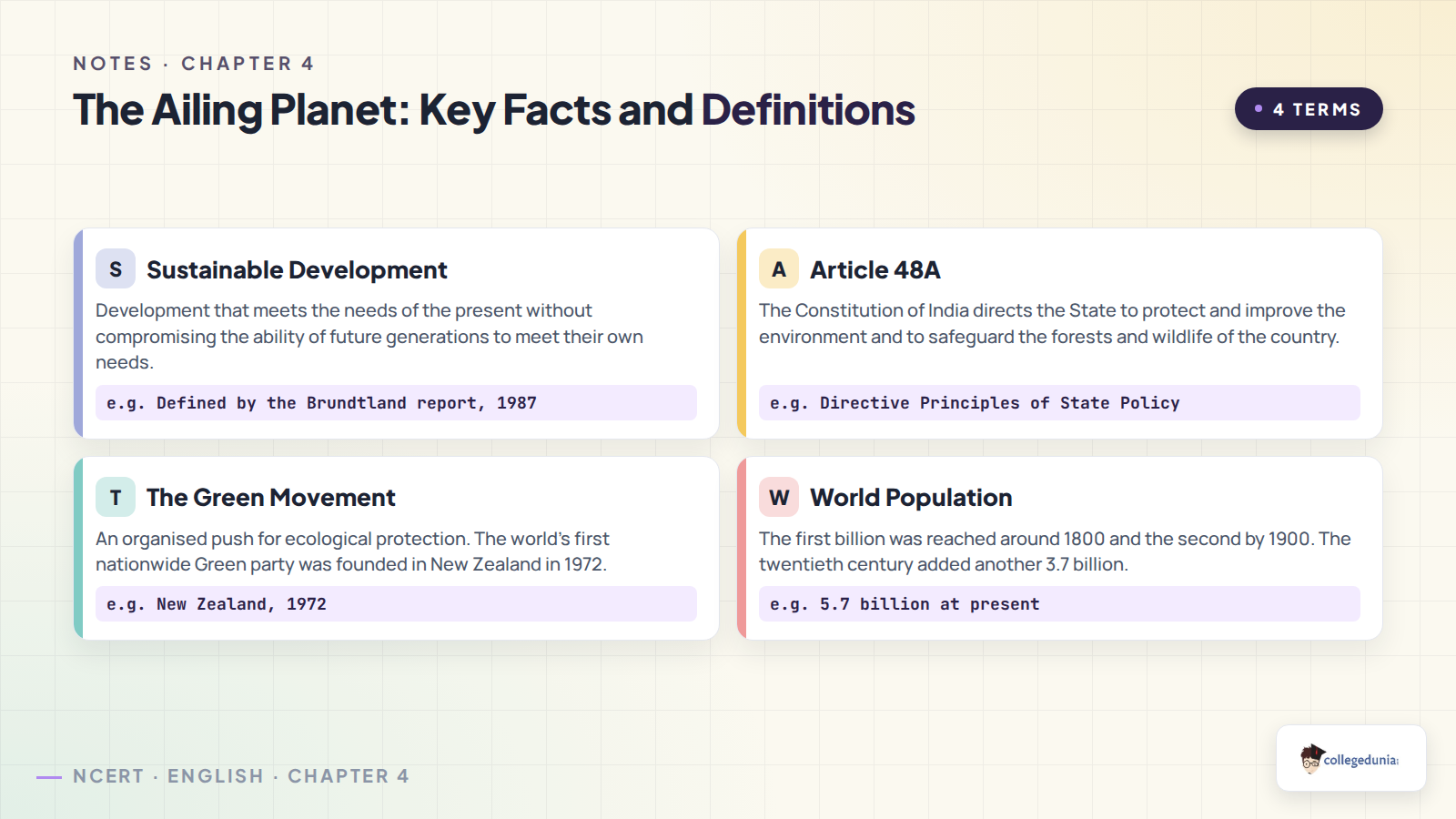
Palkhivala's numbers are the marks. Learn them from one table rather than from the running text, and always quote the figure exactly as the textbook prints it.
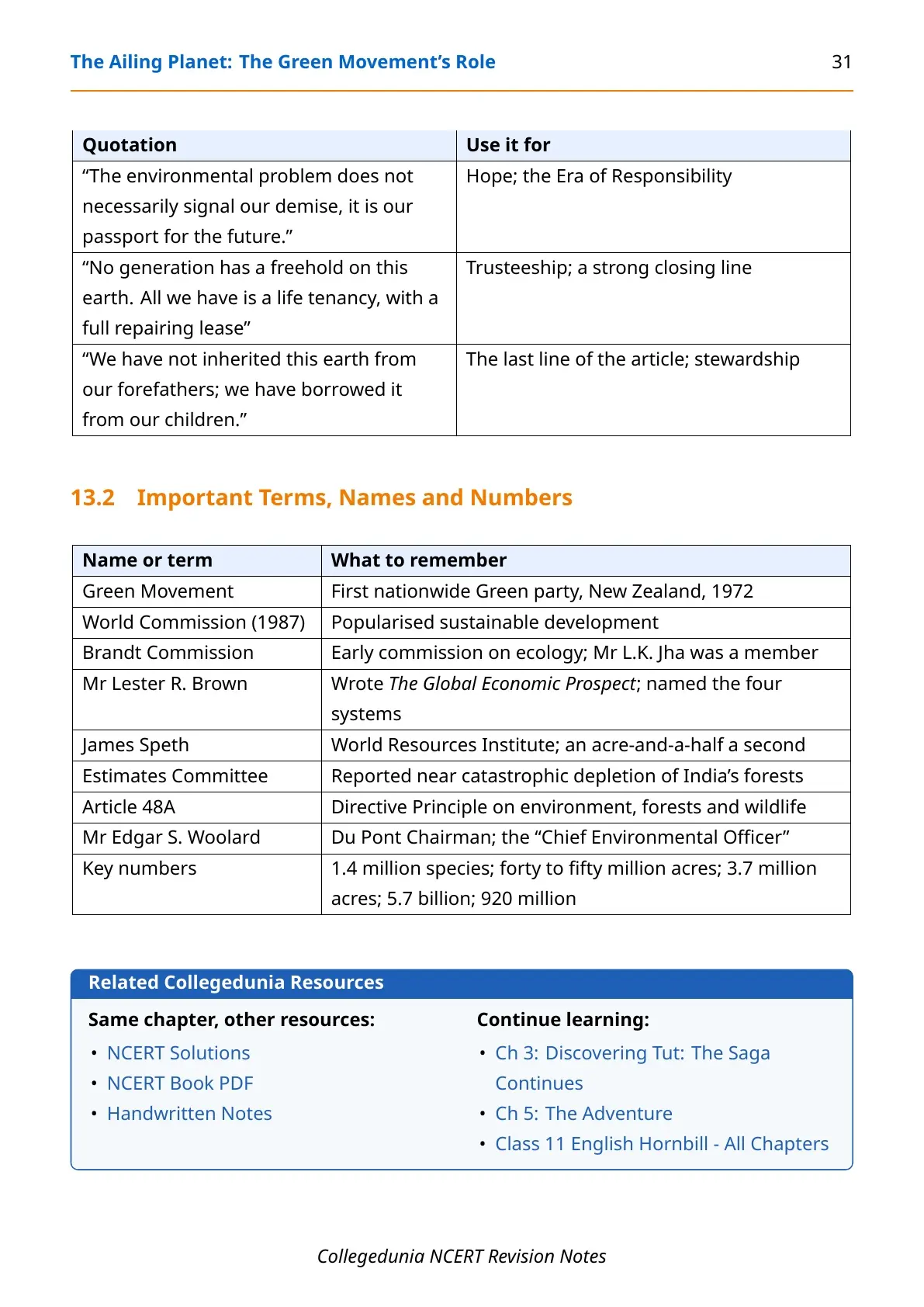
| Figure | What it refers to |
|---|---|
| 1972 | The world's first nationwide Green party was founded in New Zealand. |
| 1987 | Sustainable development popularised by the World Commission on Environment and Development. |
| 1.4 million | Living species catalogued by scientists. |
| Three to a hundred million | Other living species biologists reckon still languish unnamed in ignominious darkness. |
| Four | Principal biological systems: fisheries, forests, grasslands, croplands. |
| Forty to fifty million acres a year | Rate at which the world's tropical forests are eroding. |
| Five-fold | Increase in forest planting the World Bank says is needed for fuelwood demand in the year 2000. |
| An acre and a half a second | James Speth's revised estimate of world forest loss. |
| 3.7 million acres a year | Rate at which India is losing its forests. |
| Eight times | How much higher the real forest loss is than government statistics indicate. |
| Eighty-eight | Countries investigated in the three year United Nations satellite study. |
| Forty-four years | Years of operation of the Constitution after which casteism and bonded labour still flourish. |
| 5.7 billion | The present world population as stated in the essay. |
| One million every four days | The rate at which world population increases. |
| 920 million | The population of India as stated in the essay. |
| Article 48A | Constitutional provision on protecting the environment, forests and wildlife. |
Themes in The Ailing Planet Every Class 11 Student Must Know
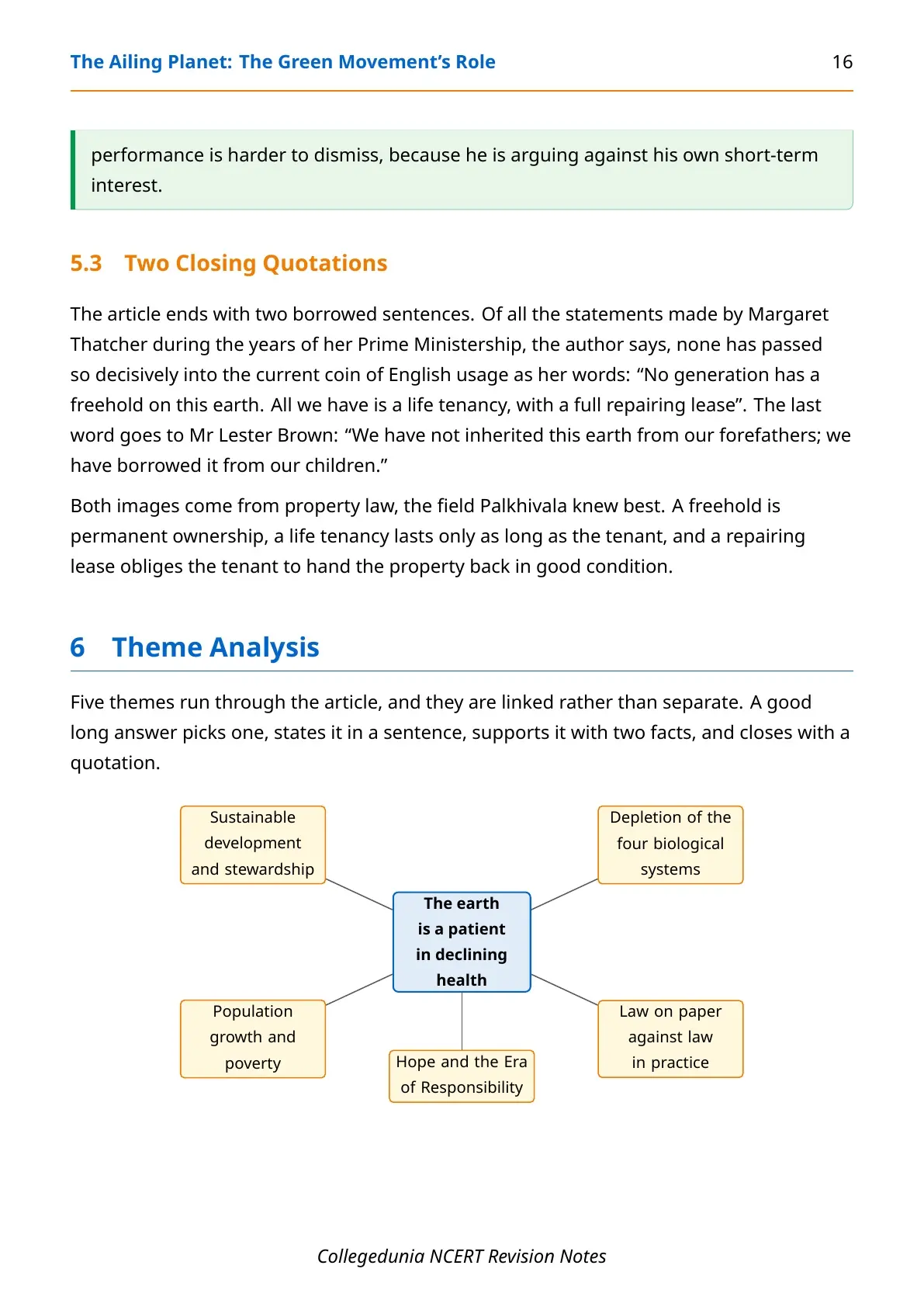
Long answer questions are set on themes, not on plot, because there is no plot here. Four themes cover almost everything a paper can ask.
- The earth as a living organism. The holistic view replaces the mechanistic one, and the planet is treated as a patient with vital signs.
- Sustainable development and trusteeship. We are stewards and trustees, holding the earth on a life tenancy with a full repairing lease.
- The gap between law and enforcement. Article 48A exists, yet forests vanish, which is the source of Palkhivala's anguish.
- Population as an environmental problem. Poverty and numbers feed each other, and the cure he offers is development plus voluntary family planning.
A fifth idea, the Era of Responsibility, is best used as the closing paragraph of any long answer. It lets you end on hope rather than on the statistics.
Difficult Expressions from The Ailing Planet with Their Meanings
The textbook lists eight expressions above the essay and asks you to infer their meaning from context. Questions on these are direct one mark items, so learn all eight.
| Expression | Meaning in the chapter |
|---|---|
| A holistic and ecological view | Seeing the world as one integrated whole rather than a set of separate parts. |
| Sustainable development | Development that meets present needs without harming the ability of future generations to meet theirs. |
| Languish | To remain neglected and unrecognised. |
| Ignominious darkness | A shameful, unworthy obscurity, used for species that stay unnamed. |
| Inter alia | Among other things. |
| Decimated | Destroyed or wiped out in large numbers. |
| Catastrophic depletion | A disastrous reduction, used for India's forest cover. |
| Transcending concern | A concern that rises above every other, here the survival of the planet. |
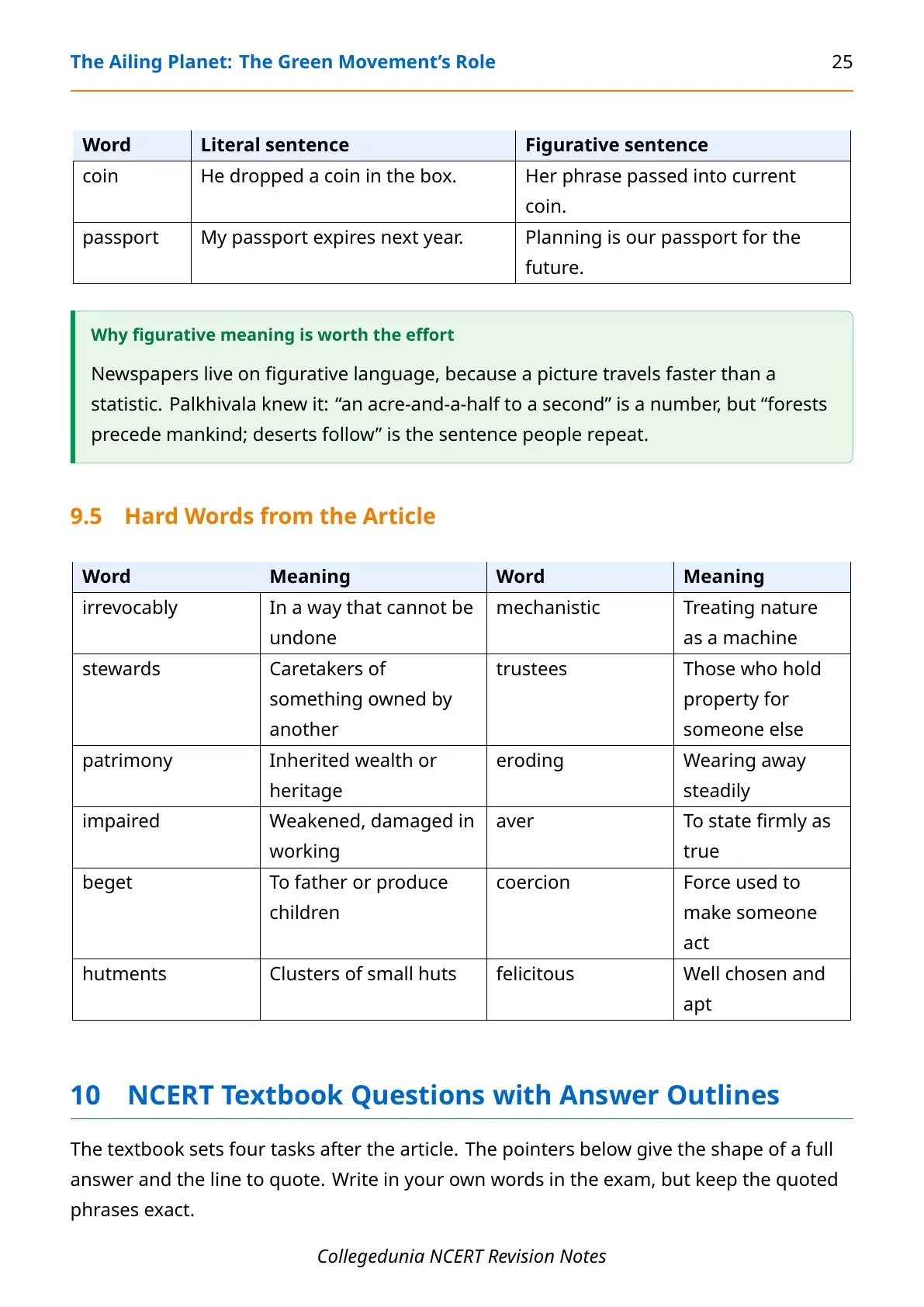
The Working With Words task adds five figurative phrases: gripped the imagination of, dawned upon, ushered in, passed into current coin and passport of the future. Each of them uses a common noun in a non literal sense, which is exactly what the second part of that task asks you to demonstrate.
Latin Phrases from the Thinking About Language Task with Meanings
Palkhivala uses inter alia in the essay, and the textbook builds a whole task around Latin expressions that are common in English. These are quick marks and are frequently set.
| Latin phrase | Meaning |
|---|---|
| Prima facie | At first sight, on the face of it. |
| Ad hoc | Made or arranged for one particular purpose only. |
| In camera | In private, not in open court. |
| Ad infinitum | Endlessly, without limit. |
| Mutatis mutandis | With the necessary changes made. |
| Caveat | A warning or a condition attached to something. |
| Tabula rasa | A blank slate, a mind before it receives impressions. |
Textbook Questions from The Ailing Planet Answered in Brief
The four Understanding the Text questions are the backbone of every school paper on the chapter. Keep each answer to four or five sentences and always carry a figure or a quotation inside it.
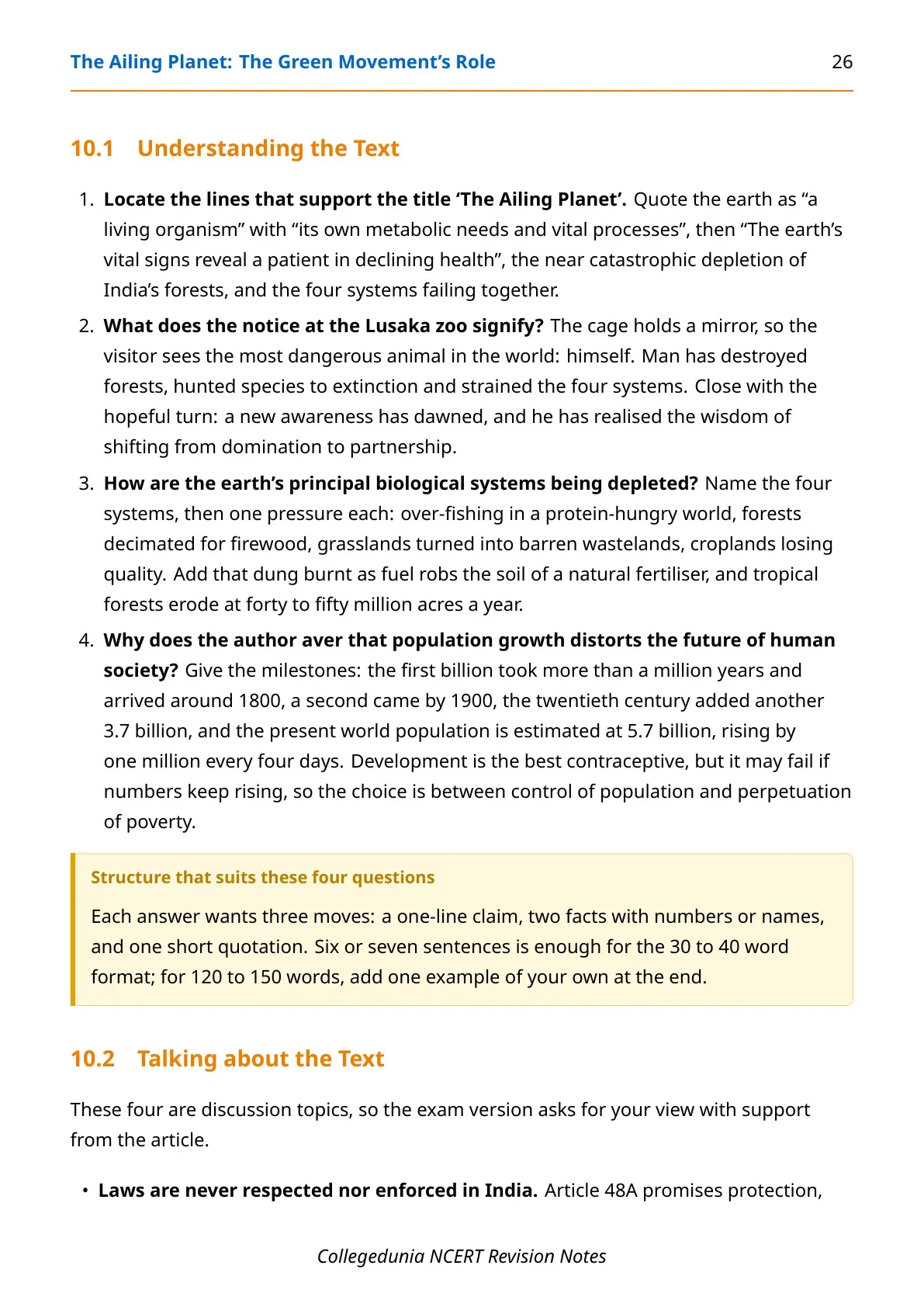
- Lines that support the title 'The Ailing Planet'. Quote "the earth's vital signs reveal a patient in declining health", then add the failing biological systems, the forest loss figures and the United Nations finding that the environment is critical in many of the eighty-eight countries investigated.
- What the Lusaka notice signifies. The cage holds a mirror, so the visitor sees himself. Man is the world's most dangerous animal because he alone destroys other species and the planet, and only he can repair the damage.
- How the principal biological systems are being depleted. Over fishing collapses fisheries, firewood cutting decimates forests, over grazing turns grasslands into barren wastelands, and croplands deteriorate as dung is burned instead of returned to the soil.
- Why population growth distorts the future. The world adds one million people every four days and stands at 5.7 billion, India at 920 million. More children means more people without work, so the real choice is between control of population and perpetuation of poverty.
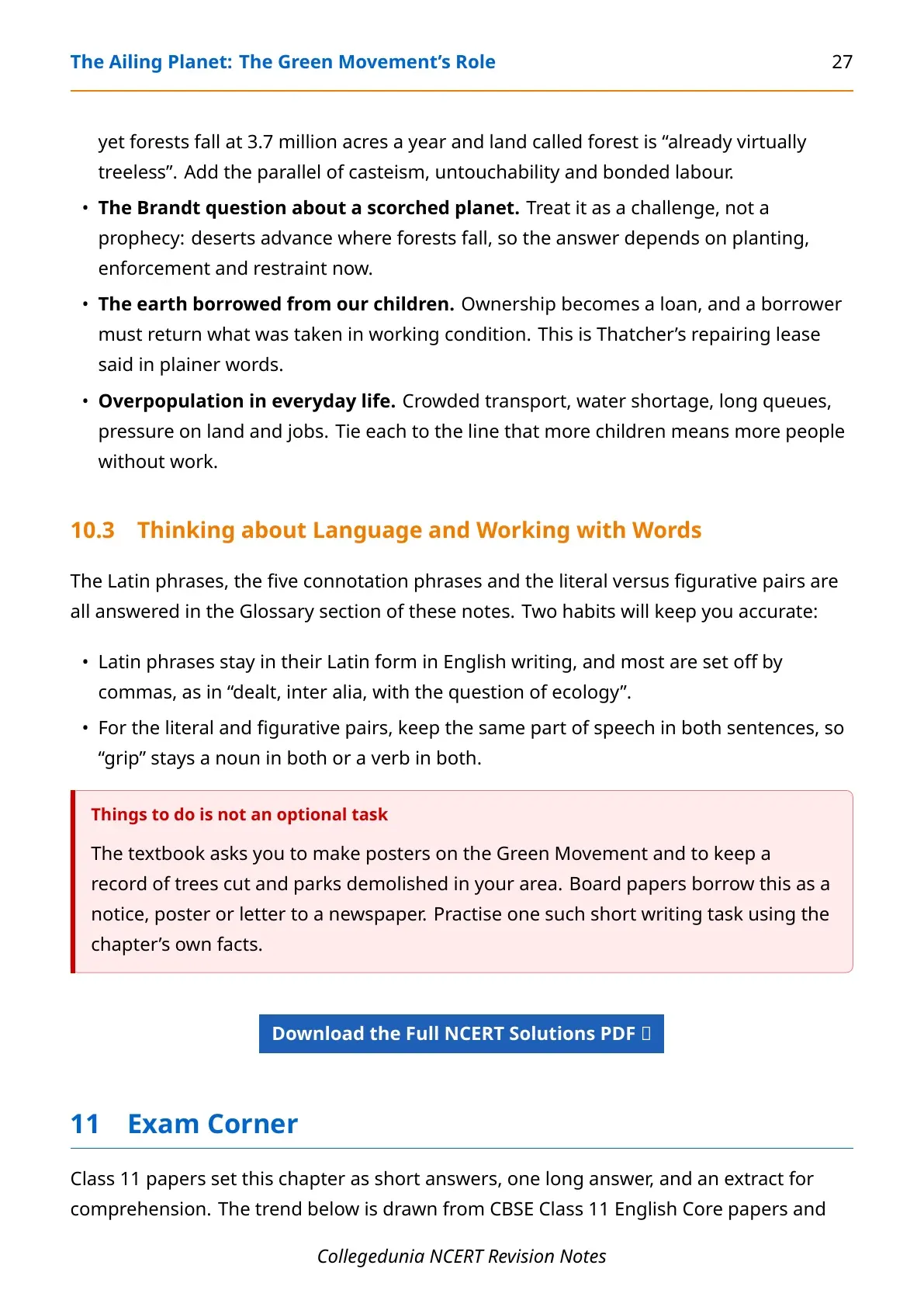
The four Talking About the Text prompts are discussion items, but schools often set them as long answers. Prepare a five point stand on each: enforcement of Indian laws, the Brandt Report question about a scorched planet, the borrowed earth quotation, and the everyday problems of overpopulation.
Common Mistakes Students Make in The Ailing Planet Answers
Check every one of these before you submit an answer. Each of them appears in school scripts every single year.
- Wrong book for Lester Brown. The essay names The Global Economic Prospect. Do not write any other Brown title.
- Wrong event for 1972. The chapter refers to the founding of the world's first nationwide Green party in New Zealand, not to any conference.
- Mixing up the two forest figures. Forty to fifty million acres a year is the world figure; 3.7 million acres a year is India's.
- Confusing 3.7 billion with 3.7 million. The billion figure is the population the twentieth century added; the million figure is India's annual forest loss.
- Updating the statistics. Write 5.7 billion and 920 million as the essay prints them, not today's numbers.
- Attributing the sustainable development definition to Palkhivala. It belongs to the World Commission on Environment and Development, 1987.
- Forgetting Article 48A's exact wording. The State shall endeavour to protect and improve, so it is a Directive Principle, not an enforceable right.
- Ending on despair. Palkhivala closes with the Era of Responsibility and the borrowed earth, so your conclusion should too.
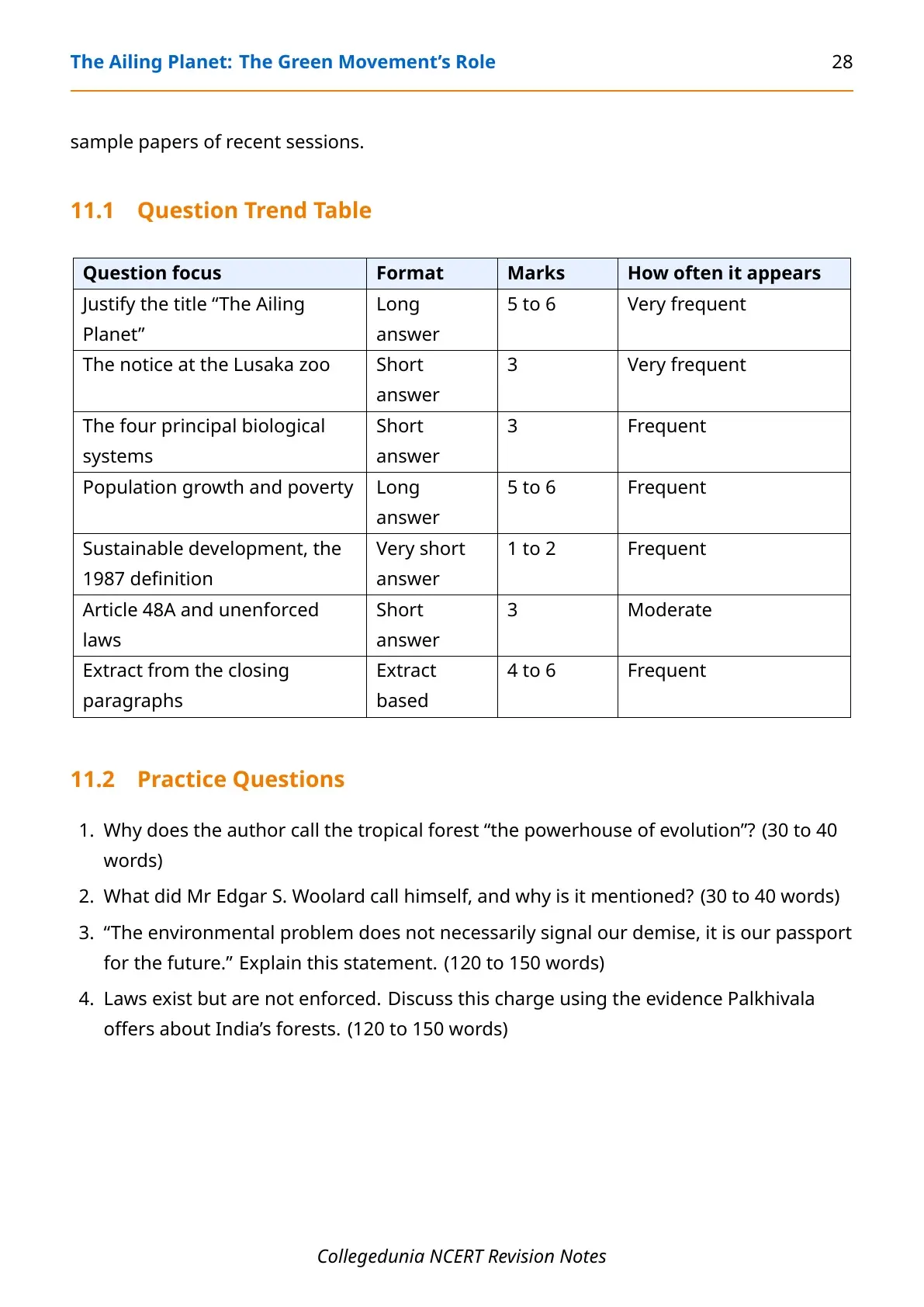
How The Ailing Planet Appears in the Class 11 English Paper
The chapter sits in the Hornbill prose section and usually contributes 6 to 8 marks across the paper. Because it is an argumentative article rather than a narrative, the question types differ from the story chapters.
| Question type | Marks | What is usually asked |
|---|---|---|
| Short answer | 2 to 3 | The Lusaka mirror, the meaning of a phrase, one statistic with its context. |
| Reference to context | 3 | An extract from the vital signs paragraph or the population paragraph. |
| Long answer | 5 to 6 | Justify the title, or explain the four biological systems, or the population argument. |
| Vocabulary item | 1 | Meaning of decimated, languish, inter alia or transcending concern. |
One tip that consistently adds marks: put a quoted figure or phrase in every answer. Examiners treat a correct statistic as proof that you have read the essay itself and not only a summary.
How to Revise The Ailing Planet in One Sitting
Forty minutes is enough if you revise in the right order. The figures come first because they are the hardest part to hold and the easiest part to lose.
- Ten minutes on the figures table. Cover the right column and recall what each number refers to.
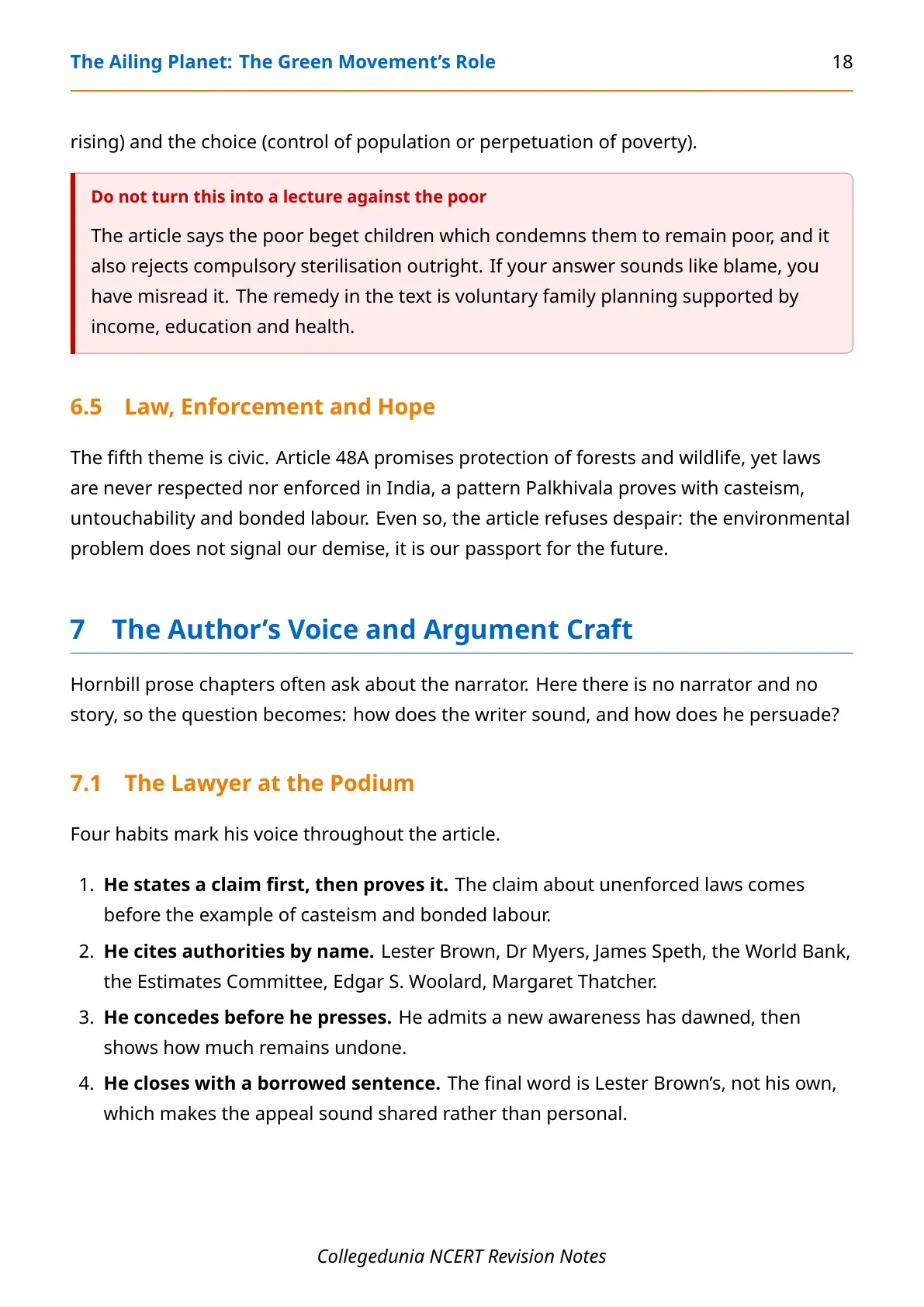
- Ten minutes on the summary. Read it once, then say the argument aloud in five steps: Green Movement, ailing earth, biological systems, Indian forests, population.
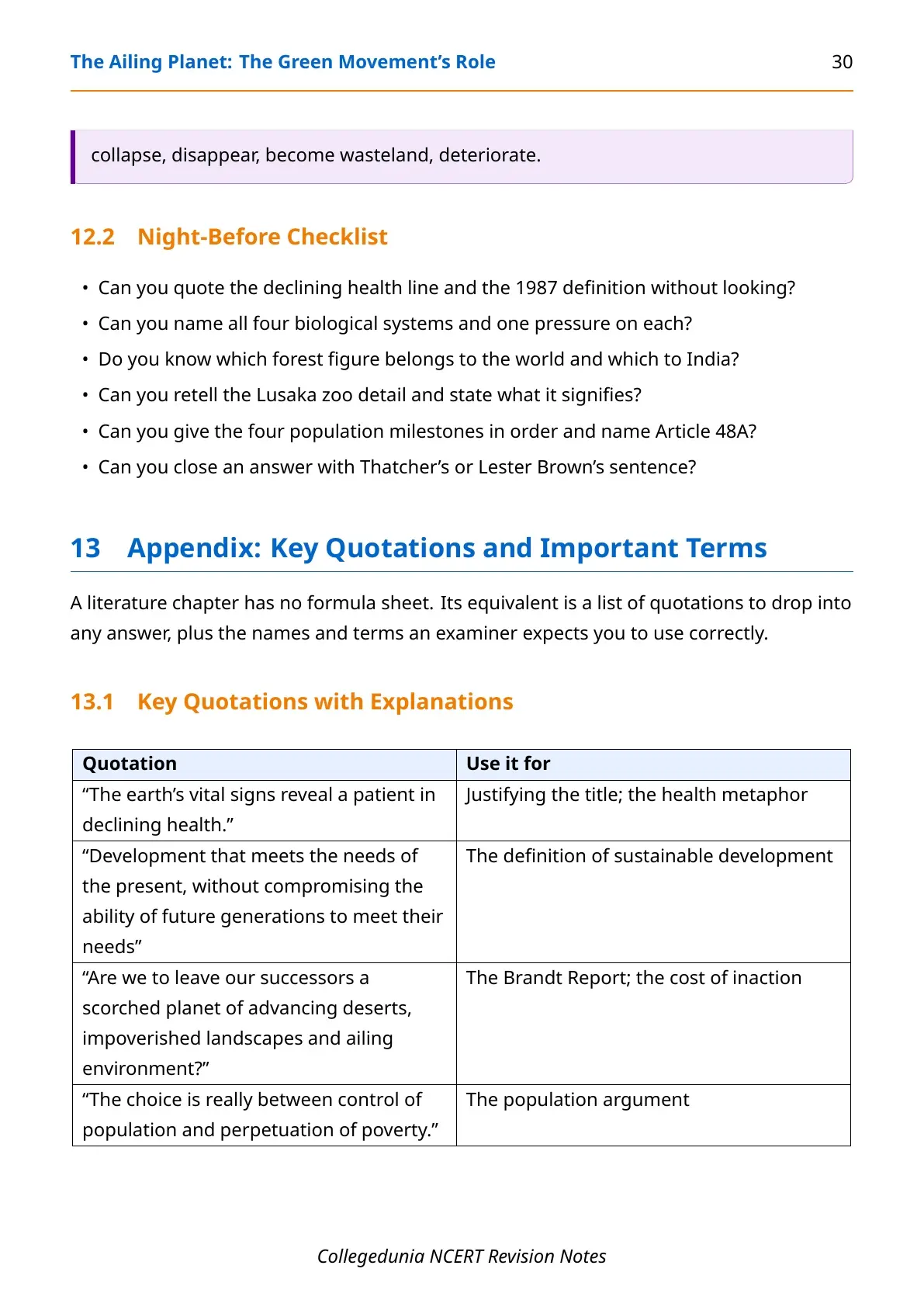
- Ten minutes on the quotations. Learn the vital signs line, the sustainable development definition, the choice between control of population and perpetuation of poverty, and the borrowed earth line.
- Ten minutes on words. The eight expressions, the seven Latin phrases and the five figurative phrases from Working With Words.
Finish by writing one full length answer on why the title fits the article. That single answer uses the summary, three figures and two quotations together, which is the best test of whether the revision worked.
NCERT Notes for All Class 11 English Hornbill Chapters
Revision notes are published for the six Hornbill prose chapters. Each page follows the same shape as this one, with summary tables, a mistakes block and a downloadable PDF.
| Chapter | Title | Revision Notes |
|---|---|---|
| Chapter 1 | The Portrait of a Lady | The Portrait of a Lady Class 11 Notes |
| Chapter 2 | We're Not Afraid to Die if We Can All Be Together | We're Not Afraid to Die Class 11 Notes |
| Chapter 3 | Discovering Tut: the Saga Continues | Discovering Tut Class 11 Notes |
| Chapter 4 | The Ailing Planet: the Green Movement's Role | You are here |
| Chapter 5 | The Adventure | The Adventure Class 11 Notes |
| Chapter 6 | Silk Road | Silk Road Class 11 Notes |
Other The Ailing Planet Resources for Class 11 English
The same chapter is covered by three more resources on Collegedunia. Use them alongside these notes depending on how much time is left before the paper.
| Resource | Best used for | Link |
|---|---|---|
| The Ailing Planet Class 11 NCERT Solutions | Every Understanding the Text, Talking about the Text and Working with Words task answered in the exam format | Read the Ailing Planet Class 11 NCERT Solutions |
| The Ailing Planet Class 11 Handwritten Notes | Last minute revision the night before the paper | Read the Ailing Planet Handwritten Notes |
| Class 11 English Hornbill Book PDF | The original chapter text with the noticing box and the end of unit tasks | Download the Class 11 English Hornbill Book PDF |
Class 11 English Hornbill Chapter 4 The Ailing Planet Notes FAQs
Ques. What is the chapter The Ailing Planet: the Green Movement's Role about?
Ans. It is an article by Nani Palkhivala, published in The Indian Express on 24 November 1994. It argues that the earth is a living organism whose health is failing, and it uses statistics on species, forests and population to show why sustainable development and the Green Movement matter.
Ques. Why is the planet called ailing in the chapter?
Ans. Palkhivala writes that the earth's vital signs reveal a patient in declining health. Its four principal biological systems are being pushed past their limits, tropical forests are eroding at forty to fifty million acres a year, and a United Nations study found the environment critical in many of the eighty-eight countries investigated.
Ques. What is sustainable development according to the chapter?
Ans. The concept was popularised in 1987 by the World Commission on Environment and Development, which defined it as development that meets the needs of the present, without compromising the ability of future generations to meet their needs. In plain terms, it means growth that does not strip the natural world of resources future generations would need.
Ques. What does the notice at the Lusaka zoo signify?
Ans. The cage at the zoo in Lusaka, Zambia, is labelled 'The world's most dangerous animal' but holds only a mirror. It tells the visitor that man himself is that animal, because he alone can destroy other species and the planet. Palkhivala adds that this animal has begun to shift from domination to partnership.
Ques. What are the four principal biological systems named in the chapter?
Ans. Fisheries, forests, grasslands and croplands. Lester R. Brown names them in his book The Global Economic Prospect. Besides supplying food, they provide virtually all raw materials for industry except minerals and petroleum derived synthetics, so they form the foundation of the global economic system.
Ques. How fast is India losing its forests according to the chapter?
Ans. India is losing its forests at the rate of 3.7 million acres a year, according to reliable data quoted in the essay. Parliament's Estimates Committee reported near catastrophic depletion over the last four decades, large areas designated as forest land are already virtually treeless, and the real loss is about eight times the government figure.
Ques. What does Article 48A of the Constitution of India say?
Ans. It provides that the State shall endeavour to protect and improve the environment and to safeguard the forests and wildlife of the country. Palkhivala quotes it to show the gap between law and practice, since he says laws are never respected nor enforced in India.
Ques. What population figures does Palkhivala quote?
Ans. Mankind took more than a million years to reach the first billion, around 1800. A second billion came by 1900, and the twentieth century added another 3.7 billion. The present world population is estimated at 5.7 billion, it increases by one million every four days, and India stands at 920 million.
Ques. What does Palkhivala mean by saying development is the best contraceptive?
Ans. He observes that fertility falls as incomes rise, education spreads and health improves. So real development brings birth rates down on its own, without coercion. His warning is that development itself may not be possible if numbers keep growing, which leaves a choice between control of population and perpetuation of poverty.
Ques. Why was the Green Movement founded and when did it begin?
Ans. The essay says the Green Movement began nearly twenty five years before the article was written, and that in 1972 the world's first nationwide Green party was founded in New Zealand. It grew out of a shift from a mechanistic view of the world to a holistic and ecological one.
Ques. What is the Era of Responsibility in the chapter?
Ans. It is the new world vision Palkhivala describes at the end of the essay, in which the survival of the planet becomes a transcending concern. Industry has a crucial role in it, illustrated by the Du Pont Chairman Mr Edgar S. Woolard, who called himself the company's Chief Environmental Officer.
Ques. Which quotations from The Ailing Planet should Class 11 students memorise?
Ans. Four are enough for most answers: the earth's vital signs reveal a patient in declining health; forests precede mankind, deserts follow; the choice is really between control of population and perpetuation of poverty; and Lester Brown's line that we have not inherited this earth from our forefathers, we have borrowed it from our children.
Ques. What do the expressions decimated and ignominious darkness mean here?
Ans. Decimated means destroyed or wiped out in large numbers, used for local forests cut for firewood. Ignominious darkness means a shameful obscurity, used for the three to a hundred million species that still languish unnamed while only about 1.4 million have been catalogued.
Ques. Are these Class 11 English Hornbill notes according to the 2026-27 syllabus?
Ans. Yes. Every summary line, figure and quotation on this page is checked against the 2026-27 reprint of the NCERT Hornbill textbook for Class 11 English Core, including the end of unit tasks for Understanding the Text, Talking About the Text, Thinking About Language and Working With Words.



Comments