



Silk Road is the Hornbill travelogue that carries you from a tent in Ravu to a cafe in Darchen. Inside these notes you will find the full journey across the Changtang, the wild ass and the Tibetan mastiffs, the frozen passes, the salt flats at Hor, the sleepless night at 4,760 metres and the meeting with Norbu. Every line is checked against the 2026-27 reprint of the NCERT Hornbill textbook.

- Covers the summary, character sketches, picturesque phrases and all seven noticing expressions.
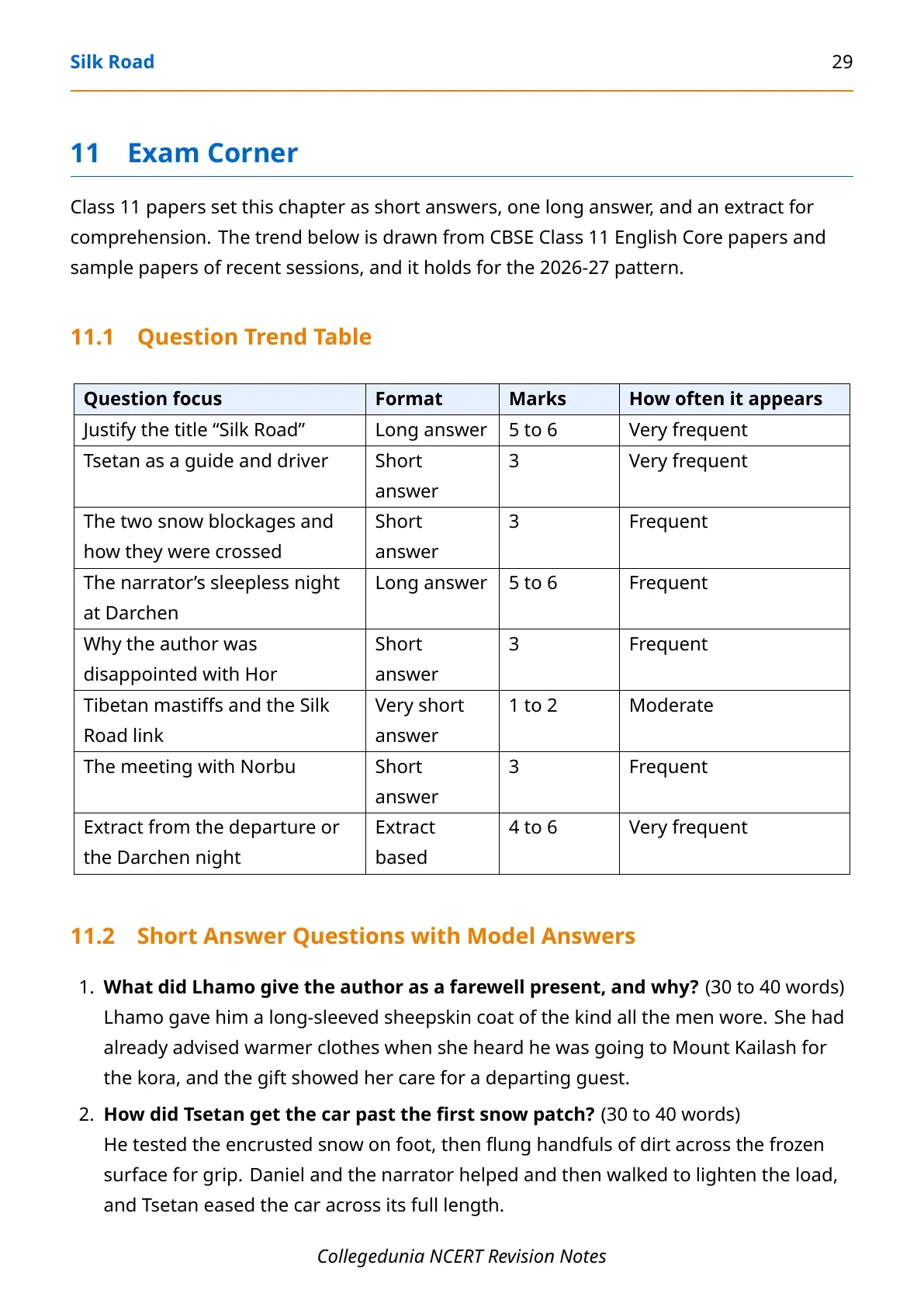
- The chapter usually carries 6 to 8 marks in the Hornbill prose section.
- Answers every Understanding the Text, Talking about the Text and Thinking about Language task.
Every note on this page is curated by Class 11 English teachers, checked line by line against the 2026-27 Hornbill print, and refined against the last five years of school question papers.
Student Feedback: Collegedunia polled 14,220 Class 11 English students before the 2026-27 school exams. 71% of the students surveyed could not name the three altitudes the narrator records on his watch. Only 29% could say why the article is titled Silk Road without looking it up.
Source: 2026-27 Class 11 English Core student poll. Sample of 14,220 students from CBSE schools across 19 states.
What These Silk Road Notes Cover for Class 11 English
This page is built for the way the travelogue is actually tested. Silk Road has no plot twist and no villain. It has places, altitudes, animals, three named people and a long list of unusual adjectives that examiners love.
- Full summary in the order Nick Middleton tells it, from the half-moon over Ravu to Norbu's laughter in the Darchen cafe.
- A stage by stage map of the drive, with every altitude the narrator notes on his wristwatch.
- Character sketches of the narrator, Tsetan, Lhamo, Daniel and Norbu, with the exact lines that support each trait.
- All seven noticing expressions plus the five uncommon adjectives from Working with Words.
- Every end of unit task answered, including the active voice question and the "have something done" structure.
Nick Middleton and the Travelogue Behind Silk Road
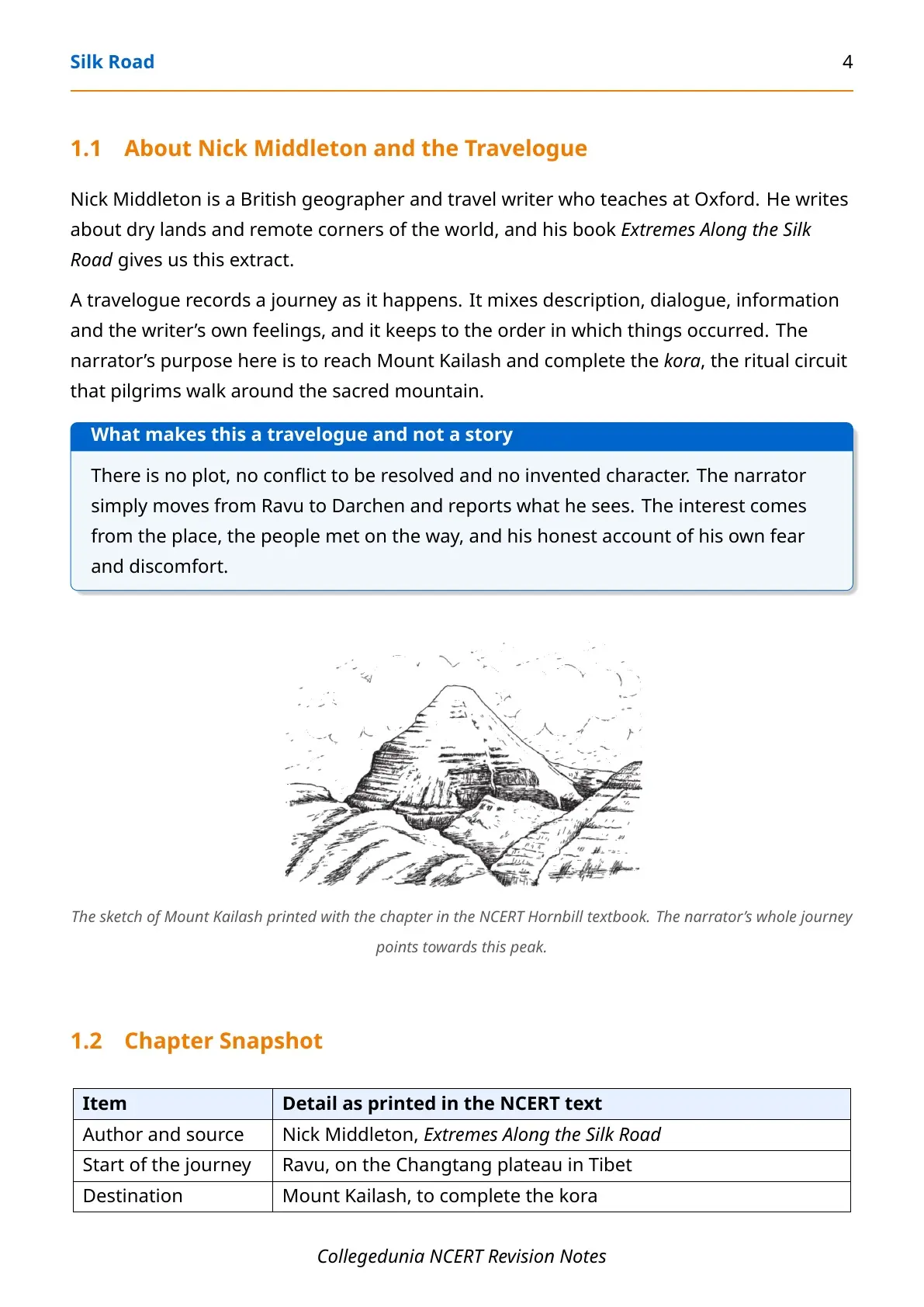
The Hornbill textbook prints a one line note with the chapter: a travelogue presenting a panoramic view of Mount Kailash. That single line tells you what kind of writing this is, and the genre itself is examinable.
- Author: Nick Middleton, a British geographer and travel writer who works on deserts and dry lands.
- Genre: travelogue, that is, a first person account of a real journey. It is not fiction.
- Where the extract sits: the piece is taken from his book on Tibet, and the extract covers only the drive from Ravu to Darchen.
- Purpose of the journey: the narrator is heading to Mount Kailash to complete the kora, the ritual circuit walked around the sacred mountain.
- Point of view: first person, with a dry, understated humour that shows up most clearly in the mastiff and medicine passages.
Because the writer is a geographer, the landscape gets as much attention as the people. Rock colour, ice, altitude and the ancient Tethys Ocean all appear, and questions on this chapter often mix description with geography.
Silk Road Summary in Simple Language
The narrator leaves Ravu on a bright morning with a half-moon still in the sky. Lhamo, a local woman, gives him a farewell present. Tsetan drives, Daniel travels with them, and the plan is a short cut off the Changtang plateau that heads south-west, almost straight towards Mount Kailash.
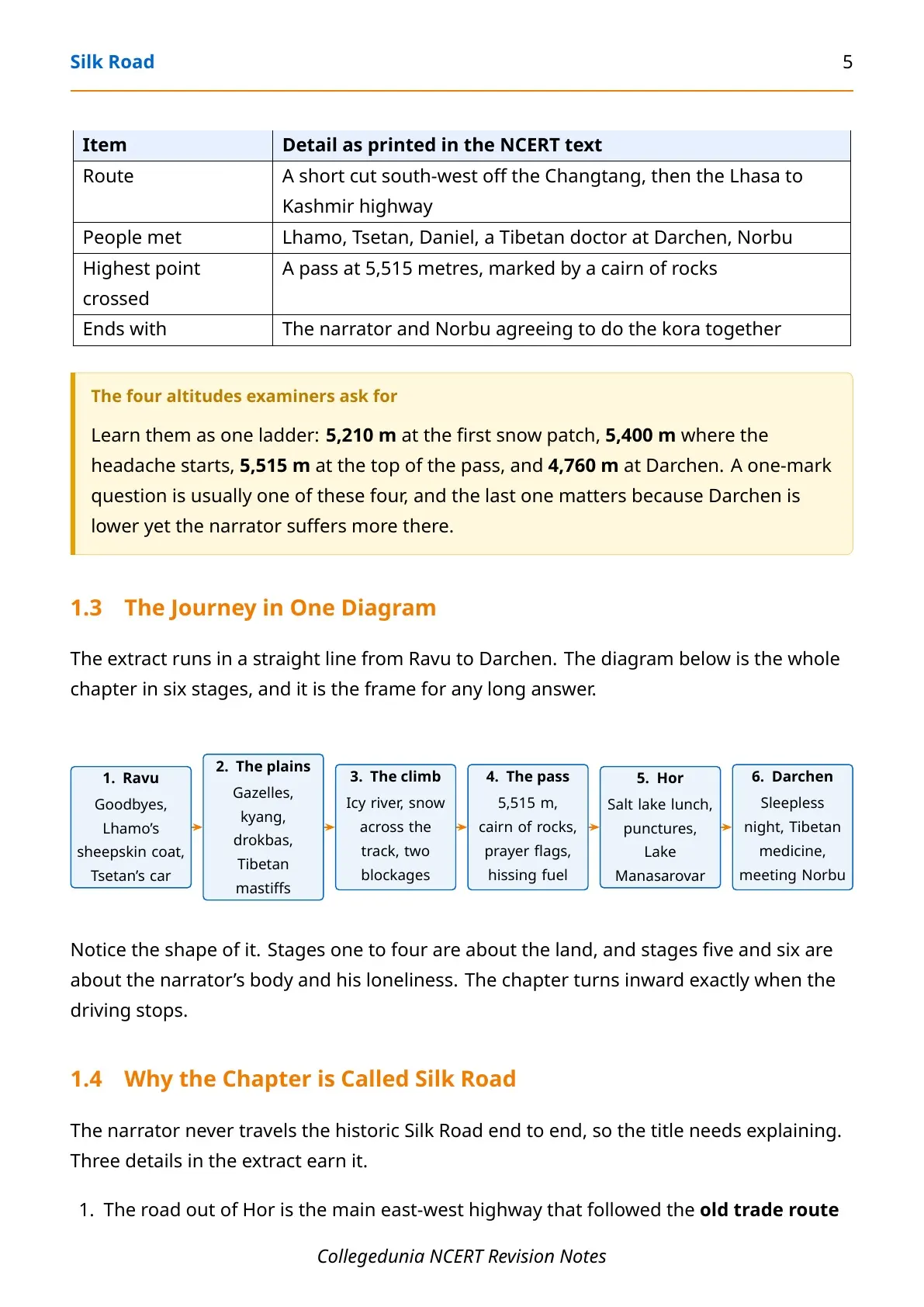
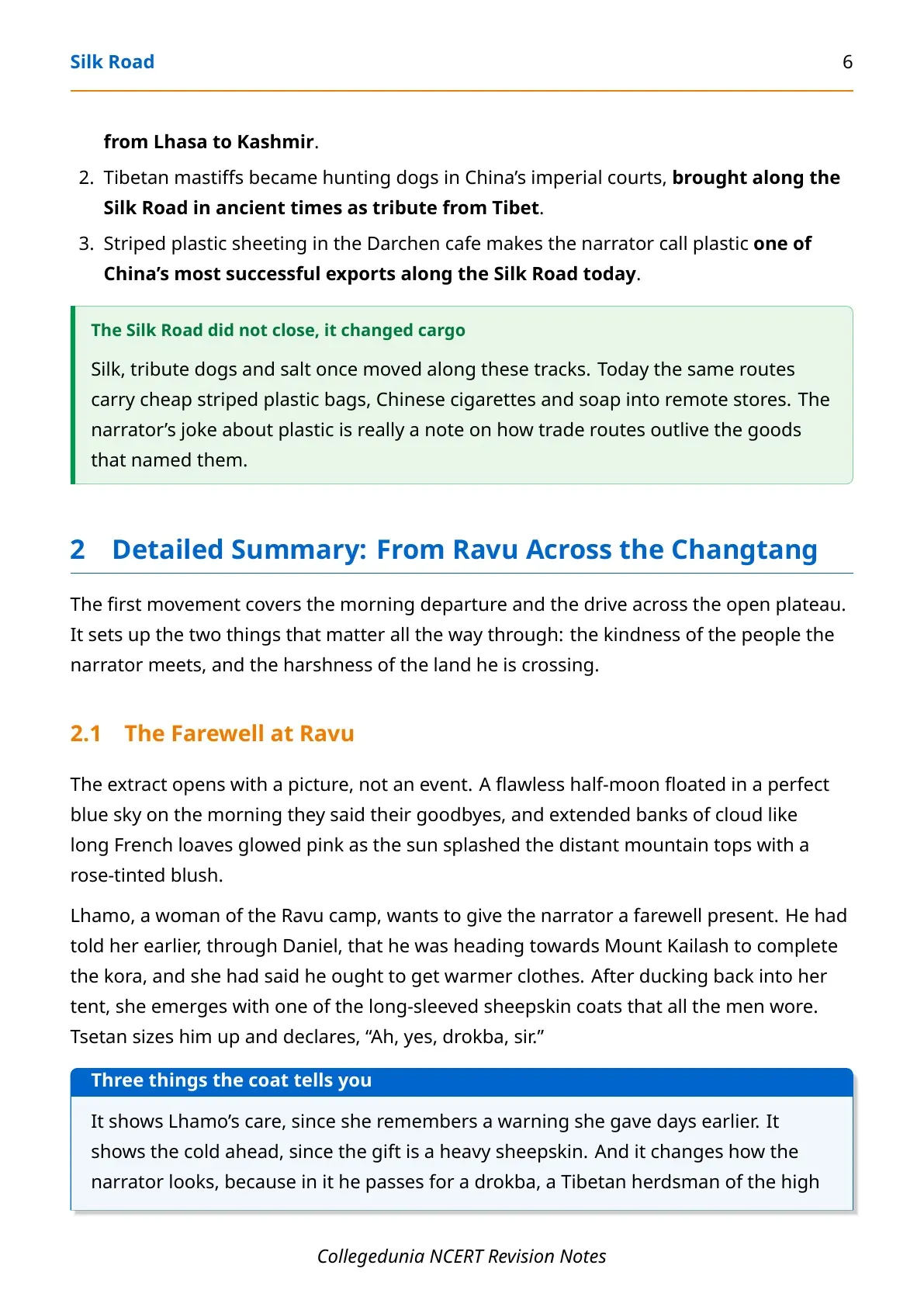
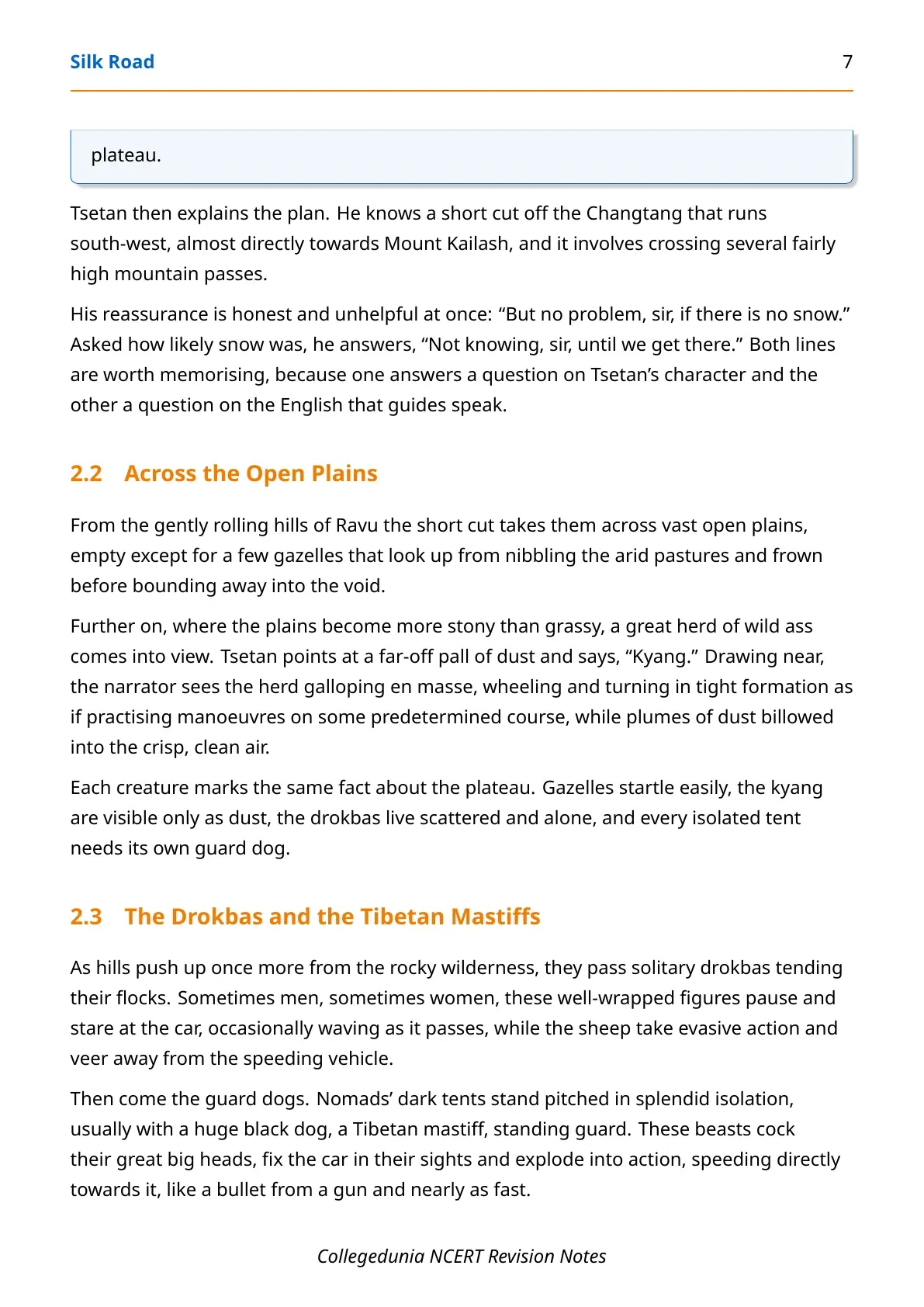
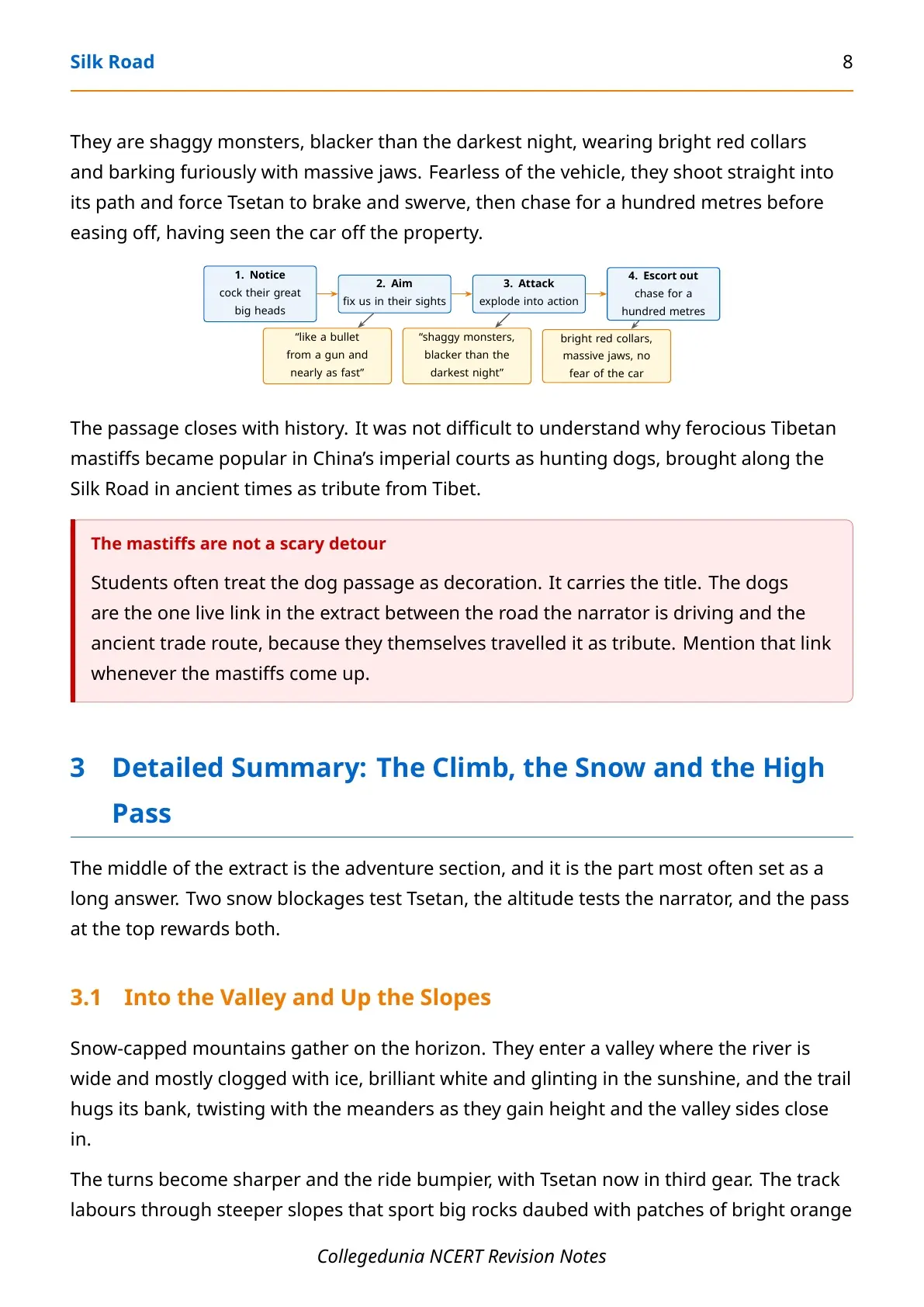
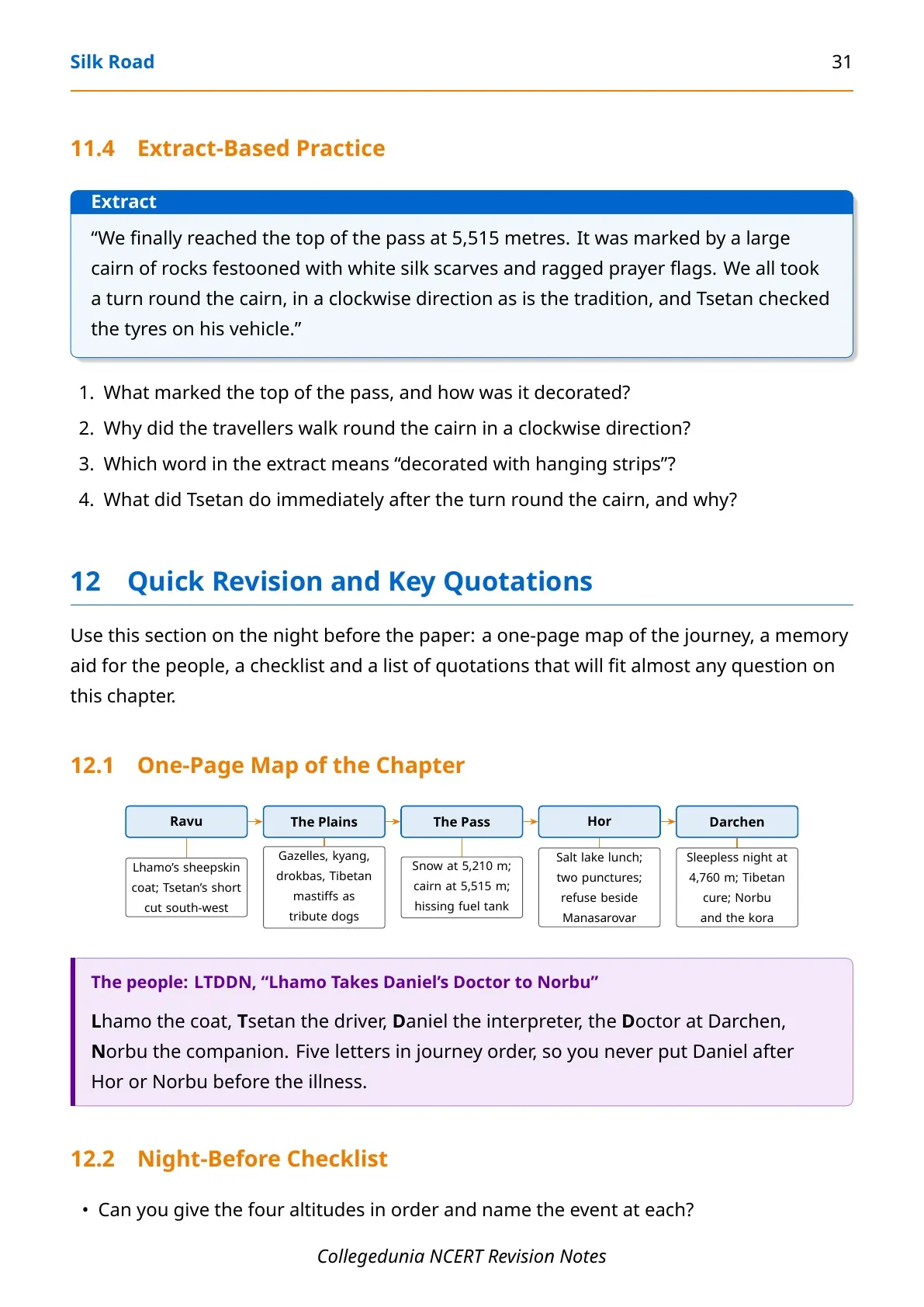
The journey has four clear stages. Learn them in order, because most short questions sit inside one of them.
- The plains. Gazelles nibble the dry pasture, a great herd of wild ass gallops in tight formation, solitary drokbas tend their flocks, and Tibetan mastiffs charge the car from the nomads' tents.
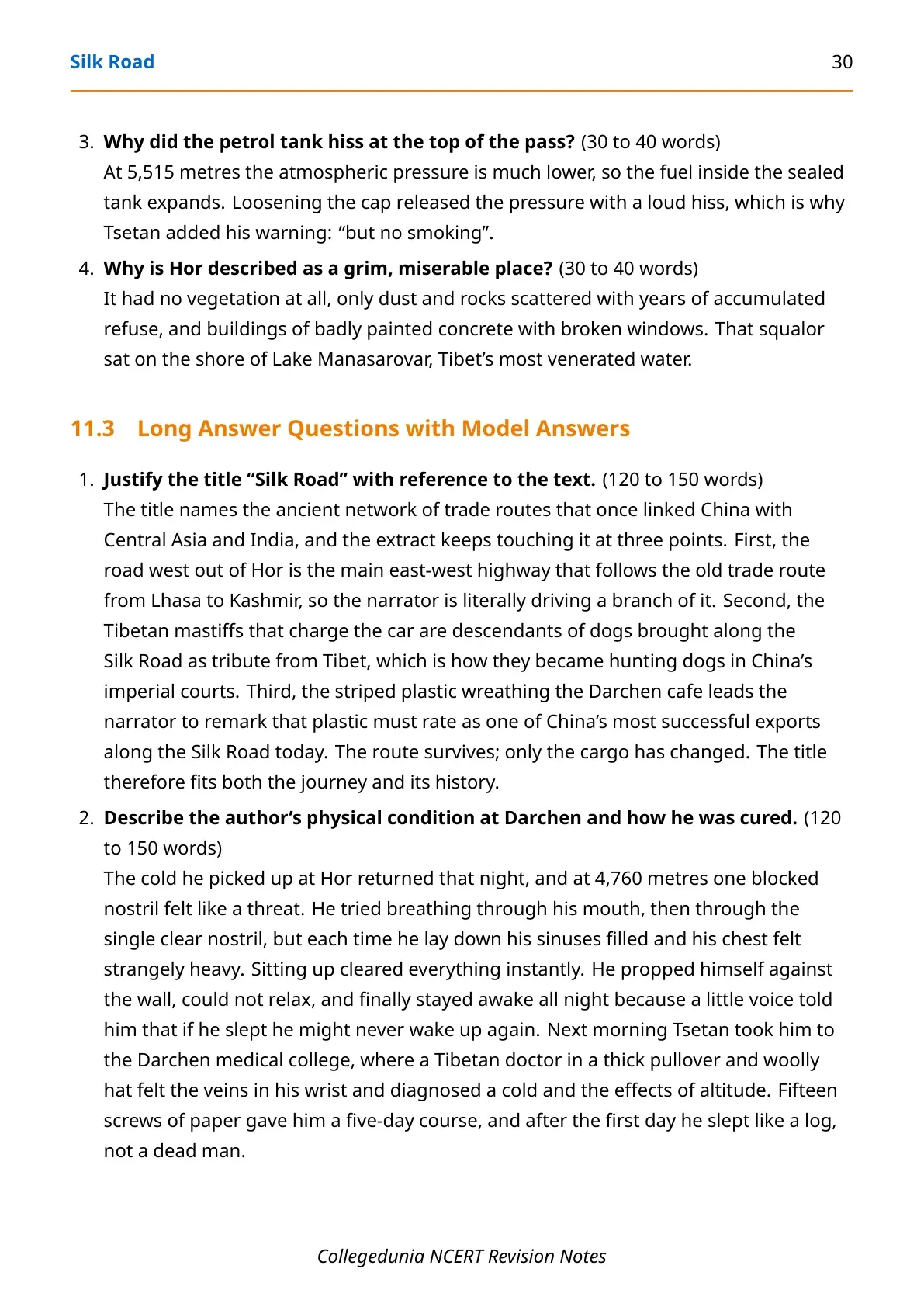
- The passes. The trail climbs beside an icy river. Snow blocks the track at 5,210 metres, then again ten minutes later. The pass tops out at 5,515 metres at a cairn of rocks.
- The salt flats and Hor. Lunch is hot noodles beside a dry salt lake. Two punctures later they reach Hor, a grim town on the shore of Lake Manasarovar, and Daniel leaves for Lhasa.
- Darchen. A sleepless night at 4,760 metres, a Tibetan doctor, five days of medicine, and then the meeting with Norbu in the town's only cafe.
The extract ends on a hopeful note. The narrator arrived too early in the season and found no pilgrims, but Norbu, a Tibetan academic from Beijing, wants to do the kora too. The two agree to travel as a team.
Silk Road Full Chapter Explanation in Video
Source: Magnet Brains on YouTube
The Farewell at Ravu and Lhamo's Sheepskin Coat Gift
The opening paragraph is the most quoted passage in the chapter, because it is pure description. The narrator sets the scene before he sets off, and the sentence pattern is worth copying into your own answers.
- The sky: a flawless half-moon floated in a perfect blue sky on the morning of the goodbyes.
- The clouds: extended banks of cloud like long French loaves glowed pink as the sun came up.
- The mountains: the sun splashed the distant mountain tops with a rose-tinted blush.
- The gift: Lhamo ducks back into her tent and comes out with one of the long-sleeved sheepskin coats that all the men wear.
- The reason: the narrator had told her, through Daniel, that he was going to Mount Kailash to complete the kora, and she said he ought to get warmer clothes.
Tsetan's reaction is the line to quote. He sizes the narrator up as they clamber into the car and declares, "Ah, yes, drokba, sir." A drokba is a Tibetan herdsman, so in one word Tsetan says the coat has turned an English visitor into a local.
Tsetan's promise about the route is equally quotable and shows his honesty. He says the short cut crosses several fairly high passes, then adds, "But no problem, sir, if there is no snow." Asked how likely that is, he answers, "Not knowing, sir, until we get there."
Wildlife on the Changtang: Gazelles, Kyang and the Tibetan Mastiffs
The animal passages carry three or four marks on their own, and they are easy to score on because the details are concrete. Revise them as a table rather than as a story.
| Animal | What the narrator sees | The detail examiners ask for |
|---|---|---|
| Gazelles | A few on the vast open plains, nibbling the arid pastures. | They look up, frown, then bound away into the void. |
| Wild ass, the kyang | A great herd where the plains turn more stony than grassy. | Tsetan spots a far-off pall of dust long before the animals appear. |
| The kyang in motion | The herd gallops en masse, wheeling and turning in tight formation. | It looks like practised manoeuvres on a predetermined course, and plumes of dust billowed into the crisp, clean air. |
| Sheep and their drokbas | Solitary well-wrapped figures, sometimes men and sometimes women, tending flocks. | They pause, stare at the car, sometimes wave. The sheep take evasive action and veer away. |
| Tibetan mastiffs | A huge black dog guarding each nomad tent pitched in splendid isolation. | Blacker than the darkest night, bright red collars, massive jaws, completely fearless of the vehicle. |
The mastiff paragraph deserves its own revision slot. The dogs cock their great heads, fix the car in their sights, then explode into action like a bullet from a gun and nearly as fast. They shoot straight into the car's path, forcing Tsetan to brake and swerve, and they chase for about a hundred metres before easing off, having seen the car off the property.
The link to the title comes at the end of that passage. The narrator says it is not difficult to understand why ferocious Tibetan mastiffs became popular in China's imperial courts as hunting dogs, brought along the Silk Road in ancient times as tribute from Tibet.
Crossing the Frozen High Passes at 5,210 Metres and 5,515 Metres
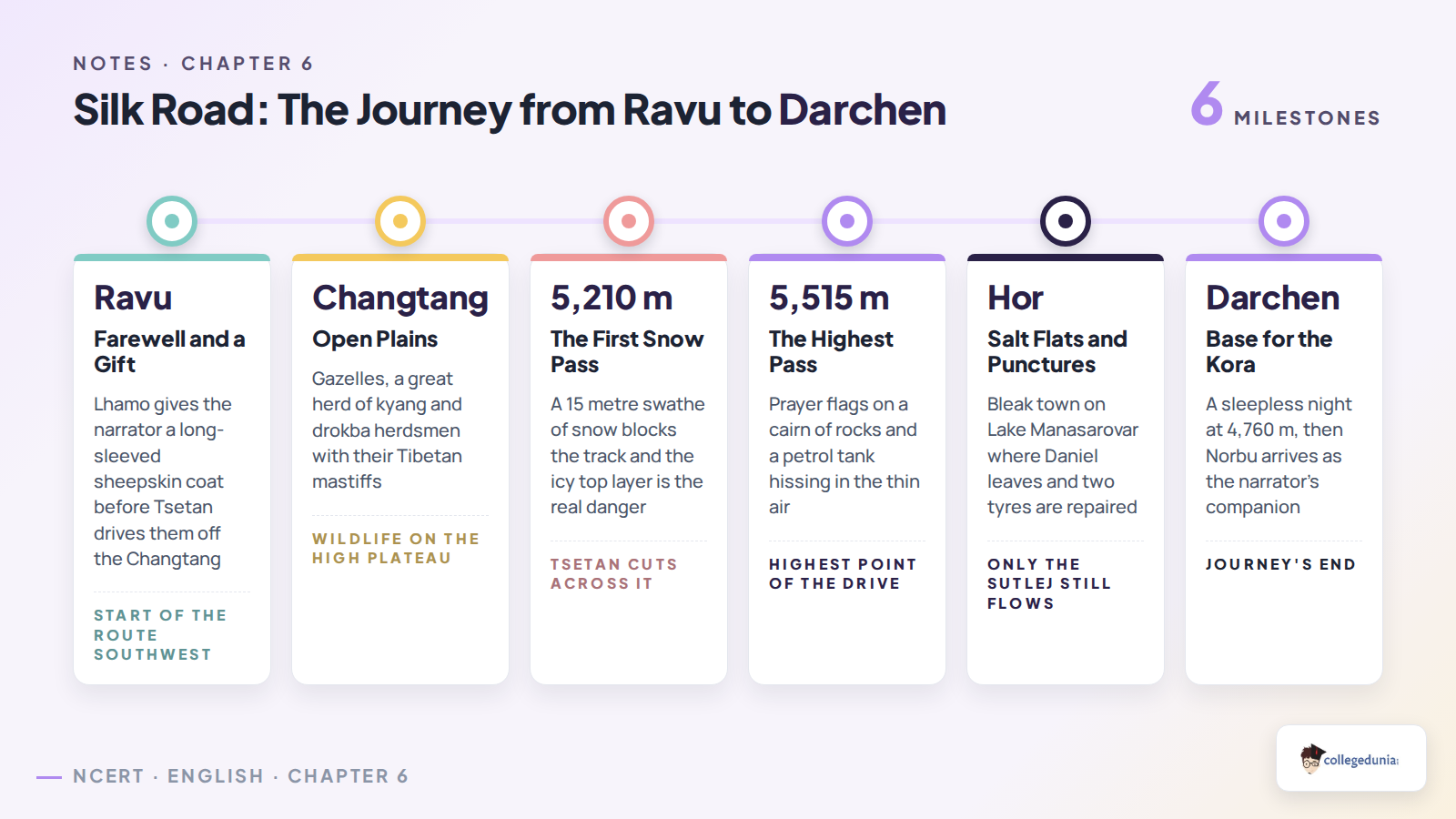
This is the adventure part of the travelogue, and it is where Tsetan's skill is shown rather than described. Track the climb by the numbers on the narrator's wristwatch, because a question on his physical condition needs them.
| Altitude | What happens there |
|---|---|
| Below the snow line | The valley river is wide and mostly clogged with ice, brilliant white and glinting in the sunshine. The trail hugs the bank and twists with the meanders. |
| The steep slopes | Big rocks daubed with patches of bright orange lichen. Hunks of snow cling on in the near-permanent shade. The narrator's ears block, so he holds his nose and snorts to clear them. |
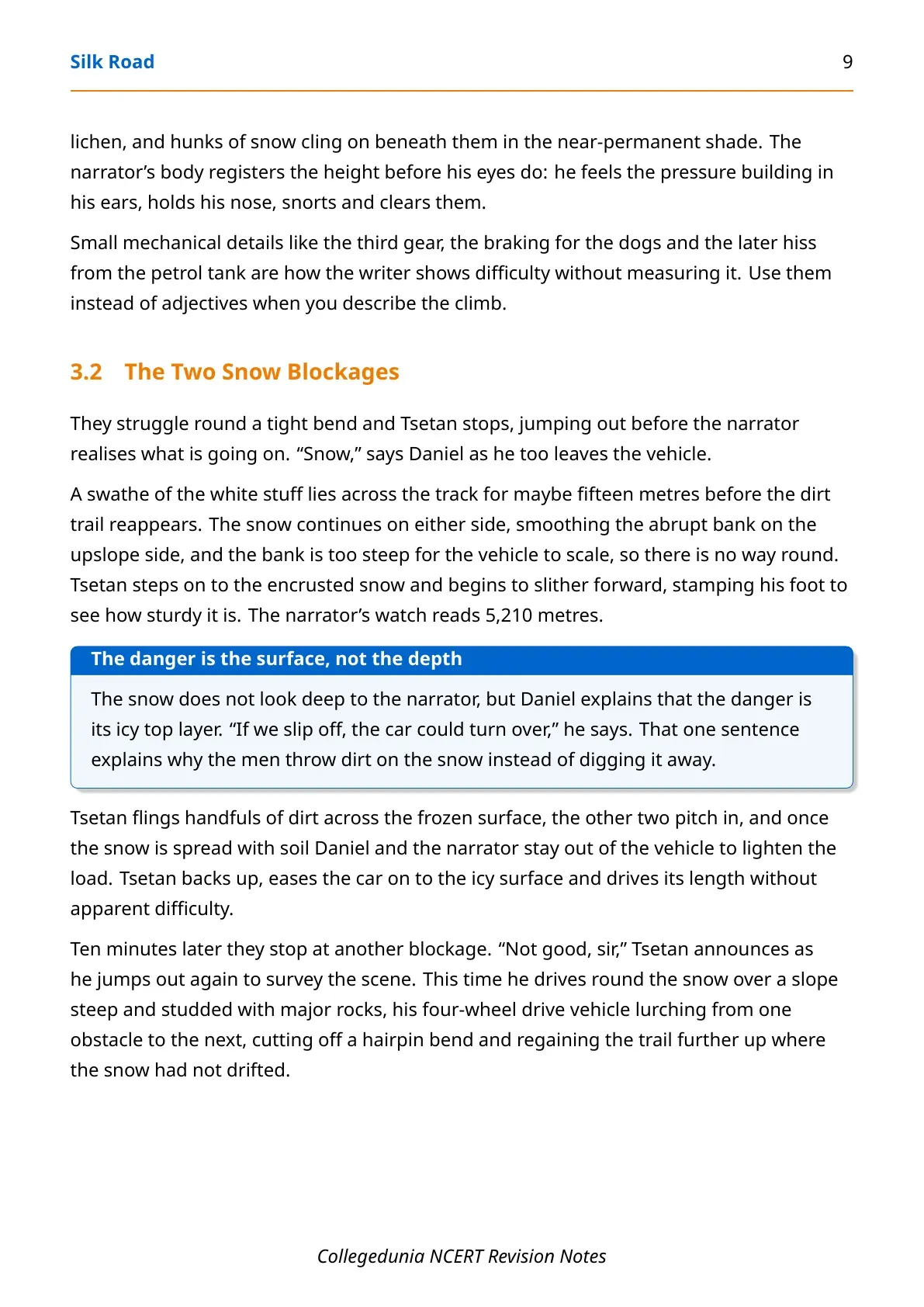
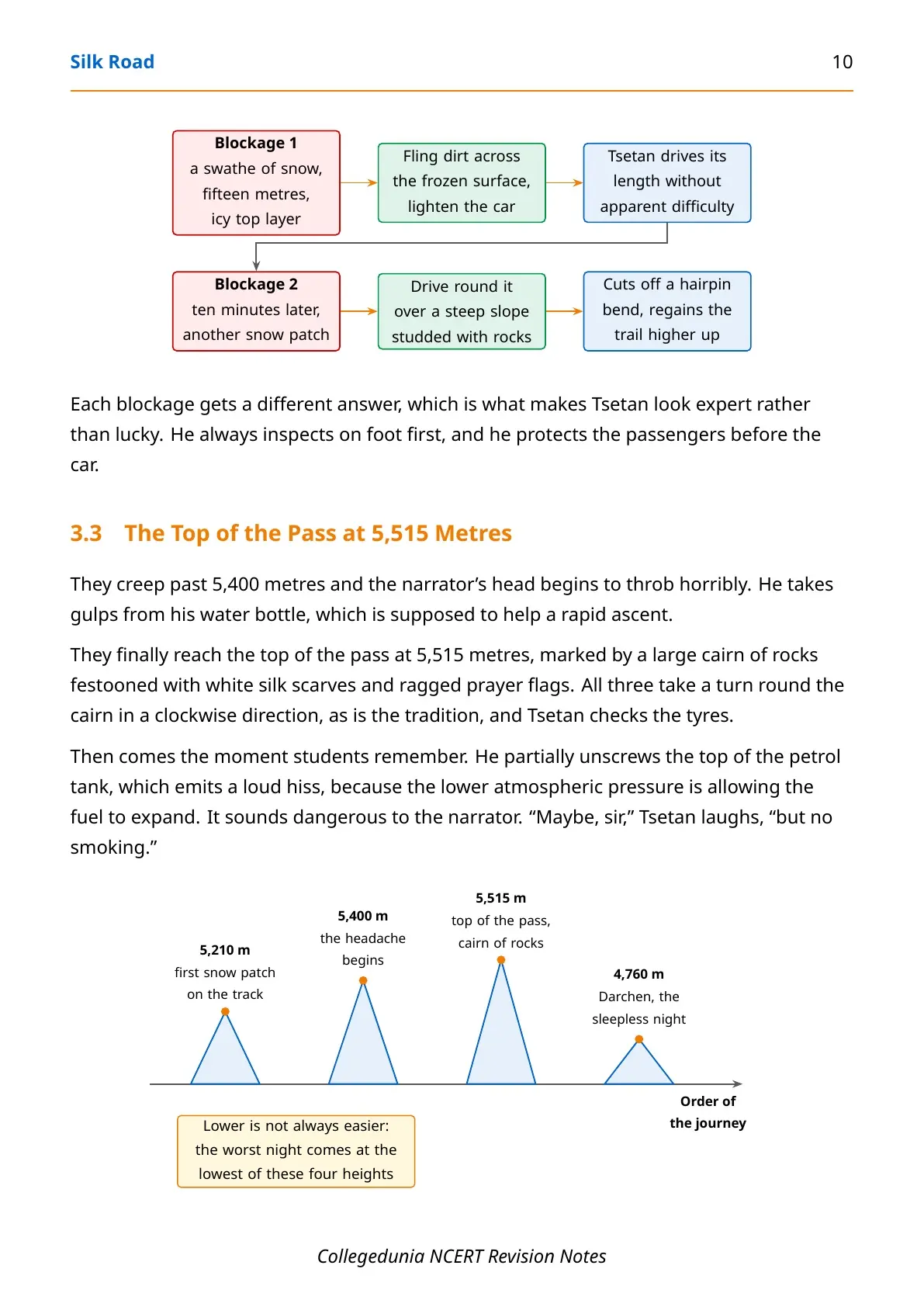
| 5,210 metres | A swathe of snow lies across the track for about fifteen metres. The bank on the upslope side is too steep to drive round. |
| Ten minutes later | A second blockage. Tsetan drives round it over a slope studded with major rocks, cutting off one of the hairpin bends and regaining the trail higher up. |
| 5,400 metres | The narrator's head begins to throb horribly. He takes gulps from his water bottle, which is supposed to help a rapid ascent. |
| 5,515 metres | The top of the pass, marked by a large cairn of rocks festooned with white silk scarves and ragged prayer flags. |
The snow crossing is the most asked scene in this section, so learn it as a sequence of five actions.
- Tsetan steps on to the encrusted snow and slithers forward, stamping his foot from time to time to test how sturdy it is.
- Daniel points out that the danger is not the depth of the snow but its icy top layer. If the car slips off, it could turn over.
- Tsetan grabs handfuls of dirt and flings them across the frozen surface. Daniel and the narrator pitch in.
- The two passengers stay out of the vehicle to lighten Tsetan's load.
- Tsetan backs up, eases the car on to the icy surface and drives its length without apparent difficulty.
At the cairn on the pass, everyone takes a turn round it in a clockwise direction, as is the tradition. Tsetan checks the tyres, then partly unscrews the petrol tank cap, which lets out a loud hiss. The lower atmospheric pressure is allowing the fuel to expand. When the narrator says it sounds dangerous, Tsetan laughs and answers, "Maybe, sir, but no smoking."
The Salt Flats, the Tethys Ocean and the Drive to Hor
The headache clears as the car careered down the far side of the pass. At two o'clock they stop for lunch, and the geographer in Nick Middleton takes over the writing for a paragraph.
- The meal: hot noodles inside a long canvas tent, part of a workcamp put up beside a dry salt lake.
- The geology: the plateau is pockmarked with salt flats and brackish lakes, vestiges of the Tethys Ocean which bordered Tibet before the great continental collision that lifted it skyward.
- The work: men with pickaxes and shovels trudge back and forth in long sheepskin coats and salt-encrusted boots.
- The glare: everyone wears sunglasses, and a steady stream of blue trucks comes out of the blindingly white lake laden with piles of salt.
- The trouble: two punctures in quick succession on the drive down, leaving Tsetan with no spares.
By late afternoon they reach Hor, back on the main east-west highway that follows the old trade route from Lhasa to Kashmir. Daniel, who is returning to Lhasa, finds a ride in a truck, and the two say goodbye outside a tyre-repair shop. Tsetan is eager to have the punctures fixed, partly because the second replacement tyre is as smooth as the narrator's bald head.
Hor, Lake Manasarovar and the Contrast with Earlier Travellers
Hor is the low point of the journey, and the question "why was the author's experience at Hor in stark contrast to earlier accounts" is set almost every year. The answer has two halves: what Hor is, and what earlier travellers felt.
| What the narrator finds at Hor | What earlier travellers recorded |
|---|---|
| No vegetation whatsoever, just dust and rocks, liberally scattered with years of accumulated refuse. | Ekai Kawaguchi, a Japanese monk who arrived in 1900, was so moved by the sanctity of the lake that he burst into tears. |
| Buildings of badly painted concrete. The town's only cafe has three broken windows and a good view of the lake through one of them. | A couple of years later the hallowed waters had a similar effect on Sven Hedin, a Swede who was not prone to sentimental outbursts. |
| A Chinese youth in military uniform spreads the grease around the table with a filthy rag before bringing tea. | Both men reacted to Manasarovar as a sacred place, not as a rubbish dump. |
The lake itself carries a two mark factual question. Ancient Hindu and Buddhist cosmology pinpoints Lake Manasarovar as the source of four great Indian rivers: the Indus, the Ganges, the Sutlej and the Brahmaputra. The narrator corrects this in one sentence. Only the Sutlej actually flows from the lake, while the headwaters of the other three rise nearby on the flanks of Mount Kailash.
Note the irony the writer builds without stating it. The most venerated stretch of water in Tibet sits beside a town that is an open-air rubbish dump. That contrast is the point of the whole section.
The Sleepless Night at Darchen and the Tibetan Medical College
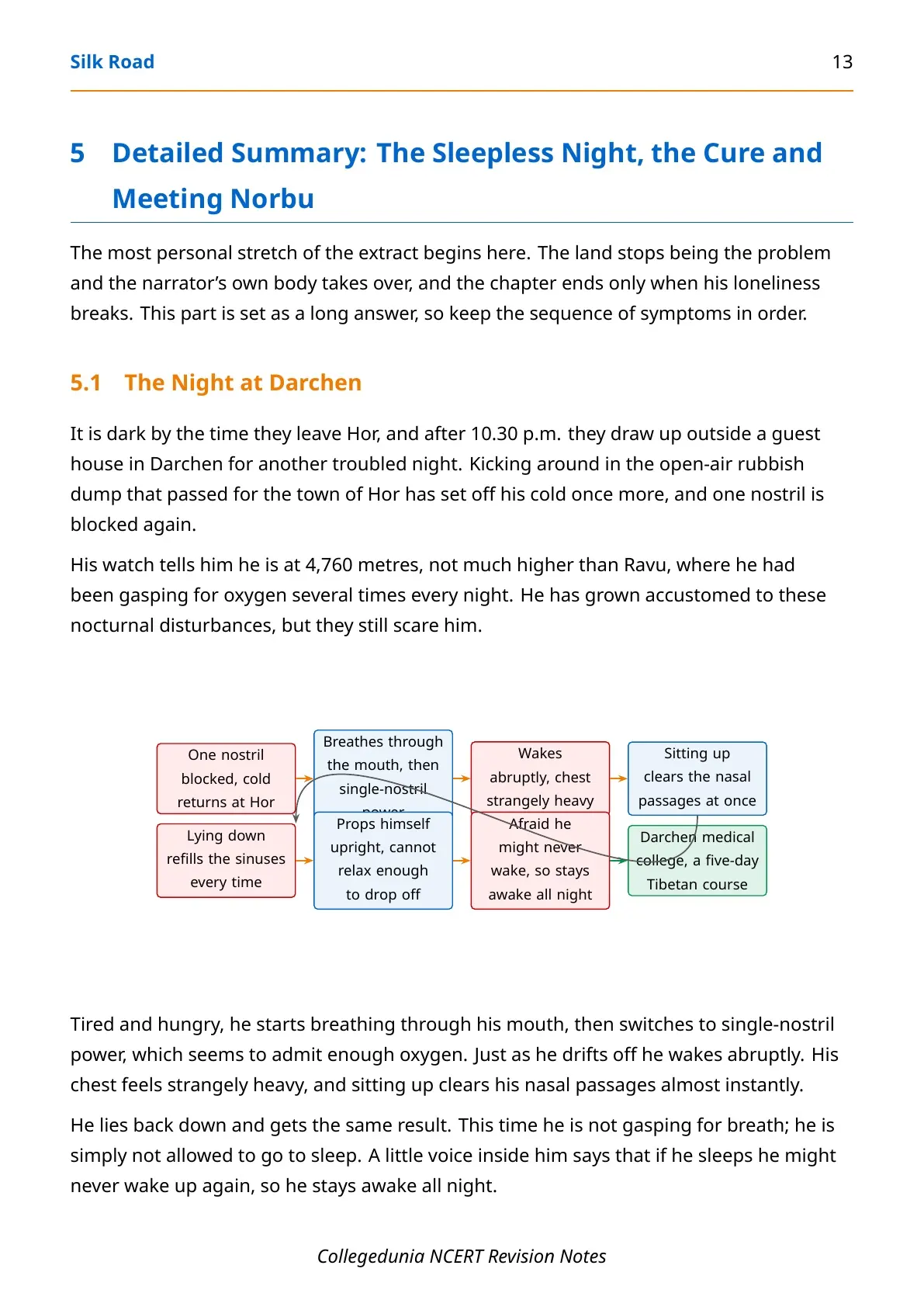
They leave Hor after dark and draw up outside a guest house in Darchen after 10.30 at night. The narrator's watch reads 4,760 metres, not much higher than Ravu, where he had already been gasping for oxygen several times a night.
The night itself is written as a sequence of attempts and failures, which makes it easy to reproduce in an answer.
- Kicking around in the rubbish of Hor has set off his cold again, and one nostril is blocked.
- He starts breathing through his mouth, then switches to single-nostril power, which seems to admit enough oxygen.
- Just as he drifts off he wakes abruptly. His chest feels strangely heavy. Sitting up clears his nasal passages almost instantly.
- He lies back down and gets the same result. This time he is not gasping for breath, he is simply not allowed to go to sleep.
- He props himself upright against the wall but cannot relax enough to drop off. A little voice inside says that if he sleeps he might never wake up, so he stays awake all night.
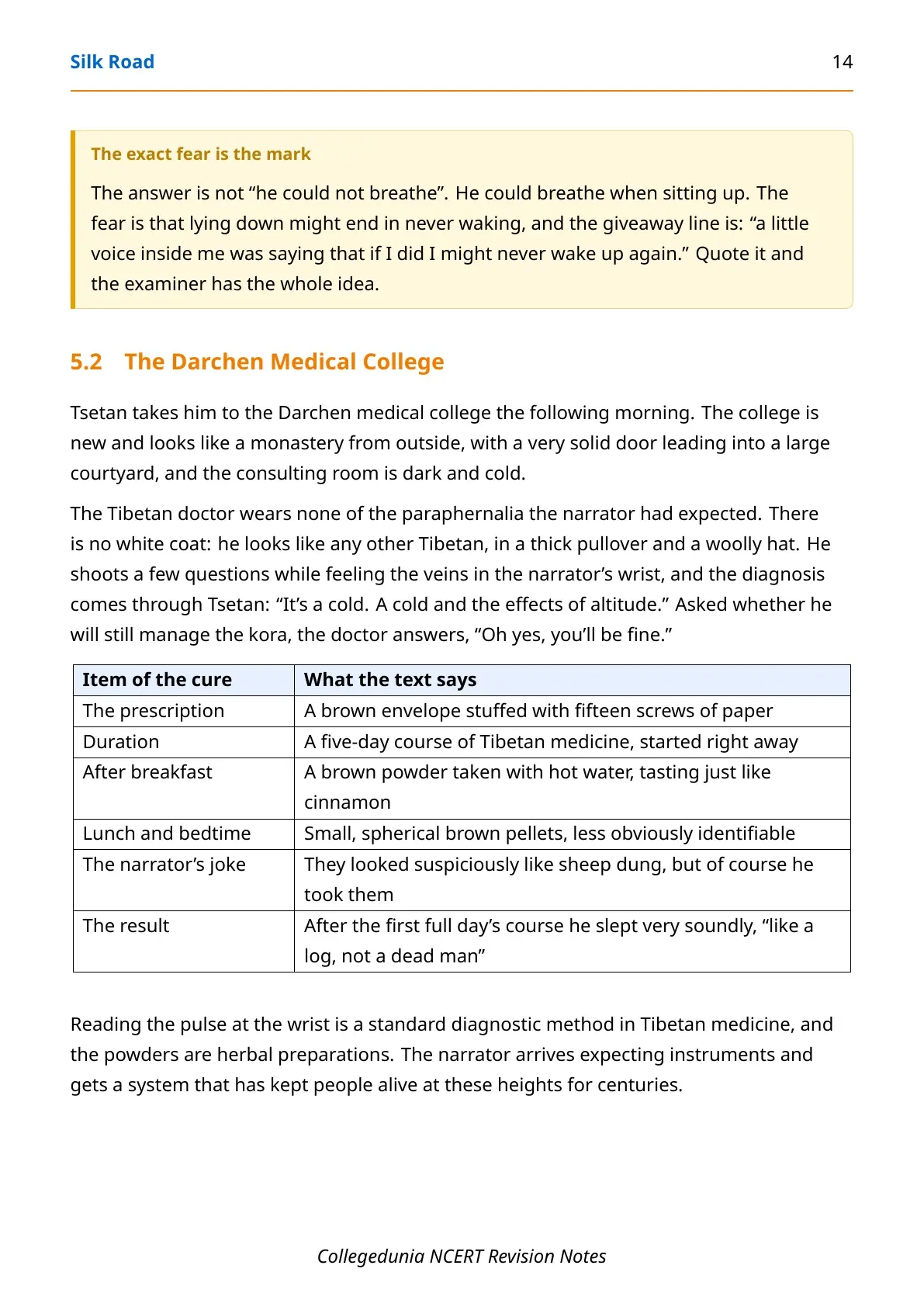
The next morning Tsetan takes him to the Darchen medical college. It is new and looks like a monastery from the outside, with a very solid door leading into a large courtyard. The consulting room is dark and cold.
- The doctor: a Tibetan who wears none of the paraphernalia the narrator expected. No white coat, just a thick pullover and a woolly hat.
- The examination: he asks a few questions through Tsetan while feeling the veins in the narrator's wrist.
- The diagnosis: "It's a cold and the effects of altitude."
- The prescription: a brown envelope stuffed with fifteen screws of paper, a five-day course of Tibetan medicine.
- The medicine: a brown powder taken with hot water that tastes just like cinnamon, plus small spherical brown pellets that look suspiciously like sheep dung.
The result is one of the best lines in the chapter. After the first full day's course the narrator sleeps very soundly, "Like a log, not a dead man." Tsetan then leaves for Lhasa with a joke that students are asked to comment on: as a Buddhist he knew it did not really matter if the narrator passed away, but he thought it would be bad for business.
Meeting Norbu: The Kora Companion Who Escaped from the Library
After a good night's sleep Darchen looks better. It is still dusty, partially derelict and punctuated by heaps of rubble and refuse, but the sun shines in a clear blue sky and the plain to the south opens on a vision of the Himalayas, commanded by a huge snow-capped mountain, Gurla Mandhata, with a wisp of cloud over its summit.
The town has a real problem for a pilgrim, though. The narrator has timed his arrival for the beginning of the season and finds no pilgrims at all. He does not want to walk the kora alone, parts of the route may still be blocked by snow, and since Tsetan left he has met nobody in Darchen with enough English to answer even that basic question.
| Detail about Norbu | What it tells the student |
|---|---|
| Wears a windcheater and metal-rimmed spectacles of a Western style | The narrator guesses at once that he is not from those parts. |
| Tibetan, but works in Beijing at the Chinese Academy of Social Sciences, in the Institute of Ethnic Literature | He is an academic, which makes him the narrator's natural companion. |
| Has written academic papers on the Kailash kora for many years | He knows the pilgrimage in theory but has never done it himself. |
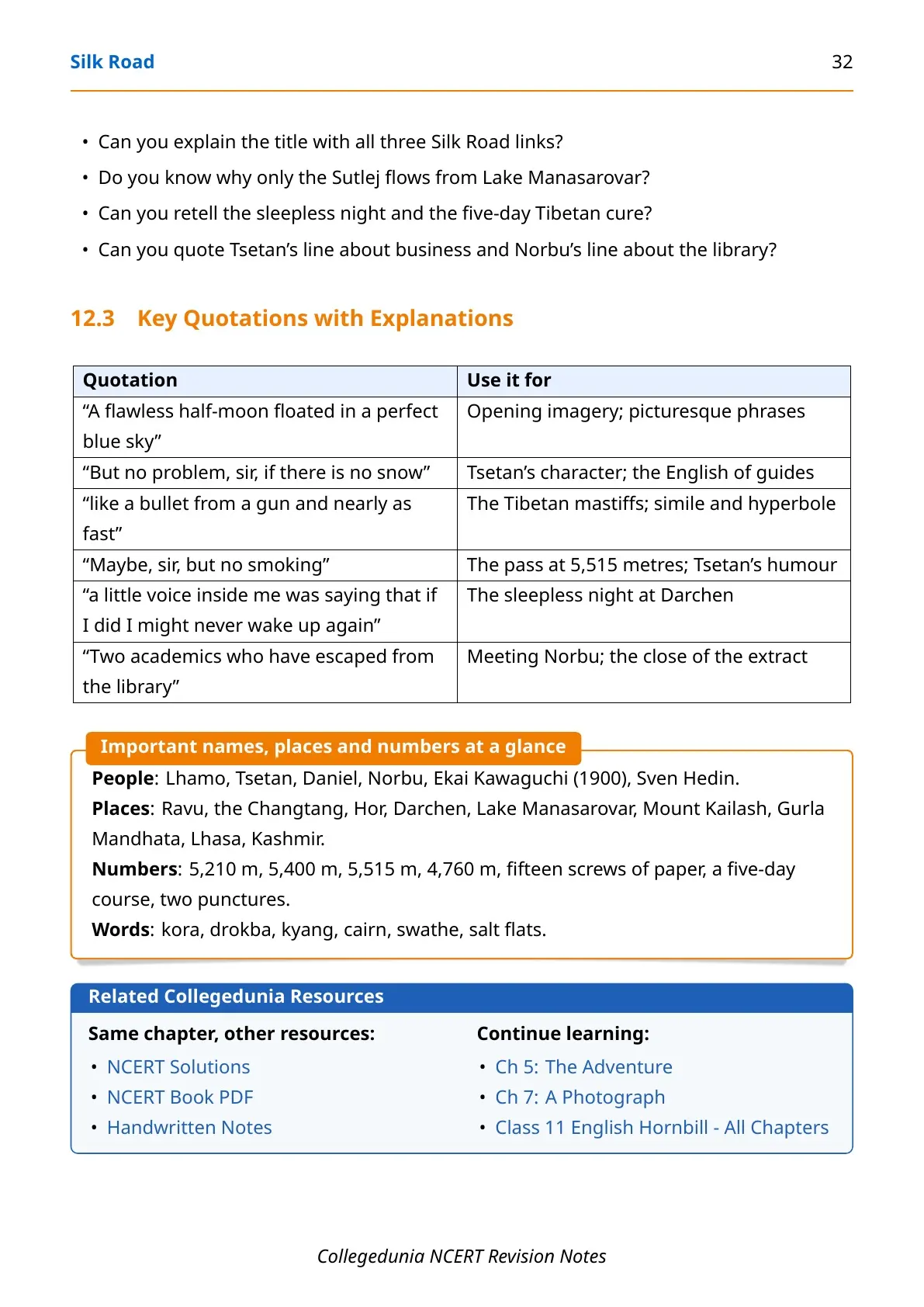
| "We could be a team. Two academics who have escaped from the library." | The line students are most often asked to explain. Both men study a subject rather than live it. |
| Keeps saying how fat he is and how tiresome it will be to walk so high up | He is almost as ill-equipped for the pilgrimage as the narrator. |
| Not really a practising Buddhist, and has no intention of prostrating himself round the mountain | He collapses across the table in hysterical laughter at the idea. |
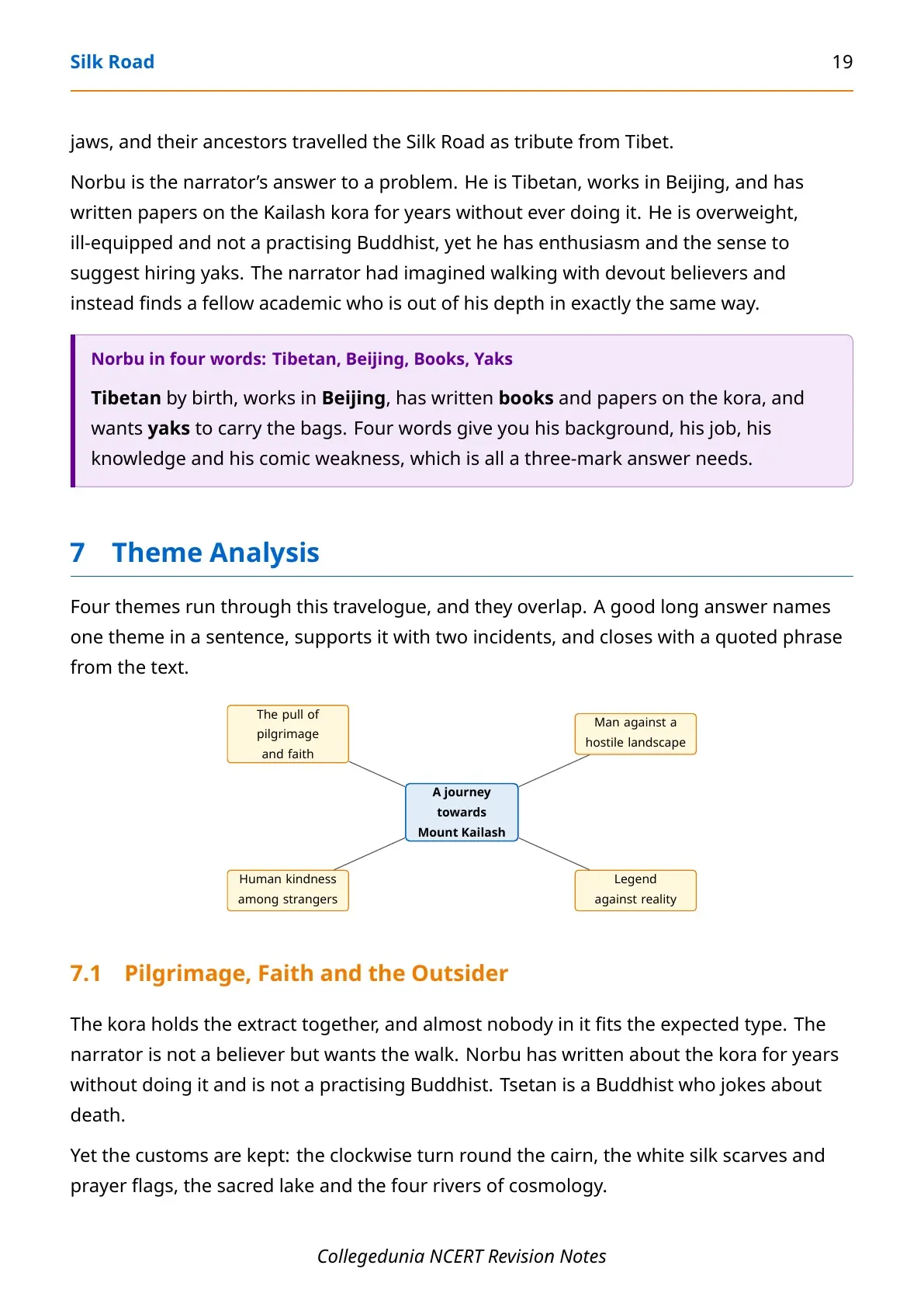
| Suggests hiring some yaks to carry the luggage | The narrator reads this as a good sign and decides Norbu may be the ideal companion. |
The cafe where they meet is small, dark and cavernous, with a long metal stove down the middle. The walls and ceiling are wreathed in sheets of striped multi-coloured plastic, broad blue, red and white, the kind made into stout shopping bags sold across China, Asia and Europe. The narrator's comment on it is the second title clue: plastic must rate as one of China's most successful exports along the Silk Road today.
Character Sketches from Silk Road with Supporting Lines
Five people appear in the extract. Long answer questions usually ask for two or three traits each, and every trait must be backed by an action from the text.
| Character | Traits | Proof from the text |
|---|---|---|
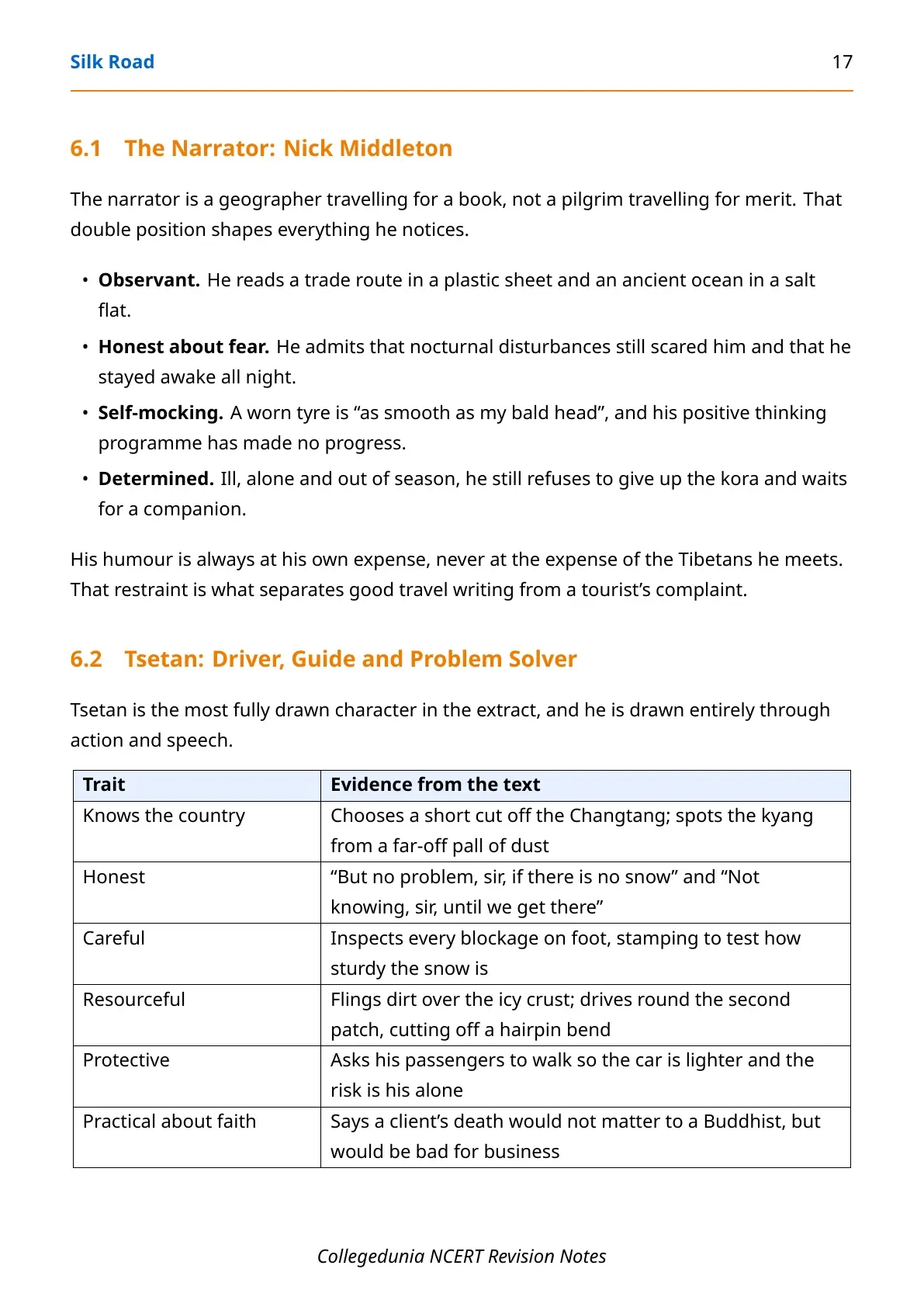
| The narrator, Nick Middleton | Observant, curious, self-deprecating, determined, honest about fear | He notices lichen colour and cloud shapes, records altitudes on his watch, jokes about his bald head, admits his positive-thinking programme was failing, and stays awake all night rather than risk sleeping. |
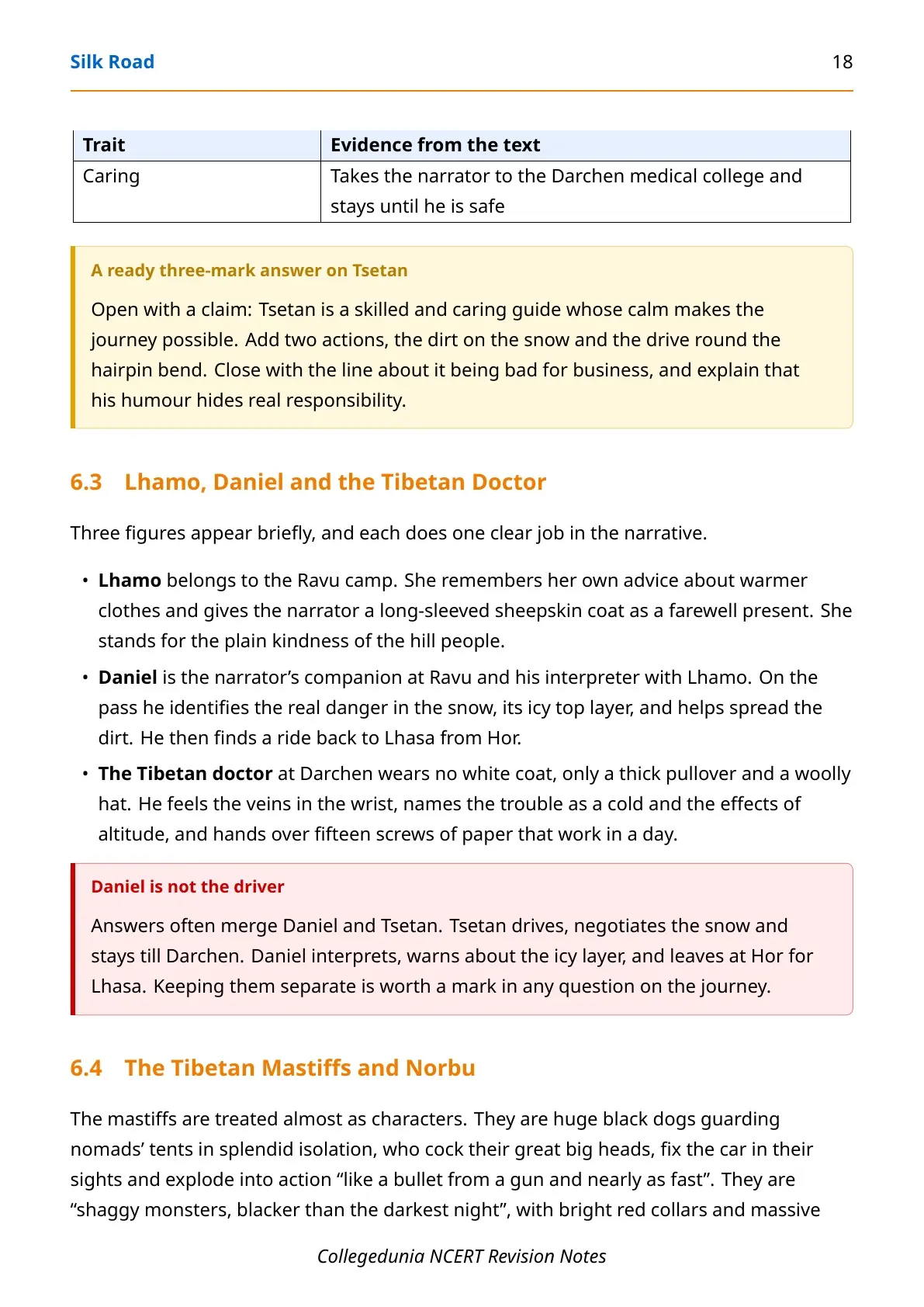
| Tsetan | Skilled driver, practical, cheerful, protective, wryly funny | He tests the snow with his foot, spreads dirt over the ice, drives round a second blockage over rocks, takes the narrator to the medical college, and jokes that dying would be bad for business. |
| Lhamo | Warm, thoughtful, generous | She notices that the visitor is not dressed for the cold and gives him one of the long-sleeved sheepskin coats the men wear. |
| Daniel | Helpful companion and interpreter, alert to danger | He translates between Lhamo and the narrator, warns that the icy top layer is the real danger, helps spread dirt on the snow, and leaves for Lhasa from Hor. |
| Norbu | Friendly, enthusiastic, self-mocking, scholarly rather than devout | He asks to share a table, offers to make a team, laughs at the idea of prostrating himself, and suggests hiring yaks for the luggage. |
One minor figure is worth a line. The Tibetan doctor at Darchen wears no white coat and takes the pulse at the wrist, which shows a system of medicine that works without the equipment a Western visitor expects.
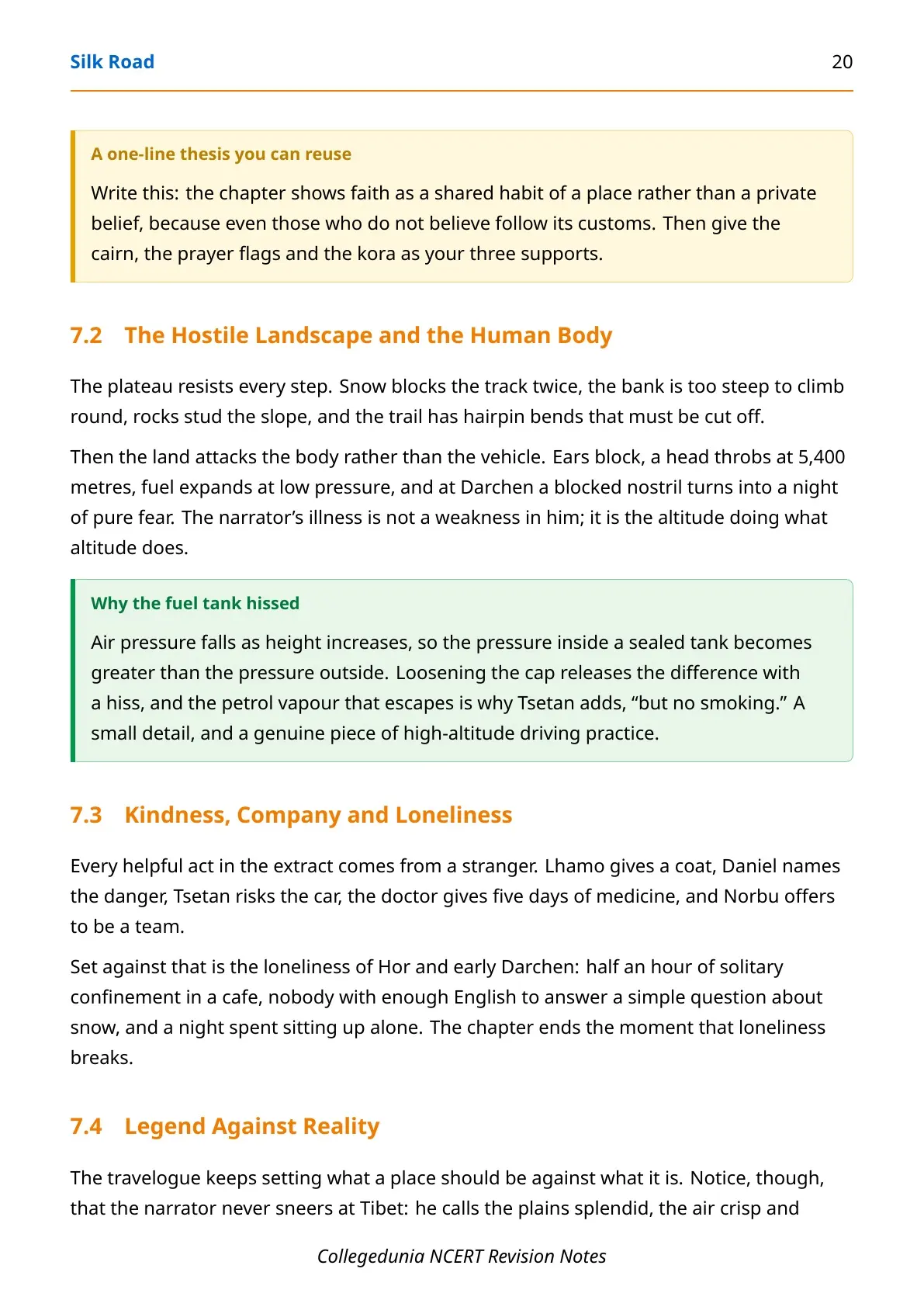
Themes in Silk Road Every Class 11 Student Must Know
Long answer questions are set on themes rather than on incidents. Four themes cover almost everything a paper can ask, and each one can be opened with a single line from the text.
- The old trade route and its modern version. Mastiffs travelled the Silk Road as tribute in ancient times. Striped plastic sheeting travels it now.
- Faith and physical hardship. The kora demands altitude, snow and sleepless nights, yet people walk it every season by choice.
- Legend against reality. Manasarovar moved a Japanese monk to tears, while the narrator finds a rubbish dump on its shore.
- The kindness of hill-folk. Lhamo's coat, Tsetan's care at the medical college and Norbu's offer of company all come from people who owe the traveller nothing.
- Human beings against the mountain. The car, the medicine and the yaks are all small answers to a very large landscape.
If a question asks which single line best states the theme, use Norbu's "two academics who have escaped from the library". It holds both the humour and the idea that this journey is about leaving theory behind.
Literary Devices and Picturesque Phrases in Silk Road
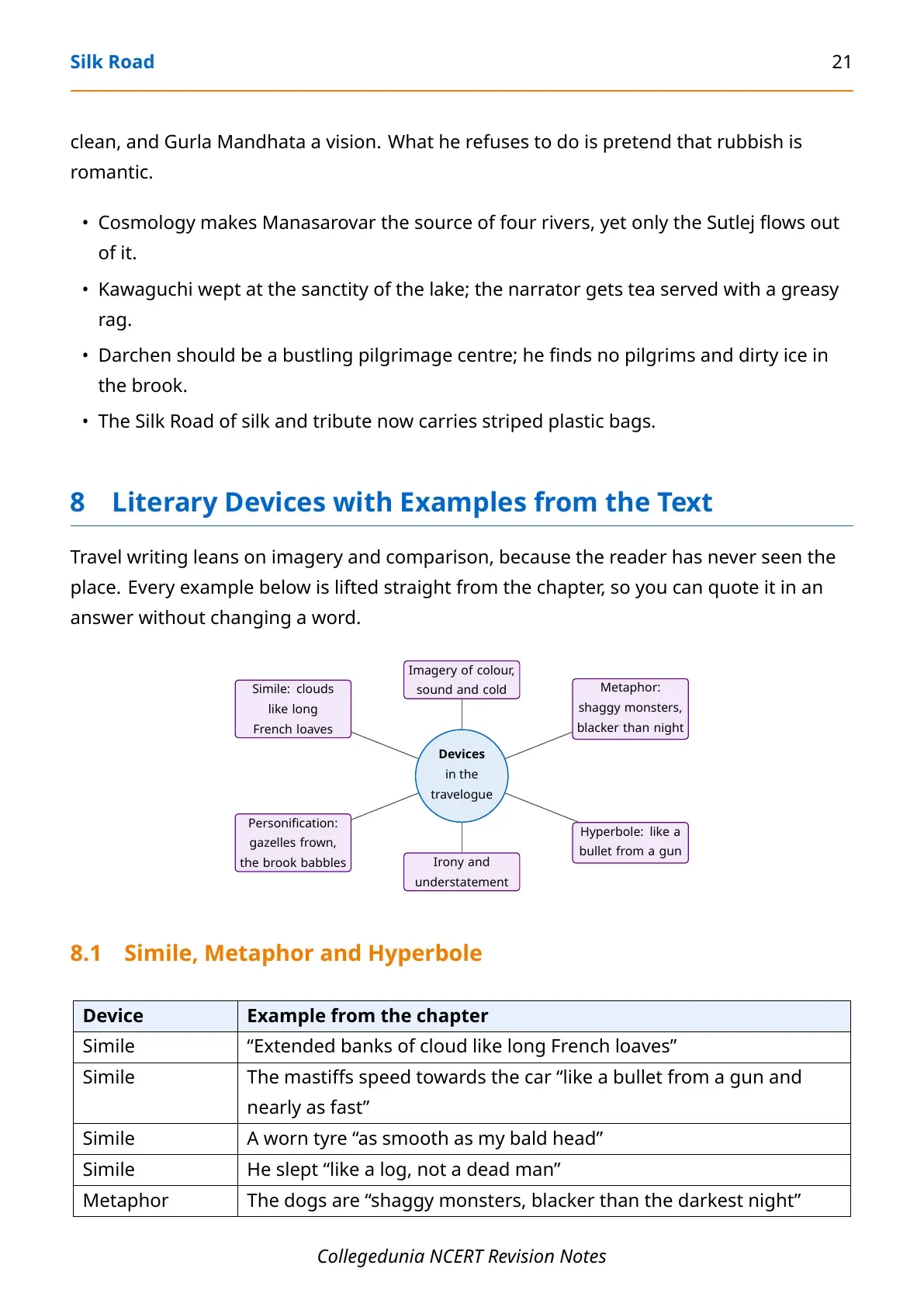
Working with Words asks you to scan the text for picturesque phrases, so keep a stock of them ready. The same phrases double as your examples for figures of speech.
| Device | Example from the text |
|---|---|
| Simile | "Extended banks of cloud like long French loaves"; the mastiffs speed towards the car "like a bullet from a gun"; the spare tyre is "as smooth as my bald head". |
| Metaphor | "These shaggy monsters" for the mastiffs; "the land of nod" for sleep; "single-nostril power" for his breathing. |
| Personification | "A flawless half-moon floated in a perfect blue sky"; the gazelles "frown" before bounding away; hills "push up" from the wilderness. |
| Imagery of colour | Mountain tops splashed "with a rose-tinted blush"; rocks "daubed with patches of bright orange lichen"; the "blindingly white lake". |
| Hyperbole | The mastiffs are "blacker than the darkest night" and "explode into action". |
| Irony | Tibet's most venerated lake sits beside a town made of dust, rocks and refuse. |
| Humour and understatement | "Maybe, sir, but no smoking"; "Like a log, not a dead man"; dying would be "bad for business". |
| Contrast | Ancient tribute against modern plastic; Kawaguchi's tears against the greasy cafe table. |
On style, say three things in an answer: the narrative is first person, it mixes travel description with geography and light comedy, and it relies on active voice to keep the pace of a moving journey.
Notice These Expressions from Silk Road with Their Meanings
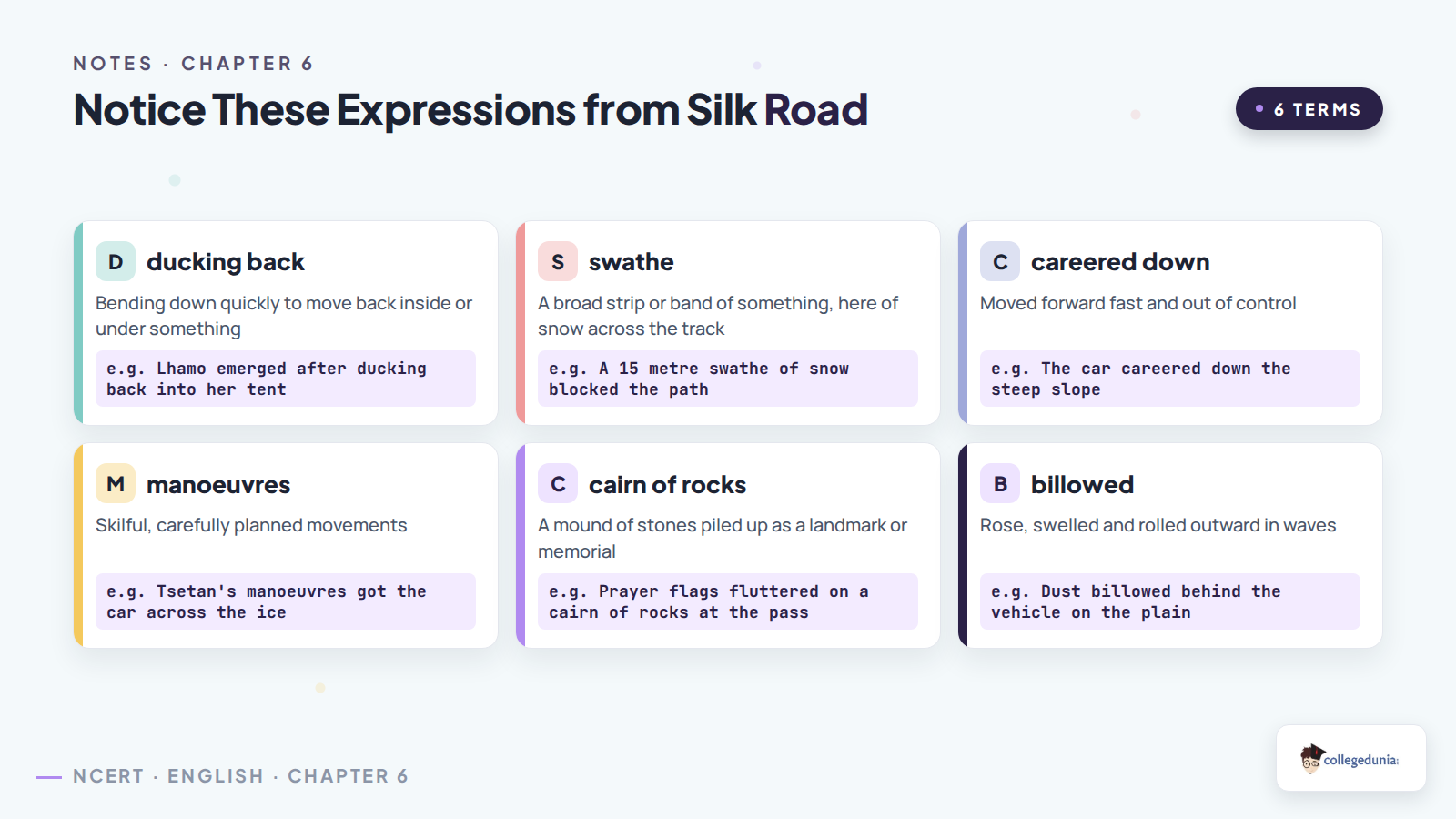
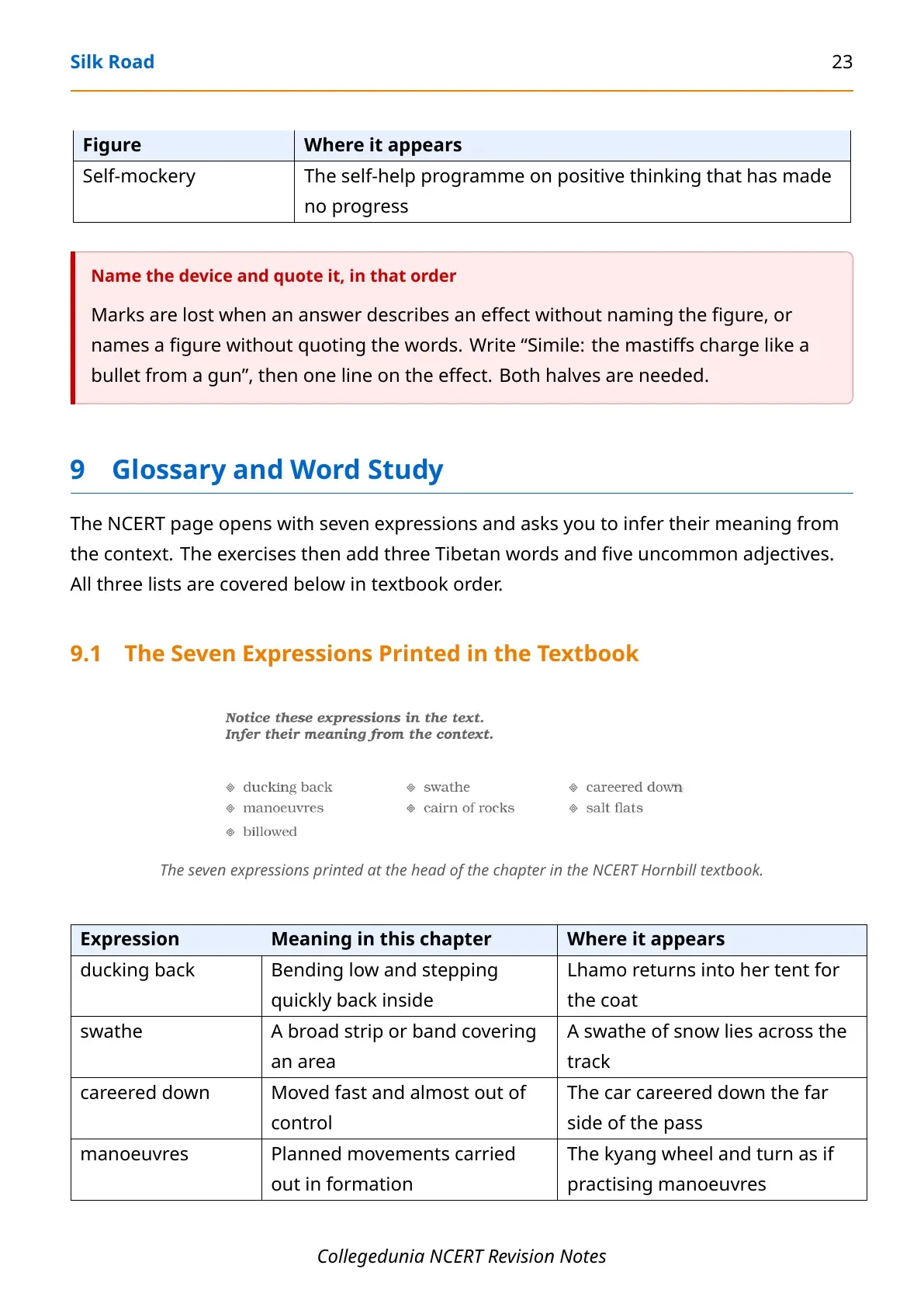
The textbook lists seven expressions above the extract and asks you to infer their meaning from the context. These are direct one mark items, so learn all seven with the sentence each one sits in.
| Expression | Meaning | Where it appears |
|---|---|---|
| Ducking back | Bending the head and stepping quickly back inside | After ducking back into her tent, Lhamo emerged with the sheepskin coat. |
| Manoeuvres | Planned, practised movements, as in a military drill | The wild ass wheel and turn as if practising manoeuvres on a predetermined course. |
| Billowed | Rose and spread out in large waves | Plumes of dust billowed into the crisp, clean air. |
| Swathe | A long broad strip or band of something | A swathe of the white stuff lay across the track for about fifteen metres. |
| Cairn of rocks | A heap of stones piled up as a landmark or memorial | The top of the pass was marked by a large cairn of rocks with prayer flags. |
| Careered down | Moved down fast and with little control | The headache cleared as they careered down the other side of the pass. |
| Salt flats | Flat stretches of land covered with a crust of salt left by dried-up water | The plateau is pockmarked with salt flats and brackish lakes. |
A quick memory trick: three of the seven come from the drive across the plains, three from the climb over the pass, and one from the lunch stop. Grouping them by stage makes them much easier to place in a context question.
Working with Words: Uncommon Adjectives from Silk Road Explained
The second Working with Words task gives five phrases and asks you to explain the use of the adjective. The marker wants the meaning plus the effect, so answer in two short parts.
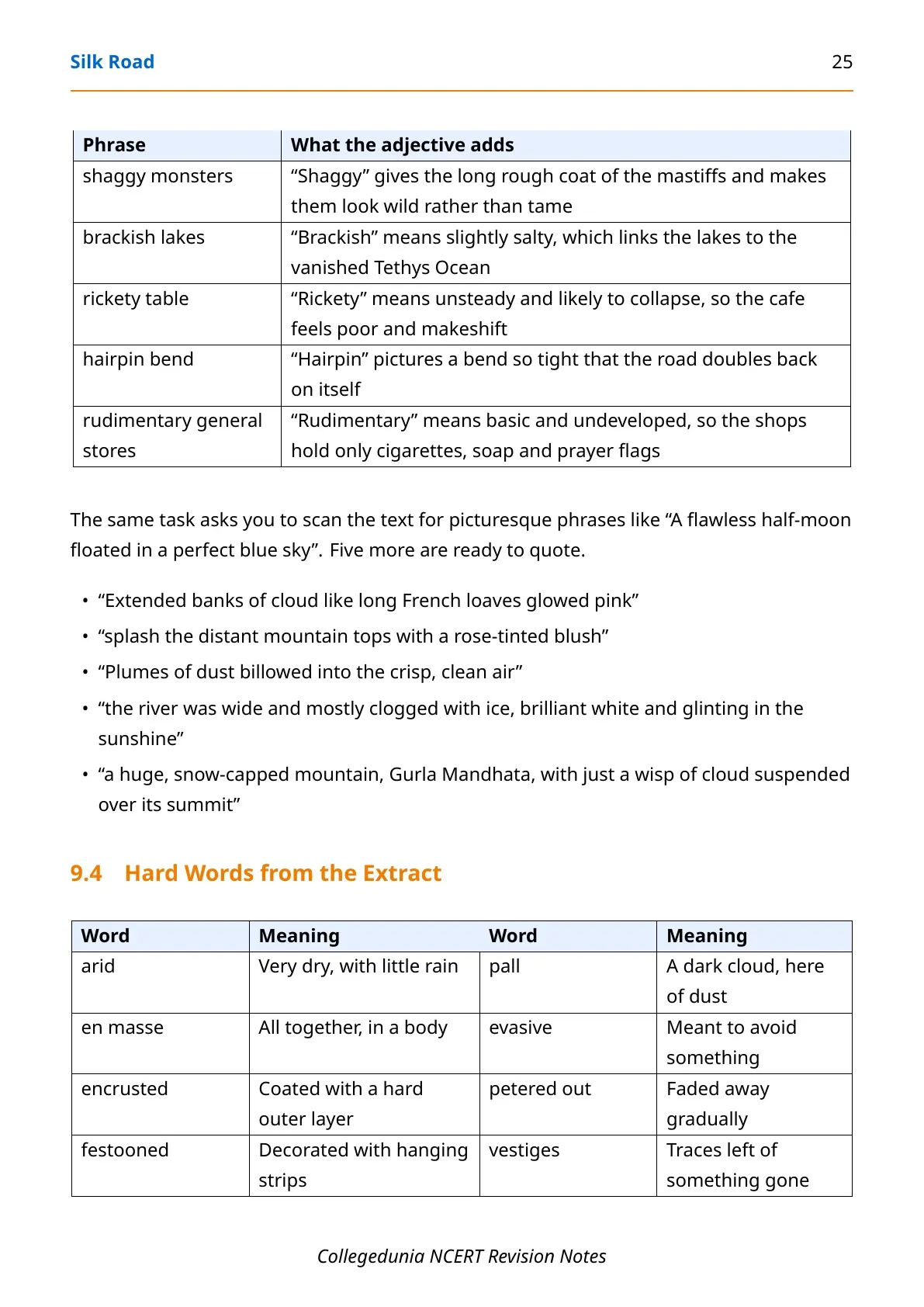
| Phrase | Meaning of the adjective | Effect it creates |
|---|---|---|
| Shaggy monsters | Covered with rough, long, untidy hair | Turns the mastiffs into creatures rather than dogs, which matches the fear the narrator feels. |
| Brackish lakes | Slightly salty, a mixture of fresh and salt water | Explains why the plateau lakes are not drinkable and links them to the vanished Tethys Ocean. |
| Rickety table | Weak in the joints and likely to wobble | Fixes the poverty and roughness of the Darchen cafe in one word. |
| Hairpin bend | A very sharp bend that doubles back like a hairpin | Shows how steep and dangerous the mountain track is, and makes Tsetan's short cut impressive. |
| Rudimentary general stores | Very basic, with only the simplest goods | Shows how little Darchen offers: Chinese cigarettes, soap and other basic provisions. |
The first part of the task asks you to scan for picturesque phrases like "A flawless half-moon floated in a perfect blue sky". Safe choices are the French loaves cloud, the rose-tinted blush on the mountains, the river brilliant white and glinting in the sunshine, and Gurla Mandhata with a wisp of cloud suspended over its summit.
Understanding the Text Questions from Silk Road Answered
The task has two parts. Part one asks for reasons behind five statements, and part two asks for a brief comment on five points. Keep each answer to three or four sentences and always tie it back to a detail from the journey.
Part I. Give reasons for the following statements.
- The article has been titled Silk Road. The journey runs along part of the ancient trade network. The highway at Hor follows the old trade route from Lhasa to Kashmir, Tibetan mastiffs once travelled that road as tribute to China's imperial courts, and the striped plastic in the Darchen cafe is a modern Chinese export along the same road. The title links the old trade route with its present-day form.
- Tibetan mastiffs were popular in China's imperial courts. They are huge, fearless and ferocious, with massive jaws and great strength. They charge a moving vehicle without hesitation and chase it off the property, which made them prized as hunting dogs. They were brought from Tibet along the Silk Road as tribute.
- The author's experience at Hor was in stark contrast to earlier accounts. Hor had no vegetation, only dust, rocks and years of accumulated refuse, and its only cafe had three broken windows and a greasy table. Earlier travellers reacted very differently to the same place. Ekai Kawaguchi burst into tears in 1900 at the sanctity of Lake Manasarovar, and Sven Hedin was moved in the same way soon after.
- The author was disappointed with Darchen. He had timed his arrival for the start of the pilgrimage season but found no pilgrims. He did not want to walk the kora alone, he did not know whether snow still blocked the route, and nobody left in the town spoke enough English to tell him.
- The author thought his positive thinking strategy worked after all. He had almost given up on it in the cafe, because his options looked severely limited. Then Norbu walked in, turned out to be a Tibetan academic who had come to do the kora, and offered to make a team. The company he needed arrived exactly when he had stopped expecting it.
Part II. Briefly comment on the following.
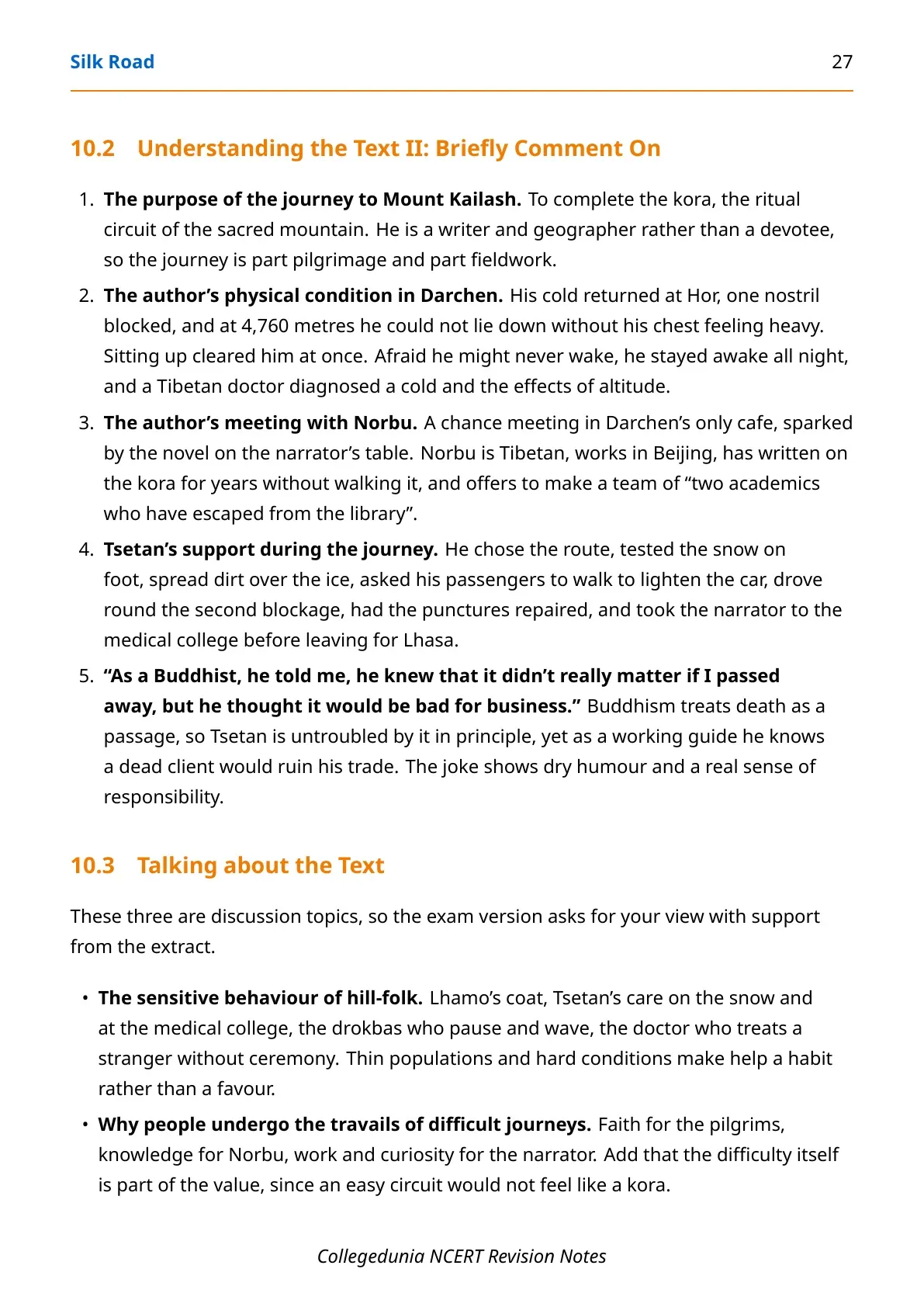
- The purpose of the author's journey to Mount Kailash. He is going to complete the kora, the ritual circuit around the sacred mountain. He is not a devout pilgrim but a traveller and writer drawn by the place and its tradition, which is why he first imagined making the trek with devout believers.
- The author's physical condition in Darchen. His cold had returned after Hor, one nostril was blocked, and at 4,760 metres he could not lie down without his chest feeling heavy. He stayed awake all night out of fear, and the Darchen doctor diagnosed a cold plus the effects of altitude.
- The author's meeting with Norbu. It happens by chance in Darchen's only cafe, where Norbu notices his book and asks to share the table. Norbu is Tibetan, works in Beijing, has written for years about the Kailash kora and has come to do it at last. His offer, "We could be a team", solves the narrator's problem in one sentence.
- Tsetan's support to the author during the journey. Tsetan chooses the short cut, tests the snow on foot, spreads dirt over the ice, drives round a second blockage across rocks, and cuts off a hairpin bend to regain the trail. Off the road he is just as useful, taking the narrator to the Darchen medical college the morning after the sleepless night.
- "As a Buddhist, he told me, he knew that it didn't really matter if I passed away, but he thought it would be bad for business." The line is a joke with a serious base. As a Buddhist, Tsetan believes in rebirth, so death is not an ending. As a working guide, he knows that a dead client would ruin his livelihood. In one sentence he shows both his faith and his practical good sense.
Talking About the Text Discussion Points from Silk Road
These are group discussion tasks in the textbook, but schools regularly set them as long answers. Prepare four or five points on each and use examples from the text rather than general opinion.
- The sensitive behaviour of hill-folk. Lhamo gives a sheepskin coat to a visitor she cannot even speak to directly. The drokbas pause and wave at a passing car. Tsetan risks his own vehicle on ice and then takes a sick foreigner to a doctor. People who live in hard places notice need quickly and act on it without being asked.
- Why people willingly undergo the travails of difficult journeys. Faith is one reason: pilgrims walk the kora for religious merit. Curiosity is another: the narrator wants to see a place he has only read about. Some travel for study, as Norbu does, and some for the plain satisfaction of finishing something hard. The difficulty is part of the reward.
- The accounts of exotic places in legends and the reality. Legend says Manasarovar is the source of four great rivers, but only the Sutlej actually flows from it. Kawaguchi wept at its sanctity, while the narrator found refuse on its shore. Reality is usually smaller and dirtier than legend, though the mountain and the lake keep their power despite the rubbish.
Thinking About Language Questions from Silk Road Answered
This task is about how people who share no first language manage to talk to each other. Answers should mention the situation, not just the grammar.
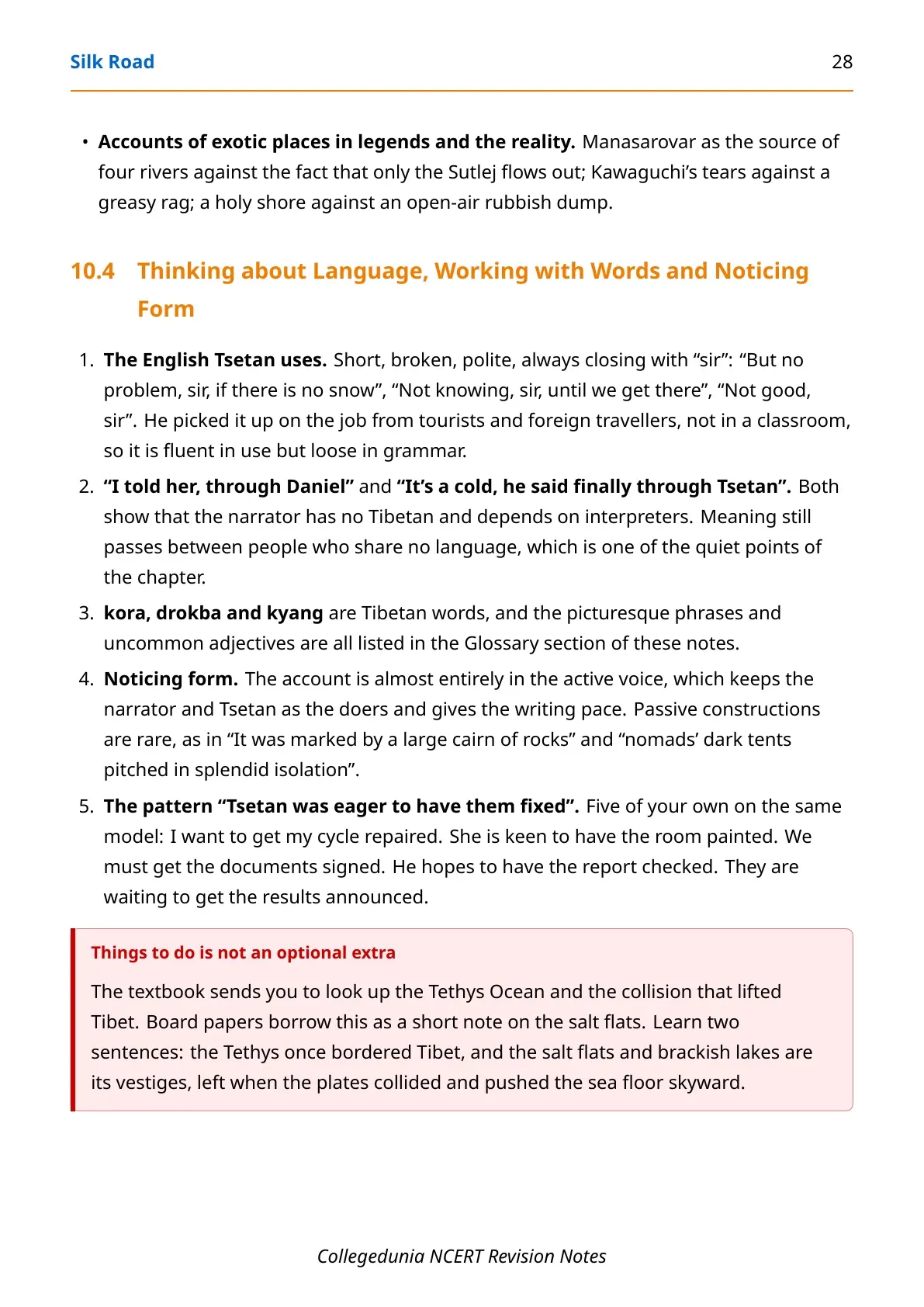
- The kind of English Tsetan uses. It is simple, broken and heavily marked by politeness. He drops articles and verbs, as in "Not knowing, sir, until we get there", and ends almost every sentence with "sir". He would have picked it up on the job, from tourists and foreign travellers he drives, rather than in a classroom.
- "I told her, through Daniel." The narrator cannot speak Tibetan and Lhamo cannot speak English, so Daniel acts as the interpreter. The phrase shows that the whole friendship with Lhamo, including the gift, was built through a third person.
- "It's a cold," he said finally through Tsetan. The doctor speaks no English either, so the diagnosis reaches the patient second-hand. Tsetan is not only the driver but the narrator's voice in every conversation after Daniel leaves.
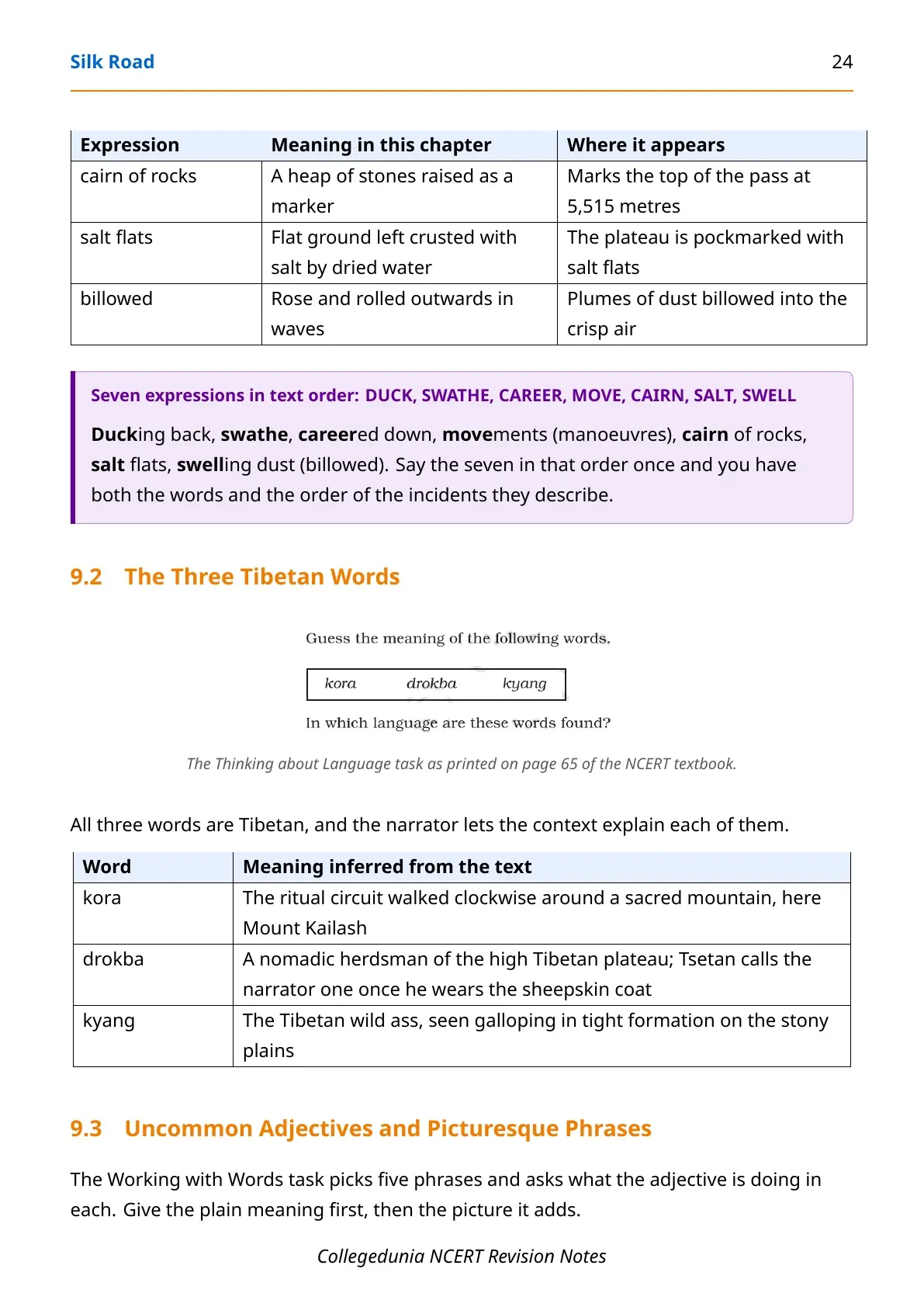
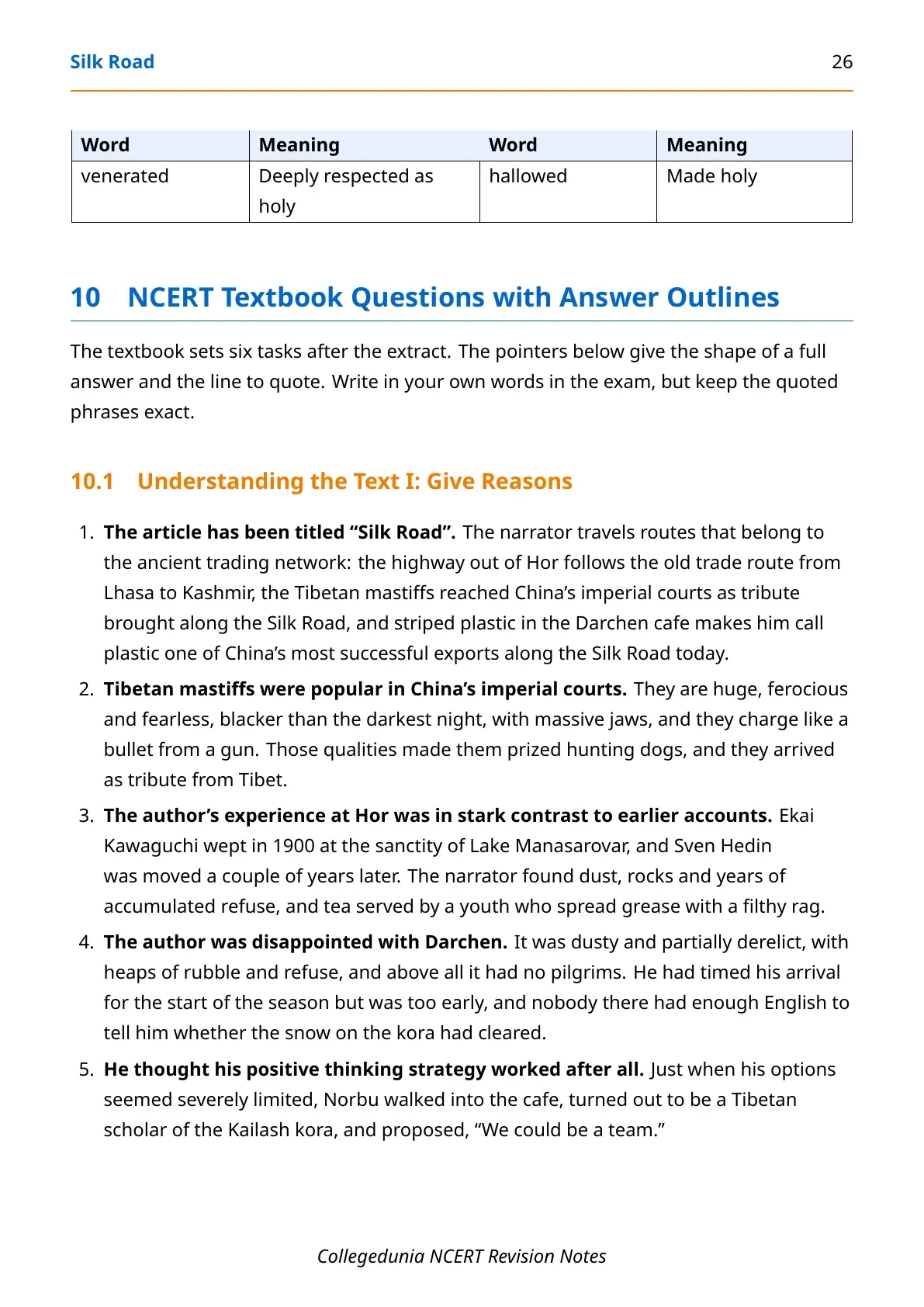
- Kora, drokba, kyang. A kora is the ritual circuit walked around a sacred mountain. A drokba is a Tibetan herdsman or nomad. A kyang is the Tibetan wild ass. All three words are Tibetan.
- Why this matters in the chapter. Nearly every important exchange in Silk Road passes through a translator, which is exactly why the narrator feels so stranded in Darchen once Tsetan has gone.
Noticing Form: Active Voice and the Have Something Done Structure
The Noticing Form task has two parts, and both are easy marks once you can see the pattern. Part one asks you to locate the few passive sentences in an account written almost entirely in the active voice.
- "It was marked by a large cairn of rocks festooned with white silk scarves and ragged prayer flags."
- "I was served by a Chinese youth in military uniform."
- "The second tyre he'd changed had been replaced by one that was as smooth as my bald head."
- "This time, I wasn't gasping for breath, I was simply not allowed to go to sleep."
- "The walls and ceiling were wreathed in sheets of multi-coloured plastic."
- "I'd been told that at the height of the pilgrimage season, the town was bustling with visitors."
The point to make about style is short. Active voice keeps the doer in front of the verb, so the writing moves as fast as the journey does. Tsetan brakes, the dogs charge, the car climbs. Passive sentences appear only where the doer does not matter, such as who piled up the cairn.
Part two gives the model sentence "Tsetan was eager to have them fixed". The structure is have plus object plus past participle, and it means getting somebody else to do the job for you. Five sentences on the same pattern:
- I must have my bicycle repaired before the school trip.
- She is going to have her hair cut on Sunday.
- We had the leaking tap replaced last week.
- He wants to have his answer sheet rechecked.
- They are having the classroom walls painted during the holidays.
Common Mistakes Students Make in Silk Road Answers
Check every one of these before you submit an answer. Each of them appears in school scripts every single year.
- Calling Silk Road a story. It is a travelogue, a first person account of a real journey, so write about the narrator and not about a character.
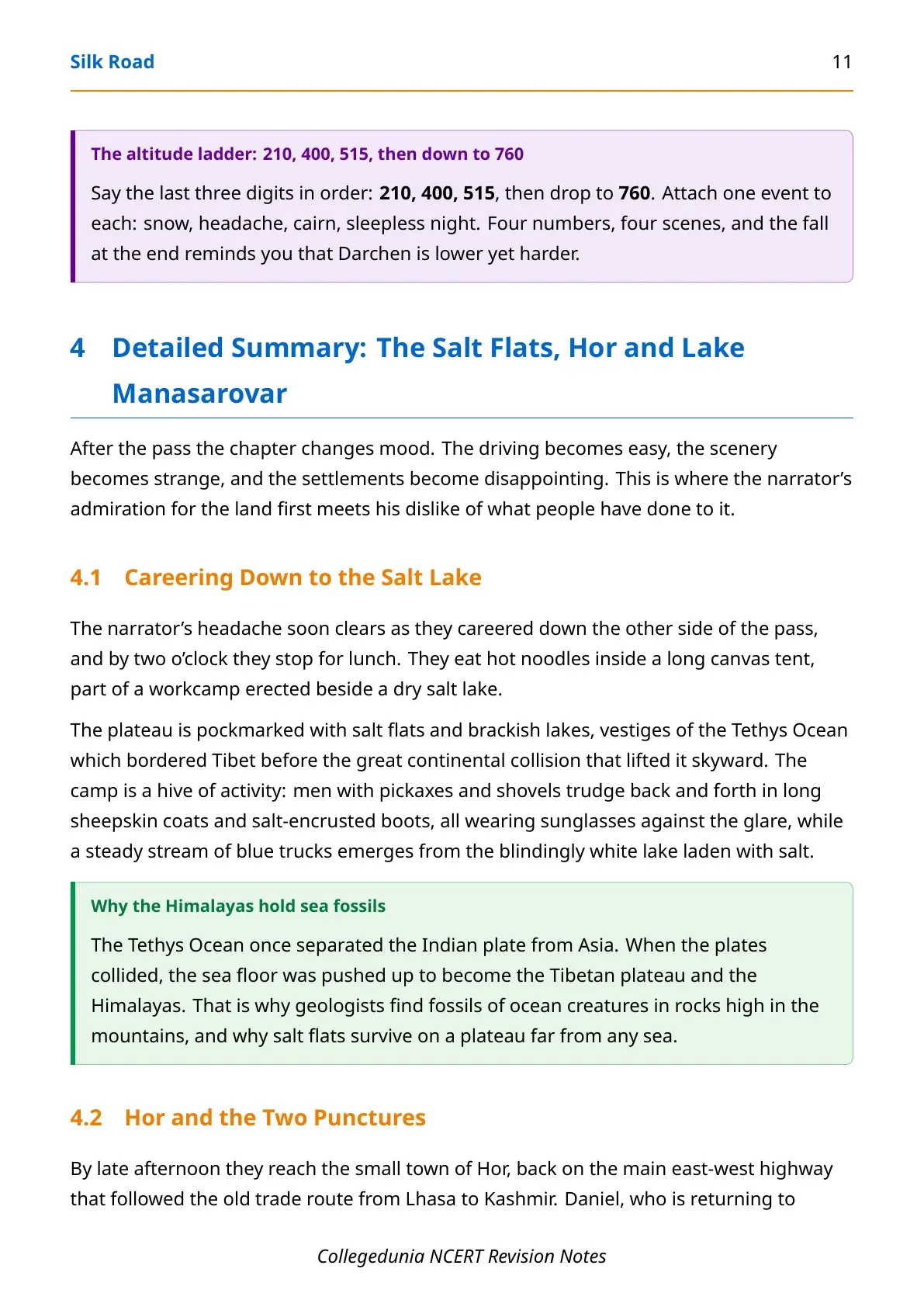
- Mixing up the altitudes. The snow patch is at 5,210 metres, the headache starts past 5,400 metres, the pass tops out at 5,515 metres, and Darchen is at 4,760 metres.
- Saying all four rivers flow from Manasarovar. Only the Sutlej flows from the lake. The headwaters of the Indus, the Ganges and the Brahmaputra rise nearby on the flanks of Mount Kailash.
- Confusing Daniel with Tsetan. Tsetan is the driver who stays till Darchen. Daniel is the companion and interpreter who leaves for Lhasa from Hor.
- Writing that Norbu is a devout pilgrim. He says himself that he is not really a practising Buddhist, and he refuses to prostrate himself round the mountain.
- Forgetting who gave the coat. Lhamo gives the sheepskin coat, and the message about warmer clothes reached the narrator through Daniel.
- Saying the danger of the snow was its depth. Daniel says the opposite. The danger was the icy top layer, because the car could turn over if it slipped.
- Spelling the Tibetan words carelessly. Kora, drokba and kyang are one mark each and are lost to spelling more often than to meaning.
How Silk Road Appears in the Class 11 English Paper
The travelogue sits in the Hornbill prose section and usually contributes 6 to 8 marks across the paper. Because it is description rather than plot, papers lean on vocabulary and on reason-based questions.
| Question type | Marks | What is usually asked |
|---|---|---|
| Short answer | 2 to 3 | Lhamo's gift, the mastiff attack, the snow crossing, the doctor's diagnosis, Norbu's offer. |
| Reference to context | 3 | An extract from the opening description or from the sleepless night at Darchen. |
| Long answer | 5 to 6 | Justify the title, describe Tsetan's role in the journey, or contrast Hor with earlier accounts of Manasarovar. |
| Vocabulary item | 1 | Meaning of swathe, cairn of rocks, careered down, manoeuvres or billowed. |
| Grammar item | 1 to 2 | Rewrite a sentence using have plus past participle, or identify a passive construction. |
One tip that consistently adds marks: put one exact detail in every answer. An altitude such as 5,515 metres, a name such as Gurla Mandhata, or the phrase about fifteen screws of paper proves you have read the chapter and not only a summary of it.
How to Revise Silk Road in One Sitting
Forty minutes is enough if you revise in the right order. Start with the route, because every other answer hangs off it.
- Ten minutes on the route. Ravu, the plains, the passes, the salt lake, Hor, Darchen. Say the altitude for each stage out loud.
- Ten minutes on the people. Two traits each for the narrator, Tsetan, Lhamo, Daniel and Norbu, with one action as proof.
- Ten minutes on words. The seven noticing expressions, the five adjectives, and the three Tibetan words.
- Ten minutes on the reason questions. The title, the mastiffs, Hor, Darchen and the positive thinking line.
Finish by writing one full length answer on why the article is titled Silk Road. That single answer pulls in the mastiffs, the Lhasa to Kashmir highway and the plastic sheeting, which is the best test of whether the revision worked.
NCERT Notes for All Class 11 English Hornbill Chapters
Revision notes are published for the six Hornbill prose chapters. Each page follows the same shape as this one, with summary tables, a mistakes block and a downloadable PDF.
| Chapter | Title | Revision Notes |
|---|---|---|
| Chapter 1 | The Portrait of a Lady | The Portrait of a Lady Class 11 Notes |
| Chapter 2 | We're Not Afraid to Die if We Can All Be Together | We're Not Afraid to Die Class 11 Notes |
| Chapter 3 | Discovering Tut: the Saga Continues | Discovering Tut Class 11 Notes |
| Chapter 4 | The Ailing Planet: the Green Movement's Role | The Ailing Planet Class 11 Notes |
| Chapter 5 | The Adventure | The Adventure Class 11 Notes |
| Chapter 6 | Silk Road | You are here |
Class 11 English Hornbill Chapter 6 Silk Road Notes FAQs
Ques. What is the chapter Silk Road by Nick Middleton about?
Ans. It is a travelogue about a drive from Ravu to Darchen in Tibet, on the way to Mount Kailash. The narrator crosses the Changtang plateau, climbs snow-blocked passes above 5,500 metres, passes salt flats, stops at the grim town of Hor beside Lake Manasarovar, and survives a sleepless night at Darchen. He ends by meeting Norbu, a Tibetan academic who agrees to walk the kora with him.
Ques. Why is the article titled Silk Road?
Ans. Because the journey moves along a stretch of the ancient trade network. The highway at Hor follows the old trade route from Lhasa to Kashmir, Tibetan mastiffs once travelled that road as tribute to China's imperial courts, and the striped plastic sheeting in the Darchen cafe is a modern Chinese export along the same route. The title ties the old road to its present-day life.
Ques. What present did Lhamo give the author and why?
Ans. She gave him one of the long-sleeved sheepskin coats that all the local men wear. The narrator had told her, through Daniel, that he was heading to Mount Kailash to complete the kora, and she said he ought to get warmer clothes. When Tsetan saw him in it he declared, "Ah, yes, drokba, sir."
Ques. Who was Tsetan and how did he help the author?
Ans. Tsetan was the Tibetan driver who took the narrator from Ravu to Darchen. He chose the short cut, tested the snow on foot, flung dirt across the icy patch, drove round a second blockage over rocks and cut off a hairpin bend. He also took the narrator to the Darchen medical college after his sleepless night and acted as his interpreter with the doctor.
Ques. What is a kora and why was the author going to do it?
Ans. A kora is the ritual circuit walked around a sacred mountain, in this case Mount Kailash. The narrator was travelling to complete it. He is a traveller and writer rather than a devout pilgrim, and he had first imagined making the trek in the company of devout believers before Norbu turned up.
Ques. Why did the Tibetan mastiffs frighten the author?
Ans. They guarded the nomads' tents and charged the moving car without fear. The narrator calls them shaggy monsters, blacker than the darkest night, with bright red collars and massive jaws. They shot straight into the car's path like a bullet from a gun, forcing Tsetan to brake and swerve, and chased for about a hundred metres before easing off.
Ques. What difficulties did the travellers face on the high passes?
Ans. A swathe of snow about fifteen metres long blocked the track at 5,210 metres, and the bank beside it was too steep to drive round. The real danger was the icy top layer, not the depth, because the car could have turned over. Ten minutes later a second blockage forced Tsetan to drive across a rocky slope, and past 5,400 metres the narrator's head began to throb.
Ques. Why was the author's experience at Hor so different from earlier accounts?
Ans. Hor had no vegetation at all, only dust, rocks and years of accumulated refuse, and its only cafe had three broken windows and a greasy table. Earlier travellers felt the opposite. Ekai Kawaguchi, a Japanese monk, burst into tears at the sanctity of Lake Manasarovar in 1900, and Sven Hedin was moved in the same way a couple of years later.
Ques. What happened to the author on his first night in Darchen?
Ans. His cold returned, one nostril was blocked, and at 4,760 metres his chest felt strangely heavy every time he lay down. Sitting up cleared his nasal passages at once, but he could not relax enough to sleep upright. A little voice inside him warned that if he slept he might never wake, so he stayed awake all night.
Ques. What treatment did the Tibetan doctor at Darchen give the author?
Ans. The doctor wore no white coat, only a thick pullover and a woolly hat, and he felt the veins in the narrator's wrist while asking questions through Tsetan. He diagnosed a cold and the effects of altitude, and handed over a brown envelope with fifteen screws of paper, a five-day course. One package held a brown powder that tasted like cinnamon, the others small brown pellets.
Ques. Who was Norbu and why was he the ideal companion?
Ans. Norbu was a Tibetan who worked in Beijing at the Chinese Academy of Social Sciences, in the Institute of Ethnic Literature. He had written academic papers on the Kailash kora for years without ever doing it. He suggested hiring yaks for the luggage and had no intention of prostrating himself round the mountain, so the narrator, equally ill-equipped, decided he would suit the trek perfectly.
Ques. What do the words kora, drokba and kyang mean?
Ans. Kora is the ritual circuit walked around a sacred mountain, drokba is a Tibetan herdsman or nomad, and kyang is the Tibetan wild ass. All three words are Tibetan, and the narrator learns each of them from Tsetan or from the journey itself.
Ques. What are the salt flats and the Tethys Ocean mentioned in Silk Road?
Ans. Salt flats are flat stretches of land left crusted with salt after water dries up. The narrator writes that the plateau is pockmarked with salt flats and brackish lakes, vestiges of the Tethys Ocean that bordered Tibet before the great continental collision lifted the land skyward. At the workcamp beside the dry salt lake, men loaded blue trucks with piles of salt.
Ques. Are these Class 11 English Hornbill notes according to the 2026-27 syllabus?
Ans. Yes. Every summary line, altitude, name and quotation on this page is checked against the 2026-27 reprint of the NCERT Hornbill textbook for Class 11 English Core, including the end of unit tasks for Understanding the Text, Talking about the Text, Thinking about Language, Working with Words and Noticing Form.



Comments