



The The Tale of Melon City Class 11 notes explain Vikram Seth's comic poem for the 2026-27 NCERT Snapshots syllabus. Use this page to revise the low arch, blame chain, public hanging, melon king, satire of justice and short exam answers before opening the full PDF.
- Download the Chapter 5 English Snapshots notes PDF for offline revision.
- Revise plot flow, poetic devices, themes, symbols and NCERT answer frames.
- Student focus: connect the melon king with blind custom and passive citizenship.
Chapter5TheTaleofMelonCityNotes.pdf?page=1&dpi=150)
Chapter5TheTaleofMelonCityNotes.pdf?page=2&dpi=150)
Chapter5TheTaleofMelonCityNotes.pdf?page=3&dpi=150)
Chapter5TheTaleofMelonCityNotes.pdf?page=4&dpi=150)
Chapter5TheTaleofMelonCityNotes.pdf?page=5&dpi=150)
Chapter5TheTaleofMelonCityNotes.pdf?page=6&dpi=150)
Chapter5TheTaleofMelonCityNotes.pdf?page=7&dpi=150)
Chapter5TheTaleofMelonCityNotes.pdf?page=8&dpi=150)
Chapter5TheTaleofMelonCityNotes.pdf?page=9&dpi=150)
Chapter5TheTaleofMelonCityNotes.pdf?page=10&dpi=150)
Chapter5TheTaleofMelonCityNotes.pdf?page=11&dpi=150)
Chapter5TheTaleofMelonCityNotes.pdf?page=12&dpi=150)
Chapter5TheTaleofMelonCityNotes.pdf?page=13&dpi=150)
Chapter5TheTaleofMelonCityNotes.pdf?page=14&dpi=150)
Chapter5TheTaleofMelonCityNotes.pdf?page=15&dpi=150)
Chapter5TheTaleofMelonCityNotes.pdf?page=16&dpi=150)
Chapter5TheTaleofMelonCityNotes.pdf?page=17&dpi=150)
Chapter5TheTaleofMelonCityNotes.pdf?page=18&dpi=150)
Chapter5TheTaleofMelonCityNotes.pdf?page=19&dpi=150)
Chapter5TheTaleofMelonCityNotes.pdf?page=20&dpi=150)
Chapter5TheTaleofMelonCityNotes.pdf?page=21&dpi=150)
Chapter5TheTaleofMelonCityNotes_flat_MobileCard.pdf?page=1&dpi=150)
Chapter5TheTaleofMelonCityNotes_flat_MobileCard.pdf?page=2&dpi=150)
Chapter5TheTaleofMelonCityNotes_flat_MobileCard.pdf?page=3&dpi=150)
Chapter5TheTaleofMelonCityNotes_flat_MobileCard.pdf?page=4&dpi=150)
Chapter5TheTaleofMelonCityNotes_flat_MobileCard.pdf?page=5&dpi=150)
Chapter5TheTaleofMelonCityNotes_flat_MobileCard.pdf?page=6&dpi=150)
Chapter5TheTaleofMelonCityNotes_flat_MobileCard.pdf?page=7&dpi=150)
Chapter5TheTaleofMelonCityNotes_flat_MobileCard.pdf?page=8&dpi=150)
Chapter5TheTaleofMelonCityNotes_flat_MobileCard.pdf?page=9&dpi=150)
Chapter5TheTaleofMelonCityNotes_flat_MobileCard.pdf?page=10&dpi=150)
Chapter5TheTaleofMelonCityNotes_flat_MobileCard.pdf?page=11&dpi=150)
Chapter5TheTaleofMelonCityNotes_flat_MobileCard.pdf?page=12&dpi=150)
Chapter5TheTaleofMelonCityNotes_flat_MobileCard.pdf?page=13&dpi=150)
Chapter5TheTaleofMelonCityNotes_flat_MobileCard.pdf?page=14&dpi=150)
Chapter5TheTaleofMelonCityNotes_flat_MobileCard.pdf?page=15&dpi=150)
Chapter5TheTaleofMelonCityNotes_flat_MobileCard.pdf?page=16&dpi=150)
Chapter5TheTaleofMelonCityNotes_flat_MobileCard.pdf?page=17&dpi=150)
Chapter5TheTaleofMelonCityNotes_flat_MobileCard.pdf?page=18&dpi=150)
Chapter5TheTaleofMelonCityNotes_flat_MobileCard.pdf?page=19&dpi=150)
Chapter5TheTaleofMelonCityNotes_flat_MobileCard.pdf?page=20&dpi=150)
Chapter5TheTaleofMelonCityNotes_flat_MobileCard.pdf?page=21&dpi=150)
Chapter5TheTaleofMelonCityNotes_flat_MobileCard.pdf?page=22&dpi=150)
Chapter5TheTaleofMelonCityNotes_flat_MobileCard.pdf?page=23&dpi=150)
Chapter5TheTaleofMelonCityNotes_flat_MobileCard.pdf?page=24&dpi=150)
Chapter5TheTaleofMelonCityNotes_flat_MobileCard.pdf?page=25&dpi=150)
Chapter5TheTaleofMelonCityNotes_flat_MobileCard.pdf?page=26&dpi=150)
Chapter5TheTaleofMelonCityNotes_flat_MobileCard.pdf?page=27&dpi=150)
These Class 11 English Snapshots notes are checked against the 2026-27 NCERT chapter and written for fast board revision.
Student Feedback on The Tale of Melon City
In a Collegedunia poll of 10,920 Class 11 English students before the 2026 exams, many students remembered the melon king but missed the satire behind it.
- 72% wanted a clearer plot order for the blame chain.
- 6 out of 10 students first wrote that the melon is only a joke.
- 48% needed help with irony and blind custom. The notes link both ideas to the ending.
Source: 2026-27 Class 11 English Core student poll. Sample of 10,920 students from CBSE schools across 14 states.
The Tale of Melon City Plot Flow
The poem starts with a king who wants a grand arch over the main road. The arch is too low, so it knocks off his crown. That small accident becomes a public trial where blame keeps moving from one person to another.
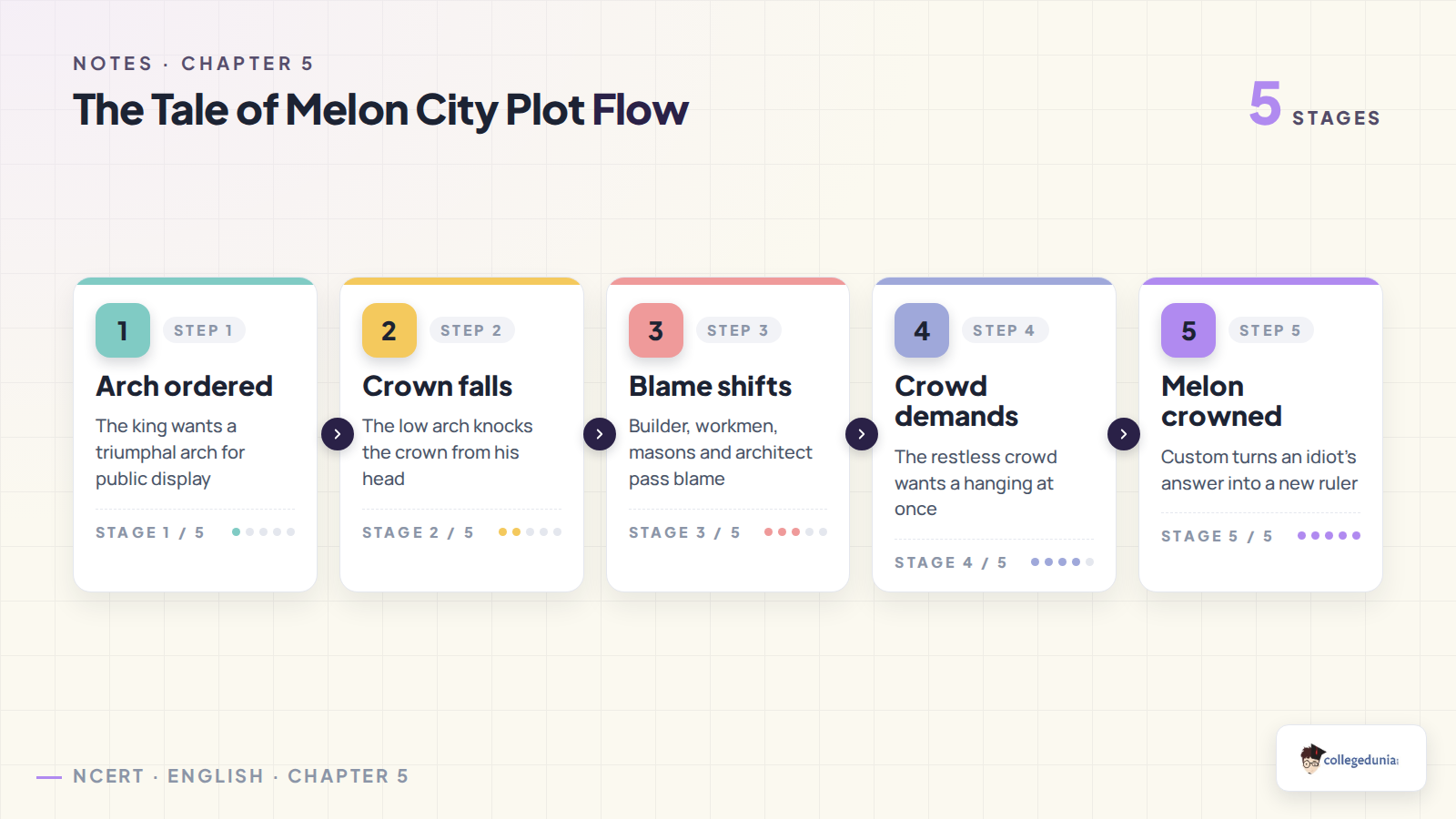
- The chief builder blames the workmen for the low arch.
- The workmen blame the wrong-sized bricks made by the masons.
- The masons blame the architect, who blames the king's own changes.
- The crowd wants a hanging, so the king dies by his own order.
The Tale of Melon City Explained
Source: Magnet Brains on YouTube
The Tale of Melon City Summary for Class 11
The king is described as just and placid, but his idea of justice is weak. He first orders the chief builder to be hanged. When the builder shifts blame, the king quickly calls the next accused person.
The main irony is that the king's search for justice finally traps the king himself. The noose is set high, and only the king fits it. After the hanging, the ministers feel relieved because the crowd has received the public punishment it wanted.
- The poem uses a simple story to criticise bad rule.
- The melon becomes king because custom is followed without thought.
- The citizens accept the melon because peace matters more to them than sense.
Justice and Blind Custom in The Tale of Melon City
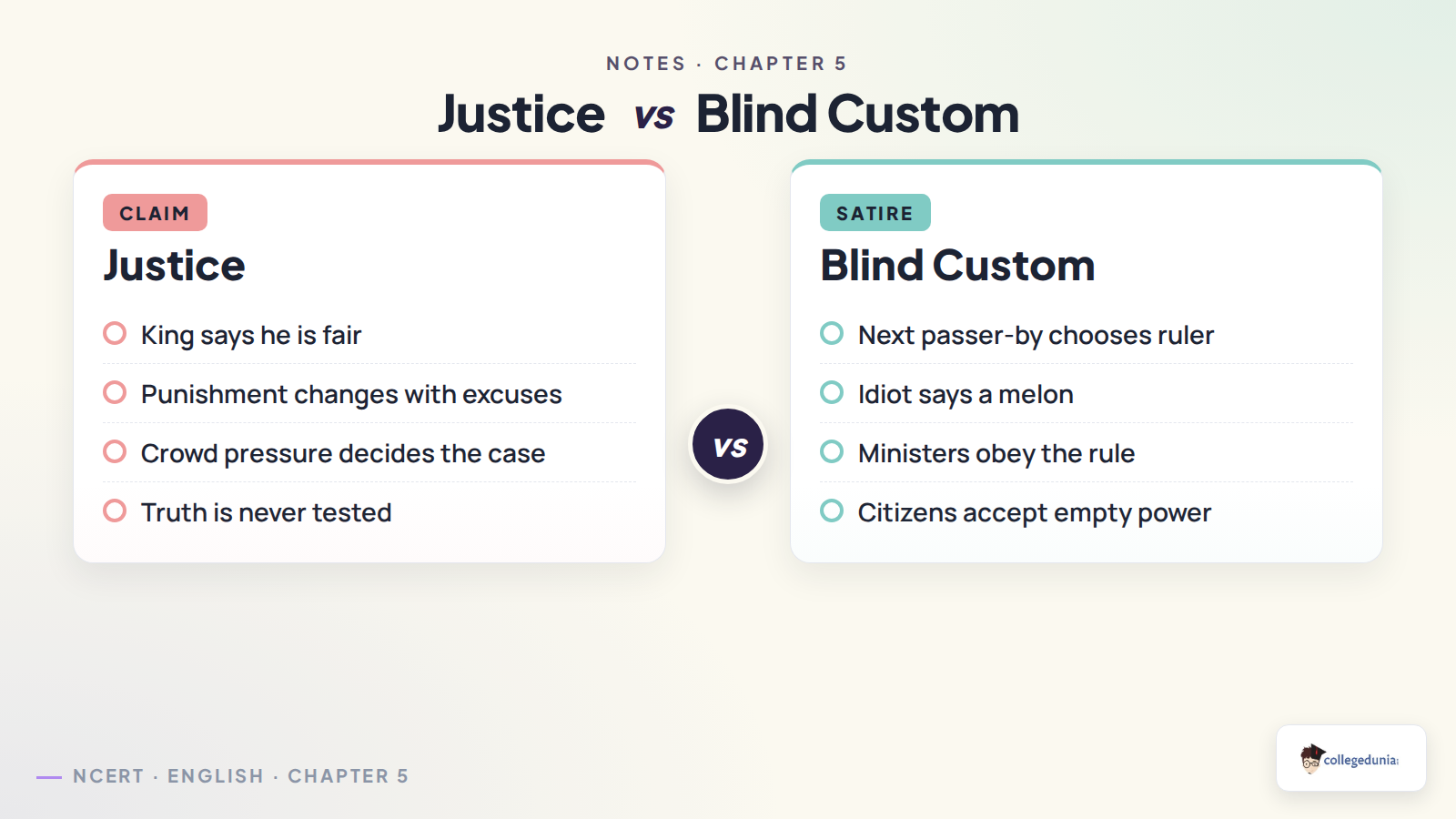
The chapter is not only a funny poem about a melon. It is a satire on systems that keep ceremony but lose judgement. Justice becomes a public show, and custom becomes a way to avoid thinking.
| Idea | Poem moment | Exam use |
|---|---|---|
| Justice as spectacle | The crowd wants a hanging immediately | Use for satire of punishment. |
| Weak leadership | The king changes the accused person again and again | Use for character sketch. |
| Bad advice | The wisest man says the arch must be hanged | Use for irony. |
| Blind custom | An idiot names a melon as ruler | Use for title and ending. |
Poetic Devices in The Tale of Melon City
The poem uses simple rhyming couplets, direct speech and repetition. These devices make the absurd story easy to follow. They also make foolish decisions sound official, which increases the comedy.
- Irony: the just king dies through his own order.
- Satire: the poem mocks weak justice and blind custom.
- Repetition: each accused person shifts blame to the next person.
- Simple diction: plain words give the poem a folk-tale sound.
How to Write Better Answers on The Tale of Melon City
Strong answers should not retell every line. State the point, choose one incident, and explain the satire. Use short phrases from the poem only when they help your answer.
- For summary answers: include the arch, crown, blame chain, king's hanging and melon custom.
- For title answers: show that the melon exposes empty rule and blind custom.
- For theme answers: connect justice, public pressure, custom and passive citizens.
- For device answers: explain irony with the king's own royal decree.
Related Resources for The Tale of Melon City
| Resource | Use it for | Link |
|---|---|---|
| NCERT Solutions | Full answers to textbook questions | Open NCERT Solutions |
| NCERT Book PDF | Official Snapshots source chapter | Open NCERT Book PDF |
| Handwritten Notes | Topper-style last-minute revision | Open Handwritten Notes |
All Class 11 English Snapshots Notes Chapters
| Chapter | Title | Notes Link |
|---|---|---|
| Chapter 1 | The Summer of the Beautiful White Horse | Open Notes |
| Chapter 2 | The Address | Open Notes |
| Chapter 3 | Mother's Day | Open Notes |
| Chapter 4 | Birth | Open Notes |
| Chapter 5 | The Tale of Melon City | You are here |
The Tale of Melon City Class 11 Notes FAQs
Ques. What is the main idea of The Tale of Melon City?
Ans. The main idea is that justice, power and custom become absurd when people stop using common sense.
Ques. Why is the king hanged in The Tale of Melon City?
Ans. The king is hanged because the noose is set high and he is the only person tall enough to fit it.
Ques. What does the melon symbolise in the poem?
Ans. The melon symbolises empty authority, blind custom and citizens who accept nonsense if daily peace continues.
Ques. How should students revise The Tale of Melon City for exams?
Ans. Students should revise the plot order, blame chain, satire of justice, poetic devices, melon symbol and title answer.



Comments