




The Birth Class 11 notes explain A. J. Cronin's story for the 2026-27 NCERT Snapshots syllabus. Use this page to revise Andrew Manson, Joe and Susan Morgan, the difficult childbirth, the newborn's revival and the final line before opening the full PDF.
- Download the Chapter 4 English Snapshots notes PDF for offline revision.
- Revise the story flow, character roles, themes, symbols and NCERT answer frames.
- Student focus: connect the baby's revival with Andrew's renewed faith in real medical work.
Chapter4BirthNotes.pdf?page=1&dpi=150)
Chapter4BirthNotes.pdf?page=2&dpi=150)
Chapter4BirthNotes.pdf?page=3&dpi=150)
Chapter4BirthNotes.pdf?page=4&dpi=150)
Chapter4BirthNotes.pdf?page=5&dpi=150)
Chapter4BirthNotes.pdf?page=6&dpi=150)
Chapter4BirthNotes.pdf?page=7&dpi=150)
Chapter4BirthNotes.pdf?page=8&dpi=150)
Chapter4BirthNotes.pdf?page=9&dpi=150)
Chapter4BirthNotes.pdf?page=10&dpi=150)
Chapter4BirthNotes.pdf?page=11&dpi=150)
Chapter4BirthNotes.pdf?page=12&dpi=150)
Chapter4BirthNotes.pdf?page=13&dpi=150)
Chapter4BirthNotes.pdf?page=14&dpi=150)
Chapter4BirthNotes.pdf?page=15&dpi=150)
Chapter4BirthNotes.pdf?page=16&dpi=150)
Chapter4BirthNotes.pdf?page=17&dpi=150)
Chapter4BirthNotes.pdf?page=18&dpi=150)
Chapter4BirthNotes.pdf?page=19&dpi=150)
Chapter4BirthNotes.pdf?page=20&dpi=150)
Chapter4BirthNotes_flat_MobileCard.pdf?page=1&dpi=150)
Chapter4BirthNotes_flat_MobileCard.pdf?page=2&dpi=150)
Chapter4BirthNotes_flat_MobileCard.pdf?page=3&dpi=150)
Chapter4BirthNotes_flat_MobileCard.pdf?page=4&dpi=150)
Chapter4BirthNotes_flat_MobileCard.pdf?page=5&dpi=150)
Chapter4BirthNotes_flat_MobileCard.pdf?page=6&dpi=150)
Chapter4BirthNotes_flat_MobileCard.pdf?page=7&dpi=150)
Chapter4BirthNotes_flat_MobileCard.pdf?page=8&dpi=150)
Chapter4BirthNotes_flat_MobileCard.pdf?page=9&dpi=150)
Chapter4BirthNotes_flat_MobileCard.pdf?page=10&dpi=150)
Chapter4BirthNotes_flat_MobileCard.pdf?page=11&dpi=150)
Chapter4BirthNotes_flat_MobileCard.pdf?page=12&dpi=150)
Chapter4BirthNotes_flat_MobileCard.pdf?page=13&dpi=150)
Chapter4BirthNotes_flat_MobileCard.pdf?page=14&dpi=150)
Chapter4BirthNotes_flat_MobileCard.pdf?page=15&dpi=150)
Chapter4BirthNotes_flat_MobileCard.pdf?page=16&dpi=150)
Chapter4BirthNotes_flat_MobileCard.pdf?page=17&dpi=150)
Chapter4BirthNotes_flat_MobileCard.pdf?page=18&dpi=150)
Chapter4BirthNotes_flat_MobileCard.pdf?page=19&dpi=150)
Chapter4BirthNotes_flat_MobileCard.pdf?page=20&dpi=150)
Chapter4BirthNotes_flat_MobileCard.pdf?page=21&dpi=150)
Chapter4BirthNotes_flat_MobileCard.pdf?page=22&dpi=150)
Chapter4BirthNotes_flat_MobileCard.pdf?page=23&dpi=150)
Chapter4BirthNotes_flat_MobileCard.pdf?page=24&dpi=150)
Chapter4BirthNotes_flat_MobileCard.pdf?page=25&dpi=150)
Chapter4BirthNotes_flat_MobileCard.pdf?page=26&dpi=150)
Chapter4BirthNotes_flat_MobileCard.pdf?page=27&dpi=150)
Chapter4BirthNotes_flat_MobileCard.pdf?page=28&dpi=150)
Chapter4BirthNotes_flat_MobileCard.pdf?page=29&dpi=150)
These Class 11 English Snapshots notes are checked against the 2026-27 NCERT chapter and built for fast board revision.
Student Feedback on Birth Chapter
In a Collegedunia poll of 11,860 Class 11 English students before the 2026 exams, many students remembered the rescue scene but missed why Andrew's final thought matters.
- 69% wanted a clearer split between plot summary and theme answer.
- 6 out of 10 students first wrote that Andrew saved only the child, not both mother and child.
- 43% needed help with the textbook medicine versus real practice question. The notes connect it with Andrew's choices during the crisis.
Source: 2026-27 Class 11 English Core student poll. Sample of 11,860 students from CBSE schools across 15 states.
Birth Class 11 Story Flow
Birth moves through one tense night in Blaenelly. Joe Morgan brings Andrew Manson to Number 12, Blaina Terrace. Andrew is already troubled by thoughts of unhappy marriages, but the Morgan household turns his private doubt into public duty.
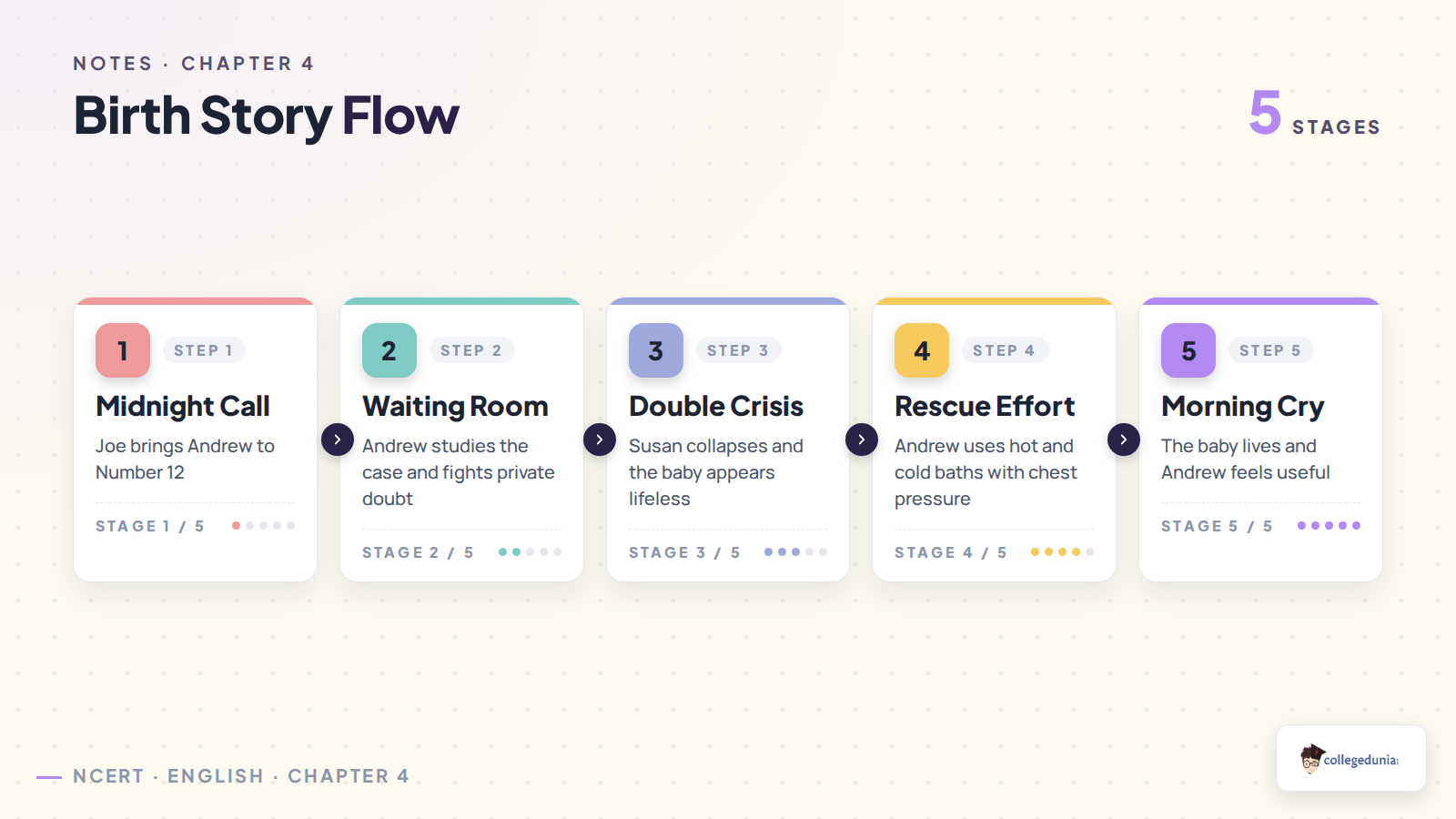
- Joe and Susan Morgan have waited nearly twenty years for their first child.
- Andrew stays through the night while the old woman watches silently.
- Susan collapses after delivery, so Andrew saves the mother first.
- The baby appears lifeless, but Andrew refuses to give up and revives him.
Birth Explained for Class 11 English Snapshots
Source: Magnet Brains on YouTube
Birth Summary for Class 11 English Snapshots
Andrew Manson is called late at night by Joe Morgan, whose wife Susan is about to give birth. The house is poor but clean, and the family has waited for this child for almost twenty years. Andrew's mind is disturbed by stories of failed marriages, yet Joe's trust forces him to act with care.
The turning point is the double crisis. Susan becomes dangerously weak and the newborn looks still and white. Andrew first treats Susan, then turns to the child. He orders hot and cold water, rubs the baby, presses the small chest and keeps working until the child cries.
- The plot joins medical danger with family hope.
- Andrew's success is practical, emotional and moral.
- The final line shows that useful work restores his confidence.
Textbook Medicine and Real Practice in Birth
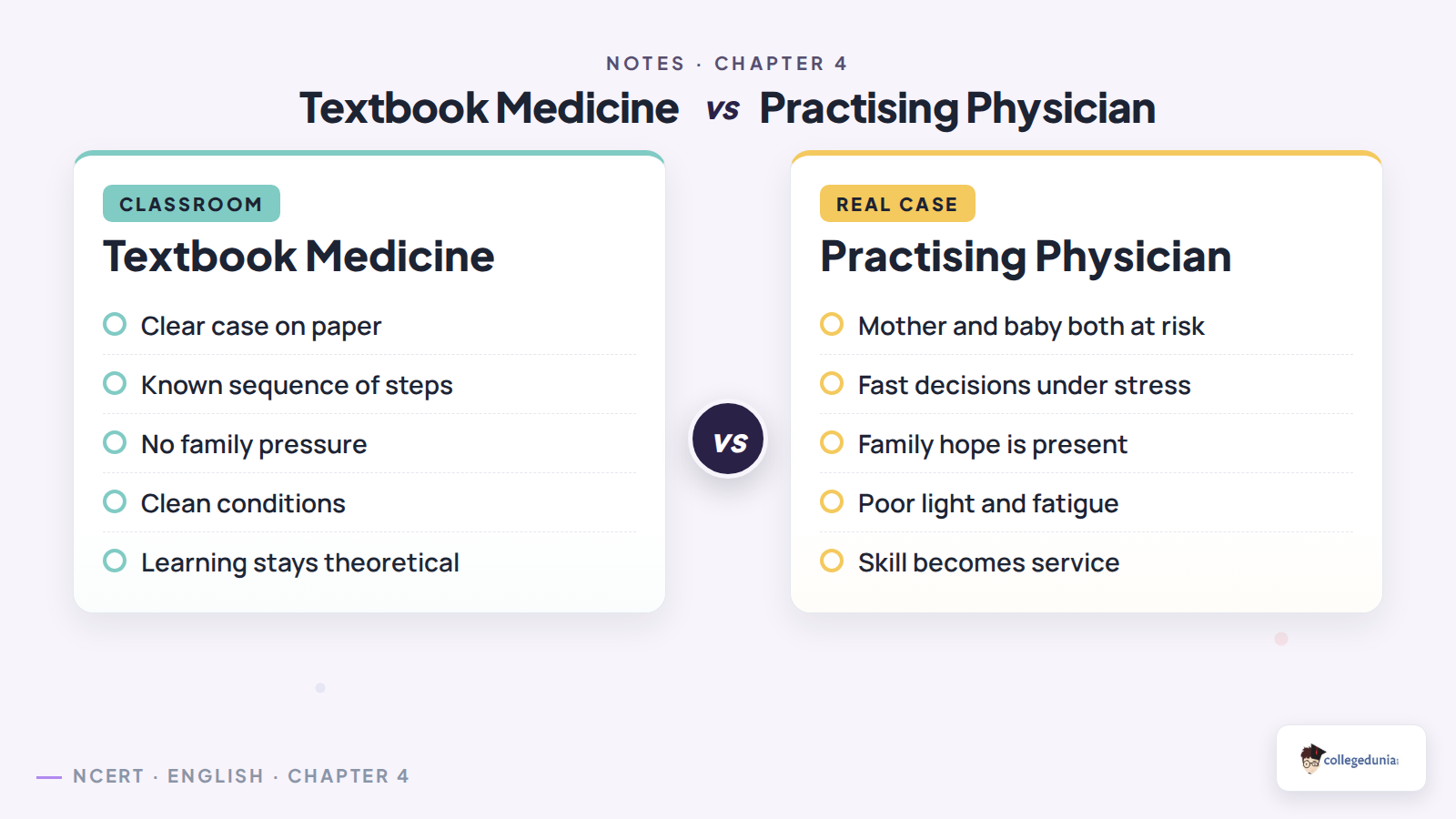
NCERT asks students to notice the gap between textbook medicine and the work of a practising physician. Textbook medicine is ordered and calm. Andrew's case is untidy, urgent and emotional, so he must use knowledge with judgement.
| Point | Textbook medicine | Andrew's practice |
|---|---|---|
| Case shape | A clean problem on paper | Mother and baby both need help |
| Pressure | No family waiting nearby | Joe's hope and fear are present |
| Decision | Steps can be studied slowly | Andrew must choose the order of treatment fast |
| Result | Learning stays theoretical | Knowledge becomes service and courage |
Characters and Themes in Birth
The chapter has no long speeches, but the characters are clear. Their actions, silences and small gestures show how much is at stake in the room. Use one incident with every trait so answers stay text-based.
| Character or theme | What to remember | Exam use |
|---|---|---|
| Andrew Manson | Young doctor troubled by doubt but loyal to duty | Use for professional growth and useful work. |
| Joe Morgan | Simple, anxious husband who trusts Andrew | Use for family longing and faith. |
| Susan Morgan | Mother whose danger creates the first crisis | Use for the physical risk of childbirth. |
| Old woman | Silent watcher beside the case | Use for fear, prayer and family hope. |
| Hope and duty | Action continues even when success looks impossible | Use for the revival scene and the ending. |
How to Write Better Answers on Birth
Strong answers on Birth are not plain retellings. State the point, choose a clear incident, and explain Andrew's change. Keep every answer tied to the NCERT text.
- For summary answers: include the night call, the delivery, Susan's collapse, the child revival and Andrew's final thought.
- For character answers: show Andrew as sensitive, responsible, decisive and renewed.
- For theme answers: connect medical duty, hope, family longing and practice over theory.
- For title answers: explain both the baby's birth and the birth of Andrew's professional faith.
Related Resources for Birth
| Resource | Use it for | Link |
|---|---|---|
| NCERT Solutions | Full answers to textbook questions | Open NCERT Solutions |
| NCERT Book PDF | Official Snapshots source chapter | Open NCERT Book PDF |
| Handwritten Notes | Topper-style last-minute revision | Open Handwritten Notes |
All Class 11 English Snapshots Notes Chapters
| Chapter | Title | Notes Link |
|---|---|---|
| Chapter 1 | The Summer of the Beautiful White Horse | Open Notes |
| Chapter 2 | The Address | Open Notes |
| Chapter 3 | Mother's Day | Open Notes |
| Chapter 4 | Birth | You are here |
| Chapter 5 | The Tale of Melon City | Open Notes |
Birth Class 11 Notes FAQs
Ques. What is the main idea of Birth Class 11?
Ans. The main idea is that real professional duty becomes meaningful when knowledge is used with courage, compassion and persistence.
Ques. Why does Andrew say he has done something real at last?
Ans. Andrew says this because he has saved Susan Morgan and revived her child. The case proves that his work can directly protect life.
Ques. What is the double crisis in Birth?
Ans. The double crisis is Susan Morgan's collapse after delivery and the newborn child's apparent lifelessness. Andrew handles both crises in order.
Ques. How should students revise Birth for exams?
Ans. Students should revise Andrew's mood, Joe's trust, the delivery, Susan's collapse, the revival method, themes and the final line.



Comments