



NCERT Class 11 English Woven Words Chapter 14 Hawk Roosting Notes explain Ted Hughes' poem through the hawk speaker, physical power, brutal frankness, the title and the human parallel for the 2026-27 syllabus.
- Download the Chapter 14 Notes PDF for offline revision.
- Revise the hawk's voice, hooked body images, creation claim, title meaning and answer frames.
- Student focus: write every answer with the real hawk first, then connect it to power and human behaviour.
Chapter14HawkRoostingNotes.pdf?page=1&dpi=150)
Chapter14HawkRoostingNotes.pdf?page=2&dpi=150)
Chapter14HawkRoostingNotes.pdf?page=3&dpi=150)
Chapter14HawkRoostingNotes.pdf?page=4&dpi=150)
Chapter14HawkRoostingNotes.pdf?page=5&dpi=150)
Chapter14HawkRoostingNotes.pdf?page=6&dpi=150)
Chapter14HawkRoostingNotes.pdf?page=7&dpi=150)
Chapter14HawkRoostingNotes.pdf?page=8&dpi=150)
Chapter14HawkRoostingNotes.pdf?page=9&dpi=150)
Chapter14HawkRoostingNotes.pdf?page=10&dpi=150)
Chapter14HawkRoostingNotes.pdf?page=11&dpi=150)
Chapter14HawkRoostingNotes.pdf?page=12&dpi=150)
Chapter14HawkRoostingNotes.pdf?page=13&dpi=150)
Chapter14HawkRoostingNotes.pdf?page=14&dpi=150)
Chapter14HawkRoostingNotes.pdf?page=15&dpi=150)
Chapter14HawkRoostingNotes.pdf?page=16&dpi=150)
Chapter14HawkRoostingNotes.pdf?page=17&dpi=150)
Chapter14HawkRoostingNotes.pdf?page=18&dpi=150)
Chapter14HawkRoostingNotes.pdf?page=19&dpi=150)
Chapter14HawkRoostingNotes.pdf?page=20&dpi=150)
Chapter14HawkRoostingNotes.pdf?page=21&dpi=150)
Chapter14HawkRoostingNotes.pdf?page=22&dpi=150)
Chapter14HawkRoostingNotes_flat_MobileCard.pdf?page=1&dpi=150)
Chapter14HawkRoostingNotes_flat_MobileCard.pdf?page=2&dpi=150)
Chapter14HawkRoostingNotes_flat_MobileCard.pdf?page=3&dpi=150)
Chapter14HawkRoostingNotes_flat_MobileCard.pdf?page=4&dpi=150)
Chapter14HawkRoostingNotes_flat_MobileCard.pdf?page=5&dpi=150)
Chapter14HawkRoostingNotes_flat_MobileCard.pdf?page=6&dpi=150)
Chapter14HawkRoostingNotes_flat_MobileCard.pdf?page=7&dpi=150)
Chapter14HawkRoostingNotes_flat_MobileCard.pdf?page=8&dpi=150)
Chapter14HawkRoostingNotes_flat_MobileCard.pdf?page=9&dpi=150)
Chapter14HawkRoostingNotes_flat_MobileCard.pdf?page=10&dpi=150)
Chapter14HawkRoostingNotes_flat_MobileCard.pdf?page=11&dpi=150)
Chapter14HawkRoostingNotes_flat_MobileCard.pdf?page=12&dpi=150)
Chapter14HawkRoostingNotes_flat_MobileCard.pdf?page=13&dpi=150)
Chapter14HawkRoostingNotes_flat_MobileCard.pdf?page=14&dpi=150)
Chapter14HawkRoostingNotes_flat_MobileCard.pdf?page=15&dpi=150)
Chapter14HawkRoostingNotes_flat_MobileCard.pdf?page=16&dpi=150)
Chapter14HawkRoostingNotes_flat_MobileCard.pdf?page=17&dpi=150)
Chapter14HawkRoostingNotes_flat_MobileCard.pdf?page=18&dpi=150)
Chapter14HawkRoostingNotes_flat_MobileCard.pdf?page=19&dpi=150)
Chapter14HawkRoostingNotes_flat_MobileCard.pdf?page=20&dpi=150)
Chapter14HawkRoostingNotes_flat_MobileCard.pdf?page=21&dpi=150)
Chapter14HawkRoostingNotes_flat_MobileCard.pdf?page=22&dpi=150)
Chapter14HawkRoostingNotes_flat_MobileCard.pdf?page=23&dpi=150)
Chapter14HawkRoostingNotes_flat_MobileCard.pdf?page=24&dpi=150)
Chapter14HawkRoostingNotes_flat_MobileCard.pdf?page=25&dpi=150)
Chapter14HawkRoostingNotes_flat_MobileCard.pdf?page=26&dpi=150)
Chapter14HawkRoostingNotes_flat_MobileCard.pdf?page=27&dpi=150)
Chapter14HawkRoostingNotes_flat_MobileCard.pdf?page=28&dpi=150)
Chapter14HawkRoostingNotes_flat_MobileCard.pdf?page=29&dpi=150)
Chapter14HawkRoostingNotes_flat_MobileCard.pdf?page=30&dpi=150)
Chapter14HawkRoostingNotes_flat_MobileCard.pdf?page=31&dpi=150)
Chapter14HawkRoostingNotes_flat_MobileCard.pdf?page=32&dpi=150)
Student Feedback on Hawk Roosting
In a Collegedunia revision poll of 10,420 Class 11 English students, most students said Hawk Roosting became easier after separating the literal bird images from the poem's larger power argument.
Hawk Roosting Class 11 Notes PDF Overview
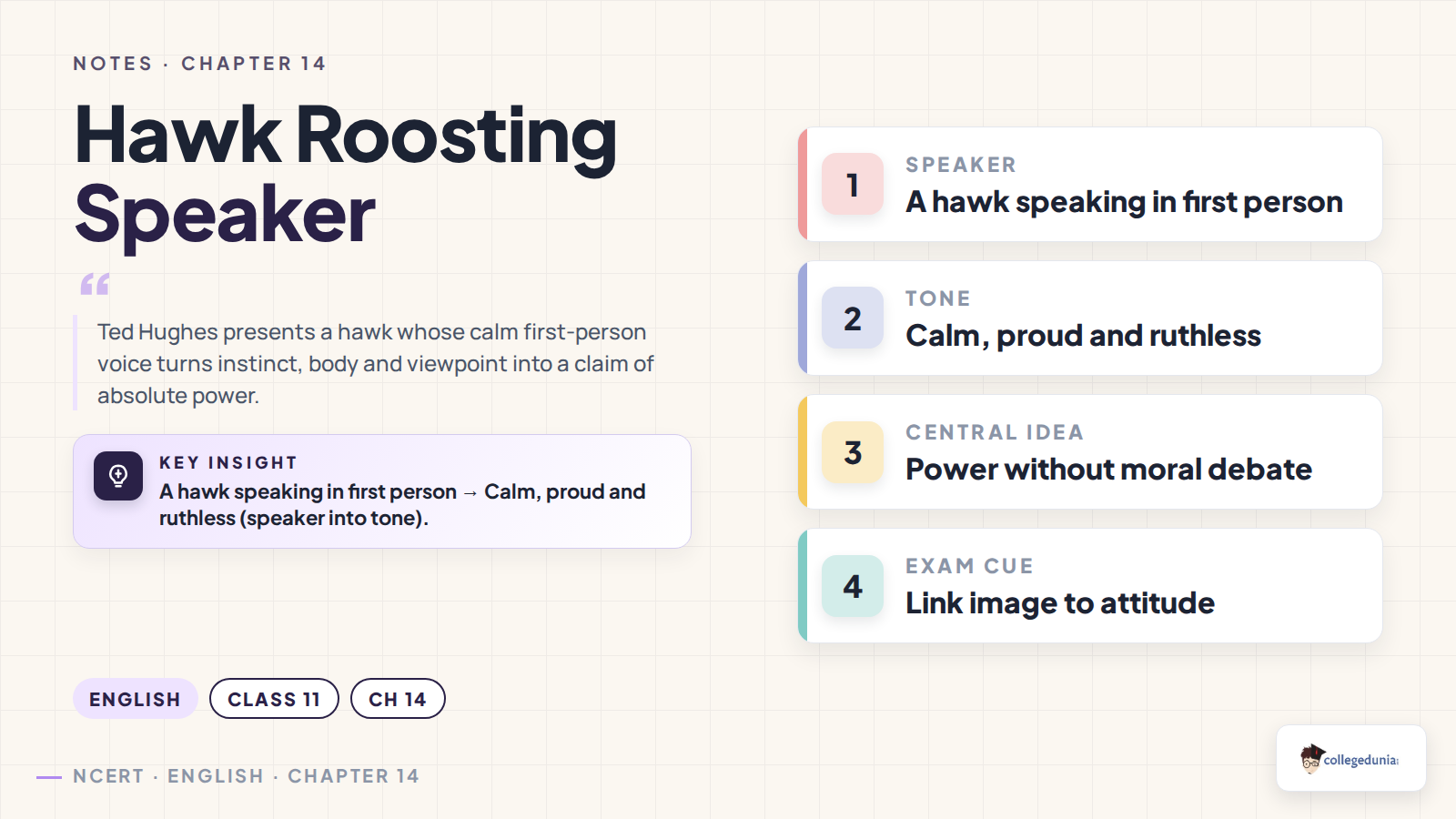
Hawk Roosting is a dramatic monologue by Ted Hughes. The hawk speaks in the first person and presents its body, height and killing instinct as signs of unquestioned authority.
| Focus area | What to remember | Exam cue |
|---|---|---|
| Speaker | A hawk speaks directly in its own voice. | Dramatic monologue |
| Body | Hooked head, hooked feet and sharp eye show power. | Physical imagery |
| Tone | The voice is calm, proud and ruthless. | Attitude |
| Theme | Natural instinct becomes a symbol of domination. | Human parallel |
Hawk Roosting Class 11 Poem Explanation
Source: Magnet Brains on YouTube
Hawk Roosting Summary and Central Idea
The poem begins with the hawk sitting at the top of the wood. It sees the earth below, claims that creation made every part of its body for control and speaks of killing without guilt. The final claim that nothing has changed shows a mind that refuses moral doubt or social change.
For Class 11 answers, keep the summary precise. The poem is not only a nature poem. It also exposes how power can sound when it feels completely entitled.
- The hawk's height creates a sense of command.
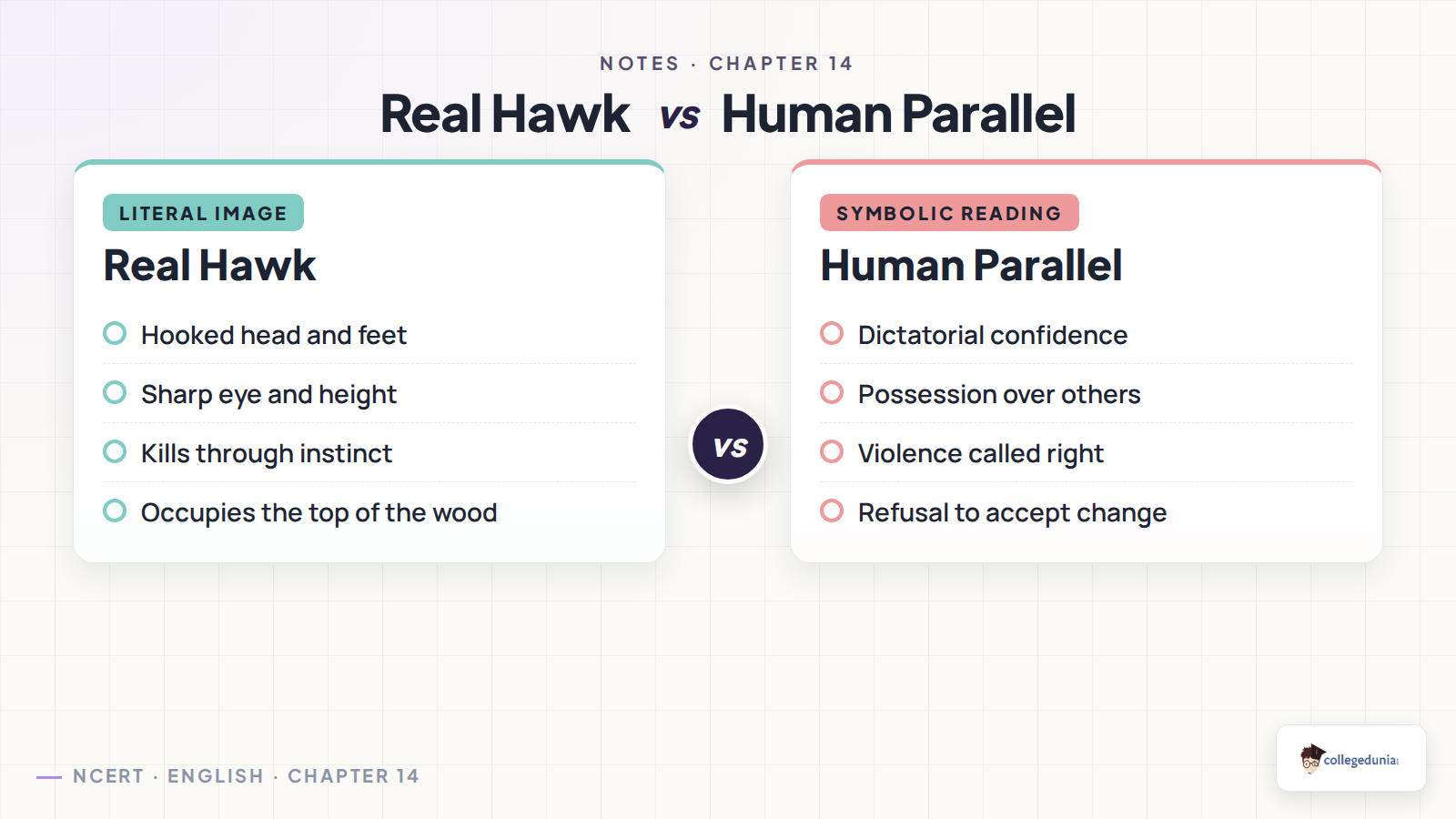
- The body images make violence look natural to the speaker.
- The repeated ownership language turns instinct into domination.
- The human parallel appears through authority, possession and refusal to change.
Important Images and Literary Devices
Ted Hughes builds the poem through concrete images. The hawk's hooked head, locked feet, sharp eye and flight over the earth help students explain both the bird's physical power and its mental arrogance.
| Device or image | Meaning in the poem | How to use it |
|---|---|---|
| Dramatic monologue | The hawk reveals itself through its own speech. | Mention first-person voice. |
| Hooked head and feet | The body is built for grip, attack and control. | Link body to power. |
| Earth below | The hawk sees the world from a height. | Explain superiority. |
| Creation imagery | The hawk believes nature designed it to rule. | Show arrogance. |
| Final no-change claim | The speaker wants permanent control. | Connect to tyranny. |
How to Write NCERT Answers for Hawk Roosting
NCERT questions ask students to explain the title, the hawk's physical features, its brutal frankness, its prowess and the parallel with human behaviour. A strong answer starts with the poem's image and then moves to the larger idea.
- For physical features, name the hooked head, hooked feet and sharp eye.
- For brutal frankness, explain that the hawk does not hide its violence.
- For the title, show that roosting suggests a calm position of control.
- For the human parallel, connect the hawk's confidence to dictatorial power.
| Question type | Best opening | Finish with |
|---|---|---|
| Title | The title fixes the hawk in a still, high position. | Control and confidence |
| Physical features | The hawk's body is shown as a weapon. | Violence made natural |
| Human behaviour | The hawk can suggest a human lust for power. | Domination and no moral check |
Related Resources for Hawk Roosting
| Resource | Use it for | Link |
|---|---|---|
| NCERT Solutions | Practise textbook answers | Open Solutions |
| NCERT Book PDF | Read the source poem | Use the PDF viewer above |
| Handwritten Notes | Revise with visual notes | Open Handwritten Notes |
All Class 11 English Woven Words Notes Chapters
| Chapter | Notes Link |
|---|---|
| Chapter 10 Coming | Open Notes |
| Chapter 11 Telephone Conversation | Open Notes |
| Chapter 12 The World is Too Much With Us | Coming soon |
| Chapter 13 Mother Tongue | Open Notes |
| Chapter 14 Hawk Roosting | Current chapter notes |
| Chapter 15 For Elkana | Coming soon |
Hawk Roosting Class 11 Notes FAQs
Ques. What is the main idea of Hawk Roosting?
Ans. The main idea is the hawk's absolute confidence in its own power. The poem also suggests how unchecked authority can appear in human behaviour.
Ques. Why is the title Hawk Roosting important?
Ans. The title shows the hawk resting in a high, secure position. This stillness makes its control look natural and complete.
Ques. Which images are important in Hawk Roosting?
Ans. Hooked head, hooked feet, sharp eye, the earth below and the allotment of death are important images because they show power, violence and possession.
Ques. How should students answer the human parallel question?
Ans. Students should begin with the real hawk and then explain how its possessive, ruthless voice resembles human domination or dictatorial power.



Comments