



The NCERT Class 11 English Woven Words Tribal Verse notes explain G.N. Devy's chapter for the 2026-27 syllabus. You get the core argument, tribal song examples, exercise anchors, and a PDF for quick revision.
- Covers oral tribal literature, Munda, Kondh, Adi, memory, performance and canon.
- Best for short answers, appreciation questions and one-shot Class 11 revision.
- PDF includes 26 pages with tables, diagrams and NCERT exercise anchors.
Chapter22TribalVerseNotes.pdf?page=1&dpi=150)
Chapter22TribalVerseNotes.pdf?page=2&dpi=150)
Chapter22TribalVerseNotes.pdf?page=3&dpi=150)
Chapter22TribalVerseNotes.pdf?page=4&dpi=150)
Chapter22TribalVerseNotes.pdf?page=5&dpi=150)
Chapter22TribalVerseNotes.pdf?page=6&dpi=150)
Chapter22TribalVerseNotes.pdf?page=7&dpi=150)
Chapter22TribalVerseNotes.pdf?page=8&dpi=150)
Chapter22TribalVerseNotes.pdf?page=9&dpi=150)
Chapter22TribalVerseNotes.pdf?page=10&dpi=150)
Chapter22TribalVerseNotes.pdf?page=11&dpi=150)
Chapter22TribalVerseNotes.pdf?page=12&dpi=150)
Chapter22TribalVerseNotes.pdf?page=13&dpi=150)
Chapter22TribalVerseNotes.pdf?page=14&dpi=150)
Chapter22TribalVerseNotes.pdf?page=15&dpi=150)
Chapter22TribalVerseNotes.pdf?page=16&dpi=150)
Chapter22TribalVerseNotes.pdf?page=17&dpi=150)
Chapter22TribalVerseNotes.pdf?page=18&dpi=150)
Chapter22TribalVerseNotes.pdf?page=19&dpi=150)
Chapter22TribalVerseNotes.pdf?page=20&dpi=150)
Chapter22TribalVerseNotes.pdf?page=21&dpi=150)
Chapter22TribalVerseNotes.pdf?page=22&dpi=150)
Chapter22TribalVerseNotes.pdf?page=23&dpi=150)
Chapter22TribalVerseNotes.pdf?page=24&dpi=150)
Chapter22TribalVerseNotes.pdf?page=25&dpi=150)
Chapter22TribalVerseNotes.pdf?page=26&dpi=150)
Chapter22TribalVerseNotes_flat_MobileCard.pdf?page=1&dpi=150)
Chapter22TribalVerseNotes_flat_MobileCard.pdf?page=2&dpi=150)
Chapter22TribalVerseNotes_flat_MobileCard.pdf?page=3&dpi=150)
Chapter22TribalVerseNotes_flat_MobileCard.pdf?page=4&dpi=150)
Chapter22TribalVerseNotes_flat_MobileCard.pdf?page=5&dpi=150)
Chapter22TribalVerseNotes_flat_MobileCard.pdf?page=6&dpi=150)
Chapter22TribalVerseNotes_flat_MobileCard.pdf?page=7&dpi=150)
Chapter22TribalVerseNotes_flat_MobileCard.pdf?page=8&dpi=150)
Chapter22TribalVerseNotes_flat_MobileCard.pdf?page=9&dpi=150)
Chapter22TribalVerseNotes_flat_MobileCard.pdf?page=10&dpi=150)
Chapter22TribalVerseNotes_flat_MobileCard.pdf?page=11&dpi=150)
Chapter22TribalVerseNotes_flat_MobileCard.pdf?page=12&dpi=150)
Chapter22TribalVerseNotes_flat_MobileCard.pdf?page=13&dpi=150)
Chapter22TribalVerseNotes_flat_MobileCard.pdf?page=14&dpi=150)
Chapter22TribalVerseNotes_flat_MobileCard.pdf?page=15&dpi=150)
Chapter22TribalVerseNotes_flat_MobileCard.pdf?page=16&dpi=150)
Chapter22TribalVerseNotes_flat_MobileCard.pdf?page=17&dpi=150)
Chapter22TribalVerseNotes_flat_MobileCard.pdf?page=18&dpi=150)
Chapter22TribalVerseNotes_flat_MobileCard.pdf?page=19&dpi=150)
Chapter22TribalVerseNotes_flat_MobileCard.pdf?page=20&dpi=150)
Chapter22TribalVerseNotes_flat_MobileCard.pdf?page=21&dpi=150)
Chapter22TribalVerseNotes_flat_MobileCard.pdf?page=22&dpi=150)
Chapter22TribalVerseNotes_flat_MobileCard.pdf?page=23&dpi=150)
Chapter22TribalVerseNotes_flat_MobileCard.pdf?page=24&dpi=150)
Chapter22TribalVerseNotes_flat_MobileCard.pdf?page=25&dpi=150)
Chapter22TribalVerseNotes_flat_MobileCard.pdf?page=26&dpi=150)
Chapter22TribalVerseNotes_flat_MobileCard.pdf?page=27&dpi=150)
Chapter22TribalVerseNotes_flat_MobileCard.pdf?page=28&dpi=150)
Chapter22TribalVerseNotes_flat_MobileCard.pdf?page=29&dpi=150)
Chapter22TribalVerseNotes_flat_MobileCard.pdf?page=30&dpi=150)
Chapter22TribalVerseNotes_flat_MobileCard.pdf?page=31&dpi=150)
Chapter22TribalVerseNotes_flat_MobileCard.pdf?page=32&dpi=150)
Chapter22TribalVerseNotes_flat_MobileCard.pdf?page=33&dpi=150)
Chapter22TribalVerseNotes_flat_MobileCard.pdf?page=34&dpi=150)
Chapter22TribalVerseNotes_flat_MobileCard.pdf?page=35&dpi=150)
Chapter22TribalVerseNotes_flat_MobileCard.pdf?page=36&dpi=150)
Chapter22TribalVerseNotes_flat_MobileCard.pdf?page=37&dpi=150)
Chapter22TribalVerseNotes_flat_MobileCard.pdf?page=38&dpi=150)
Chapter22TribalVerseNotes_flat_MobileCard.pdf?page=39&dpi=150)
Chapter22TribalVerseNotes_flat_MobileCard.pdf?page=40&dpi=150)
Chapter22TribalVerseNotes_flat_MobileCard.pdf?page=41&dpi=150)
Chapter22TribalVerseNotes_flat_MobileCard.pdf?page=42&dpi=150)
Chapter22TribalVerseNotes_flat_MobileCard.pdf?page=43&dpi=150)
Chapter22TribalVerseNotes_flat_MobileCard.pdf?page=44&dpi=150)
Chapter22TribalVerseNotes_flat_MobileCard.pdf?page=45&dpi=150)
Chapter22TribalVerseNotes_flat_MobileCard.pdf?page=46&dpi=150)
Chapter22TribalVerseNotes_flat_MobileCard.pdf?page=47&dpi=150)
Chapter22TribalVerseNotes_flat_MobileCard.pdf?page=48&dpi=150)
Chapter22TribalVerseNotes_flat_MobileCard.pdf?page=49&dpi=150)
Chapter22TribalVerseNotes_flat_MobileCard.pdf?page=50&dpi=150)
These Tribal Verse Class 11 notes are prepared for the 2026-27 NCERT Woven Words reader and focus on the exact points students need for school tests.
Tribal Verse Notes for Class 11: What Students Must Know
Tribal Verse asks students to widen their idea of literature. Devy says literature is not only printed writing. Oral songs, chants, stories and rituals can also carry literary value.
| Part of the chapter | What to revise | Answer cue |
|---|---|---|
| Devy's essay | Orality, memory, canon and tribal imagination | Literature exceeds print |
| Munda song | Birth song and value of the girl child | Nature and fullness |
| Kondh song | Death ritual and link with ancestors | Living memory |
| Adi song | Healing chant in Miri Agom | Ritual language |
The main point is simple: tribal oral traditions deserve a place in the literary canon.
Tribal Verse Explained for Class 11
Source: Magnet Brains on YouTube
G.N. Devy's Central Argument in Tribal Verse
Devy challenges the habit of counting only written works as literature. He shows that tribal communities preserve knowledge through memory, music and performance.
- Tribal verse is passed from one generation to another by voice and performance.
- The songs carry social memory, ritual practice and artistic convention.
- Translation helps students read them, but some sound and context are lost.
- Calling tribal languages dialects can hide their full cultural value.
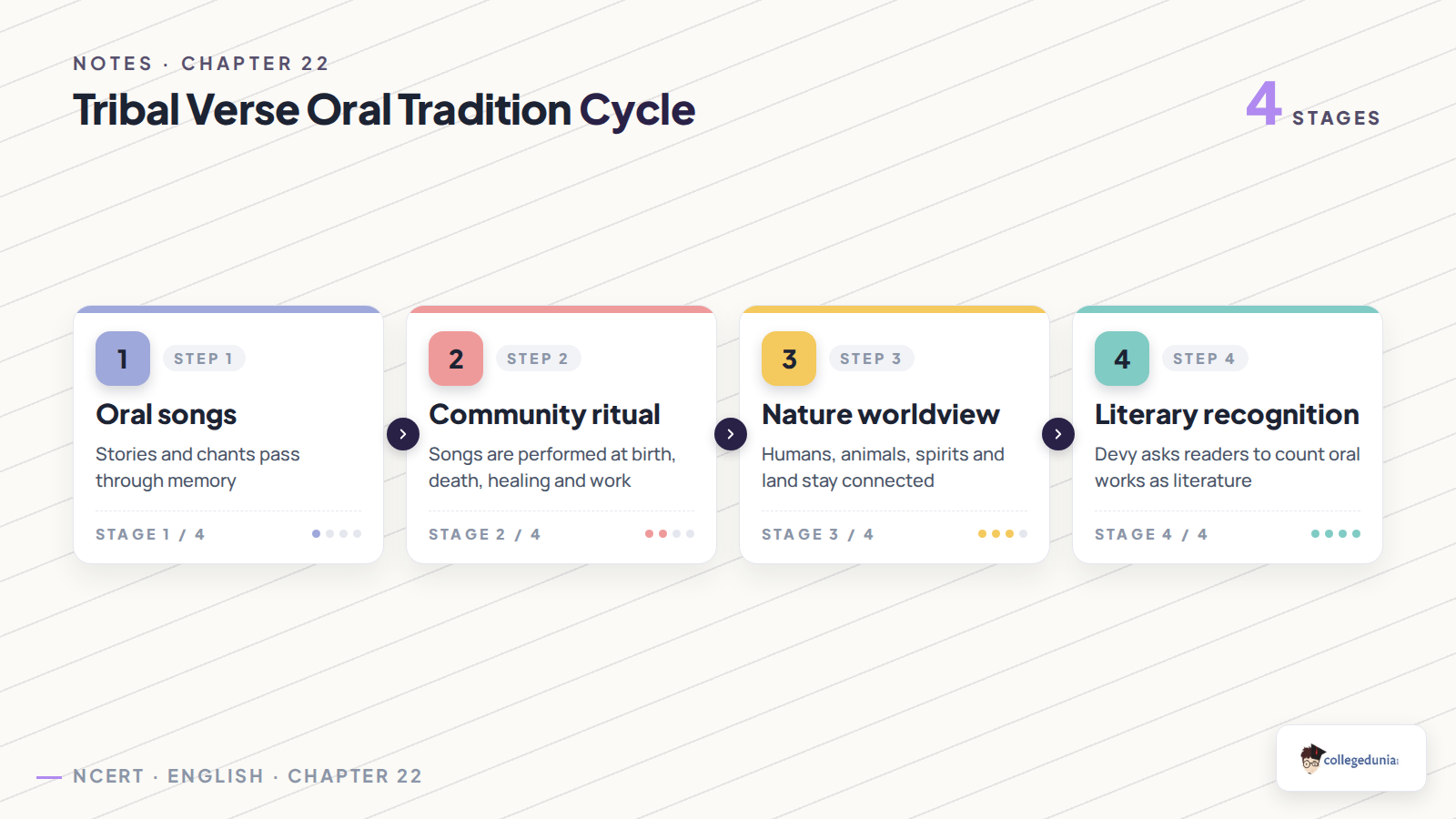
Munda, Kondh and Adi Songs in Tribal Verse
The three songs show how tribal verse joins daily life with ritual meaning. They are short, but each one gives a complete cultural view.
| Song | Core meaning | Use in answers |
|---|---|---|
| Munda song | The girl child's birth is linked with fullness and value. | Use for gender and nature imagery. |
| Kondh song | The living speak to the dead through offering and memory. | Use for personal time and ancestors. |
| Adi song | A healing chant uses Miri Agom as a ritual register. | Use for language and performance. |
Do not reduce the chapter to folk customs. The better answer connects each song to Devy's wider claim about literature.
Written Canon and Tribal Oral Verse Difference
Written literature is usually fixed on a page. Tribal oral verse is alive in memory and performance. That does not make it weaker. It only means students must read it with a different method.
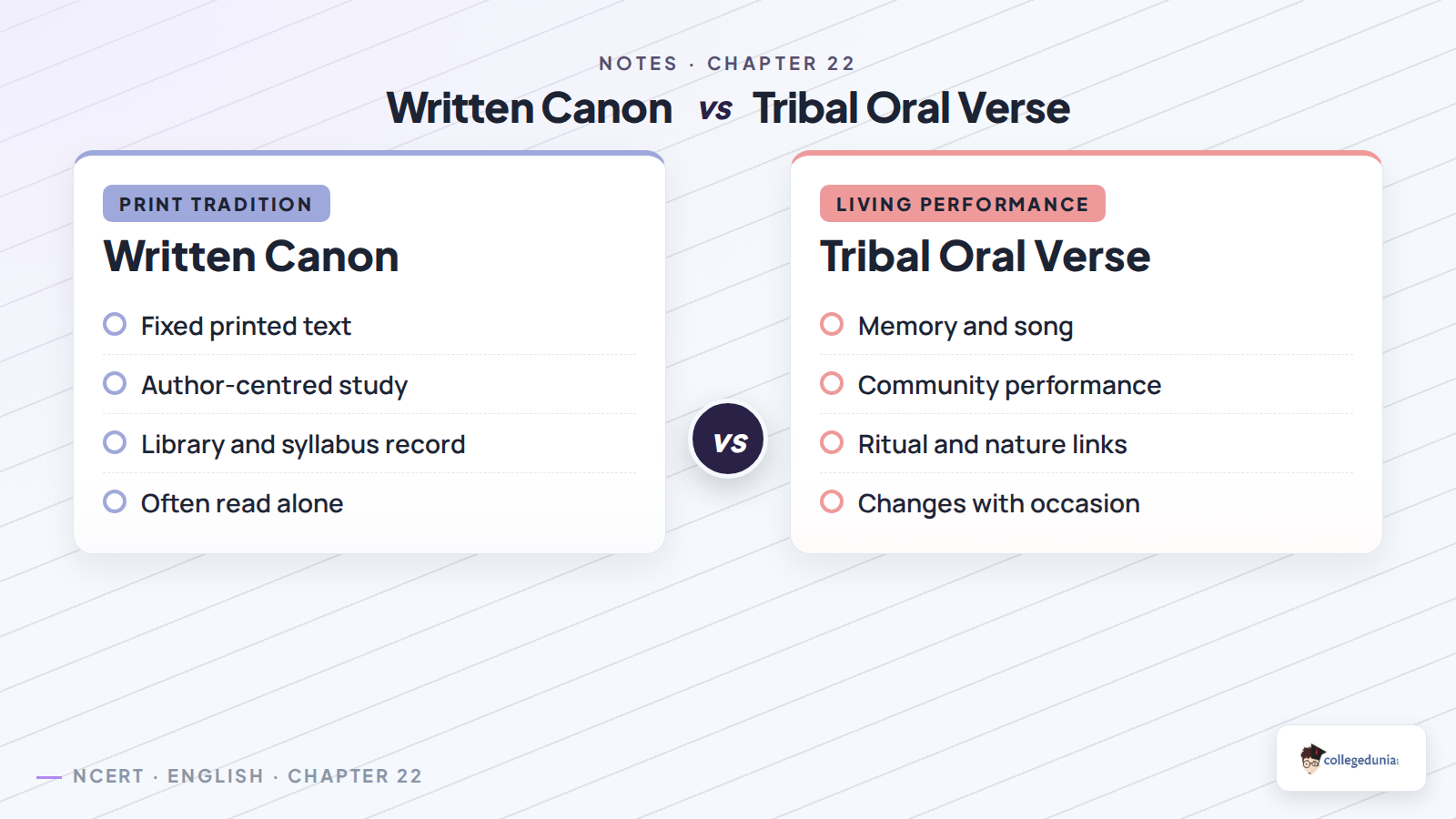
- Written canon depends on print, authorship and school records.
- Oral verse depends on voice, memory, ritual and community use.
- Tribal art can follow conventions while still changing with occasion.
Student Feedback on Tribal Verse Class 11 Notes
In a Collegedunia study poll of 12,640 Class 11 students conducted before the 2026 boards, 74% of students found Tribal Verse easier after revising the song-wise table first.
Source: 2026-27 Class 11 English student poll across CBSE schools.
How to Use the Tribal Verse Notes PDF
Use the notes PDF in three short rounds. First, read the snapshot table. Next, revise the three tribal songs. Last, practise the NCERT exercise anchors.
- Write Devy's central argument in two lines.
- Match each song with its cultural value.
- Prepare one paragraph on oral tradition and literary canon.
- Revise the common mistakes before the test.
Tip: In long answers, use the words orality, memory, performance and canon correctly.
Related Class 11 English Woven Words Resources
| Resource | Link |
|---|---|
| NCERT Solutions | Tribal Verse Class 11 NCERT Solutions |
| Solutions PDF | Tribal Verse Class 11 NCERT Solutions |
| Handwritten Notes | Tribal Verse Class 11 Handwritten Notes |
| All Chapters | Tribal Verse Class 11 Solutions |
More Class 11 English Woven Words Notes
| Chapter | Notes link |
|---|---|
| Chapter 20 | My Three Passions Class 11 Notes |
| Chapter 21 | Patterns of Creativity Class 11 Notes |
| Chapter 22 | Tribal Verse Class 11 Notes |
Tribal Verse Class 11 English Woven Words Notes FAQs
Ques. What is the main idea of Tribal Verse?
Ans. Tribal Verse says oral tribal songs, chants and performances must be treated as literature, not as casual folk material.
Ques. Who wrote Tribal Verse in Woven Words?
Ans. Tribal Verse is by G.N. Devy, a scholar known for work on tribal languages and oral traditions.
Ques. What should students revise first in Tribal Verse?
Ans. Students should revise Devy's central argument first, then the Munda, Kondh and Adi song examples.
Ques. Why is Miri Agom important in Tribal Verse?
Ans. Miri Agom is the ritual language used in the Adi healing chant. It shows how language changes with purpose.



Comments