



NCERT Notes Class 11 Psychology Chapter 6 Human Memory help students revise encoding, storage, retrieval, memory systems, forgetting and mnemonics for the 2026-27 syllabus. These notes keep the chapter ready for school tests through simple definitions, comparison tables and revision cues.
- Download the Human Memory notes PDF for offline revision.
- Revise stage model, working memory, long-term memory types and forgetting.
- Use the tables to compare memory systems, processing levels and forgetting causes.
Student Feedback: In a Collegedunia poll of 10,420 Class 11 Psychology students, 74% said they confused interference with retrieval failure before using a comparison table.
Source: 2026-27 Class 11 Psychology student poll across CBSE schools.
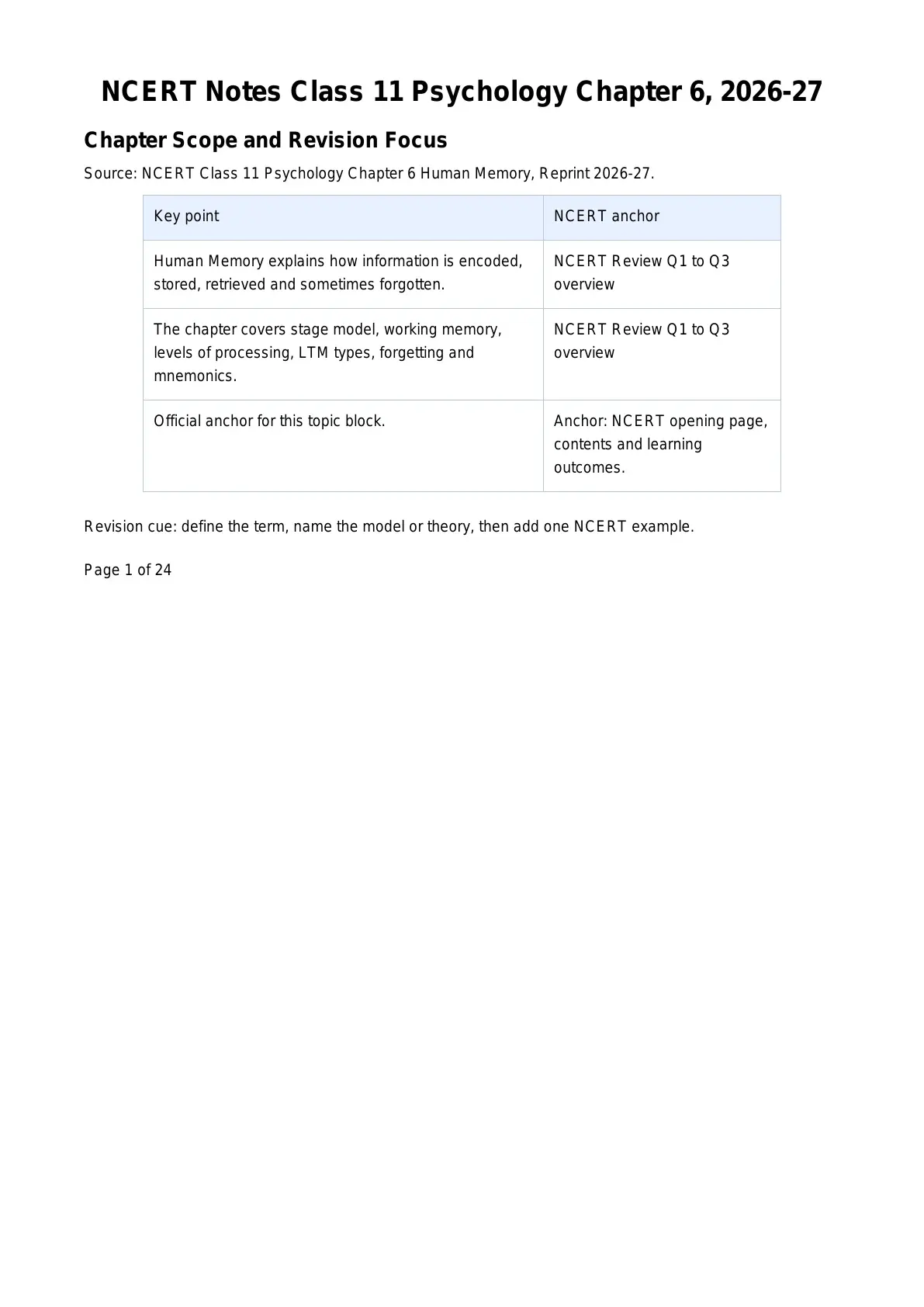
Human Memory Class 11 Notes: Chapter Overview
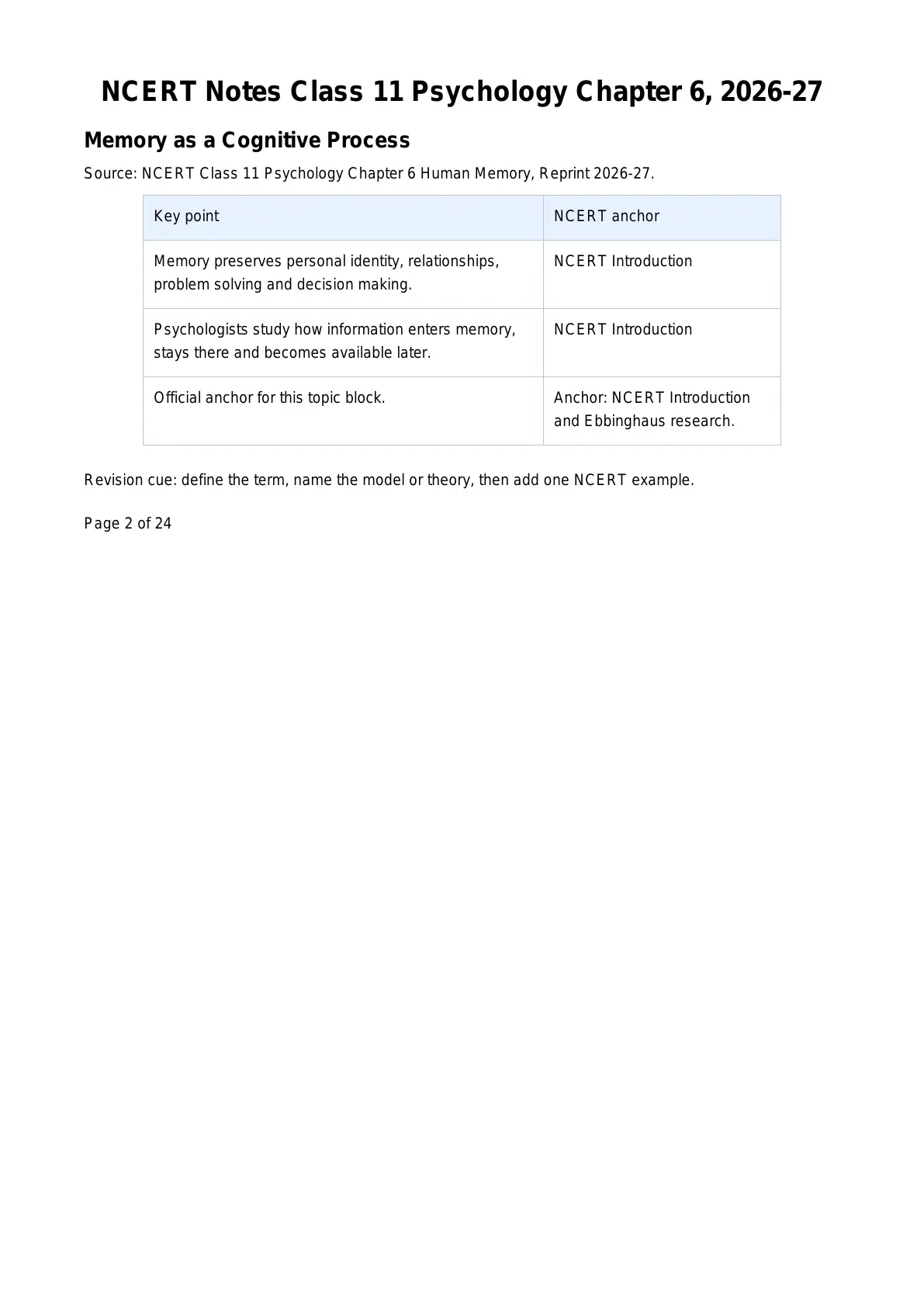
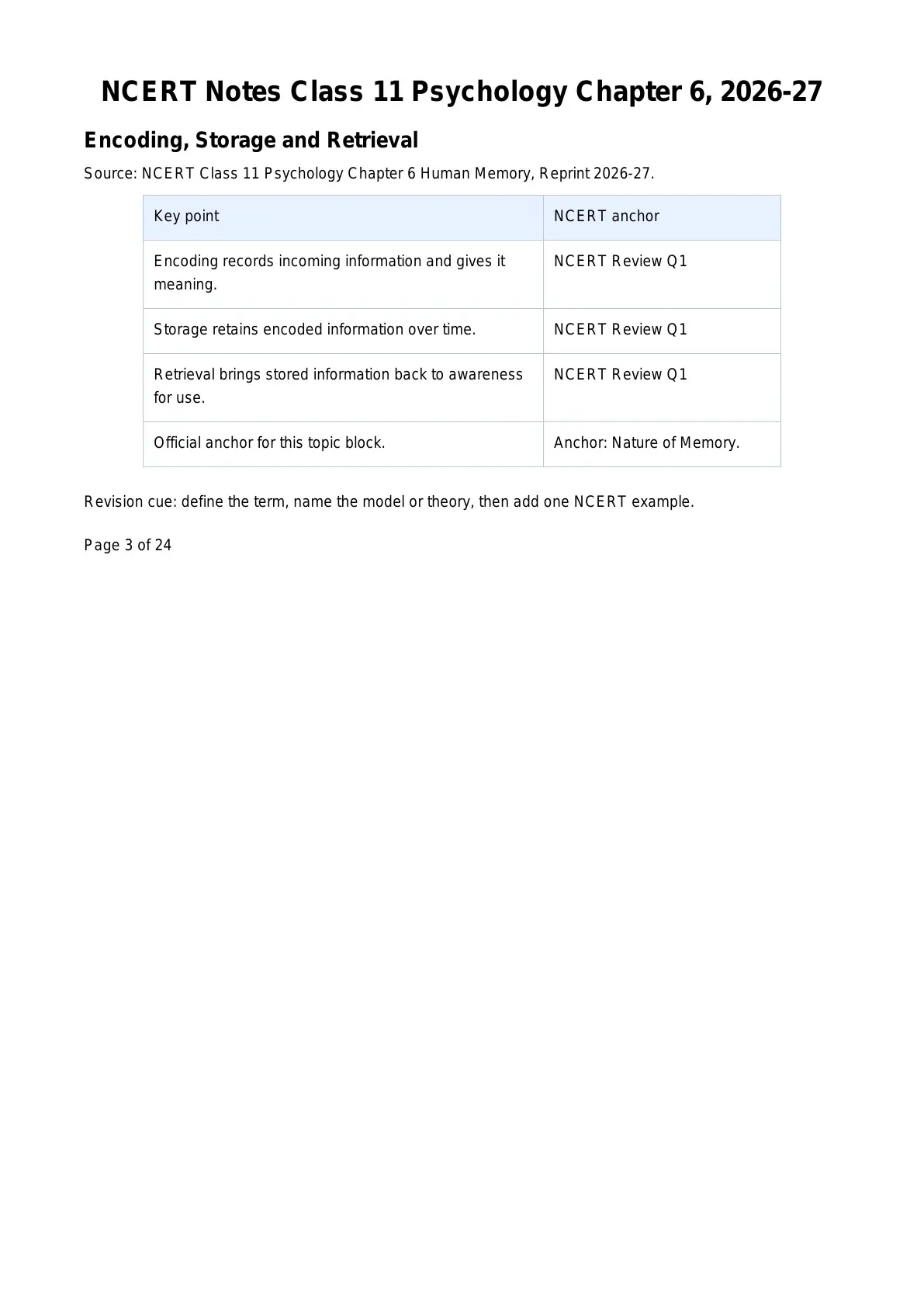
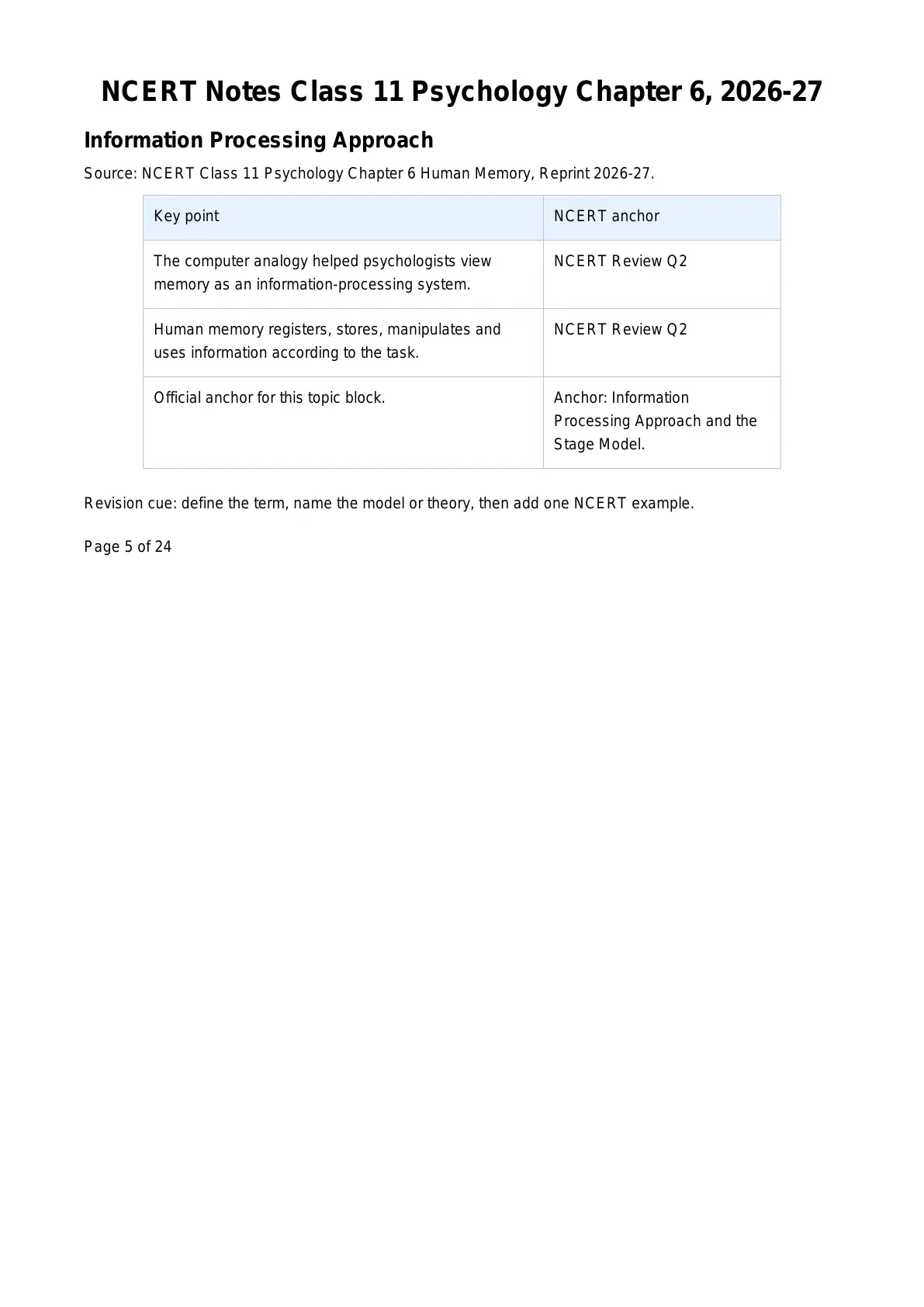
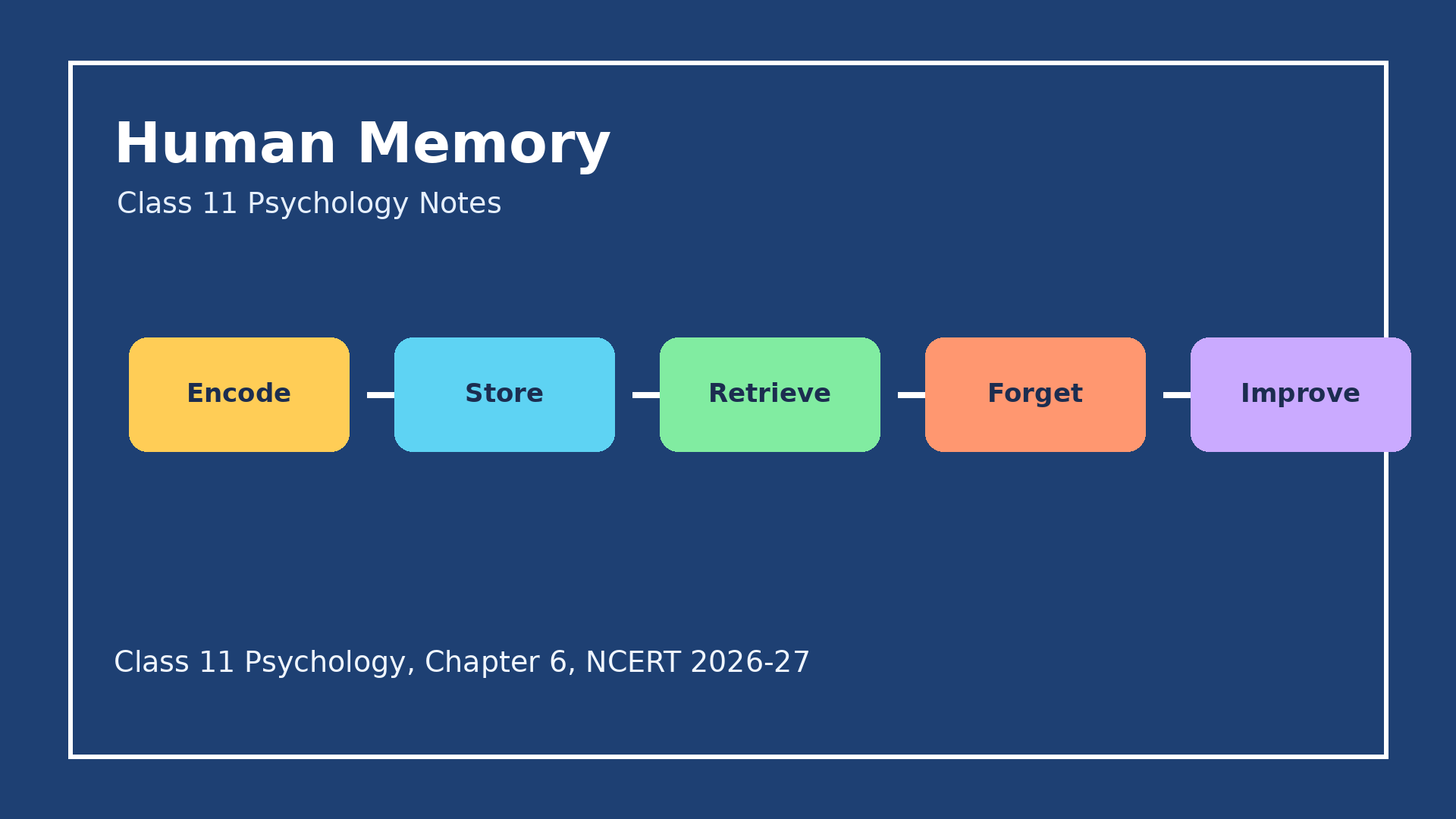
Human Memory explains how information is received, kept and recalled. NCERT uses three core terms: encoding, storage and retrieval. The safest exam line is simple: memory is an active process, not just a storehouse.
| Chapter area | What to revise | Answer cue |
|---|---|---|
| Nature of memory | Encoding, storage and retrieval | Define all three stages |
| Stage model | Sensory, short-term and long-term memory | Use Fig. 6.1 logic |
| Processing and LTM | Levels, declarative, procedural, episodic, semantic | Add one example each |
| Forgetting and improvement | Trace decay, interference, retrieval failure and mnemonics | Compare causes in a table |
Stage Model of Memory in Human Memory Class 11
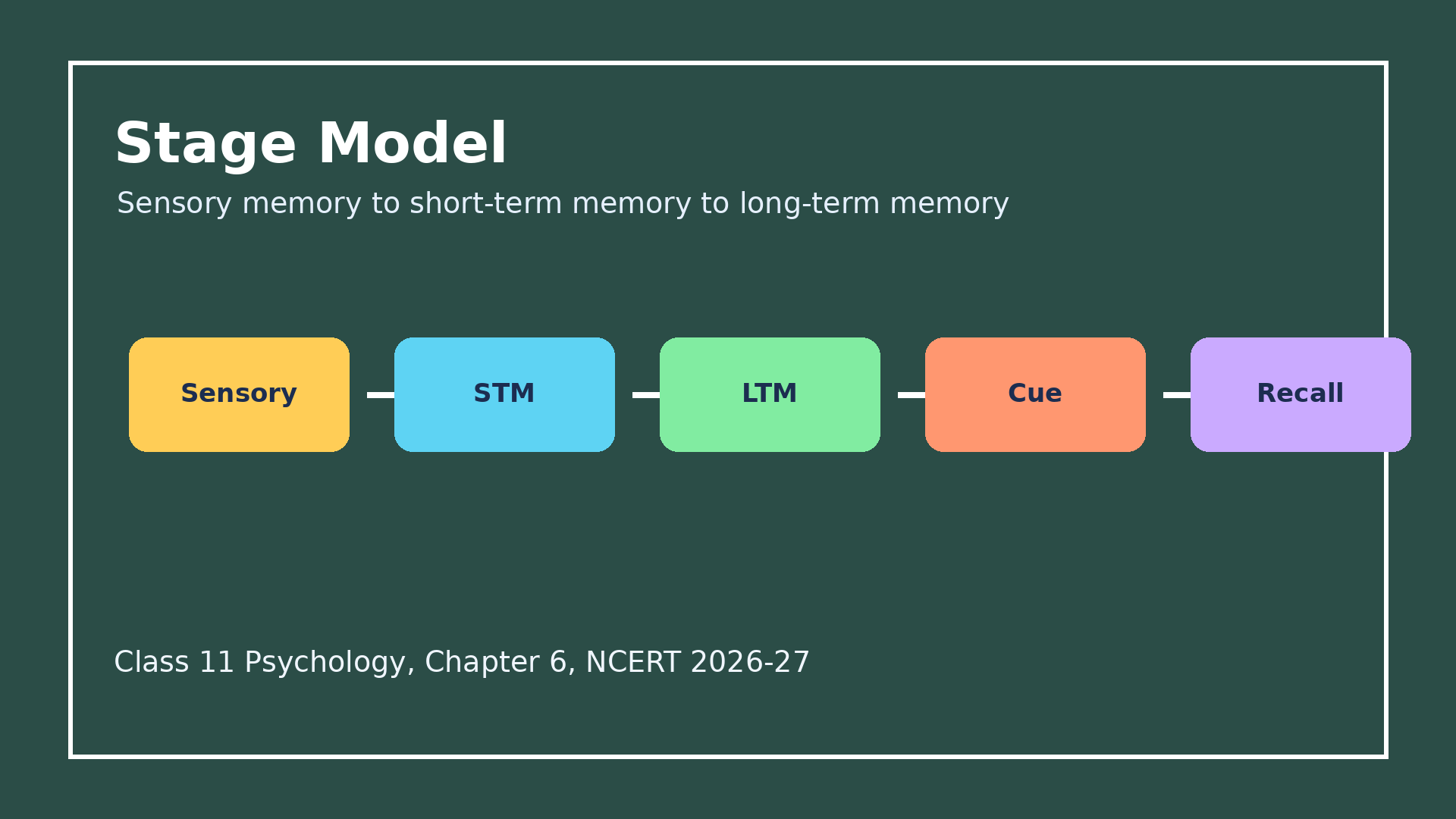
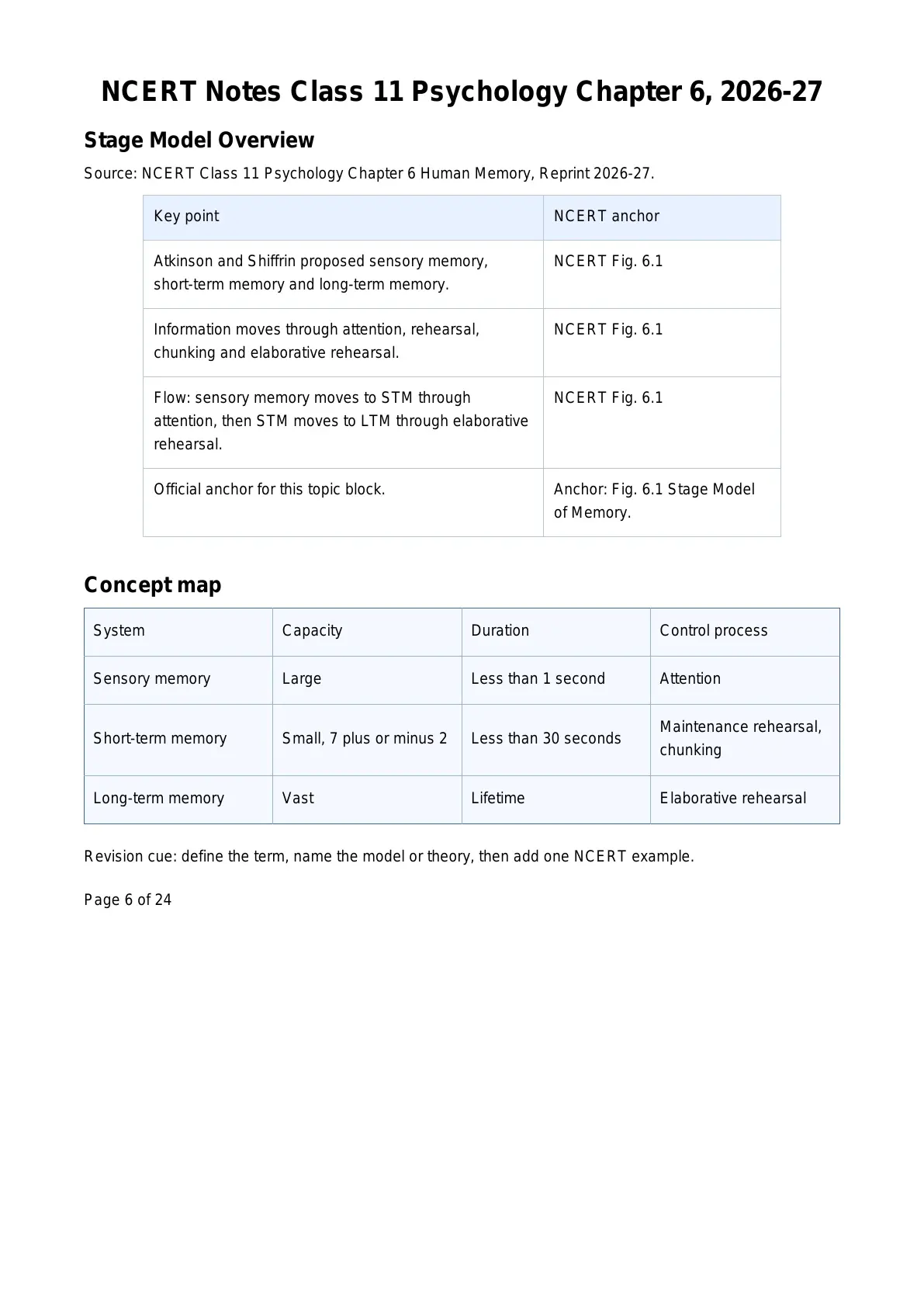
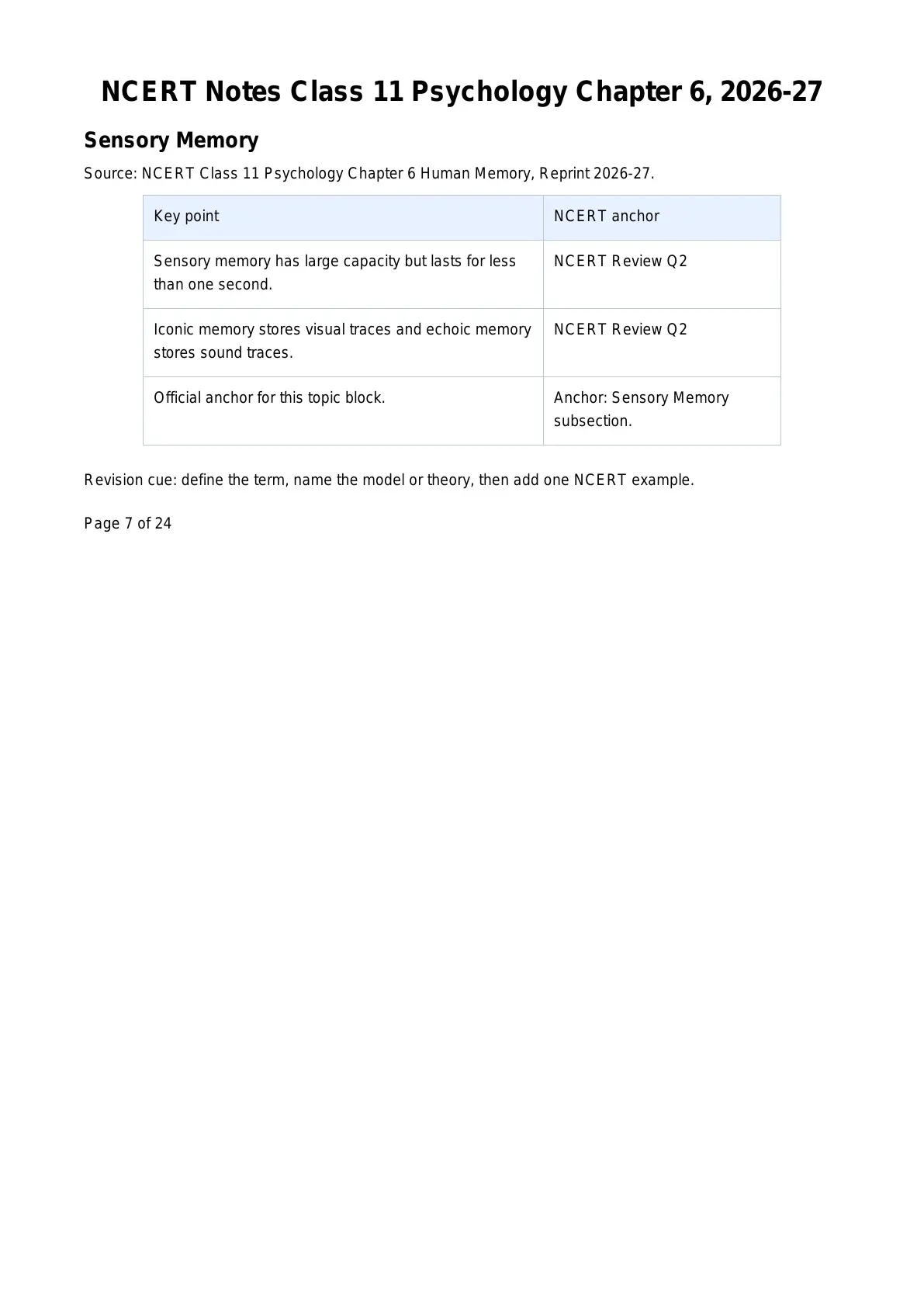
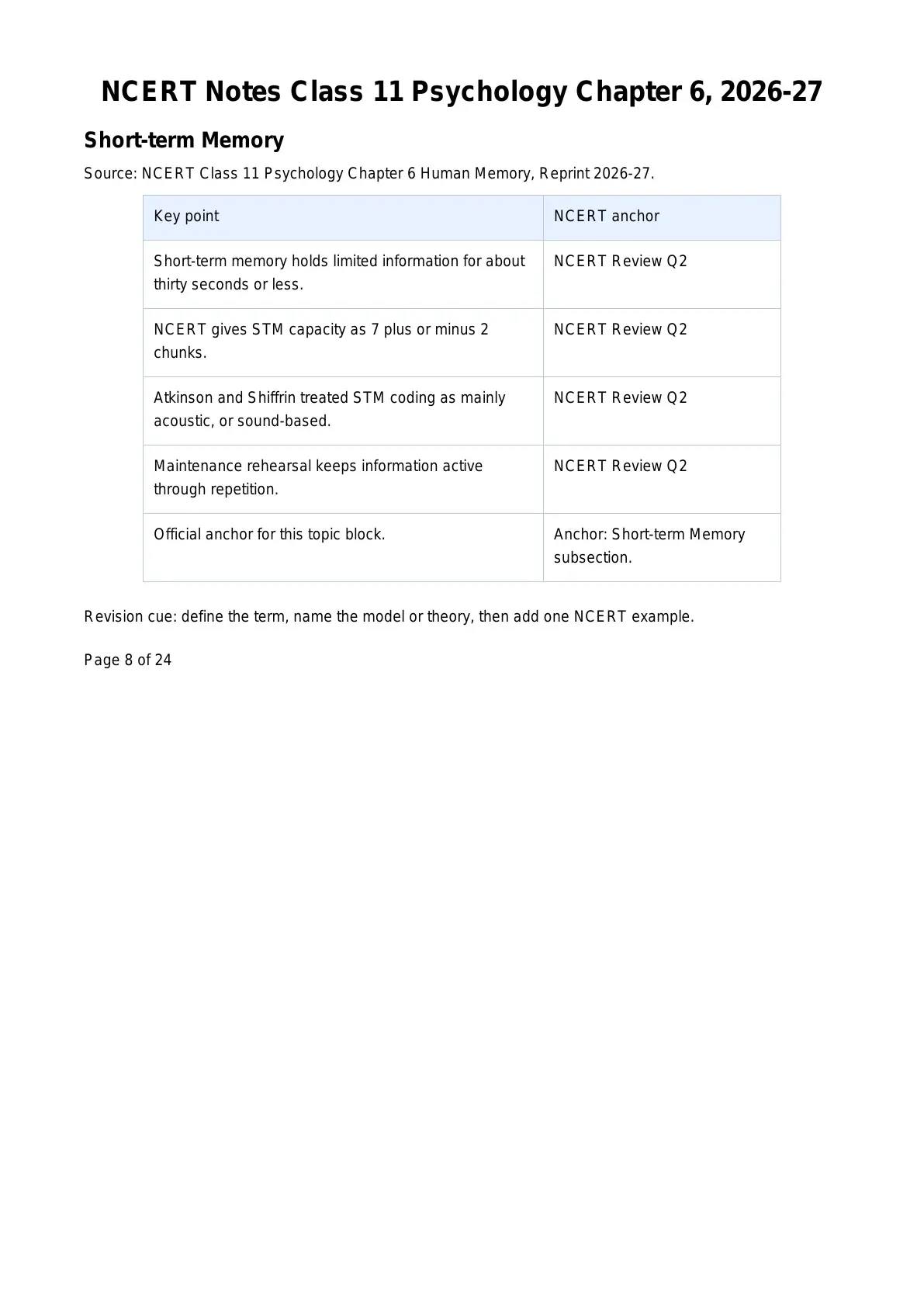
The Atkinson and Shiffrin model has three memory systems. Sensory memory holds exact sensory impressions for less than a second. Short-term memory holds limited information for about thirty seconds. Long-term memory stores meaning-based information for a long duration.
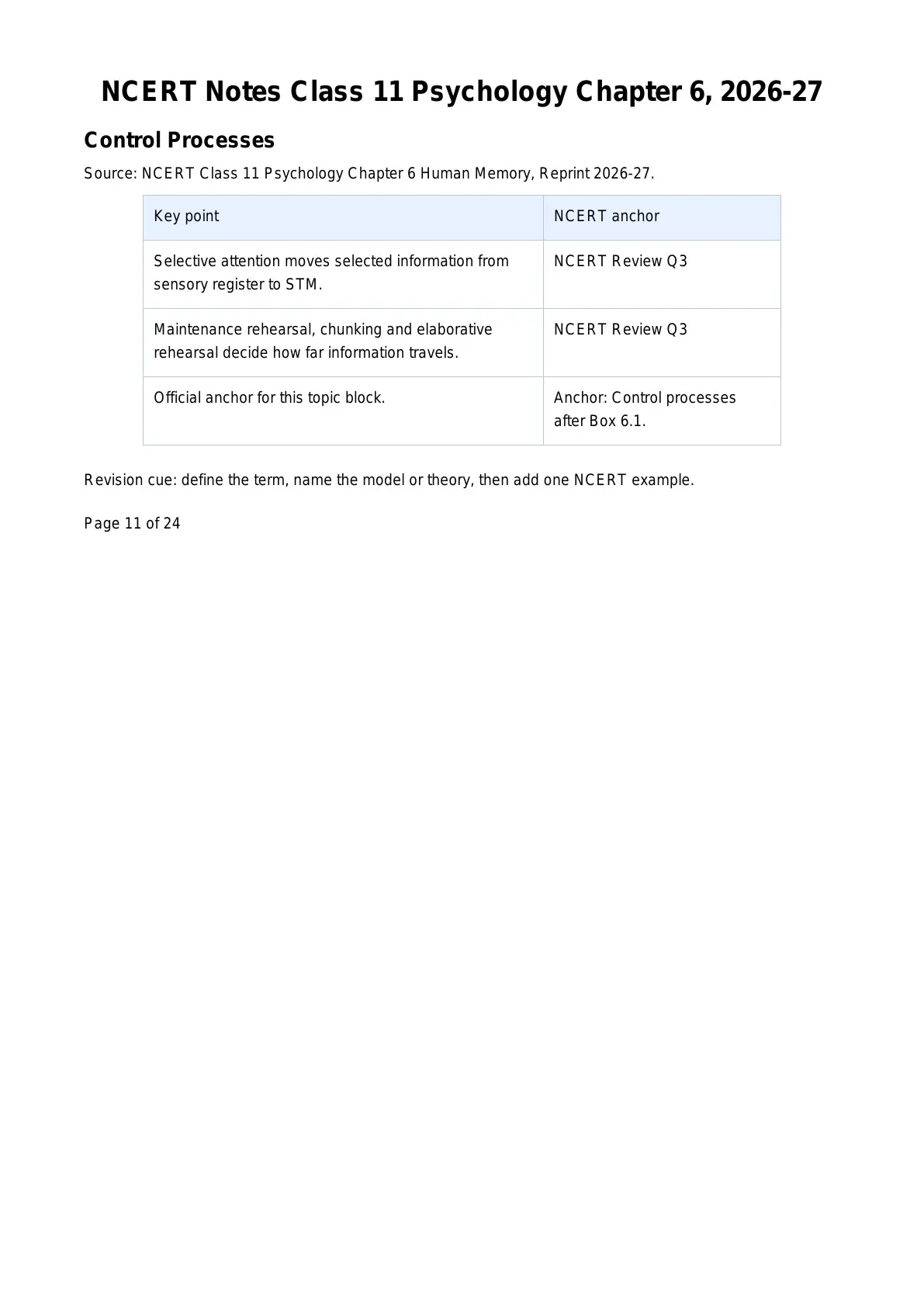
- Selective attention: moves selected information from sensory register to STM.
- Maintenance rehearsal: keeps information active by repetition.
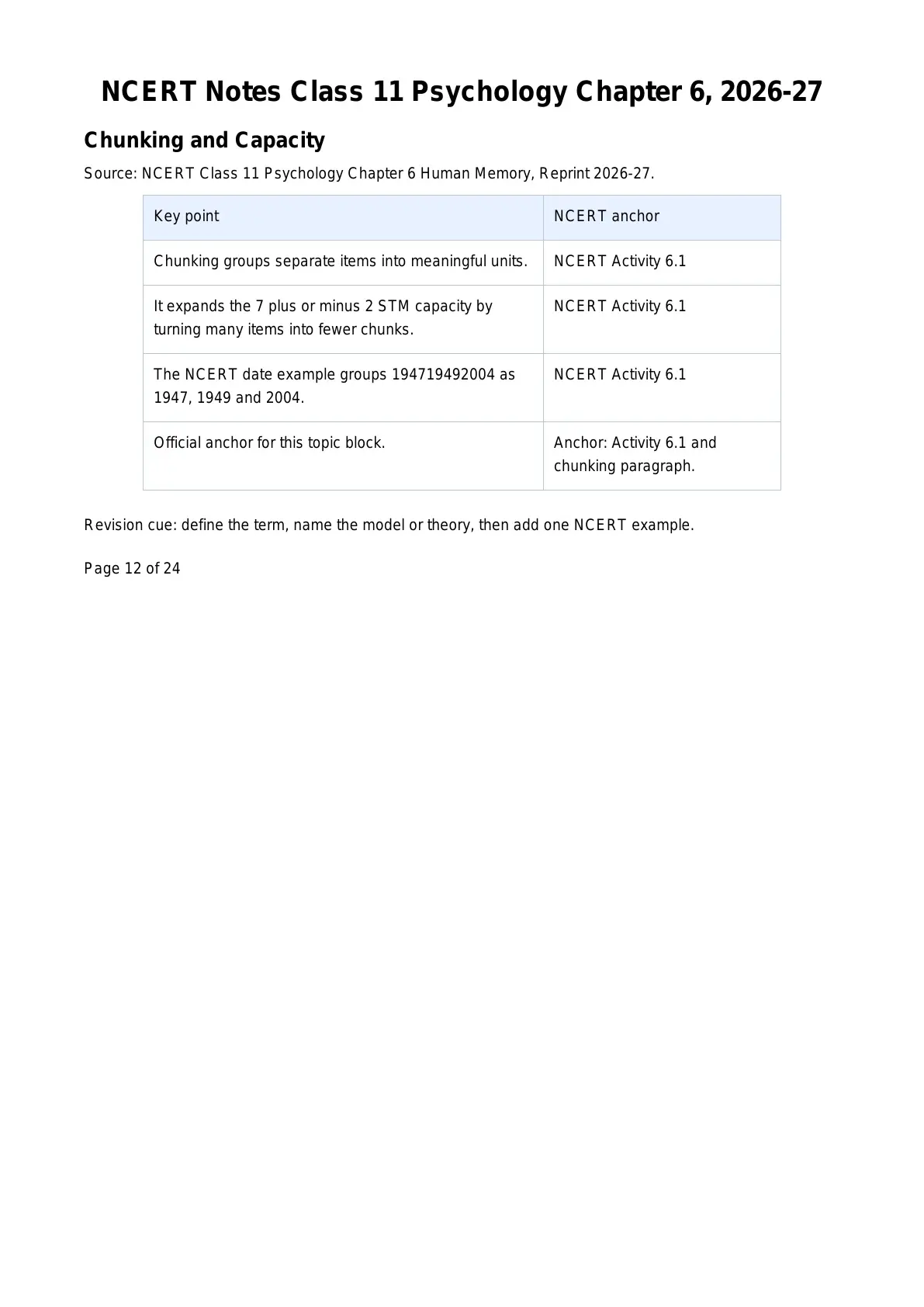
- Chunking: groups items into meaningful units.
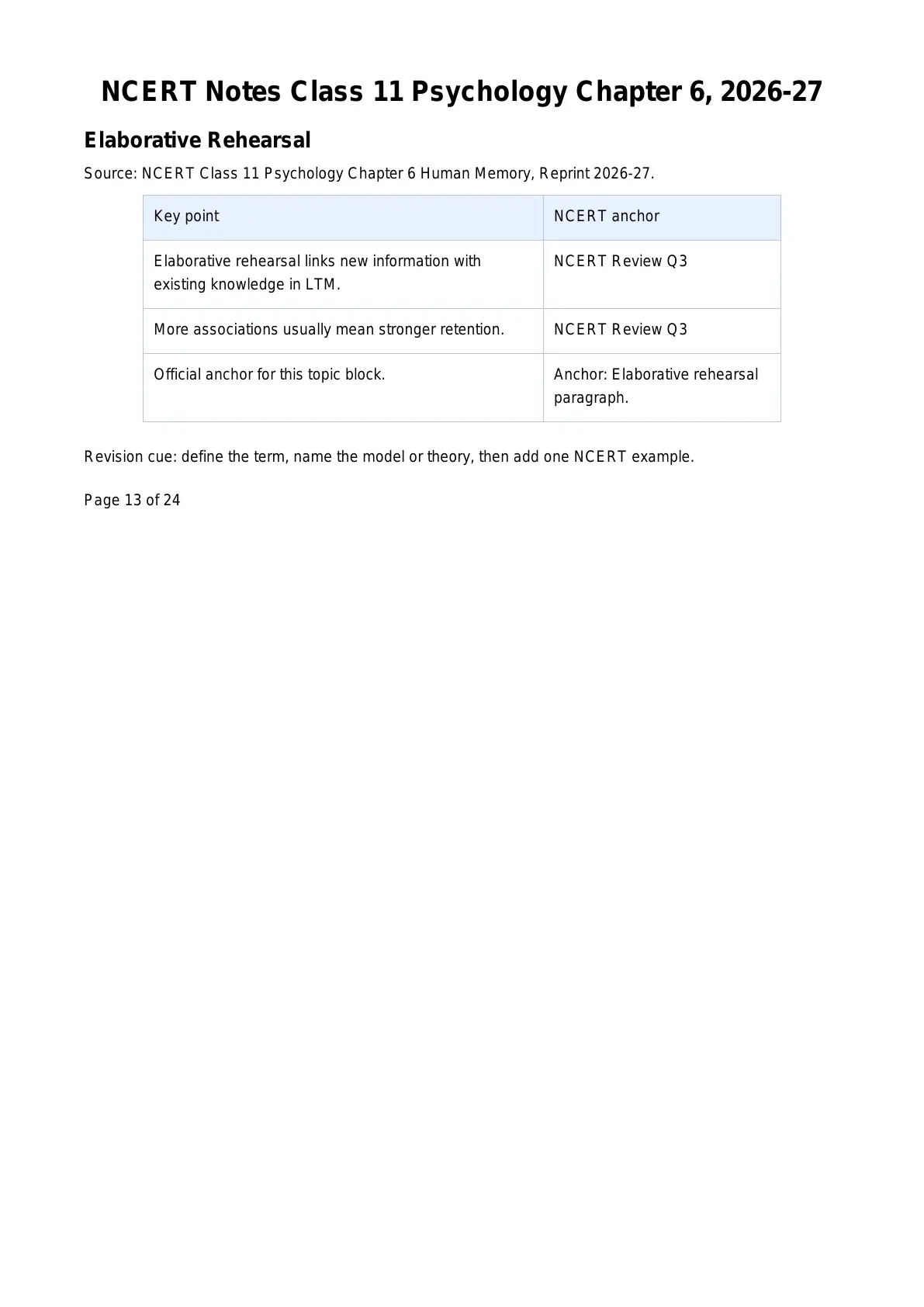
- Elaborative rehearsal: links new information with existing knowledge.
Working Memory and Levels of Processing
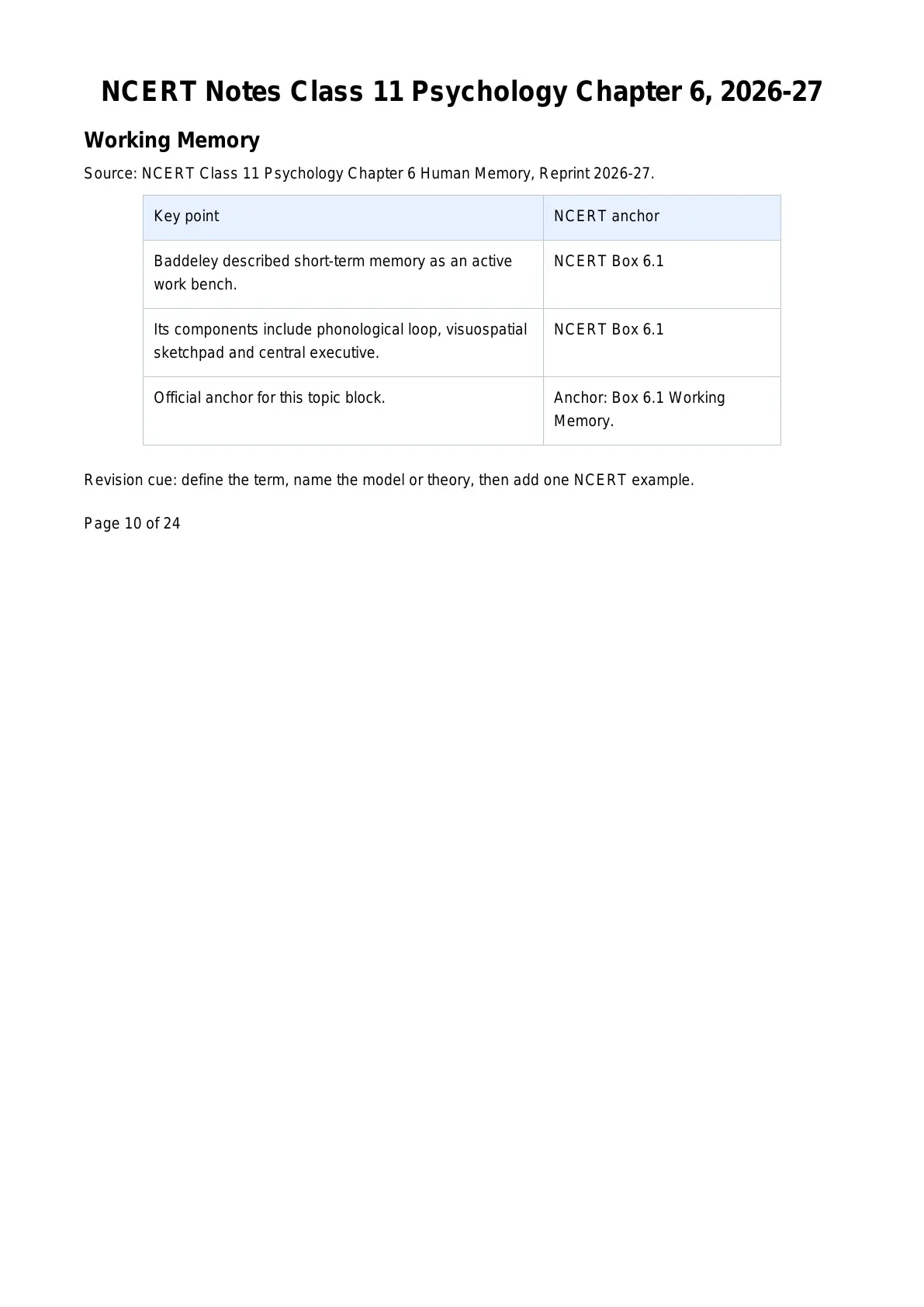
Baddeley described short-term memory as a work bench. The phonological loop handles sounds, the visuospatial sketchpad handles visual and spatial information, and the central executive controls attention and planning.
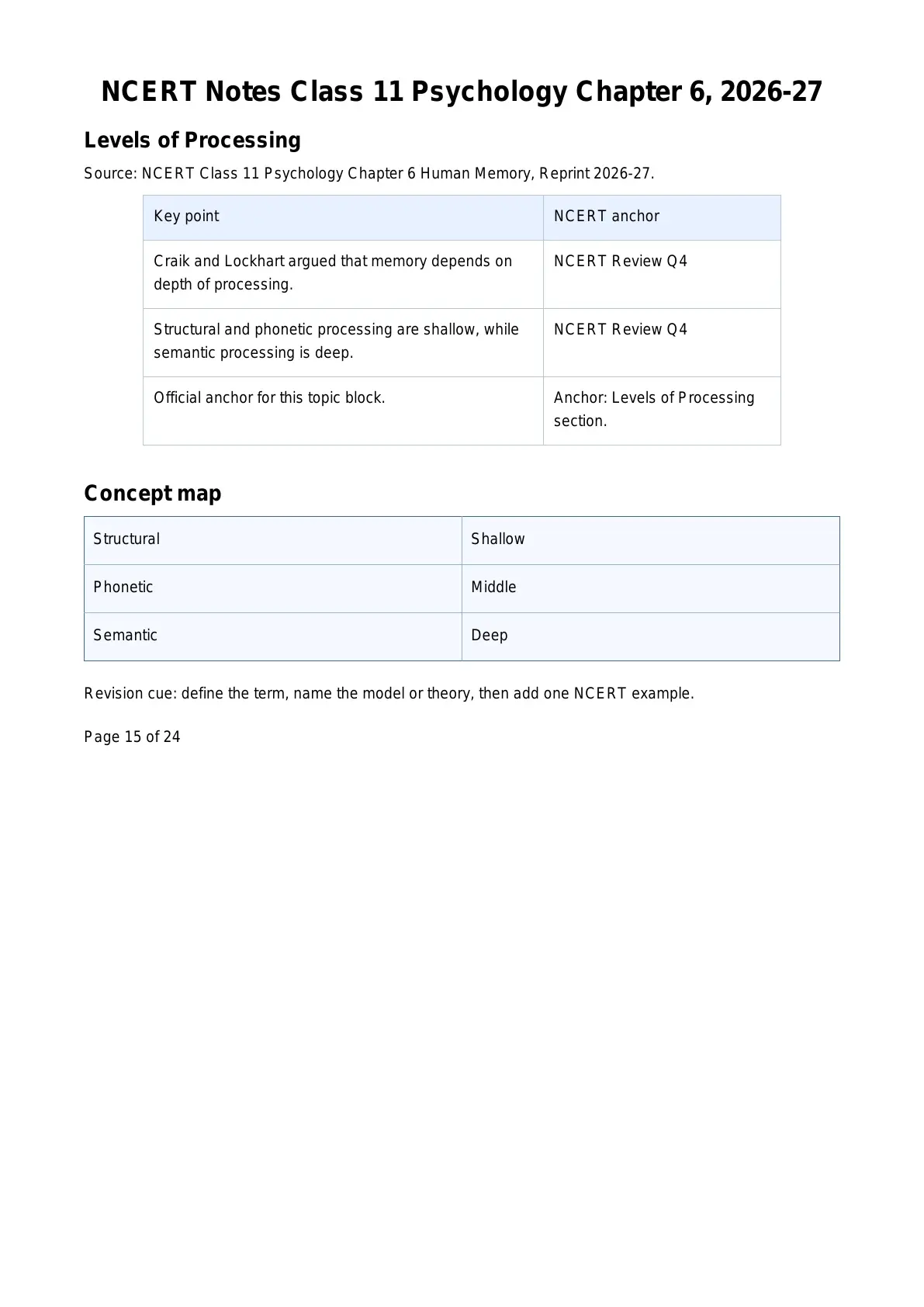
Craik and Lockhart gave the levels of processing view. Structural processing is shallow because it focuses on shape. Phonetic processing focuses on sound. Semantic processing is deepest because it focuses on meaning.
| Level | Focus | Memory result |
|---|---|---|
| Structural | Shape, size or colour | Weak retention |
| Phonetic | Sound of the word | Moderate retention |
| Semantic | Meaning and associations | Stronger retention |
Long-term Memory Types in Human Memory
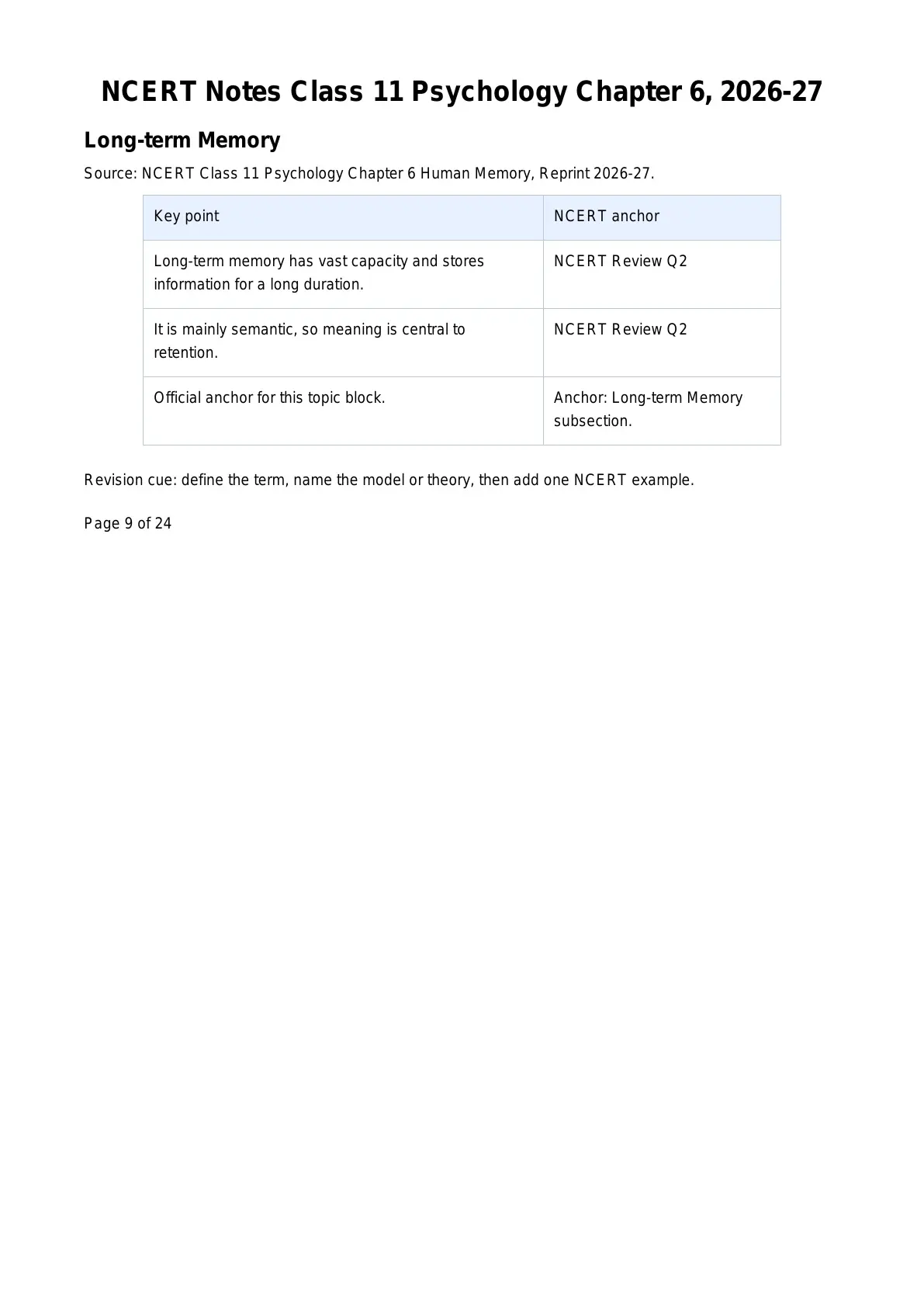
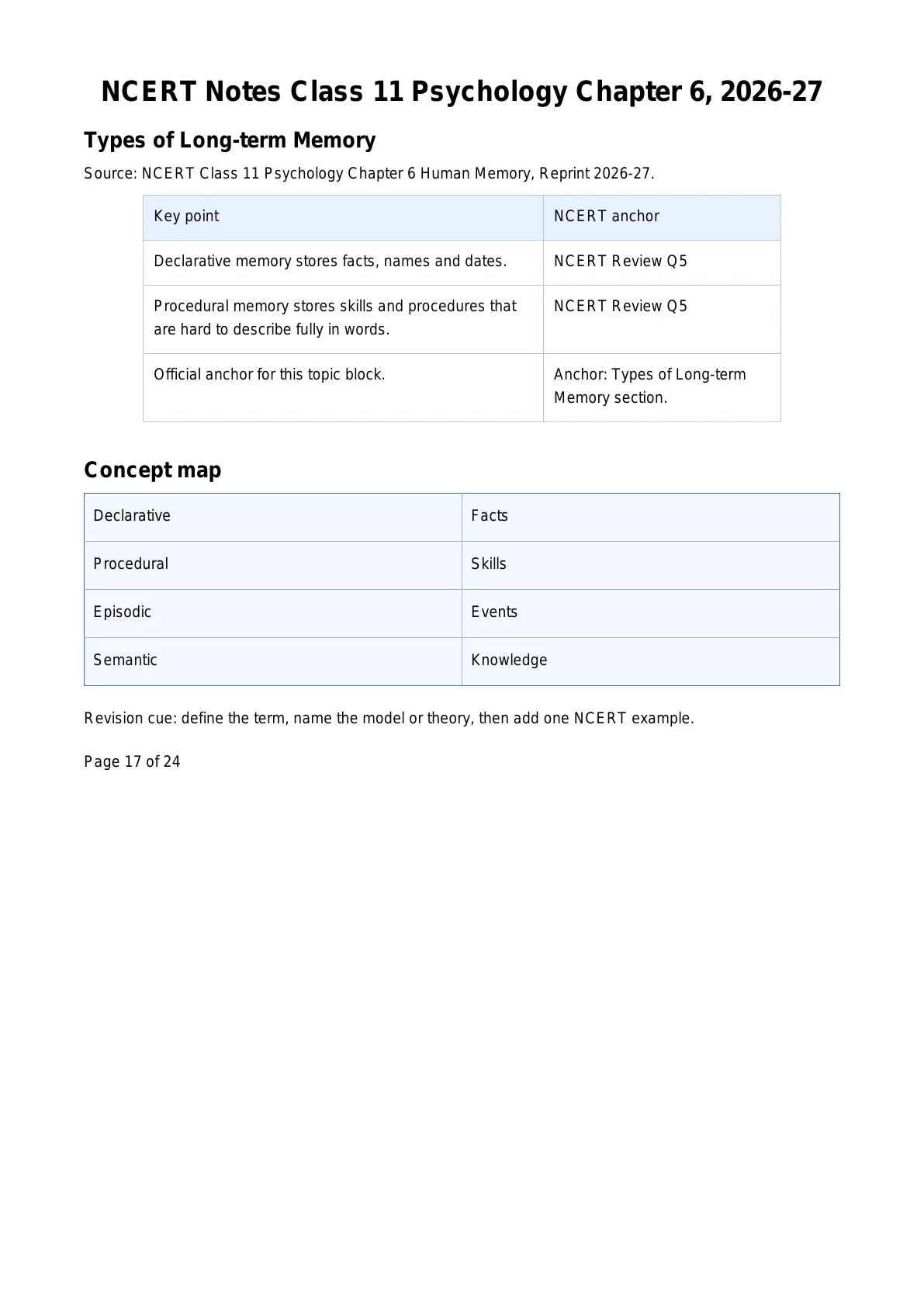
Long-term memory is not one single store. NCERT first separates declarative memory and procedural memory. Declarative memory stores facts, names and dates. Procedural memory stores skills such as cycling, typing or playing a game.
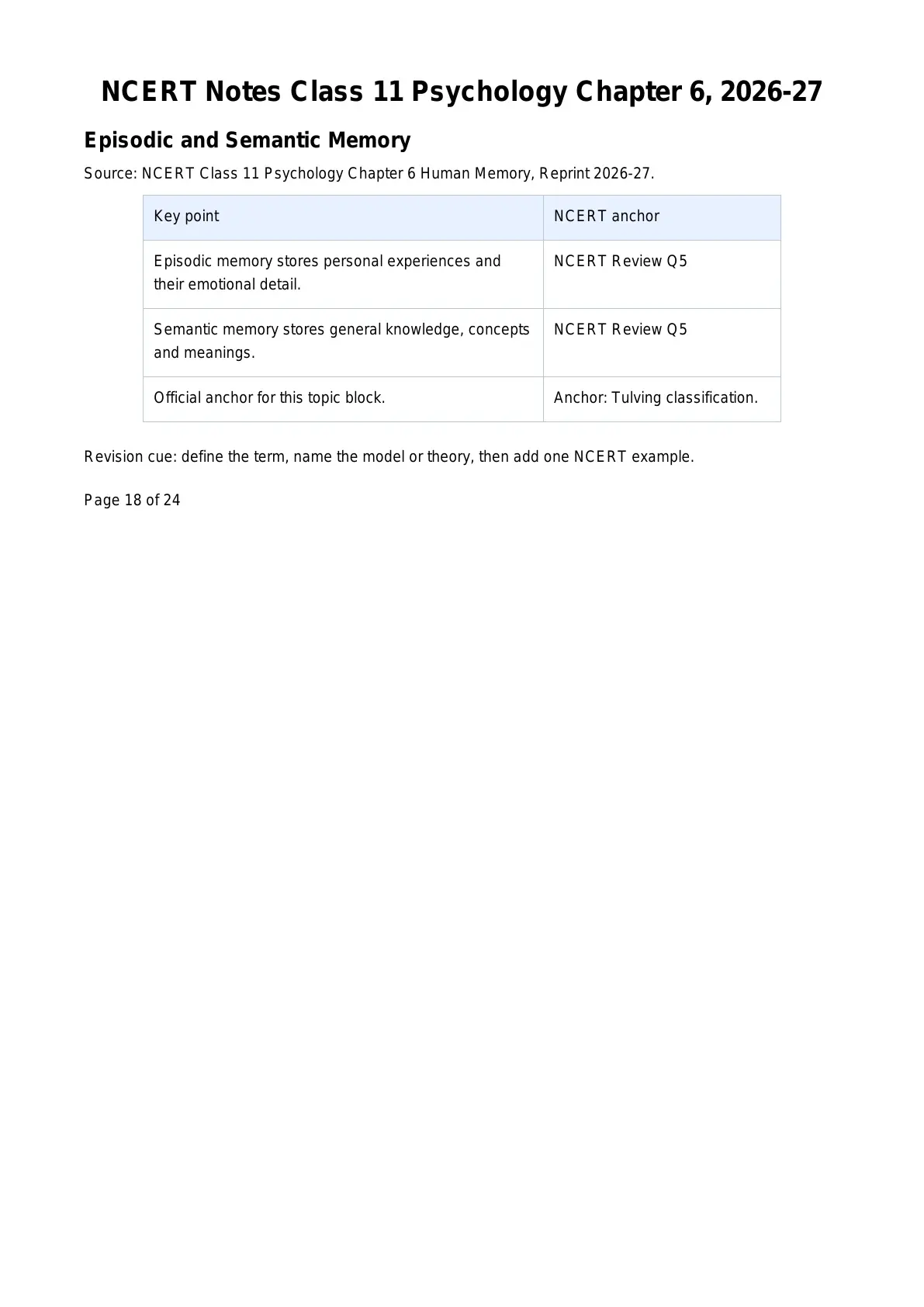
- Episodic memory: personal experiences, usually with emotional detail.
- Semantic memory: general knowledge, meanings and concepts.
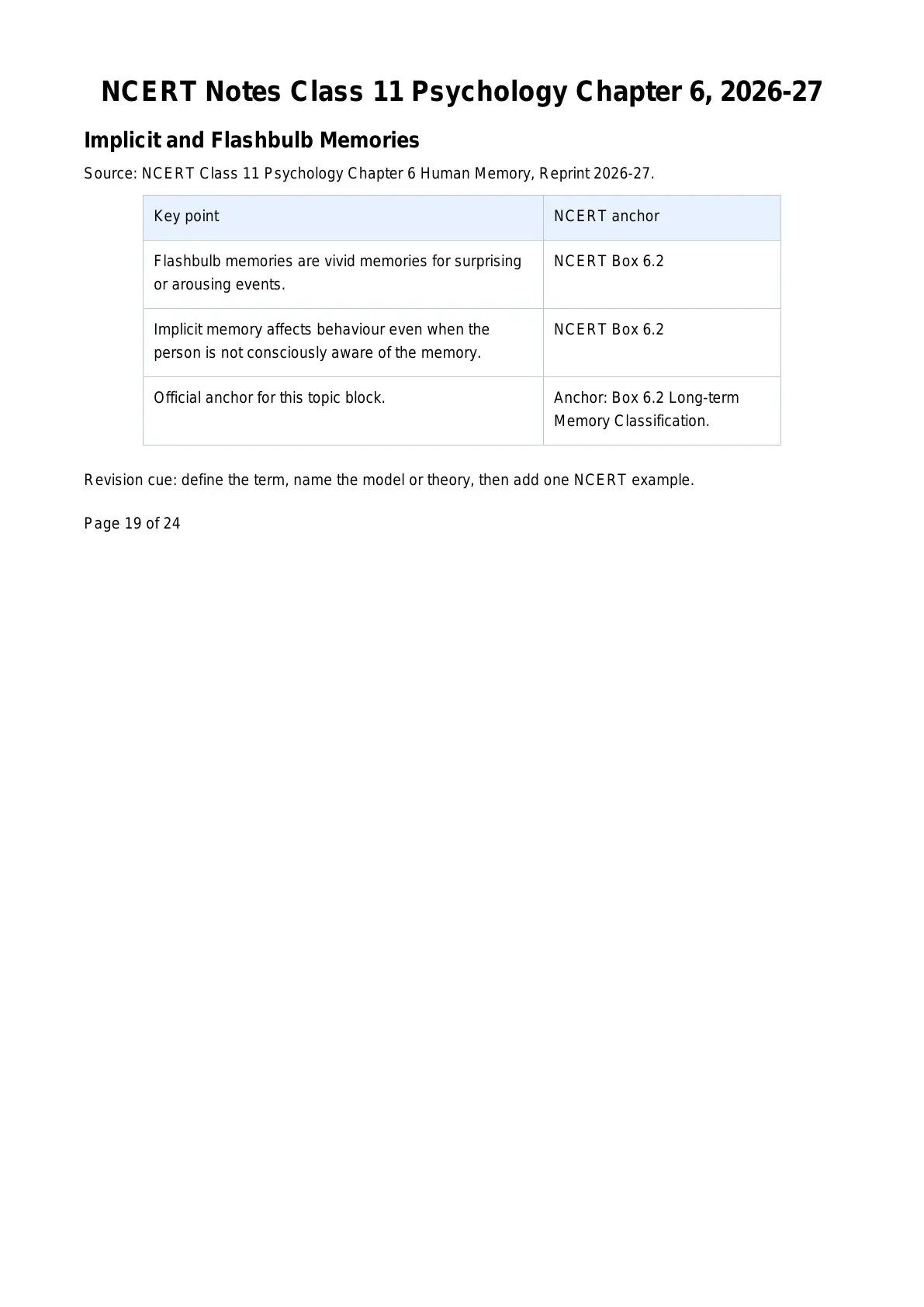
- Flashbulb memory: vivid memory of surprising or arousing events.
- Implicit memory: memory that influences behaviour without conscious awareness.
Forgetting Causes and Memory Improvement
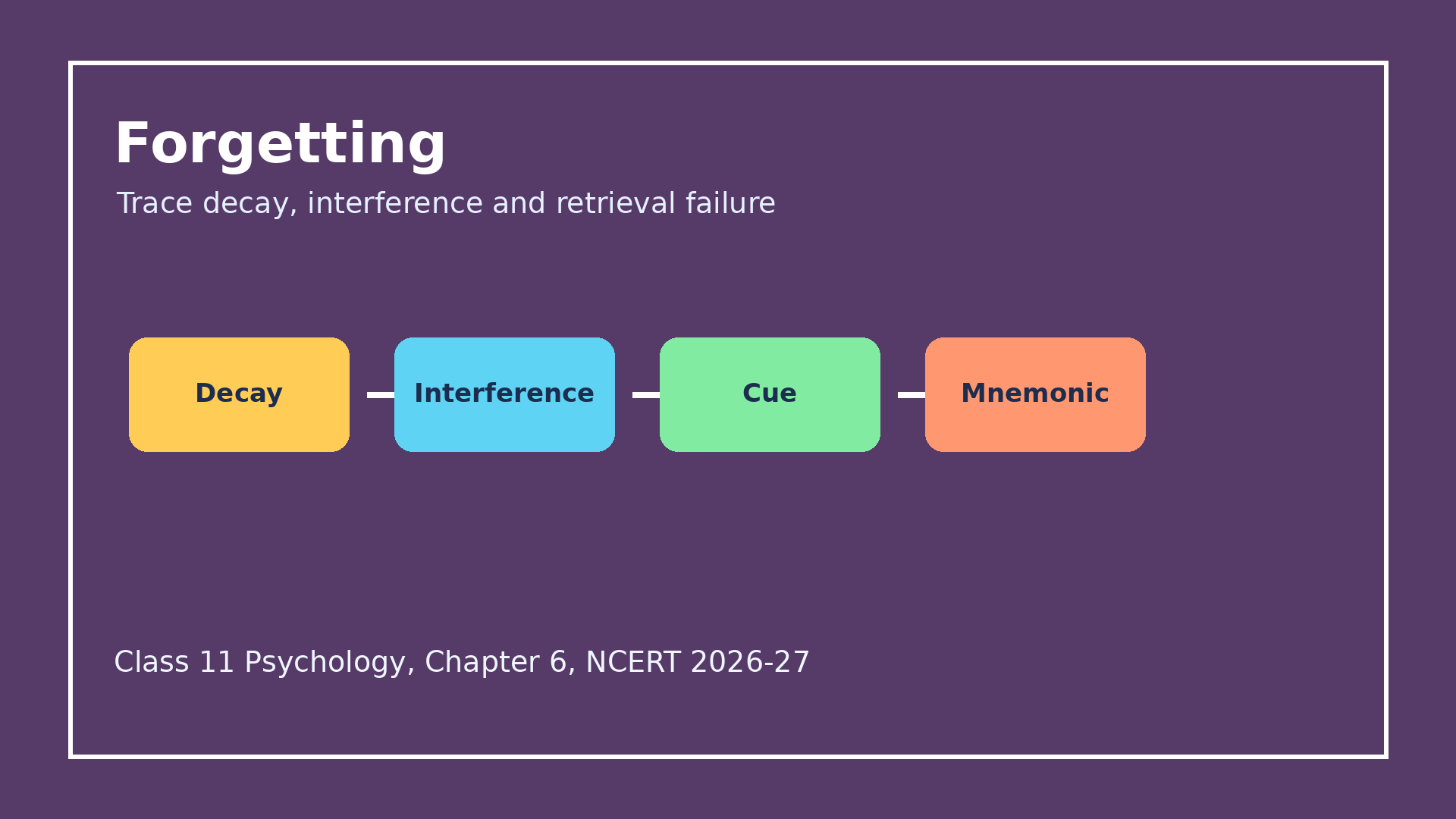
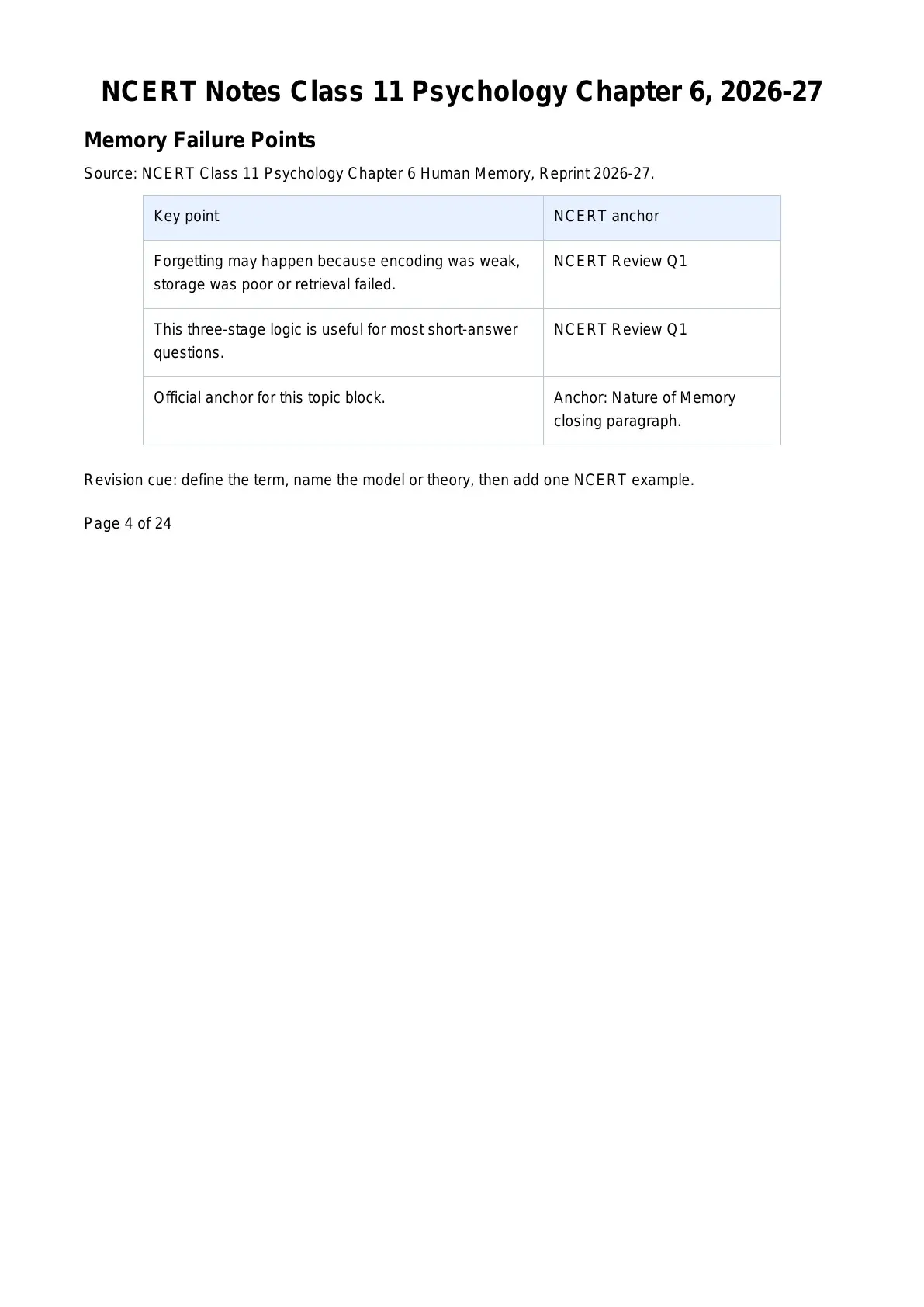
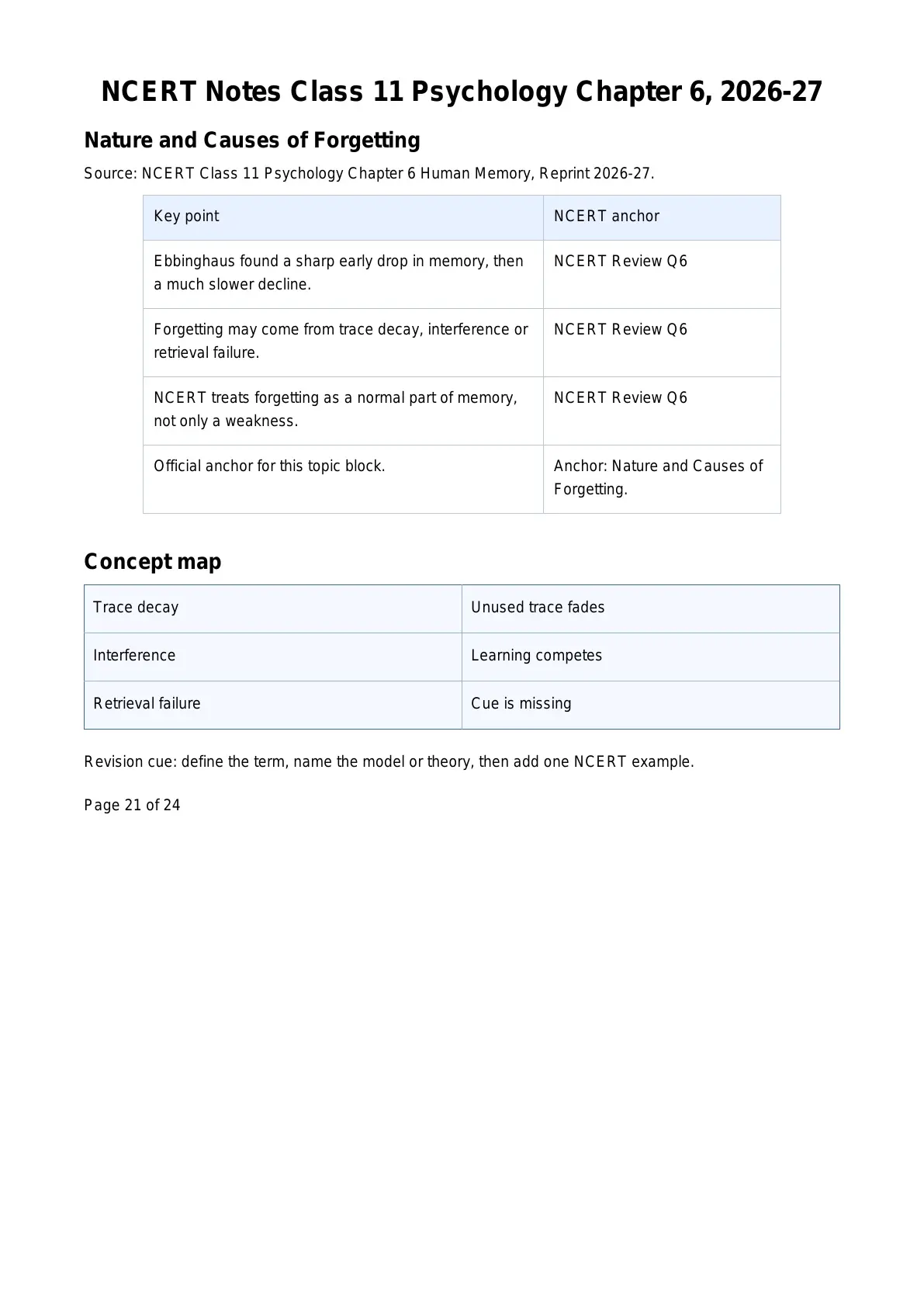
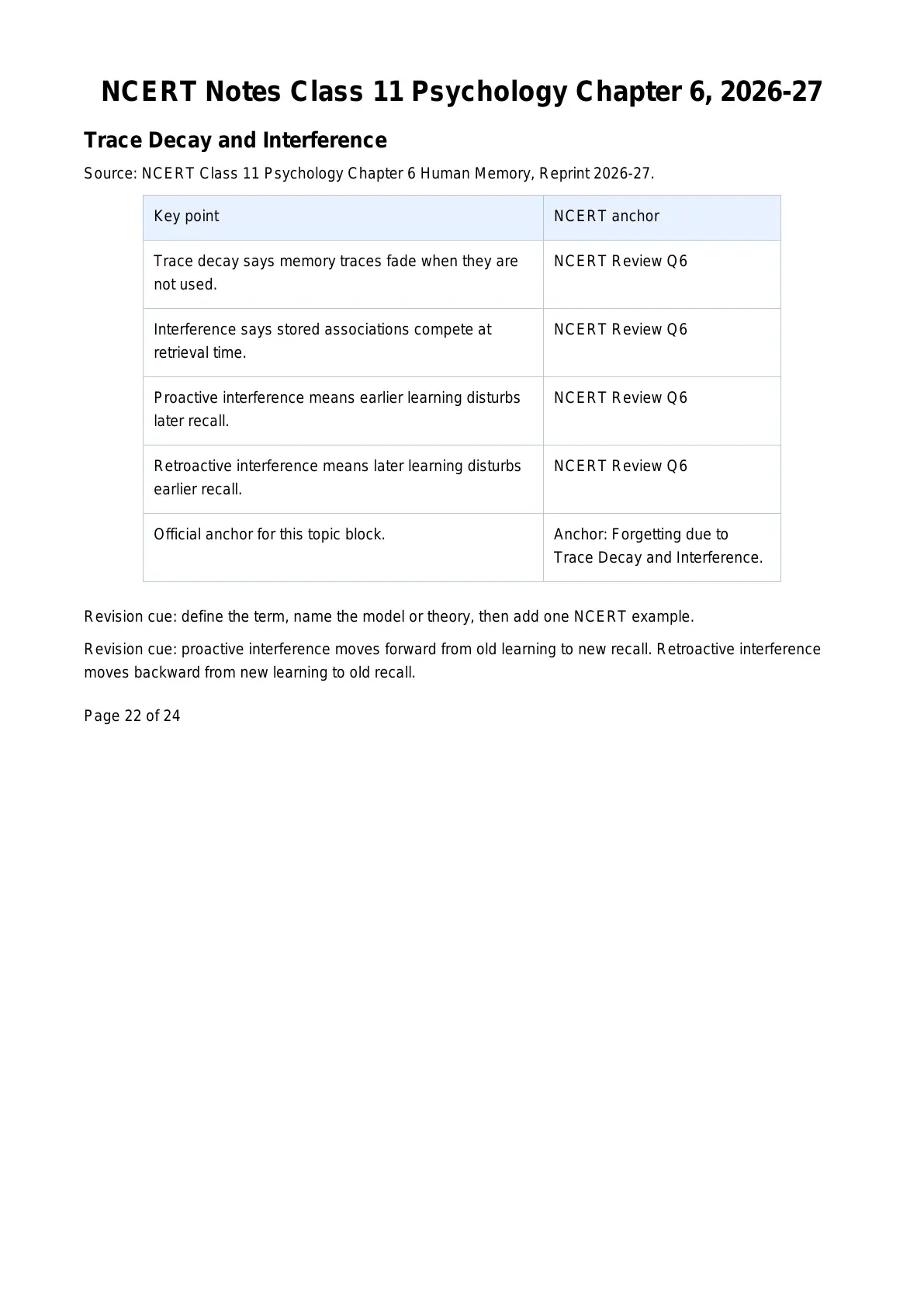
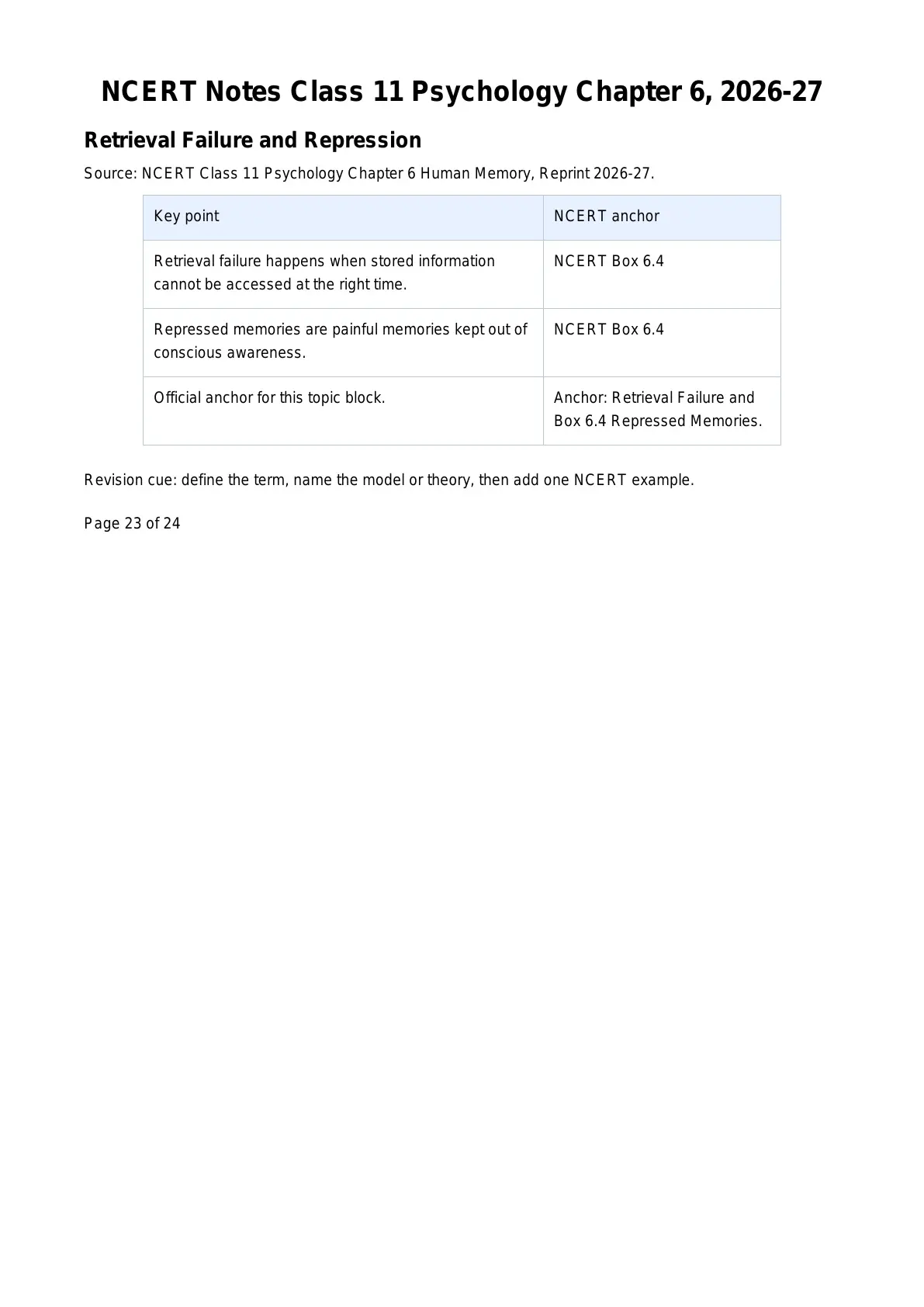
Forgetting is explained through three main causes. Trace decay says unused memory traces fade. Interference says earlier or later learning disturbs recall. Retrieval failure says information is stored but the right cue is missing.
| Cause | Meaning | Student example |
|---|---|---|
| Trace decay | Memory trace weakens over time | Unused facts fade after the test |
| Interference | One learning blocks another | New definitions mix with old ones |
| Retrieval failure | Cue is missing at recall time | Answer returns after a hint |
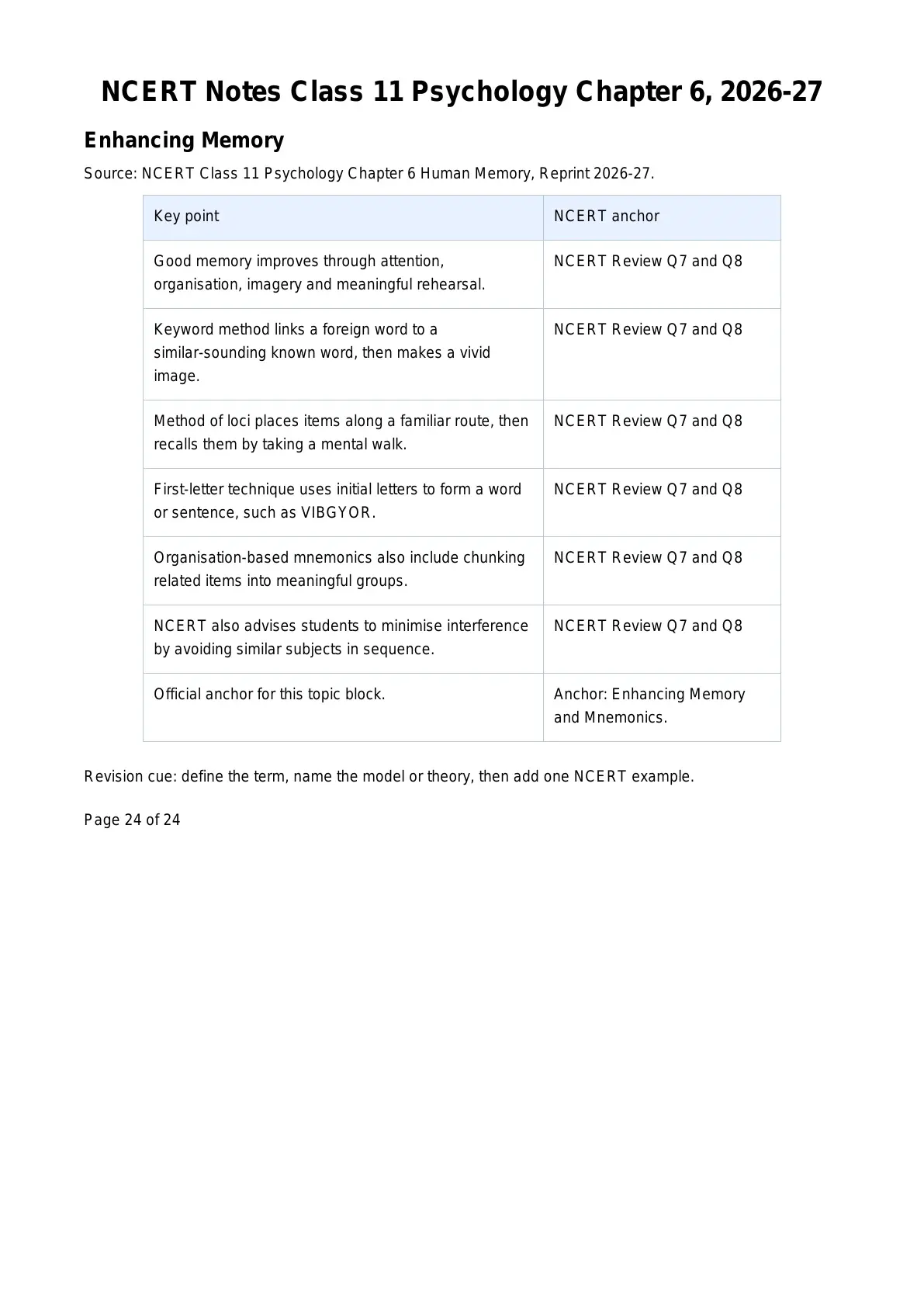
Memory can improve through attention, meaningful rehearsal, organisation and imagery. Image-based mnemonics form mental pictures. Organisation-based mnemonics use categories, hierarchies and first-letter cues.
Human Memory Explained in Simple Language
Source: Magnet Brains on YouTube
Download the Human Memory Notes PDF
Use the PDF for memory stages, models, LTM types, forgetting and mnemonics.
Download PDFRelated Psychology Resources for Human Memory
Also Check: use these links with the notes PDF when you need the same chapter in another format.
| Resource | Best use | Link |
|---|---|---|
| NCERT Solutions | Stepwise answers to textbook questions | Human Memory Class 11 NCERT Solutions |
| NCERT Book PDF | Original NCERT reading and review questions | Human Memory Class 11 NCERT Book PDF |
| Handwritten Notes | Fast visual revision before tests | Human Memory Class 11 Handwritten Notes |
Class 11 Psychology Notes for All Chapters
| Chapter | Notes Link |
|---|---|
| Chapter 1 | What is Psychology? Notes |
| Chapter 2 | Methods of Enquiry in Psychology Notes |
| Chapter 3 | Human Development Notes |
| Chapter 4 | Sensory, Attentional and Perceptual Processes Notes |
| Chapter 5 | Learning Notes |
| Chapter 6 | You are here |
| Chapter 7 | Thinking Notes |
| Chapter 8 | Motivation and Emotion Notes |
Human Memory Class 11 Notes FAQs
Ques. What is covered in Class 11 Psychology Chapter 6 notes?
Ans. The notes cover encoding, storage, retrieval, stage model, working memory, levels of processing, long-term memory types, forgetting and mnemonics.
Ques. What are the three stages of memory?
Ans. The three stages are encoding, storage and retrieval. Encoding records information, storage keeps it and retrieval brings it back for use.
Ques. What is the difference between short-term memory and working memory?
Ans. Short-term memory is a limited temporary store. Working memory is an active system that holds and manipulates information during thinking tasks.
Ques. Why do students forget learnt material?
Ans. Forgetting may happen because traces decay, similar learning interferes or the right retrieval cue is missing at recall time.



Comments