The NCERT Solutions for Class 11 Psychology Chapter 6 Human Memory cover all 7 textbook review questions from the latest 2026-27 NCERT book. The chapter explains encoding, storage, retrieval, memory stores, rehearsal, declarative memory, procedural memory, forgetting and mnemonics.
Student Feedback: In a Collegedunia poll of 10,240 Class 11 Psychology students preparing for the 2026 school exams, 71% said they understood basic memory terms but mixed up sensory memory, short-term memory, long-term memory and rehearsal types in long answers.
Source: 2026-27 Class 11 Psychology student poll across CBSE schools.
Every answer in this chapter set is checked against the 2026-27 NCERT Psychology textbook and written so that students can revise the concept, example and exam framing together.
Covers every review question with a direct solution and a detailed expert explanation.
Focuses on encoding, storage, retrieval, stage model, rehearsal, long-term memory, forgetting and mnemonics.
Useful for school exams because each answer connects the NCERT term with one clear memory example.
Human Memory Chapter 6 Key Concepts and Question Map
Chapter 6 treats memory as a set of processes that help a person register, retain and use information. For exam answers, the safest method is to name the memory process first, explain its function, and then add the NCERT example or comparison asked in the question.
Chapter area
What students must know
Where it helps
Memory processes
Encoding, storage and retrieval as three linked operations
Question 1
Stage model
Sensory memory, short-term memory and long-term memory
Question 2
Control processes
Attention, maintenance rehearsal, elaborative rehearsal and chunking
Questions 2 and 3
Long-term memory
Declarative and procedural memory with examples
Question 4
Forgetting
Trace decay, interference and retrieval failure
Questions 5 and 6
Memory improvement
Image-based and organisation-based mnemonics
Question 7
Use the NCERT vocabulary exactly: encoding, storage, retrieval, sensory memory, short-term memory, long-term memory, elaborative rehearsal, retrieval cues and mnemonics. These terms make answers precise and stop examples from sounding generic.
The first answer in the solved PDF builds the base of the chapter. Encoding records information in a usable form. Storage keeps that information over time. Retrieval brings stored information back when it is needed for an answer, decision, conversation or exam task.
Encoding: the learner gives meaning to an incoming stimulus.
Storage: the memory system retains the encoded information.
Retrieval: the learner brings stored information back into awareness.
These three processes also explain common exam problems. A weak answer may happen because the topic was not encoded meaningfully, was not stored through revision, or could not be retrieved because the right cue was missing.
Memory Systems in the Stage Model
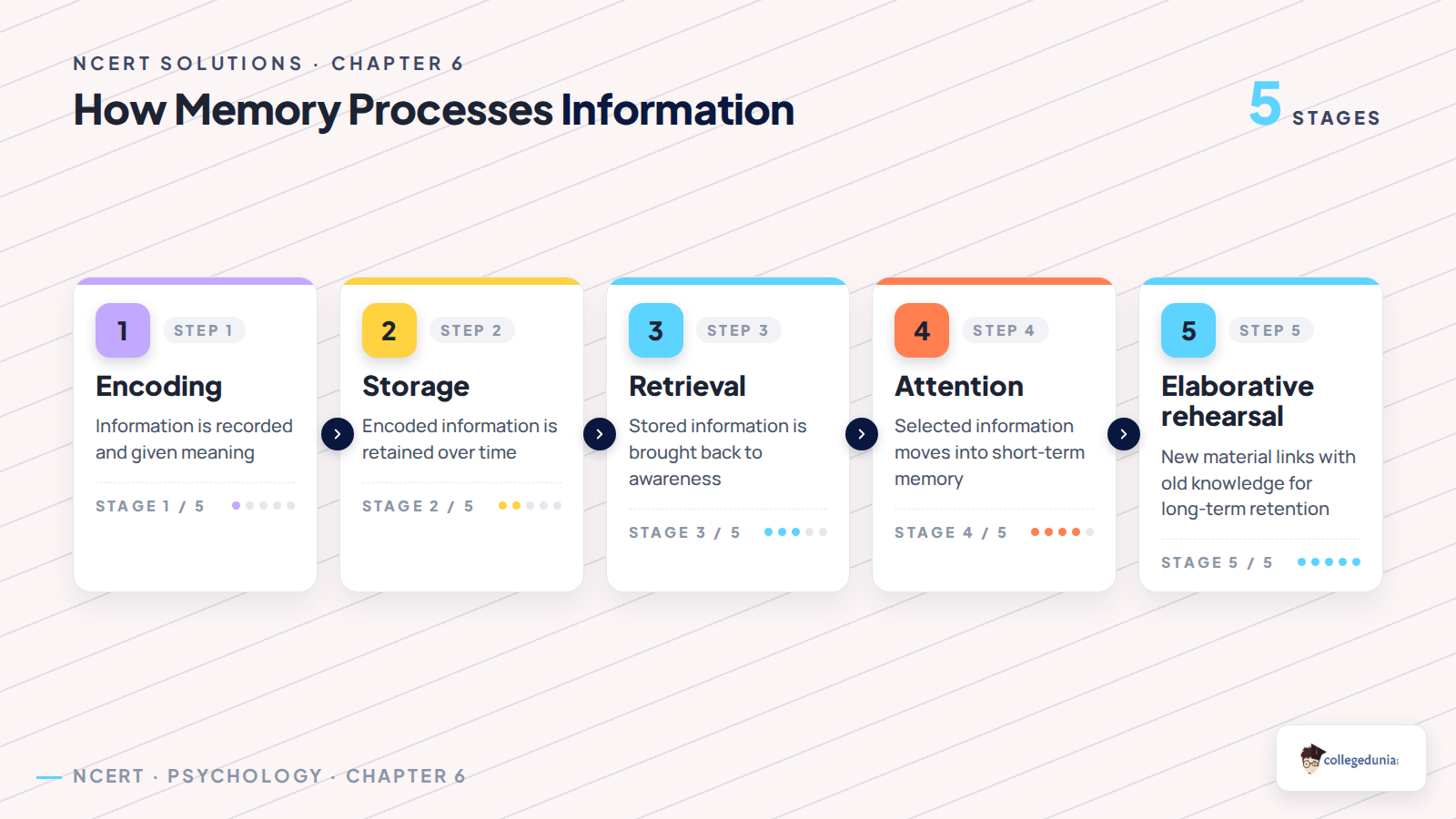
The stage model explains how information moves through sensory memory, short-term memory and long-term memory. Sensory memory holds incoming impressions very briefly. Attention selects a part of this information for short-term memory. Rehearsal and elaboration then help some information enter long-term memory.
Memory system
NCERT focus
Exam cue
Sensory memory
Large capacity but very short duration
Iconic and echoic traces
Short-term memory
Limited capacity and brief holding
Maintenance rehearsal and chunking
Long-term memory
Vast capacity and durable storage
Mainly meaning-based encoding
When a question asks how information is processed, do not only list the three systems. Show the route: sensory input, attention, short-term holding, rehearsal, elaborative rehearsal, long-term storage and later retrieval.
Maintenance and Elaborative Rehearsal in Human Memory
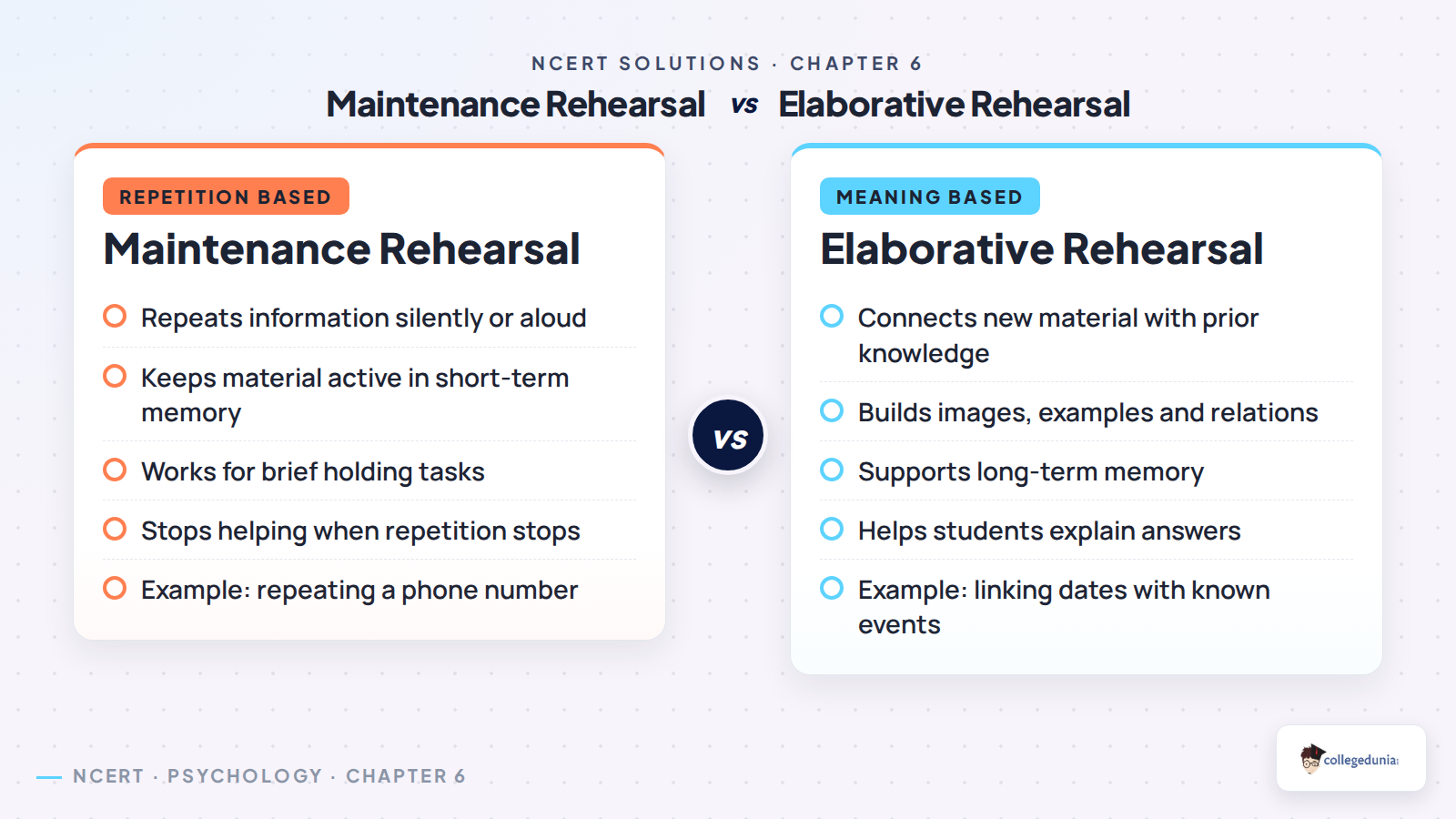
Maintenance rehearsal and elaborative rehearsal are often confused. Maintenance rehearsal is simple repetition. It keeps information active for a short time but does not necessarily make the material meaningful. Elaborative rehearsal connects the new material with meaning, examples, images, categories or earlier knowledge.
Maintenance rehearsal: repeating a phone number until it is dialled.
Elaborative rehearsal: linking a date, term or definition with a meaningful example.
Exam point: elaborative rehearsal supports long-term memory better because it creates deeper processing.
The solved answer uses this comparison because the question asks for a difference, not only two definitions. A strong school answer should include function, method, duration and one example for each rehearsal type.
Declarative Procedural and Forgetting Questions
Long-term memory is also classified by the type of information stored. Declarative memory stores facts, events, meanings and ideas that can be consciously stated. Procedural memory stores learned skills and action sequences, such as typing or riding a bicycle.
Concept
Meaning
Useful example
Declarative memory
Memory of facts, meanings and events
Knowing the definition of retrieval
Procedural memory
Memory of how to perform an action
Typing, cycling or driving
Interference
One memory disturbs another
Old password blocks a new password
Retrieval failure
Stored memory cannot be accessed
Remembering an answer after a cue appears
Forgetting questions should be framed carefully. Trace decay explains weakening over time, interference explains competition between memories, and retrieval failure explains missing cues. The PDF separates these causes so students can write comparison answers without mixing them.
Mnemonics and Better Human Memory Answers
NCERT closes the chapter with memory improvement. Mnemonics are strategies that make learning more meaningful, organised or image-based. A good memory plan should use attention, grouping, imagery, first-letter cues, spaced revision and self-testing.
Image-based methods: keyword method and method of loci.
Organisation-based methods: chunking, first-letter technique and narrative chaining.
Revision habit: revise after gaps and test recall without looking at the book.
In application questions, write a real plan instead of only defining mnemonics. Divide the chapter into units, build comparison tables, create cues, revise across days, and check the NCERT wording after self-testing.
Related Psychology Resources for Human Memory
Use the solutions PDF for answers, then move to the NCERT book, notes and handwritten notes when you want to revise the same chapter in a different format.
All NCERT Solutions for Class 11 Psychology Chapter 6 Human Memory with Step-by-Step Solutions
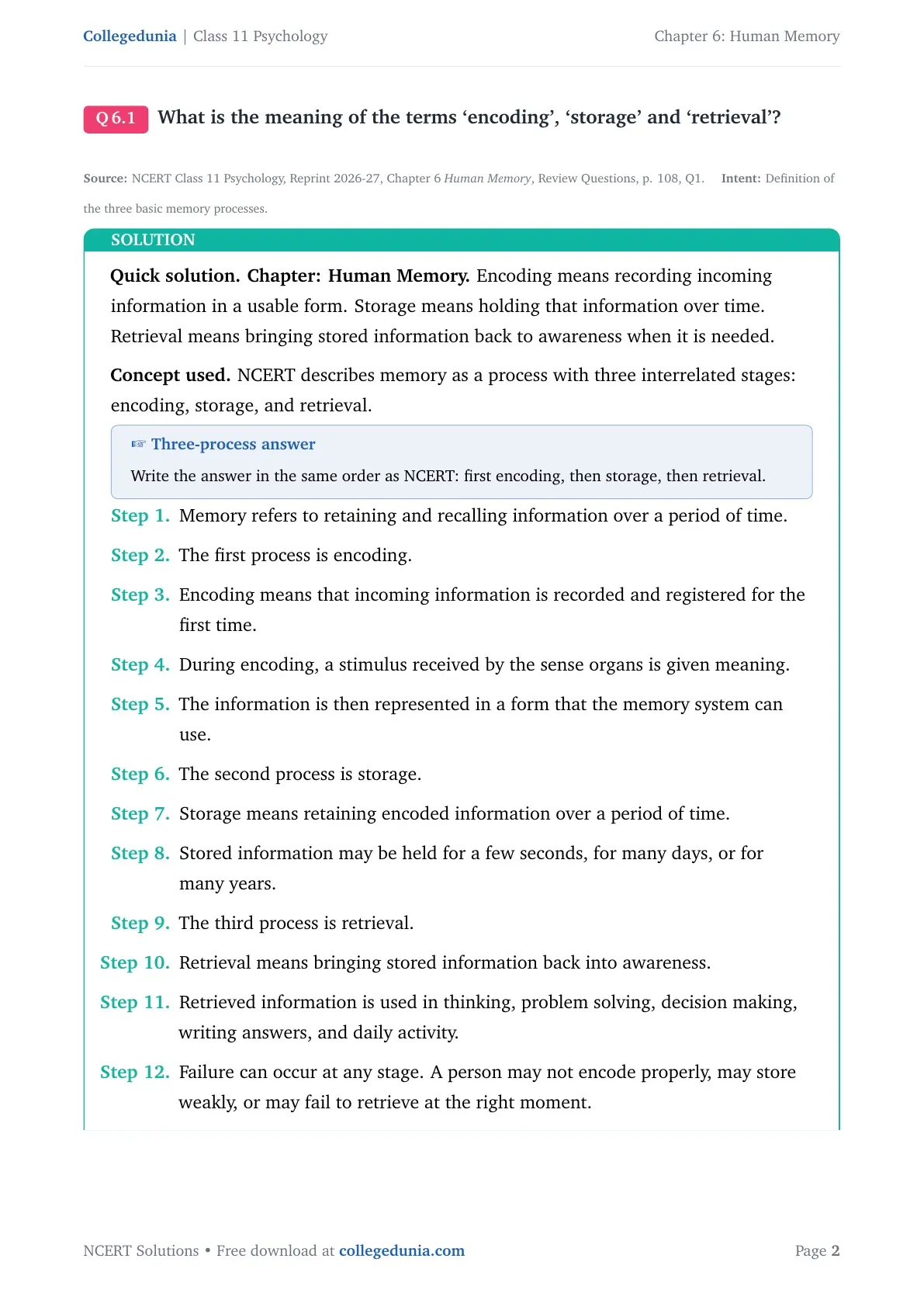
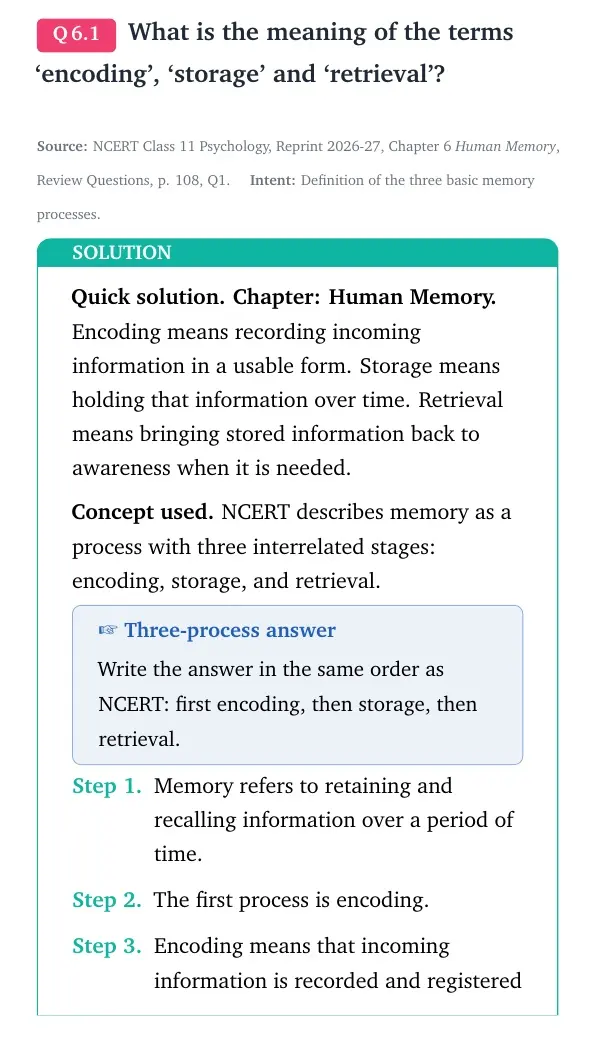
Q 6.1
What is the meaning of the terms `encoding', `storage' and `retrieval'?
Encoding means recording incoming information in a usable form. Storage means holding that information over time. Retrieval means bringing stored information back to awareness when it is needed. Concept used. NCERT describes memory as a process with three interrelated stages: encoding, storage, and retrieval.
Three-process answer
Write the answer in the same order as NCERT: first encoding, then storage, then retrieval.
Memory refers to retaining and recalling information over a period of time.
The first process is encoding.
Encoding means that incoming information is recorded and registered for the first time.
During encoding, a stimulus received by the sense organs is given meaning.
The information is then represented in a form that the memory system can use.
The second process is storage.
Storage means retaining encoded information over a period of time.
Stored information may be held for a few seconds, for many days, or for many years.
The third process is retrieval.
Retrieval means bringing stored information back into awareness.
Retrieved information is used in thinking, problem solving, decision making, writing answers, and daily activity.
Failure can occur at any stage. A person may not encode properly, may store weakly, or may fail to retrieve at the right moment.
Encoding is recording information in a meaningful and usable form. Storage is retaining it over time. Retrieval is recovering it from memory so that it can be used.
NM
Nisha Menon
M.A. Psychology, University of Delhi
Verified Expert
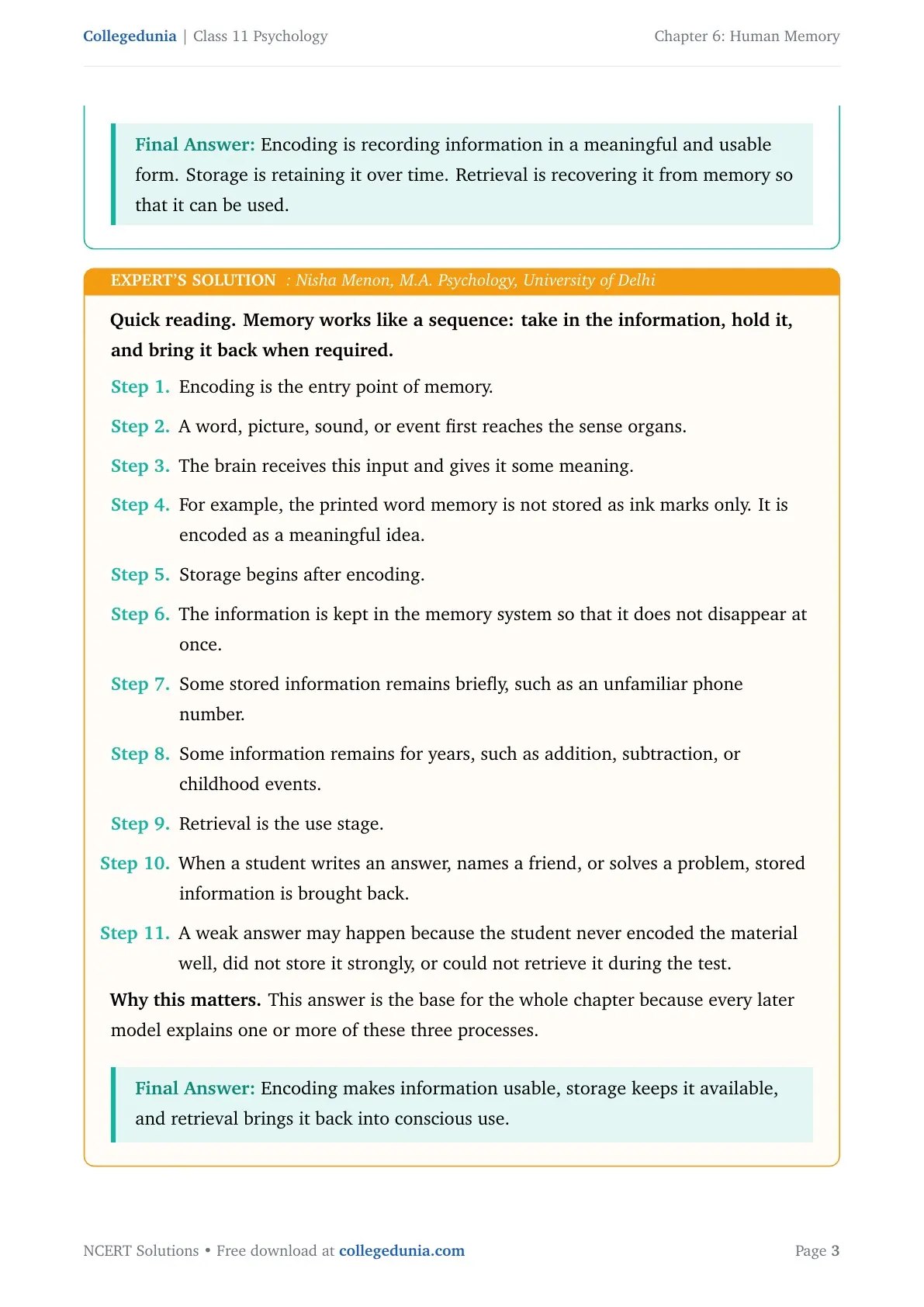
Quick reading. Memory works like a sequence: take in the information, hold it, and bring it back when required.
Encoding is the entry point of memory.
A word, picture, sound, or event first reaches the sense organs.
The brain receives this input and gives it some meaning.
For example, the printed word memory is not stored as ink marks only. It is encoded as a meaningful idea.
Storage begins after encoding.
The information is kept in the memory system so that it does not disappear at once.
Some stored information remains briefly, such as an unfamiliar phone number.
Some information remains for years, such as addition, subtraction, or childhood events.
Retrieval is the use stage.
When a student writes an answer, names a friend, or solves a problem, stored information is brought back.
A weak answer may happen because the student never encoded the material well, did not store it strongly, or could not retrieve it during the test.
Why this matters. This answer is the base for the whole chapter because every later model explains one or more of these three processes.
Encoding makes information usable, storage keeps it available, and retrieval brings it back into conscious use.
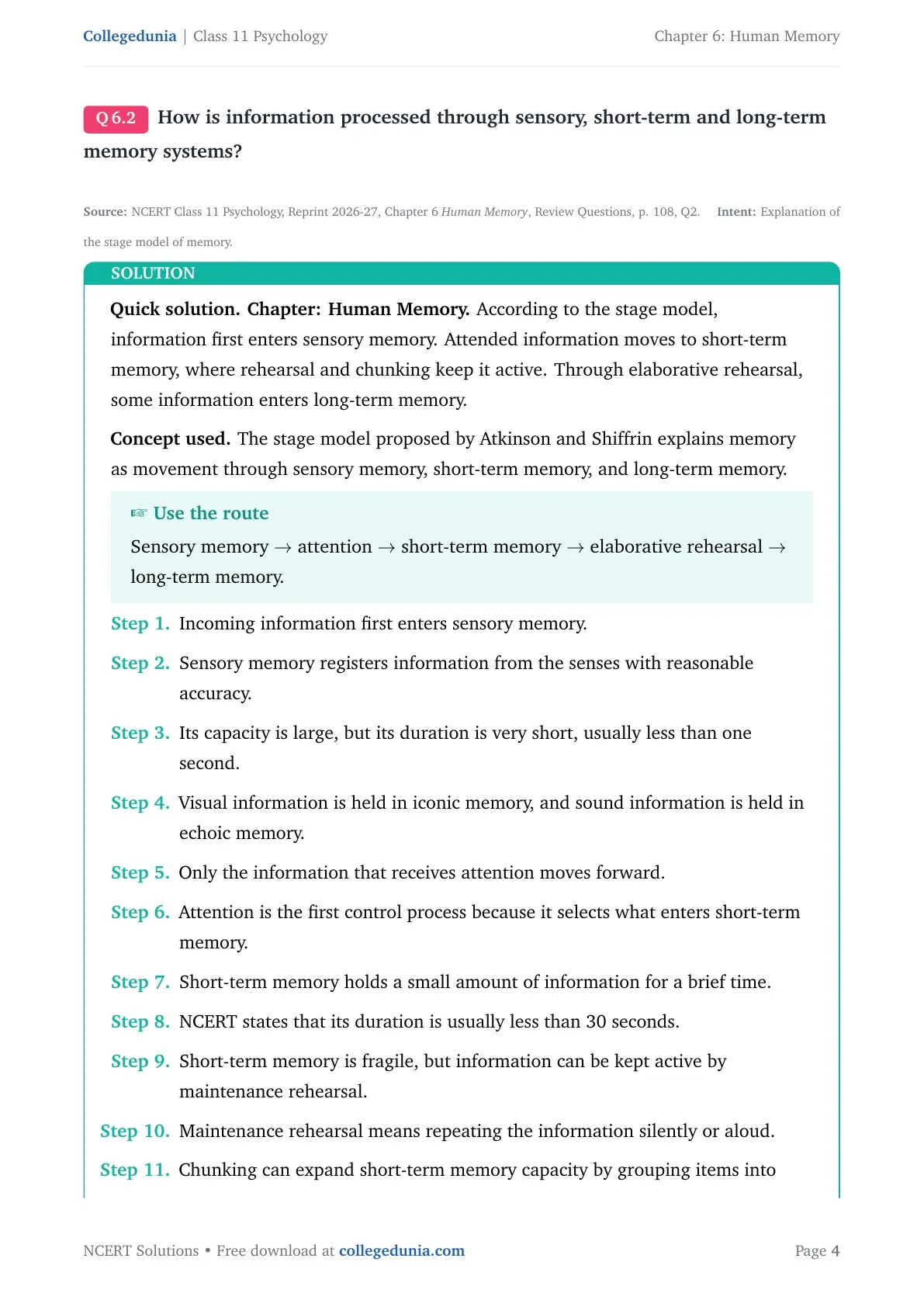
Q 6.2
How is information processed through sensory, short-term and long-term memory systems?
According to the stage model, information first enters sensory memory. Attended information moves to short-term memory, where rehearsal and chunking keep it active. Through elaborative rehearsal, some information enters long-term memory. Concept used. The stage model proposed by Atkinson and Shiffrin explains memory as movement through sensory memory, short-term memory, and long-term memory.
Sensory memory registers information from the senses with reasonable accuracy.
Its capacity is large, but its duration is very short, usually less than one second.
Visual information is held in iconic memory, and sound information is held in echoic memory.
Only the information that receives attention moves forward.
Attention is the first control process because it selects what enters short-term memory.
Short-term memory holds a small amount of information for a brief time.
NCERT states that its duration is usually less than 30 seconds.
Short-term memory is fragile, but information can be kept active by maintenance rehearsal.
Maintenance rehearsal means repeating the information silently or aloud.
Chunking can expand short-term memory capacity by grouping items into meaningful units.
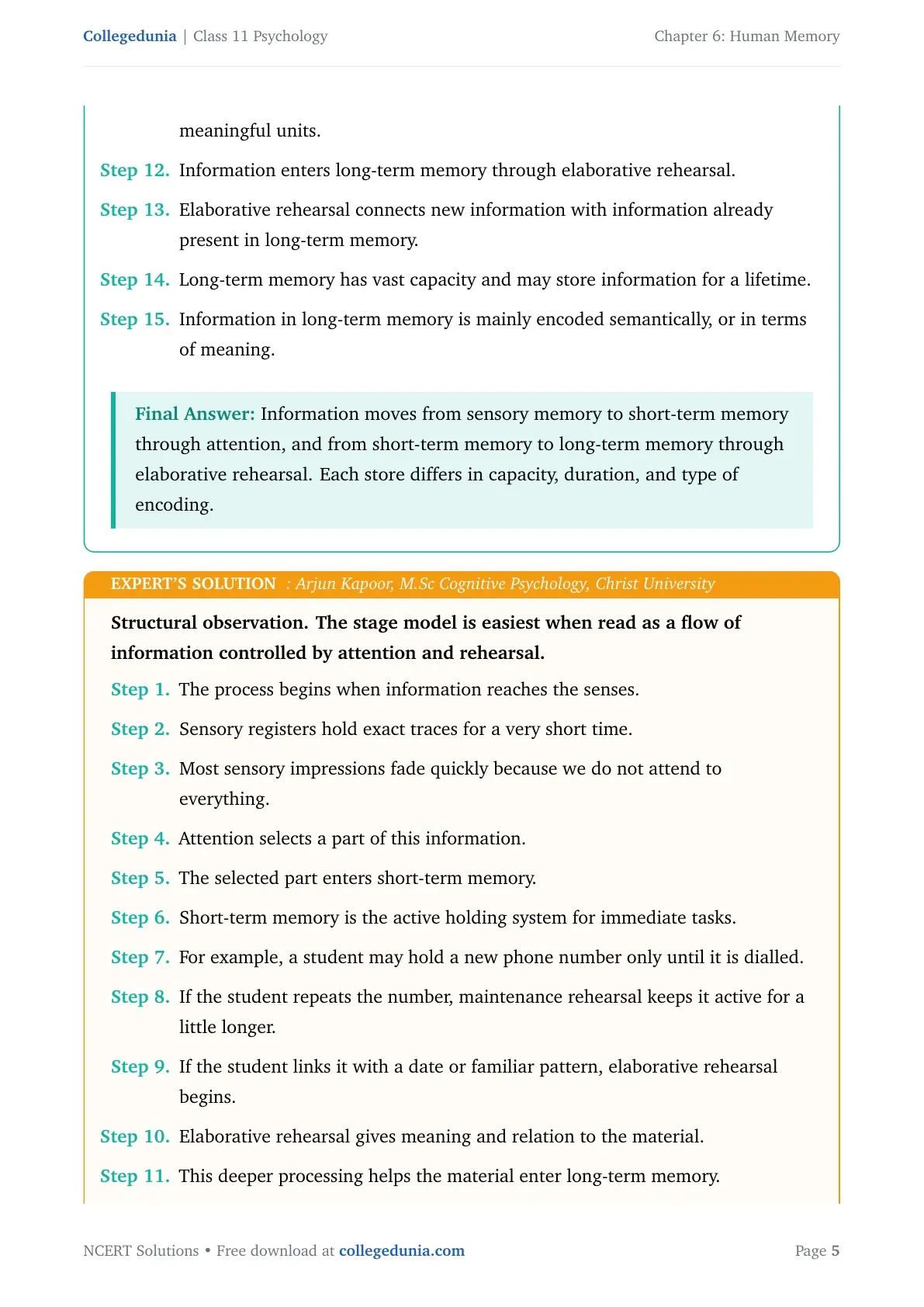
Information enters long-term memory through elaborative rehearsal.
Elaborative rehearsal connects new information with information already present in long-term memory.
Long-term memory has vast capacity and may store information for a lifetime.
Information in long-term memory is mainly encoded semantically, or in terms of meaning.
Information moves from sensory memory to short-term memory through attention, and from short-term memory to long-term memory through elaborative rehearsal. Each store differs in capacity, duration, and type of encoding.
AK
Arjun Kapoor
M.Sc Cognitive Psychology, Christ University
Verified Expert
Structural observation. The stage model is easiest when read as a flow of information controlled by attention and rehearsal.
The process begins when information reaches the senses.
Sensory registers hold exact traces for a very short time.
Most sensory impressions fade quickly because we do not attend to everything.
Attention selects a part of this information.
The selected part enters short-term memory.
Short-term memory is the active holding system for immediate tasks.
For example, a student may hold a new phone number only until it is dialled.
If the student repeats the number, maintenance rehearsal keeps it active for a little longer.
If the student links it with a date or familiar pattern, elaborative rehearsal begins.
Elaborative rehearsal gives meaning and relation to the material.
This deeper processing helps the material enter long-term memory.
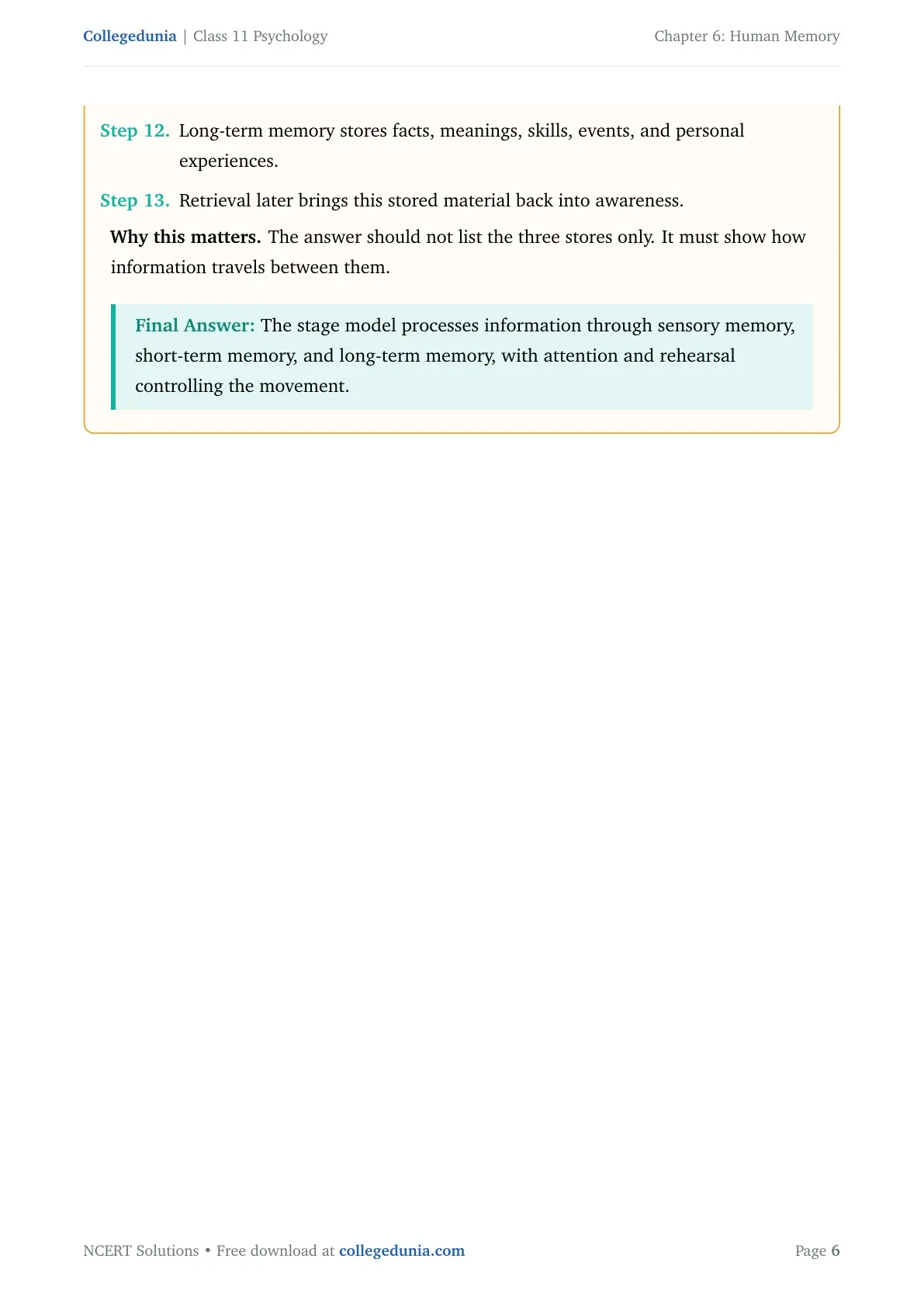
Long-term memory stores facts, meanings, skills, events, and personal experiences.
Retrieval later brings this stored material back into awareness.
Why this matters. The answer should not list the three stores only. It must show how information travels between them.
The stage model processes information through sensory memory, short-term memory, and long-term memory, with attention and rehearsal controlling the movement.
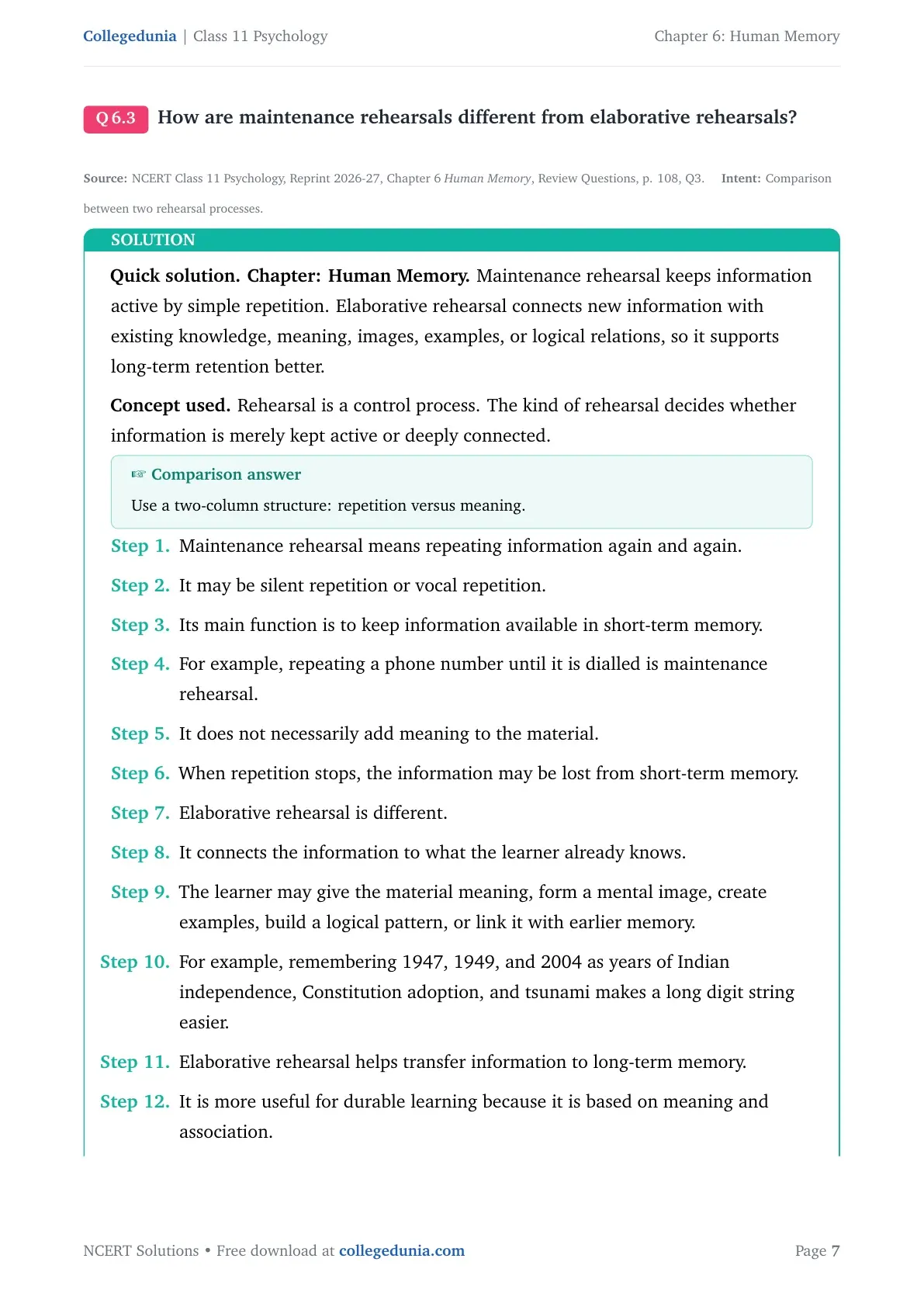
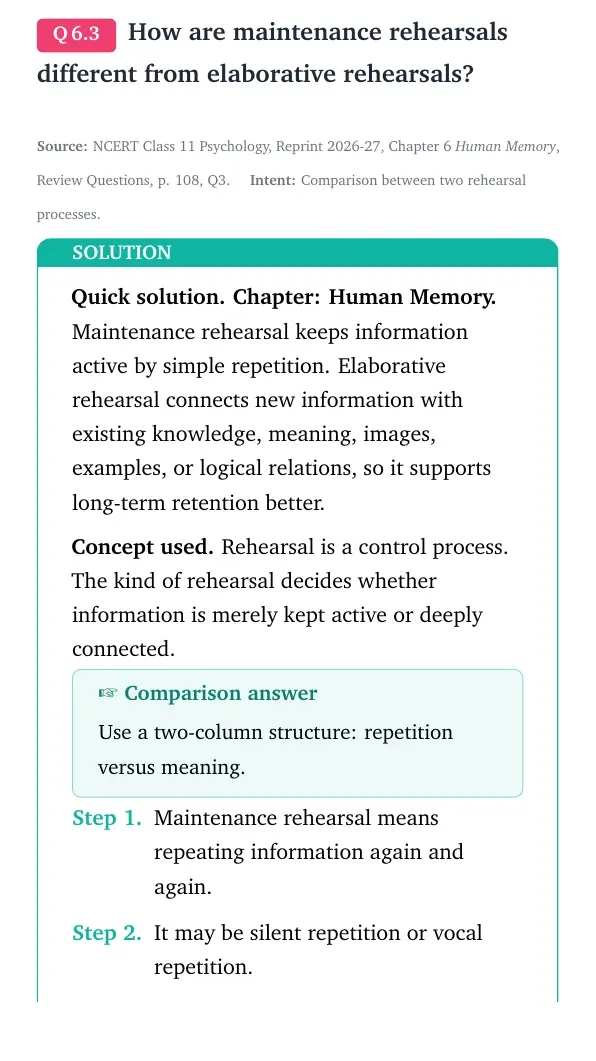
Q 6.3
How are maintenance rehearsals different from elaborative rehearsals?
Maintenance rehearsal keeps information active by simple repetition. Elaborative rehearsal connects new information with existing knowledge, meaning, images, examples, or logical relations, so it supports long-term retention better. Concept used. Rehearsal is a control process. The kind of rehearsal decides whether information is merely kept active or deeply connected.
Comparison answer
Use a two-column structure: repetition versus meaning.
Maintenance rehearsal means repeating information again and again.
It may be silent repetition or vocal repetition.
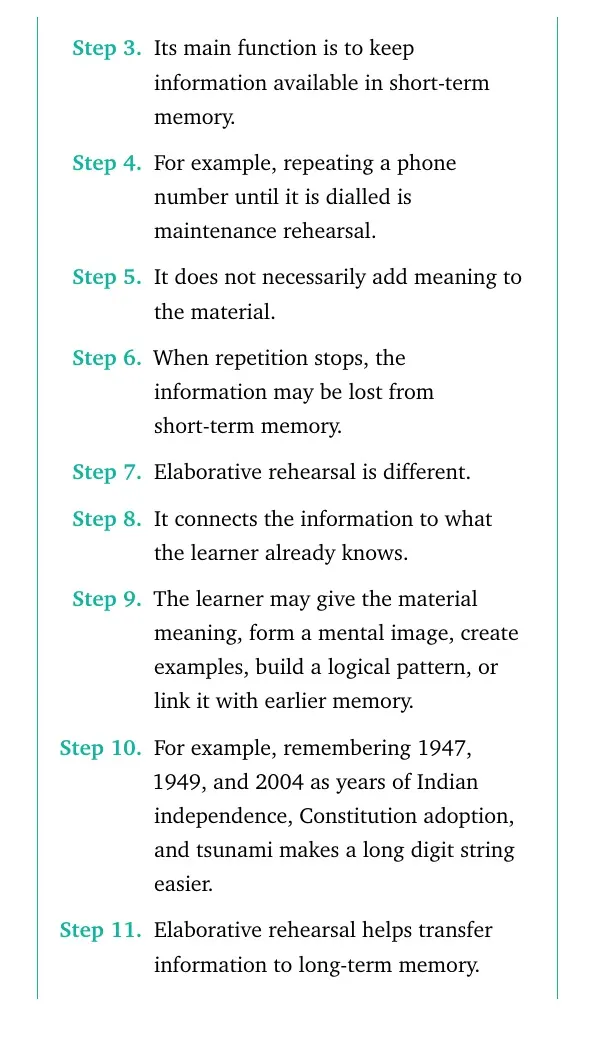
Its main function is to keep information available in short-term memory.
For example, repeating a phone number until it is dialled is maintenance rehearsal.
It does not necessarily add meaning to the material.
When repetition stops, the information may be lost from short-term memory.
Elaborative rehearsal is different.
It connects the information to what the learner already knows.
The learner may give the material meaning, form a mental image, create examples, build a logical pattern, or link it with earlier memory.
For example, remembering 1947, 1949, and 2004 as years of Indian independence, Constitution adoption, and tsunami makes a long digit string easier.
Elaborative rehearsal helps transfer information to long-term memory.
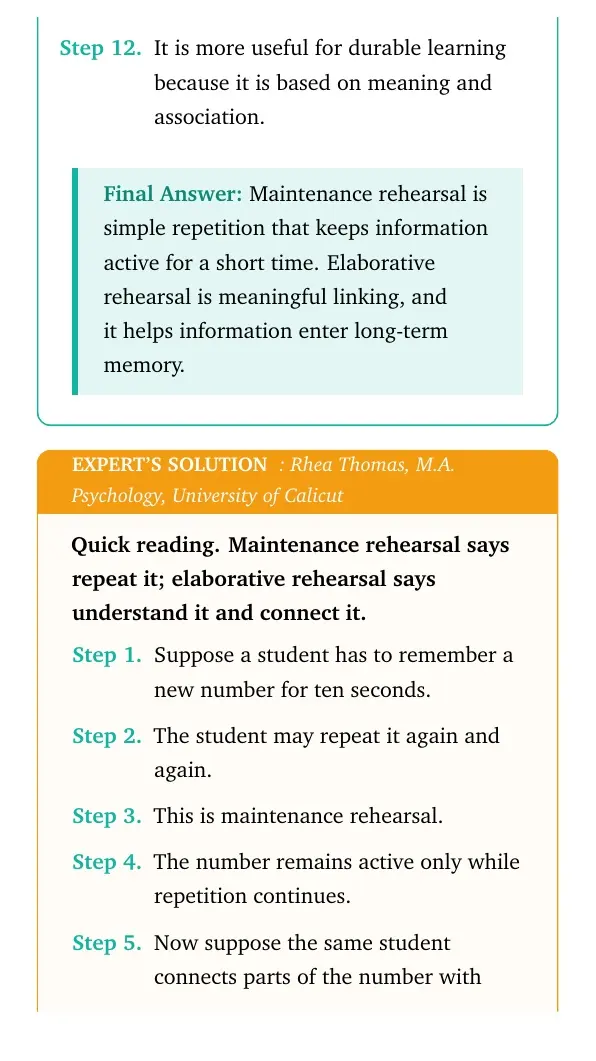
It is more useful for durable learning because it is based on meaning and association.
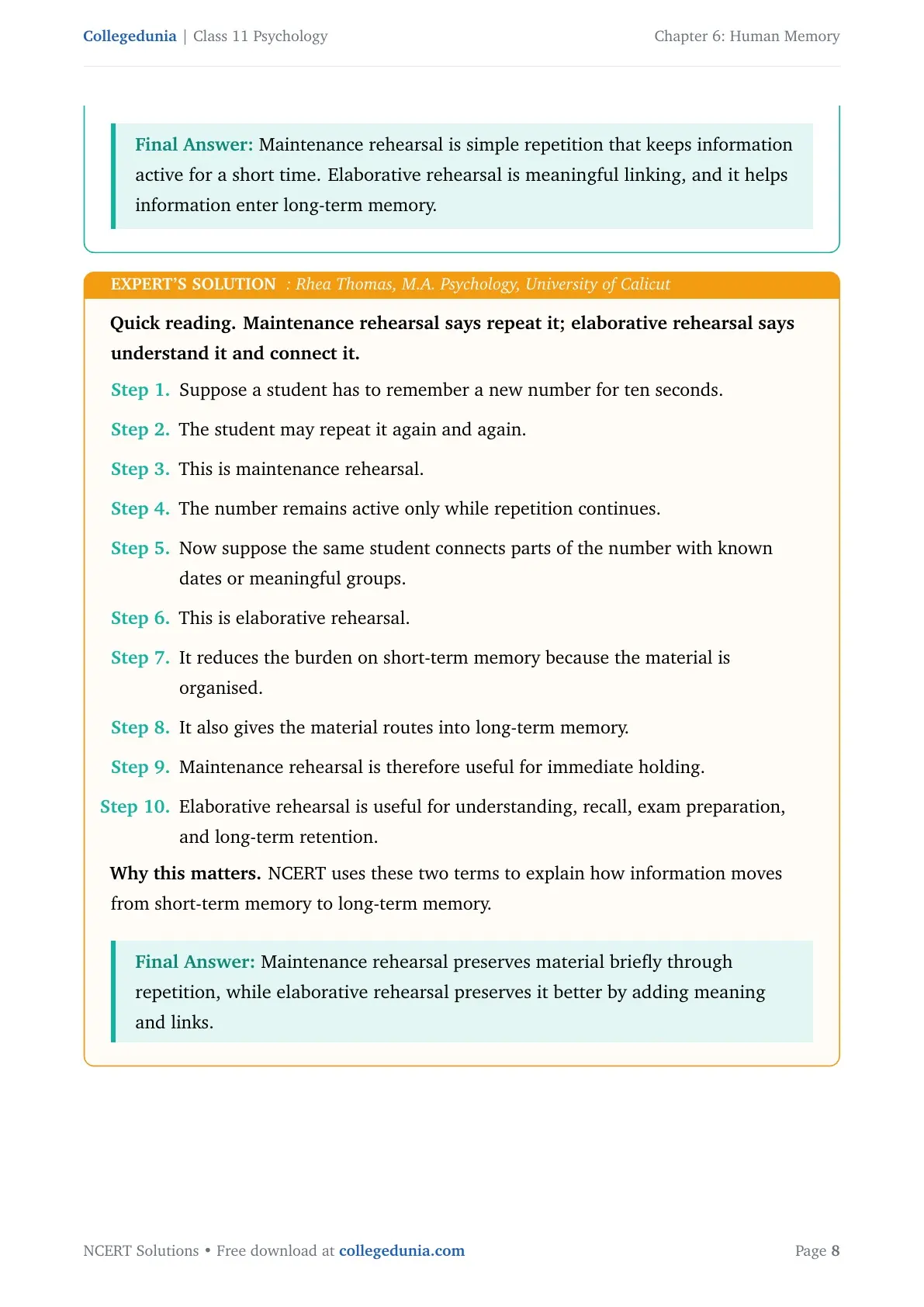
Maintenance rehearsal is simple repetition that keeps information active for a short time. Elaborative rehearsal is meaningful linking, and it helps information enter long-term memory.
RT
Rhea Thomas
M.A. Psychology, University of Calicut
Verified Expert
Quick reading. Maintenance rehearsal says repeat it; elaborative rehearsal says understand it and connect it.
Suppose a student has to remember a new number for ten seconds.
The student may repeat it again and again.
This is maintenance rehearsal.
The number remains active only while repetition continues.
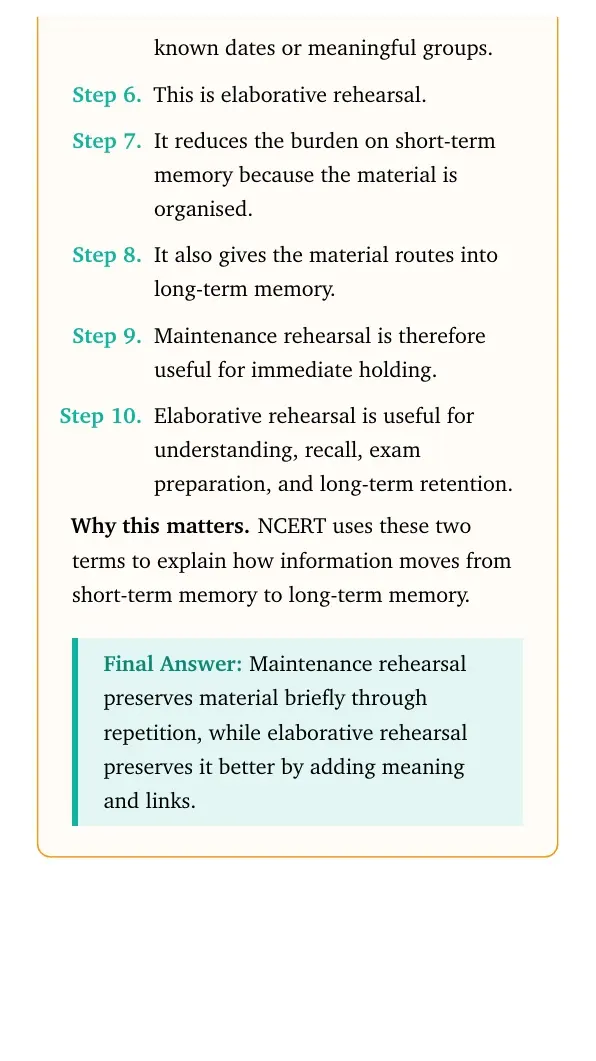
Now suppose the same student connects parts of the number with known dates or meaningful groups.
This is elaborative rehearsal.
It reduces the burden on short-term memory because the material is organised.
It also gives the material routes into long-term memory.
Maintenance rehearsal is therefore useful for immediate holding.
Elaborative rehearsal is useful for understanding, recall, exam preparation, and long-term retention.
Why this matters. NCERT uses these two terms to explain how information moves from short-term memory to long-term memory.
Maintenance rehearsal preserves material briefly through repetition, while elaborative rehearsal preserves it better by adding meaning and links.
Q 6.4
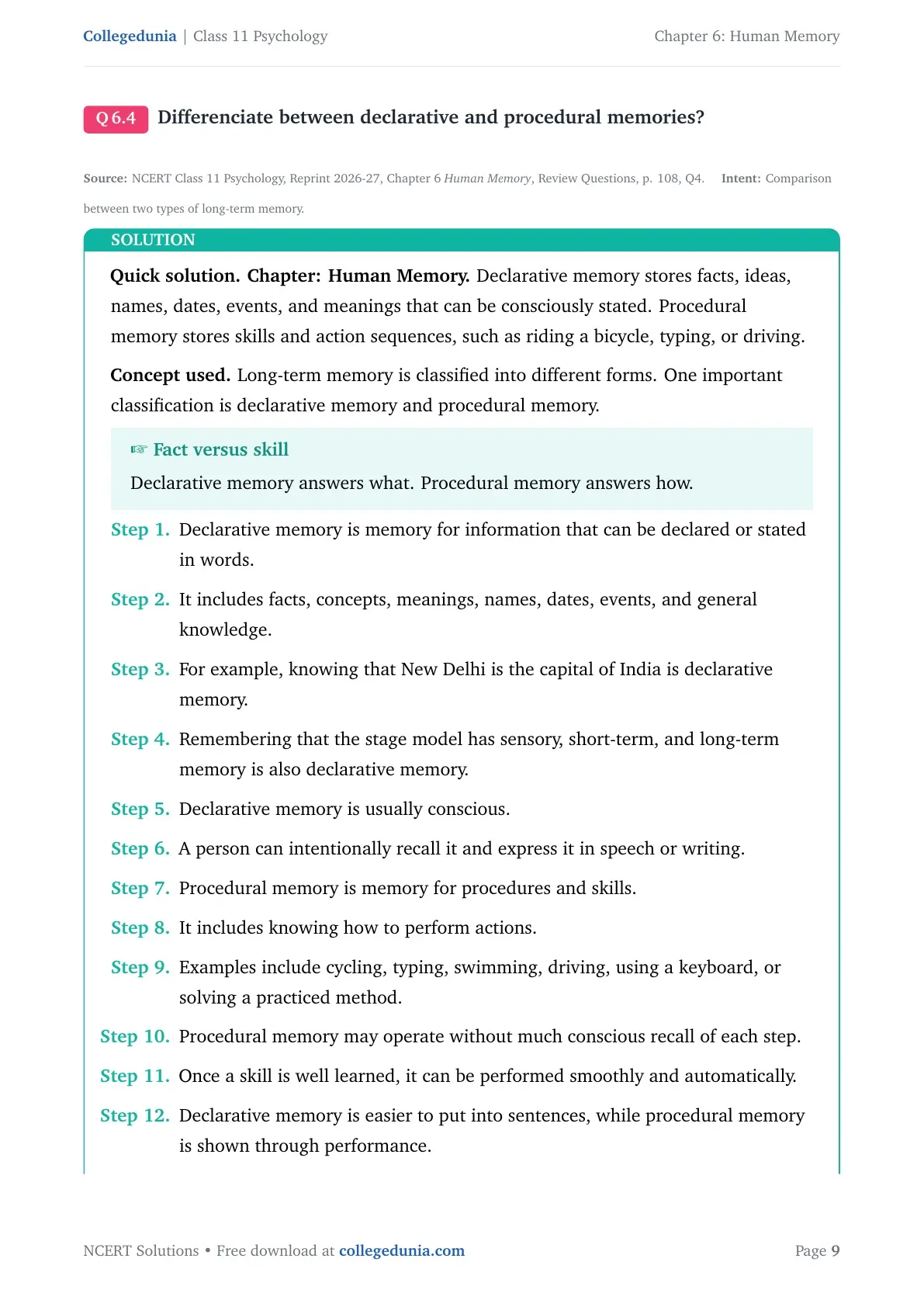
Differenciate between declarative and procedural memories?
Declarative memory stores facts, ideas, names, dates, events, and meanings that can be consciously stated. Procedural memory stores skills and action sequences, such as riding a bicycle, typing, or driving. Concept used. Long-term memory is classified into different forms. One important classification is declarative memory and procedural memory.
Declarative memory is memory for information that can be declared or stated in words.
It includes facts, concepts, meanings, names, dates, events, and general knowledge.
For example, knowing that New Delhi is the capital of India is declarative memory.
Remembering that the stage model has sensory, short-term, and long-term memory is also declarative memory.
Declarative memory is usually conscious.
A person can intentionally recall it and express it in speech or writing.
Procedural memory is memory for procedures and skills.
It includes knowing how to perform actions.
Examples include cycling, typing, swimming, driving, using a keyboard, or solving a practiced method.
Procedural memory may operate without much conscious recall of each step.
Once a skill is well learned, it can be performed smoothly and automatically.
Declarative memory is easier to put into sentences, while procedural memory is shown through performance.
Declarative memory is memory for facts and events that can be stated. Procedural memory is memory for skills and procedures that are shown through action.
KS
Kabir Sinha
M.Sc Psychology, University of Hyderabad
Verified Expert
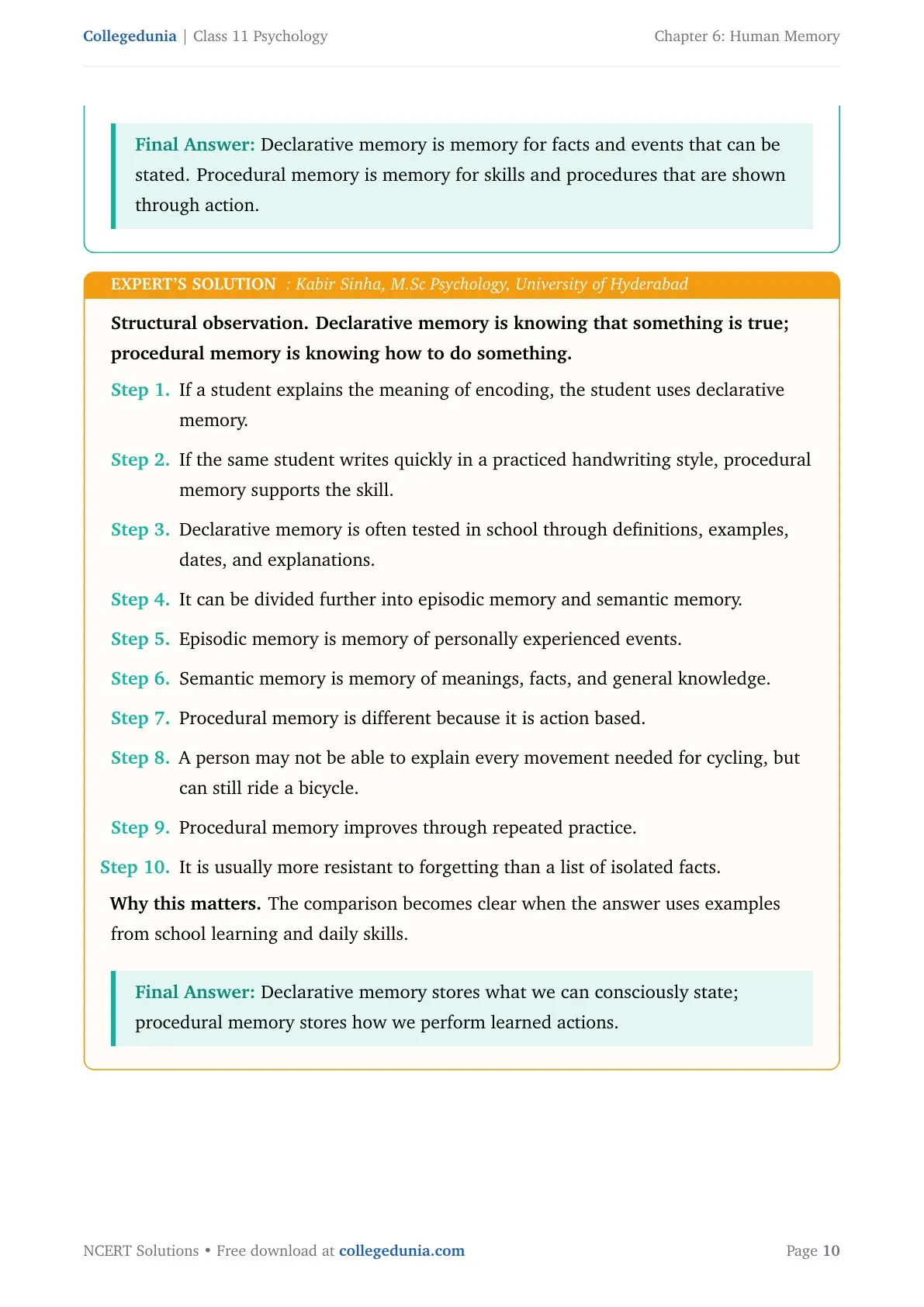
Structural observation. Declarative memory is knowing that something is true; procedural memory is knowing how to do something.
If a student explains the meaning of encoding, the student uses declarative memory.
If the same student writes quickly in a practiced handwriting style, procedural memory supports the skill.
Declarative memory is often tested in school through definitions, examples, dates, and explanations.
It can be divided further into episodic memory and semantic memory.
Episodic memory is memory of personally experienced events.
Semantic memory is memory of meanings, facts, and general knowledge.
Procedural memory is different because it is action based.
A person may not be able to explain every movement needed for cycling, but can still ride a bicycle.
Procedural memory improves through repeated practice.
It is usually more resistant to forgetting than a list of isolated facts.
Why this matters. The comparison becomes clear when the answer uses examples from school learning and daily skills.
Declarative memory stores what we can consciously state; procedural memory stores how we perform learned actions.
Q 6.5
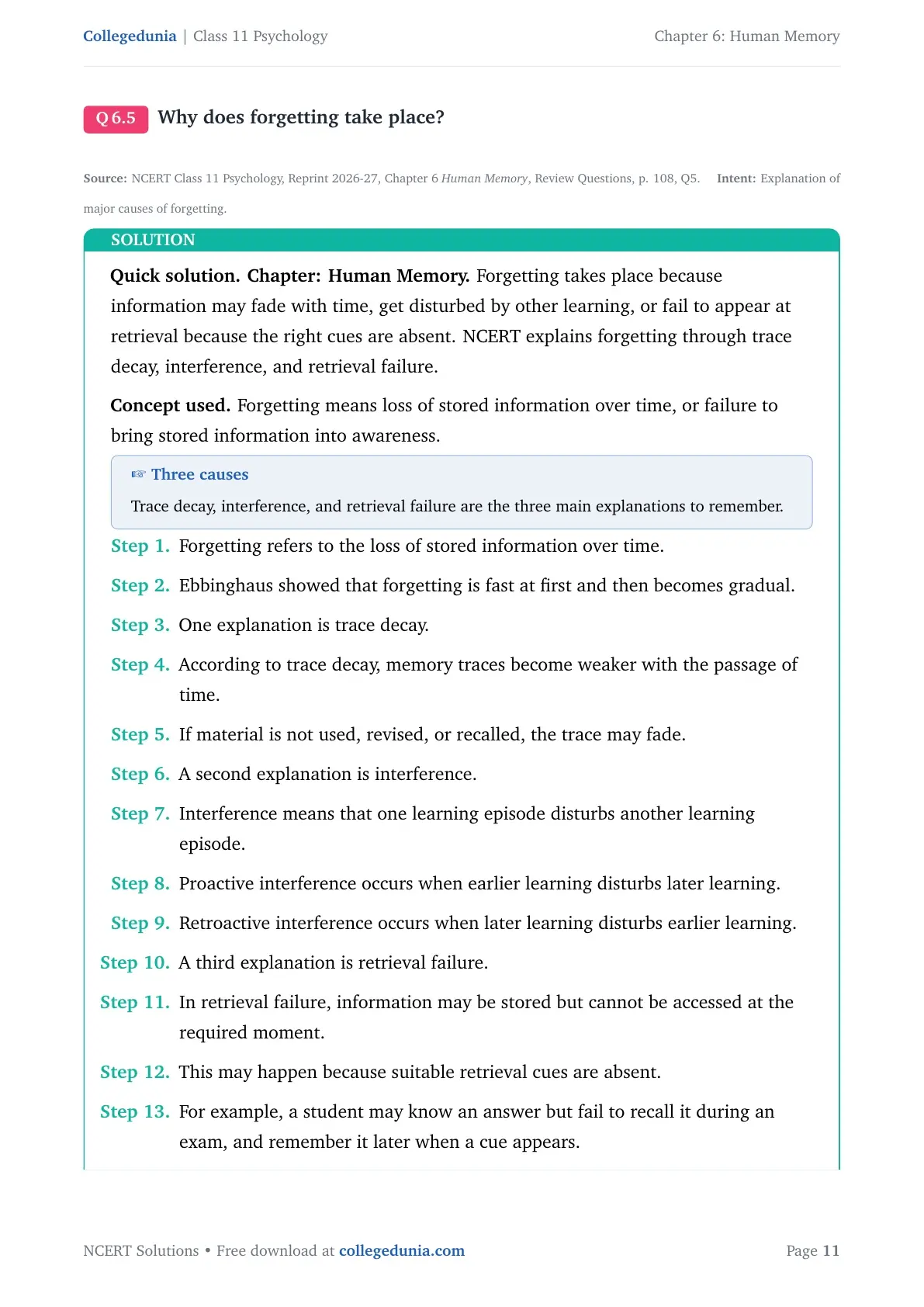
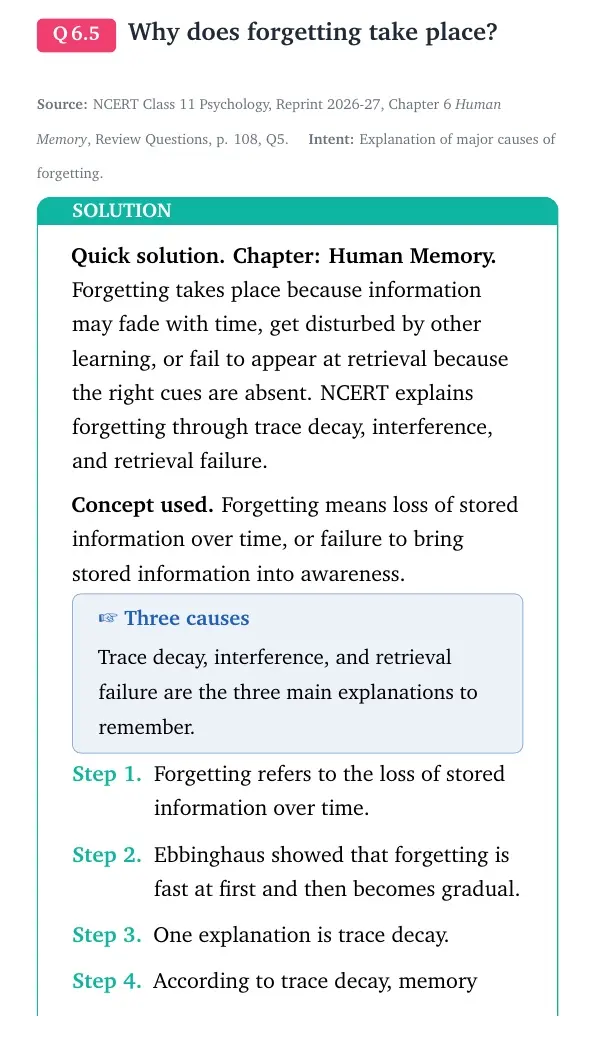
Why does forgetting take place?
Forgetting takes place because information may fade with time, get disturbed by other learning, or fail to appear at retrieval because the right cues are absent. NCERT explains forgetting through trace decay, interference, and retrieval failure. Concept used. Forgetting means loss of stored information over time, or failure to bring stored information into awareness.
Three causes
Trace decay, interference, and retrieval failure are the three main explanations to remember.
Forgetting refers to the loss of stored information over time.
Ebbinghaus showed that forgetting is fast at first and then becomes gradual.
One explanation is trace decay.
According to trace decay, memory traces become weaker with the passage of time.
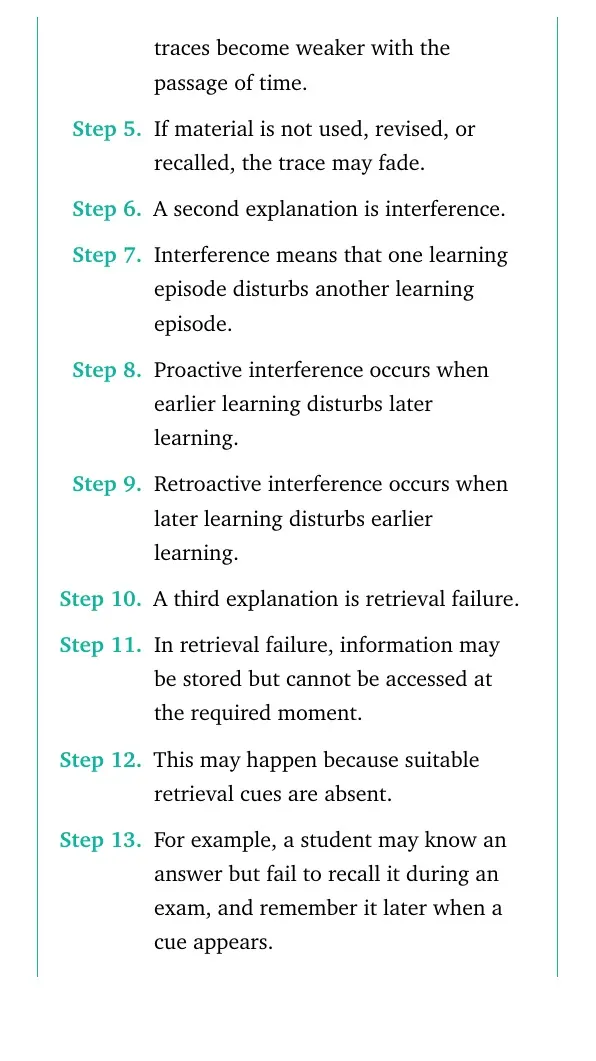
If material is not used, revised, or recalled, the trace may fade.
A second explanation is interference.
Interference means that one learning episode disturbs another learning episode.
Proactive interference occurs when earlier learning disturbs later learning.
Retroactive interference occurs when later learning disturbs earlier learning.
A third explanation is retrieval failure.
In retrieval failure, information may be stored but cannot be accessed at the required moment.
This may happen because suitable retrieval cues are absent.
For example, a student may know an answer but fail to recall it during an exam, and remember it later when a cue appears.
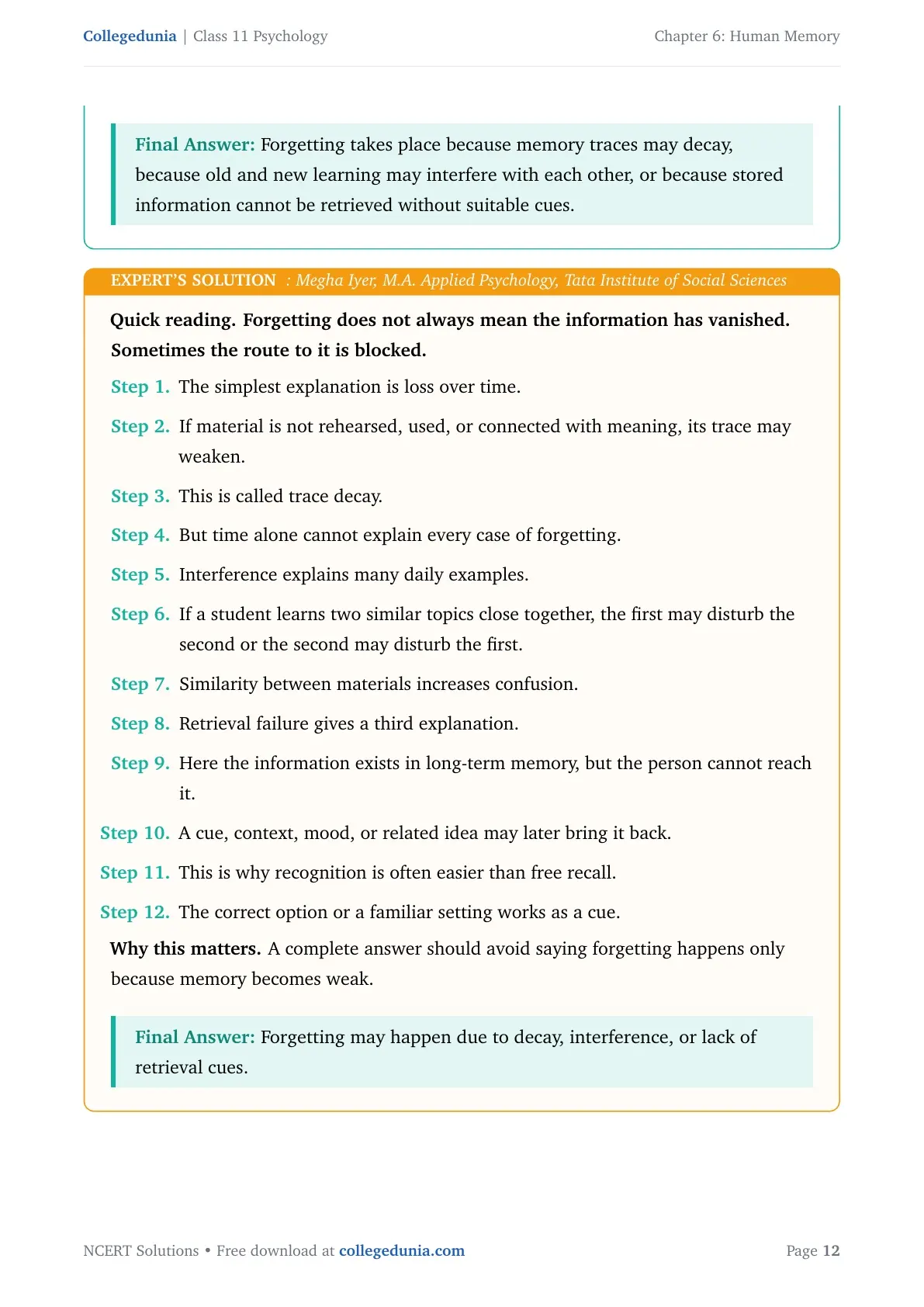
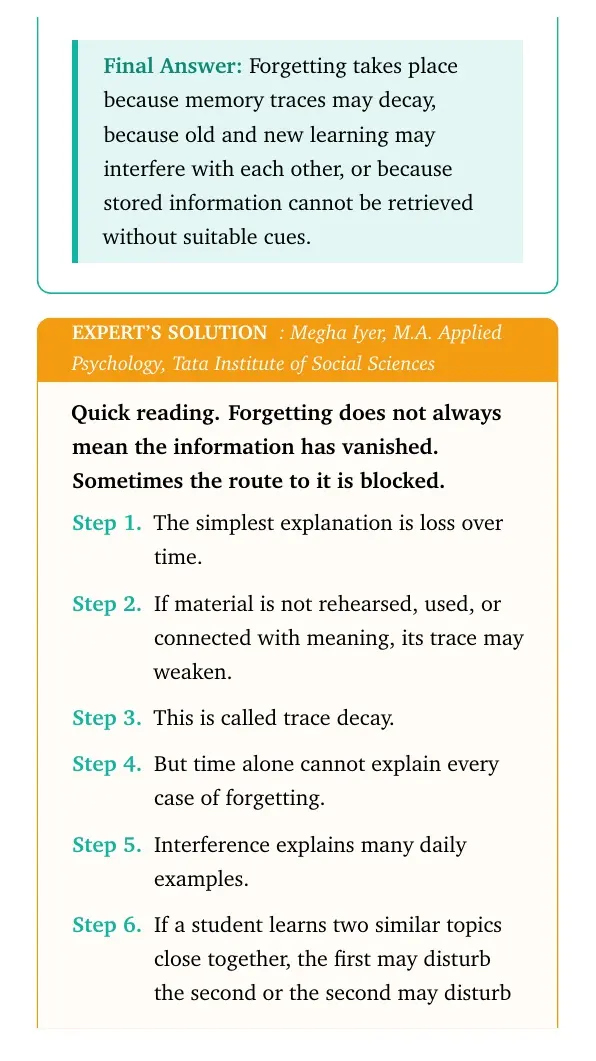
Forgetting takes place because memory traces may decay, because old and new learning may interfere with each other, or because stored information cannot be retrieved without suitable cues.
MI
Megha Iyer
M.A. Applied Psychology, Tata Institute of Social Sciences
Verified Expert
Quick reading. Forgetting does not always mean the information has vanished. Sometimes the route to it is blocked.
The simplest explanation is loss over time.
If material is not rehearsed, used, or connected with meaning, its trace may weaken.
This is called trace decay.
But time alone cannot explain every case of forgetting.
Interference explains many daily examples.
If a student learns two similar topics close together, the first may disturb the second or the second may disturb the first.
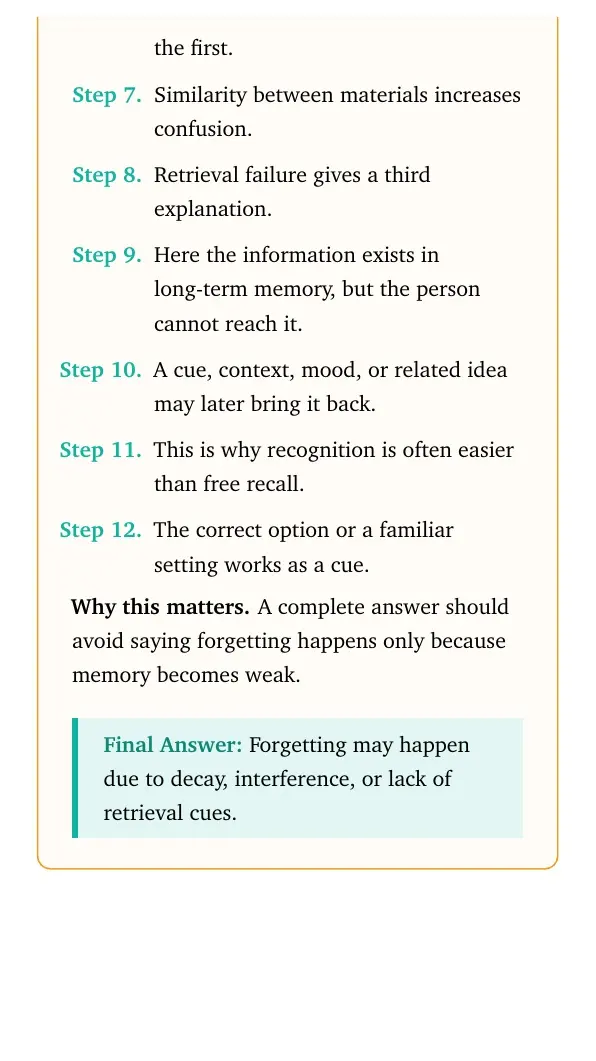
Similarity between materials increases confusion.
Retrieval failure gives a third explanation.
Here the information exists in long-term memory, but the person cannot reach it.
A cue, context, mood, or related idea may later bring it back.
This is why recognition is often easier than free recall.
The correct option or a familiar setting works as a cue.
Why this matters. A complete answer should avoid saying forgetting happens only because memory becomes weak.
Forgetting may happen due to decay, interference, or lack of retrieval cues.
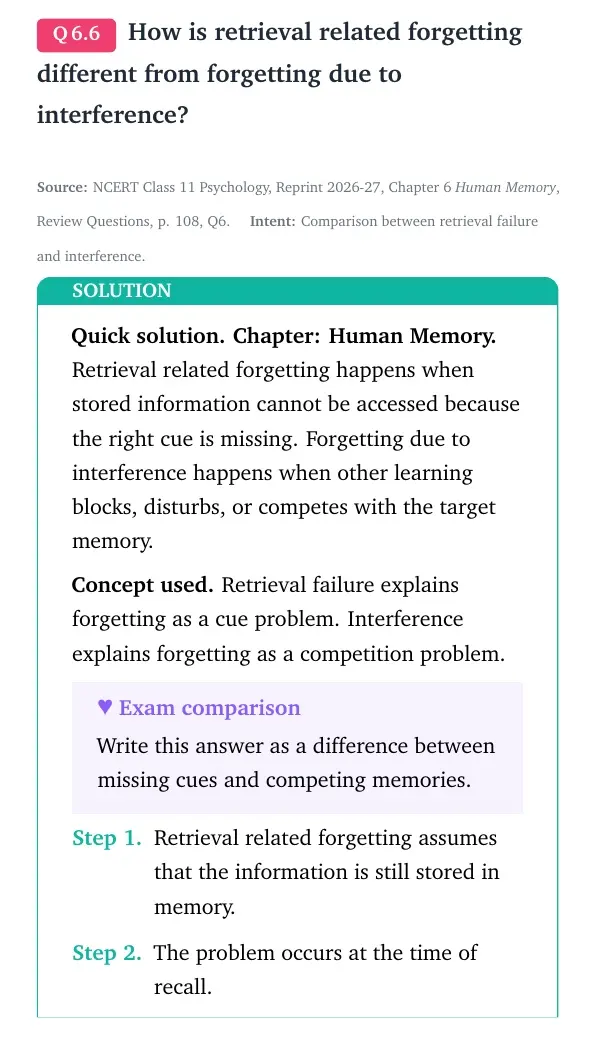
Q 6.6
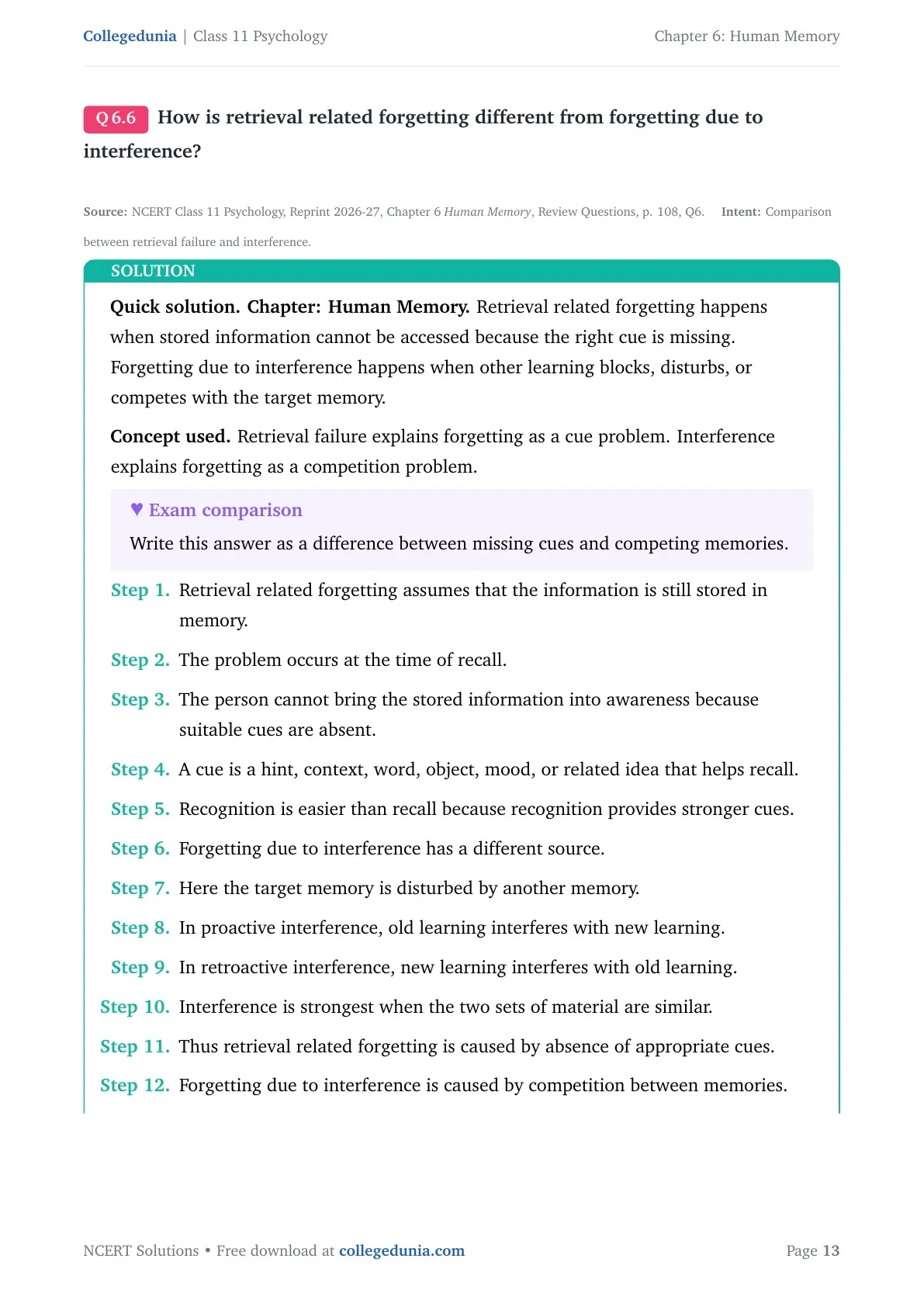
How is retrieval related forgetting different from forgetting due to interference?
Retrieval related forgetting happens when stored information cannot be accessed because the right cue is missing. Forgetting due to interference happens when other learning blocks, disturbs, or competes with the target memory. Concept used. Retrieval failure explains forgetting as a cue problem. Interference explains forgetting as a competition problem.
Exam comparison
Write this answer as a difference between missing cues and competing memories.
Retrieval related forgetting assumes that the information is still stored in memory.
The problem occurs at the time of recall.
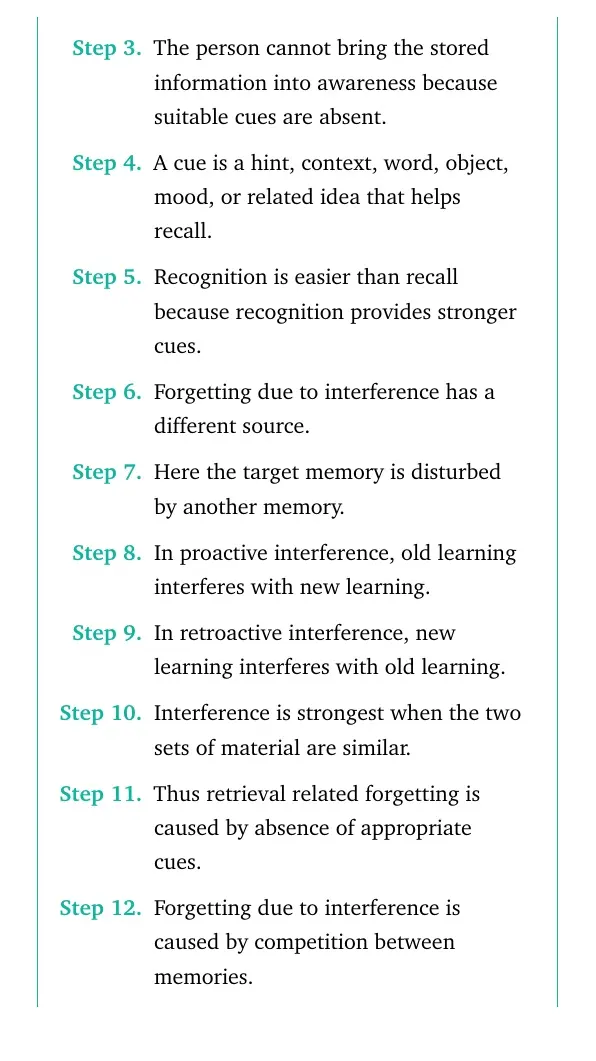
The person cannot bring the stored information into awareness because suitable cues are absent.
A cue is a hint, context, word, object, mood, or related idea that helps recall.
Recognition is easier than recall because recognition provides stronger cues.
Forgetting due to interference has a different source.
Here the target memory is disturbed by another memory.
In proactive interference, old learning interferes with new learning.
In retroactive interference, new learning interferes with old learning.
Interference is strongest when the two sets of material are similar.
Thus retrieval related forgetting is caused by absence of appropriate cues.
Forgetting due to interference is caused by competition between memories.
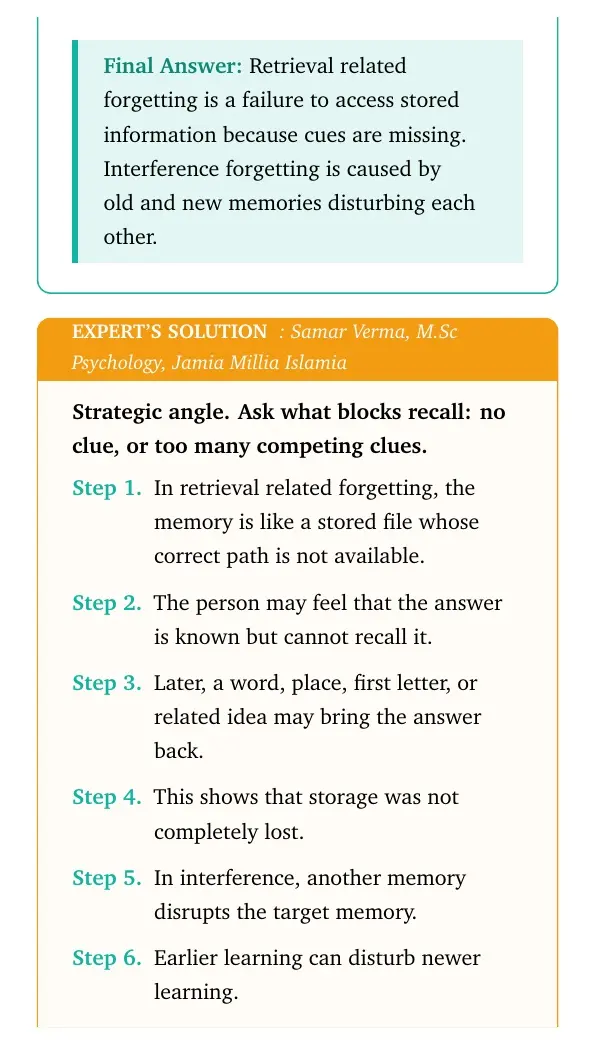
Retrieval related forgetting is a failure to access stored information because cues are missing. Interference forgetting is caused by old and new memories disturbing each other.
SV
Samar Verma
M.Sc Psychology, Jamia Millia Islamia
Verified Expert
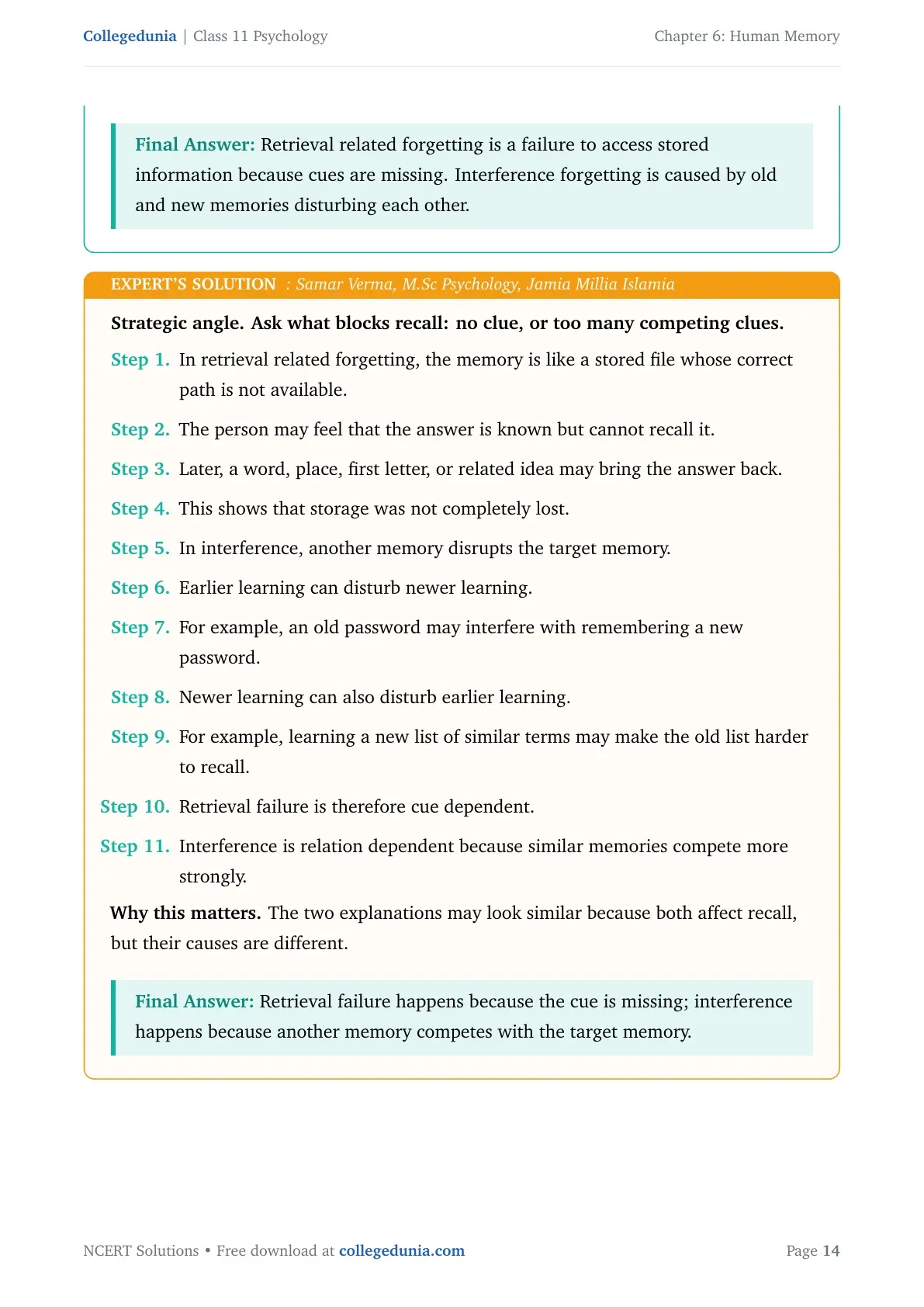
Strategic angle. Ask what blocks recall: no clue, or too many competing clues.
In retrieval related forgetting, the memory is like a stored file whose correct path is not available.
The person may feel that the answer is known but cannot recall it.
Later, a word, place, first letter, or related idea may bring the answer back.
This shows that storage was not completely lost.
In interference, another memory disrupts the target memory.
Earlier learning can disturb newer learning.
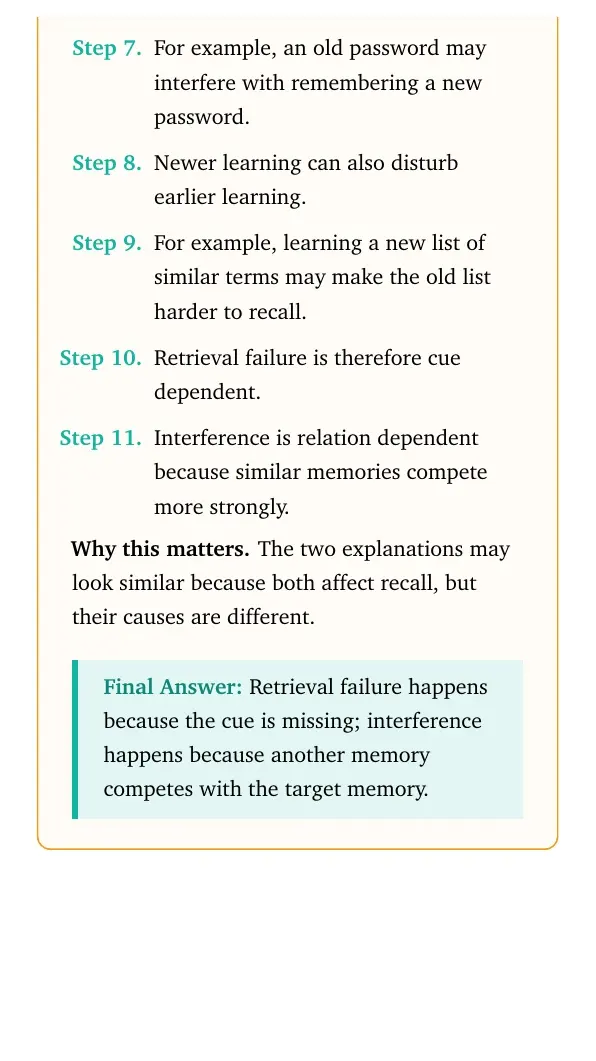
For example, an old password may interfere with remembering a new password.
Newer learning can also disturb earlier learning.
For example, learning a new list of similar terms may make the old list harder to recall.
Retrieval failure is therefore cue dependent.
Interference is relation dependent because similar memories compete more strongly.
Why this matters. The two explanations may look similar because both affect recall, but their causes are different.
Retrieval failure happens because the cue is missing; interference happens because another memory competes with the target memory.
Q 6.7
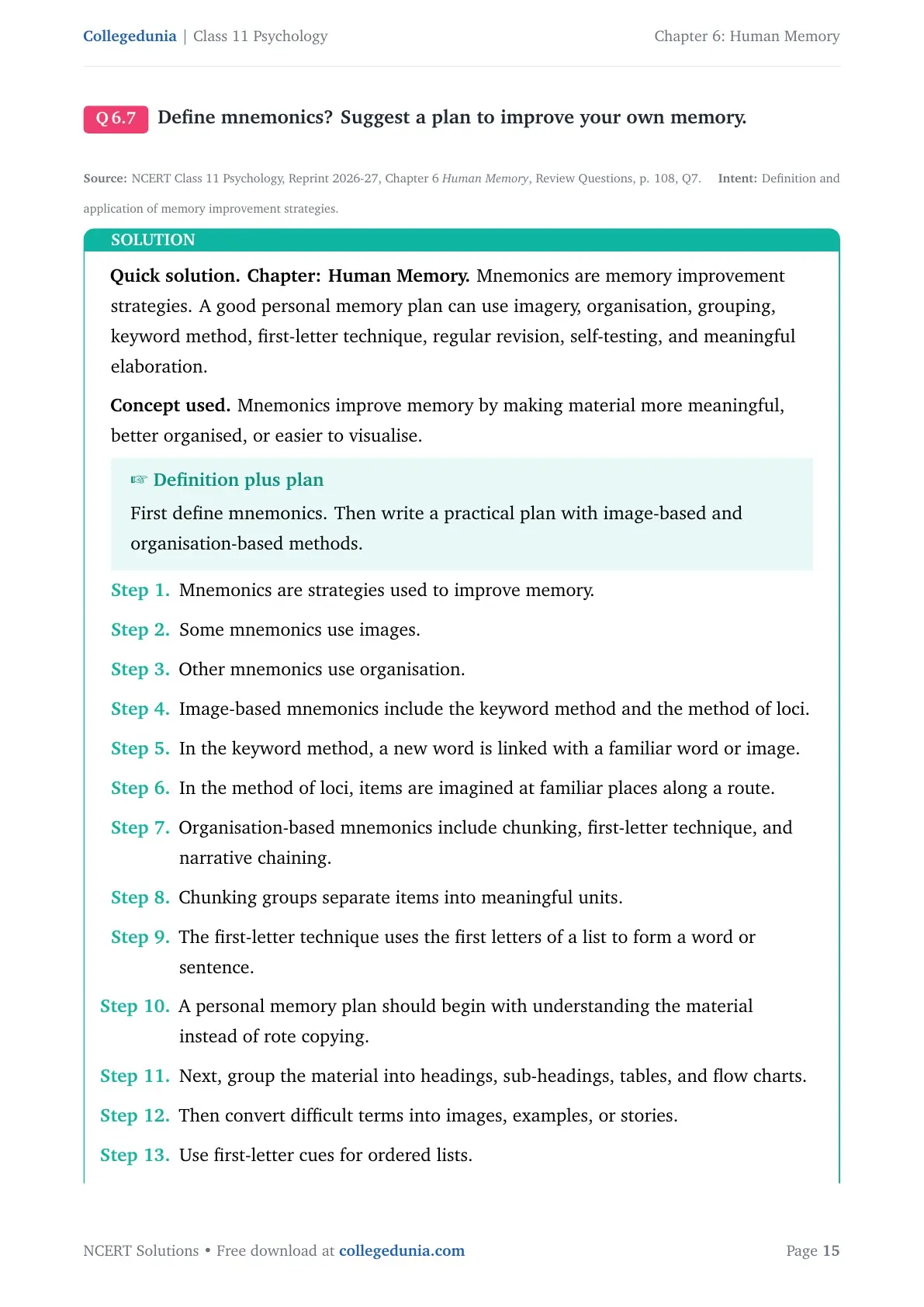
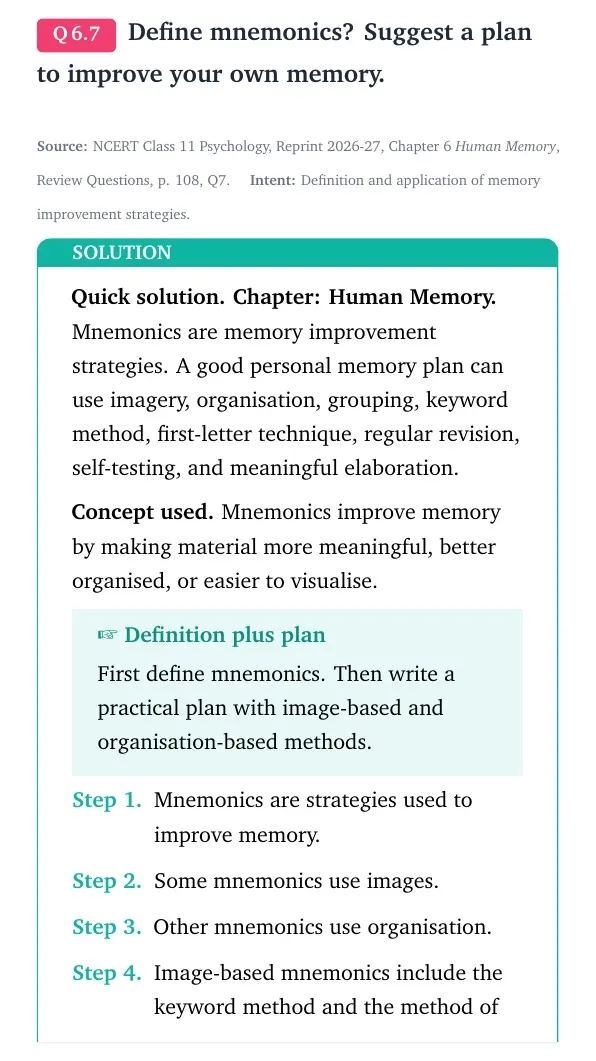
Define mnemonics? Suggest a plan to improve your own memory.
Mnemonics are memory improvement strategies. A good personal memory plan can use imagery, organisation, grouping, keyword method, first-letter technique, regular revision, self-testing, and meaningful elaboration. Concept used. Mnemonics improve memory by making material more meaningful, better organised, or easier to visualise.
Definition plus plan
First define mnemonics. Then write a practical plan with image-based and organisation-based methods.
Mnemonics are strategies used to improve memory.
Some mnemonics use images.
Other mnemonics use organisation.
Image-based mnemonics include the keyword method and the method of loci.
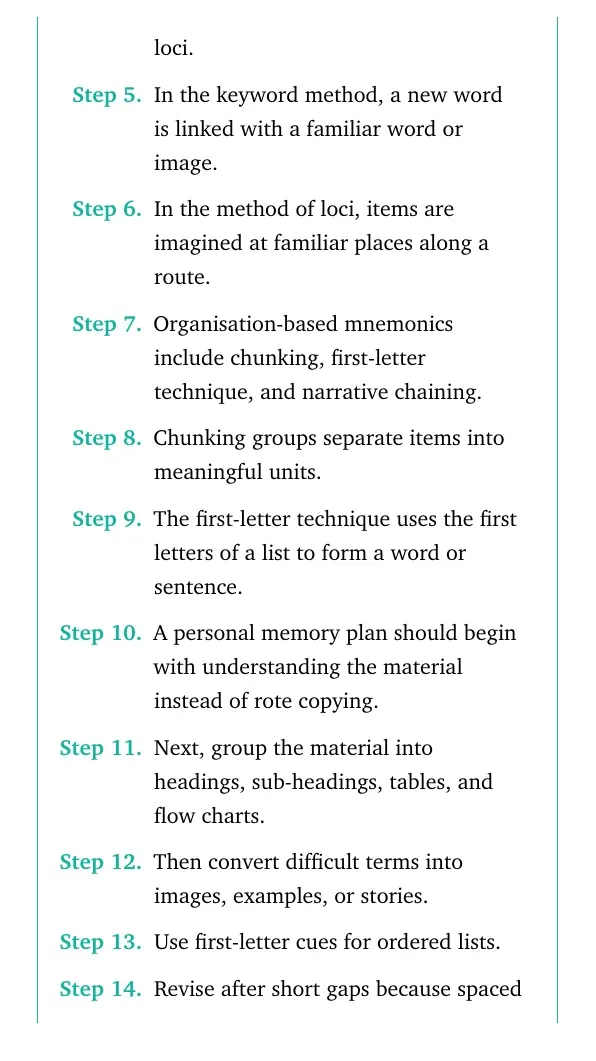
In the keyword method, a new word is linked with a familiar word or image.
In the method of loci, items are imagined at familiar places along a route.
Organisation-based mnemonics include chunking, first-letter technique, and narrative chaining.
Chunking groups separate items into meaningful units.
The first-letter technique uses the first letters of a list to form a word or sentence.
A personal memory plan should begin with understanding the material instead of rote copying.
Next, group the material into headings, sub-headings, tables, and flow charts.
Then convert difficult terms into images, examples, or stories.
Use first-letter cues for ordered lists.
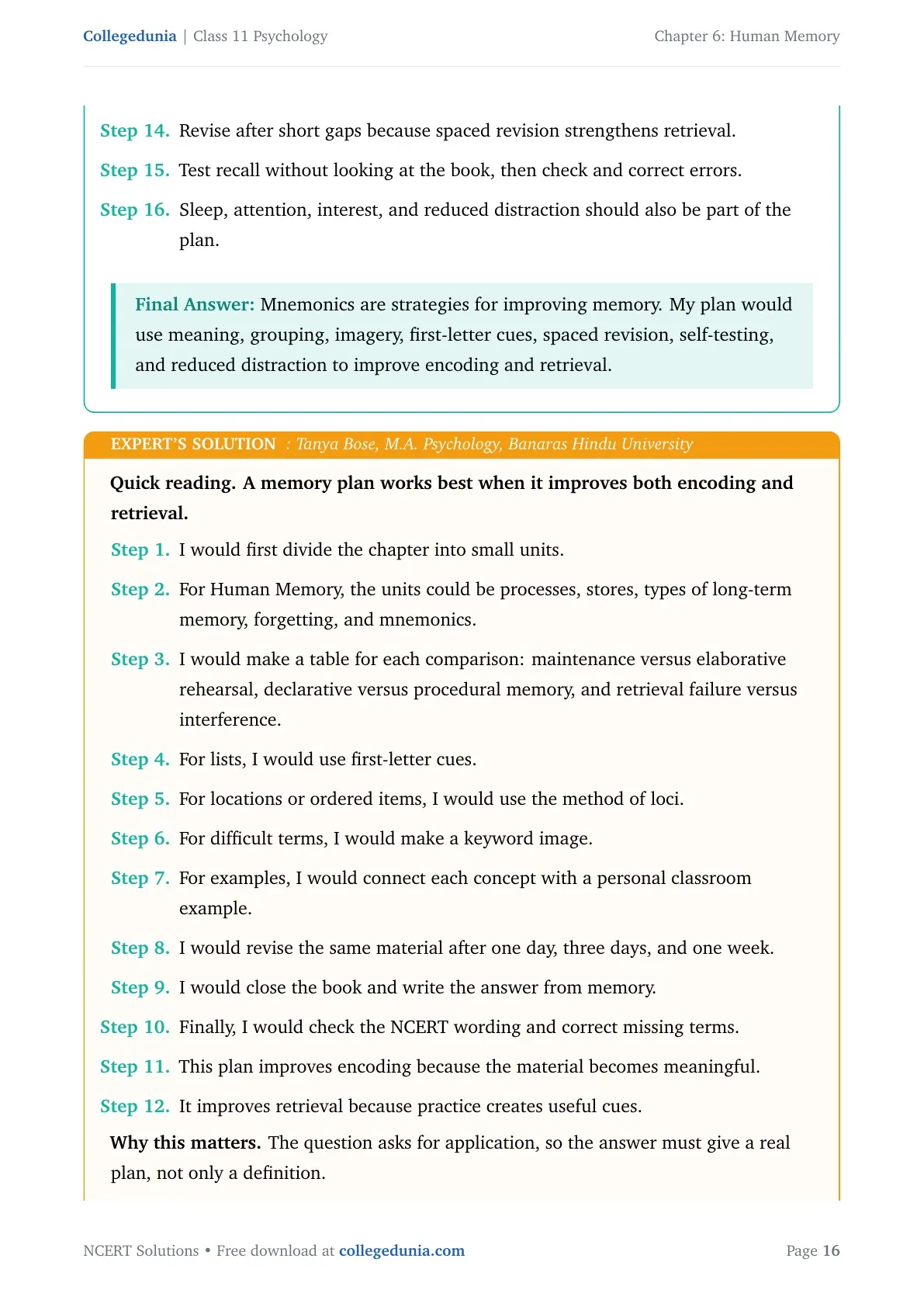
Revise after short gaps because spaced revision strengthens retrieval.
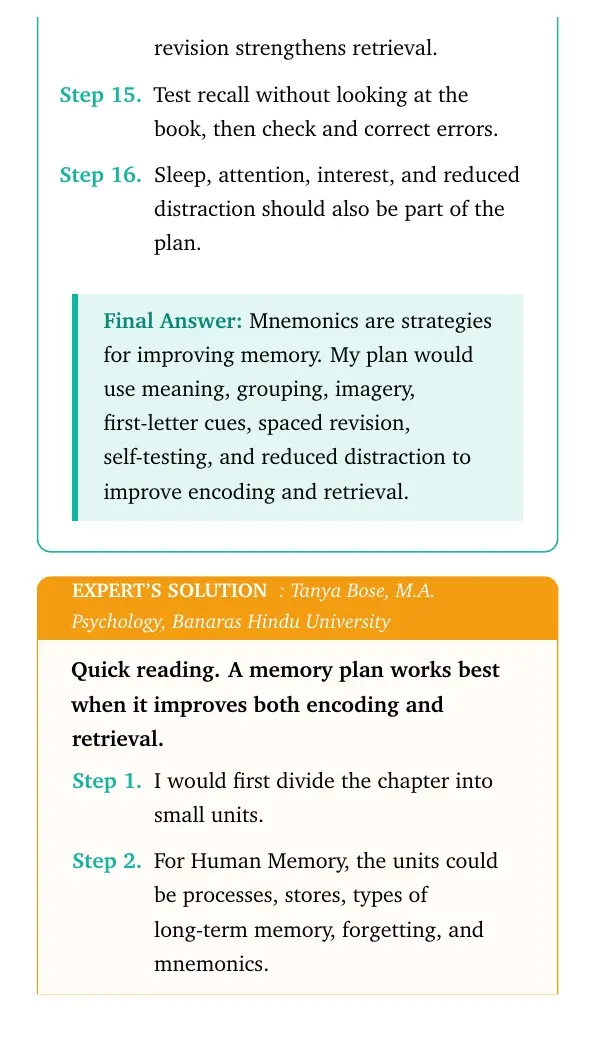
Test recall without looking at the book, then check and correct errors.
Sleep, attention, interest, and reduced distraction should also be part of the plan.
Mnemonics are strategies for improving memory. My plan would use meaning, grouping, imagery, first-letter cues, spaced revision, self-testing, and reduced distraction to improve encoding and retrieval.
TB
Tanya Bose
M.A. Psychology, Banaras Hindu University
Verified Expert
Quick reading. A memory plan works best when it improves both encoding and retrieval.
I would first divide the chapter into small units.
For Human Memory, the units could be processes, stores, types of long-term memory, forgetting, and mnemonics.
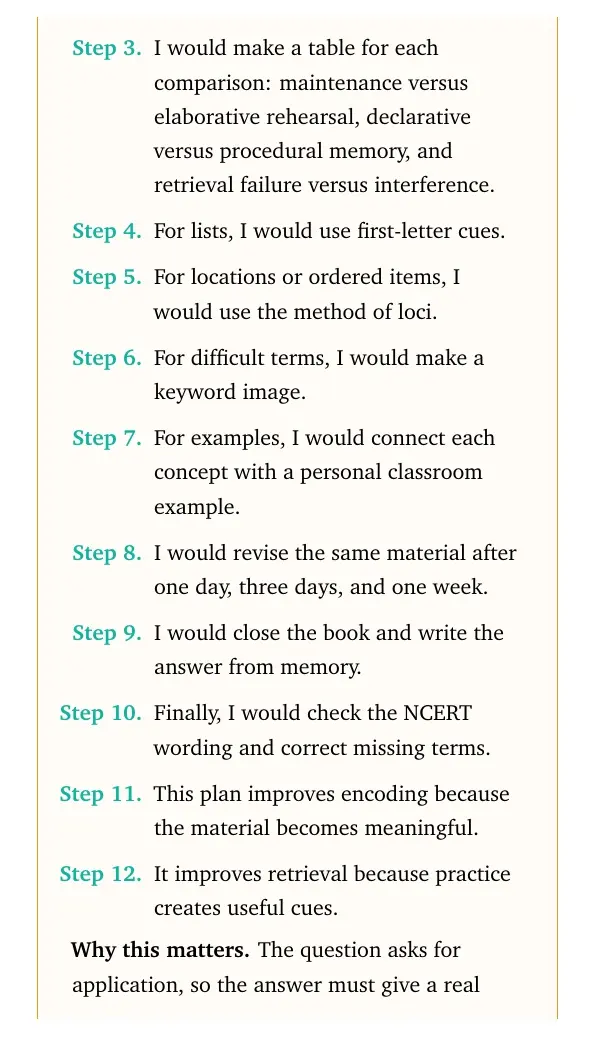
I would make a table for each comparison: maintenance versus elaborative rehearsal, declarative versus procedural memory, and retrieval failure versus interference.
For lists, I would use first-letter cues.
For locations or ordered items, I would use the method of loci.
For difficult terms, I would make a keyword image.
For examples, I would connect each concept with a personal classroom example.
I would revise the same material after one day, three days, and one week.
I would close the book and write the answer from memory.
Finally, I would check the NCERT wording and correct missing terms.
This plan improves encoding because the material becomes meaningful.
It improves retrieval because practice creates useful cues.
Why this matters. The question asks for application, so the answer must give a real plan, not only a definition.
Mnemonics improve memory through imagery and organisation. A practical plan should organise material, create cues, revise in spaced intervals, and test recall actively.
Human Memory Psychology NCERT Solutions FAQs
Ques. How many review questions are solved in Class 11 Psychology Chapter 6 Human Memory?
Ans. The PDF solves all 7 NCERT review questions from Class 11 Psychology Chapter 6 Human Memory for the 2026-27 session.
Ques. What are the three main memory processes in Chapter 6?
Ans. The three main memory processes are encoding, storage and retrieval. Encoding records information, storage retains it and retrieval brings it back for use.
Ques. What is the difference between maintenance rehearsal and elaborative rehearsal?
Ans. Maintenance rehearsal keeps information active through repetition. Elaborative rehearsal connects information with meaning, examples and earlier knowledge, so it supports long-term memory better.
Ques. Are these Human Memory NCERT Solutions useful for the 2026-27 Class 11 Psychology exam?
Ans. Yes. The answers follow the 2026-27 NCERT textbook and use school-exam framing for memory processes, stage model, forgetting, rehearsal and mnemonics.








Comments