




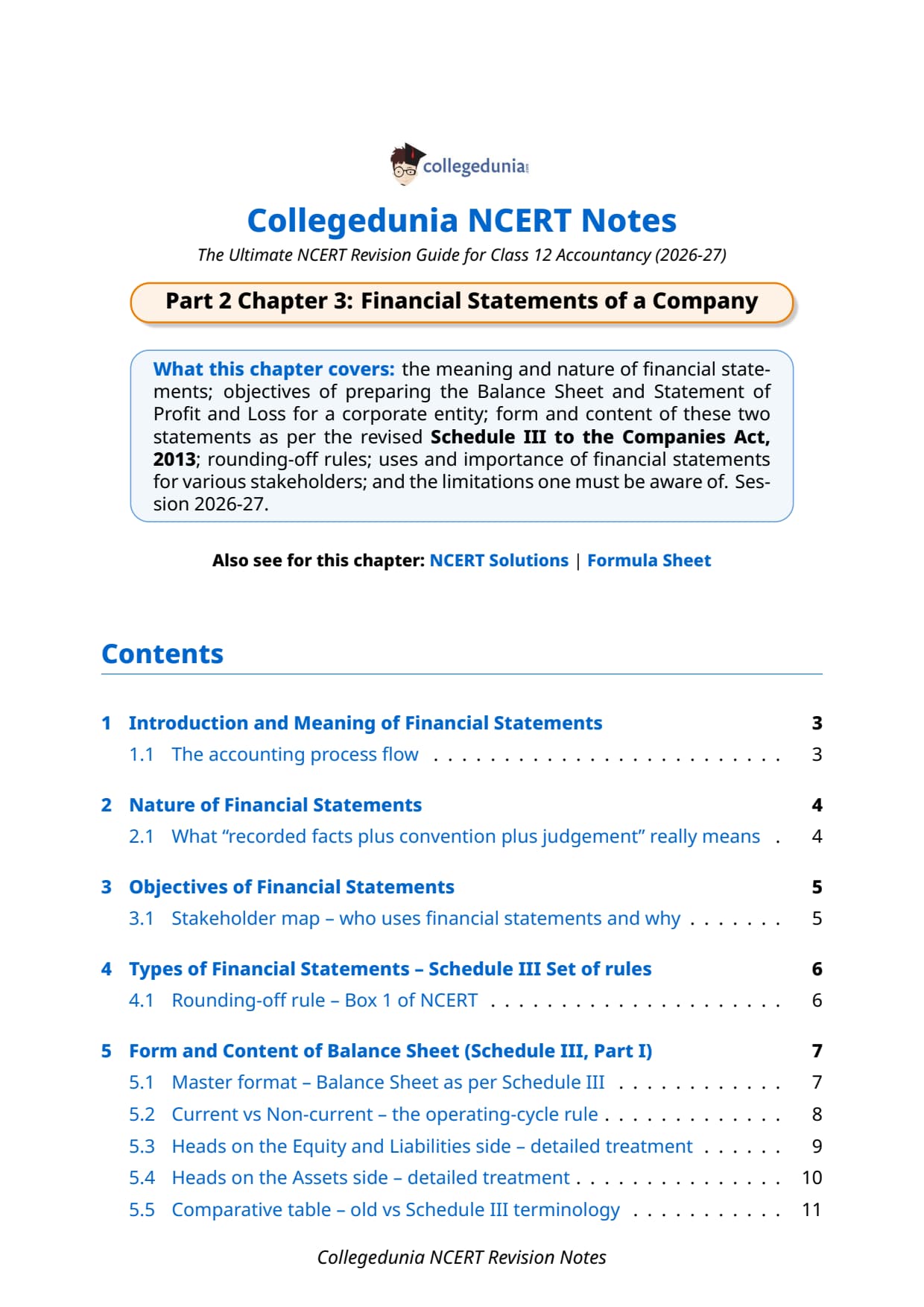
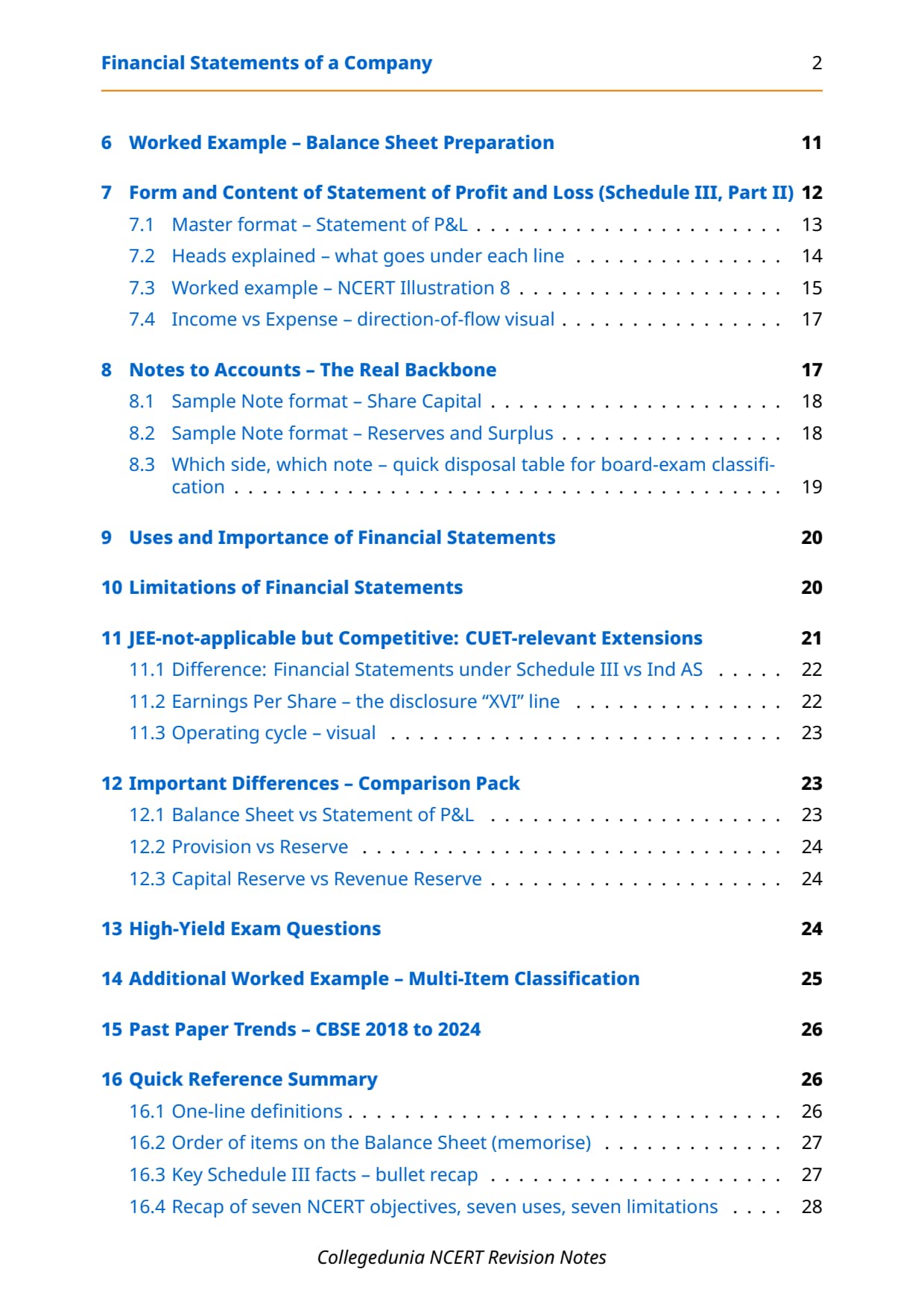
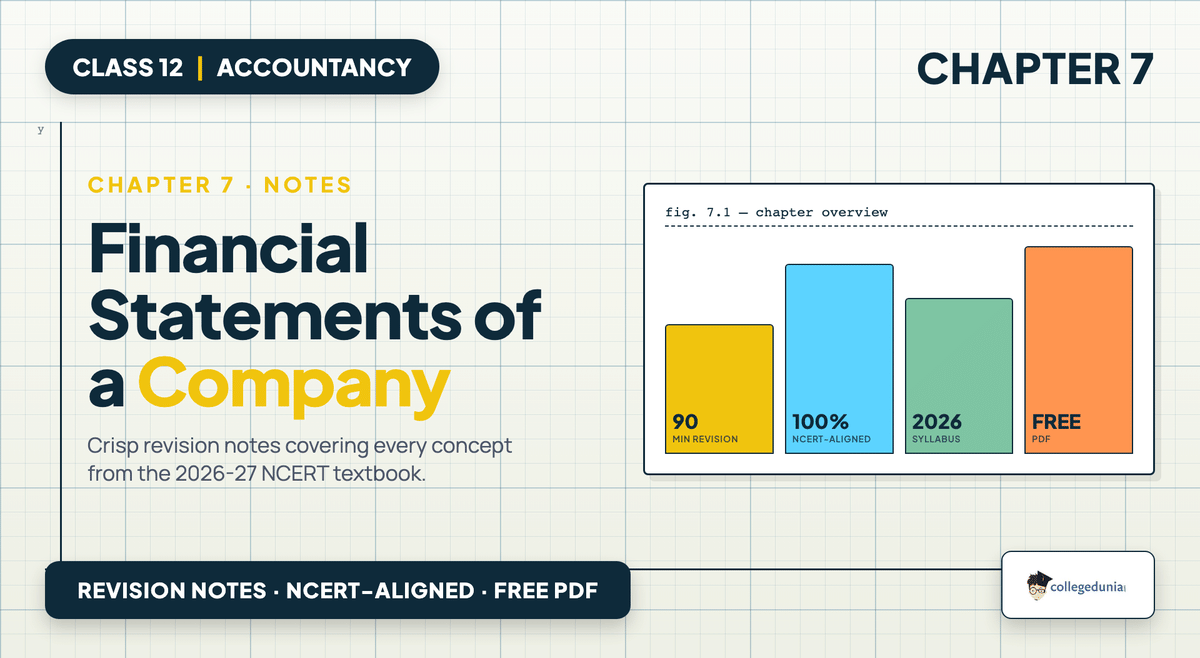
These financial statements of a company class 12 notes cover Part 2 Chapter 3 of NCERT Accountancy Part II, built around Schedule III of the Companies Act, 2013. The chapter sets the legal format for the Balance Sheet and Statement of Profit and Loss every Indian company must publish, and CBSE tests it as a near-certain 8-mark question.



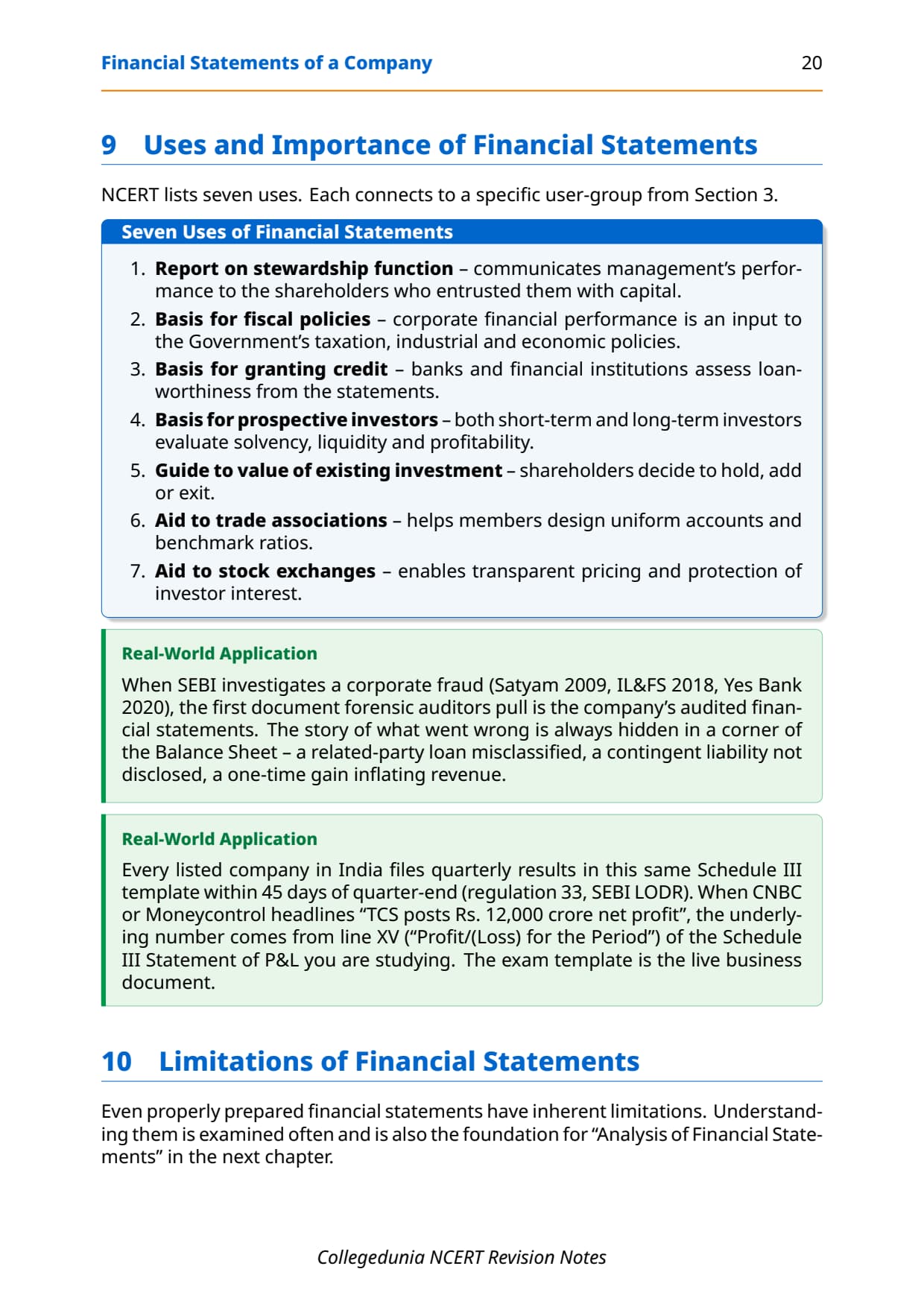
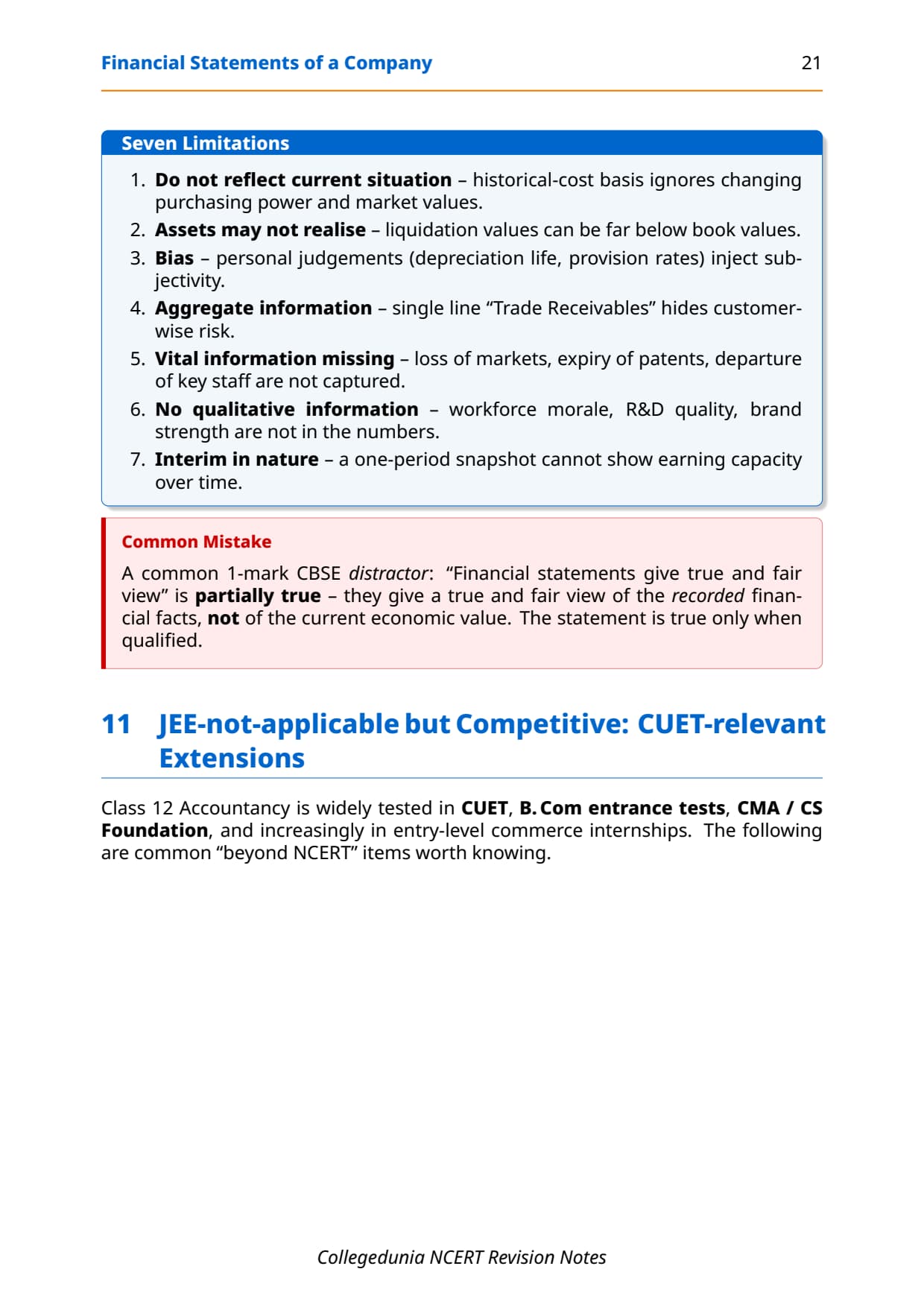
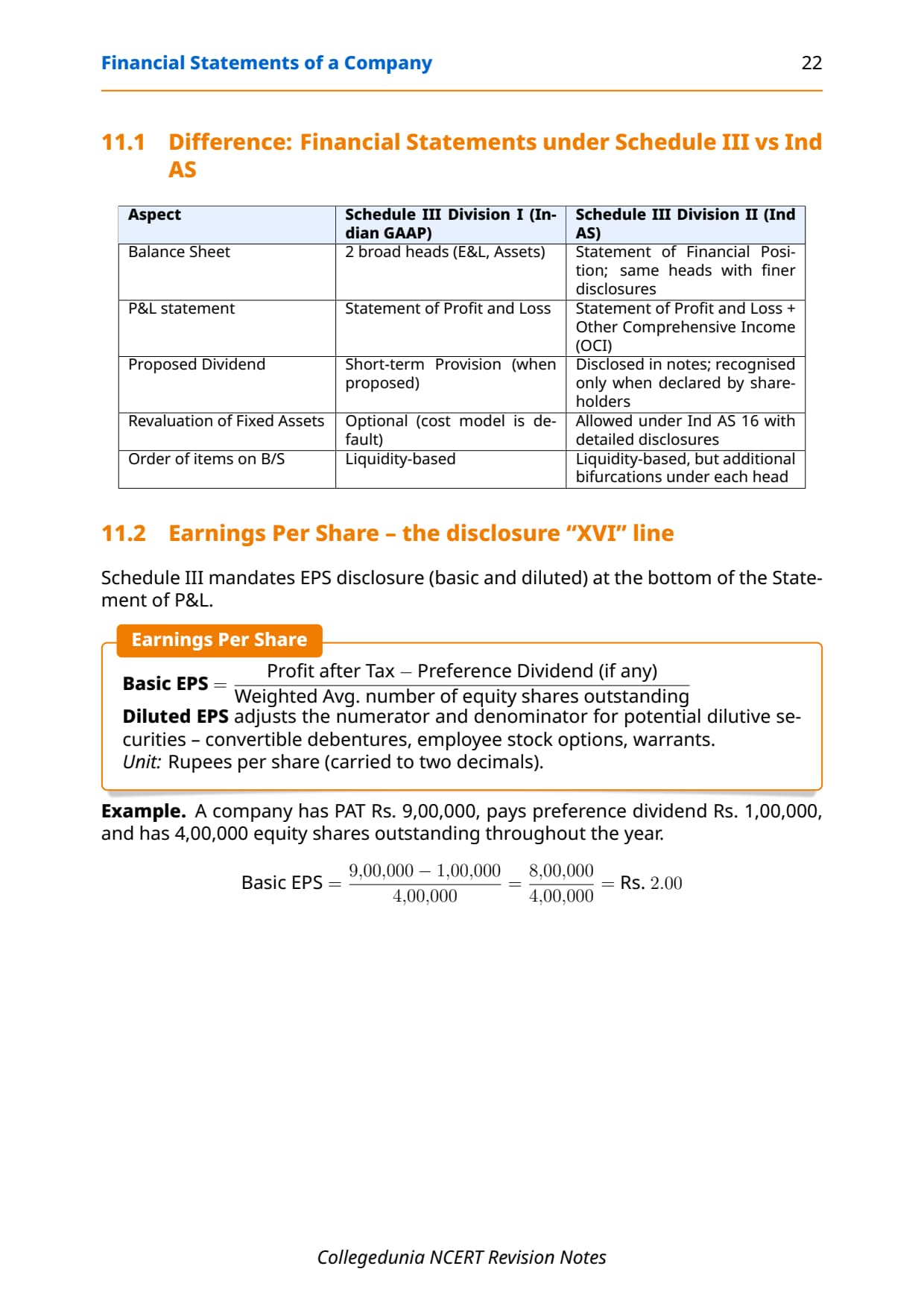
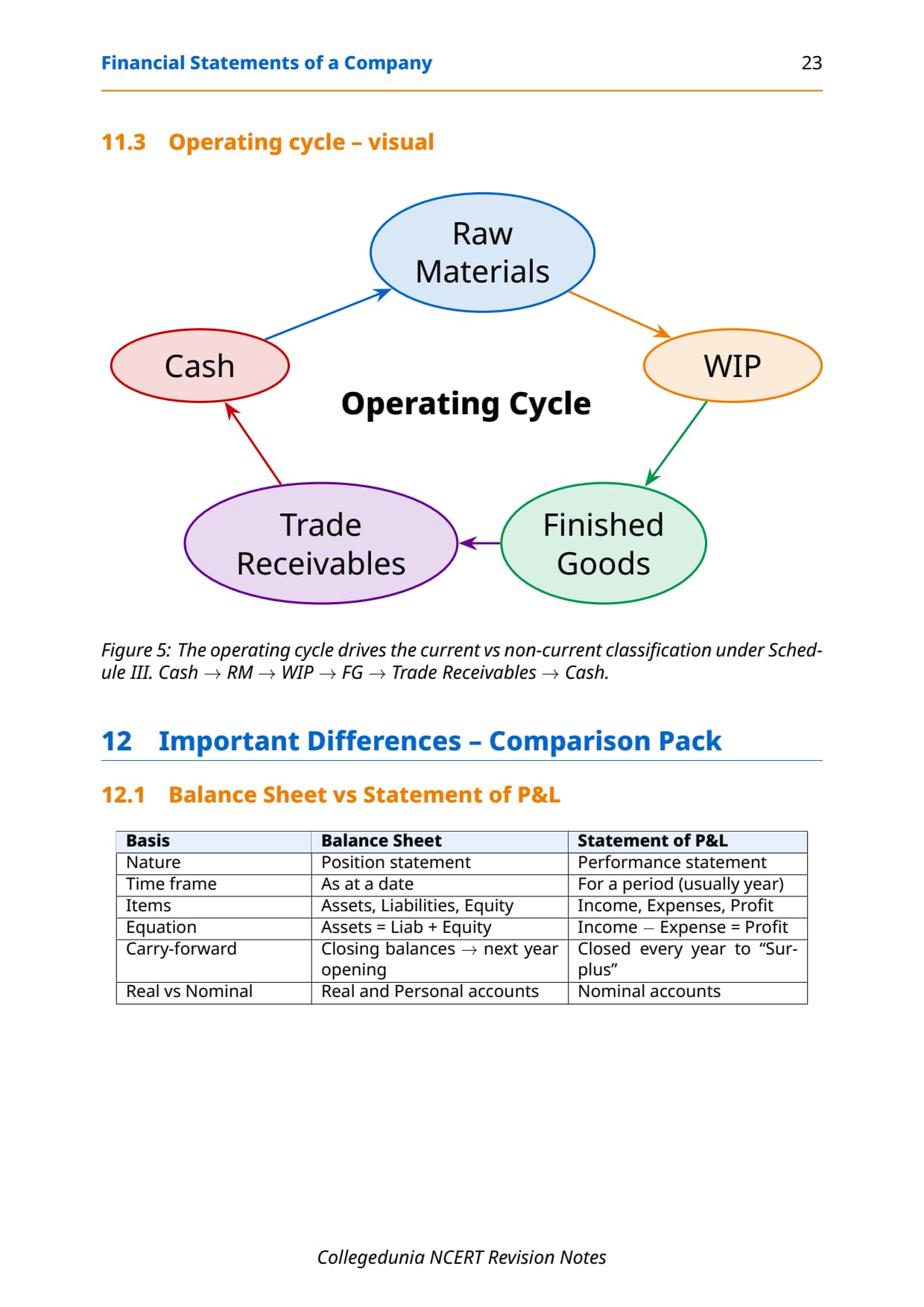
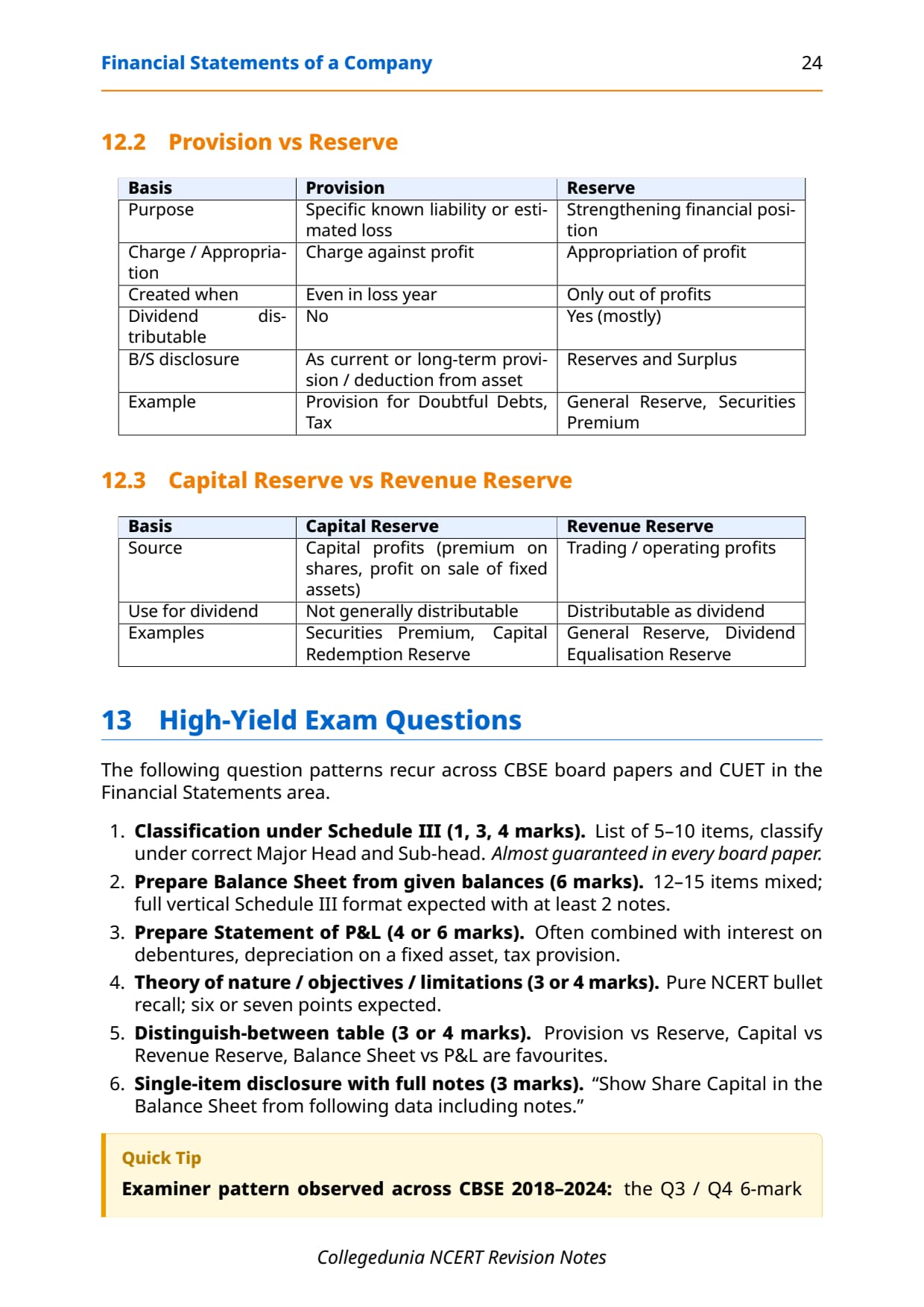
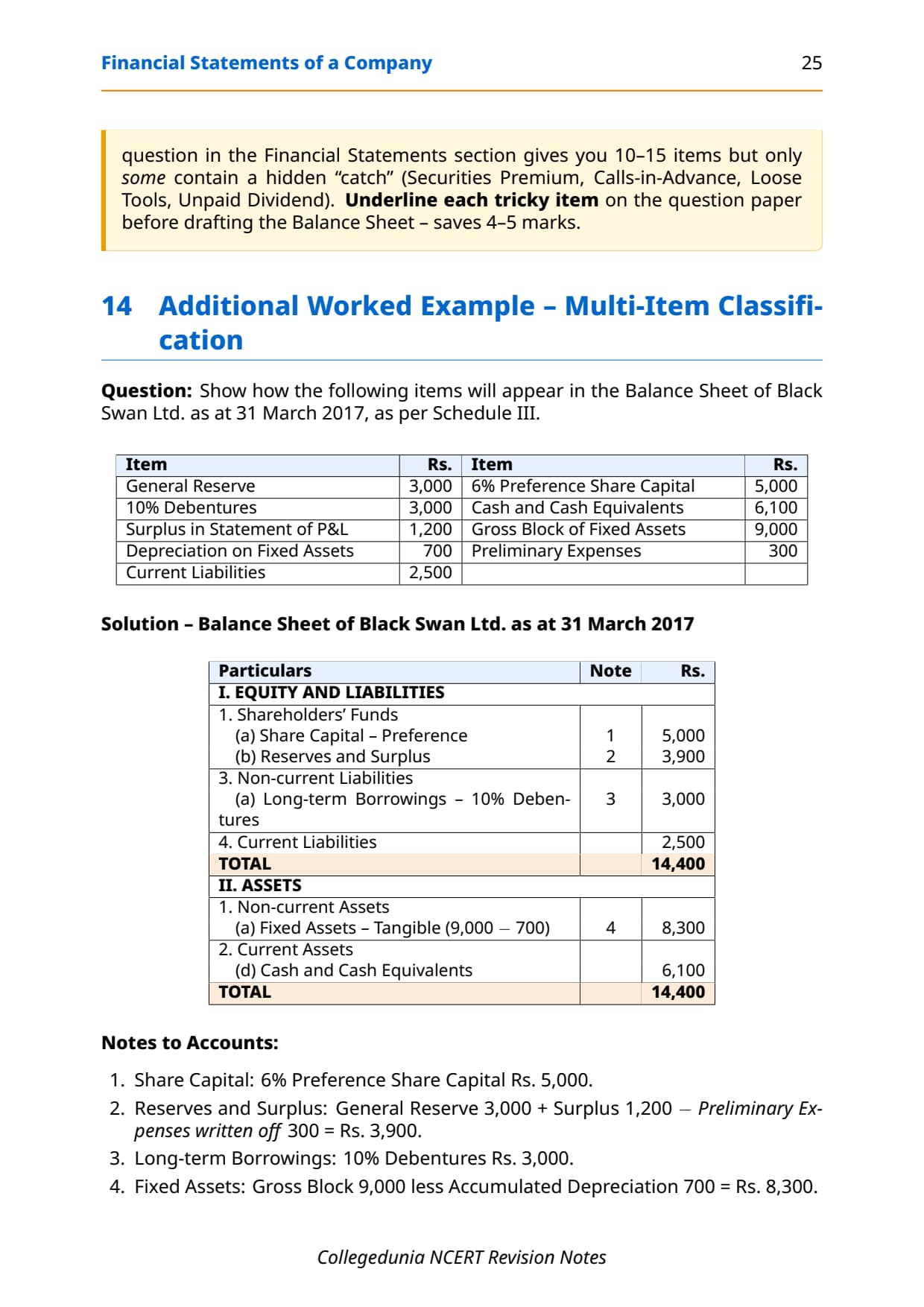
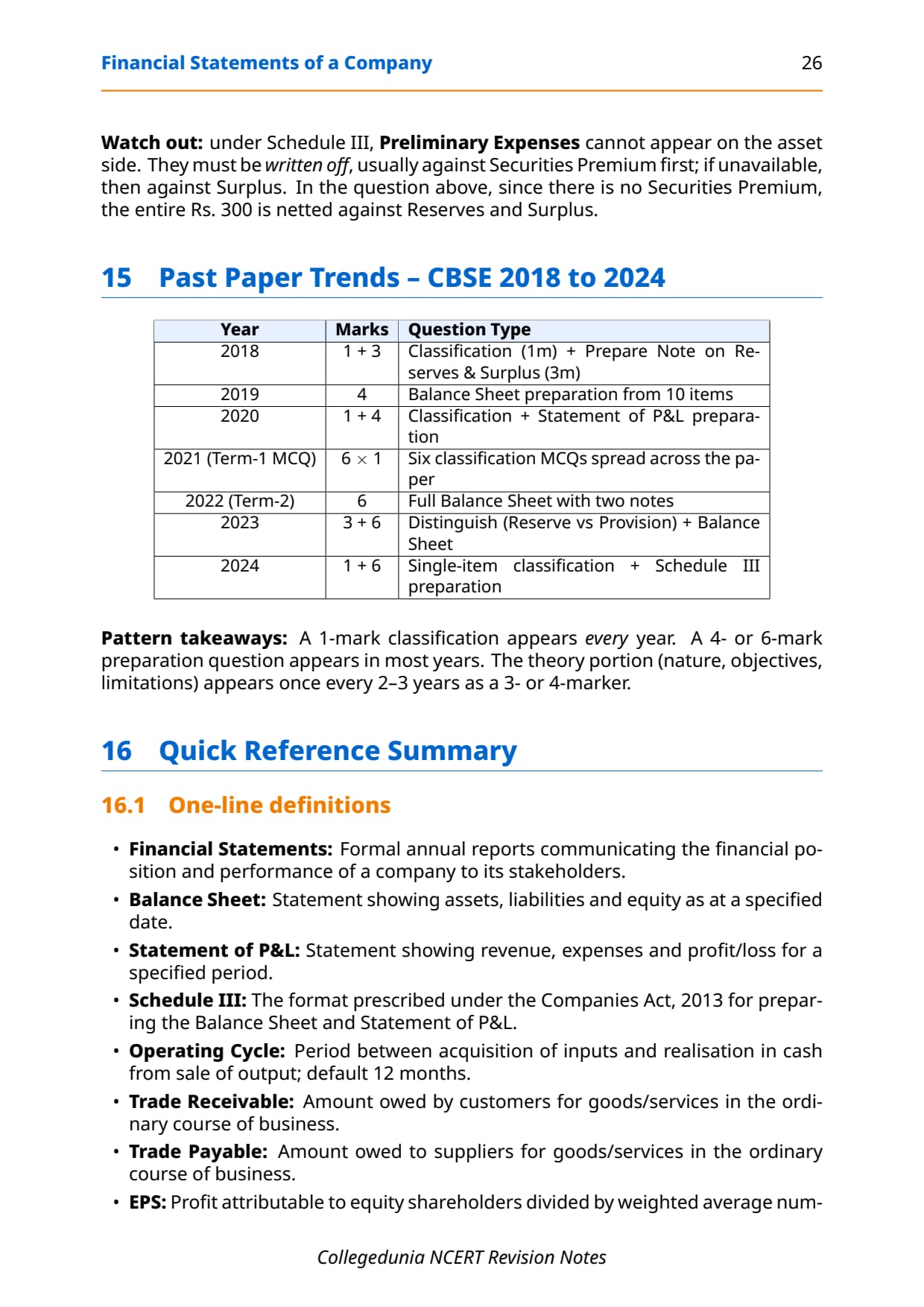
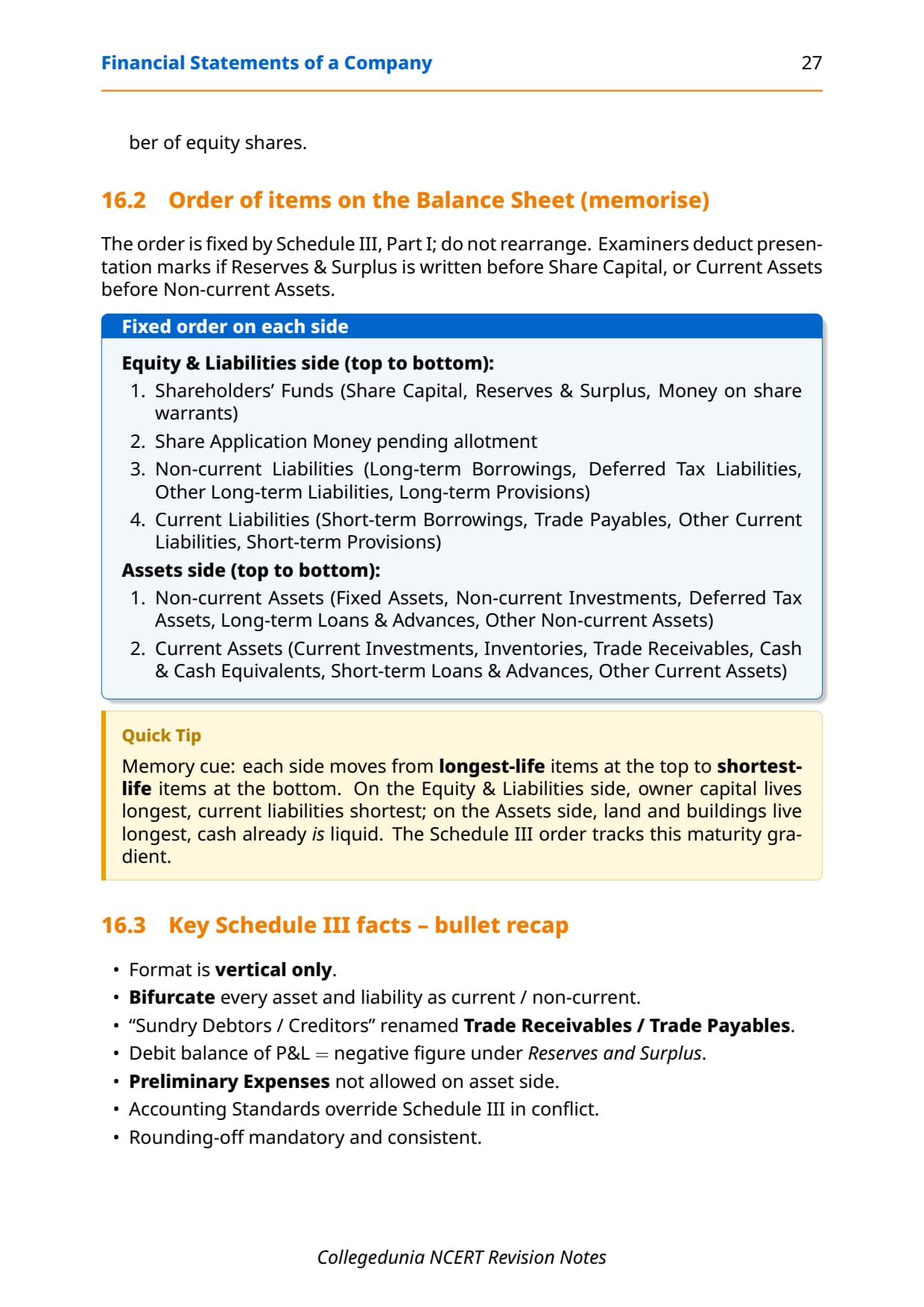
- CBSE Weightage: 8 marks, a compulsory format question every year
- Notes Length: 22-page PDF with a full Balance Sheet and P&L format
Reviewed by Chartered Accountants and senior Commerce educators, mapped to the 2026-27 NCERT reprint and six years of CBSE papers.
Also Check:
- Financial Statements of a Company Class 12 NCERT Solutions
- Issue and Redemption of Debentures Class 12 Accountancy Notes
- CBSE Class 12 Accountancy Syllabus 2026-27
Financial Statements of a Company Class 12: Why the Schedule III Format Is Tested Every Year
Every Indian company must publish a Balance Sheet and Statement of Profit and Loss under Section 129 of the Companies Act, 2013. CBSE tests Schedule III mechanically: given a trial balance, students place each item under the right head. This 8-mark question appears in every CBSE paper.
Class 12 Accountancy Part 2 Chapter 3 Financial Statements Of A Company Notes
Source: Rajat Arora on YouTube
How will Collegedunia's NCERT Notes Help with Financial Statements of a Company?
- Every Schedule III head appears in CBSE's rewarded order, so you can reproduce the Balance Sheet from memory.
- Current versus Non-Current classification is explained for tricky items like provisions and deferred tax.
- Notes to Accounts for Share Capital, Reserves, and Borrowings come as ready-to-write templates.
- Each heading flags where older NCERT wording differs from current wording.
Meaning of Financial Statements and the Companies Act, 2013 Framework
Financial Statements are the structured records of a company's financial position and performance at year-end. Under Section 2(40), they include the Balance Sheet, Statement of Profit and Loss, Cash Flow Statement (not mandatory for small companies), and notes.
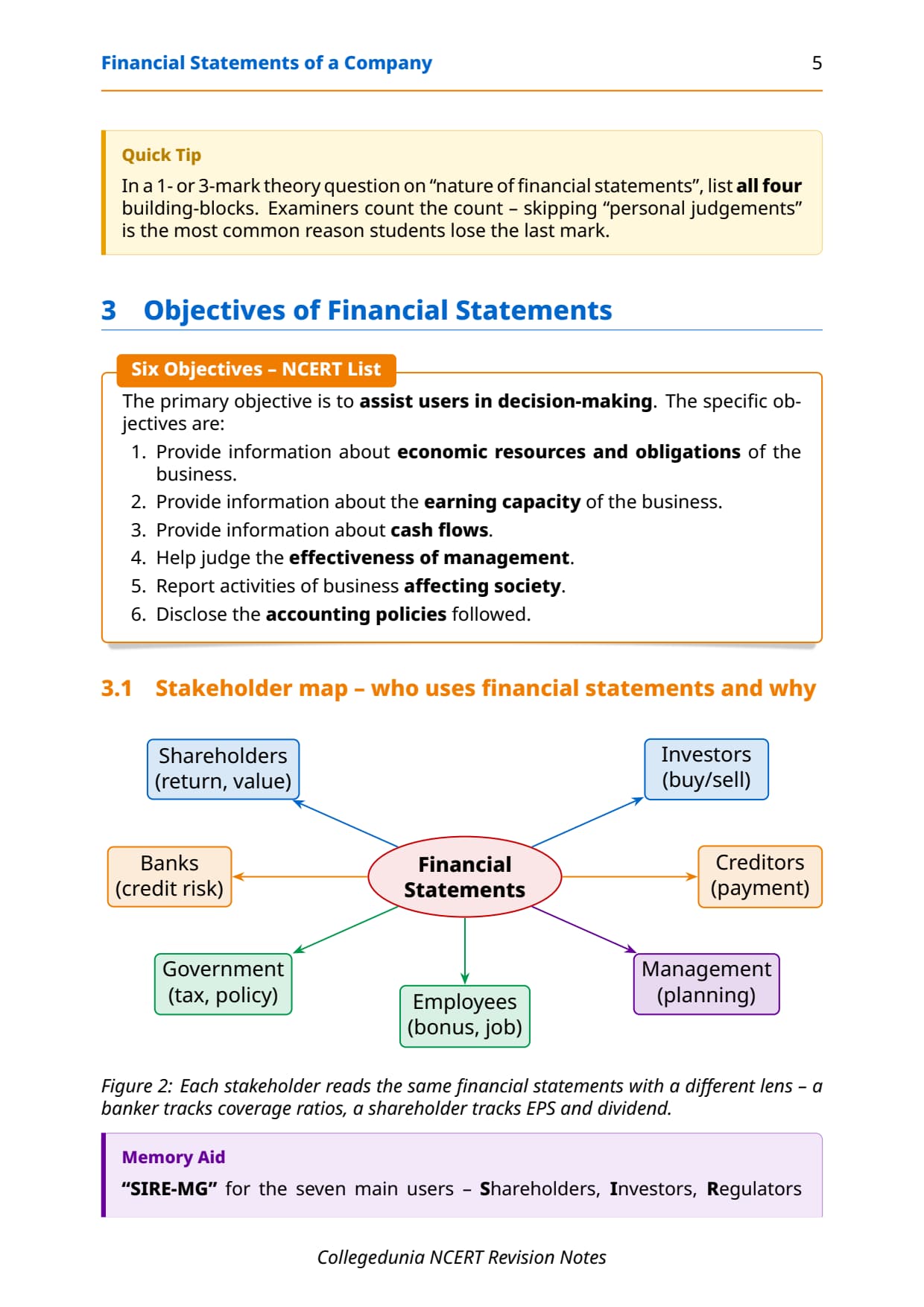
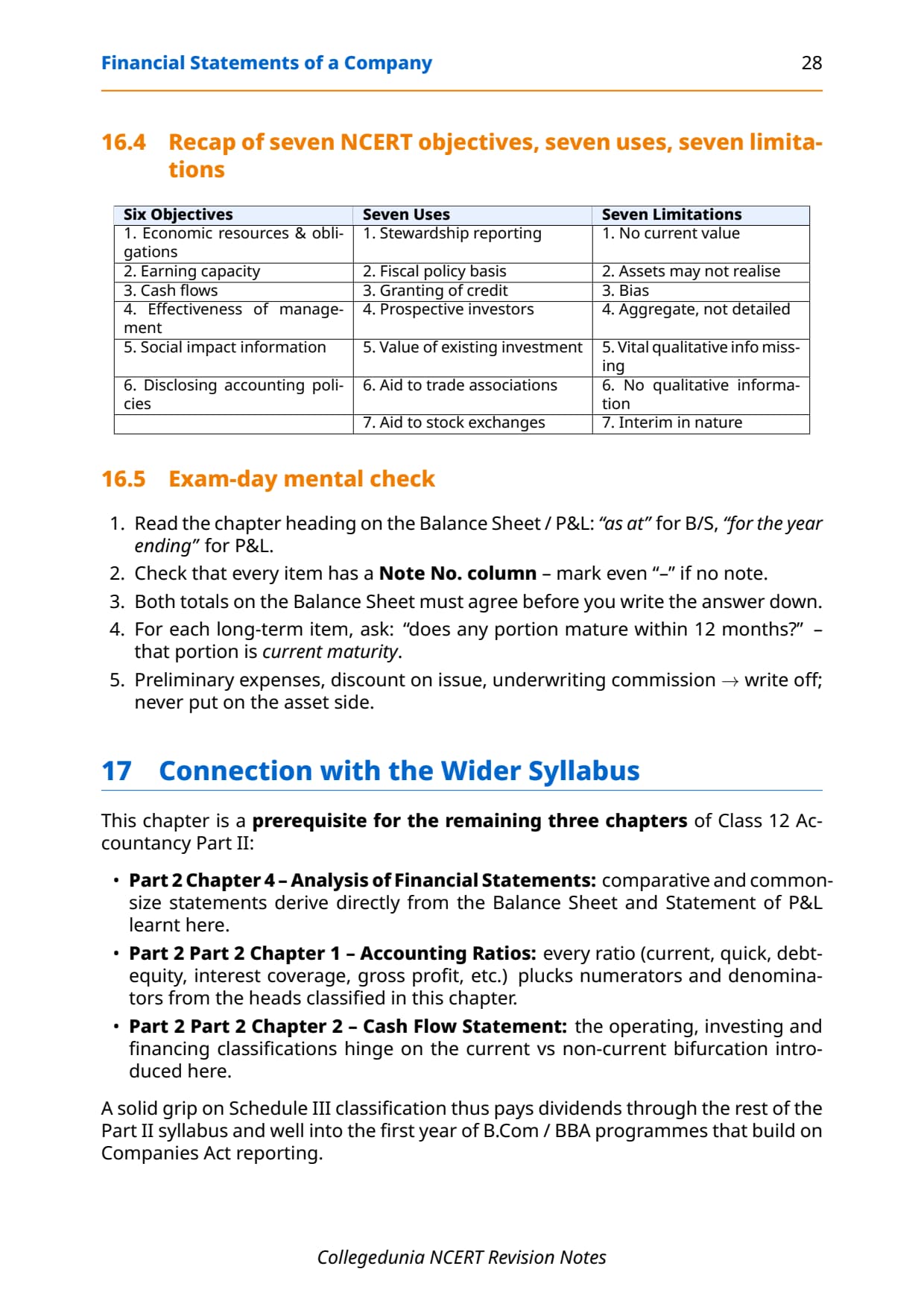
List these objectives for a 3 to 4 mark theory question.
| Objective | What it communicates to the user |
|---|---|
| Provide information about financial position | Assets, liabilities and equity at year-end (Balance Sheet) |
| Report financial performance | Revenue, expenses and profit for the year (Statement of Profit and Loss) |
| Disclose cash flows | Operating, investing and financing inflows and outflows (AS-3 statement) |
| Aid economic decision-making | Information used by investors, lenders, regulators and tax authorities |
| Show stewardship | How responsibly the management has used the resources entrusted to it |
Schedule III Format of the Balance Sheet: Major Heads and Sub-Heads
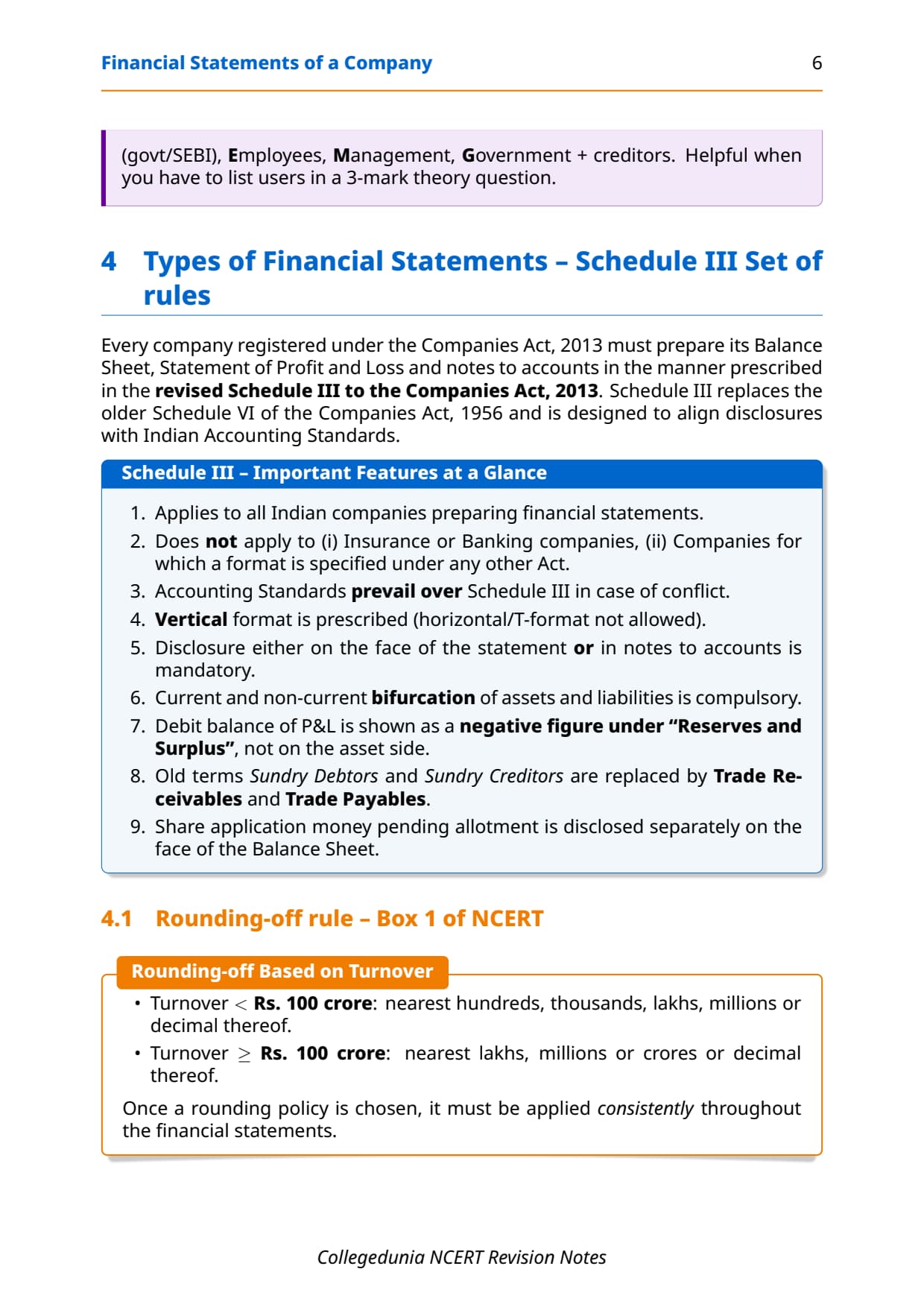
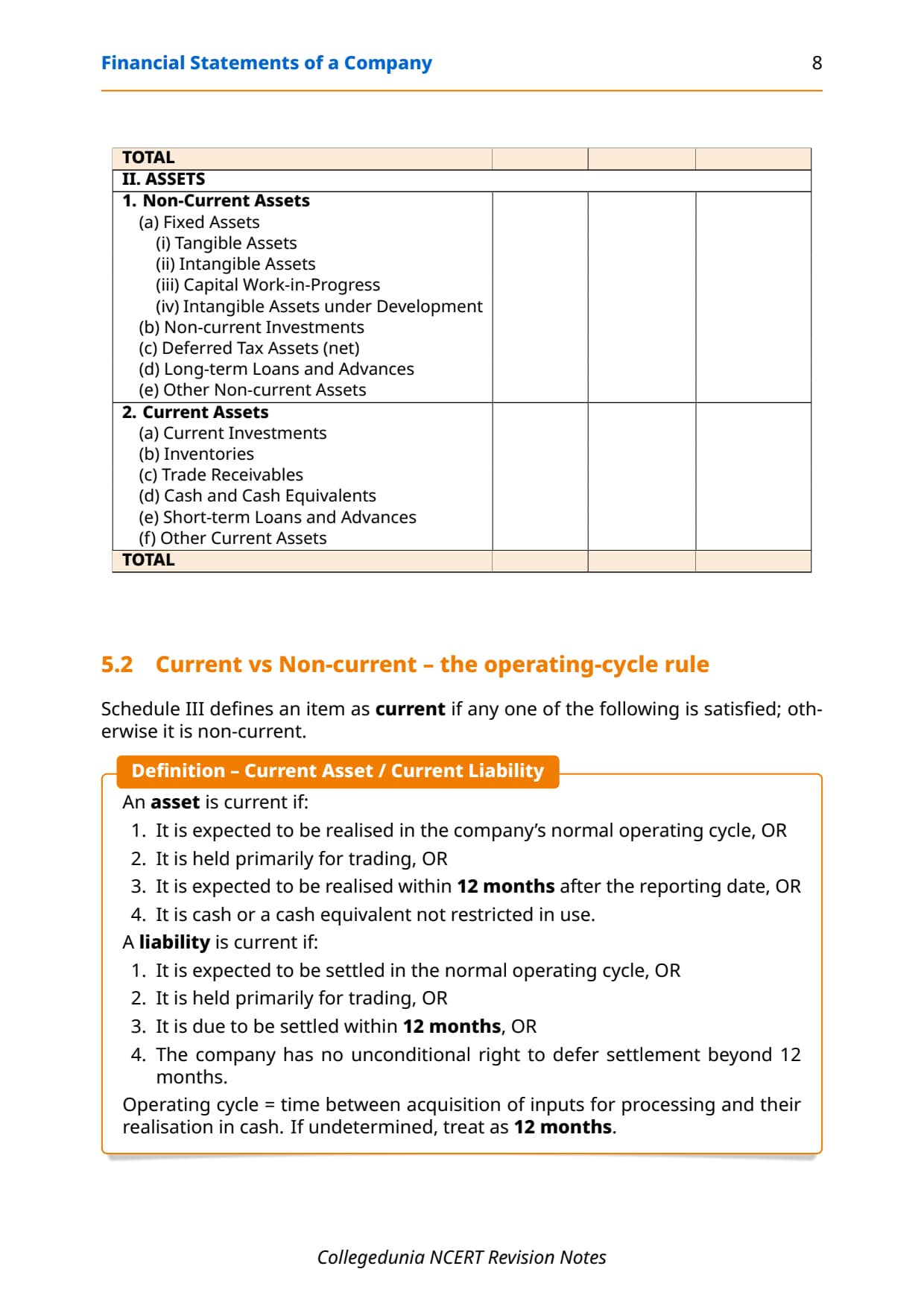
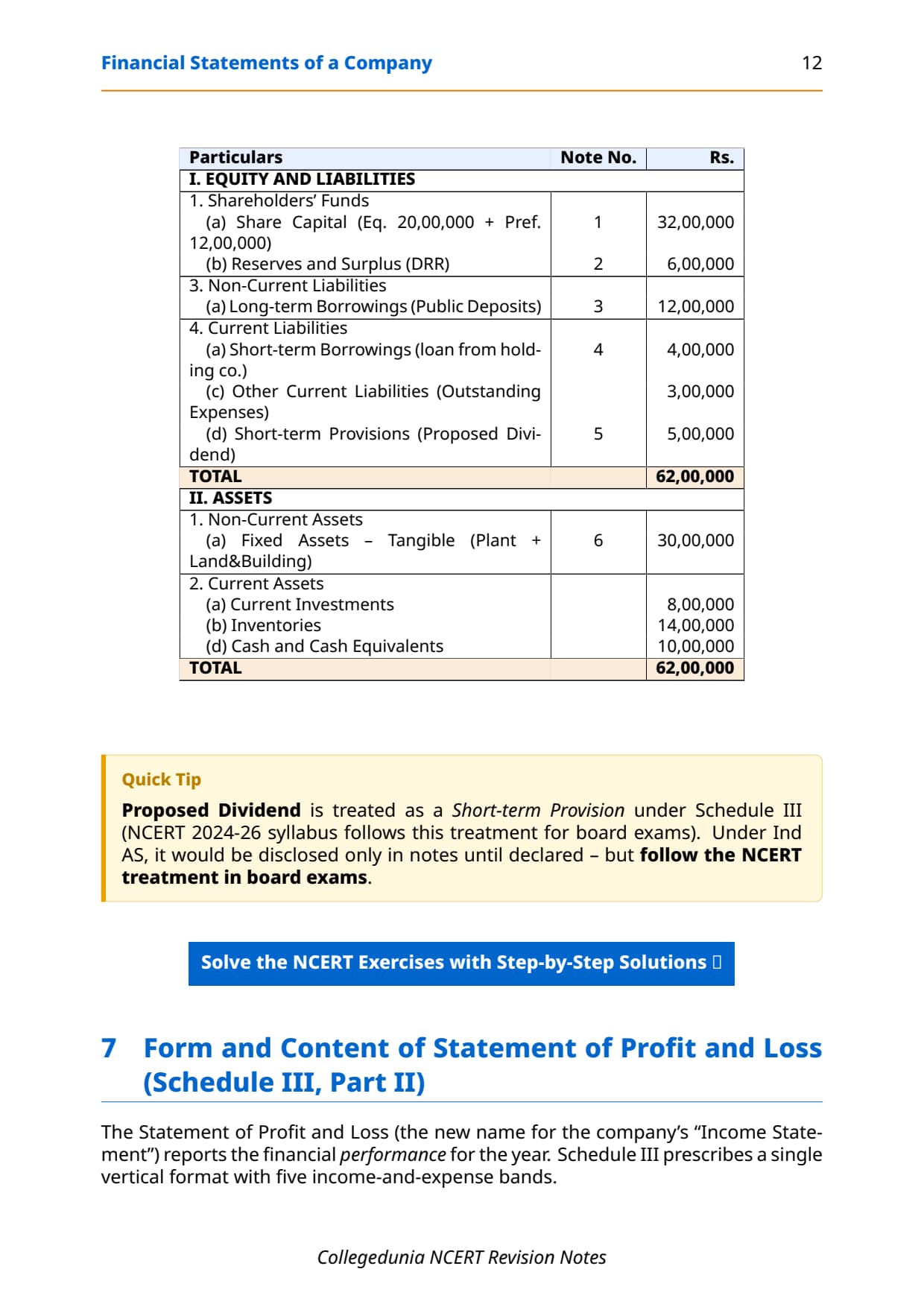
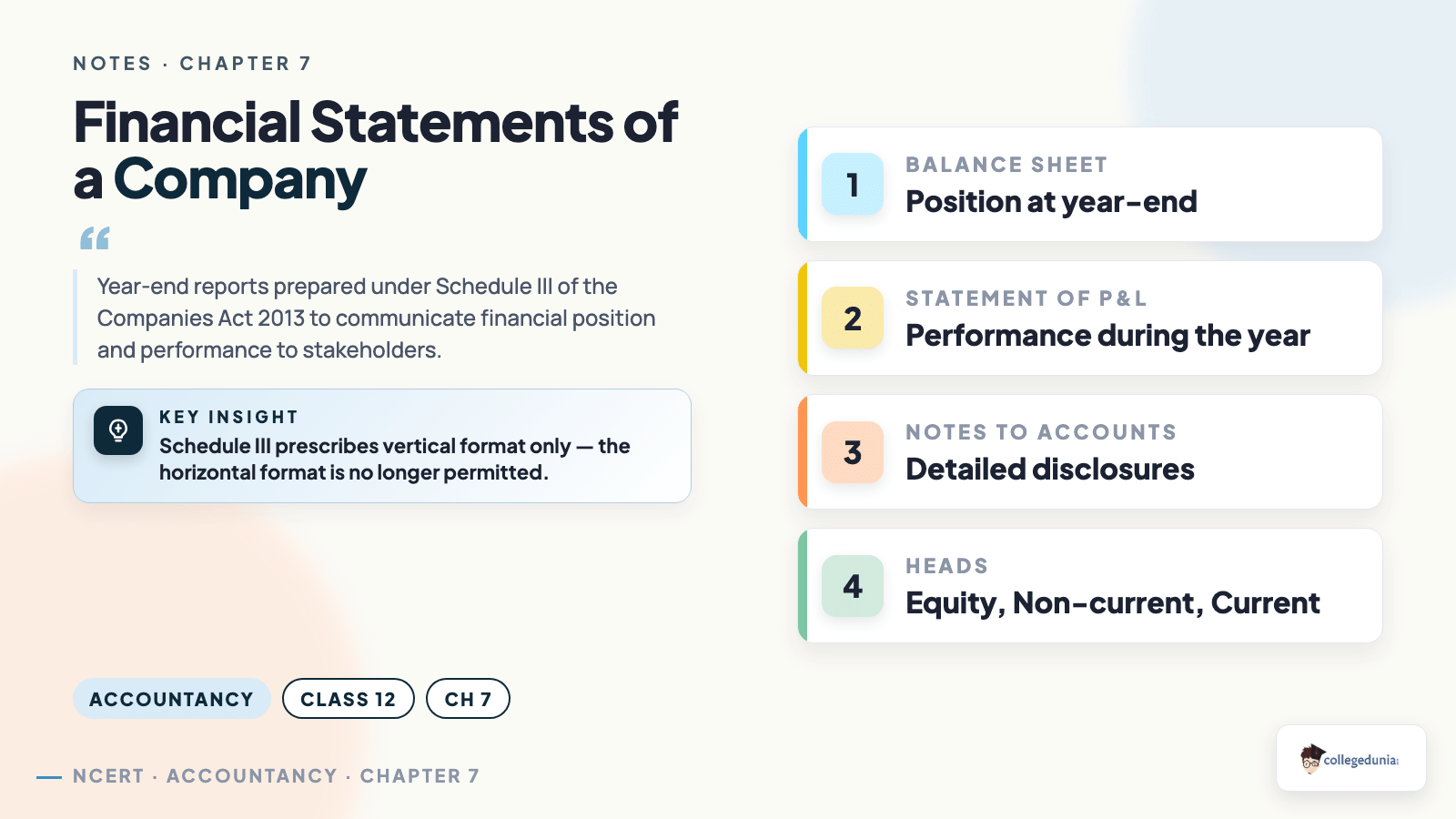
The Schedule III Balance Sheet is vertical form only. Items split into Equity and Liabilities, then Assets, each split again into Current or Non-Current.
| Section | Major Head | Sub-Heads |
|---|---|---|
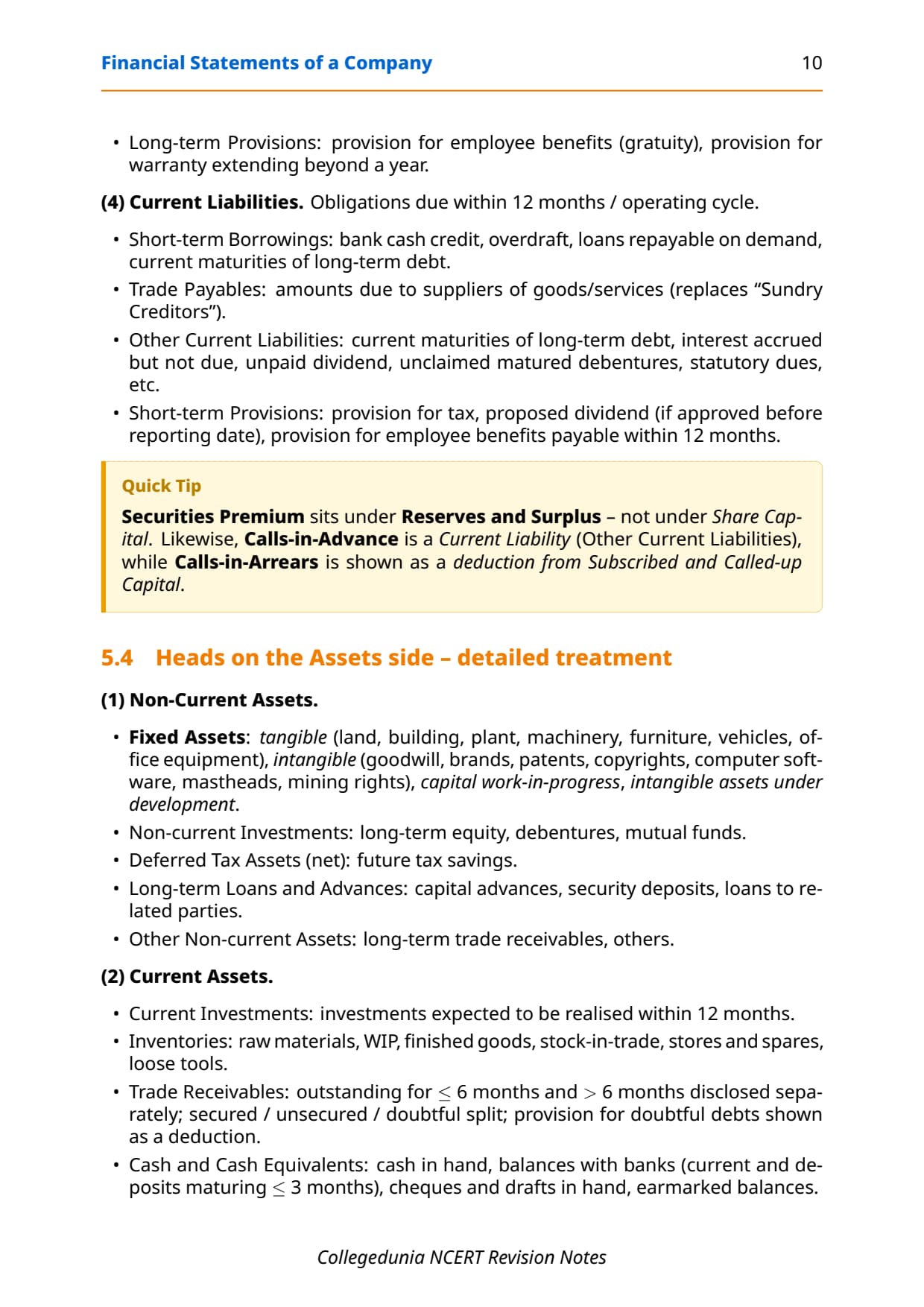
| I. EQUITY AND LIABILITIES | 1. Shareholders' Funds | (a) Share Capital (b) Reserves and Surplus (c) Money received against Share Warrants |
| 2. Share Application Money Pending Allotment | Shown as a separate line item | |
| 3. Non-Current Liabilities | (a) Long-term Borrowings (b) Deferred Tax Liabilities (Net) (c) Other Long-term Liabilities (d) Long-term Provisions | |
| 4. Current Liabilities | (a) Short-term Borrowings (b) Trade Payables (c) Other Current Liabilities (d) Short-term Provisions | |
| II. ASSETS | 1. Non-Current Assets | (a) Fixed Assets (Tangible, Intangible, Capital WIP, Intangible Assets under Development) (b) Non-current Investments (c) Deferred Tax Assets (Net) (d) Long-term Loans and Advances (e) Other Non-current Assets |
| 2. Current Assets | (a) Current Investments (b) Inventories (c) Trade Receivables (d) Cash and Cash Equivalents (e) Short-term Loans and Advances (f) Other Current Assets |
The two totals must match. A mismatch of one rupee costs the full 8 marks, since CBSE awards step-marks only when the total tallies.
Current versus Non-Current Classification: The Twelve-Month Test
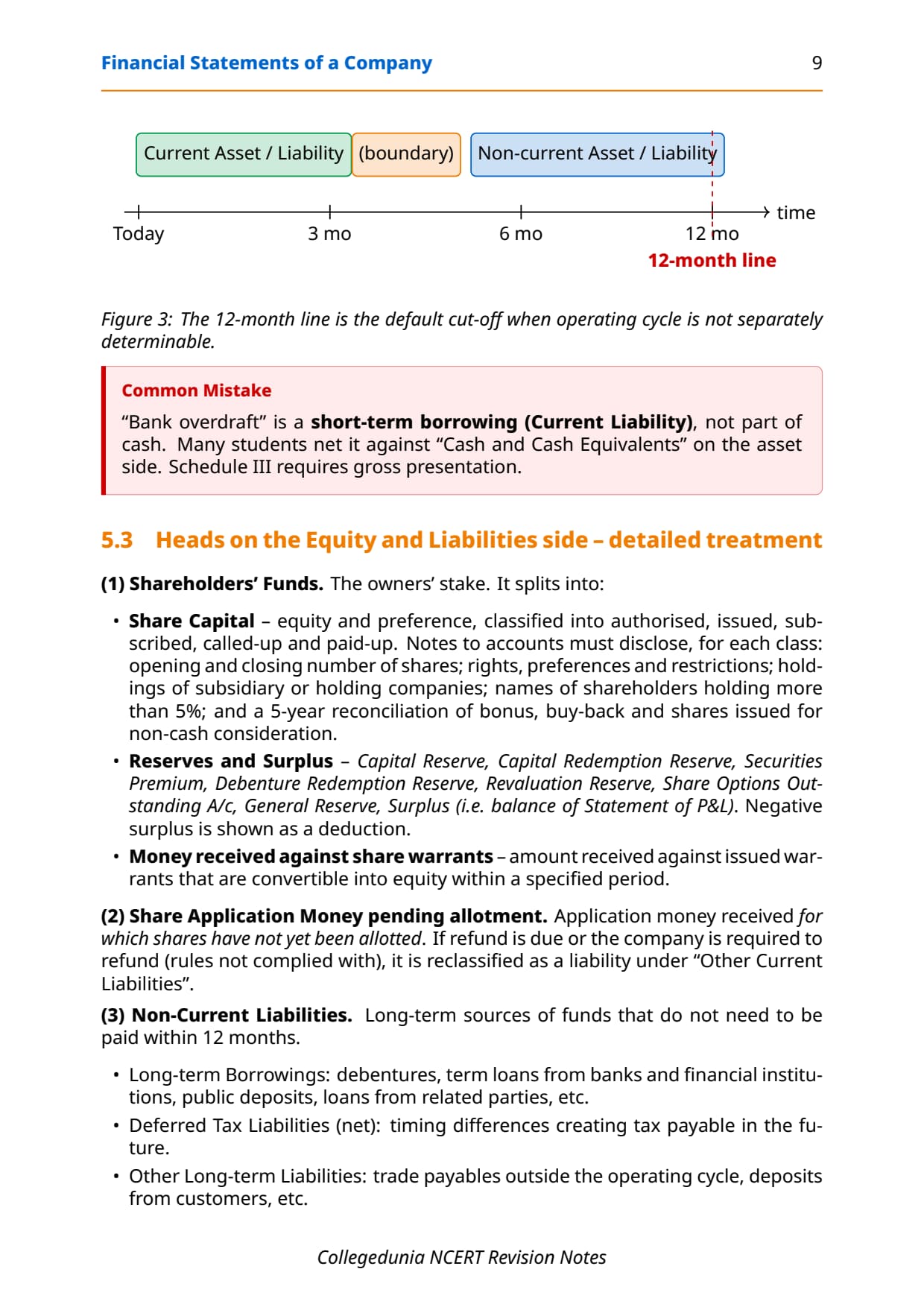
An item is Current if it settles in the normal operating cycle, is held for trading, is due within twelve months, or is cash or a cash equivalent.
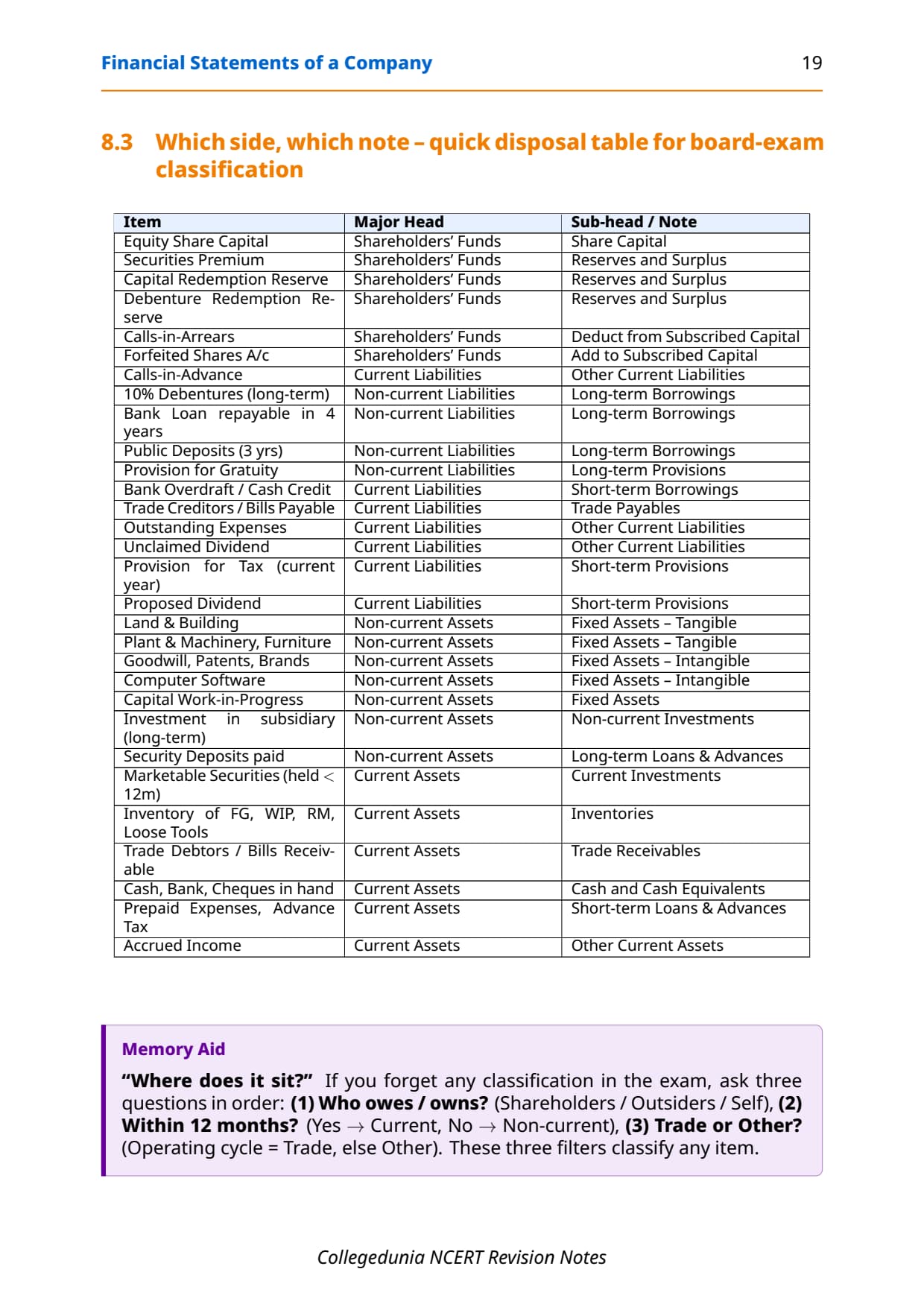
Items that trip students up, with their correct classification.
| Item | Classification | Sub-head |
|---|---|---|
| Bank overdraft | Current Liability | Short-term Borrowings |
| Public deposits payable after 3 years | Non-Current Liability | Long-term Borrowings |
| Current maturities of long-term debt | Current Liability | Other Current Liabilities |
| Calls in arrears | Subtracted from Subscribed Capital | Share Capital (Notes) |
| Calls in advance | Current Liability | Other Current Liabilities |
| Provision for tax | Current Liability | Short-term Provisions |
| Proposed dividend | Contingent Liability, disclosed in Notes (post 2016) | Not on Balance Sheet face |
| Securities Premium Reserve | Part of Reserves and Surplus | Reserves and Surplus |
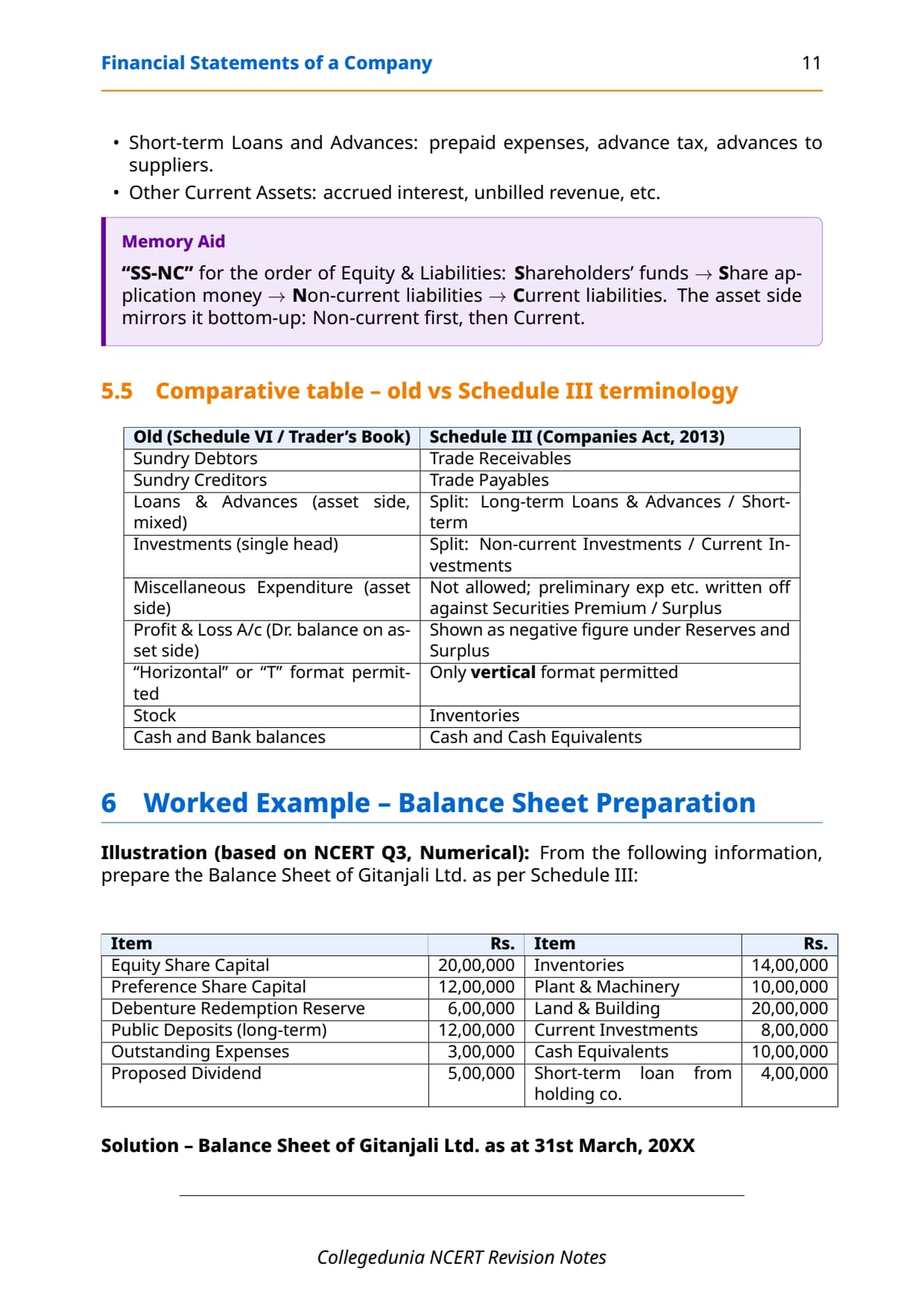
| Loose tools, stores and spare parts | Current Asset | Inventories |
| Goodwill purchased | Non-Current Asset | Fixed Assets (Intangible) |
Schedule III Format of the Statement of Profit and Loss
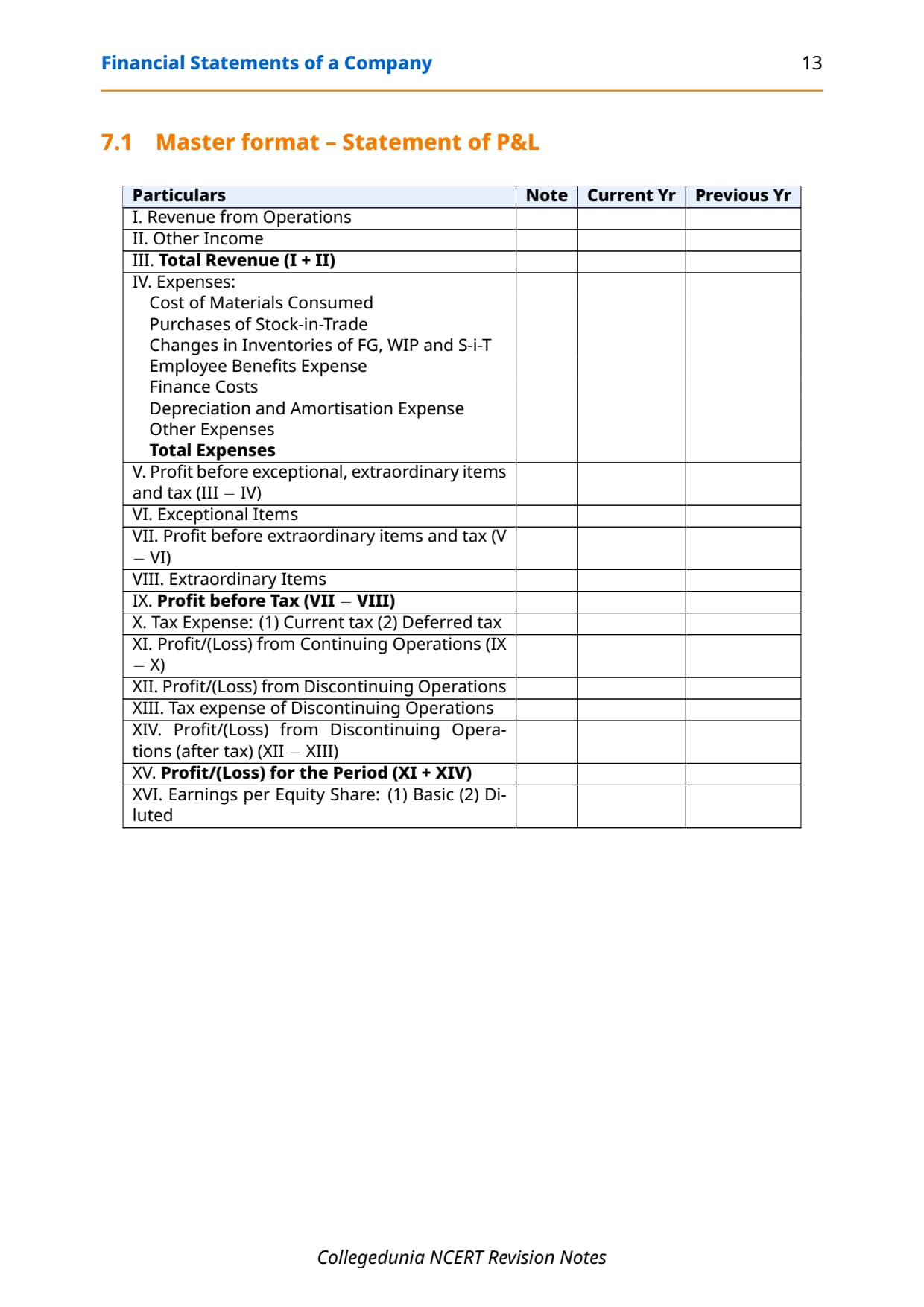
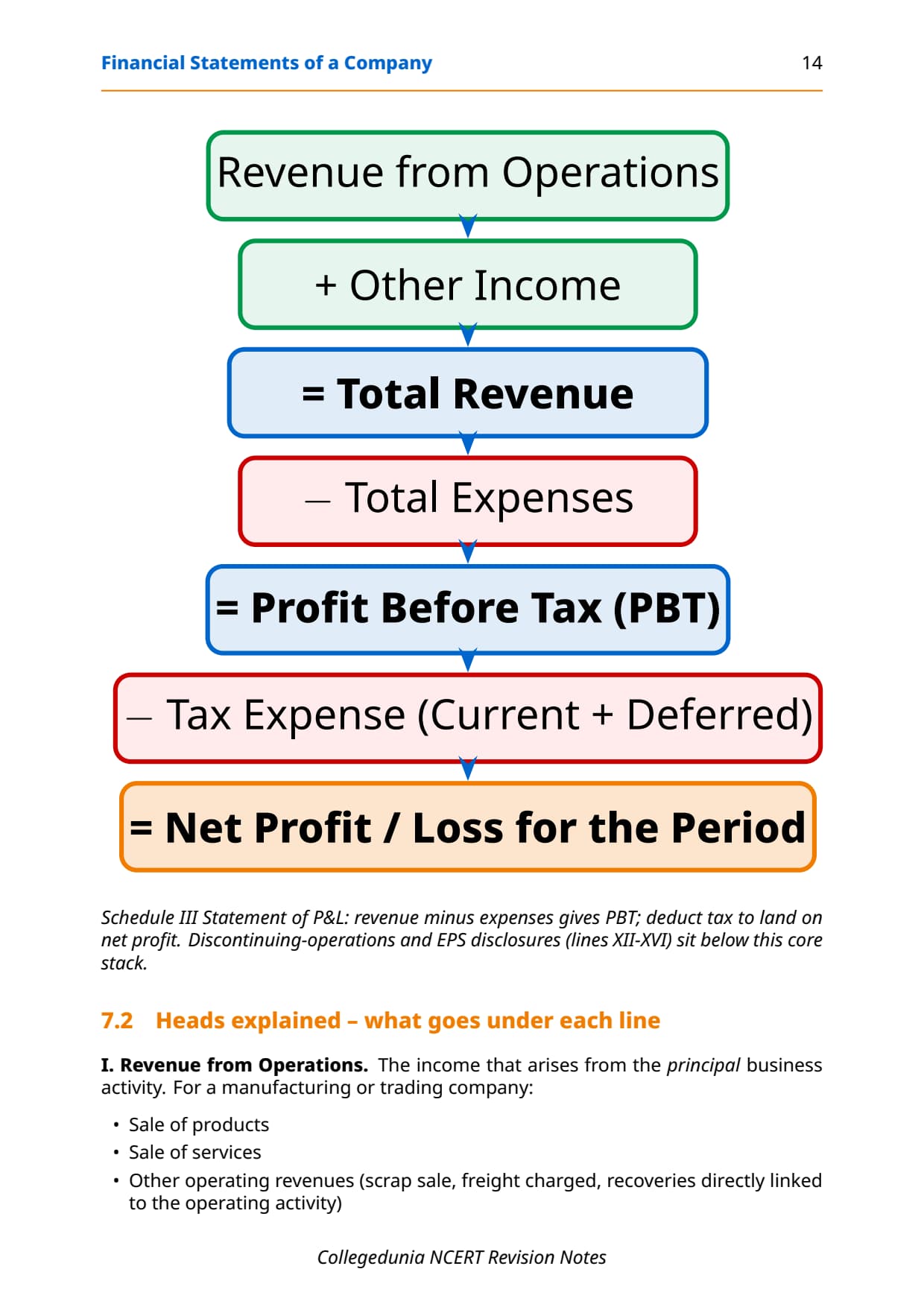
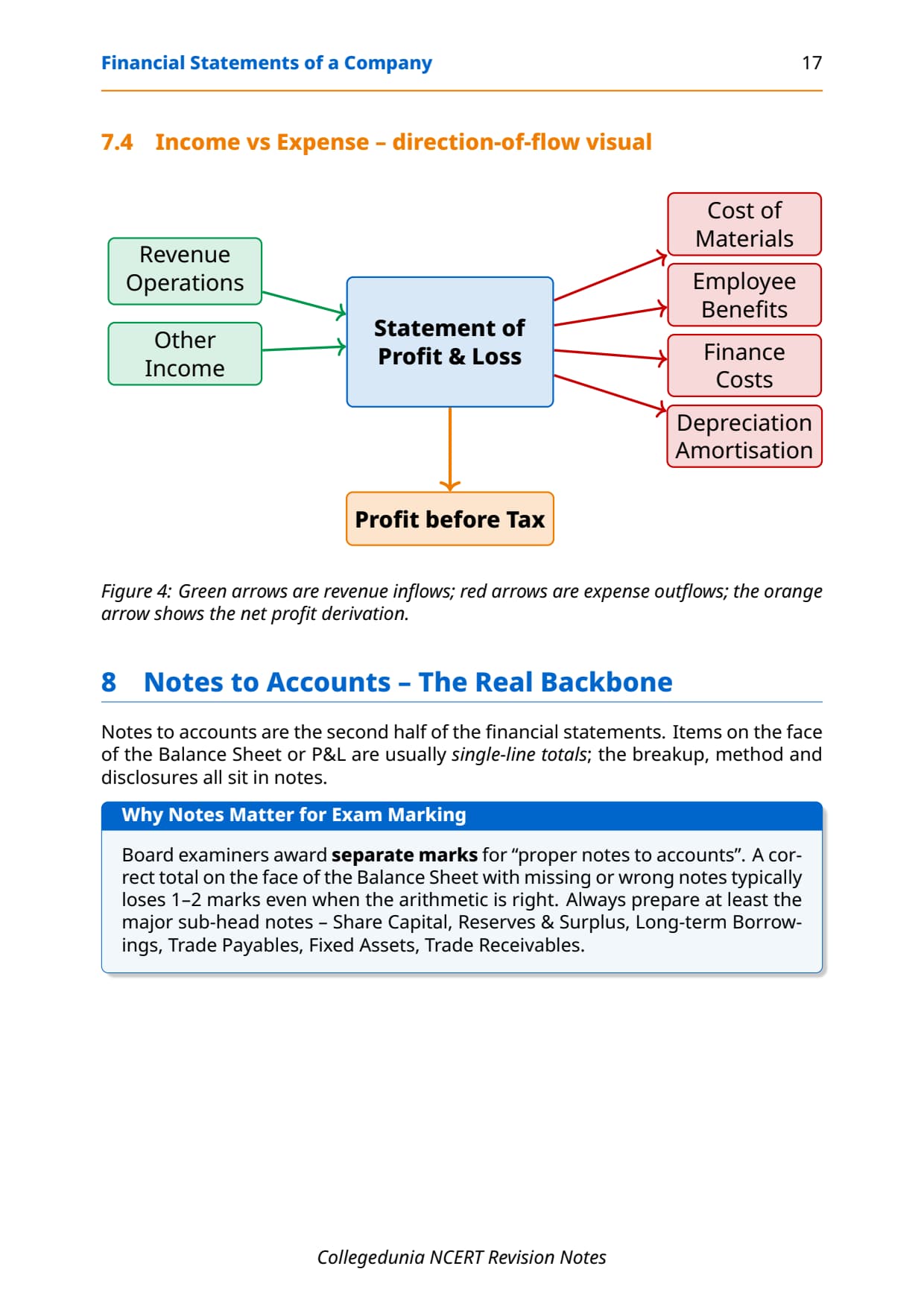
The Statement of Profit and Loss uses a vertical format with Roman numerals grading each subtotal.
| Roman Numeral | Line Item | Description |
|---|---|---|
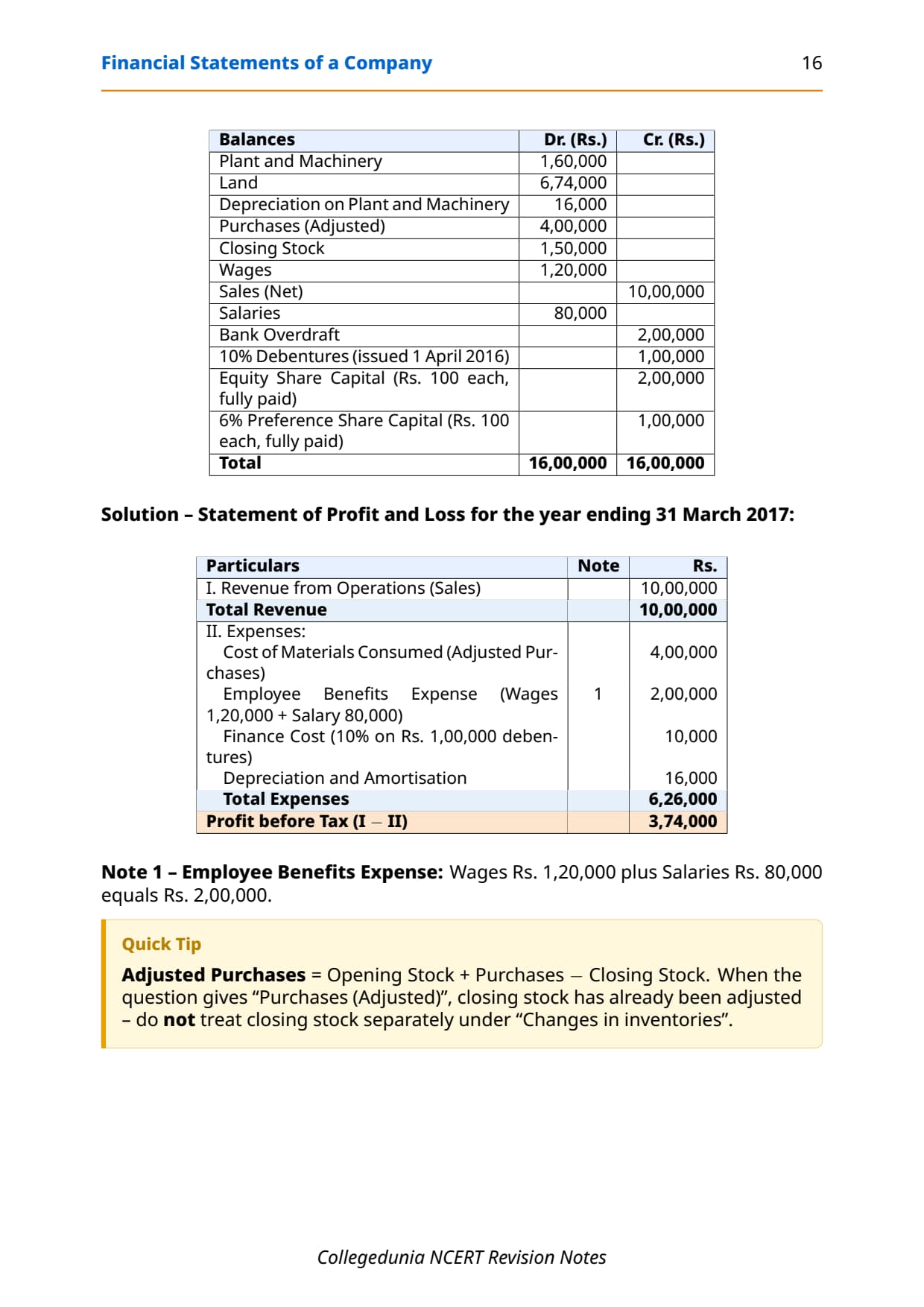
| I | Revenue from Operations | Sale of goods or services, the company's main business income |
| II | Other Income | Interest, dividend, profit on sale of fixed assets, rent received |
| III | Total Revenue (I + II) | First graded subtotal |
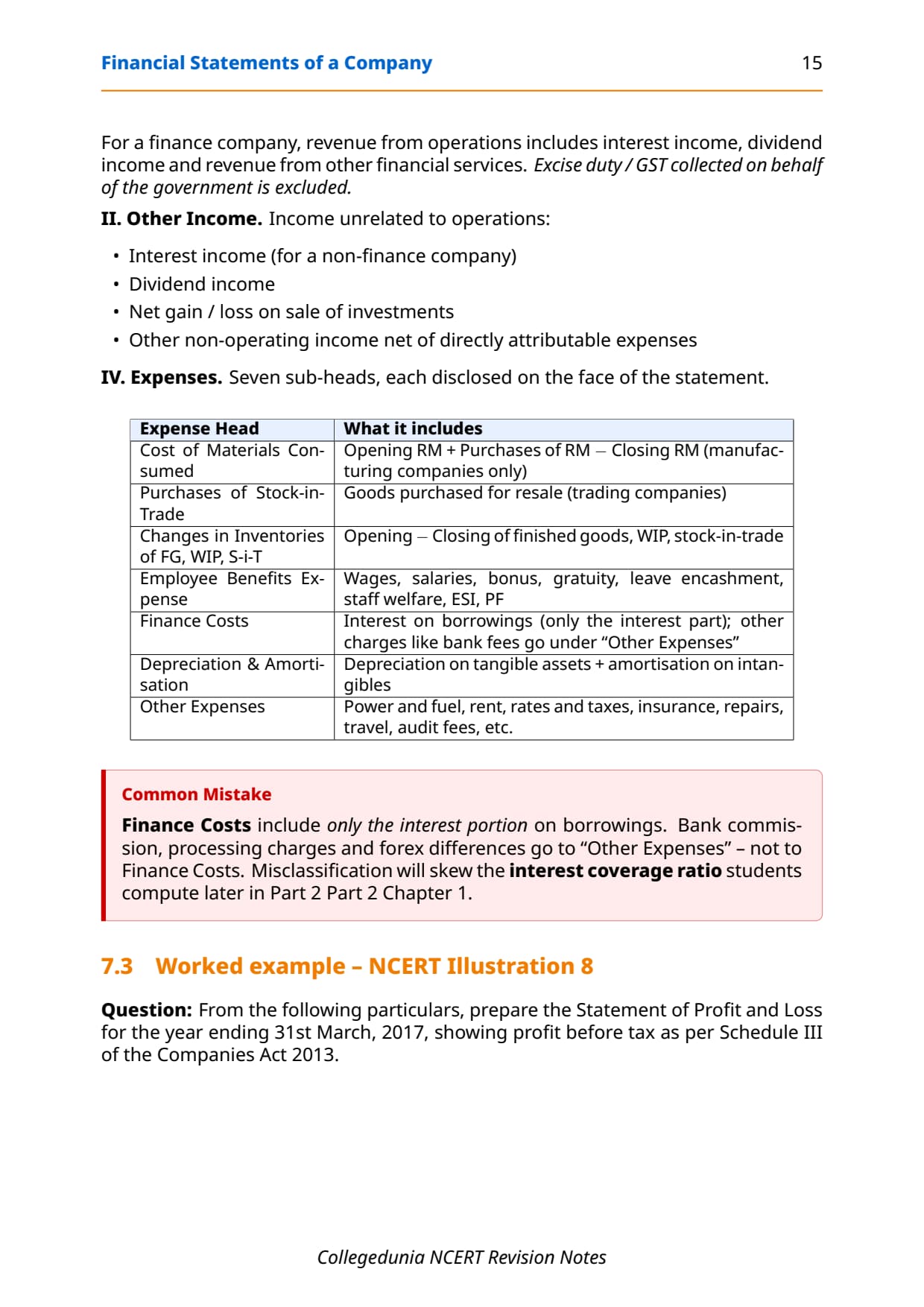
| IV | Expenses | (a) Cost of Materials Consumed (b) Purchases of Stock-in-Trade (c) Changes in Inventories (d) Employee Benefit Expenses (e) Finance Costs (f) Depreciation and Amortisation (g) Other Expenses |
| V | Profit before Tax (III - IV) | Second graded subtotal |
| VI | Tax Expense | Current Tax plus Deferred Tax |
| VII | Profit for the Period (V - VI) | Third graded subtotal, transferred to Reserves and Surplus |
| VIII to XI | EPS disclosures | Basic and Diluted Earnings Per Share, computed from VII |
Finance Costs is a separate sub-head of Expenses, never netted against Other Income.
Notes to Accounts: The Four Templates the Board Paper Asks For
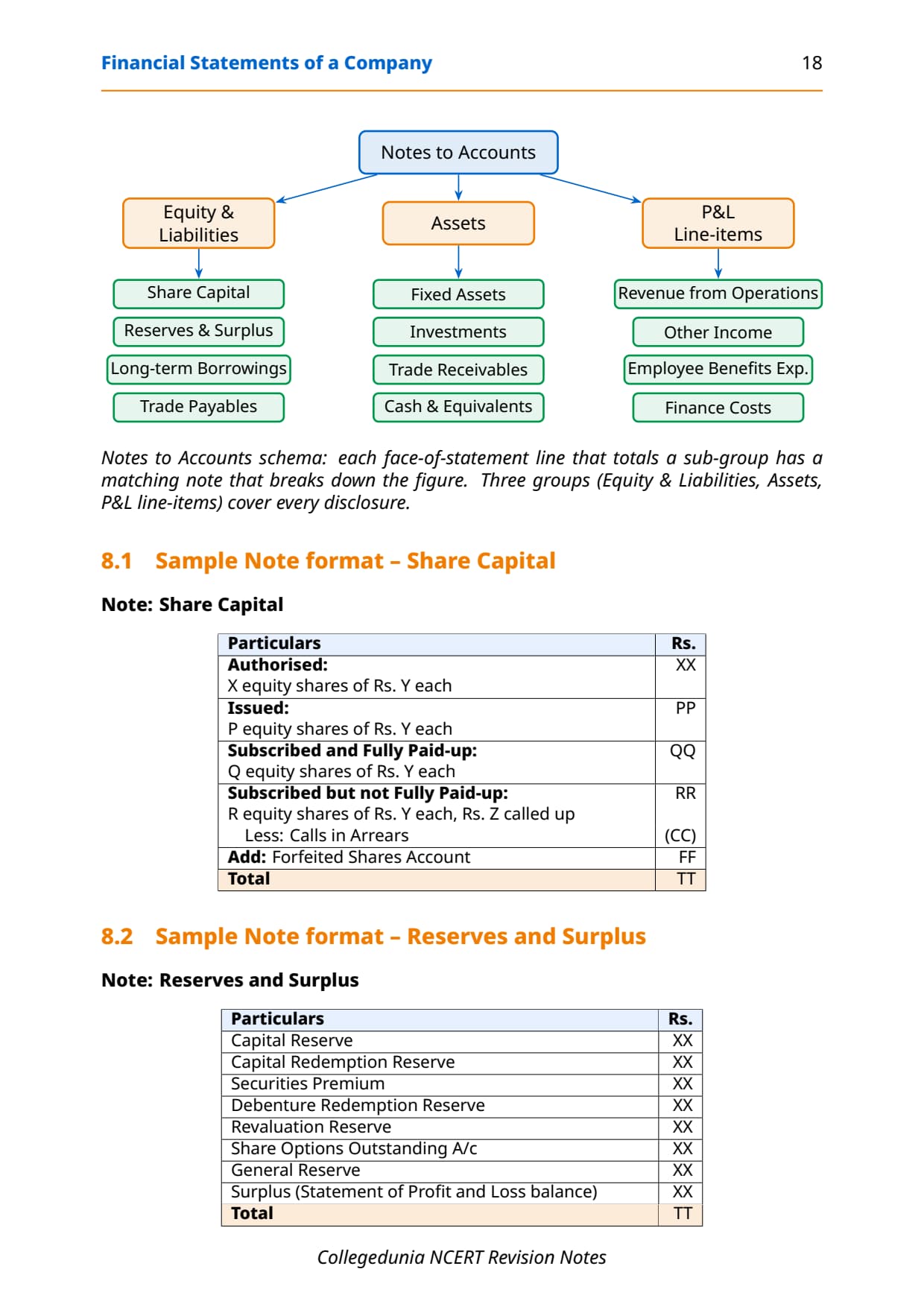
The Balance Sheet shows only totals; breakdowns sit in Notes to Accounts, most-asked for Share Capital, Reserves, Borrowings, and Assets.
| Note 1: Share Capital | Amount (Rs.) |
|---|---|
| Authorised Capital X,XX,XXX Equity Shares of Rs. 10 each | XX,XX,XXX |
| Issued Capital X,XX,XXX Equity Shares of Rs. 10 each | XX,XX,XXX |
| Subscribed Capital (a) Subscribed and Fully Paid (b) Subscribed but Not Fully Paid Less: Calls in Arrears | XX,XX,XXX XX,XX,XXX (XX,XXX) |
| Total | XX,XX,XXX |
The same layout repeats in Reserves and Surplus and in Long-term Borrowings (secured versus unsecured).
Common Mistakes in Financial Statements of a Company Numericals
- Treating Proposed Dividend as a Current Liability; since 2016 it is a contingent liability in Notes only.
- Placing Bank Overdraft under Cash Equivalents instead of Short-term Borrowings.
- Classifying Calls in Arrears as a Current Asset instead of deducting it from Subscribed Capital.
- Showing Securities Premium as a separate head instead of inside Reserves and Surplus.
- Recording Forfeited Shares outside the Subscribed Capital block.
- Forgetting Capital Work-in-Progress during construction.
Previous Year Question Trend: Financial Statements of a Company CBSE Class 12
How this format has surfaced recently.
| Year | Question Type | Marks |
|---|---|---|
| 2025 | Classification of 8 items under Schedule III heads | 4 |
| 2025 | Full Balance Sheet preparation from trial balance | 8 |
| 2024 | Short-head identification of 6 items | 3 |
| 2024 | Statement of Profit and Loss with Notes to Accounts | 6 |
| 2023 | Balance Sheet from given particulars | 8 |
| 2022 | Term-2 paper: Notes to Accounts on Share Capital | 3 |
| 2021 | Major head and sub-head pairs (objective) | 2 |
One classification question (3 to 4 marks) plus one full-format question (6 to 8 marks) give 10 to 12 marks every paper.
Full PYQ Map for Class 12 Accountancy
Full year-wise PYQ map: see the Financial Statements of a Company Class 12 NCERT Solutions page.
Other Resources
- Financial Statements of a Company Notes
- Financial Statements of a Company Class 12 NCERT Solutions
- Financial Statements of a Company Class 12 NCERT Book PDF
- CBSE Class 12 Accountancy Syllabus 2026-27
NCERT Notes for Class 12 Accountancy: All Chapters
| Chapter | Notes Link |
|---|---|
| Chapter 1 | Accounting for Partnership Basic Concepts Notes |
| Chapter 2 | Admission of a Partner Notes |
| Chapter 3 | Retirement and Death of a Partner Notes |
| Chapter 4 | Dissolution of Partnership Firm Notes |
| Part 2 Chapter 1 | Accounting for Share Capital Notes |
| Part 2 Chapter 2 | Issue and Redemption of Debentures Notes |
| Part 2 Chapter 4 | Analysis of Financial Statements Notes |
| Part 2 Chapter 5 | Accounting Ratios Notes |
| Part 2 Chapter 6 | Cash Flow Statement Notes |
Student Feedback
In a Collegedunia poll of 1,240 Class 12 Commerce students, 76% rated Financial Statements of a Company among the tougher parts of the Accountancy syllabus. After using these revision notes, 4 in 5 said they felt ready for the board questions from this chapter.
FAQs on Financial Statements of a Company Class 12 Notes
Ques. What are financial statements of a company under the Companies Act, 2013?
Ans.
Under Section 2(40) of the Companies Act, 2013, financial statements include the Balance Sheet, the Statement of Profit and Loss, the Cash Flow Statement, the Statement of Changes in Equity where applicable, and any notes annexed thereto. One-Person Companies, small companies, and dormant companies are exempted from preparing the Cash Flow Statement.
Ques. What is Schedule III of the Companies Act, 2013?
Ans.
Schedule III prescribes the format in which every Indian company must present its Balance Sheet and Statement of Profit and Loss. The format is strictly vertical and groups items under Equity and Liabilities and Assets, each further split into Current and Non-Current using the operating cycle test or a twelve-month threshold.
Ques. Under which head is Bank Overdraft shown in the Balance Sheet of a company?
Ans.
Bank Overdraft is shown under Current Liabilities, in the sub-head Short-term Borrowings. It is never combined with Cash and Cash Equivalents on the asset side because it represents a credit balance with the bank and is repayable on demand.
Ques. How is Proposed Dividend treated in the financial statements of a company?
Ans.
From the Companies (Accounting Standards) Amendment Rules, 2016, Proposed Dividend is treated as a contingent liability and is no longer shown on the face of the Balance Sheet. It is disclosed in Notes to Accounts and recognised as a liability only after the shareholders approve it at the Annual General Meeting.
Ques. What is the difference between Authorised, Issued, Subscribed, and Paid-up Capital?
Ans.
Authorised Capital is the maximum capital the company can issue as per its Memorandum. Issued Capital is the portion actually offered to investors. Subscribed Capital is the portion taken up by applicants. Paid-up Capital is the portion of Subscribed Capital on which the called-up money has been received, after deducting Calls in Arrears.
Ques. Where is Calls in Arrears shown in the Balance Sheet?
Ans.
Calls in Arrears is deducted from Subscribed but Not Fully Paid Capital inside Note 1 to Share Capital. It is never shown as a Current Asset, even though it represents money receivable from shareholders.
Ques. How many marks does Financial Statements of a Company carry in the CBSE Class 12 Board exam?
Ans.
Part 2 Chapter 3 typically carries 8 marks in the CBSE Class 12 Accountancy Board paper, split between one short classification question (3 to 4 marks) and one full-format Balance Sheet or Statement of Profit and Loss preparation (6 to 8 marks). The chapter has appeared in every Board paper from 2018 to 2025.
Ques. Are the Financial Statements of a Company Class 12 notes aligned to the 2026-27 NCERT?
Ans.
Yes, these notes follow the 2026-27 NCERT Accountancy Part II reprint, which retains the Schedule III format introduced after the Companies Act, 2013 came into force. The chapter content has not been trimmed in the current edition.



Comments