




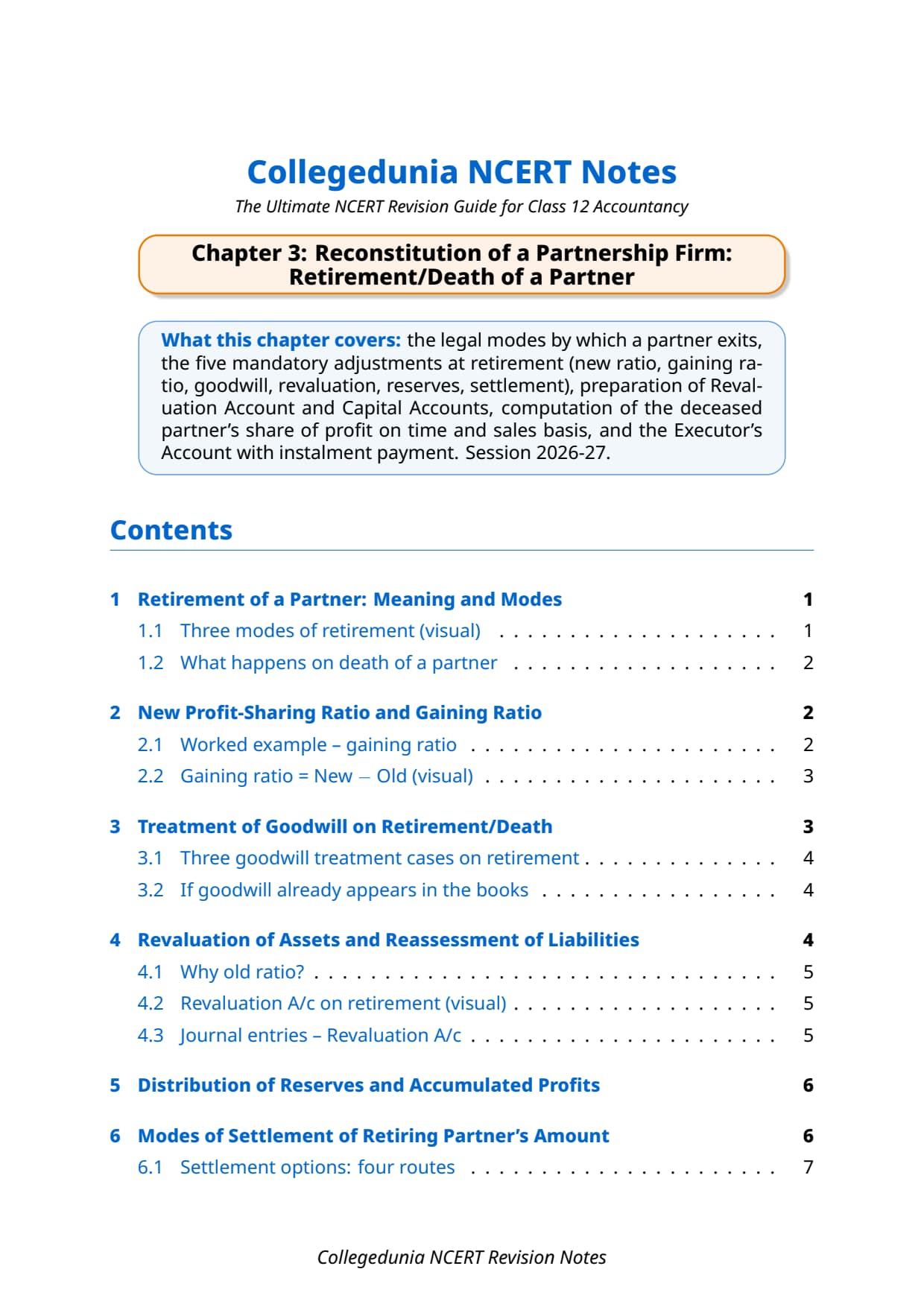
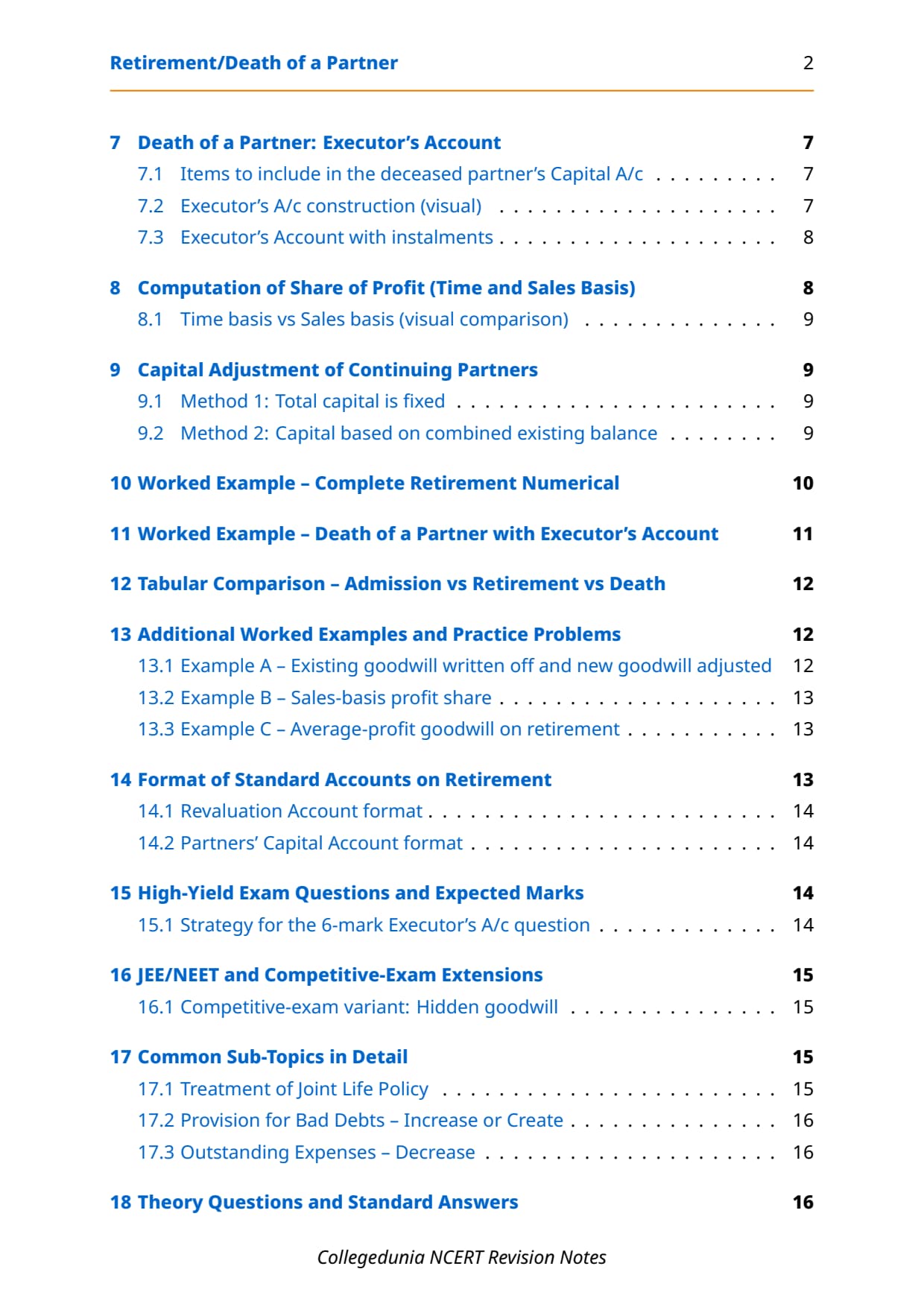
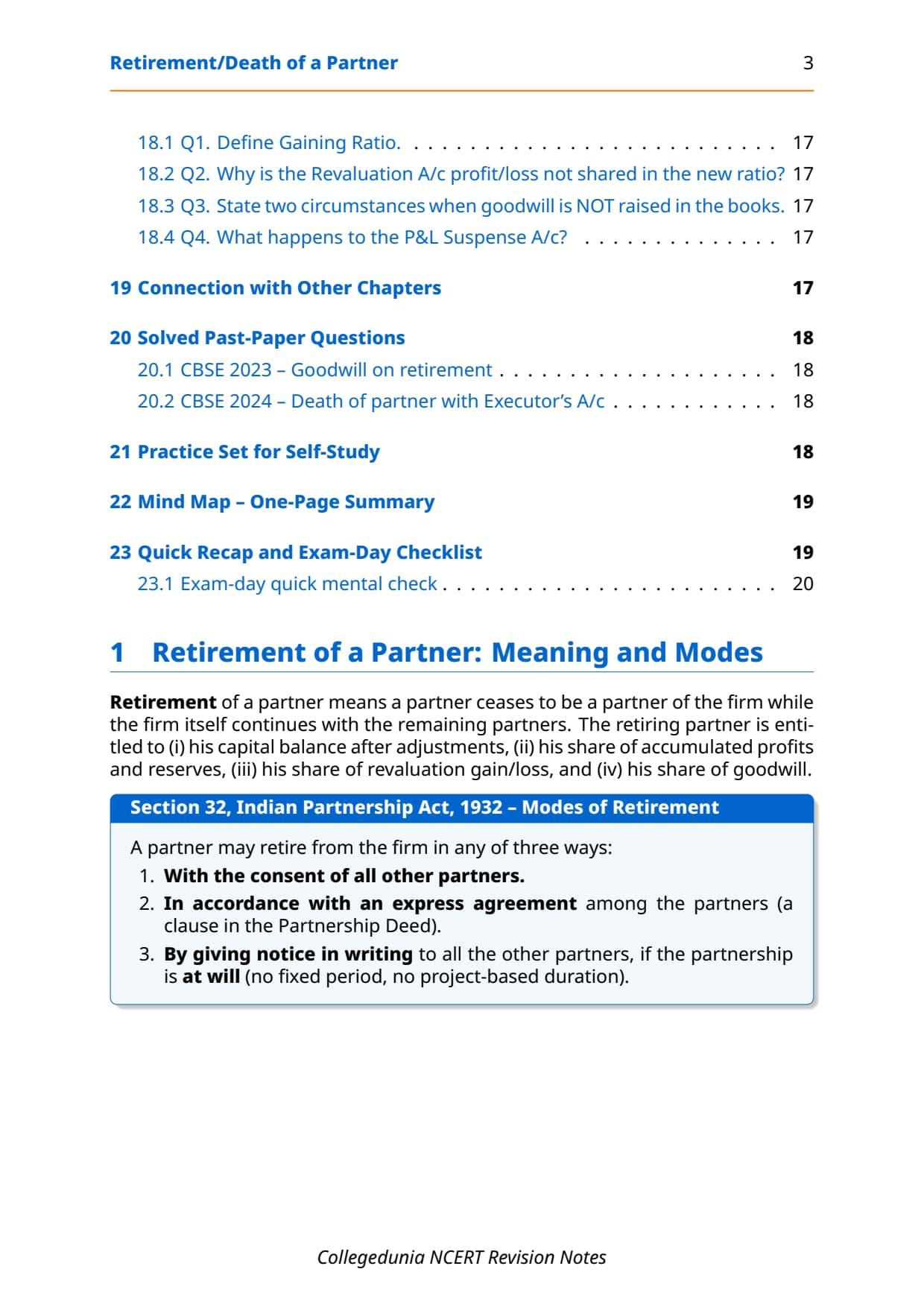
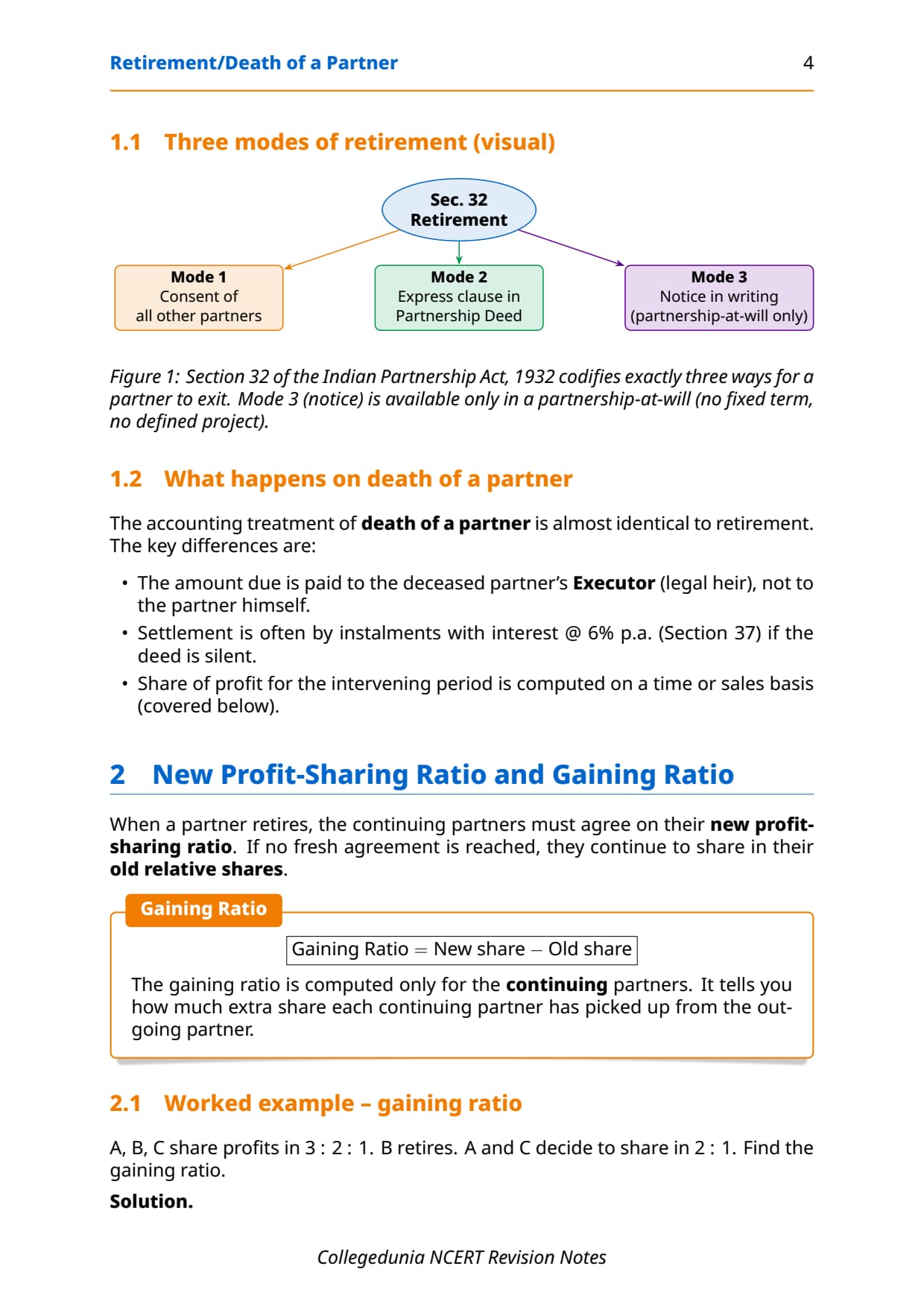
These ncert class 12 accountancy notes chapter 3 Reconstitution of a Partnership Firm: Retirement / Death of a Partner match the 2026-27 NCERT print and condense the full chapter into an exam-ready revision document, built around one five-pass workflow: ratios, goodwill, revaluation, reserves, settlement.
- CBSE Weightage: 8 to 10 marks in the Part A Partnership cluster
- Coverage: 19-page PDF, 9 sections, 14 ledger formats, 6 solved problems
Chartered Accountants and senior commerce educators curated these notes, mapped to the 2026-27 NCERT Accountancy textbook (Part 1) and checked against five years of CBSE Board papers.
Also Check:
- Retirement of a Partner Class 12 Accountancy NCERT Solutions
- Dissolution of Partnership Firm Class 12 Accountancy Notes
- CBSE Class 12 Accountancy Syllabus 2026-27
ncert class 12 accountancy notes chapter 3 Reconstitution of a Partnership Firm – Retirement / Death of a Partner: What the Chapter Covers
Chapter 3 sits in Unit 1: Accounting for Partnership Firms. It covers two events that change the firm's constitution without dissolving it: a partner's retirement, and a partner's death during the year. Both trigger the same five adjustments, but death adds three extra workings: interest up to death, profit share up to death, and the Executor's Loan Account.
| Section | What It Covers | Typical Mark Yield |
|---|---|---|
| 1. Modes of Retirement | Section 32, consent, express agreement, notice at-will | 1 to 2 marks |
| 2. New and Gaining Ratio | Gaining ratio = New ratio minus Old ratio | 1 to 2 marks |
| 3. Goodwill Treatment | AS-26, write-off, gaining-ratio adjustment | 3 to 4 marks |
| 4. Revaluation Account | Format, debit/credit rules, split in OLD ratio | 4 marks |
| 5. Reserves and Profits | Distributed in OLD ratio to all partners | 2 to 3 marks |
| 6. Modes of Settlement | Cash, instalments, Loan A/c, part-asset transfer | 2 marks |
| 7. Death and Executor's A/c | Capital A/c to Executor's A/c; instalment schedule | 6 marks |
| 8. Share of Profit up to Death | Time basis or sales basis | 2 to 3 marks |
| 9. Capital Adjustment | Fixed total capital, or combined-balance method | 3 to 4 marks |
CBSE almost always sets one 6 to 8 mark Long Answer from sections 3, 4, 7 or 9, plus a 1 mark theory tag. These notes prioritise those five sections.
Reconstitution of a Partnership Firm Retirement Death of a Partner...
Source: Rajat Arora on YouTube
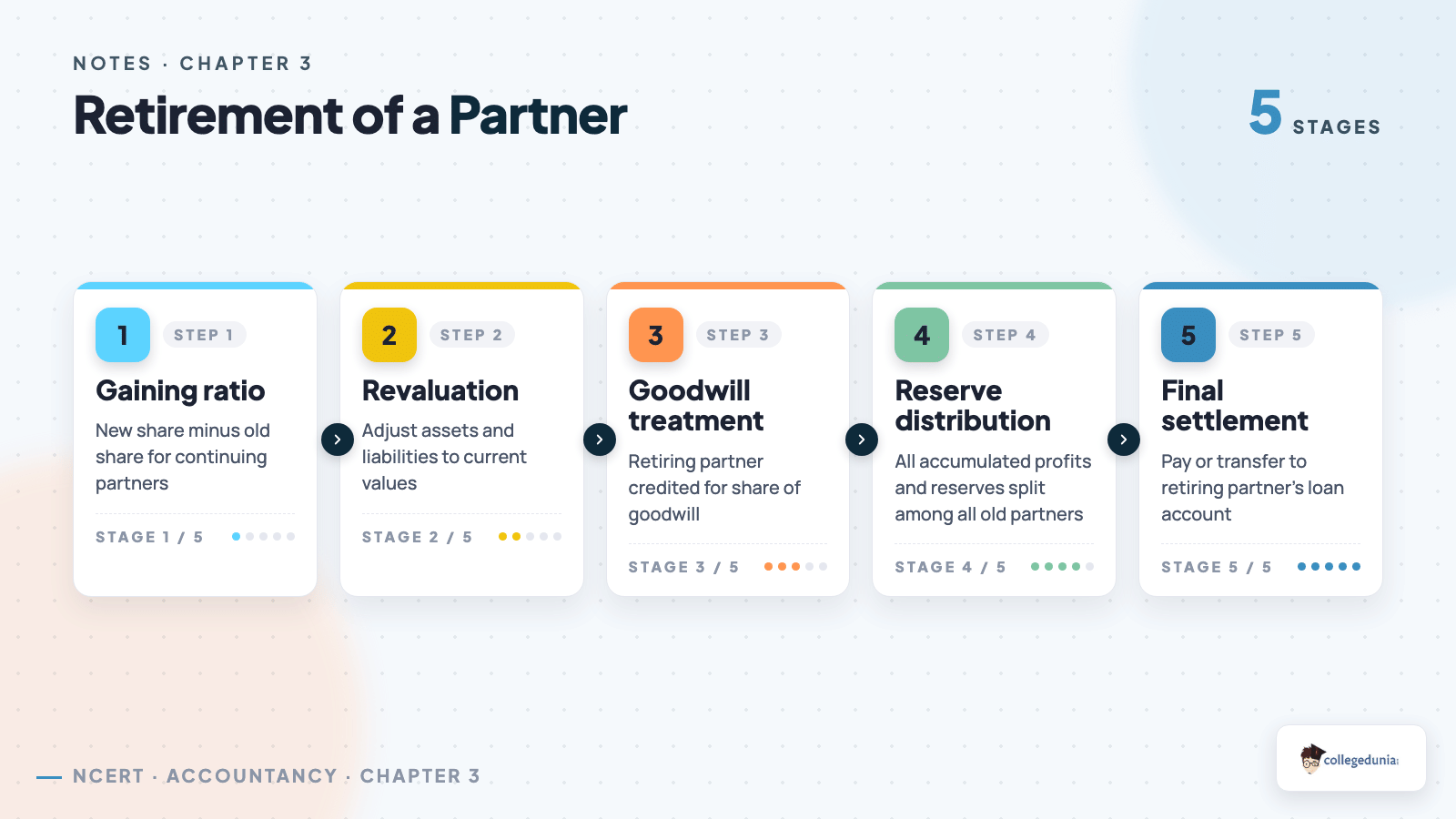
The Five-Pass Framework for Retirement and Death Numericals
Every retirement or death numerical breaks into the same five passes. Apply them in fixed order to remove guesswork in the exam hall.
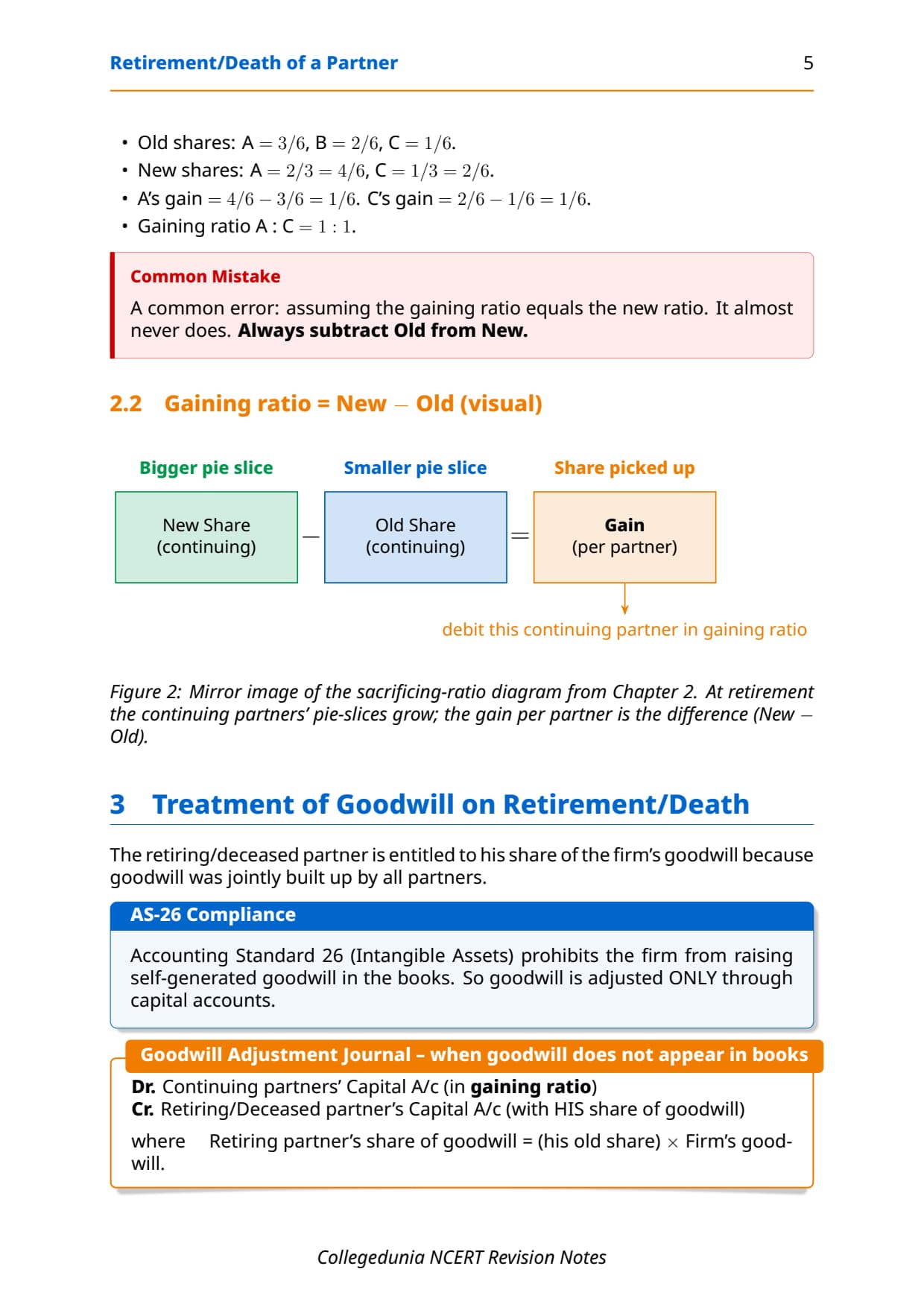
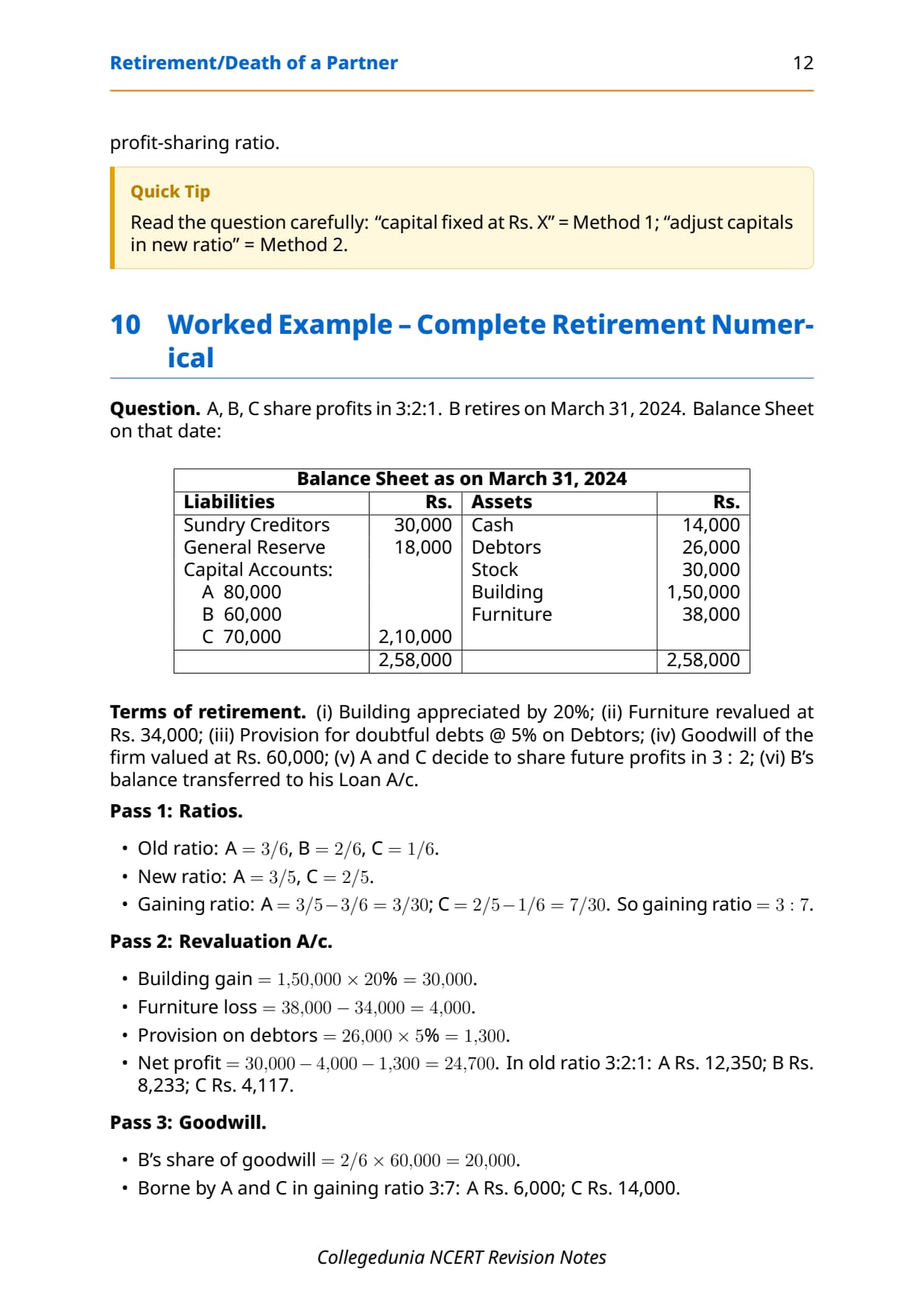
- Ratios. Find gaining ratio = new ratio minus old ratio. If silent, continuing partners share the outgoing partner's stake in their OLD ratio.
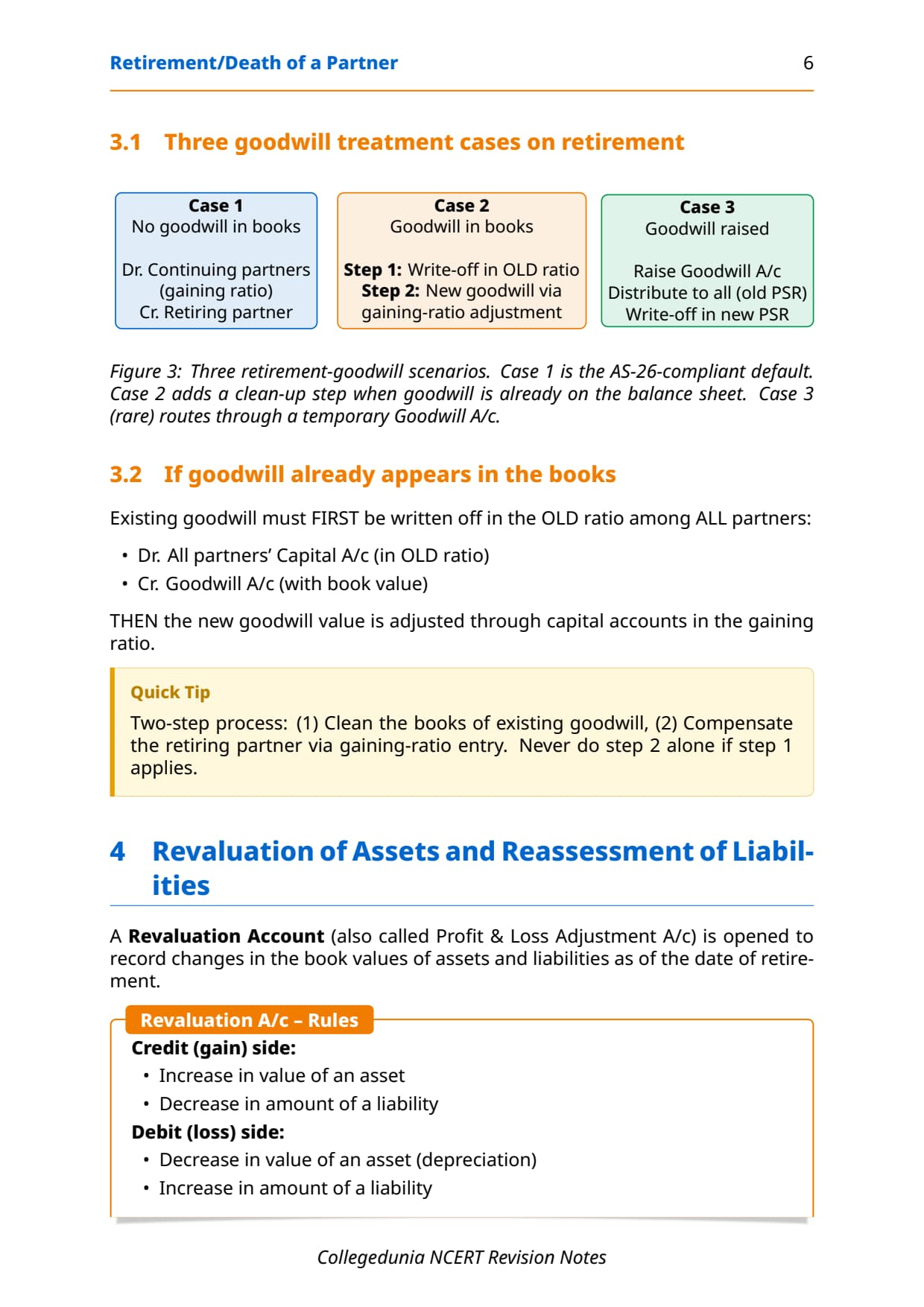
- Goodwill. Write off existing goodwill in the OLD ratio. Then debit continuing partners in the GAINING ratio and credit the outgoing partner's share.
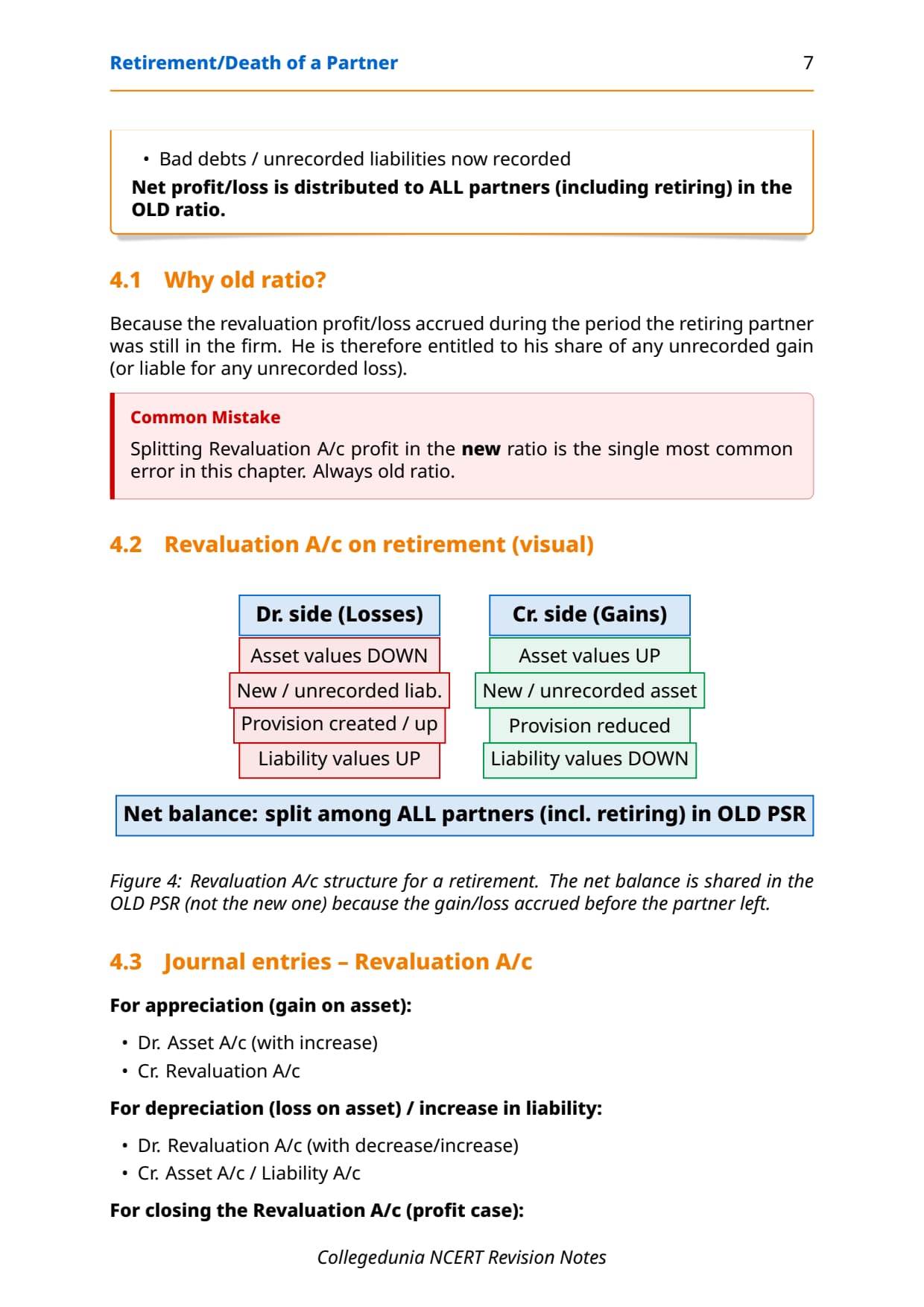
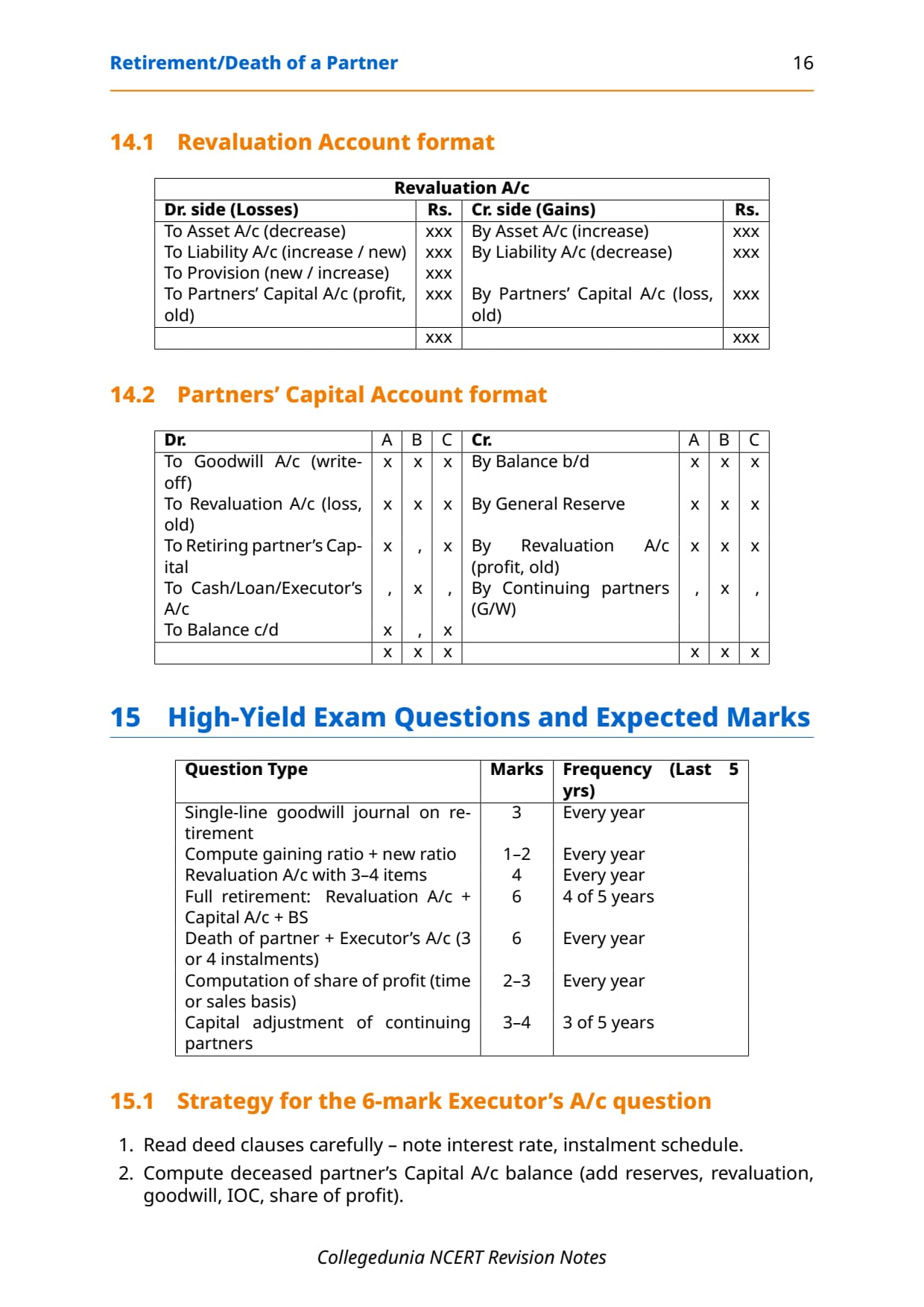
- Revaluation. Debit losses, credit gains, in a Revaluation A/c. Split the net result among ALL partners in the OLD ratio.
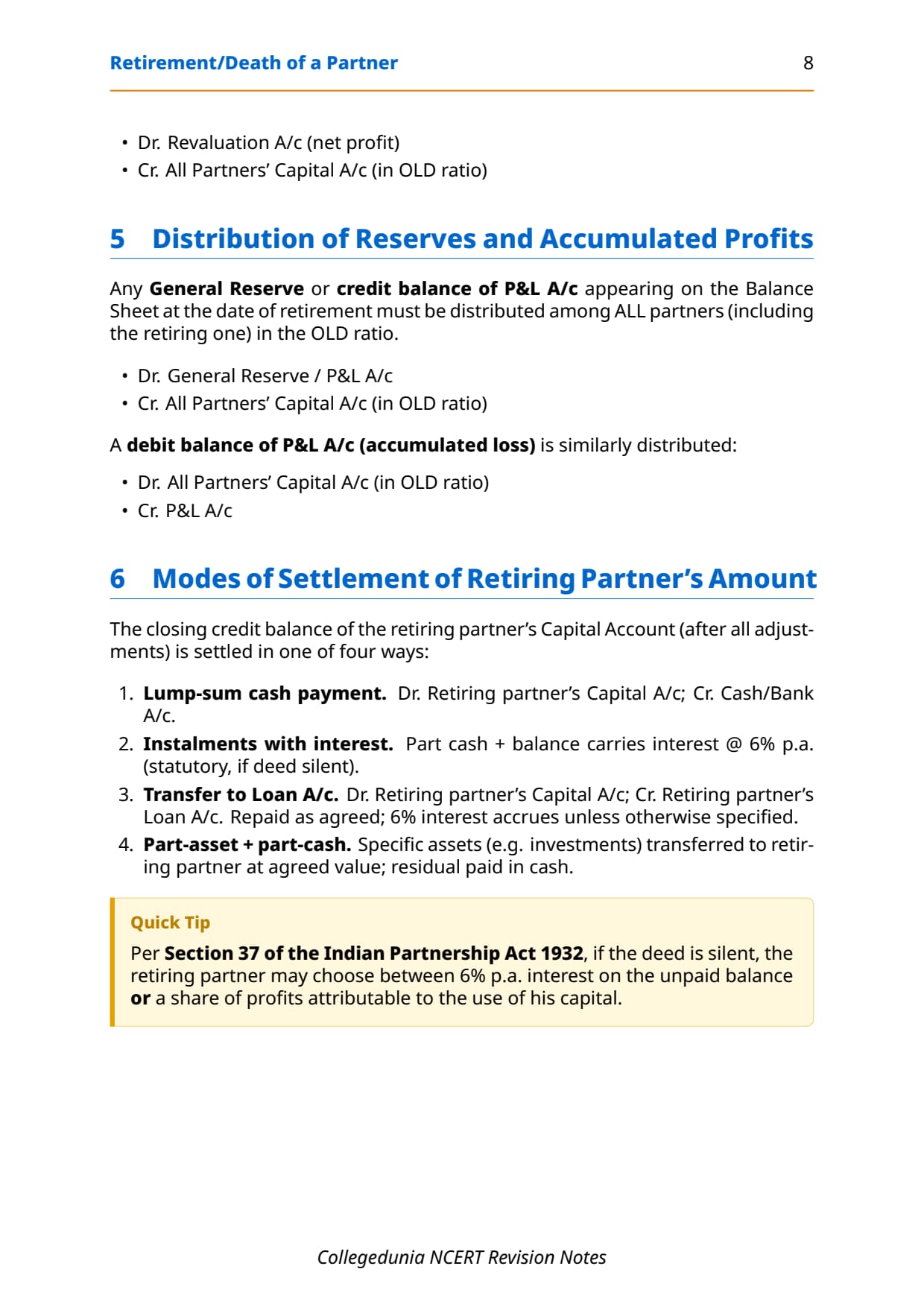
- Reserves and accumulated profits. Distribute reserves and the P&L credit balance in the OLD ratio. Debit any P&L debit balance the same way.
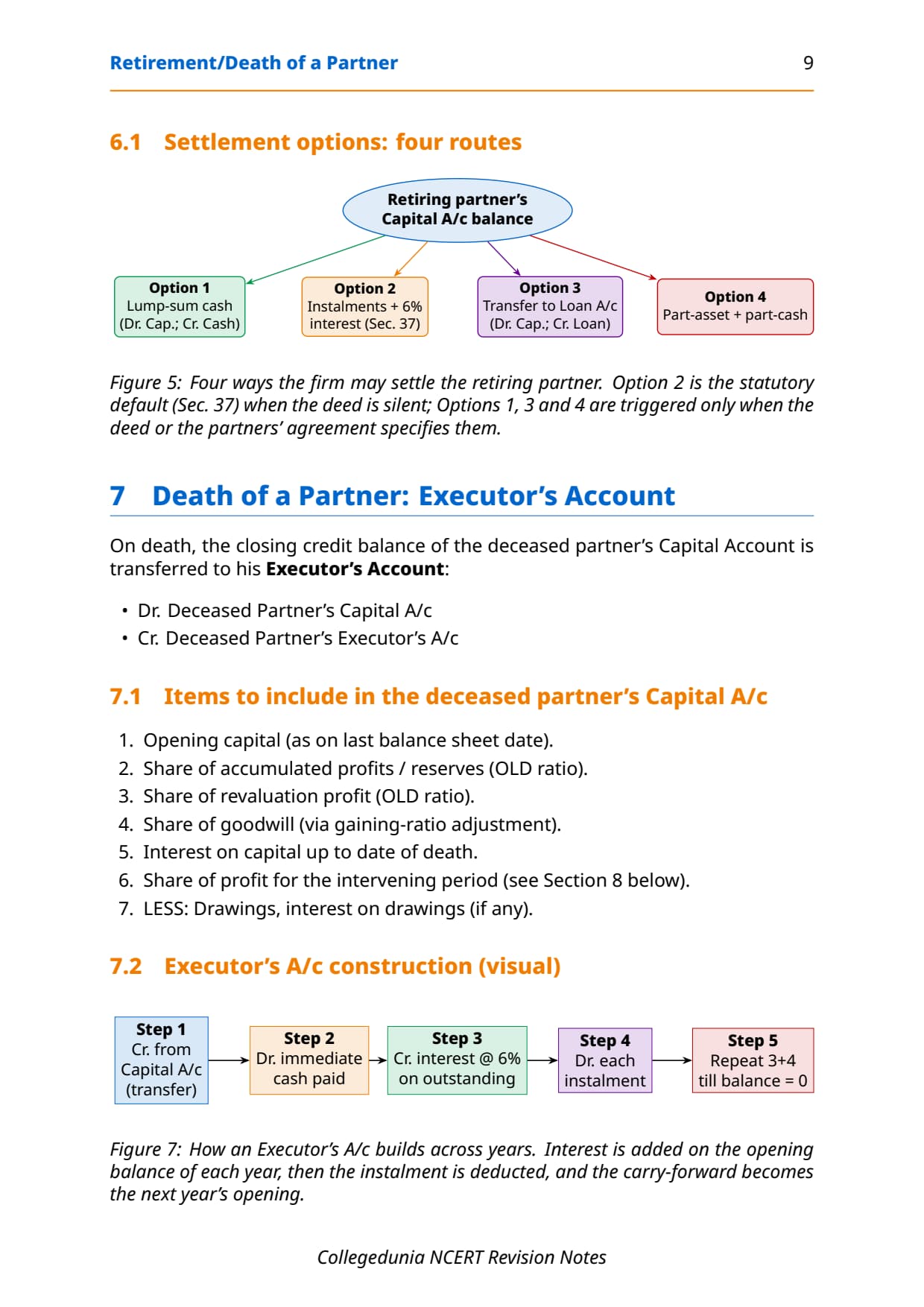
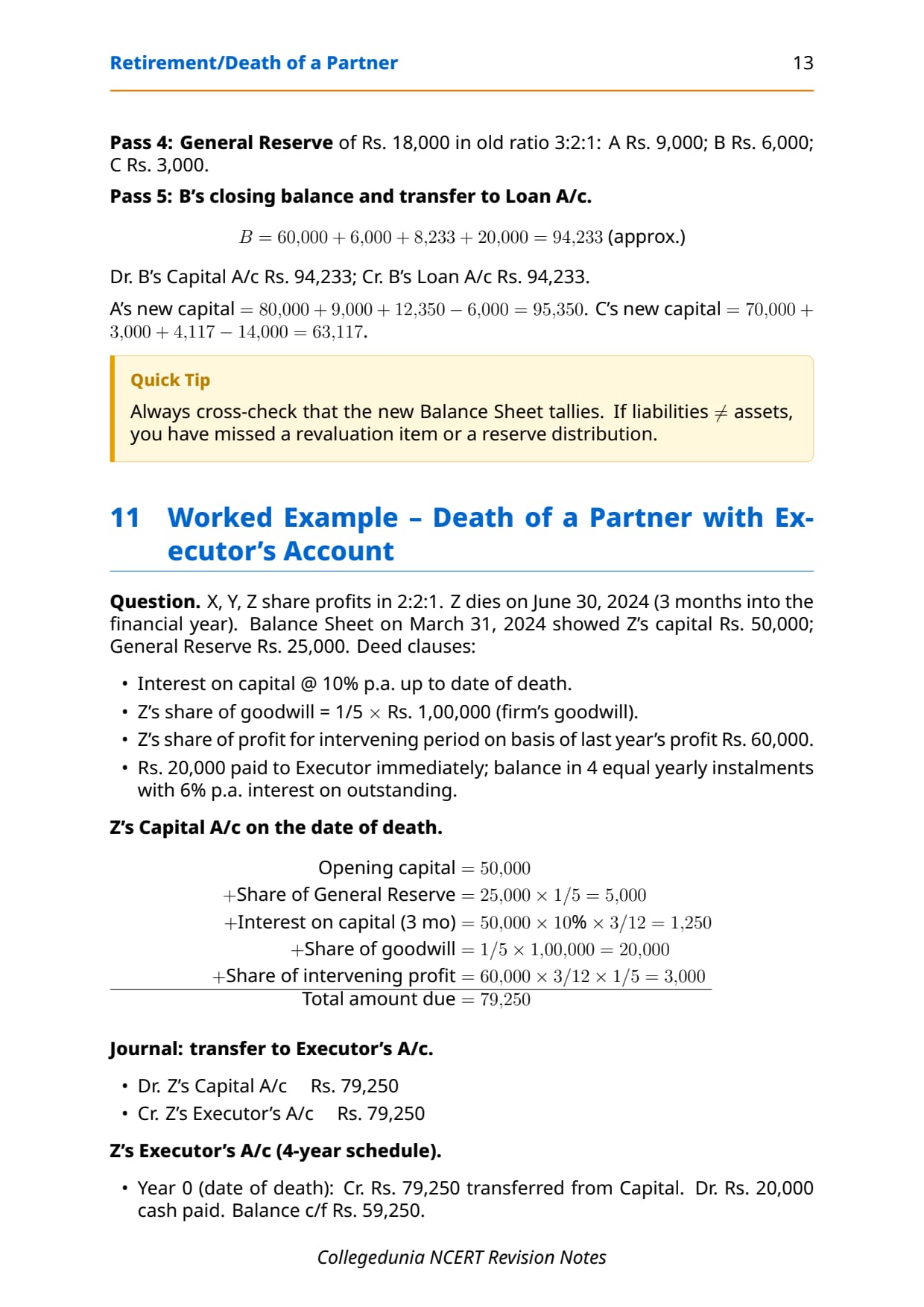
- Settlement. Find the closing balance after the four passes above. Settle by cash, Loan A/c (6 percent p.a. under Section 37 if silent), instalments, or part-asset transfer.
Goodwill Adjustment Through Gaining Ratio, Not Sacrificing Ratio
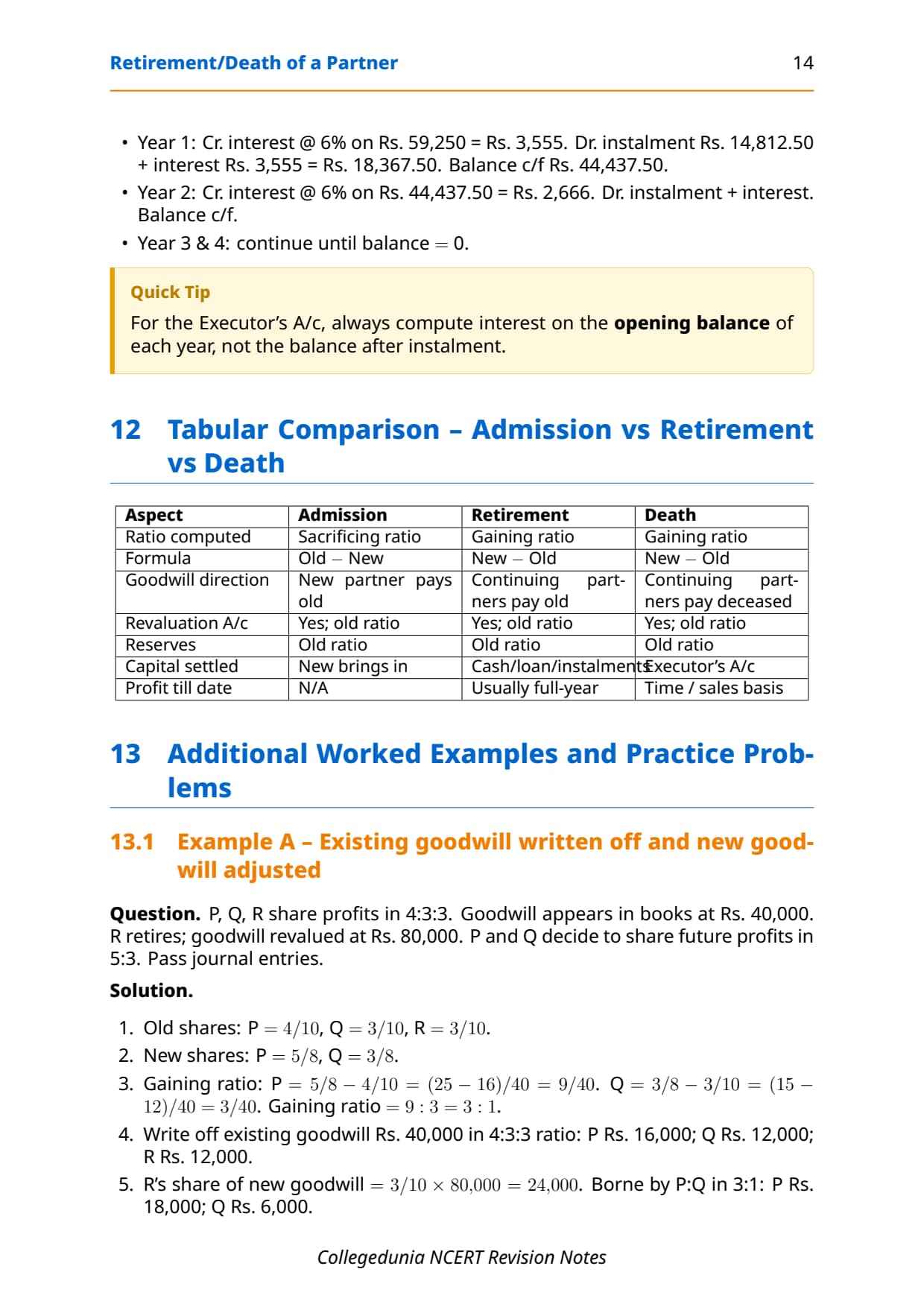
This is the most-tested CBSE trap. Admission uses the sacrificing ratio; retirement or death uses the gaining ratio. Mixing them costs students 2 to 3 marks every year.
The journal entry on retirement is:
Continuing Partner B's Capital A/c Dr. (gaining share)
To Retiring Partner's Capital A/c (his share of firm goodwill)
Under AS-26, a firm cannot raise self-generated goodwill in its books. So any existing goodwill on the Balance Sheet must be written off first in the OLD ratio.
Hidden Goodwill, A High-Mark CBSE Variant
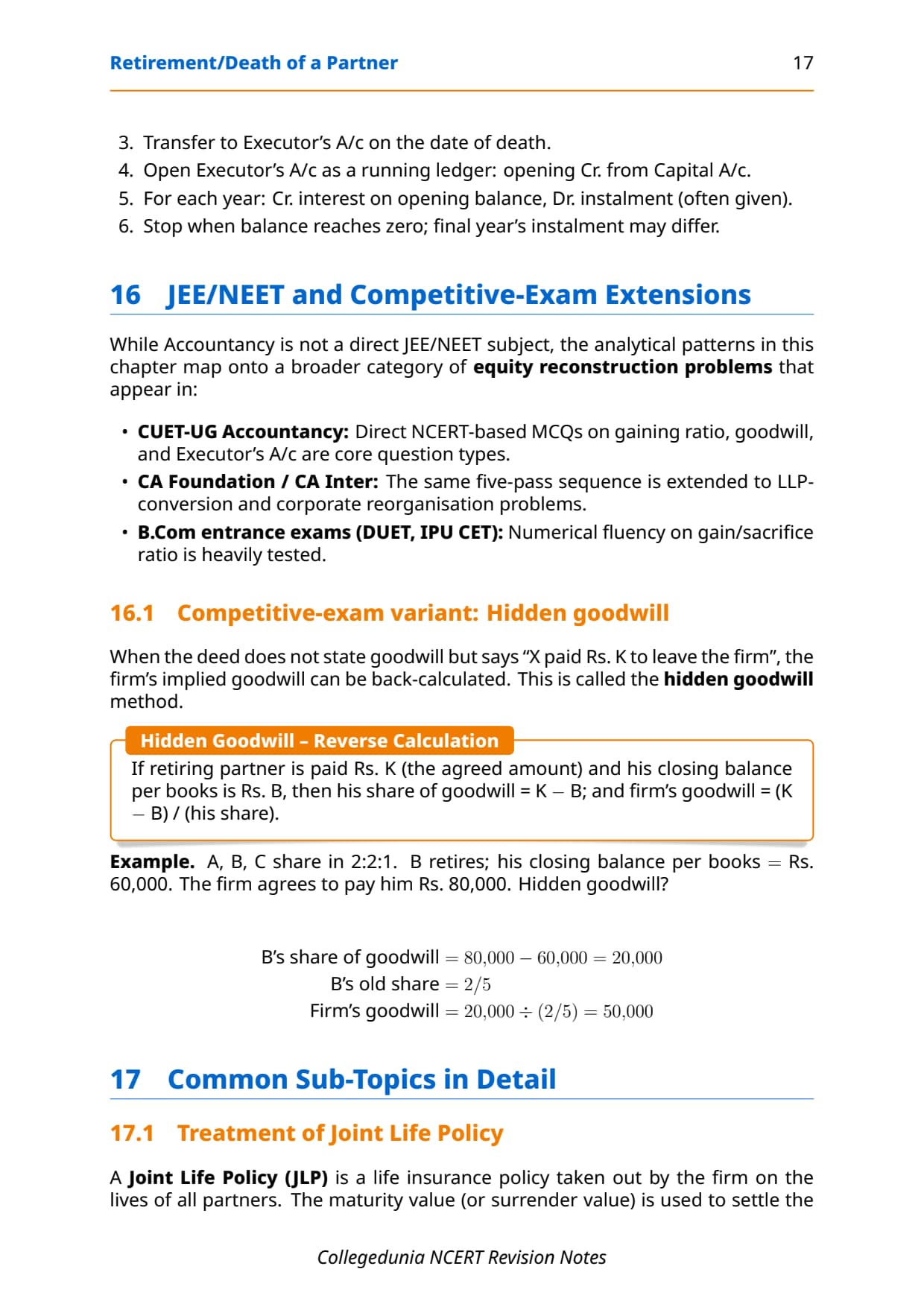
When the deed does not state the firm's goodwill but fixes the lump sum payable to the retiring partner, hidden goodwill is back-calculated:
$$\text{Hidden Goodwill of Firm} = \frac{\text{Amount Payable} - \text{Closing Capital of Retiring Partner}}{\text{Retiring Partner's Profit Share}}$$
The retiring partner is credited with his share of this hidden goodwill, debited to the continuing partners in the gaining ratio. This variant carried 4 marks in CBSE 2023.
Share of Profit up to Date of Death: Time Basis vs Sales Basis
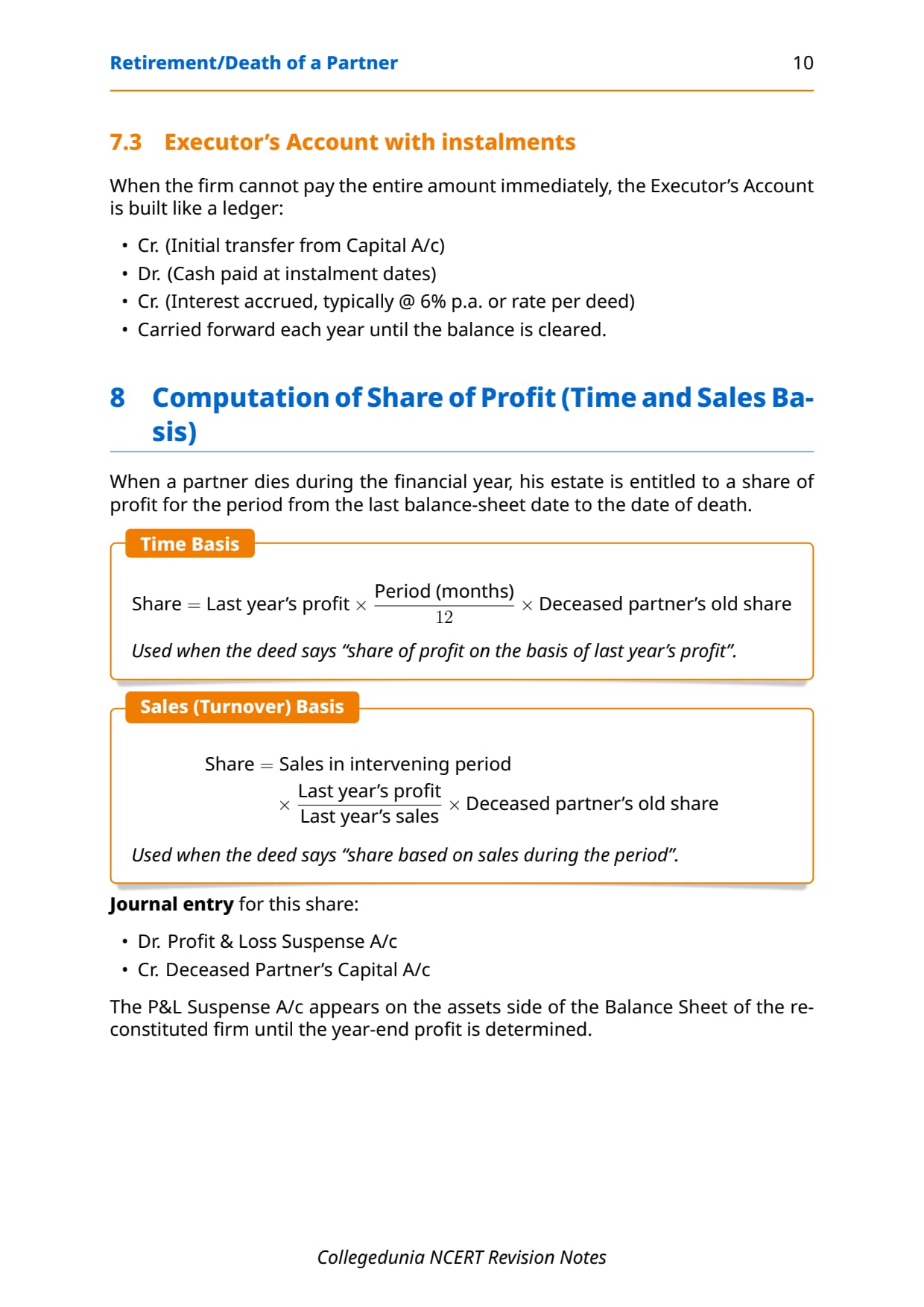
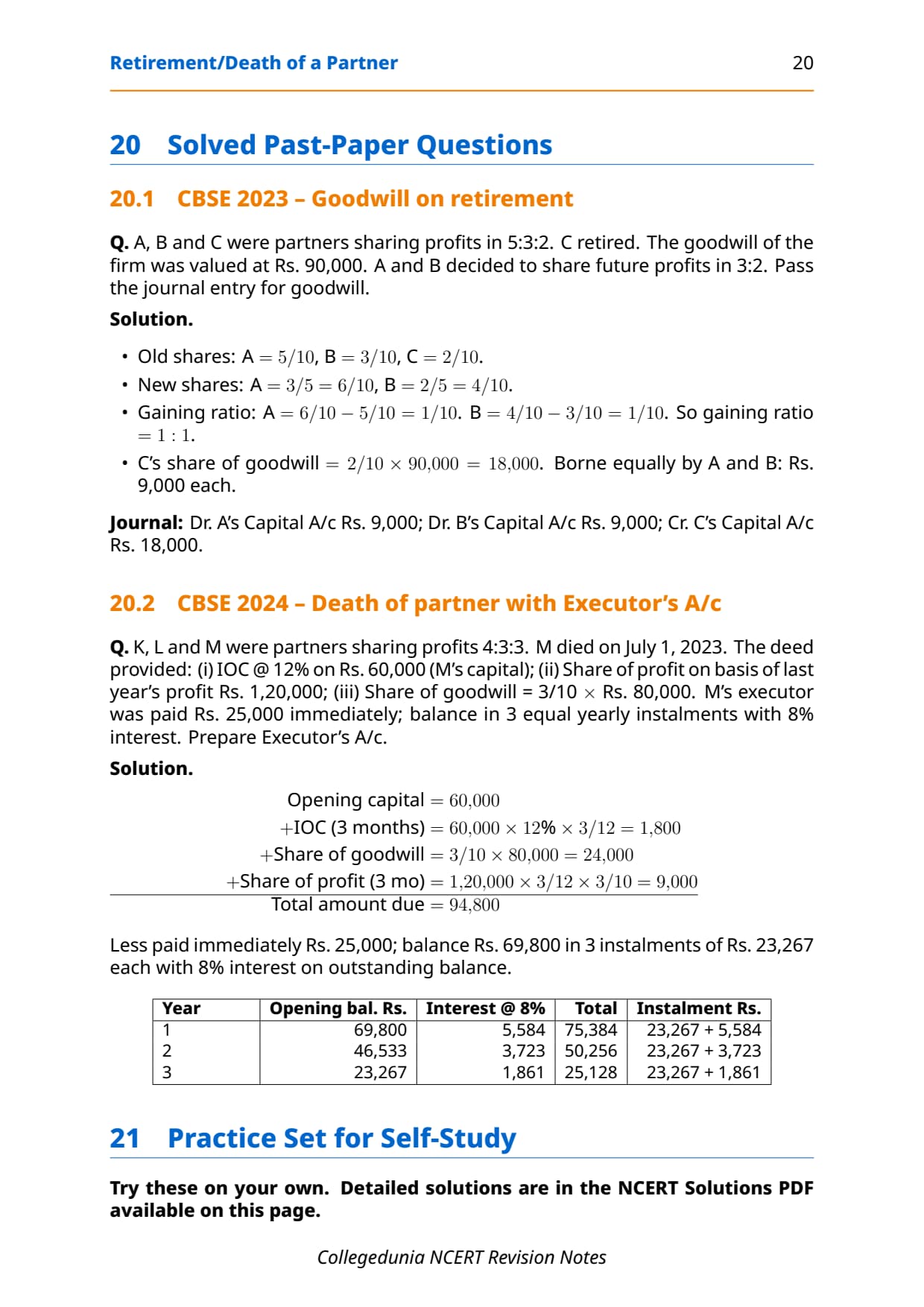
For a partner who dies during the year, credit his Capital A/c with his share of that year's profit up to death. The deed's wording decides which of two bases to use.
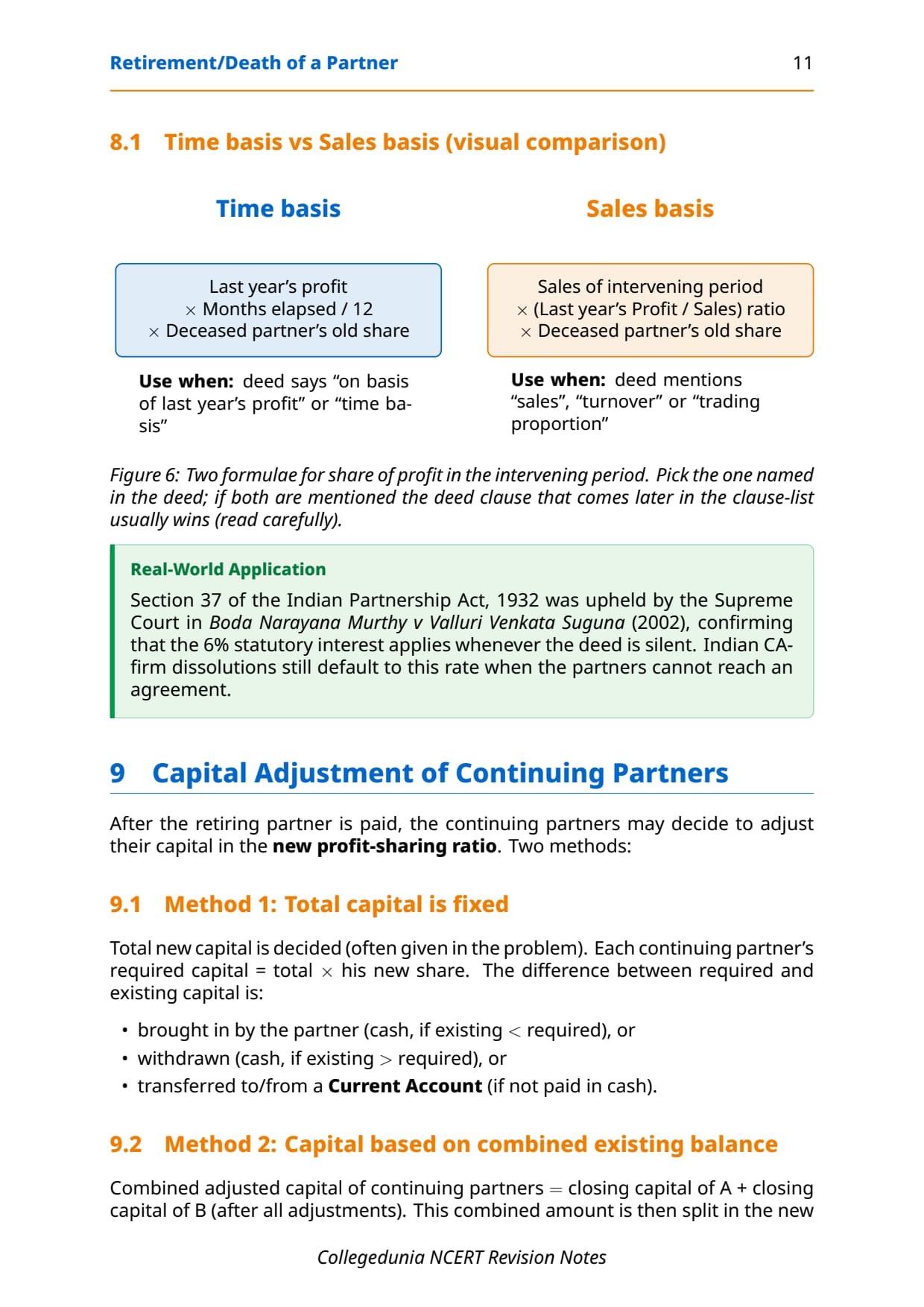
| Basis | Trigger Phrase in Deed | Formula |
|---|---|---|
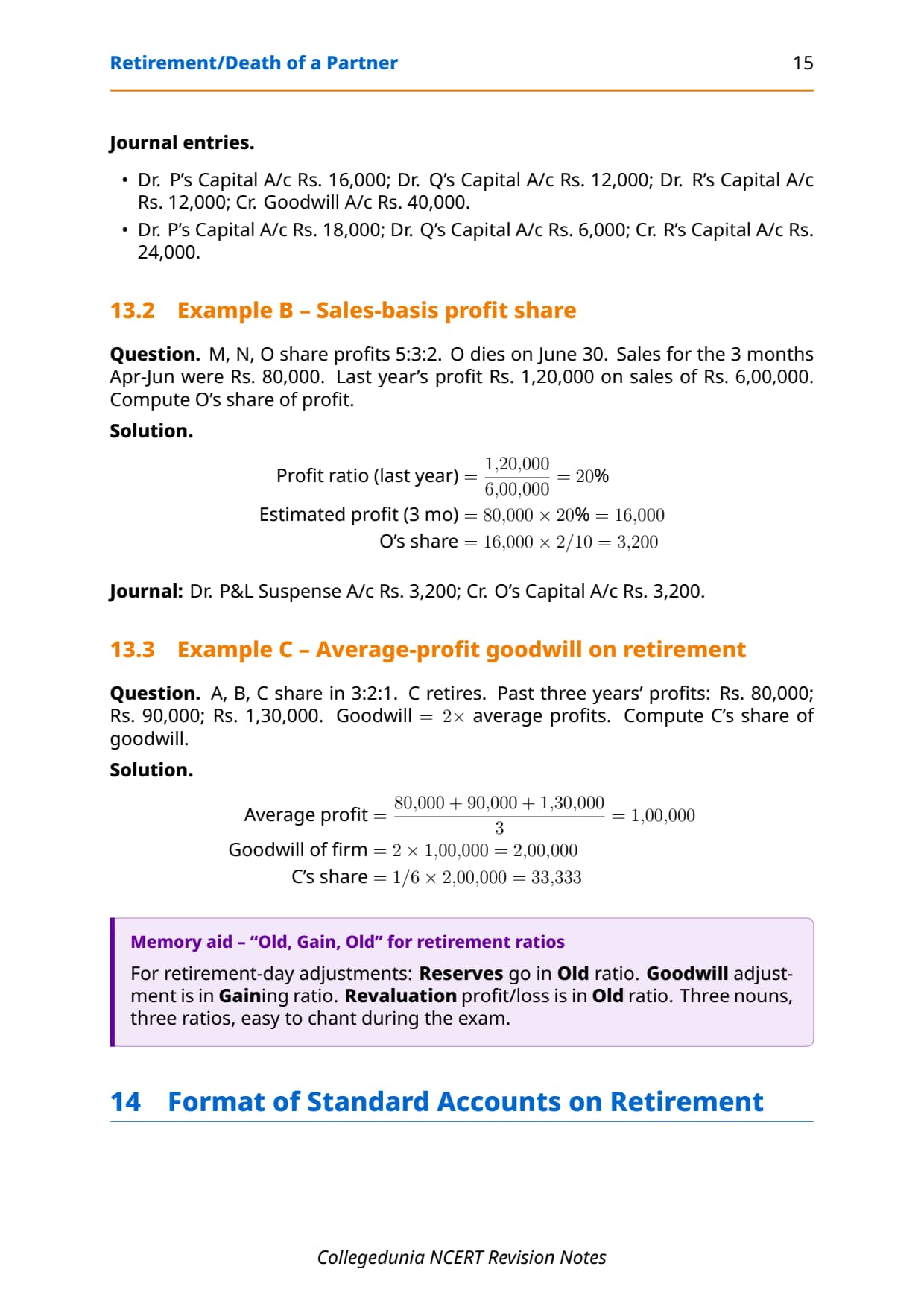
| Time Basis | "on the basis of last year's profit" or "average profit" | Last year profit × (months to death ÷ 12) × deceased's share |
| Sales Basis | "in the ratio of sales" or "on the basis of turnover" | Last year profit × (sales to death ÷ last year sales) × deceased's share |
A second option debits a Profit & Loss Suspense A/c instead, closed once next year's profit is known.
Joint Life Policy and Executor's Loan Account
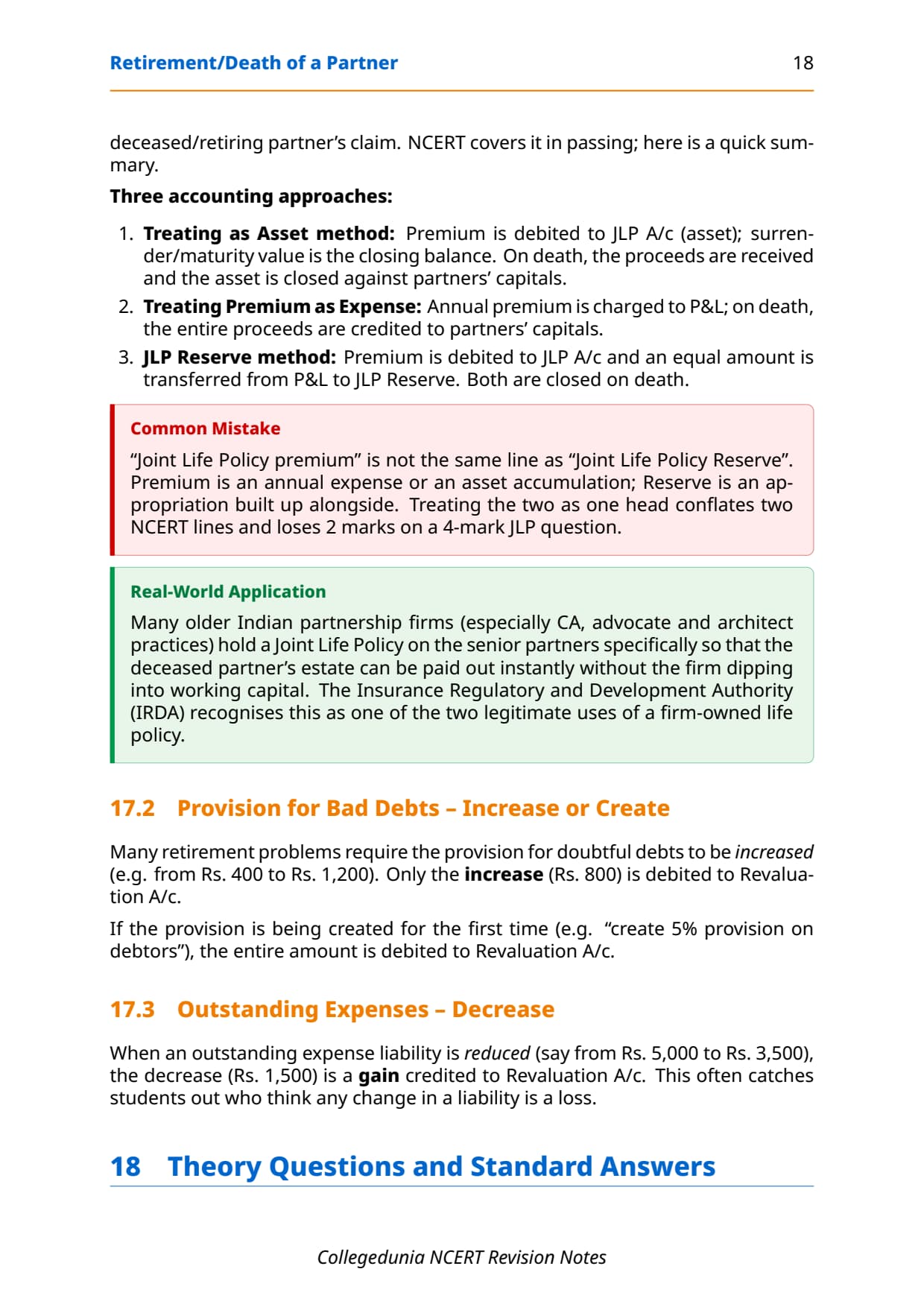
A Joint Life Policy (JLP) is survivorship insurance the firm takes on all partners. On death, the payout is credited to the deceased partner's Capital A/c through the JLP A/c. NCERT recognises three approaches:
- Premium as expense: debited to P&L A/c yearly; JLP not shown on the Balance Sheet.
- Premium as asset: shown as an asset at surrender value.
- JLP Reserve method: charged to P&L A/c, matching Reserve on liabilities.
After all five passes, the deceased partner's closing balance moves to his Executor's A/c, paid as agreed, usually three annual instalments plus 6 percent p.a. interest under Section 37.
Capital Adjustment of Continuing Partners
After the retiring partner is paid off, the continuing partners may need to adjust their capitals to match the new profit-sharing ratio. Two CBSE-tested methods are used:
- Fixed total capital method. Distribute the given new total capital in the new ratio, then bring in or withdraw cash to match.
- Combined-balance method. Add continuing partners' closing balances, distribute in the new ratio, and settle differences via Cash or Current A/c.
Common Mistakes Students Make in Reconstitution of a Partnership Firm
- Splitting Revaluation profit/loss in the new ratio instead of the OLD ratio.
- Skipping the existing-goodwill write-off before adjusting new goodwill.
- Confusing sacrificing ratio (admission) with gaining ratio (retirement).
- Treating a fall in liabilities as a debit in Revaluation A/c; it is a credit.
- Forgetting interest on capital up to death when the deed allows it.
- Using the wrong basis, time vs sales, for the deceased partner's profit share.
- Charging Executor's A/c interest on the opening sum instead of the reducing balance.
How Collegedunia's NCERT Notes Help You Score in Chapter 3
- The R-G-R-R-S sequence gives a fixed order for any retirement or death numerical.
- Every formula pairs with the exact deed phrase that triggers it.
- Hidden goodwill is fully derived, useful for CUET-UG and CA Foundation too.
- All three NCERT-approved JLP approaches are covered.
CBSE Class 12 Accountancy Previous Year Question Mapping for Chapter 3
Year-wise CBSE focus for this chapter. The Long Answer rotates between goodwill on gaining ratio, Revaluation plus Capital Account workings, and the death scenario with Executor's A/c.
| Year | Long Answer Focus | Marks |
|---|---|---|
| 2025 | Revaluation + Capital Adjustment | 6 |
| 2024 | Death, profit share on sales basis + Executor's A/c | 8 |
| 2023 | Hidden goodwill back-calculation | 6 |
| 2022 | Full Revaluation A/c and reserves distribution | 8 |
| 2021 | Goodwill adjustment in gaining ratio | 4 |
Full PYQ map: Chapter 3 NCERT Solutions with year-wise PYQ workings.
Other Resources for Class 12 Accountancy Chapter 3
- Reconstitution of a Partnership Firm – Retirement / Death of a Partner Notes
- Chapter 3 NCERT Solutions
- Chapter 3 Formula Sheet
- Chapter 3 Handwritten Notes
- Chapter 3 NCERT Book PDF
NCERT Notes for Class 12 Accountancy: All Chapters
| Chapter | Notes Link |
|---|---|
| Chapter 1 | Accounting for Not-for-Profit Organisation Notes |
| Chapter 2 | Accounting for Partnership: Basic Concepts Notes |
| Chapter 4 | Reconstitution: Admission of a Partner Notes |
| Chapter 5 | Dissolution of Partnership Firm Notes |
| Chapter 6 | Accounting for Share Capital Notes |
| Chapter 7 | Issue and Redemption of Debentures Notes |
Student Feedback
In a Collegedunia poll of 1,240 Class 12 Commerce students, 76% rated this chapter among the tougher parts of the Accountancy syllabus. After using these revision notes, 4 in 5 said they felt ready for the board questions from it.
FAQs on Class 12 Accountancy Chapter 3 Notes
Ques. What is the difference between sacrificing ratio and gaining ratio in partnership accounts?
Ans.
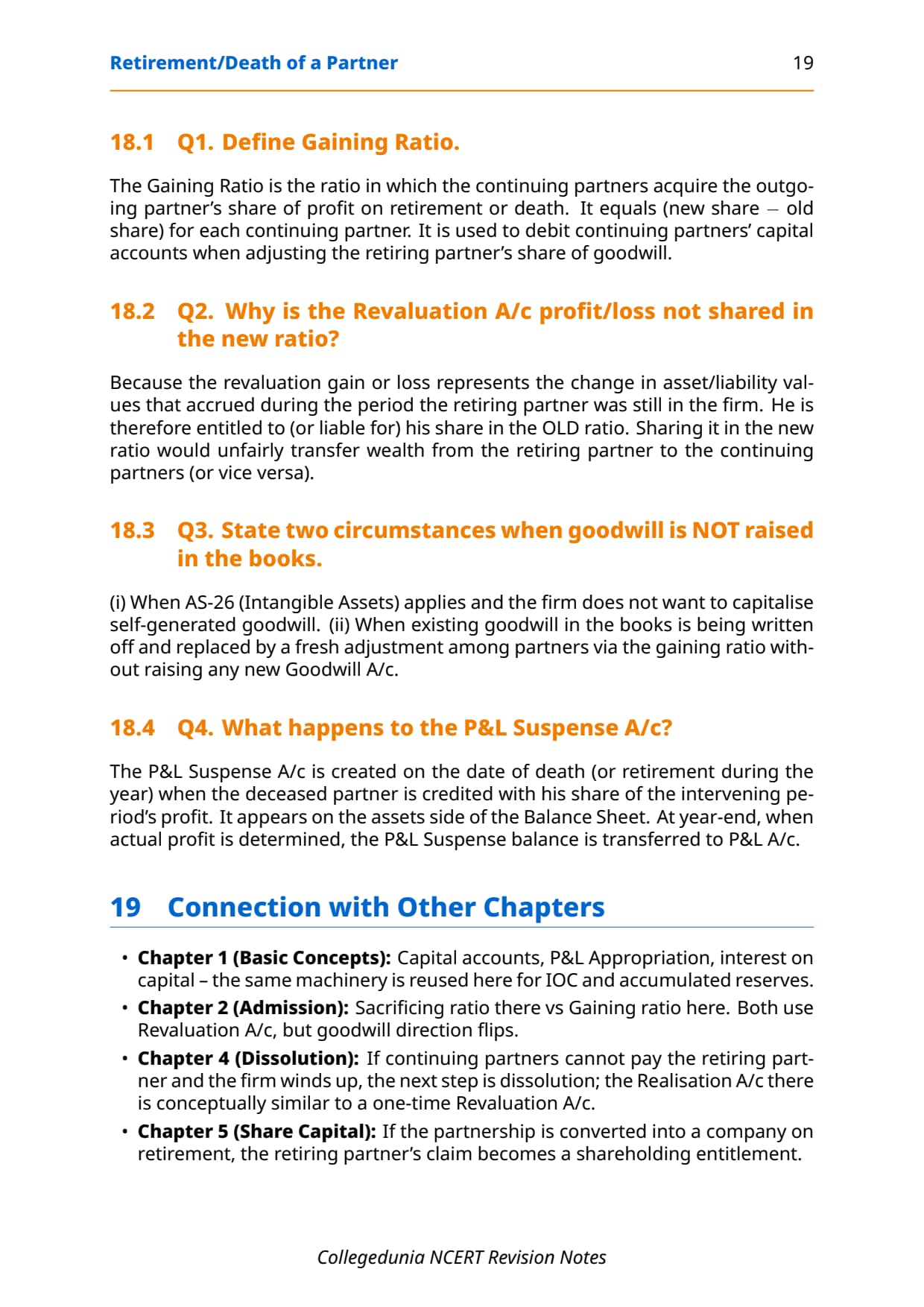
Sacrificing ratio (Old ratio minus New ratio) is used on admission of a new partner and represents the share each old partner gives up. Gaining ratio (New ratio minus Old ratio) is used on retirement or death and represents the share each continuing partner picks up from the outgoing partner. The goodwill journal entry runs through whichever ratio applies to that event.
Ques. Why is the Revaluation Account profit or loss shared in the old ratio?
Ans.
Because the revaluation gain or loss accrued during the period the retiring or deceased partner was still in the firm. He is therefore entitled to (or liable for) his share of the net result in the OLD profit-sharing ratio, alongside the continuing partners.
Ques. When is time basis used for the deceased partner's share of profit?
Ans.
Time basis applies when the deed says "share of profit on the basis of last year's profit" or "average profit". Compute: last year's profit multiplied by the fraction of the year elapsed up to date of death, then multiplied by the deceased partner's profit share. Sales basis is used only when the deed explicitly references sales or turnover.
Ques. What is the rate of interest payable to the retiring partner under Section 37 if the partnership deed is silent?
Ans.
If the deed is silent, the retiring partner is entitled to interest at 6 percent per annum on the unpaid balance, OR a share of profits attributable to the use of his capital, whichever he chooses. This is the default rule under Section 37 of the Indian Partnership Act 1932.
Ques. What is hidden goodwill on retirement of a partner?
Ans.
Hidden goodwill is the firm's implied goodwill, back-calculated when the deed does not disclose goodwill but the agreed amount payable to the retiring partner exceeds his closing capital balance. The formula is: Firm's goodwill equals (Amount Payable minus Closing Capital Balance) divided by the retiring partner's profit share. The retiring partner is then credited with his share, debited to continuing partners in the gaining ratio.
Ques. How is the deceased partner's Capital Account closed?
Ans.
After all five adjustments (ratios, goodwill, revaluation, reserves, share of profit and interest up to date of death) are credited or debited, the final balance is transferred from the deceased partner's Capital A/c to his Executor's A/c. The executor is then paid as per the deed, usually in annual instalments with interest at 6 percent p.a. under Section 37 unless a different rate is agreed.



Comments