



The Time and Time Again Class 12 notes explain A.K. Ramanujan's NCERT Kaleidoscope poem for the 2026-27 reprint. Use this page to revise clock tower imagery, imperfect time, communal tension, the damaged clock image and NCERT answer cues before downloading the full PDF.
- Download the Class 12 English Supplementary Chapter 12 notes PDF for quick revision.
- Revise the poem through clock sounds, civic order, feuds, alliances and violence.
- Student focus: the chapter tests symbol reading and concise theme explanation.
Chapter12Kaleidoscope:TimeandTimeAgainNotes.pdf?page=1&dpi=150)
Chapter12Kaleidoscope:TimeandTimeAgainNotes.pdf?page=2&dpi=150)
Chapter12Kaleidoscope:TimeandTimeAgainNotes.pdf?page=3&dpi=150)
Chapter12Kaleidoscope:TimeandTimeAgainNotes.pdf?page=4&dpi=150)
Chapter12Kaleidoscope:TimeandTimeAgainNotes.pdf?page=5&dpi=150)
Chapter12Kaleidoscope:TimeandTimeAgainNotes.pdf?page=6&dpi=150)
Chapter12Kaleidoscope:TimeandTimeAgainNotes.pdf?page=7&dpi=150)
Chapter12Kaleidoscope:TimeandTimeAgainNotes.pdf?page=8&dpi=150)
Chapter12Kaleidoscope:TimeandTimeAgainNotes.pdf?page=9&dpi=150)
Chapter12Kaleidoscope:TimeandTimeAgainNotes.pdf?page=10&dpi=150)
Chapter12Kaleidoscope:TimeandTimeAgainNotes.pdf?page=11&dpi=150)
Chapter12Kaleidoscope:TimeandTimeAgainNotes.pdf?page=12&dpi=150)
Chapter12Kaleidoscope:TimeandTimeAgainNotes.pdf?page=13&dpi=150)
Chapter12Kaleidoscope:TimeandTimeAgainNotes.pdf?page=14&dpi=150)
Chapter12Kaleidoscope:TimeandTimeAgainNotes.pdf?page=15&dpi=150)
Chapter12Kaleidoscope:TimeandTimeAgainNotes.pdf?page=16&dpi=150)
Chapter12Kaleidoscope:TimeandTimeAgainNotes.pdf?page=17&dpi=150)
Chapter12Kaleidoscope:TimeandTimeAgainNotes.pdf?page=18&dpi=150)
Chapter12Kaleidoscope:TimeandTimeAgainNotes.pdf?page=19&dpi=150)
Chapter12Kaleidoscope:TimeandTimeAgainNotes.pdf?page=20&dpi=150)
Chapter12Kaleidoscope:TimeandTimeAgainNotes.pdf?page=21&dpi=150)
Chapter12Kaleidoscope:TimeandTimeAgainNotes.pdf?page=22&dpi=150)
Chapter12Kaleidoscope:TimeandTimeAgainNotes.pdf?page=23&dpi=150)
Chapter12Kaleidoscope:TimeandTimeAgainNotes.pdf?page=24&dpi=150)
Chapter12Kaleidoscope:TimeandTimeAgainNotes.pdf?page=25&dpi=150)
Chapter12Kaleidoscope:TimeandTimeAgainNotes.pdf?page=26&dpi=150)
Chapter12Kaleidoscope:TimeandTimeAgainNotes_flat_MobileCard.pdf?page=1&dpi=150)
Chapter12Kaleidoscope:TimeandTimeAgainNotes_flat_MobileCard.pdf?page=2&dpi=150)
Chapter12Kaleidoscope:TimeandTimeAgainNotes_flat_MobileCard.pdf?page=3&dpi=150)
Chapter12Kaleidoscope:TimeandTimeAgainNotes_flat_MobileCard.pdf?page=4&dpi=150)
Chapter12Kaleidoscope:TimeandTimeAgainNotes_flat_MobileCard.pdf?page=5&dpi=150)
Chapter12Kaleidoscope:TimeandTimeAgainNotes_flat_MobileCard.pdf?page=6&dpi=150)
Chapter12Kaleidoscope:TimeandTimeAgainNotes_flat_MobileCard.pdf?page=7&dpi=150)
Chapter12Kaleidoscope:TimeandTimeAgainNotes_flat_MobileCard.pdf?page=8&dpi=150)
Chapter12Kaleidoscope:TimeandTimeAgainNotes_flat_MobileCard.pdf?page=9&dpi=150)
Chapter12Kaleidoscope:TimeandTimeAgainNotes_flat_MobileCard.pdf?page=10&dpi=150)
Chapter12Kaleidoscope:TimeandTimeAgainNotes_flat_MobileCard.pdf?page=11&dpi=150)
Chapter12Kaleidoscope:TimeandTimeAgainNotes_flat_MobileCard.pdf?page=12&dpi=150)
Chapter12Kaleidoscope:TimeandTimeAgainNotes_flat_MobileCard.pdf?page=13&dpi=150)
Chapter12Kaleidoscope:TimeandTimeAgainNotes_flat_MobileCard.pdf?page=14&dpi=150)
Chapter12Kaleidoscope:TimeandTimeAgainNotes_flat_MobileCard.pdf?page=15&dpi=150)
Chapter12Kaleidoscope:TimeandTimeAgainNotes_flat_MobileCard.pdf?page=16&dpi=150)
Chapter12Kaleidoscope:TimeandTimeAgainNotes_flat_MobileCard.pdf?page=17&dpi=150)
Chapter12Kaleidoscope:TimeandTimeAgainNotes_flat_MobileCard.pdf?page=18&dpi=150)
Chapter12Kaleidoscope:TimeandTimeAgainNotes_flat_MobileCard.pdf?page=19&dpi=150)
Chapter12Kaleidoscope:TimeandTimeAgainNotes_flat_MobileCard.pdf?page=20&dpi=150)
Chapter12Kaleidoscope:TimeandTimeAgainNotes_flat_MobileCard.pdf?page=21&dpi=150)
Chapter12Kaleidoscope:TimeandTimeAgainNotes_flat_MobileCard.pdf?page=22&dpi=150)
Chapter12Kaleidoscope:TimeandTimeAgainNotes_flat_MobileCard.pdf?page=23&dpi=150)
Chapter12Kaleidoscope:TimeandTimeAgainNotes_flat_MobileCard.pdf?page=24&dpi=150)
Chapter12Kaleidoscope:TimeandTimeAgainNotes_flat_MobileCard.pdf?page=25&dpi=150)
Chapter12Kaleidoscope:TimeandTimeAgainNotes_flat_MobileCard.pdf?page=26&dpi=150)
Chapter12Kaleidoscope:TimeandTimeAgainNotes_flat_MobileCard.pdf?page=27&dpi=150)
Chapter12Kaleidoscope:TimeandTimeAgainNotes_flat_MobileCard.pdf?page=28&dpi=150)
Chapter12Kaleidoscope:TimeandTimeAgainNotes_flat_MobileCard.pdf?page=29&dpi=150)
Chapter12Kaleidoscope:TimeandTimeAgainNotes_flat_MobileCard.pdf?page=30&dpi=150)
Chapter12Kaleidoscope:TimeandTimeAgainNotes_flat_MobileCard.pdf?page=31&dpi=150)
Chapter12Kaleidoscope:TimeandTimeAgainNotes_flat_MobileCard.pdf?page=32&dpi=150)
Chapter12Kaleidoscope:TimeandTimeAgainNotes_flat_MobileCard.pdf?page=33&dpi=150)
Chapter12Kaleidoscope:TimeandTimeAgainNotes_flat_MobileCard.pdf?page=34&dpi=150)
Chapter12Kaleidoscope:TimeandTimeAgainNotes_flat_MobileCard.pdf?page=35&dpi=150)
Chapter12Kaleidoscope:TimeandTimeAgainNotes_flat_MobileCard.pdf?page=36&dpi=150)
These Class 12 English Supplementary Time and Time Again notes are checked against the 2026-27 NCERT chapter and built for fast poem revision.
Student Feedback on Time and Time Again
In a Collegedunia poll of 12,740 Class 12 English students using NCERT literature resources, many students understood the clocks but needed help linking them to public life and conflict.
- 81% wanted a clearer split between literal time and social time.
- 76% needed support with the Hindu, Christian and Muslim reference.
- 68% found the final eyeless clock image hard to explain in short answers.
Source: 2026-27 Class 12 English student poll. Sample of 12,740 students using NCERT-aligned study resources.
Time and Time Again Summary for Class 12
Time and Time Again begins with clock towers in an old city. Their gongs do not sound exactly together. Ramanujan uses that small mismatch to show craft, chance, distance, donor pride and civic tension.
- Main idea: public time is shared, but never perfectly shared.
- Central mood: controlled observation moves into quiet sorrow.
- Answer cue: explain the clock image first, then connect it to society.
Time and Time Again Class 12 Video Explanation
Source: ENG EDU HUB on YouTube
Theme Flow in Time and Time Again
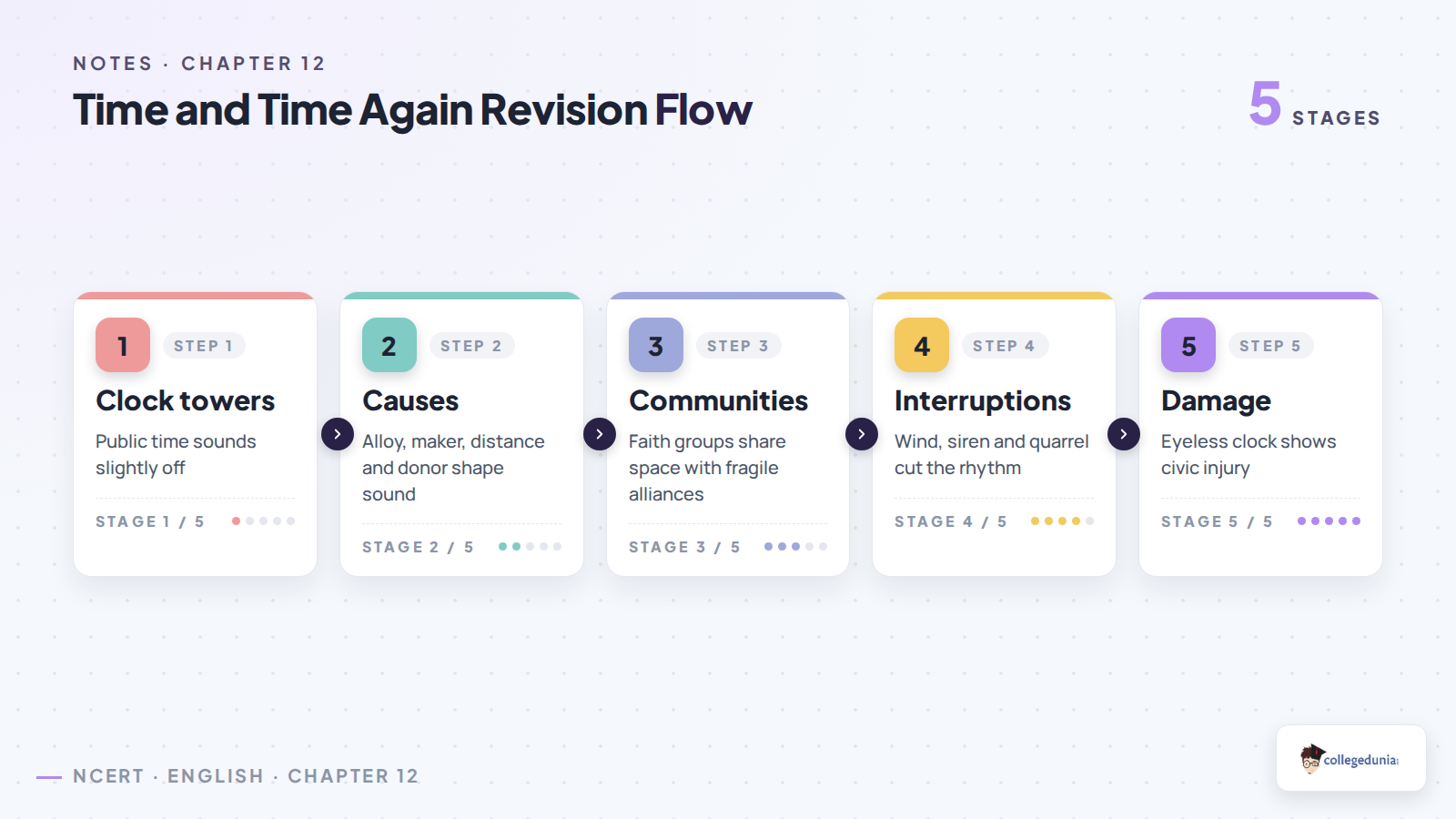
The poem moves from sound to social meaning. A student should not write only that clocks show time. The better answer explains how the city's clocks reveal uneven public life.
| Stage | Poem detail | Revision cue |
|---|---|---|
| Clock towers | Gongs sound round the clock | Public order is introduced. |
| Differences | Each clock is slightly off | Order already has cracks. |
| Social layer | Feuds and alliances are named | Time becomes civic history. |
| Damage | An eyeless clock is silent | Public order has been hurt. |
Clock Time and Social Time in Time and Time Again
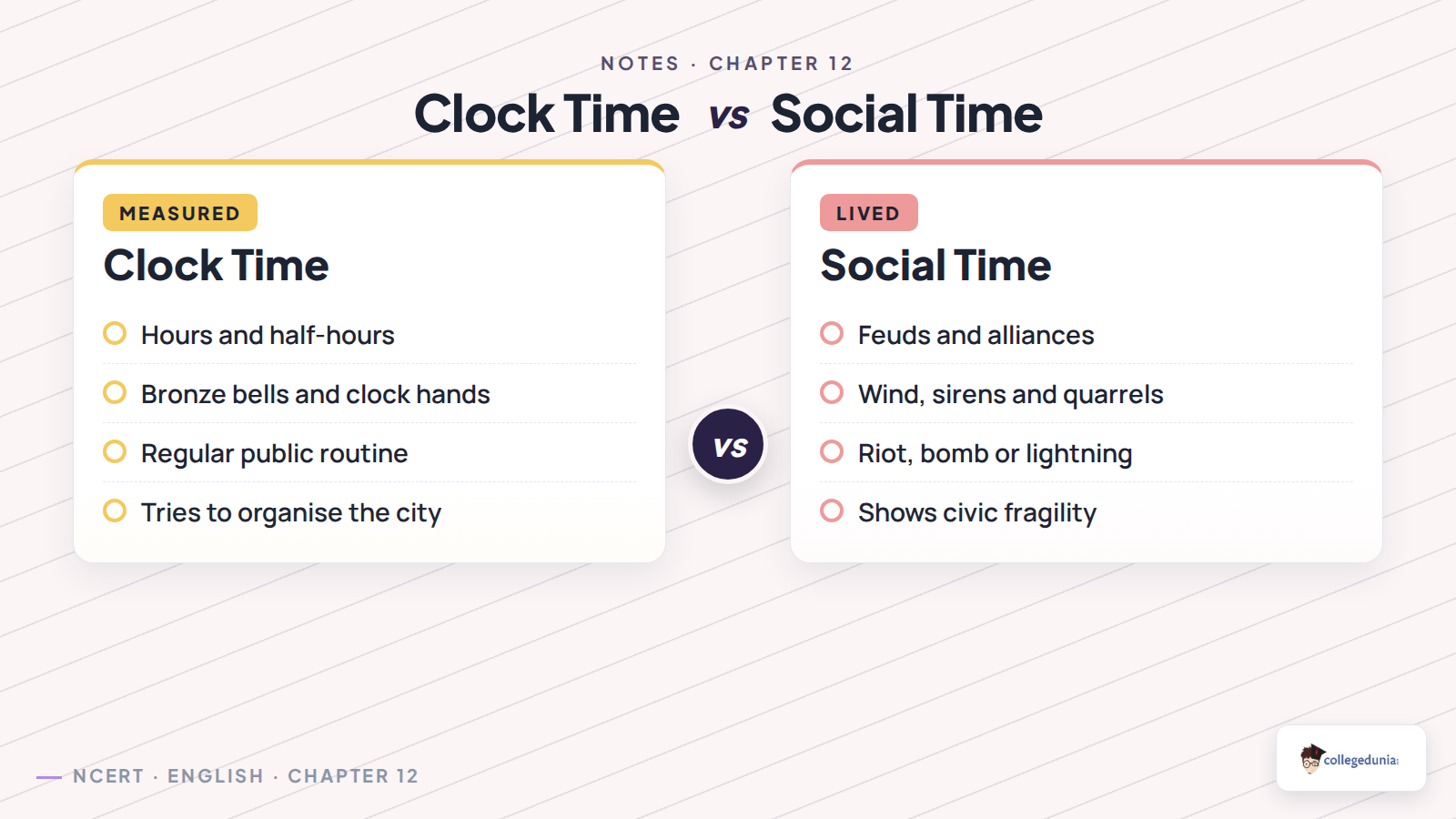
The poem's strongest contrast is between measured time and lived time. Clock time counts hours. Social time carries memory, faith, quarrels, fear and damage.
| Clock time | Social time | Answer value |
|---|---|---|
| Hours and half-hours | Feuds and alliances | Shows that routine is social. |
| Bronze tone and alloy | Donor choice and distance | Links material detail with history. |
| Clockwork order | Riot, bomb or lightning | Shows how fragile public systems are. |
Important Images in Time and Time Again
Ramanujan keeps the poem concrete. He does not start with a lecture on society. He makes students hear bells, notice metal and then face the damaged clock.
| Image | Literal meaning | Effect in answer |
|---|---|---|
| Clock towers | Public clocks in an old city | Suggest civic order and shared routine. |
| Alloy and maker's hand | Material and craft differences | Show human imperfection in public time. |
| Backstreet quarrel | A local fight or disturbance | Shows private conflict entering public sound. |
| Eyeless clock | A damaged clock face | Suggests loss of public vision and order. |
Exam cue: use the clock towers as symbols, not as simple scenery.
NCERT Questions Answer Plan for Time and Time Again
Write every answer with three parts: phrase, meaning and effect. This keeps the response clear and stops broad comments about time from taking over.
| Question focus | What to include | Final effect |
|---|---|---|
| Opening lines | Old city, clock towers and uneven gongs | The poem seems about timekeeping first. |
| Title | Repeated hours plus repeated civic trouble | The phrase gains social meaning. |
| Clock differences | Alloy, maker, distance and donor whim | The clocks become like communities. |
| Nature's precision | Lightning as exact sudden force | Nature and human violence both break order. |
| Poet's attitude | Wistful lament with quiet criticism | The poem mourns communal disharmony. |
Related Resources for Time and Time Again Class 12 English
| Resource | Use it for | Link |
|---|---|---|
| NCERT Solutions | Full textbook answers for Chapter 12 | Open NCERT Solutions |
| Previous Notes Chapter | Revise The Wild Swans at Coole before this poem | Open Chapter 11 Notes |
All Class 12 English Supplementary Notes Chapters
| Chapter | Notes link |
|---|---|
| Chapter 7: Kaleidoscope: Poems by Milton | Open Notes |
| Chapter 8: Kaleidoscope: Poems by Blake | Open Notes |
| Chapter 9: Kaleidoscope: Kubla Khan | Open Notes |
| Chapter 10: Kaleidoscope: Trees | Open Notes |
| Chapter 11: Kaleidoscope: The Wild Swans at Coole | Open Notes |
Time and Time Again Class 12 English Notes FAQs
Ques. What is Time and Time Again about?
Ans. The poem is about clock towers in an old city. Their uneven sounds reveal craft, chance, public life, communal tension and damage.
Ques. What do the clock towers symbolise in Time and Time Again?
Ans. The clock towers symbolise public time and civic order. Their slight mismatch shows difference, imperfection and social history.
Ques. Why is the final clock described as eyeless and silent?
Ans. The image shows a public timekeeper damaged by riot, bomb or lightning. It suggests broken order and a wounded city.
Ques. What is the poet's attitude to communal disharmony?
Ans. The poet's attitude is best read as wistful lament. He observes quietly, but the final image carries deep sorrow and criticism.
Ques. How should students revise Time and Time Again notes?
Ans. Students should revise clock imagery, alloy and distance, donor choice, faith communities, feuds, interruptions and the eyeless clock image.



Comments