



Class 12 English Supplementary Chapter 19 On Science Fiction Notes are prepared for the latest 2026-27 NCERT reprint. The PDF explains Isaac Asimov's ideas on myth, fantasy, science fiction, genre background and fair science fiction mystery writing.
- Part-wise coverage: Prescientific Universe and Universe of Science Fiction are explained separately.
- Exam-ready format: Includes tone, allusions, grammar tasks and NCERT question cues.
- Quick revision: Tables, diagrams and answer routes help students revise the essay before tests.
Chapter19Kaleidoscope:OnScienceFictionNotes.pdf?page=1&dpi=150)
Chapter19Kaleidoscope:OnScienceFictionNotes.pdf?page=2&dpi=150)
Chapter19Kaleidoscope:OnScienceFictionNotes.pdf?page=3&dpi=150)
Chapter19Kaleidoscope:OnScienceFictionNotes.pdf?page=4&dpi=150)
Chapter19Kaleidoscope:OnScienceFictionNotes.pdf?page=5&dpi=150)
Chapter19Kaleidoscope:OnScienceFictionNotes.pdf?page=6&dpi=150)
Chapter19Kaleidoscope:OnScienceFictionNotes.pdf?page=7&dpi=150)
Chapter19Kaleidoscope:OnScienceFictionNotes.pdf?page=8&dpi=150)
Chapter19Kaleidoscope:OnScienceFictionNotes.pdf?page=9&dpi=150)
Chapter19Kaleidoscope:OnScienceFictionNotes.pdf?page=10&dpi=150)
Chapter19Kaleidoscope:OnScienceFictionNotes.pdf?page=11&dpi=150)
Chapter19Kaleidoscope:OnScienceFictionNotes.pdf?page=12&dpi=150)
Chapter19Kaleidoscope:OnScienceFictionNotes.pdf?page=13&dpi=150)
Chapter19Kaleidoscope:OnScienceFictionNotes.pdf?page=14&dpi=150)
Chapter19Kaleidoscope:OnScienceFictionNotes.pdf?page=15&dpi=150)
Chapter19Kaleidoscope:OnScienceFictionNotes.pdf?page=16&dpi=150)
Chapter19Kaleidoscope:OnScienceFictionNotes.pdf?page=17&dpi=150)
Chapter19Kaleidoscope:OnScienceFictionNotes.pdf?page=18&dpi=150)
Chapter19Kaleidoscope:OnScienceFictionNotes.pdf?page=19&dpi=150)
Chapter19Kaleidoscope:OnScienceFictionNotes.pdf?page=20&dpi=150)
Chapter19Kaleidoscope:OnScienceFictionNotes.pdf?page=21&dpi=150)
Chapter19Kaleidoscope:OnScienceFictionNotes.pdf?page=22&dpi=150)
Chapter19Kaleidoscope:OnScienceFictionNotes.pdf?page=23&dpi=150)
Chapter19Kaleidoscope:OnScienceFictionNotes.pdf?page=24&dpi=150)
Chapter19Kaleidoscope:OnScienceFictionNotes_flat_MobileCard.pdf?page=1&dpi=150)
Chapter19Kaleidoscope:OnScienceFictionNotes_flat_MobileCard.pdf?page=2&dpi=150)
Chapter19Kaleidoscope:OnScienceFictionNotes_flat_MobileCard.pdf?page=3&dpi=150)
Chapter19Kaleidoscope:OnScienceFictionNotes_flat_MobileCard.pdf?page=4&dpi=150)
Chapter19Kaleidoscope:OnScienceFictionNotes_flat_MobileCard.pdf?page=5&dpi=150)
Chapter19Kaleidoscope:OnScienceFictionNotes_flat_MobileCard.pdf?page=6&dpi=150)
Chapter19Kaleidoscope:OnScienceFictionNotes_flat_MobileCard.pdf?page=7&dpi=150)
Chapter19Kaleidoscope:OnScienceFictionNotes_flat_MobileCard.pdf?page=8&dpi=150)
Chapter19Kaleidoscope:OnScienceFictionNotes_flat_MobileCard.pdf?page=9&dpi=150)
Chapter19Kaleidoscope:OnScienceFictionNotes_flat_MobileCard.pdf?page=10&dpi=150)
Chapter19Kaleidoscope:OnScienceFictionNotes_flat_MobileCard.pdf?page=11&dpi=150)
Chapter19Kaleidoscope:OnScienceFictionNotes_flat_MobileCard.pdf?page=12&dpi=150)
Chapter19Kaleidoscope:OnScienceFictionNotes_flat_MobileCard.pdf?page=13&dpi=150)
Chapter19Kaleidoscope:OnScienceFictionNotes_flat_MobileCard.pdf?page=14&dpi=150)
Chapter19Kaleidoscope:OnScienceFictionNotes_flat_MobileCard.pdf?page=15&dpi=150)
Chapter19Kaleidoscope:OnScienceFictionNotes_flat_MobileCard.pdf?page=16&dpi=150)
Chapter19Kaleidoscope:OnScienceFictionNotes_flat_MobileCard.pdf?page=17&dpi=150)
Chapter19Kaleidoscope:OnScienceFictionNotes_flat_MobileCard.pdf?page=18&dpi=150)
Chapter19Kaleidoscope:OnScienceFictionNotes_flat_MobileCard.pdf?page=19&dpi=150)
Chapter19Kaleidoscope:OnScienceFictionNotes_flat_MobileCard.pdf?page=20&dpi=150)
Chapter19Kaleidoscope:OnScienceFictionNotes_flat_MobileCard.pdf?page=21&dpi=150)
Chapter19Kaleidoscope:OnScienceFictionNotes_flat_MobileCard.pdf?page=22&dpi=150)
Chapter19Kaleidoscope:OnScienceFictionNotes_flat_MobileCard.pdf?page=23&dpi=150)
Chapter19Kaleidoscope:OnScienceFictionNotes_flat_MobileCard.pdf?page=24&dpi=150)
Chapter19Kaleidoscope:OnScienceFictionNotes_flat_MobileCard.pdf?page=25&dpi=150)
Chapter19Kaleidoscope:OnScienceFictionNotes_flat_MobileCard.pdf?page=26&dpi=150)
Chapter19Kaleidoscope:OnScienceFictionNotes_flat_MobileCard.pdf?page=27&dpi=150)
Chapter19Kaleidoscope:OnScienceFictionNotes_flat_MobileCard.pdf?page=28&dpi=150)
These notes follow the NCERT Class 12 English Supplementary 2026-27 reprint and are checked for chapter scope before publishing.
Student Feedback: In a Collegedunia revision poll, students said this chapter becomes easier when Asimov's two contrasts are separated: myth versus science, and content genre versus background genre.
On Science Fiction Notes PDF Contents
The chapter is built around a simple question: what makes science fiction different from myth, fantasy, mystery and ordinary fiction? Asimov answers by focusing on scientific change, laws of nature and the background of the story.
| Section | Main idea | Exam value |
|---|---|---|
| The Prescientific Universe | Myths and legends satisfy the longing for wonder through magic and divine will. | Use for comparison answers. |
| The Universe of Science Fiction | Science fiction is defined by background, not only by content. | Use for genre answers. |
| Science fiction mystery | It can be fair if the imaginary world's rules are explained early. | Use for John Campbell question. |
On Science Fiction Video Summary
Source: Magnet Brains on YouTube
Prescientific Universe and the Longing for Wonder
Asimov explains that ancient people often imagined the universe as controlled by gods, demons, priests, magicians or shamans. Natural events seemed like the actions of powerful living beings.
Myths and legends therefore used magic formulas, prayers, enchanted objects and hybrid creatures to create wonder. Their emotional purpose was close to science fiction: both show life as we do not know it.
- Winged horses and flying carpets answer the desire for travel.
- Crystal balls and magic shells resemble later communication devices.
- Centaur, Satyr, Sphinx, Harpy, Gryphon and Gorgon show the invention of unusual life.
Science Fiction Genre Map in On Science Fiction
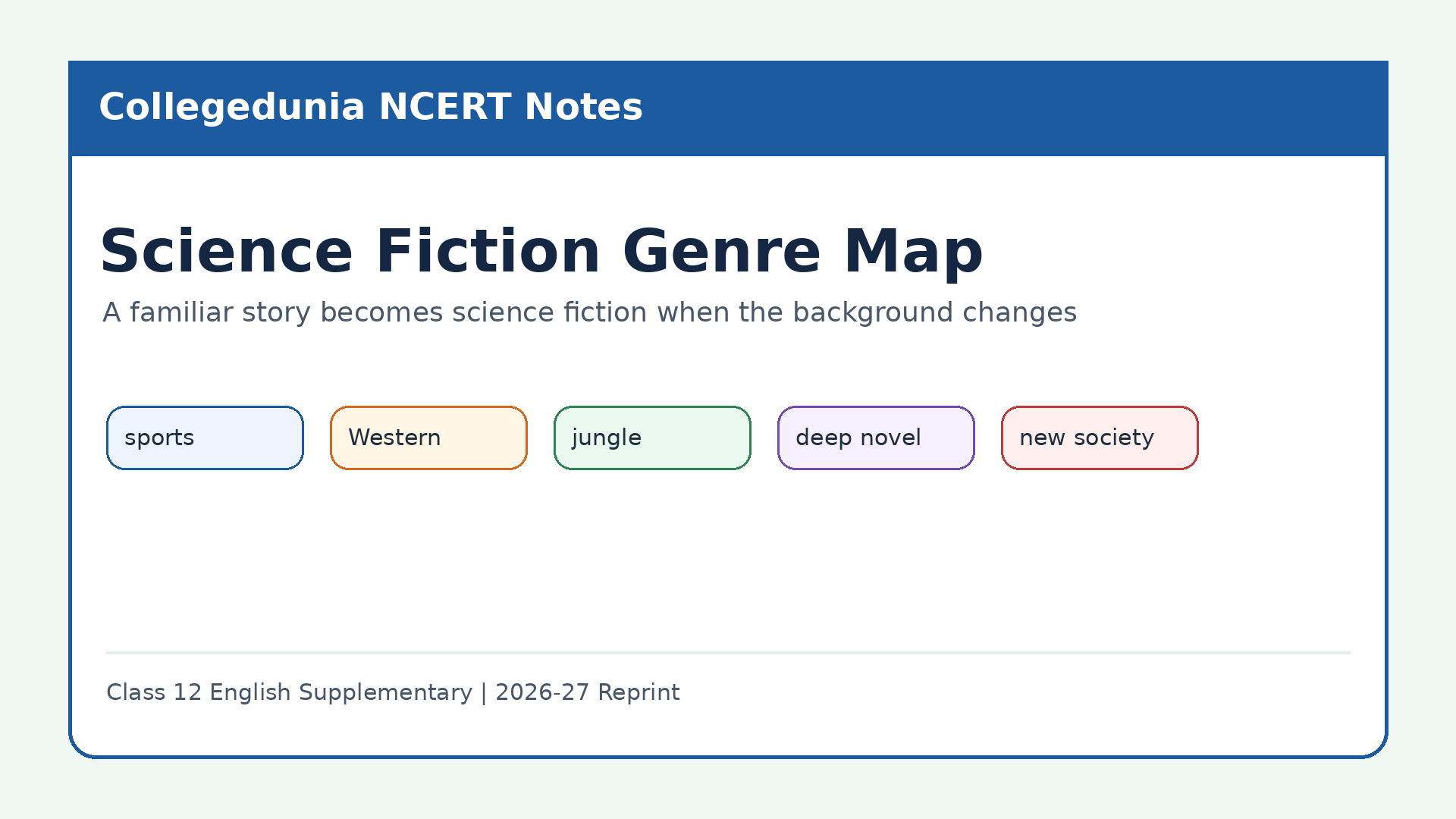
In the second part, Asimov says science fiction is not defined only by content. A sports story, Western story or jungle story can also be science fiction if its background is a significantly different society shaped by science or technology.
| Original genre | Science fiction shift | Meaning |
|---|---|---|
| Sports story | Gas gun and sphere in zero gravity | The sport remains, but the world changes. |
| Western story | Fishboy and dolphin herding fish | The Western pattern survives in a new environment. |
| Jungle story | Distant planet with exotic dangers | Adventure is placed in a scientific background. |
Fair Science Fiction Mystery Rules
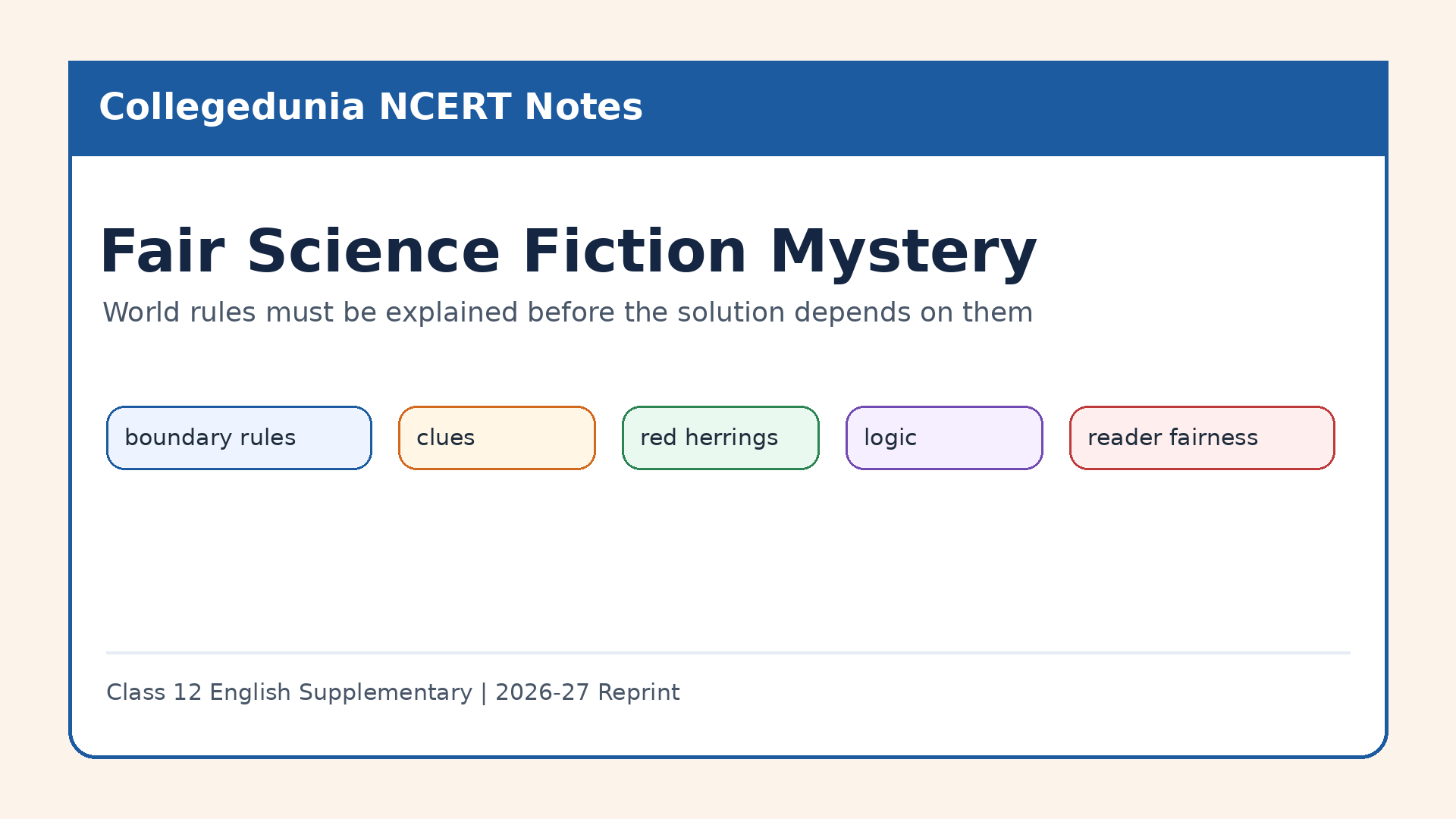
John W. Campbell thought science fiction mystery could not be fair because the writer might change the rules suddenly. Asimov replies that this makes the form difficult, not impossible.
A fair science fiction mystery must explain the boundary conditions of the imaginary society. The reader must know what can and cannot happen, and must see the important clues seen by the investigator.
- No sudden private invention should solve the case.
- Scientific facts must be accurate or carefully extrapolated.
- Misdirection and red herrings are allowed, but hidden rules are not.
On Science Fiction Important Questions
| Question | Answer cue |
|---|---|
| What parallel does Asimov draw between myths and science fiction? | Both depict strange life and satisfy wonder, but they use different explanations. |
| What gives science fiction validity? | It works in a universe governed by laws of nature and scientific understanding. |
| How does Asimov answer John Campbell? | He says fair mystery is possible if boundary conditions and clues are shared with the reader. |
| What pitfalls must a science fiction mystery writer avoid? | Wrong science, sudden rule changes, weak extrapolation and unfair hidden devices. |
Related Resources for On Science Fiction Class 12
| Resource | Use it for | Link |
|---|---|---|
| NCERT Solutions | Textbook questions and answers | On Science Fiction NCERT Solutions |
| NCERT Book PDF | Official chapter reading | On Science Fiction NCERT Book PDF |
| Handwritten Notes | Quick visual revision | On Science Fiction Handwritten Notes |
English Supplementary Notes for All Chapters
| Chapter | Notes |
|---|---|
| Chapter 15 | The Mark on the Wall Class 12 Notes |
| Chapter 16 | Film-Making Class 12 Notes |
| Chapter 17 | Why the Novel Matters Class 12 Notes |
| Chapter 18 | The Argumentative Indian Class 12 Notes |
| Chapter 19 | On Science Fiction Class 12 Notes |
| Chapter 20 | Chandalika Class 12 Notes |
On Science Fiction Class 12 Notes FAQs
Ques. What is On Science Fiction by Isaac Asimov about?
Ans. On Science Fiction explains how science fiction differs from myth, fantasy and other genres. Asimov argues that science fiction depends on scientific change, natural laws and a different story background.
Ques. What is the difference between myth and science fiction in the chapter?
Ans. Both satisfy the longing for wonder, but myths work through gods, demons and magic formulas, while science fiction works through laws of nature and scientific understanding.
Ques. Why does Asimov call science fiction a background?
Ans. He says a story may keep the content of sports, Western, jungle or mystery fiction, but become science fiction when placed in a scientifically different society or environment.
Ques. Can a science fiction mystery be fair to students?
Ans. Yes. Asimov says it is difficult but possible if the writer explains the imaginary world's boundary conditions and gives the reader all important clues.



Comments