NCERT Solutions for Class 12 English (Suppl.) Chapter 19 Kaleidoscope: On Science Fiction cover every Understanding the Text, Talking about the Text, Appreciation and Language Work task from the latest 2026-27 NCERT book. The PDF explains Isaac Asimov's essay with direct answers and expert notes for revision.
Includes 17 solved question blocks from the full On Science Fiction chapter.
Covers genre distinction, scientific change, human reaction, future prediction and grammar tasks.
Uses Solution and Expert Solution tabs so students can move from a quick answer to a deeper explanation.
Each answer follows the 2026-27 NCERT exercise order and keeps Asimov's key ideas useful for school exam writing.
Student Feedback: In a Collegedunia student survey of 12,620 Class 12 English Elective students before the 2026 boards, many students said this chapter becomes easier when they define science fiction as a story about human response to scientific change.
On Science Fiction Answer Key and Exercise Pattern
The chapter asks students to separate science fiction from labels such as sports story, Western story or jungle story. Start with Asimov's distinction: science fiction depends on scientific change and the human reaction to that change.
Exercise area
Questions
What it checks
Understanding the Text
6 questions
Genre distinction, authorial guardrails, robot examples and future prediction
Talking about the Text
2 questions
Technology, society and the limits of prediction
Appreciation
3 questions
Essay style, tone, examples and how Asimov frames science fiction
Language Work
6 tasks
Allusions, dictionary use, pause-marking, passive voice and that-clauses
The PDF solves all 17 tasks in the same order as the NCERT chapter. This keeps source wording and answer flow together for revision.
Science Fiction Idea Flow in Asimov's Essay
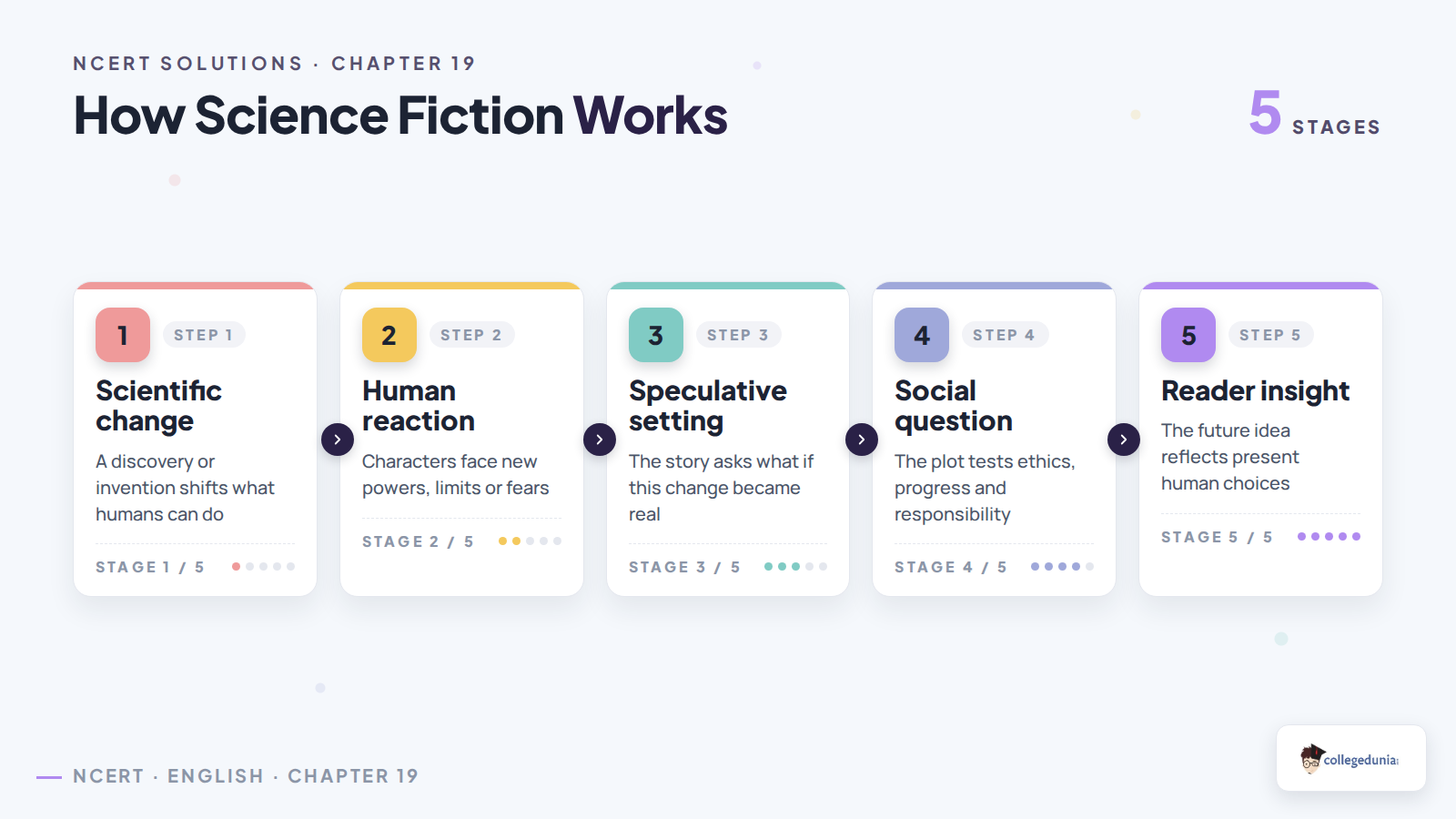
Asimov treats science fiction as a way of imagining what happens when scientific knowledge changes ordinary life. The best answers therefore need both parts: the new possibility and the human response to it.
Scientific change: a discovery, invention or new principle alters what is possible.
Human reaction: people respond with hope, fear, conflict, responsibility or curiosity.
Social question: the story asks what the change means for society, ethics and the future.
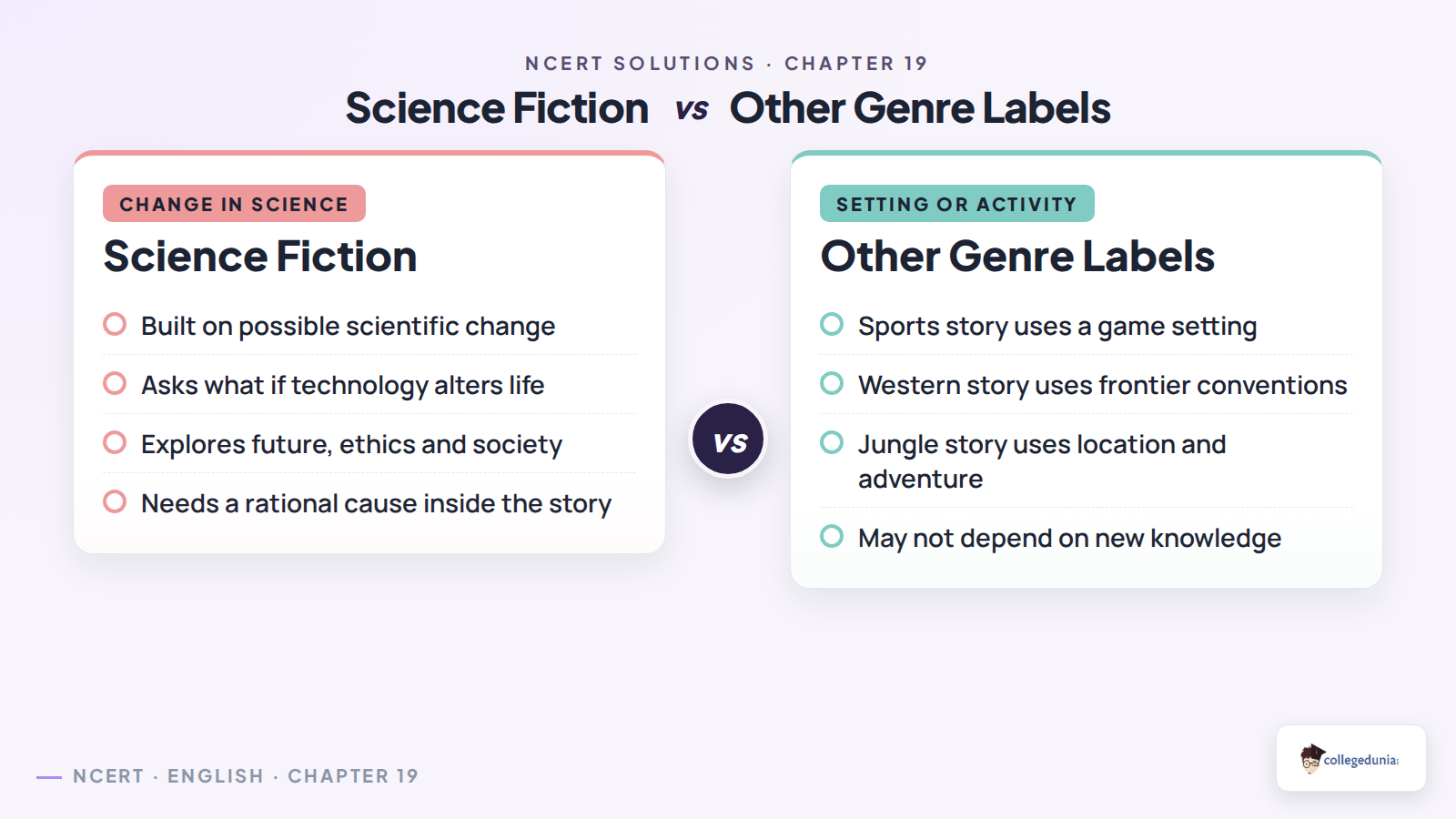
One common mistake is to define a genre only by scenery or activity. Asimov shows why that is not enough for science fiction. A sports story may revolve around a game and a jungle story may revolve around location, but science fiction turns on scientific possibility.
Idea
How Asimov uses it
Answer cue
Sports story
The label comes from activity or setting
Use it as a contrast, not as the model for science fiction.
Western story
The label comes from a historical and frontier convention
Keep the full nineteenth-century context when answering.
Science fiction
The label depends on scientific change and human reaction
Connect each answer to change, possibility and consequence.
Common Mistakes in On Science Fiction Answers
Watch Out: Weak answers often describe science fiction as any story about rockets, aliens or machines. Asimov's argument is more precise.
Do not skip the words scientific change and human reaction.
Do not treat future prediction as simple fortune-telling.
Do not omit the full Ten-2-Ten pause-marking dialogue in Language Work.
Do not shorten noun phrases or that-clause prompts in grammar answers.
Practice cue: Write each long answer with one definition, one example from Asimov and one clear link to the question.
On Science Fiction Language Work and Grammar Tasks
The Language Work section checks accuracy. Students need to identify literary allusions, use dictionary meanings in context, mark spoken pauses and transform active sentences into passive voice without changing the object.
Allusions: explain the reference and why it helps the essay.
Pause marking: preserve the complete dialogue before adding marks.
Passive voice: locate the object first, then recast the sentence.
That-clauses: decide whether the clause works as subject, object or complement.
More Class 12 English Supplementary Chapter 19 Resources
Use these related resources when you want the same chapter in another format. The table is placed above the FAQ so students can move from solutions to notes, book PDF and handwritten revision without losing the chapter context.
Resource
Best use
Link
NCERT Solutions
Step-by-step answers for every On Science Fiction task
All NCERT Solutions for Class 12 English Supplementary Chapters
The table below keeps the same resource type together, so students can move chapter by chapter through the Class 12 English supplementary Kaleidoscope question set.
All NCERT Solutions for Class 12 English (Suppl.) Chapter 19 Kaleidoscope: On Science Fiction with Step-by-Step Solutions
The expandable cards below reproduce the full solution set from the PDF. Use the Solution tab for a direct exam-ready answer and the Expert Solution tab for deeper notes on Asimov's definition of science fiction, genre contrast, prediction and grammar analysis.
Each card separates the direct answer and expert explanation.
The literature cards keep Asimov's examples visible for revision.
The grammar cards preserve the original Language Work prompts.
Q 19.1
What is the parallel drawn between myths and legends of the past and science fiction?
Concept used. Asimov compares myths, legends and science fiction through the human longing for wonder. Both imagine life beyond ordinary experience, but they use different ideas about how the universe works.
Use both sides
Mention the shared goal first, then show the difference in background.
Myths and legends show strange beings, magical powers and worlds unlike daily life.
Science fiction also shows life as we do not know it.
Both forms satisfy the human desire for wonder.
Both let people imagine powers greater than their own.
The difference lies in the background.
Myths work in a prescientific universe controlled by gods, demons and magic.
Science fiction works in a universe controlled by laws of nature.
In myths, formulas, prayers and enchantments move events.
In science fiction, knowledge of science and technology changes human power.
The parallel is that myths, legends and science fiction all satisfy the longing for wonder by showing life beyond ordinary experience. Myths use magic and divine forces, while science fiction uses science and natural law.
AM
Ananya Menon
M.A English, University of Delhi
Verified Expert
Comparative reading. Asimov compares myths, legends and science fiction through the human longing for wonder. Both imagine life beyond ordinary experience, but they use different ideas about how the universe works.
Asimov does not dismiss old stories as childish.
He says they met the same emotional need that science fiction meets now.
A flying carpet and a spacecraft both excite the wish to cross limits.
A crystal ball and television both suggest seeing at a distance.
The older form explains these wonders through magic.
The modern form explains them through science.
So the parallel is functional, not factual.
The two kinds of story do similar imaginative work in different universes.
The answer should not call myths science fiction; it should call them an older equivalent.
The parallel is that myths, legends and science fiction all satisfy the longing for wonder by showing life beyond ordinary experience. Myths use magic and divine forces, while science fiction uses science and natural law.
Q 19.2
What gives science fiction its validity?
Concept used. Science fiction becomes valid when it is rooted in scientific change and a universe governed by consistent natural laws.
Natural law
Use laws of nature, technology and future change in one answer.
Asimov says true science fiction belongs to the last two centuries.
It becomes possible when people notice rapid scientific and technological change.
Science shows that nature follows laws.
Human beings can understand those laws and use them.
That knowledge can change the future in ways different from the present.
Science fiction is valid when it imagines those changes consistently.
It should not depend on gods, demons or arbitrary magic.
Its imagined world must follow rules that the reader can understand.
Science fiction gets its validity from science, technology and the laws of nature. It imagines a changed future, but that future must follow a consistent scientific logic.
RI
Rohit Iyer
M.A English, EFLU Hyderabad
Verified Expert
Concept-first answer. Science fiction becomes valid when it is rooted in scientific change and a universe governed by consistent natural laws.
For Asimov, validity does not mean that every device already exists.
It means the imagined device belongs to a lawful universe.
Science fiction may extrapolate from known science.
It may also modify science in a rational way.
But it cannot change the rules whenever the plot needs help.
The reader must feel that the future grows from science.
That link with natural law separates it from mythic magic.
This is why the Industrial Revolution matters in the essay.
The answer should stress consistency, not only imagination.
Science fiction gets its validity from science, technology and the laws of nature. It imagines a changed future, but that future must follow a consistent scientific logic.
Q 19.3
Which literary works does the author have in mind when he refers to 'Open Sesame' or the concept of winged horses or flying carpets?
Concept used. The question asks students to identify the old wonder stories behind Asimov's examples.
Name the source tale
Connect Open Sesame with Ali Baba and flying carpets with Arabian Nights style tales.
Open Sesame refers to the cave-opening password in Ali Baba and the Forty Thieves.
That tale is associated with The Arabian Nights.
Flying carpets also belong to the wonder-tale world of The Arabian Nights and related oriental romances.
Winged horses suggest Pegasus from Greek mythology.
Such examples show old literature imagining travel, vision and power beyond ordinary human limits.
Asimov uses them because they do the emotional work that science fiction later does.
They are not scientific examples.
They are prescientific forms of imaginative wonder.
The references point mainly to Ali Baba and the Forty Thieves from The Arabian Nights, to flying-carpet tales from the same wonder tradition, and to Pegasus from Greek mythology.
MN
Meera Nair
Ph.D English, JNU
Verified Expert
Allusion map. The question asks students to identify the old wonder stories behind Asimov's examples.
Asimov expects students to hear the story tradition behind the names.
Open Sesame is not a scientific device.
It is a magical command from a famous tale.
A flying carpet belongs to the same world of enchantment.
A winged horse recalls Pegasus and other mythic travel images.
These allusions help his main claim.
Before science fiction, literature still imagined impossible travel and strange power.
The old source was magic; the modern source is science.
The answer should identify the works and connect them to Asimov's argument.
The references point mainly to Ali Baba and the Forty Thieves from The Arabian Nights, to flying-carpet tales from the same wonder tradition, and to Pegasus from Greek mythology.
Q 19.4
What makes for the distinction between the various genres of fiction - 'a sports story', 'a Western story', 'a jungle story' and science fiction?
Concept used. Asimov distinguishes most genres by content, while science fiction is mainly distinguished by background.
Use content and background
The whole answer turns on this pair of terms.
A sports story is defined by competitive activity.
A Western story is defined by the cowboy world of the American West.
A jungle story is defined by danger in a tropical forest.
These genres depend mainly on content.
Science fiction is different because it depends on background.
A sports plot, Western plot or jungle plot can become science fiction when placed in a scientifically changed society.
A baseball game in a space station can still be a sports story.
It is also science fiction because the setting changes the rules of life.
Sports, Western and jungle stories are distinguished by content. Science fiction is distinguished by background: a society or world changed by science, technology or imagined future conditions.
AR
Aditi Rao
M.A English, Jadavpur University
Verified Expert
Structure-first reading. Asimov distinguishes most genres by content, while science fiction is mainly distinguished by background.
The important word in Asimov's answer is background.
Other genres need their usual content to remain themselves.
Sports needs a contest.
Western fiction needs the cowboy world.
Jungle fiction needs the forested danger.
Science fiction can absorb all these plots.
It changes their environment through science, future society or another planet.
So science fiction is large enough to include many other genres.
The answer should show that science fiction is not only spaceships or machines.
Sports, Western and jungle stories are distinguished by content. Science fiction is distinguished by background: a society or world changed by science, technology or imagined future conditions.
Q 19.5
How does Asimov establish that John Campbell was wrong in his opinion that it is not possible for a science fiction mystery to be fair to a reader in the same way as a classical mystery is?
Concept used. A mystery is fair when the reader knows the rules, sees the clues and can reason with the investigator.
Fair play rule
Explain how boundary conditions protect the reader from surprise inventions.
Campbell feared that science fiction gave writers too much freedom.
A writer could invent a new device suddenly and solve the mystery unfairly.
Asimov accepts that this temptation exists.
But he says the problem is not conceptual impossibility.
The writer must explain the boundary conditions of the imagined society.
The reader must know what can and cannot be done.
The reader must see and hear every clue the investigator sees and hears.
Red herrings are allowed, but hidden rule changes are not.
Asimov points to his own science fiction mysteries as proof that this can be done.
Asimov proves Campbell wrong by saying that a science fiction mystery can be fair if its imagined rules are explained clearly and the reader gets the same clues as the investigator.
KS
Karan Sharma
M.A English, University of Mumbai
Verified Expert
Reasoning map. A mystery is fair when the reader knows the rules, sees the clues and can reason with the investigator.
Asimov separates difficulty from impossibility.
Science fiction mystery is hard because the writer must know science and mystery rules.
But hard writing is not impossible writing.
A fair mystery fixes the rules before the solution.
Science fiction can also fix its rules.
Once telepathy, transport or computers are explained, they become part of fair play.
The writer may misdirect the reader, but not cheat the reader.
That is Asimov's answer to Campbell.
The answer should mention boundary conditions and shared clues.
Asimov proves Campbell wrong by saying that a science fiction mystery can be fair if its imagined rules are explained clearly and the reader gets the same clues as the investigator.
Q 19.6
What are the pitfalls that the writer of science fiction mystery must guard against?
Concept used. Science fiction mystery can fail when the writer uses bad science, sudden inventions or unexplained rules to force the plot.
Do not cheat
Use Asimov's Q-rays example as the warning.
The first pitfall is changing the rules without warning.
Asimov jokes about a detective suddenly using Q-rays that nobody knew existed.
Such a device would cheat the reader.
The second pitfall is ignorance of real science.
Asimov gives examples of mystery writers who made scientific mistakes.
The third pitfall is poor extrapolation.
A science fiction writer must know science and know how to extend it rationally.
The mystery must still give all clues fairly.
The solution should arise from established rules, not from last-minute magic.
The writer must avoid sudden rule changes, invented devices introduced at the last moment, bad science, careless extrapolation and unfair hiding of clues from the reader.
SK
Sanya Kapoor
M.A English, University of Hyderabad
Verified Expert
Warning list. Science fiction mystery can fail when the writer uses bad science, sudden inventions or unexplained rules to force the plot.
The danger is stronger in science fiction than in ordinary mystery.
A normal detective story can already cheat with a special talent.
Science fiction can cheat even more easily with a new machine or law.
Asimov says this must be resisted.
The invented world needs clear limits.
The science must be accurate or rationally extended.
The mystery clues must be visible.
Only then can the reader play the same game as the detective.
The answer should use the word fair in relation to the reader.
The writer must avoid sudden rule changes, invented devices introduced at the last moment, bad science, careless extrapolation and unfair hiding of clues from the reader.
Q 19.7
Imagination and fantasy help human beings to speculate upon the possible explanations for the complexity and unpredictability of the phenomena in the universe. Discuss.
Concept used. Imagination helps human beings turn fear and curiosity about the universe into stories, explanations and models.
Balance old and new
Talk about myths first and science fiction next.
Human beings face a universe that often feels complex and unpredictable.
Before science explained many processes, people imagined gods, demons and magical powers behind events.
Such fantasy gave shape to thunder, storms, flight, distant sight and strange creatures.
It helped people make emotional sense of what they could not control.
Science later offered impersonal laws of nature.
Science fiction uses imagination again, but now it speculates through science.
It asks how technology might alter society, travel, knowledge and power.
So imagination does not oppose explanation.
It often prepares the mind to ask what may be possible.
Imagination and fantasy help people picture forces beyond ordinary life. Myths explained wonder through magic; science fiction explains wonder through science and possible future change.
DP
Devika Pillai
Ph.D English, IIT Madras
Verified Expert
Discussion answer. Imagination helps human beings turn fear and curiosity about the universe into stories, explanations and models.
The essay shows imagination as a human need.
People do not only collect facts about the universe.
They also build stories around what frightens or amazes them.
In prescientific times, those stories used divine and magical agents.
In modern times, speculative stories use scientific possibility.
Both forms explore limits.
The difference is the intellectual tool being used.
Fantasy uses enchantment; science fiction uses extrapolated science.
The answer should treat imagination as serious, not childish.
Imagination and fantasy help people picture forces beyond ordinary life. Myths explained wonder through magic; science fiction explains wonder through science and possible future change.
Q 19.8
The difference that science and technology have made to everyday life today was visualised in science fiction fifty years ago. Discuss.
Concept used. Science fiction often imagines future devices and social changes before they become normal parts of everyday life.
Use examples carefully
Examples should show prediction or early imagination, not claim exact prophecy every time.
Science fiction often takes present science and stretches it forward.
Writers imagined space travel, instant communication, robots, intelligent machines and new cities before many such ideas entered daily life.
Today, video calls, satellites, computers and automated systems make some old science fiction feel familiar.
This does not mean every story predicts the future exactly.
It means science fiction trains people to imagine change.
It asks how tools may alter work, war, homes, travel and relationships.
Asimov's point is that science and technology make the future different from the past.
Science fiction sees that difference early and turns it into story.
Many everyday technologies were first imagined in science fiction as possible futures. Science fiction does not always predict exactly, but it helps people visualise how science may change life.
RS
Rahul Sen
M.A English, Presidency University
Verified Expert
Present-day connection. Science fiction often imagines future devices and social changes before they become normal parts of everyday life.
The statement fits Asimov's view of the genre.
Once people accepted that science changes the future, writers could imagine future societies.
Some imagined tools later became ordinary.
A screen conversation, an artificial helper or a journey beyond Earth no longer feels impossible.
The value of science fiction is not perfect prediction.
Its value is disciplined speculation.
It connects scientific possibility with human life.
That is why a story from fifty years ago can look close to today's world.
The answer should avoid saying that all science fiction becomes real.
Many everyday technologies were first imagined in science fiction as possible futures. Science fiction does not always predict exactly, but it helps people visualise how science may change life.
Q 19.9
Discuss the author's attitude towards the pre-scientific imagination and the tone he adopts while talking about it.
Concept used. Asimov is amused by prescientific imagination, but he is also respectful of its literary power.
Do not call him dismissive
He is playful, but he does not throw the old stories away.
Asimov's attitude is affectionate and mildly comic.
He calls some gods whimsical and childish, and he jokes about magical formulas.
Yet he does not reject old myths and legends.
He says they satisfied the same longing for wonder that science fiction satisfies.
He even says we should not throw out literature that has delighted people for thousands of years.
His tone is conversational, witty and tolerant.
He is strict about definitions, but generous about enjoyment.
He respects good storytelling even when it belongs to a prescientific universe.
Asimov's attitude is playful but respectful. He jokes about prescientific beliefs, yet values myths and legends as exciting stories that satisfy the human longing for wonder.
PV
Priya Verma
M.A English, Banaras Hindu University
Verified Expert
Tone reading. Asimov is amused by prescientific imagination, but he is also respectful of its literary power.
The essay avoids a harsh scientific arrogance.
Asimov knows that myths do not match modern reality.
He still asks why they should be discarded.
His examples of Achilles, Hector, flying carpets and magic shells show delight.
The comic tone keeps the essay lively.
The respect keeps it from becoming contemptuous.
He wants science fiction to be defined narrowly.
But he still gives old wonder tales their literary dignity.
The answer should use both words: playful and respectful.
Asimov's attitude is playful but respectful. He jokes about prescientific beliefs, yet values myths and legends as exciting stories that satisfy the human longing for wonder.
Q 19.10
Observe how the paragraph, as a form, has been used in the essay. Some paragraphs consist of just one sentence. What purpose do you think the author had in putting them in this manner?
Concept used. Short paragraphs create emphasis, pace and a spoken argumentative rhythm.
Use paragraph effect
Mention emphasis, pause and transition.
Asimov uses paragraphs as units of thought and rhythm.
Longer paragraphs explain an idea with examples.
Single-sentence paragraphs create a pause.
They make a point stand out sharply.
For example, Never! works like a spoken response in a debate.
Short paragraphs also help him shift from one idea to the next.
They keep the essay conversational and energetic.
This style suits an argumentative essay because the reader can follow each step easily.
The one-sentence paragraphs add emphasis, pause, humour and quick transitions. They make the prose sound conversational and help the argument move clearly.
AM
Arjun Mehta
M.A English, University of Calcutta
Verified Expert
Style map. Short paragraphs create emphasis, pace and a spoken argumentative rhythm.
A paragraph is not only a block of information here.
It is also a timing device.
Asimov often builds an idea, then gives a short reply or turn.
The reader feels a speaking voice.
The short paragraph also prevents dense explanation from becoming heavy.
It points the eye to important claims.
This makes the essay easier to read.
It also supports the witty tone of the chapter.
The answer should connect paragraph length with reader effect.
The one-sentence paragraphs add emphasis, pause, humour and quick transitions. They make the prose sound conversational and help the argument move clearly.
Q 19.11
Mark the linkers used by the author to connect the point he makes in one paragraph with that in the next. For example, Let me explain the difference that makes in the last line of para 1 of Section II. These are called discourse markers or discourse signalers.
Concept used. Discourse markers guide the reader through examples, contrasts, explanations and shifts in argument.
Quote short signals
List the linker and state what it does.
Asimov uses linkers to make his argument sound like a guided conversation.
Let me explain the difference that makes signals explanation.
Take the content of any of these signals an example.
In place of signals substitution from one genre to another.
For that matter widens the point beyond category fiction.
And I agree with him signals agreement with Campbell's larger view.
In only one respect signals a contrast or exception.
Then, too adds another point.
After all gives a reason for the claim that follows.
The author uses signals such as Let me explain, Take, In place of, For that matter, And I agree, In only one respect, Then too and After all to guide the argument.
TJ
Tara Joshi
M.A English, University of Delhi
Verified Expert
Language observation. Discourse markers guide the reader through examples, contrasts, explanations and shifts in argument.
The linkers make the essay easy to follow.
They tell the reader what the next paragraph is doing.
Some introduce examples.
Some introduce contrast.
Some add support.
Some widen the discussion.
This matters because the essay moves through many genres and examples.
The discourse markers keep those movements clear.
The answer should not merely list words; it should name their function.
The author uses signals such as Let me explain, Take, In place of, For that matter, And I agree, In only one respect, Then too and After all to guide the argument.
Q 19.12
Literary Allusions: Look up a literary dictionary or encyclopedia or the internet to understand the references to the following mythical creatures: Centaur, Satyr, Sphinx, Harpy, Gryphon, Gorgon and Pegasus. Find out parallel creatures in Indian mythology.
Concept used. Mythical creatures often combine human, animal and supernatural traits. The Indian parallels are approximate because traditions rarely match one-to-one.
Use approximate parallels
Write that the parallels are similar in function or form, not exact copies.
A Centaur is half-human and half-horse; an Indian parallel may be Kinnara or other human-animal beings in epic and temple art.
A Satyr is a man-goat woodland figure; Indian mythology has goat-headed or animal-headed beings, though not an exact Satyr.
A Sphinx combines a human head and lion body; Indian parallels include Narasimha-like man-lion imagery and Yali figures.
A Harpy is a woman-bird figure; Garuda, Jatayu and Suparna beings give bird-linked parallels.
A Gryphon combines eagle and lion traits; Yali and Sharabha are close Indian composite-creature parallels.
A Gorgon has snake-like features; Nagini and Manasa traditions provide snake-woman parallels.
Pegasus is a winged horse; Uchchaihshravas and flying horse motifs offer broad Indian parallels.
The safest answer notes likeness, not exact identity.
The parallels are approximate: Centaur - Kinnara; Satyr - goat-headed beings; Sphinx - Narasimha or Yali; Harpy - Garuda or Jatayu; Gryphon - Yali or Sharabha; Gorgon - Nagini or Manasa; Pegasus - Uchchaihshravas or flying horse motifs.
VB
Vivaan Bhat
Ph.D English, JNU
Verified Expert
Cultural comparison. Mythical creatures often combine human, animal and supernatural traits. The Indian parallels are approximate because traditions rarely match one-to-one.
This task is about recognising literary allusions.
Asimov uses mythic creatures to show how old stories create wonder.
Many traditions invent composite beings.
Some combine human and animal bodies.
Some combine two animals into one powerful figure.
Indian mythology offers several comparable figures.
Exact matches are not always available.
A careful answer says parallel rather than equivalent.
The answer should avoid forcing a perfect match where none exists.
The parallels are approximate: Centaur - Kinnara; Satyr - goat-headed beings; Sphinx - Narasimha or Yali; Harpy - Garuda or Jatayu; Gryphon - Yali or Sharabha; Gorgon - Nagini or Manasa; Pegasus - Uchchaihshravas or flying horse motifs.
Q 19.13
Find out about the story of Achilles and Hector.
Concept used. Achilles and Hector belong to Homer's Iliad, where personal grief, honour and war meet in a famous duel.
Use Iliad context
Name Troy, Patroclus, Achilles and Hector.
Achilles is the greatest Greek warrior in Homer's Iliad.
Hector is the leading Trojan warrior and prince of Troy.
During the Trojan War, Hector kills Patroclus, Achilles' close companion.
Achilles returns to battle in anger.
He fights Hector outside the walls of Troy.
Achilles kills Hector and dishonours the body by dragging it behind his chariot.
Later, Hector's father Priam comes to Achilles and asks for the body.
Achilles is moved and returns it for funeral rites.
The story joins heroic combat with grief, rage and pity.
In the Iliad, Hector kills Patroclus, so Achilles returns to battle, fights Hector outside Troy and kills him. Priam later pleads for Hector's body, and Achilles returns it.
KR
Kavya Rao
M.A English, EFLU Hyderabad
Verified Expert
Story summary. Achilles and Hector belong to Homer's Iliad, where personal grief, honour and war meet in a famous duel.
Asimov mentions Achilles and Hector as an example of lasting old literature.
The duel is not modern warfare.
It uses spears, shields and heroic combat.
Yet the scene still carries emotional force.
Achilles' grief drives the fight.
Hector's death shows the human cost of war.
Priam's plea gives the story moral depth.
This supports Asimov's claim that old forms still move students.
The answer should keep the summary brief and link it to literary allusion.
In the Iliad, Hector kills Patroclus, so Achilles returns to battle, fights Hector outside Troy and kills him. Priam later pleads for Hector's body, and Achilles returns it.
Q 19.14
Pronunciation: Mark the pauses in the following dialogue. A: Good morning, this is Ten-2-Ten supermarket. Can I help you? B: Good morning, I'd like to speak to the person in charge of your After Sales Service, please. A: That's Mr Patel. B: Could you put me through to him, please? A: Who's speaking, please? B: My name's Karandikar. A: Just a moment, Mr Karandikar... I am sorry, Mr Patel's line seems to be busy. B: Well, is there someone else who could help me? A: There's Mrs Paul. She's the assistant manager, but she's out at the moment. B: Look, this is quite important! A: I'll try Mr Patel's line again for you,... trying to connect you. B: Ah! finally, ... is that Mr Patel? Good morning, this is... Hello?... oh no! I'm cut off.
Concept used. Pauses divide spoken English into tone groups. Each group should fit one breath and one small unit of meaning.
Read aloud
Place a slash where a speaker naturally takes a breath.
A: Good morning / this is Ten-2-Ten supermarket / Can I help you?
B: Good morning / I'd like to speak to the person in charge of your After Sales Service / please.
A: That's Mr Patel.
B: Could you put me through to him / please?
A: Who's speaking / please?
B: My name's Karandikar.
A: Just a moment / Mr Karandikar / I am sorry / Mr Patel's line seems to be busy.
B: Well / is there someone else who could help me?
A: There's Mrs Paul / She's the assistant manager / but she's out at the moment.
B: Look / this is quite important!
A: I'll try Mr Patel's line again for you / trying to connect you.
B: Ah / finally / is that Mr Patel? / Good morning / this is... Hello? / oh no! / I'm cut off.
Use the complete pause-marked dialogue given in the Solution steps above as the final answer. It begins Good morning / this is Ten-2-Ten supermarket / Can I help you? and continues line by line through Ah / finally / is that Mr Patel? / Good morning / this is... Hello? / oh no! / I'm cut off.
AN
Aditya Nair
M.A English, Jadavpur University
Verified Expert
Speech practice. Pauses divide spoken English into tone groups. Each group should fit one breath and one small unit of meaning.
The slashes are not grammar punctuation.
They mark breathing and meaning units.
Short greeting phrases usually form one group.
Long service phrases need a break before please.
Repair phrases like I am sorry often stand alone.
Emotional phrases like Look and Ah can stand alone too.
The final broken phone line needs several short groups.
Reading it aloud is the best test of the answer.
The answer can vary slightly if the tone groups remain natural.
Use the complete pause-marked dialogue given in the Solution steps above as the final answer. It begins Good morning / this is Ten-2-Ten supermarket / Can I help you? and continues line by line through Ah / finally / is that Mr Patel? / Good morning / this is... Hello? / oh no! / I'm cut off.
Q 19.15
Grammar: Find the noun phrases that follow have in the sports story paragraph, and the noun phrases that follow take, place, involve, change and add in the following paragraph.
Concept used. A transitive verb takes an object noun phrase or pronoun. Some objects are long because they carry modifiers.
Find the object
Ask what after the verb to locate the noun phrase.
After have in A sports story must have: some competitive activity.
After have in A Western story must have: the nomadic life of the cowboy of the American West in the latter half of the nineteenth century.
After have in The jungle story must have: the dangers implicit in a forested tropical wilderness.
After take: the content of any of these.
After place: it, meaning that content.
After involve: a society significantly different from our own.
After change: the nature of the story.
After add: it in the phrase added to it, where it refers back to the story's nature.
The key noun phrases are some competitive activity; the nomadic life of the cowboy of the American West in the latter half of the nineteenth century; the dangers implicit in a forested tropical wilderness; the content of any of these; it; a society significantly different from our own; the nature of the story; and it.
NT
Nisha Thomas
M.A English, Christ University
Verified Expert
Grammar map. A transitive verb takes an object noun phrase or pronoun. Some objects are long because they carry modifiers.
The task trains students to see verb-object relations.
Have is repeated three times with different genre objects.
Each object tells what content the genre needs.
In the next paragraph, take has the object content.
Place uses the pronoun it as object.
Involve takes society as object.
Change takes nature as object.
Add is followed by to it, so it is the pronoun to notice.
The answer should include the full phrase, not just the head noun.
The key noun phrases are some competitive activity; the nomadic life of the cowboy of the American West in the latter half of the nineteenth century; the dangers implicit in a forested tropical wilderness; the content of any of these; it; a society significantly different from our own; the nature of the story; and it.
Q 19.16
Here are a few sentences with transitive verbs, adapted from the text. Identify the noun phrases that are the verbs' objects, underline them, and turn these sentences into a passive form: He expected a sudden change of rules. Nothing prevents writers from using actual science. He revealed that he didn't know the difference between the element and the compound. He demonstrated that he couldn't tell the difference between carbon monoxide and carbon dioxide and reduced the plot to a shambles. The writer must carefully explain to the reader all the boundary conditions of the imaginary society.
Concept used. In a passive sentence, the object of the active verb becomes the subject of the passive form.
Object becomes subject
Find the object first; then change the verb to be plus past participle.
Object in sentence 1: a sudden change of rules. Passive: A sudden change of rules was expected by him.
Object in sentence 2: writers. Passive: Writers are prevented from using actual science by nothing.
Object in sentence 3: that he didn't know the difference between the element and the compound. Passive: It was revealed by him that he didn't know the difference between the element and the compound.
Objects in sentence 4: the difference between carbon monoxide and carbon dioxide; the plot. Passive: It was demonstrated by him that he couldn't tell the difference between carbon monoxide and carbon dioxide, and the plot was reduced to a shambles.
Object in sentence 5: all the boundary conditions of the imaginary society. Passive: All the boundary conditions of the imaginary society must be carefully explained to the reader by the writer.
The passive may sound awkward in some examples.
The grammar exercise is mainly about object recognition.
A natural sentence is still better than a forced passive in real writing.
Objects: a sudden change of rules; writers; that he didn't know the difference between the element and the compound; the difference between carbon monoxide and carbon dioxide; the plot; all the boundary conditions of the imaginary society. Passives: A sudden change of rules was expected by him. Writers are prevented from using actual science by nothing. It was revealed by him that he didn't know the difference between the element and the compound. It was demonstrated by him that he couldn't tell the difference between carbon monoxide and carbon dioxide, and the plot was reduced to a shambles by him. All the boundary conditions of the imaginary society must be carefully explained to the reader by the writer.
ID
Ishaan Dutta
Ph.D English, JNU
Verified Expert
Transformation method. In a passive sentence, the object of the active verb becomes the subject of the passive form.
The safest order is object first, passive second.
Not every passive sounds equally graceful.
The first and fifth are direct and natural.
Sentence 1 becomes: A sudden change of rules was expected by him.
Sentence 2 becomes: Writers are prevented from using actual science by nothing.
Sentence 3 uses an it-passive: It was revealed by him that he didn't know the difference between the element and the compound.
Sentence 4 has two passive changes: It was demonstrated by him that he couldn't tell the difference between carbon monoxide and carbon dioxide, and the plot was reduced to a shambles by him.
Sentence 5 becomes: All the boundary conditions of the imaginary society must be carefully explained to the reader by the writer.
This is why careful labelling matters before conversion.
The answer should accept slight passive variations if the object relation is correct.
Objects: a sudden change of rules; writers; that he didn't know the difference between the element and the compound; the difference between carbon monoxide and carbon dioxide; the plot; all the boundary conditions of the imaginary society. Passives: A sudden change of rules was expected by him. Writers are prevented from using actual science by nothing. It was revealed by him that he didn't know the difference between the element and the compound. It was demonstrated by him that he couldn't tell the difference between carbon monoxide and carbon dioxide, and the plot was reduced to a shambles by him. All the boundary conditions of the imaginary society must be carefully explained to the reader by the writer.
Q 19.17
Some verbs take a that-clause after them. Find the verb ask in the last paragraph of the first part of this text (which begins 'I don't even ask that...') and note how it is followed by that-clauses. Look for other verbs, in this text as well as in the earlier ones, that are followed by a that-clause (verbs such as believe, know, realise, promise...).
Concept used. A that-clause can work as the object or complement after verbs of saying, thinking, believing and requesting.
Use text examples
Give the verb and the that-clause pattern together.
In the last paragraph of Section I, Asimov writes that he does not ask that old tales be wrenched out of context.
He also asks that they be self-consistent in their prescientific universe.
The verb ask is followed by a that-clause in both cases.
Other examples in the chapter include suppose that people would invent formulas.
There is also maintained that it was impossible to write a science fiction mystery.
Asimov writes I imagine that what he expected was a sudden change of rules.
The later examples include revealed that he didn't know the difference and demonstrated that he couldn't tell the difference.
These verbs introduce reported thought, claim or discovery.
Ask is followed by that in I don't even ask that... and I ask only that.... Other verbs followed by that-clauses include suppose, maintained, imagine, revealed and demonstrated.
MK
Maya Krishnan
M.A English, EFLU Hyderabad
Verified Expert
Grammar observation. A that-clause can work as the object or complement after verbs of saying, thinking, believing and requesting.
That-clauses often behave like a whole object idea.
After ask, the clause states what the speaker requests.
After suppose or imagine, it states what the mind considers.
After maintain, it states a claim.
After reveal or demonstrate, it states what becomes clear.
The grammar pattern is common in argumentative prose.
It lets a writer handle complex ideas compactly.
The answer should quote enough words to show the pattern.
The answer should name verbs and give the that-clause relation.
Ask is followed by that in I don't even ask that... and I ask only that.... Other verbs followed by that-clauses include suppose, maintained, imagine, revealed and demonstrated.
On Science Fiction Class 12 English NCERT Solutions FAQs
Ques. How many questions are solved in Class 12 English Supplementary Chapter 19 On Science Fiction?
Ans. The PDF solves all 17 question blocks from the 2026-27 NCERT chapter, including Understanding, Talking, Appreciation and Language Work tasks.
Ques. What is the main idea of On Science Fiction?
Ans. Asimov explains that science fiction grows from scientific change and studies how human beings respond to new possibilities.
Ques. Why does Asimov compare science fiction with sports, Western and jungle stories?
Ans. He uses these labels to show that science fiction is not just a setting label; it depends on the role of science in the story.
Ques. Does this page include Language Work answers for On Science Fiction?
Ans. Yes. The solutions include literary allusions, dictionary work, pause-marking, passive voice and that-clause tasks from the official chapter.





Chapter19Kaleidoscope:OnScienceFictionSolutions.pdf?page=1&dpi=150)
Chapter19Kaleidoscope:OnScienceFictionSolutions.pdf?page=2&dpi=150)
Chapter19Kaleidoscope:OnScienceFictionSolutions.pdf?page=3&dpi=150)
Chapter19Kaleidoscope:OnScienceFictionSolutions.pdf?page=4&dpi=150)
Chapter19Kaleidoscope:OnScienceFictionSolutions.pdf?page=5&dpi=150)
Chapter19Kaleidoscope:OnScienceFictionSolutions.pdf?page=6&dpi=150)
Chapter19Kaleidoscope:OnScienceFictionSolutions.pdf?page=7&dpi=150)
Chapter19Kaleidoscope:OnScienceFictionSolutions.pdf?page=8&dpi=150)
Chapter19Kaleidoscope:OnScienceFictionSolutions.pdf?page=9&dpi=150)
Chapter19Kaleidoscope:OnScienceFictionSolutions.pdf?page=10&dpi=150)
Chapter19Kaleidoscope:OnScienceFictionSolutions.pdf?page=11&dpi=150)
Chapter19Kaleidoscope:OnScienceFictionSolutions.pdf?page=12&dpi=150)
Chapter19Kaleidoscope:OnScienceFictionSolutions.pdf?page=13&dpi=150)
Chapter19Kaleidoscope:OnScienceFictionSolutions.pdf?page=14&dpi=150)
Chapter19Kaleidoscope:OnScienceFictionSolutions.pdf?page=15&dpi=150)
Chapter19Kaleidoscope:OnScienceFictionSolutions.pdf?page=16&dpi=150)
Chapter19Kaleidoscope:OnScienceFictionSolutions.pdf?page=17&dpi=150)
Chapter19Kaleidoscope:OnScienceFictionSolutions.pdf?page=18&dpi=150)
Chapter19Kaleidoscope:OnScienceFictionSolutions.pdf?page=19&dpi=150)
Chapter19Kaleidoscope:OnScienceFictionSolutions.pdf?page=20&dpi=150)
Chapter19Kaleidoscope:OnScienceFictionSolutions.pdf?page=21&dpi=150)
Chapter19Kaleidoscope:OnScienceFictionSolutions.pdf?page=22&dpi=150)
Chapter19Kaleidoscope:OnScienceFictionSolutions.pdf?page=23&dpi=150)
Chapter19Kaleidoscope:OnScienceFictionSolutions.pdf?page=24&dpi=150)
Chapter19Kaleidoscope:OnScienceFictionSolutions.pdf?page=25&dpi=150)
Chapter19Kaleidoscope:OnScienceFictionSolutions.pdf?page=26&dpi=150)
Chapter19Kaleidoscope:OnScienceFictionSolutions.pdf?page=27&dpi=150)
Chapter19Kaleidoscope:OnScienceFictionSolutions.pdf?page=28&dpi=150)
Chapter19Kaleidoscope:OnScienceFictionSolutions.pdf?page=29&dpi=150)
Chapter19Kaleidoscope:OnScienceFictionSolutions.pdf?page=30&dpi=150)
Chapter19Kaleidoscope:OnScienceFictionSolutions.pdf?page=31&dpi=150)
Chapter19Kaleidoscope:OnScienceFictionSolutions.pdf?page=32&dpi=150)
Chapter19Kaleidoscope:OnScienceFictionSolutions_flat_MobileCard.pdf?page=1&dpi=150)
Chapter19Kaleidoscope:OnScienceFictionSolutions_flat_MobileCard.pdf?page=2&dpi=150)
Chapter19Kaleidoscope:OnScienceFictionSolutions_flat_MobileCard.pdf?page=3&dpi=150)
Chapter19Kaleidoscope:OnScienceFictionSolutions_flat_MobileCard.pdf?page=4&dpi=150)
Chapter19Kaleidoscope:OnScienceFictionSolutions_flat_MobileCard.pdf?page=5&dpi=150)
Chapter19Kaleidoscope:OnScienceFictionSolutions_flat_MobileCard.pdf?page=6&dpi=150)
Chapter19Kaleidoscope:OnScienceFictionSolutions_flat_MobileCard.pdf?page=7&dpi=150)
Chapter19Kaleidoscope:OnScienceFictionSolutions_flat_MobileCard.pdf?page=8&dpi=150)
Chapter19Kaleidoscope:OnScienceFictionSolutions_flat_MobileCard.pdf?page=9&dpi=150)
Chapter19Kaleidoscope:OnScienceFictionSolutions_flat_MobileCard.pdf?page=10&dpi=150)
Chapter19Kaleidoscope:OnScienceFictionSolutions_flat_MobileCard.pdf?page=11&dpi=150)
Chapter19Kaleidoscope:OnScienceFictionSolutions_flat_MobileCard.pdf?page=12&dpi=150)
Chapter19Kaleidoscope:OnScienceFictionSolutions_flat_MobileCard.pdf?page=13&dpi=150)
Chapter19Kaleidoscope:OnScienceFictionSolutions_flat_MobileCard.pdf?page=14&dpi=150)
Chapter19Kaleidoscope:OnScienceFictionSolutions_flat_MobileCard.pdf?page=15&dpi=150)
Chapter19Kaleidoscope:OnScienceFictionSolutions_flat_MobileCard.pdf?page=16&dpi=150)
Chapter19Kaleidoscope:OnScienceFictionSolutions_flat_MobileCard.pdf?page=17&dpi=150)
Chapter19Kaleidoscope:OnScienceFictionSolutions_flat_MobileCard.pdf?page=18&dpi=150)
Chapter19Kaleidoscope:OnScienceFictionSolutions_flat_MobileCard.pdf?page=19&dpi=150)
Chapter19Kaleidoscope:OnScienceFictionSolutions_flat_MobileCard.pdf?page=20&dpi=150)
Chapter19Kaleidoscope:OnScienceFictionSolutions_flat_MobileCard.pdf?page=21&dpi=150)
Chapter19Kaleidoscope:OnScienceFictionSolutions_flat_MobileCard.pdf?page=22&dpi=150)
Chapter19Kaleidoscope:OnScienceFictionSolutions_flat_MobileCard.pdf?page=23&dpi=150)
Chapter19Kaleidoscope:OnScienceFictionSolutions_flat_MobileCard.pdf?page=24&dpi=150)
Chapter19Kaleidoscope:OnScienceFictionSolutions_flat_MobileCard.pdf?page=25&dpi=150)
Chapter19Kaleidoscope:OnScienceFictionSolutions_flat_MobileCard.pdf?page=26&dpi=150)
Chapter19Kaleidoscope:OnScienceFictionSolutions_flat_MobileCard.pdf?page=27&dpi=150)
Chapter19Kaleidoscope:OnScienceFictionSolutions_flat_MobileCard.pdf?page=28&dpi=150)
Chapter19Kaleidoscope:OnScienceFictionSolutions_flat_MobileCard.pdf?page=29&dpi=150)
Chapter19Kaleidoscope:OnScienceFictionSolutions_flat_MobileCard.pdf?page=30&dpi=150)
Chapter19Kaleidoscope:OnScienceFictionSolutions_flat_MobileCard.pdf?page=31&dpi=150)
Chapter19Kaleidoscope:OnScienceFictionSolutions_flat_MobileCard.pdf?page=32&dpi=150)
Chapter19Kaleidoscope:OnScienceFictionSolutions_flat_MobileCard.pdf?page=33&dpi=150)
Chapter19Kaleidoscope:OnScienceFictionSolutions_flat_MobileCard.pdf?page=34&dpi=150)
Chapter19Kaleidoscope:OnScienceFictionSolutions_flat_MobileCard.pdf?page=35&dpi=150)
Chapter19Kaleidoscope:OnScienceFictionSolutions_flat_MobileCard.pdf?page=36&dpi=150)
Chapter19Kaleidoscope:OnScienceFictionSolutions_flat_MobileCard.pdf?page=37&dpi=150)
Chapter19Kaleidoscope:OnScienceFictionSolutions_flat_MobileCard.pdf?page=38&dpi=150)
Chapter19Kaleidoscope:OnScienceFictionSolutions_flat_MobileCard.pdf?page=39&dpi=150)
Chapter19Kaleidoscope:OnScienceFictionSolutions_flat_MobileCard.pdf?page=40&dpi=150)
Chapter19Kaleidoscope:OnScienceFictionSolutions_flat_MobileCard.pdf?page=41&dpi=150)
Chapter19Kaleidoscope:OnScienceFictionSolutions_flat_MobileCard.pdf?page=42&dpi=150)
Chapter19Kaleidoscope:OnScienceFictionSolutions_flat_MobileCard.pdf?page=43&dpi=150)
Chapter19Kaleidoscope:OnScienceFictionSolutions_flat_MobileCard.pdf?page=44&dpi=150)
Chapter19Kaleidoscope:OnScienceFictionSolutions_flat_MobileCard.pdf?page=45&dpi=150)
Chapter19Kaleidoscope:OnScienceFictionSolutions_flat_MobileCard.pdf?page=46&dpi=150)
Chapter19Kaleidoscope:OnScienceFictionSolutions_flat_MobileCard.pdf?page=47&dpi=150)
Chapter19Kaleidoscope:OnScienceFictionSolutions_flat_MobileCard.pdf?page=48&dpi=150)
Chapter19Kaleidoscope:OnScienceFictionSolutions_flat_MobileCard.pdf?page=49&dpi=150)
Chapter19Kaleidoscope:OnScienceFictionSolutions_flat_MobileCard.pdf?page=50&dpi=150)
Chapter19Kaleidoscope:OnScienceFictionSolutions_flat_MobileCard.pdf?page=51&dpi=150)
Chapter19Kaleidoscope:OnScienceFictionSolutions_flat_MobileCard.pdf?page=52&dpi=150)
Chapter19Kaleidoscope:OnScienceFictionSolutions_flat_MobileCard.pdf?page=53&dpi=150)
Chapter19Kaleidoscope:OnScienceFictionSolutions_flat_MobileCard.pdf?page=54&dpi=150)
Chapter19Kaleidoscope:OnScienceFictionSolutions_flat_MobileCard.pdf?page=55&dpi=150)
Chapter19Kaleidoscope:OnScienceFictionSolutions_flat_MobileCard.pdf?page=56&dpi=150)
Chapter19Kaleidoscope:OnScienceFictionSolutions_flat_MobileCard.pdf?page=57&dpi=150)
Chapter19Kaleidoscope:OnScienceFictionSolutions_flat_MobileCard.pdf?page=58&dpi=150)
Chapter19Kaleidoscope:OnScienceFictionSolutions_flat_MobileCard.pdf?page=59&dpi=150)
Chapter19Kaleidoscope:OnScienceFictionSolutions_flat_MobileCard.pdf?page=60&dpi=150)



Comments