



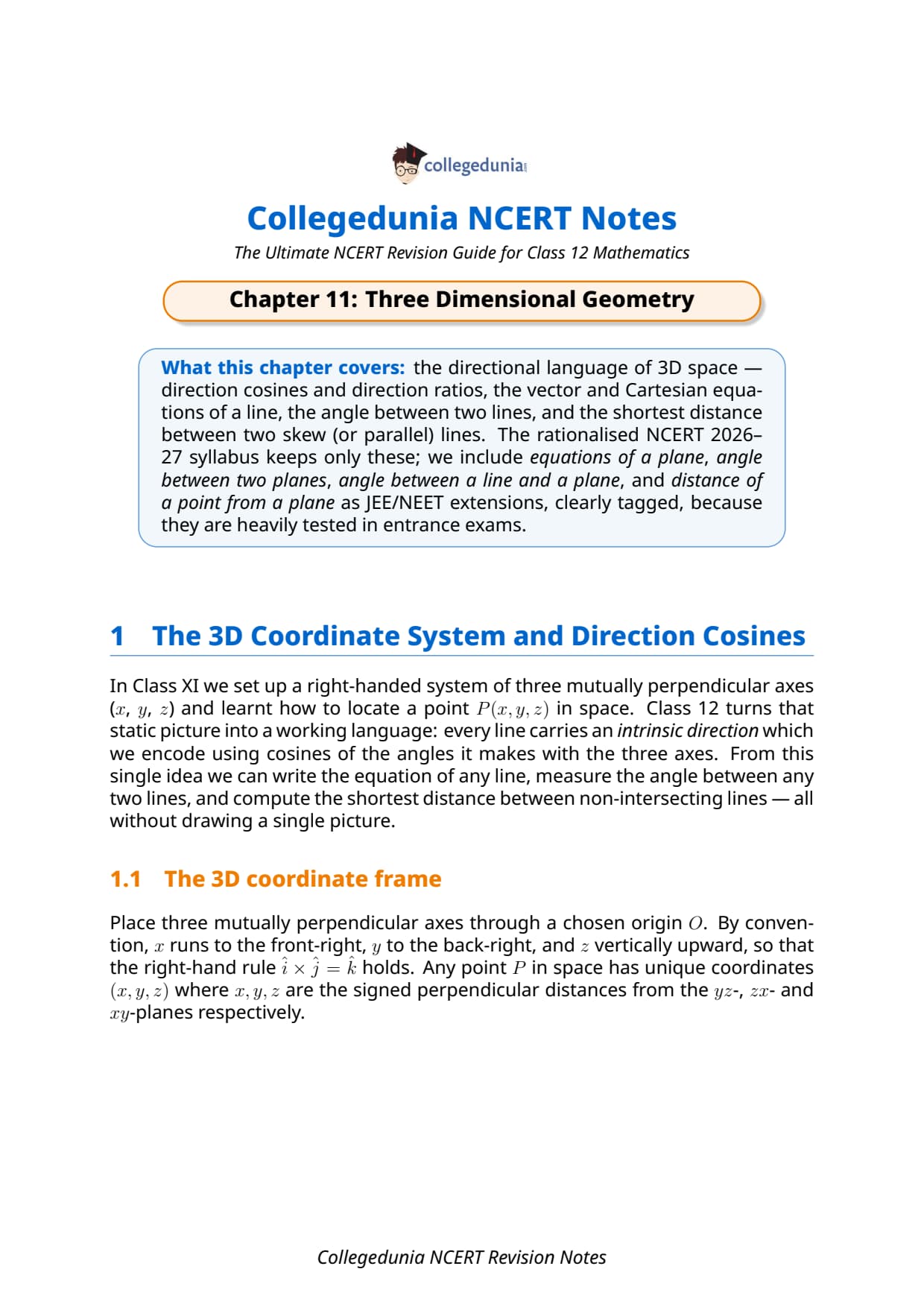
These notes cover Class 12 Maths Chapter 11 Three Dimensional Geometry in the same order as the NCERT textbook. Every result is stated, explained in one line, and backed by the key formula. You can download the full notes as a free PDF on this page.


- CBSE Boards: 6 to 8 marks, part of the 14-mark Vectors and 3D Geometry unit.
- JEE Main: 2 to 3 questions on lines, planes, and skew-line distance.
The chapter covers lines and planes across nine NCERT sections. Four results drive most long-answer questions: angle between two lines, shortest distance for skew lines, plane in normal form, and distance of a point from a plane. These notes are checked against the 2026-27 NCERT textbook and recent CBSE marking schemes.
|
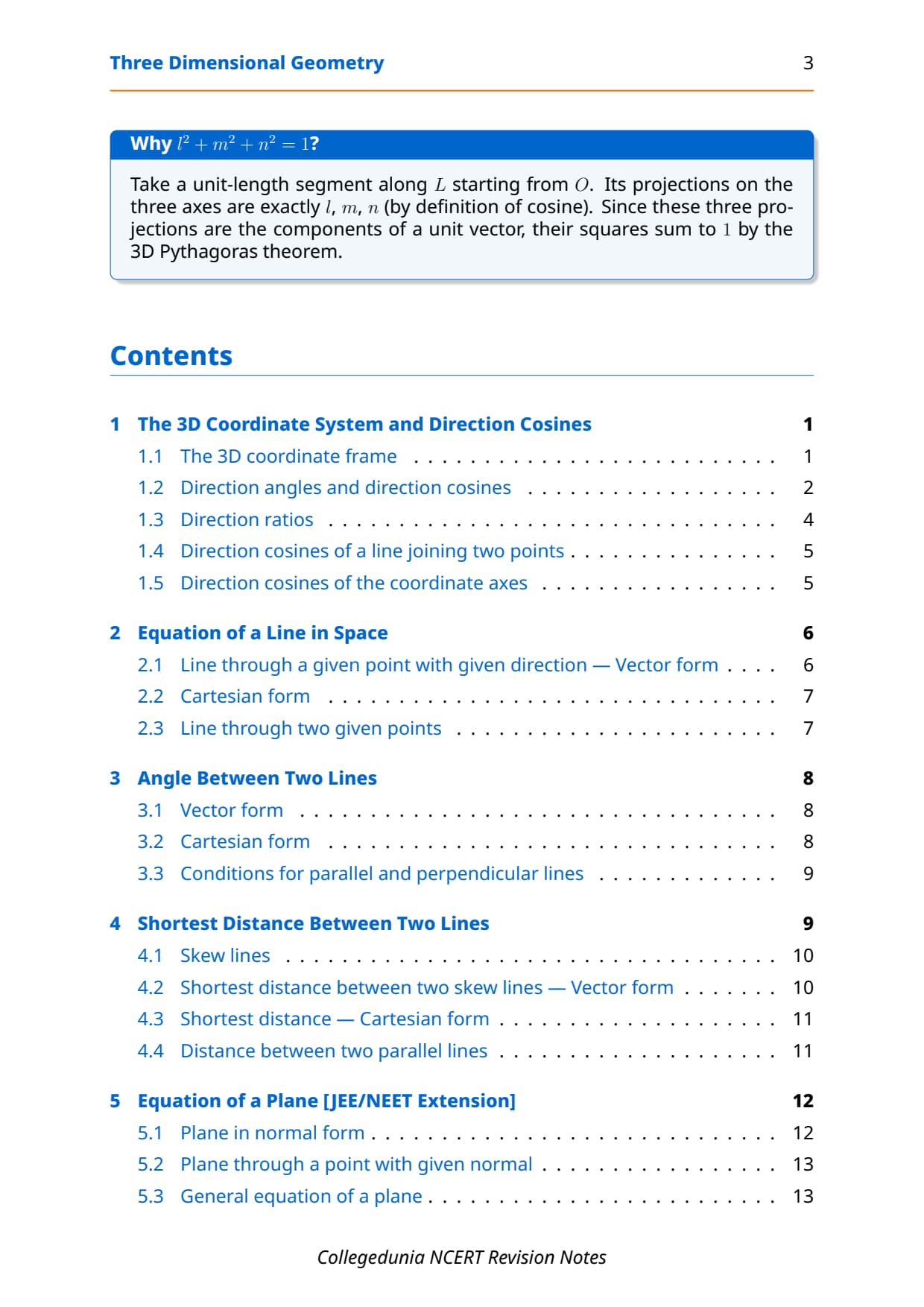
Table of Contents |
Class 12 Maths Ncert Notes Chapter 11 Three Dimensional Geometry: Section Sequence
The NCERT uses a vectors-first approach. It starts with direction cosines, then the vector and Cartesian forms of a line, the angle and distance results, and finally the plane in four forms. The notes below follow the same order.
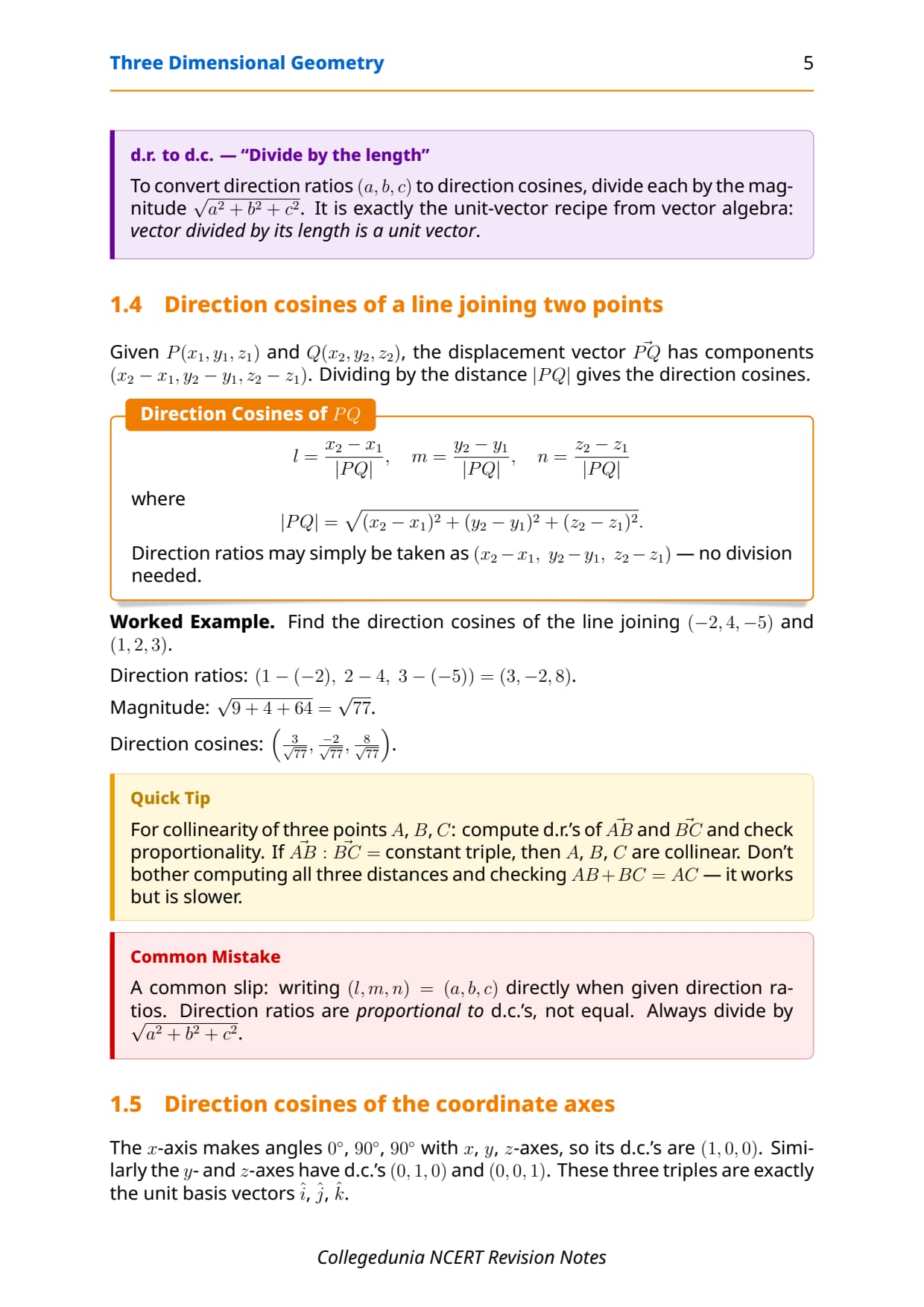
1. Direction cosines and direction ratios of a line
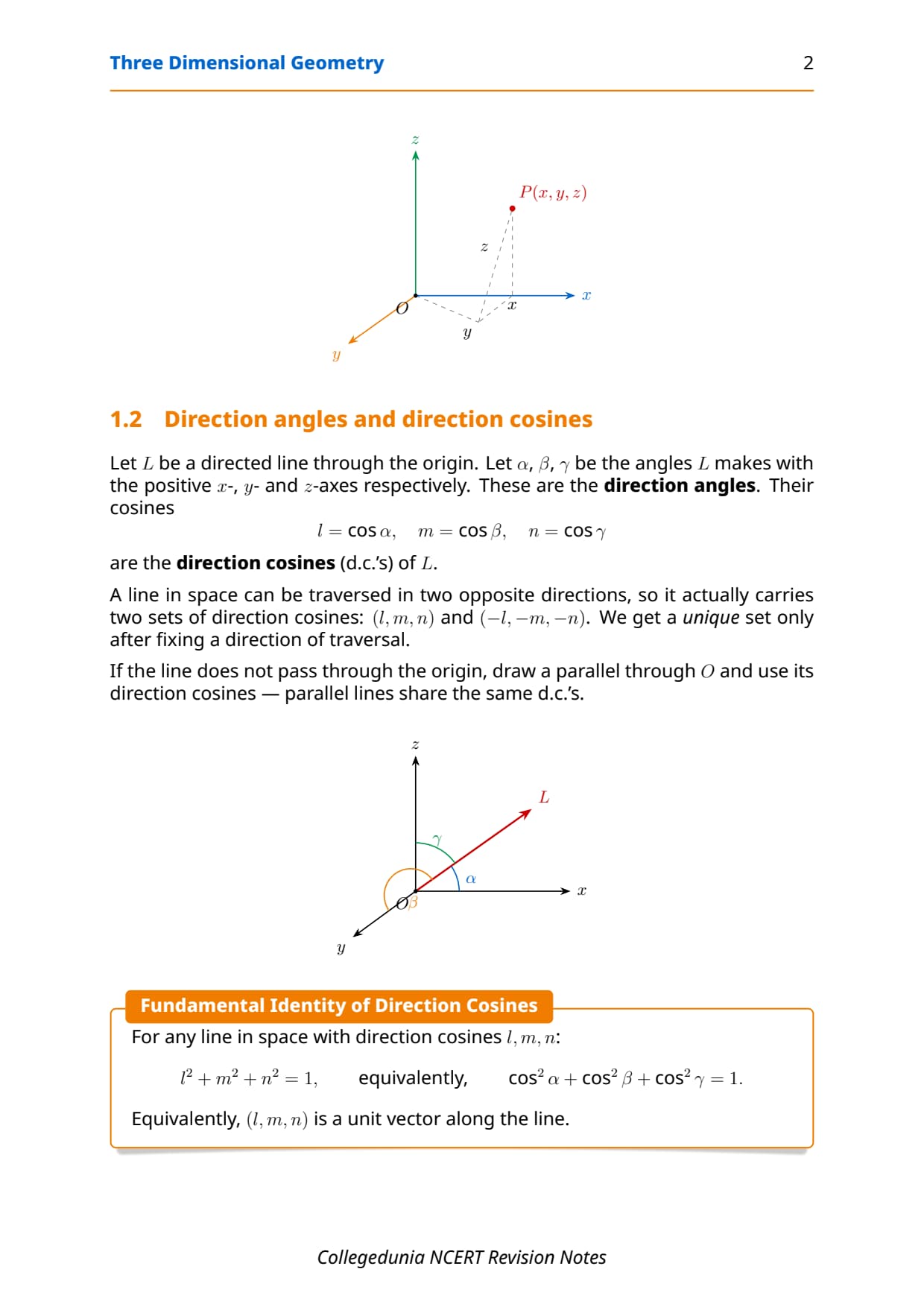
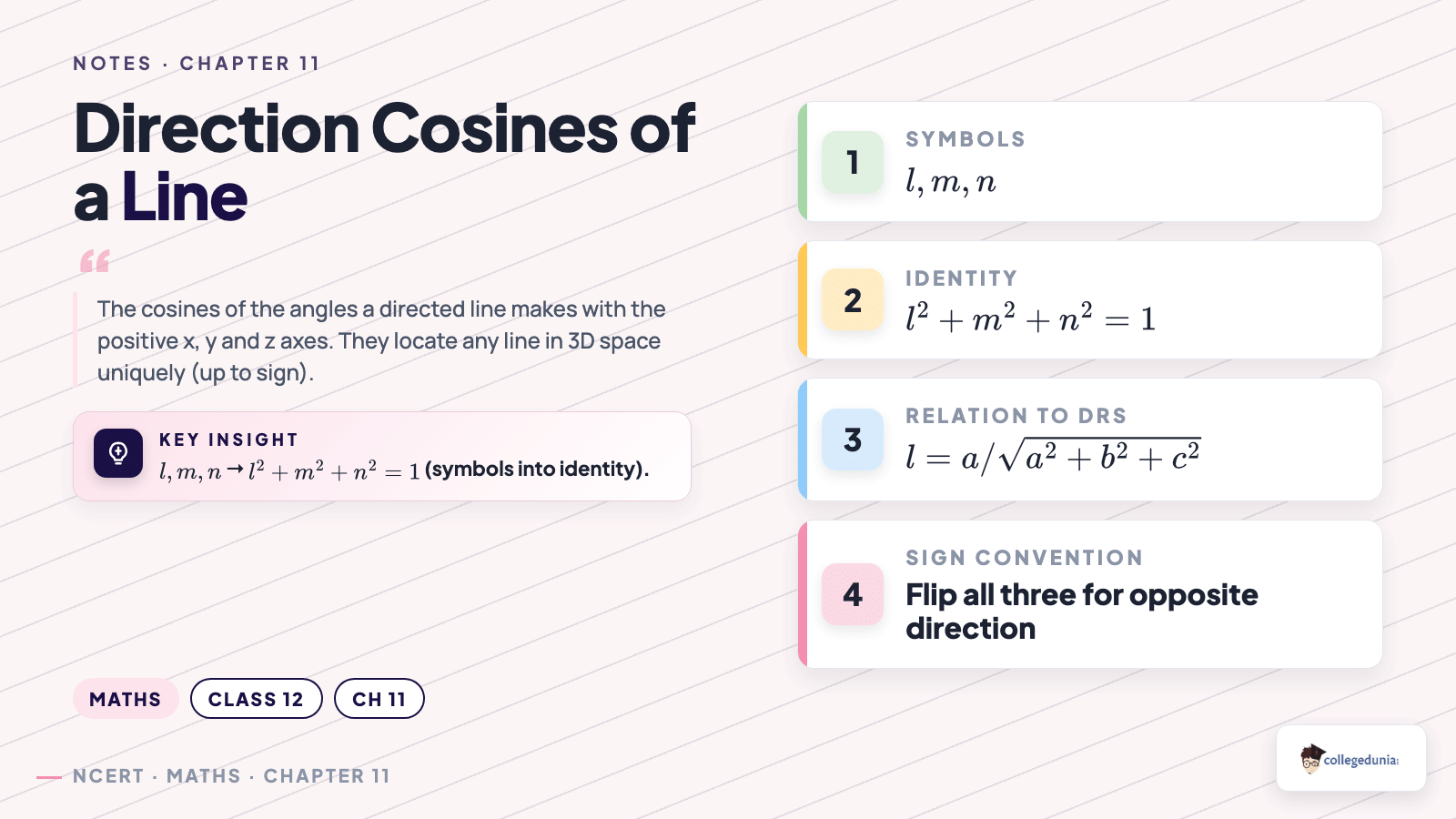
If a line makes angles α, β, γ with the axes, then l = cosα, m = cosβ, n = cosγ are its direction cosines and satisfy: $$ l^2 + m^2 + n^2 = 1 $$
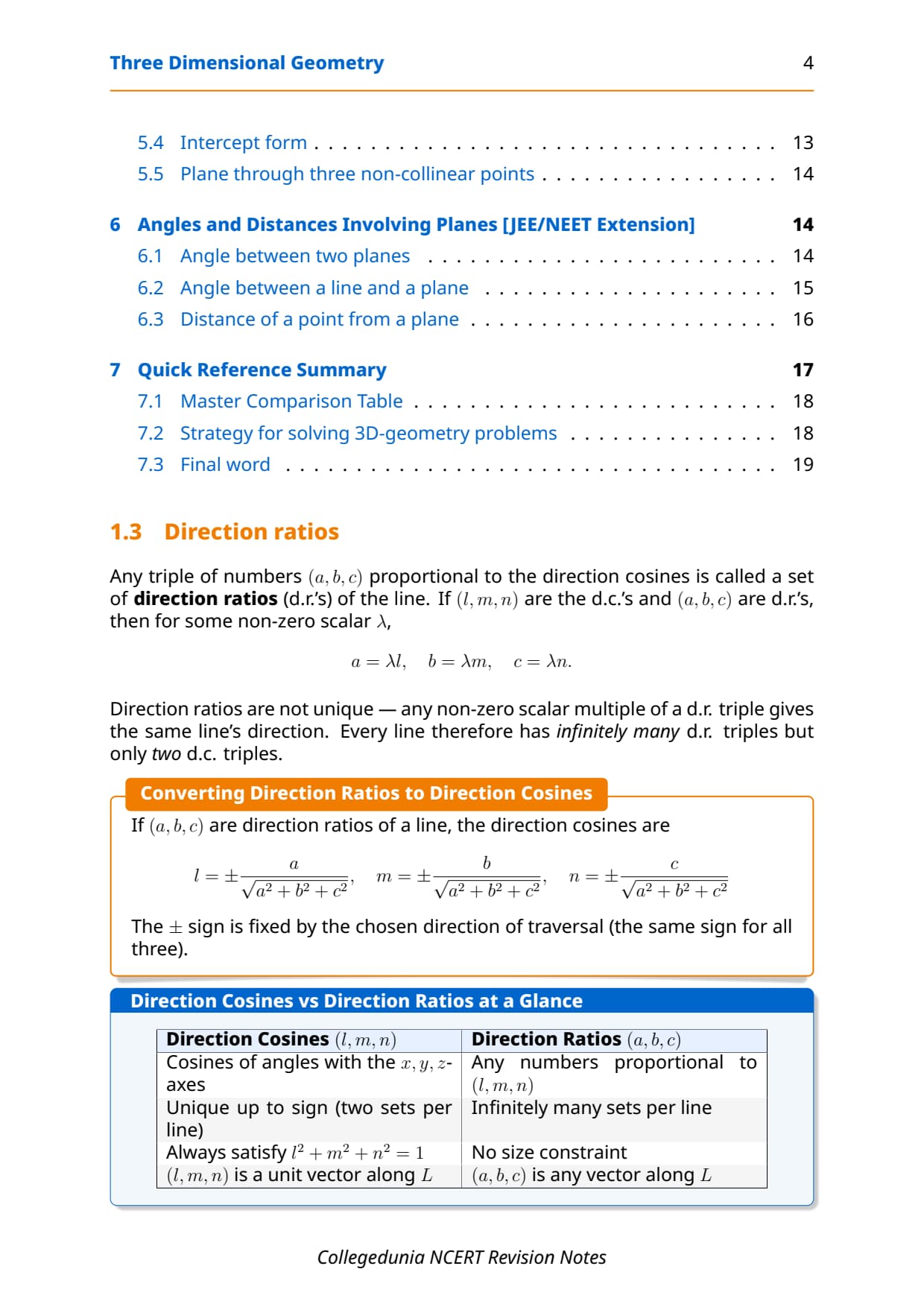
Three numbers a, b, c proportional to l, m, n are direction ratios. To recover the cosines: $$ l = \dfrac{a}{\sqrt{a^2+b^2+c^2}},\ \ m = \dfrac{b}{\sqrt{a^2+b^2+c^2}},\ \ n = \dfrac{c}{\sqrt{a^2+b^2+c^2}} $$
Quick Note: Cosines are unique up to sign; ratios only up to a scalar. So (1, 2, 2) and (3, 6, 6) give the same line.
2. Direction cosines of a line through two given points
For a line through P(x1, y1, z1) and Q(x2, y2, z2) , the direction ratios are (x2 - x1, y2 - y1, z2 - z1) and: $$ l = \dfrac{x_2 - x_1}{PQ},\ m = \dfrac{y_2 - y_1}{PQ},\ n = \dfrac{z_2 - z_1}{PQ} $$ where PQ = √(x2-x1)2 + (y2-y1)2 + (z2-z1)2 .
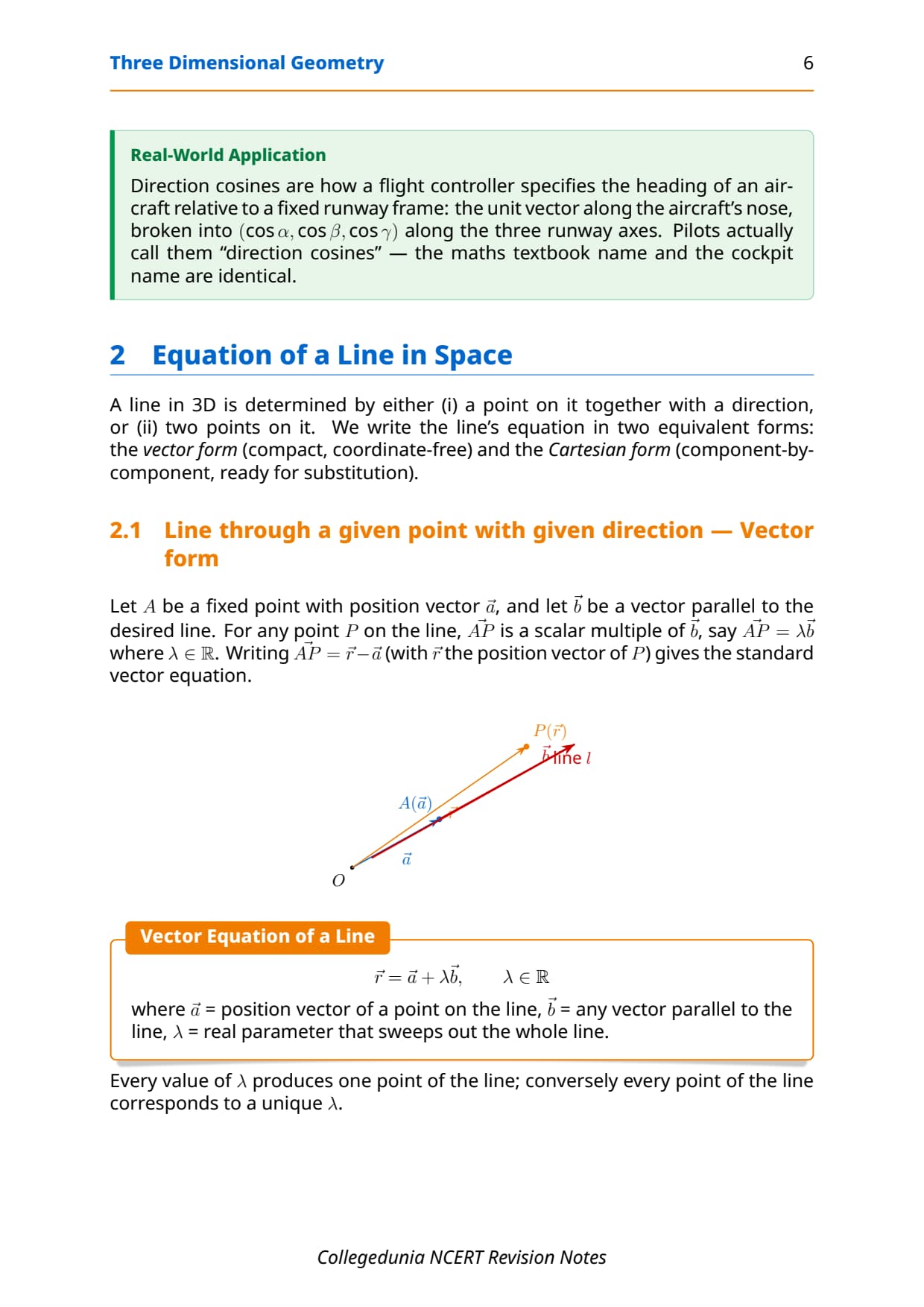
3. Vector and Cartesian equation of a line
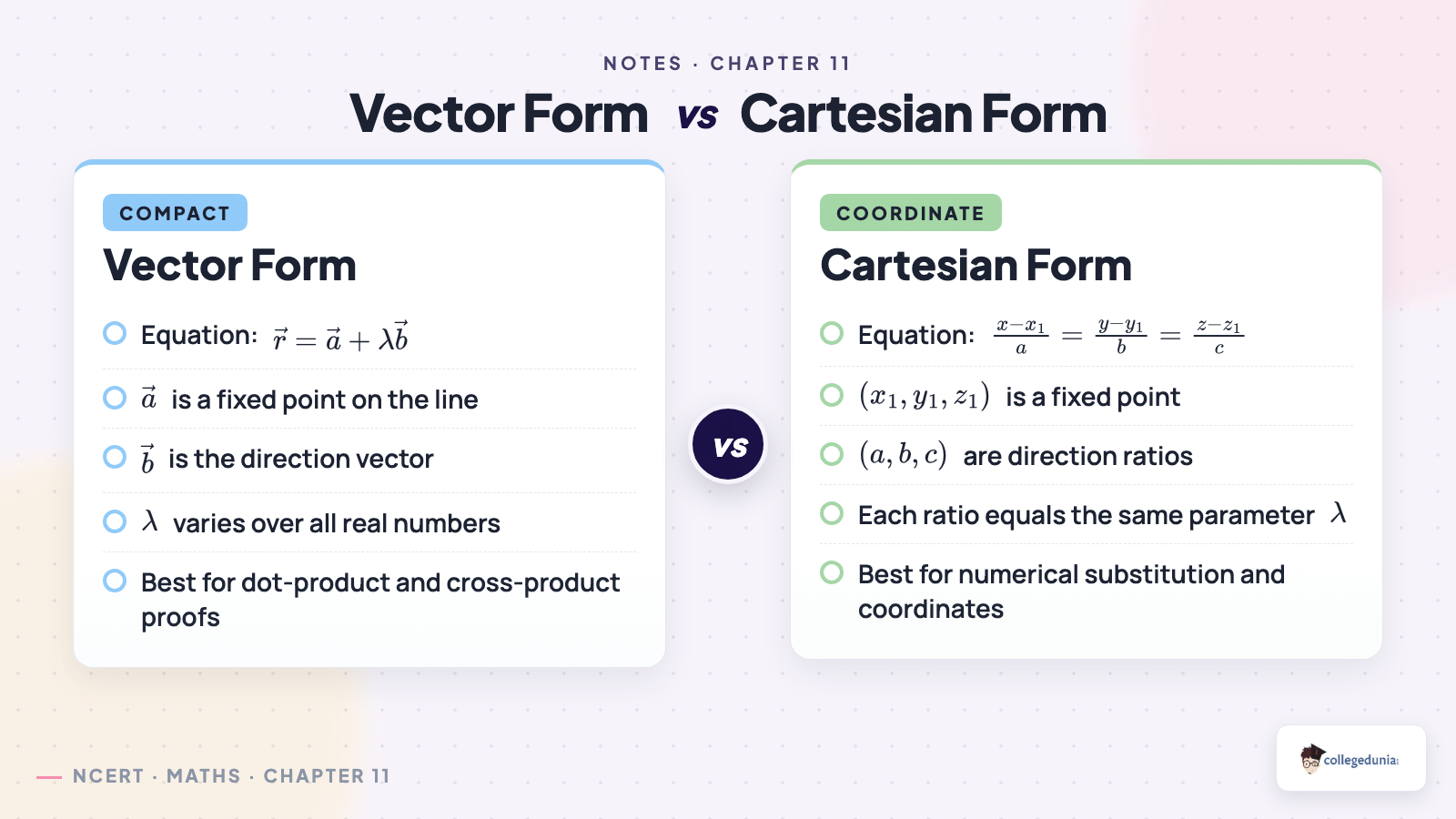
A line through the point with position vector a⃗ and parallel to b⃗ is described by:
$$ \vec{r} = \vec{a} + \lambda \vec{b}, \quad \lambda \in \mathbb{R} $$
With a⃗ = x1 î + y1 ĵ + z1 k̂ and b⃗ = a î + b ĵ + c k̂ , the symmetric Cartesian form is:
$$ \dfrac{x - x_1}{a} = \dfrac{y - y_1}{b} = \dfrac{z - z_1}{c} $$
Watch Out: If any of a, b, c is zero, do not divide by it. Write that coordinate as a separate equation.
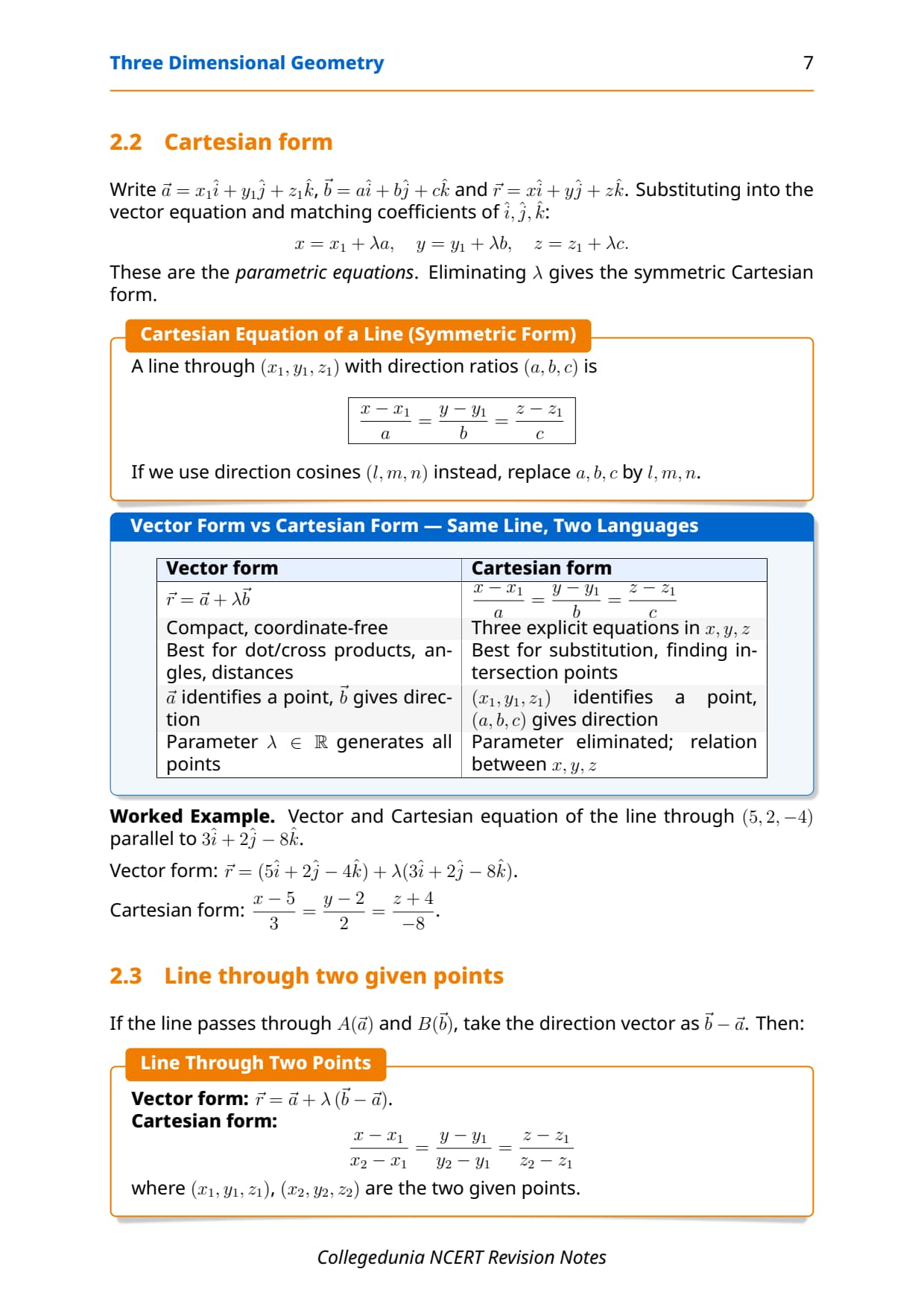
4. Line through two given points
The line joining A(a⃗) and B(b⃗) has vector equation: $$ \vec{r} = \vec{a} + \lambda (\vec{b} - \vec{a}) $$ and Cartesian form: $$ \dfrac{x - x_1}{x_2 - x_1} = \dfrac{y - y_1}{y_2 - y_1} = \dfrac{z - z_1}{z_2 - z_1} $$
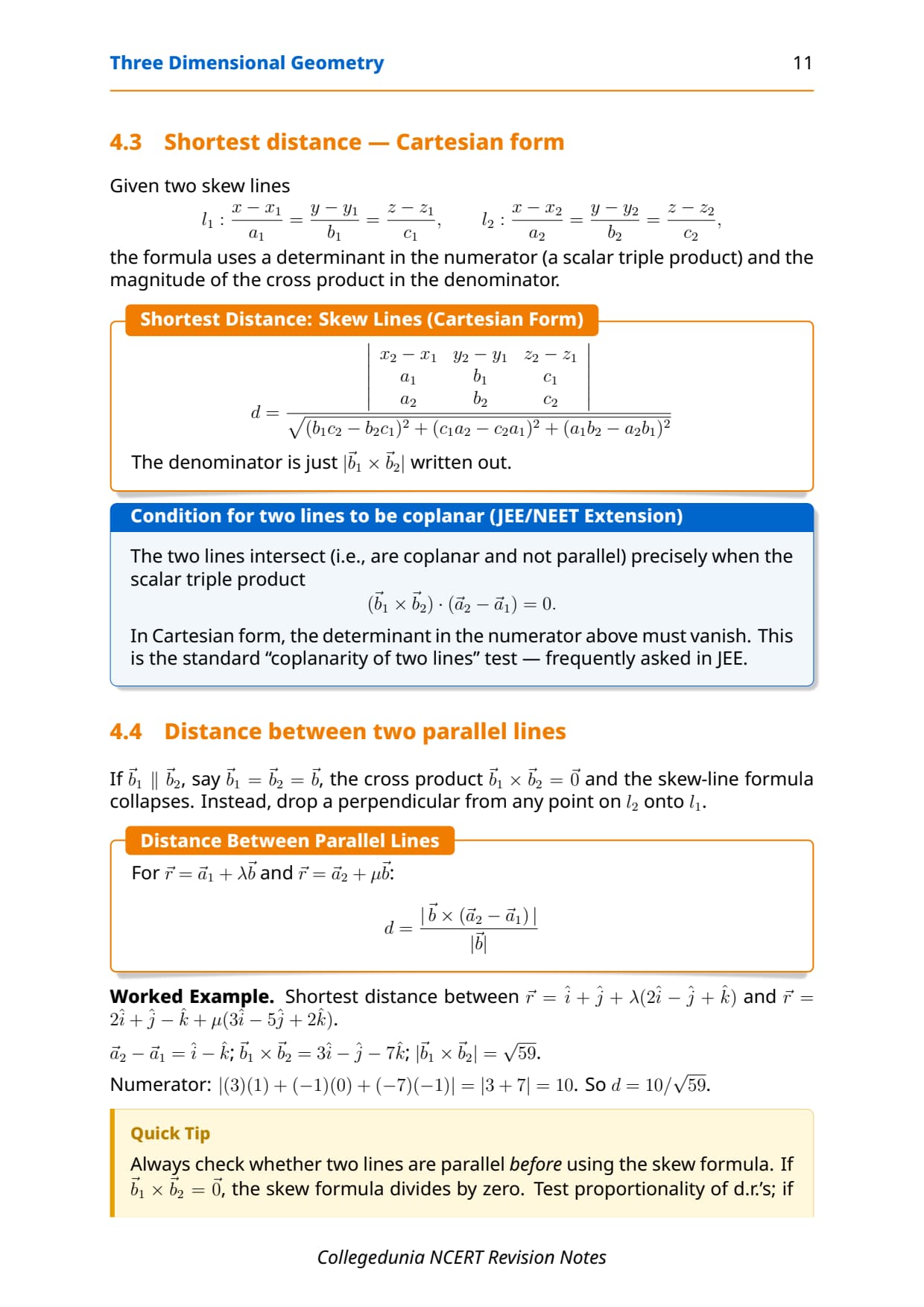
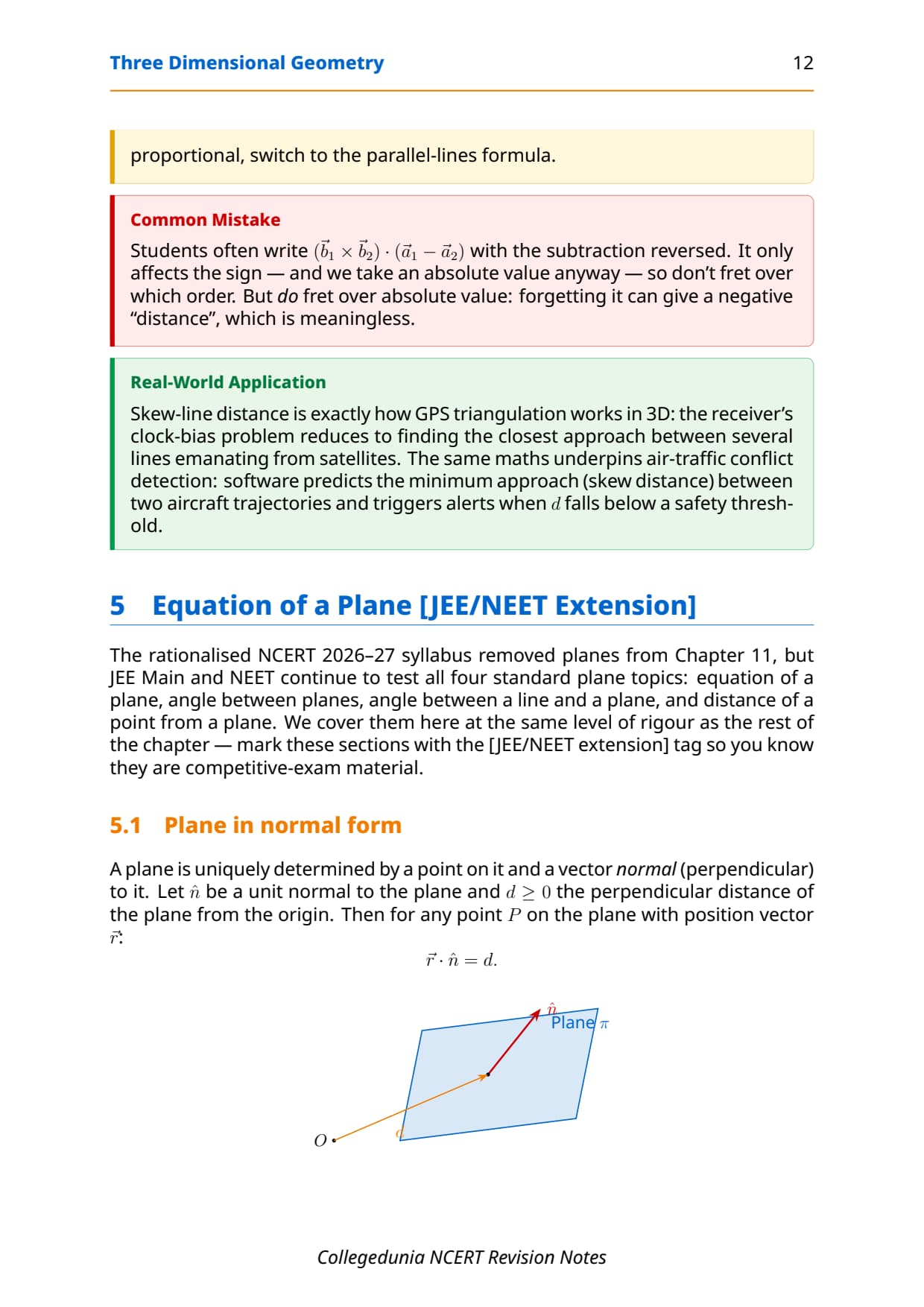
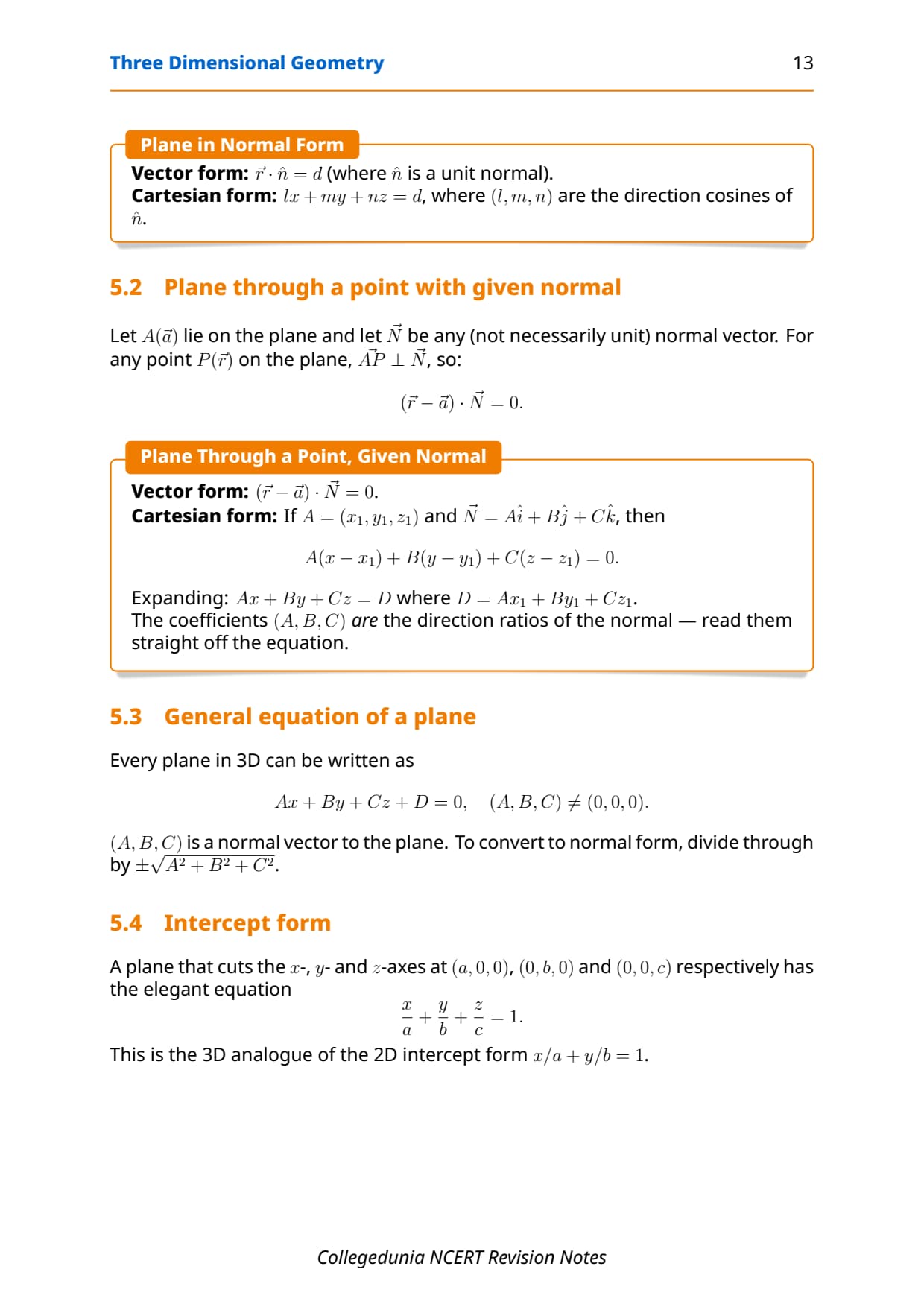
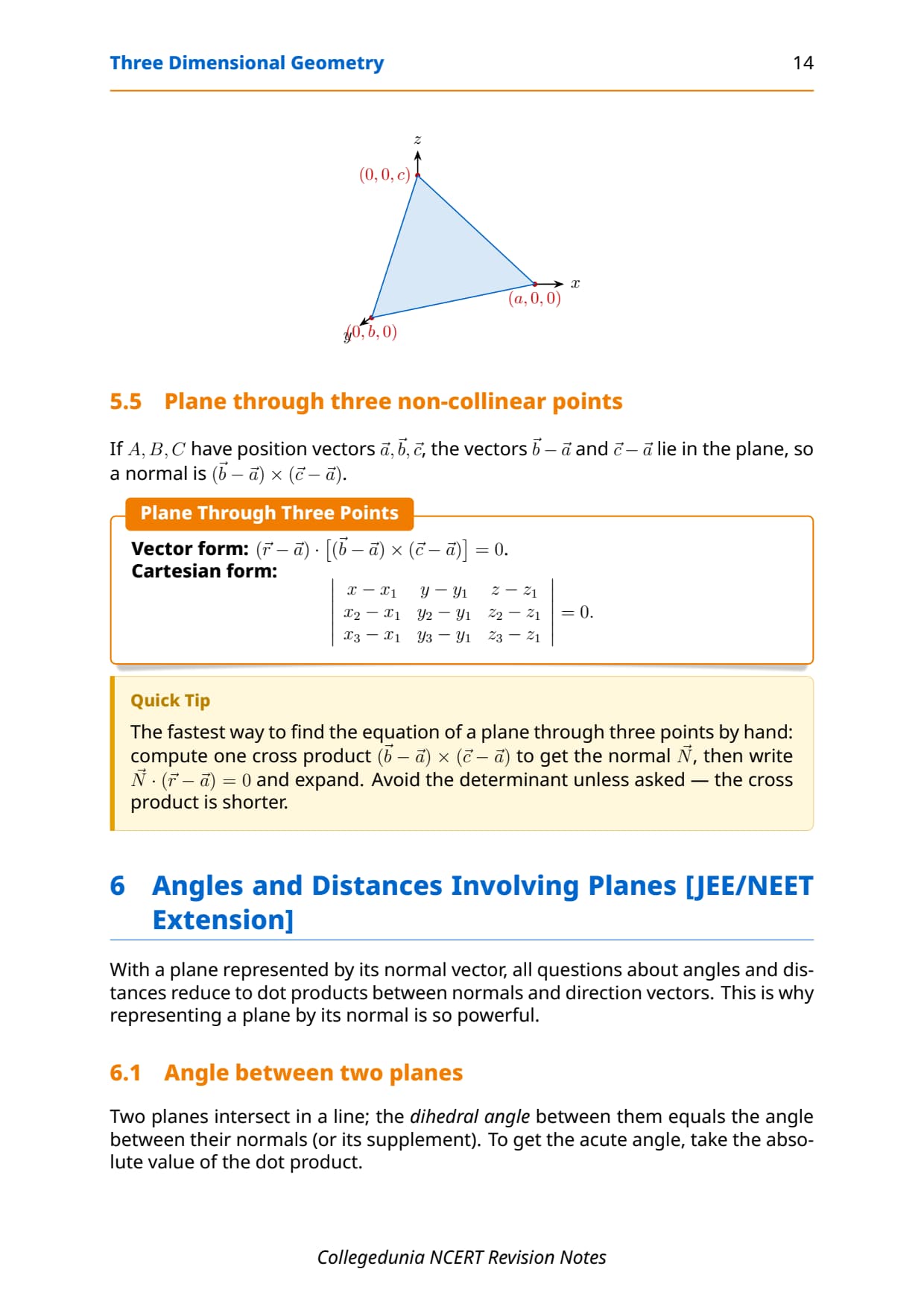
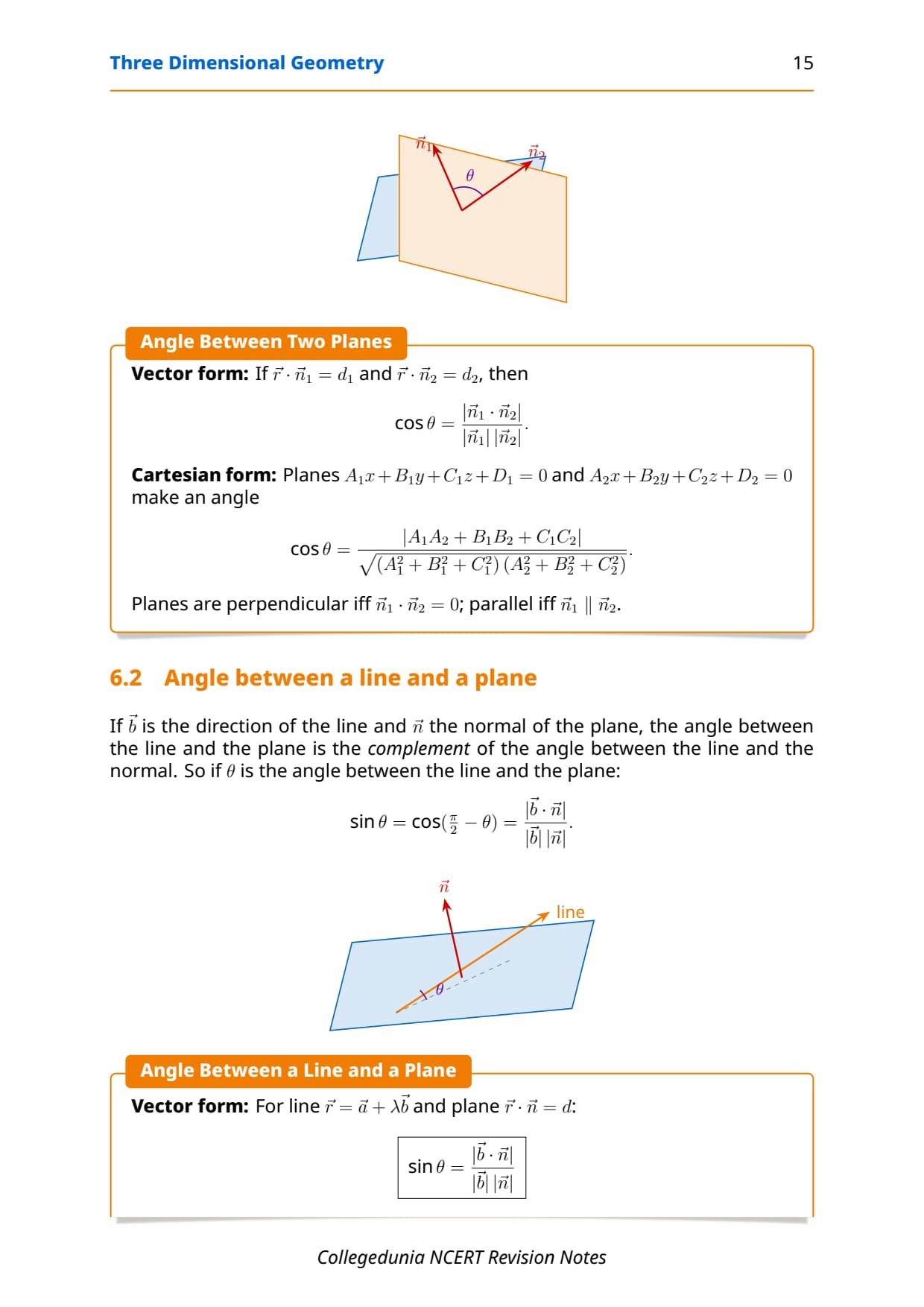
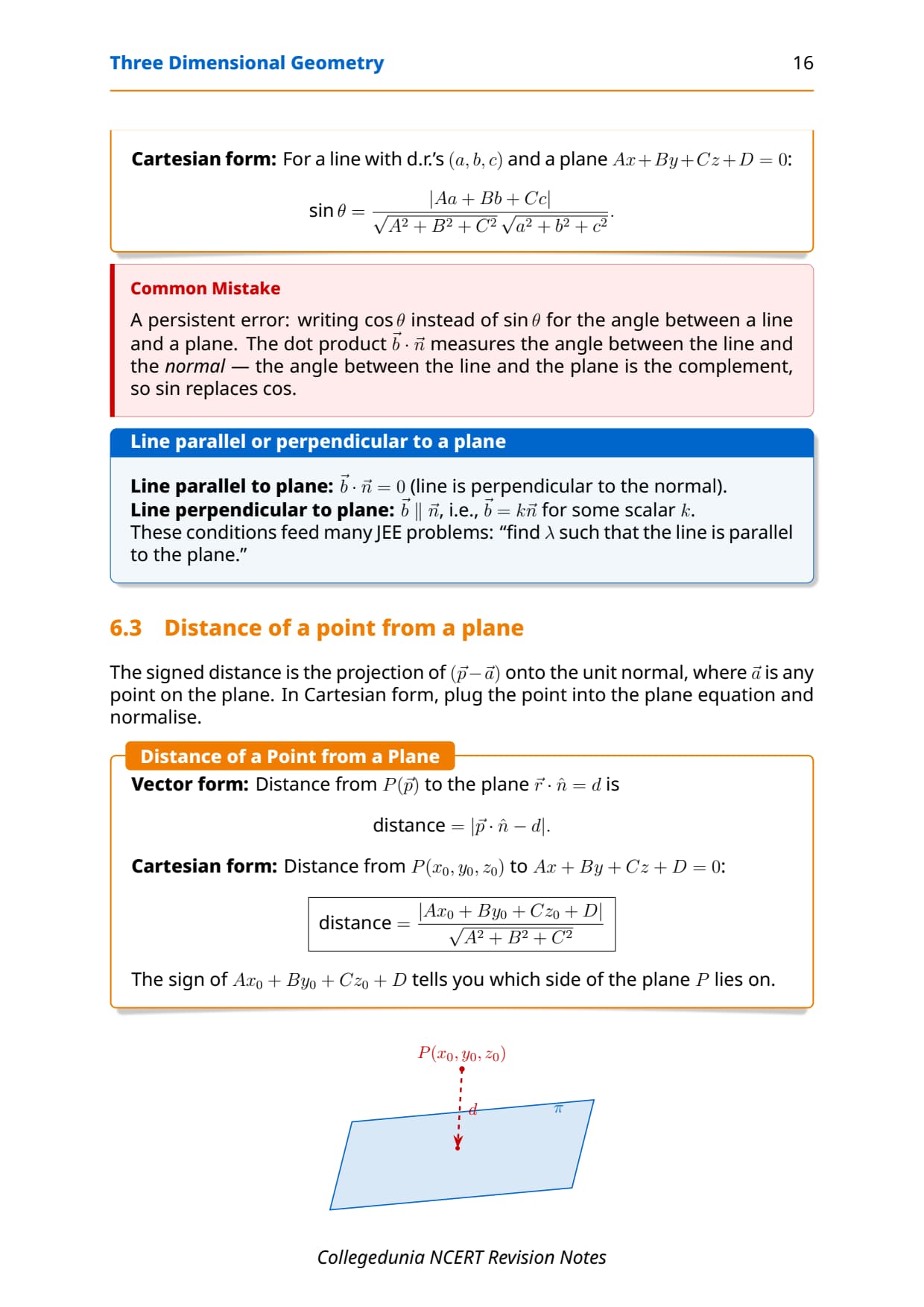
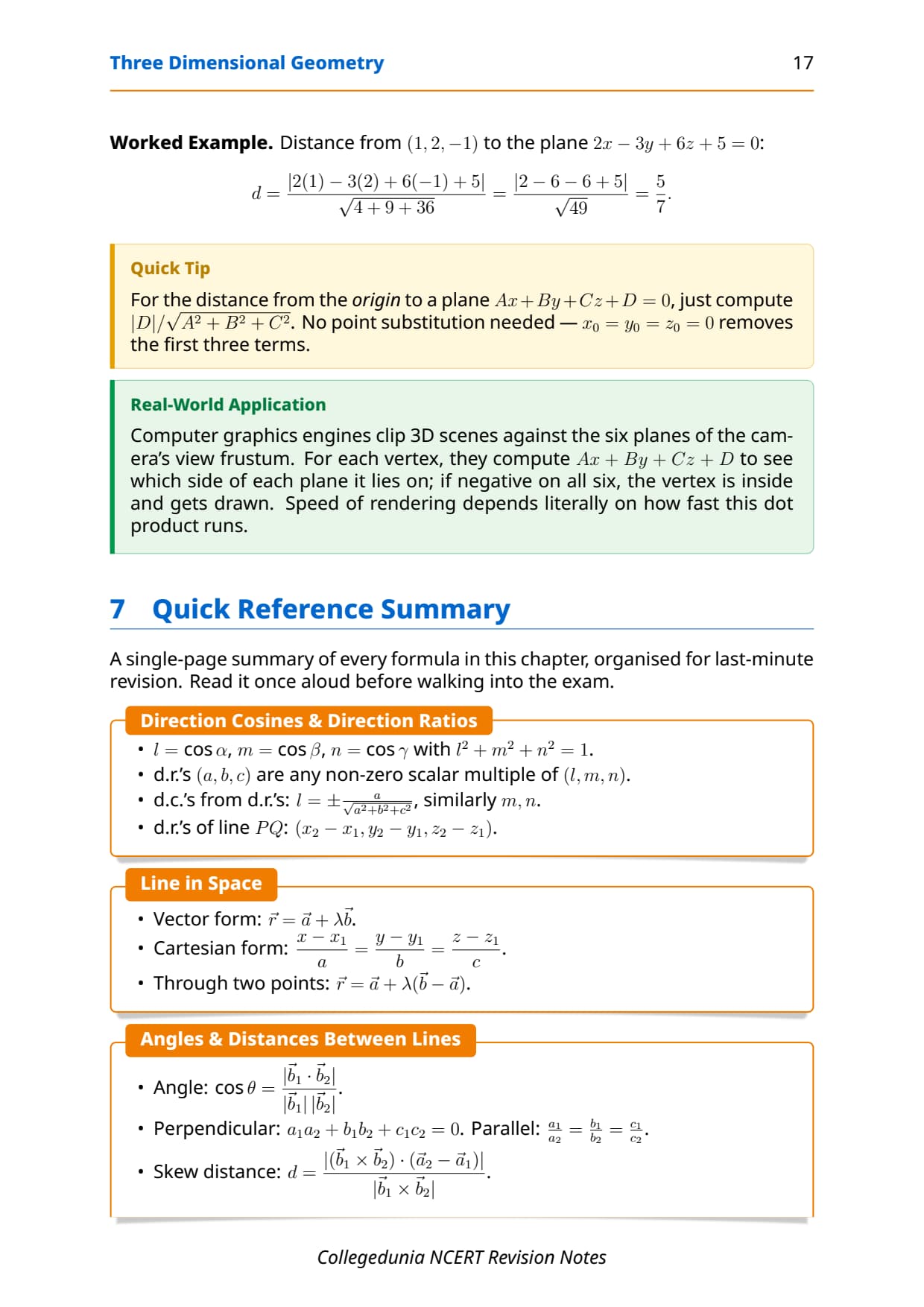
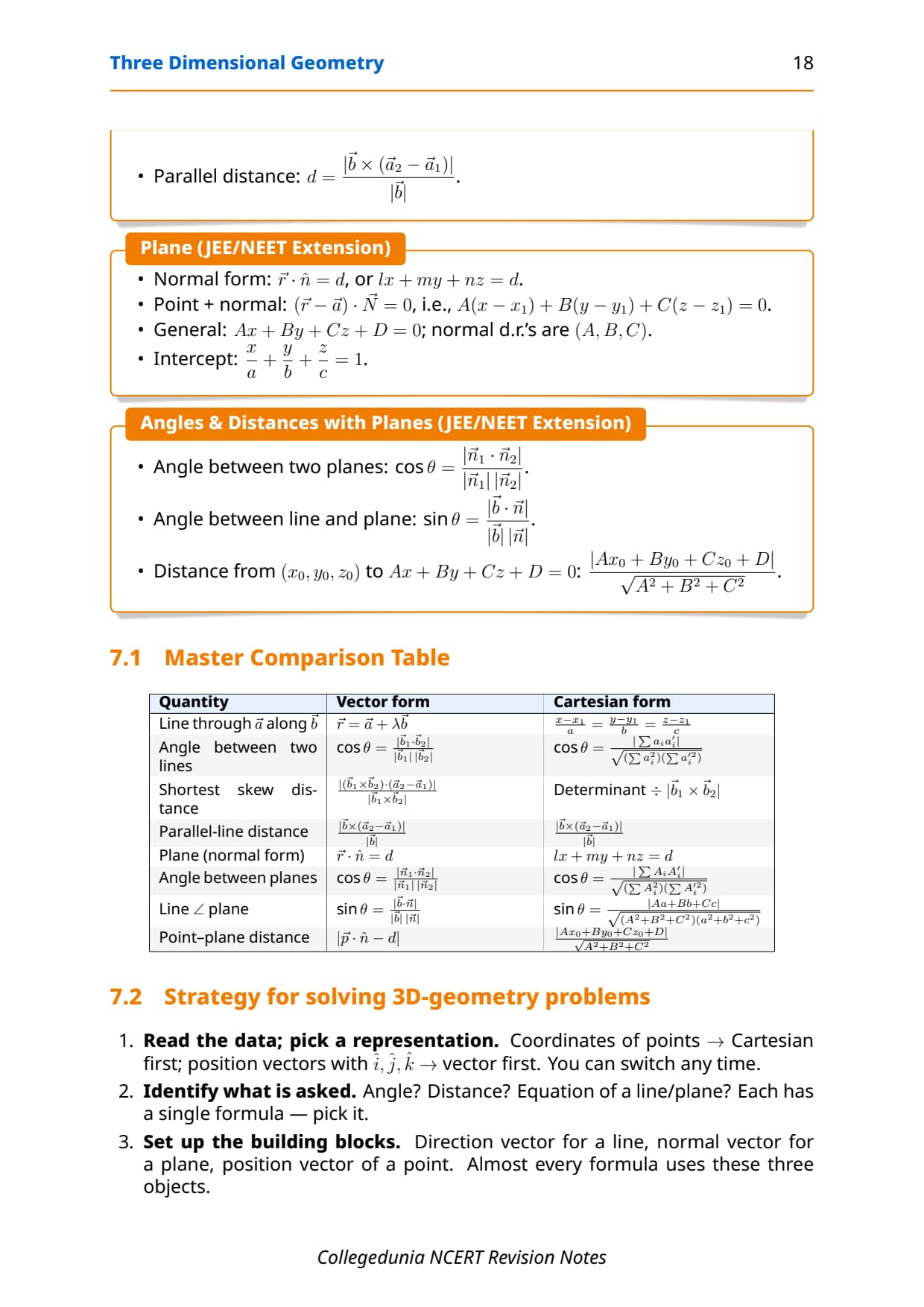
Topics 5 to 10 - angle between two lines, shortest distance between skew lines, distance between parallel lines, the plane in four forms, angle between planes, and distance of a point from a plane - are captured in the formula table below.
Three Dimensional Geometry Solved on Video
Source: Magnet Brains on YouTube
Class 12 Maths Chapter 11 Formula Recall: Top Five Results
| Result | Formula |
|---|---|
| Direction-cosine identity | l2 + m2 + n2 = 1 |
| Vector equation of a line | r⃗ = a⃗ + λ b⃗ |
| Angle between two lines | cosθ = |b1⃗ · b2⃗||b1⃗||b2⃗| |
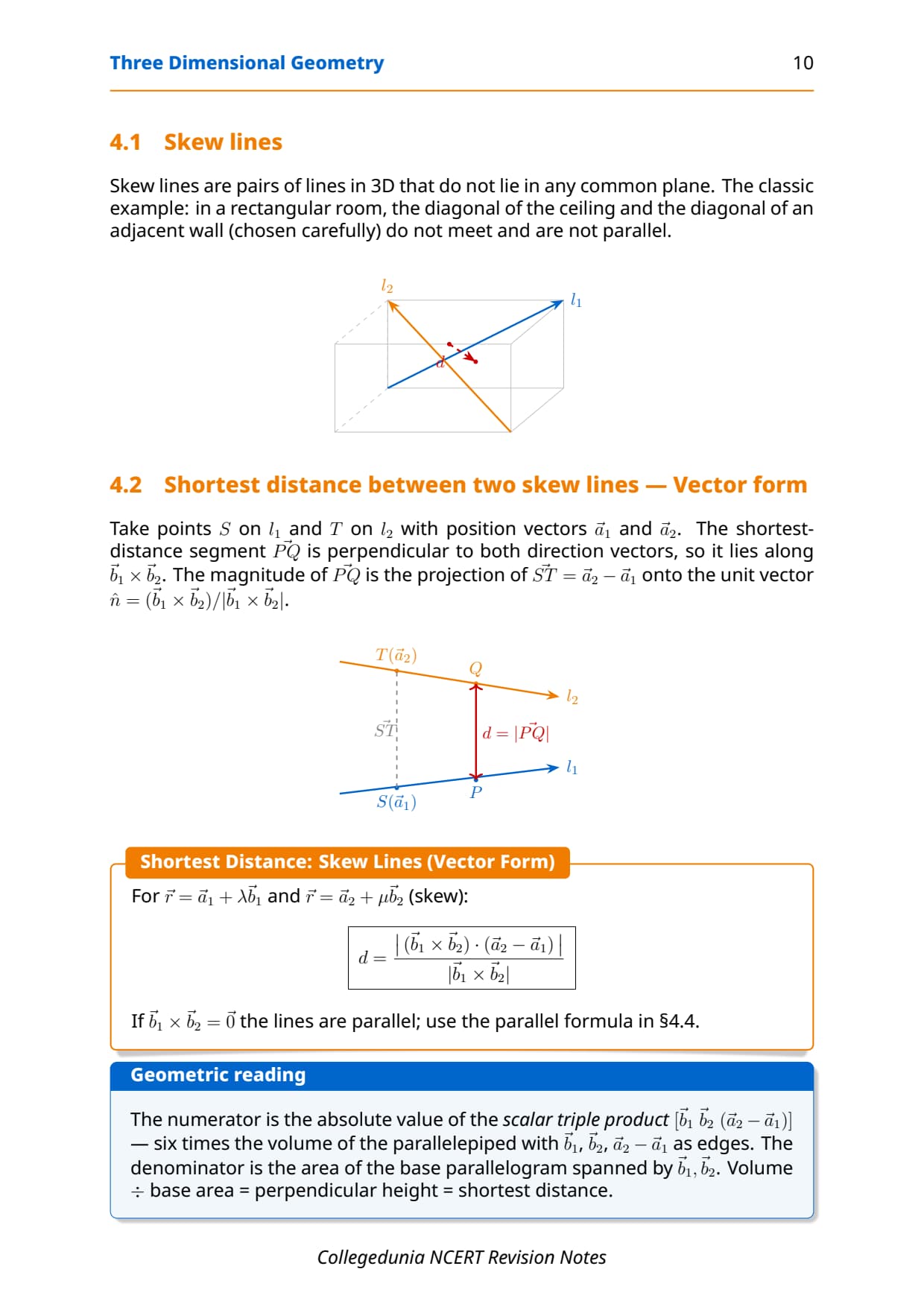
| Shortest distance, skew lines | d = |(b1⃗ × b2⃗) · (a2⃗ - a1⃗)||b1⃗ × b2⃗| |
| Distance of point from plane | d = |Ax0 + By0 + Cz0 + D|√A2 + B2 + C2 |
Class 12 Maths Chapter 11 CBSE Previous Year Question Trends
| Year | Marks | Concept tag |
|---|---|---|
| 2025 | 5 | Shortest distance between two skew lines (vector form) |
| 2025 | 3 | Distance of a given point from a given plane |
| 2024 | 5 | Line through two points + shortest distance to a second line |
| 2023 | 3 | Direction cosines of the line joining two points |
| 2022 | 2 | Angle between two lines (Cartesian form) |
Class 12 Maths Chapter 11: Common Mistakes to Avoid
- Confusing direction cosines (unique up to sign) with direction ratios (unique up to scalar). The identity l2 + m2 + n2 = 1 holds for cosines only.
- Dividing by zero in the Cartesian form when one of a, b, c is zero. Write that coordinate separately.
- Dropping the modulus in the angle formula. CBSE wants the acute angle, so the modulus is a must.
- Using the skew-line formula on parallel lines. There the cross product is zero, so use |b⃗ × (a2⃗ - a1⃗)| / |b⃗| instead.
- Mixing up "line and plane" with "two lines". The line-plane angle uses sine, not cosine.
Other Resources for Class 12 Maths Chapter 11 Three Dimensional Geometry
- NCERT Solutions for Class 12 Maths Chapter 11 Three Dimensional Geometry
- Class 12 Maths Chapter 11 Three Dimensional Geometry Formula Sheet
- Class 12 Maths Chapter 11 Three Dimensional Geometry Handwritten Notes
- Class 12 Maths Chapter 11 Three Dimensional Geometry Exemplar Solutions
- NCERT Class 12 Maths Chapter 11 Three Dimensional Geometry Book PDF
- NCERT Exemplar Class 12 Maths Chapter 11 Three Dimensional Geometry PDF
NCERT Notes for Class 12 Maths: All Chapters
| Chapter | NCERT Notes |
|---|---|
| Chapter 1 | Relations and Functions Notes |
| Chapter 2 | Inverse Trigonometric Functions Notes |
| Chapter 3 | Matrices Notes |
| Chapter 4 | Determinants Notes |
| Chapter 5 | Continuity and Differentiability Notes |
| Chapter 6 | Application of Derivatives Notes |
| Chapter 7 | Integrals Notes |
| Chapter 8 | Application of Integrals Notes |
| Chapter 9 | Differential Equations Notes |
| Chapter 10 | Vector Algebra Notes |
| Chapter 11 | Three Dimensional Geometry Notes |
| Chapter 12 | Linear Programming Notes |
| Chapter 13 | Probability Notes |
Exercise-wise Breakdown of the Three Dimensional Geometry Chapter
| Exercise | Topic Tested |
|---|---|
| Exercise 11.1 | Direction cosines, direction ratios of a line |
| Exercise 11.2 | Vector and Cartesian equations of a line in 3D |
| Miscellaneous Exercise | Mixed three-dimensional geometry problems |
PDF Download Formats and Languages for the Three Dimensional Geometry Chapter
| Format | Best for | Approx. size |
|---|---|---|
| Normal-resolution PDF | Phone reading, quick revision between classes | 2-3 MB |
| HD PDF | Print-ready, desk study, board hall photocopy | 8-10 MB |
| Handwritten Notes PDF | Mirrors how a topper writes the chapter under Sunday-revision pace | 5-7 MB |
The PDF is NCERT-faithful and also comes in a Hindi edition with the same page numbering.
How the Three Dimensional Geometry Notes Pair with NCERT Solutions and the Formula Sheet
| Resource | Use it for | When |
|---|---|---|
| Notes (this page) | Theory and exam patterns | First pass |
| NCERT Solutions PDF | Step-by-step exercises | Second pass |
| Formula sheet PDF | One-page recall | Third pass |
| Handwritten Notes PDF | Quick reading | Anytime |
The NCERT Solutions cover every exercise step by step, and reference books like RD Sharma add extra JEE practice on the same definitions.
How to Use the Three Dimensional Geometry Notes Page Most Effectively
| Sitting | Duration | What to do |
|---|---|---|
| Sitting 1: Theory | ~90 min | Read the NCERT chapter and the formula recall on this page. Mark every definition. |
| Sitting 2: Solved Examples | ~90 min | Re-solve each NCERT example on your own, then check against the printed working. |
| Sitting 3: Exercises | ~90 min | Attempt the exercises and use the linked solution pages to verify. |
- Spend about 60 percent of revision time on NCERT and 40 percent on JEE-style sets. For CUET, focus on definitions and one-step applications.
Student Feedback - Three Dimensional Geometry Difficulty (March 2026 survey of 12,840 Class 12 students):
- 73% of students surveyed rated this chapter as a higher-weightage unit for the CBSE boards.
- The average student lost 1.2 marks by skipping a single intermediate step.
- Toppers said writing out the formula recall sheet added 1-2 marks on the long-answer question.



Comments