



The NCERT Notes for Class 6 Science Chapter 10 Living Creatures: Exploring their Characteristics explain living and non-living things, seed germination, plant movement, mosquito life cycle and frog life cycle for the 2026-27 Curiosity textbook.
- Best use: revise the chapter after reading the official NCERT activities once.
- PDF focus: living features, seed experiments, plant response and life cycle diagrams.
- Chapter value: helps students answer reason-based questions with examples from the textbook.
Ch10LivingCreatures:ExploringtheirCharacteristicsNotesNCERT2026-27.pdf?page=1&dpi=150)
Ch10LivingCreatures:ExploringtheirCharacteristicsNotesNCERT2026-27.pdf?page=2&dpi=150)
Ch10LivingCreatures:ExploringtheirCharacteristicsNotesNCERT2026-27.pdf?page=3&dpi=150)
Ch10LivingCreatures:ExploringtheirCharacteristicsNotesNCERT2026-27.pdf?page=4&dpi=150)
Ch10LivingCreatures:ExploringtheirCharacteristicsNotesNCERT2026-27.pdf?page=5&dpi=150)
Ch10LivingCreatures:ExploringtheirCharacteristicsNotesNCERT2026-27.pdf?page=6&dpi=150)
Ch10LivingCreatures:ExploringtheirCharacteristicsNotesNCERT2026-27.pdf?page=7&dpi=150)
Ch10LivingCreatures:ExploringtheirCharacteristicsNotesNCERT2026-27.pdf?page=8&dpi=150)
Ch10LivingCreatures:ExploringtheirCharacteristicsNotesNCERT2026-27.pdf?page=9&dpi=150)
Ch10LivingCreatures:ExploringtheirCharacteristicsNotesNCERT2026-27.pdf?page=10&dpi=150)
Ch10LivingCreatures:ExploringtheirCharacteristicsNotesNCERT2026-27.pdf?page=11&dpi=150)
Ch10LivingCreatures:ExploringtheirCharacteristicsNotesNCERT2026-27.pdf?page=12&dpi=150)
Ch10LivingCreatures:ExploringtheirCharacteristicsNotesNCERT2026-27.pdf?page=13&dpi=150)
Ch10LivingCreatures:ExploringtheirCharacteristicsNotesNCERT2026-27.pdf?page=14&dpi=150)
Ch10LivingCreatures:ExploringtheirCharacteristicsNotesNCERT2026-27.pdf?page=15&dpi=150)
Ch10LivingCreatures:ExploringtheirCharacteristicsNotesNCERT2026-27.pdf?page=16&dpi=150)
Ch10LivingCreatures:ExploringtheirCharacteristicsNotesNCERT2026-27.pdf?page=17&dpi=150)
Ch10LivingCreatures:ExploringtheirCharacteristicsNotesNCERT2026-27.pdf?page=18&dpi=150)
Ch10LivingCreatures:ExploringtheirCharacteristicsNotesNCERT2026-27.pdf?page=19&dpi=150)
Ch10LivingCreatures:ExploringtheirCharacteristicsNotesNCERT2026-27.pdf?page=20&dpi=150)
Ch10LivingCreatures:ExploringtheirCharacteristicsNotesNCERT2026-27.pdf?page=21&dpi=150)
Ch10LivingCreatures:ExploringtheirCharacteristicsNotesNCERT2026-27.pdf?page=22&dpi=150)
Ch10LivingCreatures:ExploringtheirCharacteristicsNotesNCERT2026-27.pdf?page=23&dpi=150)
Ch10LivingCreatures:ExploringtheirCharacteristicsNotesNCERT2026-27_flat_MobileCard.pdf?page=1&dpi=150)
Ch10LivingCreatures:ExploringtheirCharacteristicsNotesNCERT2026-27_flat_MobileCard.pdf?page=2&dpi=150)
Ch10LivingCreatures:ExploringtheirCharacteristicsNotesNCERT2026-27_flat_MobileCard.pdf?page=3&dpi=150)
Ch10LivingCreatures:ExploringtheirCharacteristicsNotesNCERT2026-27_flat_MobileCard.pdf?page=4&dpi=150)
Ch10LivingCreatures:ExploringtheirCharacteristicsNotesNCERT2026-27_flat_MobileCard.pdf?page=5&dpi=150)
Ch10LivingCreatures:ExploringtheirCharacteristicsNotesNCERT2026-27_flat_MobileCard.pdf?page=6&dpi=150)
Ch10LivingCreatures:ExploringtheirCharacteristicsNotesNCERT2026-27_flat_MobileCard.pdf?page=7&dpi=150)
Ch10LivingCreatures:ExploringtheirCharacteristicsNotesNCERT2026-27_flat_MobileCard.pdf?page=8&dpi=150)
Ch10LivingCreatures:ExploringtheirCharacteristicsNotesNCERT2026-27_flat_MobileCard.pdf?page=9&dpi=150)
Ch10LivingCreatures:ExploringtheirCharacteristicsNotesNCERT2026-27_flat_MobileCard.pdf?page=10&dpi=150)
Ch10LivingCreatures:ExploringtheirCharacteristicsNotesNCERT2026-27_flat_MobileCard.pdf?page=11&dpi=150)
Ch10LivingCreatures:ExploringtheirCharacteristicsNotesNCERT2026-27_flat_MobileCard.pdf?page=12&dpi=150)
Ch10LivingCreatures:ExploringtheirCharacteristicsNotesNCERT2026-27_flat_MobileCard.pdf?page=13&dpi=150)
Ch10LivingCreatures:ExploringtheirCharacteristicsNotesNCERT2026-27_flat_MobileCard.pdf?page=14&dpi=150)
Ch10LivingCreatures:ExploringtheirCharacteristicsNotesNCERT2026-27_flat_MobileCard.pdf?page=15&dpi=150)
Ch10LivingCreatures:ExploringtheirCharacteristicsNotesNCERT2026-27_flat_MobileCard.pdf?page=16&dpi=150)
Ch10LivingCreatures:ExploringtheirCharacteristicsNotesNCERT2026-27_flat_MobileCard.pdf?page=17&dpi=150)
Ch10LivingCreatures:ExploringtheirCharacteristicsNotesNCERT2026-27_flat_MobileCard.pdf?page=18&dpi=150)
Ch10LivingCreatures:ExploringtheirCharacteristicsNotesNCERT2026-27_flat_MobileCard.pdf?page=19&dpi=150)
Ch10LivingCreatures:ExploringtheirCharacteristicsNotesNCERT2026-27_flat_MobileCard.pdf?page=20&dpi=150)
Ch10LivingCreatures:ExploringtheirCharacteristicsNotesNCERT2026-27_flat_MobileCard.pdf?page=21&dpi=150)
Ch10LivingCreatures:ExploringtheirCharacteristicsNotesNCERT2026-27_flat_MobileCard.pdf?page=22&dpi=150)
Ch10LivingCreatures:ExploringtheirCharacteristicsNotesNCERT2026-27_flat_MobileCard.pdf?page=23&dpi=150)
Ch10LivingCreatures:ExploringtheirCharacteristicsNotesNCERT2026-27_flat_MobileCard.pdf?page=24&dpi=150)
Ch10LivingCreatures:ExploringtheirCharacteristicsNotesNCERT2026-27_flat_MobileCard.pdf?page=25&dpi=150)
Ch10LivingCreatures:ExploringtheirCharacteristicsNotesNCERT2026-27_flat_MobileCard.pdf?page=26&dpi=150)
Ch10LivingCreatures:ExploringtheirCharacteristicsNotesNCERT2026-27_flat_MobileCard.pdf?page=27&dpi=150)
Ch10LivingCreatures:ExploringtheirCharacteristicsNotesNCERT2026-27_flat_MobileCard.pdf?page=28&dpi=150)
Ch10LivingCreatures:ExploringtheirCharacteristicsNotesNCERT2026-27_flat_MobileCard.pdf?page=29&dpi=150)
Ch10LivingCreatures:ExploringtheirCharacteristicsNotesNCERT2026-27_flat_MobileCard.pdf?page=30&dpi=150)
Ch10LivingCreatures:ExploringtheirCharacteristicsNotesNCERT2026-27_flat_MobileCard.pdf?page=31&dpi=150)
Student Feedback: In Collegedunia NCERT revision checks with 13,800 students, Chapter 10 became easier when students used a living-things checklist before memorising life cycles.
- 78% wanted a clear difference between movement in animals and movement in plants.
- 71% found seed germination easier after comparing the four-pot activity.
- 66% revised faster with plant, mosquito and frog life cycles in one chart.
Living Creatures Class 6 Notes Overview
Chapter 10 starts with a simple question about a shell and a living snail. It then asks students to compare objects around them and decide whether they are living or non-living.
| Feature | What it means | Textbook example |
|---|---|---|
| Growth | Body size or parts increase over time. | Child grows, seedling grows. |
| Nutrition | Food supports growth and energy. | Living beings need food. |
| Respiration | Food and air help release energy. | Animals breathe, plants exchange air. |
| Response | A living being reacts to a stimulus. | Chhui-mui leaves fold on touch. |
Living Creatures Chapter 10 Video Revision
Source: Magnet Brains on YouTube
Living and Non-living Things in Chapter 10
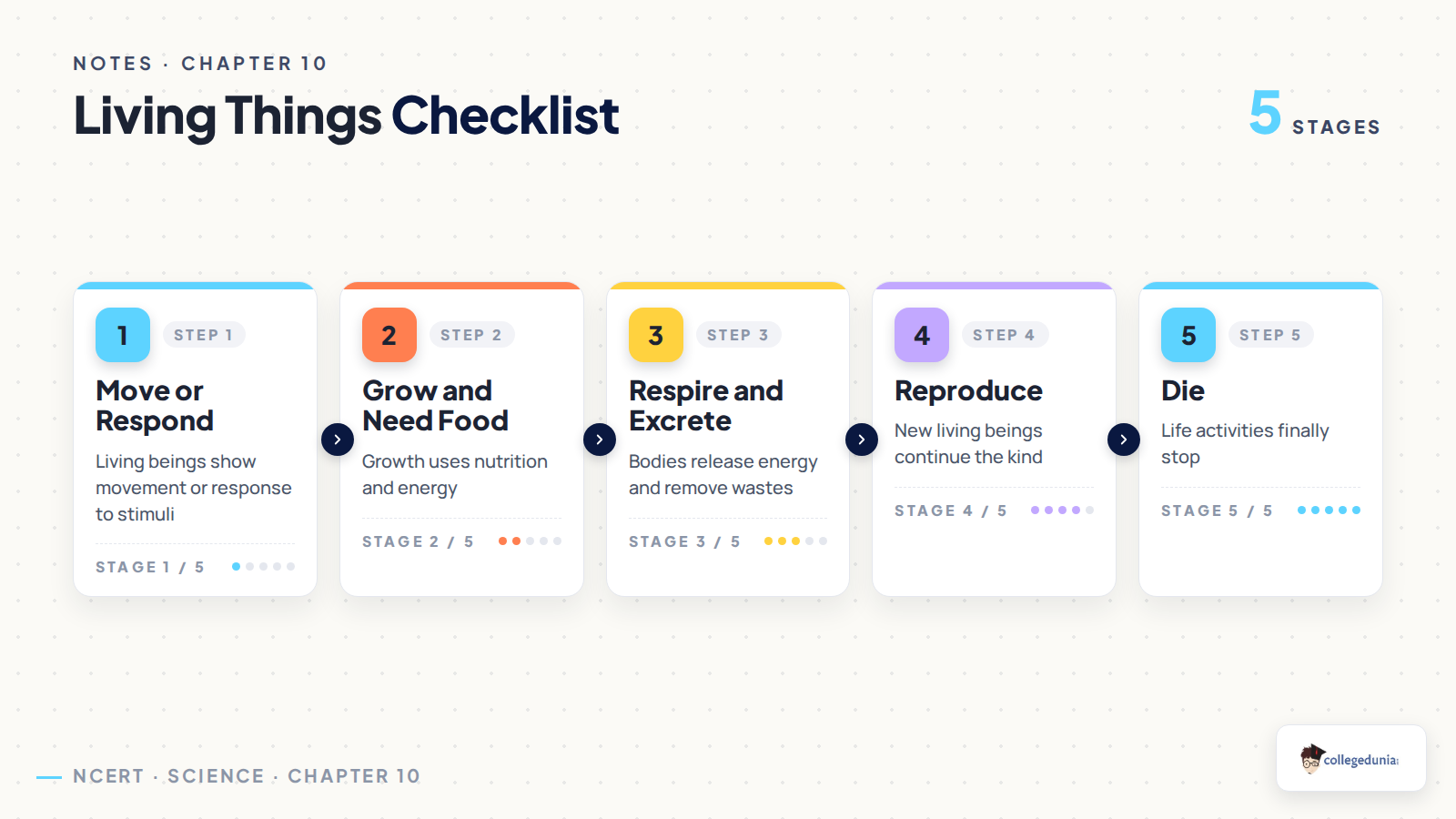
A single feature cannot prove that something is living. A car moves, but it does not grow, respire, excrete or reproduce. A plant does not walk, but it grows and responds.
- Movement: animals move from place to place, while plant parts may bend or close.
- Stimulus: touch, light, heat and gravity can cause a response.
- Excretion: living bodies remove wastes such as sweat, urine or extra water.
- Use several life processes together before calling something living.
Seed Germination Conditions in Living Creatures Notes
The four-pot activity teaches that bean seeds need the right amount of water and air. Sunlight is not needed at the first stage for bean seed germination, but it helps the seedling grow later.
| Pot | Condition | Likely result |
|---|---|---|
| A | No water, direct sunlight | No proper germination |
| B | Excess water, direct sunlight | Air spaces get blocked |
| C | Moist soil, dark place | Seeds can germinate |
| D | Moist soil, direct sunlight | Seeds germinate and grow well |
Plant Movement and Life Cycle in Class 6 Science Chapter 10
Activity 10.3 shows that roots usually grow downward and shoots usually grow upward. When light comes from one side, the shoot bends toward light.
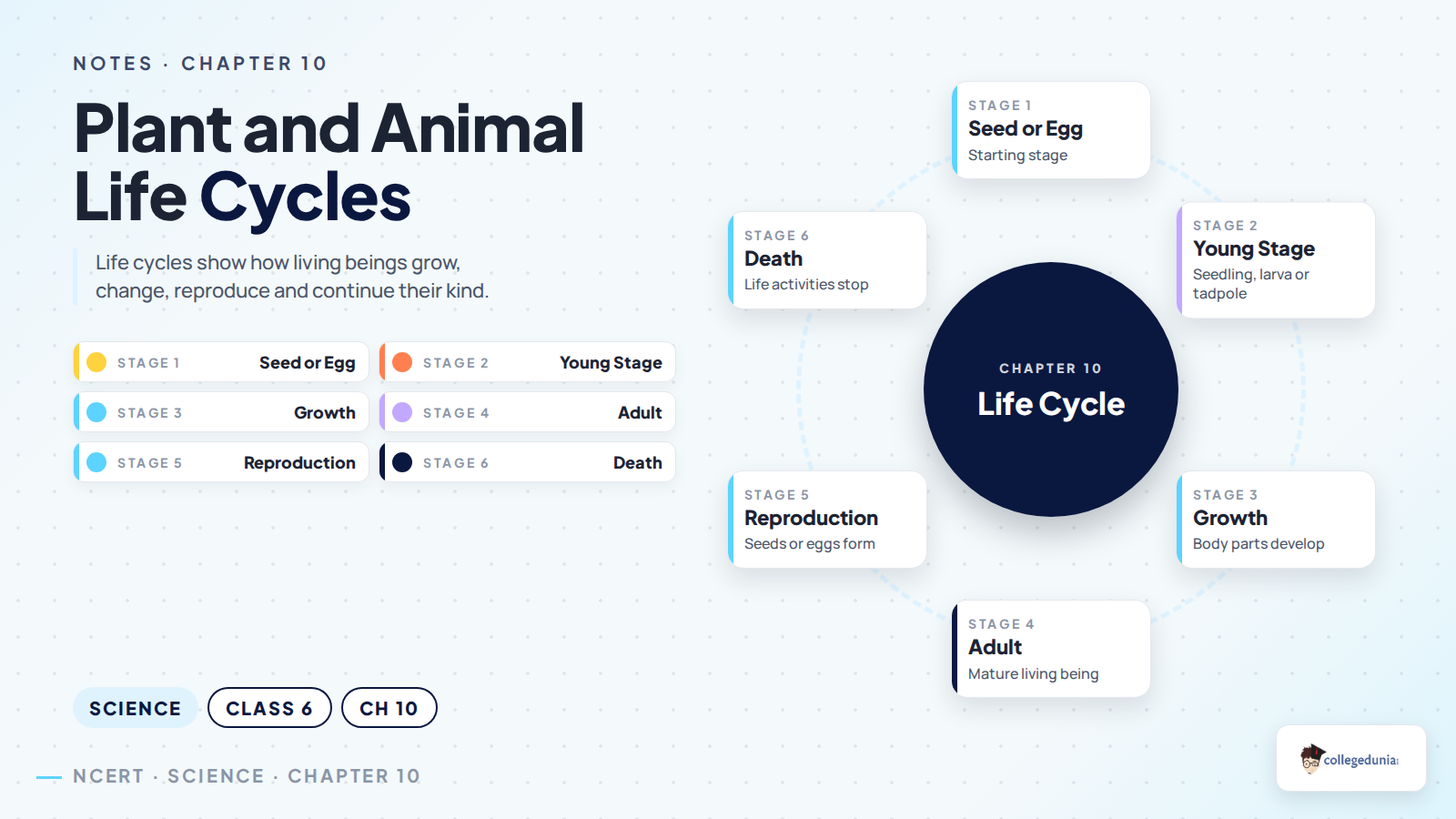
- Plant life cycle: seed, seedling, leaves, flowers, fruit, seeds and death.
- Root response: roots grow downward and help hold the plant.
- Shoot response: shoots grow upward and toward sunlight.
- The bean plant life cycle continues when new seeds germinate.
Mosquito and Frog Life Cycles for Class 6 Science
The chapter also compares animal life cycles. Mosquitoes pass through egg, larva, pupa and adult stages. Frogs pass through spawn, tadpole, froglet and adult stages.
| Life cycle | Main stages | Important clue |
|---|---|---|
| Mosquito | Egg, larva, pupa, adult | Larva and pupa live in water. |
| Frog | Spawn, tadpole, froglet, adult | Tadpole has a tail and later grows legs. |
| Plant | Seed, seedling, mature plant, flower, fruit | Fruit contains seeds for the next generation. |
How to Use the Living Creatures Notes PDF
Use the PDF after one reading of the textbook. Start with the checklist of living features, then revise the activities and life cycle diagrams.
- Write the eight living features once without looking.
- Draw the four-pot germination table.
- Practice root and shoot direction questions.
- Compare mosquito and frog life cycles in a two-column table.
Related Class 6 Science Resources for Living Creatures
| Resource | Use it for | Link |
|---|---|---|
| NCERT Book PDF | Read the official chapter activities | Chapter 10 Book PDF |
| NCERT Solutions | Check exercise answers | Chapter 10 Solutions |
| Handwritten Notes | Use quick handwritten revision | Chapter 10 Handwritten Notes |
More Class 6 Science Notes
| Chapter | Notes Link |
|---|---|
| Chapter 7 Temperature and its Measurement | Open Notes |
| Chapter 8 A Journey through States of Water | Open Notes |
| Chapter 9 Methods of Separation in Everyday Life | Open Notes |
| Chapter 11 Nature's Treasures | Open Notes |
Living Creatures Class 6 Notes FAQs
Ques. What is covered in Class 6 Science Chapter 10 notes?
Ans. The notes cover living and non-living things, seed germination, plant movement, plant life cycle, mosquito life cycle and frog life cycle.
Ques. What conditions are needed for seed germination?
Ans. Bean seeds need the right amount of water and air. Most seeds do not need light at the start, but seedlings need sunlight later.
Ques. What are the stages in a mosquito life cycle?
Ans. The mosquito life cycle has four stages: egg, larva, pupa and adult. Larva and pupa stages happen in water.
Ques. Are these notes based on the 2026-27 NCERT Curiosity textbook?
Ans. Yes. The PDF follows Class 6 Science Curiosity Chapter 10 Living Creatures: Exploring their Characteristics for the 2026-27 NCERT syllabus.



Comments