




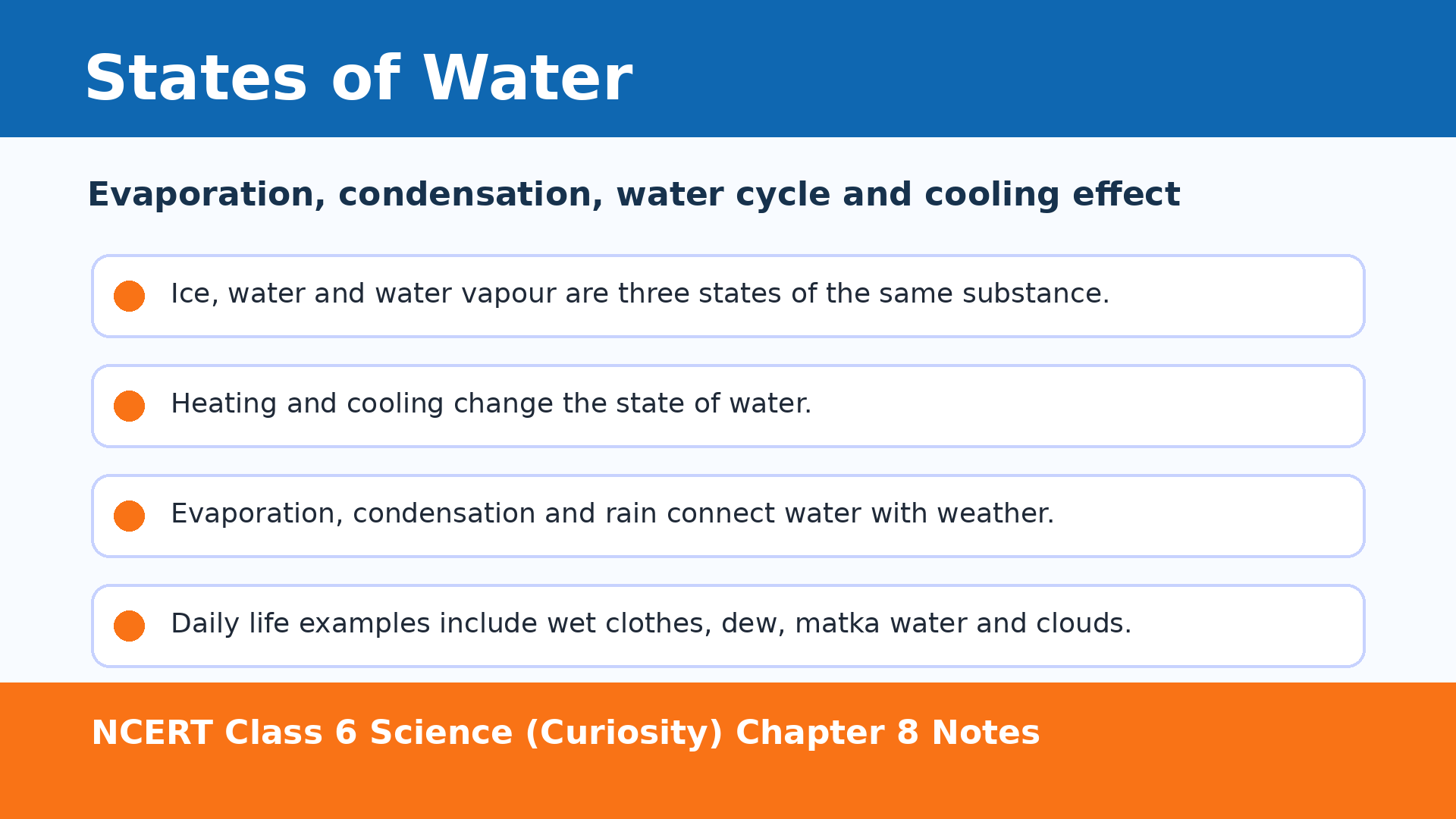
The NCERT Notes for Class 6 Science Chapter 8 A Journey through States of Water explain evaporation, condensation, melting, freezing, humidity, cooling effect, cloud formation and the water cycle for the 2026-27 Curiosity textbook.
- Best use: revise the chapter after reading the official NCERT activities once.
- PDF focus: process names, daily examples, investigation tables and water cycle logic.
- Chapter value: builds the base for matter, weather, water conservation and scientific reasoning.
Chapter8AJourneythroughStatesofWaterNotes.pdf?page=1&dpi=150)
Chapter8AJourneythroughStatesofWaterNotes.pdf?page=2&dpi=150)
Chapter8AJourneythroughStatesofWaterNotes.pdf?page=3&dpi=150)
Chapter8AJourneythroughStatesofWaterNotes.pdf?page=4&dpi=150)
Chapter8AJourneythroughStatesofWaterNotes.pdf?page=5&dpi=150)
Chapter8AJourneythroughStatesofWaterNotes.pdf?page=6&dpi=150)
Chapter8AJourneythroughStatesofWaterNotes.pdf?page=7&dpi=150)
Chapter8AJourneythroughStatesofWaterNotes.pdf?page=8&dpi=150)
Chapter8AJourneythroughStatesofWaterNotes.pdf?page=9&dpi=150)
Chapter8AJourneythroughStatesofWaterNotes.pdf?page=10&dpi=150)
Chapter8AJourneythroughStatesofWaterNotes.pdf?page=11&dpi=150)
Chapter8AJourneythroughStatesofWaterNotes.pdf?page=12&dpi=150)
Chapter8AJourneythroughStatesofWaterNotes.pdf?page=13&dpi=150)
Chapter8AJourneythroughStatesofWaterNotes.pdf?page=14&dpi=150)
Chapter8AJourneythroughStatesofWaterNotes.pdf?page=15&dpi=150)
Chapter8AJourneythroughStatesofWaterNotes.pdf?page=16&dpi=150)
Chapter8AJourneythroughStatesofWaterNotes.pdf?page=17&dpi=150)
Chapter8AJourneythroughStatesofWaterNotes.pdf?page=18&dpi=150)
Chapter8AJourneythroughStatesofWaterNotes.pdf?page=19&dpi=150)
Chapter8AJourneythroughStatesofWaterNotes.pdf?page=20&dpi=150)
Chapter8AJourneythroughStatesofWaterNotes.pdf?page=21&dpi=150)
Chapter8AJourneythroughStatesofWaterNotes_flat_MobileCard.pdf?page=1&dpi=150)
Chapter8AJourneythroughStatesofWaterNotes_flat_MobileCard.pdf?page=2&dpi=150)
Chapter8AJourneythroughStatesofWaterNotes_flat_MobileCard.pdf?page=3&dpi=150)
Chapter8AJourneythroughStatesofWaterNotes_flat_MobileCard.pdf?page=4&dpi=150)
Chapter8AJourneythroughStatesofWaterNotes_flat_MobileCard.pdf?page=5&dpi=150)
Chapter8AJourneythroughStatesofWaterNotes_flat_MobileCard.pdf?page=6&dpi=150)
Chapter8AJourneythroughStatesofWaterNotes_flat_MobileCard.pdf?page=7&dpi=150)
Chapter8AJourneythroughStatesofWaterNotes_flat_MobileCard.pdf?page=8&dpi=150)
Chapter8AJourneythroughStatesofWaterNotes_flat_MobileCard.pdf?page=9&dpi=150)
Chapter8AJourneythroughStatesofWaterNotes_flat_MobileCard.pdf?page=10&dpi=150)
Chapter8AJourneythroughStatesofWaterNotes_flat_MobileCard.pdf?page=11&dpi=150)
Chapter8AJourneythroughStatesofWaterNotes_flat_MobileCard.pdf?page=12&dpi=150)
Chapter8AJourneythroughStatesofWaterNotes_flat_MobileCard.pdf?page=13&dpi=150)
Chapter8AJourneythroughStatesofWaterNotes_flat_MobileCard.pdf?page=14&dpi=150)
Chapter8AJourneythroughStatesofWaterNotes_flat_MobileCard.pdf?page=15&dpi=150)
Chapter8AJourneythroughStatesofWaterNotes_flat_MobileCard.pdf?page=16&dpi=150)
Chapter8AJourneythroughStatesofWaterNotes_flat_MobileCard.pdf?page=17&dpi=150)
Chapter8AJourneythroughStatesofWaterNotes_flat_MobileCard.pdf?page=18&dpi=150)
Chapter8AJourneythroughStatesofWaterNotes_flat_MobileCard.pdf?page=19&dpi=150)
Chapter8AJourneythroughStatesofWaterNotes_flat_MobileCard.pdf?page=20&dpi=150)
Chapter8AJourneythroughStatesofWaterNotes_flat_MobileCard.pdf?page=21&dpi=150)
Chapter8AJourneythroughStatesofWaterNotes_flat_MobileCard.pdf?page=22&dpi=150)
Chapter8AJourneythroughStatesofWaterNotes_flat_MobileCard.pdf?page=23&dpi=150)
Chapter8AJourneythroughStatesofWaterNotes_flat_MobileCard.pdf?page=24&dpi=150)
Chapter8AJourneythroughStatesofWaterNotes_flat_MobileCard.pdf?page=25&dpi=150)
Chapter8AJourneythroughStatesofWaterNotes_flat_MobileCard.pdf?page=26&dpi=150)
Chapter8AJourneythroughStatesofWaterNotes_flat_MobileCard.pdf?page=27&dpi=150)
Chapter8AJourneythroughStatesofWaterNotes_flat_MobileCard.pdf?page=28&dpi=150)
Chapter8AJourneythroughStatesofWaterNotes_flat_MobileCard.pdf?page=29&dpi=150)
Student Feedback: In Collegedunia NCERT revision checks, students found Chapter 8 easier when the three states, evaporation and condensation were revised as one connected water journey.
- 74% needed a clear difference between evaporation and condensation.
- 68% wanted daily examples like wet clothes, dew, matka water and clouds.
- 61% revised faster with a water cycle map.
Class 6 Science Chapter 8 Notes Overview
Chapter 8 starts with ice in lemonade and then moves to disappearing water, droplets on a cold glass, different states of water, evaporation rate, cooling effect and rain. The main idea is simple: water can change state, but it remains the same substance.
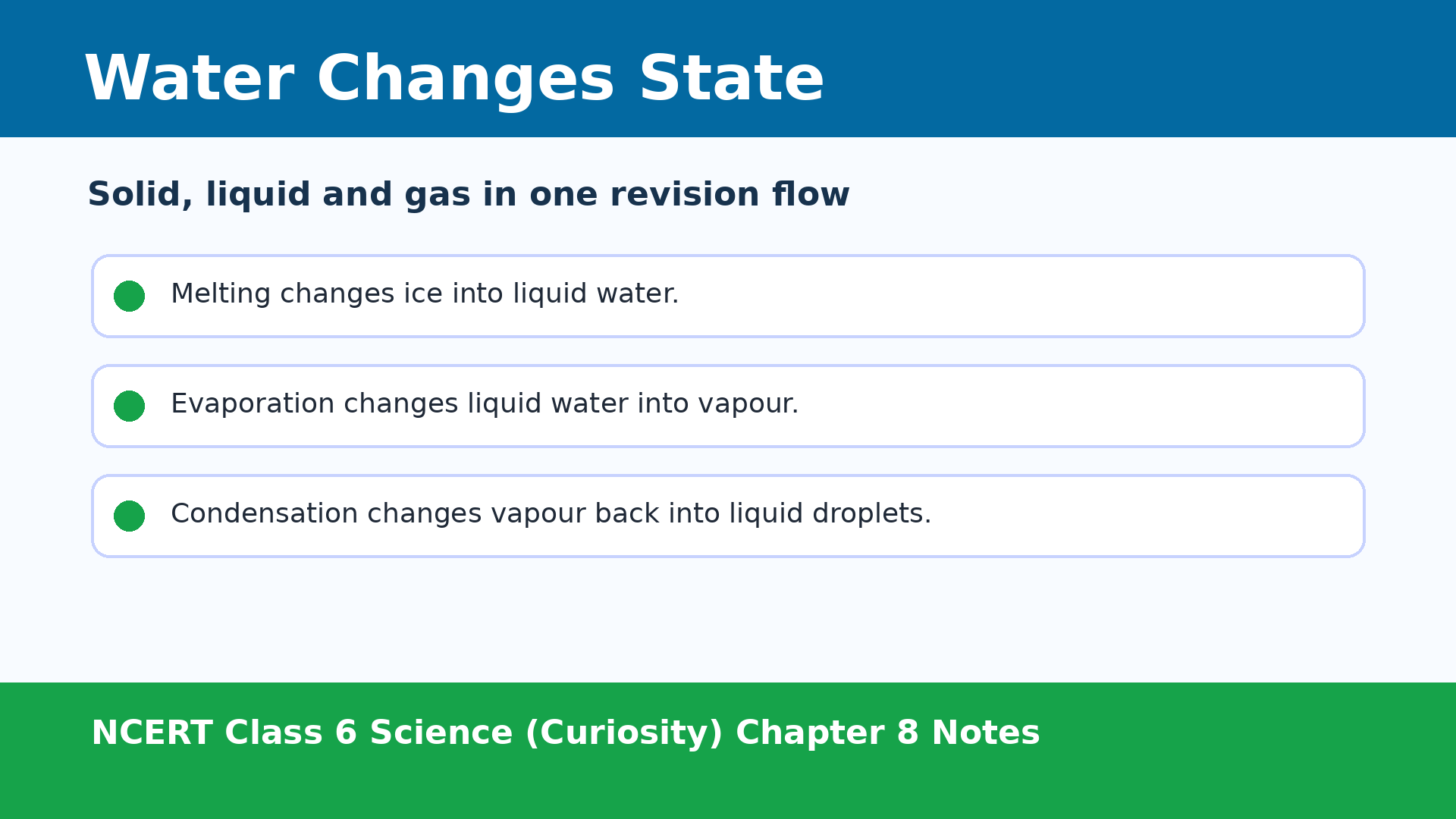
| Concept | Meaning | Daily example |
|---|---|---|
| Melting | Solid changes into liquid | Ice becomes water |
| Evaporation | Liquid changes into vapour | Wet clothes dry |
| Condensation | Vapour changes into liquid | Drops on cold glass |
| Freezing | Liquid changes into solid | Water becomes ice |
Evaporation and Condensation in Chapter 8
Evaporation is the conversion of water into water vapour. It happens even at room temperature. Condensation is the conversion of water vapour into liquid water. Dew, water drops on a cold tumbler and drops inside a covered boiling vessel are condensation examples.
- More exposed area makes evaporation faster.
- Sunlight and heat make evaporation faster.
- Moving air helps water evaporate faster.
- High humidity slows evaporation.
Water Cycle and Rain Formation
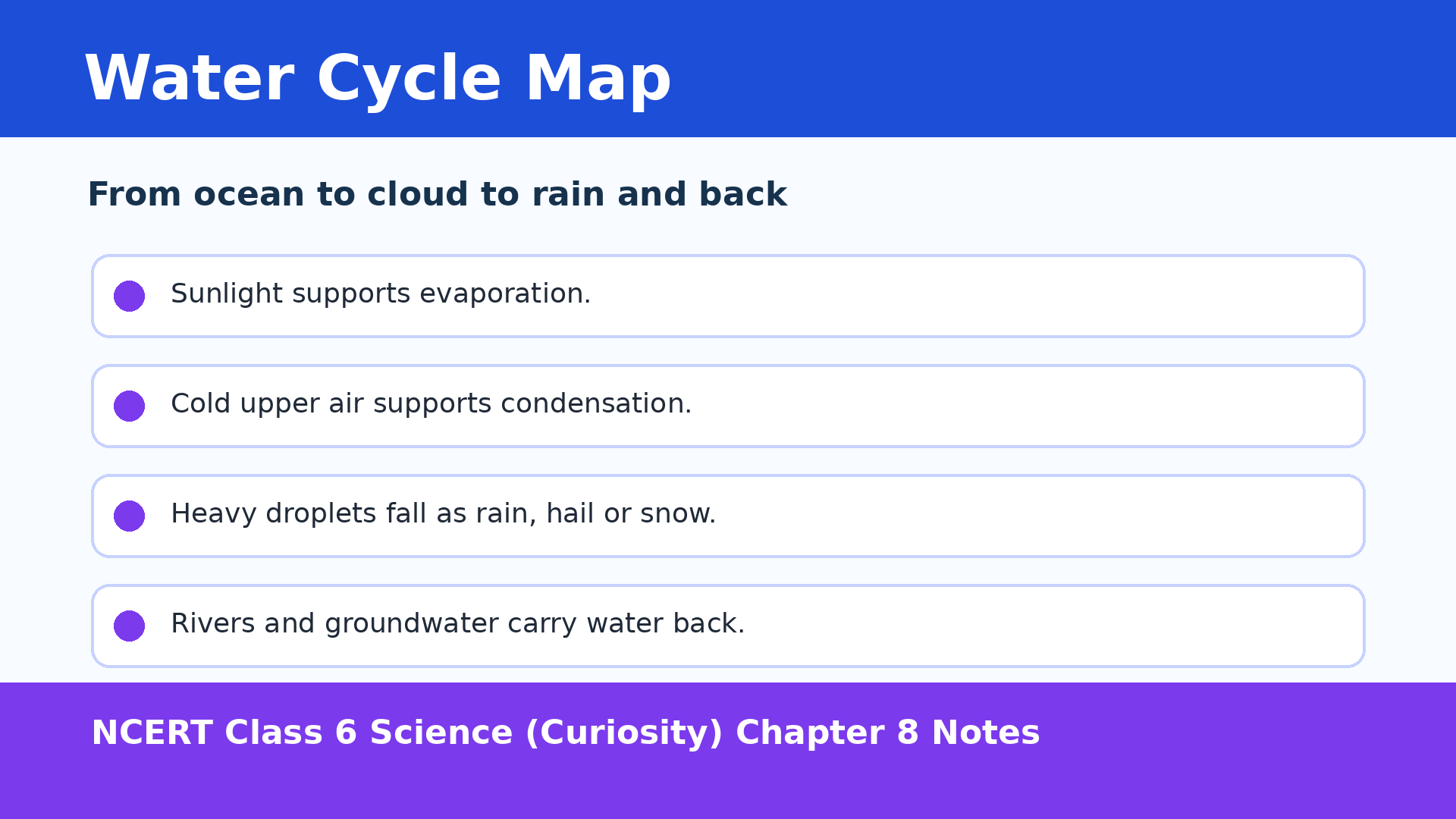
Water evaporates from oceans, lakes, rivers and wet surfaces. Water vapour rises with air, cools higher above the Earth and condenses around dust particles. Tiny droplets form clouds. Bigger drops become rain, hail or snow.
A Journey through States of Water Video Revision
Source: Magnet Brains on YouTube
Cooling Effect and Everyday Applications
Evaporation causes cooling because water takes heat from the surface while changing into vapour. This explains why sweat cools the body, why water in a matka feels cool and why a pot-in-pot cooler can keep fruits and vegetables fresh for some time.
| Example | Process | Result |
|---|---|---|
| Sweat under a fan | Faster evaporation | Skin feels cooler |
| Earthen pot | Water evaporates from outer surface | Water inside cools |
| Wet roof in summer | Evaporation uses heat | Surface cools |
Related Class 6 Science Resources for Chapter 8
| Resource | Use it for | Link |
|---|---|---|
| NCERT Book PDF | Read the official chapter activities | Chapter 8 Book PDF |
| NCERT Solutions | Check exercise answers | Chapter 8 Solutions |
| Handwritten Notes | Use notebook-style revision | Chapter 8 Handwritten Notes |
More Class 6 Science Notes
| Chapter | Notes Link |
|---|---|
| Chapter 5 Measurement of Length and Motion | Open Notes |
| Chapter 6 Materials Around Us | Open Notes |
| Chapter 7 Temperature and its Measurement | Open Notes |
| Chapter 8 A Journey through States of Water | Current notes |
A Journey through States of Water Class 6 Notes FAQs
Ques. What is covered in Class 6 Science Chapter 8 notes?
Ans. The notes cover states of water, evaporation, condensation, melting, freezing, humidity, cooling effect, clouds, rain and the water cycle.
Ques. What is evaporation in this chapter?
Ans. Evaporation is the process by which liquid water changes into water vapour. Wet clothes drying is a common example.
Ques. What is condensation in Class 6 Science Chapter 8?
Ans. Condensation is the process by which water vapour changes into liquid water, as seen on the outside of a cold glass.
Ques. Are these notes based on the 2026-27 NCERT Curiosity textbook?
Ans. Yes. The PDF follows Class 6 Science Curiosity Chapter 8 A Journey through States of Water for the 2026-27 NCERT syllabus.



Comments