



The NCERT Notes for Class 6 Science Chapter 11 Nature's Treasures explain air, water, sunlight, forests, soil, rocks, minerals, fossil fuels and conservation for the 2026-27 Curiosity textbook.
- Best use: revise every natural resource after reading the NCERT story once.
- PDF focus: air composition, freshwater conservation, solar energy, forests and fossil fuels.
- Chapter value: helps students answer definition, example and conservation questions clearly.
Chapter11Nature’sTreasuresNotes.pdf?page=1&dpi=150)
Chapter11Nature’sTreasuresNotes.pdf?page=2&dpi=150)
Chapter11Nature’sTreasuresNotes.pdf?page=3&dpi=150)
Chapter11Nature’sTreasuresNotes.pdf?page=4&dpi=150)
Chapter11Nature’sTreasuresNotes.pdf?page=5&dpi=150)
Chapter11Nature’sTreasuresNotes.pdf?page=6&dpi=150)
Chapter11Nature’sTreasuresNotes.pdf?page=7&dpi=150)
Chapter11Nature’sTreasuresNotes.pdf?page=8&dpi=150)
Chapter11Nature’sTreasuresNotes.pdf?page=9&dpi=150)
Chapter11Nature’sTreasuresNotes.pdf?page=10&dpi=150)
Chapter11Nature’sTreasuresNotes.pdf?page=11&dpi=150)
Chapter11Nature’sTreasuresNotes.pdf?page=12&dpi=150)
Chapter11Nature’sTreasuresNotes.pdf?page=13&dpi=150)
Chapter11Nature’sTreasuresNotes.pdf?page=14&dpi=150)
Chapter11Nature’sTreasuresNotes.pdf?page=15&dpi=150)
Chapter11Nature’sTreasuresNotes.pdf?page=16&dpi=150)
Chapter11Nature’sTreasuresNotes.pdf?page=17&dpi=150)
Chapter11Nature’sTreasuresNotes.pdf?page=18&dpi=150)
Chapter11Nature’sTreasuresNotes.pdf?page=19&dpi=150)
Chapter11Nature’sTreasuresNotes.pdf?page=20&dpi=150)
Chapter11Nature’sTreasuresNotes_flat_MobileCard.pdf?page=1&dpi=150)
Chapter11Nature’sTreasuresNotes_flat_MobileCard.pdf?page=2&dpi=150)
Chapter11Nature’sTreasuresNotes_flat_MobileCard.pdf?page=3&dpi=150)
Chapter11Nature’sTreasuresNotes_flat_MobileCard.pdf?page=4&dpi=150)
Chapter11Nature’sTreasuresNotes_flat_MobileCard.pdf?page=5&dpi=150)
Chapter11Nature’sTreasuresNotes_flat_MobileCard.pdf?page=6&dpi=150)
Chapter11Nature’sTreasuresNotes_flat_MobileCard.pdf?page=7&dpi=150)
Chapter11Nature’sTreasuresNotes_flat_MobileCard.pdf?page=8&dpi=150)
Chapter11Nature’sTreasuresNotes_flat_MobileCard.pdf?page=9&dpi=150)
Chapter11Nature’sTreasuresNotes_flat_MobileCard.pdf?page=10&dpi=150)
Chapter11Nature’sTreasuresNotes_flat_MobileCard.pdf?page=11&dpi=150)
Chapter11Nature’sTreasuresNotes_flat_MobileCard.pdf?page=12&dpi=150)
Chapter11Nature’sTreasuresNotes_flat_MobileCard.pdf?page=13&dpi=150)
Chapter11Nature’sTreasuresNotes_flat_MobileCard.pdf?page=14&dpi=150)
Chapter11Nature’sTreasuresNotes_flat_MobileCard.pdf?page=15&dpi=150)
Chapter11Nature’sTreasuresNotes_flat_MobileCard.pdf?page=16&dpi=150)
Chapter11Nature’sTreasuresNotes_flat_MobileCard.pdf?page=17&dpi=150)
Chapter11Nature’sTreasuresNotes_flat_MobileCard.pdf?page=18&dpi=150)
Chapter11Nature’sTreasuresNotes_flat_MobileCard.pdf?page=19&dpi=150)
Chapter11Nature’sTreasuresNotes_flat_MobileCard.pdf?page=20&dpi=150)
Chapter11Nature’sTreasuresNotes_flat_MobileCard.pdf?page=21&dpi=150)
Chapter11Nature’sTreasuresNotes_flat_MobileCard.pdf?page=22&dpi=150)
Chapter11Nature’sTreasuresNotes_flat_MobileCard.pdf?page=23&dpi=150)
Chapter11Nature’sTreasuresNotes_flat_MobileCard.pdf?page=24&dpi=150)
Chapter11Nature’sTreasuresNotes_flat_MobileCard.pdf?page=25&dpi=150)
Chapter11Nature’sTreasuresNotes_flat_MobileCard.pdf?page=26&dpi=150)
Student Feedback: In Collegedunia NCERT revision checks with 12,900 students, Chapter 11 became easier when students grouped resources by use and renewability before memorising definitions.
- 76% wanted a simple air, water and Sun revision map.
- 72% found renewable and non-renewable resources easier after a side-by-side table.
- 68% revised faster when water harvesting and fossil fuels were linked to daily life examples.
Nature's Treasures Class 6 Notes Overview
Chapter 11 follows Bhoomi and Surya during a vacation at Ajji's village near the Western Ghats. The story shows how fresh air, fertile soil, water, sunlight, forests and fuels support life.
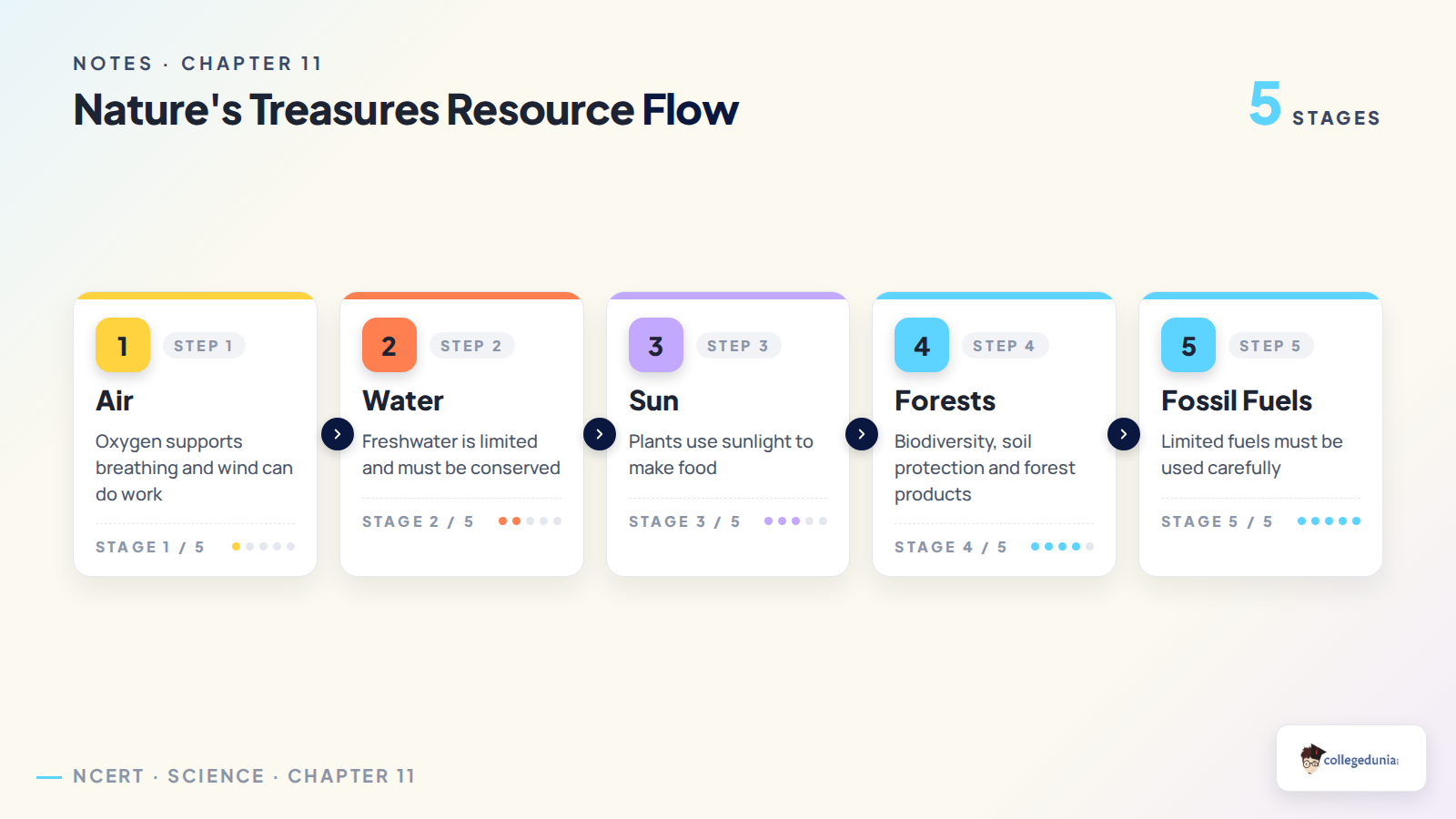
| Resource | Key point | Textbook link |
|---|---|---|
| Air | Air contains oxygen needed by most living beings. | Activity 11.1 and Fig. 11.1 |
| Water | Freshwater is limited and must be conserved. | Activity 11.3 and Fig. 11.4 |
| Sun | Plants use sunlight to make food. | Energy from the Sun section |
| Forests | Forests support biodiversity and protect soil. | Forests section |
Nature's Treasures Video Revision
Source: Magnet Brains on YouTube
Air and Wind in Nature's Treasures Notes
Air is a mixture of gases. The NCERT chart shows about 78% nitrogen, 21% oxygen and 1% argon, carbon dioxide and other gases.
- Oxygen is needed by most living beings for survival.
- Moving air is called wind, and gentle wind is called a breeze.
- Wind can rotate a firki and can also run windmills.
- Remember the air composition as 78-21-1.
Water Conservation and Rainwater Harvesting
Water is used for drinking, cooking, bathing, cleaning, farming and industry. Most water on Earth is saline, so easily available freshwater must be used carefully.
| Problem | Simple action | Why it helps |
|---|---|---|
| Tap left open | Close taps while brushing or soaping hands. | Reduces daily wastage. |
| Leaking taps | Fix leaks quickly. | Saves clean water. |
| Rainwater lost | Collect rainwater in tanks or recharge pits. | Stores water for later use. |
| Water pollution | Do not throw waste into water bodies. | Keeps water fit for living beings. |
Sun Energy, Forests and Soil in Class 6 Science
The Sun gives heat and light. Plants use sunlight to make food, so animals and humans depend on the Sun through food chains.
- Solar devices: solar panels, solar cookers and solar water heaters use solar energy.
- Forests: forests provide food, shelter, medicines, shade and soil protection.
- Soil: soil forms when rocks break down over a long time with help from water, sunlight and living organisms.
- Forests recover slowly, so cutting large forest areas harms biodiversity.
Rocks, Minerals and Fossil Fuels
Rocks are used in houses, roads, dams, roofs and tools. Minerals give useful metals such as aluminium, gold, copper and iron.
Coal, petroleum and natural gas are called fossil fuels. They form from ancient buried living matter over millions of years, so they are limited resources.
- Petrol and diesel are widely used in vehicles.
- Natural gas is used for cooking, electricity and CNG vehicles.
- Coal is mainly used for electricity production.
- Burning fossil fuels produces smoke and carbon dioxide.
Renewable and Non-renewable Resources
Natural resources are classified by how quickly nature can restore them. Renewable resources are restored in a reasonable time, while non-renewable resources take too long to return.
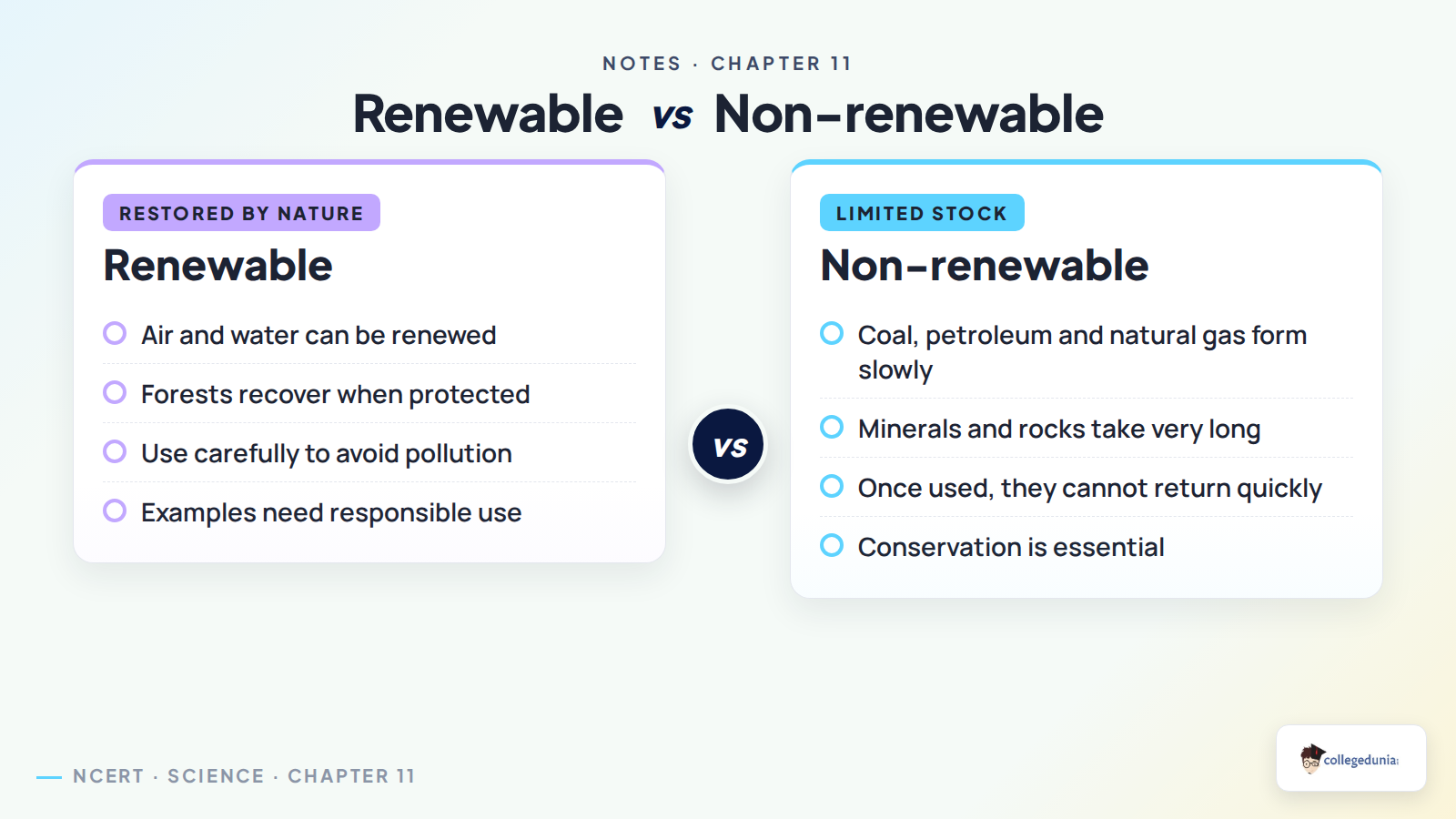
| Type | Meaning | Examples |
|---|---|---|
| Renewable | Gets renewed, replenished or restored in a reasonable time. | Air, water and forests when used responsibly. |
| Non-renewable | Does not get replenished in a reasonable time. | Coal, petroleum, natural gas, rocks and minerals. |
How to Use the Nature's Treasures Notes PDF
Use the PDF after one textbook reading. Start with the resource-flow chart, then revise the examples and conservation actions.
- Write the 78-21-1 air composition from memory.
- Draw a small rainwater harvesting diagram.
- Compare renewable and non-renewable resources in a two-column table.
- Practice one conservation action each for water, forests and fossil fuels.
Related Class 6 Science Resources for Nature's Treasures
| Resource | Use it for | Link |
|---|---|---|
| NCERT Book PDF | Read the official chapter text | Chapter 11 Book PDF |
| NCERT Solutions | Check textbook exercise answers | Chapter 11 Solutions |
| Handwritten Notes | Use quick handwritten revision | Chapter 11 Handwritten Notes |
More Class 6 Science Notes
| Chapter | Notes Link |
|---|---|
| Chapter 8 A Journey through States of Water | Open Notes |
| Chapter 9 Methods of Separation in Everyday Life | Open Notes |
| Chapter 10 Living Creatures: Exploring their Characteristics | Open Notes |
| Chapter 12 Beyond Earth | Open Notes |
Nature's Treasures Class 6 Notes FAQs
Ques. What is covered in Class 6 Science Chapter 11 Nature's Treasures notes?
Ans. The notes cover air, water, sunlight, forests, soil, rocks, minerals, fossil fuels, renewable resources and non-renewable resources.
Ques. What is the composition of air in Chapter 11?
Ans. Air contains about 78% nitrogen, 21% oxygen and 1% argon, carbon dioxide and other gases.
Ques. Why is rainwater harvesting important?
Ans. Rainwater harvesting collects and stores rainwater for later use. It helps conserve freshwater and reduce water shortage.
Ques. Are these notes based on the 2026-27 NCERT Curiosity textbook?
Ans. Yes. The PDF follows Class 6 Science Curiosity Chapter 11 Nature's Treasures for the 2026-27 NCERT syllabus.



Comments