



The NCERT Class 7 English Poorvi Chapter 1 Learning Together notes help students revise the story, poem, Helen Keller extract, vocabulary, grammar and writing tasks for the 2026-27 syllabus.
- Story focus: Jahnavi's wish to study and the River's advice.
- Poem focus: King Bruce learns persistence from a spider.
- Revision focus: Helen Keller, Braille, inclusion, personification, prepositions and modal verbs.
Chapter1LearningTogetherNotes.pdf?page=1&dpi=150)
Chapter1LearningTogetherNotes.pdf?page=2&dpi=150)
Chapter1LearningTogetherNotes.pdf?page=3&dpi=150)
Chapter1LearningTogetherNotes.pdf?page=4&dpi=150)
Chapter1LearningTogetherNotes.pdf?page=5&dpi=150)
Chapter1LearningTogetherNotes.pdf?page=6&dpi=150)
Chapter1LearningTogetherNotes.pdf?page=7&dpi=150)
Chapter1LearningTogetherNotes.pdf?page=8&dpi=150)
Chapter1LearningTogetherNotes.pdf?page=9&dpi=150)
Chapter1LearningTogetherNotes.pdf?page=10&dpi=150)
Chapter1LearningTogetherNotes.pdf?page=11&dpi=150)
Chapter1LearningTogetherNotes.pdf?page=12&dpi=150)
Chapter1LearningTogetherNotes.pdf?page=13&dpi=150)
Chapter1LearningTogetherNotes.pdf?page=14&dpi=150)
Chapter1LearningTogetherNotes.pdf?page=15&dpi=150)
Chapter1LearningTogetherNotes.pdf?page=16&dpi=150)
Chapter1LearningTogetherNotes.pdf?page=17&dpi=150)
Chapter1LearningTogetherNotes.pdf?page=18&dpi=150)
Chapter1LearningTogetherNotes.pdf?page=19&dpi=150)
Chapter1LearningTogetherNotes.pdf?page=20&dpi=150)
Chapter1LearningTogetherNotes.pdf?page=21&dpi=150)
Chapter1LearningTogetherNotes.pdf?page=22&dpi=150)
Chapter1LearningTogetherNotes.pdf?page=23&dpi=150)
Chapter1LearningTogetherNotes.pdf?page=24&dpi=150)
Chapter1LearningTogetherNotes.pdf?page=25&dpi=150)
Chapter1LearningTogetherNotes.pdf?page=26&dpi=150)
Chapter1LearningTogetherNotes.pdf?page=27&dpi=150)
Chapter1LearningTogetherNotes.pdf?page=28&dpi=150)
Chapter1LearningTogetherNotes.pdf?page=29&dpi=150)
Chapter1LearningTogetherNotes_flat_MobileCard.pdf?page=1&dpi=150)
Chapter1LearningTogetherNotes_flat_MobileCard.pdf?page=2&dpi=150)
Chapter1LearningTogetherNotes_flat_MobileCard.pdf?page=3&dpi=150)
Chapter1LearningTogetherNotes_flat_MobileCard.pdf?page=4&dpi=150)
Chapter1LearningTogetherNotes_flat_MobileCard.pdf?page=5&dpi=150)
Chapter1LearningTogetherNotes_flat_MobileCard.pdf?page=6&dpi=150)
Chapter1LearningTogetherNotes_flat_MobileCard.pdf?page=7&dpi=150)
Chapter1LearningTogetherNotes_flat_MobileCard.pdf?page=8&dpi=150)
Chapter1LearningTogetherNotes_flat_MobileCard.pdf?page=9&dpi=150)
Chapter1LearningTogetherNotes_flat_MobileCard.pdf?page=10&dpi=150)
Chapter1LearningTogetherNotes_flat_MobileCard.pdf?page=11&dpi=150)
Chapter1LearningTogetherNotes_flat_MobileCard.pdf?page=12&dpi=150)
Chapter1LearningTogetherNotes_flat_MobileCard.pdf?page=13&dpi=150)
Chapter1LearningTogetherNotes_flat_MobileCard.pdf?page=14&dpi=150)
Chapter1LearningTogetherNotes_flat_MobileCard.pdf?page=15&dpi=150)
Chapter1LearningTogetherNotes_flat_MobileCard.pdf?page=16&dpi=150)
Chapter1LearningTogetherNotes_flat_MobileCard.pdf?page=17&dpi=150)
Chapter1LearningTogetherNotes_flat_MobileCard.pdf?page=18&dpi=150)
Chapter1LearningTogetherNotes_flat_MobileCard.pdf?page=19&dpi=150)
Chapter1LearningTogetherNotes_flat_MobileCard.pdf?page=20&dpi=150)
Chapter1LearningTogetherNotes_flat_MobileCard.pdf?page=21&dpi=150)
Chapter1LearningTogetherNotes_flat_MobileCard.pdf?page=22&dpi=150)
Chapter1LearningTogetherNotes_flat_MobileCard.pdf?page=23&dpi=150)
Chapter1LearningTogetherNotes_flat_MobileCard.pdf?page=24&dpi=150)
Chapter1LearningTogetherNotes_flat_MobileCard.pdf?page=25&dpi=150)
Chapter1LearningTogetherNotes_flat_MobileCard.pdf?page=26&dpi=150)
Chapter1LearningTogetherNotes_flat_MobileCard.pdf?page=27&dpi=150)
Chapter1LearningTogetherNotes_flat_MobileCard.pdf?page=28&dpi=150)
Chapter1LearningTogetherNotes_flat_MobileCard.pdf?page=29&dpi=150)
Chapter1LearningTogetherNotes_flat_MobileCard.pdf?page=30&dpi=150)
Chapter1LearningTogetherNotes_flat_MobileCard.pdf?page=31&dpi=150)
Chapter1LearningTogetherNotes_flat_MobileCard.pdf?page=32&dpi=150)
Chapter1LearningTogetherNotes_flat_MobileCard.pdf?page=33&dpi=150)
Chapter1LearningTogetherNotes_flat_MobileCard.pdf?page=34&dpi=150)
Chapter1LearningTogetherNotes_flat_MobileCard.pdf?page=35&dpi=150)
Chapter1LearningTogetherNotes_flat_MobileCard.pdf?page=36&dpi=150)
Chapter1LearningTogetherNotes_flat_MobileCard.pdf?page=37&dpi=150)
Chapter1LearningTogetherNotes_flat_MobileCard.pdf?page=38&dpi=150)
These Class 7 English notes are built from the Poorvi textbook chapter and keep the revision points short, clear and exam-ready.
Learning Together Notes: Story and Poem Highlights
Learning Together includes the story The Day the River Spoke, the poem Try Again and the prose extract Three Days to See. The story presents Jahnavi as a curious girl who wants to go to school, the poem shows King Bruce learning persistence from a spider, and Helen Keller's extract teaches careful observation and gratitude.
- Jahnavi's dream is to study like her brother and sister.
- The River encourages her to act with courage.
- The spider teaches King Bruce to try again after failure.
- Helen Keller reminds students to value sight, sound, touch and accessibility.
Learning Together Story Explained for Class 7
Source: Magnet Brains on YouTube
Learning Together Chapter 1 Important Themes
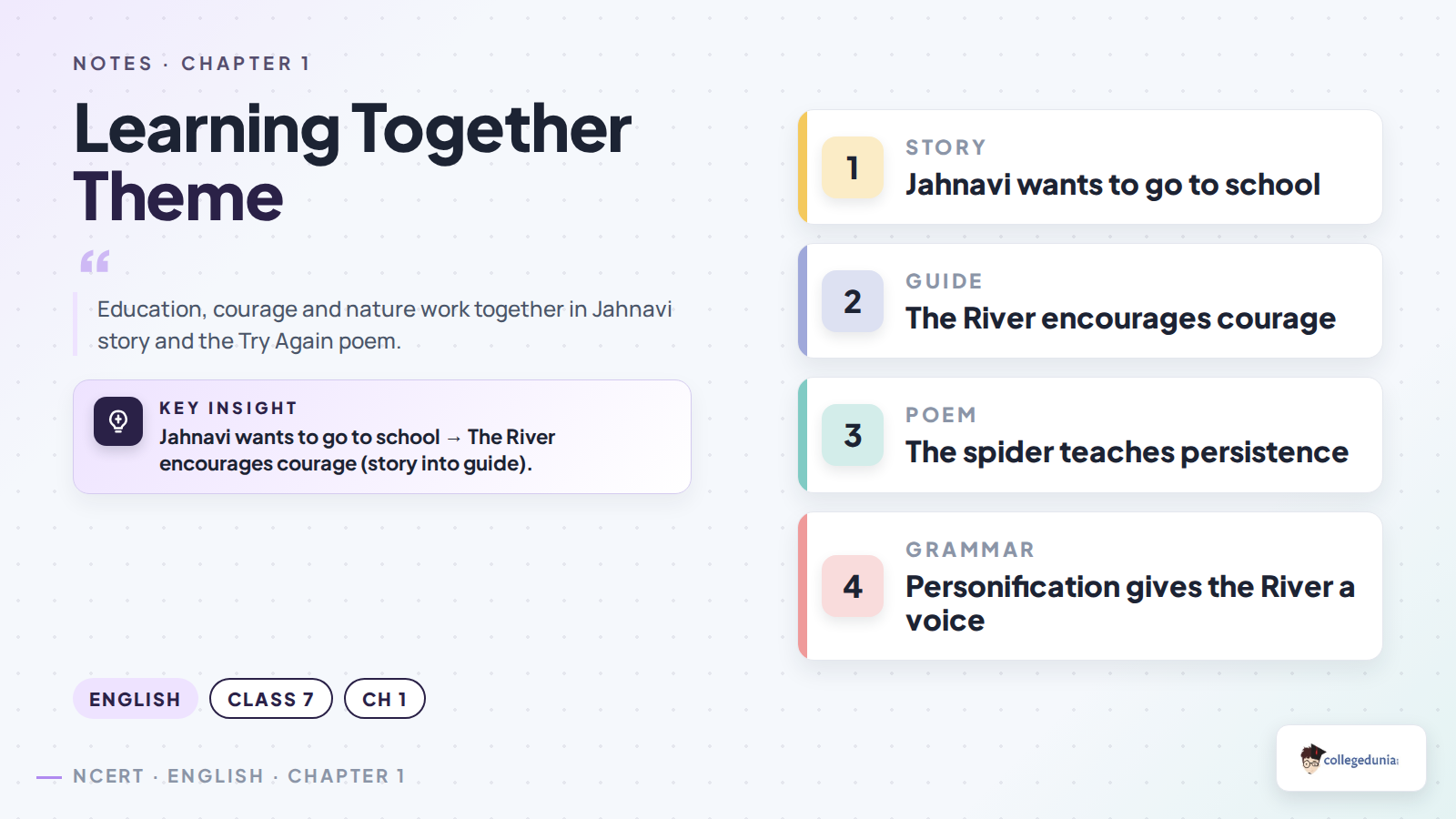
The most important themes are education, courage, nature and equal chances for girls. Jahnavi's wish to become a teacher shows how one girl's education can help many other children.
| Theme | Where it appears |
|---|---|
| Education | Jahnavi wants to read, write and do sums. |
| Courage | She enters school even though she is scared. |
| Nature | The River becomes a speaking guide. |
Three Days to See Class 7 Notes
Three Days to See is adapted from Helen Keller. Keller imagines what she would do if she could see for only three days, so the extract asks students to notice people, nature, books, art and city life with more care.
- Day 1: she wants to see people who have supported her and made life meaningful.
- Day 2: she wants to see nature, museums, books and art.
- Day 3: she wants to watch everyday city life and human activity.
The related NCERT activities connect the extract with Braille, Indian Sign Language, accessibility and respectful inclusion. Students should remember that accessibility is about independence and equal participation, not pity.
Learning Together Vocabulary and Grammar Practice
The chapter gives useful sound words such as splashed, murmuring, shrieked, rustle, rattling, gasped and wailed. It also teaches personification, prepositions and modal verbs through examples from Unit 1.
- Personification: the River speaks, advises and comforts Jahnavi.
- Preposition: a word followed by an object, such as through the classroom or between two classmates.
- Adverb: a word that tells more about the action, such as walking around.
- Modal verb: a helping verb such as can, could, may, might, shall, should, will, would, must or ought to.
Try Again Poetic Devices and Practice Tasks
The poem Try Again trains students to notice sound, form and expression. It is narrative because it tells a story, and its rhyme pattern is mostly ABAB. Repeated phrases such as tried and tried and steadily steadily make the message of perseverance stronger.
- Alliteration: valid examples include cling and crawl, slippery sprawl and higher and higher.
- Interjection: Bravo shows sudden praise or strong feeling.
- Contractions: 'twas and 'tis are shortened forms used for rhythm.
- Speaking task: narrate a personal experience of being motivated to carry on.
- Writing task: write a letter to a cousin about overcoming a difficult situation and not quitting.
Student Feedback on Learning Together Revision
In a Collegedunia student survey of 10,420 Class 7 students before the 2026 boards, 72% said the theme table helped them revise the chapter faster.
Source: 2026-27 Class 7 English student poll across CBSE schools.
How to Use These Learning Together Notes
Read the chapter once from the NCERT book, then revise this PDF section by section. After that, try one extract question, one value-based question and one grammar exercise without looking at the answer.
- First revise the story sequence and the poem message.
- Then revise Helen Keller's three-day plan and the inclusion ideas.
- Finally practise vocabulary, prepositions and modal verbs.
| Related Resource | Use |
|---|---|
| Learning Together NCERT Solutions | For textbook questions and answers |
| Learning Together NCERT Book PDF | For reading the original text |
| Learning Together Handwritten Notes | For quick revision |
| Class 7 English Poorvi Notes | Chapter Link |
|---|---|
| Chapter 2 Wit and Humour | Open Notes |
| Chapter 3 Dreams and Discoveries | Open Notes |
| Chapter 4 Travel and Adventure | Open Notes |
Learning Together Class 7 English Notes FAQs
Ques. What is the main message of Learning Together?
Ans. The chapter says that education, courage and support can help a child change her future.
Ques. Why is the River written with a capital letter?
Ans. The River is personified as a character that speaks, listens and advises Jahnavi.
Ques. What does the poem Try Again teach?
Ans. It teaches that repeated effort can help a person overcome failure and despair.



Comments