




The NCERT Class 7 English Poorvi Chapter 4 Travel and Adventure notes help students revise Unit 4 for the 2026-27 syllabus. The PDF covers The Tunnel, Travel, Conquering the Summit, grammar, maps, formal letter writing and project tasks.
- Story focus: Suraj, Sunder Singh, the tunnel, the leopard and the night mail.
- Poem focus: train imagery, rhyme, tone, repetition and symbol.
- Grammar focus: sound words, would, used to, colon, semicolon, pronunciation of c and articles.
Chapter4TravelandAdventureNotes.pdf?page=1&dpi=150)
Chapter4TravelandAdventureNotes.pdf?page=2&dpi=150)
Chapter4TravelandAdventureNotes.pdf?page=3&dpi=150)
Chapter4TravelandAdventureNotes.pdf?page=4&dpi=150)
Chapter4TravelandAdventureNotes.pdf?page=5&dpi=150)
Chapter4TravelandAdventureNotes.pdf?page=6&dpi=150)
Chapter4TravelandAdventureNotes.pdf?page=7&dpi=150)
Chapter4TravelandAdventureNotes.pdf?page=8&dpi=150)
Chapter4TravelandAdventureNotes.pdf?page=9&dpi=150)
Chapter4TravelandAdventureNotes.pdf?page=10&dpi=150)
Chapter4TravelandAdventureNotes.pdf?page=11&dpi=150)
Chapter4TravelandAdventureNotes.pdf?page=12&dpi=150)
Chapter4TravelandAdventureNotes.pdf?page=13&dpi=150)
Chapter4TravelandAdventureNotes.pdf?page=14&dpi=150)
Chapter4TravelandAdventureNotes.pdf?page=15&dpi=150)
Chapter4TravelandAdventureNotes.pdf?page=16&dpi=150)
Chapter4TravelandAdventureNotes.pdf?page=17&dpi=150)
Chapter4TravelandAdventureNotes.pdf?page=18&dpi=150)
Chapter4TravelandAdventureNotes.pdf?page=19&dpi=150)
Chapter4TravelandAdventureNotes.pdf?page=20&dpi=150)
Chapter4TravelandAdventureNotes.pdf?page=21&dpi=150)
Chapter4TravelandAdventureNotes.pdf?page=22&dpi=150)
Chapter4TravelandAdventureNotes.pdf?page=23&dpi=150)
Chapter4TravelandAdventureNotes.pdf?page=24&dpi=150)
Chapter4TravelandAdventureNotes.pdf?page=25&dpi=150)
Chapter4TravelandAdventureNotes_flat_MobileCard.pdf?page=1&dpi=150)
Chapter4TravelandAdventureNotes_flat_MobileCard.pdf?page=2&dpi=150)
Chapter4TravelandAdventureNotes_flat_MobileCard.pdf?page=3&dpi=150)
Chapter4TravelandAdventureNotes_flat_MobileCard.pdf?page=4&dpi=150)
Chapter4TravelandAdventureNotes_flat_MobileCard.pdf?page=5&dpi=150)
Chapter4TravelandAdventureNotes_flat_MobileCard.pdf?page=6&dpi=150)
Chapter4TravelandAdventureNotes_flat_MobileCard.pdf?page=7&dpi=150)
Chapter4TravelandAdventureNotes_flat_MobileCard.pdf?page=8&dpi=150)
Chapter4TravelandAdventureNotes_flat_MobileCard.pdf?page=9&dpi=150)
Chapter4TravelandAdventureNotes_flat_MobileCard.pdf?page=10&dpi=150)
Chapter4TravelandAdventureNotes_flat_MobileCard.pdf?page=11&dpi=150)
Chapter4TravelandAdventureNotes_flat_MobileCard.pdf?page=12&dpi=150)
Chapter4TravelandAdventureNotes_flat_MobileCard.pdf?page=13&dpi=150)
Chapter4TravelandAdventureNotes_flat_MobileCard.pdf?page=14&dpi=150)
Chapter4TravelandAdventureNotes_flat_MobileCard.pdf?page=15&dpi=150)
Chapter4TravelandAdventureNotes_flat_MobileCard.pdf?page=16&dpi=150)
Chapter4TravelandAdventureNotes_flat_MobileCard.pdf?page=17&dpi=150)
Chapter4TravelandAdventureNotes_flat_MobileCard.pdf?page=18&dpi=150)
Chapter4TravelandAdventureNotes_flat_MobileCard.pdf?page=19&dpi=150)
Chapter4TravelandAdventureNotes_flat_MobileCard.pdf?page=20&dpi=150)
Chapter4TravelandAdventureNotes_flat_MobileCard.pdf?page=21&dpi=150)
Chapter4TravelandAdventureNotes_flat_MobileCard.pdf?page=22&dpi=150)
Chapter4TravelandAdventureNotes_flat_MobileCard.pdf?page=23&dpi=150)
Chapter4TravelandAdventureNotes_flat_MobileCard.pdf?page=24&dpi=150)
Chapter4TravelandAdventureNotes_flat_MobileCard.pdf?page=25&dpi=150)
Chapter4TravelandAdventureNotes_flat_MobileCard.pdf?page=26&dpi=150)
Chapter4TravelandAdventureNotes_flat_MobileCard.pdf?page=27&dpi=150)
Chapter4TravelandAdventureNotes_flat_MobileCard.pdf?page=28&dpi=150)
Chapter4TravelandAdventureNotes_flat_MobileCard.pdf?page=29&dpi=150)
Chapter4TravelandAdventureNotes_flat_MobileCard.pdf?page=30&dpi=150)
Chapter4TravelandAdventureNotes_flat_MobileCard.pdf?page=31&dpi=150)
Chapter4TravelandAdventureNotes_flat_MobileCard.pdf?page=32&dpi=150)
Chapter4TravelandAdventureNotes_flat_MobileCard.pdf?page=33&dpi=150)
These notes follow the 2026-27 NCERT English Poorvi textbook and keep the revision points clear for Class 7 students.
Travel and Adventure Class 7 Notes Overview
Travel and Adventure connects courage with movement. The unit places Suraj and Sunder Singh near a railway tunnel, turns train sounds into a travel dream, and uses Arunima Sinha's Everest journey to show resilience.
- The story checks character traits, atmosphere and extract-based understanding.
- The poem checks rhyme, sound, symbol and tone.
- The Arunima Sinha text checks courage, goal-setting and extract-based reflection.
- The language tasks check grammar, maps, speaking, letters and project work.
The Tunnel Class 7 English Poorvi Story Notes
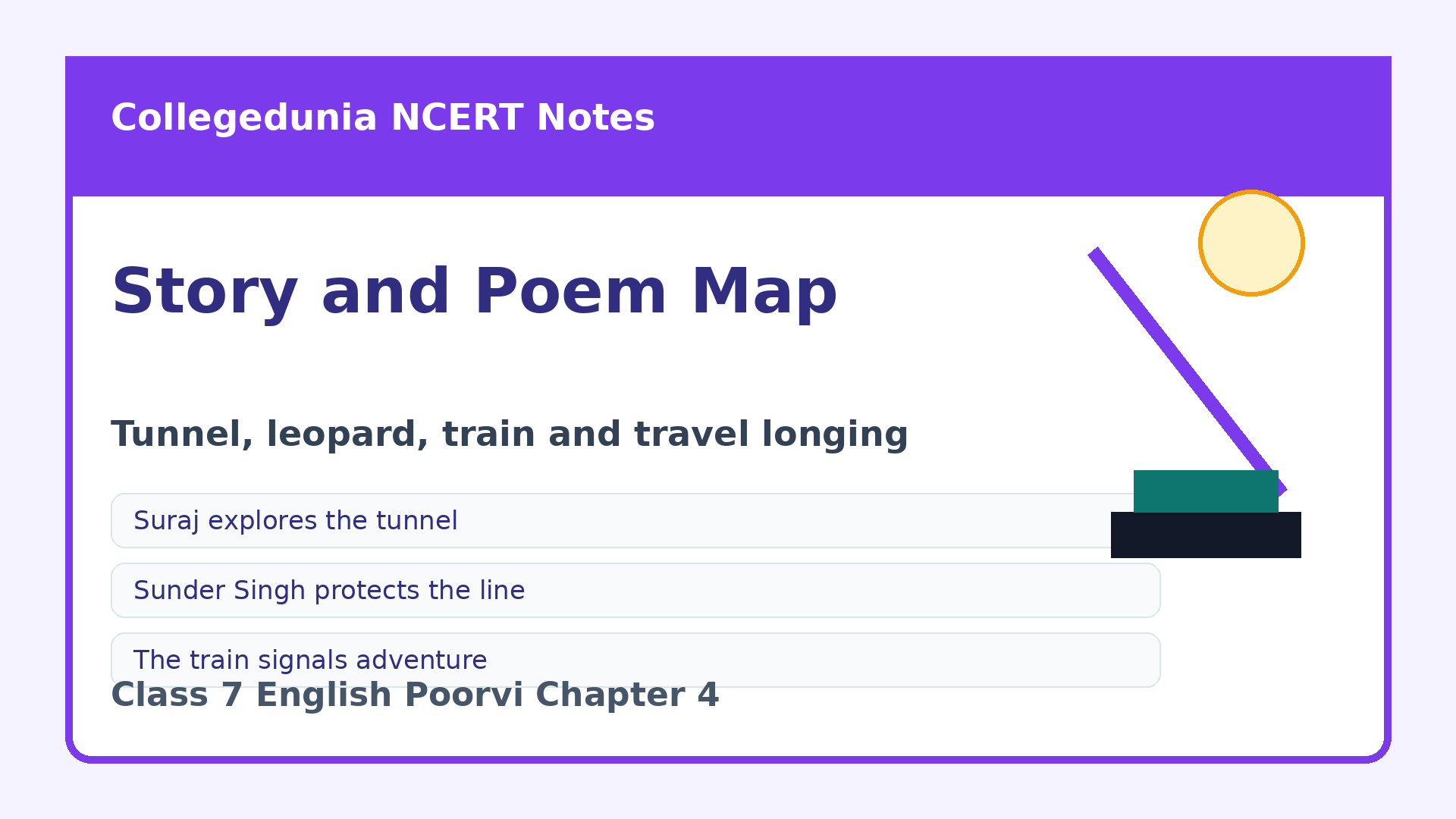
Suraj waits near the tunnel because he loves watching the steam train. Sunder Singh guards the tunnel and checks it before each train passes. Their friendship grows when both help save a leopard from the train.
| Character | Revision point |
|---|---|
| Suraj | Curious, adventurous and brave despite fear. |
| Sunder Singh | Responsible, calm and closely connected with jungle life. |
| Leopard | A wild animal that must be protected from the train. |
Travel Poem Notes for Class 7 English Poorvi
The poem Travel presents the train as a symbol of movement, distance and opportunity. The speaker hears the train during the day, imagines it at night and strongly wishes to travel.
- Tone: dreamy, eager, restless and adventurous.
- Sound: whistle and engine sounds create movement.
- Symbol: the train stands for adventure and new places.
The Tunnel Class 7 English Poorvi Explanation Video
Source: Magnet Brains
Conquering the Summit Class 7 English Poorvi Notes
Conquering the Summit tells how Arunima Sinha moved from a life-changing accident to the top of Mount Everest. The section is useful for questions on resilience, mental strength, Bachendri Pal's guidance and goal-setting.
| NCERT task | What to revise |
|---|---|
| Let us discuss | Why Arunima is called a beacon of hope and resilience. |
| Extract question | Bachendri Pal's words and Arunima's summit emotions. |
| Let us write | Formal letter requesting an excursion to a nearby hill station. |
| Explore | Adventure sports table and Indian mountaineer fact sheets. |
Travel and Adventure Grammar Practice for Class 7
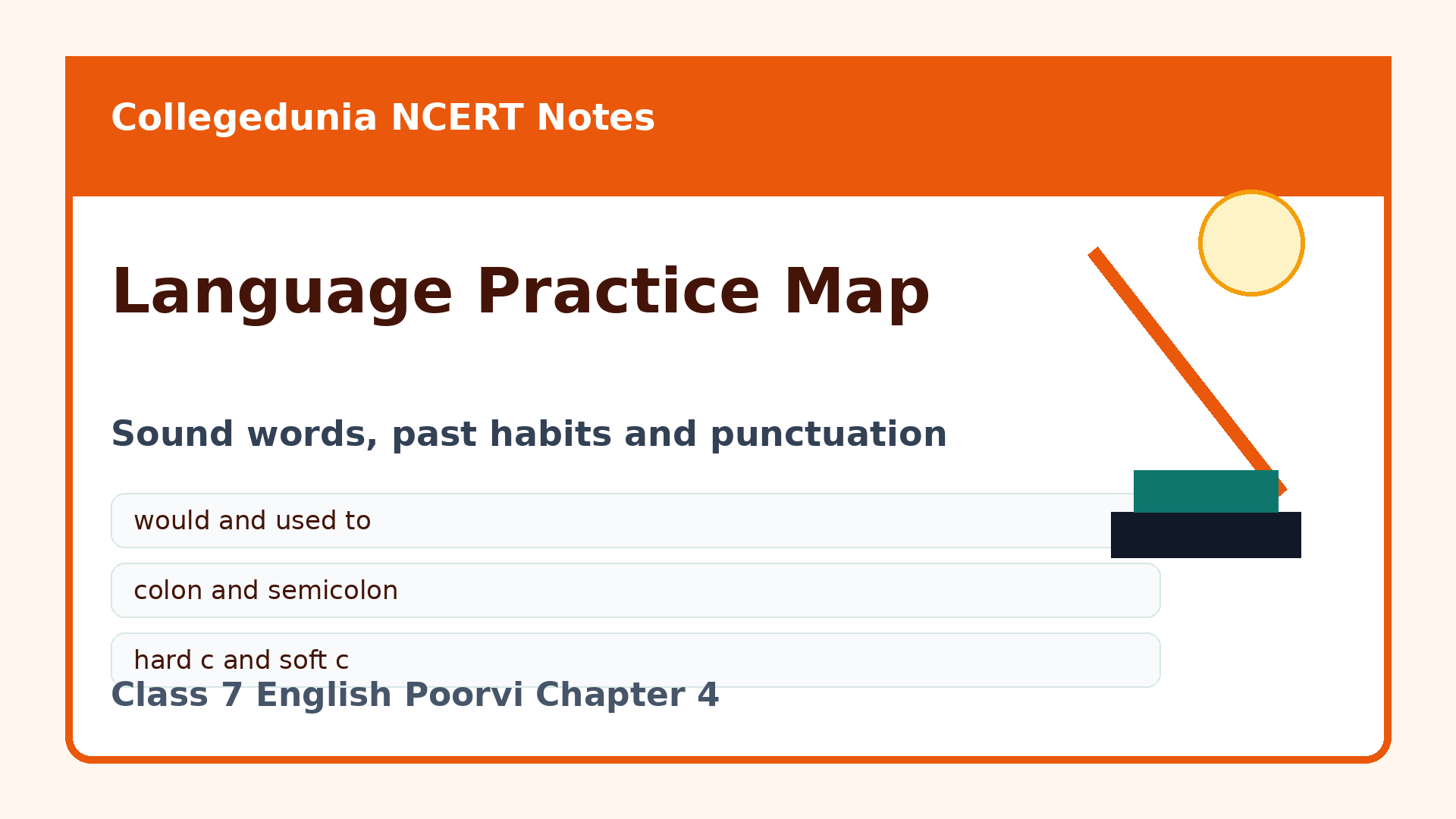
The grammar work covers sound words, habitual past forms, punctuation, pronunciation and articles. Learn each rule with one textbook example and one fresh example.
- Sound words: creaking, chatter, hissing, rustle and puffing.
- Past habit: use would for repeated past action and used to for an old habit or state.
- Punctuation: use a colon before a list and a semicolon between related complete clauses.
- Articles: use a, an and the according to sound and specificity.
Travel and Adventure Explore Tasks
The NCERT explore work asks students to connect the chapter with real travel and adventure examples. Revise Atal Tunnel, Indian Railways history, Mountain Railways of India, Vande Bharat Express, underwater rail tunnels, adventure sports and Indian mountaineers.
| Task | Key points |
|---|---|
| The Tunnel explore | Atal Tunnel, Rohtang Pass, Indian Railways, Bori Bunder to Thane. |
| Travel explore | Mountain Railways, Vande Bharat Express, Thames Tunnel, Seikan Tunnel, Channel Tunnel. |
| Conquering explore | Adventure sports table and fact sheets on Indian mountaineers. |
Student Feedback on Travel and Adventure Notes
In a Collegedunia student review of 11,860 Class 7 English students before the 2026 exams, students said the story table and grammar drill list were the most useful revision parts.
How to Use These Travel and Adventure Notes
Read the textbook once before using the PDF. Then revise one block at a time: story, poem, Arunima Sinha text, grammar and writing. After that, answer one extract question and one grammar question without looking at the notes.
- Use the story map for Suraj and Sunder Singh questions.
- Use the poem notes for tone, sound and train symbol questions.
- Use the grammar section for would, used to, colon, semicolon and article practice.
Travel and Adventure Class 7 Cross Resource Links
| Resource | Use |
|---|---|
| Travel and Adventure NCERT Solutions | Use for textbook answers. |
| Travel and Adventure NCERT Book PDF | Use for reading the original chapter. |
| Travel and Adventure Handwritten Notes | Use for a fast recap before class tests. |
| Class 7 English Poorvi Notes | Chapter Link |
|---|---|
| Chapter 1 Learning Together | Open Notes |
| Chapter 2 Wit and Humour | Open Notes |
| Chapter 3 Dreams and Discoveries | Open Notes |
Travel and Adventure Class 7 English Poorvi Notes FAQs
Ques. What does Travel and Adventure Class 7 English Poorvi include?
Ans. It includes The Tunnel, Travel, Conquering the Summit, grammar, map tasks, formal letter writing and project work.
Ques. What is the main theme of The Tunnel?
Ans. The story shows curiosity, courage, responsibility and respect for nature through Suraj and Sunder Singh.
Ques. What does the train symbolise in the poem Travel?
Ans. The train symbolises adventure, movement, opportunity and the speaker's wish to see new places.
Ques. Why is Arunima Sinha important in Conquering the Summit?
Ans. Her journey shows resilience, goal-setting and mental strength after a life-changing accident.



Comments