



The NCERT Class 7 English Poorvi Chapter 2 Wit and Humour notes help students revise the Dr. Dolittle story, the poem A Funny Man, the play Say the Right Thing, grammar, vocabulary and writing tasks for the 2026-27 syllabus.
- Story focus: Doctor Dolittle learns animal language and becomes an animal doctor.
- Poem focus: A strange funny man creates laughter through nonsense actions.
- Play focus: Mary learns that polite conversation needs thought, kindness and timing.
Chapter2WitandHumourNotes.pdf?page=1&dpi=150)
Chapter2WitandHumourNotes.pdf?page=2&dpi=150)
Chapter2WitandHumourNotes.pdf?page=3&dpi=150)
Chapter2WitandHumourNotes.pdf?page=4&dpi=150)
Chapter2WitandHumourNotes.pdf?page=5&dpi=150)
Chapter2WitandHumourNotes.pdf?page=6&dpi=150)
Chapter2WitandHumourNotes.pdf?page=7&dpi=150)
Chapter2WitandHumourNotes.pdf?page=8&dpi=150)
Chapter2WitandHumourNotes.pdf?page=9&dpi=150)
Chapter2WitandHumourNotes.pdf?page=10&dpi=150)
Chapter2WitandHumourNotes.pdf?page=11&dpi=150)
Chapter2WitandHumourNotes.pdf?page=12&dpi=150)
Chapter2WitandHumourNotes.pdf?page=13&dpi=150)
Chapter2WitandHumourNotes.pdf?page=14&dpi=150)
Chapter2WitandHumourNotes.pdf?page=15&dpi=150)
Chapter2WitandHumourNotes.pdf?page=16&dpi=150)
Chapter2WitandHumourNotes.pdf?page=17&dpi=150)
Chapter2WitandHumourNotes.pdf?page=18&dpi=150)
Chapter2WitandHumourNotes.pdf?page=19&dpi=150)
Chapter2WitandHumourNotes.pdf?page=20&dpi=150)
Chapter2WitandHumourNotes.pdf?page=21&dpi=150)
Chapter2WitandHumourNotes.pdf?page=22&dpi=150)
Chapter2WitandHumourNotes.pdf?page=23&dpi=150)
Chapter2WitandHumourNotes.pdf?page=24&dpi=150)
Chapter2WitandHumourNotes.pdf?page=25&dpi=150)
Chapter2WitandHumourNotes.pdf?page=26&dpi=150)
Chapter2WitandHumourNotes.pdf?page=27&dpi=150)
Chapter2WitandHumourNotes.pdf?page=28&dpi=150)
Chapter2WitandHumourNotes.pdf?page=29&dpi=150)
Chapter2WitandHumourNotes_flat_MobileCard.pdf?page=1&dpi=150)
Chapter2WitandHumourNotes_flat_MobileCard.pdf?page=2&dpi=150)
Chapter2WitandHumourNotes_flat_MobileCard.pdf?page=3&dpi=150)
Chapter2WitandHumourNotes_flat_MobileCard.pdf?page=4&dpi=150)
Chapter2WitandHumourNotes_flat_MobileCard.pdf?page=5&dpi=150)
Chapter2WitandHumourNotes_flat_MobileCard.pdf?page=6&dpi=150)
Chapter2WitandHumourNotes_flat_MobileCard.pdf?page=7&dpi=150)
Chapter2WitandHumourNotes_flat_MobileCard.pdf?page=8&dpi=150)
Chapter2WitandHumourNotes_flat_MobileCard.pdf?page=9&dpi=150)
Chapter2WitandHumourNotes_flat_MobileCard.pdf?page=10&dpi=150)
Chapter2WitandHumourNotes_flat_MobileCard.pdf?page=11&dpi=150)
Chapter2WitandHumourNotes_flat_MobileCard.pdf?page=12&dpi=150)
Chapter2WitandHumourNotes_flat_MobileCard.pdf?page=13&dpi=150)
Chapter2WitandHumourNotes_flat_MobileCard.pdf?page=14&dpi=150)
Chapter2WitandHumourNotes_flat_MobileCard.pdf?page=15&dpi=150)
Chapter2WitandHumourNotes_flat_MobileCard.pdf?page=16&dpi=150)
Chapter2WitandHumourNotes_flat_MobileCard.pdf?page=17&dpi=150)
Chapter2WitandHumourNotes_flat_MobileCard.pdf?page=18&dpi=150)
Chapter2WitandHumourNotes_flat_MobileCard.pdf?page=19&dpi=150)
Chapter2WitandHumourNotes_flat_MobileCard.pdf?page=20&dpi=150)
Chapter2WitandHumourNotes_flat_MobileCard.pdf?page=21&dpi=150)
Chapter2WitandHumourNotes_flat_MobileCard.pdf?page=22&dpi=150)
Chapter2WitandHumourNotes_flat_MobileCard.pdf?page=23&dpi=150)
Chapter2WitandHumourNotes_flat_MobileCard.pdf?page=24&dpi=150)
Chapter2WitandHumourNotes_flat_MobileCard.pdf?page=25&dpi=150)
Chapter2WitandHumourNotes_flat_MobileCard.pdf?page=26&dpi=150)
Chapter2WitandHumourNotes_flat_MobileCard.pdf?page=27&dpi=150)
Chapter2WitandHumourNotes_flat_MobileCard.pdf?page=28&dpi=150)
Chapter2WitandHumourNotes_flat_MobileCard.pdf?page=29&dpi=150)
Chapter2WitandHumourNotes_flat_MobileCard.pdf?page=30&dpi=150)
Chapter2WitandHumourNotes_flat_MobileCard.pdf?page=31&dpi=150)
Chapter2WitandHumourNotes_flat_MobileCard.pdf?page=32&dpi=150)
Chapter2WitandHumourNotes_flat_MobileCard.pdf?page=33&dpi=150)
Chapter2WitandHumourNotes_flat_MobileCard.pdf?page=34&dpi=150)
Chapter2WitandHumourNotes_flat_MobileCard.pdf?page=35&dpi=150)
Chapter2WitandHumourNotes_flat_MobileCard.pdf?page=36&dpi=150)
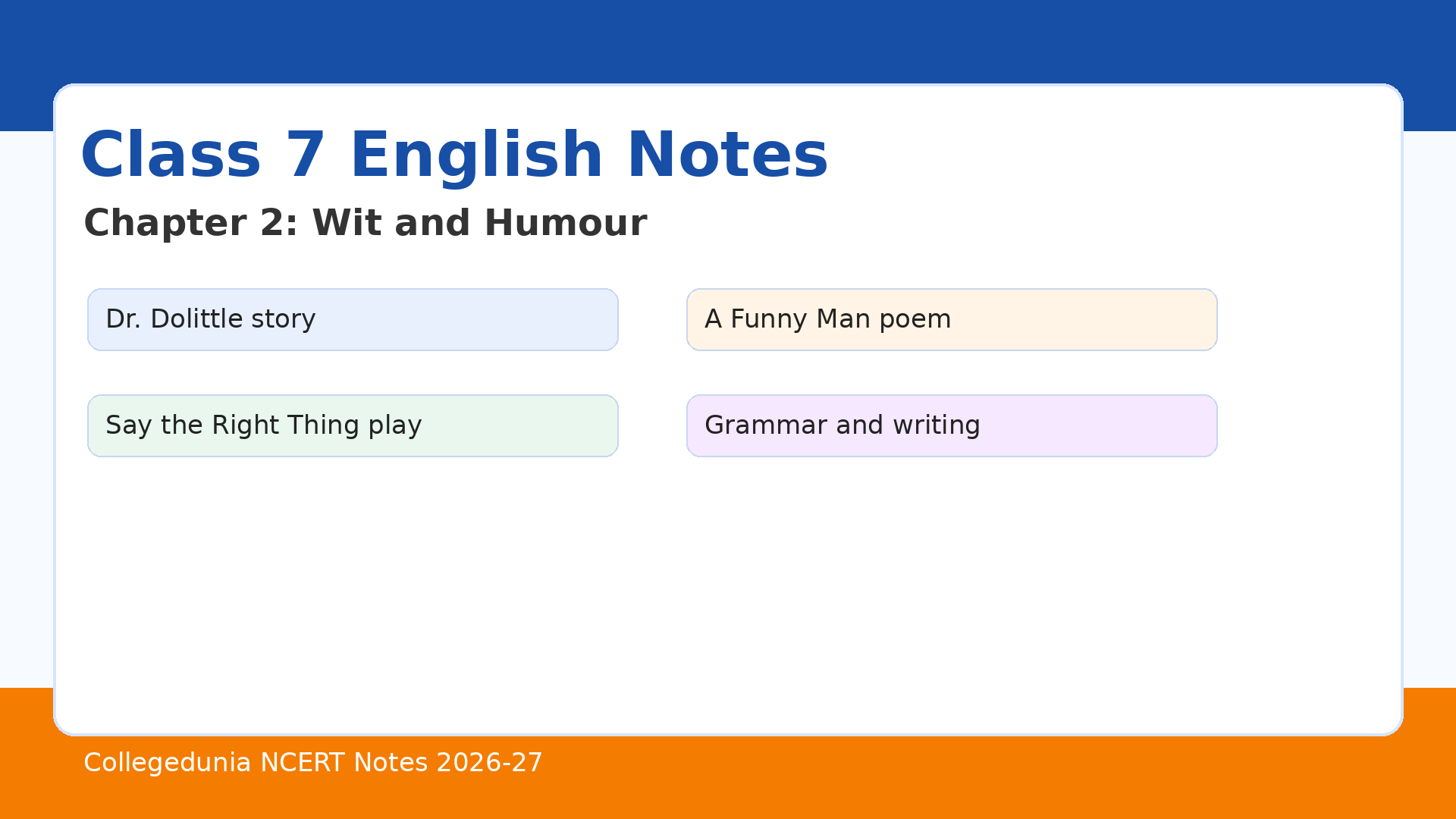
These Class 7 English notes follow the Poorvi textbook chapter and keep the revision points short, clear and exam-ready.
Wit and Humour Class 7 Notes Overview
Wit and Humour contains three different comic forms. The prose story uses animal speech, the poem uses nonsense images, and the play uses awkward conversation. Students should revise the events, speakers, themes, language rules and writing formats together.
- Dr. Dolittle becomes famous because he can understand animals.
- Polynesia teaches him that animals communicate through words and body language.
- The funny man wears a shoe on his head and hats on his feet.
- Mary repeatedly says the wrong thing while trying to be polite.
Animals, Birds, and Dr. Dolittle Summary
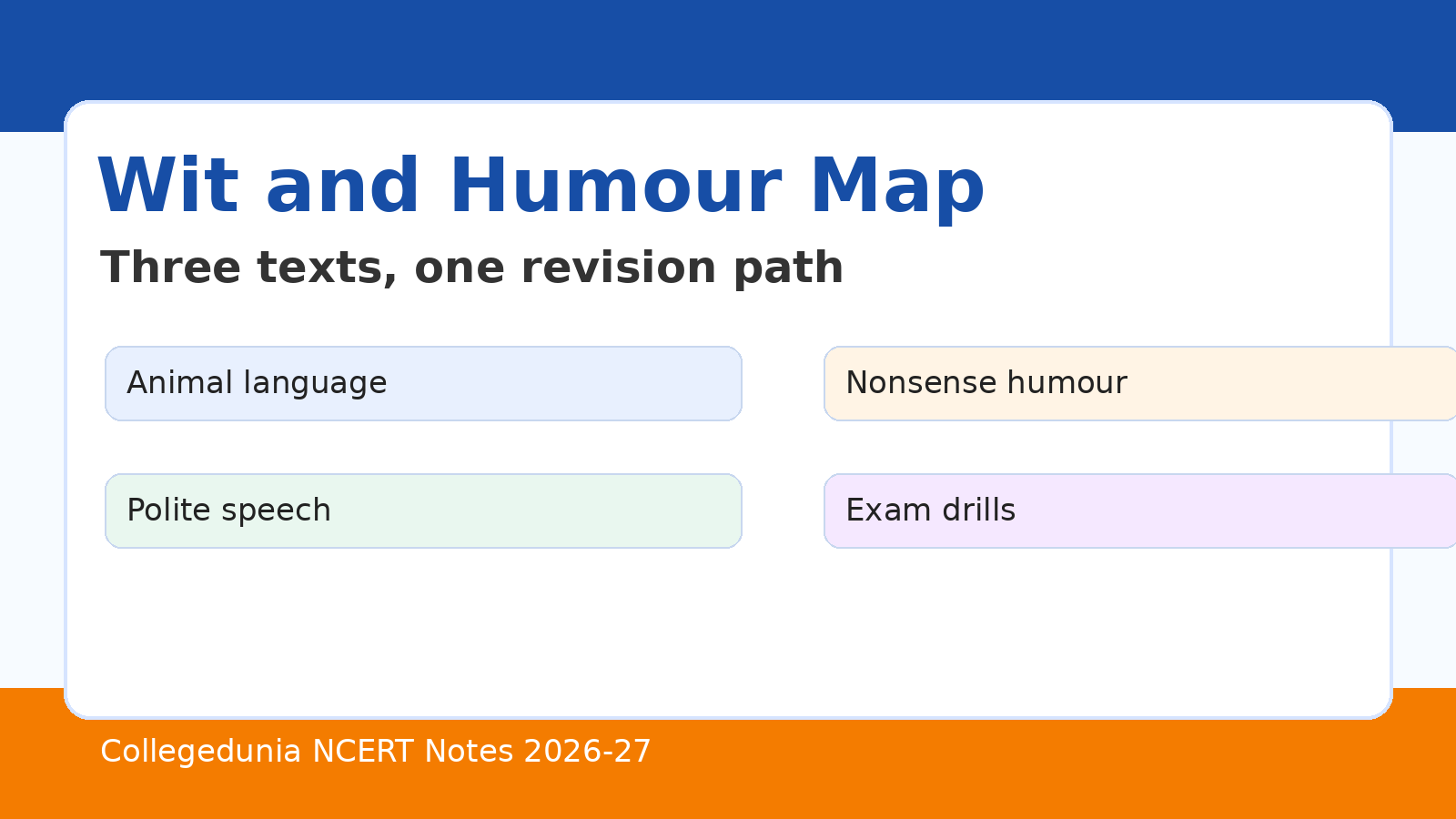
The Cat's-food-Man suggests that Doctor Dolittle should become an animal doctor because he knows animals better than other vets. Polynesia the parrot then teaches him bird language and explains that animals use ears, feet, tails and noses to communicate.
| Event | Why it matters |
|---|---|
| Polynesia teaches bird language | Dolittle discovers that animals have their own languages. |
| The plough horse asks for green spectacles | The story shows why listening to animals matters. |
| Animals crowd Dolittle's garden | His kindness and skill make him famous worldwide. |
A Funny Man Poem Notes
A Funny Man is a playful poem about a strange man who wears a shoe upon his head, hats upon his feet, offers a currant bun like a rose and hops home on his head. The humour comes from impossible images and polite nonsense.
- Tone: humorous, playful and nonsensical.
- Important device: alliteration in phrases such as sounding sight and hopped home.
- Writing skill: limericks use the AABBA rhyme scheme and a funny ending.
Say the Right Thing Play Notes
Say the Right Thing is a humorous play about Mary and Mrs. Shaw. Mrs. Shaw tells Mary to be kind to guests and to say things that will please them. Mary tries to follow the advice, but she keeps making careless remarks that embarrass Mrs. Harding and Mrs. Lee.
- Mary wrongly praises Mrs. Harding's children, though Mrs. Harding has none.
- She criticises bankers, clothes, illness, talkative people, dogs and horse riding.
- The repeated stage direction no one speaks shows the awkward silence after each mistake.
Wit and Humour Grammar and Vocabulary
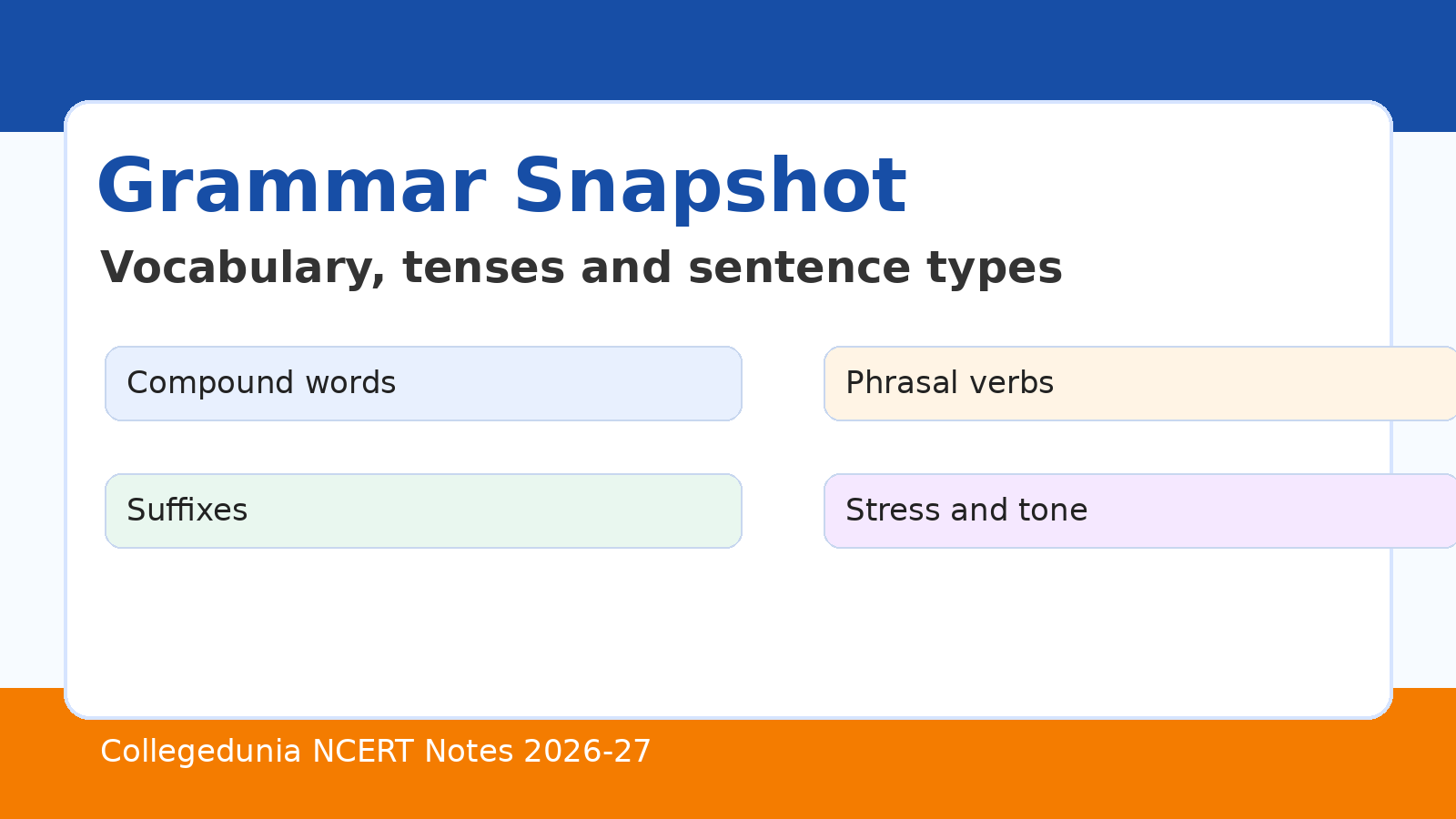
The chapter includes compound words, palindromes, present perfect tense, phrasal verbs, suffixes, say and tell, present perfect continuous tense and sentence types. These grammar points are best revised with examples from the chapter.
- Compound words: Cat's-food-Man, bird language and flowerpots.
- Palindrome: a word or phrase that reads the same backwards and forwards.
- Present perfect: has or have plus the past participle.
- Present perfect continuous: has or have been plus verb-ing.
Doctor Dolittle Animal Language Video
Source: YouTube learning video
Student Feedback on Wit and Humour Revision
In a Collegedunia student survey of 9,860 Class 7 students before the 2026 boards, 74% said a combined story, poem and play table made this chapter easier to revise.
Source: 2026-27 Class 7 English student poll across CBSE schools.
How to Use These Wit and Humour Notes
Read each text once from the NCERT book, then revise one section of the PDF at a time. After revision, try one extract question from the prose, one poetry question and one play-based question without looking at the answers.
- First revise the Dr. Dolittle sequence and animal-language idea.
- Then revise the funny man's actions, tone and poetic devices.
- Finally revise Mary's blunders, stage directions and grammar rules.
| Related Resource | Use |
|---|---|
| Wit and Humour NCERT Solutions | For textbook questions and answers |
| Wit and Humour NCERT Book PDF | For reading the original text |
| Wit and Humour Handwritten Notes | For quick revision |
| Class 7 English Poorvi Notes | Chapter Link |
|---|---|
| Chapter 1 Learning Together | Open Notes |
| Chapter 3 Dreams and Discoveries | Open Notes |
| Chapter 4 Travel and Adventure | Open Notes |
Wit and Humour Class 7 English Notes FAQs
Ques. What is the main idea of Animals, Birds, and Dr. Dolittle?
Ans. The story shows that Doctor Dolittle becomes a successful animal doctor because he learns to understand animal language.
Ques. Why is A Funny Man humorous?
Ans. It is humorous because the funny man behaves in impossible and surprising ways while remaining polite.
Ques. What does Say the Right Thing teach?
Ans. The play teaches that polite conversation needs kindness, awareness and careful choice of words.



Comments