



Inside the Number Play Class 7 notes, you will find parity rules, magic squares, the Virahanka sequence, and digit puzzles. These ideas follow the 2026-27 NCERT Mathematics (Part 1) book. Each rule is paired with a quick example for revision.
- Chapter focus: Parity, number grids, magic squares, sequences, and hidden digits.
- Key skill: Use patterns to decide what is possible without checking every case.
- Revision goal: Explain each answer with a rule, example, or counterexample.
Chapter6NumberPlayNotes.pdf?page=1&dpi=150)
Chapter6NumberPlayNotes.pdf?page=2&dpi=150)
Chapter6NumberPlayNotes.pdf?page=3&dpi=150)
Chapter6NumberPlayNotes.pdf?page=4&dpi=150)
Chapter6NumberPlayNotes.pdf?page=5&dpi=150)
Chapter6NumberPlayNotes.pdf?page=6&dpi=150)
Chapter6NumberPlayNotes.pdf?page=7&dpi=150)
Chapter6NumberPlayNotes.pdf?page=8&dpi=150)
Chapter6NumberPlayNotes.pdf?page=9&dpi=150)
Chapter6NumberPlayNotes.pdf?page=10&dpi=150)
Chapter6NumberPlayNotes.pdf?page=11&dpi=150)
Chapter6NumberPlayNotes.pdf?page=12&dpi=150)
Chapter6NumberPlayNotes.pdf?page=13&dpi=150)
Chapter6NumberPlayNotes.pdf?page=14&dpi=150)
Chapter6NumberPlayNotes.pdf?page=15&dpi=150)
Chapter6NumberPlayNotes.pdf?page=16&dpi=150)
Chapter6NumberPlayNotes.pdf?page=17&dpi=150)
Chapter6NumberPlayNotes.pdf?page=18&dpi=150)
Chapter6NumberPlayNotes.pdf?page=19&dpi=150)
Chapter6NumberPlayNotes.pdf?page=20&dpi=150)
Chapter6NumberPlayNotes.pdf?page=21&dpi=150)
Chapter6NumberPlayNotes.pdf?page=22&dpi=150)
Chapter6NumberPlayNotes.pdf?page=23&dpi=150)
Chapter6NumberPlayNotes_flat_MobileCard.pdf?page=1&dpi=150)
Chapter6NumberPlayNotes_flat_MobileCard.pdf?page=2&dpi=150)
Chapter6NumberPlayNotes_flat_MobileCard.pdf?page=3&dpi=150)
Chapter6NumberPlayNotes_flat_MobileCard.pdf?page=4&dpi=150)
Chapter6NumberPlayNotes_flat_MobileCard.pdf?page=5&dpi=150)
Chapter6NumberPlayNotes_flat_MobileCard.pdf?page=6&dpi=150)
Chapter6NumberPlayNotes_flat_MobileCard.pdf?page=7&dpi=150)
Chapter6NumberPlayNotes_flat_MobileCard.pdf?page=8&dpi=150)
Chapter6NumberPlayNotes_flat_MobileCard.pdf?page=9&dpi=150)
Chapter6NumberPlayNotes_flat_MobileCard.pdf?page=10&dpi=150)
Chapter6NumberPlayNotes_flat_MobileCard.pdf?page=11&dpi=150)
Chapter6NumberPlayNotes_flat_MobileCard.pdf?page=12&dpi=150)
Chapter6NumberPlayNotes_flat_MobileCard.pdf?page=13&dpi=150)
Chapter6NumberPlayNotes_flat_MobileCard.pdf?page=14&dpi=150)
Chapter6NumberPlayNotes_flat_MobileCard.pdf?page=15&dpi=150)
Chapter6NumberPlayNotes_flat_MobileCard.pdf?page=16&dpi=150)
Chapter6NumberPlayNotes_flat_MobileCard.pdf?page=17&dpi=150)
Chapter6NumberPlayNotes_flat_MobileCard.pdf?page=18&dpi=150)
Chapter6NumberPlayNotes_flat_MobileCard.pdf?page=19&dpi=150)
Chapter6NumberPlayNotes_flat_MobileCard.pdf?page=20&dpi=150)
Chapter6NumberPlayNotes_flat_MobileCard.pdf?page=21&dpi=150)
Chapter6NumberPlayNotes_flat_MobileCard.pdf?page=22&dpi=150)
Chapter6NumberPlayNotes_flat_MobileCard.pdf?page=23&dpi=150)
Chapter6NumberPlayNotes_flat_MobileCard.pdf?page=24&dpi=150)
Chapter6NumberPlayNotes_flat_MobileCard.pdf?page=25&dpi=150)
Chapter6NumberPlayNotes_flat_MobileCard.pdf?page=26&dpi=150)
Chapter6NumberPlayNotes_flat_MobileCard.pdf?page=27&dpi=150)
Chapter6NumberPlayNotes_flat_MobileCard.pdf?page=28&dpi=150)
Chapter6NumberPlayNotes_flat_MobileCard.pdf?page=29&dpi=150)
Chapter6NumberPlayNotes_flat_MobileCard.pdf?page=30&dpi=150)
Chapter6NumberPlayNotes_flat_MobileCard.pdf?page=31&dpi=150)
Chapter6NumberPlayNotes_flat_MobileCard.pdf?page=32&dpi=150)
Chapter6NumberPlayNotes_flat_MobileCard.pdf?page=33&dpi=150)
These Collegedunia notes follow the 2026-27 NCERT Ganita Prakash chapter and keep every number rule easy to check.
Number Play Topic Map for Class 7 Mathematics
Number Play connects familiar numbers with reasoning. The chapter asks you to notice a pattern, test it, and explain why it works.
| Topic | Main idea | Revision priority |
|---|---|---|
| Numbers tell us things | A number can describe position or order in a group | Medium |
| Picking parity | Even and odd rules can prove whether a result is possible | High |
| Number grids | Rows, columns, and diagonals reveal linked sums | High |
| Virahanka sequence | Each new term is the sum of the previous two terms | High |
| Digits in disguise | Place value helps find missing digits in calculations | Medium |
Number Play Important Questions
Source: Magnet Brains on YouTube
Parity Rules in Number Play with Quick Proofs
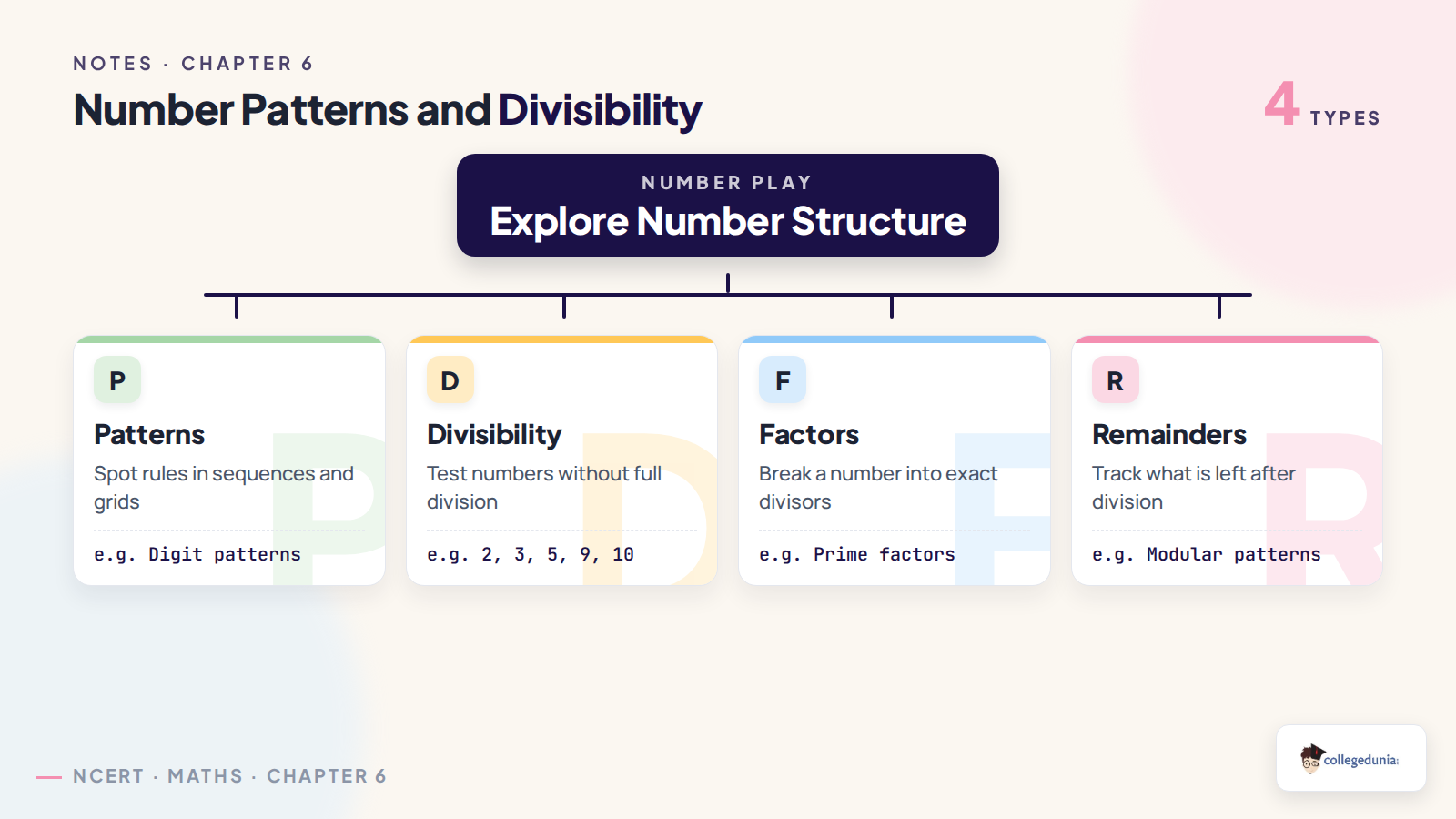
Parity tells whether a whole number is even or odd. An even number forms complete pairs. An odd number leaves one item without a pair.
| Operation | Result | Example |
|---|---|---|
| even + even | even | 8 + 12 = 20 |
| odd + odd | even | 7 + 9 = 16 |
| even + odd | odd | 10 + 5 = 15 |
| odd number of odd addends | odd | 3 + 5 + 7 = 15 |
| even number of odd addends | even | 3 + 5 + 7 + 9 = 24 |
Five odd numbers can never add to an even number. This rule solves the chapter's five-card puzzle without listing every choice.
Parity of Products, Grids, and Algebraic Expressions
A rectangular grid has rows multiplied by columns. The product is odd only when both factors are odd. One even factor makes the product even.
- 27 multiplied by 13 is odd because both factors are odd.
- 42 multiplied by 78 is even because both factors are even.
- 135 multiplied by 654 is even because one factor is even.
- An expression such as 2n is always even for every whole number n.
For 3n + 4, the parity changes with n. The term 3n has the same parity as n, while 4 is even.
Magic Squares and Number Grid Patterns
A magic square has equal sums across every row, column, and main diagonal. Random placement rarely works, so use relationships between cells.
- Find the target sum from a complete row or column.
- Subtract known entries to find one missing number.
- Check the new number in its other row or column.
- Test both diagonals after filling the square.
The chapter also studies smaller groups inside a square. Opposite or symmetric positions often have matching totals. Always check the pattern with every valid row, not only one example.
Virahanka Sequence and Its Rhythm Pattern
The Virahanka sequence counts ways to form rhythms with short and long syllables. Its terms begin 1, 2, 3, 5, 8, 13, and continue.
- Start with the first two terms, 1 and 2.
- Add neighbouring terms to get the next term.
- For example, 3 + 5 gives 8.
- Then 5 + 8 gives 13.
Each term equals the sum of the two terms just before it. This same pattern appears in branching plants and many counting problems.
Digits in Disguise with Place Value Reasoning
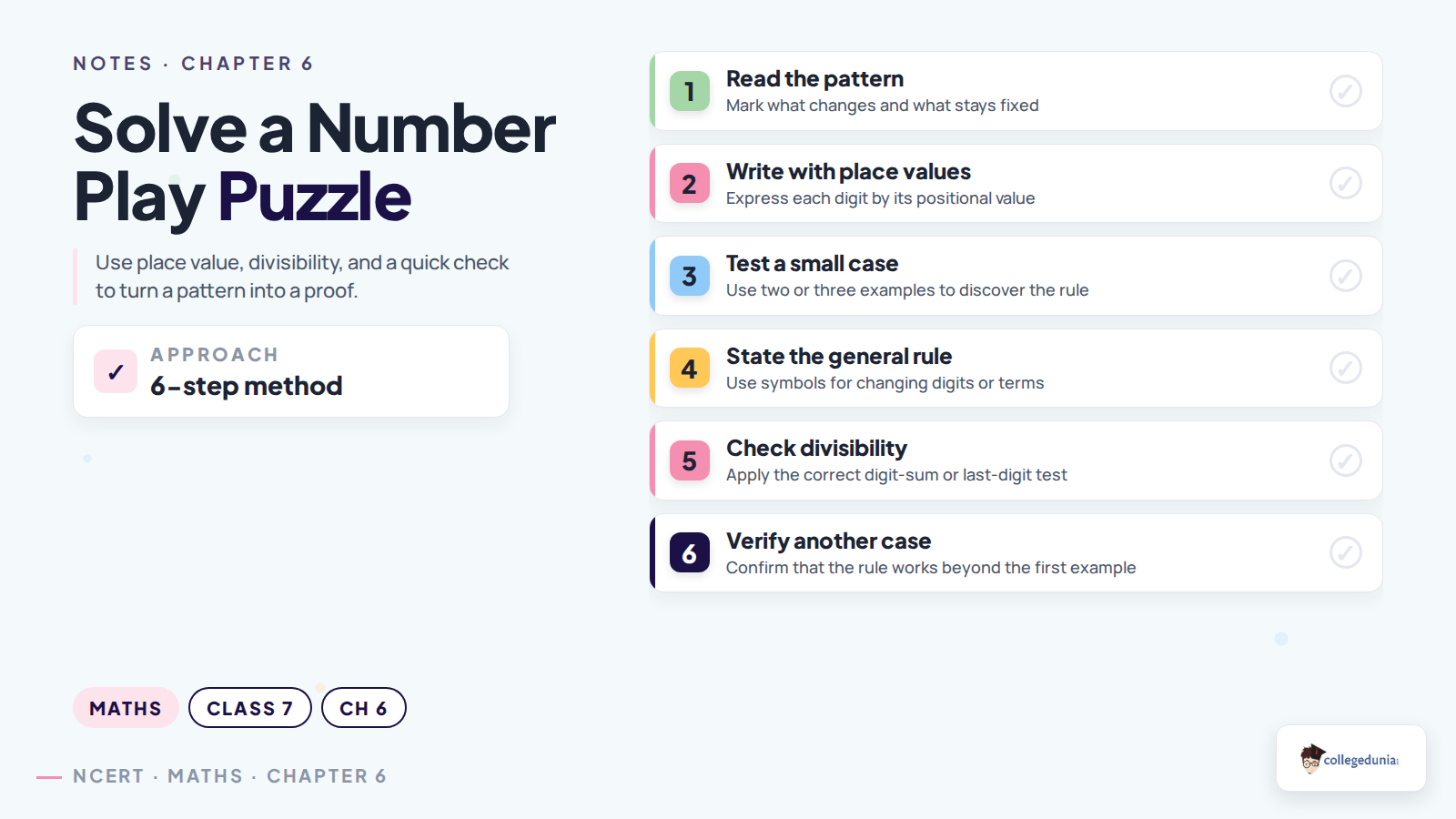
Digit puzzles replace one or more digits with letters or shapes. Each symbol keeps the same value wherever it appears. Place value and carrying reveal the answer.
- Begin with the units column.
- Record any carry above the next column.
- Use the same digit for every matching symbol.
- Check the complete addition after finding all digits.
A leading symbol cannot be zero in a multi-digit number. Column-by-column checking is safer than guessing the whole number.
Common Mistakes Students Make in Number Play
Most errors happen when a pattern is accepted after one example. A rule needs reasoning or several careful checks.
- Do not decide a sum's parity by looking only at its largest addend.
- Do not call every square grid a magic square.
- Do not skip carries in a missing-digit calculation.
- Do not continue a sequence before finding its actual rule.
A counterexample is enough to show that an “always true” claim is false. Use one when a statement fails.
Number Play Class 7 Related Resources
Use the textbook for activities and the handwritten notes for a short final recap.
| Resource | Link |
|---|---|
| NCERT Book PDF | Number Play Class 7 NCERT Book PDF |
| Handwritten Notes | Number Play Class 7 Handwritten Notes |
NCERT Notes for Class 7 Mathematics (Part 1): All Chapters
Use this table to move between Mathematics (Part 1) notes during revision.
| Chapter | Notes |
|---|---|
| Chapter 1 | Large Numbers Around Us Notes |
| Chapter 3 | A Peek Beyond the Point Notes |
| Chapter 4 | Expressions using Letter-Numbers Notes |
| Chapter 5 | Parallel and Intersecting Lines Notes |
| Chapter 6 | Number Play Notes |
| Chapter 7 | A Tale of Three Intersecting Lines Notes |
| Chapter 8 | Working with Fractions Notes |
Number Play Class 7 Mathematics Notes FAQs
Ques. What is parity in Number Play?
Ans. Parity is the property of a whole number being even or odd.
Ques. What is the sum of two odd numbers?
Ans. The sum is always even because the two unpaired items form one more pair.
Ques. When is the product of two numbers odd?
Ans. The product is odd only when both numbers are odd.
Ques. What makes a number grid a magic square?
Ans. Every row, column, and main diagonal must have the same sum.
Ques. What is the rule of the Virahanka sequence?
Ans. Add the previous two terms to get the next term. The chapter begins with 1, 2, 3, 5, 8.
Ques. How should students solve digits-in-disguise puzzles?
Ans. Start from the units column, track carries, and keep each repeated symbol equal to the same digit.
Ques. Are these notes based on the 2026-27 NCERT book?
Ans. Yes. They follow Chapter 6 of the 2026-27 Ganita Prakash Mathematics (Part 1) book for Grade 7.



Comments