



Inside the Working with Fractions Class 7 notes, you will find multiplication rules, division methods, mixed-number steps, and fraction problems from daily life. The explanations follow the 2026-27 NCERT Mathematics (Part 1) book and show each calculation in a clear order.
- Chapter focus: Multiply and divide fractions without mixing up the numerator and denominator.
- Key skill: Convert mixed numbers into improper fractions before calculating.
- Revision goal: Estimate first, solve carefully, and check whether the answer is reasonable.
Chapter8WorkingwithFractionsNotes.pdf?page=1&dpi=150)
Chapter8WorkingwithFractionsNotes.pdf?page=2&dpi=150)
Chapter8WorkingwithFractionsNotes.pdf?page=3&dpi=150)
Chapter8WorkingwithFractionsNotes.pdf?page=4&dpi=150)
Chapter8WorkingwithFractionsNotes.pdf?page=5&dpi=150)
Chapter8WorkingwithFractionsNotes.pdf?page=6&dpi=150)
Chapter8WorkingwithFractionsNotes.pdf?page=7&dpi=150)
Chapter8WorkingwithFractionsNotes.pdf?page=8&dpi=150)
Chapter8WorkingwithFractionsNotes.pdf?page=9&dpi=150)
Chapter8WorkingwithFractionsNotes.pdf?page=10&dpi=150)
Chapter8WorkingwithFractionsNotes.pdf?page=11&dpi=150)
Chapter8WorkingwithFractionsNotes.pdf?page=12&dpi=150)
Chapter8WorkingwithFractionsNotes.pdf?page=13&dpi=150)
Chapter8WorkingwithFractionsNotes.pdf?page=14&dpi=150)
Chapter8WorkingwithFractionsNotes.pdf?page=15&dpi=150)
Chapter8WorkingwithFractionsNotes.pdf?page=16&dpi=150)
Chapter8WorkingwithFractionsNotes.pdf?page=17&dpi=150)
Chapter8WorkingwithFractionsNotes.pdf?page=18&dpi=150)
Chapter8WorkingwithFractionsNotes.pdf?page=19&dpi=150)
Chapter8WorkingwithFractionsNotes.pdf?page=20&dpi=150)
Chapter8WorkingwithFractionsNotes.pdf?page=21&dpi=150)
Chapter8WorkingwithFractionsNotes.pdf?page=22&dpi=150)
Chapter8WorkingwithFractionsNotes.pdf?page=23&dpi=150)
Chapter8WorkingwithFractionsNotes.pdf?page=24&dpi=150)
Chapter8WorkingwithFractionsNotes_flat_MobileCard.pdf?page=1&dpi=150)
Chapter8WorkingwithFractionsNotes_flat_MobileCard.pdf?page=2&dpi=150)
Chapter8WorkingwithFractionsNotes_flat_MobileCard.pdf?page=3&dpi=150)
Chapter8WorkingwithFractionsNotes_flat_MobileCard.pdf?page=4&dpi=150)
Chapter8WorkingwithFractionsNotes_flat_MobileCard.pdf?page=5&dpi=150)
Chapter8WorkingwithFractionsNotes_flat_MobileCard.pdf?page=6&dpi=150)
Chapter8WorkingwithFractionsNotes_flat_MobileCard.pdf?page=7&dpi=150)
Chapter8WorkingwithFractionsNotes_flat_MobileCard.pdf?page=8&dpi=150)
Chapter8WorkingwithFractionsNotes_flat_MobileCard.pdf?page=9&dpi=150)
Chapter8WorkingwithFractionsNotes_flat_MobileCard.pdf?page=10&dpi=150)
Chapter8WorkingwithFractionsNotes_flat_MobileCard.pdf?page=11&dpi=150)
Chapter8WorkingwithFractionsNotes_flat_MobileCard.pdf?page=12&dpi=150)
Chapter8WorkingwithFractionsNotes_flat_MobileCard.pdf?page=13&dpi=150)
Chapter8WorkingwithFractionsNotes_flat_MobileCard.pdf?page=14&dpi=150)
Chapter8WorkingwithFractionsNotes_flat_MobileCard.pdf?page=15&dpi=150)
Chapter8WorkingwithFractionsNotes_flat_MobileCard.pdf?page=16&dpi=150)
Chapter8WorkingwithFractionsNotes_flat_MobileCard.pdf?page=17&dpi=150)
Chapter8WorkingwithFractionsNotes_flat_MobileCard.pdf?page=18&dpi=150)
Chapter8WorkingwithFractionsNotes_flat_MobileCard.pdf?page=19&dpi=150)
Chapter8WorkingwithFractionsNotes_flat_MobileCard.pdf?page=20&dpi=150)
Chapter8WorkingwithFractionsNotes_flat_MobileCard.pdf?page=21&dpi=150)
Chapter8WorkingwithFractionsNotes_flat_MobileCard.pdf?page=22&dpi=150)
Chapter8WorkingwithFractionsNotes_flat_MobileCard.pdf?page=23&dpi=150)
Chapter8WorkingwithFractionsNotes_flat_MobileCard.pdf?page=24&dpi=150)
Chapter8WorkingwithFractionsNotes_flat_MobileCard.pdf?page=25&dpi=150)
Chapter8WorkingwithFractionsNotes_flat_MobileCard.pdf?page=26&dpi=150)
Chapter8WorkingwithFractionsNotes_flat_MobileCard.pdf?page=27&dpi=150)
Chapter8WorkingwithFractionsNotes_flat_MobileCard.pdf?page=28&dpi=150)
Chapter8WorkingwithFractionsNotes_flat_MobileCard.pdf?page=29&dpi=150)
These Collegedunia notes follow the 2026-27 NCERT Ganita Prakash chapter and explain every fraction rule with simple examples.
|
Table of Contents |
Working with Fractions Topic Map for Class 7 Mathematics
Working with Fractions builds on the meaning of a fraction and then moves to operations. The main challenge is choosing the correct rule for each question.
| Topic | Main idea | Revision priority |
|---|---|---|
| Fraction of a quantity | Multiply the quantity by the given fraction | High |
| Fraction multiplication | Multiply numerators and denominators | High |
| Fraction division | Multiply by the reciprocal of the divisor | High |
| Mixed numbers | Convert before multiplying or dividing | Medium |
| Word problems | Translate “of” and sharing language into operations | Medium |
Working with Fractions One-Shot Revision
Source: Magnet Brains on YouTube
Finding a Fraction of a Quantity with Clear Steps
The word of usually means multiplication in a fraction question. First divide the quantity by the denominator. Then multiply that result by the numerator.
- Read the whole quantity and its unit.
- Divide the whole by the fraction's denominator.
- Multiply the result by the numerator.
- Write the correct unit with the answer.
To find 3/5 of 40, calculate 40 divided by 5, then multiply by 3. The answer is 24. Dividing by the denominator first often keeps the numbers small.
Multiplying Fractions and Mixed Numbers Correctly
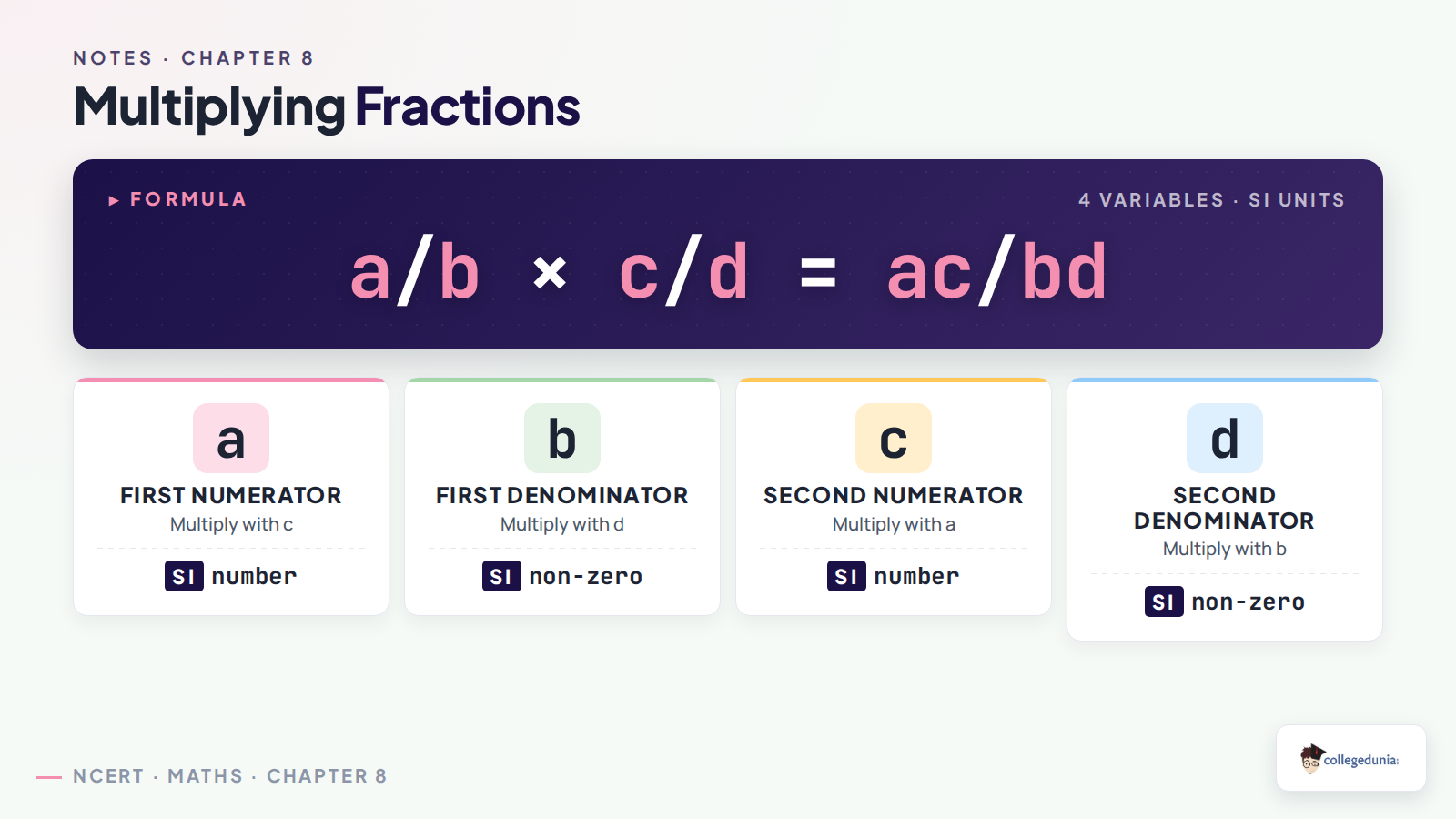
For two fractions, multiply the numerators together and the denominators together. Simplify before or after multiplication. Both ways give the same result.
- Change every whole number into a fraction with denominator 1.
- Change each mixed number into an improper fraction.
- Cancel common factors across a numerator and denominator.
- Multiply the remaining values and simplify the answer.
For 2/3 times 9/10, cancel 3 with 9 and 2 with 10. The remaining calculation is 1 times 3 over 1 times 5, giving 3/5. Cancellation changes the form of the numbers, not the value of the product.
Dividing Fractions by Using the Reciprocal Rule
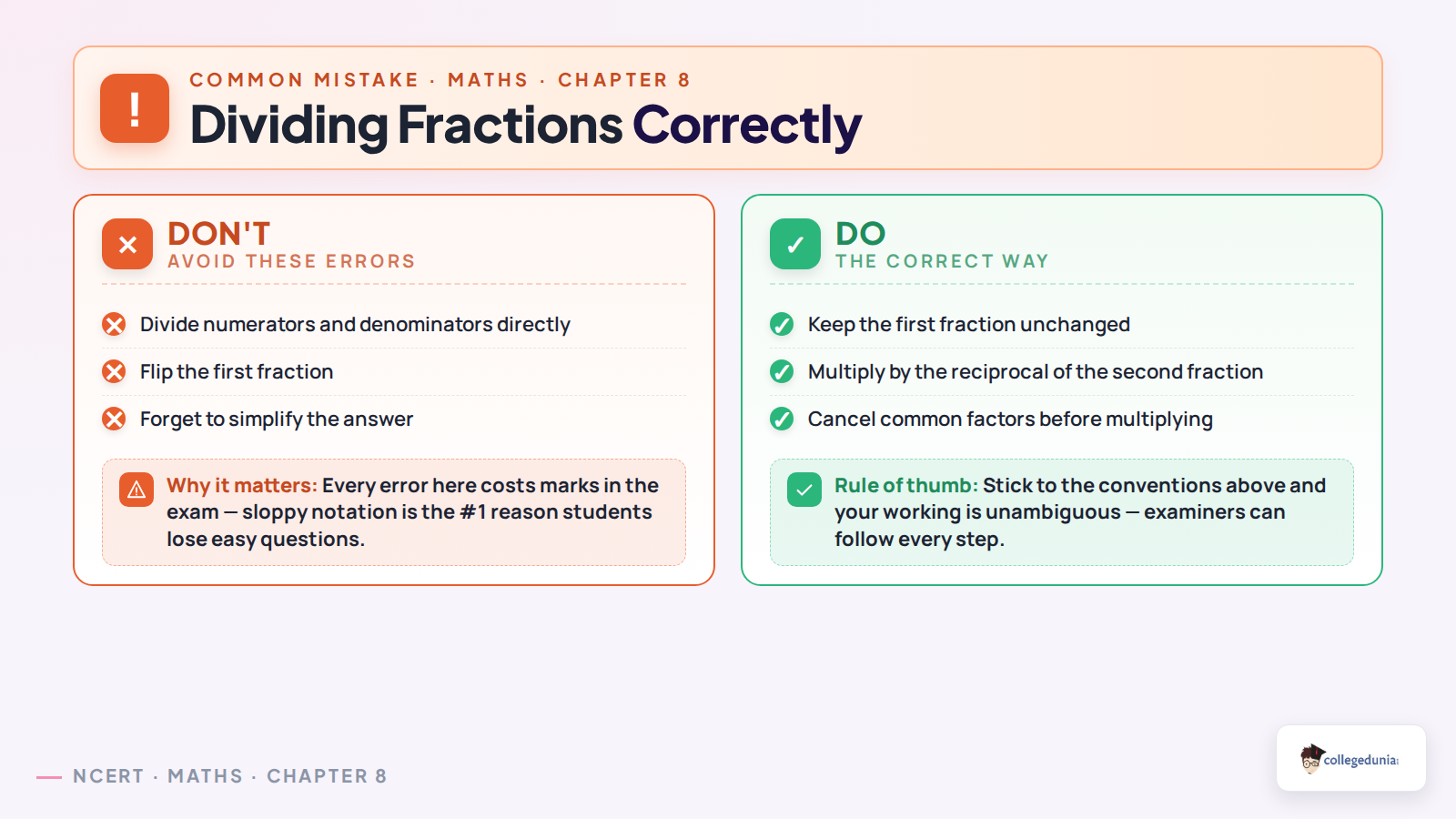
Division asks how many groups of one number fit inside another. When the divisor is non-zero, keep the first fraction and multiply by the reciprocal of the second.
| Question type | Rewrite | Next step |
|---|---|---|
| Fraction divided by fraction | Keep the first; invert the second | Multiply and simplify |
| Whole number divided by fraction | Write the whole number over 1 | Multiply by the reciprocal |
| Fraction divided by whole number | Write the whole number over 1 | Invert it, then multiply |
| Mixed number division | Convert both mixed numbers first | Use the same reciprocal rule |
For 3/4 divided by 2/5, change division to multiplication and invert 2/5. The calculation becomes 3/4 times 5/2, which equals 15/8 or 1 7/8.
Estimating Fraction Answers Before Calculating
Estimation helps you catch an answer that is too large or too small. Compare each fraction with 0, 1/2, or 1 before doing the exact work.
- A proper fraction lies between 0 and 1.
- Multiplying by a proper fraction makes a positive number smaller.
- Dividing by a proper fraction makes a positive number larger.
- A product near 1/2 should not suddenly become a large whole number.
A reasonable estimate is a fast check, not a replacement for exact working. Write the exact fraction unless the question asks for an estimate.
Common Mistakes in Working with Fractions Questions
Most errors come from using an addition rule during multiplication or inverting the wrong fraction during division. A short check prevents both mistakes.
- Do not find a common denominator for multiplication.
- Do not multiply a mixed number before converting it.
- Do not invert both fractions in a division question.
- Do not cancel terms joined by addition or subtraction.
- Do not leave an improper fraction unsimplified when a mixed answer is expected.
Check the operation sign before each line of working. Many wrong answers begin when division changes to multiplication without inverting the divisor.
Working with Fractions Class 7 Related Resources
Use the NCERT book for chapter activities and the handwritten notes for a quick recap before practice.
| Resource | Link |
|---|---|
| NCERT Book PDF | Working with Fractions Class 7 NCERT Book PDF |
| Handwritten Notes | Working with Fractions Class 7 Handwritten Notes |
| Notes | Working with Fractions Class 7 Notes |
NCERT Notes for Class 7 Mathematics (Part 1): All Chapters
Use this table to move between Mathematics (Part 1) notes during revision.
| Chapter | Notes |
|---|---|
| Chapter 1 | Large Numbers Around Us Notes |
| Chapter 3 | A Peek Beyond the Point Notes |
| Chapter 4 | Expressions using Letter-Numbers Notes |
| Chapter 5 | Parallel and Intersecting Lines Notes |
| Chapter 6 | Number Play Notes |
| Chapter 7 | A Tale of Three Intersecting Lines Notes |
| Chapter 8 | Working with Fractions Notes |
Working with Fractions Class 7 Mathematics Notes FAQs
Ques. How do you multiply two fractions?
Ans. Multiply the numerators together and multiply the denominators together. Then simplify the product.
Ques. How do you divide one fraction by another?
Ans. Keep the first fraction, change division to multiplication, and invert the second fraction.
Ques. What is the reciprocal of a fraction?
Ans. For a non-zero fraction, the reciprocal is made by swapping the numerator and denominator. The reciprocal of 3/5 is 5/3.
Ques. How do you multiply mixed numbers?
Ans. Convert each mixed number into an improper fraction. Multiply the fractions and simplify the result.
Ques. Why is estimation useful in fraction questions?
Ans. Estimation shows whether an exact answer is reasonable and helps catch operation or calculation errors.
Ques. Can terms be cancelled across addition?
Ans. No. Cancellation works with common factors in multiplication, not with terms joined by addition or subtraction.
Ques. Are these Working with Fractions notes based on the 2026-27 NCERT book?
Ans. Yes. They follow Chapter 8 of the 2026-27 Ganita Prakash Mathematics (Part 1) book for Grade 7.



Comments