



The NCERT Notes for Class 7 Mathematics Part 2 Chapter 3 Finding Common Ground cover factors, common factors, HCF, multiples, LCM and the product relation for the 2026-27 textbook. Use these notes to revise how numbers find a shared base before solving chapter questions.
- Resource: Class 7 Maths Part 2 Chapter 3 Notes PDF.
- Chapter focus: prime factorisation, HCF, LCM, co-prime numbers and word problems.
- Revision use: quick rules, solved checks and common-trap reminders.
Chapter3FindingCommonGroundNotes.pdf?page=1&dpi=150)
Chapter3FindingCommonGroundNotes.pdf?page=2&dpi=150)
Chapter3FindingCommonGroundNotes.pdf?page=3&dpi=150)
Chapter3FindingCommonGroundNotes.pdf?page=4&dpi=150)
Chapter3FindingCommonGroundNotes.pdf?page=5&dpi=150)
Chapter3FindingCommonGroundNotes.pdf?page=6&dpi=150)
Chapter3FindingCommonGroundNotes.pdf?page=7&dpi=150)
Chapter3FindingCommonGroundNotes.pdf?page=8&dpi=150)
Chapter3FindingCommonGroundNotes.pdf?page=9&dpi=150)
Chapter3FindingCommonGroundNotes.pdf?page=10&dpi=150)
Chapter3FindingCommonGroundNotes.pdf?page=11&dpi=150)
Chapter3FindingCommonGroundNotes.pdf?page=12&dpi=150)
Chapter3FindingCommonGroundNotes.pdf?page=13&dpi=150)
Chapter3FindingCommonGroundNotes.pdf?page=14&dpi=150)
Chapter3FindingCommonGroundNotes.pdf?page=15&dpi=150)
Chapter3FindingCommonGroundNotes.pdf?page=16&dpi=150)
Chapter3FindingCommonGroundNotes.pdf?page=17&dpi=150)
Chapter3FindingCommonGroundNotes.pdf?page=18&dpi=150)
Chapter3FindingCommonGroundNotes.pdf?page=19&dpi=150)
Chapter3FindingCommonGroundNotes.pdf?page=20&dpi=150)
Chapter3FindingCommonGroundNotes.pdf?page=21&dpi=150)
Chapter3FindingCommonGroundNotes.pdf?page=22&dpi=150)
Chapter3FindingCommonGroundNotes.pdf?page=23&dpi=150)
Chapter3FindingCommonGroundNotes.pdf?page=24&dpi=150)
Chapter3FindingCommonGroundNotes.pdf?page=25&dpi=150)
Chapter3FindingCommonGroundNotes.pdf?page=26&dpi=150)
Chapter3FindingCommonGroundNotes.pdf?page=27&dpi=150)
Chapter3FindingCommonGroundNotes.pdf?page=28&dpi=150)
Chapter3FindingCommonGroundNotes.pdf?page=29&dpi=150)
Chapter3FindingCommonGroundNotes.pdf?page=30&dpi=150)
Chapter3FindingCommonGroundNotes_flat_MobileCard.pdf?page=1&dpi=150)
Chapter3FindingCommonGroundNotes_flat_MobileCard.pdf?page=2&dpi=150)
Chapter3FindingCommonGroundNotes_flat_MobileCard.pdf?page=3&dpi=150)
Chapter3FindingCommonGroundNotes_flat_MobileCard.pdf?page=4&dpi=150)
Chapter3FindingCommonGroundNotes_flat_MobileCard.pdf?page=5&dpi=150)
Chapter3FindingCommonGroundNotes_flat_MobileCard.pdf?page=6&dpi=150)
Chapter3FindingCommonGroundNotes_flat_MobileCard.pdf?page=7&dpi=150)
Chapter3FindingCommonGroundNotes_flat_MobileCard.pdf?page=8&dpi=150)
Chapter3FindingCommonGroundNotes_flat_MobileCard.pdf?page=9&dpi=150)
Chapter3FindingCommonGroundNotes_flat_MobileCard.pdf?page=10&dpi=150)
Chapter3FindingCommonGroundNotes_flat_MobileCard.pdf?page=11&dpi=150)
Chapter3FindingCommonGroundNotes_flat_MobileCard.pdf?page=12&dpi=150)
Chapter3FindingCommonGroundNotes_flat_MobileCard.pdf?page=13&dpi=150)
Chapter3FindingCommonGroundNotes_flat_MobileCard.pdf?page=14&dpi=150)
Chapter3FindingCommonGroundNotes_flat_MobileCard.pdf?page=15&dpi=150)
Chapter3FindingCommonGroundNotes_flat_MobileCard.pdf?page=16&dpi=150)
Chapter3FindingCommonGroundNotes_flat_MobileCard.pdf?page=17&dpi=150)
Chapter3FindingCommonGroundNotes_flat_MobileCard.pdf?page=18&dpi=150)
Chapter3FindingCommonGroundNotes_flat_MobileCard.pdf?page=19&dpi=150)
Chapter3FindingCommonGroundNotes_flat_MobileCard.pdf?page=20&dpi=150)
Chapter3FindingCommonGroundNotes_flat_MobileCard.pdf?page=21&dpi=150)
Chapter3FindingCommonGroundNotes_flat_MobileCard.pdf?page=22&dpi=150)
Chapter3FindingCommonGroundNotes_flat_MobileCard.pdf?page=23&dpi=150)
Chapter3FindingCommonGroundNotes_flat_MobileCard.pdf?page=24&dpi=150)
Chapter3FindingCommonGroundNotes_flat_MobileCard.pdf?page=25&dpi=150)
Chapter3FindingCommonGroundNotes_flat_MobileCard.pdf?page=26&dpi=150)
Chapter3FindingCommonGroundNotes_flat_MobileCard.pdf?page=27&dpi=150)
Chapter3FindingCommonGroundNotes_flat_MobileCard.pdf?page=28&dpi=150)
Chapter3FindingCommonGroundNotes_flat_MobileCard.pdf?page=29&dpi=150)
Chapter3FindingCommonGroundNotes_flat_MobileCard.pdf?page=30&dpi=150)
Chapter3FindingCommonGroundNotes_flat_MobileCard.pdf?page=31&dpi=150)
Chapter3FindingCommonGroundNotes_flat_MobileCard.pdf?page=32&dpi=150)
Chapter3FindingCommonGroundNotes_flat_MobileCard.pdf?page=33&dpi=150)
Chapter3FindingCommonGroundNotes_flat_MobileCard.pdf?page=34&dpi=150)
Chapter3FindingCommonGroundNotes_flat_MobileCard.pdf?page=35&dpi=150)
Chapter3FindingCommonGroundNotes_flat_MobileCard.pdf?page=36&dpi=150)
Chapter3FindingCommonGroundNotes_flat_MobileCard.pdf?page=37&dpi=150)
Chapter3FindingCommonGroundNotes_flat_MobileCard.pdf?page=38&dpi=150)
Chapter3FindingCommonGroundNotes_flat_MobileCard.pdf?page=39&dpi=150)
Chapter3FindingCommonGroundNotes_flat_MobileCard.pdf?page=40&dpi=150)
Chapter3FindingCommonGroundNotes_flat_MobileCard.pdf?page=41&dpi=150)
Chapter3FindingCommonGroundNotes_flat_MobileCard.pdf?page=42&dpi=150)
Student Feedback: Students usually improve when they decide first whether the story is asking for sharing groups or repeated cycles.
Finding Common Ground Class 7 Notes Overview
Finding Common Ground is about comparing two or more numbers through their factors and multiples. A factor divides a number exactly, while a multiple is obtained by multiplying the number by whole numbers.
The chapter builds two main tools. HCF is useful when a situation asks for the greatest equal sharing size, and LCM is useful when repeated events have to meet again. Prime factorisation keeps both calculations organised.
Finding Common Ground Video Lesson
Source: Magnet Brains on YouTube
Factors, Multiples and Common Ground
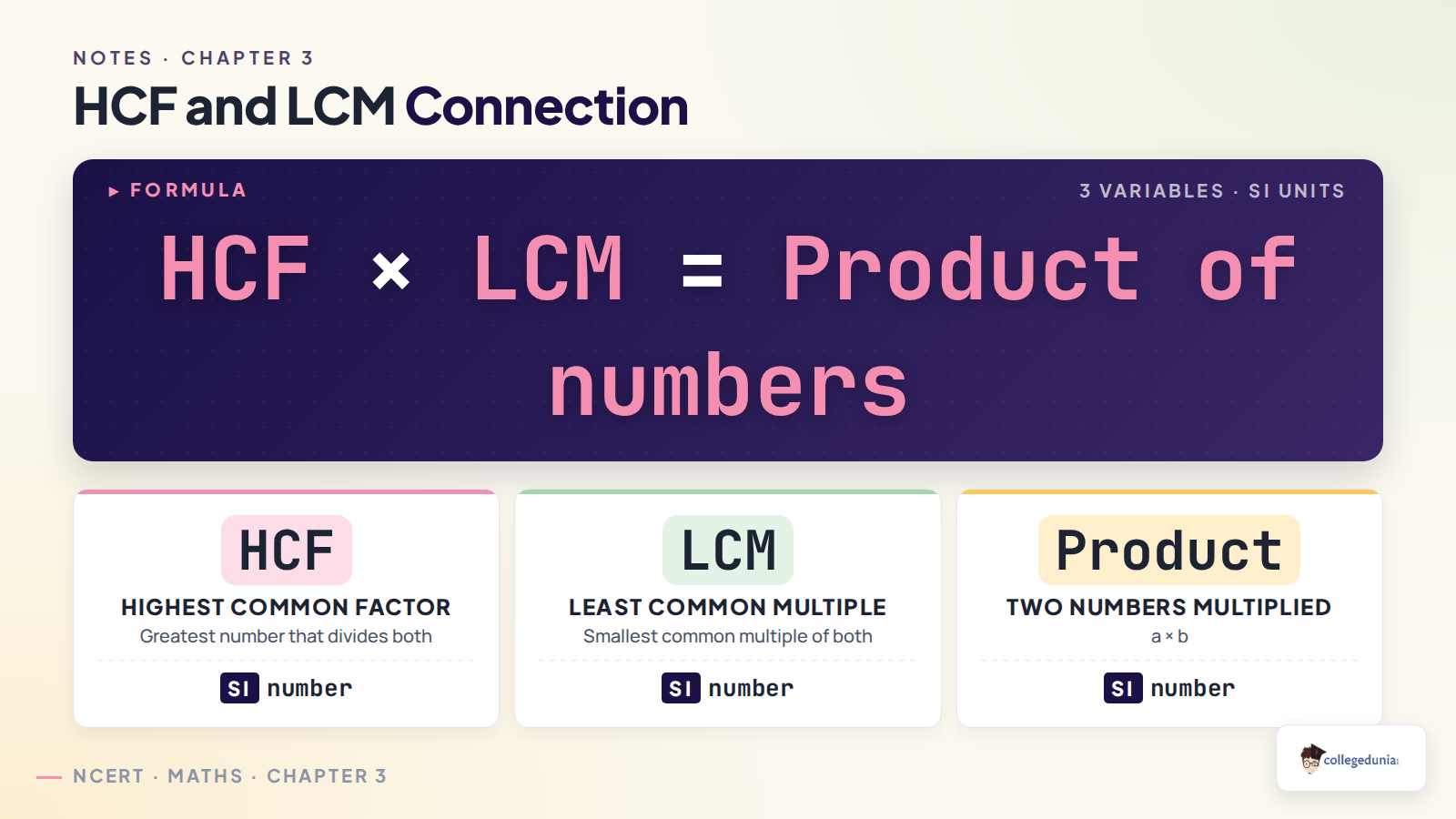
Common factors are factors shared by two numbers. Common multiples are multiples shared by two numbers. The greatest common factor becomes the HCF, and the least common multiple becomes the LCM.
| Term | Meaning | Example |
|---|---|---|
| Factor | Divides a number exactly | 4 is a factor of 16 |
| Multiple | Obtained by repeated multiplication | 16, 32, 48 are multiples of 16 |
| HCF | Highest common factor | HCF of 12 and 16 is 4 |
| LCM | Least common multiple | LCM of 12 and 16 is 48 |
Prime Factorisation Method for HCF and LCM
Prime factorisation rewrites every number as a product of prime numbers. Once the prime factors are written, the HCF uses only common prime factors with their smaller powers. The LCM uses all prime factors with their highest powers.
For two positive numbers, the relation is:
| Numbers | HCF | LCM | Check |
|---|---|---|---|
| 12 and 16 | 4 | 48 | 4 x 48 = 12 x 16 |
| 45 and 105 | 15 | 315 | 15 x 315 = 45 x 105 |
| 84 and 108 | 12 | 756 | 12 x 756 = 84 x 108 |
Choosing HCF or LCM in Word Problems
Word problems often give the clue before the numbers. Equal grouping, largest tile size and maximum sharing usually point to HCF. Events repeating together, bells ringing again and minimum common quantity usually point to LCM.
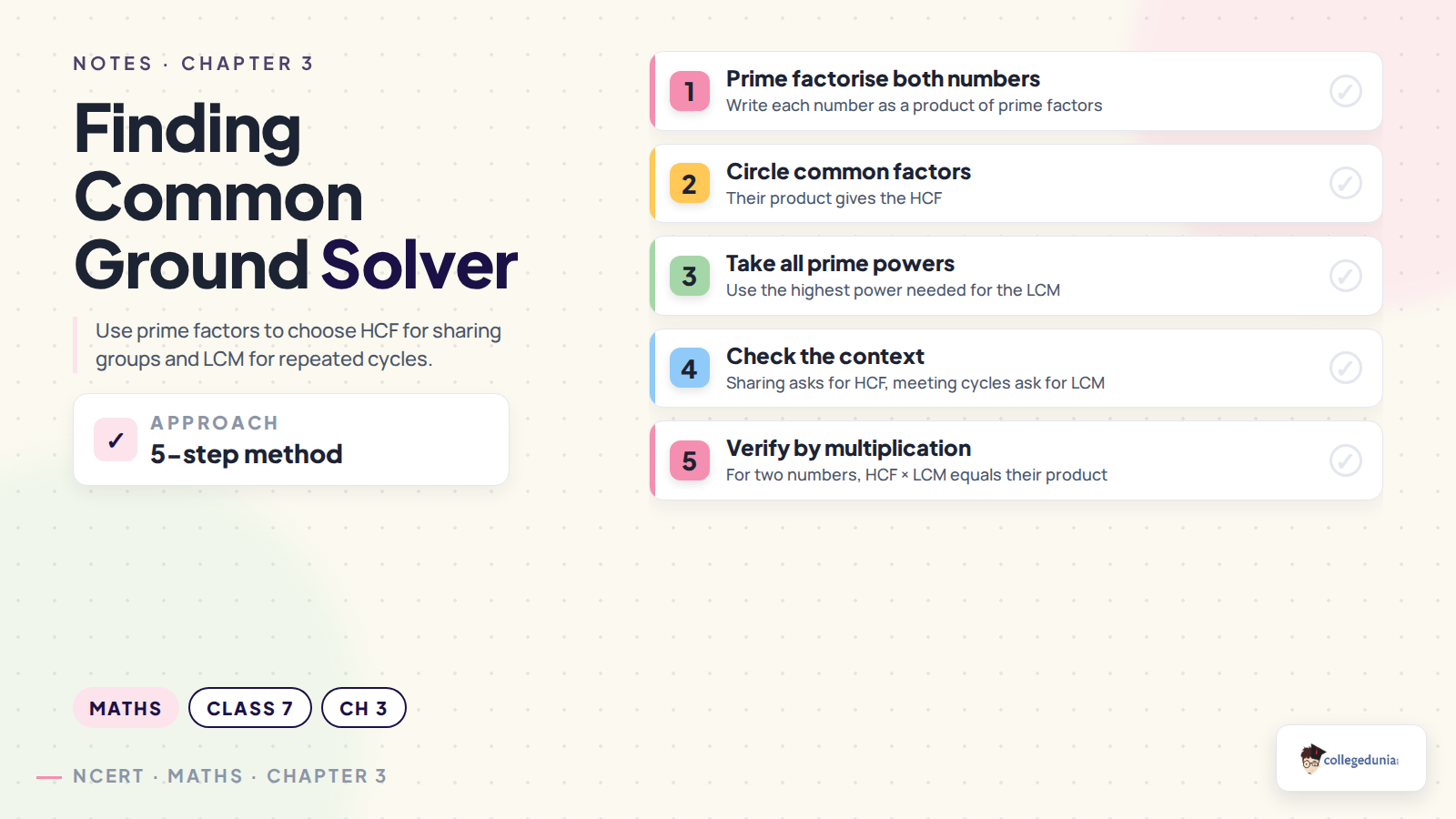
- Use HCF when the answer must divide each given number exactly.
- Use LCM when the answer must be a common multiple of all given numbers.
- Check units because time, length and item-count questions can look similar.
- Verify the result by testing whether it satisfies every condition in the question.
Finding Common Ground Important Results
The chapter also introduces co-prime numbers and number patterns. Two numbers are co-prime if their HCF is 1. They do not have to be prime individually; for example, 8 and 15 are co-prime.
| Idea | Rule | Quick check |
|---|---|---|
| Co-prime numbers | HCF is 1 | 8 and 15 |
| Prime factor tree | Keep splitting until all factors are prime | 84 = 2 x 2 x 3 x 7 |
| Common factor | Appears in both factor lists | 1, 2, 4 for 12 and 16 |
| LCM check | Must be divisible by both numbers | 48 is divisible by 12 and 16 |
How to Use These Finding Common Ground Notes
Start with the meaning of factor and multiple. Then practise one HCF example, one LCM example and one word problem. This sequence keeps the chapter clear and prevents formula memorisation without context.
- List factors for small numbers before using prime factorisation.
- Use factor trees for larger numbers such as 84 and 108.
- Write HCF and LCM with a short reason, not only the final number.
- Check whether the story asks for largest, smallest, sharing or repetition.
Do not treat every two-number question as an LCM question. A rectangular room tiled with the largest possible square tile needs HCF, not LCM.
Class 7 Maths Part 2 Chapter 3 Resource Links
Use these related resources when you want the same chapter in another format.
| Resource | Best use | Link |
|---|---|---|
| NCERT Notes | Quick concept revision | Open notes |
| NCERT Solutions | Step-by-step answers for textbook questions | Open solutions |
| Handwritten Notes | Fast visual revision | Open handwritten notes |
| NCERT Book PDF | Official textbook chapter | Open book PDF |
All NCERT Notes for Class 7 Mathematics Part 2 Chapters
| Chapter | Title | Notes link |
|---|---|---|
| Chapter 1 | Geometric Twins | Open Notes |
| Chapter 2 | Operations with Integers | Open Notes |
| Chapter 3 | Finding Common Ground | Open Notes |
| Chapter 4 | Another Peek Beyond the Point | Open Notes |
| Chapter 5 | Connecting the Dots | Open Notes |
| Chapter 6 | Constructions and Tilings | Open Notes |
| Chapter 7 | Finding the Unknown | Open Notes |
Finding Common Ground Class 7 Maths NCERT Notes FAQs
Ques. What does Class 7 Maths Chapter 3 Finding Common Ground explain?
Ans. It explains factors, multiples, common factors, HCF, LCM, prime factorisation and word problems based on common sharing or repetition.
Ques. What is the difference between HCF and LCM?
Ans. HCF is the highest number that divides the given numbers exactly. LCM is the smallest number that is a multiple of the given numbers.
Ques. How do I know whether to use HCF or LCM?
Ans. Use HCF for largest equal groups or tile sizes. Use LCM for repeated events, cycles or the smallest common quantity.
Ques. Do these notes follow the 2026-27 NCERT textbook?
Ans. Yes. The notes follow the 2026-27 Ganita Prakash Class 7 Mathematics Part 2 chapter on Finding Common Ground.



Comments