



Electricity: Circuits and their Components is the chapter where most students mix up an LED's positive and negative wires, or misread a circuit diagram with two switches. The NCERT Notes below walk through every symbol, wiring rule, and worked example for the 2026-27 session.
- Covers cells, batteries, lamps, LEDs, switches, circuit diagrams, and conductors and insulators from the 2026-27 NCERT Curiosity textbook.
- Includes quick-reference tables, LED polarity rules, and a common-mistakes checklist for fast revision.
- Free PDF download, matched to the 2026-27 NCERT Curiosity textbook.
These Class 7 Science notes for Electricity: Circuits and their Components are curated by subject experts and checked line by line against the 2026-27 NCERT Curiosity textbook.
Everyday Uses of Electricity and the Electric Cell
Electricity reaches homes and factories through wires, from sources such as hydroelectric dams, windmills, solar panels, and thermal power plants. This chapter studies a portable source instead: the electric cell.
| Category | Everyday Examples |
|---|---|
| Cooking | Electric kettle, mixer grinder, toaster, oven, microwave |
| Lighting | Homes, offices, streets, markets, factories |
| Transportation | Train, bus, car, scooter, lift, escalator |
| Heating and cooling | Fan, room heater, immersion rod, geyser, refrigerator, AC |
| Entertainment and communication | Television, radio, mobile phone, internet |
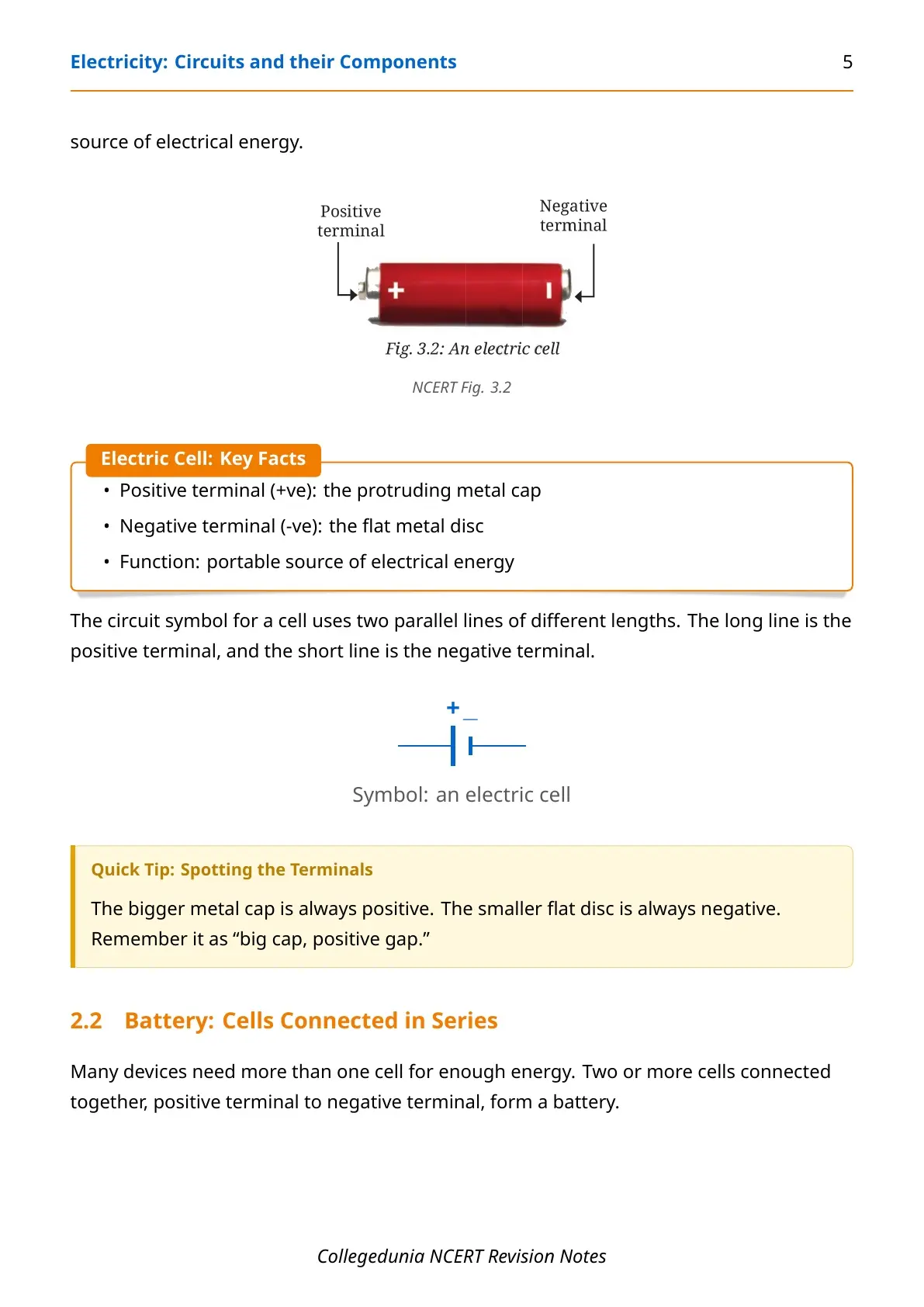
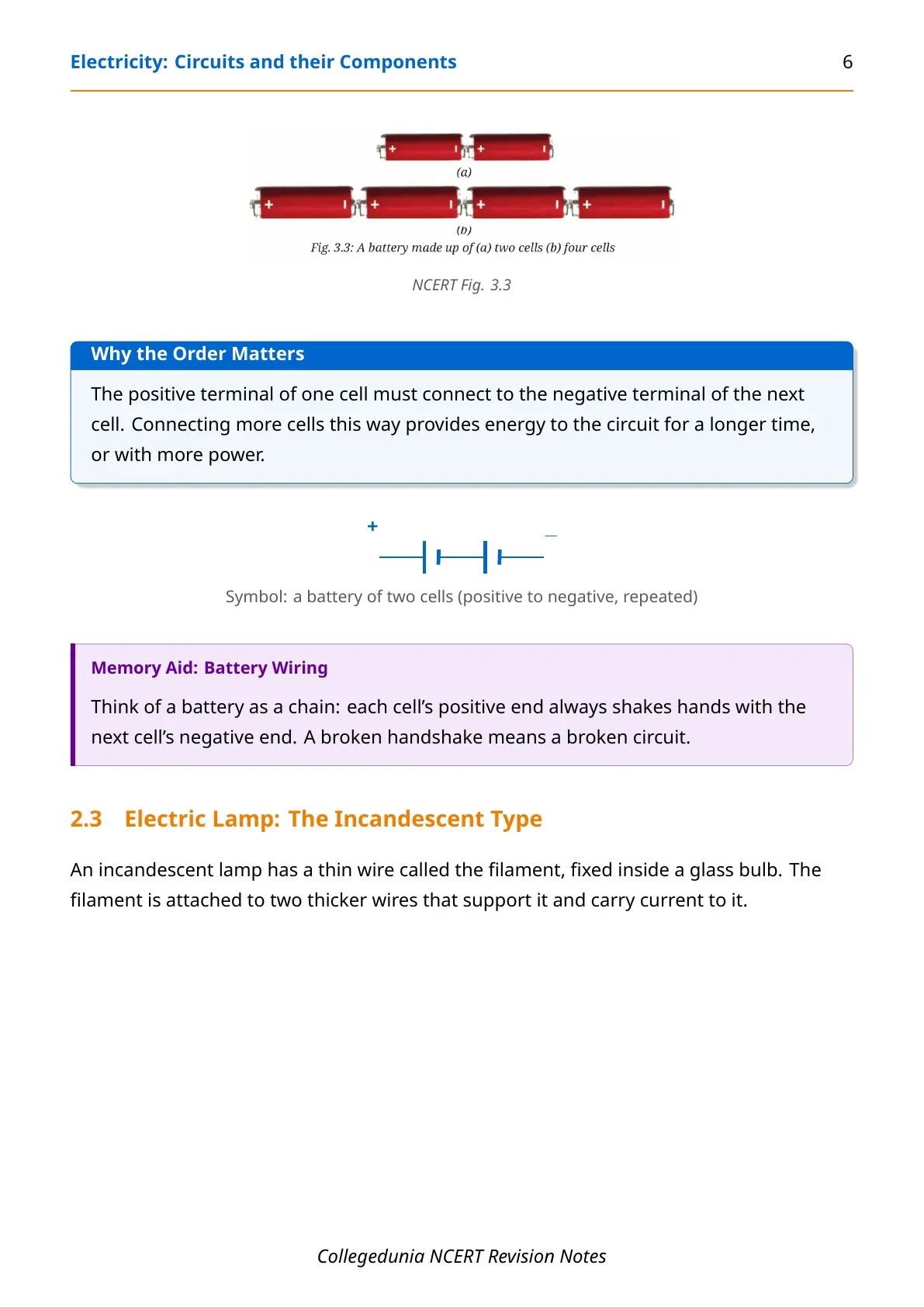
An electric cell has two terminals: a protruding metal cap that is the positive terminal, and a flat metal disc that is the negative terminal. It is a portable source of electrical energy, and two or more cells joined positive to negative form a battery.
Real-World Example: the Bhakra Nangal hydroelectric power house uses the force of falling water to generate electricity, one of many ways India generates the electricity that finally reaches our homes through wires.
What Happens Inside a Working Torch
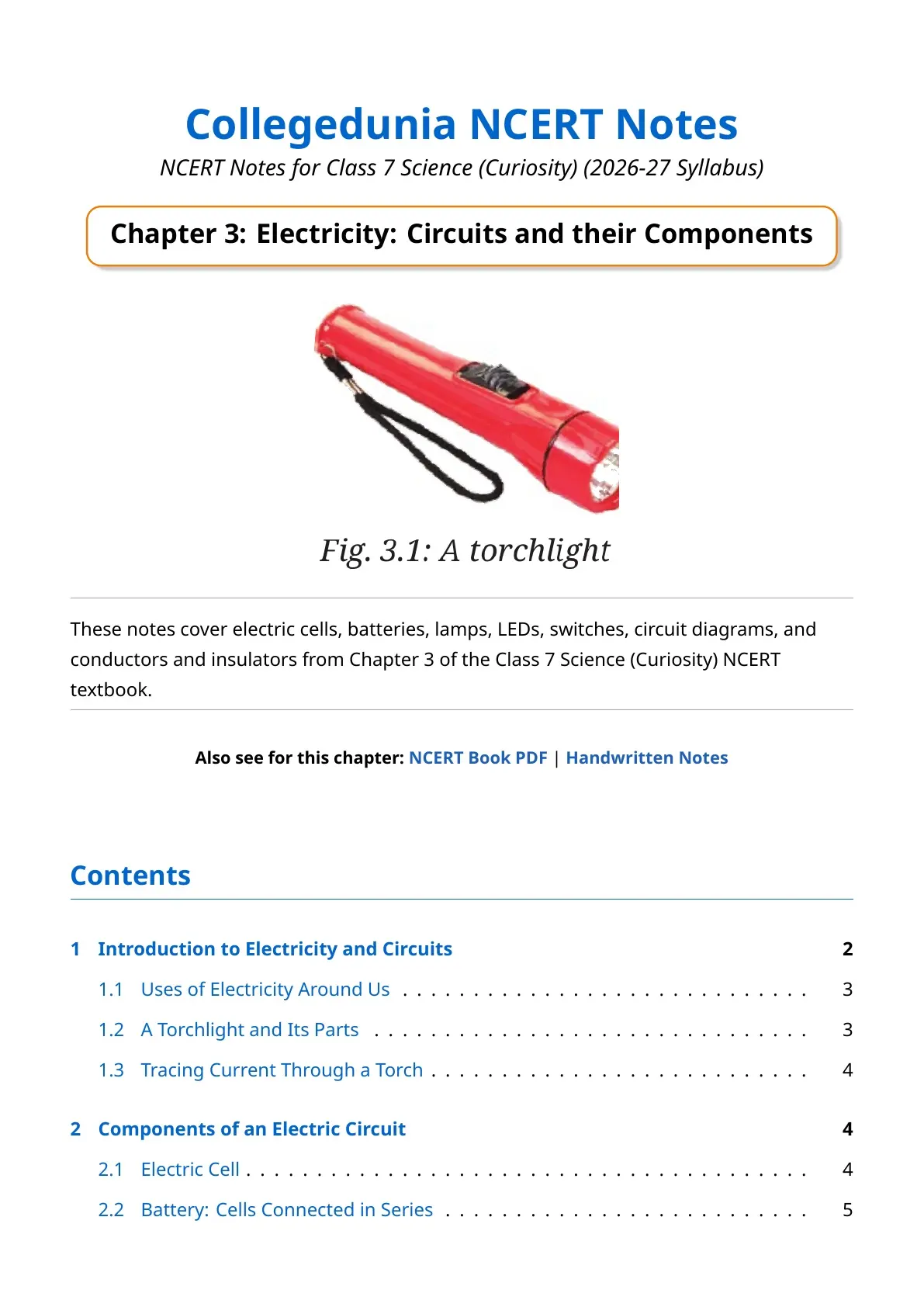
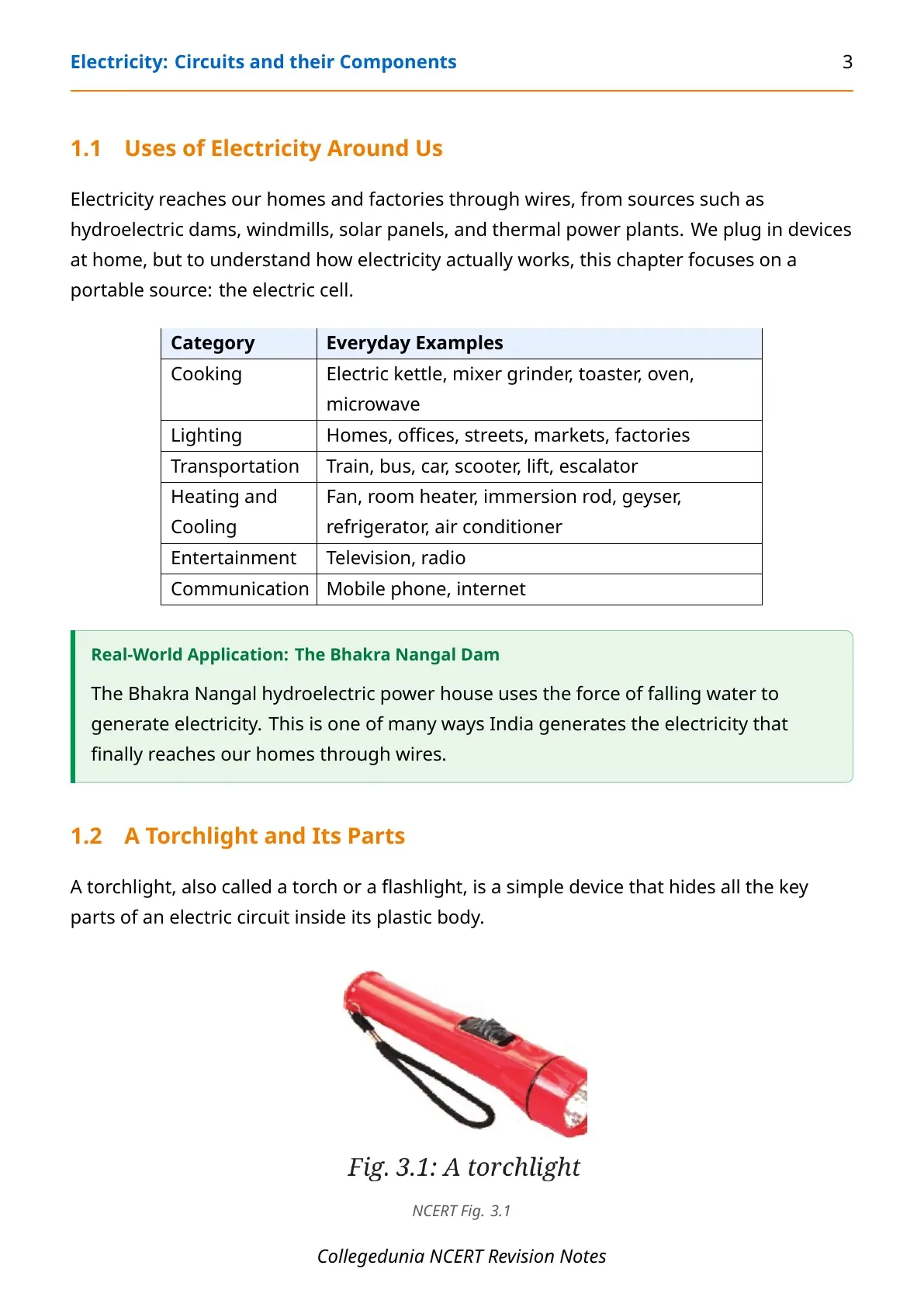
A torchlight hides every part of an electric circuit inside its plastic body: a lamp, a switch, and two or more cells. Opening one and sliding its switch is the fastest way to see a full circuit at work.
- The cells supply electrical energy from their positive terminal.
- Current travels through the wire, crosses a closed switch, passes through the lamp, and returns to the negative terminal.
- Break any one link in that loop, a fused filament or an open switch, and the whole path stops.
This one idea, a complete, unbroken loop, is the thread running through this entire chapter. Never test electricity using the home power supply; every activity in this chapter uses only cells or batteries, the same kind found in torches, wall clocks, and remotes.
Electricity: Circuits and their Components Explained in Simple Language
Source: Magnet Brains on YouTube
Circuit Symbols for Cells, Lamps, LEDs, and Switches
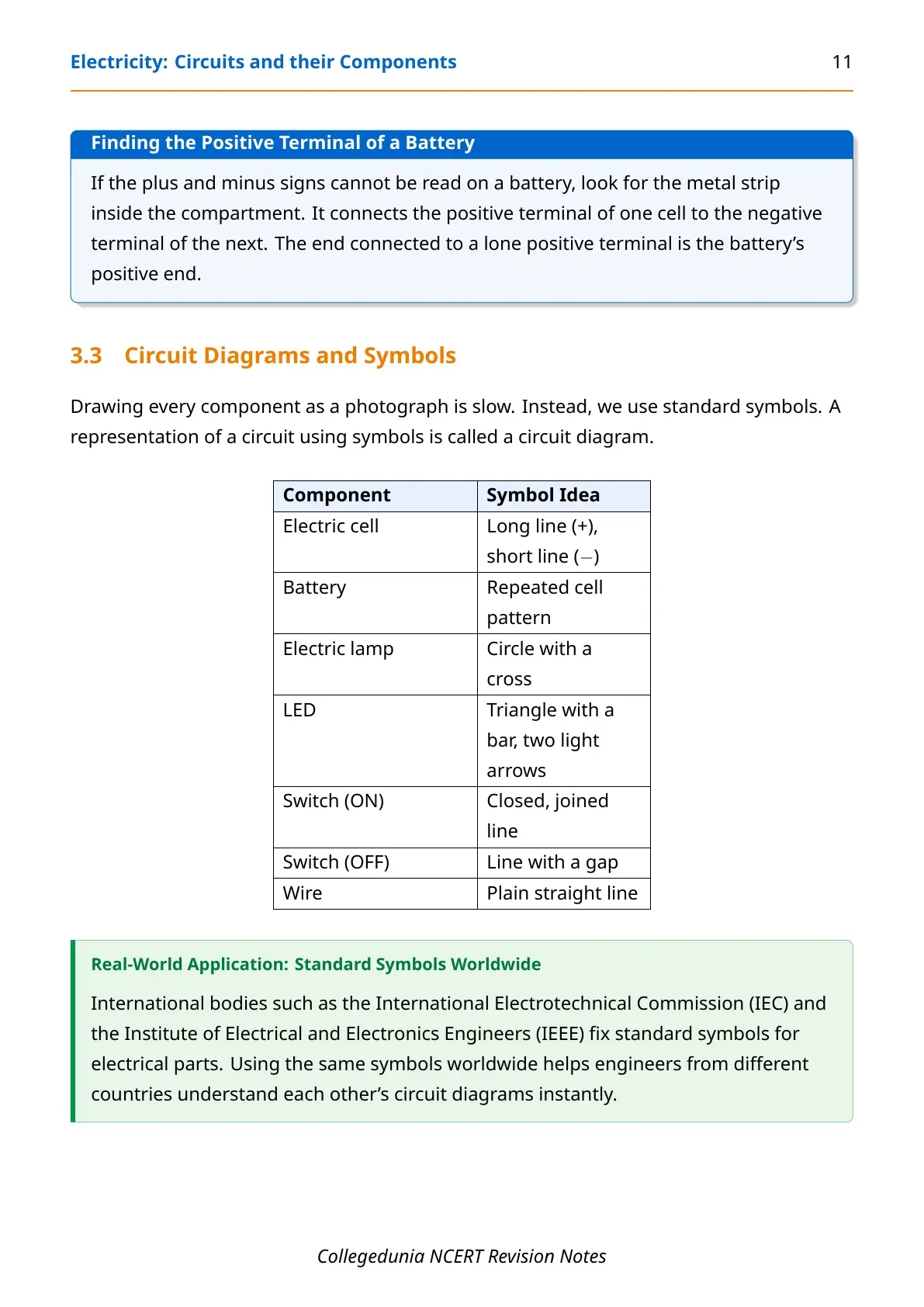
Drawing every part as a photograph is slow, so circuits are drawn using standard symbols instead. A circuit drawn this way is called a circuit diagram.
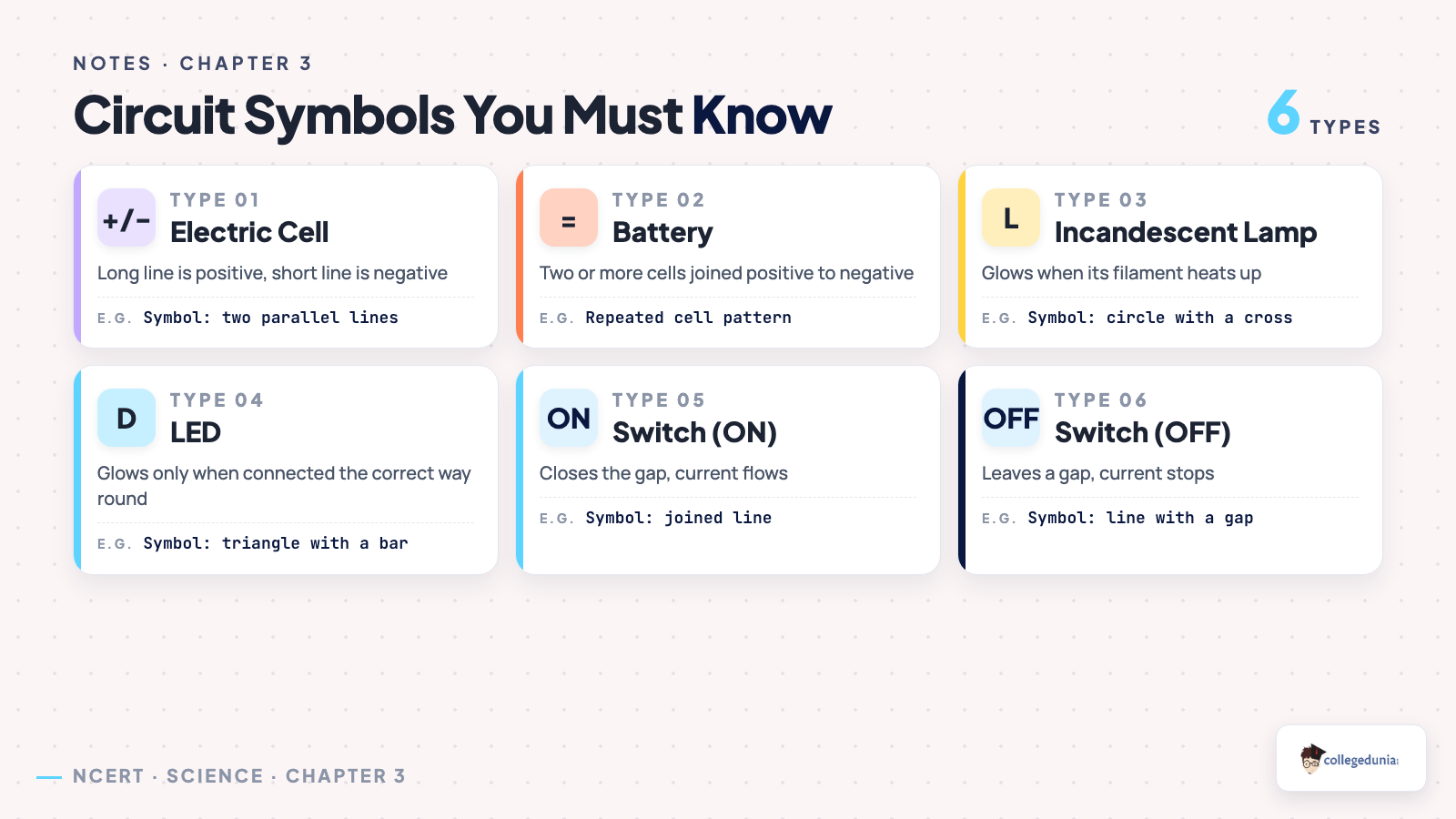
| Component | Symbol Idea | Key Fact |
|---|---|---|
| Electric cell | Long line (+), short line (−) | Bigger metal cap is always positive |
| Battery | Repeated cell pattern | Two or more cells joined positive to negative |
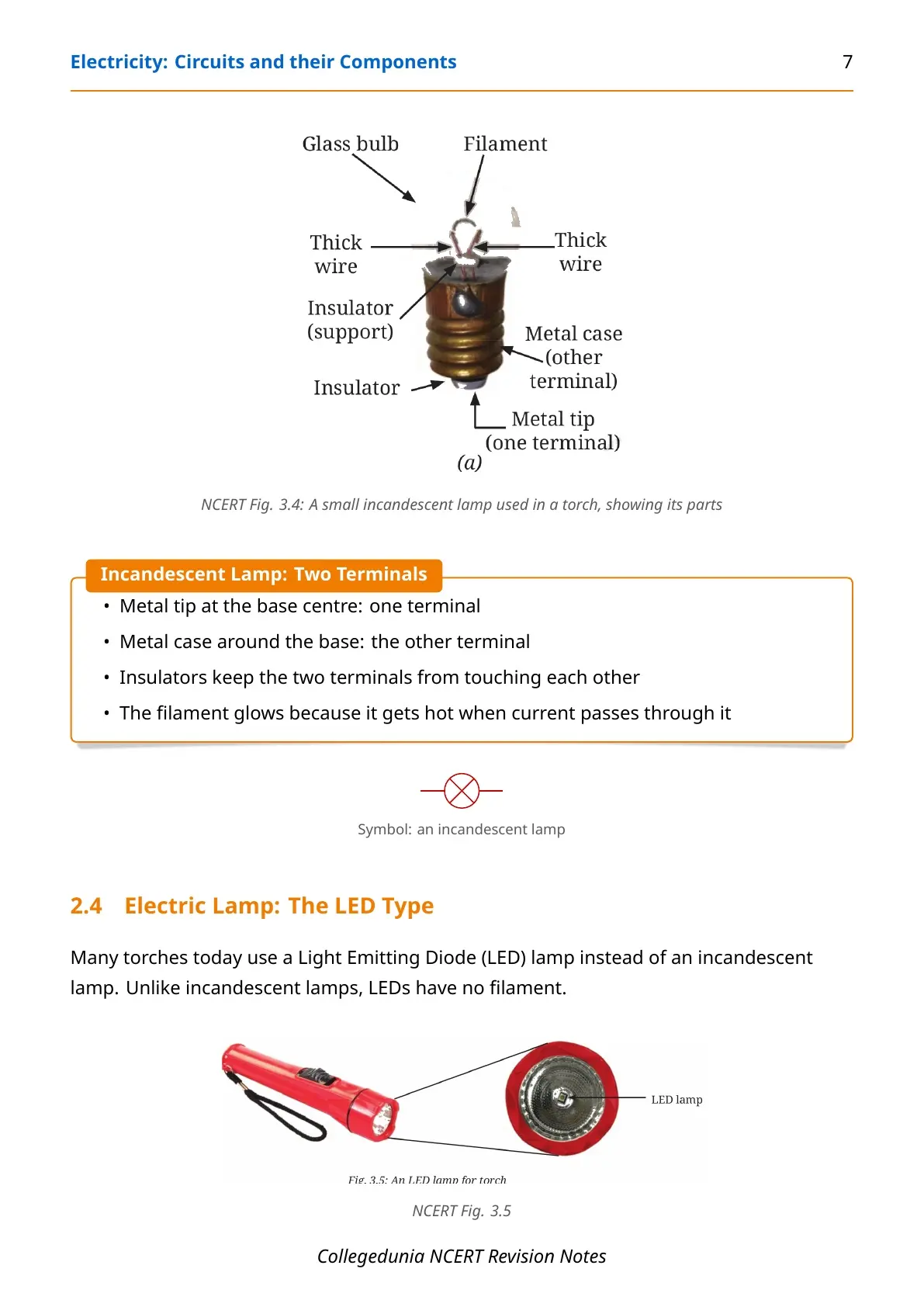
| Incandescent lamp | Circle with a cross | Glows because its filament heats up |
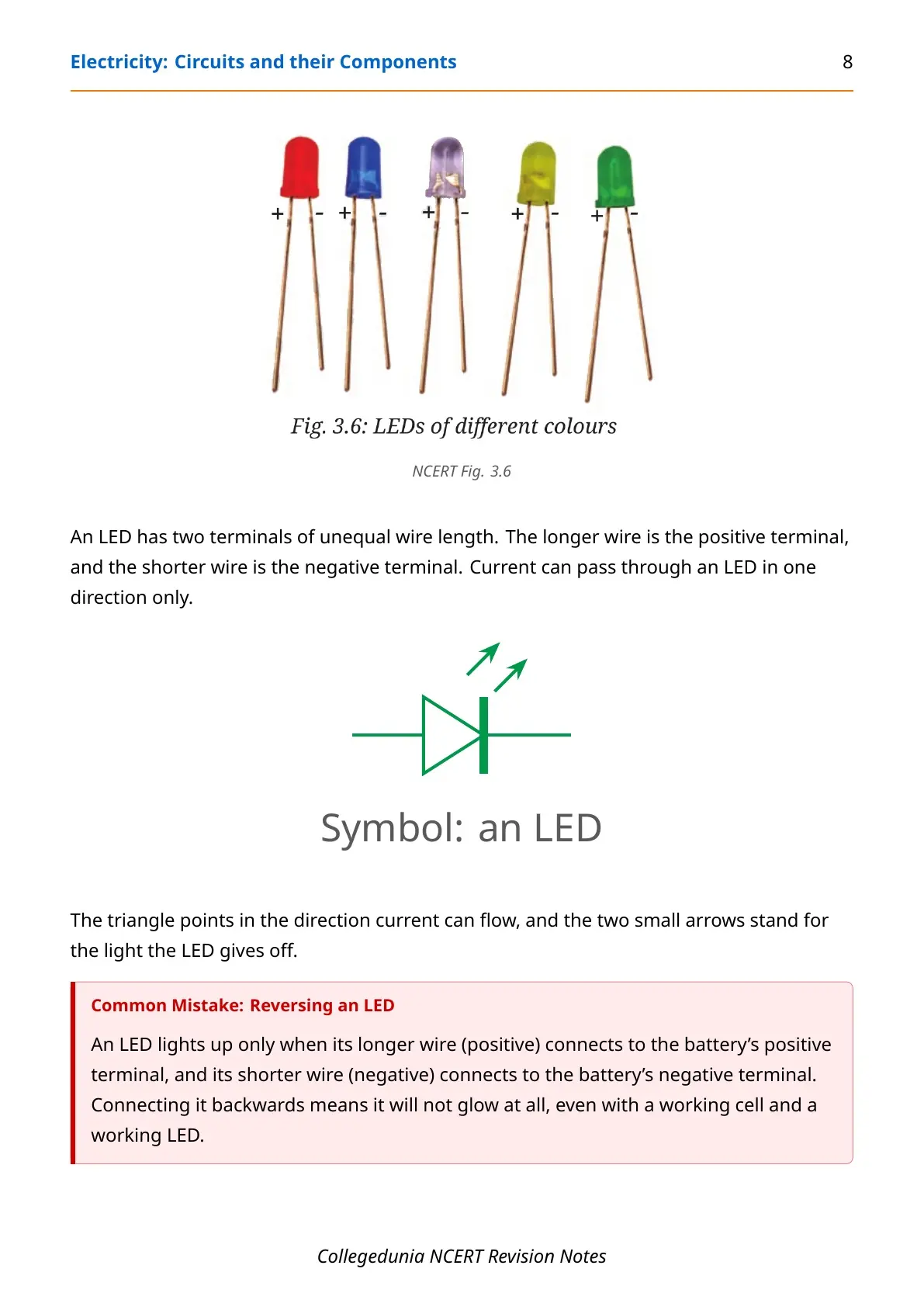
| LED | Triangle with a bar, two light arrows | Longer wire is positive, shorter is negative |
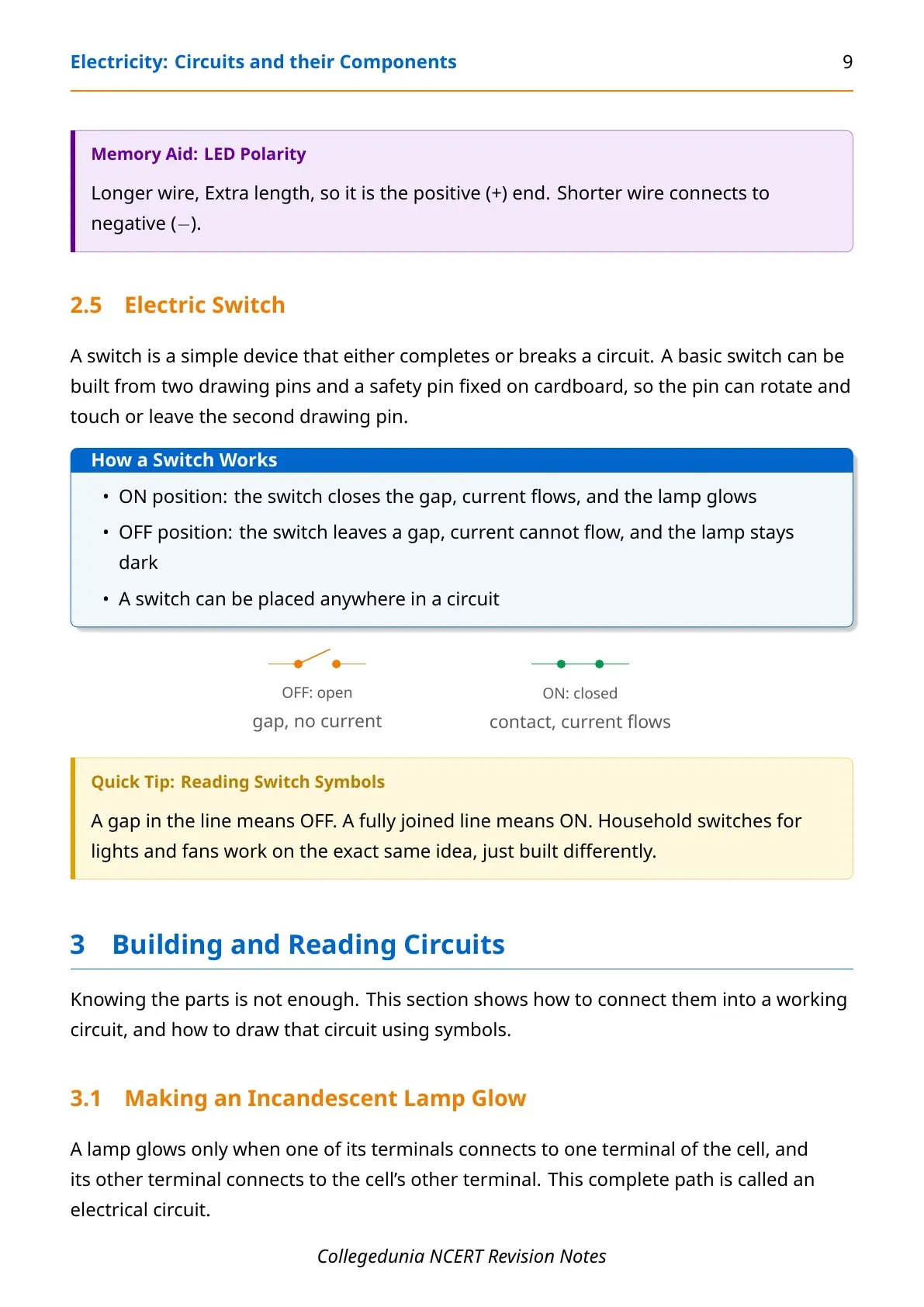
| Switch (ON) | Closed, joined line | Gap closed, current flows |
| Switch (OFF) | Line with a gap | Gap open, current stops |
Tip: the long line is always the positive terminal of a cell, and the short line is always negative. Remember it as "big cap, positive gap."
Why an LED Must Be Connected the Correct Way Round
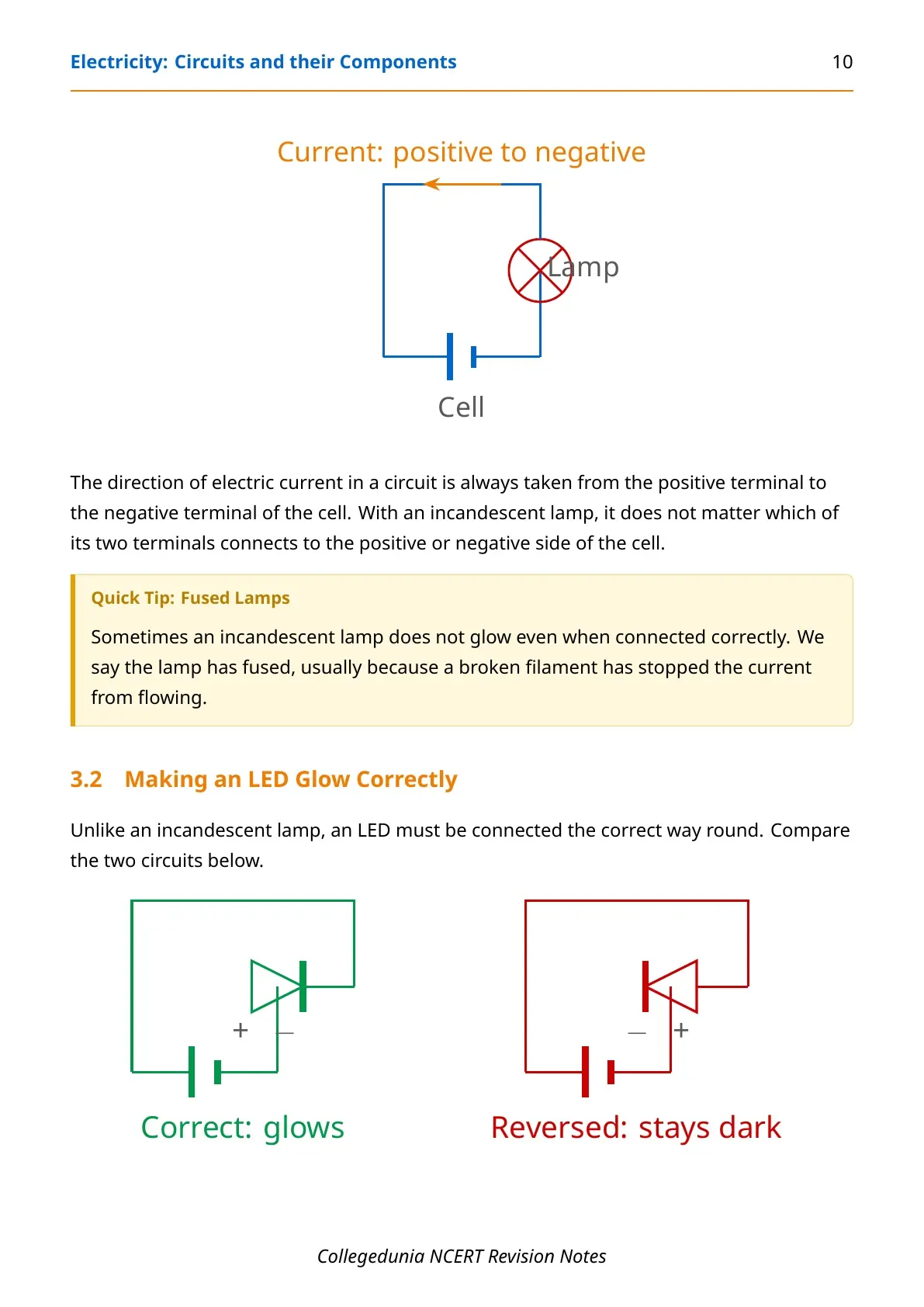
An incandescent lamp glows no matter which of its two terminals meets the cell's positive or negative side. An LED does not work that way, and this single rule trips up more Class 7 students than any other part of the chapter.
- An LED has two terminals of unequal wire length, unlike a symmetrical incandescent lamp.
- The longer wire is positive; the shorter wire is negative.
- Current passes through an LED in one direction only.
Connecting an LED backwards means it stays dark even with a working cell and a working LED. If the plus and minus signs on a battery are worn off, look for the metal strip inside the compartment; it connects the positive terminal of one cell to the negative terminal of the next, and the end left with a lone positive terminal is the battery's positive end.
A Circuit With Two Switches
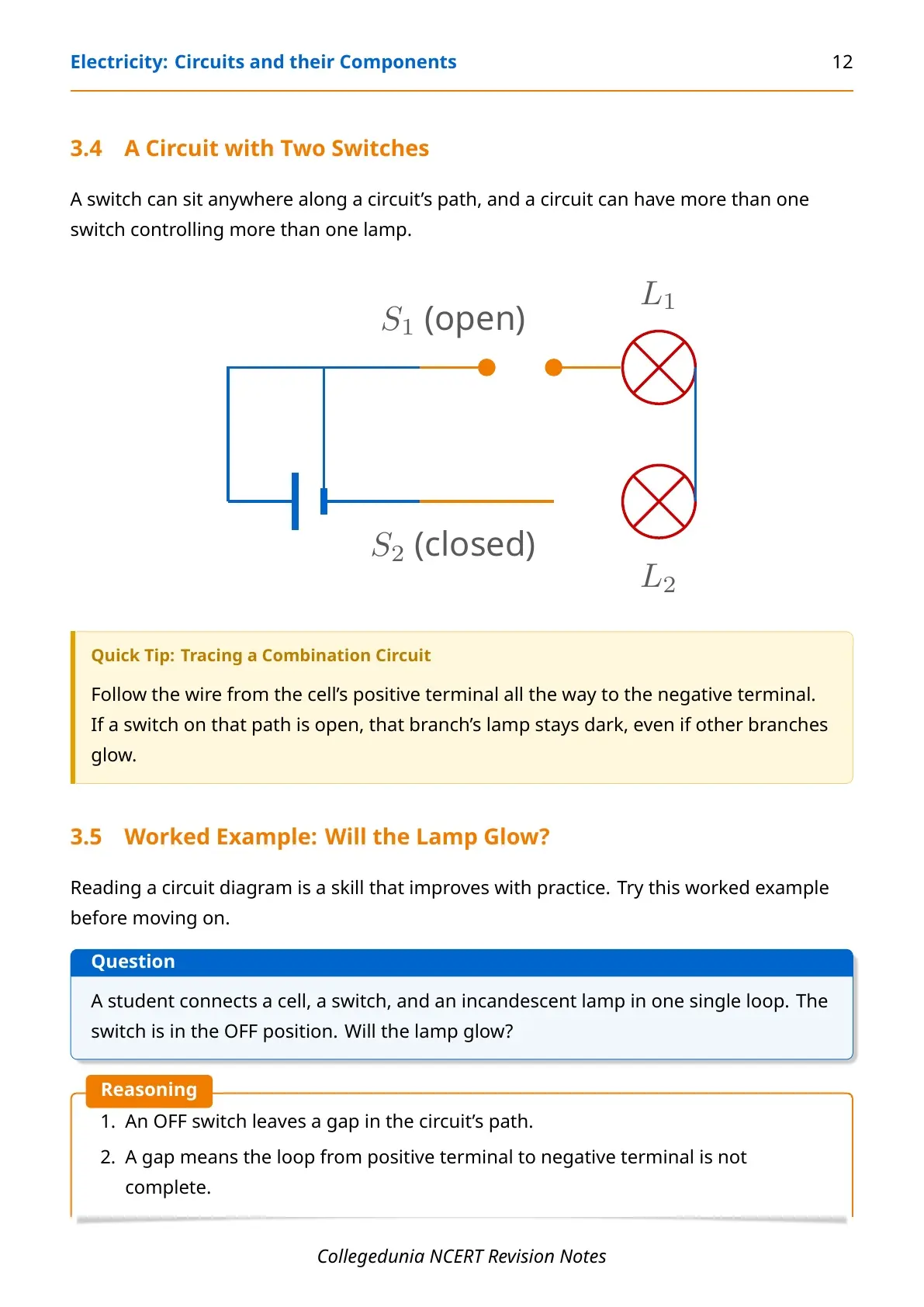
A switch can sit anywhere along a circuit's path, and a single circuit can have more than one switch controlling more than one lamp. Tracing such a circuit is a skill worth practising before moving to bigger diagrams.
- Follow the wire from the cell's positive terminal all the way to the negative terminal.
- If a switch on a branch is open, that branch's lamp stays dark, even if the other branch glows.
- A wrong-order battery, where a positive terminal does not meet a negative terminal correctly, breaks the loop the same way an open switch does.
Practice question: a torch has two cells placed with their terminals in the wrong order. Will the lamp glow? Check whether the positive terminal of one cell meets the negative terminal of the next; a wrong order breaks that rule, so the lamp will not glow.
Series and Parallel Circuits: Two Ways to Wire More Than One Lamp
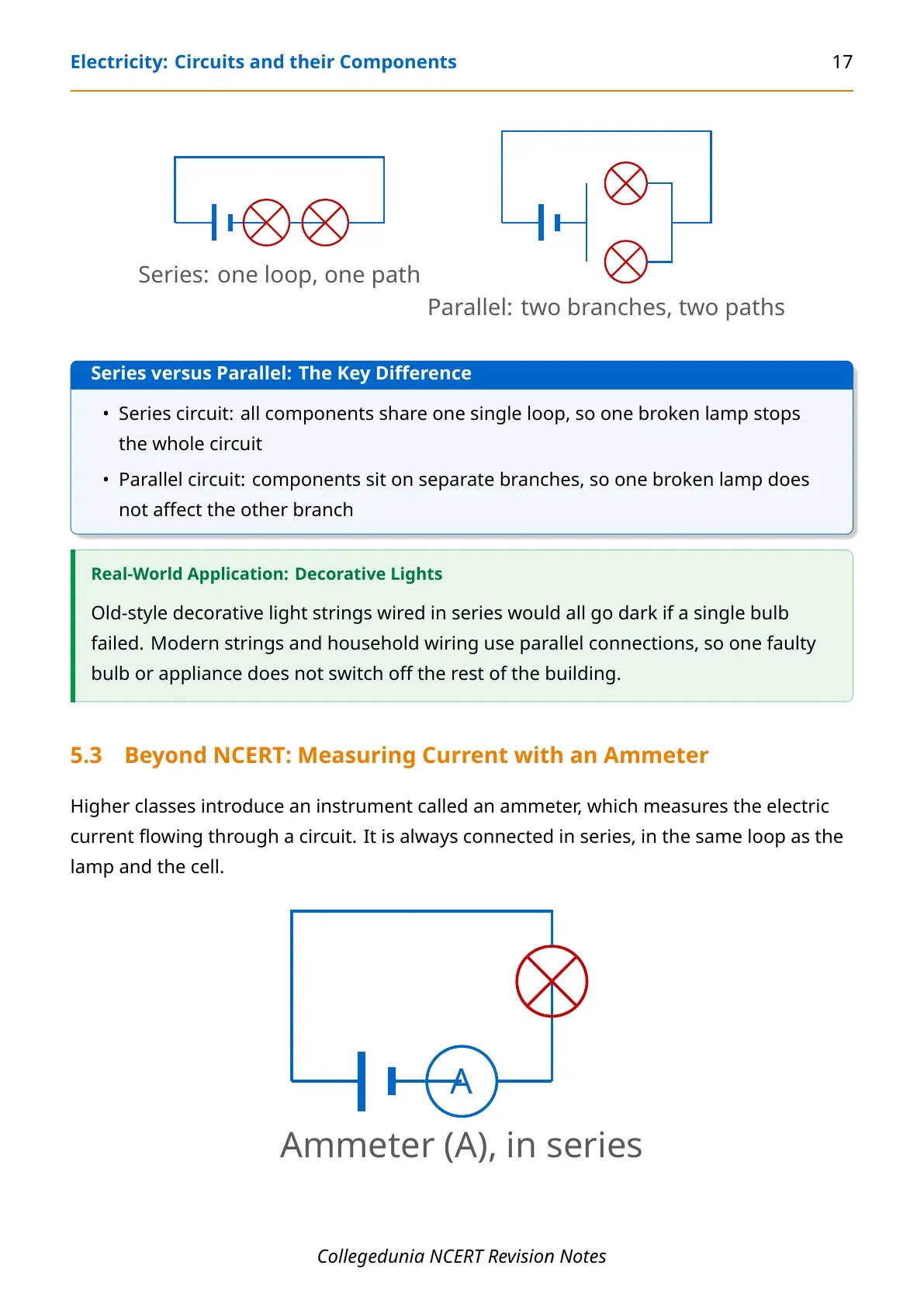
The NCERT chapter also introduces a circuit with two switches controlling two lamps, and this idea grows into a full topic in higher classes: grouping circuits by how their lamps are wired.
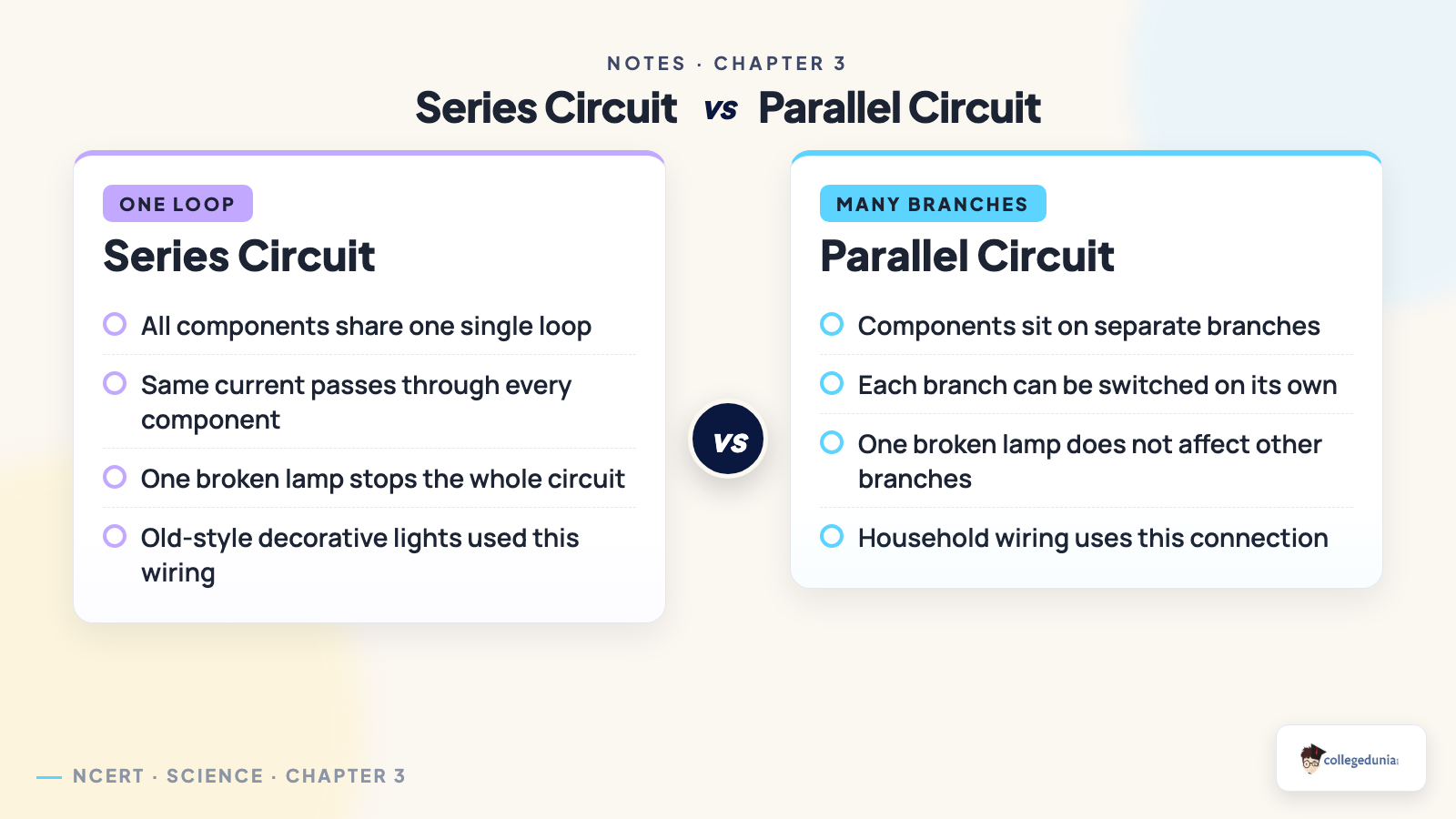
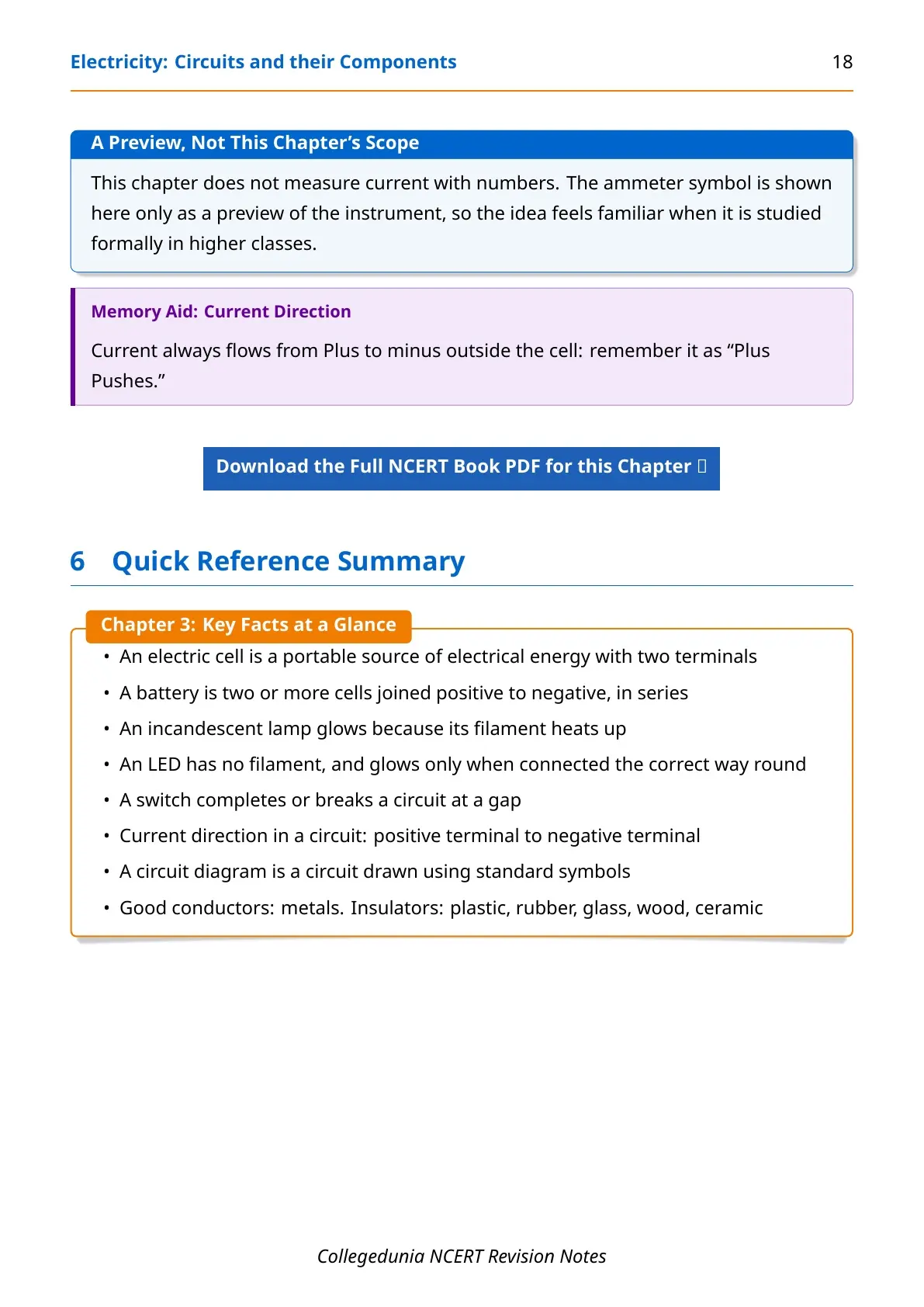
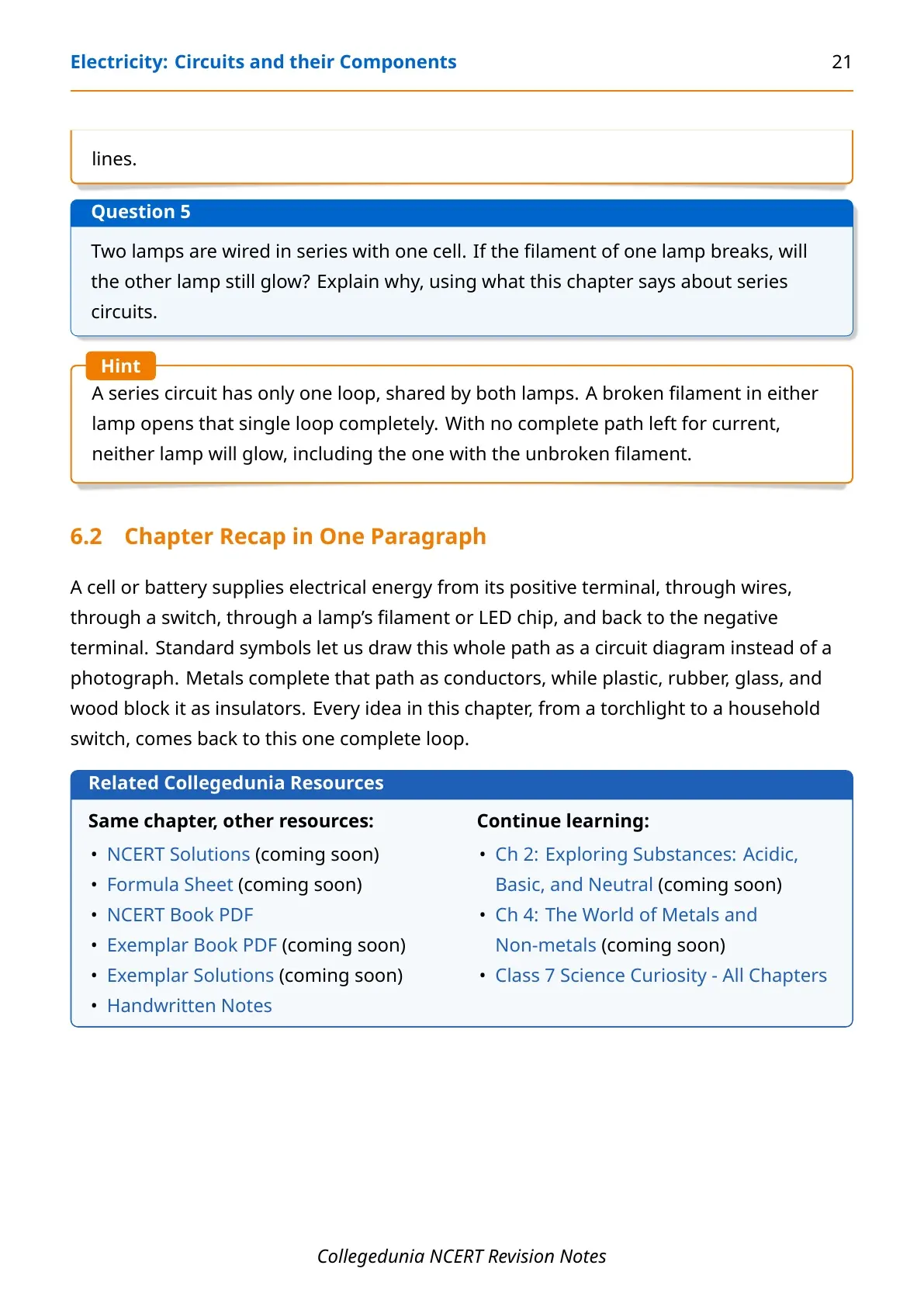
In a series circuit, every component shares one single loop, so a single broken lamp stops the whole circuit. In a parallel circuit, components sit on separate branches, so one broken lamp does not switch off the others. Household wiring uses parallel connections for exactly this reason: one faulty appliance should never turn off the rest of the building.
Electrical Conductors and Insulators
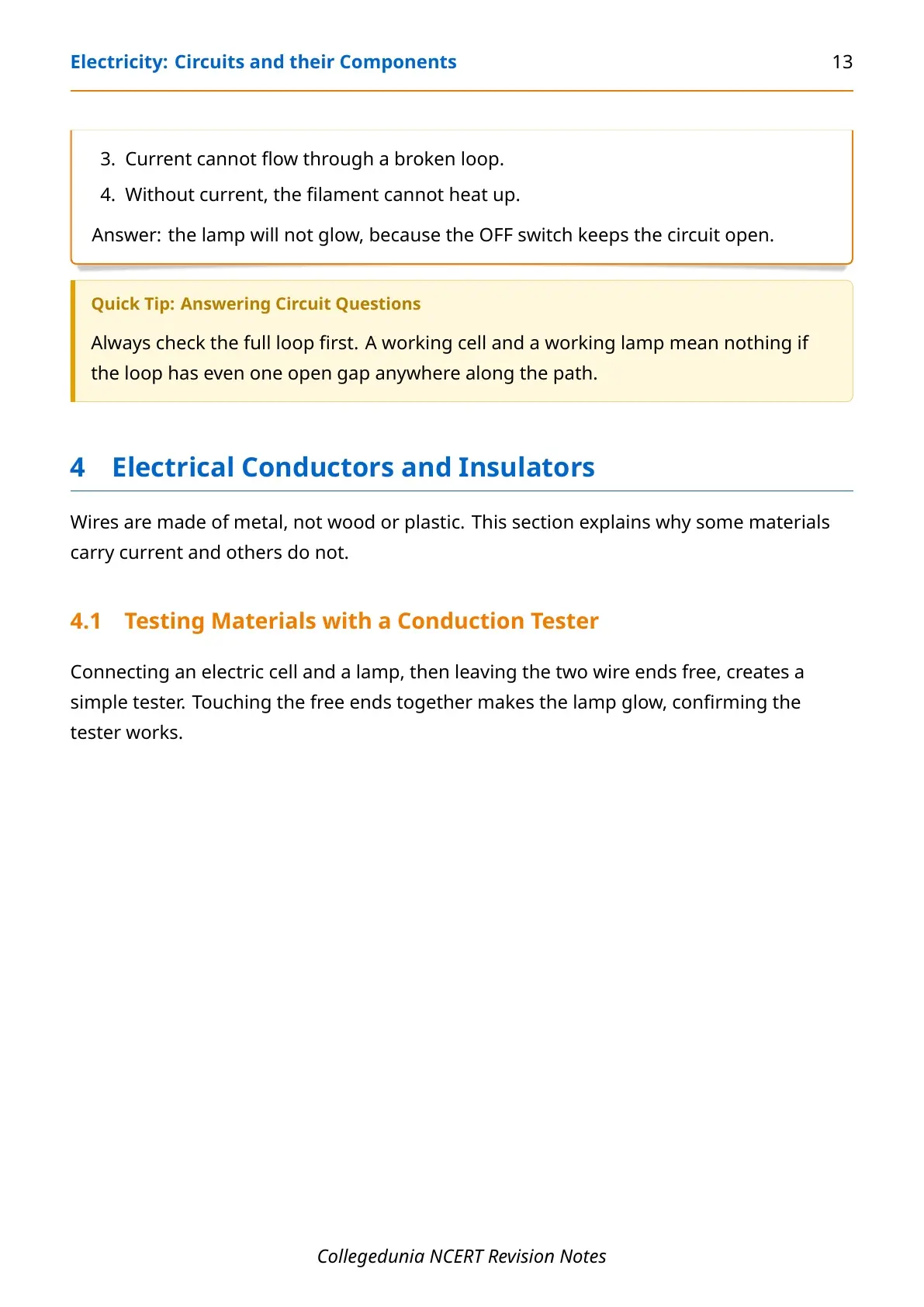
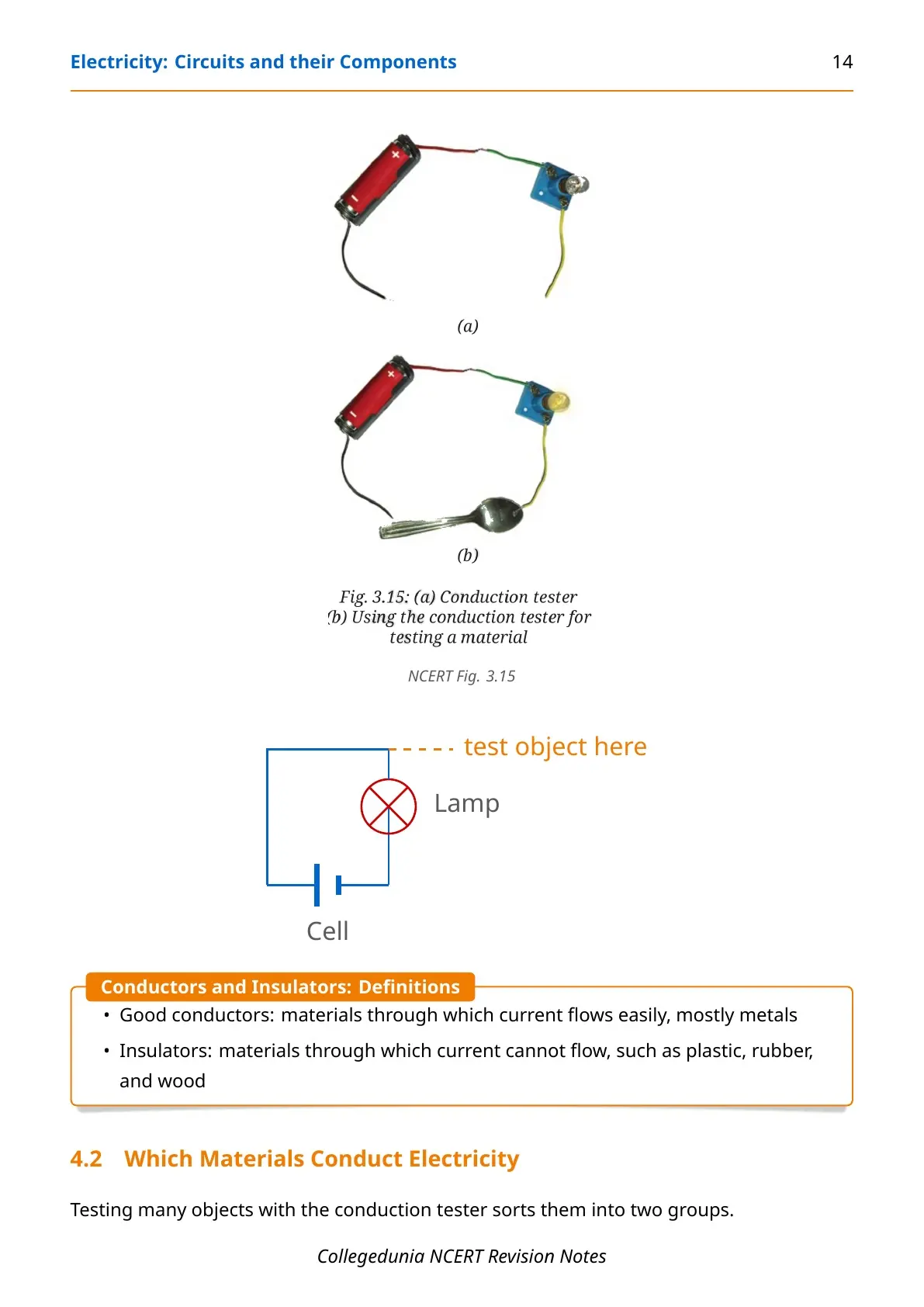
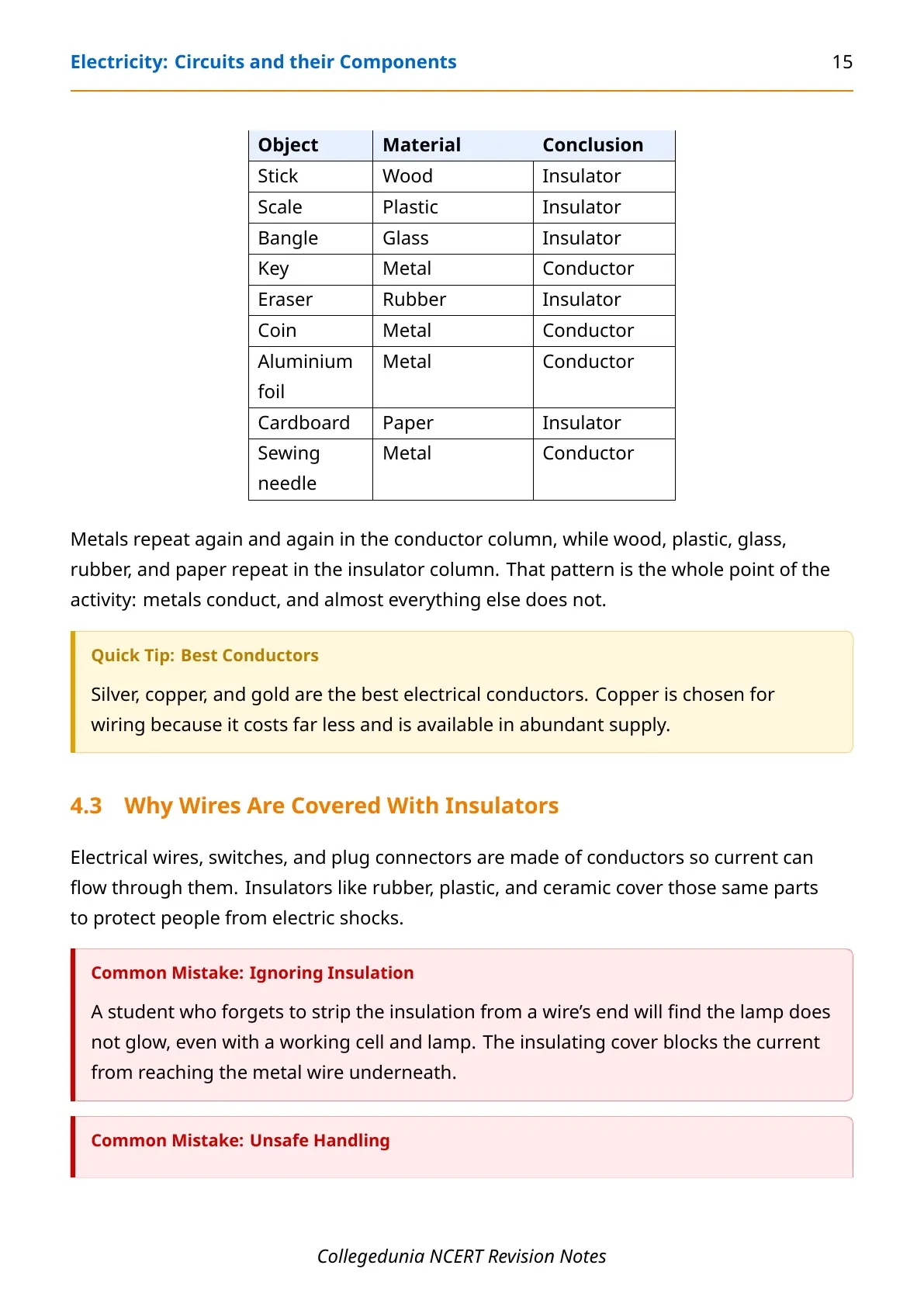
Wires, switches, and plug connectors need materials that let current flow, and materials that stop it. A simple tester, made from a cell, a lamp, and two free wire ends, sorts any object into one of two groups in seconds.
| Object | Material | Conclusion |
|---|---|---|
| Key, coin, sewing needle | Metal | Conductor |
| Aluminium foil | Metal | Conductor |
| Stick, cardboard | Wood, paper | Insulator |
| Scale, eraser | Plastic, rubber | Insulator |
| Bangle | Glass | Insulator |
Metals repeat again and again in the conductor column, while wood, plastic, glass, rubber, and paper repeat in the insulator column. Silver, copper, and gold are the best electrical conductors, and copper is chosen for household wiring because it costs far less while staying widely available.
Also Check: insulators like rubber, plastic, and ceramic cover wires and switches to stop electric shocks, because our own body also conducts electricity. Never touch a switch or plug with wet hands.
Worked Example: Reading a Circuit Correctly
A student connects a cell, a switch, and an incandescent lamp in one single loop. The switch is in the OFF position. Will the lamp glow?
- An OFF switch leaves a gap in the circuit's path.
- A gap means the loop from the positive terminal to the negative terminal is not complete.
- Current cannot flow through a broken loop, so the filament cannot heat up.
Answer: the lamp will not glow, because the OFF switch keeps the circuit open. Always check the full loop first; a working cell and a working lamp mean nothing if even one gap remains along the path.
Direct Current and Alternating Current: Beyond This Chapter
Higher classes group electricity itself into two types, and this chapter's cells are one half of that picture.
- Direct Current (DC): the type of electricity from cells and batteries, used in small portable devices.
- Alternating Current (AC): the type of electricity from power plants that reaches wall sockets, used to run larger appliances.
Cells and batteries themselves come in many shapes for different jobs. Cylindrical batteries power torchlights, clocks, and remotes, button cells power watches and hearing aids, and rechargeable batteries power mobile phones, laptops, and electric vehicles.
Quick Revision: Key Terms and Common Mistakes
| Term | One-Line Meaning |
|---|---|
| Electric cell | Portable source of electrical energy, two terminals |
| Battery | Two or more cells connected positive to negative |
| Filament | Thin wire in an incandescent lamp that glows when heated |
| LED | Lamp with no filament, glows in one current direction only |
| Circuit diagram | Circuit drawn using standard symbols |
| Conductor / Insulator | Lets current flow easily / blocks current flow |
- Assuming an LED works in either direction, like an incandescent lamp, is the most common mistake in this chapter.
- Forgetting to strip insulation from wire ends before connecting a circuit.
- Reading the smaller metal cap of a cell as its negative terminal, when it is actually positive.
Student Feedback: What 10,760 Students Told Us
Student Feedback
What 10,760 students told us about their Electricity: Circuits journey.
In a Collegedunia poll of 10,760 Class 7 students conducted before the 2026-27 school exams, 64% of students named reversing the LED's terminals as the trickiest part of this chapter. Most students said the switch ON/OFF symbols were the easiest to remember once drawn out by hand.
Other Chapter 3 Resources on Collegedunia
| Resource | Status |
|---|---|
| NCERT Notes (this page) | Available now |
| NCERT Book PDF | Coming soon |
| Handwritten Notes | Coming soon |
| NCERT Solutions | Coming soon |
| Formula Sheet | Coming soon |
| Exemplar Solutions | Coming soon |
Class 7 Science Curiosity Notes for All Chapters
| Chapter | Notes |
|---|---|
| Chapter 1 | The Ever-Evolving World of Science |
| Chapter 2 | Exploring Substances: Acidic, Basic, and Neutral |
| Chapter 3 | Electricity: Circuits and their Components (this page) |
| Chapter 4 | The World of Metals and Non-metals (coming soon) |
| Chapter 5 | Changes Around Us: Physical and Chemical (coming soon) |
| Chapter 6 | Adolescence: A Stage of Growth and Change (coming soon) |
| Chapter 7 | Heat Transfer in Nature (coming soon) |
| Chapter 8 | Measurement of Time and Motion (coming soon) |
| Chapter 9 | Life Processes in Animals (coming soon) |
| Chapter 10 | Life Processes in Plants (coming soon) |
| Chapter 11 | Light, Shadows and Reflections (coming soon) |
| Chapter 12 | Earth, Moon, and the Sun (coming soon) |
| Class 7 Science Curiosity - All Chapters | |
Class 7 Science Chapter 3 Electricity Circuits and their Components Notes FAQs
Ques. What is an electric circuit?
Ans. An electric circuit is a complete, unbroken path that lets current flow from a cell's positive terminal, through wires and components, back to its negative terminal.
Ques. How is a battery different from an electric cell?
Ans. An electric cell is a single portable source of electrical energy with two terminals. A battery is two or more cells connected positive terminal to negative terminal.
Ques. What are circuit diagrams?
Ans. Circuit diagrams are representations of a circuit drawn using standard symbols for cells, batteries, lamps, LEDs, and switches, instead of photographs of the actual parts.
Ques. Why does an LED glow only in one direction?
Ans. Current can pass through an LED in one direction only. Its longer wire is the positive terminal and its shorter wire is the negative terminal; connecting it backwards keeps it dark.
Ques. Does the direction matter for an incandescent lamp?
Ans. No. An incandescent lamp glows regardless of which of its two terminals connects to the cell's positive or negative side, unlike an LED.
Ques. What is the difference between a conductor and an insulator?
Ans. A conductor, mostly metals, lets electric current flow through it easily. An insulator, such as plastic, rubber, glass, or wood, blocks current from flowing.
Ques. Why are electrical wires covered with insulators?
Ans. Wires are made of conductors so current can flow, but they are covered with insulators like rubber and plastic to stop the current from reaching a person's body and causing a shock.
Ques. What is the difference between a series circuit and a parallel circuit?
Ans. In a series circuit, all components share one loop, so one broken lamp stops the whole circuit. In a parallel circuit, components sit on separate branches, so one broken lamp does not affect the rest.
Ques. Why does a switch make a lamp glow or stay dark?
Ans. A switch closes or opens a gap in the circuit. Closing the gap (ON) lets current flow so the lamp glows; opening the gap (OFF) breaks the path so the lamp stays dark.
Ques. Which materials conduct electricity the best?
Ans. Silver, copper, and gold are the best electrical conductors. Copper is used in household wiring because it is far cheaper and more widely available than silver or gold.
Ques. Is it safe to test electricity using a home power socket?
Ans. No. Never experiment with the home power supply. All activities in this chapter use only cells or batteries, the same type found in torches, clocks, and remotes.
Ques. Where can I download the Class 7 Science Chapter 3 Notes PDF?
Ans. You can download the Electricity: Circuits and their Components Notes PDF directly from this page, free of cost and matched to the 2026-27 NCERT Curiosity textbook.



Comments