



Inside the Class 7 Science Curiosity notes for Measurement of Time and Motion, you will find timekeeping methods, pendulum activities and speed calculations. These 2026-27 notes explain how to compare journeys fairly using distance and time. Use the Collegedunia PDF to revise units, average speed and uniform linear motion.
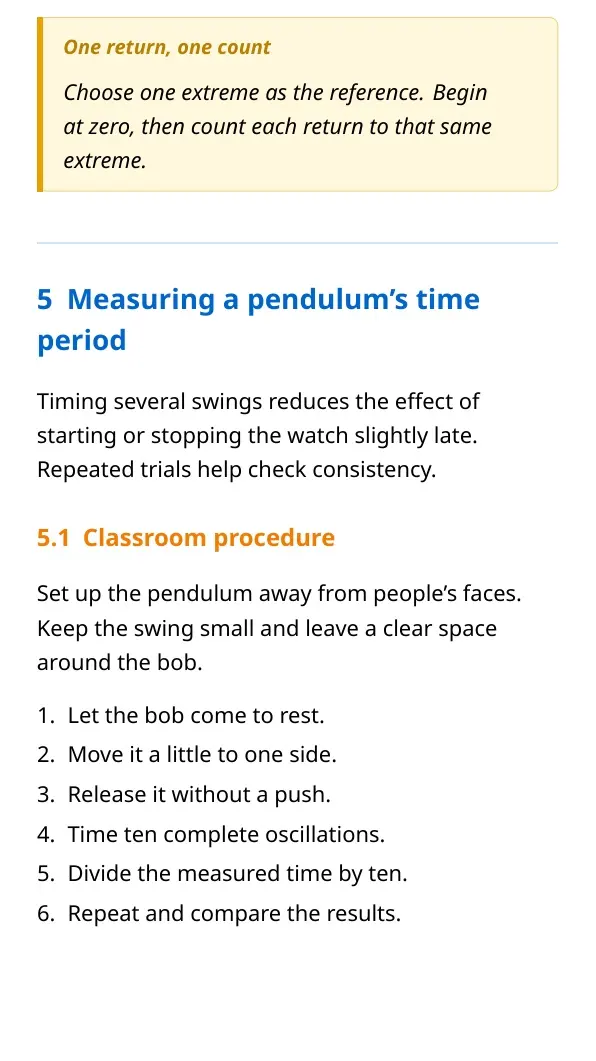
- Measure a pendulum's time period by timing several complete oscillations.
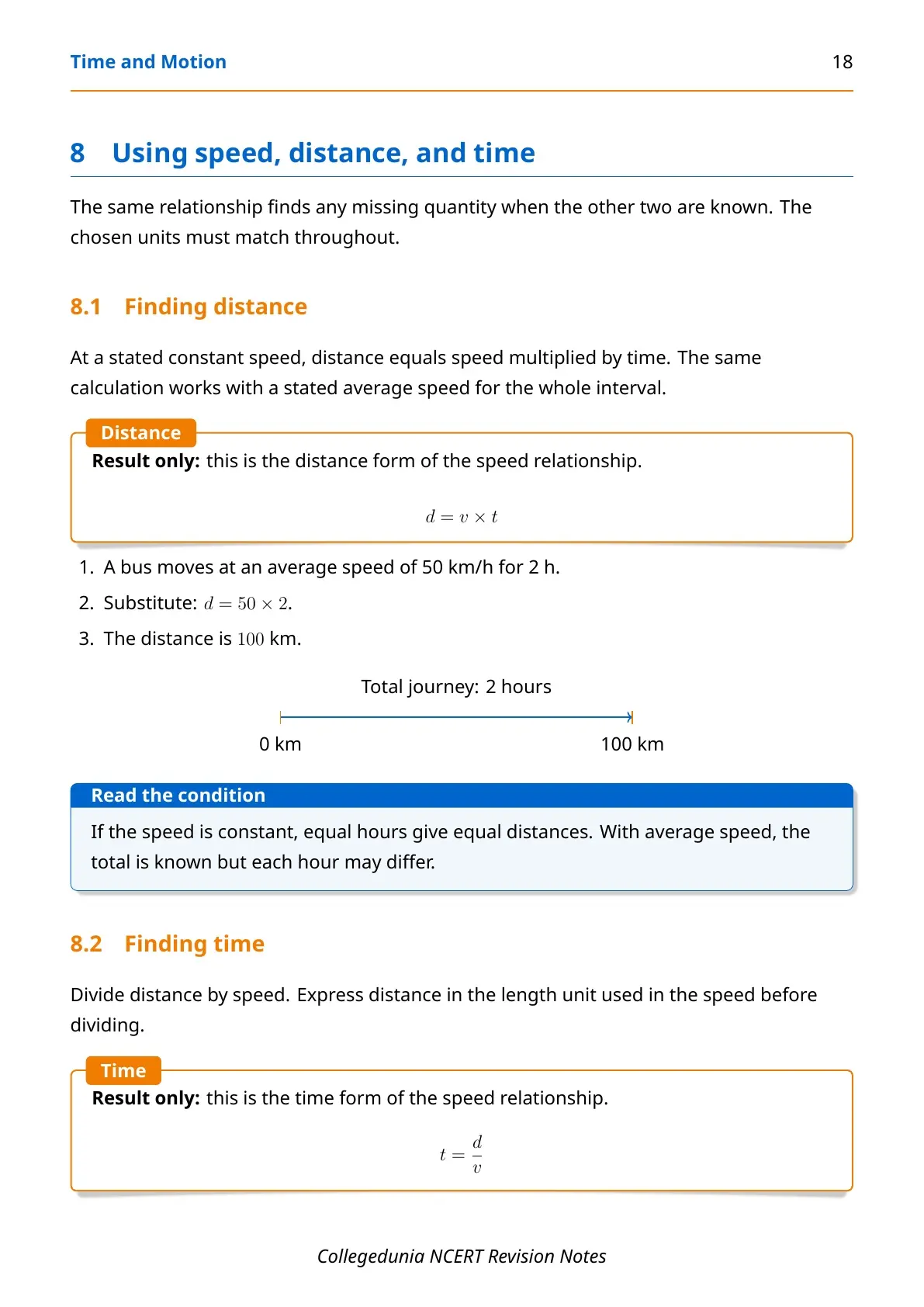
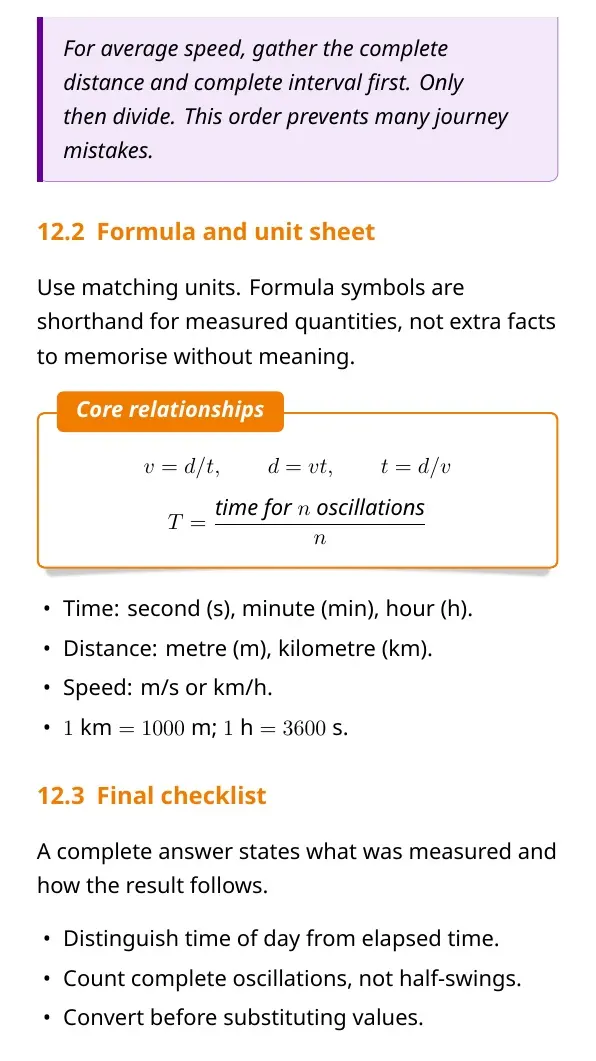
- Calculate speed, distance and time using matching units.
- Compare uniform and non-uniform linear motion from distance tables.
Student Feedback and Self-Check
After studying, explain which step needs more practice: counting oscillations, converting units or finding average speed. Share your question with your teacher.
These Collegedunia notes follow the topics and activities in the 2026-27 NCERT Curiosity chapter.
Measurement of Time and Motion: From Sundials to Clocks
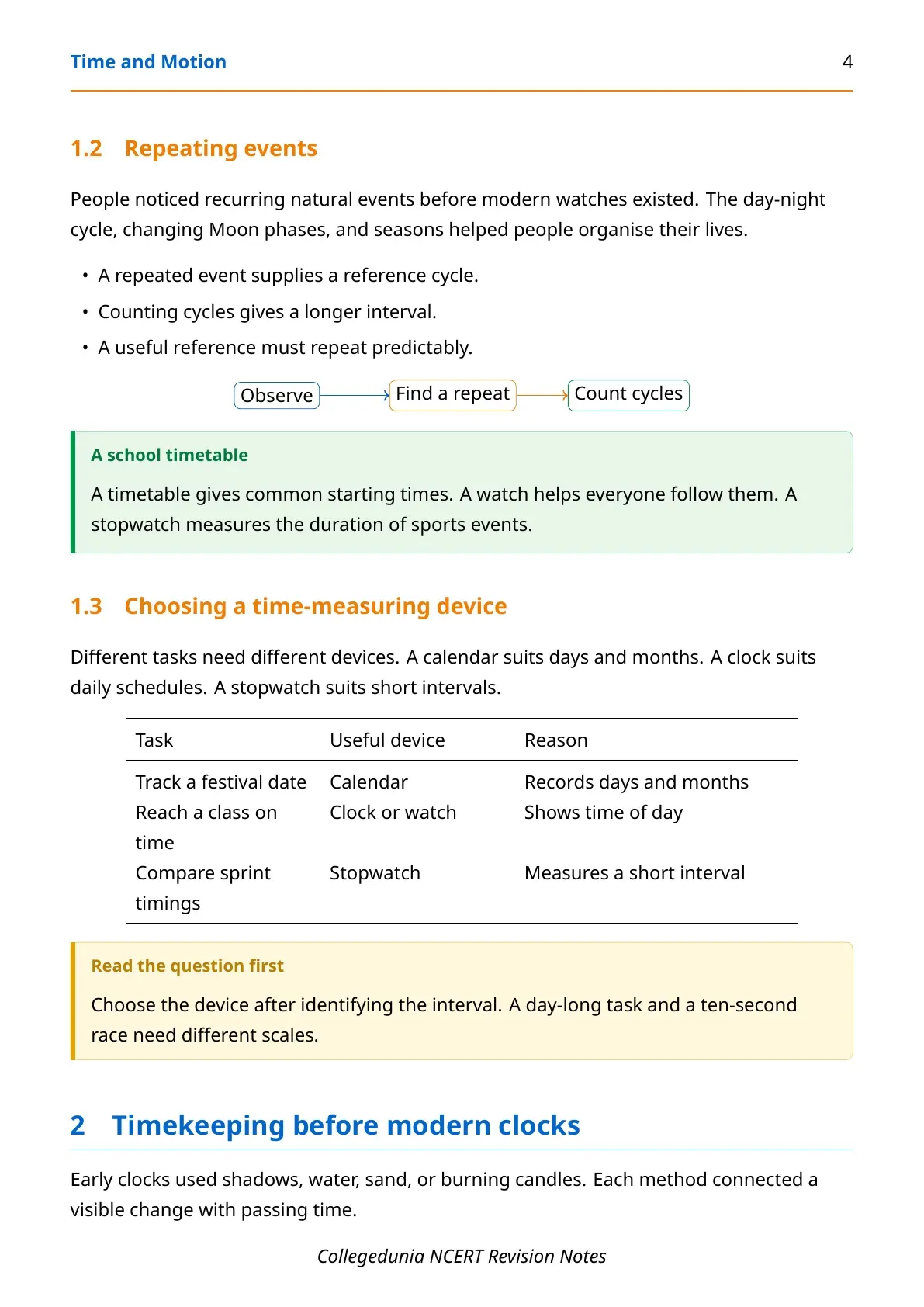
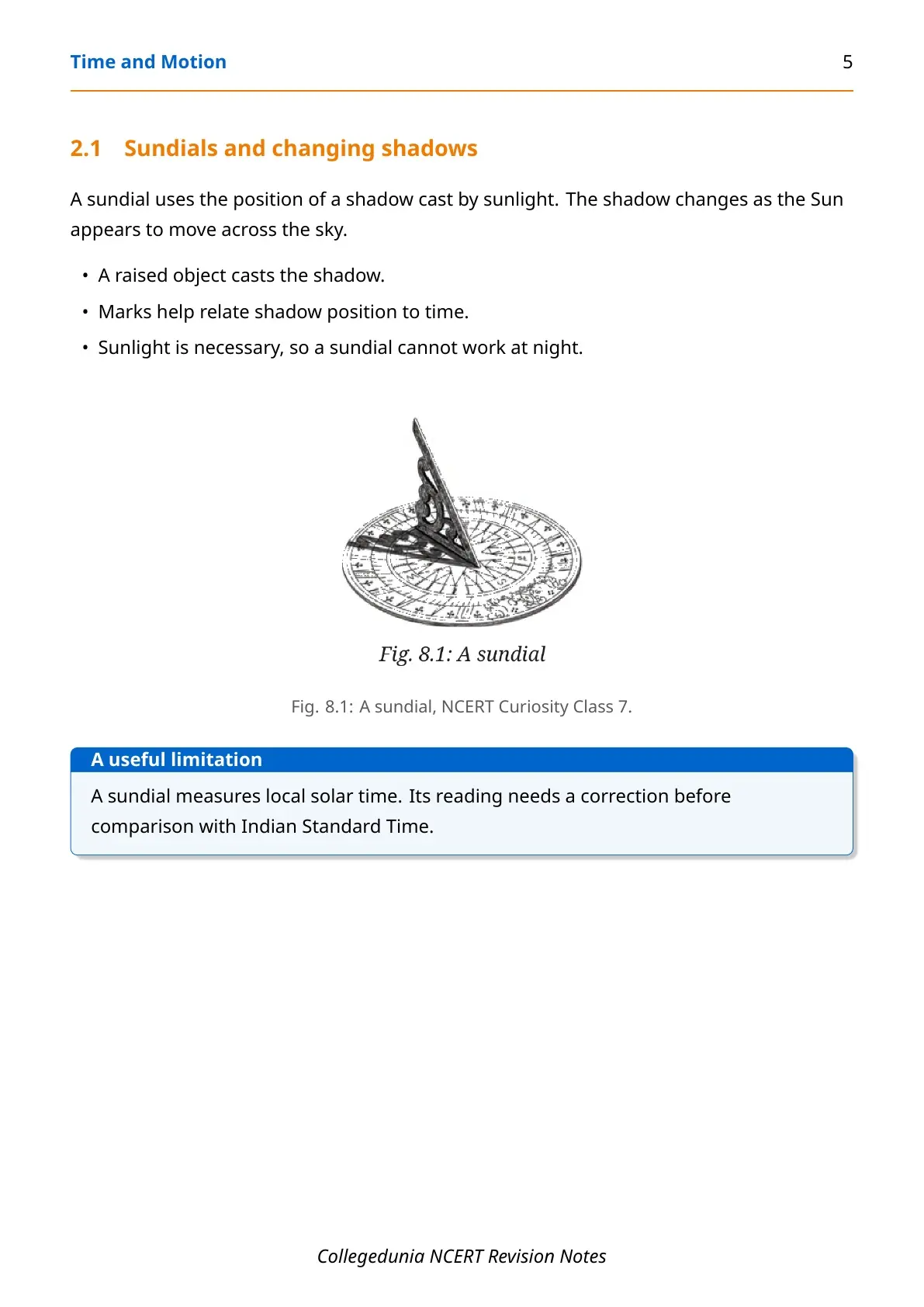
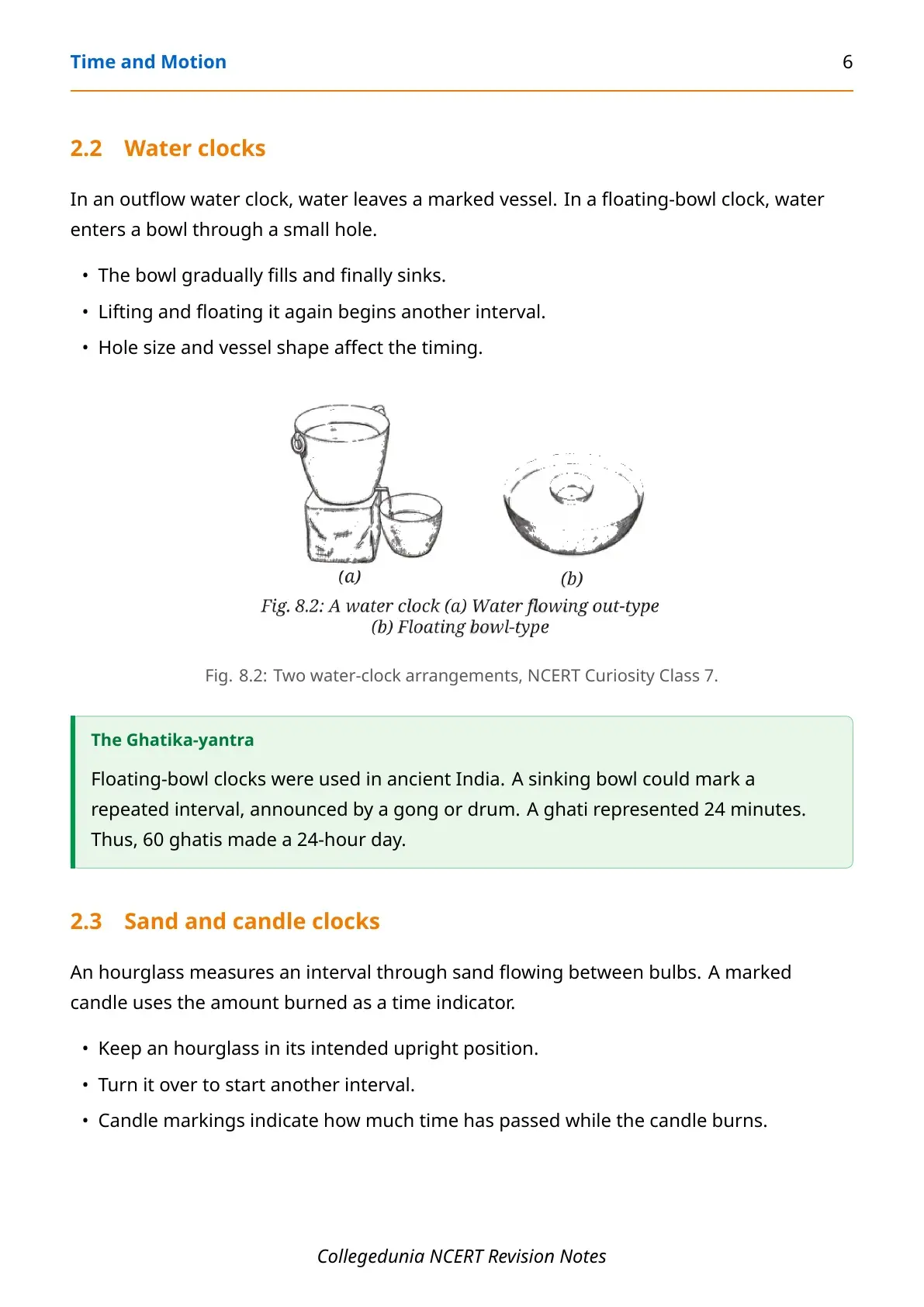
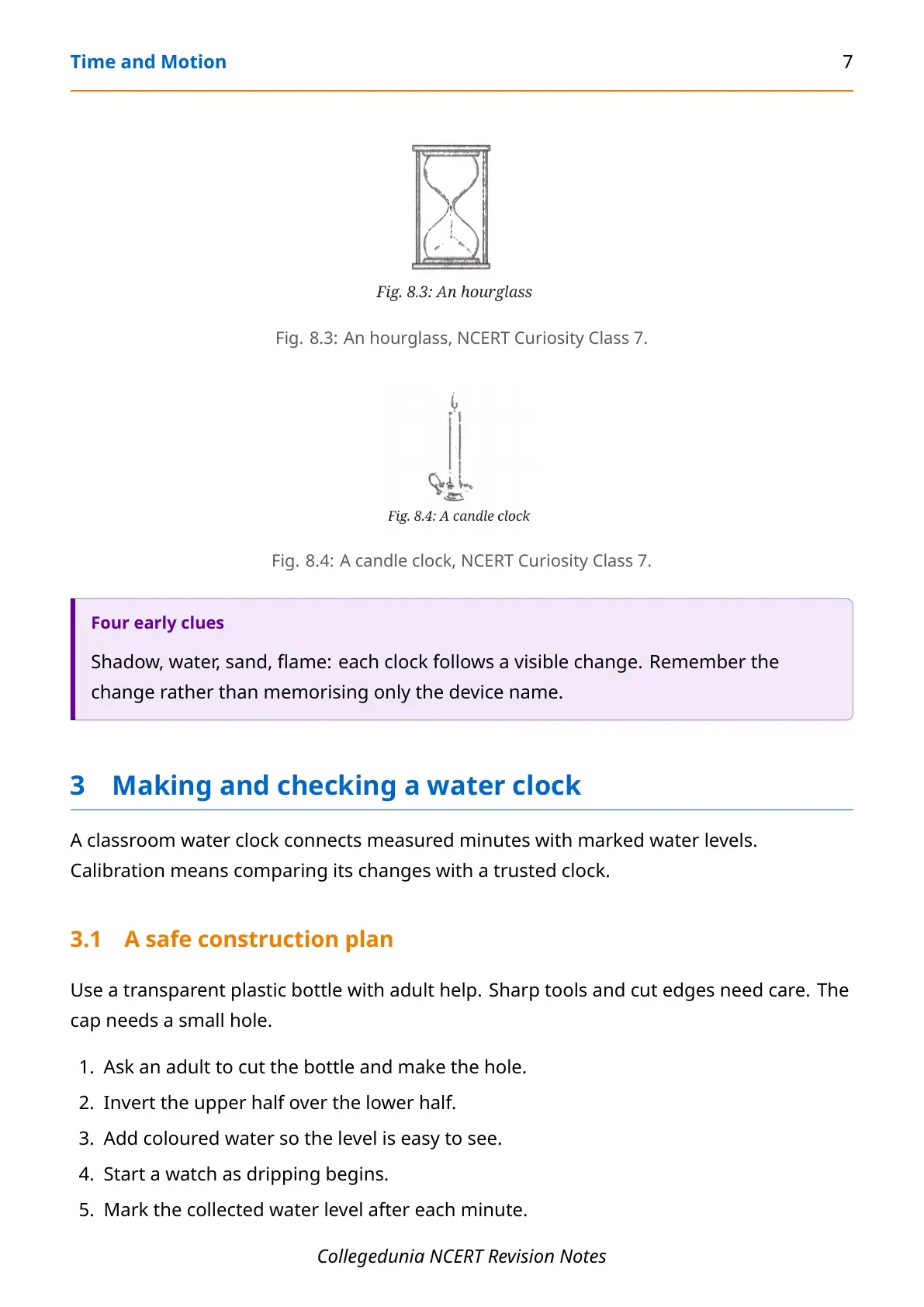
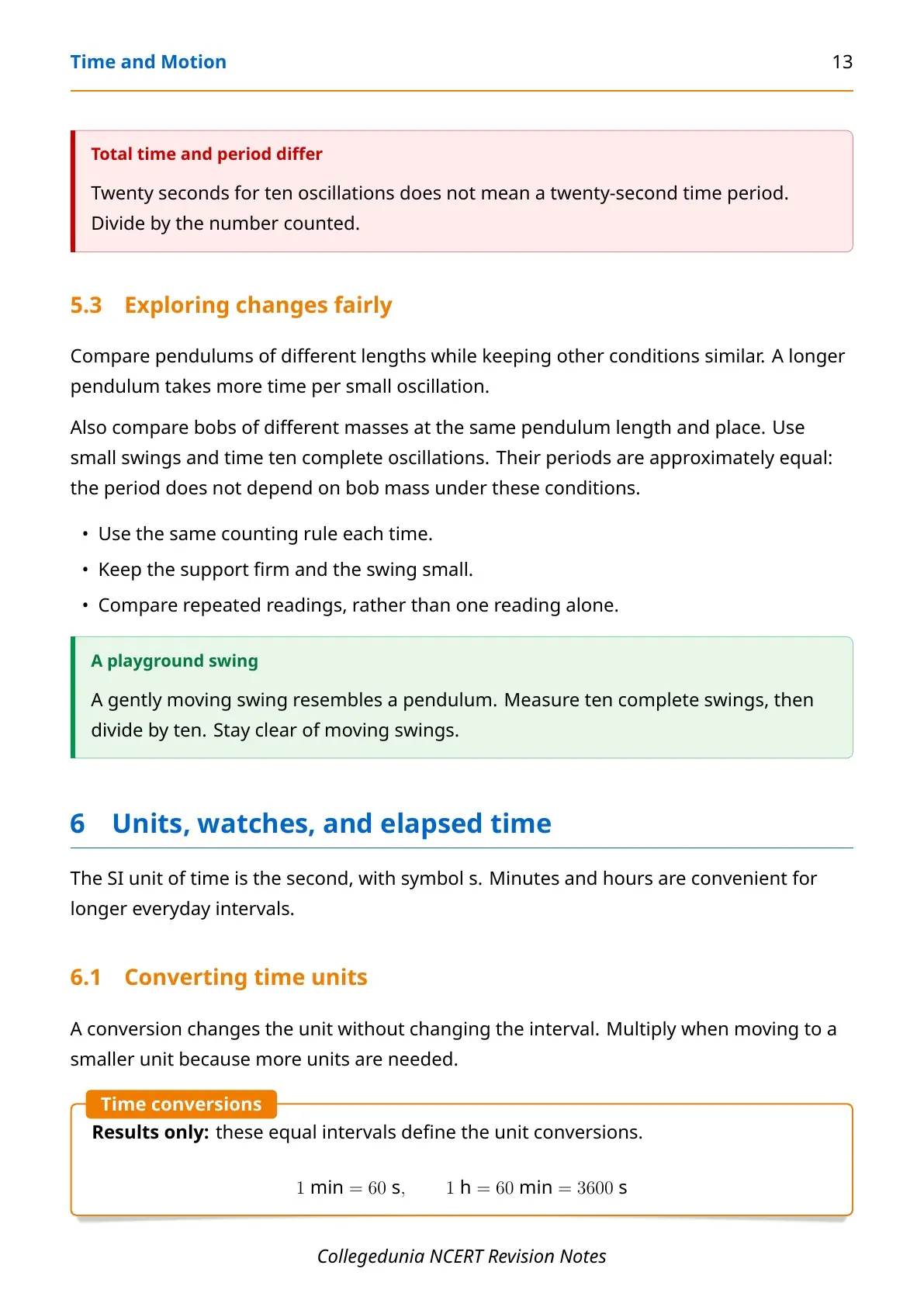
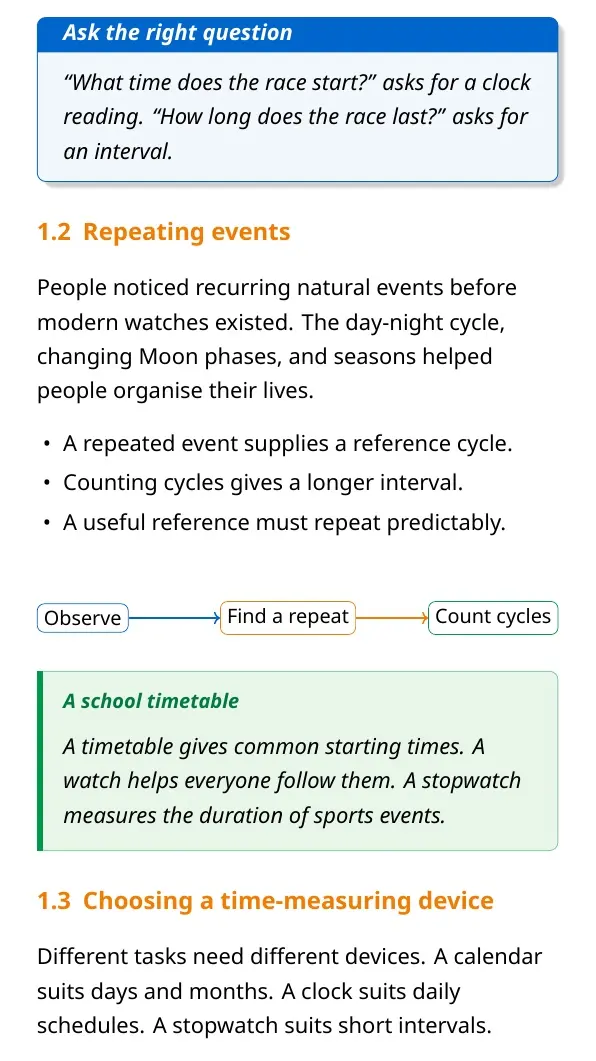
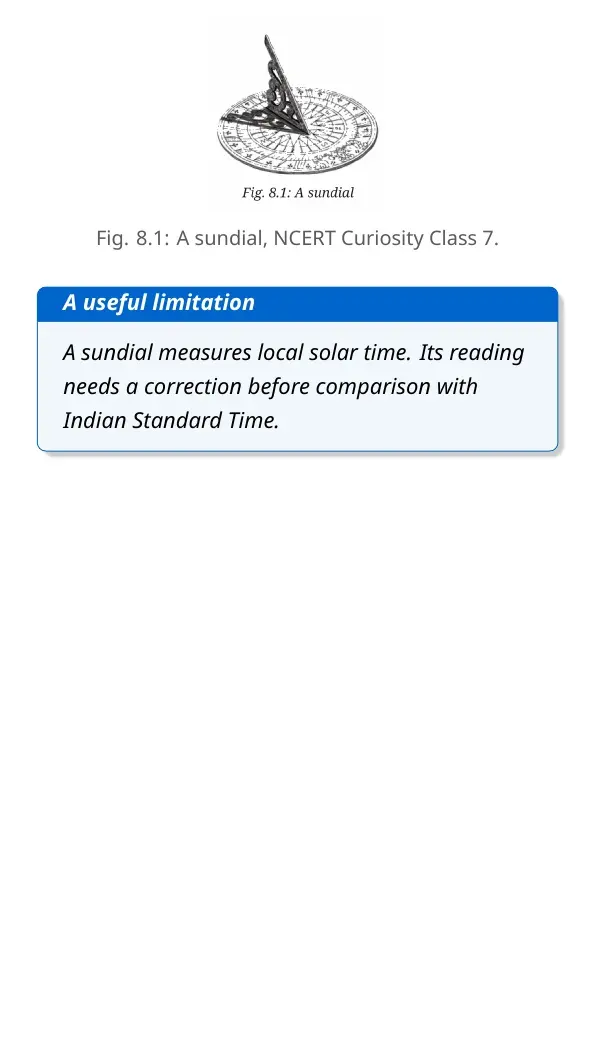
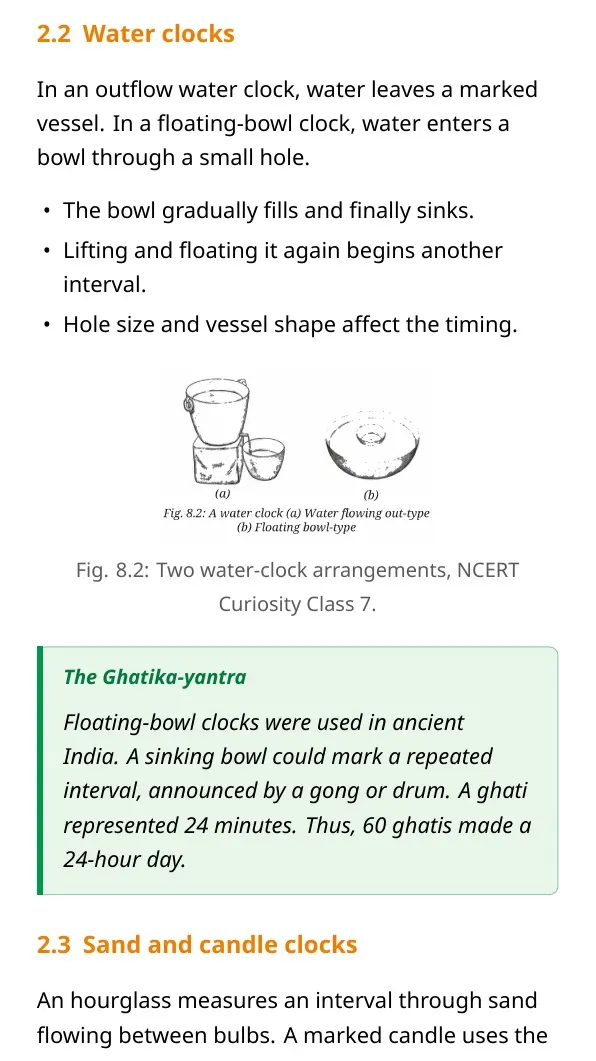
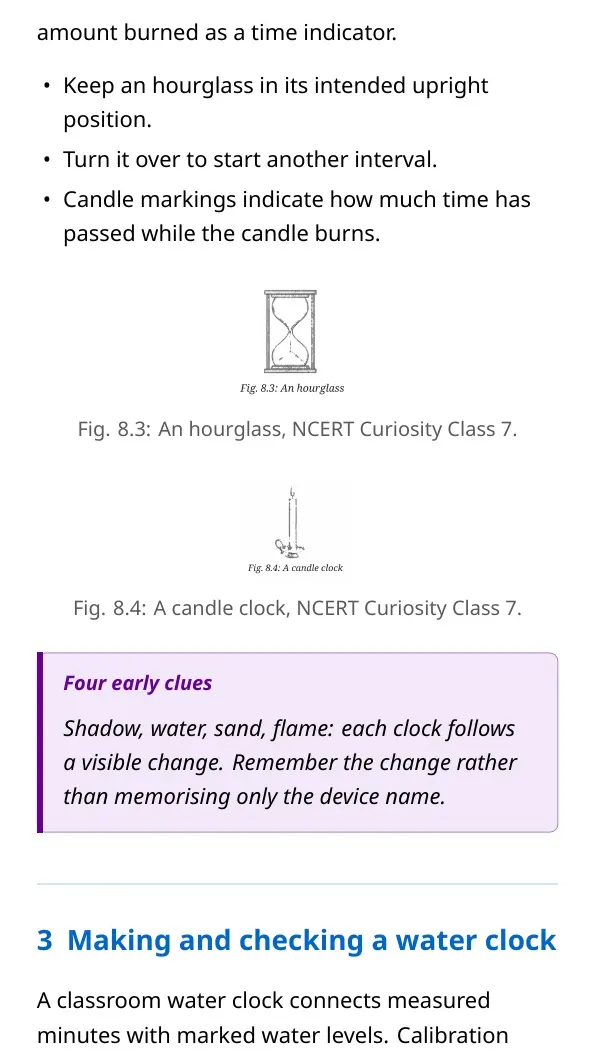
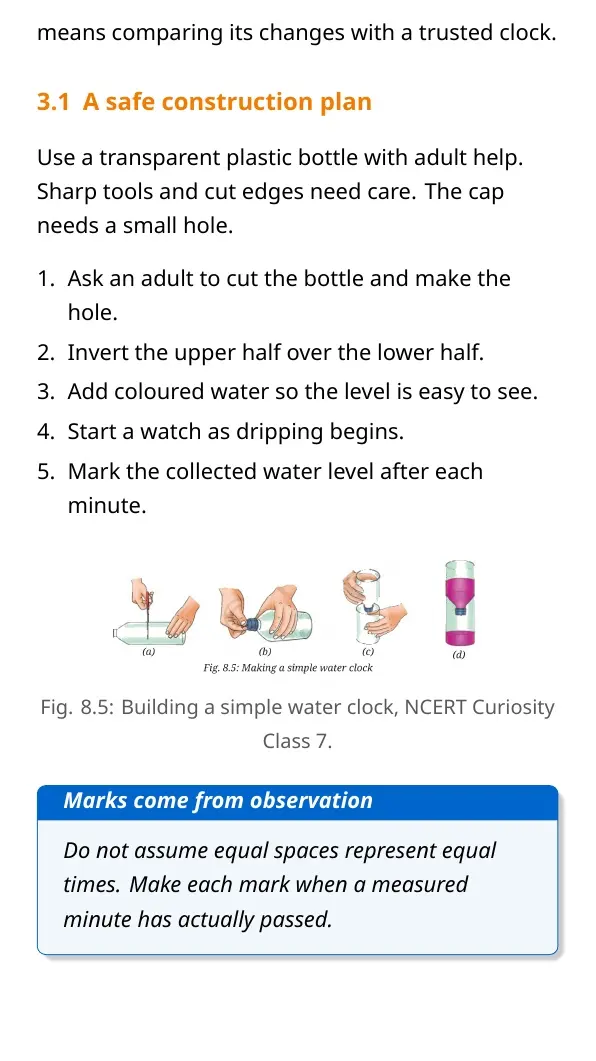
People first used repeating natural events to track time. Sunrise and sunset, Moon phases and seasons helped them recognise cycles. Smaller time intervals needed devices such as sundials, water clocks, hourglasses and candle clocks.
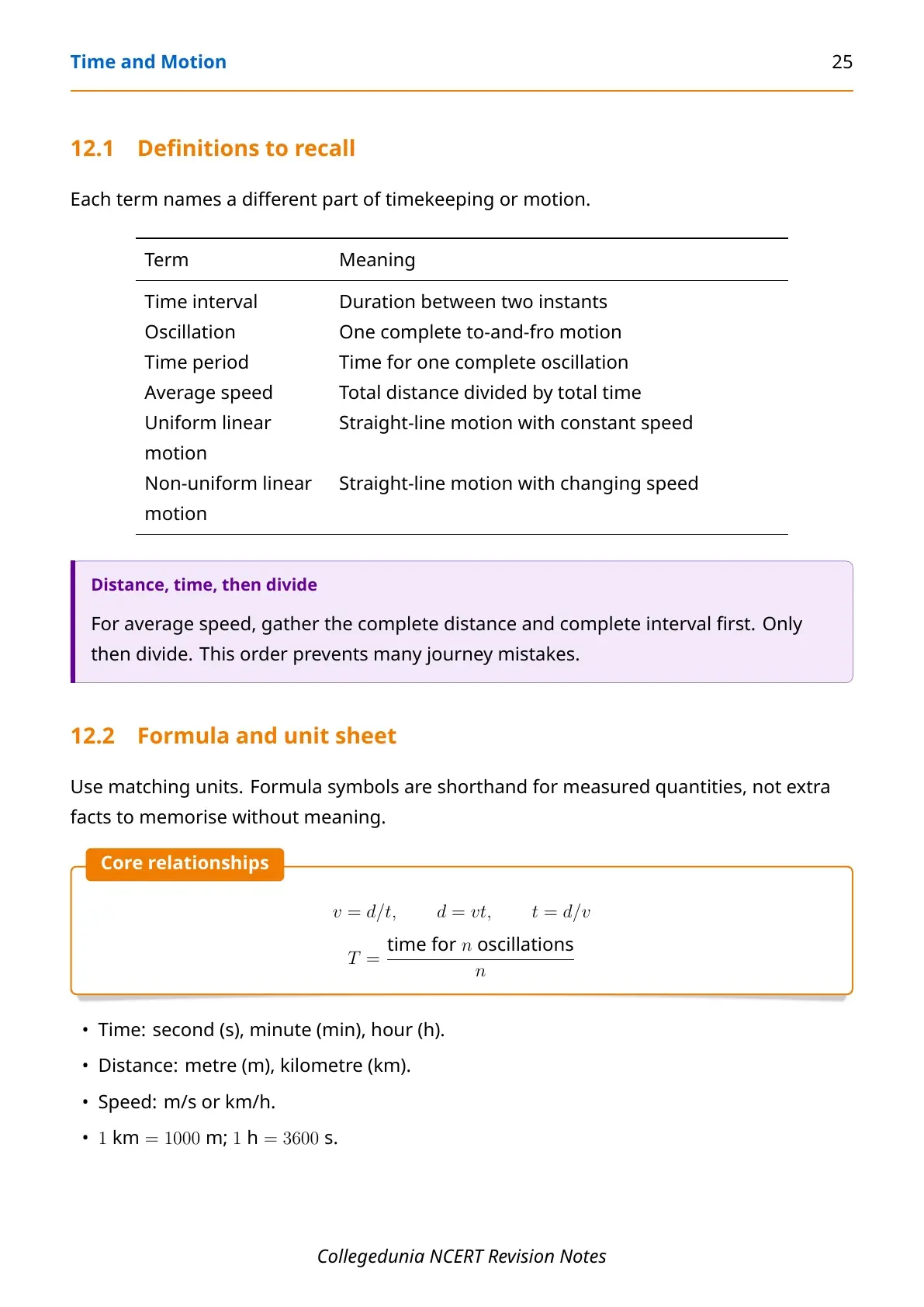
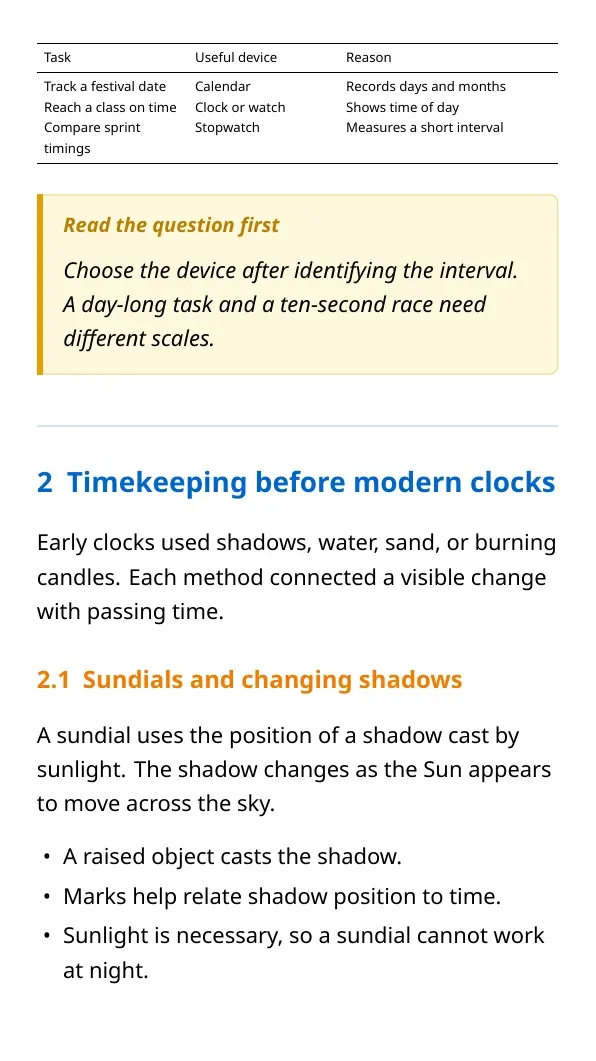
| Device | How it measures time |
|---|---|
| Sundial | Uses the changing position of a shadow in sunlight |
| Water clock | Uses water flowing out of a vessel or into a floating bowl |
| Hourglass | Uses sand flowing between two bulbs |
| Candle clock | Uses markings reached as a candle burns |
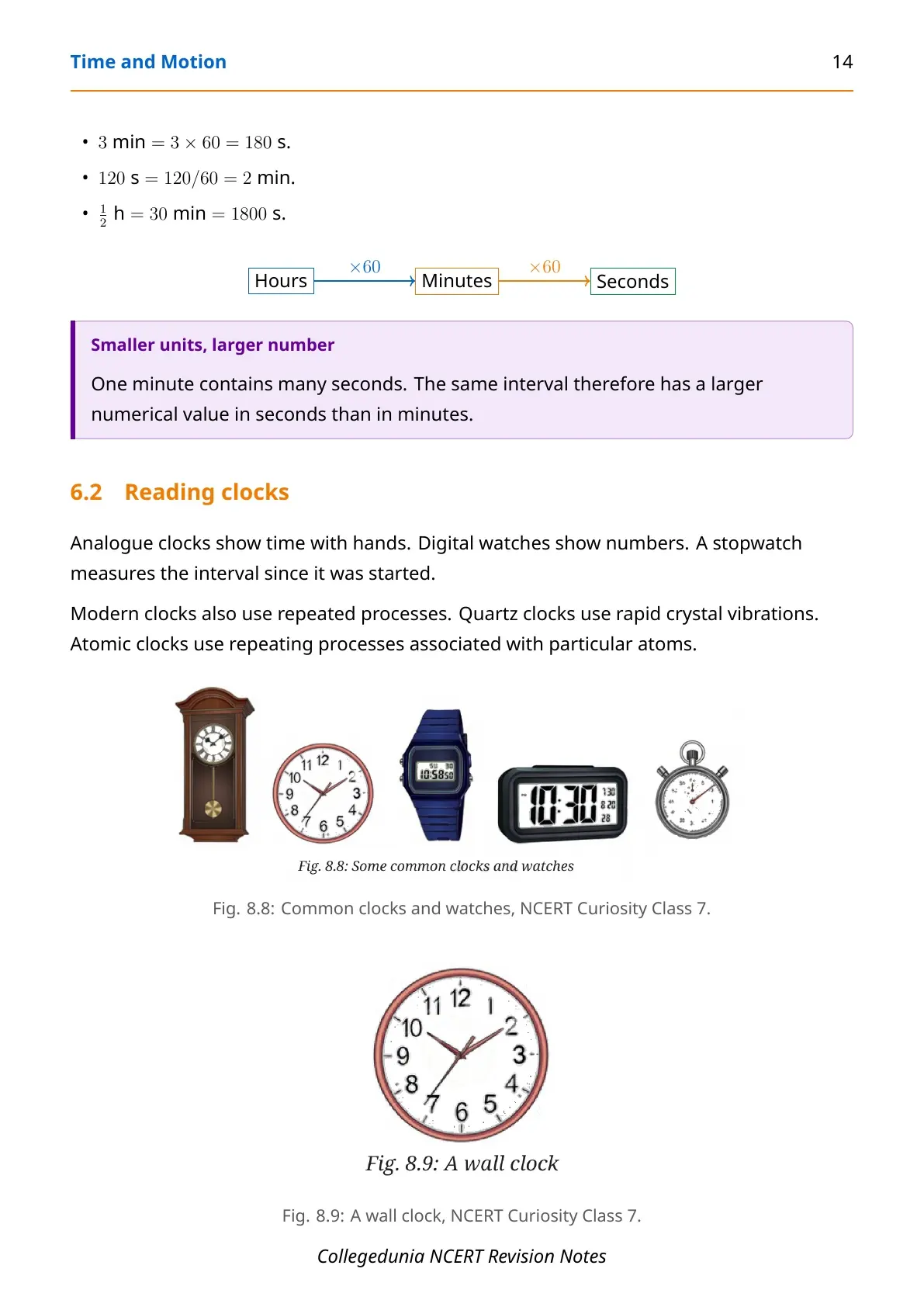
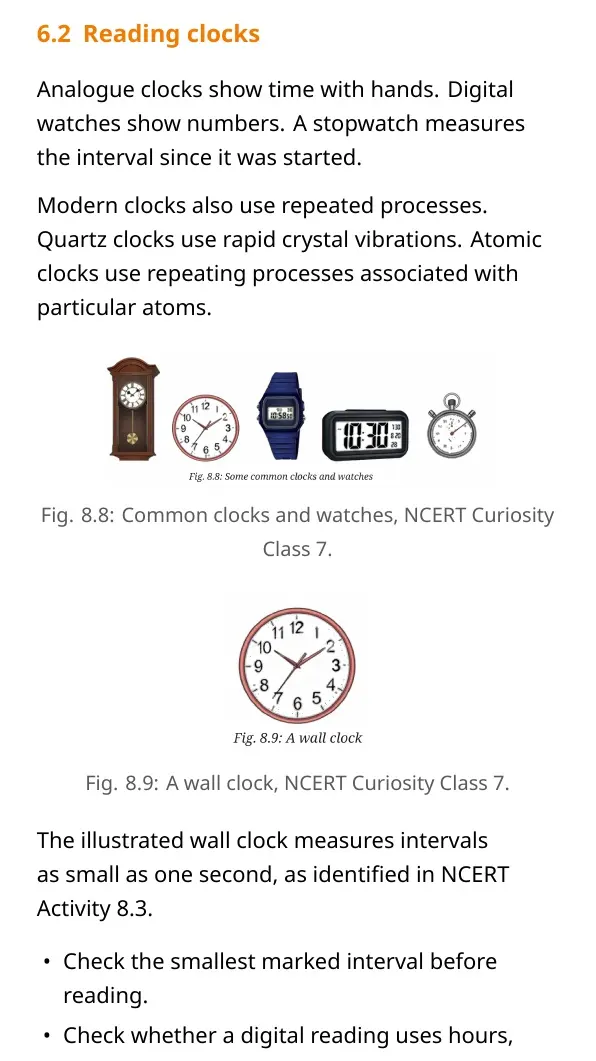
A sundial needs sunlight. In a water clock, changing water level can change the flow rate. Modern quartz clocks use regular vibrations of quartz crystals. A stopwatch measures the duration of an event, such as a race.
Measurement of Time and Motion Explained for Class 7
Source: Magnet Brains on YouTube
Measurement of Time and Motion: Timing a Simple Pendulum
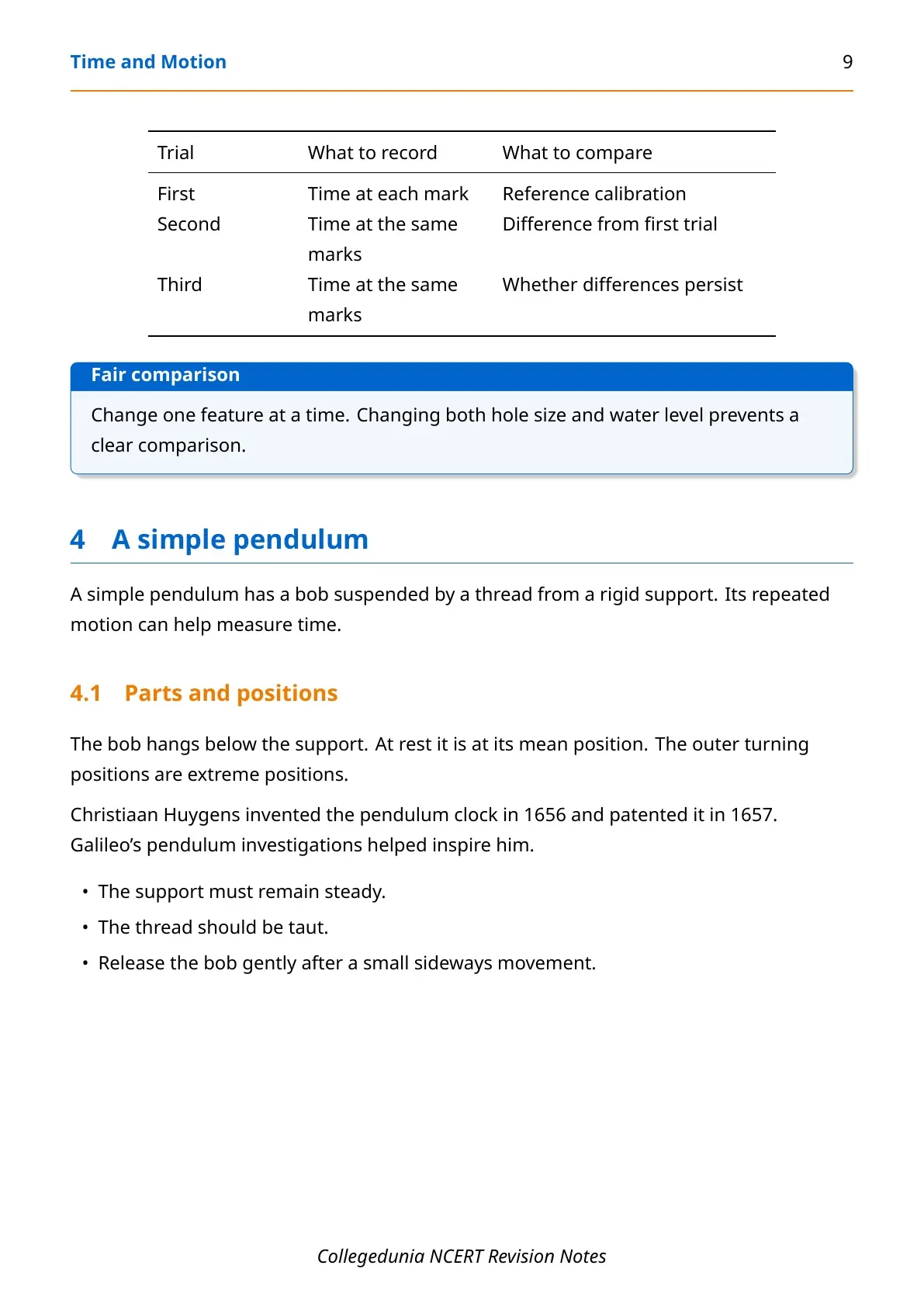
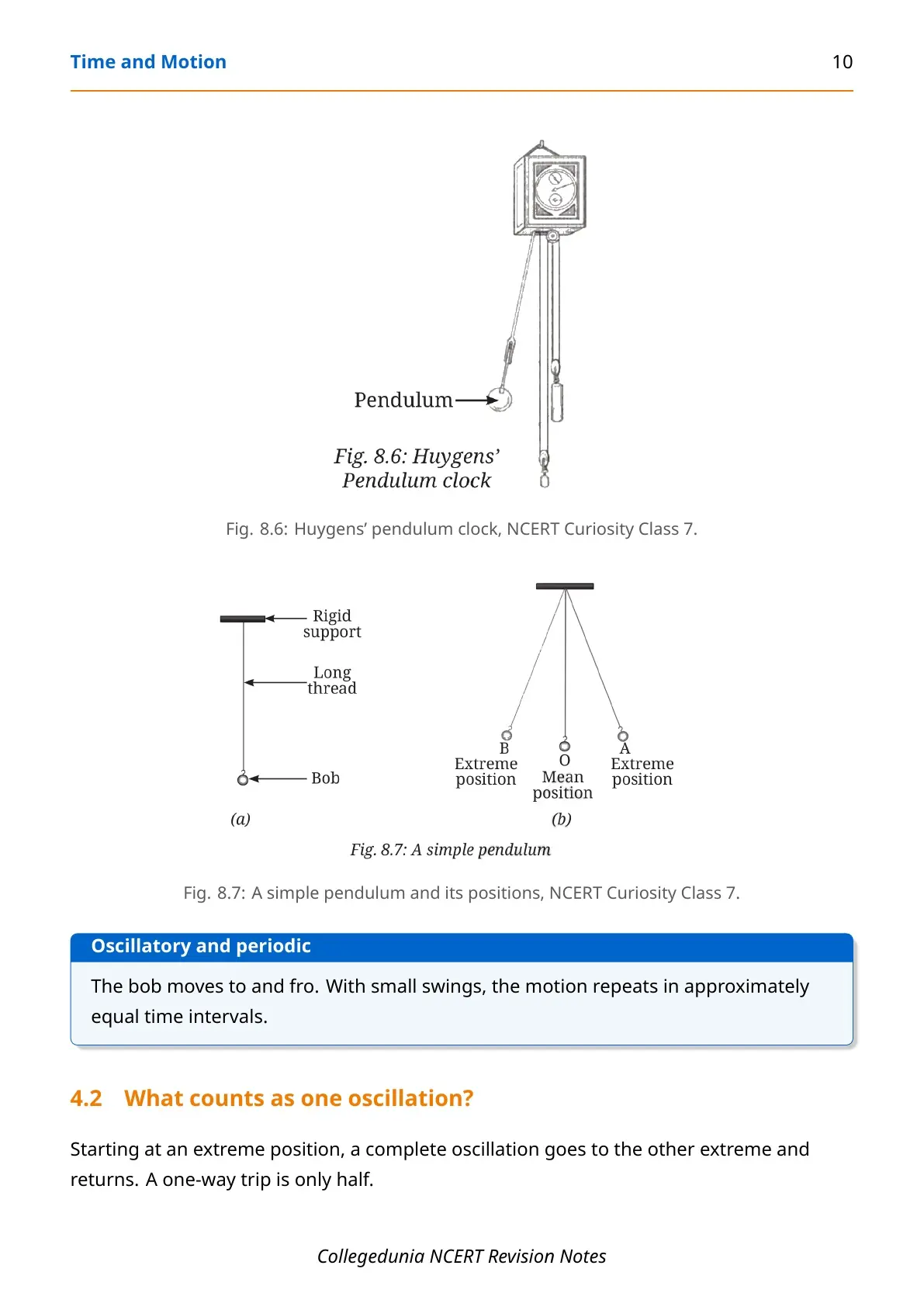
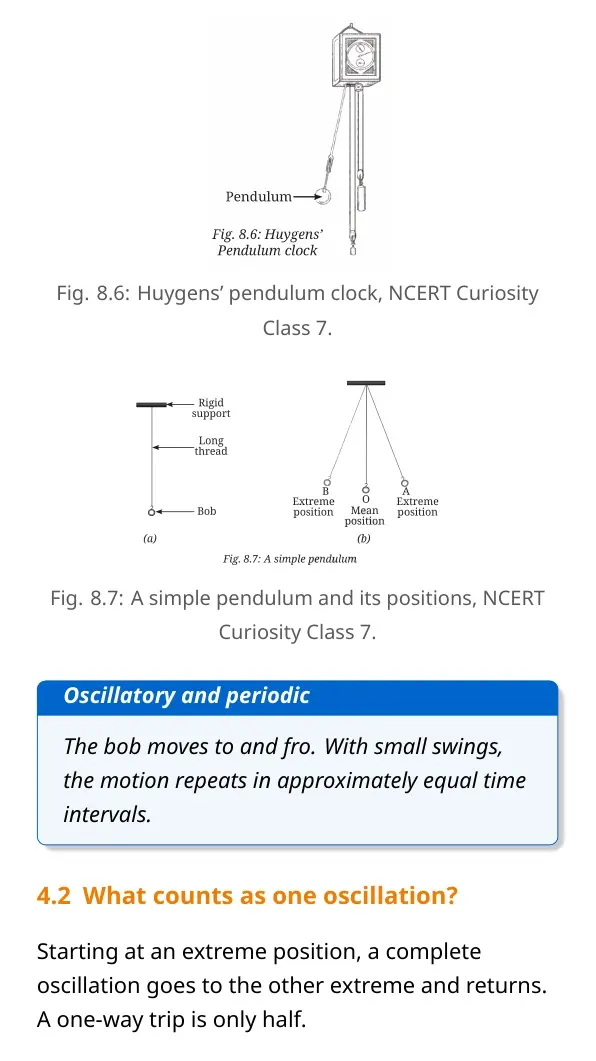
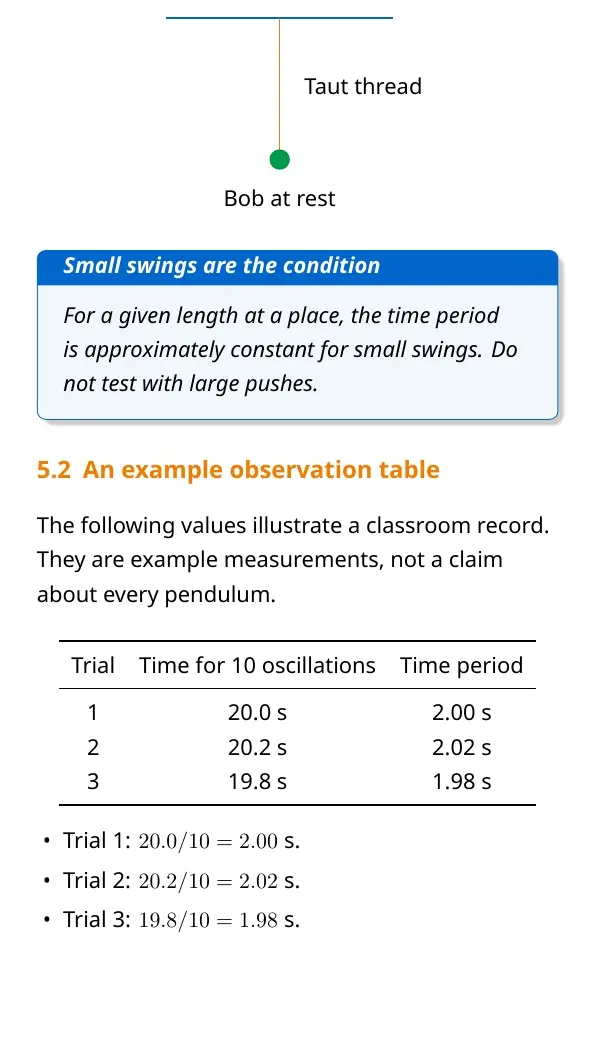
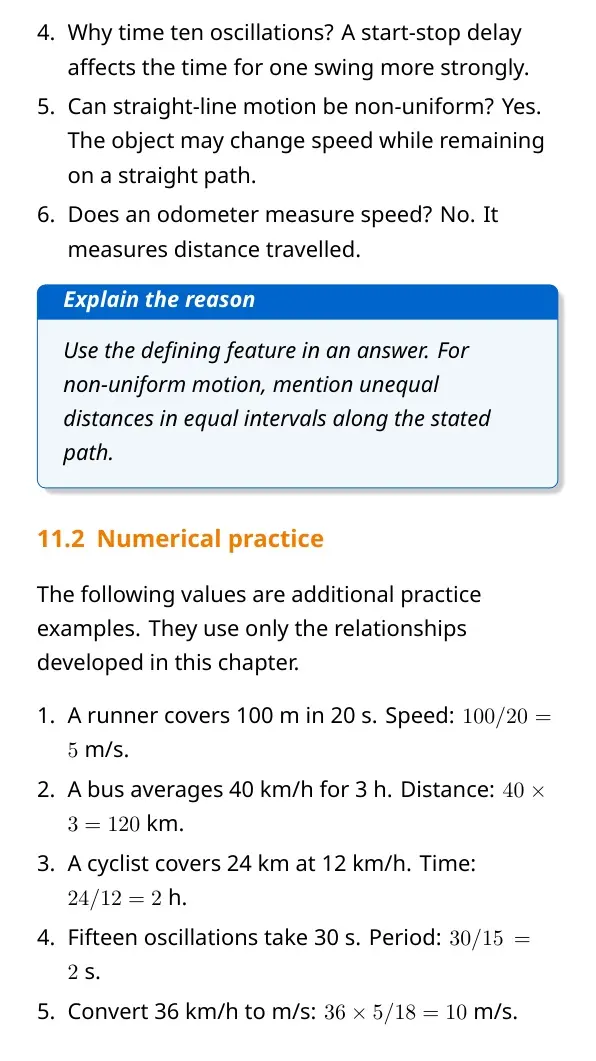
A simple pendulum has a small bob suspended from a rigid support by a thread. Its rest position is the mean position. Pull the bob slightly aside and release it gently without pushing.
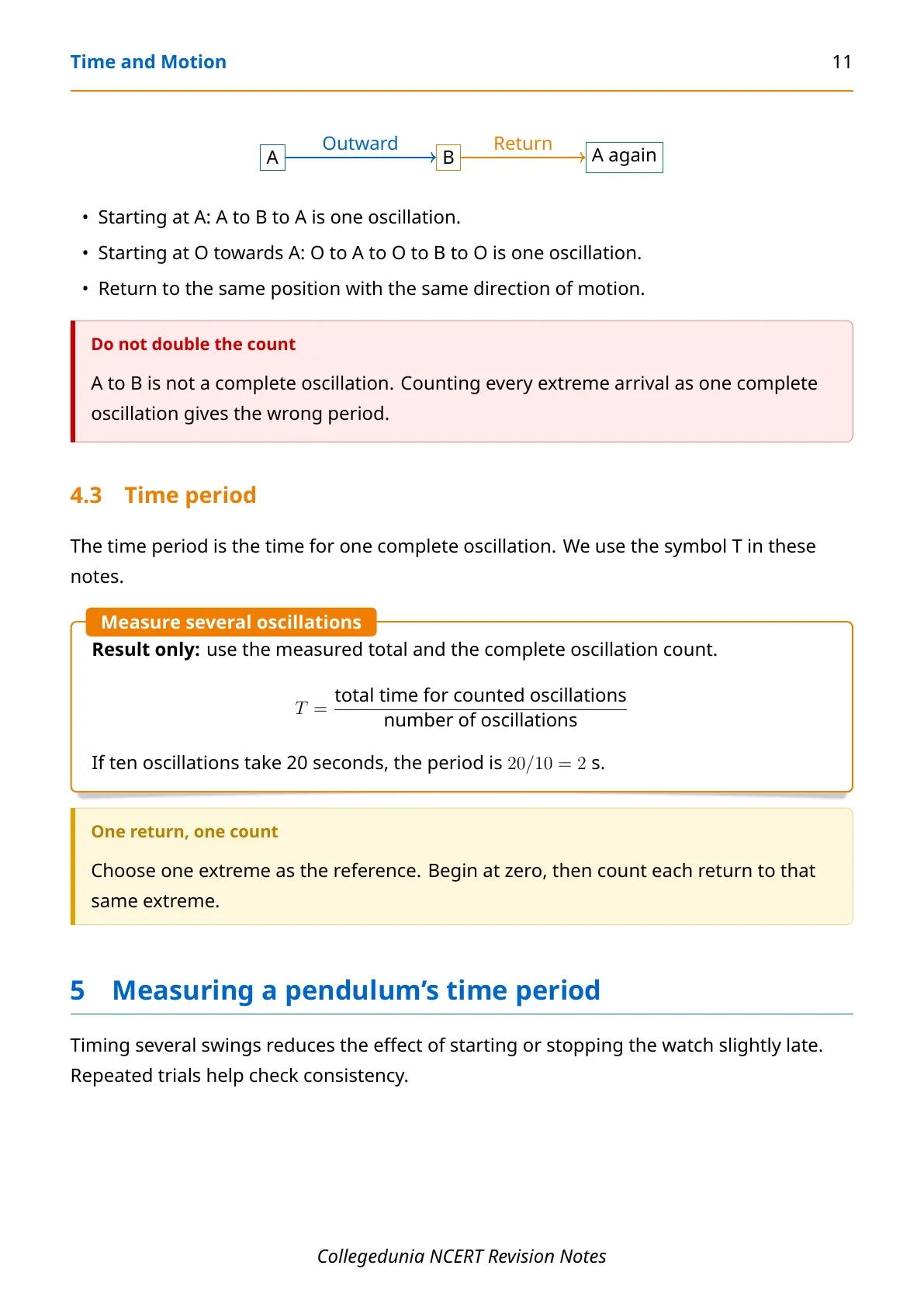
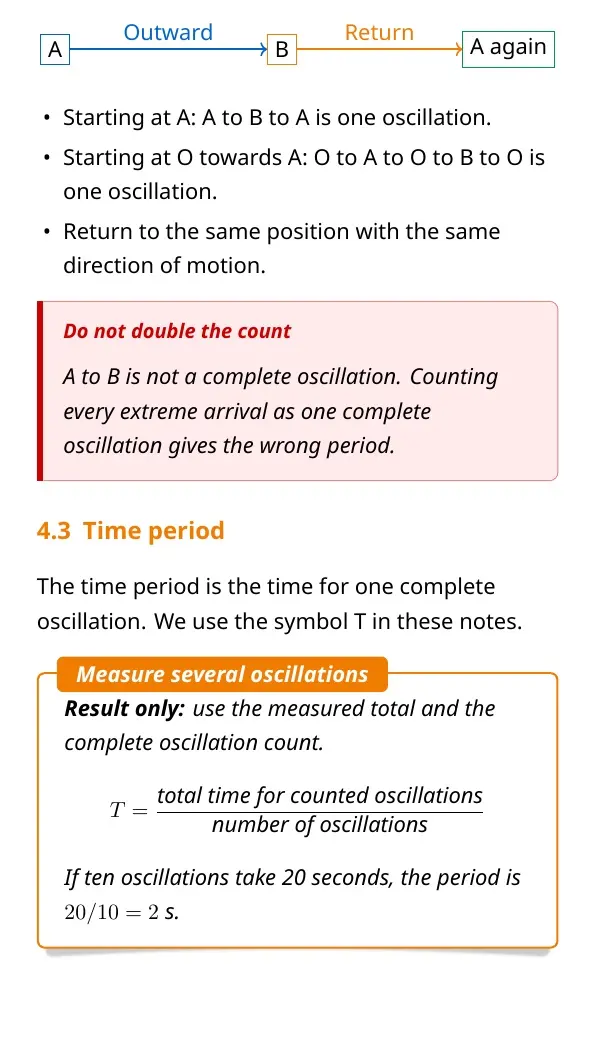
One complete oscillation returns the bob to its starting position and direction of motion. Starting at one extreme, it moves to the other extreme and back. A single trip between the two extremes is only half an oscillation.
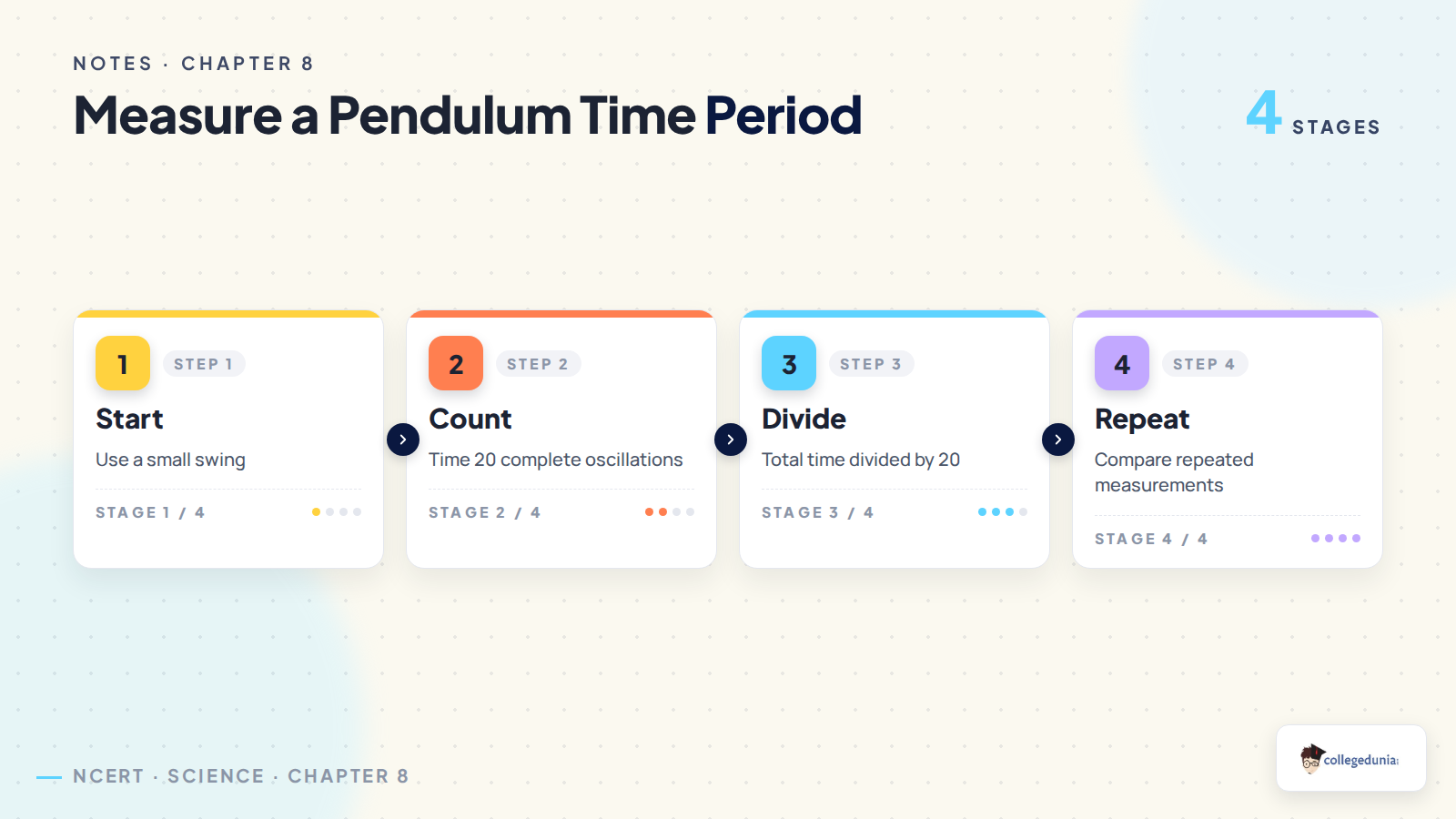
- Keep the string length fixed and use a small swing.
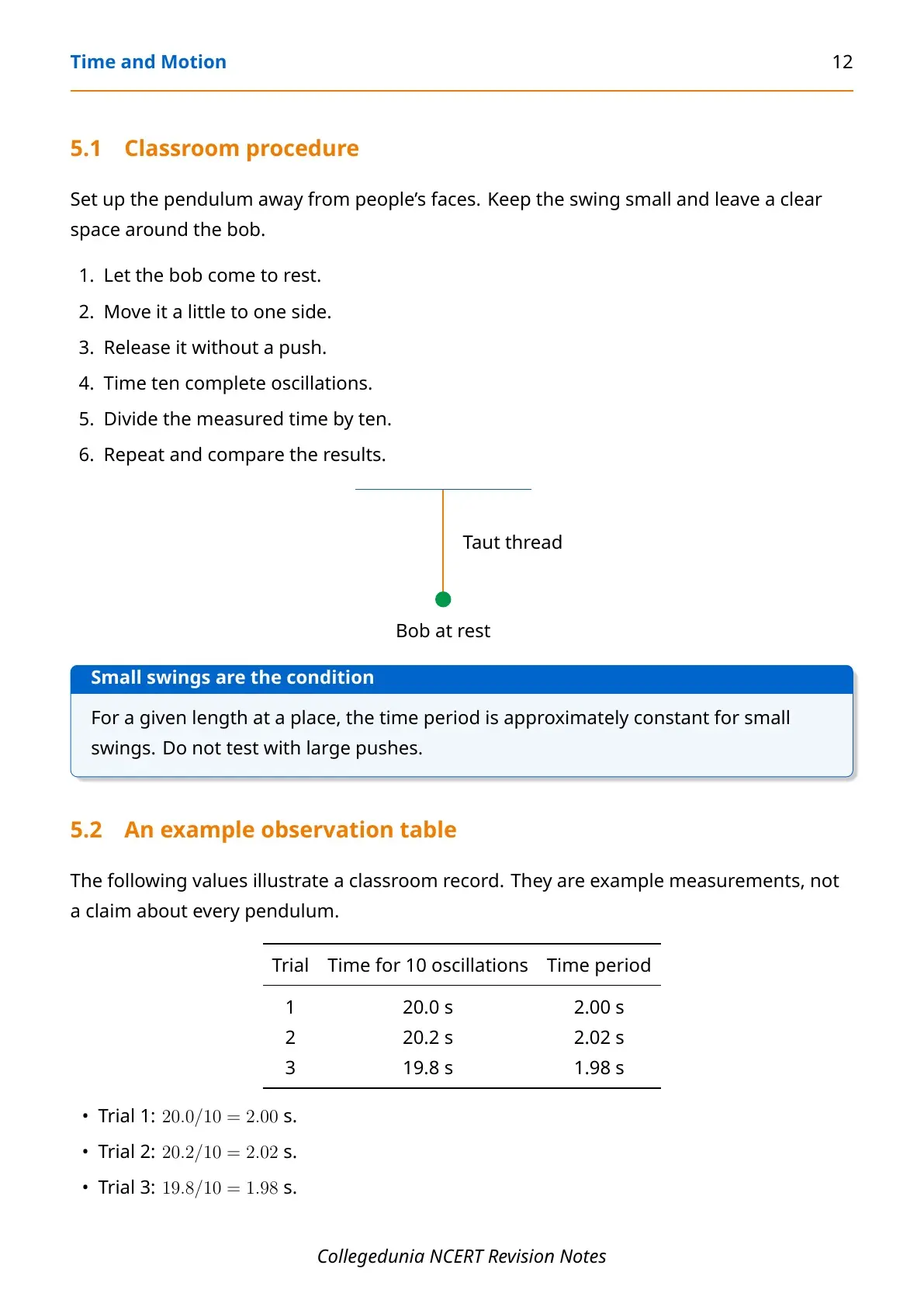
- Time 10 complete oscillations with a stopwatch.
- Divide the total time by 10 to find the time period.
- Repeat the measurement to check for small timing differences.
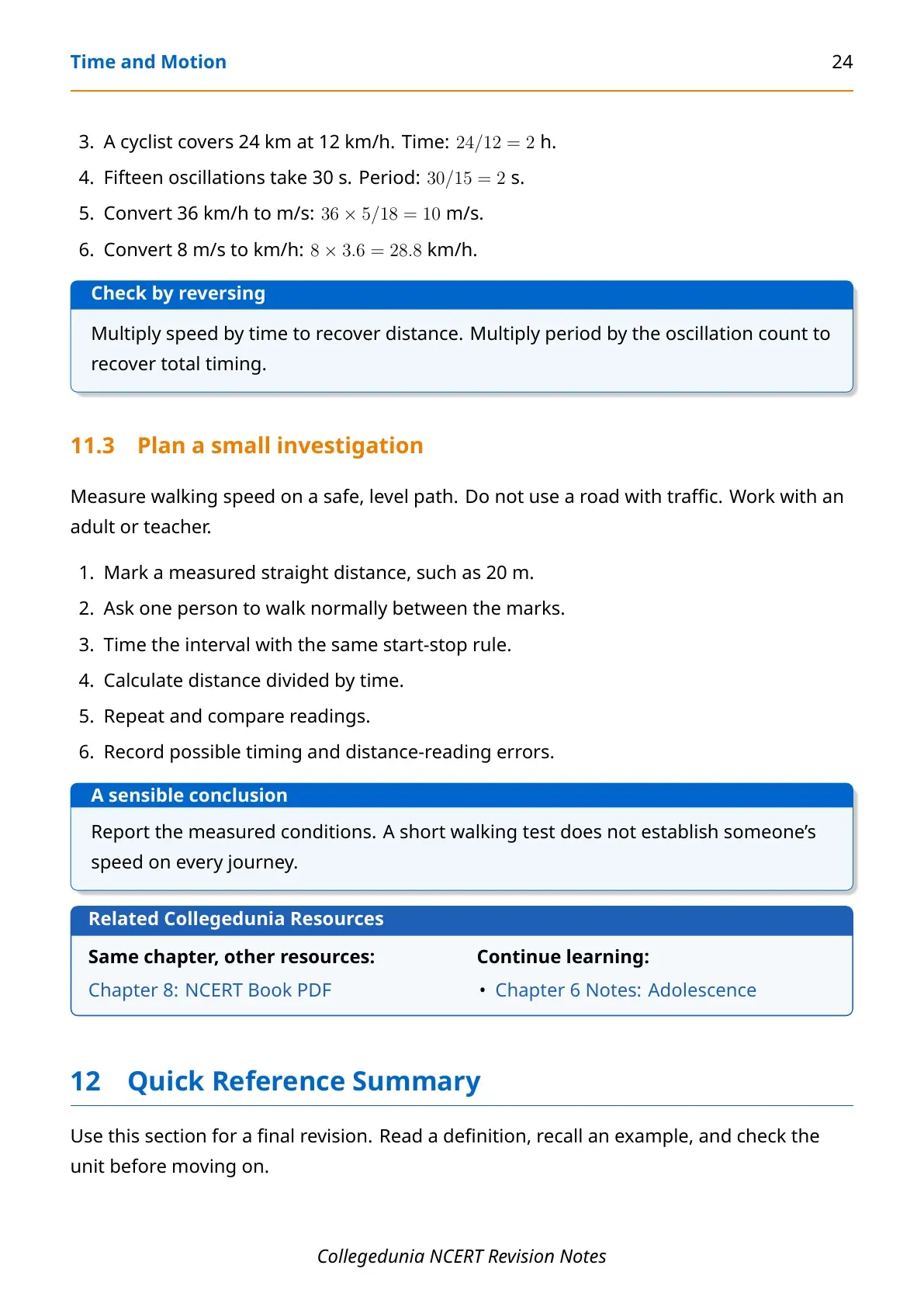
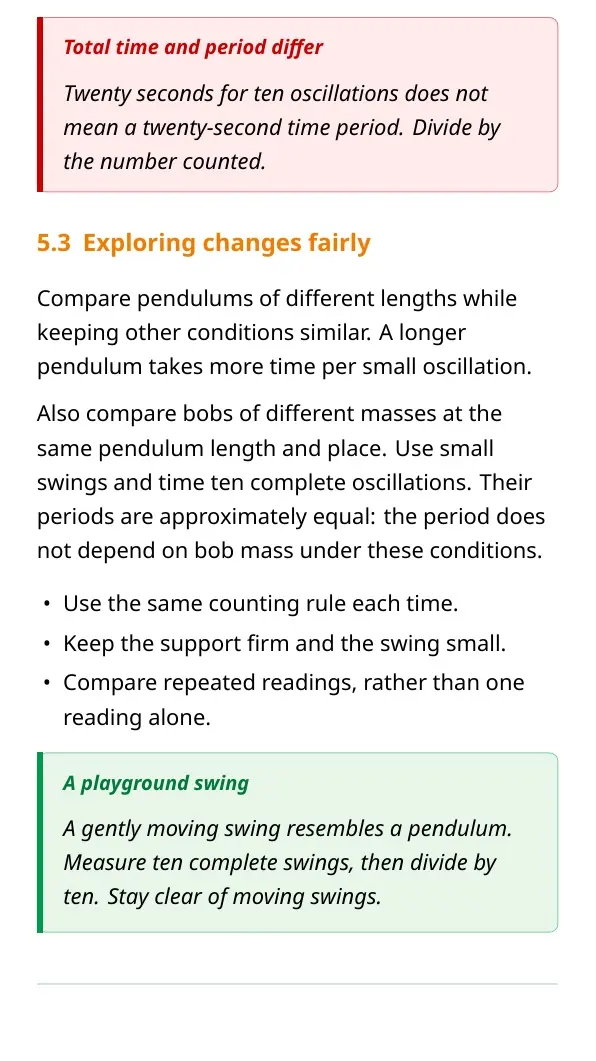
The time period is the time for one complete oscillation. If 10 oscillations take 20 s, the time period is 2 s. For the same length at the same place, it stays nearly constant for small swings. A longer pendulum takes more time per oscillation. At fixed length and place, changing the bob mass does not change its period appreciably for small swings.
Measurement of Time and Motion: Units and Speed Formulas
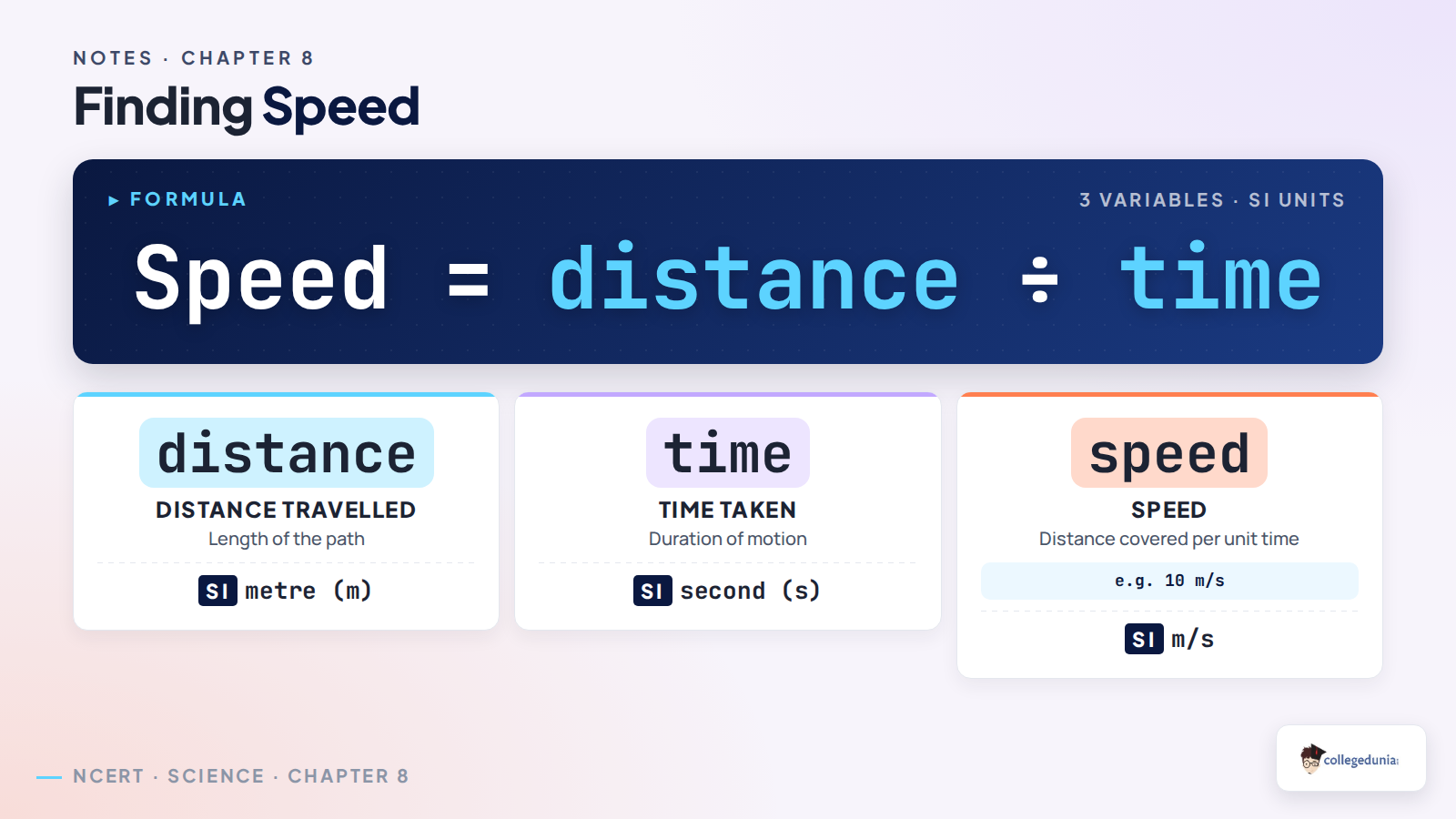
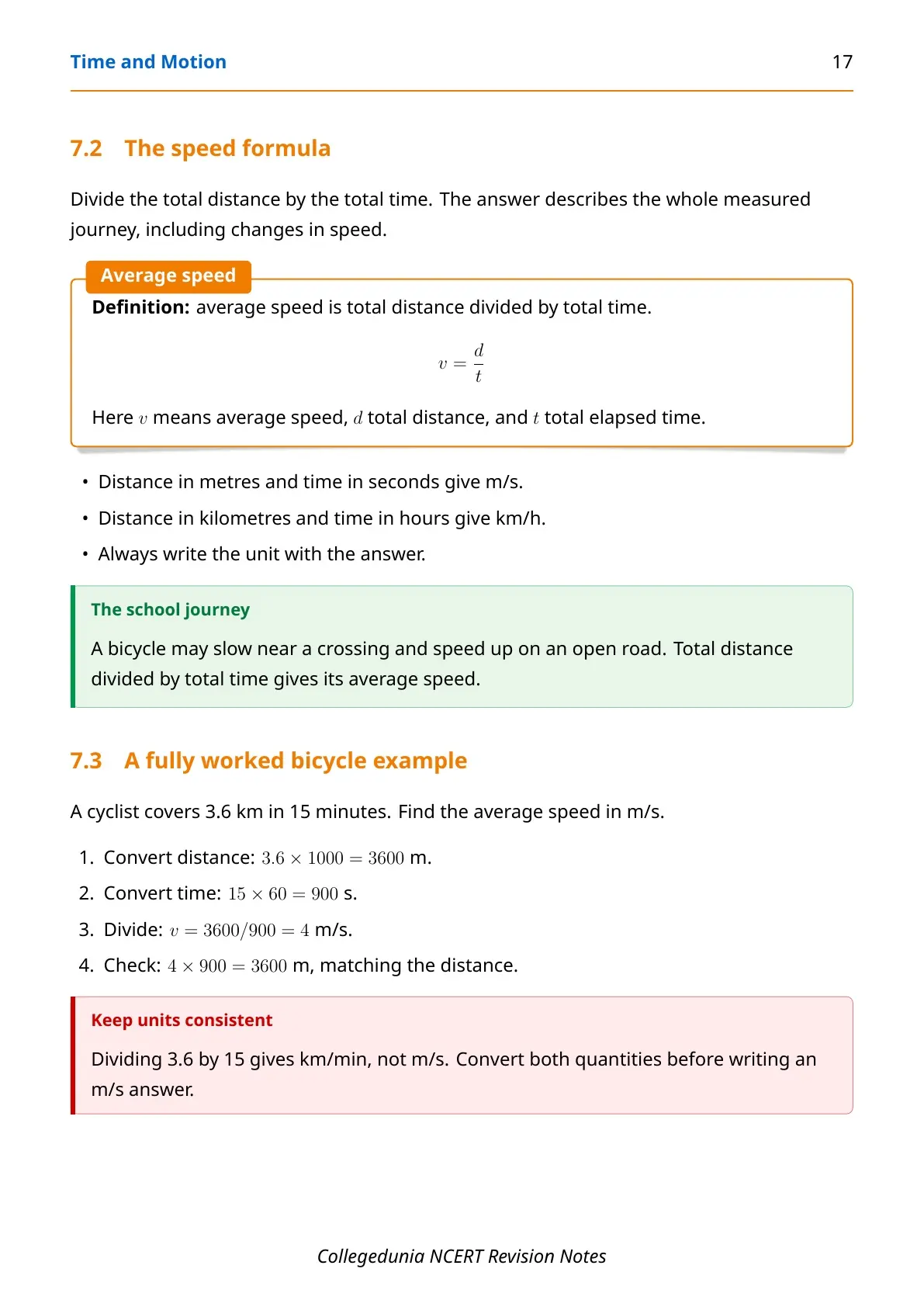
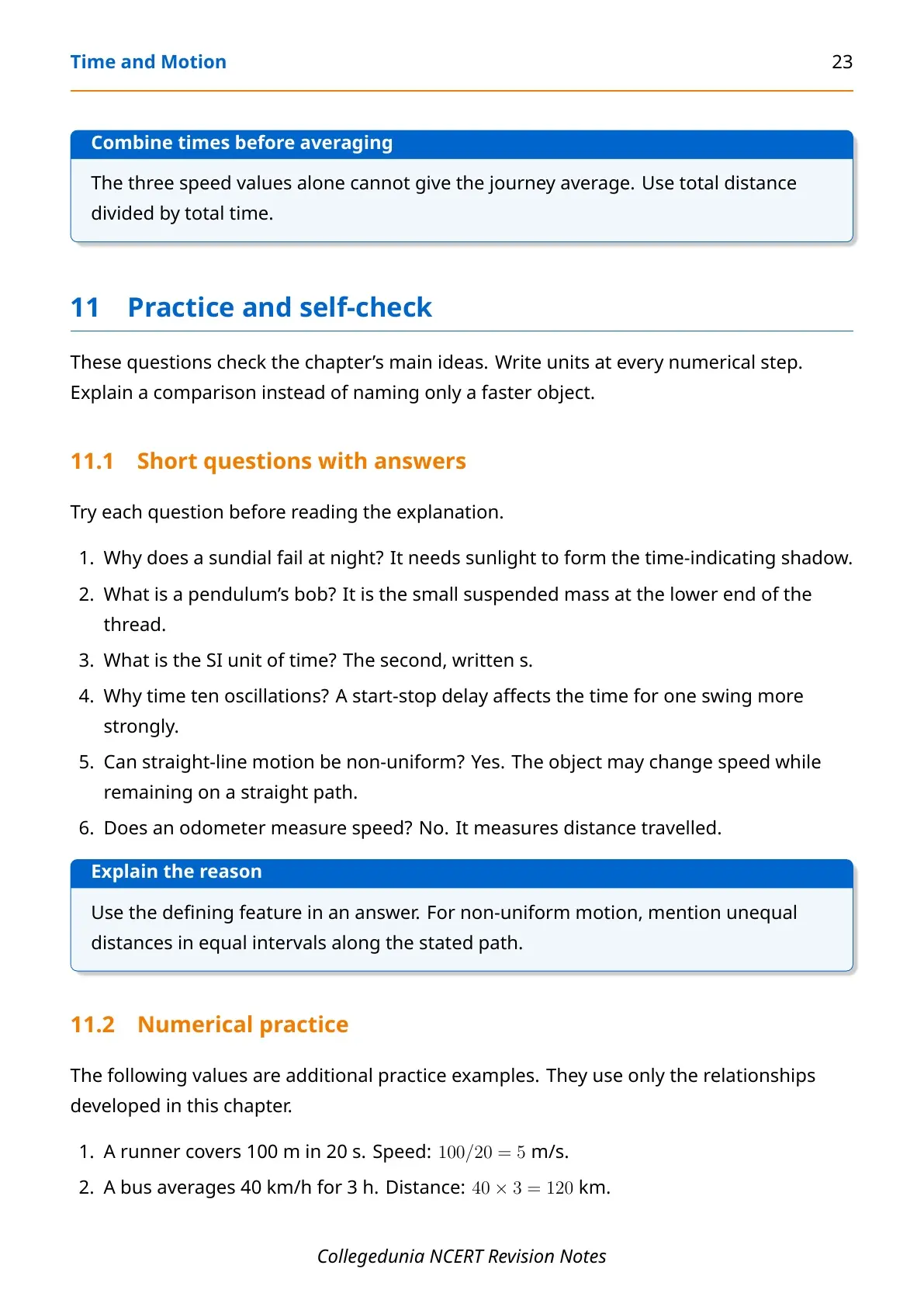
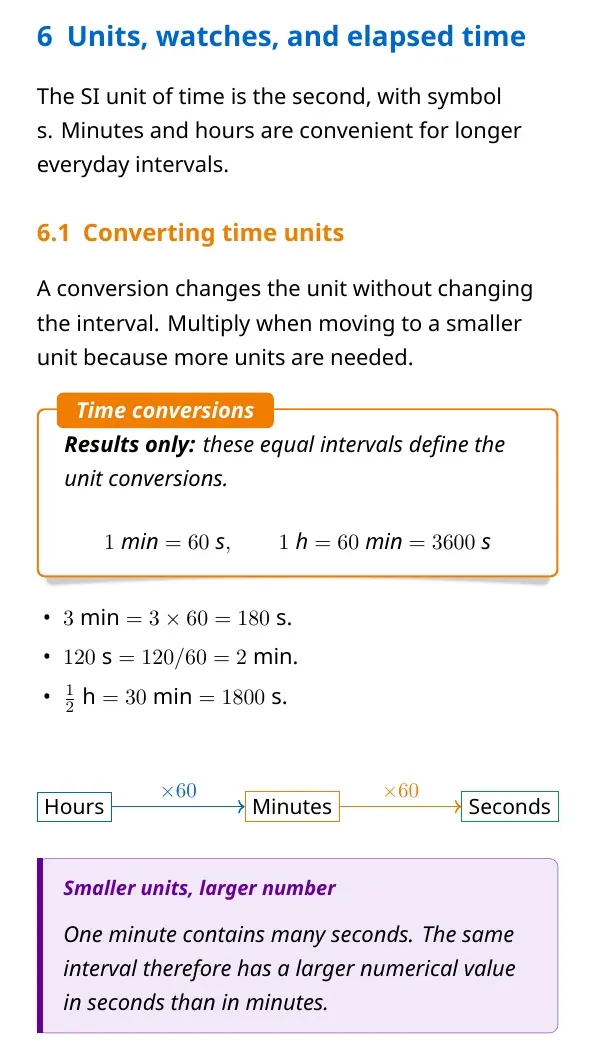
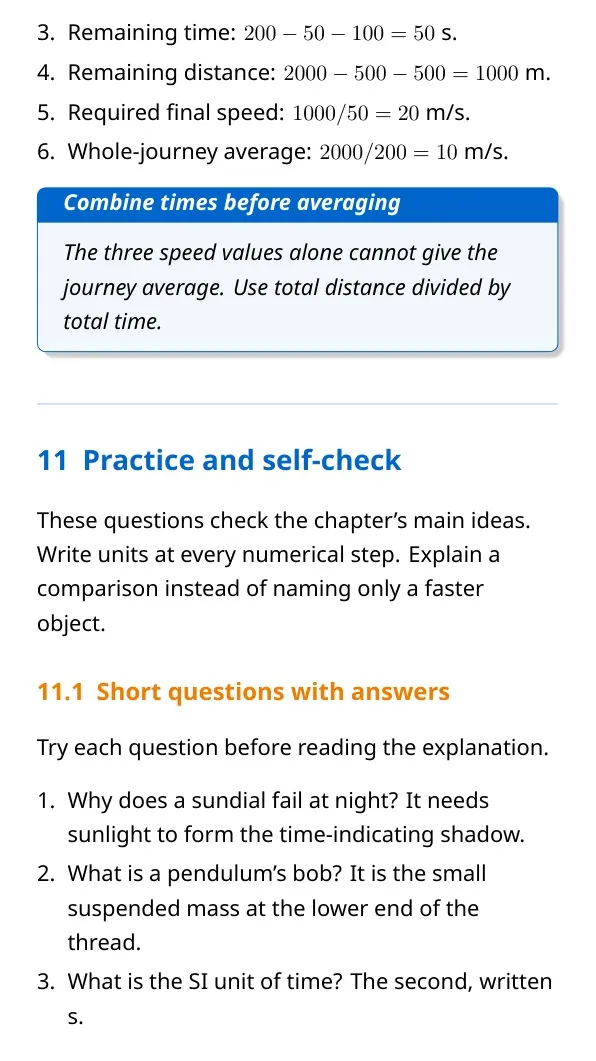
The SI unit of time is the second, written s. One minute has 60 seconds, and one hour has 3600 seconds. Speed compares distance travelled with the time taken. Greater speed means more distance in the same time.
| Quantity | Calculation | Example unit |
|---|---|---|
| Average speed | Total distance ÷ total time | m/s or km/h |
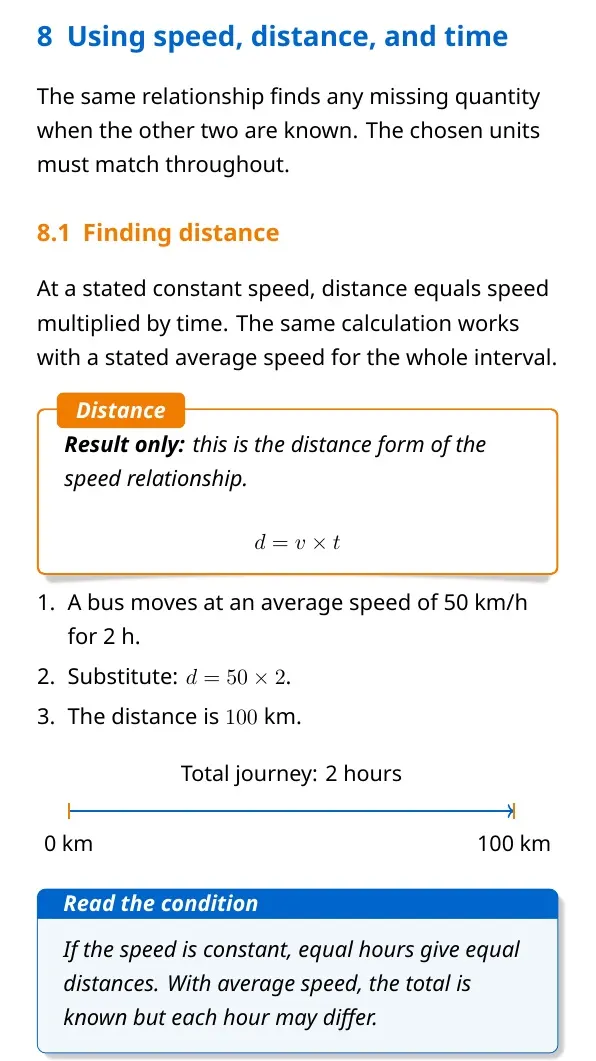
| Distance | Speed × time, for constant speed | m or km |
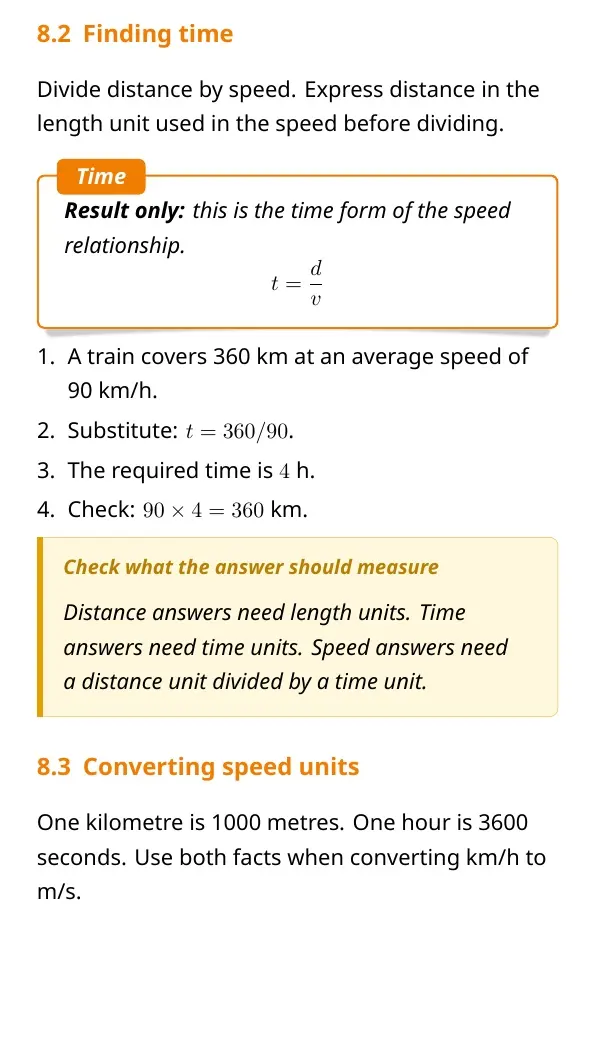
| Time | Distance ÷ speed, for constant speed | s or h |
| Pendulum time period | Total time ÷ number of complete oscillations | s |
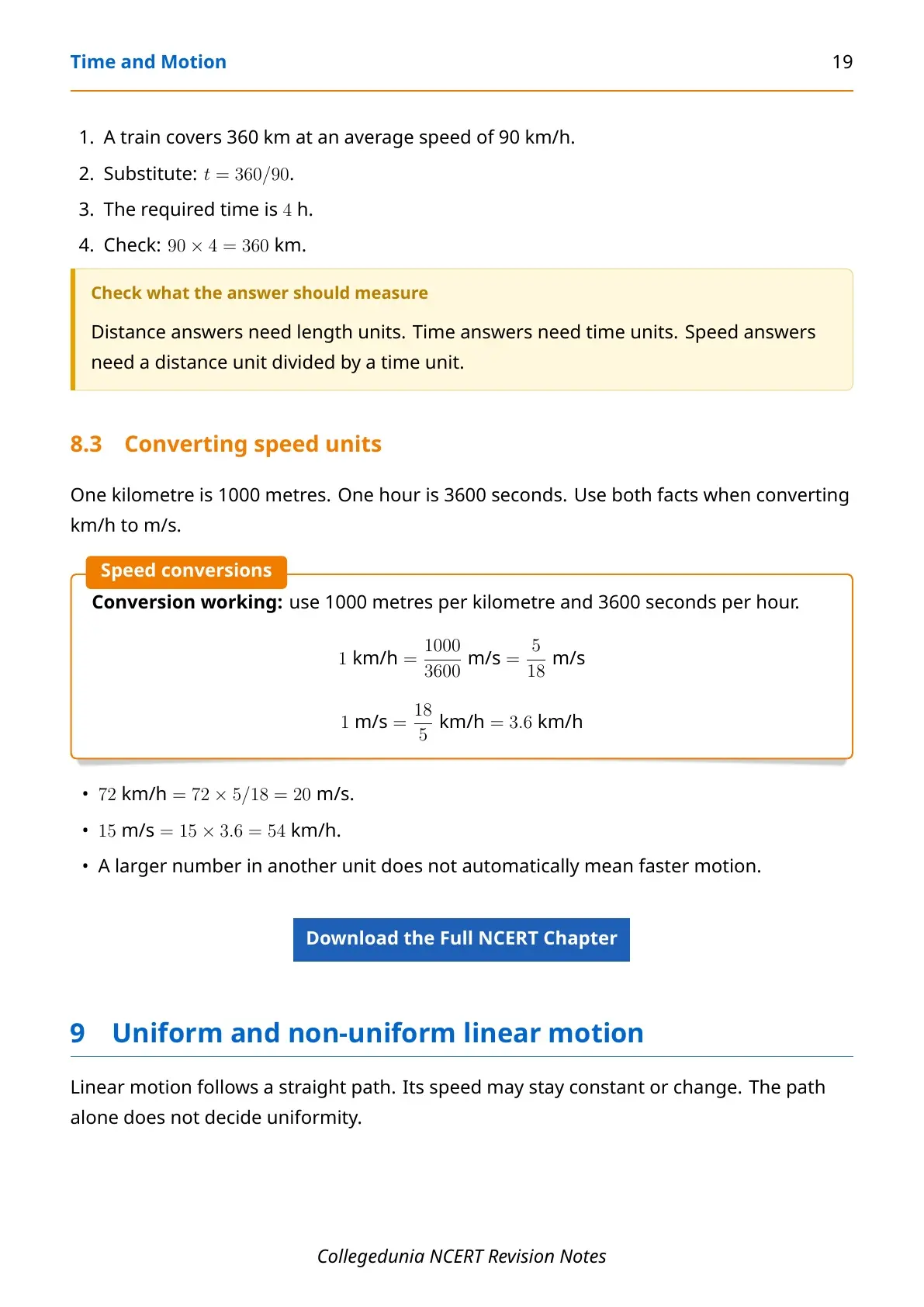
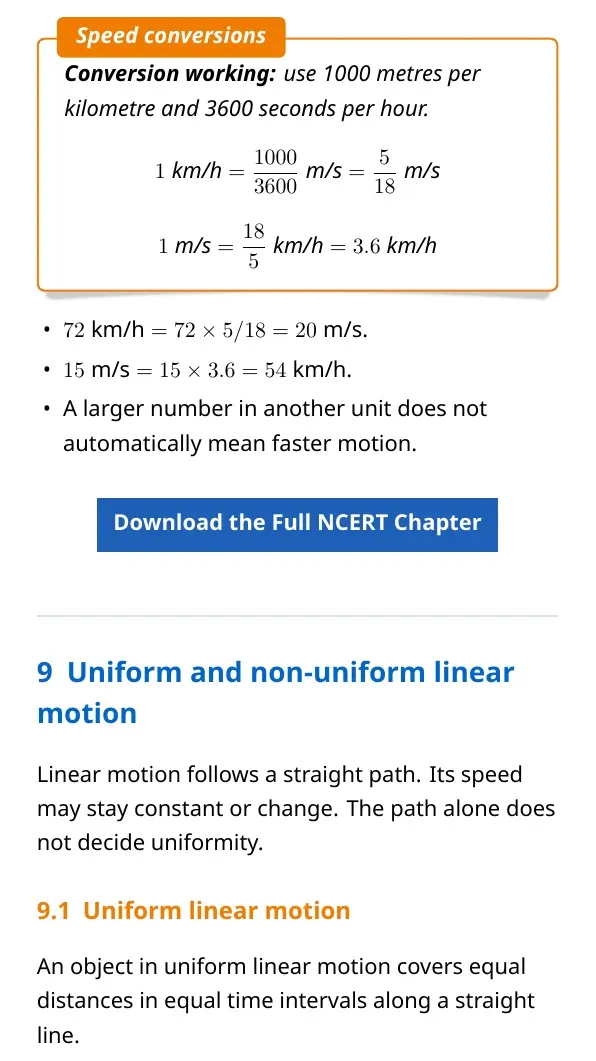
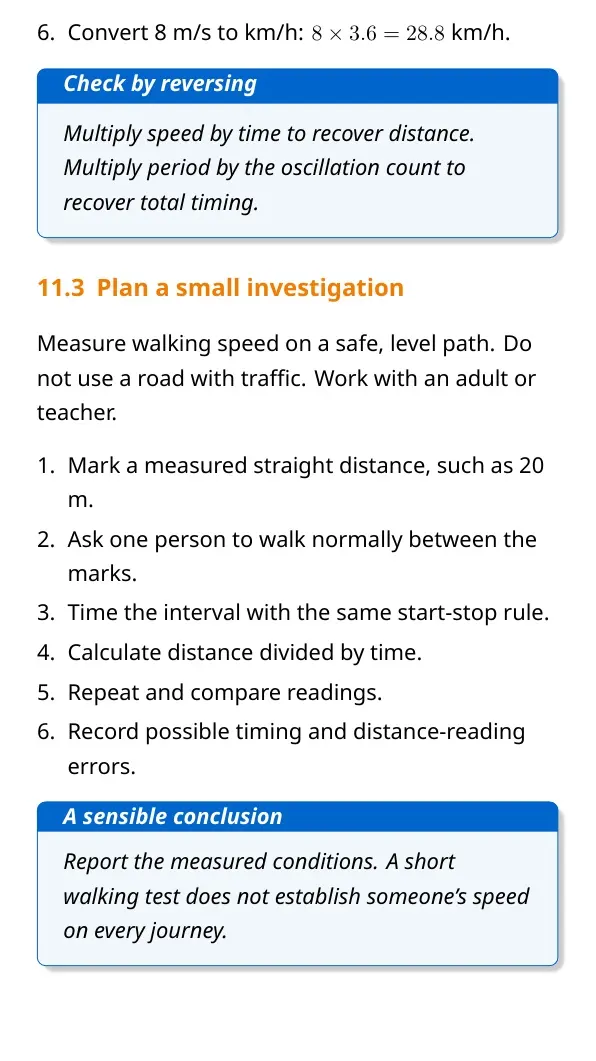
Use matching units before substituting values. Convert kilometres to metres and hours to seconds when you need m/s. Multiply m/s by 3.6 to get km/h; divide km/h by 3.6 to get m/s.
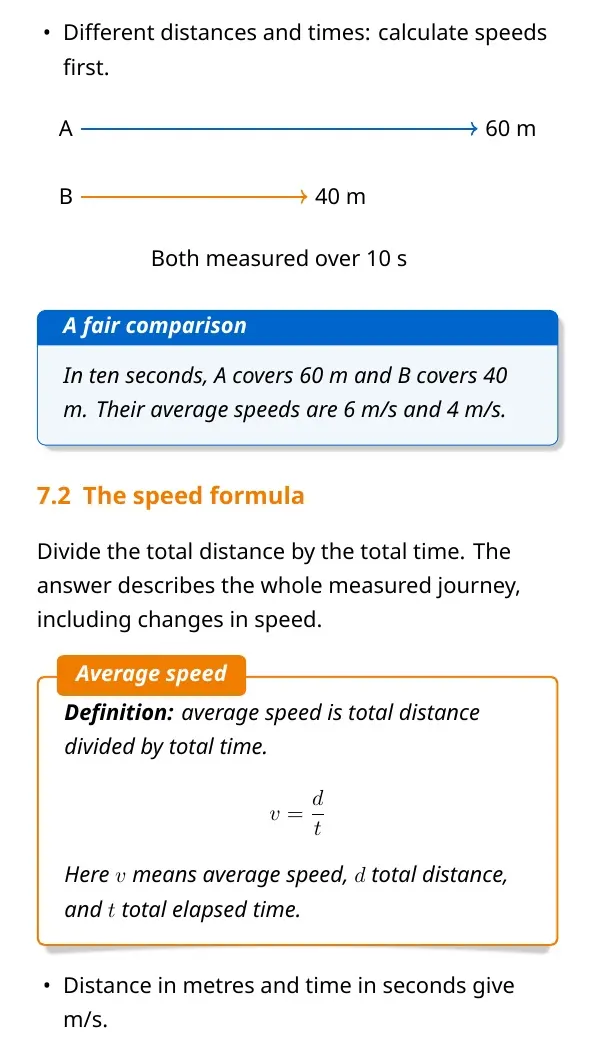
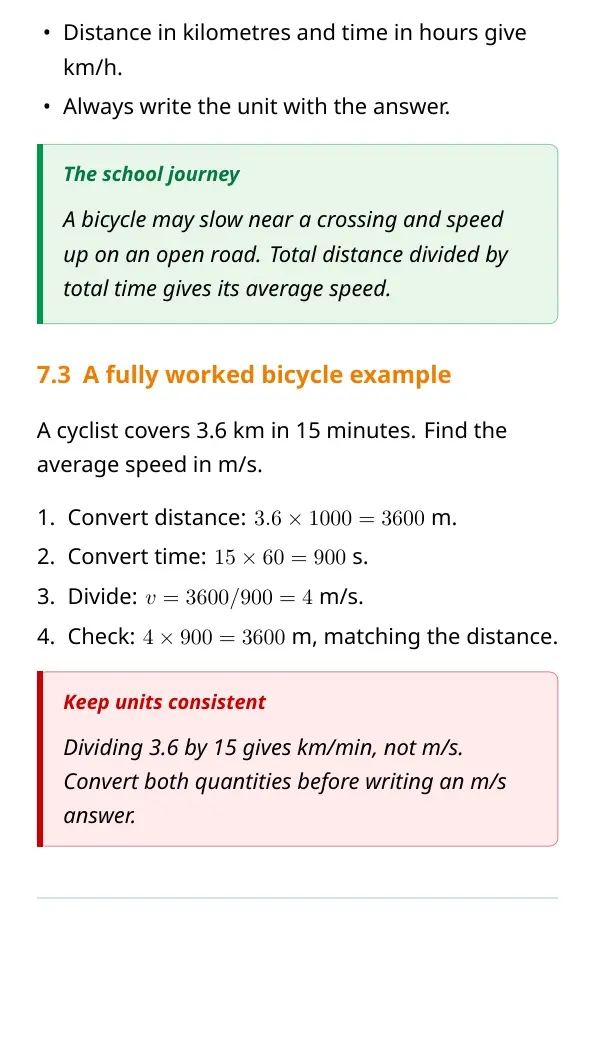
A cyclist travels 120 m in 30 s. Average speed is 120 ÷ 30 = 4 m/s. This equals 14.4 km/h. A speedometer shows a vehicle's speed; an odometer records the distance it travels.
Measurement of Time and Motion: Comparing Linear Motion
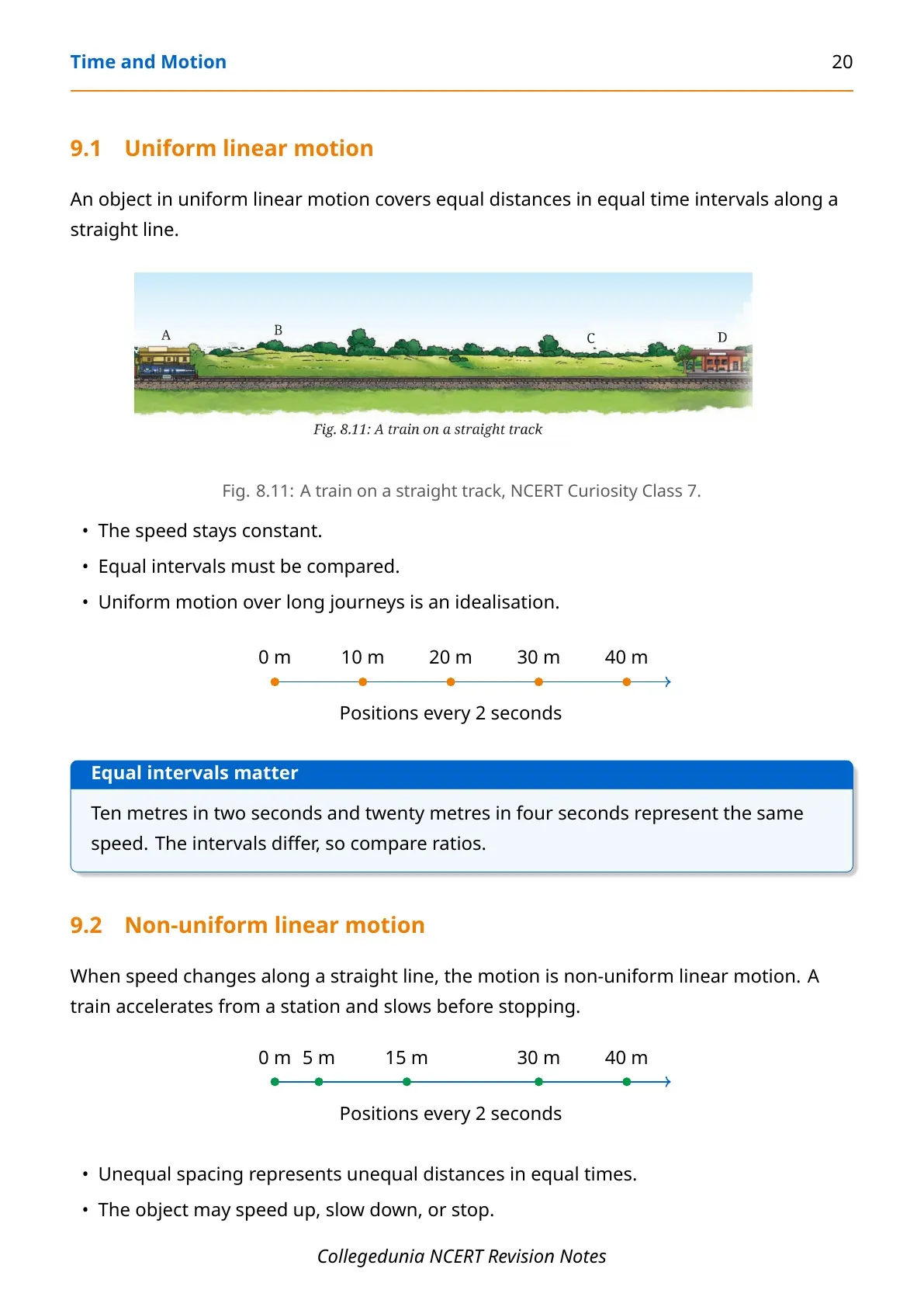
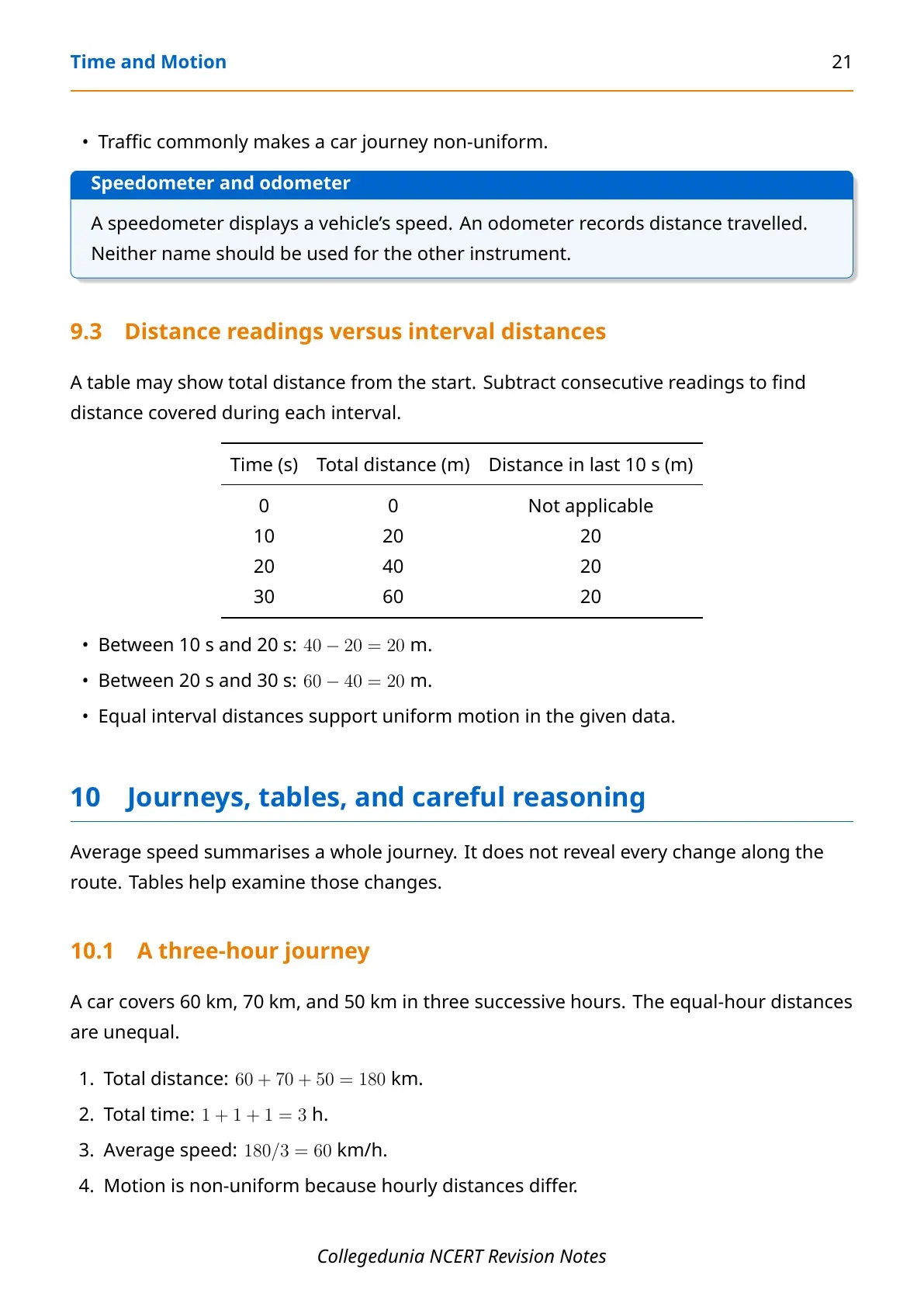
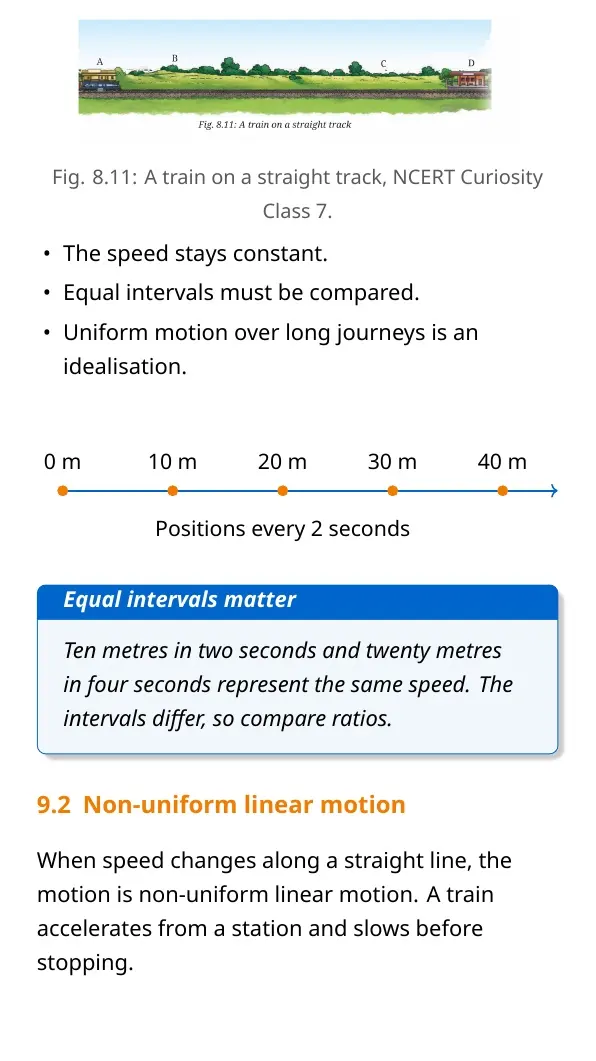
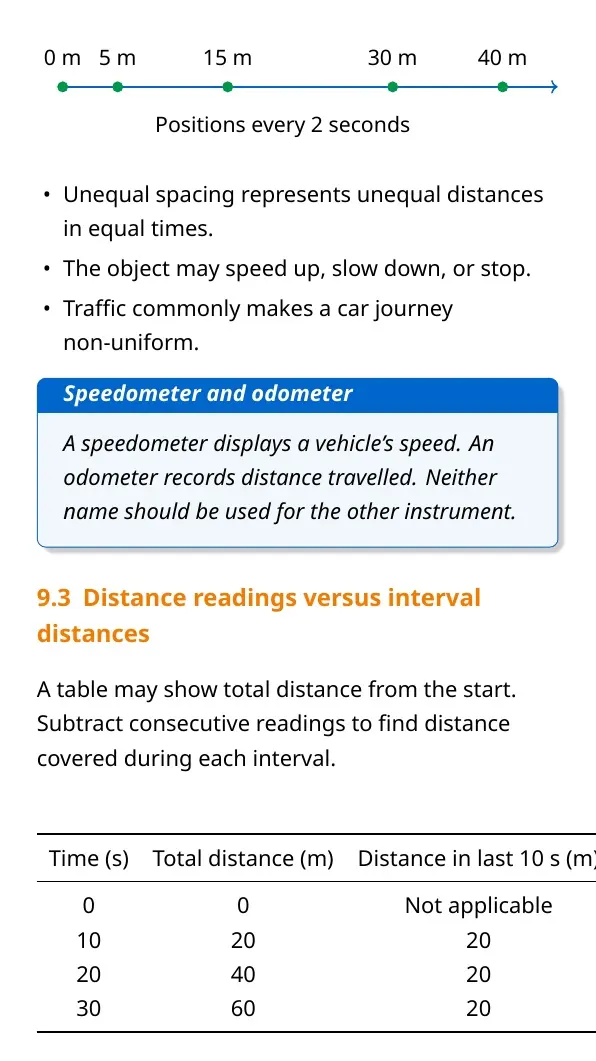
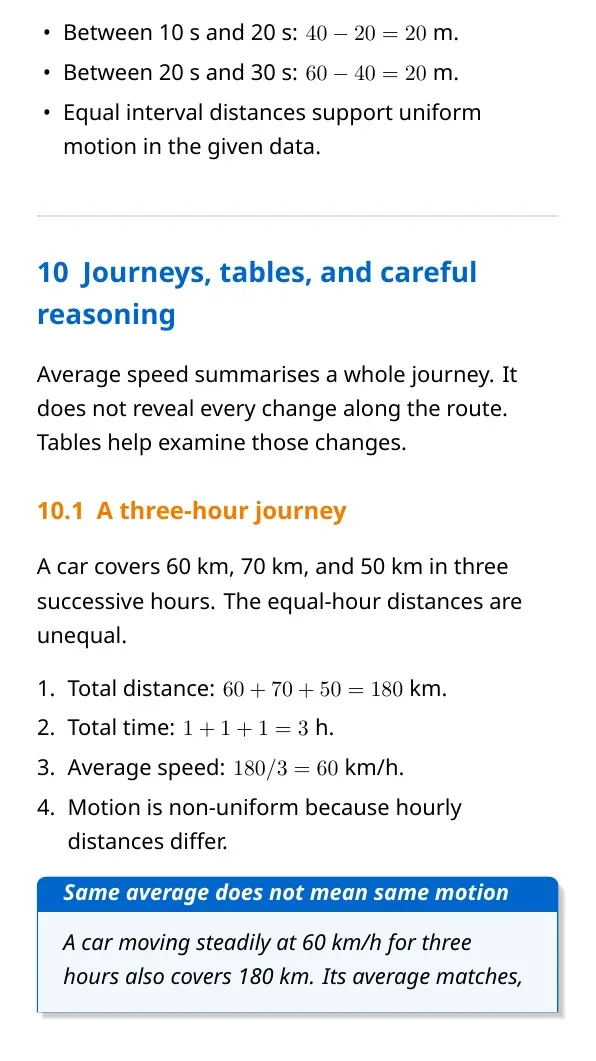
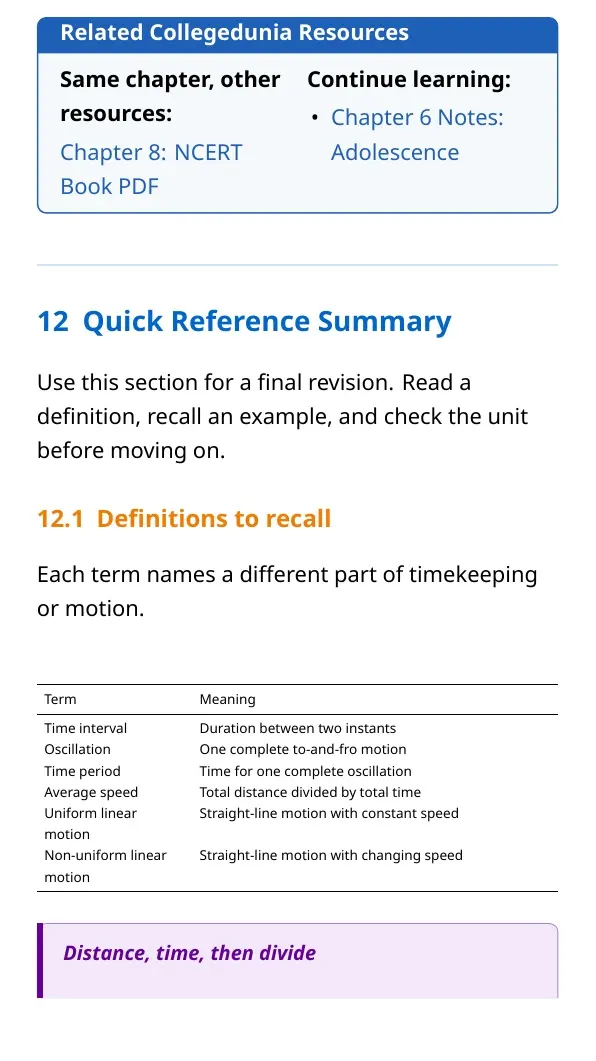
Linear motion is motion along a straight line. In uniform linear motion, speed remains constant. The object covers equal distances in equal time intervals. In non-uniform linear motion, its speed changes.
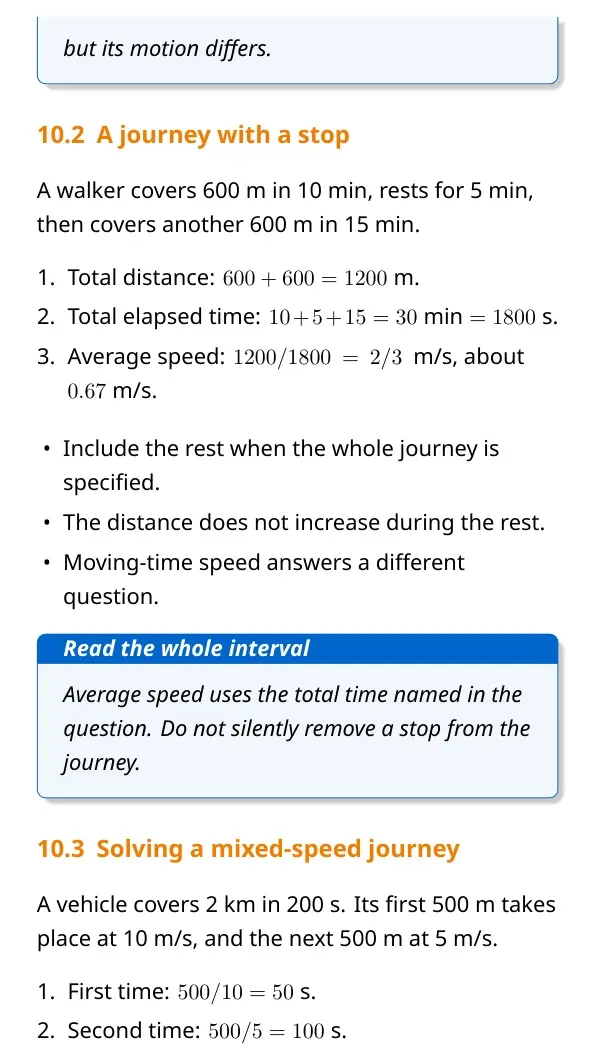
| Equal 10 s intervals | Object A: distance during interval | Object B: distance during interval |
|---|---|---|
| First | 20 m | 10 m |
| Second | 20 m | 20 m |
| Third | 20 m | 30 m |
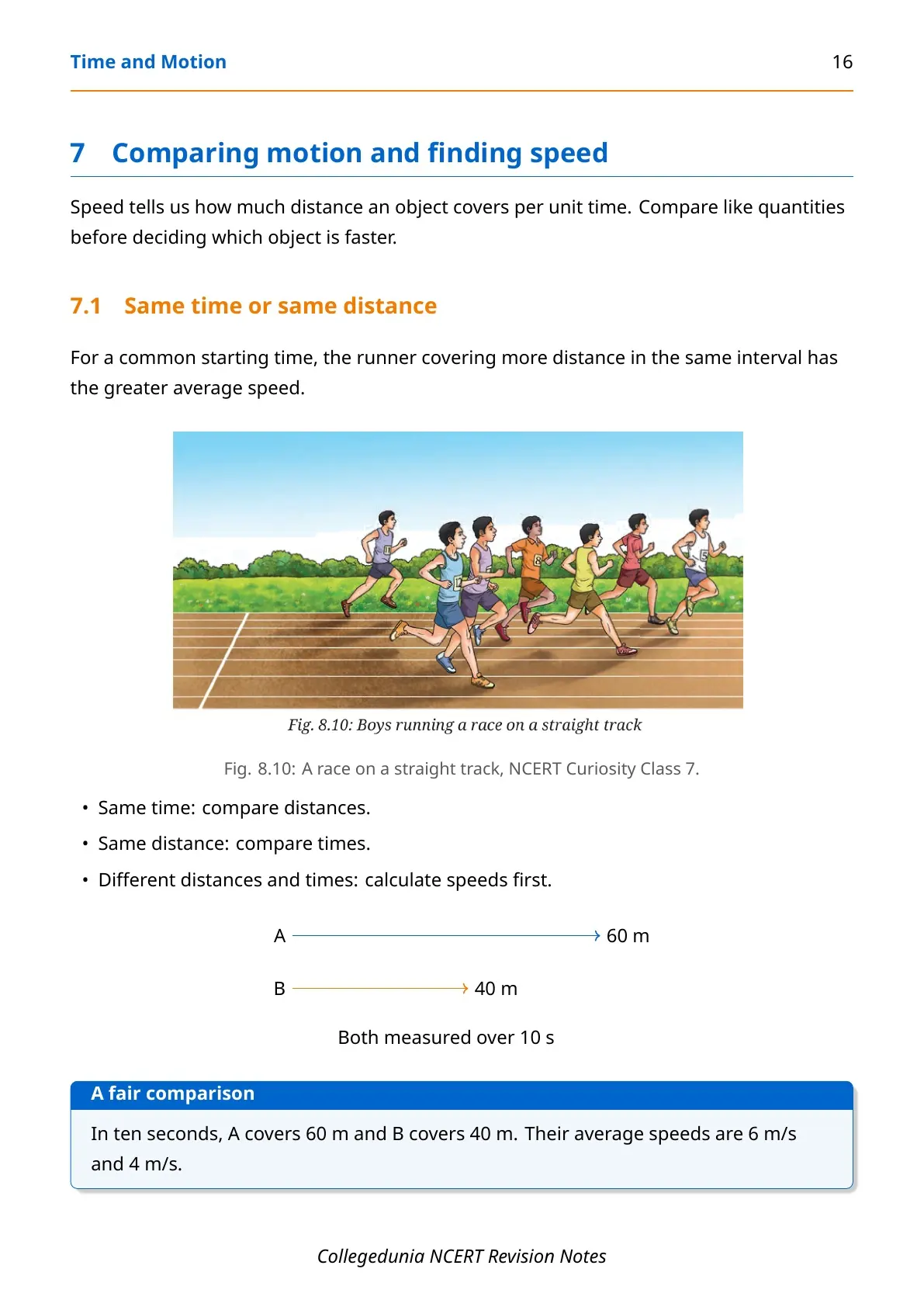
On straight paths, A shows uniform motion while B shows non-uniform motion. Both travel 60 m in 30 s. Both have the same average speed of 2 m/s, despite their different motion patterns.
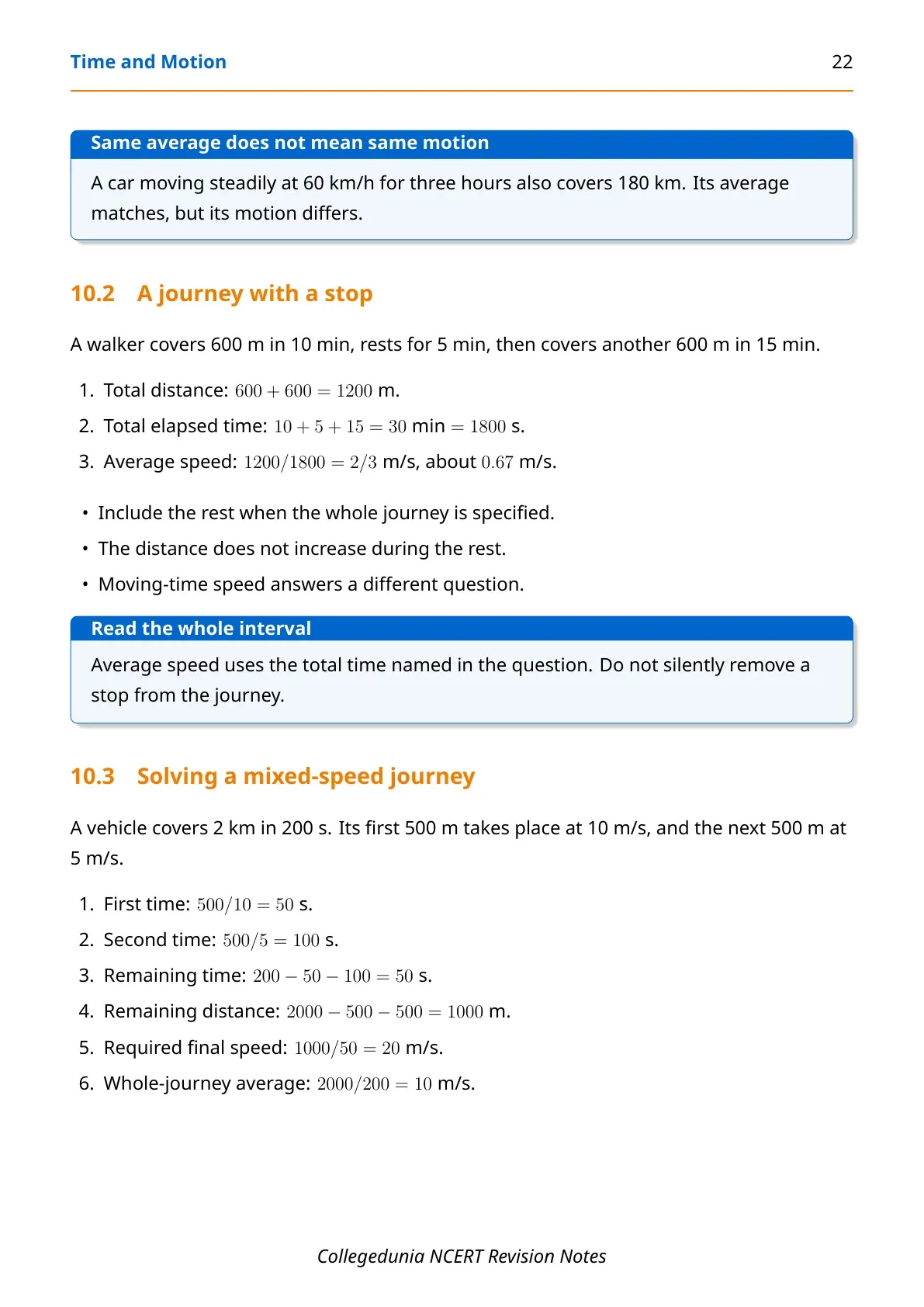
Average speed does not prove that speed stayed constant. For a whole journey, divide total distance by total time. Do not simply average speeds from unequal-duration parts of a journey.
Measurement of Time and Motion: Mistakes and Revision Checks
Focus on the reasoning behind each calculation. School assessment patterns vary, so ask your teacher about marks and coverage.
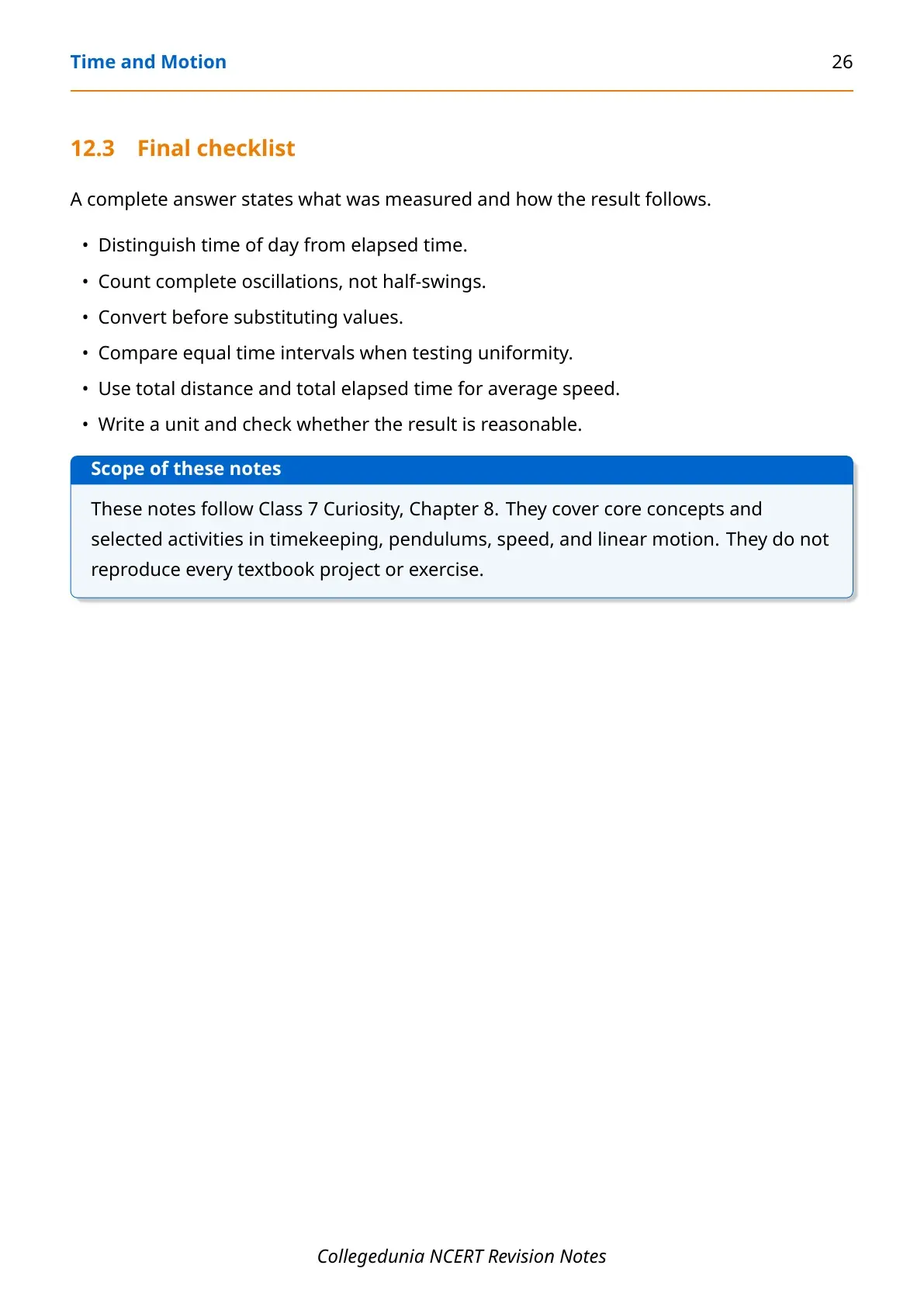
- Count complete oscillations, rather than every crossing of the mean position.
- Write the speed unit with every numerical answer.
- Compare distance increments during equal intervals, rather than cumulative distances alone.
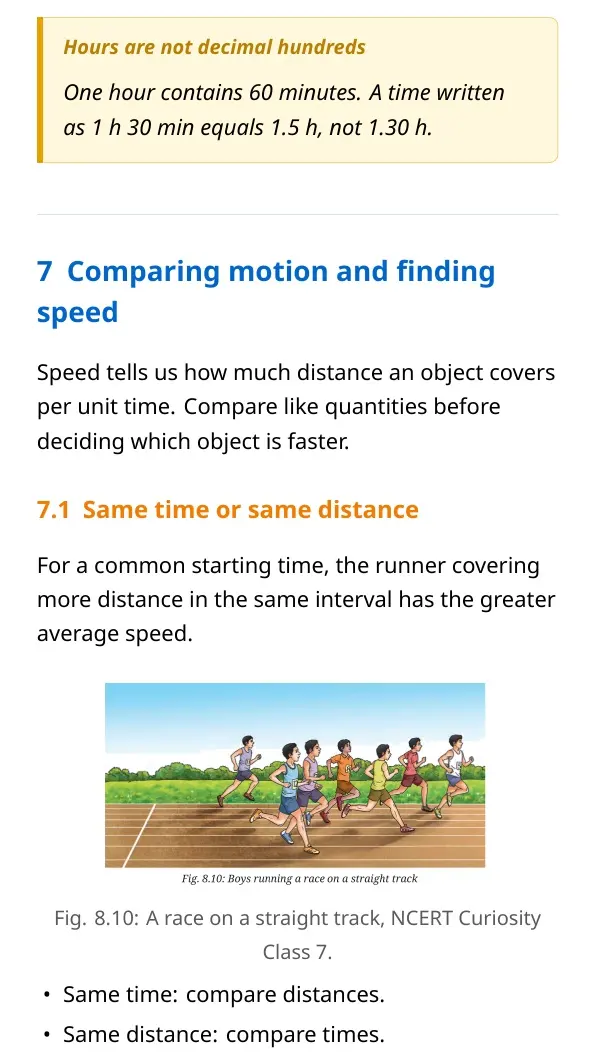
- For equal distances, the object taking less time has greater average speed.
| Practice prompt | Check |
|---|---|
| A pendulum takes 36 s for 20 oscillations | Time period = 36 ÷ 20 = 1.8 s |
| A vehicle travels at 5 m/s for 40 s | Distance = 5 × 40 = 200 m |
| A journey covers 60 km, 70 km and 50 km in three consecutive hours | Non-uniform motion; average speed = 180 ÷ 3 = 60 km/h |
Measurement of Time and Motion: Related Study Resources
Read the textbook activities alongside these notes. Compare your observations with the official chapter.
| Resource | Use |
|---|---|
| Measurement of Time and Motion Class 7 NCERT Book PDF | Read official activities and exercises |
All Chapters: Class 7 Science Curiosity Notes
Continue revision using notes for other Curiosity chapters.
| Chapter | Notes |
|---|---|
| 5 | Changes Around Us: Physical and Chemical Notes |
| 6 | Adolescence: A Stage of Growth and Change Notes |
| 4 | The World of Metals and Non-metals Notes |
Measurement of Time and Motion Class 7 Science Notes FAQs
Ques. What do these Measurement of Time and Motion notes cover?
Ans. They cover timekeeping devices, simple pendulums, time units, speed calculations and uniform and non-uniform linear motion.
Ques. How do you measure the time period of a pendulum?
Ans. Time several complete oscillations, then divide that time by the number of oscillations. Repeat with the same length and small swings.
Ques. Why should we time several oscillations?
Ans. Timing several oscillations reduces the relative effect of small errors when starting and stopping the stopwatch.
Ques. How do you convert m/s into km/h?
Ans. Multiply the speed in m/s by 3.6. To convert km/h into m/s, divide by 3.6.
Ques. Does equal average speed mean identical motion?
Ans. No. Two objects can cover the same total distance in the same time while moving at different speeds during the journey.
Ques. What is the difference between a speedometer and an odometer?
Ans. A speedometer shows speed. An odometer records the distance travelled by a vehicle.
Ques. Is there fixed chapter weightage for Class 7 Science?
Ans. School assessment patterns vary. Follow your teacher’s syllabus and paper pattern instead of assuming fixed marks.
Ques. What is the time period?
Ans. The time period is the time taken to complete one oscillation. Its SI unit is the second.
Ques. How is average speed defined?
Ans. Average speed is the total distance travelled divided by the total time taken.
Ques. What are uniform and non-uniform linear motion?
Ans. Uniform linear motion has constant speed along a straight line. In non-uniform linear motion, speed changes along a straight line.



Comments