




If you are preparing for the Class 7 Science exam, Changes Around Us: Physical and Chemical is one of the chapters you cannot afford to skip. The NCERT Notes below cover every physical change, chemical change, and reversible or irreversible example from the 2026-27 Curiosity textbook.
- Covers physical change, chemical change, rusting, combustion, the fire triangle, weathering, and erosion.
- Includes the CRISP mnemonic, a lime water test, and a quick-recall physical vs chemical table.
- Free PDF download, matched to the 2026-27 NCERT Curiosity textbook.
These Class 7 Science notes for Changes Around Us: Physical and Chemical are curated by subject experts and checked line by line against the 2026-27 NCERT Curiosity textbook.
What Counts as a Change? Physical and Chemical, Explained
Ice melting on a hot day, milk turning into curd, a paper boat folded from a plain sheet, a matchstick bursting into flame: all of these are changes, but they are not the same kind of change. Change is any process in which a substance's properties, position, or state get altered, and our senses (sight, smell, touch, hearing) usually tell us a change has happened.
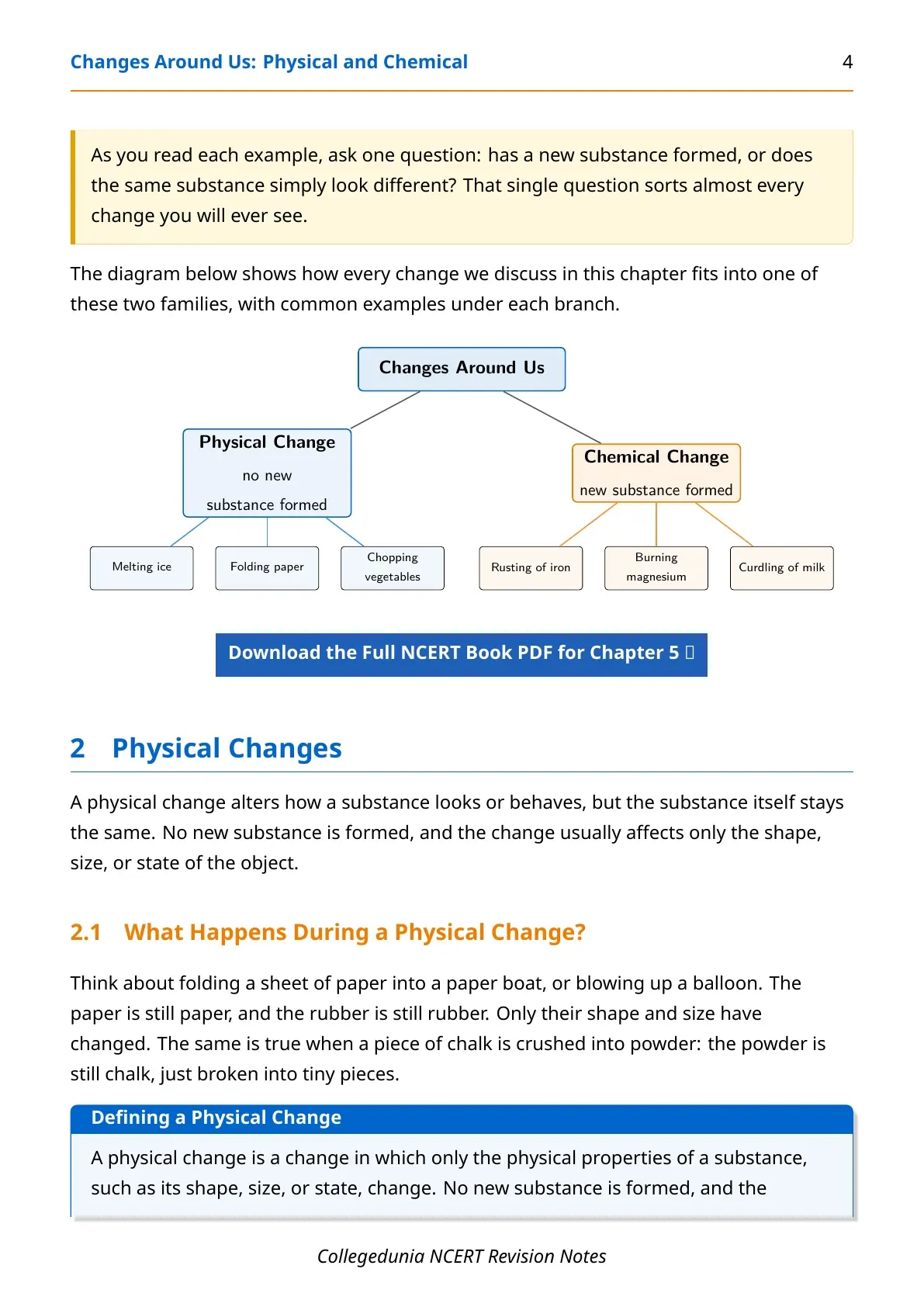
- A physical change alters shape, size, or state; no new substance forms.
- A chemical change produces one or more new substances altogether.
Every change you will meet in this chapter falls into one of these two buckets, and learning to sort a change correctly is the single most tested skill from this chapter.
Changes Around Us Explained for Class 7
Source: Magnet Brains on YouTube
Physical Changes: Definition and Everyday Examples
Fold a sheet of paper into a boat, or crush a piece of chalk into powder. The paper is still paper and the chalk is still chalk; only their shape or size has changed. A physical change is one in which only the shape, size, or state of a substance changes, with no new substance formed.
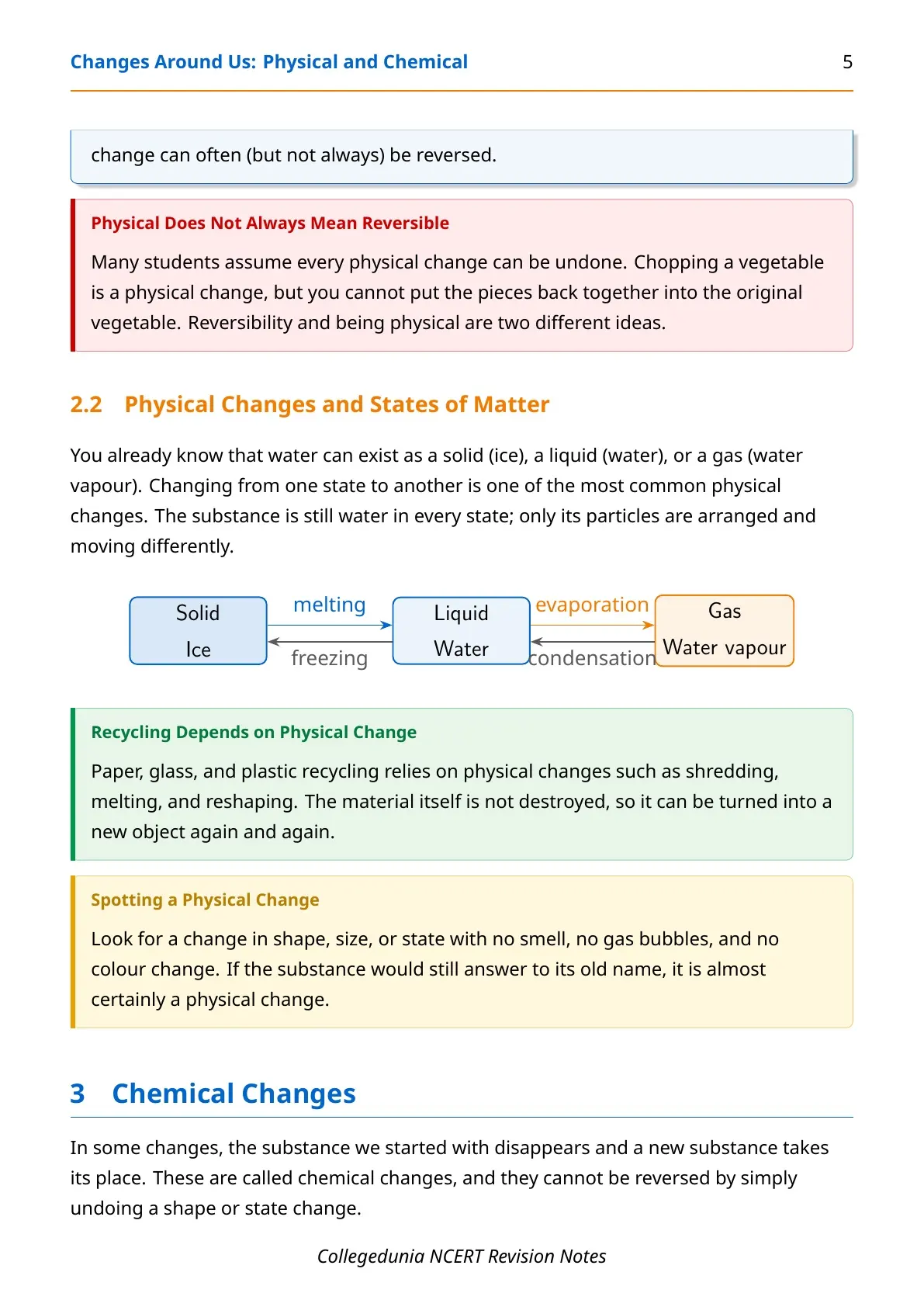
- Melting ice, boiling water, and condensing steam are all state changes of the same substance, water.
- Folding paper, crushing chalk, and cutting cloth change shape or size only.
- Dissolving sugar or salt in water is physical; the sugar can be recovered by evaporating the water.
Tip: a physical change is often reversible, but not always. Chopping a vegetable is a physical change, yet the pieces can never be put back together into the original vegetable. Reversibility and being physical are two separate ideas.
Chemical Changes: Signs, Tests and the CRISP Mnemonic
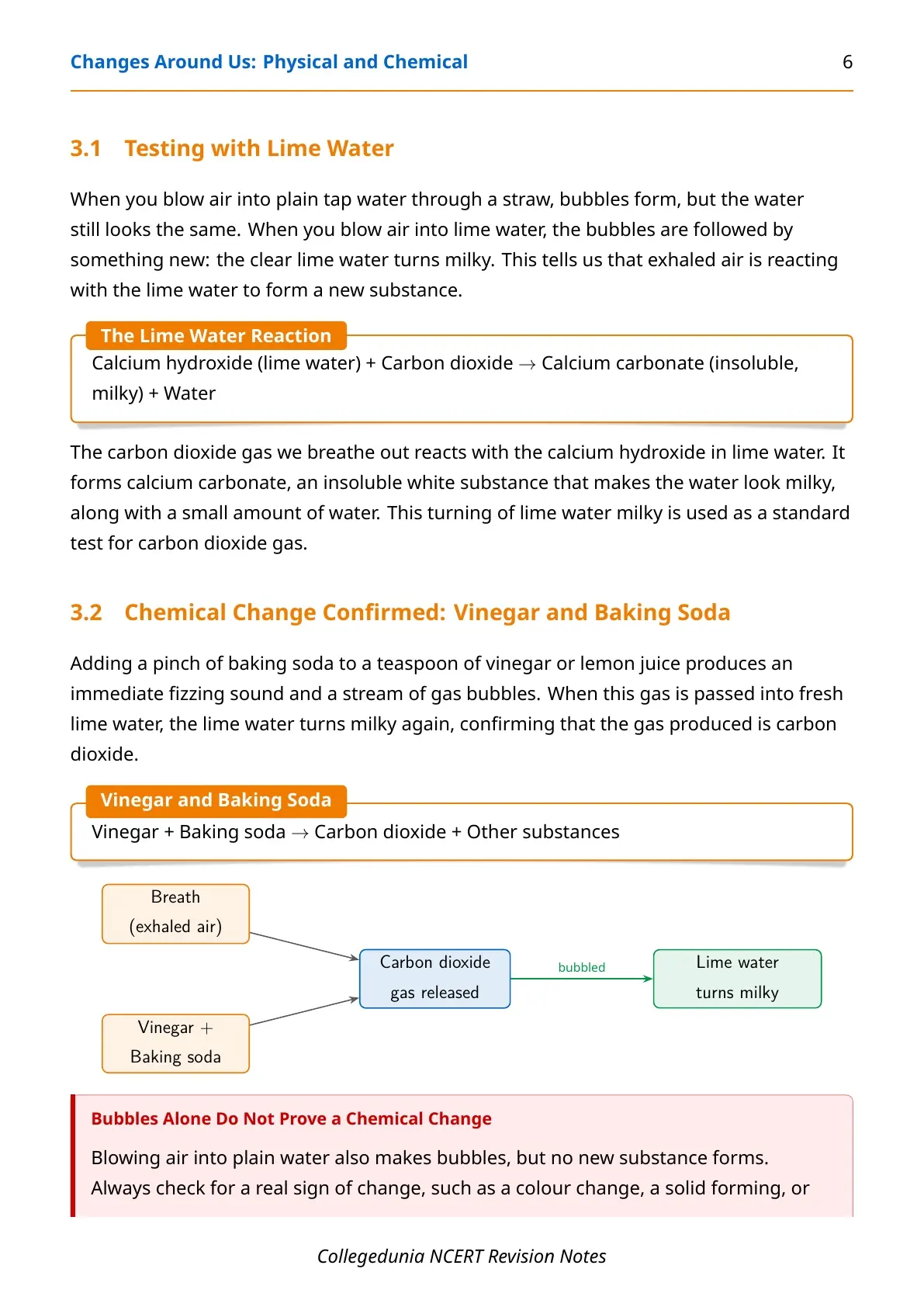
Blow air through a straw into plain water and bubbles form, but the water looks unchanged. Blow the same breath into lime water, and the clear liquid turns milky. A new substance has formed, which is the clearest sign of a chemical change.
| Reaction | What Happens |
|---|---|
| Lime water test | Calcium hydroxide + Carbon dioxide → Calcium carbonate (milky) + Water |
| Vinegar and baking soda | Vinegar + Baking soda → Carbon dioxide (fizzing) + other substances |
Passing the gas released from vinegar and baking soda into fresh lime water turns it milky again, confirming the gas is carbon dioxide. Bubbles alone do not prove a chemical change though; plain water fizzes too when air is blown through it, but no new substance forms.
- A colour change that does not reverse, such as iron turning reddish brown.
- A gas released, seen as fizzing or bubbling.
- A new solid, or precipitate, forming, such as milky calcium carbonate.
- Heat or light given out or absorbed.
- A smell that was not present before.
Remember these five signs with CRISP: Colour change, Release of gas, Irreversibility, Smell change, Precipitate formed. A chemical change is one in which one or more new substances are formed through a chemical reaction.
Physical Change vs Chemical Change at a Glance
Once the CRISP signs are clear, most Class 7 exam questions boil down to sorting a described activity into one of two columns. The image below puts both columns side by side for a fast recap.
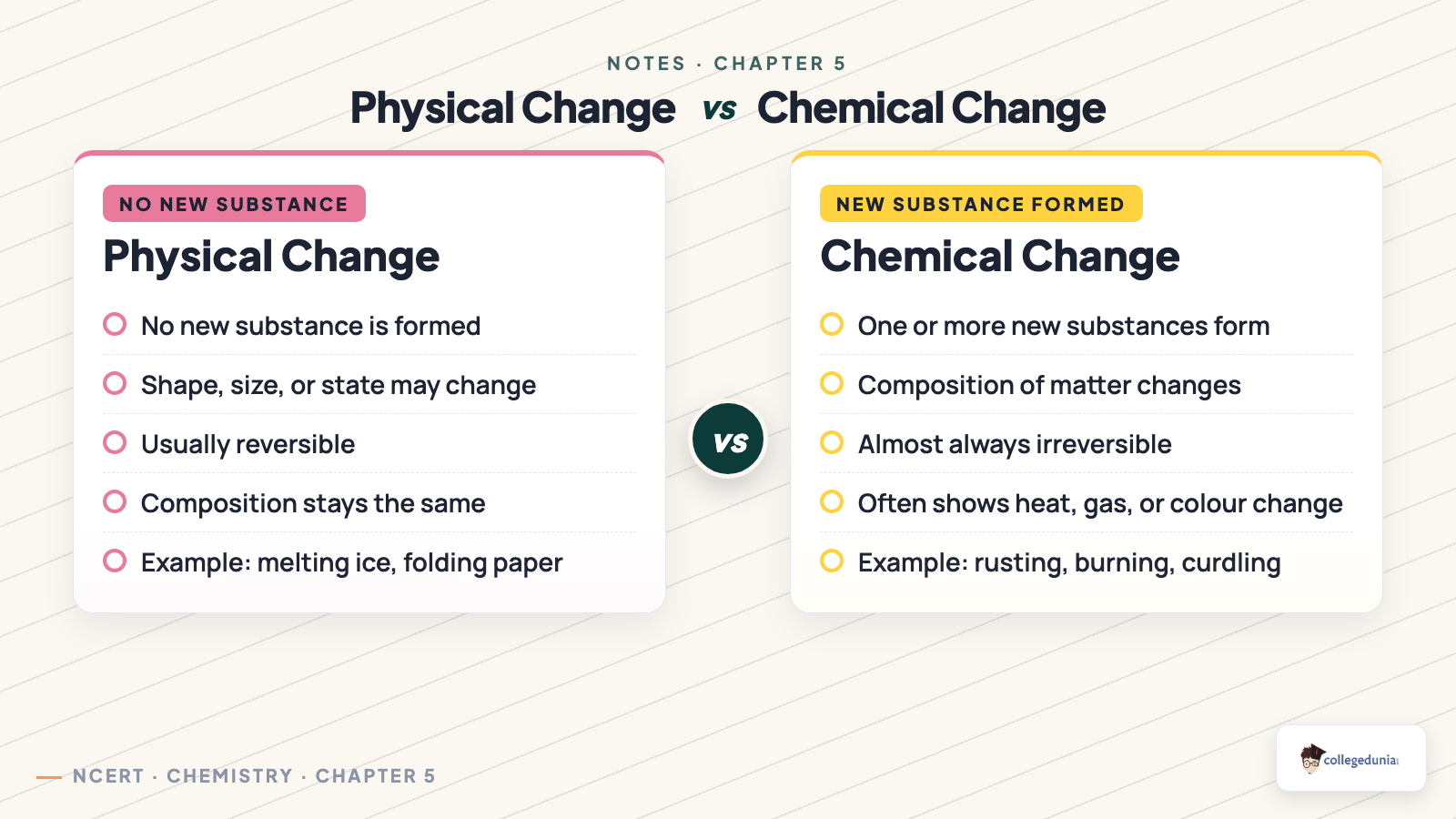
Also Check: a change can show heat or a colour shift and still be physical, for example, hot water feels different but is still water; always check for a genuinely new substance before calling something chemical.
Rusting, Combustion and the Fire Triangle
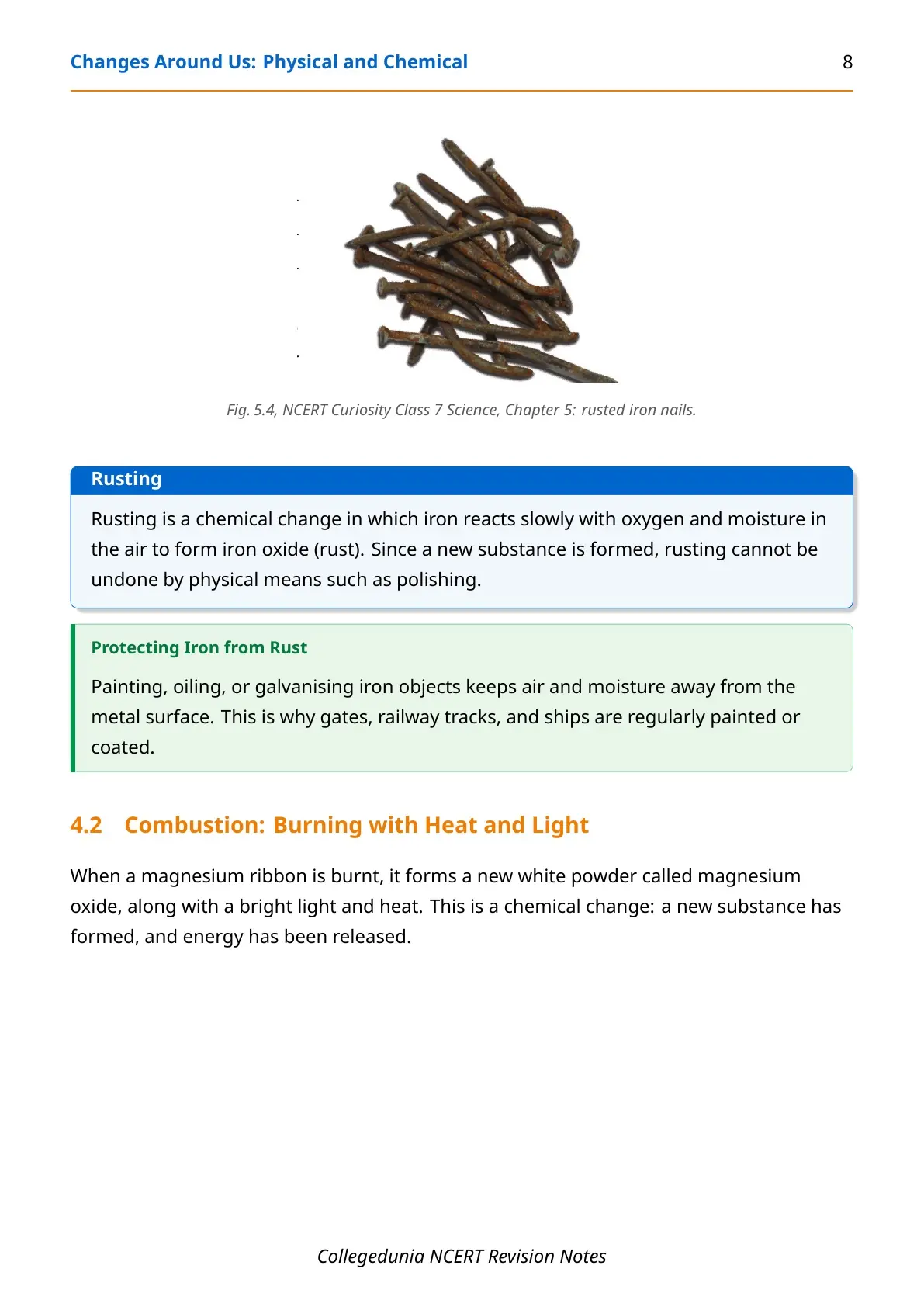
Iron nails left out in moist air slowly develop a reddish-brown coating. Rusting is a chemical change in which iron reacts slowly with oxygen and moisture to form iron oxide, and since a new substance is formed, rusting cannot be undone by polishing. Painting, oiling, or galvanising iron objects keeps air and moisture away and protects gates, railway tracks, and ships.
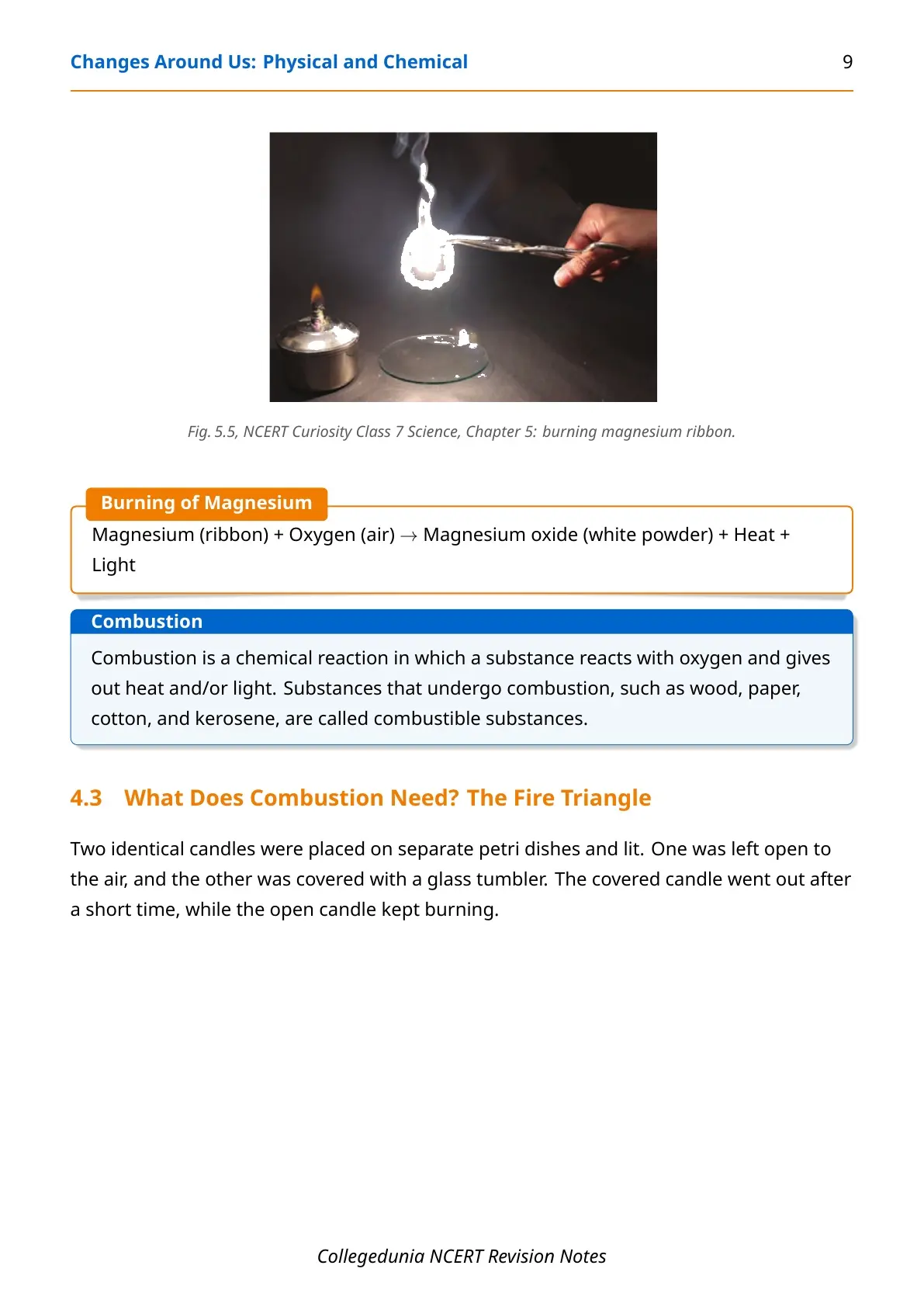
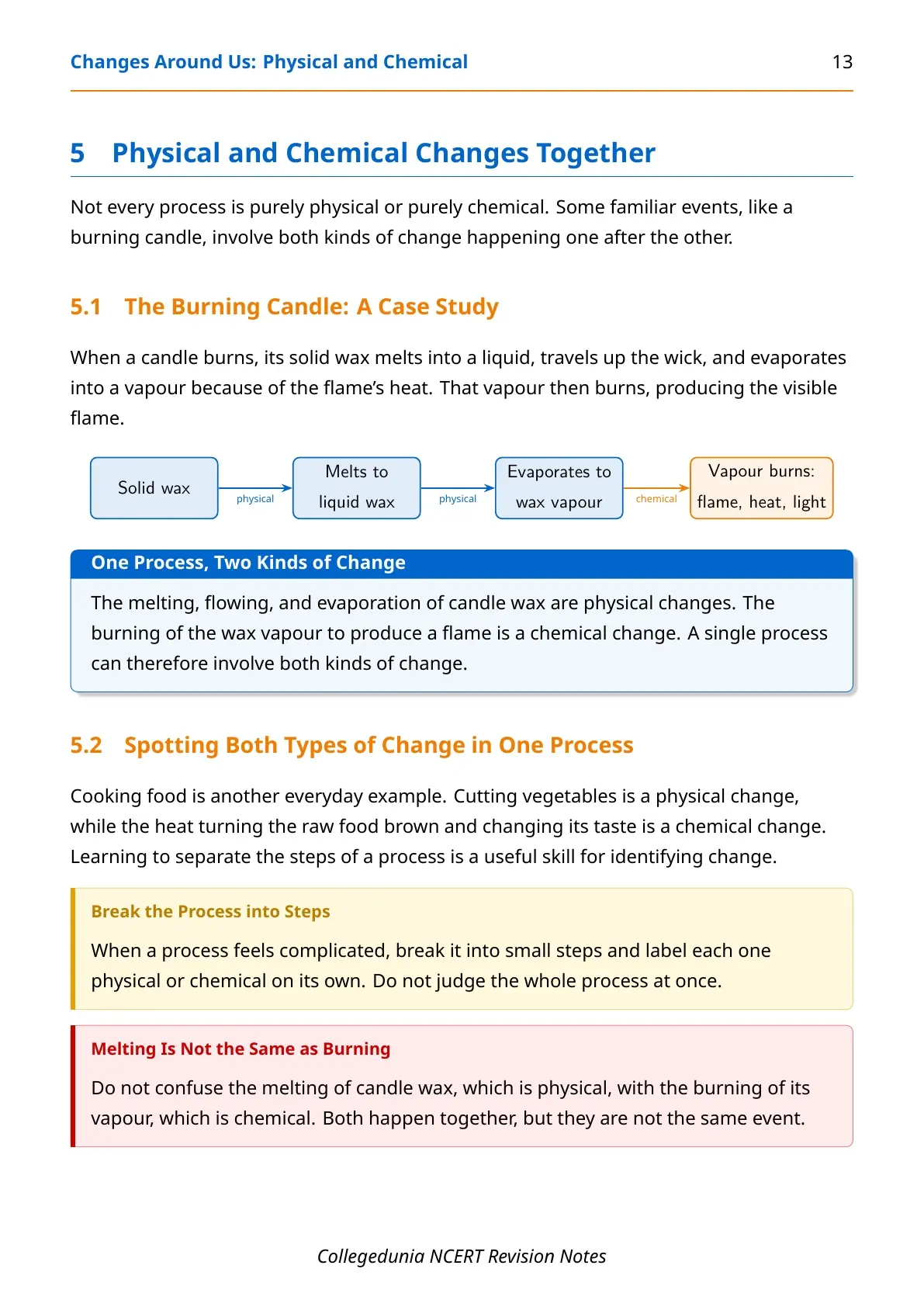
Burning a magnesium ribbon shows a different chemical change: combustion, a reaction with oxygen that gives out heat and light. Magnesium ribbon plus oxygen forms magnesium oxide, a white powder, along with heat and light. Wood, paper, cotton, and kerosene are called combustible substances because they support this kind of burning.
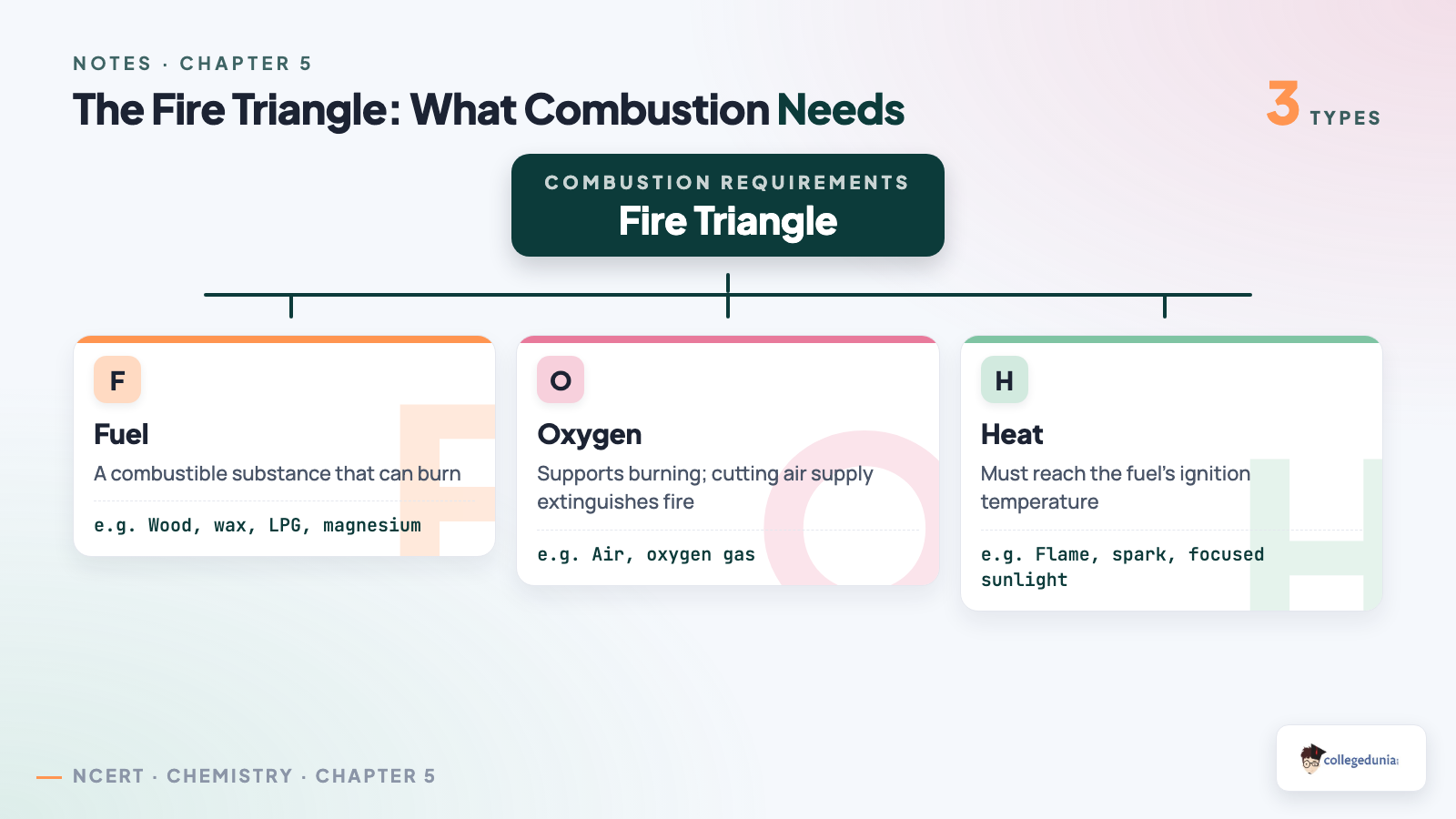
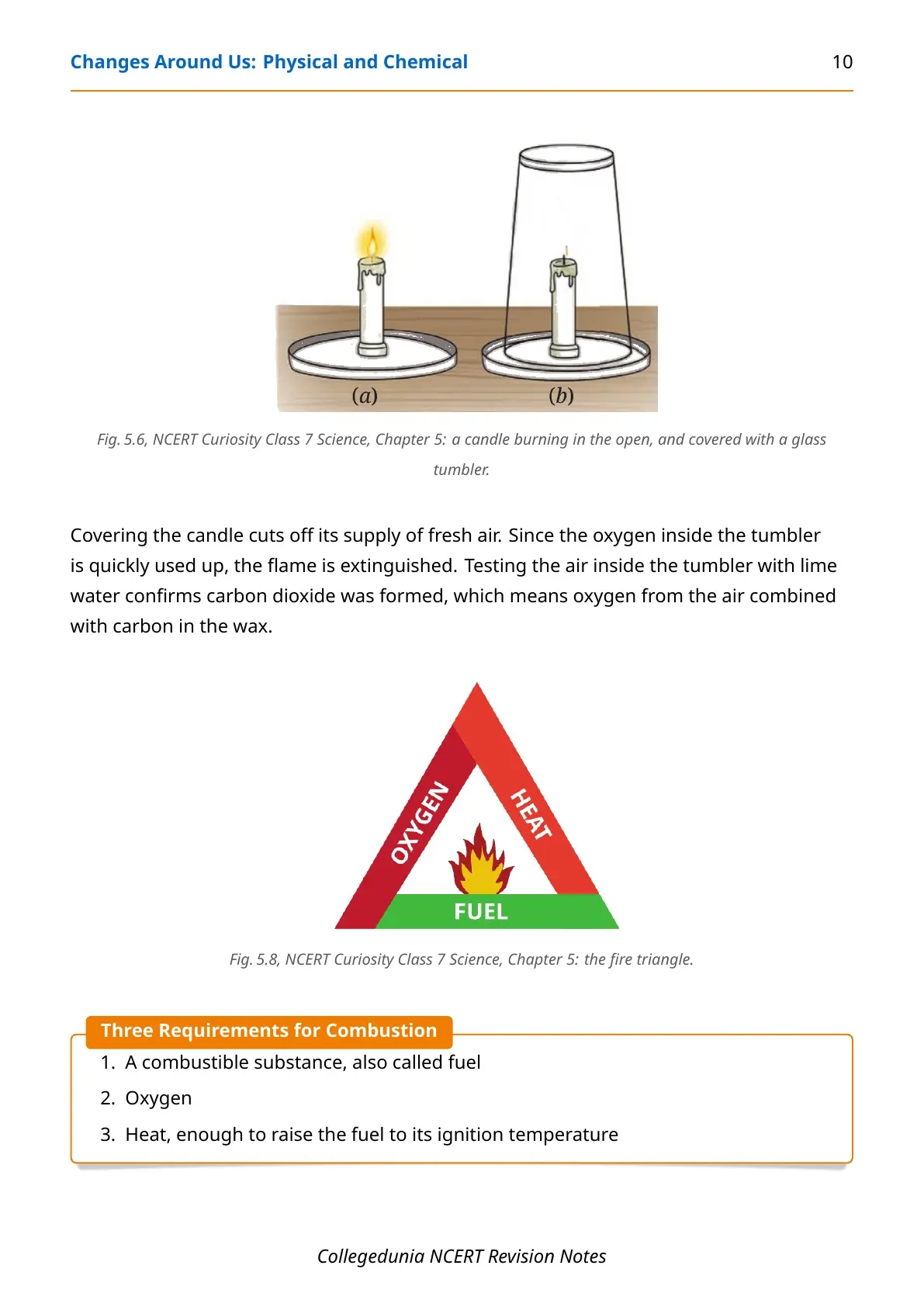
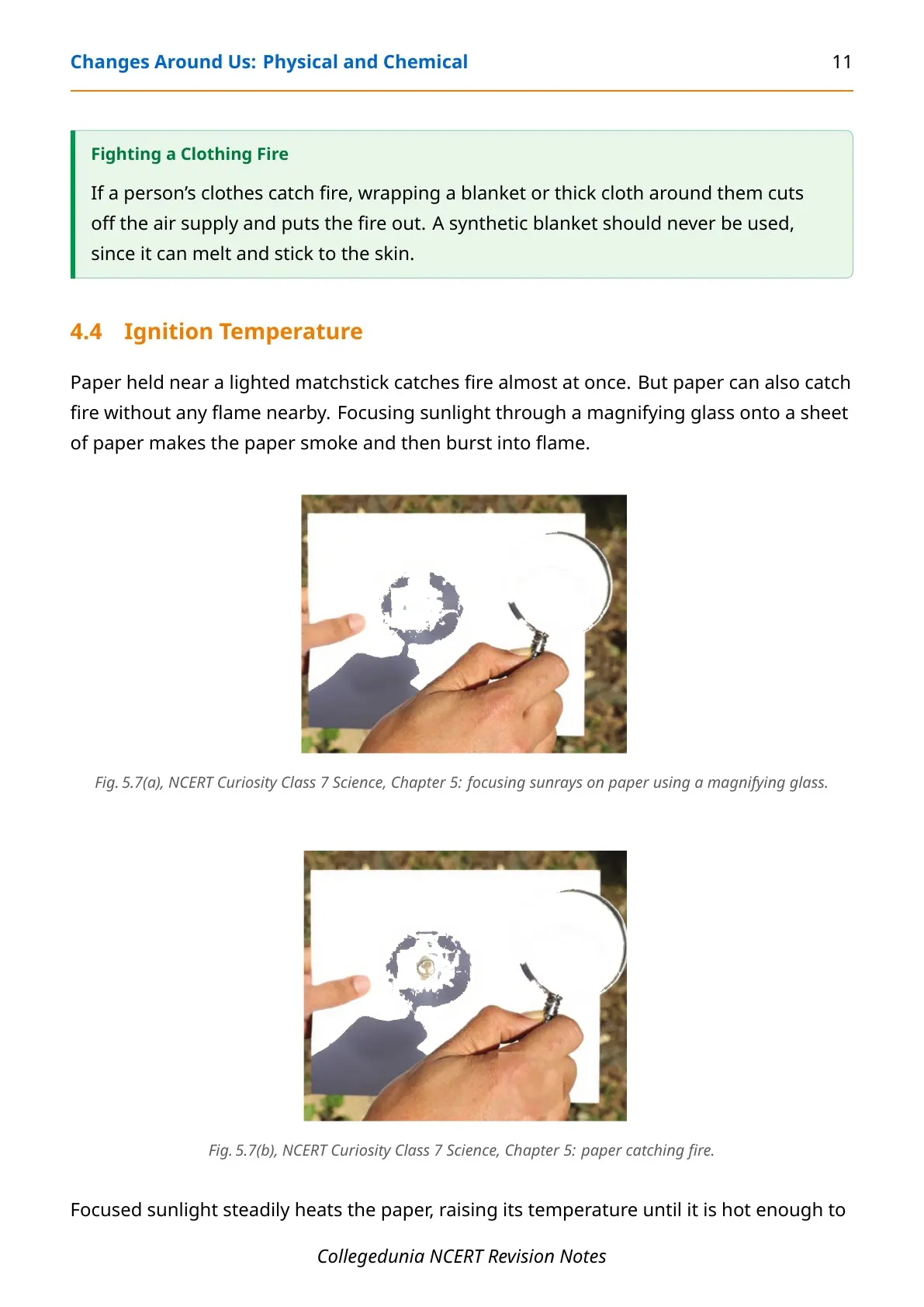
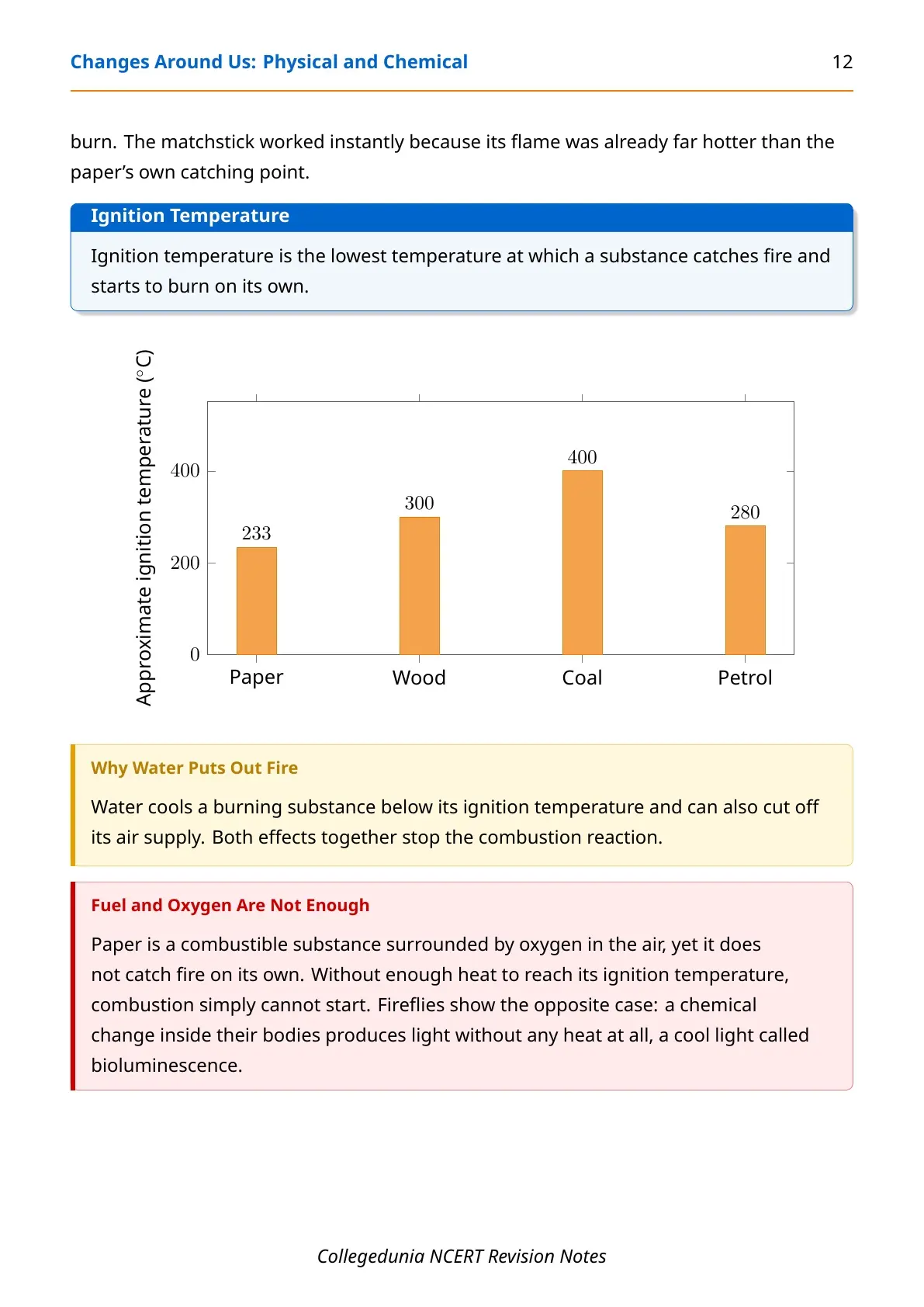
Two identical candles, one left open and one covered with a glass tumbler, show why combustion needs three things together. The covered candle goes out because its oxygen supply runs out. Fuel, oxygen, and heat raised to the fuel's ignition temperature must all be present, which is exactly why water puts out a fire: it cools the fuel below its ignition temperature and cuts off the oxygen supply at the same time.
Reversible and Irreversible Changes
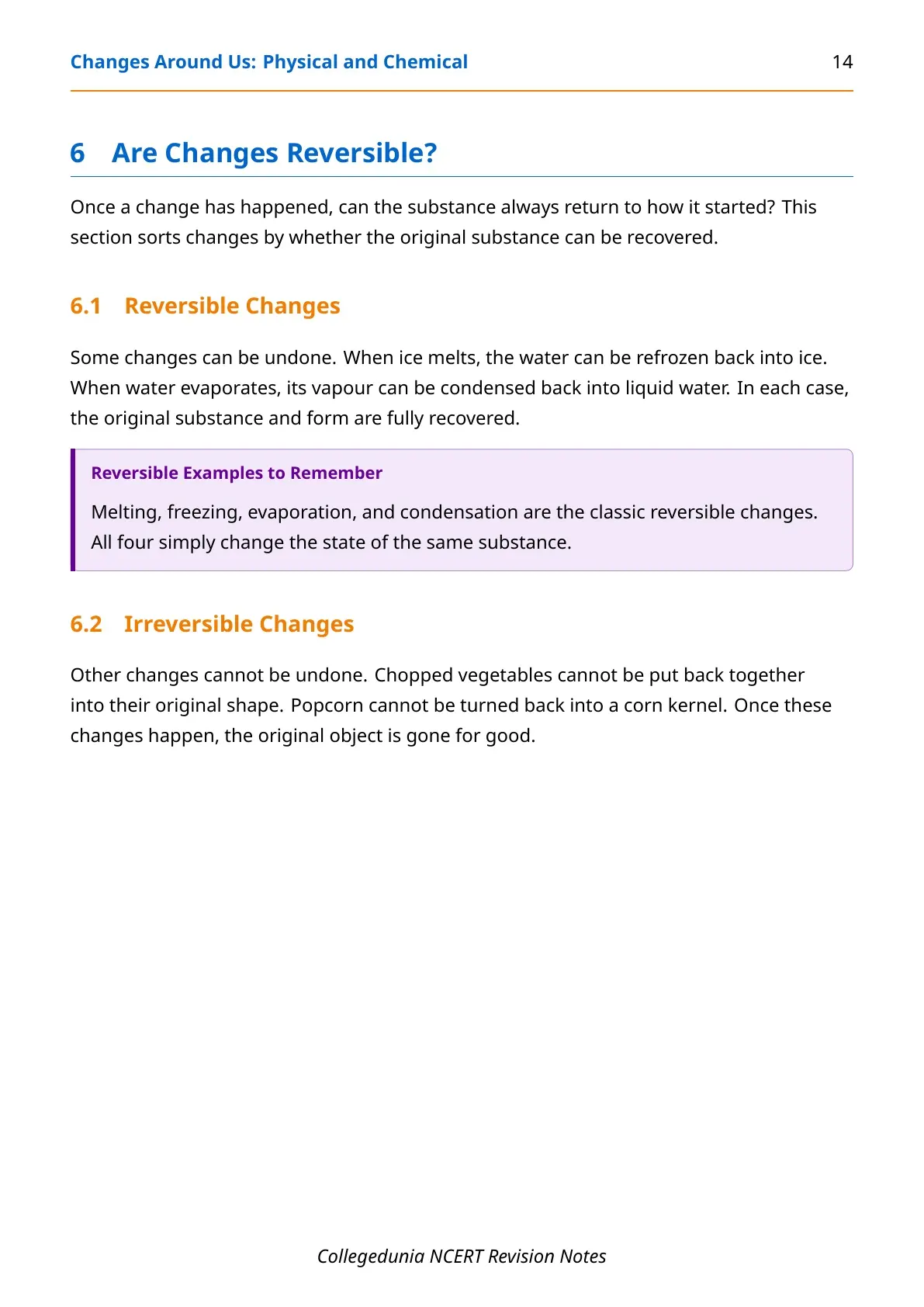
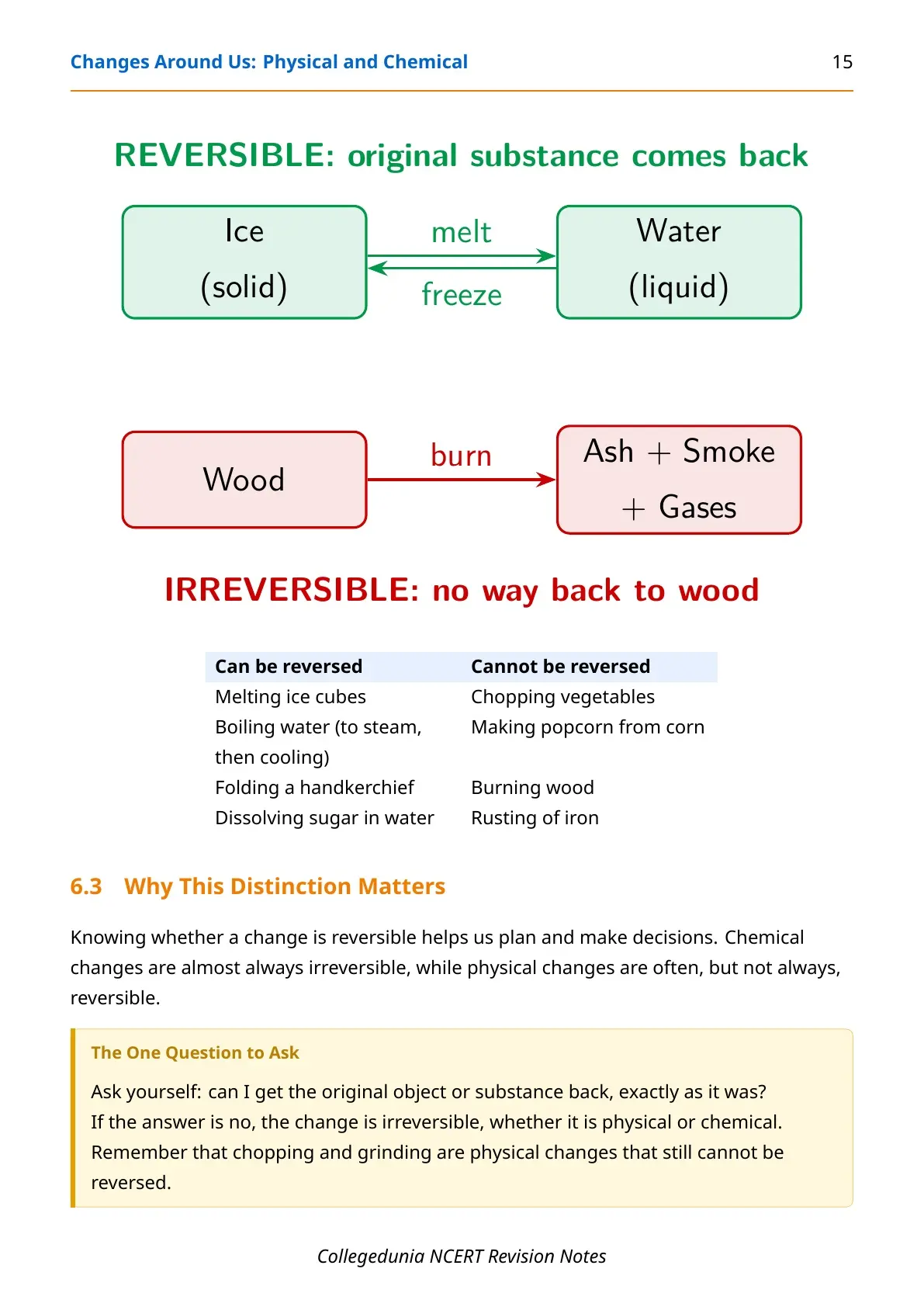
Some changes let the original substance come back exactly as it was. Others do not. Sorting a change this way helps decide what can be undone and what cannot.
| Can Be Reversed | Cannot Be Reversed |
|---|---|
| Melting ice cubes | Chopping vegetables |
| Boiling water to steam, then cooling | Making popcorn from corn |
| Folding a handkerchief | Burning wood |
| Dissolving sugar in water | Rusting of iron |
Melting, freezing, evaporation, and condensation are the classic reversible changes, since all four simply change the state of the same substance. Chemical changes are almost always irreversible, while physical changes are often, but not always, reversible; chopping and grinding are physical yet still permanent.
Desirable and Undesirable Changes
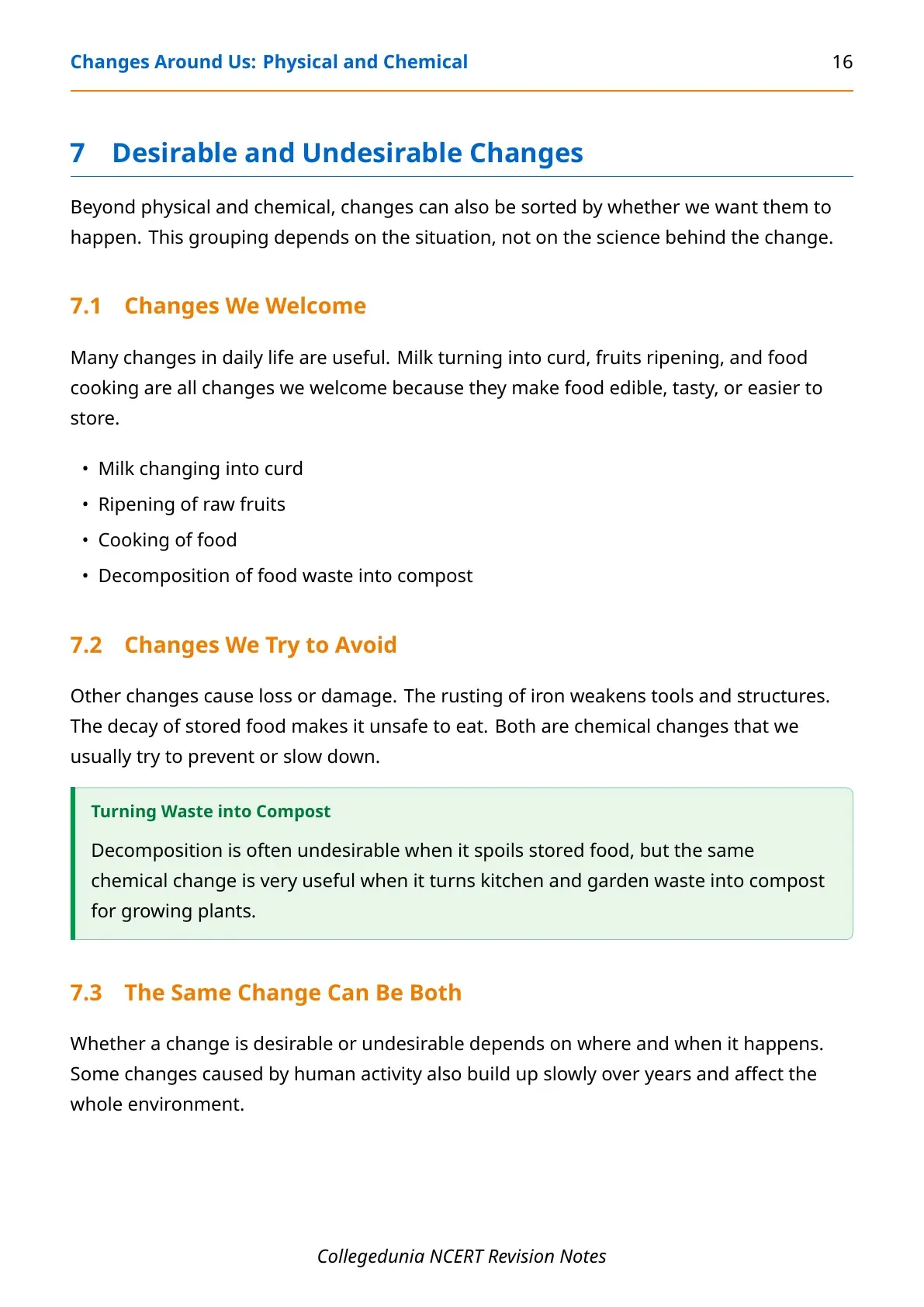
The same kind of change can help us or cause damage, depending on the situation it happens in. Curd formation, fruit ripening, cooking food, and composting are welcomed. Rusting of tools, food spoilage, paint peeling, and excess carbon dioxide from burning fuels are not.
| Desirable | Undesirable |
|---|---|
| Curd formation, fruit ripening | Rusting of tools, food spoilage |
| Cooking food, composting | Paint pollution, excess CO₂ from fuels |
Decomposition is a single chemical process, yet it is undesirable in stored food and desirable in a compost pit. One label does not fit every situation; always judge desirability by the context, not the change alone.
Weathering and Erosion: How Rocks Slowly Turn to Soil
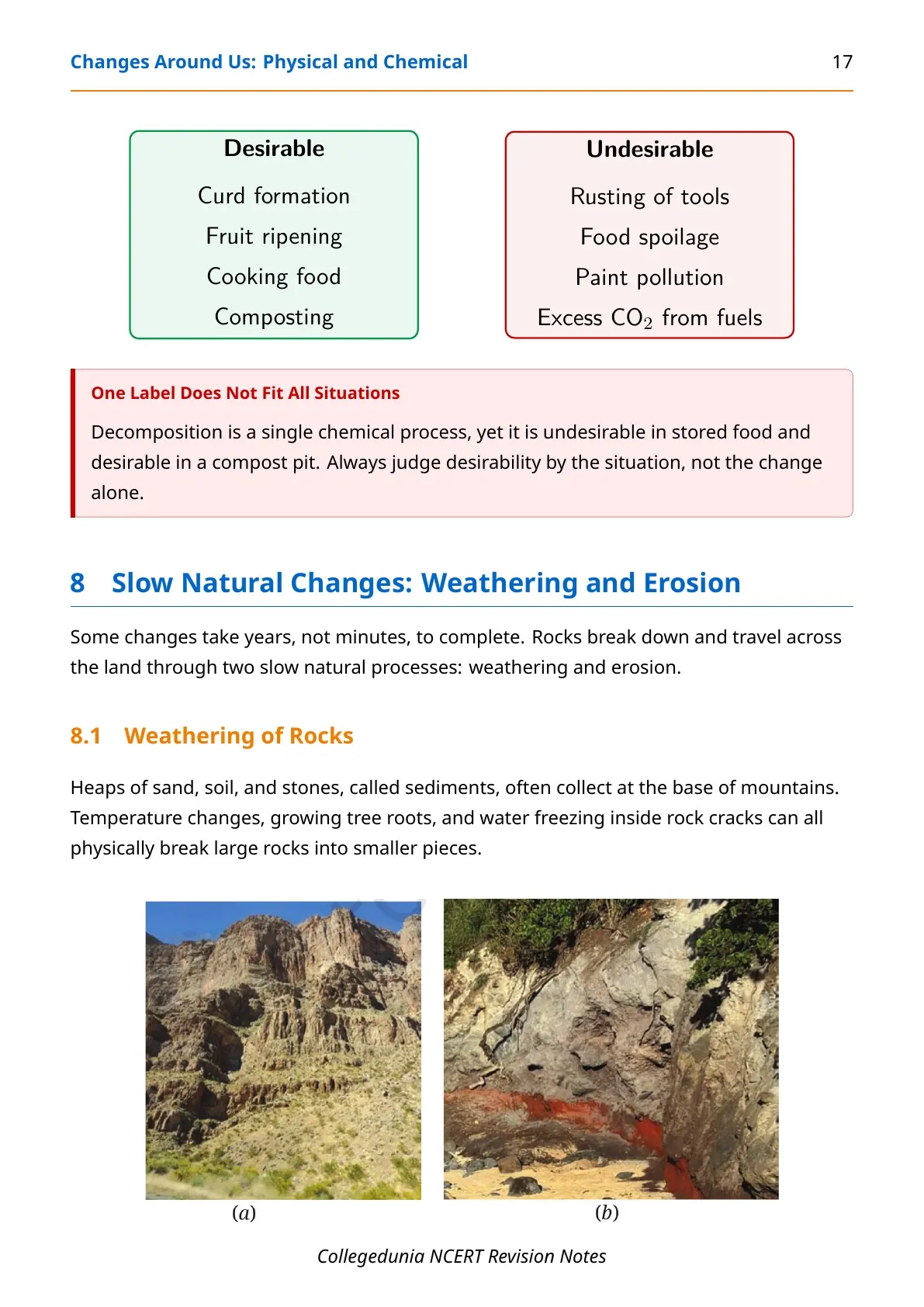
Not every change finishes in seconds. Heaps of sand, soil, and stones, called sediments, collect at the base of mountains over years. Temperature changes, growing tree roots, and water freezing inside cracks physically break large rocks apart, while water and dissolved chemicals react with minerals inside rocks and change their composition, sometimes turning a black basalt rock red with iron oxide.
- Weathering: the combined physical and chemical breakdown of rocks at the Earth's surface, where they stand.
- Erosion: the transport of broken rock, soil, and sediment from one place to another by wind and flowing water.
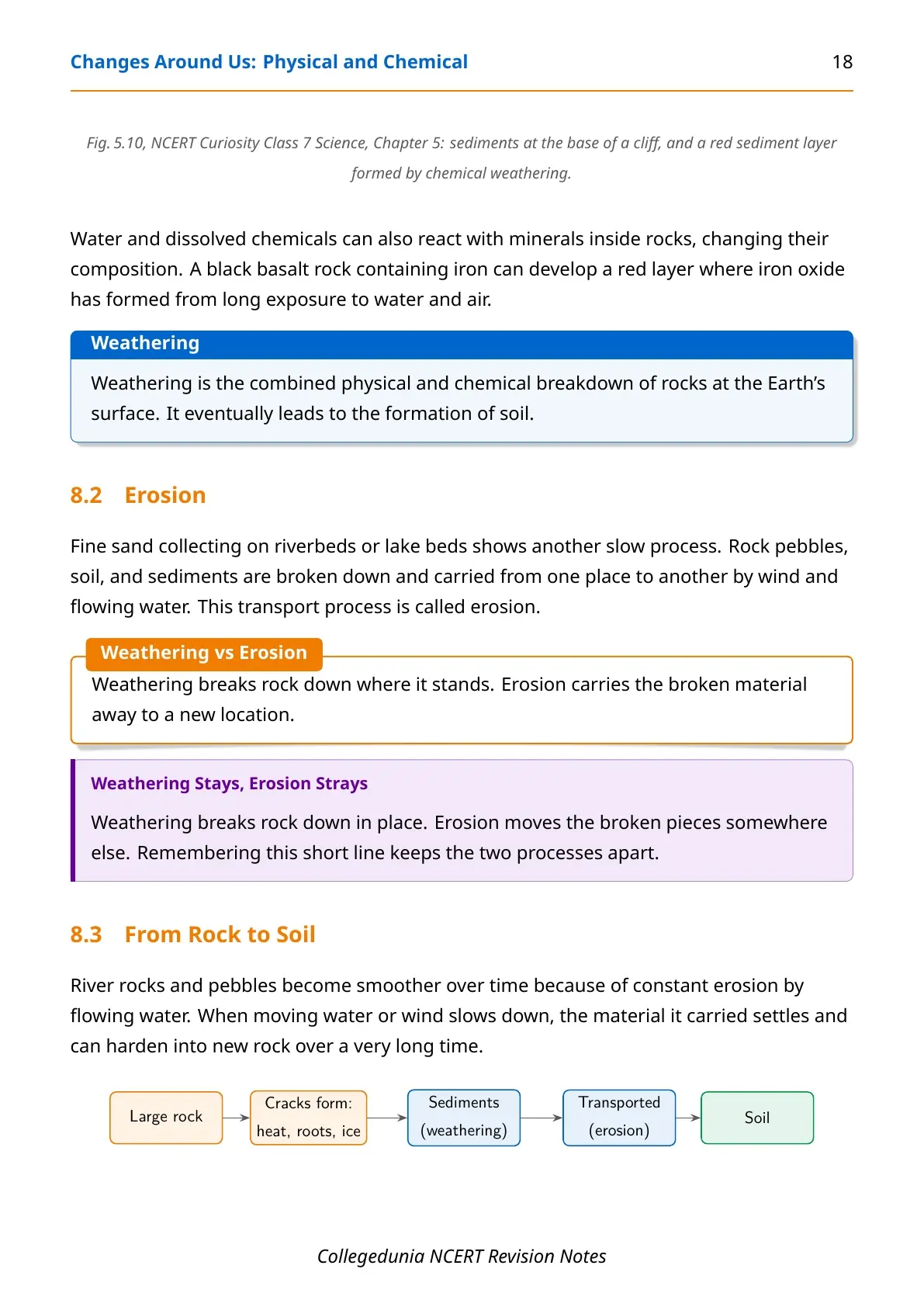
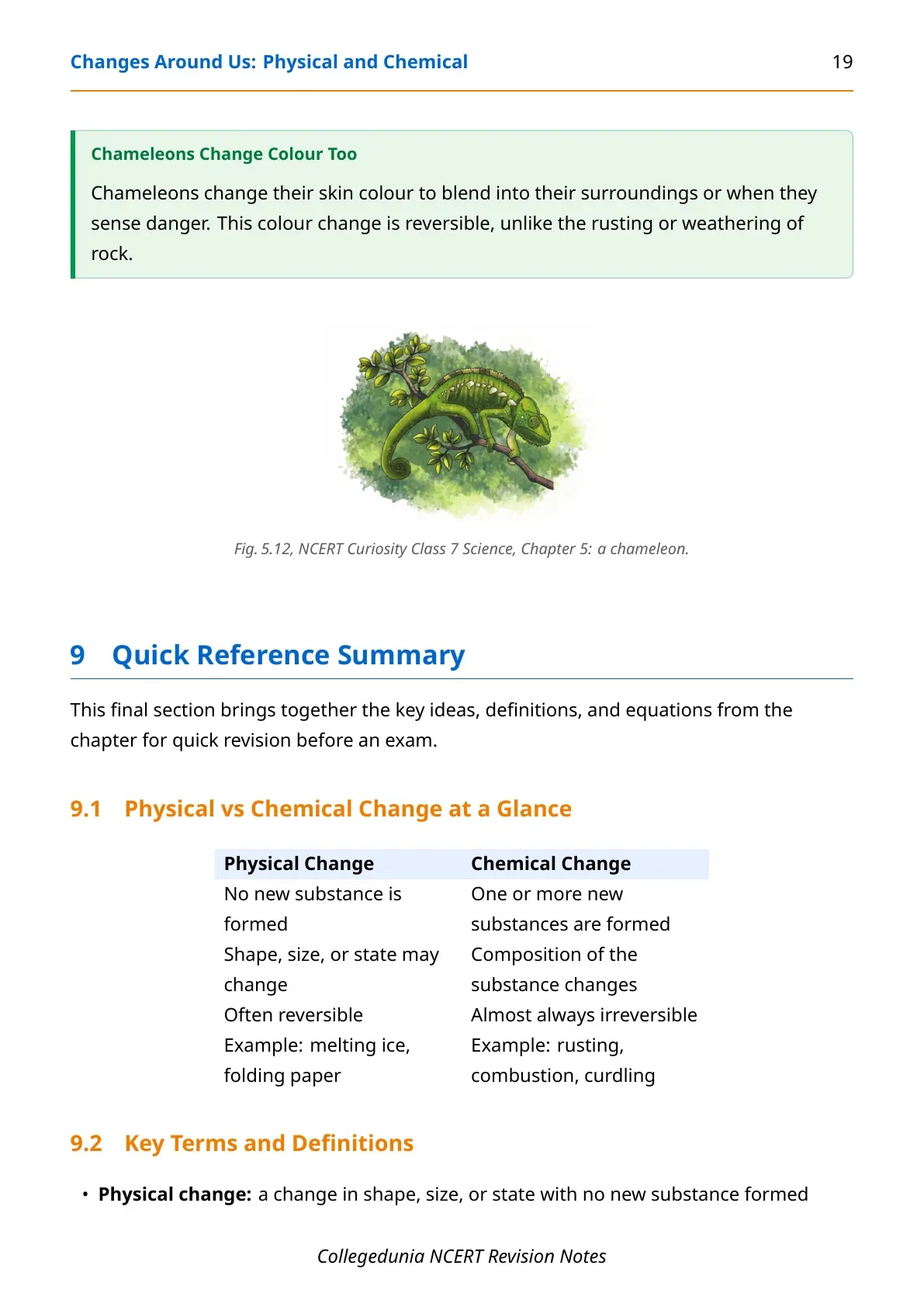
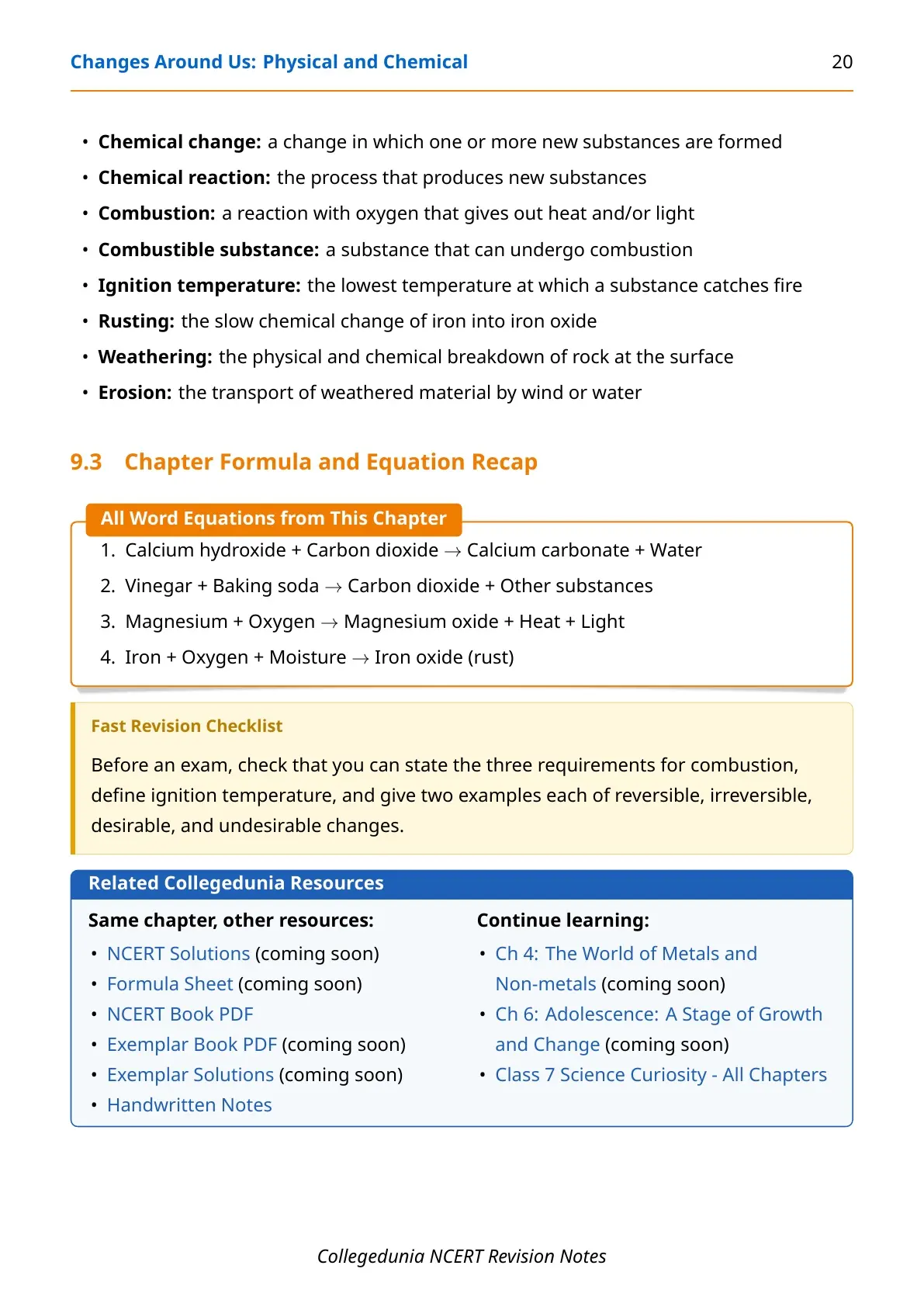
Remember it as weathering stays, erosion strays: weathering breaks rock down in place, and erosion carries the pieces elsewhere. Over a very long time, this cycle, large rock to cracks to sediments to transported material, forms soil. Even a chameleon's colour change is a reminder that not all change is chemical: it shifts colour to blend in or signal danger, a reversible change unlike the rusting or weathering seen elsewhere in this chapter.
Common Mistakes Students Make in the Changes Around Us Chapter
- Assuming every physical change is reversible; chopping and grinding are physical but permanent.
- Treating bubbles alone as proof of a chemical change, when plain water also fizzes with blown air.
- Mixing up weathering (rock breaks in place) with erosion (broken rock is carried away).
- Forgetting that fuel, oxygen, and ignition temperature must all be present together for combustion.
- Labelling a change as always desirable or undesirable instead of judging it by the situation.
Student Feedback: What 11,280 Students Told Us
What 11,280 students told us about their Changes Around Us journey.
In a Collegedunia poll of 11,280 Class 7 students conducted before the 2026-27 school exams, 68% of students named telling weathering and erosion apart as the trickiest part of this chapter. Most students said the CRISP mnemonic was the easiest fact to keep once they had tried the lime water test themselves.
Other Class 7 Science Chapter 5 Resources on Collegedunia
| Resource | Status |
|---|---|
| NCERT Notes (this page) | Available now |
| NCERT Book PDF | Available now |
| Handwritten Notes | Available now |
| NCERT Solutions | Coming soon |
| Formula Sheet | Coming soon |
| Exemplar Solutions | Coming soon |
| Exemplar Book PDF | Coming soon |
Class 7 Science Curiosity Notes for All Chapters
| Chapter | Notes |
|---|---|
| Chapter 1 | The Ever-Evolving World of Science (coming soon) |
| Chapter 2 | Exploring Substances: Acidic, Basic, and Neutral (coming soon) |
| Chapter 3 | Electricity: Circuits and their Components (coming soon) |
| Chapter 4 | The World of Metals and Non-metals (coming soon) |
| Chapter 5 | Changes Around Us: Physical and Chemical (this page) |
| Chapter 6 | Adolescence: A Stage of Growth and Change (coming soon) |
| Chapter 7 | Heat Transfer in Nature (coming soon) |
| Chapter 8 | Measurement of Time and Motion (coming soon) |
| Chapter 9 | Life Processes in Animals (coming soon) |
| Chapter 10 | Life Processes in Plants (coming soon) |
| Chapter 11 | Light: Shadows and Reflections (coming soon) |
| Chapter 12 | Earth, Moon, and the Sun (coming soon) |
| Class 7 Science Curiosity - All Chapters | |
Class 7 Science Chapter 5 Changes Around Us Physical and Chemical Notes FAQs
Ques. What is the main difference between a physical change and a chemical change?
Ans. In a physical change, only the shape, size, or state of a substance changes and no new substance is formed. In a chemical change, one or more new substances are formed and the composition of the substance changes.
Ques. Is rusting a physical change or a chemical change?
Ans. Rusting is a chemical change. Iron reacts slowly with oxygen and moisture in the air to form iron oxide, a new substance, so rusting cannot be undone by polishing.
Ques. What are the five signs of a chemical change?
Ans. The five signs, remembered with the mnemonic CRISP, are Colour change, Release of gas, Irreversibility, Smell change, and Precipitate formed.
Ques. What three things does combustion need?
Ans. Combustion needs a combustible substance (fuel), oxygen, and heat sufficient to raise the fuel to its ignition temperature. This is called the fire triangle.
Ques. Why does water put out a fire?
Ans. Water cools the burning substance below its ignition temperature and also forms a layer that cuts off the oxygen supply, so both requirements for combustion are removed at once.
Ques. What is the difference between weathering and erosion?
Ans. Weathering is the physical and chemical breakdown of rock at the place where it stands. Erosion is the transport of that broken material to a new location by wind or flowing water.
Ques. Are all physical changes reversible?
Ans. No. Many physical changes such as chopping vegetables or crushing chalk cannot be reversed, even though no new substance is formed. Reversibility and being physical are two separate ideas.
Ques. How is the lime water test used to detect carbon dioxide?
Ans. When carbon dioxide gas is passed through lime water, it reacts with calcium hydroxide to form calcium carbonate, an insoluble white substance that turns the lime water milky.
Ques. Can the same change be both desirable and undesirable?
Ans. Yes. Decomposition, for example, is undesirable when it spoils stored food but desirable when it turns waste into compost. Desirability depends on the situation, not the change itself.
Ques. What is ignition temperature?
Ans. Ignition temperature is the minimum temperature a combustible substance must reach before it catches fire and keeps burning on its own.
Ques. Where can I download the Class 7 Science Chapter 5 Notes PDF?
Ans. You can download the Changes Around Us: Physical and Chemical Notes PDF directly from this page, free of cost and matched to the 2026-27 NCERT Curiosity textbook.



Comments