



The NCERT Class 7 Social Science Chapter 11 notes for From Barter to Money explain barter, double coincidence of wants, functions of money, coinage, paper currency, RBI and digital payments for the 2026-27 NCERT textbook. The PDF helps students revise the chapter through tables, timelines and answer-ready frames.
- Best for revision: barter limits, functions of money, ancient coins and UPI.
- Use with the PDF: read the farmer and ox example before writing long answers.
- 2026-27 focus: follows Exploring Society: India and Beyond, Part 1, Chapter 11.
Chapter11FromBartertoMoneyNotes.pdf?page=1&dpi=150)
Chapter11FromBartertoMoneyNotes.pdf?page=2&dpi=150)
Chapter11FromBartertoMoneyNotes.pdf?page=3&dpi=150)
Chapter11FromBartertoMoneyNotes.pdf?page=4&dpi=150)
Chapter11FromBartertoMoneyNotes.pdf?page=5&dpi=150)
Chapter11FromBartertoMoneyNotes.pdf?page=6&dpi=150)
Chapter11FromBartertoMoneyNotes.pdf?page=7&dpi=150)
Chapter11FromBartertoMoneyNotes.pdf?page=8&dpi=150)
Chapter11FromBartertoMoneyNotes.pdf?page=9&dpi=150)
Chapter11FromBartertoMoneyNotes.pdf?page=10&dpi=150)
Chapter11FromBartertoMoneyNotes.pdf?page=11&dpi=150)
Chapter11FromBartertoMoneyNotes.pdf?page=12&dpi=150)
Chapter11FromBartertoMoneyNotes.pdf?page=13&dpi=150)
Chapter11FromBartertoMoneyNotes.pdf?page=14&dpi=150)
Chapter11FromBartertoMoneyNotes.pdf?page=15&dpi=150)
Chapter11FromBartertoMoneyNotes.pdf?page=16&dpi=150)
Chapter11FromBartertoMoneyNotes.pdf?page=17&dpi=150)
Chapter11FromBartertoMoneyNotes.pdf?page=18&dpi=150)
Chapter11FromBartertoMoneyNotes.pdf?page=19&dpi=150)
Chapter11FromBartertoMoneyNotes.pdf?page=20&dpi=150)
Chapter11FromBartertoMoneyNotes.pdf?page=21&dpi=150)
Chapter11FromBartertoMoneyNotes.pdf?page=22&dpi=150)
Chapter11FromBartertoMoneyNotes.pdf?page=23&dpi=150)
Chapter11FromBartertoMoneyNotes_flat_MobileCard.pdf?page=1&dpi=150)
Chapter11FromBartertoMoneyNotes_flat_MobileCard.pdf?page=2&dpi=150)
Chapter11FromBartertoMoneyNotes_flat_MobileCard.pdf?page=3&dpi=150)
Chapter11FromBartertoMoneyNotes_flat_MobileCard.pdf?page=4&dpi=150)
Chapter11FromBartertoMoneyNotes_flat_MobileCard.pdf?page=5&dpi=150)
Chapter11FromBartertoMoneyNotes_flat_MobileCard.pdf?page=6&dpi=150)
Chapter11FromBartertoMoneyNotes_flat_MobileCard.pdf?page=7&dpi=150)
Chapter11FromBartertoMoneyNotes_flat_MobileCard.pdf?page=8&dpi=150)
Chapter11FromBartertoMoneyNotes_flat_MobileCard.pdf?page=9&dpi=150)
Chapter11FromBartertoMoneyNotes_flat_MobileCard.pdf?page=10&dpi=150)
Chapter11FromBartertoMoneyNotes_flat_MobileCard.pdf?page=11&dpi=150)
Chapter11FromBartertoMoneyNotes_flat_MobileCard.pdf?page=12&dpi=150)
Chapter11FromBartertoMoneyNotes_flat_MobileCard.pdf?page=13&dpi=150)
Chapter11FromBartertoMoneyNotes_flat_MobileCard.pdf?page=14&dpi=150)
Chapter11FromBartertoMoneyNotes_flat_MobileCard.pdf?page=15&dpi=150)
Chapter11FromBartertoMoneyNotes_flat_MobileCard.pdf?page=16&dpi=150)
Chapter11FromBartertoMoneyNotes_flat_MobileCard.pdf?page=17&dpi=150)
Chapter11FromBartertoMoneyNotes_flat_MobileCard.pdf?page=18&dpi=150)
Chapter11FromBartertoMoneyNotes_flat_MobileCard.pdf?page=19&dpi=150)
Chapter11FromBartertoMoneyNotes_flat_MobileCard.pdf?page=20&dpi=150)
Chapter11FromBartertoMoneyNotes_flat_MobileCard.pdf?page=21&dpi=150)
Chapter11FromBartertoMoneyNotes_flat_MobileCard.pdf?page=22&dpi=150)
Chapter11FromBartertoMoneyNotes_flat_MobileCard.pdf?page=23&dpi=150)
Chapter11FromBartertoMoneyNotes_flat_MobileCard.pdf?page=24&dpi=150)
Chapter11FromBartertoMoneyNotes_flat_MobileCard.pdf?page=25&dpi=150)
Chapter11FromBartertoMoneyNotes_flat_MobileCard.pdf?page=26&dpi=150)
Chapter11FromBartertoMoneyNotes_flat_MobileCard.pdf?page=27&dpi=150)
Chapter11FromBartertoMoneyNotes_flat_MobileCard.pdf?page=28&dpi=150)
Chapter11FromBartertoMoneyNotes_flat_MobileCard.pdf?page=29&dpi=150)
Chapter11FromBartertoMoneyNotes_flat_MobileCard.pdf?page=30&dpi=150)
Chapter11FromBartertoMoneyNotes_flat_MobileCard.pdf?page=31&dpi=150)
Chapter11FromBartertoMoneyNotes_flat_MobileCard.pdf?page=32&dpi=150)
Chapter11FromBartertoMoneyNotes_flat_MobileCard.pdf?page=33&dpi=150)
Chapter11FromBartertoMoneyNotes_flat_MobileCard.pdf?page=34&dpi=150)
Chapter11FromBartertoMoneyNotes_flat_MobileCard.pdf?page=35&dpi=150)
Student Feedback: In a Collegedunia poll of 9,860 Class 7 students before the 2026 school exams, 81% said Chapter 11 became easier after they revised barter limits and functions of money together.
From Barter to Money Notes Highlights
From Barter to Money explains why exchange became easier when money replaced direct barter. The safest revision line is that money solves matching, value, storage and payment problems.
| Topic | What to remember | Exam cue |
|---|---|---|
| Barter | Direct exchange without money | Use for Q1 |
| Double coincidence | Both sides want what the other offers | Use for Q2 |
| Functions of money | Exchange, value, store and deferred payment | Use for long answers |
| Digital money | UPI, QR codes and bank transfers | Use for Q9 |
Why Money Replaced Barter
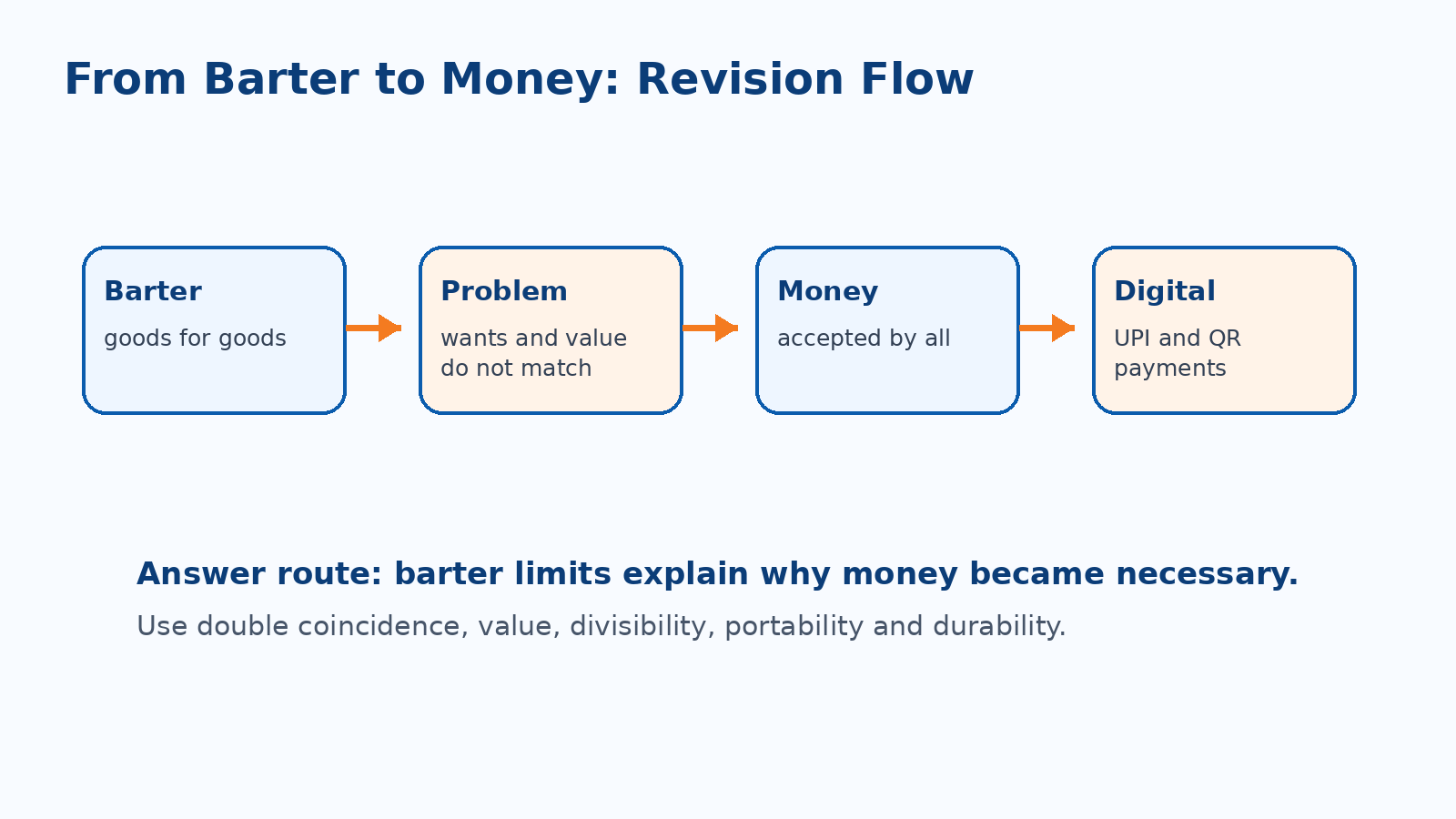
The barter system needed two people whose wants matched exactly. The farmer and ox example shows how hard it was to find the right person, agree on value, carry goods and store leftovers.
- Double coincidence: both sides must want each other's goods.
- Common value: goods must be compared fairly.
- Storage: goods like wheat may spoil.
From Barter to Money Class 7 Video Explanation
Source: Magnet Brains on YouTube
Journey of Money from Coins to UPI
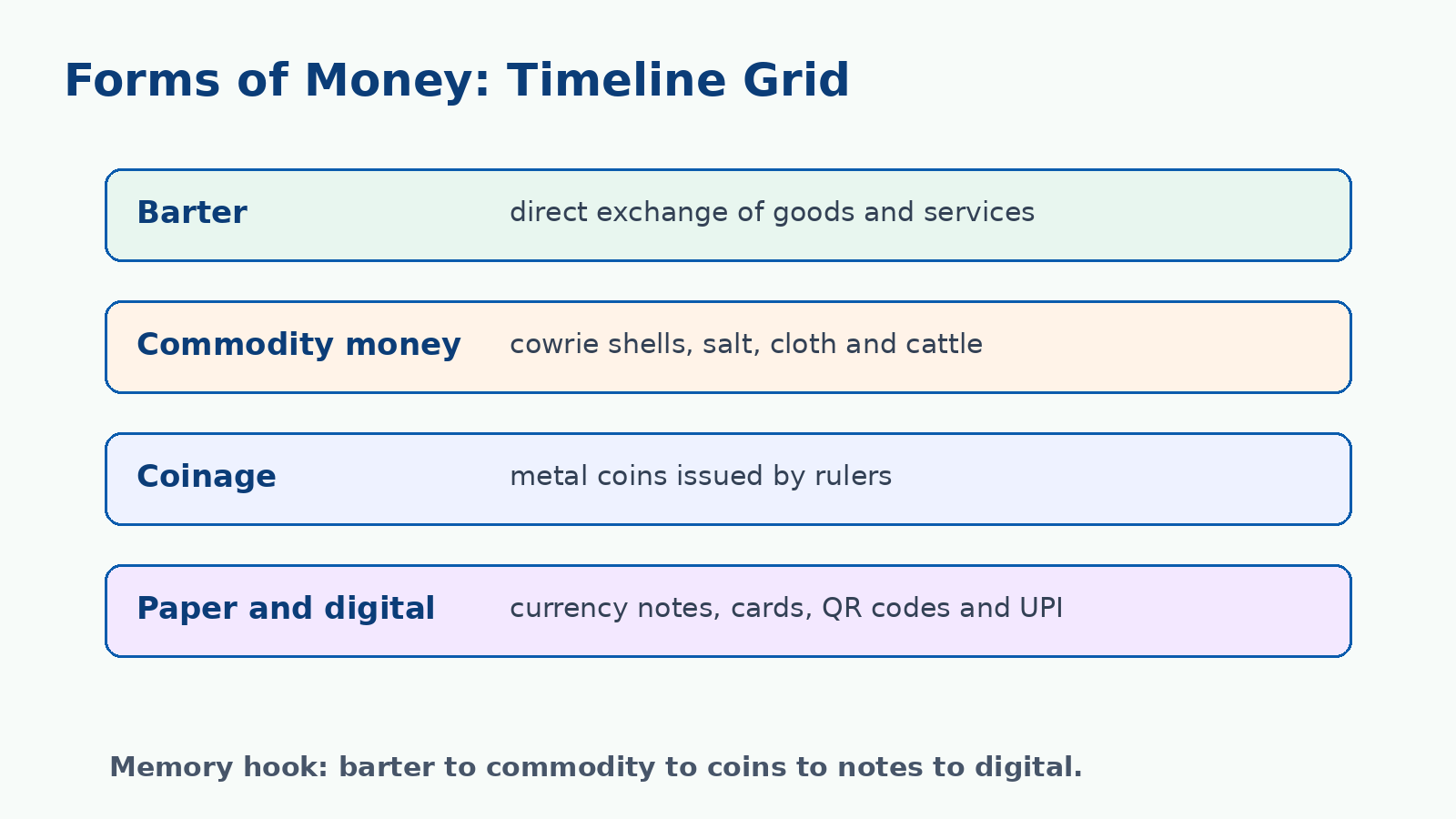
Money changed form as society, trade and technology changed. The chapter moves from commodity money and coinage to paper currency and digital money.
| Form | Chapter link | What to revise |
|---|---|---|
| Commodity money | Cowrie shells, salt, cloth and cattle | Accepted goods |
| Coinage | Metal coins issued by rulers | Symbols, motifs and trade |
| Paper currency | RBI issues currency in India | Denominations and security |
| Digital money | QR code, cards, net banking and UPI | Electronic transfer |
More Class 7 Social Science Chapter 11 Resources
Use these related NCERT resources when you want Chapter 11 in another format. The official book PDF is useful for source reading, while handwritten notes help with quick recall.
| Resource | Best use | Link |
|---|---|---|
| NCERT Solutions | Practice textbook questions and activities | Open NCERT Solutions |
| NCERT Book PDF | Read the official chapter | Open Book PDF |
| Handwritten Notes | Revise terms and diagrams quickly | Open Handwritten Notes |
All Class 7 Social Science Part 1 Notes
The table below keeps the same resource type together, so students can move chapter by chapter through Class 7 Social Science Part 1 notes.
| Chapter | NCERT chapter title | Notes link |
|---|---|---|
| Chapter 1 | Geographical Diversity of India | Open Notes |
| Chapter 2 | Understanding the Weather | Open Notes |
| Chapter 3 | Climates of India | Open Notes |
| Chapter 4 | New Beginnings: Cities and States | Open Notes |
| Chapter 5 | The Rise of Empires | Open Notes |
| Chapter 6 | The Age of Reorganisation | Open Notes |
| Chapter 7 | The Gupta Era: An Age of Tireless Creativity | Open Notes |
| Chapter 8 | How the Land Becomes Sacred | Open Notes |
| Chapter 9 | From the Rulers to the Ruled: Types of Governments | Open Notes |
| Chapter 10 | The Constitution of India: An Introduction | Open Notes |
| Chapter 11 | From Barter to Money | Current notes |
| Chapter 12 | Understanding Markets | Open Notes |
Class 7 Social Science Chapter 11 From Barter to Money Notes FAQs
Ques. What is the barter system?
Ans. The barter system is the direct exchange of goods or services without using money.
Ques. What is double coincidence of wants?
Ans. It is a situation where two people each have something the other wants and can exchange directly.
Ques. What are the main functions of money?
Ans. Money works as a medium of exchange, store of value, measure of value and standard of deferred payment.
Ques. Who issues currency in India?
Ans. The Reserve Bank of India is the legal authority that issues currency in India.



Comments