



The NCERT Class 7 Social Science Chapter 6 notes for The Age of Reorganisation explain the post-Maurya period, Shungas, Satavahanas, Chedis, Sangam-age kingdoms, Indo-Greeks, Shakas, Kushanas, trade routes and art styles for the 2026-27 NCERT textbook. The PDF helps students revise Chapter 6 through timelines, comparison tables, diagrams and activity answer frames.
- Best for revision: post-Maurya change, southern kingdoms, foreign-origin dynasties and cultural assimilation.
- Use with the PDF: read the timeline first, then revise the dynasty tables and map cues.
- 2026-27 focus: follows Exploring Society: India and Beyond, Part 1, Chapter 6.
Chapter6TheAgeofReorganisationNotes.pdf?page=1&dpi=150)
Chapter6TheAgeofReorganisationNotes.pdf?page=2&dpi=150)
Chapter6TheAgeofReorganisationNotes.pdf?page=3&dpi=150)
Chapter6TheAgeofReorganisationNotes.pdf?page=4&dpi=150)
Chapter6TheAgeofReorganisationNotes.pdf?page=5&dpi=150)
Chapter6TheAgeofReorganisationNotes.pdf?page=6&dpi=150)
Chapter6TheAgeofReorganisationNotes.pdf?page=7&dpi=150)
Chapter6TheAgeofReorganisationNotes.pdf?page=8&dpi=150)
Chapter6TheAgeofReorganisationNotes.pdf?page=9&dpi=150)
Chapter6TheAgeofReorganisationNotes.pdf?page=10&dpi=150)
Chapter6TheAgeofReorganisationNotes.pdf?page=11&dpi=150)
Chapter6TheAgeofReorganisationNotes.pdf?page=12&dpi=150)
Chapter6TheAgeofReorganisationNotes.pdf?page=13&dpi=150)
Chapter6TheAgeofReorganisationNotes.pdf?page=14&dpi=150)
Chapter6TheAgeofReorganisationNotes.pdf?page=15&dpi=150)
Chapter6TheAgeofReorganisationNotes.pdf?page=16&dpi=150)
Chapter6TheAgeofReorganisationNotes.pdf?page=17&dpi=150)
Chapter6TheAgeofReorganisationNotes.pdf?page=18&dpi=150)
Chapter6TheAgeofReorganisationNotes.pdf?page=19&dpi=150)
Chapter6TheAgeofReorganisationNotes.pdf?page=20&dpi=150)
Chapter6TheAgeofReorganisationNotes.pdf?page=21&dpi=150)
Chapter6TheAgeofReorganisationNotes.pdf?page=22&dpi=150)
Chapter6TheAgeofReorganisationNotes.pdf?page=23&dpi=150)
Chapter6TheAgeofReorganisationNotes.pdf?page=24&dpi=150)
Chapter6TheAgeofReorganisationNotes.pdf?page=25&dpi=150)
Chapter6TheAgeofReorganisationNotes.pdf?page=26&dpi=150)
Chapter6TheAgeofReorganisationNotes.pdf?page=27&dpi=150)
Chapter6TheAgeofReorganisationNotes_flat_MobileCard.pdf?page=1&dpi=150)
Chapter6TheAgeofReorganisationNotes_flat_MobileCard.pdf?page=2&dpi=150)
Chapter6TheAgeofReorganisationNotes_flat_MobileCard.pdf?page=3&dpi=150)
Chapter6TheAgeofReorganisationNotes_flat_MobileCard.pdf?page=4&dpi=150)
Chapter6TheAgeofReorganisationNotes_flat_MobileCard.pdf?page=5&dpi=150)
Chapter6TheAgeofReorganisationNotes_flat_MobileCard.pdf?page=6&dpi=150)
Chapter6TheAgeofReorganisationNotes_flat_MobileCard.pdf?page=7&dpi=150)
Chapter6TheAgeofReorganisationNotes_flat_MobileCard.pdf?page=8&dpi=150)
Chapter6TheAgeofReorganisationNotes_flat_MobileCard.pdf?page=9&dpi=150)
Chapter6TheAgeofReorganisationNotes_flat_MobileCard.pdf?page=10&dpi=150)
Chapter6TheAgeofReorganisationNotes_flat_MobileCard.pdf?page=11&dpi=150)
Chapter6TheAgeofReorganisationNotes_flat_MobileCard.pdf?page=12&dpi=150)
Chapter6TheAgeofReorganisationNotes_flat_MobileCard.pdf?page=13&dpi=150)
Chapter6TheAgeofReorganisationNotes_flat_MobileCard.pdf?page=14&dpi=150)
Chapter6TheAgeofReorganisationNotes_flat_MobileCard.pdf?page=15&dpi=150)
Chapter6TheAgeofReorganisationNotes_flat_MobileCard.pdf?page=16&dpi=150)
Chapter6TheAgeofReorganisationNotes_flat_MobileCard.pdf?page=17&dpi=150)
Chapter6TheAgeofReorganisationNotes_flat_MobileCard.pdf?page=18&dpi=150)
Chapter6TheAgeofReorganisationNotes_flat_MobileCard.pdf?page=19&dpi=150)
Chapter6TheAgeofReorganisationNotes_flat_MobileCard.pdf?page=20&dpi=150)
Chapter6TheAgeofReorganisationNotes_flat_MobileCard.pdf?page=21&dpi=150)
Chapter6TheAgeofReorganisationNotes_flat_MobileCard.pdf?page=22&dpi=150)
Chapter6TheAgeofReorganisationNotes_flat_MobileCard.pdf?page=23&dpi=150)
Chapter6TheAgeofReorganisationNotes_flat_MobileCard.pdf?page=24&dpi=150)
Chapter6TheAgeofReorganisationNotes_flat_MobileCard.pdf?page=25&dpi=150)
Chapter6TheAgeofReorganisationNotes_flat_MobileCard.pdf?page=26&dpi=150)
Chapter6TheAgeofReorganisationNotes_flat_MobileCard.pdf?page=27&dpi=150)
Chapter6TheAgeofReorganisationNotes_flat_MobileCard.pdf?page=28&dpi=150)
Chapter6TheAgeofReorganisationNotes_flat_MobileCard.pdf?page=29&dpi=150)
Chapter6TheAgeofReorganisationNotes_flat_MobileCard.pdf?page=30&dpi=150)
Chapter6TheAgeofReorganisationNotes_flat_MobileCard.pdf?page=31&dpi=150)
Chapter6TheAgeofReorganisationNotes_flat_MobileCard.pdf?page=32&dpi=150)
Chapter6TheAgeofReorganisationNotes_flat_MobileCard.pdf?page=33&dpi=150)
Chapter6TheAgeofReorganisationNotes_flat_MobileCard.pdf?page=34&dpi=150)
Chapter6TheAgeofReorganisationNotes_flat_MobileCard.pdf?page=35&dpi=150)
Chapter6TheAgeofReorganisationNotes_flat_MobileCard.pdf?page=36&dpi=150)
Chapter6TheAgeofReorganisationNotes_flat_MobileCard.pdf?page=37&dpi=150)
Chapter6TheAgeofReorganisationNotes_flat_MobileCard.pdf?page=38&dpi=150)
Student Feedback: In a Collegedunia revision poll of 5,940 Class 7 students, 72% said Chapter 6 became easier after they grouped kingdoms by region, source evidence and cultural contribution.
Chapter 6 The Age of Reorganisation Notes Highlights
The Age of Reorganisation explains how India changed after the Maurya Empire. New kingdoms emerged, outside-origin groups entered through the northwest, and cultural exchange shaped art, coins, inscriptions, literature and trade. The chapter should be revised as a story of political reorganisation plus cultural confluence.
| Topic | What to remember | Exam cue |
|---|---|---|
| Reorganisation | Post-Maurya regions became new kingdoms and competed for control | Use for the big-question answer |
| Satavahanas | Deccan power, trade, coins, caves and mother-name titles | Link economy with inscriptions |
| Sangam Age | Cholas, Cheras, Pandyas and early Tamil literature | Use poems as historical sources |
| Kushanas | Kanishka, Silk Route, coins, Gandhara and Mathura art | Connect trade with art |
Post-Maurya Reorganisation Map Cues
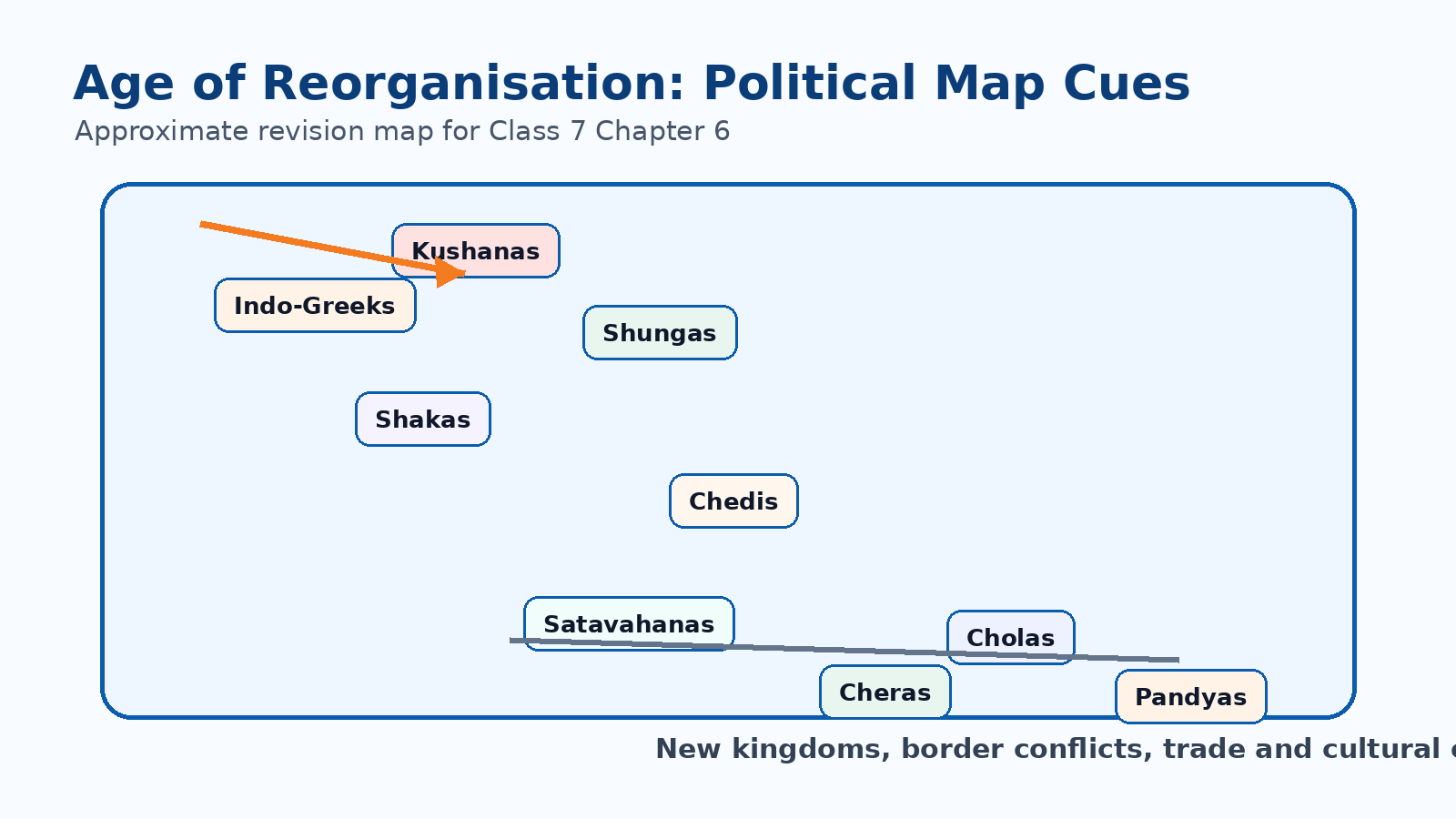
The chapter begins with the breakup of Mauryan control around 185 BCE. Tributary regions became more assertive, borderlands became vulnerable, and rulers used alliances, marriages and warfare to gain territory. This is why the period is called an age of reorganisation.
- Within the subcontinent: Shungas, Chedis, Satavahanas, Cholas, Cheras and Pandyas.
- Outside-origin groups: Indo-Greeks, Shakas and Kushanas entered from the northwest.
- Common outcome: art, architecture, coinage and language absorbed several influences.
Satavahanas and Reorganisation Class 7 Video
Source: Magnet Brains on YouTube
Shungas Satavahanas and Chedis Revision
The first half of Chapter 6 moves through regional powers after the Mauryas. The Shungas revived Vedic rituals and supported art. The Satavahanas built Deccan prosperity through agriculture, trade, coins and caves. The Chedis under Kharavela show Jain patronage and rock-cut architecture.
| Dynasty | Region or evidence | Revision point |
|---|---|---|
| Shungas | North and central India | Ashvamedha, Bharhut Stupa and Sanskrit learning |
| Satavahanas | Deccan, Amaravati and Pratishthana | Trade coins, Naneghat, Karla caves and Gautamiputra title |
| Chedis | Kalinga, Udayagiri and Khandagiri | Kharavela, Hathigumpha inscription and respect for sects |
Sangam Age and Southern Kingdoms
The Cholas, Cheras and Pandyas remained important in the southern region. Sangam literature is a major source because it records poems about love, heroism, generosity, rulers, cities and social life. Students should use literature together with coins, inscriptions and archaeology.
- Cholas: Karikala, Kaveri region and Kallanai or Grand Anicut.
- Cheras: Vanji or Karur, spices, timber, ivory, pearls and Roman trade links.
- Pandyas: Madurai, pearls, naval power, inscriptions and welfare claims.
Gandhara and Mathura Art Comparison
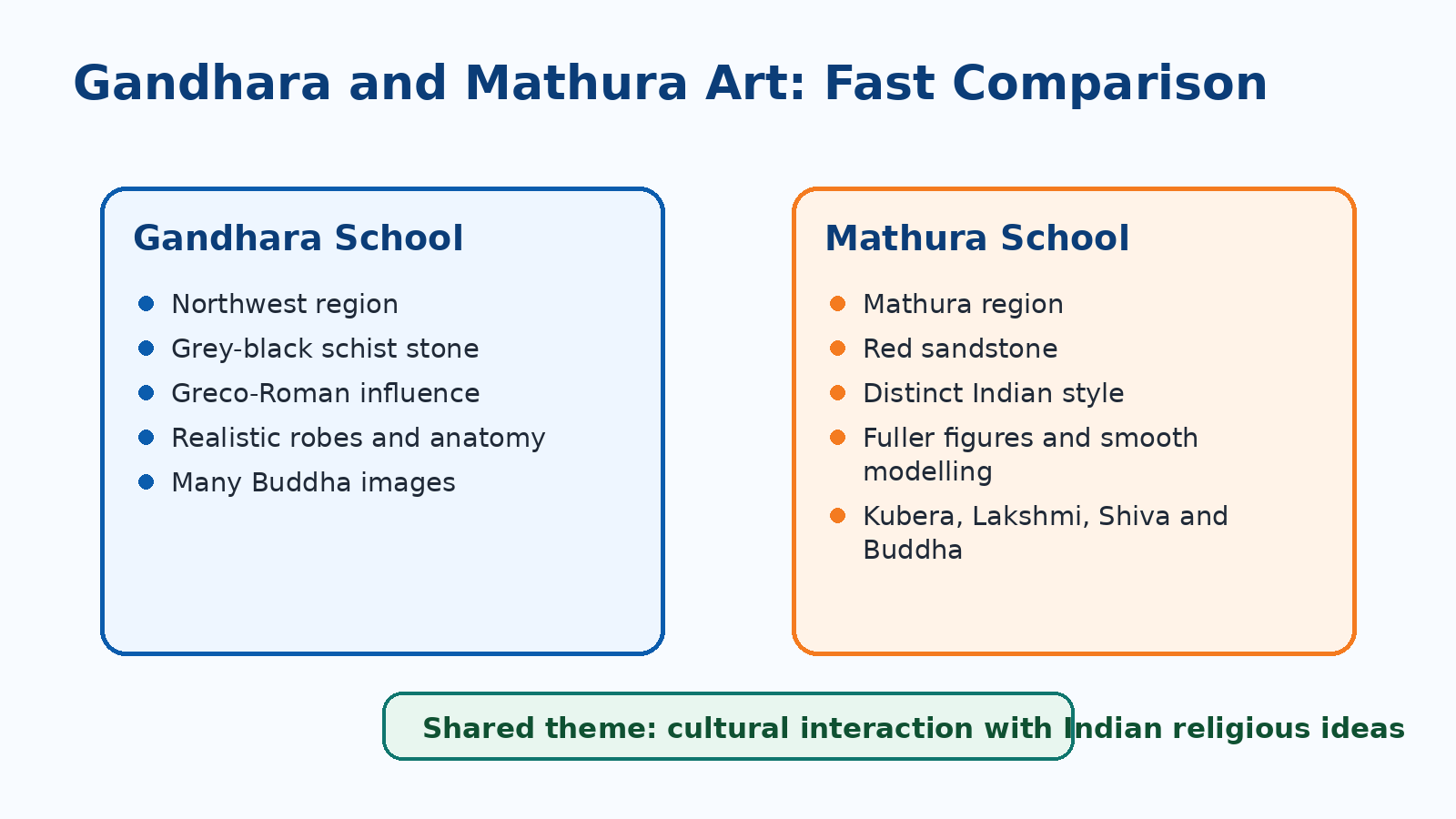
Kushana rule encouraged cultural intermixing. Gandhara art used grey-black schist and showed Greco-Roman influence in robes and realistic body forms. Mathura art used red sandstone and showed a distinct Indian style with fuller figures and smooth modelling.
| Art school | Main feature | Memory clue |
|---|---|---|
| Gandhara | Grey-black schist, Greco-Roman influence and Buddha images | Northwest fusion style |
| Mathura | Red sandstone, Indian style and fuller figures | Mathura region style |
How to Use the Class 7 Chapter 6 Notes PDF
Start with the timeline in the PDF, then revise dynasty groups and source evidence. For long answers, use a four-part frame: context, example, source and impact. For reorganisation, always mention both political change and cultural exchange.
- Use the dynasty table for short notes on Shungas, Satavahanas and Chedis.
- Use the southern kingdoms section for Sangam literature and trade answers.
- Use the art comparison image for Gandhara and Mathura difference questions.
More Class 7 Social Science Chapter 6 Resources
Use these related NCERT resources when you want Chapter 6 in another format. The official book PDF is useful for maps and images, while handwritten notes are useful for fast last-minute recall.
| Resource | Best use | Link |
|---|---|---|
| NCERT Solutions | Practice textbook questions and activity answers | Open NCERT Solutions |
| NCERT Book PDF | Read the official chapter with maps, artefacts and questions | Open Book PDF |
| Handwritten Notes | Revise terms, timelines and comparison frames quickly | Open Handwritten Notes |
All Class 7 Social Science Part 1 Notes
The table below keeps the same resource type together, so students can move chapter by chapter through Class 7 Social Science Part 1 notes.
| Chapter | NCERT chapter title | Notes link |
|---|---|---|
| Chapter 1 | Geographical Diversity of India | Open Notes |
| Chapter 2 | Understanding the Weather | Open Notes |
| Chapter 3 | Climates of India | Open Notes |
| Chapter 4 | New Beginnings: Cities and States | Open Notes |
| Chapter 5 | The Rise of Empires | Open Notes |
| Chapter 6 | The Age of Reorganisation | Current notes |
| Chapter 7 | The Gupta Era: An Age of Tireless Creativity | Open Notes |
| Chapter 8 | How the Land Becomes Sacred | Open Notes |
| Chapter 9 | From the Rulers to the Ruled: Types of Governments | Open Notes |
| Chapter 10 | The Constitution of India: An Introduction | Open Notes |
| Chapter 11 | From Barter to Money | Open Notes |
| Chapter 12 | Understanding Markets | Open Notes |
Class 7 Social Science Chapter 6 The Age of Reorganisation Notes FAQs
Ques. Why is Chapter 6 called The Age of Reorganisation?
Ans. It is called so because after the Maurya Empire declined, regions reorganised into new kingdoms while foreign-origin groups entered and interacted with Indian society.
Ques. Which dynasties are important in Class 7 Social Science Chapter 6?
Ans. Important dynasties include the Shungas, Satavahanas, Chedis, Cholas, Cheras, Pandyas, Indo-Greeks, Shakas and Kushanas.
Ques. What is Sangam literature?
Ans. Sangam literature is the oldest south Indian literature and includes poems that help historians study society, values, rulers and culture.
Ques. What is the difference between Gandhara and Mathura art?
Ans. Gandhara art shows Greco-Roman influence and grey-black schist, while Mathura art uses red sandstone and has a distinct Indian style.



Comments