



The NCERT Class 7 Social Science Chapter 9 notes for From the Rulers to the Ruled: Types of Governments explain government functions, democracy, elections, monarchy, theocracy, dictatorship, oligarchy and democratic rights for the 2026-27 NCERT textbook. The PDF helps students revise the chapter through comparison tables, flow charts and short answer frames.
- Best for revision: government functions, democracy principles and non-democratic government forms.
- Use with the PDF: read the comparison table before attempting NCERT questions 4, 5 and 8.
- 2026-27 focus: follows Exploring Society: India and Beyond, Part 1, Chapter 9.
Chapter9FromtheRulerstotheRuled:TypesofGovernmentsNotes.pdf?page=1&dpi=150)
Chapter9FromtheRulerstotheRuled:TypesofGovernmentsNotes.pdf?page=2&dpi=150)
Chapter9FromtheRulerstotheRuled:TypesofGovernmentsNotes.pdf?page=3&dpi=150)
Chapter9FromtheRulerstotheRuled:TypesofGovernmentsNotes.pdf?page=4&dpi=150)
Chapter9FromtheRulerstotheRuled:TypesofGovernmentsNotes.pdf?page=5&dpi=150)
Chapter9FromtheRulerstotheRuled:TypesofGovernmentsNotes.pdf?page=6&dpi=150)
Chapter9FromtheRulerstotheRuled:TypesofGovernmentsNotes.pdf?page=7&dpi=150)
Chapter9FromtheRulerstotheRuled:TypesofGovernmentsNotes.pdf?page=8&dpi=150)
Chapter9FromtheRulerstotheRuled:TypesofGovernmentsNotes.pdf?page=9&dpi=150)
Chapter9FromtheRulerstotheRuled:TypesofGovernmentsNotes.pdf?page=10&dpi=150)
Chapter9FromtheRulerstotheRuled:TypesofGovernmentsNotes.pdf?page=11&dpi=150)
Chapter9FromtheRulerstotheRuled:TypesofGovernmentsNotes.pdf?page=12&dpi=150)
Chapter9FromtheRulerstotheRuled:TypesofGovernmentsNotes.pdf?page=13&dpi=150)
Chapter9FromtheRulerstotheRuled:TypesofGovernmentsNotes.pdf?page=14&dpi=150)
Chapter9FromtheRulerstotheRuled:TypesofGovernmentsNotes.pdf?page=15&dpi=150)
Chapter9FromtheRulerstotheRuled:TypesofGovernmentsNotes.pdf?page=16&dpi=150)
Chapter9FromtheRulerstotheRuled:TypesofGovernmentsNotes.pdf?page=17&dpi=150)
Chapter9FromtheRulerstotheRuled:TypesofGovernmentsNotes.pdf?page=18&dpi=150)
Chapter9FromtheRulerstotheRuled:TypesofGovernmentsNotes.pdf?page=19&dpi=150)
Chapter9FromtheRulerstotheRuled:TypesofGovernmentsNotes.pdf?page=20&dpi=150)
Chapter9FromtheRulerstotheRuled:TypesofGovernmentsNotes.pdf?page=21&dpi=150)
Chapter9FromtheRulerstotheRuled:TypesofGovernmentsNotes_flat_MobileCard.pdf?page=1&dpi=150)
Chapter9FromtheRulerstotheRuled:TypesofGovernmentsNotes_flat_MobileCard.pdf?page=2&dpi=150)
Chapter9FromtheRulerstotheRuled:TypesofGovernmentsNotes_flat_MobileCard.pdf?page=3&dpi=150)
Chapter9FromtheRulerstotheRuled:TypesofGovernmentsNotes_flat_MobileCard.pdf?page=4&dpi=150)
Chapter9FromtheRulerstotheRuled:TypesofGovernmentsNotes_flat_MobileCard.pdf?page=5&dpi=150)
Chapter9FromtheRulerstotheRuled:TypesofGovernmentsNotes_flat_MobileCard.pdf?page=6&dpi=150)
Chapter9FromtheRulerstotheRuled:TypesofGovernmentsNotes_flat_MobileCard.pdf?page=7&dpi=150)
Chapter9FromtheRulerstotheRuled:TypesofGovernmentsNotes_flat_MobileCard.pdf?page=8&dpi=150)
Chapter9FromtheRulerstotheRuled:TypesofGovernmentsNotes_flat_MobileCard.pdf?page=9&dpi=150)
Chapter9FromtheRulerstotheRuled:TypesofGovernmentsNotes_flat_MobileCard.pdf?page=10&dpi=150)
Chapter9FromtheRulerstotheRuled:TypesofGovernmentsNotes_flat_MobileCard.pdf?page=11&dpi=150)
Chapter9FromtheRulerstotheRuled:TypesofGovernmentsNotes_flat_MobileCard.pdf?page=12&dpi=150)
Chapter9FromtheRulerstotheRuled:TypesofGovernmentsNotes_flat_MobileCard.pdf?page=13&dpi=150)
Chapter9FromtheRulerstotheRuled:TypesofGovernmentsNotes_flat_MobileCard.pdf?page=14&dpi=150)
Chapter9FromtheRulerstotheRuled:TypesofGovernmentsNotes_flat_MobileCard.pdf?page=15&dpi=150)
Chapter9FromtheRulerstotheRuled:TypesofGovernmentsNotes_flat_MobileCard.pdf?page=16&dpi=150)
Chapter9FromtheRulerstotheRuled:TypesofGovernmentsNotes_flat_MobileCard.pdf?page=17&dpi=150)
Chapter9FromtheRulerstotheRuled:TypesofGovernmentsNotes_flat_MobileCard.pdf?page=18&dpi=150)
Chapter9FromtheRulerstotheRuled:TypesofGovernmentsNotes_flat_MobileCard.pdf?page=19&dpi=150)
Chapter9FromtheRulerstotheRuled:TypesofGovernmentsNotes_flat_MobileCard.pdf?page=20&dpi=150)
Chapter9FromtheRulerstotheRuled:TypesofGovernmentsNotes_flat_MobileCard.pdf?page=21&dpi=150)
Chapter9FromtheRulerstotheRuled:TypesofGovernmentsNotes_flat_MobileCard.pdf?page=22&dpi=150)
Chapter9FromtheRulerstotheRuled:TypesofGovernmentsNotes_flat_MobileCard.pdf?page=23&dpi=150)
Chapter9FromtheRulerstotheRuled:TypesofGovernmentsNotes_flat_MobileCard.pdf?page=24&dpi=150)
Chapter9FromtheRulerstotheRuled:TypesofGovernmentsNotes_flat_MobileCard.pdf?page=25&dpi=150)
Chapter9FromtheRulerstotheRuled:TypesofGovernmentsNotes_flat_MobileCard.pdf?page=26&dpi=150)
Chapter9FromtheRulerstotheRuled:TypesofGovernmentsNotes_flat_MobileCard.pdf?page=27&dpi=150)
Chapter9FromtheRulerstotheRuled:TypesofGovernmentsNotes_flat_MobileCard.pdf?page=28&dpi=150)
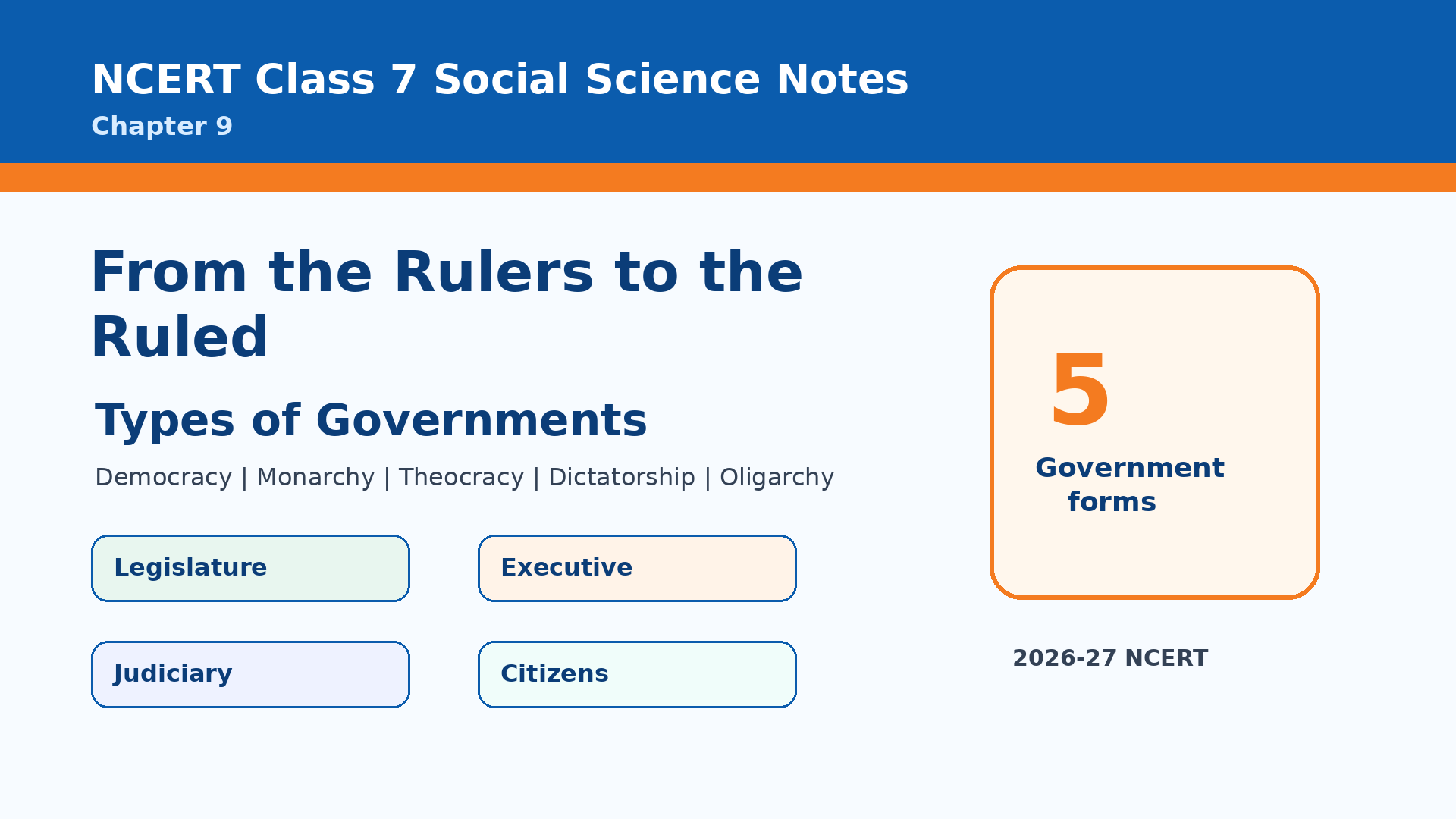
Student Feedback: In a Collegedunia poll of 11,870 Class 7 students before the 2026 school exams, 76% said Chapter 9 became easier after they compared governments by power, rights and accountability.
|
Table of Contents |
From the Rulers to the Ruled Notes Highlights
From the Rulers to the Ruled: Types of Governments explains how governments are formed and why democracy gives people a voice. The safest revision method is to compare each system by source of power, citizen rights and accountability.
| Topic | What to remember | Exam cue |
|---|---|---|
| Government | Maintains order, security, services and welfare | Use for role-based answers |
| Democracy | People elect representatives and can change them | Use vote and accountability |
| Other forms | Power may rest with a monarch, religion, dictator or few people | Use comparison table |
Government Functions: Legislative Executive Judicial
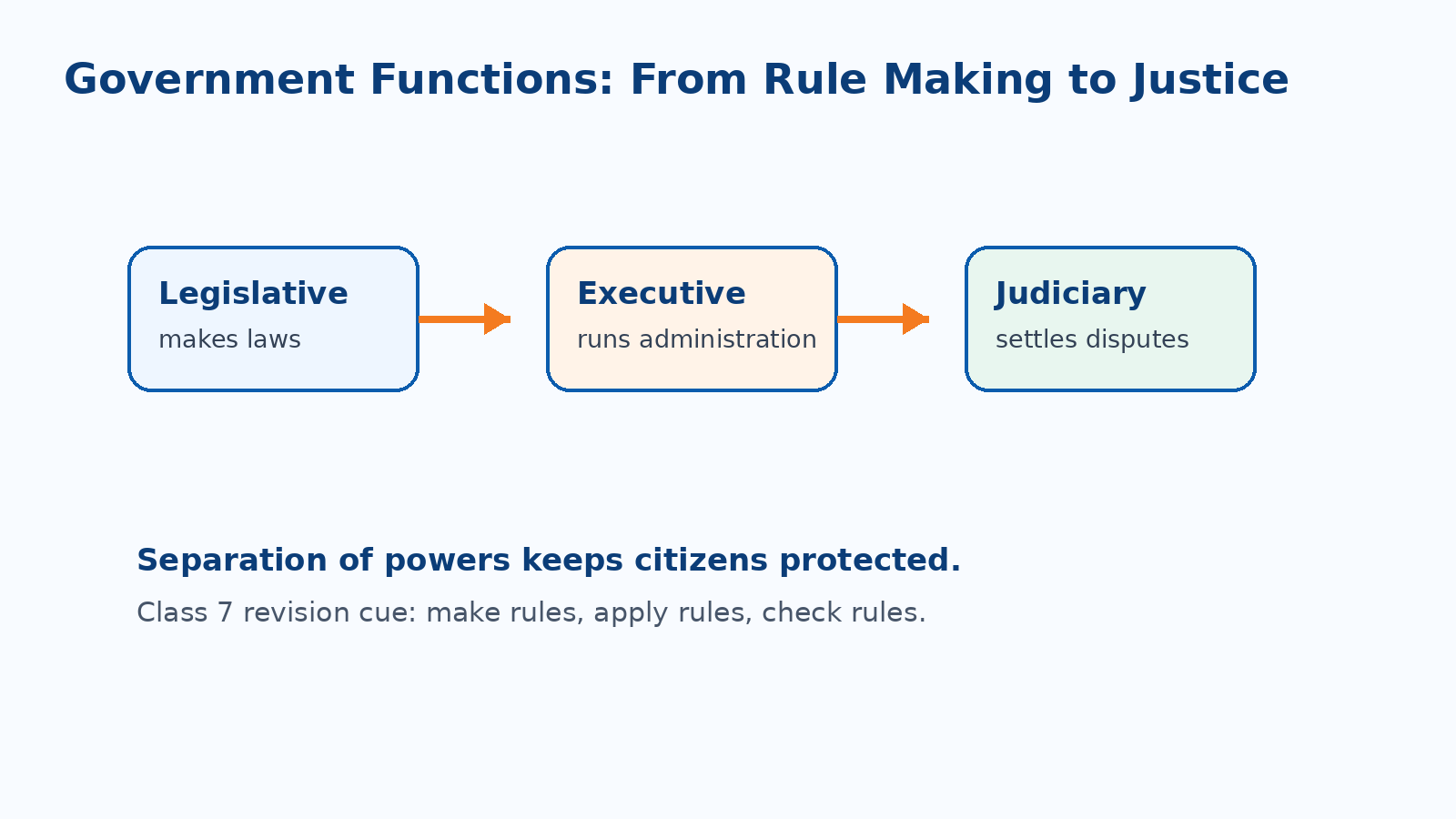
The chapter explains three key functions. The legislative function creates rules, the executive implements them, and the judiciary checks whether rules are followed.
- Legislature: makes laws and represents public choices.
- Executive: runs the administration according to laws.
- Judiciary: protects rights and settles disputes.
Types of Governments Class 7 Video Explanation
Source: Magnet Brains on YouTube
Types of Governments Comparison Chart
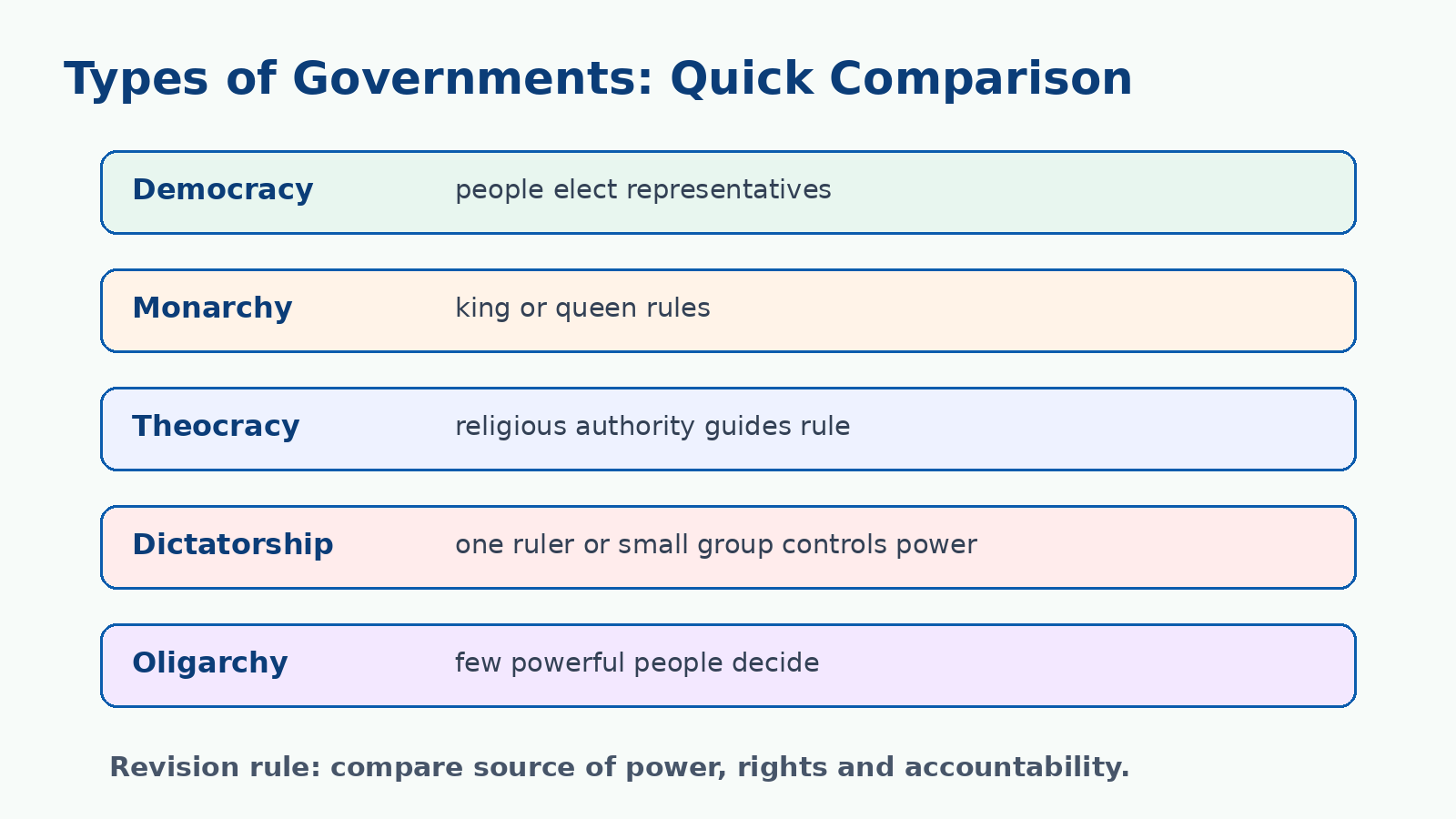
Different governments answer the same question differently: who holds power? Democracy places authority with people, while monarchy, theocracy, dictatorship and oligarchy place power elsewhere.
| Government type | Power rests with | Student answer cue |
|---|---|---|
| Democracy | People through representatives | Vote, rights, accountability |
| Monarchy | King or queen | Hereditary rule |
| Theocracy | Religious authority | Religion-based governance |
| Dictatorship | One person or small group | Absolute power and limited freedom |
| Oligarchy | Few powerful people | Wealth or influence capture |
Why Democracy Matters in Class 7 Social Science Chapter 9
Democracy matters because people can choose representatives, ask questions, protect rights and change governments peacefully. For long answers, always connect democracy with freedom, equality and accountability.
- People can vote at regular intervals.
- Citizens have fundamental rights and freedoms.
- The judiciary protects rights and checks misuse of power.
- Citizens must stay alert against corruption, inequality and information manipulation.
More Class 7 Social Science Chapter 9 Resources
Use these related NCERT resources when you want Chapter 9 in another format. The book PDF is useful for source reading, while handwritten notes help with quick recall.
| Resource | Best use | Link |
|---|---|---|
| NCERT Solutions | Practice textbook questions and activities | Open NCERT Solutions |
| NCERT Book PDF | Read the official chapter | Open Book PDF |
| Handwritten Notes | Revise terms and examples quickly | Open Handwritten Notes |
All Class 7 Social Science Part 1 Notes
The table below keeps the same resource type together, so students can move chapter by chapter through Class 7 Social Science Part 1 notes.
| Chapter | NCERT chapter title | Notes link |
|---|---|---|
| Chapter 1 | Geographical Diversity of India | Open Notes |
| Chapter 2 | Understanding the Weather | Open Notes |
| Chapter 3 | Climates of India | Open Notes |
| Chapter 4 | New Beginnings: Cities and States | Open Notes |
| Chapter 5 | The Rise of Empires | Open Notes |
| Chapter 6 | The Age of Reorganisation | Open Notes |
| Chapter 7 | The Gupta Era: An Age of Tireless Creativity | Open Notes |
| Chapter 8 | How the Land Becomes Sacred | Open Notes |
| Chapter 9 | From the Rulers to the Ruled: Types of Governments | Current notes |
| Chapter 10 | The Constitution of India: An Introduction | Open Notes |
| Chapter 11 | From Barter to Money | Open Notes |
| Chapter 12 | Understanding Markets | Open Notes |
Class 7 Social Science Chapter 9 Types of Governments Notes FAQs
Ques. What are the three functions of government in Chapter 9?
Ans. The three functions are legislative, executive and judicial. They mean making rules, implementing rules and checking whether rules are followed.
Ques. Which type of government does India have?
Ans. India has a representative parliamentary democracy. People elect representatives, and the executive is accountable to the legislature.
Ques. What is oligarchy?
Ans. Oligarchy is a form of government where a small powerful group makes important decisions, usually due to wealth or influence.
Ques. Why is democracy important?
Ans. Democracy gives people voice, rights, elections and accountability. It also gives citizens a peaceful way to change representatives.



Comments