




The NCERT Solutions for Class 7 Social Science Chapter 9 From the Rulers to the Ruled: Types of Governments cover all eight questions and activities from the chapter, per the latest 2026-27 CBSE syllabus, built on the chapter's five-type framework: democracy, monarchy, theocracy, dictatorship and oligarchy.
- Question coverage: All 8 questions and activities, from matching government practices to classifying the governments of five real countries.
- Exam weight: Civics reasoning answers like these carry 6 to 8 marks in the annual Class 7 paper.
- Also on this page: a Five Types of Government comparison image, a checked-vs-unchecked power classification image, and links to the Notes and Book PDF.
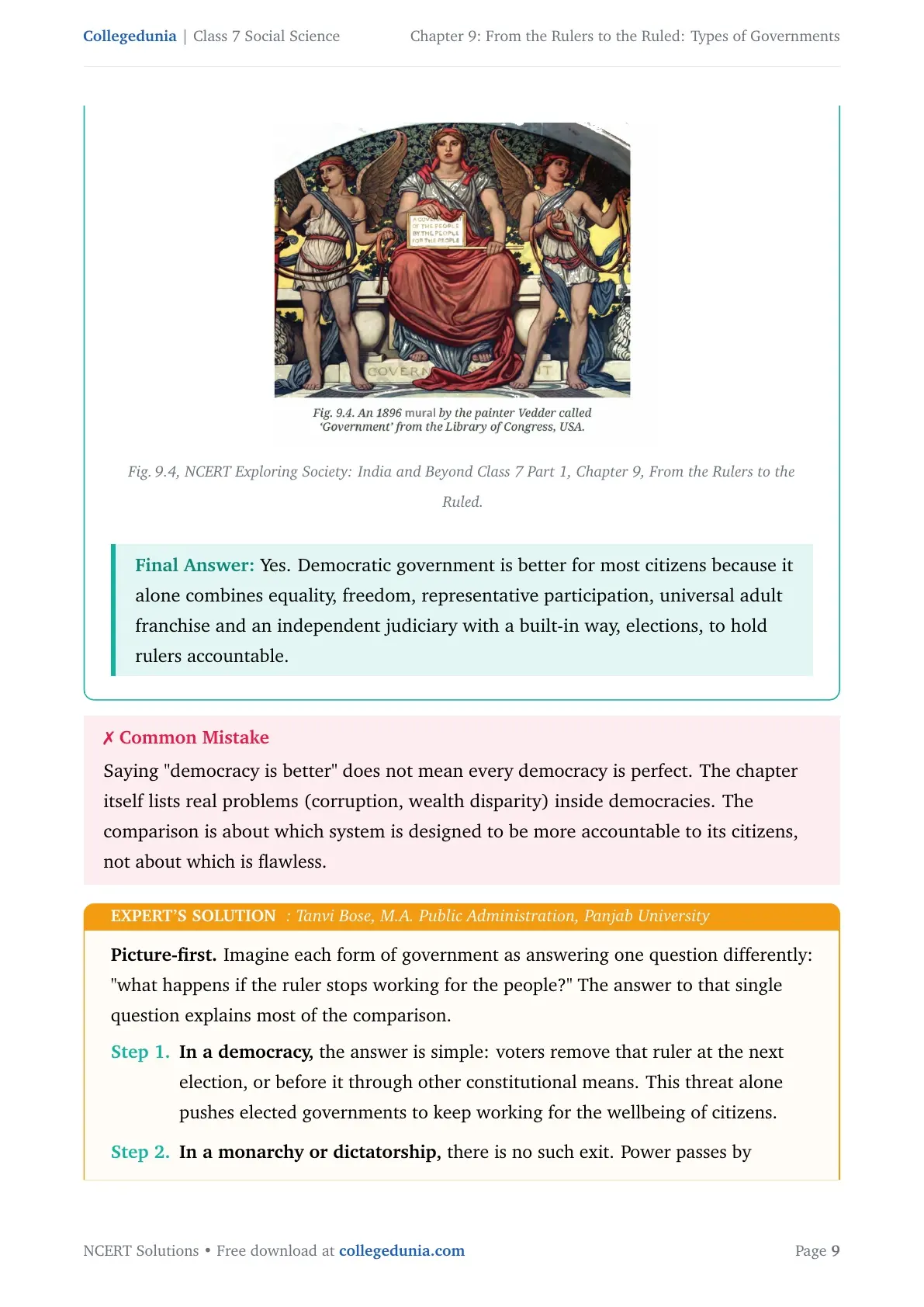
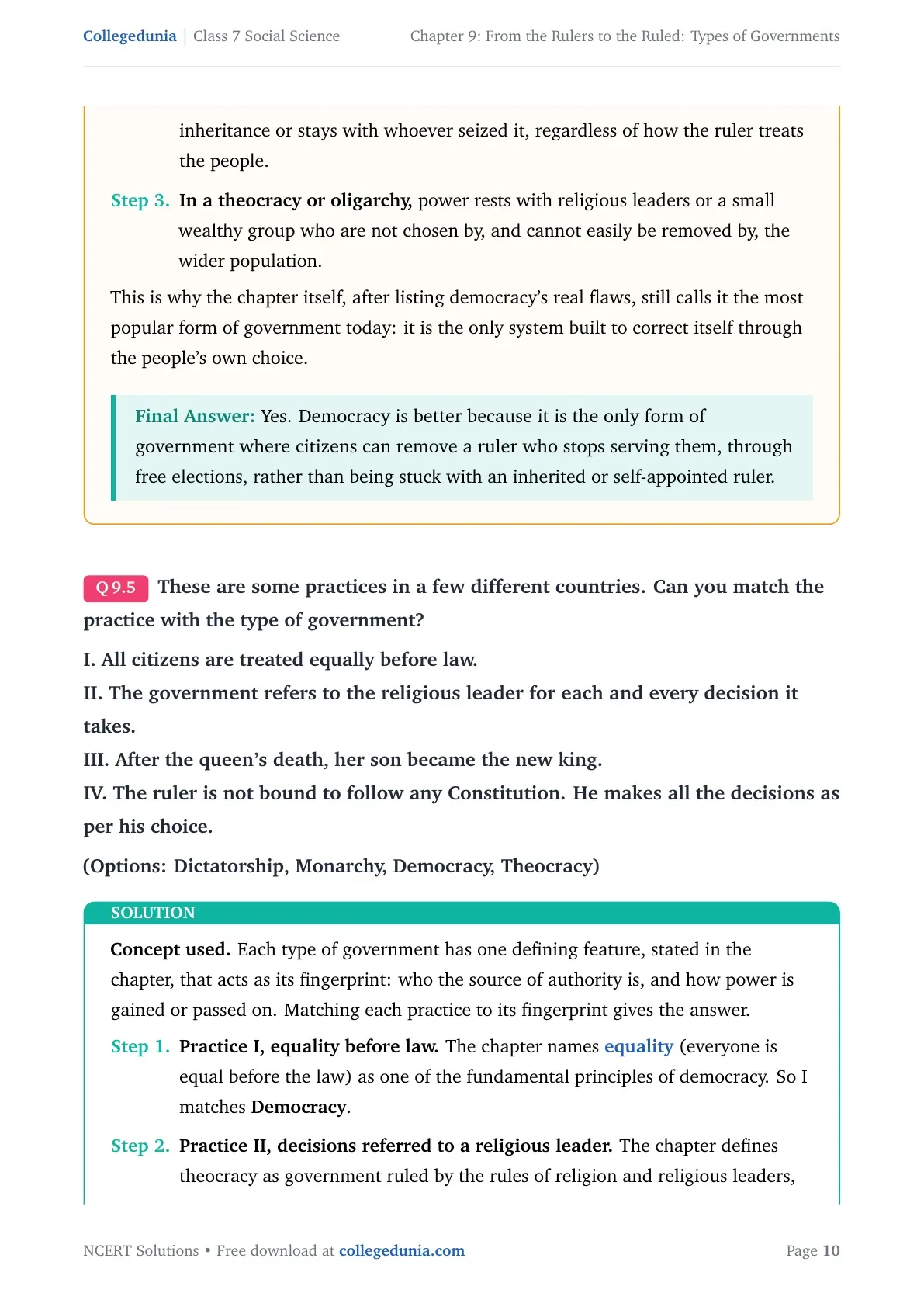
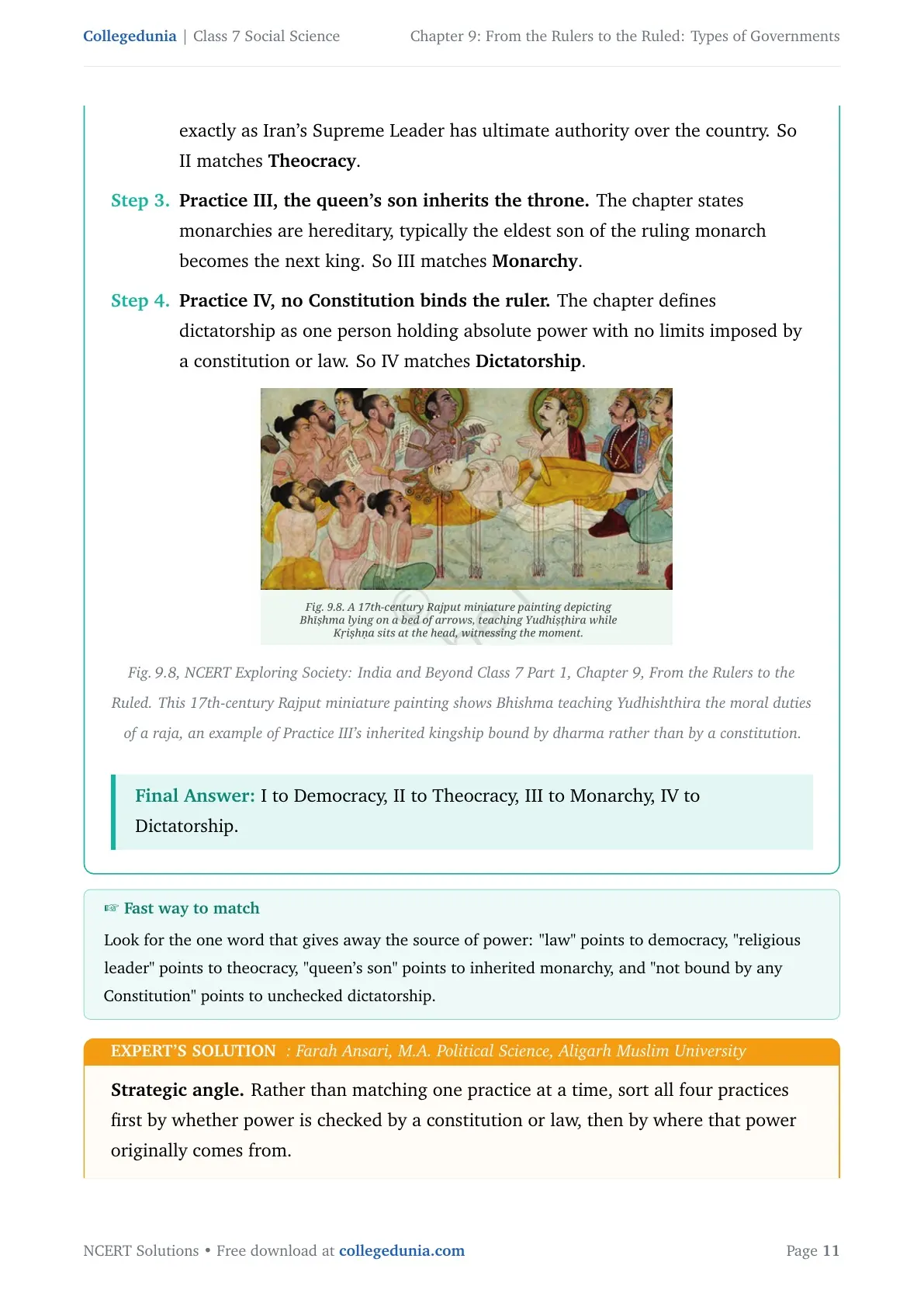
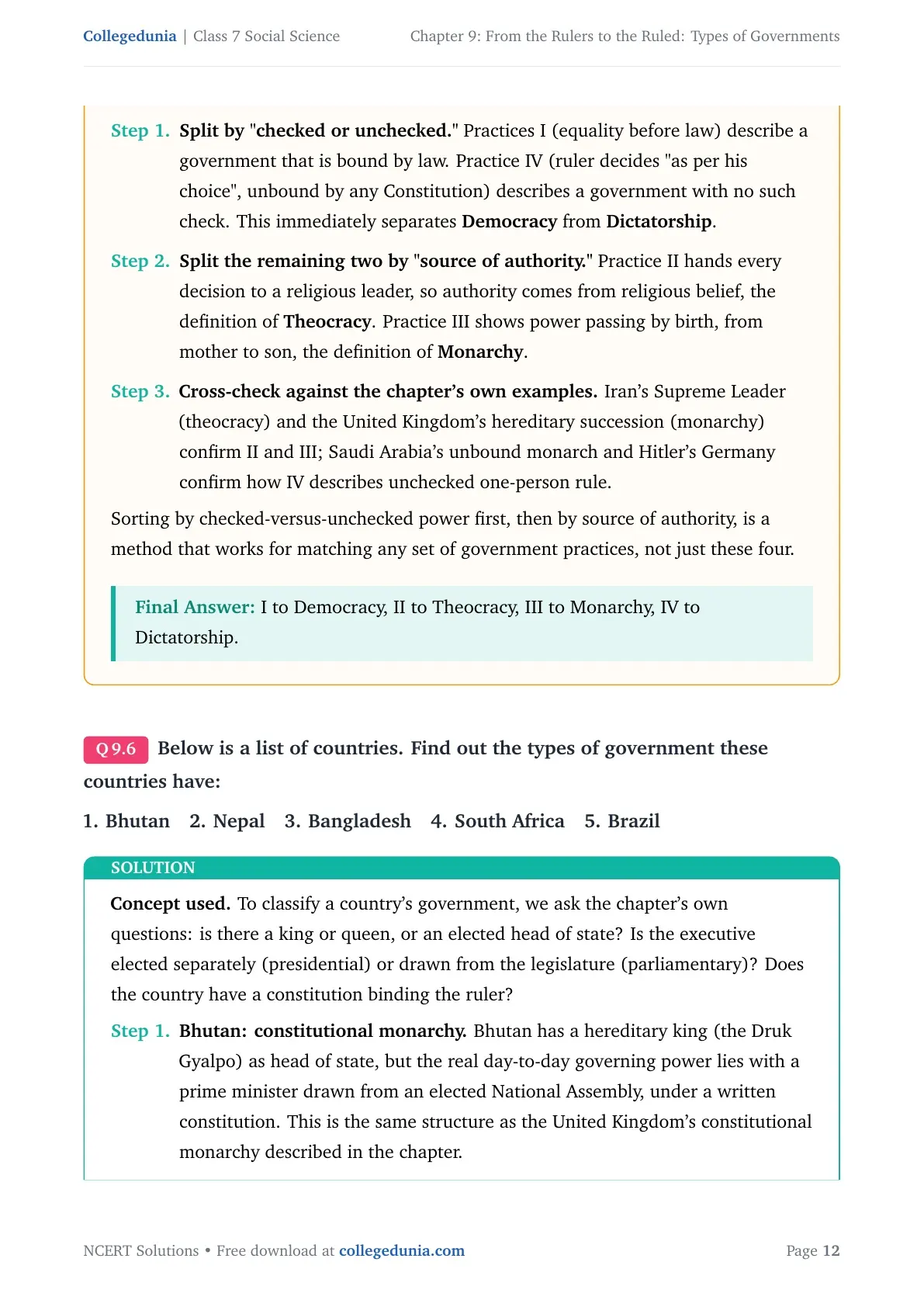
Every NCERT solution on this page is curated by subject experts, checked against the 2026-27 rationalised NCERT print, and written in plain Class 7 language.
Want the full worked answers, one question at a time? Open the dedicated question bank below for step-by-step solutions to every question and activity in From the Rulers to the Ruled: Types of Governments, each with a concept explanation, an Expert's Solution and a boxed final answer.
View All Step-by-Step Solutions for From the Rulers to the Ruled: Types of Governments
Why From the Rulers to the Ruled Matters for Class 7 Social Science
Chapter 9 of Exploring Society: India and Beyond, Part 1, asks who gets to rule and where that power comes from. It builds on democracy from Grade 6, then widens the lens to monarchy, theocracy, dictatorship and oligarchy.
NCERT does not test this chapter as five names to memorise. It tests whether a student can explain why a government is classified the way it is, which is what NCERT Solutions Class 7 Social Science Chapter 9 From the Rulers to the Ruled walks through for every question.
| Concept | What it means | Why it matters |
|---|---|---|
| Checked vs unchecked power | Whether a constitution and courts limit the ruler, or the ruler answers to no one | Separates democracy and constitutional monarchy from absolute monarchy, theocracy, dictatorship and oligarchy |
| Parliamentary democracy | The executive (prime minister, council of ministers) sits inside and answers to the legislature, as in India | Explains why India is not the same kind of democracy as the USA |
| Independent judiciary | Courts work separately from the executive and legislature, free of their control | Is the mechanism that makes equality and freedom actually enforceable |
| Hurdles in democracy | Corruption, wealth disparity and misinformation weaken democratic ideals in practice | Shows why citizen vigilance, not just a constitution, keeps democracy working |
Most Class 7 papers build a long answer around India's classification as a parliamentary democracy, or around why judges must stay independent. Naming the exact term, not describing it in general words, earns full marks.
Five Types of Government: Democracy, Monarchy, Theocracy, Dictatorship and Oligarchy
Q1 asks students to name the types of government covered in the chapter. A government's type depends on who holds the power to rule, and how that power passes to the next ruler.
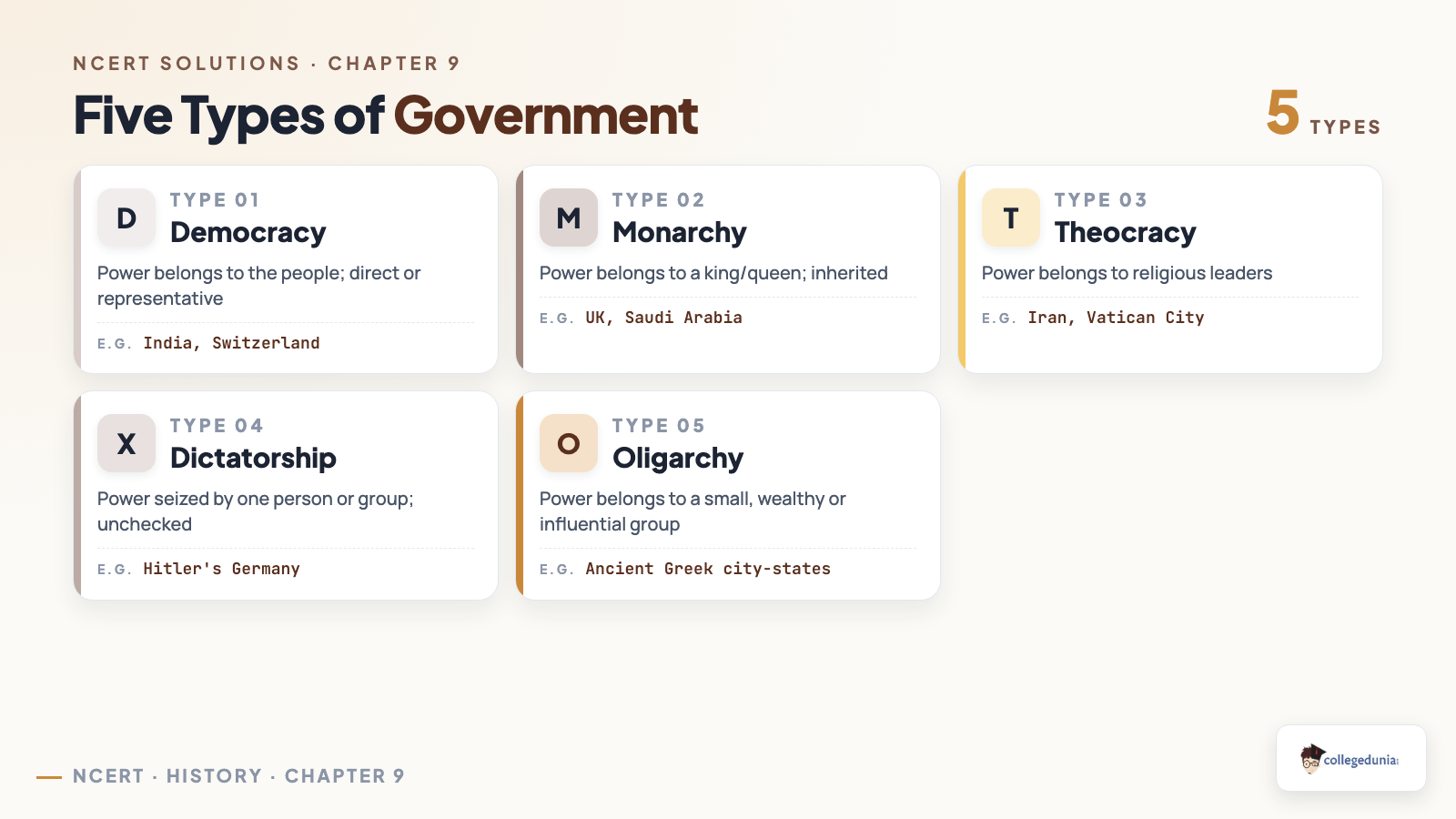
- Democracy. Power belongs to the people. Direct democracy (every citizen votes on every decision) and representative democracy (citizens elect representatives, as in India) are its two forms.
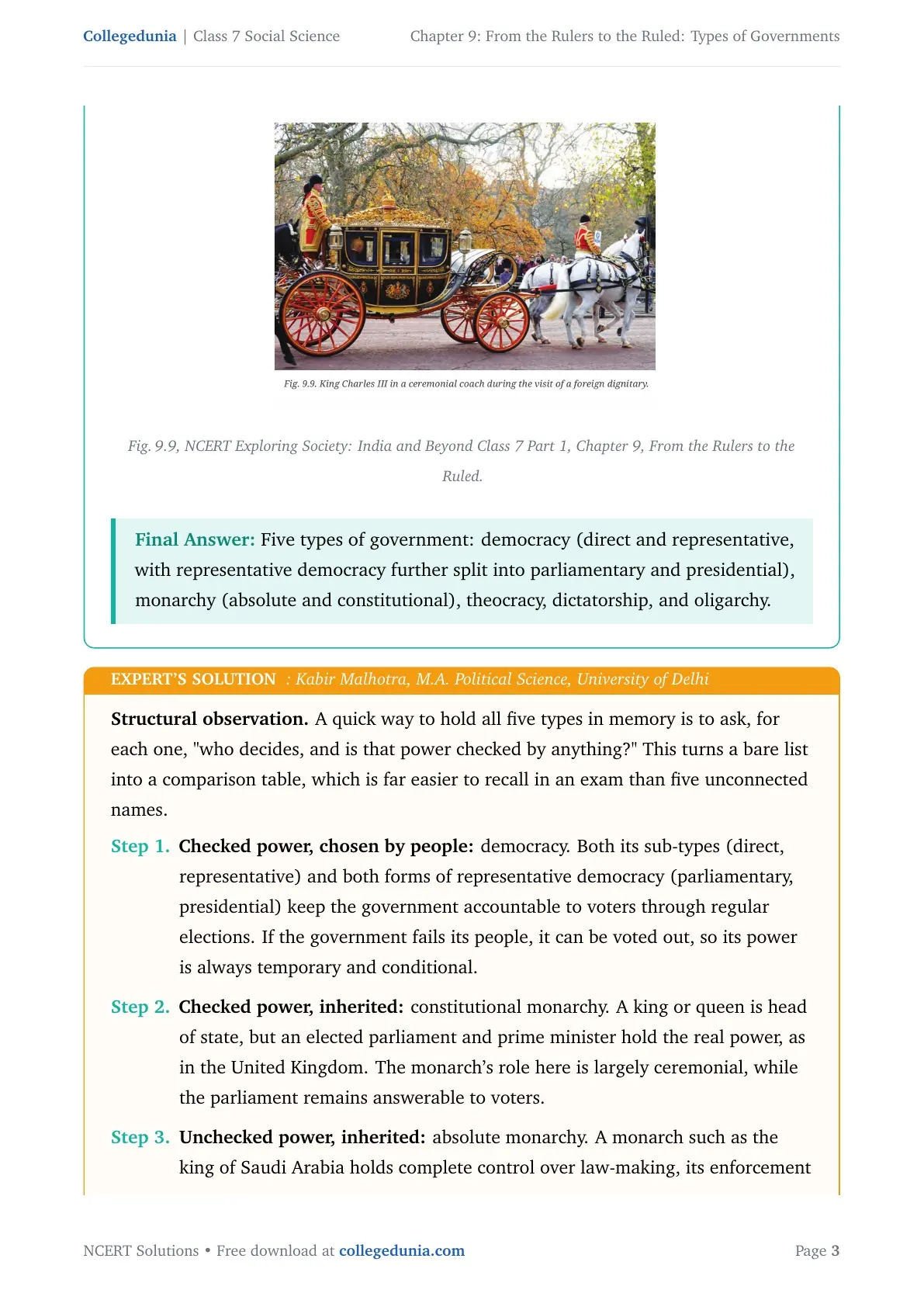
- Monarchy. Power belongs to a king or queen and passes down within one family. Absolute monarchy (Saudi Arabia) gives the monarch complete power; constitutional monarchy (the United Kingdom) limits the monarch to a ceremonial role.
- Theocracy. Power belongs to religious leaders, and the country is ruled by the rules of a religion, as in Iran and Vatican City.
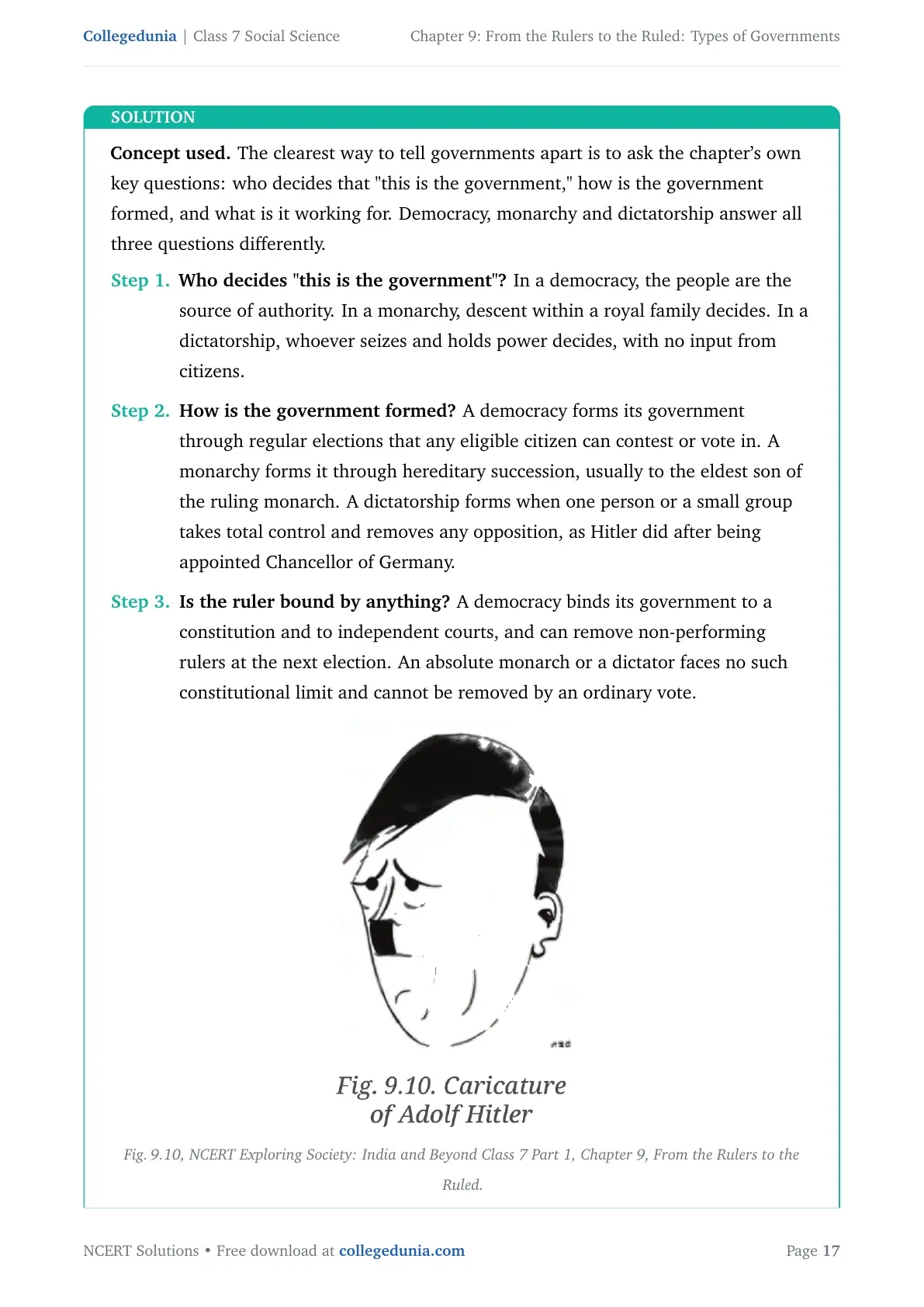
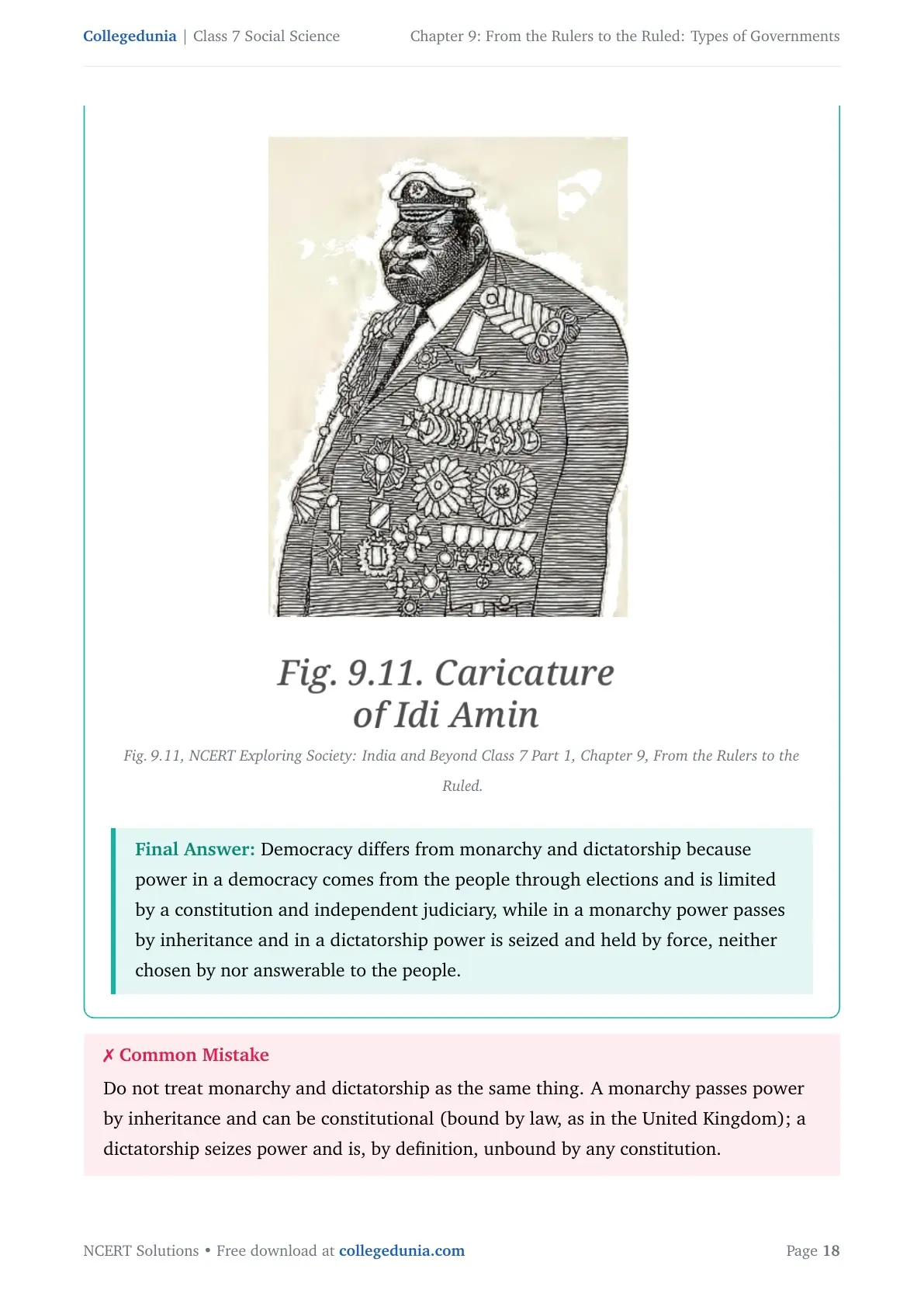
- Dictatorship. Power belongs to one person or a small group with no limits from any constitution, as with Adolf Hitler in Germany and Idi Amin in Uganda.
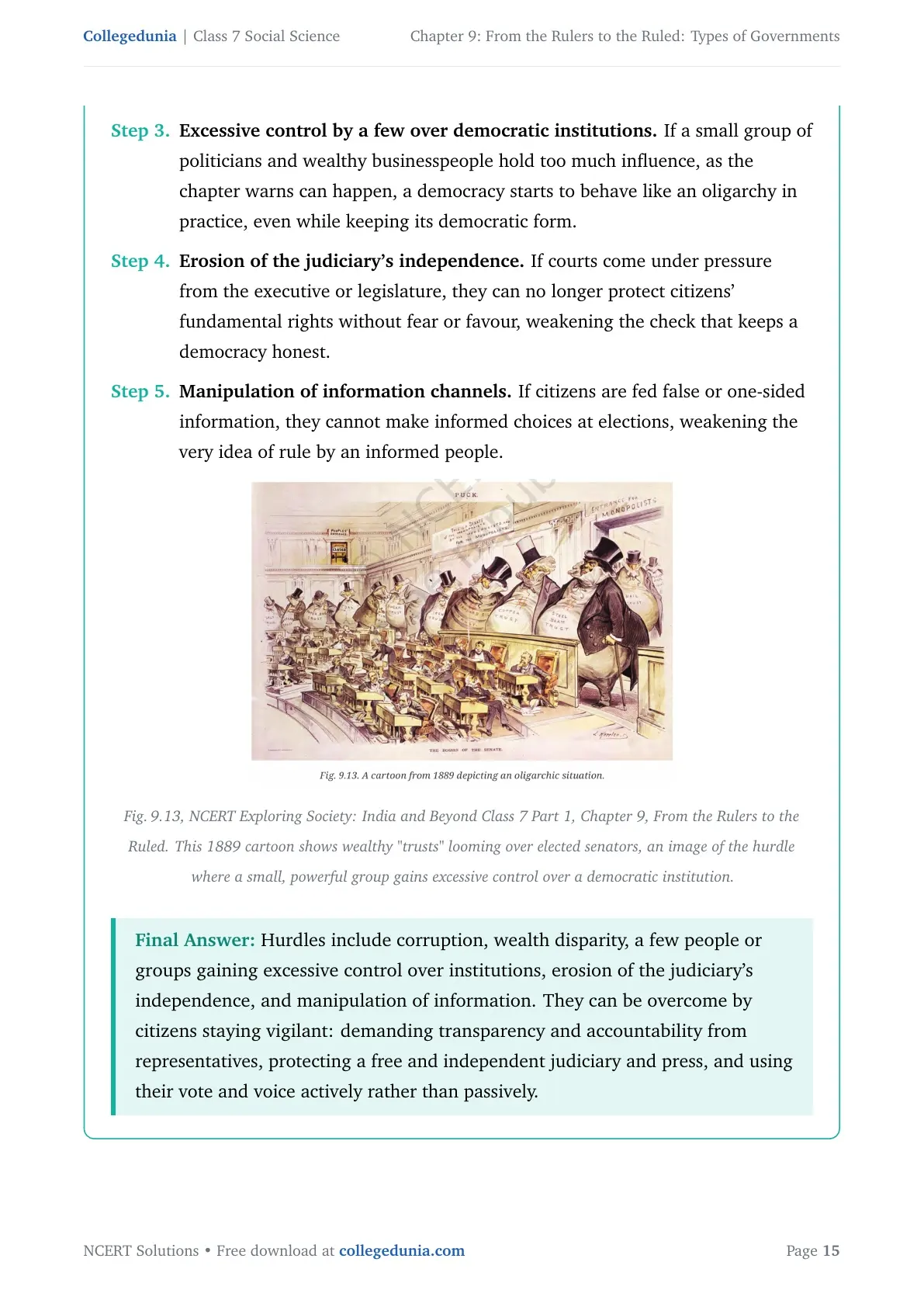
- Oligarchy. Power belongs to a small, powerful group, usually wealthy or influential people, as in some aristocratic city-states of ancient Greece.
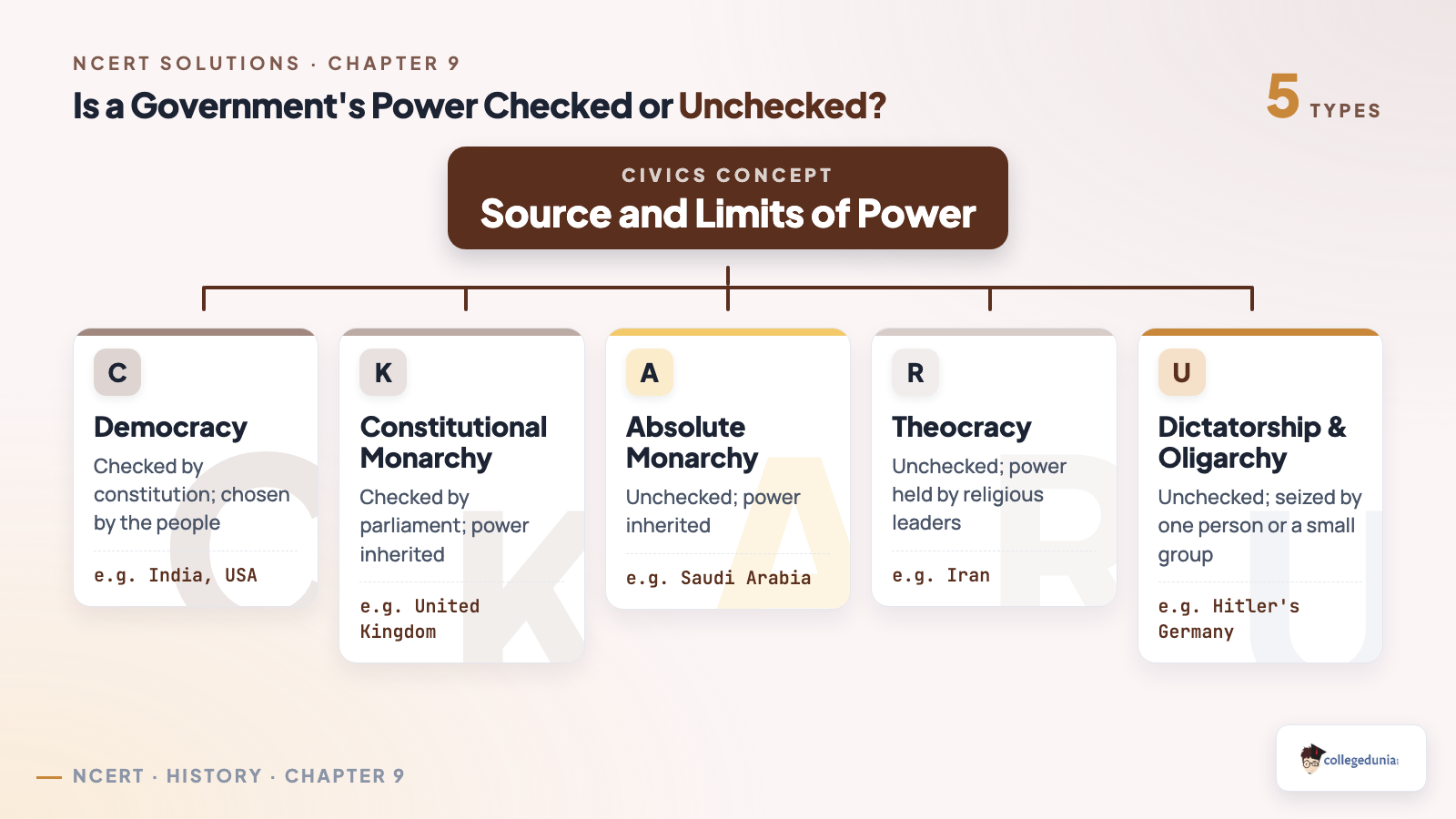
A quick memory check for all five types: "who decides, and is that power checked by anything?" Democracy and constitutional monarchy are checked by law; absolute monarchy, theocracy, dictatorship and oligarchy are not.
From the Rulers to the Ruled Explained for Class 7 Boards
Source: Magnet Brains on YouTube
From the Rulers to the Ruled Question and Activity Breakdown
The chapter closes with eight questions. Each asks for reasoning, a short explanation or country-classification research rather than a single fixed fact, so NCERT rewards structure and evidence, not a one-line reply.
| Question | What it covers | Answer type |
|---|---|---|
| Q1 | Naming the various types of government learnt in the chapter | Recall and listing answer |
| Q2 | Which type of government India has, and why | Applied, evidence-based reasoning answer |
| Q3 | Three reasons an independent judiciary matters in every democracy | Long reasoning answer |
| Q4 | Whether democratic government is better than other forms | Opinion-based reasoning answer |
| Q5 | Matching four government practices to their government type | Matching activity |
| Q6 | Finding the type of government of five countries | Research-based listing answer |
| Q7 | Hurdles in achieving democratic values, and how to overcome them | Long reasoning answer |
| Q8 | How democracy differs from monarchy and dictatorship | Comparative explanation answer |
Each question needs full sentences and named examples. Teachers usually pick Q2, Q5 or Q8 for a periodic test, so practise those three first.
Why India Is a Parliamentary Democracy and Why Judges Must Stay Independent
Q2 asks which type of government India has, and why. A government is a parliamentary democracy when the people elect their representatives, and the executive sits inside and stays accountable to the legislature rather than being elected separately.
- India is a democracy. Power belongs to the people, who elect their representatives through universal adult franchise.
- India is a representative democracy. Citizens elect representatives who form the government, rather than voting on every law themselves.
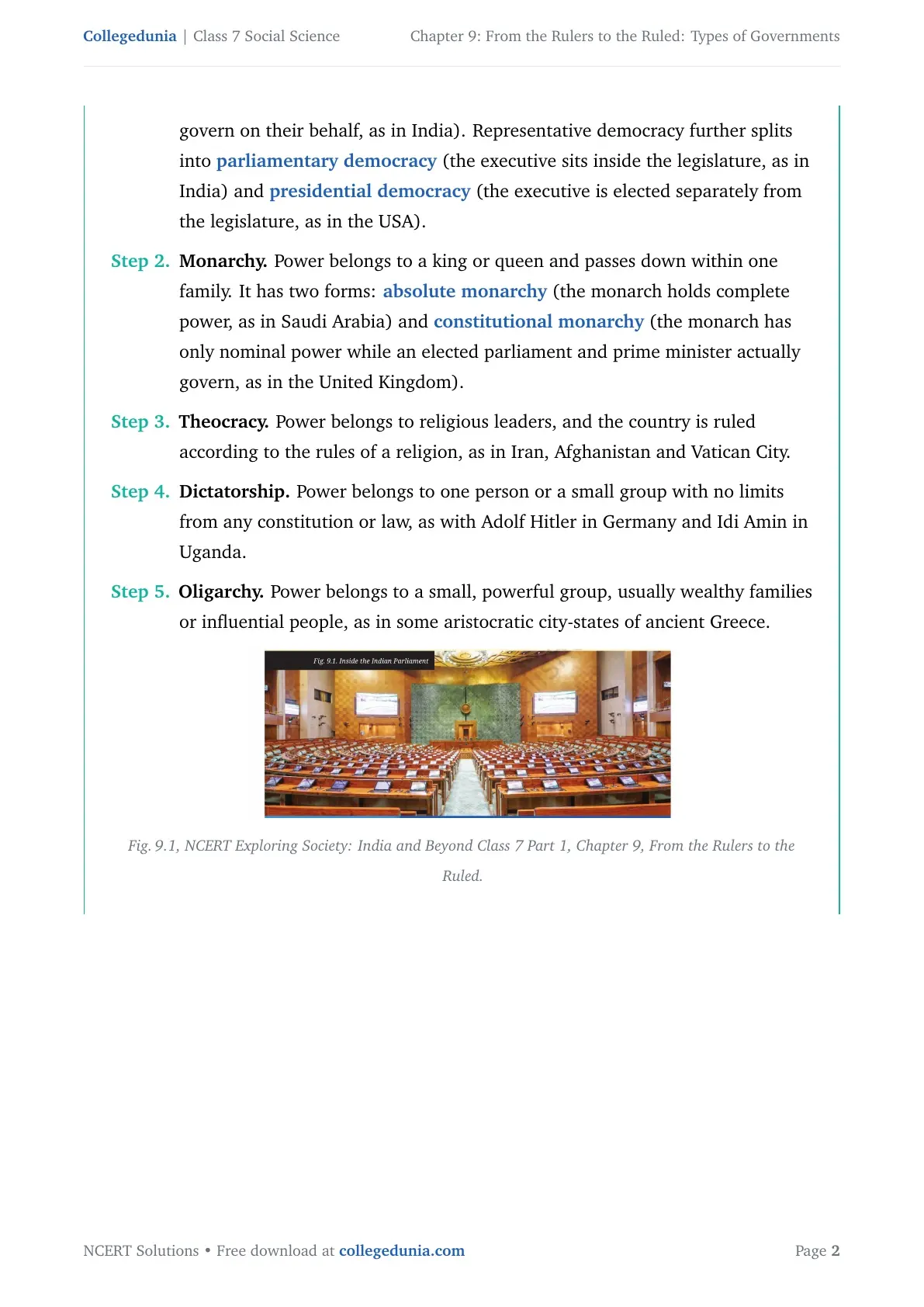
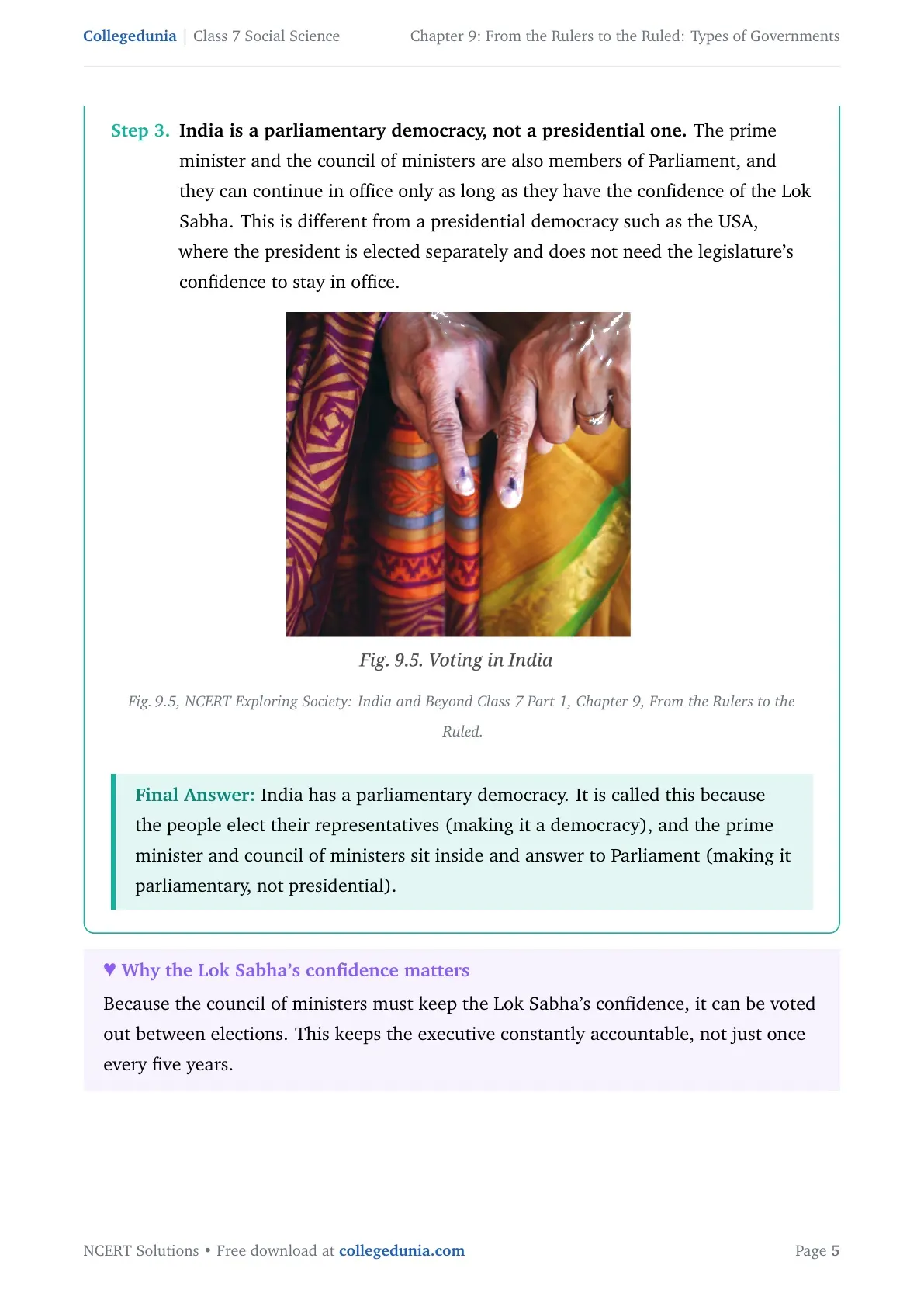
- India is parliamentary, not presidential. The prime minister and council of ministers stay in office only as long as they hold the confidence of the Lok Sabha, unlike the USA's presidential system.
Q3 asks for three reasons an independent judiciary matters. Courts that work separately from the executive and legislature apply the law fairly to every citizen, protect fundamental rights without fear or favour, and can rule against the government itself when it oversteps the constitution.
Matching Government Practices and Classifying Five Countries
Q5 gives four real-world practices to match against democracy, monarchy, theocracy or dictatorship. Q6 asks for the actual government type of five named countries.
| Country | Type of government | Why |
|---|---|---|
| Bhutan | Constitutional monarchy | A hereditary king (the Druk Gyalpo) is head of state, but an elected National Assembly and prime minister govern under a written constitution |
| Nepal | Federal parliamentary republic | Abolished its monarchy in 2008; now elects a president and prime minister from its Federal Parliament |
| Bangladesh | Parliamentary republic | Elects its Parliament (Jatiya Sangsad); the prime minister holds executive power, drawn from the majority |
| South Africa | Parliamentary republic | The president is head of state and government, but is elected by the National Assembly, not directly by voters |
| Brazil | Federal presidential republic | The president is directly elected by the people and governs independently of Congress |
A two-question filter works for any country: is there a monarch, and is the executive elected separately from the legislature? Only Bhutan answers yes to the first; only Brazil answers yes to the second, making it the one presidential republic here.
Common Mistakes Students Make in the Types of Governments Chapter
Read this before your next test. Each mistake below has cost real marks on Class 7 papers.
- Treating monarchy and dictatorship as the same thing. A monarchy passes power by inheritance and can be constitutional (bound by law); a dictatorship seizes power and is, by definition, unbound by any constitution.
- Calling India's system just "democracy". Full marks need "parliamentary democracy", and the reason: the executive sits inside and answers to Parliament, unlike a presidential system.
- Naming only one reason for judicial independence. Q3 asks for three distinct reasons; blending two into one sentence loses marks per point.
- Missing that Bhutan is a monarchy at all. Because an elected National Assembly actually governs Bhutan, students often assume it has no king; it is a constitutional monarchy, not a republic.
- Saying "democracy is perfect". The chapter lists real problems (corruption, wealth disparity); the argument for democracy is about accountability, not flawlessness.
Student Feedback: In a Collegedunia survey of 11,540 Class 7 students before the 2026 boards, 58% named the five-country classification question (Q6) as the hardest part to research and write correctly. Students who scored well named the exact type (for example, "federal presidential republic" for Brazil) instead of writing "democracy" in general terms.
Source: 2026-27 Class 7 Social Science student survey. Sample of 11,540 students from CBSE schools across 14 states.
How to Study From the Rulers to the Ruled Effectively
This chapter mixes recall, reasoning and country-classification research. Short revision blocks work better than one long sitting.
- Block 1, 20 minutes. Learn the five types of government and one real example for each, then the checked-versus-unchecked-power split.
- Block 2, 25 minutes. Practise explaining why India is a parliamentary democracy and the three reasons an independent judiciary matters.
- Block 3, 20 minutes. Learn the five countries from Q6 and their exact government type, using the two-question filter.
- Night before, 15 minutes. Re-read the Common Mistakes list and redo the Q5 matching activity from memory.
More From the Rulers to the Ruled Class 7 Resources
Also Check: This chapter is also available in other formats on Collegedunia. Read the solutions first, then the notes for a deeper topic walk-through.
| Resource | Best used for | Open it |
|---|---|---|
| NCERT Notes | Topic-by-topic summary of the five types of government and India's parliamentary democracy | From the Rulers to the Ruled Class 7 Notes |
| NCERT Book PDF | The official 2026-27 chapter text with all figures | Class 7 Social Science Part 1 Chapter 9 Book PDF |
| Handwritten Notes | Quick one-sitting revision in clear handwriting | From the Rulers to the Ruled Class 7 Handwritten Notes |
NCERT Solutions for Class 7 Social Science Part 1: All Chapters
NCERT Solutions for every chapter of Part 1, so you can move on once this one is done.
Sample Solutions from From the Rulers to the Ruled Chapter 9
Below are two of the eight questions, answered in full. Every question in the complete PDF gets the same level of detail: a concept explanation, a step-by-step answer, and a boxed final answer.
- Concept used: the exact NCERT term or idea the question is testing, named upfront.
- Step-by-step answer: the reasoning broken into short, exam-ready points.
- Boxed answer: a final, one-look summary a student can revise from directly.
Ques. Which type of Government does India have? And why is that called that type?
India is a democracy: power belongs to the people of India, who elect their representatives through universal adult franchise. India is specifically a representative democracy, since citizens elect representatives who form the government and legislate on their behalf, rather than voting on every law directly.
India is parliamentary, not presidential. The prime minister and the council of ministers are also members of Parliament, and they can continue in office only as long as they have the confidence of the Lok Sabha. This is different from a presidential democracy such as the USA, where the president is elected separately and does not need the legislature's confidence to stay in office.
Boxed answer: India has a parliamentary democracy. It is called this because the people elect their representatives (making it a democracy), and the prime minister and council of ministers sit inside and answer to Parliament (making it parliamentary, not presidential).
Ques. Democracy is different from monarchy and dictatorship. Explain.
In a democracy, the people are the source of authority, government forms through regular elections any eligible citizen can contest, and the government is bound by a constitution and independent courts, so non-performing rulers can be voted out. In a monarchy, descent within a royal family decides who rules, and succession usually passes to the eldest son of the ruling monarch.
In a dictatorship, whoever seizes and holds power decides, with no input from citizens; power is taken and held by force, as Hitler did after being appointed Chancellor of Germany. An absolute monarch or a dictator faces no constitutional limit and cannot be removed by an ordinary vote.
Boxed answer: Democracy differs from monarchy and dictatorship because power in a democracy comes from the people through elections and is limited by a constitution and independent judiciary, while in a monarchy power passes by inheritance and in a dictatorship power is seized and held by force, neither chosen by nor answerable to the people.
From the Rulers to the Ruled Class 7 Social Science NCERT Solutions FAQs
Ques. Where can I download the NCERT Solutions for Class 7 Social Science Chapter 9 From the Rulers to the Ruled PDF?
Ans. Use the download option at the top of this page. The file is free, covers all 8 questions and activities from the chapter, and is available in both Normal and HD quality.
Ques. What are the five types of government mentioned in this chapter?
Ans. The five types are democracy (direct and representative), monarchy (absolute and constitutional), theocracy, dictatorship and oligarchy, each classified by who holds power and whether that power is checked by a constitution.
Ques. Which type of government does India have?
Ans. India has a parliamentary democracy: the people elect their representatives, and the prime minister and council of ministers sit inside and remain accountable to Parliament, unlike a presidential system such as the USA.
Ques. Why is an independent judiciary important in a democracy?
Ans. An independent judiciary applies the law fairly to every citizen, protects fundamental rights without fear or favour, and can act as a check on the executive and legislature themselves when they overstep the constitution.
Ques. What is the difference between an absolute monarchy and a constitutional monarchy?
Ans. In an absolute monarchy, such as Saudi Arabia, the monarch holds complete power. In a constitutional monarchy, such as the United Kingdom, the monarch has only nominal power while an elected parliament and prime minister actually govern.
Ques. What type of government does Bhutan have?
Ans. Bhutan is a constitutional monarchy. A hereditary king, the Druk Gyalpo, is head of state, but an elected National Assembly and prime minister actually govern the country under a written constitution.
Ques. What type of government does Brazil have?
Ans. Brazil is a federal presidential republic. Its president is directly elected by the people and governs independently of the National Congress, unlike a parliamentary system where the executive answers to the legislature.
Ques. How is a dictatorship different from a monarchy?
Ans. A monarchy passes power by inheritance within one family and can be constitutional, meaning bound by law. A dictatorship seizes power by force and is, by definition, unbound by any constitution, as with Hitler in Germany and Idi Amin in Uganda.
Ques. What are the main hurdles democracies face in achieving their ideals?
Ans. The chapter lists corruption, wealth disparity, excessive control by a few over democratic institutions, erosion of judicial independence, and manipulation of information as the main hurdles, overcome through citizen vigilance and transparency.
Ques. Is this NCERT Solutions PDF aligned with the 2026-27 syllabus?
Ans. Yes. This page follows the current 2026-27 edition of Exploring Society: India and Beyond, Grade 7 Part 1, and every answer matches the chapter content and question order printed in that edition.
Ques. How many pages is the Class 7 Social Science Chapter 9 NCERT Solutions PDF?
Ans. The Solutions PDF runs to 20 pages and covers all 8 questions and activities from From the Rulers to the Ruled, with a concept explanation, step-by-step reasoning and a boxed final answer for each one.
Ques. What is an oligarchy, and where has it existed?
Ans. An oligarchy is a government where power belongs to a small, powerful group, usually wealthy or influential people, as seen in some aristocratic city-states of ancient Greece.



Comments