



The NCERT Class 7 Social Science Chapter 5 notes for India, a Home to Many explain how Jews, Syriac Christians, Parsis, Arab merchants, Siddis, Armenians, Baha'is, Polish children and Tibetan refugees made India home. These notes follow the 2026-27 NCERT textbook and help students revise refuge, integration, contribution and values.
- Best for revision: community-wise reasons, settlement places, examples of integration and value-based answers.
- Use with the PDF: read the snapshot table first, then revise one community card at a time.
- 2026-27 focus: follows Exploring Society: India and Beyond, Part 2, Chapter 5.
Chapter5India,aHometoManyNotes.pdf?page=1&dpi=150)
Chapter5India,aHometoManyNotes.pdf?page=2&dpi=150)
Chapter5India,aHometoManyNotes.pdf?page=3&dpi=150)
Chapter5India,aHometoManyNotes.pdf?page=4&dpi=150)
Chapter5India,aHometoManyNotes.pdf?page=5&dpi=150)
Chapter5India,aHometoManyNotes.pdf?page=6&dpi=150)
Chapter5India,aHometoManyNotes.pdf?page=7&dpi=150)
Chapter5India,aHometoManyNotes.pdf?page=8&dpi=150)
Chapter5India,aHometoManyNotes.pdf?page=9&dpi=150)
Chapter5India,aHometoManyNotes.pdf?page=10&dpi=150)
Chapter5India,aHometoManyNotes.pdf?page=11&dpi=150)
Chapter5India,aHometoManyNotes.pdf?page=12&dpi=150)
Chapter5India,aHometoManyNotes.pdf?page=13&dpi=150)
Chapter5India,aHometoManyNotes.pdf?page=14&dpi=150)
Chapter5India,aHometoManyNotes.pdf?page=15&dpi=150)
Chapter5India,aHometoManyNotes.pdf?page=16&dpi=150)
Chapter5India,aHometoManyNotes.pdf?page=17&dpi=150)
Chapter5India,aHometoManyNotes.pdf?page=18&dpi=150)
Chapter5India,aHometoManyNotes.pdf?page=19&dpi=150)
Chapter5India,aHometoManyNotes.pdf?page=20&dpi=150)
Chapter5India,aHometoManyNotes.pdf?page=21&dpi=150)
Chapter5India,aHometoManyNotes.pdf?page=22&dpi=150)
Chapter5India,aHometoManyNotes_flat_MobileCard.pdf?page=1&dpi=150)
Chapter5India,aHometoManyNotes_flat_MobileCard.pdf?page=2&dpi=150)
Chapter5India,aHometoManyNotes_flat_MobileCard.pdf?page=3&dpi=150)
Chapter5India,aHometoManyNotes_flat_MobileCard.pdf?page=4&dpi=150)
Chapter5India,aHometoManyNotes_flat_MobileCard.pdf?page=5&dpi=150)
Chapter5India,aHometoManyNotes_flat_MobileCard.pdf?page=6&dpi=150)
Chapter5India,aHometoManyNotes_flat_MobileCard.pdf?page=7&dpi=150)
Chapter5India,aHometoManyNotes_flat_MobileCard.pdf?page=8&dpi=150)
Chapter5India,aHometoManyNotes_flat_MobileCard.pdf?page=9&dpi=150)
Chapter5India,aHometoManyNotes_flat_MobileCard.pdf?page=10&dpi=150)
Chapter5India,aHometoManyNotes_flat_MobileCard.pdf?page=11&dpi=150)
Chapter5India,aHometoManyNotes_flat_MobileCard.pdf?page=12&dpi=150)
Chapter5India,aHometoManyNotes_flat_MobileCard.pdf?page=13&dpi=150)
Chapter5India,aHometoManyNotes_flat_MobileCard.pdf?page=14&dpi=150)
Chapter5India,aHometoManyNotes_flat_MobileCard.pdf?page=15&dpi=150)
Chapter5India,aHometoManyNotes_flat_MobileCard.pdf?page=16&dpi=150)
Chapter5India,aHometoManyNotes_flat_MobileCard.pdf?page=17&dpi=150)
Chapter5India,aHometoManyNotes_flat_MobileCard.pdf?page=18&dpi=150)
Chapter5India,aHometoManyNotes_flat_MobileCard.pdf?page=19&dpi=150)
Chapter5India,aHometoManyNotes_flat_MobileCard.pdf?page=20&dpi=150)
Chapter5India,aHometoManyNotes_flat_MobileCard.pdf?page=21&dpi=150)
Chapter5India,aHometoManyNotes_flat_MobileCard.pdf?page=22&dpi=150)
Chapter5India,aHometoManyNotes_flat_MobileCard.pdf?page=23&dpi=150)
Chapter5India,aHometoManyNotes_flat_MobileCard.pdf?page=24&dpi=150)
Chapter5India,aHometoManyNotes_flat_MobileCard.pdf?page=25&dpi=150)
Chapter5India,aHometoManyNotes_flat_MobileCard.pdf?page=26&dpi=150)
Chapter5India,aHometoManyNotes_flat_MobileCard.pdf?page=27&dpi=150)
Chapter5India,aHometoManyNotes_flat_MobileCard.pdf?page=28&dpi=150)
Chapter5India,aHometoManyNotes_flat_MobileCard.pdf?page=29&dpi=150)
Chapter5India,aHometoManyNotes_flat_MobileCard.pdf?page=30&dpi=150)
Chapter5India,aHometoManyNotes_flat_MobileCard.pdf?page=31&dpi=150)
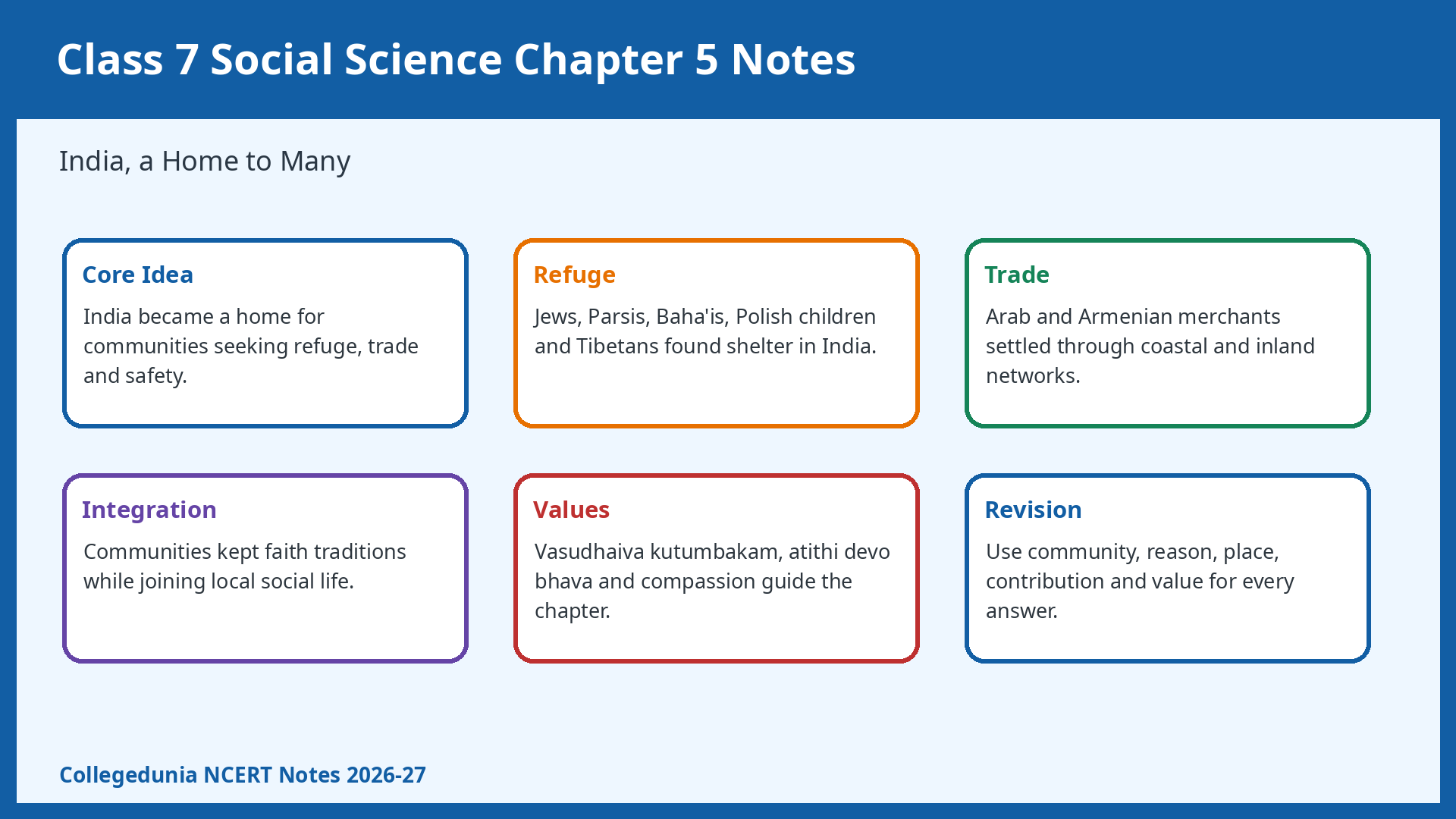
Student Feedback: Students usually find this chapter easier after grouping every story as community, reason, place, contribution and value.
India, a Home to Many Notes Overview
Chapter 5 explains why India became a home for people from different parts of the world. Some communities came because they faced persecution. Some came as traders. Some came during war or political crisis. NCERT connects these stories with acceptance, compassion and integration.
| Revision frame | Question to ask | Example |
|---|---|---|
| Community | Who came? | Parsis, Jews, Tibetans |
| Reason | Why did they come? | Persecution, trade, war, refuge |
| Place | Where did they settle? | Konkan, Kerala, Gujarat, Dharamshala |
| Contribution | How did they enrich India? | Trade, culture, public service, medicine |
| Value | Which Indian value appears? | Vasudhaiva kutumbakam |
Routes to a New Home
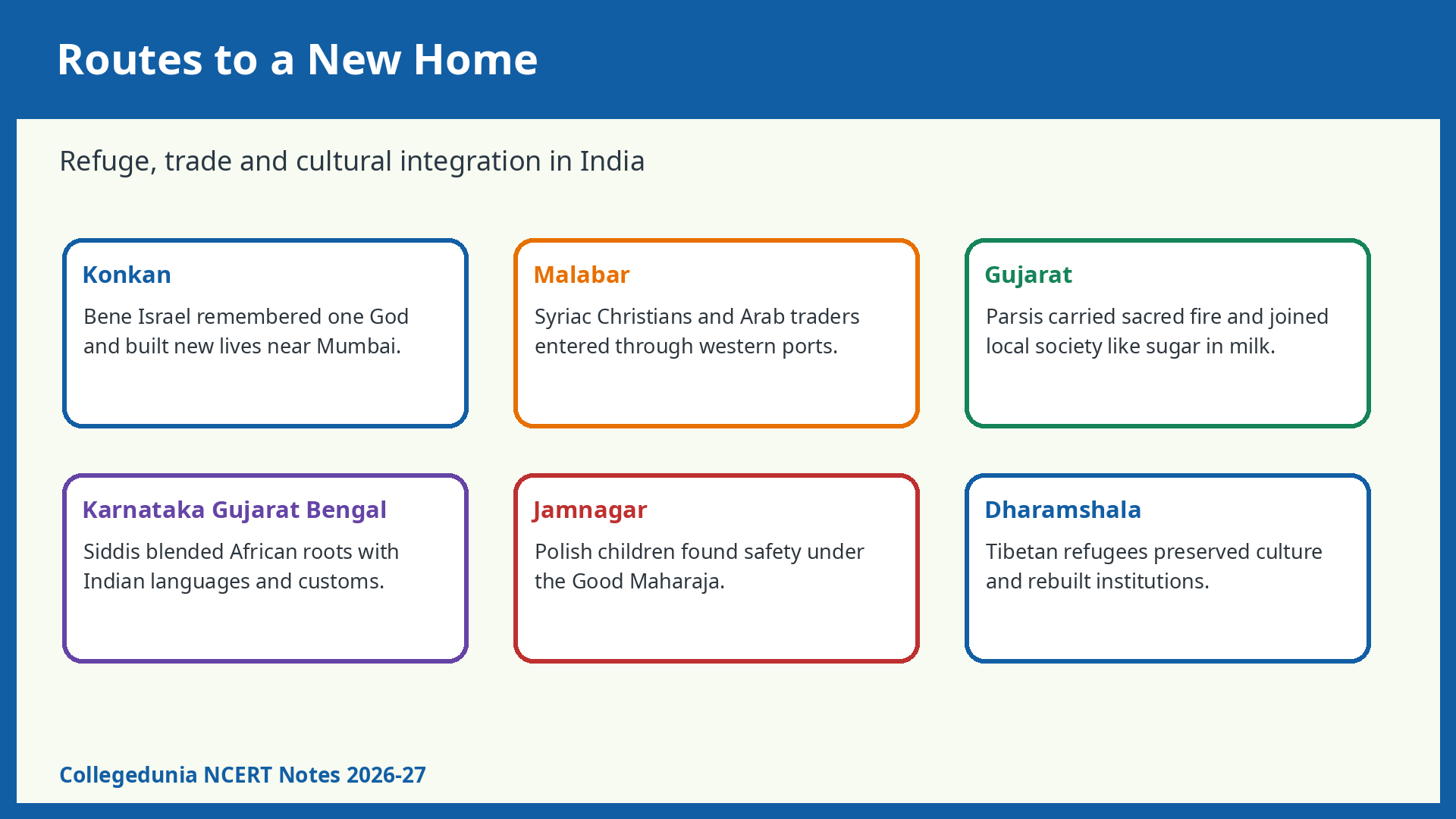
The chapter covers many routes into India. Jews found safety on the Konkan coast and near Cochin. Syriac Christians and Arab traders came through the Malabar coast. Parsis reached Gujarat. Armenians moved through trade networks. Tibetans crossed the Himalaya after 1959.
- Refuge stories: Jews, Parsis, Baha'is, Polish children and Tibetans.
- Trade stories: Arab merchants and Armenians.
- Integration stories: Siddis, Syriac Christians and Parsis show identity with local belonging.
India, a Home to Many Chapter 5 Revision Video
Source: Magnet Brains on YouTube
Community-wise Snapshot Table
| Community | Reason or route | Place cue | Value shown |
|---|---|---|---|
| Indian Jews | Persecution and refuge | Konkan, Cochin | Faith freedom |
| Syriac Christians | West Asian pressure and trade routes | Malabar coast | Worship with integration |
| Parsis | Religious persecution in Persia | Sanjan, Udvada | Blend without displacing |
| Arab merchants | Peaceful trade | Kerala, Gujarat, Karnataka | Coastal exchange |
| Siddis | Forced movement through slavery | Karnataka, Gujarat, Bengal | Dignity and upliftment |
| Armenians | Trade and Mughal patronage | Agra, Kolkata, Chennai | Urban contribution |
| Baha'is | Safety and unity teaching | New Delhi, India-wide | Religious harmony |
| Polish children | War and displacement | Jamnagar | Compassion in crisis |
| Tibetans | Political refuge after 1959 | Dharamshala, Bylakuppe | Culture preservation |
Values Behind Class 7 Social Science Chapter 5
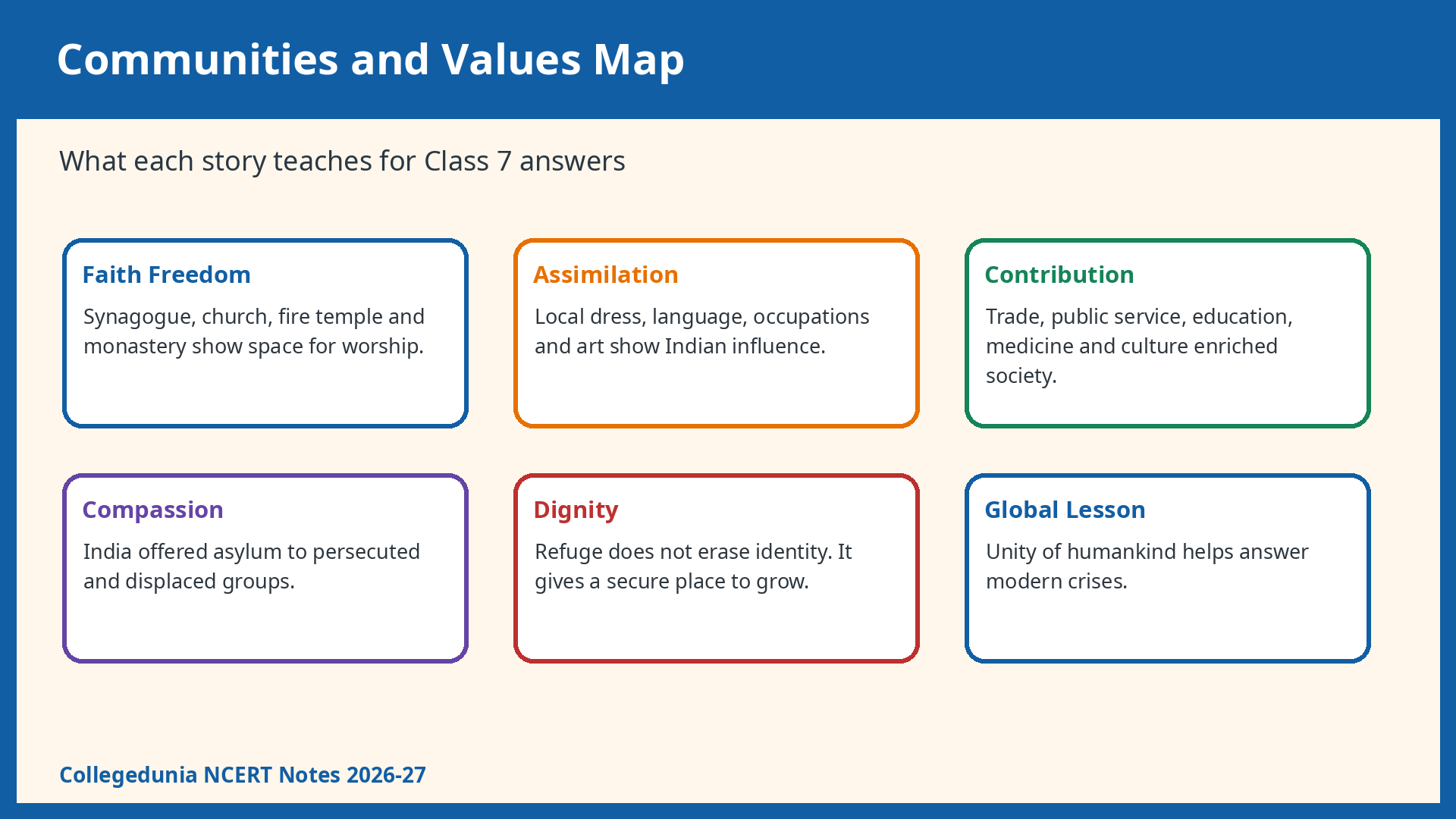
NCERT uses these examples to explain a larger Indian value system. Vasudhaiva kutumbakam means the world is family. Atithi devo bhava means the guest deserves respect. Sarve bhavantu sukhinah wishes happiness for all beings.
- Use the Parsi milk and sugar story for integration.
- Use the Good Maharaja story for compassion during crisis.
- Use Tibetan settlements for culture preservation with refuge.
Related Resources
| Resource | Best use | Link |
|---|---|---|
| NCERT Notes | Topic-wise revision with tables | Current page |
| NCERT Solutions | Practice textbook questions | Open NCERT Solutions |
| NCERT Book PDF | Read the official chapter | Open Book PDF |
| Handwritten Notes | Quick one-sitting revision | Open Handwritten Notes |
Social Science Notes for All Chapters
| Chapter | NCERT chapter title | Notes link |
|---|---|---|
| Chapter 1 | The Story of Indian Farming | Open Notes |
| Chapter 2 | India and Her Neighbours | Open Notes |
| Chapter 3 | Empires and Kingdoms: 6th to 10th Centuries | Open Notes |
| Chapter 4 | Turning Tides: 11th and 12th Centuries | Open Notes |
| Chapter 5 | India, a Home to Many | Current notes |
| Chapter 6 | The State, the Government, and You | Open Notes |
| Chapter 7 | Infrastructure: Engine of India's Development | Open Notes |
| Chapter 8 | Banks and the Magic of Finance | Open Notes |
India, a Home to Many Class 7 Notes FAQs
Ques. What is Class 7 Social Science Chapter 5 about?
Ans. It explains how many communities came to India for refuge, trade, safety or opportunity, and how Indian society helped them integrate.
Ques. What does the Parsi milk and sugar story mean?
Ans. It means Parsis promised to blend into local society like sugar in milk, adding sweetness without displacing the people already there.
Ques. Why did Tibetan refugees come to India?
Ans. Tibetan refugees came after Chinese control over Tibet and the 1959 uprising. India granted asylum and helped preserve Tibetan culture.
Ques. Which Indian values are linked with this chapter?
Ans. The chapter links vasudhaiva kutumbakam, atithi devo bhava, sarve bhavantu sukhinah, compassion and peaceful coexistence with India's welcome to different communities.



Comments