



The NCERT Class 7 Social Science Chapter 6 notes for The State, the Government, and You explain state, government, democracy, republic, rights, judiciary, bureaucracy and citizen participation. These notes follow the 2026-27 NCERT textbook and include tables, examples and a free PDF.
- Best for revision: state versus government, democracy versus republic and three organs of government.
- Use with the PDF: revise the summary table first, then read the answer frames.
- 2026-27 focus: follows Exploring Society: India and Beyond, Part 2, Chapter 6.
Chapter6TheState,theGovernment,andYouNotes.pdf?page=1&dpi=150)
Chapter6TheState,theGovernment,andYouNotes.pdf?page=2&dpi=150)
Chapter6TheState,theGovernment,andYouNotes.pdf?page=3&dpi=150)
Chapter6TheState,theGovernment,andYouNotes.pdf?page=4&dpi=150)
Chapter6TheState,theGovernment,andYouNotes.pdf?page=5&dpi=150)
Chapter6TheState,theGovernment,andYouNotes.pdf?page=6&dpi=150)
Chapter6TheState,theGovernment,andYouNotes.pdf?page=7&dpi=150)
Chapter6TheState,theGovernment,andYouNotes.pdf?page=8&dpi=150)
Chapter6TheState,theGovernment,andYouNotes.pdf?page=9&dpi=150)
Chapter6TheState,theGovernment,andYouNotes.pdf?page=10&dpi=150)
Chapter6TheState,theGovernment,andYouNotes.pdf?page=11&dpi=150)
Chapter6TheState,theGovernment,andYouNotes.pdf?page=12&dpi=150)
Chapter6TheState,theGovernment,andYouNotes.pdf?page=13&dpi=150)
Chapter6TheState,theGovernment,andYouNotes.pdf?page=14&dpi=150)
Chapter6TheState,theGovernment,andYouNotes.pdf?page=15&dpi=150)
Chapter6TheState,theGovernment,andYouNotes.pdf?page=16&dpi=150)
Chapter6TheState,theGovernment,andYouNotes.pdf?page=17&dpi=150)
Chapter6TheState,theGovernment,andYouNotes.pdf?page=18&dpi=150)
Chapter6TheState,theGovernment,andYouNotes.pdf?page=19&dpi=150)
Chapter6TheState,theGovernment,andYouNotes.pdf?page=20&dpi=150)
Chapter6TheState,theGovernment,andYouNotes_flat_MobileCard.pdf?page=1&dpi=150)
Chapter6TheState,theGovernment,andYouNotes_flat_MobileCard.pdf?page=2&dpi=150)
Chapter6TheState,theGovernment,andYouNotes_flat_MobileCard.pdf?page=3&dpi=150)
Chapter6TheState,theGovernment,andYouNotes_flat_MobileCard.pdf?page=4&dpi=150)
Chapter6TheState,theGovernment,andYouNotes_flat_MobileCard.pdf?page=5&dpi=150)
Chapter6TheState,theGovernment,andYouNotes_flat_MobileCard.pdf?page=6&dpi=150)
Chapter6TheState,theGovernment,andYouNotes_flat_MobileCard.pdf?page=7&dpi=150)
Chapter6TheState,theGovernment,andYouNotes_flat_MobileCard.pdf?page=8&dpi=150)
Chapter6TheState,theGovernment,andYouNotes_flat_MobileCard.pdf?page=9&dpi=150)
Chapter6TheState,theGovernment,andYouNotes_flat_MobileCard.pdf?page=10&dpi=150)
Chapter6TheState,theGovernment,andYouNotes_flat_MobileCard.pdf?page=11&dpi=150)
Chapter6TheState,theGovernment,andYouNotes_flat_MobileCard.pdf?page=12&dpi=150)
Chapter6TheState,theGovernment,andYouNotes_flat_MobileCard.pdf?page=13&dpi=150)
Chapter6TheState,theGovernment,andYouNotes_flat_MobileCard.pdf?page=14&dpi=150)
Chapter6TheState,theGovernment,andYouNotes_flat_MobileCard.pdf?page=15&dpi=150)
Chapter6TheState,theGovernment,andYouNotes_flat_MobileCard.pdf?page=16&dpi=150)
Chapter6TheState,theGovernment,andYouNotes_flat_MobileCard.pdf?page=17&dpi=150)
Chapter6TheState,theGovernment,andYouNotes_flat_MobileCard.pdf?page=18&dpi=150)
Chapter6TheState,theGovernment,andYouNotes_flat_MobileCard.pdf?page=19&dpi=150)
Chapter6TheState,theGovernment,andYouNotes_flat_MobileCard.pdf?page=20&dpi=150)
Chapter6TheState,theGovernment,andYouNotes_flat_MobileCard.pdf?page=21&dpi=150)
Chapter6TheState,theGovernment,andYouNotes_flat_MobileCard.pdf?page=22&dpi=150)
Chapter6TheState,theGovernment,andYouNotes_flat_MobileCard.pdf?page=23&dpi=150)
Chapter6TheState,theGovernment,andYouNotes_flat_MobileCard.pdf?page=24&dpi=150)
Chapter6TheState,theGovernment,andYouNotes_flat_MobileCard.pdf?page=25&dpi=150)
Chapter6TheState,theGovernment,andYouNotes_flat_MobileCard.pdf?page=26&dpi=150)
Chapter6TheState,theGovernment,andYouNotes_flat_MobileCard.pdf?page=27&dpi=150)
Chapter6TheState,theGovernment,andYouNotes_flat_MobileCard.pdf?page=28&dpi=150)
Chapter6TheState,theGovernment,andYouNotes_flat_MobileCard.pdf?page=29&dpi=150)
Chapter6TheState,theGovernment,andYouNotes_flat_MobileCard.pdf?page=30&dpi=150)
Chapter6TheState,theGovernment,andYouNotes_flat_MobileCard.pdf?page=31&dpi=150)
Chapter6TheState,theGovernment,andYouNotes_flat_MobileCard.pdf?page=32&dpi=150)
Chapter6TheState,theGovernment,andYouNotes_flat_MobileCard.pdf?page=33&dpi=150)
Student Feedback: Students usually find this chapter easier after separating state, government and citizen action into three revision columns.
The State, the Government, and You Notes Overview
Chapter 6 explains how the state, government and citizens are linked. The state is the larger political organisation. The government is the working system that makes laws, implements policies and settles disputes through institutions.
| Revision area | Key idea | Example cue |
|---|---|---|
| State | People, land, government and sovereignty | India as a political organisation |
| Government | System that runs daily work | Legislature, executive and judiciary |
| Democracy | People choose leaders | Free and fair elections |
| Republic | Head of state is elected | President, not hereditary monarch |
| Citizen action | People can question and participate | RTI, grievance portal, media, voting |
State and Government Difference in Class 7 Social Science Chapter 6
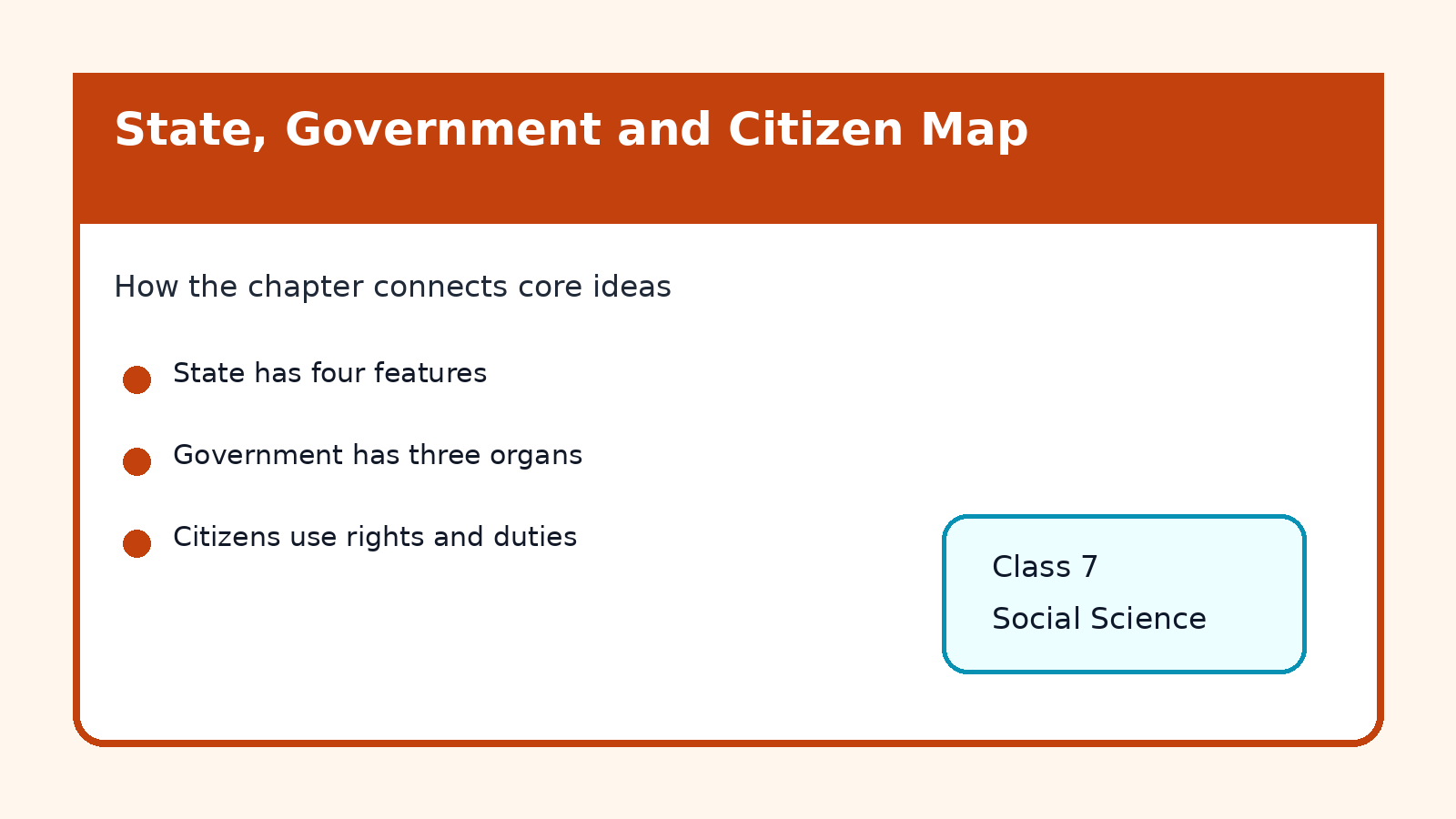
A state has four parts: people, territory, government and sovereignty. Government is only one part of the state. Governments can change after elections, but the state continues.
- People: a permanent population with shared belonging.
- Territory: a defined geographical area with boundaries.
- Sovereignty: full power to make decisions without outside control.
- Government: the working body that makes and implements decisions.
The State, the Government, and You Chapter 6 Revision Video
Source: Magnet Brains on YouTube
Democracy Republic and Rights in Chapter 6
Democracy means rule by the people. People choose their representatives through elections. A republic has an elected head of state instead of a hereditary monarch. India is both because elected representatives govern under the Constitution.
| Term | Meaning | Class 7 answer cue |
|---|---|---|
| Democracy | People choose government | Elections and accountability |
| Republic | Elected head of state | President instead of monarch |
| Rule of law | Everyone must follow law | Even government power has limits |
| Rights | Constitutional protections | Freedom, equality and justice |
Citizen Engagement Tools in Class 7 Social Science Chapter 6
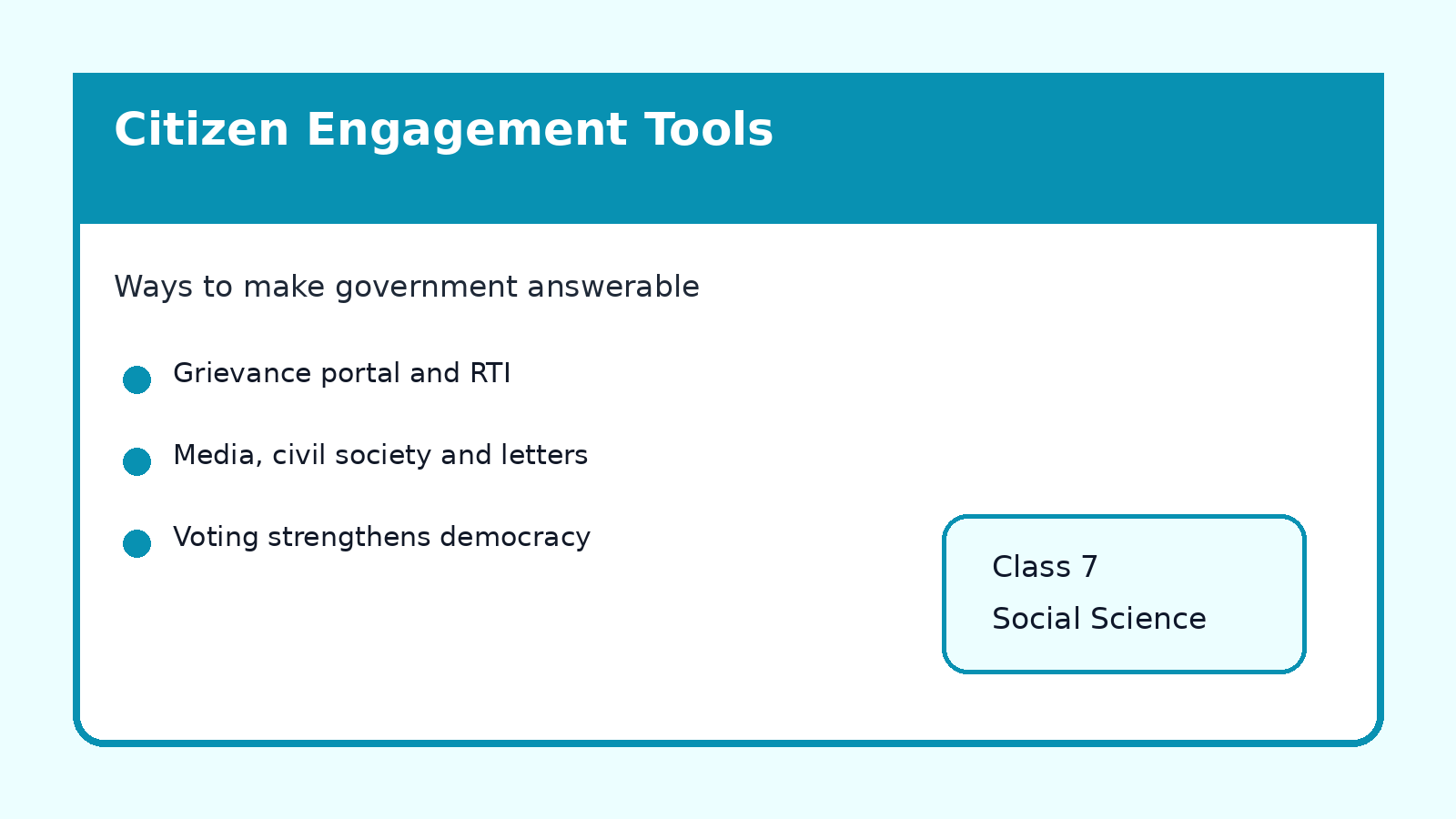
Citizens can help government work better by asking questions, reporting problems and participating in elections. NCERT gives practical methods such as grievance redressal, RTI, media, civil society groups, letters and voting.
- Grievance redressal: file complaints through offices or portals.
- RTI: ask for information about public actions and funds.
- Media and civil society: raise issues peacefully and responsibly.
- Voting: choose representatives after comparing plans and performance.
The State, the Government, and You Related Resources
| Resource | Best use | Link |
|---|---|---|
| NCERT Notes | Topic-wise revision with tables | Current page |
| NCERT Solutions | Practice textbook questions | Open NCERT Solutions |
| NCERT Book PDF | Read the official chapter | Open Book PDF |
| Handwritten Notes | Quick one-sitting revision | Open Handwritten Notes |
Social Science Notes for All Chapters
| Chapter | NCERT chapter title | Notes link |
|---|---|---|
| Chapter 1 | The Story of Indian Farming | Open Notes |
| Chapter 2 | India and Her Neighbours | Open Notes |
| Chapter 3 | Empires and Kingdoms: 6th to 10th Centuries | Open Notes |
| Chapter 4 | Turning Tides: 11th and 12th Centuries | Open Notes |
| Chapter 5 | India, a Home to Many | Open Notes |
| Chapter 6 | The State, the Government, and You | Current notes |
| Chapter 7 | Infrastructure: Engine of India's Development | Open Notes |
| Chapter 8 | Banks and the Magic of Finance | Open Notes |
The State, the Government, and You Class 7 Notes FAQs
Ques. What is Class 7 Social Science Chapter 6 about?
Ans. It explains the difference between state and government, democracy and republic, organs of government, judiciary, citizen action and decentralisation.
Ques. What are the four features of a state?
Ans. The four features are people, territory, government and sovereignty. Together they make a political organisation able to govern itself.
Ques. Why is India called a democratic republic?
Ans. India is democratic because people elect representatives. It is a republic because the head of state is elected and power is limited by the Constitution.
Ques. How can citizens engage with government?
Ans. Citizens can use grievance portals, RTI, media, civil society organisations, letters to representatives and elections to make government accountable.



Comments