



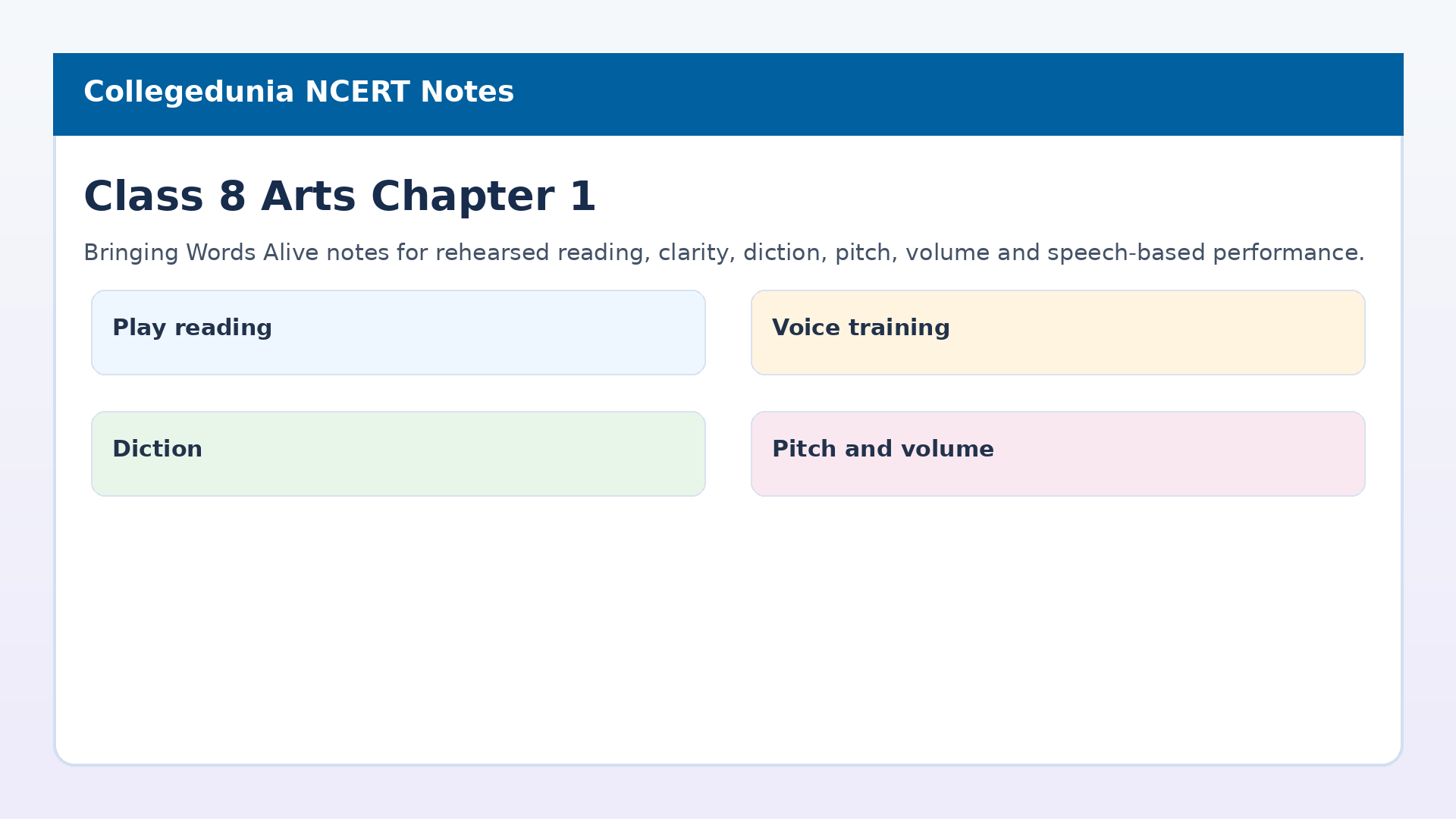
The NCERT Notes for Class 8 Arts (Kriti) Chapter 1 Bringing Words Alive - Play Reading help students revise rehearsed reading, voice training, diction, pitch, volume and speech-based performance for the 2026-27 session. The chapter shows how a script can come alive even without sets, props, costumes or action.
- PDF included: 20 plus pages with diagrams, tables, activity notes and quick revision boxes.
- Best for: classroom play reading, oral performance, circle time and chapter assessment.
- Chapter focus: using voice, pause, clarity and emotion to communicate meaning.
Chapter1BringingWordsAlive-PlayReadingNotes.pdf?page=1&dpi=150)
Chapter1BringingWordsAlive-PlayReadingNotes.pdf?page=2&dpi=150)
Chapter1BringingWordsAlive-PlayReadingNotes.pdf?page=3&dpi=150)
Chapter1BringingWordsAlive-PlayReadingNotes.pdf?page=4&dpi=150)
Chapter1BringingWordsAlive-PlayReadingNotes.pdf?page=5&dpi=150)
Chapter1BringingWordsAlive-PlayReadingNotes.pdf?page=6&dpi=150)
Chapter1BringingWordsAlive-PlayReadingNotes.pdf?page=7&dpi=150)
Chapter1BringingWordsAlive-PlayReadingNotes.pdf?page=8&dpi=150)
Chapter1BringingWordsAlive-PlayReadingNotes.pdf?page=9&dpi=150)
Chapter1BringingWordsAlive-PlayReadingNotes.pdf?page=10&dpi=150)
Chapter1BringingWordsAlive-PlayReadingNotes.pdf?page=11&dpi=150)
Chapter1BringingWordsAlive-PlayReadingNotes.pdf?page=12&dpi=150)
Chapter1BringingWordsAlive-PlayReadingNotes.pdf?page=13&dpi=150)
Chapter1BringingWordsAlive-PlayReadingNotes.pdf?page=14&dpi=150)
Chapter1BringingWordsAlive-PlayReadingNotes.pdf?page=15&dpi=150)
Chapter1BringingWordsAlive-PlayReadingNotes.pdf?page=16&dpi=150)
Chapter1BringingWordsAlive-PlayReadingNotes.pdf?page=17&dpi=150)
Chapter1BringingWordsAlive-PlayReadingNotes.pdf?page=18&dpi=150)
Chapter1BringingWordsAlive-PlayReadingNotes.pdf?page=19&dpi=150)
Chapter1BringingWordsAlive-PlayReadingNotes.pdf?page=20&dpi=150)
Chapter1BringingWordsAlive-PlayReadingNotes.pdf?page=21&dpi=150)
Chapter1BringingWordsAlive-PlayReadingNotes.pdf?page=22&dpi=150)
Chapter1BringingWordsAlive-PlayReadingNotes.pdf?page=23&dpi=150)
Chapter1BringingWordsAlive-PlayReadingNotes.pdf?page=24&dpi=150)
Chapter1BringingWordsAlive-PlayReadingNotes.pdf?page=25&dpi=150)
Chapter1BringingWordsAlive-PlayReadingNotes_flat_MobileCard.pdf?page=1&dpi=150)
Chapter1BringingWordsAlive-PlayReadingNotes_flat_MobileCard.pdf?page=2&dpi=150)
Chapter1BringingWordsAlive-PlayReadingNotes_flat_MobileCard.pdf?page=3&dpi=150)
Chapter1BringingWordsAlive-PlayReadingNotes_flat_MobileCard.pdf?page=4&dpi=150)
Chapter1BringingWordsAlive-PlayReadingNotes_flat_MobileCard.pdf?page=5&dpi=150)
Chapter1BringingWordsAlive-PlayReadingNotes_flat_MobileCard.pdf?page=6&dpi=150)
Chapter1BringingWordsAlive-PlayReadingNotes_flat_MobileCard.pdf?page=7&dpi=150)
Chapter1BringingWordsAlive-PlayReadingNotes_flat_MobileCard.pdf?page=8&dpi=150)
Chapter1BringingWordsAlive-PlayReadingNotes_flat_MobileCard.pdf?page=9&dpi=150)
Chapter1BringingWordsAlive-PlayReadingNotes_flat_MobileCard.pdf?page=10&dpi=150)
Chapter1BringingWordsAlive-PlayReadingNotes_flat_MobileCard.pdf?page=11&dpi=150)
Chapter1BringingWordsAlive-PlayReadingNotes_flat_MobileCard.pdf?page=12&dpi=150)
Chapter1BringingWordsAlive-PlayReadingNotes_flat_MobileCard.pdf?page=13&dpi=150)
Chapter1BringingWordsAlive-PlayReadingNotes_flat_MobileCard.pdf?page=14&dpi=150)
Chapter1BringingWordsAlive-PlayReadingNotes_flat_MobileCard.pdf?page=15&dpi=150)
Chapter1BringingWordsAlive-PlayReadingNotes_flat_MobileCard.pdf?page=16&dpi=150)
Chapter1BringingWordsAlive-PlayReadingNotes_flat_MobileCard.pdf?page=17&dpi=150)
Chapter1BringingWordsAlive-PlayReadingNotes_flat_MobileCard.pdf?page=18&dpi=150)
Chapter1BringingWordsAlive-PlayReadingNotes_flat_MobileCard.pdf?page=19&dpi=150)
Chapter1BringingWordsAlive-PlayReadingNotes_flat_MobileCard.pdf?page=20&dpi=150)
Chapter1BringingWordsAlive-PlayReadingNotes_flat_MobileCard.pdf?page=21&dpi=150)
Chapter1BringingWordsAlive-PlayReadingNotes_flat_MobileCard.pdf?page=22&dpi=150)
Chapter1BringingWordsAlive-PlayReadingNotes_flat_MobileCard.pdf?page=23&dpi=150)
Chapter1BringingWordsAlive-PlayReadingNotes_flat_MobileCard.pdf?page=24&dpi=150)
Chapter1BringingWordsAlive-PlayReadingNotes_flat_MobileCard.pdf?page=25&dpi=150)
Chapter1BringingWordsAlive-PlayReadingNotes_flat_MobileCard.pdf?page=26&dpi=150)
Chapter1BringingWordsAlive-PlayReadingNotes_flat_MobileCard.pdf?page=27&dpi=150)
Chapter1BringingWordsAlive-PlayReadingNotes_flat_MobileCard.pdf?page=28&dpi=150)
Chapter1BringingWordsAlive-PlayReadingNotes_flat_MobileCard.pdf?page=29&dpi=150)
Chapter1BringingWordsAlive-PlayReadingNotes_flat_MobileCard.pdf?page=30&dpi=150)
Chapter1BringingWordsAlive-PlayReadingNotes_flat_MobileCard.pdf?page=31&dpi=150)
Chapter1BringingWordsAlive-PlayReadingNotes_flat_MobileCard.pdf?page=32&dpi=150)
Chapter1BringingWordsAlive-PlayReadingNotes_flat_MobileCard.pdf?page=33&dpi=150)
Chapter1BringingWordsAlive-PlayReadingNotes_flat_MobileCard.pdf?page=34&dpi=150)
Chapter1BringingWordsAlive-PlayReadingNotes_flat_MobileCard.pdf?page=35&dpi=150)
Chapter1BringingWordsAlive-PlayReadingNotes_flat_MobileCard.pdf?page=36&dpi=150)
Play Reading Notes PDF Highlights
Bringing Words Alive - Play Reading introduces rehearsed reading as a performance form. Students learn how dialogue becomes meaningful when the speaker controls clarity, pace, pause, pitch and volume.
| Area | What to revise | Example |
|---|---|---|
| Rehearsed reading | performing a script mainly through voice | stage reading |
| Voice system | air pressure, vibration and resonance | lungs, larynx and vocal tract |
| Speech skills | clarity, diction and intonation | tongue twisters and word stress |
| Emotion | volume, pitch and tone | animal emotion activity |
Voice Practice Video
Source: Magnet Brains on YouTube
Rehearsed Reading and Voice Training
Rehearsed reading uses regular clothes, visible scripts and limited stage material. The actor stays in character and uses voice to suggest character, mood and relationship.
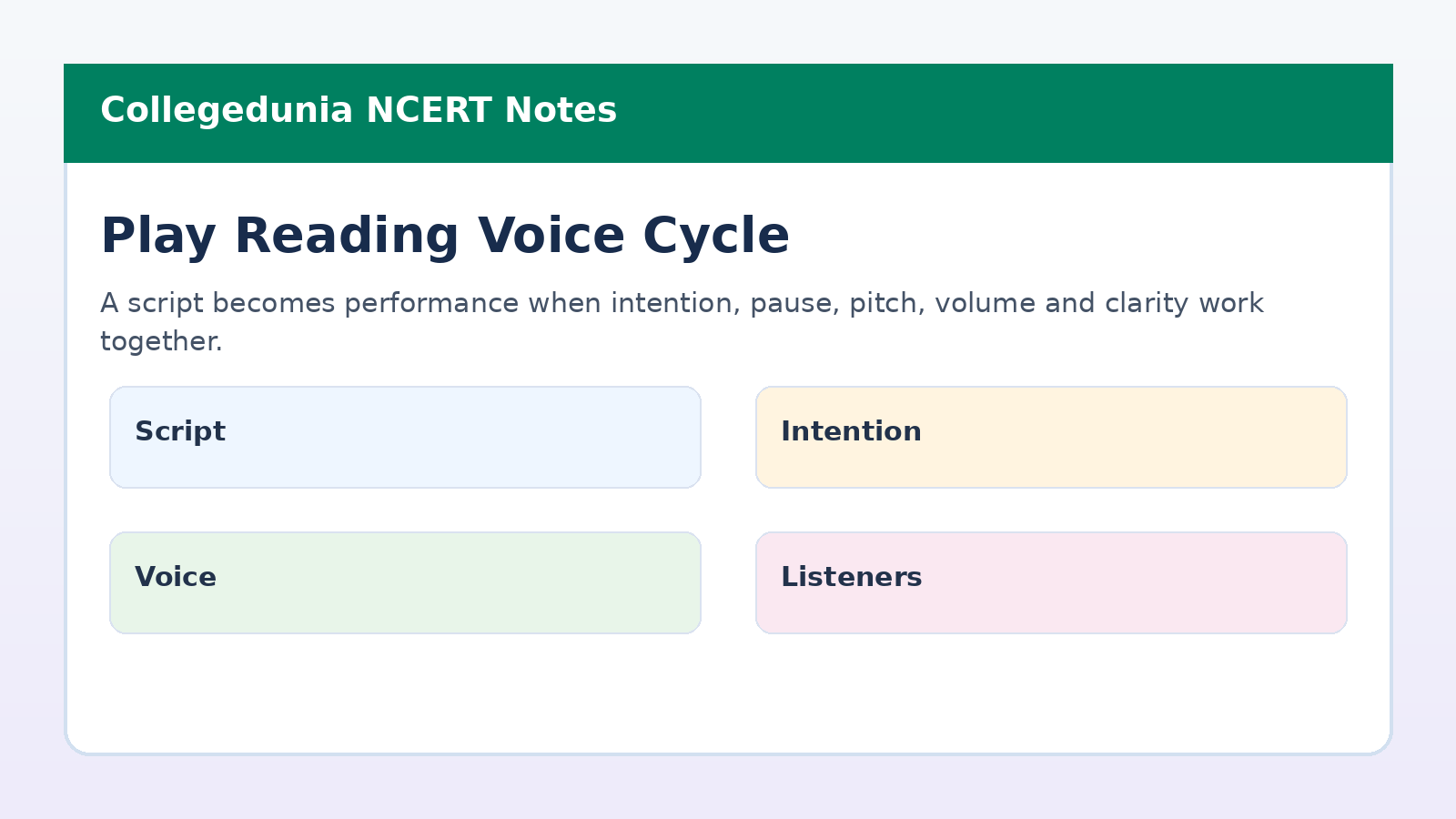
- Air pressure: lungs and diaphragm support sound.
- Vibration: larynx and vocal folds create the voice sound.
- Resonance: throat, mouth and nasal spaces shape recognisable voice.
- Performance use: each line needs intention, pause and clear delivery.
Clarity, Diction and Intonation
Clarity depends on syllables being heard properly. Diction improves when students speak slowly, pause between ideas and stress the word that carries meaning.
| Skill | Meaning | Practice |
|---|---|---|
| Clarity | distinct words and syllables | read tongue twisters slowly first |
| Diction | careful articulation and pause | pause after every sentence idea |
| Intonation | stress on important words | shift stress in one sentence |
| Pace | speed of speech | match speed with mood |
Volume, Pitch and Emotion
Volume is how loud or soft a sound is. Pitch is how high or low it is. Together they help a student show fear, power, excitement, calmness or sadness.
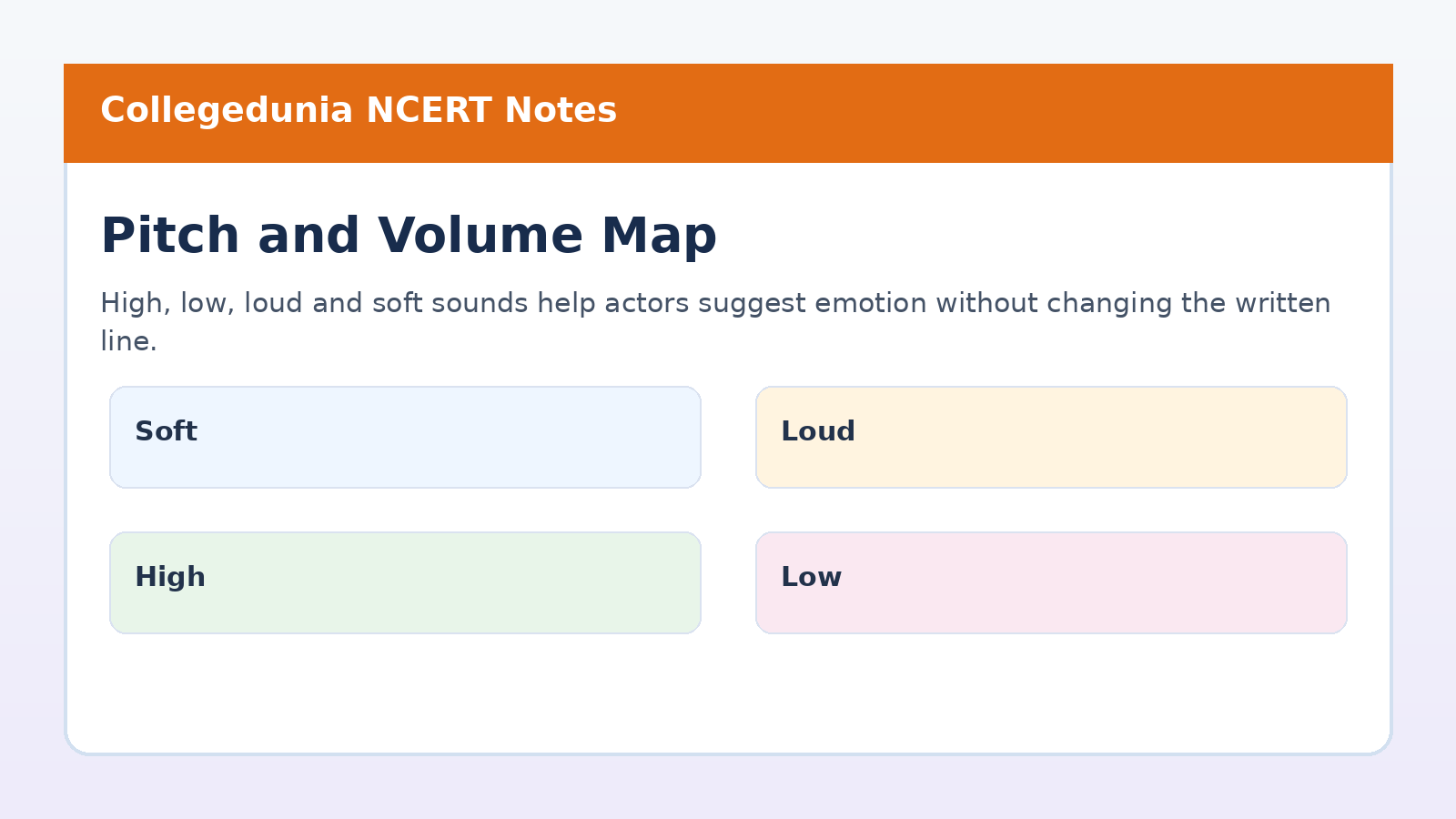
- Loud low voice: may suggest power, dominance or anger.
- Soft high voice: may suggest fear, surprise or playfulness.
- Soft low voice: may suggest calmness, sadness or seriousness.
- Activity link: animal sounds help students test vocal emotion.
Gibberish Speech and Life Skills
The gibberish activity shows that listeners can understand feeling even without known words. Tone, rhythm, facial expression and context help the brain read meaning.
| Activity | Purpose | Revision clue |
|---|---|---|
| Tongue twisters | clarity and pronunciation | accuracy before speed |
| Word impact | stress and meaning | one sentence, many meanings |
| Animal emotion | pitch and volume | guess feeling from sound |
| Gibberish speech | emotion beyond language | use rhythm and tone |
Other Class 8 Arts Kriti Bringing Words Alive Resources
| Resource | Use it for | Link |
|---|---|---|
| NCERT Book PDF | Read the official chapter before revision | Bringing Words Alive Book PDF |
| NCERT Solutions | Revise activity-based answers and assessment points | Bringing Words Alive NCERT Solutions |
| Handwritten Notes | Use quick visual notes for last-minute revision | Bringing Words Alive Handwritten Notes |
Class 8 Arts Kriti Notes All Chapters
| Chapter | Notes Link |
|---|---|
| Chapter 1 Bringing Words Alive - Play Reading | Current chapter notes |
| Chapter 2 One Stage, Many Scripts | One Stage, Many Scripts Notes |
| Chapter 3 From Page to Stage | From Page to Stage Notes |
| Chapter 4 Applause and Advice | Applause and Advice Notes |
| Chapter 5 Discovering the Elements of Music | Discovering the Elements of Music Notes |
| Chapter 6 Musical Instruments | Musical Instruments Notes |
| Chapter 7 Indian Classical Music | Indian Classical Music Notes |
| Chapter 8 Inspiration and Imagination | Inspiration and Imagination Notes |
| Chapter 9 My World of Music | My World of Music Notes |
| Chapter 10 Inner Dynamics of Dance | Inner Dynamics of Dance Notes |
| Chapter 11 Pan Indian Dance Forms | Pan Indian Dance Forms Notes |
| Chapter 12 Dance for Well-being | Dance for Well-being Notes |
| Chapter 13 Innovation Inclusivity and Inspiring Change | Innovation Inclusivity and Inspiring Change Notes |
| Chapter 14 A Presentation of Dance and Choreography | A Presentation of Dance and Choreography Notes |
| Chapter 15 Elements and Principles of Visual Art and Design | Elements and Principles of Visual Art and Design Notes |
| Chapter 16 Still Life in Colour | Still Life in Colour Notes |
| Chapter 17 People in Places | People in Places Notes |
| Chapter 18 Arts of the People With the People For the People | Arts of the People With the People For the People Notes |
| Chapter 19 Campaign for Art Awareness | Campaign for Art Awareness Notes |
Bringing Words Alive Class 8 Arts Kriti Notes FAQs
Ques. What is covered in Bringing Words Alive - Play Reading Class 8 notes?
Ans. The notes cover rehearsed reading, voice training, clarity, diction, intonation, volume, pitch, gibberish speech and communication skills.
Ques. What is rehearsed reading?
Ans. Rehearsed reading is a form of theatre where actors read from scripts with prepared voice, emotion and character work, usually without sets or costumes.
Ques. Why are pitch and volume important in play reading?
Ans. Pitch and volume help show emotion and personality. They allow listeners to sense fear, power, calmness, excitement or sadness through voice.
Ques. How can students practise clarity in speech?
Ans. Students can practise tongue twisters slowly, pronounce every syllable clearly, pause between ideas and increase speed only after accuracy improves.



Comments