



The NCERT Class 8 Arts (Kriti) Chapter 2 One Stage, Many Scripts Notes explain how a written idea becomes a stage-ready script. The PDF covers script types, ancient Indian drama forms, genre classification, playwright examples and the two classroom activities from the 2026-27 NCERT textbook.
- Use these notes to revise dialogue, narrative, mime and musical scripts before class activity.
- The chapter also covers Daśha Rūpaka, modern script structures and genre examples.
- In a student feedback check, 74% of learners found the genre table useful for quick revision.
Chapter2OneStage,ManyScriptsNotes.pdf?page=1&dpi=150)
Chapter2OneStage,ManyScriptsNotes.pdf?page=2&dpi=150)
Chapter2OneStage,ManyScriptsNotes.pdf?page=3&dpi=150)
Chapter2OneStage,ManyScriptsNotes.pdf?page=4&dpi=150)
Chapter2OneStage,ManyScriptsNotes.pdf?page=5&dpi=150)
Chapter2OneStage,ManyScriptsNotes.pdf?page=6&dpi=150)
Chapter2OneStage,ManyScriptsNotes.pdf?page=7&dpi=150)
Chapter2OneStage,ManyScriptsNotes.pdf?page=8&dpi=150)
Chapter2OneStage,ManyScriptsNotes.pdf?page=9&dpi=150)
Chapter2OneStage,ManyScriptsNotes.pdf?page=10&dpi=150)
Chapter2OneStage,ManyScriptsNotes.pdf?page=11&dpi=150)
Chapter2OneStage,ManyScriptsNotes.pdf?page=12&dpi=150)
Chapter2OneStage,ManyScriptsNotes.pdf?page=13&dpi=150)
Chapter2OneStage,ManyScriptsNotes.pdf?page=14&dpi=150)
Chapter2OneStage,ManyScriptsNotes.pdf?page=15&dpi=150)
Chapter2OneStage,ManyScriptsNotes.pdf?page=16&dpi=150)
Chapter2OneStage,ManyScriptsNotes.pdf?page=17&dpi=150)
Chapter2OneStage,ManyScriptsNotes.pdf?page=18&dpi=150)
Chapter2OneStage,ManyScriptsNotes.pdf?page=19&dpi=150)
Chapter2OneStage,ManyScriptsNotes.pdf?page=20&dpi=150)
Chapter2OneStage,ManyScriptsNotes.pdf?page=21&dpi=150)
Chapter2OneStage,ManyScriptsNotes.pdf?page=22&dpi=150)
Chapter2OneStage,ManyScriptsNotes.pdf?page=23&dpi=150)
Chapter2OneStage,ManyScriptsNotes.pdf?page=24&dpi=150)
Chapter2OneStage,ManyScriptsNotes.pdf?page=25&dpi=150)
Chapter2OneStage,ManyScriptsNotes.pdf?page=26&dpi=150)
Chapter2OneStage,ManyScriptsNotes.pdf?page=27&dpi=150)
Chapter2OneStage,ManyScriptsNotes.pdf?page=28&dpi=150)
Chapter2OneStage,ManyScriptsNotes.pdf?page=29&dpi=150)
Chapter2OneStage,ManyScriptsNotes_flat_MobileCard.pdf?page=1&dpi=150)
Chapter2OneStage,ManyScriptsNotes_flat_MobileCard.pdf?page=2&dpi=150)
Chapter2OneStage,ManyScriptsNotes_flat_MobileCard.pdf?page=3&dpi=150)
Chapter2OneStage,ManyScriptsNotes_flat_MobileCard.pdf?page=4&dpi=150)
Chapter2OneStage,ManyScriptsNotes_flat_MobileCard.pdf?page=5&dpi=150)
Chapter2OneStage,ManyScriptsNotes_flat_MobileCard.pdf?page=6&dpi=150)
Chapter2OneStage,ManyScriptsNotes_flat_MobileCard.pdf?page=7&dpi=150)
Chapter2OneStage,ManyScriptsNotes_flat_MobileCard.pdf?page=8&dpi=150)
Chapter2OneStage,ManyScriptsNotes_flat_MobileCard.pdf?page=9&dpi=150)
Chapter2OneStage,ManyScriptsNotes_flat_MobileCard.pdf?page=10&dpi=150)
Chapter2OneStage,ManyScriptsNotes_flat_MobileCard.pdf?page=11&dpi=150)
Chapter2OneStage,ManyScriptsNotes_flat_MobileCard.pdf?page=12&dpi=150)
Chapter2OneStage,ManyScriptsNotes_flat_MobileCard.pdf?page=13&dpi=150)
Chapter2OneStage,ManyScriptsNotes_flat_MobileCard.pdf?page=14&dpi=150)
Chapter2OneStage,ManyScriptsNotes_flat_MobileCard.pdf?page=15&dpi=150)
Chapter2OneStage,ManyScriptsNotes_flat_MobileCard.pdf?page=16&dpi=150)
Chapter2OneStage,ManyScriptsNotes_flat_MobileCard.pdf?page=17&dpi=150)
Chapter2OneStage,ManyScriptsNotes_flat_MobileCard.pdf?page=18&dpi=150)
Chapter2OneStage,ManyScriptsNotes_flat_MobileCard.pdf?page=19&dpi=150)
Chapter2OneStage,ManyScriptsNotes_flat_MobileCard.pdf?page=20&dpi=150)
Chapter2OneStage,ManyScriptsNotes_flat_MobileCard.pdf?page=21&dpi=150)
Chapter2OneStage,ManyScriptsNotes_flat_MobileCard.pdf?page=22&dpi=150)
Chapter2OneStage,ManyScriptsNotes_flat_MobileCard.pdf?page=23&dpi=150)
Chapter2OneStage,ManyScriptsNotes_flat_MobileCard.pdf?page=24&dpi=150)
Chapter2OneStage,ManyScriptsNotes_flat_MobileCard.pdf?page=25&dpi=150)
Chapter2OneStage,ManyScriptsNotes_flat_MobileCard.pdf?page=26&dpi=150)
Chapter2OneStage,ManyScriptsNotes_flat_MobileCard.pdf?page=27&dpi=150)
Chapter2OneStage,ManyScriptsNotes_flat_MobileCard.pdf?page=28&dpi=150)
Chapter2OneStage,ManyScriptsNotes_flat_MobileCard.pdf?page=29&dpi=150)
Chapter2OneStage,ManyScriptsNotes_flat_MobileCard.pdf?page=30&dpi=150)
Chapter2OneStage,ManyScriptsNotes_flat_MobileCard.pdf?page=31&dpi=150)
Chapter2OneStage,ManyScriptsNotes_flat_MobileCard.pdf?page=32&dpi=150)
Chapter2OneStage,ManyScriptsNotes_flat_MobileCard.pdf?page=33&dpi=150)
Chapter2OneStage,ManyScriptsNotes_flat_MobileCard.pdf?page=34&dpi=150)
Chapter2OneStage,ManyScriptsNotes_flat_MobileCard.pdf?page=35&dpi=150)
Chapter2OneStage,ManyScriptsNotes_flat_MobileCard.pdf?page=36&dpi=150)
Chapter2OneStage,ManyScriptsNotes_flat_MobileCard.pdf?page=37&dpi=150)
Chapter2OneStage,ManyScriptsNotes_flat_MobileCard.pdf?page=38&dpi=150)
Chapter2OneStage,ManyScriptsNotes_flat_MobileCard.pdf?page=39&dpi=150)
Chapter2OneStage,ManyScriptsNotes_flat_MobileCard.pdf?page=40&dpi=150)
Chapter2OneStage,ManyScriptsNotes_flat_MobileCard.pdf?page=41&dpi=150)
Chapter2OneStage,ManyScriptsNotes_flat_MobileCard.pdf?page=42&dpi=150)
Chapter2OneStage,ManyScriptsNotes_flat_MobileCard.pdf?page=43&dpi=150)
In This Article
One Stage Many Scripts Chapter Snapshot
One Stage, Many Scripts starts with the reason writing matters. A script brings clarity, helps a group share ideas, builds creative detail and keeps a record for future performance. The chapter shows that every performance, from stage plays to films and web series, begins with carefully written material.
The chapter also connects modern script writing with older Indian drama thought. Ancient Indian writers used terms such as rupa, rupaka and drushya kavya. These ideas show that drama was treated as visible poetry, where dialogue, poetry, action and performance worked together.
Script Types Covered in Chapter 2
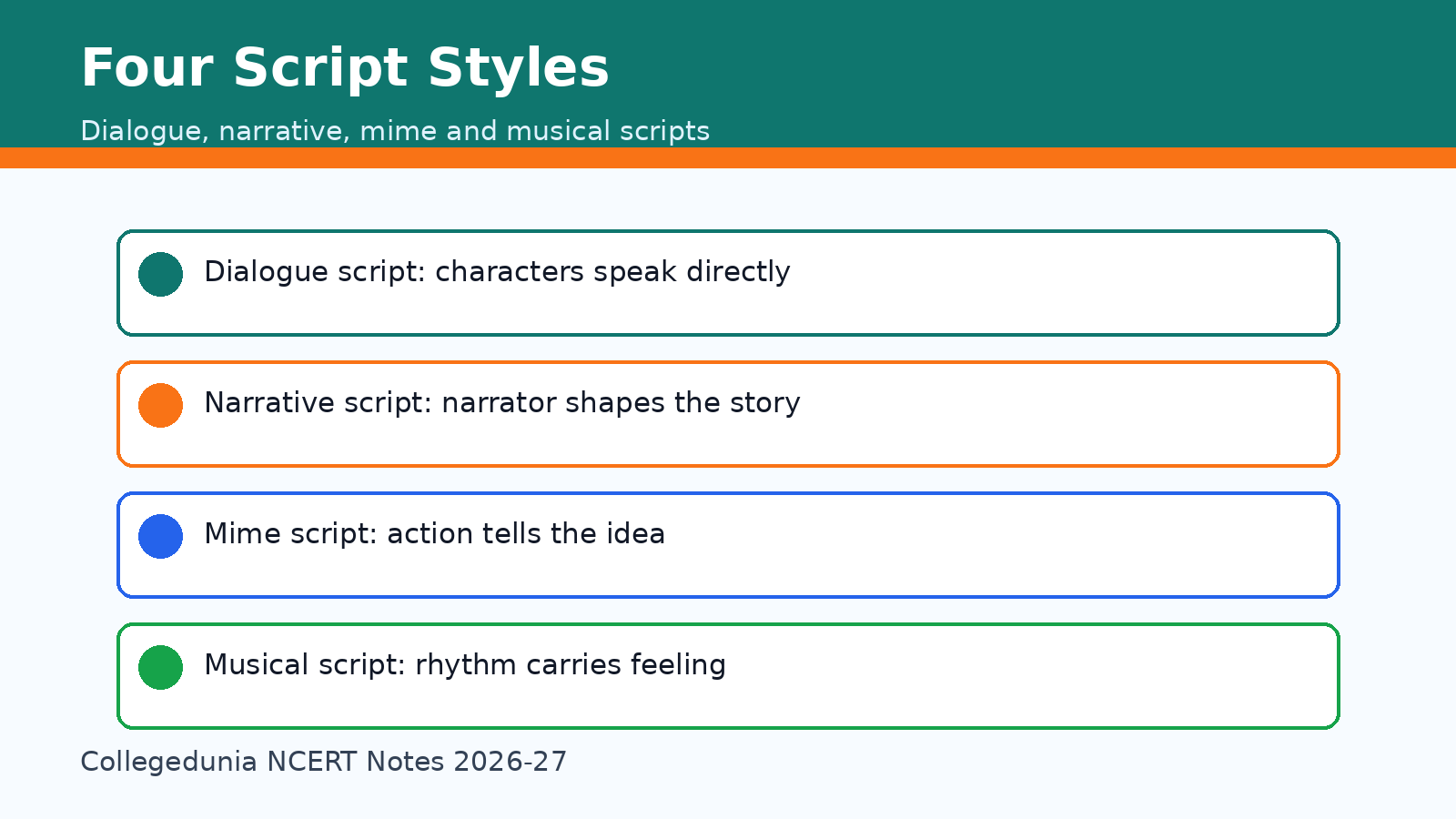
The first activity asks students to write the same topic in four script styles. A dialogue script lets characters speak directly. A narrative script uses a narrator. A mime script depends on action and stage directions. A musical script includes lyrics or rhythmic speech.
- Dialogue scripts need clear speaker names and short lines.
- Narrative scripts need a strong narrator voice.
- Mime scripts need precise action cues.
- Musical scripts need rhythm, repetition and sound patterns.
The key revision point is simple: script type tells how a performance is written, while genre tells its style or mood.
Daśha Rūpaka and Modern Script Structures
The chapter compares classical forms from the Nāṭyaśhāstra with present-day script structures. Nataka, Prakarana, Bhana, Prahasana, Dima, Vyayoga, Samavakara, Anka, Ihamrga and Veethi show different choices of act count, plot type, theme and performance style.
| Classical form | Quick meaning | Modern link |
|---|---|---|
| Nataka | Five to ten acts, often heroic or divine | Long play or major drama |
| Prahasana | One-act comic work | Comedy sketch or short comic play |
| Vyayoga | One-act heroic story | Short action-based dramatic piece |
| Veethi | One-act play with few characters | Small classroom performance |
Modern scripts may be one-act, two-act, three-act, linear, non-linear or adapted. Adapted scripts come from earlier material such as novels, stories, poems or historical events.
Genre Meaning and Examples
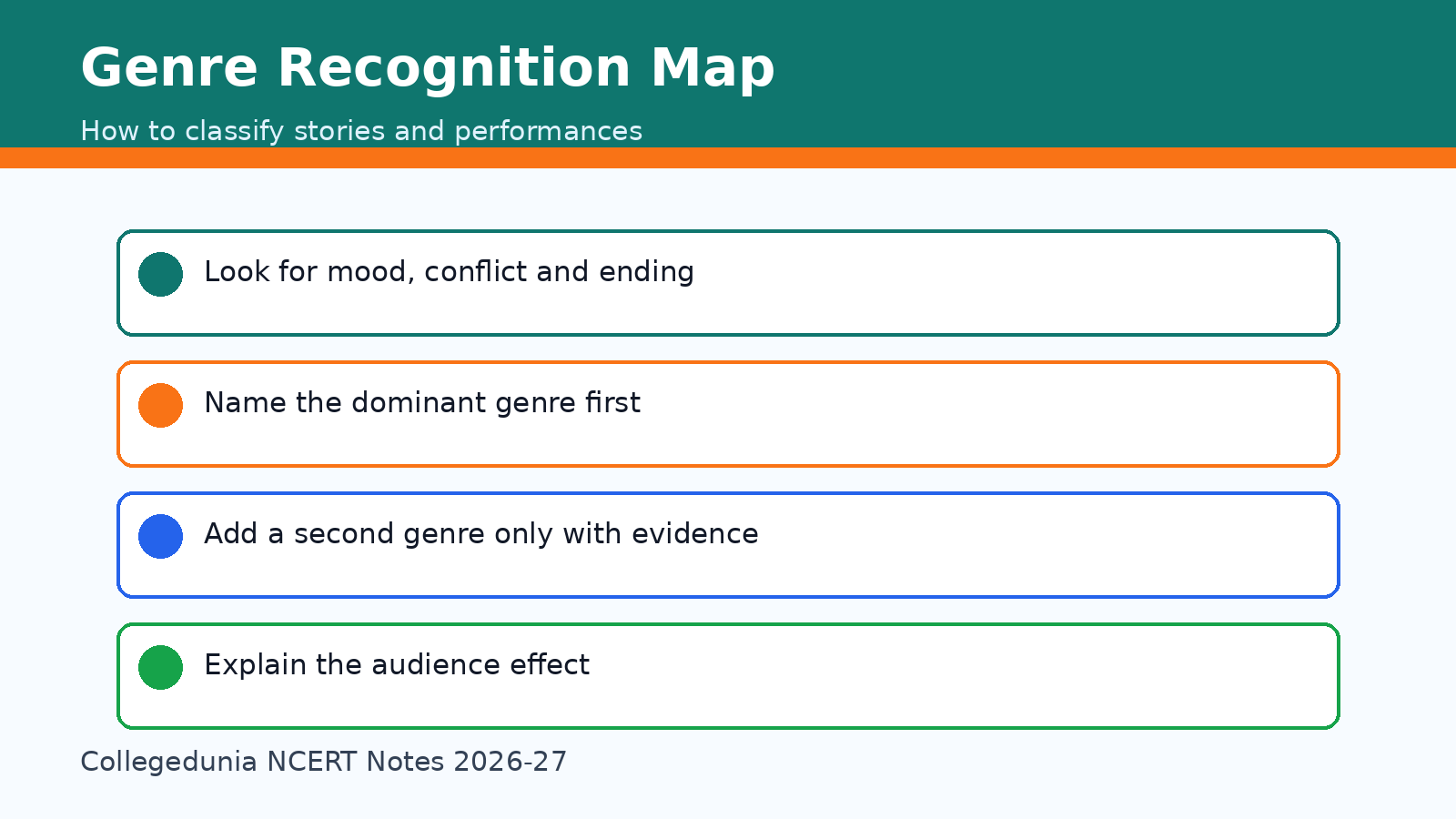
A genre is a type or style of art, literature, music or film with shared features. It helps students understand what kind of work they are watching or reading. The chapter lists tragedy, comedy, melodrama, historical drama, musical, mystery, experimental, fantasy and docudrama.
Genre is useful because it gives a clear guide for understanding the writer's intention. It also helps libraries, bookshops and students organise works. Some works mix genres, such as tragicomedy or fantasy with historical drama.
| Genre | Feature | Example clue |
|---|---|---|
| Comedy | Humour and happy ending | Misunderstanding or funny twist |
| Mystery | Puzzle hidden until the end | Clues and final reveal |
| Fantasy | Magical or imaginary world | Portal, magical object or impossible event |
| Docudrama | Dramatised real event | Facts shown through performance |
One Stage Many Scripts Video Lesson for Class 8 Arts
Source: YouTube educational drama lesson
How to Use These Notes
Start with the chapter snapshot, then revise the script-style chart and genre table. After that, practise Activity 2.1 by writing the forest-box idea in one selected style. Use Activity 2.2 to test whether you can identify genres with evidence.
- For quick revision, memorise the difference between script type and genre.
- For classroom work, prepare one example each for comedy, mystery and fantasy.
- For assessment, connect genres with personal experience and imagination.
More Class 8 Arts Resources for One Stage Many Scripts
| Resource | Link |
|---|---|
| NCERT Book PDF | One Stage Many Scripts Class 8 Book PDF |
| NCERT Solutions | One Stage Many Scripts Class 8 Solutions |
| Handwritten Notes | One Stage Many Scripts Class 8 Handwritten Notes |
Class 8 Arts (Kriti) Notes for Other Chapters
| Chapter | Notes PDF |
|---|---|
| Chapter 1 Bringing Words Alive: Play Reading | Download Chapter 1 Notes |
| Chapter 3 From Page to Stage | Download Chapter 3 Notes |
| Chapter 4 Applause and Advice | Download Chapter 4 Notes |
| Chapter 5 Discovering the Elements of Music | Download Chapter 5 Notes |
One Stage Many Scripts Class 8 Arts Notes FAQs
Ques. What is covered in One Stage Many Scripts Class 8 notes?
Ans. The notes cover script types, Daśha Rūpaka, modern script structures, genre examples, playwrights and the two NCERT classroom activities.
Ques. What is the difference between script type and genre?
Ans. Script type tells how a performance is written, such as dialogue or mime. Genre tells the style or mood, such as comedy, mystery or fantasy.
Ques. Are these notes based on the 2026-27 NCERT textbook?
Ans. Yes. The notes follow Class 8 Arts (Kriti) Chapter 2 One Stage, Many Scripts from the 2026-27 NCERT book.



Comments