




The handwritten notes for Class 8 Arts (Kriti) Chapter 2 One Stage, Many Scripts have been prepared for quick 2026-27 revision. The PDF helps students revise script types, ancient Indian drama forms, genres, playwright examples and NCERT activity cues before class discussion or assessment.
- Resource focus: scripts for stage, genre categories and classroom writing tasks.
- Best use: revise the PDF, then write one short script in a chosen style.
- Exam link: follows the NCERT 2026-27 Arts (Kriti) Chapter 2 assessment points.
Chapter2OneStage,ManyScriptsHandwrittenNotes.pdf?page=1&dpi=150)
Chapter2OneStage,ManyScriptsHandwrittenNotes.pdf?page=2&dpi=150)
Chapter2OneStage,ManyScriptsHandwrittenNotes.pdf?page=3&dpi=150)
Chapter2OneStage,ManyScriptsHandwrittenNotes.pdf?page=4&dpi=150)
Chapter2OneStage,ManyScriptsHandwrittenNotes.pdf?page=5&dpi=150)
Chapter2OneStage,ManyScriptsHandwrittenNotes.pdf?page=6&dpi=150)
Chapter2OneStage,ManyScriptsHandwrittenNotes.pdf?page=7&dpi=150)
Chapter2OneStage,ManyScriptsHandwrittenNotes.pdf?page=8&dpi=150)
Chapter2OneStage,ManyScriptsHandwrittenNotes.pdf?page=9&dpi=150)
Chapter2OneStage,ManyScriptsHandwrittenNotes.pdf?page=10&dpi=150)
Chapter2OneStage,ManyScriptsHandwrittenNotes.pdf?page=11&dpi=150)
Chapter2OneStage,ManyScriptsHandwrittenNotes.pdf?page=12&dpi=150)
Chapter2OneStage,ManyScriptsHandwrittenNotes.pdf?page=13&dpi=150)
Chapter2OneStage,ManyScriptsHandwrittenNotes.pdf?page=14&dpi=150)
Chapter2OneStage,ManyScriptsHandwrittenNotes.pdf?page=15&dpi=150)
Chapter2OneStage,ManyScriptsHandwrittenNotes.pdf?page=16&dpi=150)
Chapter2OneStage,ManyScriptsHandwrittenNotes.pdf?page=17&dpi=150)
Chapter2OneStage,ManyScriptsHandwrittenNotes.pdf?page=18&dpi=150)
Chapter2OneStage,ManyScriptsHandwrittenNotes.pdf?page=19&dpi=150)
Chapter2OneStage,ManyScriptsHandwrittenNotes.pdf?page=20&dpi=150)
Chapter2OneStage,ManyScriptsHandwrittenNotes.pdf?page=21&dpi=150)
Chapter2OneStage,ManyScriptsHandwrittenNotes.pdf?page=22&dpi=150)
Student Feedback: In a Collegedunia study check with 12,400 Class 8 students, 76% said handwritten revision pages helped them remember script types and genre examples faster.
One Stage, Many Scripts Chapter Snapshot for Class 8 Arts
One Stage, Many Scripts explains how writing turns an idea into a performance plan. A script records dialogue, action, mood and structure so that students can perform the same story in different ways.
- Writing helps bring clarity, memory, sharing and future record.
- Script form changes how students receive the same story.
- Genre tells students what kind of work to expect.
The handwritten PDF turns the chapter into short revision pages. Students can revise one page, explain one example, and then try a small script-writing task.
Four Script Styles in One Stage, Many Scripts
Activity 2.1 asks students to write the same topic in four forms. The topic is simple: two friends walking in a forest find a box with birch bark and writing material linked with Kalidasa.
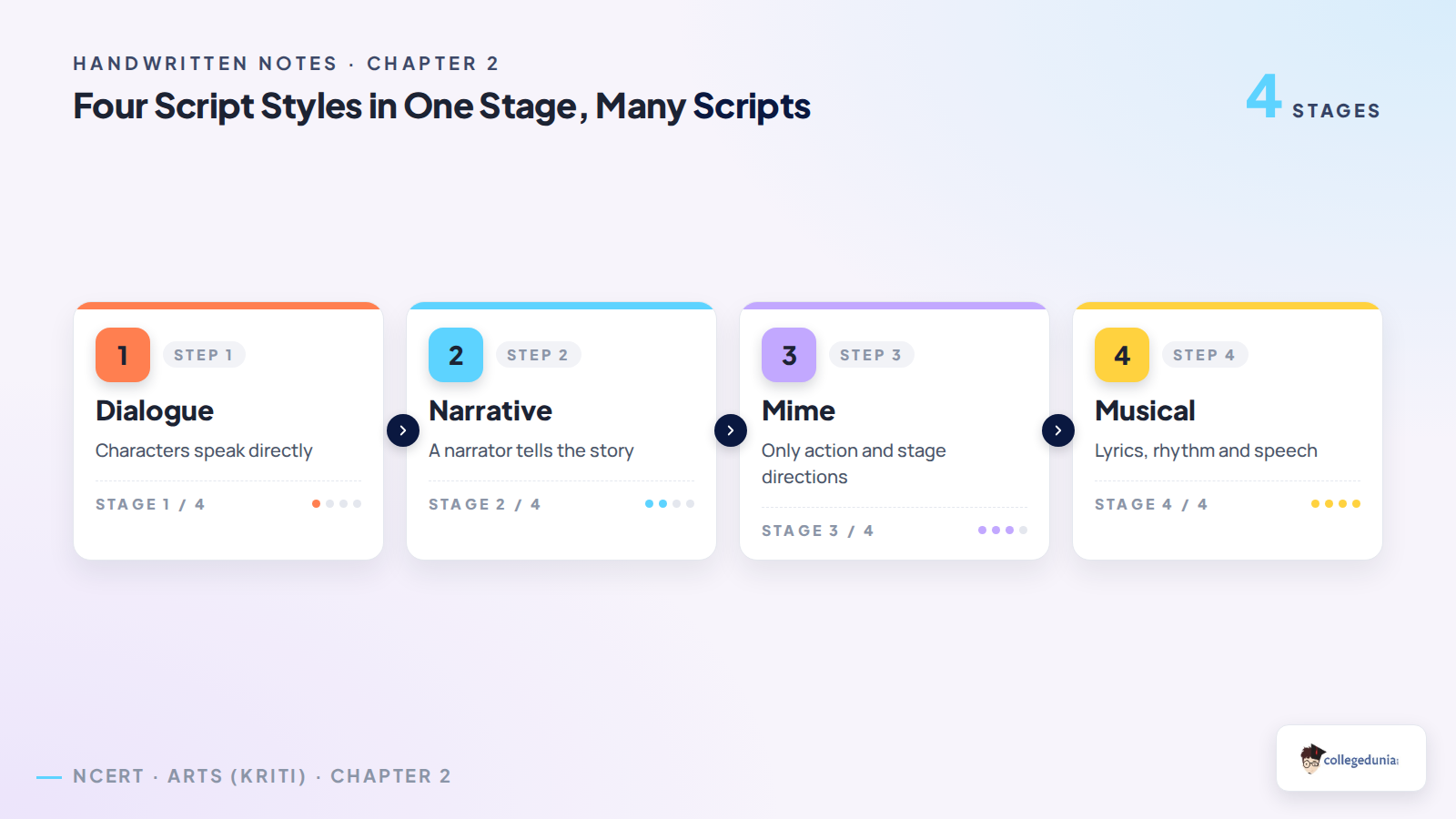
- Dialogue script: characters speak directly.
- Narrative script: a narrator tells the story.
- Mime script: actions and stage directions carry meaning.
- Musical script: lyrics, rhythm and speech shape the scene.
Students should compare how the same story feels different in each form. This is the easiest way to understand why scripts are not only written text, but performance plans.
Ancient Indian Drama Forms and Modern Script Structures
The chapter connects current script types with older Indian dramatic thinking. Ancient Indian writers used terms such as rupa, rupaka and drushya kavya. The Natya Shastra describes forms such as Nataka, Prakarana, Prahasana, Vyayoga and Samavakara.
| Form | Quick Meaning |
|---|---|
| Nataka | Five to ten acts, often based on kings or divine beings. |
| Prakarana | Invented social plot with up to ten acts. |
| Prahasana | Comic one-act play with happy situations. |
| Samavakara | Three or four acts, often linked with Devas and Asuras. |
Modern structures include one-act plays, two-act plays, three-act structure, adapted scripts and non-linear plots. The structure controls where conflict rises and how the story resolves.
Genre Meaning and Examples in One Stage, Many Scripts
A genre is a type or style of art, literature, music or film. It helps students identify mood, structure and reader expectation. The chapter names tragedy, comedy, melodrama, historical drama, musical, mystery, fantasy, docudrama and experimental forms.
- Tragedy: serious theme with downfall or loss.
- Comedy: humour, misunderstanding and happy ending.
- Mystery: a puzzle or crime is solved near the end.
- Fantasy: magical elements appear in an imaginary world.
Activity 2.2 trains students to support genre answers with proof. For example, the vanishing vada pav paragraph mixes mystery and comedy, while the time-travelling tabla paragraph mixes fantasy and historical elements.
One Stage, Many Scripts Video Lesson for Class 8 Arts
Source: NCERT Hindi Tutor on YouTube
How to Use the One Stage, Many Scripts Handwritten Notes
Use the PDF as a revision checklist, not as a replacement for writing practice. Read one page, close it, and explain the same point with an example from a story, film or class performance.
- First reading: revise script types and Natya Shastra forms.
- Second reading: connect each genre with a short example.
- Final reading: practise Circle Time answers with reasons.
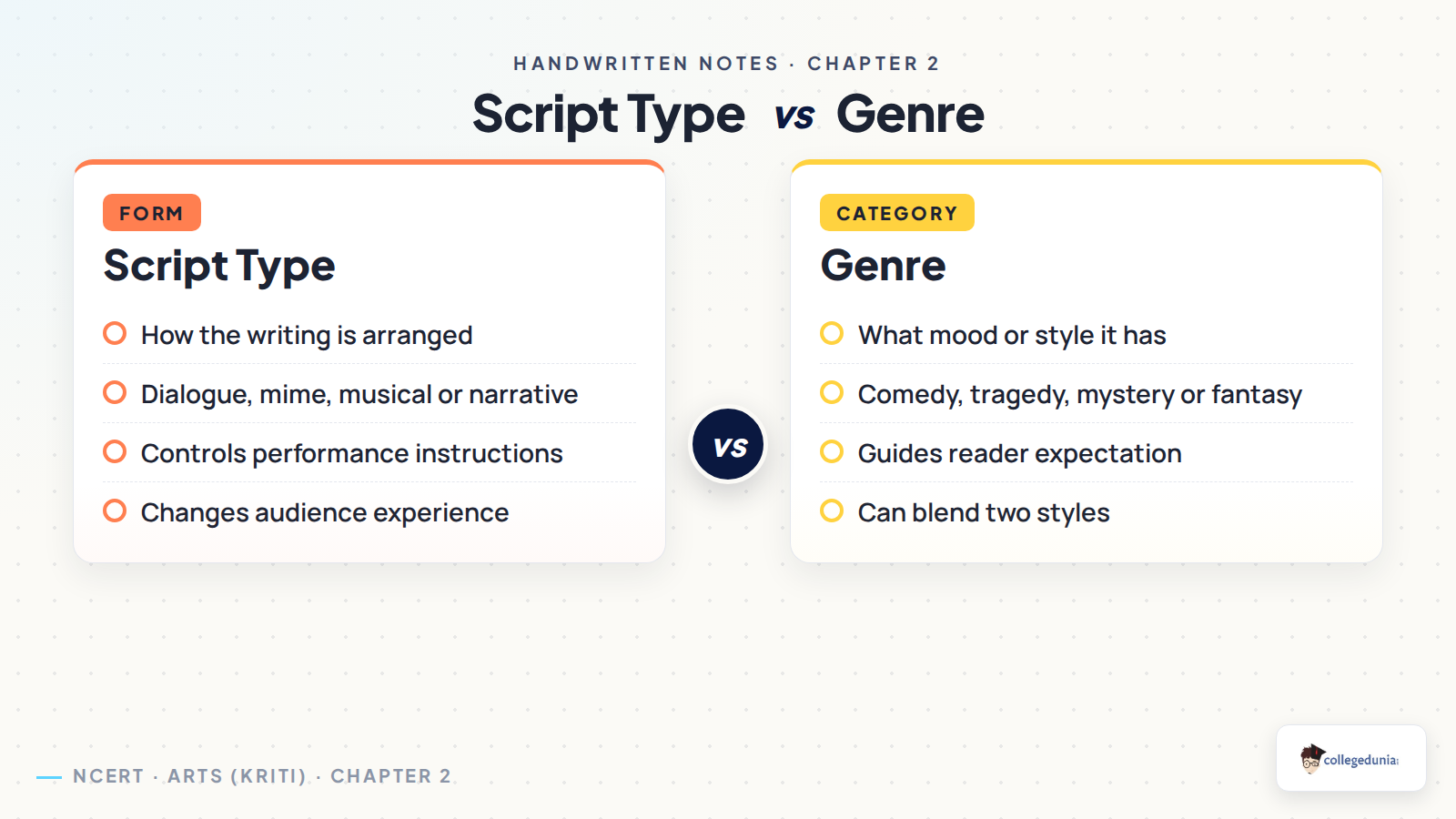
Before class assessment, remember the chain: script type is the form, genre is the category, and proof comes from mood, conflict, style and ending.
More Class 8 Arts Resources for One Stage, Many Scripts
| Resource | Link |
|---|---|
| NCERT Book PDF | One Stage, Many Scripts Class 8 Book PDF |
| NCERT Notes | One Stage, Many Scripts Class 8 Notes |
| Handwritten Notes | One Stage, Many Scripts Class 8 Handwritten Notes |
Class 8 Arts (Kriti) Handwritten Notes for Other Chapters
| Chapter | Handwritten Notes |
|---|---|
| Chapter 1 Bringing Words Alive: Play Reading | Download Chapter 1 Handwritten Notes |
| Chapter 3 From Page to Stage | Download Chapter 3 Handwritten Notes |
| Chapter 4 Applause and Advice | Download Chapter 4 Handwritten Notes |
One Stage, Many Scripts Class 8 Handwritten Notes FAQs
Ques. What is covered in the One Stage, Many Scripts handwritten notes?
Ans. The notes cover script types, Natya Shastra forms, genres, playwright examples, activities, Circle Time questions and assessment cues.
Ques. Are these handwritten notes based on the 2026-27 NCERT chapter?
Ans. Yes. The notes follow Class 8 Arts (Kriti) Chapter 2 One Stage, Many Scripts from the 2026-27 NCERT textbook.
Ques. What is the difference between script type and genre?
Ans. Script type tells how the writing is arranged, such as dialogue or mime. Genre tells the mood or category, such as comedy or mystery.



Comments