




The NCERT Class 8 English Poorvi Chapter 1 Notes explain Wit and Wisdom for the 2026-27 syllabus. These notes cover all three chapter texts: "The Wit that Won Hearts", "A Concrete Example" and "Wisdom Paves the Way", along with vocabulary, grammar and writing tasks.
Chapter1WitandWisdomNotes.pdf?page=1&dpi=150)
Chapter1WitandWisdomNotes.pdf?page=2&dpi=150)
Chapter1WitandWisdomNotes.pdf?page=3&dpi=150)
Chapter1WitandWisdomNotes.pdf?page=4&dpi=150)
Chapter1WitandWisdomNotes.pdf?page=5&dpi=150)
Chapter1WitandWisdomNotes.pdf?page=6&dpi=150)
Chapter1WitandWisdomNotes.pdf?page=7&dpi=150)
Chapter1WitandWisdomNotes.pdf?page=8&dpi=150)
Chapter1WitandWisdomNotes.pdf?page=9&dpi=150)
Chapter1WitandWisdomNotes.pdf?page=10&dpi=150)
Chapter1WitandWisdomNotes.pdf?page=11&dpi=150)
Chapter1WitandWisdomNotes.pdf?page=12&dpi=150)
Chapter1WitandWisdomNotes.pdf?page=13&dpi=150)
Chapter1WitandWisdomNotes.pdf?page=14&dpi=150)
Chapter1WitandWisdomNotes.pdf?page=15&dpi=150)
Chapter1WitandWisdomNotes.pdf?page=16&dpi=150)
Chapter1WitandWisdomNotes.pdf?page=17&dpi=150)
Chapter1WitandWisdomNotes.pdf?page=18&dpi=150)
Chapter1WitandWisdomNotes.pdf?page=19&dpi=150)
Chapter1WitandWisdomNotes.pdf?page=20&dpi=150)
Chapter1WitandWisdomNotes.pdf?page=21&dpi=150)
Chapter1WitandWisdomNotes.pdf?page=22&dpi=150)
Chapter1WitandWisdomNotes.pdf?page=23&dpi=150)
Chapter1WitandWisdomNotes.pdf?page=24&dpi=150)
Chapter1WitandWisdomNotes.pdf?page=25&dpi=150)
Chapter1WitandWisdomNotes.pdf?page=26&dpi=150)
Chapter1WitandWisdomNotes.pdf?page=27&dpi=150)
Chapter1WitandWisdomNotes.pdf?page=28&dpi=150)
Chapter1WitandWisdomNotes.pdf?page=29&dpi=150)
Chapter1WitandWisdomNotes_flat_MobileCard.pdf?page=1&dpi=150)
Chapter1WitandWisdomNotes_flat_MobileCard.pdf?page=2&dpi=150)
Chapter1WitandWisdomNotes_flat_MobileCard.pdf?page=3&dpi=150)
Chapter1WitandWisdomNotes_flat_MobileCard.pdf?page=4&dpi=150)
Chapter1WitandWisdomNotes_flat_MobileCard.pdf?page=5&dpi=150)
Chapter1WitandWisdomNotes_flat_MobileCard.pdf?page=6&dpi=150)
Chapter1WitandWisdomNotes_flat_MobileCard.pdf?page=7&dpi=150)
Chapter1WitandWisdomNotes_flat_MobileCard.pdf?page=8&dpi=150)
Chapter1WitandWisdomNotes_flat_MobileCard.pdf?page=9&dpi=150)
Chapter1WitandWisdomNotes_flat_MobileCard.pdf?page=10&dpi=150)
Chapter1WitandWisdomNotes_flat_MobileCard.pdf?page=11&dpi=150)
Chapter1WitandWisdomNotes_flat_MobileCard.pdf?page=12&dpi=150)
Chapter1WitandWisdomNotes_flat_MobileCard.pdf?page=13&dpi=150)
Chapter1WitandWisdomNotes_flat_MobileCard.pdf?page=14&dpi=150)
Chapter1WitandWisdomNotes_flat_MobileCard.pdf?page=15&dpi=150)
Chapter1WitandWisdomNotes_flat_MobileCard.pdf?page=16&dpi=150)
Chapter1WitandWisdomNotes_flat_MobileCard.pdf?page=17&dpi=150)
Chapter1WitandWisdomNotes_flat_MobileCard.pdf?page=18&dpi=150)
Chapter1WitandWisdomNotes_flat_MobileCard.pdf?page=19&dpi=150)
Chapter1WitandWisdomNotes_flat_MobileCard.pdf?page=20&dpi=150)
Chapter1WitandWisdomNotes_flat_MobileCard.pdf?page=21&dpi=150)
Chapter1WitandWisdomNotes_flat_MobileCard.pdf?page=22&dpi=150)
Chapter1WitandWisdomNotes_flat_MobileCard.pdf?page=23&dpi=150)
Chapter1WitandWisdomNotes_flat_MobileCard.pdf?page=24&dpi=150)
Chapter1WitandWisdomNotes_flat_MobileCard.pdf?page=25&dpi=150)
Chapter1WitandWisdomNotes_flat_MobileCard.pdf?page=26&dpi=150)
Chapter1WitandWisdomNotes_flat_MobileCard.pdf?page=27&dpi=150)
Chapter1WitandWisdomNotes_flat_MobileCard.pdf?page=28&dpi=150)
Chapter1WitandWisdomNotes_flat_MobileCard.pdf?page=29&dpi=150)
Chapter1WitandWisdomNotes_flat_MobileCard.pdf?page=30&dpi=150)
Chapter1WitandWisdomNotes_flat_MobileCard.pdf?page=31&dpi=150)
Chapter1WitandWisdomNotes_flat_MobileCard.pdf?page=32&dpi=150)
Chapter1WitandWisdomNotes_flat_MobileCard.pdf?page=33&dpi=150)
Chapter1WitandWisdomNotes_flat_MobileCard.pdf?page=34&dpi=150)
Chapter1WitandWisdomNotes_flat_MobileCard.pdf?page=35&dpi=150)
Chapter1WitandWisdomNotes_flat_MobileCard.pdf?page=36&dpi=150)
Chapter1WitandWisdomNotes_flat_MobileCard.pdf?page=37&dpi=150)
Chapter1WitandWisdomNotes_flat_MobileCard.pdf?page=38&dpi=150)
Student Feedback: In a Collegedunia revision check with 12,480 Class 8 students before the 2026 school exams, 76% said a story-flow image helped them remember Rama's plan faster.
- Resource focus: Class 8 English Poorvi Chapter 1 revision with story, poem, play, themes and grammar support.
- Best use: read the notes PDF first, then practise extract answers, poem devices, modal verbs and writing formats.
- Exam link: follows the NCERT 2026-27 Poorvi chapter Wit and Wisdom.
Wit and Wisdom Notes Overview for Class 8 English Poorvi
Wit and Wisdom begins with "The Wit that Won Hearts", a story about King Krishnadeva Raya, Queen Thirumalambal and Tenali Rama. The chapter then moves to the poem "A Concrete Example" and the play "Wisdom Paves the Way". The unit links wit with kindness, observation and fair judgement.
| Part of Chapter 1 | What students revise |
|---|---|
| Story summary | The quarrel, Rama's paddy seed plan and the apology. |
| Poem notes | Mrs. Jones' stone garden, the pun in the title, irony, refrain and alliteration. |
| Play notes | The four young men, camel-track deductions, the merchant's accusation and the king's decision. |
| Language work | Sound words, compound words, if-clause patterns, modal verbs and formal writing. |
Wit and Wisdom Story Arc: From Misunderstanding to Apology
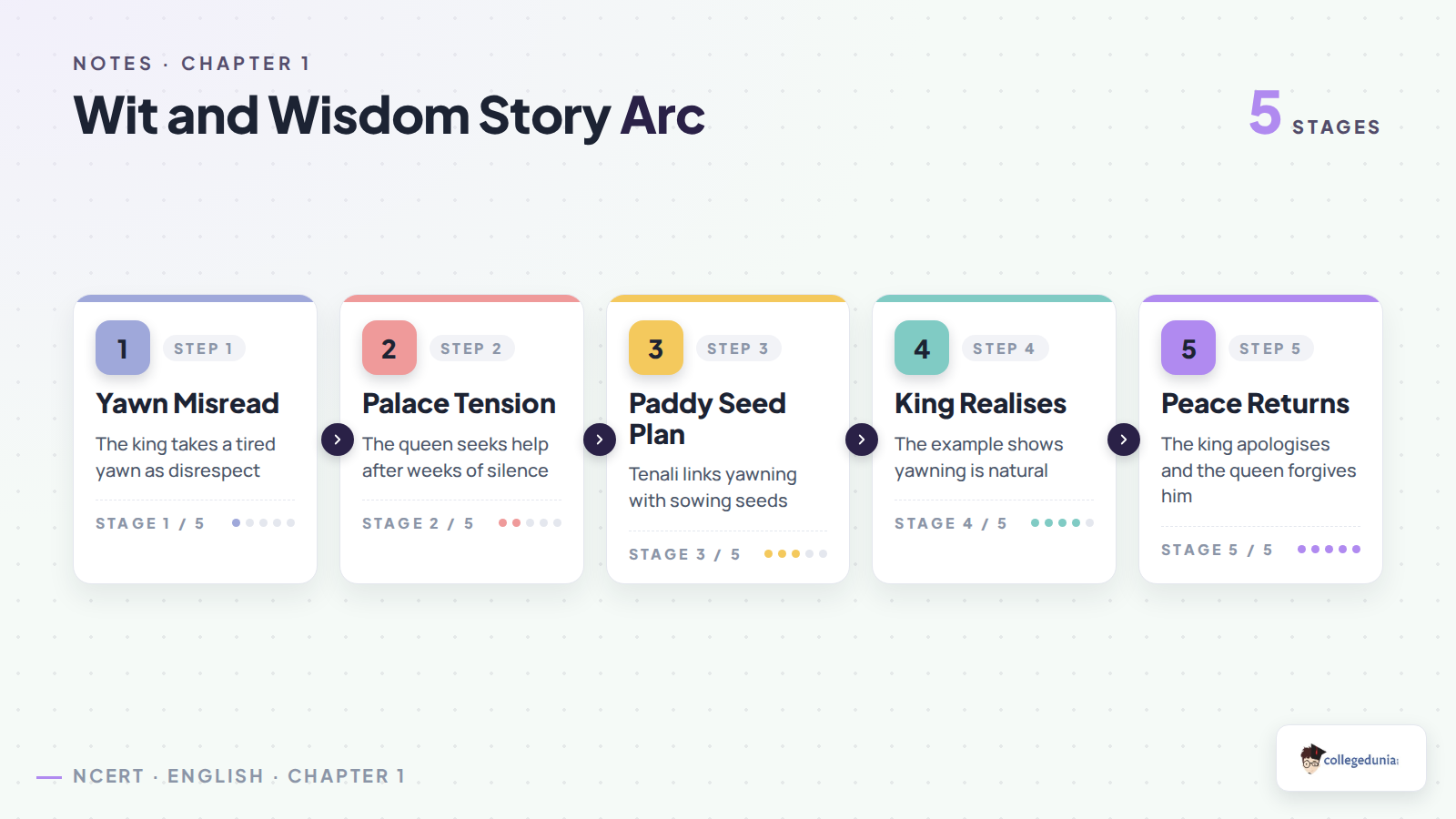
The story moves through five clear steps. The king feels hurt, the queen seeks help, Rama builds a clever example, and the king understands his mistake. Rama wins hearts because he corrects the king without insulting him.
- Conflict: the king thinks the queen yawned to insult his poem.
- Strategy: Rama links yawning with sowing paddy seeds.
- Resolution: the king apologises and the queen forgives him.
A Concrete Example Poem Notes for Class 8
"A Concrete Example" is a humorous poem about Mrs. Jones and her unusual garden. The speaker notices stones, a crazy path, a lily pond, a rockery, a sundial and tiny plants. The ending is funny because the speaker asks where the flower is, and Mrs. Jones says the speaker is standing on it.
| Poem point | Revision note |
|---|---|
| Tone | Humorous, amusing and light-hearted. |
| Title pun | Concrete means hard material and also a clear example. |
| Irony | The speaker discusses the flower but is actually standing on it. |
| Alliteration | Examples include "got a garden", "sundial with a strange device" and "so delicate and small". |
Wisdom Paves the Way Play Notes for Class 8
The play follows Ram Datt, Shiv Datt, Har Datt and Dev Datt on the road to Ujjain. They do not see the missing camel directly, but they infer its details from tracks and signs on the road.
| Young man | Deduction |
|---|---|
| Ram Datt | The camel is lame because one footprint is faint. |
| Shiv Datt | The camel is blind in the right eye because it ate foliage only on the left side. |
| Har Datt | The camel has a short tail because it could not fend off pests. |
| Dev Datt | The camel has stomach pain because of its careful hind-leg movement. |
Wit and Wisdom Explained by Magnet Brains for Class 8
Source: Magnet Brains on YouTube
Wit and Wisdom Themes and Character Points for Answers
Use themes to write better answers. The chapter shows that wit is useful only when it is kind. It also shows how pride can make a small action seem insulting, how perception shapes a poem and how observation can protect innocent people.
| Character or theme | Answer point |
|---|---|
| Tenali Rama | He is witty, patient and emotionally intelligent. |
| King Krishnadeva Raya | He is wise, but his pride clouds his judgement. |
| Queen Thirumalambal | She is patient, forgiving and sensible. |
| Mrs. Jones | She values small details in her unusual garden. |
| Four young men | They use evidence before making conclusions. |
| Core lesson | Wit becomes wisdom when it is joined with fairness and care. |
Wit and Wisdom Vocabulary and Grammar for Quick Revision
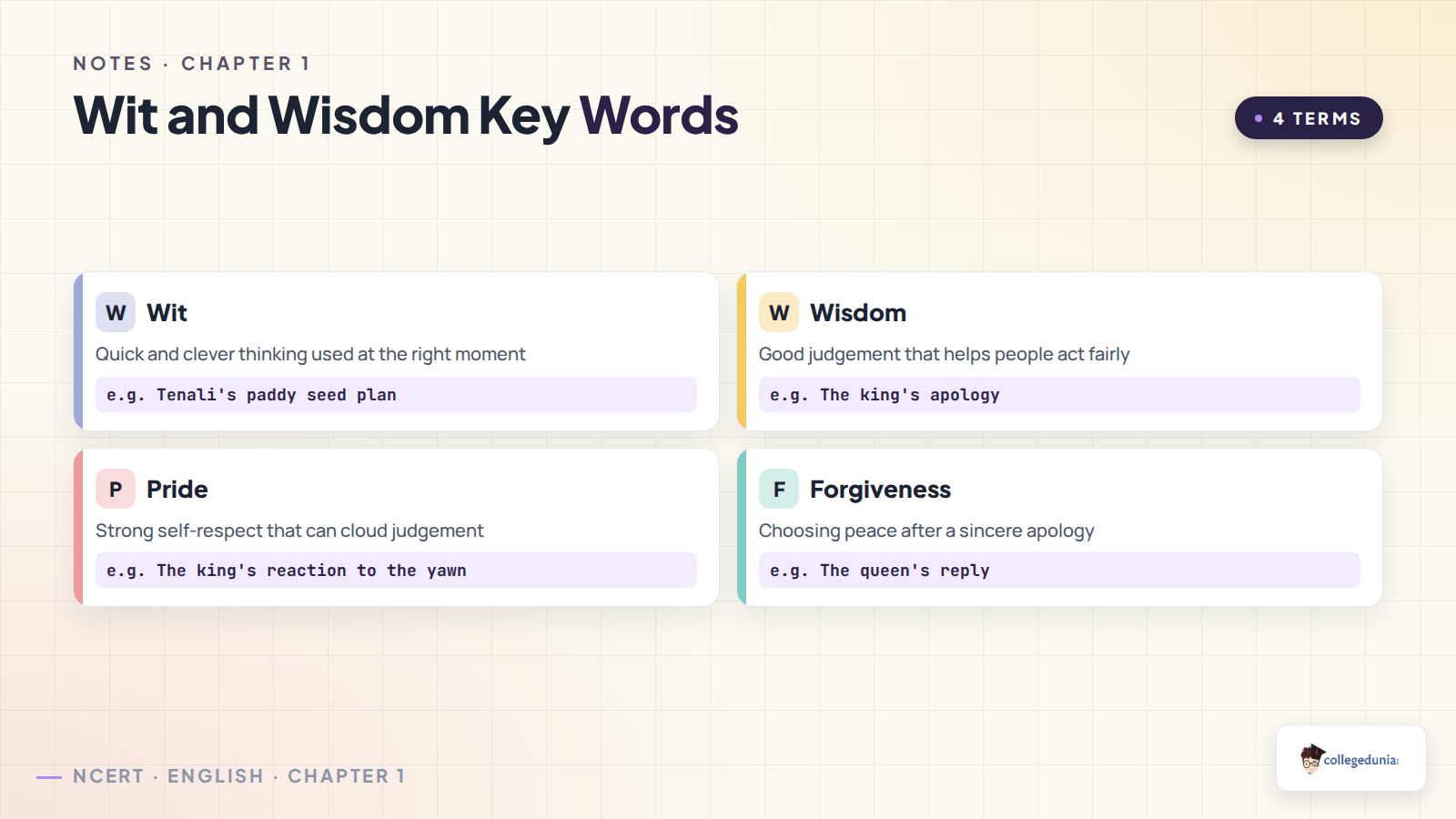
The textbook asks students to revise sound words, compound words, conditional sentences, modal verbs and formal writing. For if clauses, first check the time. Possible future, imaginary present and unreal past all use different verb patterns.
- Sound words: roared, murmur, snickers, sighed and whispered show mood.
- Compound words: closed, hyphenated and open compounds have different spellings.
- If clauses: use will, would or would have based on the time.
- Modal verbs: can, could, may, might, must, should and need to show function.
- Writing formats: revise notice writing for the Herb Garden and a formal complaint letter for a damaged road.
How Students Should Use the Wit and Wisdom Notes PDF
Start with the PDF summary, then revise the vocabulary table. After that, answer two extract questions without looking at the notes. Students who revise in this order remember the plot and grammar together.
- Read the story summary and mark the turning point.
- Revise Tenali Rama, Mrs. Jones and the four young men as separate character notes.
- Practise one conditional sentence from each type.
- Write one long answer on Rama's strategy, one poem answer on irony and one play answer on deduction.
More Class 8 English Poorvi Chapter 1 Resources
Use these links when you want another resource for the same chapter. The Notes PDF is best for revision, while other resource types help with textbook reading and solved answers.
| Resource | Link |
|---|---|
| NCERT Solutions | Wit and Wisdom Class 8 NCERT Solutions |
| NCERT Book PDF | Wit and Wisdom Class 8 NCERT Book PDF |
| Handwritten Notes | Wit and Wisdom Class 8 Handwritten Notes |
Class 8 English Poorvi Notes for All Chapters
The table below helps students continue with the same Notes resource type across the Poorvi textbook.
| Chapter | Notes Link |
|---|---|
| Chapter 1: Wit and Wisdom | Wit and Wisdom Class 8 Notes |
| Chapter 2: Values and Dispositions | Values and Dispositions Class 8 Notes |
| Chapter 3: Mystery and Magic | Mystery and Magic Class 8 Notes |
| Chapter 4: Environment | Environment Class 8 Notes |
| Chapter 5: Science and Curiosity | Science and Curiosity Class 8 Notes |
Wit and Wisdom Class 8 English Poorvi Notes FAQs
Ques. What does Wit and Wisdom Chapter 1 teach students?
Ans. Wit and Wisdom teaches that cleverness works best with kindness, observation and fair judgement. The chapter includes a story, a poem and a play.
Ques. Why did the king stop speaking to the queen?
Ans. The king thought the queen yawned because she disliked his poem. She was only tired, so the problem came from misunderstanding.
Ques. How did Tenali Rama solve the problem in Wit and Wisdom?
Ans. Rama used a paddy seed example. He said yawning while sowing would spoil the yield, which made the king realise yawning is natural.
Ques. What grammar topic is revised in Class 8 English Poorvi Chapter 1?
Ans. The chapter revises conditional sentences and modal verbs. Students also practise notice writing and a formal complaint letter.



Comments