



NCERT Class 8 Science Chapter 11 Keeping Time with the Skies Notes explain Moon phases, moonrise timing, calendars, festivals and artificial satellites for the 2026-27 NCERT Curiosity textbook.
- Best for Moon phases: covers waxing, waning, full Moon, new Moon, crescent and gibbous shapes.
- Useful for calendars: explains day, month, year, lunar calendars, solar calendars and luni-solar calendars.
- Free PDF: download full chapter notes with diagrams, tables, festival examples and answer frames.
Chapter11KeepingTimewiththeSkiesNotes.pdf?page=1&dpi=150)
Chapter11KeepingTimewiththeSkiesNotes.pdf?page=2&dpi=150)
Chapter11KeepingTimewiththeSkiesNotes.pdf?page=3&dpi=150)
Chapter11KeepingTimewiththeSkiesNotes.pdf?page=4&dpi=150)
Chapter11KeepingTimewiththeSkiesNotes.pdf?page=5&dpi=150)
Chapter11KeepingTimewiththeSkiesNotes.pdf?page=6&dpi=150)
Chapter11KeepingTimewiththeSkiesNotes.pdf?page=7&dpi=150)
Chapter11KeepingTimewiththeSkiesNotes.pdf?page=8&dpi=150)
Chapter11KeepingTimewiththeSkiesNotes.pdf?page=9&dpi=150)
Chapter11KeepingTimewiththeSkiesNotes.pdf?page=10&dpi=150)
Chapter11KeepingTimewiththeSkiesNotes.pdf?page=11&dpi=150)
Chapter11KeepingTimewiththeSkiesNotes.pdf?page=12&dpi=150)
Chapter11KeepingTimewiththeSkiesNotes.pdf?page=13&dpi=150)
Chapter11KeepingTimewiththeSkiesNotes.pdf?page=14&dpi=150)
Chapter11KeepingTimewiththeSkiesNotes.pdf?page=15&dpi=150)
Chapter11KeepingTimewiththeSkiesNotes.pdf?page=16&dpi=150)
Chapter11KeepingTimewiththeSkiesNotes.pdf?page=17&dpi=150)
Chapter11KeepingTimewiththeSkiesNotes.pdf?page=18&dpi=150)
Chapter11KeepingTimewiththeSkiesNotes.pdf?page=19&dpi=150)
Chapter11KeepingTimewiththeSkiesNotes.pdf?page=20&dpi=150)
Chapter11KeepingTimewiththeSkiesNotes.pdf?page=21&dpi=150)
Chapter11KeepingTimewiththeSkiesNotes.pdf?page=22&dpi=150)
Chapter11KeepingTimewiththeSkiesNotes.pdf?page=23&dpi=150)
Chapter11KeepingTimewiththeSkiesNotes.pdf?page=24&dpi=150)
Chapter11KeepingTimewiththeSkiesNotes.pdf?page=25&dpi=150)
Chapter11KeepingTimewiththeSkiesNotes.pdf?page=26&dpi=150)
Chapter11KeepingTimewiththeSkiesNotes.pdf?page=27&dpi=150)
Chapter11KeepingTimewiththeSkiesNotes_flat_MobileCard.pdf?page=1&dpi=150)
Chapter11KeepingTimewiththeSkiesNotes_flat_MobileCard.pdf?page=2&dpi=150)
Chapter11KeepingTimewiththeSkiesNotes_flat_MobileCard.pdf?page=3&dpi=150)
Chapter11KeepingTimewiththeSkiesNotes_flat_MobileCard.pdf?page=4&dpi=150)
Chapter11KeepingTimewiththeSkiesNotes_flat_MobileCard.pdf?page=5&dpi=150)
Chapter11KeepingTimewiththeSkiesNotes_flat_MobileCard.pdf?page=6&dpi=150)
Chapter11KeepingTimewiththeSkiesNotes_flat_MobileCard.pdf?page=7&dpi=150)
Chapter11KeepingTimewiththeSkiesNotes_flat_MobileCard.pdf?page=8&dpi=150)
Chapter11KeepingTimewiththeSkiesNotes_flat_MobileCard.pdf?page=9&dpi=150)
Chapter11KeepingTimewiththeSkiesNotes_flat_MobileCard.pdf?page=10&dpi=150)
Chapter11KeepingTimewiththeSkiesNotes_flat_MobileCard.pdf?page=11&dpi=150)
Chapter11KeepingTimewiththeSkiesNotes_flat_MobileCard.pdf?page=12&dpi=150)
Chapter11KeepingTimewiththeSkiesNotes_flat_MobileCard.pdf?page=13&dpi=150)
Chapter11KeepingTimewiththeSkiesNotes_flat_MobileCard.pdf?page=14&dpi=150)
Chapter11KeepingTimewiththeSkiesNotes_flat_MobileCard.pdf?page=15&dpi=150)
Chapter11KeepingTimewiththeSkiesNotes_flat_MobileCard.pdf?page=16&dpi=150)
Chapter11KeepingTimewiththeSkiesNotes_flat_MobileCard.pdf?page=17&dpi=150)
Chapter11KeepingTimewiththeSkiesNotes_flat_MobileCard.pdf?page=18&dpi=150)
Chapter11KeepingTimewiththeSkiesNotes_flat_MobileCard.pdf?page=19&dpi=150)
Chapter11KeepingTimewiththeSkiesNotes_flat_MobileCard.pdf?page=20&dpi=150)
Chapter11KeepingTimewiththeSkiesNotes_flat_MobileCard.pdf?page=21&dpi=150)
Chapter11KeepingTimewiththeSkiesNotes_flat_MobileCard.pdf?page=22&dpi=150)
Chapter11KeepingTimewiththeSkiesNotes_flat_MobileCard.pdf?page=23&dpi=150)
Chapter11KeepingTimewiththeSkiesNotes_flat_MobileCard.pdf?page=24&dpi=150)
Chapter11KeepingTimewiththeSkiesNotes_flat_MobileCard.pdf?page=25&dpi=150)
Chapter11KeepingTimewiththeSkiesNotes_flat_MobileCard.pdf?page=26&dpi=150)
Chapter11KeepingTimewiththeSkiesNotes_flat_MobileCard.pdf?page=27&dpi=150)
Chapter11KeepingTimewiththeSkiesNotes_flat_MobileCard.pdf?page=28&dpi=150)
Chapter11KeepingTimewiththeSkiesNotes_flat_MobileCard.pdf?page=29&dpi=150)
Chapter11KeepingTimewiththeSkiesNotes_flat_MobileCard.pdf?page=30&dpi=150)
Chapter11KeepingTimewiththeSkiesNotes_flat_MobileCard.pdf?page=31&dpi=150)
Student Feedback: In a Collegedunia revision poll of Class 8 Science students, 79% said Chapter 11 became easier after they separated Moon phases, calendar types and satellite uses into three revision blocks.
Keeping Time with the Skies Notes Overview
Class 8 Science Chapter 11 begins with the Moon visible in daytime. The chapter explains why the Moon has phases even though its shape stays spherical.
Students also learn how day, month and year came from repeating sky cycles. The chapter then connects calendars with festivals and introduces artificial satellites launched for communication, navigation, weather, mapping and research.
Moon Phases Calendars and Satellites Video Lesson
Source: BYJU'S on YouTube
Moon Phases and Moonrise in Class 8 Science Chapter 11
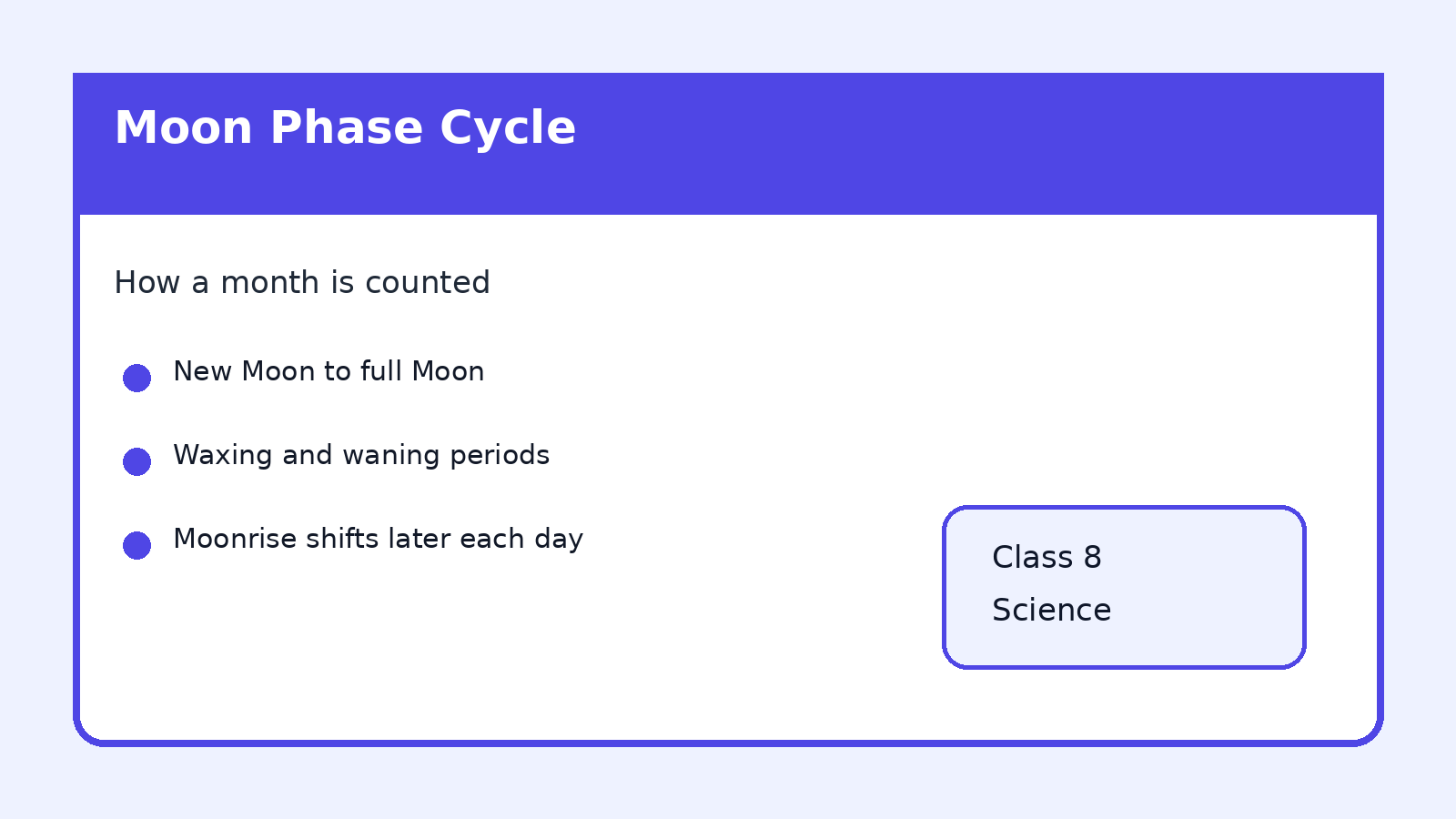
The Moon shines by reflected sunlight. Only the half facing the Sun is illuminated, and Earth sees different fractions of that lit half as the Moon revolves around Earth.
| Moon idea | Meaning | Revision clue |
|---|---|---|
| Waxing | Bright part increases after new Moon | Best seen near sunset |
| Waning | Bright part decreases after full Moon | Best seen near sunrise |
| Moonrise shift | Moon appears in a similar sky position later next day | Roughly 50 minutes later |
Calendars and Sky Cycles in Keeping Time with the Skies
The chapter explains three natural clocks. A day comes from Earth's rotation, a month from the Moon's phase cycle and a year from Earth's seasonal cycle around the Sun.
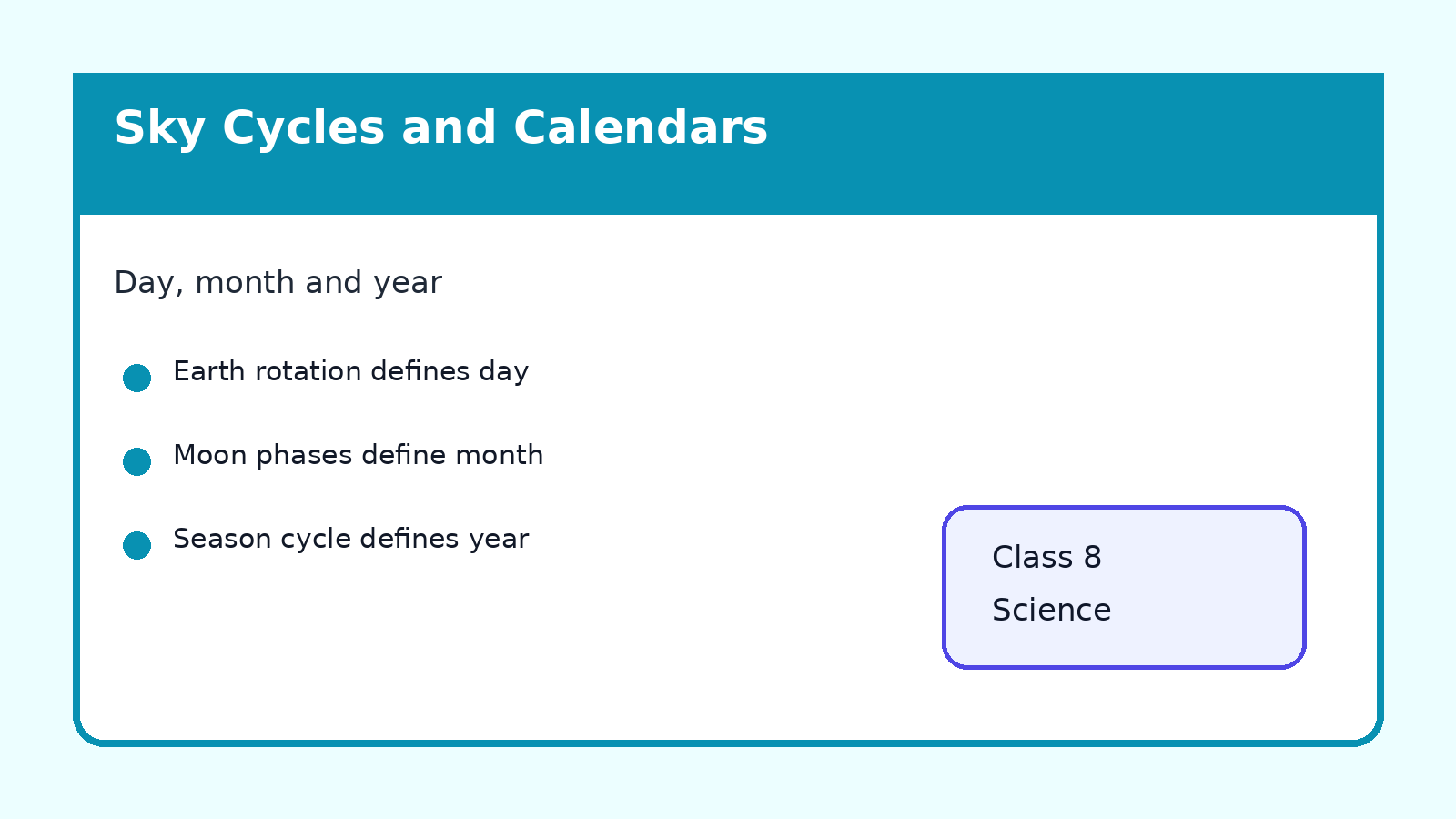
- Lunar calendar: follows Moon phases and has about 354 days in 12 months.
- Solar calendar: follows seasons and uses leap years to stay aligned.
- Luni-solar calendar: follows Moon months and adds an extra month when needed.
Festivals Artificial Satellites and Class 8 Science Chapter 11
Moon based festivals can shift across Gregorian dates because lunar months do not match solar months exactly. Diwali falls on the new Moon of Kartika, Holi on the full Moon of Phalguna, Buddha Purnima on the full Moon of Vaisakha, Eid-ul-Fitr after crescent Moon sighting and Dussehra on the tenth day of Ashwina.
Luni-solar festival dates usually stay within a limited range because extra months correct the gap, while purely lunar festivals can move earlier by about 11 days each solar year. Some festival dates can also differ by one day across regions because exact lunar phase at sunrise matters. Solar sidereal festivals such as Makar Sankranti and Pongal stay near the same Gregorian dates but slowly shift because sidereal and tropical years differ.
Artificial satellites are human-made objects placed in orbit around Earth. ISRO missions support maps, weather warnings, disaster management, communication, navigation and astronomy research.
Keeping Time with the Skies Related Resources
| Resource | Link |
|---|---|
| NCERT Solutions | Class 8 Science Chapter 11 NCERT Solutions |
| NCERT Book PDF | Class 8 Science Chapter 11 NCERT Book PDF |
| Handwritten Notes | Class 8 Science Chapter 11 Handwritten Notes |
Class 8 Science Curiosity Notes for All Chapters
| Chapter | Notes |
|---|---|
| Chapter 8 | Nature of Matter Elements Compounds and Mixtures Notes |
| Chapter 9 | The Amazing World of Solutes Solvents and Solutions Notes |
| Chapter 10 | Light Mirrors and Lenses Notes |
| Chapter 11 | Keeping Time with the Skies Notes |
Student Doubts on Class 8 Science Chapter 11
Keeping Time with the Skies Class 8 Notes FAQs
Ques. What causes the phases of the Moon?
Ans. Moon phases happen because Earth sees different parts of the Moon's illuminated half as the Moon revolves around Earth.
Ques. Are Moon phases caused by Earth's shadow?
Ans. No. Earth's shadow causes a lunar eclipse. Regular Moon phases are caused by the changing Sun, Moon and Earth positions.
Ques. Why do some festival dates shift every year?
Ans. Moon based festival dates shift because lunar months do not match the solar calendar months exactly.
Ques. What are artificial satellites used for?
Ans. Artificial satellites are used for communication, navigation, weather monitoring, disaster management, mapping and scientific research.



Comments