



NCERT Class 8 Science Chapter 12 Notes cover How Nature Works in Harmony for the 2026-27 NCERT Curiosity textbook. The PDF explains habitats, ecosystems, food chains, food webs, decomposers, ecosystem balance and sustainable farming in simple revision language.
- Revise biotic and abiotic components with pond, forest and farm examples.
- Use food-chain and food-web diagrams for quick recall.
- Check cascading effects, Sundarbans threats and sustainable farming points.
Chapter12HowNatureWorksinHarmonyNotes.pdf?page=1&dpi=150)
Chapter12HowNatureWorksinHarmonyNotes.pdf?page=2&dpi=150)
Chapter12HowNatureWorksinHarmonyNotes.pdf?page=3&dpi=150)
Chapter12HowNatureWorksinHarmonyNotes.pdf?page=4&dpi=150)
Chapter12HowNatureWorksinHarmonyNotes.pdf?page=5&dpi=150)
Chapter12HowNatureWorksinHarmonyNotes.pdf?page=6&dpi=150)
Chapter12HowNatureWorksinHarmonyNotes.pdf?page=7&dpi=150)
Chapter12HowNatureWorksinHarmonyNotes.pdf?page=8&dpi=150)
Chapter12HowNatureWorksinHarmonyNotes.pdf?page=9&dpi=150)
Chapter12HowNatureWorksinHarmonyNotes.pdf?page=10&dpi=150)
Chapter12HowNatureWorksinHarmonyNotes.pdf?page=11&dpi=150)
Chapter12HowNatureWorksinHarmonyNotes.pdf?page=12&dpi=150)
Chapter12HowNatureWorksinHarmonyNotes.pdf?page=13&dpi=150)
Chapter12HowNatureWorksinHarmonyNotes.pdf?page=14&dpi=150)
Chapter12HowNatureWorksinHarmonyNotes.pdf?page=15&dpi=150)
Chapter12HowNatureWorksinHarmonyNotes.pdf?page=16&dpi=150)
Chapter12HowNatureWorksinHarmonyNotes.pdf?page=17&dpi=150)
Chapter12HowNatureWorksinHarmonyNotes.pdf?page=18&dpi=150)
Chapter12HowNatureWorksinHarmonyNotes.pdf?page=19&dpi=150)
Chapter12HowNatureWorksinHarmonyNotes.pdf?page=20&dpi=150)
Chapter12HowNatureWorksinHarmonyNotes.pdf?page=21&dpi=150)
Chapter12HowNatureWorksinHarmonyNotes.pdf?page=22&dpi=150)
Chapter12HowNatureWorksinHarmonyNotes.pdf?page=23&dpi=150)
Chapter12HowNatureWorksinHarmonyNotes_flat_MobileCard.pdf?page=1&dpi=150)
Chapter12HowNatureWorksinHarmonyNotes_flat_MobileCard.pdf?page=2&dpi=150)
Chapter12HowNatureWorksinHarmonyNotes_flat_MobileCard.pdf?page=3&dpi=150)
Chapter12HowNatureWorksinHarmonyNotes_flat_MobileCard.pdf?page=4&dpi=150)
Chapter12HowNatureWorksinHarmonyNotes_flat_MobileCard.pdf?page=5&dpi=150)
Chapter12HowNatureWorksinHarmonyNotes_flat_MobileCard.pdf?page=6&dpi=150)
Chapter12HowNatureWorksinHarmonyNotes_flat_MobileCard.pdf?page=7&dpi=150)
Chapter12HowNatureWorksinHarmonyNotes_flat_MobileCard.pdf?page=8&dpi=150)
Chapter12HowNatureWorksinHarmonyNotes_flat_MobileCard.pdf?page=9&dpi=150)
Chapter12HowNatureWorksinHarmonyNotes_flat_MobileCard.pdf?page=10&dpi=150)
Chapter12HowNatureWorksinHarmonyNotes_flat_MobileCard.pdf?page=11&dpi=150)
Chapter12HowNatureWorksinHarmonyNotes_flat_MobileCard.pdf?page=12&dpi=150)
Chapter12HowNatureWorksinHarmonyNotes_flat_MobileCard.pdf?page=13&dpi=150)
Chapter12HowNatureWorksinHarmonyNotes_flat_MobileCard.pdf?page=14&dpi=150)
Chapter12HowNatureWorksinHarmonyNotes_flat_MobileCard.pdf?page=15&dpi=150)
Chapter12HowNatureWorksinHarmonyNotes_flat_MobileCard.pdf?page=16&dpi=150)
Chapter12HowNatureWorksinHarmonyNotes_flat_MobileCard.pdf?page=17&dpi=150)
Chapter12HowNatureWorksinHarmonyNotes_flat_MobileCard.pdf?page=18&dpi=150)
Chapter12HowNatureWorksinHarmonyNotes_flat_MobileCard.pdf?page=19&dpi=150)
Chapter12HowNatureWorksinHarmonyNotes_flat_MobileCard.pdf?page=20&dpi=150)
Chapter12HowNatureWorksinHarmonyNotes_flat_MobileCard.pdf?page=21&dpi=150)
Chapter12HowNatureWorksinHarmonyNotes_flat_MobileCard.pdf?page=22&dpi=150)
Chapter12HowNatureWorksinHarmonyNotes_flat_MobileCard.pdf?page=23&dpi=150)
Chapter12HowNatureWorksinHarmonyNotes_flat_MobileCard.pdf?page=24&dpi=150)
Chapter12HowNatureWorksinHarmonyNotes_flat_MobileCard.pdf?page=25&dpi=150)
Chapter12HowNatureWorksinHarmonyNotes_flat_MobileCard.pdf?page=26&dpi=150)
Chapter12HowNatureWorksinHarmonyNotes_flat_MobileCard.pdf?page=27&dpi=150)
Chapter12HowNatureWorksinHarmonyNotes_flat_MobileCard.pdf?page=28&dpi=150)
Chapter12HowNatureWorksinHarmonyNotes_flat_MobileCard.pdf?page=29&dpi=150)
Student Feedback: Students find this chapter easier when examples are grouped as habitat, food relationship, balance and human impact.
How Nature Works in Harmony Notes PDF for Class 8 Science
The notes PDF follows the 2026-27 NCERT chapter and explains each idea through examples. It starts with elephant corridors and habitat loss, then moves to populations, communities, ecosystems, food chains, food webs and decomposers. The central point is interdependence: one change can affect many living and non-living components.
- Habitat: place where an organism gets suitable living conditions.
- Population: same type of organisms living together at a given time.
- Community: different populations sharing one habitat.
- Ecosystem: biotic and abiotic components interacting in an area.
How One Ecosystem Change Leads to Another
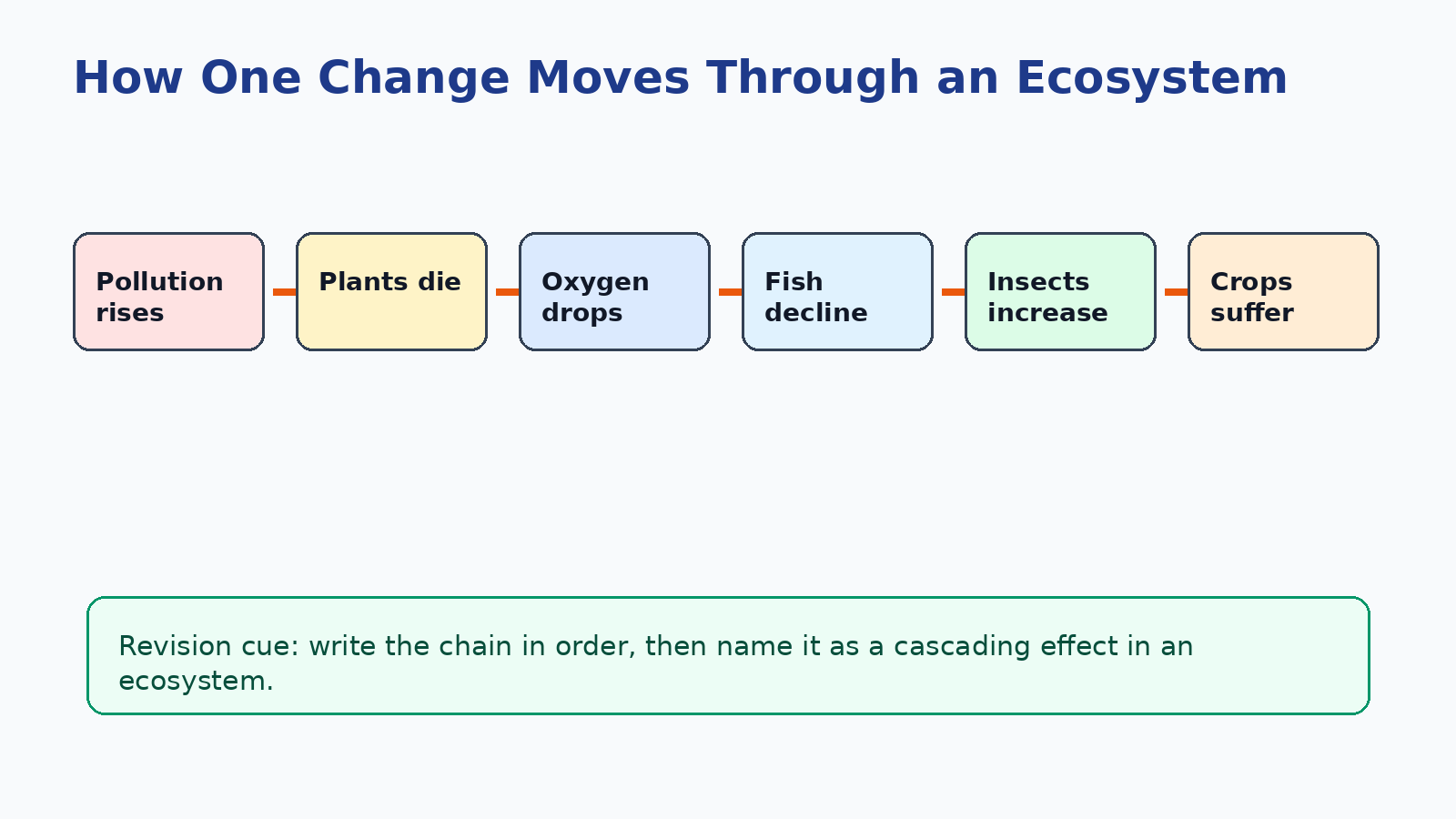
The chapter shows that pollution, habitat loss or overuse can trigger a chain reaction. If pond plants die, oxygen falls, fish decline, insects increase and nearby crops may get damaged. This is why the notes place cascading effects beside food relationships.
| Starting change | Likely effect | Revision cue |
|---|---|---|
| Forest shrinkage | Animals enter farms and villages | Habitat loss |
| Overfishing | Food-web balance changes | Population link |
| Frog harvesting | Pest population rises | Natural pest control |
Food Chain and Food Web Revision for How Nature Works in Harmony
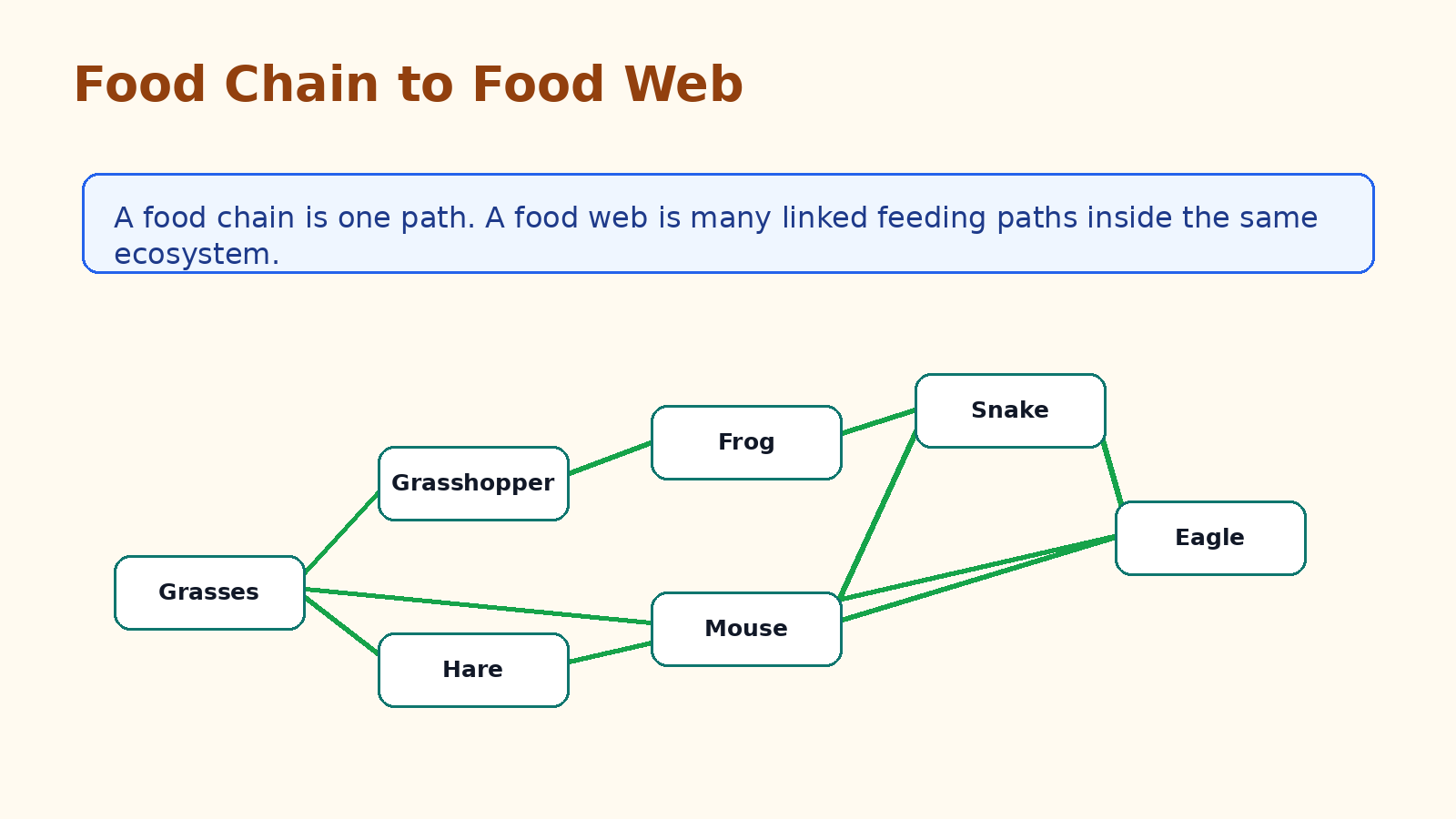
A food chain is one feeding path, such as grass to grasshopper to frog to snake to eagle. A food web is a network of linked food chains. Always read the arrow as energy passing from food to feeder.
- Producers form the first trophic level.
- Herbivores feed on producers.
- Carnivores feed on other animals.
- Decomposers recycle nutrients from dead matter.
Important Topics from Class 8 Science Chapter 12 Notes
The chapter is concept-heavy, so students should revise definitions and examples together. The most tested points are biotic-abiotic interactions, trophic levels, relationship types and human threats to ecosystems.
| Topic | What to remember |
|---|---|
| Mutualism | Both organisms benefit, as in honeybee and flower. |
| Commensalism | One benefits, the other is not affected, as in orchid on tree. |
| Parasitism | One benefits while the other is harmed, as in tick on dog. |
| Sundarbans | Mangroves reduce storm damage and support biodiversity. |
Common Mistakes in How Nature Works in Harmony Answers
Students often mix habitat, community and ecosystem. Another common error is writing food chains with arrows in the wrong direction. The safer method is to define the term, give one NCERT example and state the relationship clearly.
- Do not call every feeding relationship a food web.
- Do not forget decomposers when writing nutrient recycling answers.
- Do not write ecosystem services without naming clean air, water, soil or food.
- Do not treat balance as fixed; it is dynamic.
Class 8 Science Chapter 12 Resources
Use the notes with the official textbook PDF and other chapter resources. The table below keeps same-chapter links above the FAQ section.
| Resource | Use | Link |
|---|---|---|
| NCERT Solutions | Exercise answers | Open solutions |
| NCERT Book PDF | Official chapter text | Open book PDF |
| Handwritten Notes | Quick revision copy | Open handwritten notes |
NCERT Class 8 Science Notes: All Chapters
| Chapter | Notes |
|---|---|
| Chapter 9 The Amazing World of Solutes, Solvents, and Solutions | Open Chapter 9 Notes |
| Chapter 10 Light: Mirrors and Lenses | Open Chapter 10 Notes |
| Chapter 11 Keeping Time with the Skies | Open Chapter 11 Notes |
| Chapter 12 How Nature Works in Harmony | Open Chapter 12 Notes |
How Nature Works in Harmony Class 8 Science Notes FAQs
Ques. What does Class 8 Science Chapter 12 How Nature Works in Harmony explain?
Ans. It explains habitats, populations, communities, ecosystems, food chains, food webs, decomposers, ecosystem balance and human impact.
Ques. What is the difference between a food chain and a food web?
Ans. A food chain is one feeding path. A food web is a network of many connected feeding paths in an ecosystem.
Ques. Why are decomposers important in Chapter 12?
Ans. Decomposers break down dead plants, animals and waste. They return nutrients to soil and keep matter cycling in nature.



Comments